

Crypto World
Nobody Predicts Sam Altman ChatGPT AI Would Say This About Bitcoin

Sam Altman model ChatGPT AI just looked at an ugly Bitcoin chart and predicts for a rebound into the $80,000 to $95,000 range by September. With BTC sitting at $61,340 right now, that is a 30% to 55% climb at the exact moment sentiment feels its absolute worst, and that timing is the whole point.
The core thesis is simple. The best bull market entries almost never feel good. They show up when the chart looks broken and everyone has given up, not when price is ripping and the news is glowing.
Right now BTC price looks ugly, but the read is that this is a painful reset inside a bigger bull cycle, not the final top. That single distinction is what separates a generational buy from a falling knife, and the call leans hard on it being the former.
The bull case says ETF flows stabilize, institutional adoption keeps grinding higher, and capital rotates back into crypto once this shakeout finishes.
That mix pushes BTC back toward $80,000 to $95,000 by September. The bigger picture is even more interesting.
If historical post-halving behavior, liquidity conditions, and institutional demand all line up, the strongest phase of the cycle could land around November, with Bitcoin challenging $100,000 plus again into late 2026.
The bear case is real and worth respecting. If ETF outflows keep bleeding, macro stays tight, and risk appetite stays glued to AI and equities, BTC could slide toward $50,000 to $55,000 before a durable bottom forms.

That is the zone where the deeper flush plays out. Still, as long as Bitcoin holds major long-term support, the odds favor this being a brutal correction inside a broader bull cycle rather than the start of a multi-year bear market.
Bitcoin Price Prediction: When The Chart Looks Broken Is When The Cycle Pays
Now the chart. BTC is on the weekly and price sits at $60,800 after a steep drop from the $128,000 top set last July.
The structure is a deep correction, a clear stack of lower highs since that peak with price now sliding into a major demand zone.
Pattern wise this is a return to the wide accumulation band that runs from roughly $52,000 to $61,000, the same shelf that launched the entire last leg up.
Key support sits at $60,000, with the next floor near $55,000 and deeper demand around $52,000. Resistance stacks at $70,000, then $80,000, and the heavier ceiling at $90,000.
RSI is reading 32.79 with its signal line at 40.31. So momentum is sitting well below its average and pressing toward oversold on the high timeframe.
That wide gap of about 7.5 points shows real selling pressure short term, but on the weekly, this kind of stretch into oversold has marked major cycle lows before.
When RSI curls back above the 40.31 signal, it flips the long-term read back to bullish. Tie it together, and the chart is sitting right on the support that has historically launched the next leg. Hold this $52,000 to $61,000 band and the path back toward $80,000 and beyond opens up exactly like the prediction lays out.
You Might Like What ChatGPT AI Predicts About LiquidChain
The rotation has started. Most people will recognize it after it has already happened.
Large caps are not broken. They are capped. Bitcoin, Ethereum, and XRP are pinned under the same resistance they have been testing for weeks. The macro catalyst keeps getting rescheduled. The institutional inflows keep getting pushed back. Waiting on things outside your control is not positioning. It is just sitting still.
Capital that understands cycles moves before the next thing becomes obvious. Not after.
Early stage infrastructure works on different math. Small market cap means a modest capital rotation produces dramatic movement. Returns arise from the gap between what something is genuinely worth and what the market has priced it at. That gap closes the moment the project gets discovered. Right now it is still open.
Multi-chain fragmentation is one of the most expensive unsolved problems in DeFi. Bitcoin, Ethereum, and Solana run completely isolated systems. Every user crossing those boundaries pays for that in fees, slippage, and failed transactions. Every single time.
LiquidChain removes the cost entirely. All 3 networks in one execution layer. One deployment. Full ecosystem access. No cross-chain tax.
The presale is at $0.01454 with just over $820,000 raised. Still early. Still undiscovered.
Execution is unproven. Adoption is unknown. Established assets offer a smoother ride toward a ceiling that is already priced in. LiquidChain is a seat at a table that has not been set yet.
Explore the LiquidChain Presale
The post Nobody Predicts Sam Altman ChatGPT AI Would Say This About Bitcoin appeared first on Cryptonews.

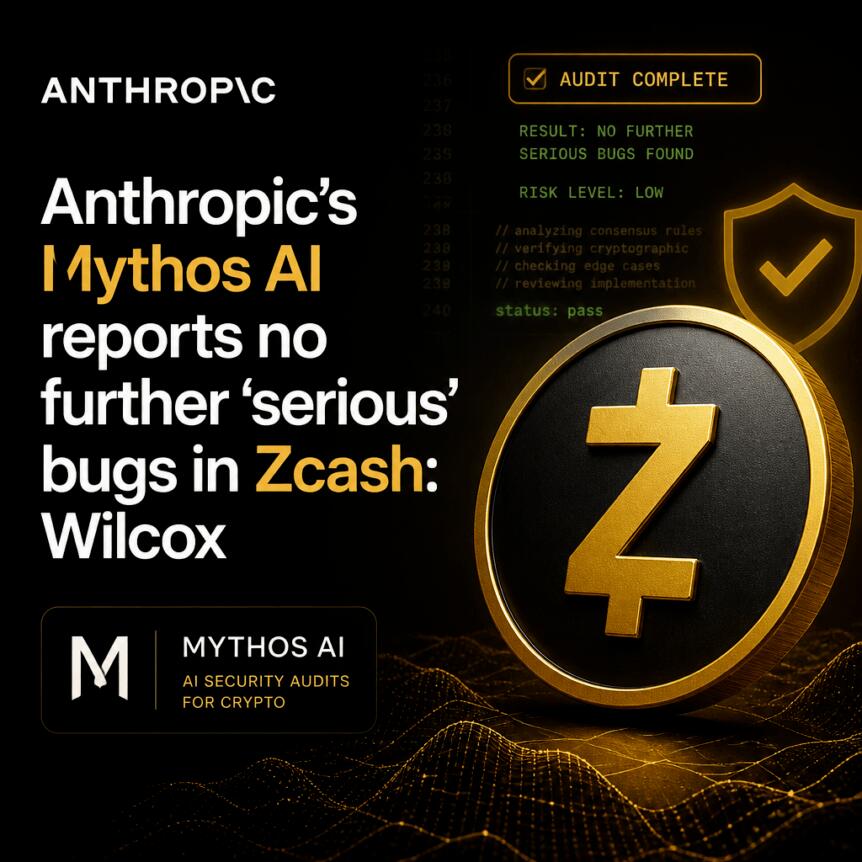
Zcash founder Zooko Wilcox says a security review of the privacy-focused protocol conducted using Anthropic’s Claude Mythos AI model did not uncover serious issues. The assessment was requested by Shielded Labs, a Swiss non-profit that supports Zcash development.
Wilcox shared the result in an X post on Saturday, adding that the audit found “no more serious bugs” in the Zcash protocol. The announcement follows earlier emergency steps taken by Zcash developers in early June after a vulnerability in the network’s shielded pool was identified and addressed.
Key takeaways
- Zooko Wilcox says Anthropic’s Claude Mythos security audit found no serious vulnerabilities in Zcash’s protocol after a Shielded Labs request.
- In early June, Zcash developers temporarily suspended Orchard shielded pool transactions, then restored functionality the same day via an emergency upgrade.
- The Orchard issue was linked to a four-year-old forgery bug, discovered with assistance from Anthropic’s Claude Opus 4.8 model and researcher Taylor Hornby.
- The Zcash Foundation stated there was no evidence of exploitation, no detected unauthorized value creation, and no impact on user privacy.
- Across crypto, the rapid rise of advanced AI security tooling is increasing both defensive capability and concern about who benefits from vulnerability-finding at scale.
Claude Mythos audit reports no serious Zcash protocol flaws
Wilcox’s update centers on an AI-assisted security audit carried out by Anthropic’s Claude Mythos model. According to his post, Shielded Labs—described as a Swiss-based non-profit supporting Zcash development—requested the review, which then concluded that there were no serious vulnerabilities in the Zcash protocol.
The timing of the claim matters for Zcash users watching for follow-up risk after an Orchard-related emergency earlier this month. While AI tooling can accelerate the discovery of potential issues, a “no serious vulnerabilities” outcome also signals that at least this specific protocol check did not reveal additional high-impact defects.
June Orchard disruption and the emergency upgrade
Before the Claude Mythos audit result, Zcash developers took more direct operational action on June 3. They temporarily suspended Orchard transactions after discovering a vulnerability inside the shielded pool that processes privacy-preserving transfers.
Functionality was restored later that same day through an emergency upgrade, indicating a rapid response once the risk was identified. The Zcash Foundation later characterized the situation as one without confirmed exploitation.
In its account of the incident, the Zcash Foundation said there was no evidence the vulnerability was exploited, that no unauthorized value creation was detected, and that user privacy remained unaffected. Those statements were made in connection with an emergency soft fork and related network activation details described by the foundation in its technical update.
What the Orchard vulnerability actually was
Based on the earlier reporting referenced in Wilcox’s broader context, the Orchard problem traced back to a forgery bug that had existed for four years. Security researcher Taylor Hornby is credited with discovering the issue with help from Anthropic’s Claude Opus 4.8 model.
This distinction is important for investors and builders because it frames the risk not as a newly introduced flaw, but as something that had been latent and only later surfaced through improved analysis. It also implies that even older vulnerabilities can re-emerge as new tooling and methods become available—particularly where complex cryptographic protocols are concerned.
AI security tools: faster discovery, heightened threat concerns
While Zcash’s development process appears to benefit from advanced AI assistance, the larger debate in crypto is whether the same tools can also be used to accelerate attacks. The industry has increasingly raised alarms that improved vulnerability discovery could shift advantage toward threat actors.
Anthropic released the first public version of Claude Mythos, and the company has previously said Mythos and related models uncovered more than 10,000 high or critical-severity vulnerabilities in “systemically important software.” That statement fueled scrutiny over whether such capabilities should be broadly accessible.
In response to concerns, Anthropic stated that its Fable 5 model was “made safe for general use” with safeguards designed to reroute certain topics—such as cybersecurity—toward a different model (Claude Opus 4.8). However, Anthropic also later said it suspended access to Fable 5 and Mythos 5 following a US government export control directive citing national security concerns.
From the perspective of crypto defense, this creates a complicated landscape: AI models may be able to identify vulnerabilities quickly, but access controls and evolving policy can change who can use that capability and for what purpose. The result is a growing asymmetry between attackers and defenders, especially in a market where fast-moving smart-contract ecosystems can become targets.
Bug bounty platform Immunefi CEO Mitchell Amador warned in an interview that the proliferation of these new AI tools is changing the cybersecurity playing field toward attackers, calling it a “vulnerability apocalypse.” He tied that dynamic to a resurgence in DeFi hacks. Separately, DefiLlama’s data shows crypto hacks reached $634 million in April—the highest monthly total since the Bybit incident that led to roughly $1.4 billion in losses in February 2025.
Why the Zcash audit matters now
Zcash’s latest update is not just about whether one vulnerability was found—it’s also about whether the privacy protocol has additional serious problems after a high-scrutiny period. The combination of a June Orchard emergency response and a later Claude Mythos audit outcome suggests the team is continuing to stress-test the system with modern security approaches.
Still, Zcash users should treat the audit result as one datapoint among many. The Claude Mythos review reportedly found no serious issues, but the broader crypto environment remains sensitive to rapidly evolving AI-assisted security research—meaning the key question going forward is not whether AI can find problems, but how quickly vulnerabilities (and any exploitation attempts) can be detected, patched, and validated across different platforms.
Readers should watch for whether Zcash developers share additional post-audit assurance steps, and whether the industry’s ongoing AI model access changes—driven by export controls and “safety” restrictions—shift the tempo of both defensive research and attack activity.
Crypto World
Tokenization mirrors the $20 trillion ETF boom as blockchain and AI converge, new Ondo exec says


“ETFs were referred to as weapons of mass destruction,” Hoffman said, recalling the skepticism that surrounded the structure before it became one of the dominant ways investors access markets.
When he joined the ETF industry in the early 2000s, the market held roughly $200 billion in assets, he said. Today, it’s nearly a $20-trillion global asset class, according to a PwC report.
He said tokenization is following a similar path, but much faster than ETFs.
“Every market that digitizes gets larger,” he said. “And tokenization is really the digitization of capital markets.”
Building for an agent-driven future
For Hoffman, tokenization will become the foundation for what comes next: AI-driven financial services.
He said he envisions a future where autonomous agents continuously monitor markets and allocate capital through professionally managed portfolios that update in real time as conditions change.
“Our end state will be portfolios that are professionally managed, real-time and adjusting to market circumstances and data changes,” he said.
To get there, the industry first needs tokenized assets, onchain prime-brokerage infrastructure and asset-management strategies that can be executed natively on blockchain networks.
Ondo is building toward that vision, he said. The firm already offers tokenized U.S. Treasury products and plans to expand into stocks, ETFs and perpetual futures through its tokenized marketplace.
Bitcoin price recovered over $64,000 after Pakistan said a US-Iran peace deal could be finalised within 24 hours, giving crypto markets a short-term lift after days of geopolitical tension.
Pakistani Prime Minister Shehbaz Sharif said the two sides were “closer to a peace deal than ever before.” He said Pakistan was preparing for an electronic signing once the deal is finalised, with technical-level talks expected next week.
The statement gave traders a clearer de-escalation signal. Crypto prices moved higher soon after, although the market reaction remained measured.
A Relief for Bitcoin?
Bitcoin traded around $64,100, up roughly 1.2% to 1.4% over 24 hours, based on major market trackers. The total crypto market also rose by about 1%, placing the global market value near $2.2 trillion.
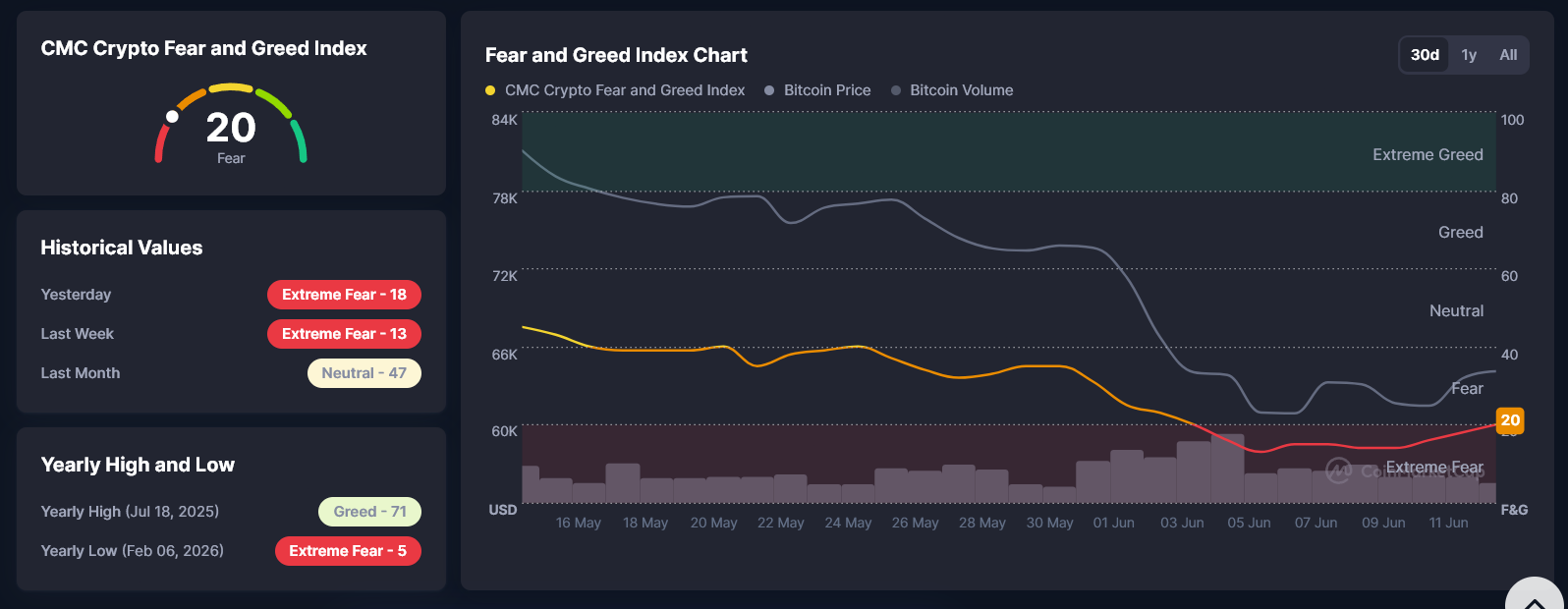
However, sentiment remains weak. The Crypto Fear and Greed Index was still near 20, which points to fear in the market. That shows traders are buying the peace-deal headline, but they are still cautious.

Bitcoin’s four-hour chart shows the same picture. BTC has recovered above its short-term moving averages, including the 20 EMA, 50 EMA, and VWAP area. That suggests panic selling has cooled.
Still, larger resistance levels remain above the current price. Bitcoin is below the 100 EMA near $66,100 and the 200 EMA near $69,650.
A break above the $66,000 area would give the recovery stronger technical support.

Momentum has improved. The four-hour RSI sits near 59, which shows buyers have regained control without pushing the market into overheated territory. Volatility is also falling, based on the ATR reading.
For now, crypto markets are treating the peace-deal claim as positive. A signed agreement could extend the relief move, while any delay or fresh military incident could quickly pressure risk assets again.
The post US-Iran Peace Deal Expected in 24-Hours: Will Bitcoin Price Recover? appeared first on BeInCrypto.
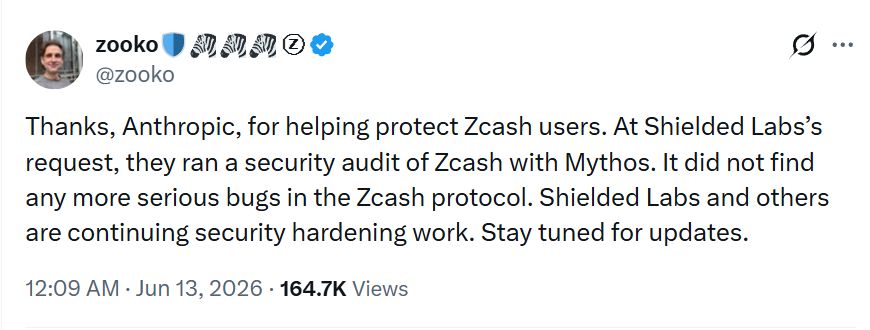
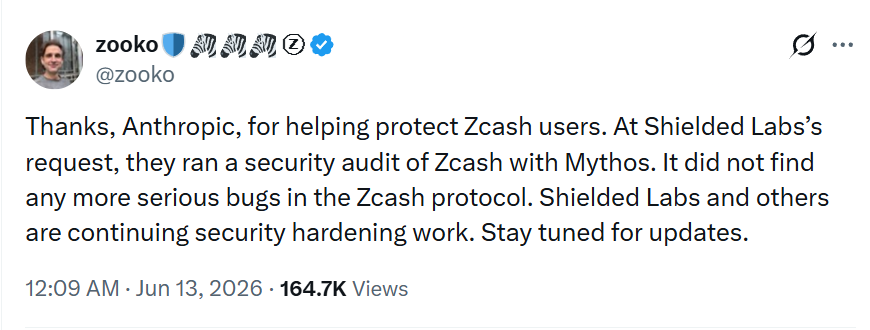
Zcash founder Zooko Wilcox said a security audit by Anthropic’s Claude Mythos artificial intelligence model found no serious vulnerabilities in the privacy-preserving cryptocurrency’s protocol.
Requested by Shielded Labs, a Swiss-based non-profit supporting the development of Zcash, the AI security audit did not find “any more serious bugs” in the Zcash protocol, according to a Saturday X post by Wilcox.
On June 3, Zcash developers temporarily suspended Orchard transactions after discovering a vulnerability in the shielded pool. Functionality was restored later that day through an emergency upgrade.
The issue stemmed from a four-year-old forgery bug in the Orchard shielded pool that was discovered by security researcher Taylor Hornby with the help of Anthropic’s Claude Opus 4.8 model. The Zcash Foundation said there was no evidence that the vulnerability was exploited, nor was there any unauthorized value creation detected, while user privacy was unaffected.
Source: Zooko Wilcox
AI models spark crypto security concerns
While developers are using new AI models to identify vulnerabilities, the technology is simultaneously raising security concerns across the crypto industry.
On Tuesday, Anthropic released the first public version of its Claude Mythos model, Fable 5. The company said last month that the Mythos model uncovered more than 10,000 high or critical-severity vulnerabilities in “systemically important software,” leading to concerns about whether it should be publicly released.
The company said users that Fable 5 was “made safe for general use” and has safeguards that reroute some topics, such as cybersecurity, to a different model, Claude Opus 4.8.
On Friday, Anthropic said it suspended access to its Fable 5 and Mythos 5 AI models due to a US government export control directive citing national security concerns.
Related: Recovery hopes fade as Kelp DAO hacker launders nearly all $220M in stolen funds
The proliferation of these new AI models has shifted the cybersecurity playing field in favor of the threat actors, causing a “vulnerability apocalypse” that is fueling a resurgence in decentralized finance (DeFi) hacks, Mitchell Amador, the CEO of bug bounty platform Immunefi, told Cointelegraph in a recent interview.
Crypto hacks surged to $634 million in April, the highest monthly value since the Bybit hack led to about $1.4 billion in losses in February 2025, according to DefiLlama data.
Magazine: The legal battle over who can claim DeFi’s stolen millions

The most important dates for SpaceX haven’t happened yet, according to TD Securities.
Peter Haynes, the firm’s head of index and market structure, suggests SpaceX’s public debut is only a small part of the larger SpaceX timeline.
He’s urging investors to pay close attention to when SpaceX is added to key indexes — including the S&P Total Market Index, MCI Global Index, Russell Indexes and Nasdaq 100 early this summer.
“Day 15 [after SpaceX goes public], which should be July 6… will be the day that Nasdaq rebalances the 100 Index to reflect SpaceX’s IPO shares,” he told CNBC’s “ETF Edge” this week ahead of Friday’s IPO. “Then from there, we’re looking at when do indexes adjust for the additional shares that will be freely tradable down the road.”
In what Haynes called a “controversial decision,” the S&P 500 Index Committee announced earlier this month that SpaceX will not be fast-tracked into the index, meaning the Elon Musk rocket maker must trade on the market for at least one year until it becomes eligible.
“That leaves us with the other benchmarks and their rebalancing schedule,” said Haynes.
The decision means greater significance for upcoming index events, as many shares will become freely tradable and need to be reflected in the benchmarks, he says.
SpaceX debuted at the Nasdaq at 11:46 a.m. ET on Friday. The stock surged more than 19% to close at $160.95 — its market cap exceeding $2 trillion.
In a special note to CNBC after Friday’s market close, Haynes wrote: “We take for granted that the infrastructure that supports the equity trading business always works. Today was a test of that infrastructure and in my opinion the industry passed the test.”


Ripple CEO Brad Garlinghouse intensified criticism of JPMorgan’s Jamie Dimon after accusing the banking executive of mischaracterizing the CLARITY Act, a proposed US crypto market framework.
The dispute arrives at a pivotal moment for digital asset regulation and could shape institutional adoption in the months ahead.
Why is the CLARITY Act so Important
The CLARITY Act is a proposed US regulatory framework that defines how digital assets are supervised and clarifies responsibilities among financial agencies. Its stated objective is to strengthen legal certainty while supporting innovation and investor protection.
During an interview on Fox Business, Garlinghouse rejected recent criticism from Dimon and argued that public opposition to the bill misrepresented its purpose.
According to the Ripple executive, the proposal weakens compliance standards by failing to reflect how the legislation separates oversight responsibilities among regulators.
“As much as we can talk about whether or not Brian Armstrong is representing the industry, he is not; he is representing Coinbase, and in certain ways he is going to look out for Coinbase’s best interest. But at the end of the day, I think what Jamie Dimon did was a disservice. He’s representing that this reduces compliance concerns, that it makes it easier to do bad things. That’s just not true. It’s either intentional misrepresentation or even negligent to try to make support for the CLARITY Act go away,” Garlinghouse said.
Supporters of the measure believe clearer rules could reduce uncertainty that has slowed institutional participation in the United States. The broader argument is that legal ambiguity has encouraged companies and trading activity to move offshore.
Garlinghouse emphasized this point, noting that most digital asset trading now occurs outside the United States, which is increasing competitive pressure on domestic markets.
Follow us on X to get the latest news as it happens
Ripple and JPMorgan Deepen the Divide
Garlinghouse suggested JPMorgan has economic incentives to preserve existing market structures. He pointed to the bank’s payments business as one of its most profitable segments and argued that emerging blockchain infrastructure introduces competitive pressure.
Dimon has remained one of the most vocal critics of the crypto sector for years while continuing to support selected internal blockchain initiatives. More recently, he questioned whether legislation like the CLARITY Act could create compliance gaps or increase financial risk.
“We will fight the CLARITY Act. If we lose, we lose, and we’ll live. But it will be fought,” Jamie Dimon recently stated.
Supporters of the proposal disagree. Regulatory advocates and industry participants argue that standardized rules could improve oversight while preventing capital, talent, and liquidity from relocating abroad.
The debate extends beyond politics. Ripple has expanded into liquidity products, artificial intelligence integrations for payments, and its RLUSD stablecoin initiative. A clearer legal framework could reduce barriers for banks and corporations evaluating blockchain infrastructure.
Why Timing Could Become Decisive
Congress faces a compressed legislative calendar before the August recess, increasing pressure on lawmakers to prioritize market structure proposals.
For crypto companies, the outcome may influence where investment, development, and trading activity occur over the next decade. For established financial institutions, it may redefine competition across payments, settlement, and financial services.
The confrontation between Garlinghouse and Dimon has amplified attention around the CLARITY Act and transformed a technical regulatory discussion into a broader debate about the future of financial infrastructure.
The post Ripple CEO Slams JPMorgan for “Misrepresenting” the CLARITY Act appeared first on BeInCrypto.

Michael Saylor, executive chairman of Strategy, has defended the company’s first reported Bitcoin sale since 2022, arguing that the ability to sell BTC when necessary is integral to issuing “digital credit” products. The comments come as Strategy continues to frame Bitcoin not just as a treasury asset, but as the backing for securities designed to generate yield.
In a June 1 filing with the U.S. Securities and Exchange Commission, Strategy disclosed it sold 32 BTC—an action that contrasted with Saylor’s long-standing public message to “never sell your Bitcoin.” Speaking to Cointelegraph at the BTC Prague conference, Saylor said the logic is simple: digital-credit instruments only retain value if the issuer can manage its collateral and obligations.
Key takeaways
- Strategy disclosed a 32 BTC sale on June 1, marking its first reported BTC sale since 2022.
- Saylor argues “digital credit” requires the practical ability to sell Bitcoin to support credit-linked products and dividends.
- He positioned Strategy’s STRC preferred stock as a credit instrument backed by the company’s Bitcoin balance sheet.
- Saylor described digital credit markets as a potential “trillion-dollar opportunity,” including yield targets he claimed could reach up to 8%.
- Recent stress in apxUSD highlights how digital-credit collateral and liquidity can be tested when BTC and related assets move sharply.
Why Strategy sold Bitcoin after “never sell” messaging
Strategy’s filing—covering a sale of 32 BTC—was widely notable because it came after years in which Saylor’s rhetoric emphasized holding. In his remarks at BTC Prague, Saylor reframed the issue around the function of Bitcoin within Strategy’s business model.
He said that Bitcoin treasury companies that issue credit-linked securities must retain the ability to sell holdings when needed. In his explanation, if a company commits to never selling its BTC, the resulting credit products lose the flexibility investors rely on—meaning the securities’ perceived value could deteriorate.
“If the company’s policy is that we won’t sell the Bitcoin, then the credit won’t have value and the equity won’t have value,” Saylor said, adding: “The company is in the business of selling digital credit. The credit is backed by capital. Bitcoin is capital.”
The distinction Saylor drew matters for investors trying to understand the risk structure of Bitcoin-backed credit instruments. For holders of treasury-backed securities, the question is not whether BTC is “sold or not” in every scenario—it’s whether the issuer can actively manage collateral to meet obligations without undermining the product’s credit economics.
“Digital credit” as a Bitcoin use case
Saylor described digital credit markets as the next phase of Bitcoin finance, asserting they could enable yield-bearing digital money products. He argued that Bitcoin is a “digital transformation of capital,” and that instruments such as STRC represent a transformation of credit.
According to Saylor, digital credit products can offer yields “of up to 8%,” which he said is multiple times higher than traditional savings accounts. While the headline yield claim is framed as an outcome possible in these markets, the underlying premise is that Bitcoin collateral can be structured to support credit obligations and dividend-style distributions.
For Strategy, that thesis is not abstract. Saylor pointed to STRC preferred stock as an example of a “digital credit” instrument that uses Strategy’s Bitcoin balance sheet to support credit responsibilities. He also suggested that these securities have become a primary pathway for raising capital to acquire additional Bitcoin.
That broader model shifts the lens for market watchers. Instead of treating Strategy as only a spot BTC holder, Saylor’s comments place the firm inside a credit origination and balance-sheet engineering framework—one where collateral liquidity, market drawdowns, and dividend mechanics may determine whether the product performs as designed.
Market stress test: apxUSD depeg linked to STRC collateral
Saylor’s bullish framing on digital credit came alongside a concrete example of how these systems can face pressure during volatile market moves. On June 4, Apyx Finance’s dividend-backed synthetic stablecoin, apxUSD, reportedly depegged to as low as $0.90 while Bitcoin traded below $63,000 and STRC shares fell below their $100 par value.
In a report on the depeg, Apyx attributed the decline to changes in the value of STRC, which is described as the stablecoin’s primary collateral asset. As STRC’s value dropped, Apyx said the protocol’s reserve value was reduced. The company also pointed to factors including falling Bitcoin prices, thinning liquidity, and derivative-driven market dynamics.
At press time in Cointelegraph’s reporting, apxUSD was trading around $0.96—still below its $1 peg. The episode underscores a key investor question for digital credit products: even if the mechanism is designed to create yield, what happens when the underlying collateral and the market plumbing both deteriorate at the same time?
The implication is that issuers and borrowers in these structures may rely not only on long-term collateral value, but also on short-term liquidity conditions. In that sense, Saylor’s insistence on having the ability to sell Bitcoin when necessary directly intersects with the kind of collateral stress that depegs and drawdowns can trigger.
What to watch next for Bitcoin-backed credit
Saylor’s defense of the Bitcoin sale is ultimately a statement about operational flexibility in digital-credit systems—particularly how issuers manage collateral across market downturns. For investors, the next signals to monitor are how Strategy and similar operators disclose collateral management policies, and whether stablecoin and synthetic credit products can hold their structure when BTC and collateral-linked securities move quickly.

The author of Broken Money and The Stolguard Incident, Lyn Alden, has taken to X to defend BTC amid the recent drama that stemmed from Strategy’s decision to sell a tiny portion of its crypto holdings for the first time in about four years.
Other popular names that defended the asset include Samson Mow, who believes corporations such as Strategy are free to buy because BTC was “designed for this.”
It Wasn’t Meant to Be
The Michael Saylor-founded business intelligence giant turned massive bitcoin buyer attracted significant backlash over the past couple of weeks for its decision to dispose of a fraction of its total BTC holdings, selling 32 units. Unlike what some critics believed at the time, this wasn’t a capitulation event. The sale was necessary to support preferred stock distributions, including cash dividends across the company’s stock series.
Nevertheless, the cryptocurrency tumbled in the following week or so, going from over $75,000 (its price when the sale was conducted) to a 19-month low at $59,100. Although there were multiple other factors behind the decline, some pointed to Strategy’s decision, which may have caused some FUD.
This prompted some well-known names, such as Jim Cramer, to publicly blame Saylor and Strategy for their alleged role. The company’s former CEO was quick to respond and, in a more recent speech, explained he never said Strategy won’t sell if it’s necessary to do so. However, he remains a firm believer that individuals should not sell.
Lyn Alden also didn’t support the narrative that Strategy can single-handedly ‘kill’ bitcoin as Cramer claimed. In fact, he noted that if the cryptocurrency and the network behind it can be killed by one entity buying it, then “it wasn’t meant to be.”
“If all it takes to kill bitcoin is a bullish entity that likes it enough to buy, then go home,” she asserted.
Mow Concurs
Samson Mow, CEO of Jan 3 and a long-term bitcoin proponent, agreed with Alden’s statement. In a comment below the original post, he argued that BTC is not a proof-of-stake system; it allows corporations and nation-states to buy it, as ownership doesn’t “confer control.”
Moreover, he added that this is precisely what bitcoin was designed for.
Bitcoin isn’t a proof of stake system. Corporations can buy. Nation-states can buy. Ownership doesn’t confer control. Bitcoin was designed for this.
— Samson Mow (@Excellion) June 11, 2026
The post Bitcoin Cannot Be Killed by Saylor’s Strategy or Any Single Entity: Alden appeared first on CryptoPotato.

Michael Saylor, executive chairman of Strategy, defended the company’s recent Bitcoin sale, saying the ability to sell the asset is necessary to continue issuing “digital credit.”
Strategy disclosed its first reported Bitcoin sale since 2022 in a June 1 filing with the US Securities and Exchange Commission, offloading 32 BTC in a move that appeared at odds with Saylor’s long-running “never sell your Bitcoin” mantra.
In an interview with Cointelegraph at the BTC Prague conference, Saylor said that Bitcoin treasury companies must retain the ability to sell holdings when necessary to support dividend-paying securities and other Bitcoin-backed credit products.
“If the company’s policy is that we won’t sell the Bitcoin, then the credit won’t have value and the equity won’t have value,” he said, adding:
The company is in the business of selling digital credit. The credit is backed by capital. Bitcoin is capital.”

Cointelegraph’s Ciaran Lyons (left) and Strategy founder Michael Saylor (right) at BTC Prague. Source: Cointelegraph
Saylor described products like Strategy’s STRC preferred stock as “digital credit” instruments that use the company’s Bitcoin balance sheet to support credit obligations. For Strategy, such securities have become a primary vehicle for raising capital to acquire more Bitcoin.
Digital credit is a “trillion-dollar” opportunity for Bitcoin finance, Saylor says
Digital credit markets are emerging as the next “trillion-dollar opportunity” in finance, a development that Saylor said could enable yield-bearing digital money products.
“I see Bitcoin as the digital transformation of capital. I see STRC as the digital transformation of credit,” Saylor said, explaining that digital credit products can offer yields of up to 8%, which is three to four times more than traditional savings accounts.
Related: Saylor downplays Bitcoin slide as Strategy faces $11B paper loss
Saylor said digital credit products could transform how people see credit markets, while also bringing billions of dollars into the Bitcoin ecosystem.
He cited projects such as Saturn and Apyx as examples of yield-bearing products built on top of digital credit markets. One of those products recently faced a test of its resilience.
On June 4, Apyx Finance’s dividend-backed synthetic stablecoin (apxUSD) depegged to as low as $0.90 as Bitcoin traded below $63,000 and STRC shares fell below their $100 par value.
According to Apyx, the decline in STRC, the stablecoin’s primary collateral asset, reduced the protocol’s reserve value. The company also cited falling Bitcoin prices, thinning liquidity and derivative-driven market dynamics as factors behind the depeg.
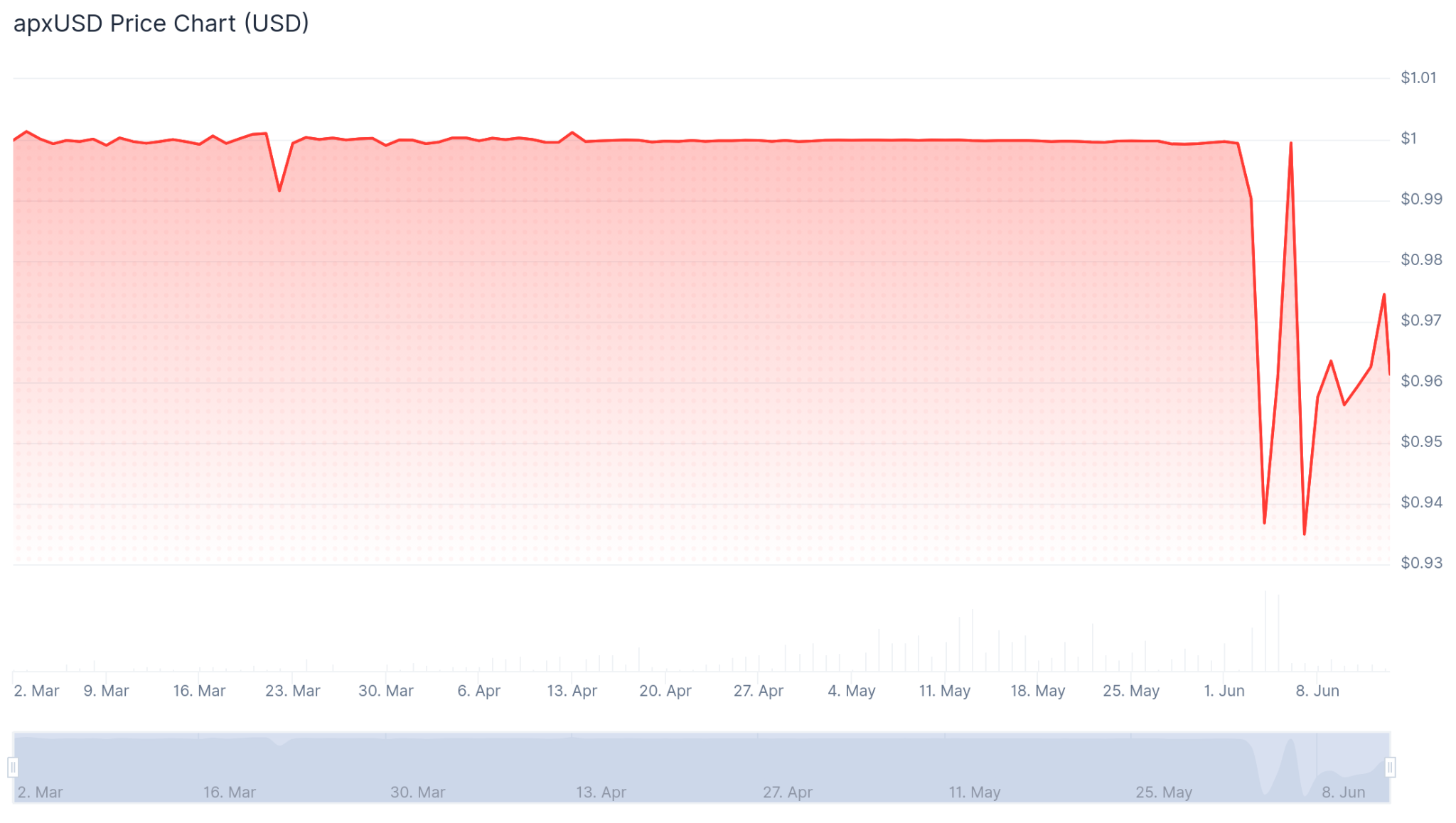
At press time, apxUSD traded at $0.96, below its $1 peg. Source: Coingecko
The full interview with Saylor will be available on Cointelegraph’s YouTube channel in the coming days.
Magazine: Bitcoin ETFs bleed $1B, Aave’s $71M ETH unfreeze bid delayed: Hodler’s Digest, May 10 – 16


An Iran-linked hacker group known as Handala says it breached FBI surveillance drones and threatened the 2026 World Cup, the SITE Intelligence Group revealed.
The warning lands days into a tournament already guarded by heavy federal security, and it names team buses as a possible target.
Who is Handala, the Iranian Hactivist Group?
Handala presents itself as a pro-Palestinian hacktivist collective. However, US officials and Western researchers assess it as a front for Iranian intelligence.
The group has targeted Israeli-linked entities and other countries since December 2023. Its activity sharpened after US-Israeli strikes on Tehran in February.
In March, Handala claimed it had hacked the email of FBI Director Kash Patel. It then published personal photos and other material.
Follow us on X to get the latest news as it happens
The Drone Threat and a Disputed Claim
Handala said in the statement quoted by The SITE Intelligence Group that it had access “for months” to footage from first-person view (FPV) drones used by the FBI.
The drones run facial recognition and license plate checks for counterterrorism. The group issued a direct warning.
“Better tighten your World Cup security, we don’t like some of those teams at all. Don’t forget: FPVs are everywhere; you never know when one might end up right in your team’s bus,” Handala said.
However, SITE questioned the group’s evidence. It found that one supposed hack video came from a software firm’s December 2024 promotion.
The State Department is offering up to $10 million for information leading to the identification of Handala members. The reward shows how seriously Washington treats the group.
The FIFA World Cup tournament runs through July 19 across 16 cities. Whether the threat proves real or not, it raises the security stakes for an event watched by billions.
Subscribe to our YouTube channel to watch leaders and journalists provide expert insights
The post Iran-Linked Hackers Threaten World Cup After Alleged FBI Drone Breach appeared first on BeInCrypto.
Henry Cavill Joins Kevin Hart In Netflix Spy Comedy

Hundreds of crews feature in back-to-back races at the Durham Regatta

Tokenomics: The New Divide Between AI Winners And Renters (SP500)

BloFin War of Whales 2026 Grand Prix opens registration for $5M trading championship

Blockchain.com files with SEC for U.S. IPO

Israel says it has killed new Hamas military leader in Gaza City airstrikes

Bitcoin & Ethereum ausgebrochen! Longs laufen, wir warten auf unsere Ziele um auszucashen!

Financial Freedom: Your Ultimate Investing & Budgeting Guide #shorts

Evening vibes@Tabula Rasa Alfresco & Bar, Financial District,Hyderabad#shortsvideo #shorts#ytshorts
-

 NewsBeat6 days ago
Alexander Zverev wins the French Open to finally earn a 1st Grand Slam title
-
 Entertainment7 days ago
The Best Mystery Series of All Time Is Surging on Streaming 30 Years After It Ended
-

 Crypto World5 days ago
Anatomy of the June crypto crash: Fed, Iran, Saylor
-

 Crypto World2 days ago
Oppenheimer backs SpaceX as $70 billion retail frenzy builds
-

 Crypto World2 days ago
Markets Rally as SpaceX IPO Looms Amid Iran Tensions and Inflation Surge
-
 Crypto World7 days ago
Senator Cynthia Lummis Calls CLARITY Act the Most Consequential Financial Legislation of This Generation
-
 NewsBeat6 days ago
Alexander Zverev conquers demons and outlasts Flavio Cobolli to win French Open for first major title
-

 Tech6 days ago
Microsoft unveils seven homegrown AI models in new bid for ‘long term self-sufficiency’
-

 Business5 days ago
High Stakes for Wembanyama as New York Pushes for 3-0 Lead
-

 Tech6 days ago
Notion restores access to Anthropic after service disruption
-
 Business7 days ago
The Pain Points Taking a Fragile Tech Rally Down a Notch
-
 Crypto World5 days ago
Eli Lilly (LLY) Stock Surges 4% Following Breakthrough Sleep Apnea Trial Results
-
 Business6 days ago
The investment to transform historic St Helen’s ground in Swansea
-

 Crypto World6 days ago
Trump’s AI Ownership Plan Could Benefit Anthropic at OpenAI’s Expense
-
 Sports4 days ago
Bangladesh beat Australia after 20 years in ODIs, register only their second win over six-time world champions | Cricket News
-

 Tech14 hours ago
NanoClaw integrates JFrog registries to secure AI agent downloads
-

 Crypto World9 hours ago
Bitget enters Argentina’s regulated crypto market through PSAV registration
-

 Tech1 day ago
This Week In Security: Microsoft On Microsoft, Register Your Domains, Linux On ARM, And FreeBSD Joins The File Cache Club
-

 Politics2 days ago
Politics Home | Healey Resignation Is “Colossal Failure Of Government”, Says Former Labour Defence Secretary
-

 Sports2 days ago
First Time Since 1971: Australia Register Historic Low In ODI Cricket
You must be logged in to post a comment Login