TL;DR
Palantir’s Karp predicts full AI nationalization in two years. He says Sanders’ 50% proposal will look moderate. Trump, Sanders, and Karp agree the shift is coming.




Palantir’s Karp predicts full AI nationalization in two years. He says Sanders’ 50% proposal will look moderate. Trump, Sanders, and Karp agree the shift is coming.
Palantir CEO Alex Karp says full nationalization of AI companies is coming, and that Senator Bernie Sanders’ proposal for 50% public ownership will soon look moderate. “In two years, they’re not going to think Bernie Sanders is progressive,” Karp told CNBC on Wednesday. “They’re going to be like, ‘Bernie Sanders, you only want 50%? What is this 50%?’”
Karp said he has spent six months privately warning top AI executives about the threat. “The momentum is on the side of people who want to nationalise them,” he said. He described himself as a “card-carrying progressive” and argued that the most important political decisions in the country will be driven by whether politicians understand AI.
The prediction lands in an increasingly crowded political space. Sanders has outlined his American AI Sovereign Wealth Fund Act, which would impose a one-time 50% tax on stock, not profits, from companies like OpenAI, Anthropic, and xAI. Trump has said he plans to meet AI company leaders to discuss some form of public ownership, calling it a “partnership with the American public.” The two sides disagree on nearly everything else.
“The question is not whether AI will change the world, it will,” Sanders said in a video this month. “The question is who will own and control that future.” Trump said at the White House: “If we do that, the public will become very rich, the people in our country.”

The 💜 of EU tech
The latest rumblings from the EU tech scene, a story from our wise ol’ founder Boris, and some questionable AI art. It’s free, every week, in your inbox. Sign up now!
Not everyone in Trump’s orbit agrees. David Sacks, the former White House AI and crypto czar, warned that Republicans who adopt the Sanders position will regret it. “Conservatives are right to fear where this is all headed but ought to think more carefully about how regulations they are flirting with now will be used against them the next time a Democrat administration is in power,” Sacks wrote.
Karp framed the debate differently. He said Americans are asking what will happen to them as AI eliminates jobs, “and the answers aren’t all good or bad.” He predicted the US would need to “retrain and retool” and said it is better positioned to do so than Europe. He did not address how Palantir, which sells AI to governments and militaries, would be affected by nationalization.
The bipartisan convergence on public ownership of AI is remarkable. A year ago, the idea of the US government taking equity stakes in AI companies would have been dismissed as fringe. Now a socialist senator, a Republican president, and a defence contractor CEO all agree it is likely. The disagreement is only about how much and how fast.
Whether any of it happens depends on legislation, which has not been introduced yet, and on whether AI companies voluntarily offer equity, as OpenAI has proposed through its Public Wealth Fund concept. But Karp’s prediction is the most extreme version yet from a sitting CEO: not 10%, not 50%, but full nationalization, and within two years.

It takes significant upskilling to stay abreast of changes along the Industry 4.0 career path, but courses don’t have to cost an arm, a leg and all of your time.

Regardless of the industry you find yourself in, the majority of professionals will at some stage in their career find themselves in need of new skills. Online courses are a key way to upskill in a cost-effective, timely manner that suits the individual.
When it comes to Industry 4.0 specifically, there are a wide range of career routes to choose from – be it a role in AI, machine learning, supply chains, manufacturing or sustainability, just to name a few. With that level of choice comes a plethora of opportunities to learn new skills, broaden your career horizons and even make a real-world impact in a space that has near endless potential.
So, for professionals working in Industry 4.0 careers, what courses are worth taking a look at?
Robotics and automation are a core pillar of Industry 4.0, as more and more of the processes and technologies within the workplace are powered by advanced tech and AI. Skills in robotics and automation are absolutely essential for jobseekers and established professionals aiming for career longevity.
With that in mind, edtech Udemy has multiple free and fee paying options on the subject of robotics. Courses include a free Mechanisms and Motion Robotics Focus tutorial, which takes roughly five hours to complete, has downloadable materials and can be accessed when needed. The course is designed for students interested in 3D CAD design, mechanical engineering and robotics.
For beginners, there is also a free two-hour Robotics Introductory Course that provides a comprehensive foundation for beginners, hobbyists and professionals alike. The course offers opportunities for hands-on learning that covers everything you need to know ahead of building and programming robots. This will include the fundamentals of robotics, basic electronics, programming languages and the robot operating system.
Coursera also has interesting options open to professionals, including a Generative AI Automation Specialisation course from Vanderbilt University. The programme offers a free trial, takes four weeks to complete and comes with a certificate of completion. There is also a Fundamentals of Robotics & Industrial Automation course available, that will take around a week to complete, consists of three modules and aims to provide a comprehensive understanding of essential concepts and practical skills.
Similar to robotics and automation, smart manufacturing is a defining feature of Industry 4.0 and skills in this area are a must.
For those at an intermediate level, Coursera has a Digital Manufacturing: Introduction and Smart Design course. The programme takes eight hours to complete, can be engaged with flexibly and consists of three modules. It also comes with a sharable certificate upon completion of the course. Created for mechanical, manufacturing and mechatronics engineers, the course is intended for those who want to comprehend and navigate the transformative concepts and technologies that shape modern industry. Participants will learn about the fundamental principles of digital manufacturing, the path to Industry 4.0 and emerging technology.
Springboard+ and Chevron College are offering a level 9 post-graduate microcredential course on smart factories. The part-time programme is funded by the Micro-credential Learner Fee Subsidy 2026 programme and fees will be subsidised at 80pc for all eligible learner categories – criteria for eligibility are available on the website. The programme will introduce learners to modern and emerging developments in manufacturing engineering, with a focus on the digital technologies powering smart factories and connected production systems. Core topics include digital twins, simulations, smart sensors, artificial intelligence, IoT, robotics, machine learning and virtual reality, covering their applications and deployment in manufacturing.
3D printing or additive manufacturing skills are highly relevant for Industry 4.0 careers and there are plenty of upskilling opportunities available to professionals and jobseekers. Learning platform Alison is hosting a future of additive manufacturing technologies course – published by Indian platform The National Programme on Technology Enhanced Learning – that is free, takes three to four hours and is CPD accredited. Intermediate level students will learn how to explain the objectives of machine intelligence, break down the features of blockchain technology, define additive manufacturing, outline the categories, describe the process chain, analyse the design for additive manufacturing and discuss the supply chain.
Coursera have similar paid and free trial programmes, such as Additive Manufacturing offered by University of Arizona, Essentials of Additive Manufacturing offered by the Indian Institute of Technology Guwahati, and Aerospace 3D Printing Additive Manufacturing, among others.
Don’t miss out on the knowledge you need to succeed. Sign up for the Daily Brief, Silicon Republic’s digest of need-to-know sci-tech news.


The new fab marks a win for the EU in its attempts to improve the bloc’s chipmaking capacity.
Global semiconductor company Infineon Technologies is set to open a new €5bn chip factory in Germany, extending its existing campus in Dresden.
The factory represents Infineon’s single largest investment, according to Bloomberg, and was built with support from European Union subsidies. The Smart Power Fab will be opening doors on 2 July.
EU support for Infineon is part of a strong effort aimed at honing the bloc’s chipmaking capabilities and improving resilience to foreign pressures on the industry. Last year, the European Commission approved a direct grant of up to €920m for Infineon to support its investment in Dresden.
The fab also received support under a different programme aimed at supporting common European interests on microelectronics and communication technologies. The company said that the total funding for the newly expanded Dresden site amounts to around €1bn.
The new “first-of-a-kind” European plant will produce two types of semiconductor technologies to be used in industrial, automotive and consumer applications, according to the Commission.
Infineon claimed that the development will create up to 1,000 new jobs, aside from jobs created in the investment ecosystem.
“The AI data centres currently being built and planned around the world will consume twice as much electricity in 2030 as they do today,” Alesander Gorski, Infineon’s chief operating officer, told media at a walk-through of the site. “That’s as much as the entire Federal Republic of Germany.”
Chip production at the fab will be scaled over a period of time depending on demand, Gorski said, adding that it could potentially add as much as €5bn in revenue every year.
The Smart Power Fab is a welcome success for the EU, coming less than a year after Intel scrapped plans for a chip factory in Germany and an assembling and testing facility in Poland.
Earlier this year, Infineon opened a new Cork-based R&D centre focused on its newest innovations in the automotive and consumer microelectronics space, in areas such as battery management, motor control and touchscreens.
Don’t miss out on the knowledge you need to succeed. Sign up for the Daily Brief, Silicon Republic’s digest of need-to-know sci-tech news.


We previously covered such conversions, with another recent one in 2024 involving another 1:150 scale model. That particular one demonstrated driving around on scale model roads, which shows a good practical use of this conversion if you want to have e.g. a scale model town with cars that actually drive around.
In the video you can see how first the base of the scale model has a tiny 25 mAh Li-polymer battery installed, along with two motors, one for steering and one for driving using a rod-linkage system and a lead screw.
The tiny gears used were salvaged from mechanical watches, with photoreflectors keeping track of the driving and steering positions. Remote control is done by infrared, with a tiny SMD IR receiver module in the car, while charging and programming of the MCU is done via terminals installed on the bottom.
In the final part of the video the car is demonstrated driving around, with working head- and rear lights, as well as blinkers and stop lights, including the top rear one. In the video description links are provided to the various schematics and software on Google Drive for those who are feeling like a fun Sunday afternoon project.


ZincFive, an Oregon company providing nickel-zinc batteries for data centers, announced Thursday that it’s partnering with SparkLabs Group to go public through a SPAC (Special Purpose Acquisition Company). The deal is valued at $600 million before additional investments.
ZincFive has nearly 2 gigawatts of battery systems either sold or under contract, and reports that its revenue more than doubled from 2024 to approximately $66.9 million last year. It ended the year with a backlog of orders totaling $81 million.
The new capital will allow ZincFive to scale manufacturing at two plants in China, and it plans to explore opportunities for opening a facility in the U.S., Bloomberg reported.

The company, based in Tualatin, Ore., just south of Portland, promotes its battery chemistry as a safer energy storage solution with a smaller footprint compared to traditional lead-acid and lithium-ion batteries.
“We believe we are well-positioned to expand globally and deliver long-term value as the data center market continues to evolve,” Tod Higinbotham, ZincFive’s CEO, said in a statement.
SparkLabs, an accelerator and venture capital firm, is using Spark I Acquisition Corp. to take ZincFive public through a reverse merger. The battery maker expects to be listed on the Nasdaq exchange under the ticker symbol ZFIV.
The deal is expected to bring in at least $100 million from investors (with up to $25 million more possible), which meets the minimum cash needed to complete the merger. Current ZincFive owners are rolling all of their equity back into the new company. ZincFive also took out a $35 million short-term loan, most of which will be paid back when the deal closes.
The company has previously raised $254 million from investors including Helios Climate Ventures, Climate Investment, Senator Investment Group and Standard Investments, according to PitchBook. The company began as EnSite Power and a decade ago acquired PowerGenix System.
Denon offers a solid selection of turntable styles and budgets, but the new DP-500BT, introduced alongside the company’s latest multi-room Home speakers, is arguably its most intriguing. Designed to inhabit two audio worlds at once, the DP-500BT is a belt-driven, semi-automatic turntable with the build quality and pricing you’d expect from the brand’s “hi-fi” tier, while also offering Bluetooth support for wireless streaming.
It’s no coincidence that the DP-500BT arrives with Denon’s new multi-room speakers. You don’t usually expect a turntable at this level to cater to the limitations of a Bluetooth signal, but Denon’s system makes it remarkably easy to switch from a wired connection to streaming your records wirelessly to any of its new speakers, which can, in turn, like Sonos and other multi-room speakers, broadcast your stacks of wax throughout the home over Wi-Fi.
On paper, it’s a best-of-both-worlds scenario, and it works out pretty well in practice, too. While you’re certainly paying extra for wireless convenience, the DP-500BT stands out with impressive sound and build quality, and its sleek matte plinth, offset by glittering aluminum components, provides sterling style. If you don’t need Bluetooth, you can get more for your money elsewhere, and there’s no shortage of great turntables out there, but for a certain kind of listener, this flexible deck could be the perfect way to take your records to new heights.
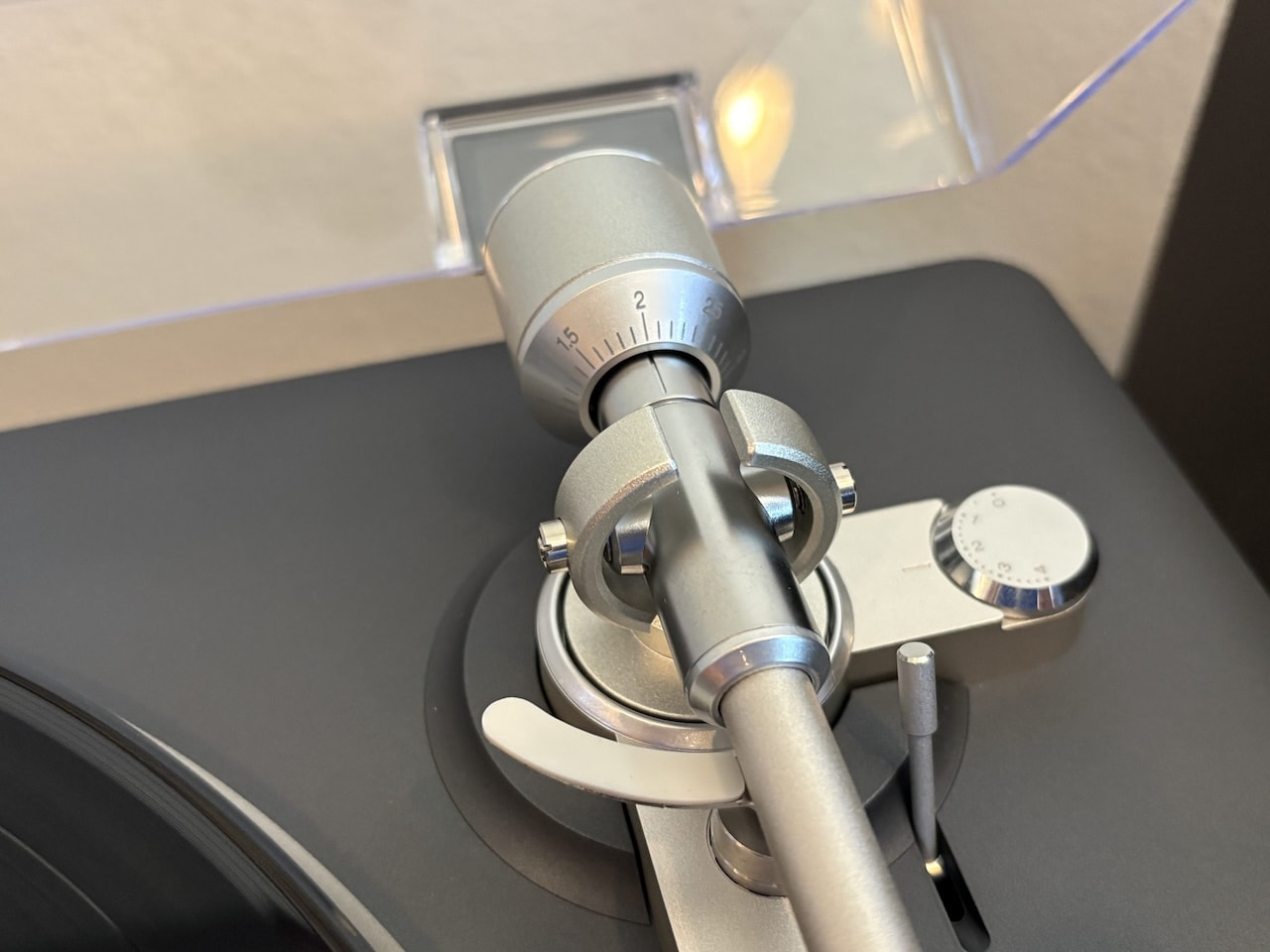
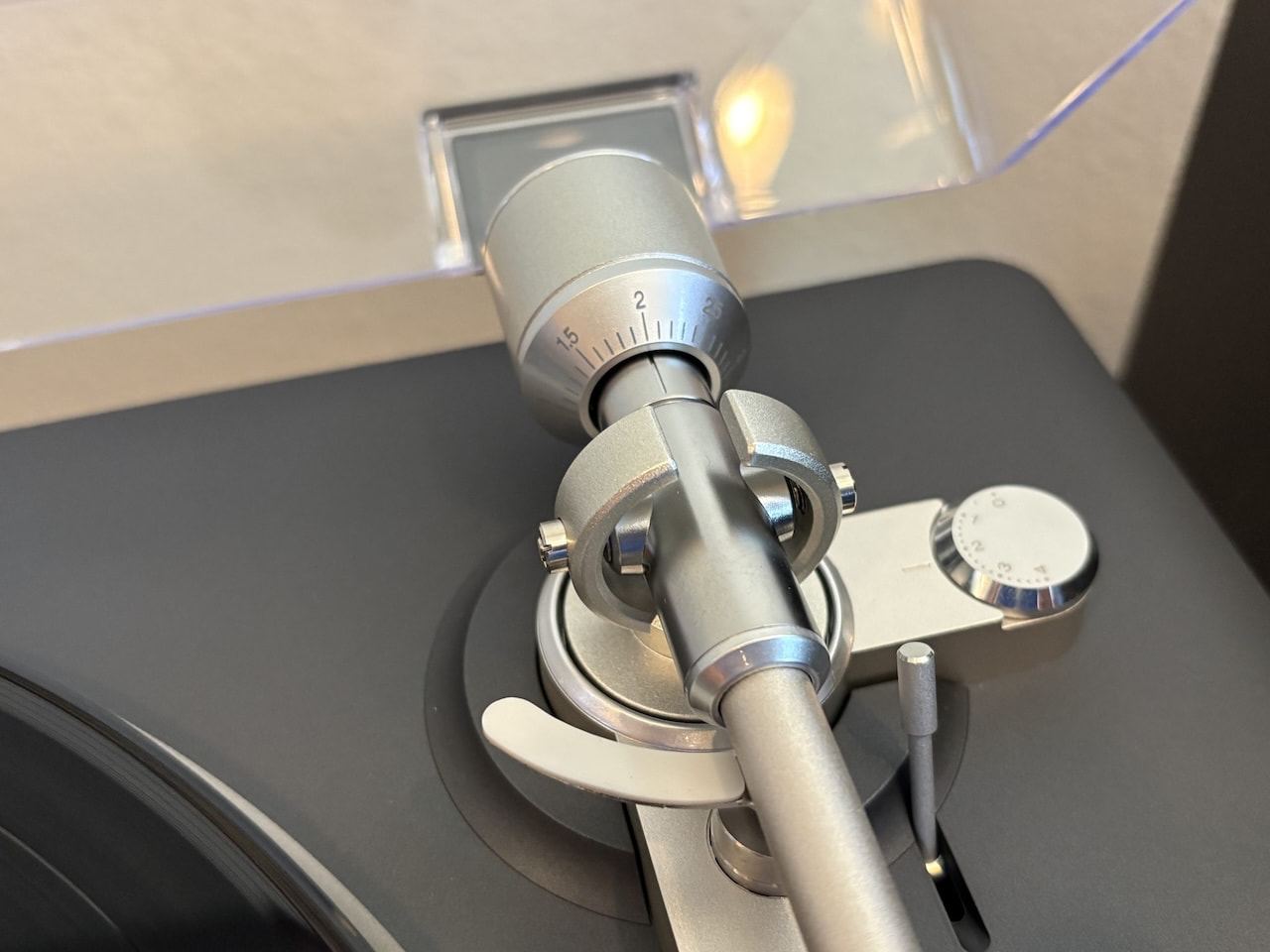
Even though I’ve put together my fair share of turntables over the years, every time I unbox one, it’s a little intimidating. All those separate, delicate components spread out in a blanket of foam, with only my decidedly uncrafty hands to put it all together. Luckily, it gets easier with time, and Denon’s latest deck may just be the simplest high-end model I’ve assembled yet.
Each piece is carefully arranged, while the quick-start manual provides a step-by-step walkthrough that even first-time turntable users should have no trouble following. You’ll get an included RCA cable with a ground (not necessary for most setups) and, of course, a power cable. As a global brand, I was particularly impressed by Denon’s inclusion of an adaptable DC power supply with attachable connections for all the major global output types. You may never move to London, but if you do, the DP-500BT has you covered.
Installing a turntable belt can sometimes feel dicey, but Denon’s attached red ribbon makes it virtually foolproof to slip it over the pulley. The quick-connect moving-magnet cartridge and detailed counterweight instructions had me set up and listening in minutes. I especially appreciated the pivoting stylus protector, which slides up or down so you can balance the tonearm above the platter without sweating needle carnage. Even the included dust cover has easy-slide hinges that only fit one way, so try as I might, I couldn’t attach it backward.
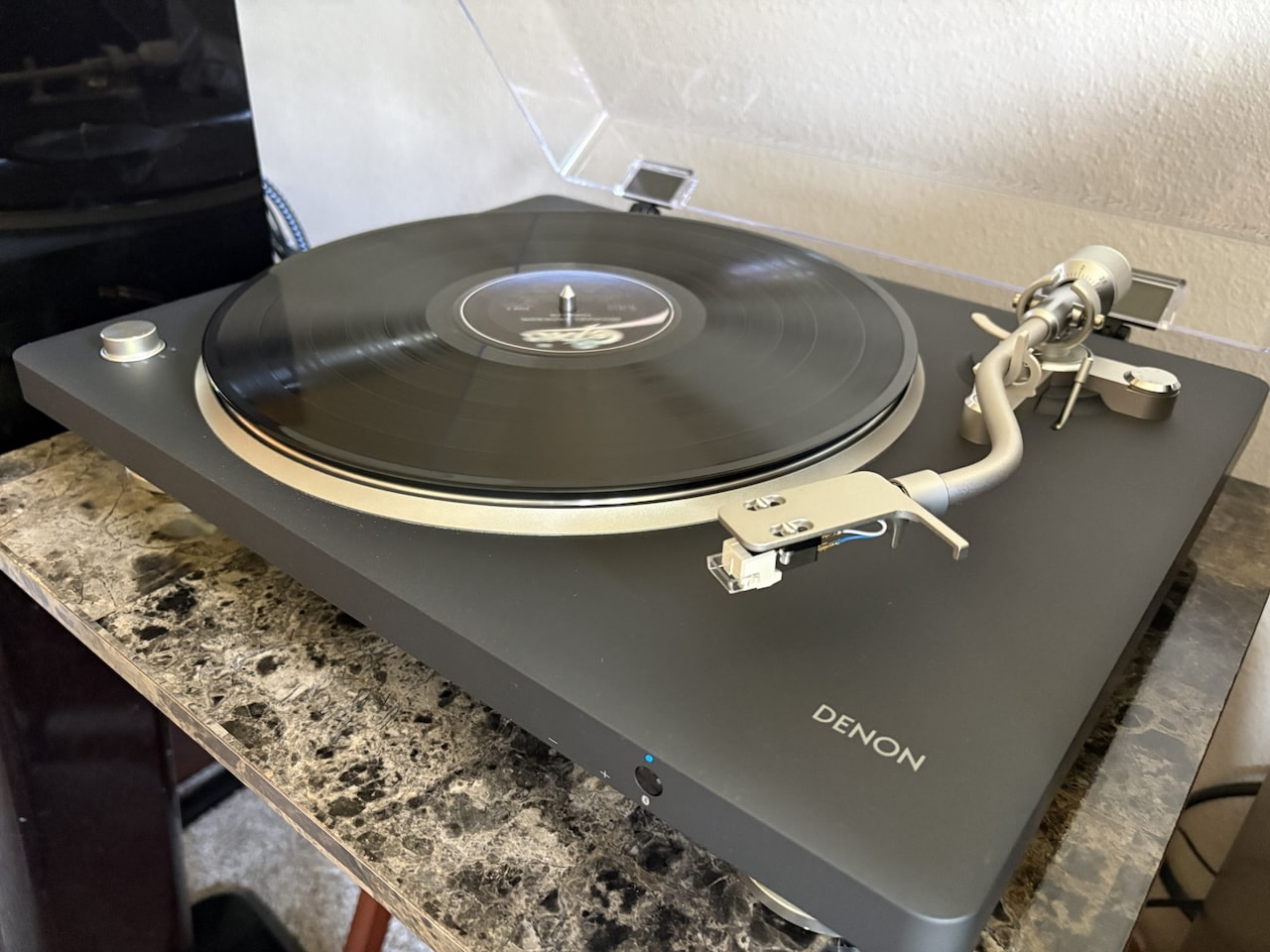
Once assembled, the DP-500BT is, in a word, gorgeous. A modern counterpoint to my more retro-styled wood-plinth U-Turn Orbit Theory reference table, Denon’s industrial elegance is no less striking. Little touches like the beaded silver tonearm and machined-aluminum control dials set against the slate gray chassis catch the eye without looking ostentatious.
Speaking of the control dial, this is one of the few turntables I’ve tested that supports all record sizes and types you’ll come across, including 78, 45, and the more common 33 1/3 RPM. You’re not likely to find many 78s these days, but it’s nice to have options for older shellac records, am I right? On the plinth’s right side, you’ll find a key for engaging and pairing Bluetooth and, underneath, mercurial control keys for volume output. More on that later.
The DP-500BT’s semi-automatic operation doesn’t fully return the tonearm, but it will pause the motor and raise the DSN-85 stylus when it reaches the lead-out groove at the end of the side, which is particularly useful if you plan to connect it to a multi-room system like Denon’s HEOS speakers over Bluetooth.
An internal phono-preamp at the back (labeled “Equalizer”) is another obvious inclusion for this design, raising the turntable’s phono output to line level for connection to newer audio systems by default. You can bypass it if you’re connecting a high-end preamp or amplifier with a quality phono preamp built in, but in testing, the internal option proved solid enough, roughly on par with my Rolls VP-29 outboard preamp.
The table’s die-cast aluminum platter, hefty and stable chassis, and S-shaped tonearm are all designed to minimize distortion and vibration for clean reproduction of your catalog.
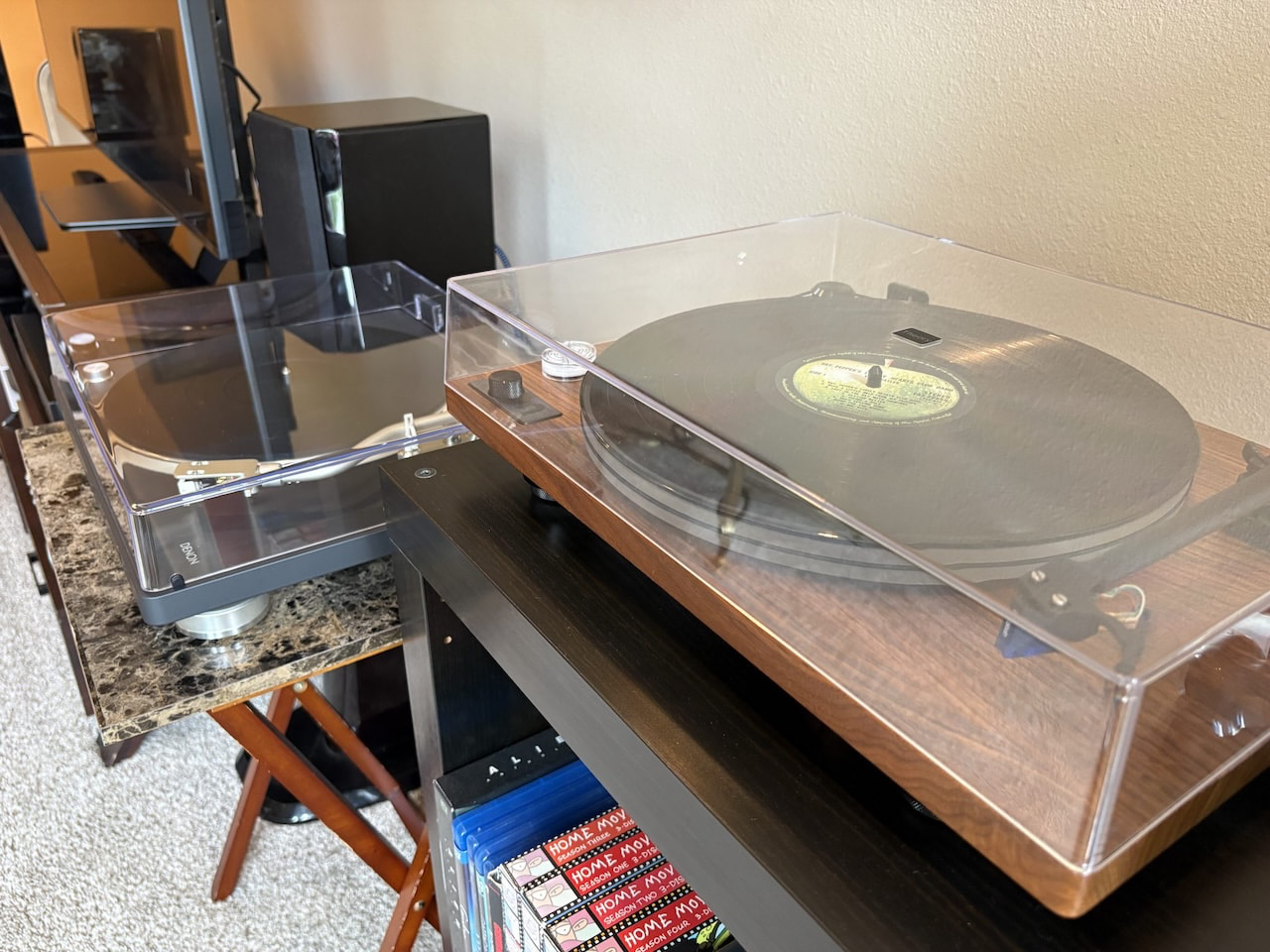
The DP-500BT sounded quite good across my collection, though it was clear right away that it doesn’t offer the same level of expression, instrumental definition, or overall dimensionality as the Orbit Theory that holds court on my console. That’s not too surprising considering that the Theory costs $180 more with the included phono preamp and comes fitted with the Ortofon 2M Blue, a better-quality moving magnet cartridge than Denon’s bundled DSN-85.
What the Theory does not offer, however, is the DP-500BT’s semi-automatic tonearm operation or Bluetooth support, which are the features that make Denon’s table more flexible for a different kind of listener.
For its part, the DP-500BT did a relatively impressive job with my favorite reference records over my midrange SVS 2.1-channel listening station, including a pair of Prime Wireless Pro speakers and a 3000 Micro Subwoofer. Hallmarks include smooth tonal delivery, good balance from bass through treble, and enough touch and articulation to elevate your best pressings.
My modern pressing of Brubeck’s Take Five is always a good starting point, and the deck didn’t disappoint. There was plenty of vibrant color to Joe Morello’s snazzy snare and firm gravitas to his tom rolls and bass drum, matched by sweet yet creamy resonance in the middle keys of Dave’s piano. The first track, “Blue Rondo,” readily reveals the breathy reed work of Desmond’s sax solo and standout tracking of the little tonal shifts as he moves around the mic.
Throwing on some indie rock in Fruit Bats’ Absolute Loser, I was pleased by the stereo spread, providing clear delineation between the many dual guitar lines, some lovely jangle to the banjo in “Humbug Mountain Song,” and extended swells from the album’s many pad synths for an immersive overall soundstage.
Moving to more challenging, warped records, like my vintage pressing of Magical Mystery Tour, the DP-500BT did well limiting wow fluctuation, or the little tonal variations on dodgier records that are easily revealed by budget turntables, even as I could see the needle riding the waves up and down. There was a lovely sweep as the bus flies across the stereo image in the title track, a crisp crunch to the left-side percussion with just enough psychedelic swirl, and a cohesive presentation of the bright, slightly playful brass in the right channel.
Again, switching to the Orbit Theory provided a more engaging and expressive performance, bringing out more color and definition to each guitar and vocal line, better crunch in the snare and cymbals, and more satiny flavor to the horns. Still, the DP-500BT does a fine job and is well suited for a mid-tier audio setup, with enough ceiling to step up as needed, especially if you’re willing to swap out the cartridge down the line for something fancier.
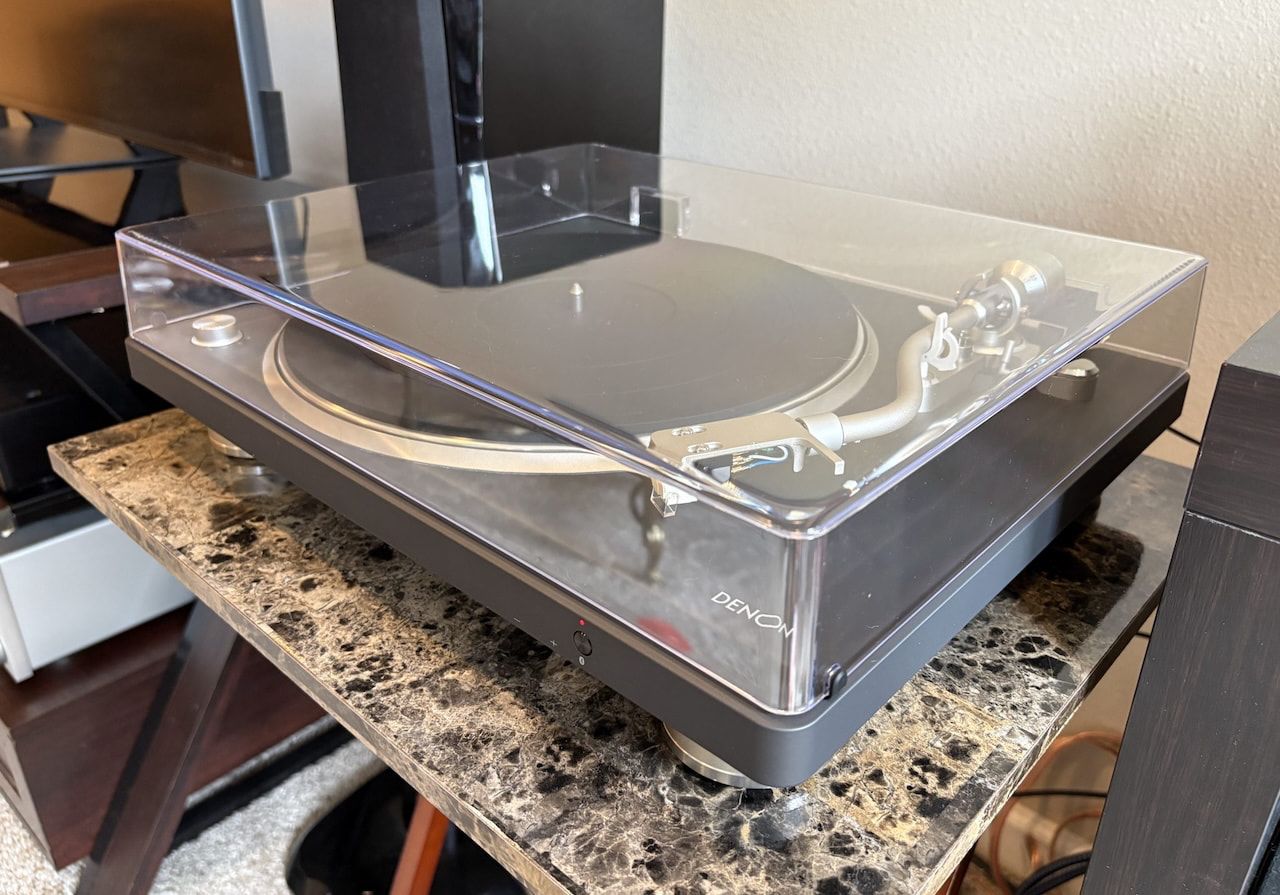
I’ve long been baffled by mostly budget turntables designed to stream over Bluetooth. Even in the digital age, when the latest pressings often cater to music recorded in 1s and 0s, it always seemed counterintuitive to me to listen to analog media through a digital format that, by its nature, runs against the whole point of playing records in the first place. After spending a few weeks with the DP-500BT, I started to understand the appeal.
For starters, connecting to a Bluetooth speaker is surprisingly simple. Just hold down the Bluetooth key until the blue pairing light flashes, do the same on your desired speaker or system, and they should automatically pair. The only issue I ran into when using Denon’s Home 400 speaker was that the volume was too low at first, and both times I tried to use the table’s onboard volume, it shot up way too loud. Suffice it to say, I controlled volume from the speaker directly or via Denon’s HEOS multi-room app from then on.
Otherwise, while Bluetooth will never be my preferred way to experience vinyl, it does offer real convenience while preserving much of what makes playing records appealing in the first place. You’re getting the core of vinyl’s tactile ritualism: diving through the original artwork and lyrics, going hands-on with the media, and dropping the needle in a groove, all big parts of the appeal.
Moreover, vinyl’s demand for album-forward listening provides a very different experience from streaming services that cater to singles or playlists, essentially forcing you to cover deeper musical territory.
From a performance standpoint, regardless of the limitations of compressed streaming, what isn’t lost here is the original mix and pressing of each record, providing a distinctive sonic experience that preserves its time and place. My 1984 reissue of Michael Jackson’s Thriller sounds very different from the latest remaster, with smoother, fuller bass and a more rounded midrange, while still providing that fabulous snap to the snare on its seminal classic, “Billie Jean.”
My older and more worn-down records sound soft and fuzzy. My brighter and cleaner pressings, from Brubeck to my ‘70s Japanese Beatles pressings, all sounded, well, brighter and cleaner.
To take things up a level, the DP-500BT supports aptX, aptX HD, and aptX Adaptive, designed for “HD quality” audio. That’s especially great for aptX-ready wireless headphones, like Bowers & Wilkins’ Px7 S3 or high-end Bluetooth setups. Oddly, Denon’s own Home speakers do not appear to support aptX (the turntable’s LED goes from Blue to Purple with aptX). Even so, they did well with the basics, and more notably, connecting to Denon’s Home 400 allowed me to pass the sound over its HEOS multi-room system to other speakers via Wi-Fi, like the Home 200, for a whole-home experience.
And thanks to the table’s semi-automatic return, you can step away and control volume remotely without having to worry about the needle getting trashed if you can’t get back to change it right away. When supplementing a traditional wired setup, the system’s versatility had me listening in more ways, more often.
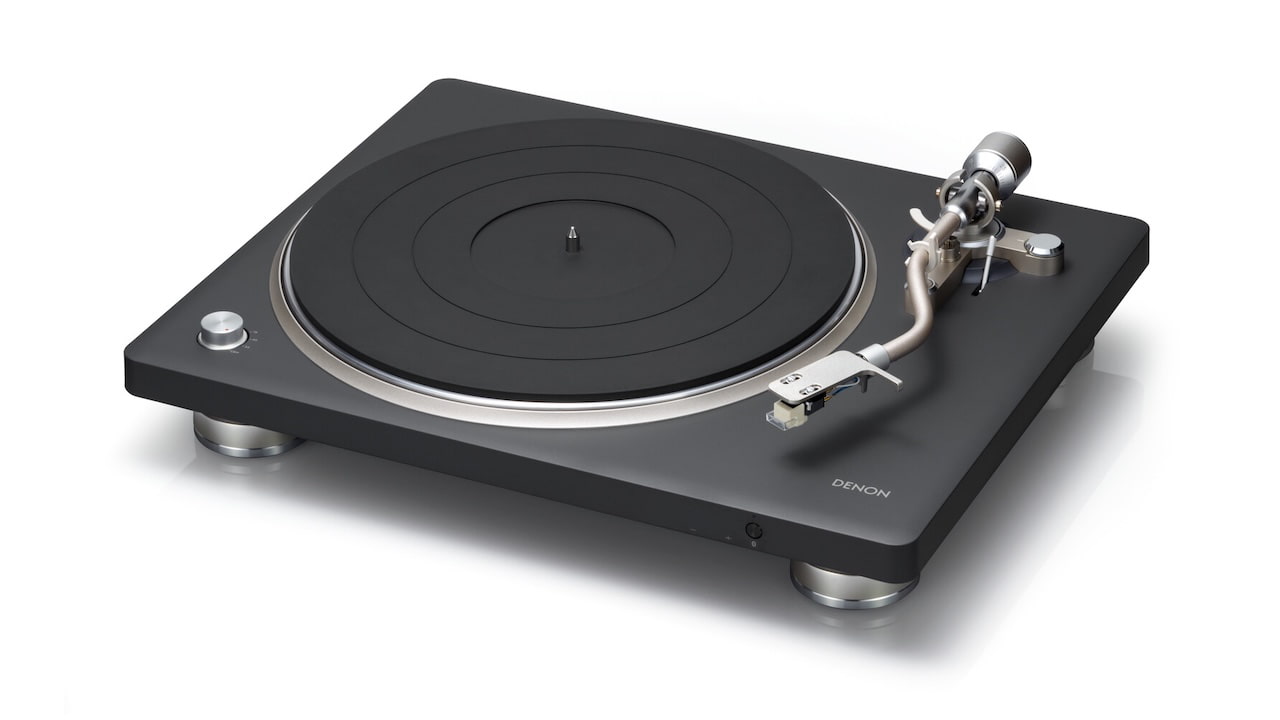
Denon’s DP-500BT is an incredibly flexible turntable, offering multiple ways to play, especially with a compatible whole-home audio setup, without skimping on performance. You can get superior sound quality at similar pricing with options like the U-Turn Orbit Theory, but few turntables I’ve encountered provide such a good balance between versatile playback and hi-fi performance, all at a relatively attainable price point.
Better still, listeners using the wired output can improve performance further by upgrading to a higher-quality moving magnet cartridge, such as the Ortofon 2M Blue or the new Grado Prestige Gold4.
For serious vinyl fans looking to stretch out into wireless streaming, and especially those already invested in options like Denon’s latest Home speakers, the DP-500BT is a great buy that sounds nearly as good as it looks.
★★★★★★★★★★ Performance
★★★★★★★★★★ Usability
★★★★★★★★★★ Build Quality
★★★★★★★★★★ Value

Craft Recordings is heading back to the pumpkin patch, and this one should hit hard for anyone old enough to remember watching It’s the Great Pumpkin, Charlie Brown on television before Halloween became a month-long retail hostage situation. To mark the 60th anniversary of It’s the Great Pumpkin, Charlie Brown, Vince Guaraldi’s 1966 Halloween soundtrack returns on August 7th in collectible zoetrope vinyl and limited-edition pressings, featuring “The Great Pumpkin Waltz,” “Graveyard Theme,” “Linus and Lucy,” and rare outtakes from one of the most beloved Peanuts TV specials ever produced.
The timing is not accidental. Peanuts and Charlie Brown have become one of the hottest nostalgia licenses in music and hi-fi, with Craft Recordings continuing its run of Guaraldi reissues after releases tied to A Charlie Brown Christmas, It’s the Easter Beagle, Charlie Brown!, A Boy Named Charlie Brown, Be My Valentine, Charlie Brown, and It’s Arbor Day, Charlie Brown.
eCoustics has covered that vinyl revival closely, including Craft’s Record Store Day releases and the 60th anniversary A Charlie Brown Christmas zoetrope pressing.
And it is not just records. The Peanuts revival has spilled directly into audio hardware, including Pro-Ject’s limited-edition Peanuts 75th Anniversary Turntable, a themed T1 BT-based deck with built-in phono stage, Bluetooth transmission, and enough Charlie Brown energy to make even Schroeder consider upgrading his rig. That is where this latest Craft release fits: part soundtrack restoration, part collectible vinyl, part proof that Guaraldi’s jazz scores have become a very real corner of the modern hi-fi and vinyl economy.

Arriving August 7th and available to pre-order now, Craft Recordings’ 60th anniversary reissue of It’s the Great Pumpkin, Charlie Brown brings Vince Guaraldi’s 1966 Halloween soundtrack back to vinyl in multiple collectible formats. The main release is a 45 RPM zoetrope LP featuring memorable animated scenes from the special on each side, along with a new essay by Sean Mendelson.
Because apparently one pumpkin was not enough, Craft is also rolling out several limited-edition variants through exclusive retail partners. Target will offer an Orange 4-inch Tiny Vinyl beginning July 17th, with “The Great Pumpkin Waltz” on Side A and “Graveyard Theme” on Side B. Pumpkin-shaped pressings arrive August 21st in several colorways, including Electric Pumpkin Patch at Barnes & Noble, Pumpkin Spice at Walmart, Ghost White at Target, and Candy Corn through Craft Recordings. The Orange Pumpkin pressing also returns by popular demand at all major retailers.
That may sound like a lot of plastic gourds, but the demand makes sense. Peanuts remains one of the strongest nostalgia licenses in music and hi-fi, and Guaraldi’s scores have become a legitimate gateway drug into jazz for listeners who first encountered them while waiting to see whether Linus was finally going to be vindicated.
By 1966, Vince Guaraldi was still in the early stages of what became a long and fruitful creative partnership with producer Lee Mendelson. Mendelson originally approached the Bay Area jazz pianist to score a documentary about Charles M. Schulz and the Peanuts comic strip. That film, A Boy Named Charlie Brown, never aired, but the collaboration survived and led directly to A Charlie Brown Christmas in 1965.

That special, written by Schulz, animated by Bill Melendez, and produced by Mendelson, became an immediate success, and Guaraldi’s soundtrack became one of the most enduring holiday albums ever recorded. The following year, Mendelson brought Guaraldi back for two more Peanuts specials: Charlie Brown’s All-Stars!, which aired in June, and It’s the Great Pumpkin, Charlie Brown, which debuted on October 27, 1966.
Recorded only weeks before its broadcast at Desilu’s Gower Street Studio in Hollywood, It’s the Great Pumpkin, Charlie Brown marked an important shift in the sound of the Peanuts specials. Guaraldi had handled the music for the first two specials largely on his own, but this time he was joined by seasoned composer, arranger, and conductor John Scott Trotter, best known for his long run as Bing Crosby’s music director. Trotter helped bring more structure to the sessions, shaping Guaraldi’s jazz writing into shorter, television-ready cues without draining the personality out of the music. A small miracle, considering what network television can do to anything interesting.
Guaraldi’s core trio included bassist Monty Budwig and drummer Colin Bailey, with additional color from Emmanuel “Mannie” Klein on trumpet, John Gray on guitar, and Ronald Lang on woodwinds. Together, they gave the special its autumnal texture: warm, slightly mysterious, and just melancholy enough to remind you that Charlie Brown was never getting a normal Halloween.
The centerpiece remains “The Great Pumpkin Waltz,” a sophisticated and beautifully restrained theme tied to Linus’ unwavering belief in the mythical figure he insists will rise from the pumpkin patch. Other highlights include the eerie “Breathless,” the playful “The Red Baron,” the familiar “Charlie Brown Theme,” and the immortal “Linus and Lucy,” which remains one of the most recognizable pieces of music ever attached to an animated television special.
When It’s the Great Pumpkin, Charlie Brown premiered, it captured a 49 percent audience share and earned an Emmy nomination. Unlike A Charlie Brown Christmas, however, it did not receive a proper companion soundtrack at the time. Select tracks appeared on compilations over the years, but the first comprehensive soundtrack release did not arrive until 2018. Craft reissued it again in 2022 after the discovery of the original session tapes, adding more material from the recordings.
Guaraldi would go on to score 15 Peanuts specials before his death in 1976. His music remains a major part of the franchise’s identity, not because it was cute or merely nostalgic, but because it treated children and adults like they could handle real melody, real swing, and a little emotional ambiguity. Imagine that. A children’s special with better musical taste than half the people in charge of streaming playlists.
Where to buy: $36.98 at Amazon | Craft Recordings (ships August 7, 2026)


— Microsoft technical fellow Marcus Fontoura is leaving the company after serving as Azure Core’s chief technology officer for more than a year. During that time he also published A Platform Mindset, a book exploring how to build scalable systems and effective teams.
@media (max-width: 600px) {
aside.callout { float:none !important; max-width:100% !important; margin-left:0 !important; margin-right:0 !important; }
aside.callout .callout-img { display:none !important; }
}
Fontoura had an earlier eight-year run at Microsoft, where he worked as a technical fellow in Azure and as a partner architect for Bing before departing in 2022 to join fintech company Stone as CTO and head of engineering. Prior to Microsoft, he held positions at Google, Yahoo and IBM.
“I leave with deep gratitude and immense respect for the people and culture that make Microsoft such a special place,” he said on LinkedIn. Fontoura, who is based in Boca Raton, Fla., did not share his next move.
— Travis Moore is now the first chief revenue officer for Xealth, a Seattle-based digital health startup acquired last year by Samsung Electronics.

“The challenge is no longer simply finding more technology. It is connecting that technology to the clinical workflows and turning fragmented tools into coordinated, meaningful care,” Moore said on LinkedIn.
Moore began his career in healthcare 25 years ago as a pediatric nurse before moving into health technology, where he worked in product management, sales and marketing and then transitioned to commercial leadership. He joins Xealth from Eleos Health, a North Carolina behavioral health company, where he served as head of sales.
— Judson Althoff, CEO of Microsoft’s Commercial Business, was appointed to GE Aerospace’s board of directors. Althoff has been with the tech company for 13 years.
— Eric Foster has taken a role at Slalom, a Seattle-based business and technology consulting firm, as leader of its Pacific Northwest market. Foster comes from Accenture, where he spent 14 years across three stints, most recently as managing director.
— Digimarc, a Beaverton, Ore., company providing digital watermark technology, named Paul Carreiro as CEO, effective July 6. Carreiro joins from Atlanta’s Elemica, where he has been chief executive and president for two years. He succeeds Riley McCormack, who will remain on the board of directors.
The AI boom is driving business, said a Digimarc release, as “both humans and intelligent systems require scalable ways to verify what’s real, protect what matters, and move forward with confidence.”
— Jose Calzada has joined the VP ranks at Microsoft with a promotion to VP software engineer. Calzada works on the company’s AI platform and has been with Microsoft for 17 years. He joined as a design engineer intern and was later hired permanently to the Outlook team.
— Soracom, a Japanese IoT connectivity company, has named Richard Halliday as CEO of its operations in North and South America. The publicly traded company’s U.S. headquarters are in Bellevue, Wash. Halliday has been with Soracom for more than four years.
— Seattle Mayor Katie Wilson has reshuffled her leadership team, moving Nicole Vallestero Soper from her current role as director of policy and innovation to director of affordability, housing, and economic development, Publicola reported. Before joining city leadership, Soper was a principal consultant at Transformative Shifts.
— Scott Whalen of Pacific Northwest National Laboratory has been honored as the Department of Energy’s National Innovator of the Year. Whalen serves as chief scientist in PNNL’s Applied Materials and Manufacturing group and leads its Thermomechanical Processing team. He holds 23 U.S. patents with 13 more pending.

Among the increasing concern about screen time in school comes a new culprit: the vetting process for school software.
A growing group of parents and teachers has spent the last few years fighting against cellphones in the classroom, with some extending that to all digital devices. But the school-issued laptops, and the software accompanying them, have been left largely unscathed.
“A lot of the issues with personal devices can move to the district-issued devices,” said Kim Whitman, co-lead for Smartphone Free Childhood US, in a previous interview with EdSurge. Whitman explained that when students do not have cellphones, they can still message with friends on their Chromebooks, or through tools like Google Docs. “There are definitely issues with school-issued devices as well.”
Proposals in three states – Rhode Island, Utah and Vermont – are now tackling these concerns.
At the start of this year’s legislative session, all three states concurrently proposed reviewing the vetting process of education software.
In most districts, school boards, IT personnel and administrators choose vendors, often relying on the vendors’ own data to prove the products’ safety and efficacy.
“There is nobody right now that is confirming these products are safe, effective and legal,” Whitman said in a previous interview. “It should not fall on the district’s IT director; it would be impossible for them to do it. And the companies should not be tasked with doing it — that would be like nicotine companies vetting their own cigarettes.”
The proposed legislation is looking to change that.
Bill: An act relating to educational technology products
NEWSLETTERS
Sign up for EdSurge newsletters for timely news, insights and analysis.
Status: Passed by the House March 27; currently before the Senate Committee on Education
This bill proposes to require that providers of educational technology products register annually with the state. It also requires the secretary of state to create a certification standard and review process for these products before schools can use them.
Any provider of an educational technology product — specifically student-facing tools that are used for teaching and learning in schools — must register with the secretary of state, pay a registration fee of $100 and provide its most up-to-date terms and conditions and privacy policy.
The secretary of state would work with the Vermont Agency of Education to review registrations.
Criteria for certification include:
The product’s compliance with state curriculum standards
Advantages of using it versus non-digital methods
Whether it was explicitly designed for educational purposes
Design features, including artificial intelligence, geotracking and targeted advertising
While the initial bill proposed that any edtech provider not certified by the state, but continues to operate, could be liable for fines of $50 a day up to $10,000, that language was struck by the final bill passed from the House.
If passed by the Senate, the bill would go into effect July 1, 2026. By November 2027, the Agency of Education would submit a written report on which state entities should be involved in the edtech certification and any other recommendations for certification.
Bill: Software in Education
Status: Signed into law on March 18
The bill requires the Utah Board of Education to study the use of software and digital practices in public schools, review best practices and provide guidance for responsible use.
The state also passed a Classroom Technology Amendments bill tackling screen time at every grade level, banning it entirely from kindergarten through third grade, except for computer science and assessments. Middle school students must have their parents “opt-in” to taking devices home and high school students will be allowed to bring home devices unless parents “opt-out.”
“We’re not anti-technology,” Rep. Ariel Defay (R-UT) said in a statement. She is a sponsor of the Classroom Technology Amendments bill. “We just want to ensure that education technology is used intentionally and actually helps students to learn.”
Bill: The Safe School Technology Act of 2026
Status: Passed by the House April 14; currently in the Senate Education Committee
This bill, proposed by three Rhode Island representatives who are also mothers, is part of a six-bill package focused on protecting children from social media, artificial intelligence and digital platforms.
The Safe School Technology Act bill would be enacted this August if approved, banning software providers from activating or accessing any audio or video functions on a device outside of school-related activities. It also bans the use of location data.
The initial bill lists a litany of concerns that the “lack of regulation” caused, including increased screen time, and “marketing commercial products as educational with no accountability; children being given devices without proof of developmental appropriateness and parents being excluded from decisions about their child’s digital exposure.”
But the main concern, argued by state Representative June Speakman (D-RI), who sponsored the bill, is that a majority of school districts’ technology policies do not have limits on tracking student devices. She added roughly two-thirds of districts also do not limit school-issued device’s ability to activate audio and video.
“Passing this bill will provide clear, consistent protection across all schools in the state that assures students and their families that their devices cannot be used to invade their privacy or track their activities,” Speakman said in a statement.
“They deserve to feel confident that their privacy is protected when they use technology that is required for school,” she added.
Several technology proponents have pushed back.
The Software and Information Industry Association spoke out against the Rhode Island bill in March, saying if the bill passed it would make the state be one of the most restrictive in the nation.
In an open letter to Joseph McNamara, chair of the Rhode Island House Education Committee, Abigail Wilson, director of state policy at the Software and Information Industry Association, said the bill “proposes an overly restrictive regulatory framework that will severely disrupt classroom instruction, impose massive unfunded administrative burdens on local schools, and deprive Rhode Island students of critical, evidence-based learning tools.”
Keith Krueger, CEO of the nonprofit Consortium for School Networking, told NBC News that the proposed legislation “does keep me up at night.”
“I think some well-intentioned policymakers … are rushing so quickly that they haven’t thought through the implications,” he said.
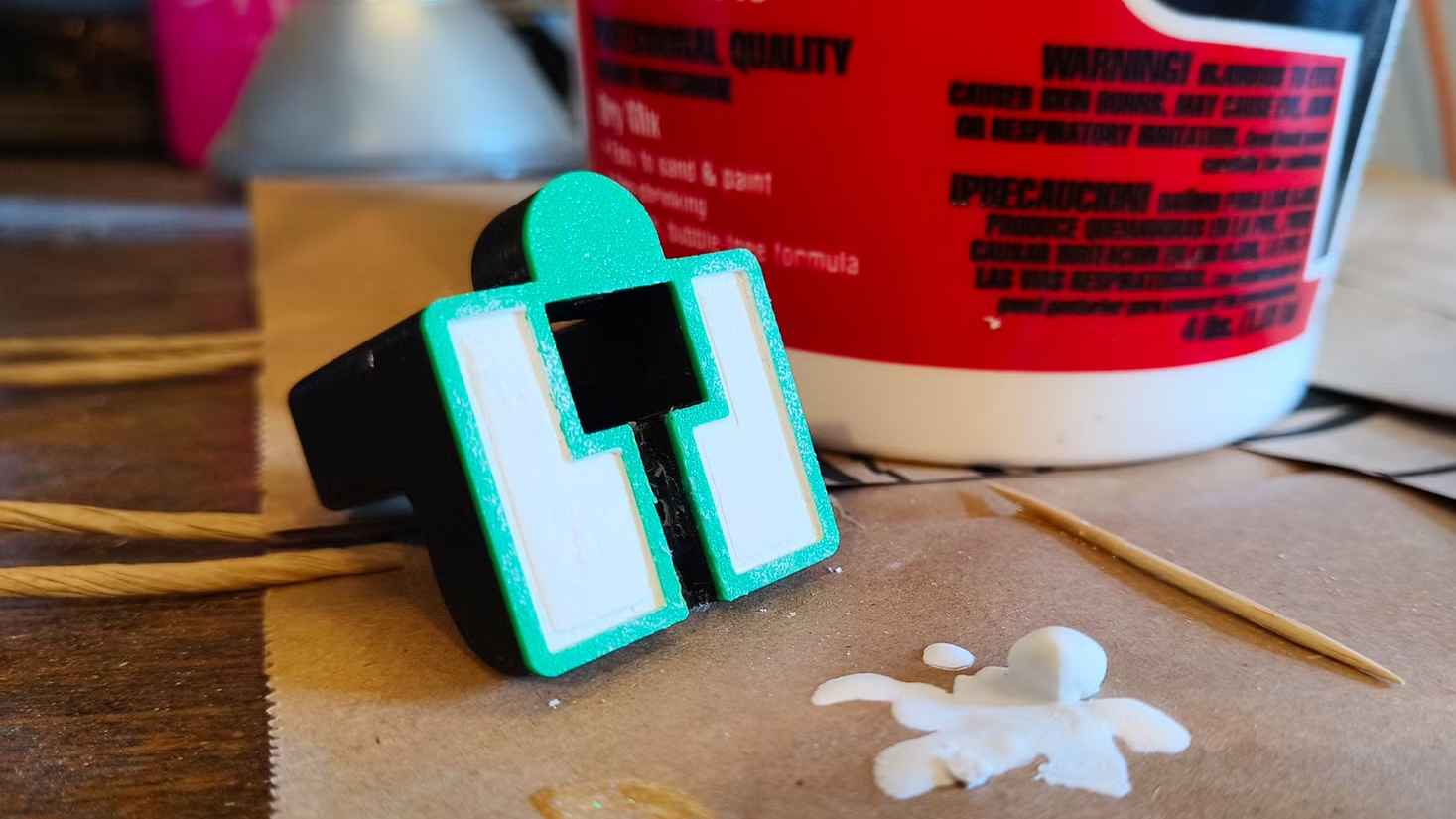
Sometimes it’s useful to add extra mass to a 3D print, and [Joe Fedewa] shared a simple and effective technique that uses plaster of Paris. Rather than pause the print and insert hardware or weighted bits inside, he designed the base as hollow. Not in the sense of zero infill, but in the sense of modeling a cavity into the open bottom of the object.
After the print is complete, he mixes the dry plaster with water until it creates a thick but pourable mixture. Then the object gets turned upside-down and the cavity filled. In about an hour, it will have set up enough to be handled and worked.
Plaster of Paris has a good heft to it, but more importantly it can be made perfectly presentable thanks to being very friendly to post-processing. Any rough spots can be easily sanded and the whole bottom smoothed, so one doesn’t even need to cap it off. Completely cured plaster can be sealed with a clear coat for a more durable finish, if desired.
This basic concept has been used in other ways, such as reinforcing prints with concrete to yield parts solid enough to make tools out of. But using plaster of Paris not just to add mass, but specifically to create a presentable surface that doesn’t need covering up is a neat and highly economical adaptation of the idea.
Other methods of adding mass to a 3D print include inserting metal balls or chunky nuts, bolts, or other hardware, but this method doesn’t require pausing prints to insert things. Nor does it require sealing off or capping the print, messing with goopy epoxies or resins, or spending a lot of money — making it a good one to keep in mind in case it comes in handy someday.


Security
Clinical trial participant data stolen, but pharma giant says exposed records were pseudonymized
Pharmaceutical giant Novo Nordisk says data related to clinical trial participants was stolen as part of a cyberattack.
The affected patient data was pseudonymized and not directly linked to names or other direct identifiers, the company said.
The maker of the Wegovy weight-loss drug said the affected data types include patient ID, information on trial participation, gender, year of birth, biomarkers, health/immunogenicity data, and lifestyle factors including smoking status, alcohol use, and BMI.
“This information is not directly linked to any patients by name or other direct identifiers,” the Novo Nordisk said on its dedicated page for the attack.
“Information about identity would therefore require access to underlying information, identifying patients by name etc. This information was not exposed. We therefore do not consider the incident to enable any third party to identify participants in our clinical trials.”
The same statement confirmed that the attack affected a “limited number of internal IT systems,” and the company said some systems have been taken offline as a precaution.
Although it does not believe there is an immediate risk stemming from the breach, it nonetheless warned patients to remain vigilant for anything that could be connected to the data stolen during the attack.
A separate letter sent to the company’s healthcare partners (HCPs) states that additional personal information may have been stolen and could lead to targeted phishing attempts.
Affected HCP data includes names and registration numbers, email addresses, phone numbers, WhatsApp details, and office locations.
“Based on the nature of the exposed data, the potential consequences of the incident include targeted phishing attempts through emails, phone, and WhatsApp, or fraudulent communications impersonating colleagues,” Novo Nordisk said in the letter.
“We recommend that you remain vigilant against unexpected messages or calls and report any suspicious activity to us.”
The pharma biz warned that it may take time to bring these systems back online, but it is working to do so “in a controlled and safe manner.”
Elsewhere, it all sounds like standard practice. Outside experts were called in to help investigate, and Novo Nordisk has not yet confirmed the scale of the breach, nor will it until the experts have more time to assess the damage.
Novo Nordisk added that the attack has had no impact on its core business operations, which remain running as normal.
The attack was announced on what should have been a day of celebration for the company, whose flagship semaglutide weight-loss and diabetes pill received the green light to become the UK’s first daily GLP-1 tablet hours earlier.
The Wegovy pill joins the list of approved weight-management treatments that act as agonists for the GLP-1 receptor. All the other approved treatments are injectables, including Wegovy and Ozempic, both of which are also developed by Novo Nordisk.
The Danish company employs roughly 67,900 people across 80 countries, and markets products in nearly every country globally. ®



The Best Mystery Series of All Time Is Surging on Streaming 30 Years After It Ended


Alexander Zverev wins the French Open to finally earn a 1st Grand Slam title


Anatomy of the June crypto crash: Fed, Iran, Saylor


Oppenheimer backs SpaceX as $70 billion retail frenzy builds


Suspicious Polyfill login prompts pop up on Toshiba, Muji websites


Markets Rally as SpaceX IPO Looms Amid Iran Tensions and Inflation Surge

Senator Cynthia Lummis Calls CLARITY Act the Most Consequential Financial Legislation of This Generation


Microsoft unveils seven homegrown AI models in new bid for ‘long term self-sufficiency’

Alexander Zverev conquers demons and outlasts Flavio Cobolli to win French Open for first major title

Von der Leyen’s AI envoy pick draws conflict-of-interest fire


High Stakes for Wembanyama as New York Pushes for 3-0 Lead


Hackers now exploit SolarWinds Serv-U flaw to crash servers

The Pain Points Taking a Fragile Tech Rally Down a Notch

Eli Lilly (LLY) Stock Surges 4% Following Breakthrough Sleep Apnea Trial Results


Notion restores access to Anthropic after service disruption


Trump’s AI Ownership Plan Could Benefit Anthropic at OpenAI’s Expense

The investment to transform historic St Helen’s ground in Swansea

Bangladesh beat Australia after 20 years in ODIs, register only their second win over six-time world champions | Cricket News


Forensic Expert Floats Handyman Theory in Disappearance of Savannah Guthrie’s Mother


This Week In Security: Microsoft On Microsoft, Register Your Domains, Linux On ARM, And FreeBSD Joins The File Cache Club




You must be logged in to post a comment Login