

Crypto World
Big banks are ditching private blockchains to build tokenized cash networks on public infrastructure



Banks are focusing on pulling stablecoins and tokenized forms of more traditional financial instruments into one integrated package to meet growing institutional demand for multi-asset flexibility.
Rather than waiting for a single winner to emerge, large asset managers and corporate treasuries are demanding a multi-instrument setup in which stablecoins, tokenized bank deposits and tokenized money market funds all run on the same infrastructure.
“The demand from institutional clients is consistent: they are not waiting for any single instrument to prevail,” Thomas Eichenberger, chief strategy officer and deputy group CEO at Swiss-based digital asset bank Sygnum, told CoinDesk on Thursday in an email.
“They are asking how tokenized deposits, regulated stablecoins, and tokenized money market funds can be combined and made interoperable, so a treasury function can move between them — permissioned settlement, 24/7 cross-border flows, yield with on-demand liquidity — under one regulatory framework they already trust,” he added.
Sygnum, which describes itself as the world’s first digital assets bank, partnered late last year with Swiss banking powerhouse UBS and PostFinance, a subsidiary company of the state-owned Swiss Post, to test blockchain payments between institutions on Ethereum.

Crypto World
Solana Foundation Launches Frontier Traders, an Institutional Program for $500M+ Volume Firms
The Solana Foundation launched Frontier Traders Thursday afternoon, a formal institutional program for elite trading firms, with the first qualifying campaign opening on SpaceX tokenized equity Friday. The entry bar sits at $500 million in trailing 30-day onchain DEX volume combined with $16… Read the full story at The Defiant
The Fidelity Digital Dollar reportedly deployed liquidity to both Curve Finance and Uniswap in a single Ethereum block Thursday evening, with an on-chain watcher flagging the move as the Fidelity-branded stablecoin's first foray onto permissionless DeFi rails. LytninCrypto, an on-chain data… Read the full story at The Defiant
South Korean police are investigating Bithumb CEO Lee Jae-won over bribery allegations linked to hiring people connected to independent lawmaker Kim Byung-ki.
According to Yonhap News, the Seoul Metropolitan Police Agency’s Public Crime Investigation Unit is examining claims that Lee approved the hiring of Kim’s second son after receiving a direct employment request from the lawmaker.
Political Hiring Scandal
The case stems from statements provided by a former aide to Kim, who had previously raised other allegations against the lawmaker. The aide told police that Kim met Lee for drinks at a restaurant in Seoul’s Mapo district in November 2024 and asked him to hire his son.
Police suspect the alleged hiring may have been linked to Kim’s activities while serving on the National Assembly’s Political Affairs Committee. Investigators believe Kim concentrated his legislative efforts on criticizing alleged monopoly practices involving Dunamu, the operator of rival crypto exchange Upbit, in return for his son being employed at Bithumb.
Earlier this month, police listed Lee as a bribery suspect in a second search warrant targeting Bithumb’s headquarters in Seoul’s Gangnam district and several related locations. During an earlier raid carried out in February, investigators had already named Kim as a suspect in connection with alleged preferential hiring tied to his son’s recruitment, while Bithumb was listed as a witness in the case.
Police are now reviewing materials seized during the searches and are expected to question certain individuals regarding the hiring process and whether they were aware of any job solicitation efforts.
Troubles Pile Up
Beyond the hiring controversy, Bithumb has recently been entangled in several separate legal and compliance-related disputes. In May, a South Korean court temporarily blocked a six-month partial business suspension imposed on the crypto exchange by the Financial Intelligence Unit (FIU).
The court’s decision paused the sanctions until a final ruling is made in Bithumb’s legal challenge against the regulator. The FIU had accused the exchange of around 6.65 million violations of financial rules, including failures in customer identity checks and transaction monitoring. Regulators also fined Bithumb 36.8 billion won and warned several company officials.
Earlier in April, Bithumb took legal action to freeze 7 BTC that remained missing after a major payout mistake during a promotional event. Due to a system input error, the exchange accidentally distributed Bitcoin instead of Korean won to users. Although most of the funds were recovered quickly, some recipients allegedly refused to return the remaining assets, which forced Bithumb to pursue a provisional seizure.
The post Bithumb CEO Booked in South Korea Bribery Probe Over Lawmaker’s Son Hiring appeared first on CryptoPotato.
Crypto World
Crypto News, June 11: Bitcoin Price Unfazed by Trump and His Threat to Flatten Tehran, Chainlink and Kraken Power FIFA World Cup

Crypto markets open with Bitcoin price showing surprising strength despite Trump threats on Iran. Chainlink and World Cup partnership shows growing mainstream ties, offering a bright spot amid volatility from geopolitics and ETF outflows.
Trump hinted at an Iran deal days away after proportional strikes yesterday. Today, he told Fox News that without an agreement, the U.S. will “bomb the sh*t out of them” tonight. He also revealed that the U.S. is taking millions of barrels of oil out of Iran every night while Hormuz stays closed. Trump added that when it ends, oil will drop back to prior levels.

Discover: The best pre-launch token sales
Bitcoin Price Holds Firm Amid Trump Escalation
Bitcoin price faces selling pressure from heavy U.S. spot Bitcoin ETF outflows as the streak continued into this week. It’s a prolonged outflow since May, with hundreds of millions exiting daily, led by BlackRock’s IBIT. Right now, the multi-week totals have reached billions withdrawn, yet Bitcoin price has held with even some bounces.
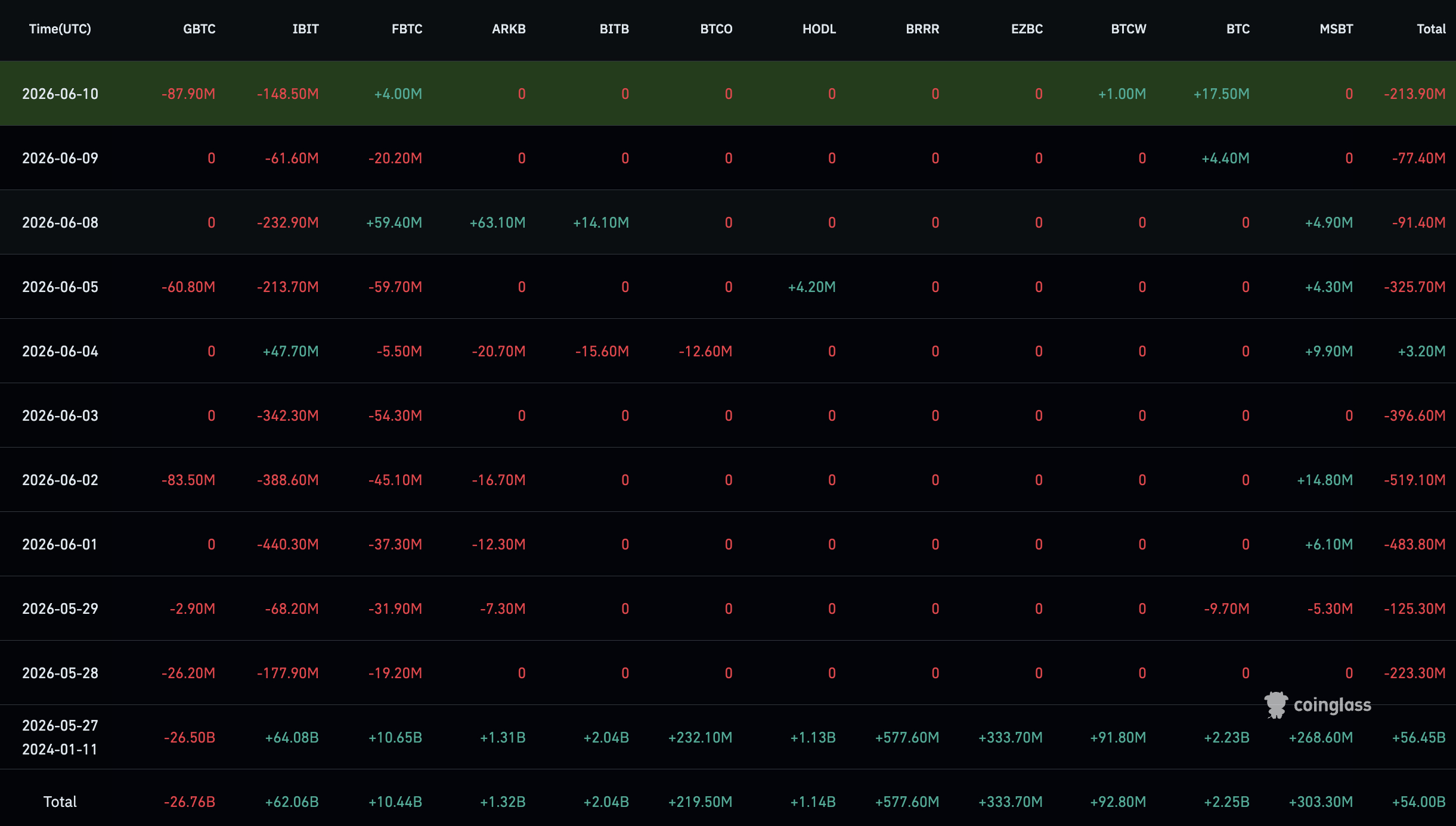
Yesterday, soft-core inflation data unexpectedly supported risk assets, including crypto. Although hotter energy components add caution for us watching rate-cut odds. Geopolitical noise from Trump has not derailed resilience yet.
A fresh story from hours ago shows corporate buyers still competing hard. Strive CEO Matt Cole threw a joke to Michael Saylor that last week they bought 32 Bitcoin. Michael Saylor replied that he wants those 32 Bitcoin back. Strategy sold exactly 32 BTC in late May but maintains net buying overall, battling the fixed 21 million supply race.
— Coin Bureau (@coinbureau) June 11, 2026
 SAYLOR WANTS HIS BITCOIN BACK
Strive CEO Matt Cole joked, “Last week, we bought 32 Bitcoin. If you know, you know.”
Michael Saylor quickly replied: “I’m gonna want that 32 Bitcoin back.”  pic.twitter.com/Ehce9NeJ4t
Discover: The best crypto to diversify your portfolio with
Chainlink and Kraken Power FIFA World Cup
Chainlink is now named to power official FIFA World Cup prediction markets, ADI Predictstreet, the tournament’s official partner. The deal will involve Myriad adopting Chainlink oracles for accurate, instant settlements across all 104 matches serving billions of fans. This marks a major real-world utility for Chainlink data feeds.
6 billion fans. 200 countries. 1 prediction market oracle. — Chainlink (@chainlink) June 9, 2026
Chainlink is exclusively powering the official 2026 FIFA World Cup prediction market partner, @Predictstreet.
Chainlink  @FIFAWorldCup pic.twitter.com/V5JruV2c7Z
Chainlink follows Kraken, as a day earlier, it was named the Official Crypto Exchange Supporter of the World Cup. The partnership targets North America and Europe with fan activations, education, and giveaways.
Moving to Artificial Intelligence, after it singlehandedly eliminated millions of human jobs, Tether placed a $1.4 billion bet on autonomous machine economies and AI. The focus is on paying robots via stablecoins as part of bigger institutional moves into real-world AI and crypto integration. This follows MetaMask’s AI wallet launch and XRPL’s similar payment pushes yesterday.
Questions linger after setbacks like Humanity Protocol issues, yet momentum for practical applications grows.
Discover: The best pre-launch token sales
Institutional Conviction and Real Utility Point Higher
Adoption headlines around Chainlink and the World Cup show crypto moving beyond speculation into everyday use cases. Billions of fans will interact with prediction markets settled instantly, proving Chainlink’s value at scale while Kraken brings new users through the World Cup platform.

Corporate accumulation continues despite ETF outflows. The recent Saylor exchange with Strive shows how big players view the fixed supply as increasingly scarce. Institutional players like Tether committing billions to AI-stablecoin systems signal long-term bets on utility that outlast short-term volatility.
Bitcoin price has likely absorbed Trump, Iran, geopolitics, and outflow pressure without breaking key levels.
When the Iran situation resolves and oil normalizes, macro tailwinds could return quickly. Also, not to forget the Ukraine war, which could get a surprise peace deal. All, combined with real-world traction and AI-crypto experiments, the setup favors holders.
Discover: The best crypto to diversify your portfolio with
The post Crypto News, June 11: Bitcoin Price Unfazed by Trump and His Threat to Flatten Tehran, Chainlink and Kraken Power FIFA World Cup appeared first on Cryptonews.
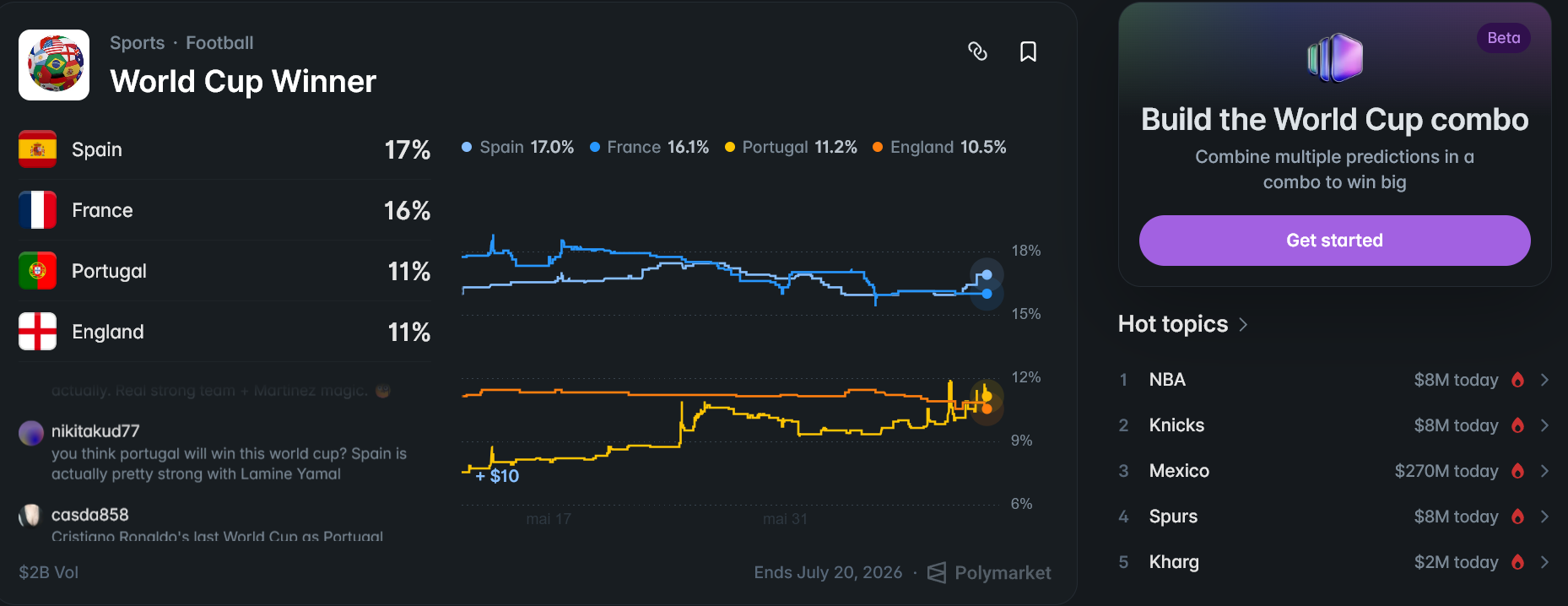
Crypto prediction markets crossed $2 billion in World Cup winner bets as the tournament opened in Mexico City today, and millions of traders still can’t agree on who will lift the trophy. Spain and France share the lead at around 16%, while defending champion Argentina sits at just 9%.
The combined total across Polymarket ($1.9 billion) and Kalshi ($132 million) makes this the largest single prediction market event in crypto history. Polymarket runs 328 live World Cup markets and saw $66 million traded in the last 24 hours, with the pool of funds behind those bets sitting at $352.7 million.

The $2 Billion World Cup Betting Record
Polymarket opened the World Cup winner market in July 2025, giving traders nearly a year to weigh in before the opening whistle.
Volume accelerated as the tournament approached, with $66 million changing hands in a single 24-hour window. The combined Polymarket and Kalshi total sets a new record for the largest single prediction market event in crypto history.
Prediction markets have become a staple at every major 2025 event, from the US presidential race to the Super Bowl. The World Cup now represents the biggest test of crypto betting infrastructure yet.
Spain, France, and the Defending Champion
Spain’s 16.5% and France’s 16.1% sit close enough that the market effectively rates them equal co-favourites. England and Portugal each sit at around 11%, with Brazil at 8%.
Defending champion Argentina sits at just 9%, lower than both European sides in the second tier.
The market is not saying Argentina cannot win, but two years on from their Qatar 2022 triumph, crypto bettors no longer rate Argentina as the team to beat. Every result in the group stage will shift that reading fast.
FIFA Goes On-Chain
This tournament also marks FIFA’s first official on-chain prediction infrastructure. ADI Predictstreet, an official FIFA partner powered by Chainlink, runs a separate market alongside Polymarket and Kalshi.
The governing body of world football now operates in the same prediction market space that crypto traders have built.
The tournament has 38 days and 104 matches to settle what $2 billion in collective wisdom couldn’t. The market will not stay deadlocked.
The post Crypto Just Put $2 Billion on the World Cup Winner, and It’s a Draw appeared first on BeInCrypto.
Citigroup is launching a blockchain-based marketplace for private company shares, looking to give wealthy and institutional investors a new way to gain exposure to pre-IPO firms as Wall Street pushes deeper into tokenized finance.
According to The Wall Street Journal, the platform will use tokenized depositary receipts issued by Citi, which represent ownership interests in private companies. The offering will initially be initially available to foreign investors, with US access planned at a later date.
The initiative allows investors to invest in private company shares “right next to their Apple stock, Citi digital asset executive Artem Korenyuk told the Journal.
Major banks are increasingly adopting tokenization to modernize traditional financial markets. Citi argues that structuring private investments through tokenized depositary receipts offers a more transparent alternative to special-purpose vehicles (SPVs), which have become a common, but often opaque, way for investors to access private companies.
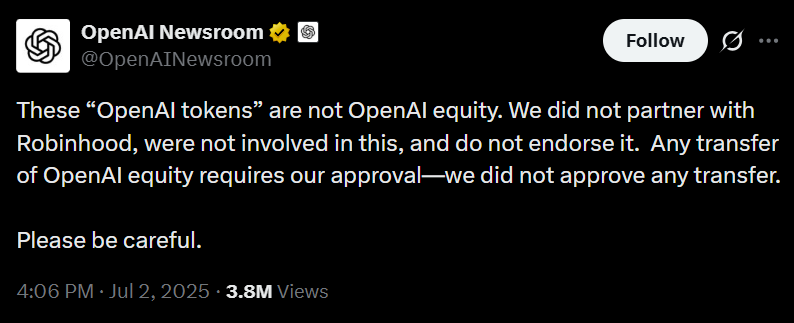
That distinction is notable as interest in pre-IPO investing surges. Several fintech platforms, including Robinhood, have explored offering tokenized exposure to private companies such as OpenAI, though those products generally provide indirect economic exposure rather than legal ownership of the underlying shares. OpenAI last year cautioned investors that these so-called tokenized stocks do not represent equity in the company.
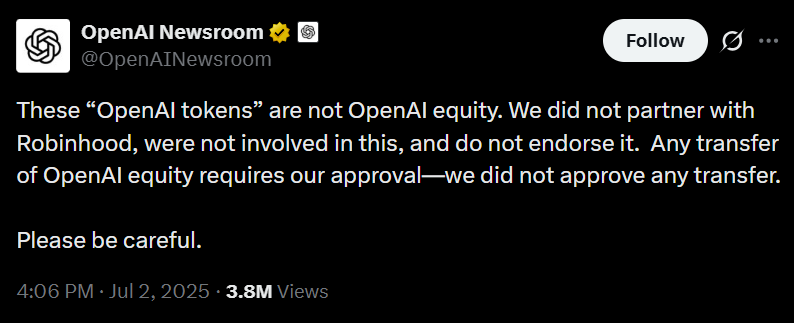
OpenAI’s warning to investors on buying tokenized shares. Source: OpenAI Newsroom
The underlying infrastructure of the venture’s blockchain will be operated by SIX Digital Exchange, a subsidiary of Switzerland’s stock exchange operator, SIX Group. Citi said it is already in discussions with several large private companies about making their shares available on the platform.
Related: Crypto Biz: Crypto infrastructure spending rises as ETF appetite cools
Private markets tend to outperform over time
Growing interest in pre-IPO investing reflects a broader shift toward private markets, where companies are staying private for longer and generating more of their value before reaching public exchanges.
Last December, the American Investment Council published a report citing PitchBook data showing that private equity outperformed the S&P 500 index across five-, 10-, 15- and 20-year investment horizons. This was seen despite the index delivering stronger returns over shorter time periods.
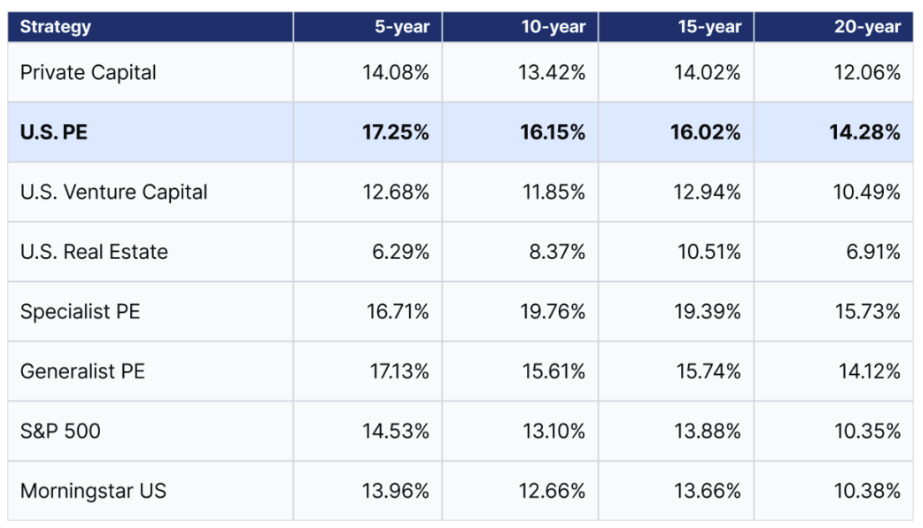
Private equity has outperformed the broader market over longer time horizons. Source: American Investment Council
At the time, American Investment Council President and CEO Will Dunham argued that private equity’s long-term outperformance strengthened the case for expanding retail access through investment vehicles such as 401(k) plans.
The sector’s strong returns, coupled with the trend of companies staying private for longer, have fueled investor interest in pre-IPO opportunities and heightened anticipation for major public listings.
The frenzy surrounding SpaceX’s IPO underscores the trend, with Bloomberg reporting that retail investors alone have placed more than $70 billion in orders for Friday’s offering as of Thursday. Elon Musk’s rocket and AI company is targeting a valuation of $1.8 trillion after its public debut.
Related: Kraken’s xStocks tops $25B in volume with more than 80K onchain holders

TLDR
- SPCX represents tokenized SpaceX shares issued through Backpack Securities.
- Token can be redeemed for underlying equity via regulated brokerage access.
- Sunrise provides infrastructure for issuance and Solana integration.
- SPCX trades on Solana with self-custody wallet support.
- Launch aligns with SpaceX’s Nasdaq listing day for dual-market access.
SpaceX shares will begin trading on Solana alongside Nasdaq listing via tokenization. Backpack Securities and Sunrise will launch SPCX representing SpaceX equity onchain. The token enables trading, redemption, and self-custody across Solana venues.
SpaceX Stock Token Launches on Solana Network
Backpack issues SPCX as a tokenized claim on SpaceX shares. Eligible users can redeem tokens for underlying shares through brokerage. The firms link brokerage accounts with blockchain settlement systems.
Sunrise provides infrastructure supporting the issuance and distribution of SPCX tokens. The token targets Solana for fast settlement and continuous trading access. Holders may transfer SPCX within supported wallets and platforms.
Backpack states SPCX can move between the token and equity forms. The structure allows redemption and re-tokenization through verified accounts. Trading will operate outside normal market hours on Solana.
Solana Trading Expansion for Tokenized Equities
The launch places SpaceX exposure onchain on listing day. Solana supports continuous trading beyond traditional exchange hours. Backpack integrates custody tools with regulated brokerage services.
SPCX can be stored in self-custody wallets securely. Users can trade tokens across supported Solana venues globally. The system mirrors traditional equity ownership through blockchain records.
Backpack CEO Armani Ferrante described portability across financial systems. “It is making underlying securities portable across financial systems.” The statement highlights integration between brokerage and blockchain rails.
Tokenized equities continue expanding across crypto markets this year. Firms experiment with blockchain rails for traditional asset exposure. SPCX enters this trend with regulated brokerage backing.
Solana supports high-speed settlement for tokenized trading systems. Developers build infrastructure for continuous financial market access. Backpack uses this network for SPCX distribution and trading.
Sunrise coordinates the issuance process with regulated brokerage partners. Token structure links shares with redeemable blockchain units. Users access SPCX through approved wallets and platforms.
Nasdaq listing proceeds separately from onchain SPCX trading. Both markets operate simultaneously for SpaceX exposure access. This dual structure enables parallel price discovery mechanisms.
Backpack ensures compliance through brokerage custody arrangements. Redemption requests convert tokens into underlying equity shares. Verification processes govern eligible participant access.
Solana venues support peer-to-peer SPCX transfers. Self-custody options give users direct asset control. Trading remains active beyond conventional market schedules.
The product aligns tokenized finance with traditional equity markets. Backpack integrates brokerage systems with blockchain infrastructure layers. Sunrise manages technical issuance workflows for token distribution.
SPCX availability begins with the SpaceX Nasdaq listing day. Trading access expands through Solana-based applications and wallets. Backpack continues rollout across supported jurisdictions and partners.


New data from on-chain analytics firm Santiment shows that trading activity across crypto’s largest non-stablecoin assets has fallen to levels not seen since 2024.
According to the company, the slowdown is pointing to a market where traders have largely stepped back, a condition that has often appeared before relief rallies when confidence eventually comes back.
Crypto Traders Retreat as Volumes Dry Up
Santiment’s analysis, shared on X on June 11, noted that top-cap assets are seeing two-year low trading volumes and framed that as a potential capitulation signal rather than the start of another leg down.
“Traders appear reluctant to aggressively buy or sell as macro uncertainty, geopolitical tensions, and recent liquidations keep participants on the sidelines,” wrote the firm.
While low activity can appear bearish, Santiment noted that periods of weak participation have historically come just before some of crypto’s strongest recoveries. The firm said markets rarely reverse higher when investors are actively chasing prices and that turning points often emerge when traders become disengaged and expect little movement.
Data from CoinGecko supported Santiment’s take on trading flow, whereby the 24-hour trading volume of Bitcoin amounted to about $30 billion, dropping by almost 20% when compared to that of the previous day. Ethereum’s, though, was a much more modest 1.40%, while Tron (TRX) and BNB saw activity dip by 4% and 10%, respectively.
Still, some altcoins registered upticks, with Solana (SOL), for instance, seeing a 23% jump in its 24-hour trading volume while that of Ripple’s XRP went up 11%.
Santiment says that this type of market situation, where capital is sitting idly despite continued development and institutional involvement in the industry, is becoming more like one looking for a new reason to make a move.
“If confidence begins returning, just a small amount of inflows could be enough to spark a much needed relief rally as sidelined capital re-enters the sector,” was their verdict.
On-Chain Signals Are Not Helping
The lack of participation from crypto investors isn’t happening in a vacuum, given that the on-chain backdrop has grown more difficult recently.
For example, data published earlier this week by CryptoQuant contributor Axel Adler Jr. showed that BTC’s Realized Cap 30-day change had fallen to -1.1%, the deepest level of capital outflows since mid-March, with around $12 billion leaving the network since a high point in May.
Meanwhile, Bitcoin’s adjusted SOPR, which measures whether coins are being sold at a profit or loss, has stayed below 1.0 for 13 straight days. That reading means that the BTC moved on-chain is being sold at an average loss, which Adler associated with weaker holders leaving the market.
The post Crypto Trading Volumes Plunge to 2-Year Lows as Market Fatigue Sets In appeared first on CryptoPotato.


Exchange flows remain broadly normal, while stablecoin supply has seen little meaningful contraction. More speculative corners of the digital asset market also continue attracting capital. Products linked to higher-risk crypto assets are still gathering inflows, something Dori says would be unlikely if investors were abandoning the asset class altogether.
Perhaps the strongest argument against the IPO-rotation theory comes from derivatives markets.
Dori pointed to a decline in CME bitcoin futures open interest that has coincided with ETF redemptions. That relationship suggests a significant portion of the outflows may be linked to the unwinding of cash-and-carry arbitrage trades rather than investors reallocating toward equity offerings.
A cash-and-carry trade is a popular institutional arbitrage strategy that seeks to profit from the gap between bitcoin’s spot price and futures prices. Investors buy spot bitcoin, often through an ETF, while also selling bitcoin futures contracts. As long as futures trade at a premium to spot prices, the investor can earn a relatively low-risk yield when the contracts converge at expiry.
When that premium narrows, or funding conditions become less attractive, traders unwind the position by selling their spot exposure and closing their futures shorts. That process can generate ETF outflows even when investors are not turning bearish on bitcoin itself. Instead, the arbitrage opportunity has simply become less profitable.

Raydium, the Solana-based decentralized exchange, was drained of $1.34 million on June 10, 2026, when an attacker exploited five deprecated liquidity pools from its legacy AMM V3 program, a smart contract vulnerability that had sat dormant on-chain for five years.
The attacker, whose Solana address ends in ‘Bq33QVk,’ made off with approximately $900,000 in USDC, $357,000 in SOL, and $86,000 in RAY tokens.
— Solana Hub (@SolanaHub_) June 10, 2026
 Raydium confirms $1.34M exploit on legacy AMM V3 pools. No current users affected; full compensation from treasury. pic.twitter.com/tqmKATA2tH
After draining the pools, the exploiter bridged all funds from Solana to Ethereum via a cross-chain bridge, then deposited them into Tornado Cash to obscure the trail, a standard cross-chain laundering sequence that leaves recovery prospects slim.
Discover: The Best Crypto to Diversify Your Portfolio
The LP Mint Validation Flaw: How Fake Tokens Emptied Real Pools
The root cause was a smart contract vulnerability in Raydium’s legacy AMM V3 program, a DeFi exploit enabled by insufficient LP token validation. In any standard automated market maker, liquidity pool shares are represented by LP tokens that track a provider’s proportional stake. When funds are withdrawn, the contract verifies the LP tokens being burned match the pool’s legitimate mint.
Raydium’s deprecated AMM V3 program failed to perform that check. The attacker created a fake SPL token mint unrelated to any real Raydium liquidity pool, minted a single unit of that counterfeit LP token, then called the legacy withdraw function.
The old contract treated the attacker as a 100% LP shareholder and released the entire pool’s reserves.
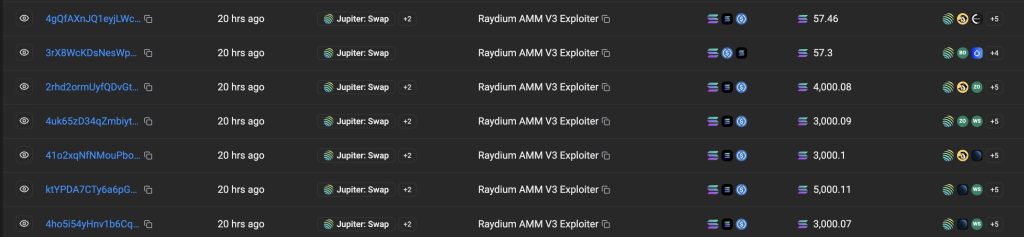
The sequence was repeated across all five deprecated pools, Sollet USDT–RAY, Sollet ETH–RAY, SRM–RAY, USDC–RAY, and RAY–SOL, draining approximately 150,177 RAY, 5,603 SOL, and 893,700 USDC in total.
Pseudonymous Raydium contributor 0xInfra confirmed on X that the attack was caused by “a self-contained logic flaw” and explicitly ruled out any key compromise or authority-level issue, meaning no propagation risk exists to current Raydium programs.
The December 2022 Raydium hack, a roughly $4.4 million loss caused by a private key theft – had pushed the team to harden operational security and migrate to audited contracts.
The June 2026 incident is a structurally different failure: not an operational breach, but a legacy codebase left callable on-chain with real assets still sitting inside it.
Tornado Cash Exit: Funds Bridge to Ethereum, Trail Goes Cold
On-chain investigators flagged the exploit in real time as the attacker aggregated USDC, SOL, and RAY across the five drained pools before moving cross-chain.
The full balance was bridged from Solana to Ethereum, then routed through KuCoin and FixedFloat before landing in Tornado Cash, the privacy protocol that remains the exit ramp of choice for DeFi exploit proceeds.
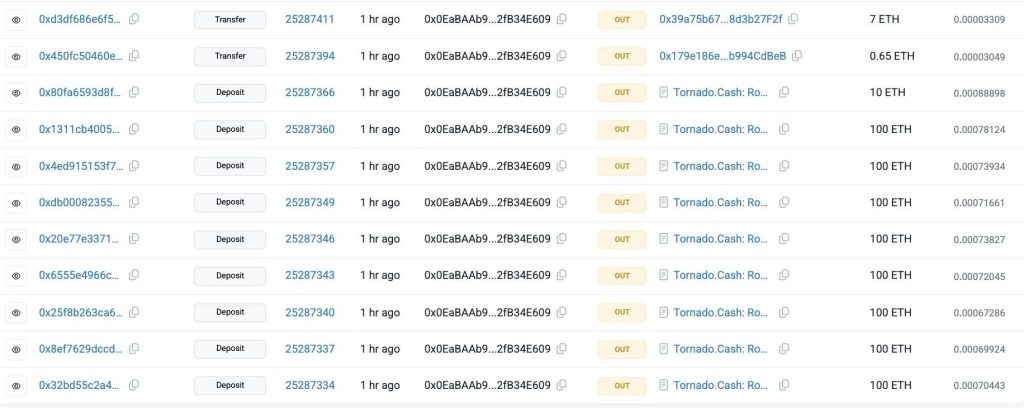
Community analysts tracking the wallet ending in ‘Bq33QVk’ confirmed the complete cross-chain exit, noting the attacker did not attempt to liquidate funds through Solana-native venues.
Once inside Tornado Cash, transaction-level tracing breaks down. No funds are reported frozen or flagged by centralized exchanges at this time.
No Active Users Affected, Raydium Treasury to Cover Losses
The most important immediate fact for Raydium users: no active accounts or current pools were touched. “No current users of Raydium are affected by this exploit or would have been able to interact with these pools through the UI since their deprecation,” 0xInfra stated.
The deprecated AMM V3 pools were invisible in the front-end and inaccessible through normal user flows.
Raydium confirmed it will repay all stolen funds in full using its protocol treasury. Legacy AMM V3 program IDs are being formally retired to prevent further calls, and the team has launched a comprehensive security review of all mainnet and legacy code paths. The reimbursement timeline has not been specified publicly.
RAY token is up around 2% in the 24 hours following the incident, trading at $0.578. The token has shed 7% over the past week amid broader Solana ecosystem weakness and sits 96.6% below its all-time high of $16.83.
Discover: The Best Token Presales
The post Raydium Hit With $1.34M Exploit via Fake LP Tokens on Deprecated Solana Pools appeared first on Cryptonews.

El Nino has formed in the Pacific and could set records, forecasters say

Zebra Technologies Corporation (ZBRA) Presents at 46th Annual William Blair Growth Stock Conference – Slideshow

Solana Foundation Launches Frontier Traders, an Institutional Program for $500M+ Volume Firms



-

 Fashion6 days ago
Weekend Open Thread: Evereve – Corporette.com
-
 Crypto World6 days ago
Jensen Huang Approves Samsung, SK Hynix, and Micron for NVIDIA (NVDA) HBM4 Memory Supply
-

 Crypto World4 days ago
Anatomy of the June crypto crash: Fed, Iran, Saylor
-
 Entertainment5 days ago
The Best Mystery Series of All Time Is Surging on Streaming 30 Years After It Ended
-

 NewsBeat4 days ago
Alexander Zverev wins the French Open to finally earn a 1st Grand Slam title
-

 Tech6 days ago
Suspicious Polyfill login prompts pop up on Toshiba, Muji websites
-
Crypto World5 days ago
Senator Cynthia Lummis Calls CLARITY Act the Most Consequential Financial Legislation of This Generation
-

 Tech7 days ago
Microsoft launches MXC, an OS-level sandbox for AI agents, with OpenAI and Nvidia already on board
-

 Tech4 days ago
Microsoft unveils seven homegrown AI models in new bid for ‘long term self-sufficiency’
-

 Business7 days ago
(VIDEO) Justin Bieber Delivers Surprise Happy Birthday Serenade to Diners at Los Angeles Mexican Restaurant
-
 Business5 days ago
The Pain Points Taking a Fragile Tech Rally Down a Notch
-

 Business4 days ago
High Stakes for Wembanyama as New York Pushes for 3-0 Lead
-
 NewsBeat4 days ago
Alexander Zverev conquers demons and outlasts Flavio Cobolli to win French Open for first major title
-
 Crypto World3 days ago
Eli Lilly (LLY) Stock Surges 4% Following Breakthrough Sleep Apnea Trial Results
-

 Tech6 days ago
Von der Leyen’s AI envoy pick draws conflict-of-interest fire
-

 Tech6 days ago
Meta steals a tactic from Tesla and builds data centers in tents
-
Crypto World7 days ago
LBank Surpasses 25 Million Users Worldwide as AFA Partnership Continues to Drive Global Growth
-

 Tech6 days ago
Hackers now exploit SolarWinds Serv-U flaw to crash servers
-

 Crypto World4 days ago
Trump’s AI Ownership Plan Could Benefit Anthropic at OpenAI’s Expense
-
 Sports2 days ago
Bangladesh beat Australia after 20 years in ODIs, register only their second win over six-time world champions | Cricket News
You must be logged in to post a comment Login