



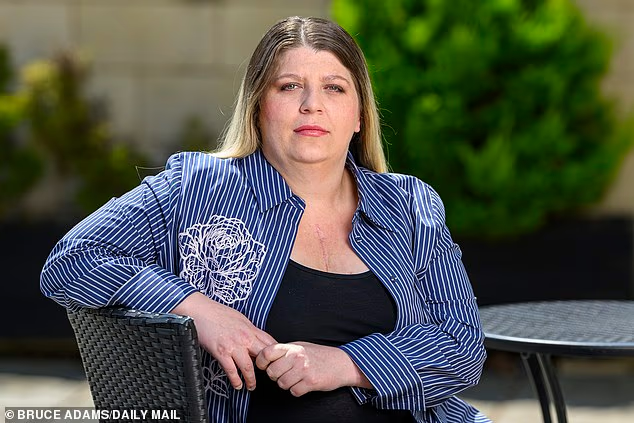
Sarah Wilson dislikes the term ‘grooming gang’. She would prefer the men who stole her childhood to be known less euphemistically. ‘They were monsters: child rapists, paedophiles. To call them “groomers” softens their crimes,’ she says.
For five years, from the age of 11, Sarah was enslaved to Muslim men who plied her with alcohol and Class A drugs until she was insensible, then raped her.
The first assault took place in her primary school playground, where she was forced to perform oral sex on a man; the location emphasising both her vulnerability and – although it was past school home time – the flagrant disregard of the authorities who might have protected her.
Now 34, Sarah’s fight for justice has been long and arduous. It was not until 2024, more than two decades after the first of a series of heinous crimes was committed against her, that she was finally given a voice.
And hers is strident and forthright. Courageously, she re-lived the horror of her abuse to secure the convictions in court of seven of the men – she estimates the true count to be around 100 – who raped and abused her.
She has given evidence in three separate trials at Sheffield Crown Court and her abusers were given sentences of between six and 25 years. The most recent ended in February this year and saw taxi driver Riyasth Hussain, who raped her twice when she was 13 or 14, jailed for 20 years.
Meanwhile, a two-week trial in September 2025 had found Obaidullah Omari, 46 – who had also abused Sarah – guilty of three counts of rape and two counts of indecent assault. He was given a 19-year prison sentence. Her abusers formed part of a notorious criminal network in Rotherham, South Yorkshire, that flouted the law and were ignored by police until the National Crime Agency’s Operation Stovewood in 2014 finally began to bring them to justice.
Sarah Wilson has given evidence in three separate trials at Sheffield Crown Court and her abusers were given sentences of between six and 25 years

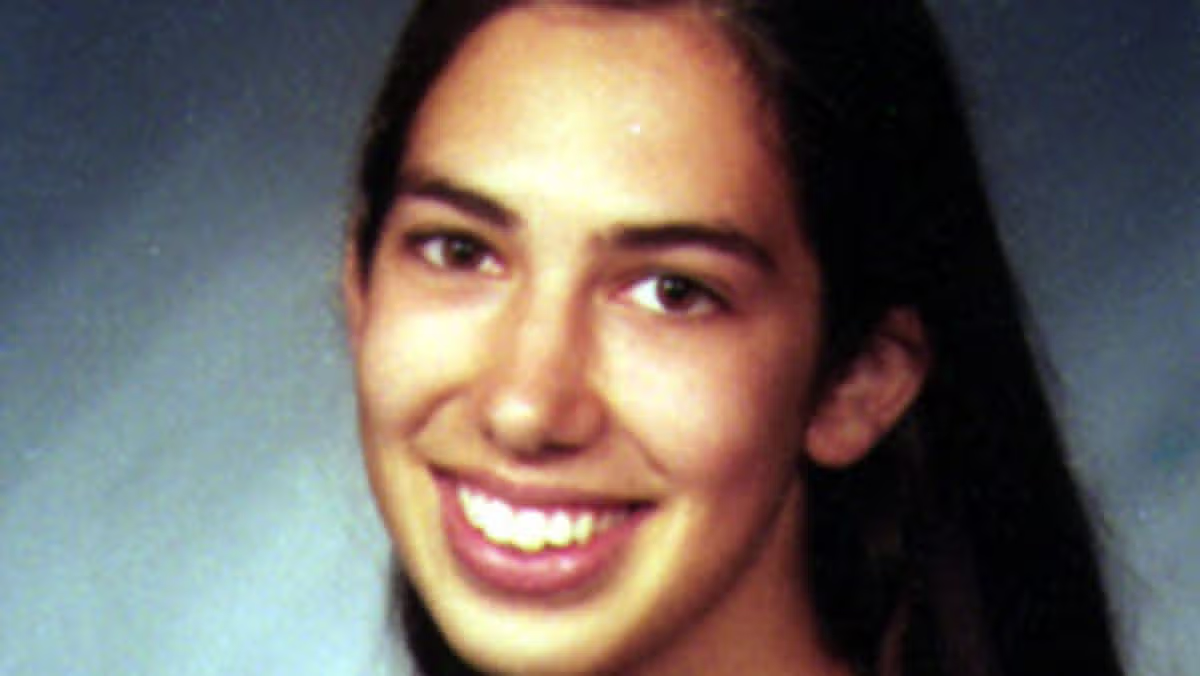
Between the ages of 11 and 16, Sarah was abused by grooming gangs in Rotherham who plied her with drugs and alcohol. She is seen at 14 years old
Now Sarah, who has waived her legal right to anonymity, is steeling herself for yet another fight. She has been told that under the Government’s new Sentencing Act of 2026 – aimed at freeing up extra space in our overcrowded prisons – Hussain and Omari, perpetrators of sickening abuses against her, as well as other women and children, could be eligible for release in just six and five years respectively.
‘I’m just so angry,’ she tells me. ‘If they’re released this early I’ll have been fighting for justice longer than they’ve spent in prison. I’m actually frightened of Hussain. He’s a very dangerous individual; completely unhinged. He didn’t groom me or try to befriend me, but whenever he saw me, he raped me. I’m frightened that if he comes out he’ll kill me.
‘In my mind he’s the most dangerous of all the men who abused me. I relived the trauma of what I endured as a child in court, and now this is another trauma I’ve got to face. I’ve looked Hussain in the eyes and thought: “In the end I won, you b******.”
‘But if he’s released after six years, he’ll have won.’
Indeed, such is the widespread fury about the early release scheme that last week Prime Minister Andy Burnham announced an ‘urgent review’ of the policy ahead of its planned start in September. While Sarah ‘welcomes’ the review, she fears it will not go far enough. ‘We don’t yet know if dangerous offenders like the men who abused me will be exempt from the scheme,’ she says.
‘Rapists and paedophiles should serve their entire sentences. I don’t care what colour their skin is, what religion they are: if you abuse a woman, man or child you should serve your whole sentence.
‘If it was up to me, Hussain and Omari would never see daylight again. They’re monsters who have never shown any remorse.
‘They would carry on offending if they were released. If you’re attracted to children, you always will be. I was frightened for my life when I was a kid. Now I’m frightened all over again – this time of retribution.’
Sarah was first given hope that justice would prevail when Baroness Jay reported in 2014 on the sexual exploitation of hundreds of girls in Rotherham, by Muslim men.
‘When I started co-operating with the National Crime Agency, I felt sure I’d finally get justice for the little girl no one would fight for. Although I’d been to the police before and been ignored, as a grown woman I knew they couldn’t crush or silence me anymore.’
Indeed, Sarah, who suffers from congenital heart disease, was so determined to testify in court, she begged her medical team to defer open-heart surgery so she could stand in the witness box.
Reluctantly they agreed and, after the last trial ended, she underwent a 12-hour operation. The scar bisecting her chest where her sternum was opened testifies to their ‘wonderful’ work.
‘I knew that every word I said in court was true,’ she continues. ‘I’ve got a strong sense of justice and, when Omari and Hussain were sentenced, I felt I’d achieved it. But now I’m fighting for justice again. We need a system that is weighted in favour of survivors, rather than offenders.’

Obaidullah Omari, 46, was found guilty of three counts of rape and two counts of indecent assault. He was given a 19-year prison sentence

A trial which ended in February this year saw taxi driver Riyasth Hussain, who raped Sarah twice when she was 13 or 14, jailed for 20 years
Sarah, a mum to two young children, is one of five Yorkshire women who have signed a letter to the Government urging it to exempt perpetrators of sexual abuse from early release.
Today she recalls how her young life descended into hell.
She was 11 when she was introduced by a 14-year-old girl to two young men of Pakistani heritage, and forced to perform oral sex on one of them. Friendless and bullied at school, she was flattered by the attention of the older girl: ‘Today I want to kill that girl. She enticed me and encouraged me. She was told to recruit younger girls because she’d become too old for her abusers. She did what she was told.
‘After the sex act I felt disgusted and dirty, confused. I was too young to consent to anything.
‘But people who haven’t been sexually exploited don’t understand that, at the beginning, you also feel a sense of belonging. You become friends with men who are older than you. Some of them drive cars, they pay you compliments, give you food, cigarettes, then drugs. My mum recalls that I came home with gifts of jewellery and make-up.
‘Suddenly I felt accepted, as if I was part of a group. But you have to give something back: your body.
‘Then it becomes, “We own you” and you’re given heroin, amphetamines, cocaine until you’re dependent. In reality I was just a piece of fresh meat, recruited by an older girl whose so-called “boyfriend” liked having sex with children. Eventually, I was driven round the country, trafficked and gang-raped.’
When she was 12, she lost her virginity through rape to a 30-year-old man. The perpetrator, Mohammed Zameer Sadiq – now 52 – was already serving a 20-year sentence for sexual offences against women and other children when, two years ago, he was convicted of the attack on Sarah and given a 15-year sentence.
Three men violated her in quick succession. ‘I was raped on a bench and it really hurt me. They’d say, “If you don’t do this we’ll take your phone off you.” Or they’d take my phone anyway and leave me stranded.
‘By the time I was 12, I had the numbers of 177 gang members in my phone. When they demanded, I went to them; I didn’t dare disobey. They’d batter me or threaten my family if I did.’
Sarah’s distraught mum Maggie, now 64, a lone mother to four children holding down two jobs, was desperate to wrest her daughter from the abusers.
Maggie confronted one of them: ‘She actually got him by the throat,’ says Sarah. ‘She was horrified but completely helpless. He just laughed in her face when she threatened to report him.
‘Mum really tried her best. She went repeatedly to the police when I went missing. Eventually the police said they’d fine her for wasting their time and being a nuisance. She was told I’d made a “lifestyle choice”, that I was a “dirty little prostitute”.
‘Actually I was a child. Only 12. I had no choice. And I was permanently intoxicated. What else was Mum supposed to do?’
I ask her to pinpoint the worst thing that happened to her: the memories come back as bleak snapshots. ‘I was driven to Birmingham and taken to a house. They marched me upstairs to a room with a filthy mattress on the floor. You’re given drink and more drink. Drugs. Then men raped me, one after the other, maybe 12 of them.
‘I remember focusing on a cobweb in the corner. I made my body go limp and my mind go blank. You do what you have to do to survive. If you don’t, you’re f*****. It all becomes a blur.’
So it was that Sarah’s childhood was stolen.
She was decried as a prostitute but she was never given money. She wonders now if cash did, in fact, change hands among her abusers.
She truanted from school – she left without qualifications, although she wanted to be a nurse, an ambition she still hopes to realise – and, aged 12, was sent to a children’s home for her own ‘protection’.
But the people who were meant to be her guardians actually became facilitators.
‘It got even worse for me because the children’s home didn’t even report me missing. The staff didn’t give a s***.’
By the age of 16, the gangs were tiring of her – she was ‘too old’. Broken, scared and defiled, she was discarded.

Sarah’s life, quiet now, revolves entirely around raising her two sons, and she has rebuilt her relationship with her mother
It is a measure of her steely resolve that she has since rebuilt her life, resumed her education, written a book about her experiences and is raising her two sons to be thoughtful and caring members of society. She has also rebuilt the relationship with her mum, who is now an integral part of her family life.
Sarah’s manner is warm, her views uncompromising and trenchantly expressed. Her life, quiet now, revolves entirely around the children she so palpably adores. She sets them a good example – does not drink, party, take drugs.
But her vulnerability is evident. She is still prey to flashbacks, nightmares and eating disorders.
‘I either eat too little or too much. I take medication to sleep, pills for anxiety.’
It is smells that awaken the most potent memories: ‘A certain aftershave that one of my perpetrators wore. I get a whiff of it and the reaction is physical. I feel sick. A cherry-scented air freshener in a car. I cannot tolerate it. I cannot get in a car that smells of the air freshener.’
She says she’s speaking now ‘for the children who are our future’.
‘I feel I have no choice but to speak out against this new law,’ she says.
‘I’d say to the Justice Minister who supports it: “Imagine if it was one of your own children who had been abused. It can happen to any child, from all walks of life, if they are vulnerable. Would you want that paedophile rapist freed early to walk our streets?”’
Violated by Sarah Wilson is published by Harper Element.




















































You must be logged in to post a comment Login