

Crypto World
Whale Buys $22.3M in SPCX as Synthetic Price Gains 30% Premium


Crypto traders are already positioning around SpaceX’s IPO through a synthetic perpetual market, and one large account is sitting on paper gains—highlighting how quickly equity speculation can migrate into leveraged derivatives.
According to data on Hypurrscan, a whale has opened an isolated 2x leveraged long on “xyz:SPCX,” a synthetic pre-IPO perpetual contract tied to SpaceX. The position is currently valued at about $22.29 million and, based on entry and recent pricing, is showing more than $1.15 million in unrealized profit after only limited funding costs.
Key takeaways
- The whale’s isolated 2x long on synthetic SPCX is worth about $22.29 million, with unrealized profit of roughly $1.15 million.
- Synthetic SPCX trades near $175—around 30% above SpaceX’s $135 IPO offer price—suggesting traders expect a strong first-day move.
- IPO history cited from Jay Ritter’s research shows first-day outperformance often benefits offer-price holders more than late buyers.
- Multiple valuation estimates from traditional investors point to potential post-listing downside, which could matter for leveraged traders if prices revert.
A large leveraged bet already in the money
The Hypurrscan listing for address 0x9cc10bd3c7e2486c0ae4623e4f7cc3ff143fac56 shows the trader holding an isolated long position on xyz:SPCX. The notional size is about $22.29 million, and the account appears to have entered near $168.
With the synthetic market recently trading around $175, the whale’s position is left with an estimated unrealized gain of approximately $1.15 million. The position has reportedly incurred just over $500 in funding fees so far—an important detail for traders because funding can erode profits on leveraged perpetuals if the market remains on one side for long periods.
While the account shows strong mark-to-market performance, it also implies downside risk. The liquidation level is reported around $93.27; if SPCX were to fall to that threshold, the position could face an estimated loss of roughly $9.4 million.
Why synthetic SPCX is trading at a premium
SpaceX priced its IPO at $135 per share and plans to raise about $75 billion by selling roughly 555.6 million shares, putting the company’s valuation at around $1.77 trillion. The stock is expected to begin trading on Nasdaq under the ticker SPCX.
In the synthetic perpetual market, traders are effectively paying up. At roughly $175, SPCX is trading about 30% above the IPO price, according to the coverage and chart references cited in the original reporting. That premium implies crypto derivatives participants are leaning toward a strong early rally—potentially before broader equity trading fully reflects the listing.
Market-implied expectations across other platforms align with the same direction. Bloomberg cited derivatives “implied” valuations suggesting SpaceX could be priced around $2.4 trillion, more than 35% above the IPO valuation. Polymarket also reportedly placed odds that the company will land in a $2 trillion to $2.5 trillion market-cap range on the first day of trading.
For traders, the practical takeaway is that the synthetic market is not merely tracking the IPO; it is pricing in a sequence of outcomes. When the derivative premium is large, it can reflect optimism—but it can also set up crowded positioning, especially if the first prints in the equity market fail to match expectations.
IPO dynamics: first-day strength doesn’t always help later entrants
Even with a 30% premium signaling aggressive demand, IPO history cautions against interpreting early pricing as a durable trend—particularly for investors entering after the initial enthusiasm.
According to Jay Ritter’s IPO database (as cited in the original article), US IPOs from 2020 to 2025 averaged about 30% first-day gains. However, Ritter’s research also emphasizes that much of that upside accrues to investors who actually receive shares at the offer price. Buyers who arrive only after the opening print typically face a different setup as sentiment and order-flow normalize.
Ritter’s longer-run analysis (2001 to 2024) further indicates that companies with positive first-day returns averaged a 29.6% debut gain, but later underperformed the broader market by about 8.5 percentage points over the next three years. The pattern becomes sharper for higher-valuation offerings: IPOs with trailing sales above $100 million and price-to-sales ratios above 40 reportedly delivered an average three-year return of -44.8% for buyers at the first close.
The original reporting frames SpaceX as one of the most oversubscribed IPOs in recent memory, and it notes that the company is going public at nearly 94 times trailing sales—an attribute that, in Ritter’s framework, is associated with more challenging post-listing performance.
Recent listings cited as analogs underline how quickly “day-one” attention can fade. Cerebras (CBRS) reportedly opened significantly above its offer price, then declined sharply after the first session. The original article also references post-debut pressure in deals like Rivian (RIVN) and Uber (UBER), connecting part of the drawdown to the timing of lockup expirations that can increase supply.
Traditional valuation warnings add pressure to the bullish trade
Beyond derivatives pricing, traditional valuation perspectives also raise the question of whether synthetic SPCX’s premium is justified.
Morningstar’s Nicholas Owens, as cited in the original coverage, valued SpaceX at about $780 billion—roughly 55% below the IPO price—arguing that the stock appears significantly overvalued and that investors should wait for the share price to settle after listing.
NYU professor Aswath Damodaran, also cited, estimated fair value around $1.25–1.3 trillion and described the $135 offer as “rich.” Another view from analyst The Fundamental Investor, referenced via an X post, suggested the stock is likely to trade below the IPO price, potentially leaving early retail buyers underwater for years.
For crypto traders using leverage, these warnings matter because they intersect with the mechanics of perpetuals. If SPCX begins to mean-revert toward a range closer to offer-price expectations, leveraged longs—especially those initiated at the first signs of premium—can unwind quickly due to margin constraints and liquidation risk.
That makes the whale position’s margin profile a key monitoring point. With liquidation indicated around the low $90s, the trade has meaningful room on paper if the market stays elevated, but it also carries asymmetric risk if the IPO underwhelms relative to what the synthetic premium implies.
Going forward, readers should watch how the synthetic SPCX premium evolves once the IPO opens on Nasdaq—particularly whether early equity prints validate the ~30% uplift or trigger a rapid premium compression in the perpetual market. Until then, the gap between traditional valuation skepticism and crypto derivatives pricing is likely to remain the central tension for anyone taking leveraged exposure.

Bitcoin’s price tried to break out above $64,000 yesterday, but it was stopped, and it still trades close to that level on Saturday morning.
Most larger-cap alts have posted minor gains over the past day, including ADA and HYPE, both up around 3%. In contrast, XMR has dumped hard.
BTC Calms at $64K
The primary cryptocurrency reacted well to the massive price decline observed during the first week of June, culminating that Friday in a nosedive to $59,100. After dumping to this 19-month low, the asset rebounded and jumped toward $64,000 on June 8.
The controversial developments on the US-Iran war front, which included new attacks against numerous countries in the region, halted bitcoin’s attempted recovery. So did the May CPI numbers, which were the highest in years.
BTC dipped below $61,000 on a couple of occasions during the week, but managed to defend that level and aimed at a more profound recovery. The highest price came yesterday, just hours before SPCX went live for trading on Wall Street, with a surge to almost $64,500. However, the bears intervened, and BTC now trades just under $64,000.
Its market capitalization has climbed to almost $1.280 trillion on CG. Its dominance over the alts, though, has increased further to 56.4%.

XMR Dumps
Ethereum continues to inch closer to $1,700 after another minor daily increase. BNB, XRP, and TRX have marked similar increases of under 1%. DOGE and SOL are up by 1.6%-1.7%, while HYPE has jumped by more than 3% to $59. Cardano’s native token continues with its recovery attempts. The token is up by 3% to well above $0.17 after the recent massacre.
In contrast, XMR has erased all the gains from earlier this week, dropping by more than 12% to $340. NEAR and ZEC are also slightly in the red. In contrast, BEAT, TAO, and ICP have marked substantial gains of up to 11%.
The total cryptocurrency market cap has remained near $2.270 trillion on CG.

The post Bitcoin (BTC) Calms Close to $64K, Cardano (ADA) Eyes Recovery: Weekend Watch appeared first on CryptoPotato.
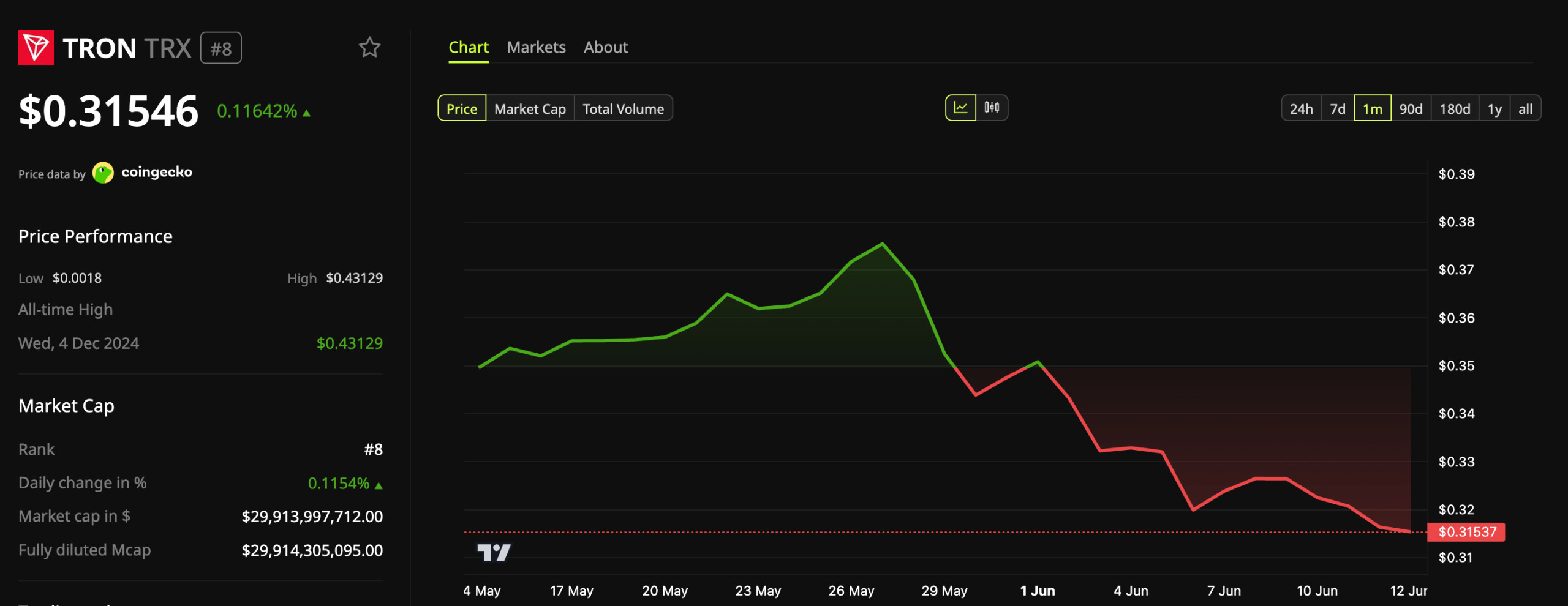
Tron (TRX) ranked as the worst weekly performer among the top 10 crypto assets, even as three bullish indicators formed beneath the price.
TRX traded near $0.315 on Saturday, holding the eighth spot by market value at roughly $29.9 billion. The token fell about 1.5% over the week. It also dropped close to 10% across the past 30 days.

3 Bullish Factors Stack Up for Tron as Price Dips
Price action lagged the supportive on-chain and corporate signals. Daily transactions on Tron surpassed 14.3 million, a record for the network.
Activity climbed 15% over the previous 30 days. The figures point to rising demand for the chain’s settlement capacity.
Follow us on X to get the latest news as it happens

CertiK also reported that the stablecoin value on Tron set a record this quarter. It reached $90.96 billion on May 24 and sits near $90.3 billion today. That marks a 4.9% rise since the end of Q1 and a 16.4% gain over the past year.
Decentralized exchange (DEX) activity also recovered. The firm noted that DEX volume rose 28% over the past 30 days, rebounding from multi-quarter lows.
In addition to network growth, institutional accumulation also continued. Tron Inc., the Nasdaq-listed treasury company, bought 159,118 TRX today. The purchase lifted its holdings above 700.3 million TRX. Overall, the firm has added 1.8 million TRX so far this month.
Regulated market access marked the third supportive signal. TRX gained a spot listing on Bitnomial, a CFTC-regulated US exchange and clearinghouse. The June 5 debut expanded access for American investors and institutions.
Days earlier, OKX Europe listed TRXUSD expiry perpetuals. The MiFID-regulated crypto derivatives product is available to eligible traders across 30 European Economic Area jurisdictions, with up to 10x leverage.
Together, the two listings stretched institutional reach across two continents. Tron founder Justin Sun framed the move as a step toward broader market participation.
“As demand for compliant digital asset products continues to grow, the availability of TRX on regulated platforms supports broader market access, greater transparency and the continued maturation of the digital asset ecosystem,” Sun said.
On the technical front, BeInCrypto’s analysis found that TRX trades inside an ascending triangle on the weekly chart, with resistance near $0.365 and a rising trendline that has held since mid-July 2024.
A confirmed break above resistance could open the door to further gains.
Subscribe to our YouTube channel to watch leaders and journalists provide expert insights
The post Tron Shows 3 Bullish Signals While Topping Weekly Loser List appeared first on BeInCrypto.


Anthropic has suspended access to its newly launched Fable 5 and Mythos 5 artificial intelligence models after receiving a U.S. government export control directive tied to national security concerns.
Summary
- Anthropic suspended Fable 5 and Mythos 5 after receiving a U.S. export control directive.
- The company said officials cited national security concerns linked to a potential jailbreak method.
- The move comes days after the launch of the new AI models and amid a major infrastructure expansion push.
According to a statement published by Anthropic on Friday, the company received the directive at 5:21 p.m. ET, instructing it to block access to Fable 5 and Mythos 5 for all foreign nationals, regardless of whether they are located inside or outside the United States. The order also applied to foreign-national employees working at Anthropic.
Faced with the directive, Anthropic said it disabled both models for all users to ensure compliance with the government’s requirements. The company added that its other models, including Opus 4.8, remain available and are not affected by the restrictions.
“We are complying with the government’s legal directive and are removing access to Fable 5 and Mythos 5 for all users.”
The move comes only days after Anthropic introduced Fable 5 as a generally available Mythos-class model and released Mythos 5 for a limited group of approved cybersecurity and infrastructure users.
According to Anthropic, Fable 5 was designed to handle longer and more complex tasks than previous Claude models and delivered strong performance across software engineering, scientific research, finance, vision, memory, and knowledge work.
Government concerns center on potential model jailbreak
While authorities did not provide detailed evidence supporting the order, Anthropic said it believes the government is concerned about a possible jailbreak technique that could bypass some of Fable 5’s safeguards.
According to Anthropic, officials have so far presented only verbal evidence of what the company described as a narrow, non-universal jailbreak. The company said the reported method involves asking the model to analyze a specific codebase and identify or repair software vulnerabilities.
Anthropic explained that a non-universal jailbreak differs significantly from a universal jailbreak because it does not broadly remove a model’s safety protections across a wide range of tasks.
“We disagree that the finding of a narrow potential jailbreak should be cause for recalling a commercial model deployed to hundreds of millions of people. If this standard was applied across the industry, we believe it would essentially halt all new model deployments for all frontier model providers.”
At the same time, Anthropic said it is working with authorities and believes the directive may have resulted from a misunderstanding. The company stated that it is seeking to restore access as quickly as possible.
Infrastructure expansion continues despite model restrictions
Even as access to Fable 5 and Mythos 5 remains suspended, Anthropic continues to expand its computing capacity for future AI systems.
As reported by crypto.news, private credit firms Blackstone and Apollo Global Management are syndicating approximately $36 billion in financing to support Anthropic’s next phase of infrastructure spending. Reuters reported that the funds will be used to acquire custom tensor processing unit chips from Google, backed by Broadcom technology, which Anthropic plans to lease for its AI operations.
Separately, Anthropic has been urging governments to establish rules for frontier AI systems as model capabilities advance. The company has proposed policy measures covering dangerous deployments, independent evaluations, cybersecurity safeguards, and economic preparation for workers affected by AI adoption.
Those policy recommendations now arrive as Anthropic finds itself at the center of one of the most significant government interventions involving a newly released frontier AI model.

TLDR:
- FinCEN clarifies how banks can share suspected fraud data under Section 314(b) program rules
- Guidance allows sharing of IP addresses, login patterns, and fraud indicators across institutions
- Move supports Treasury effort to disrupt fraud networks through faster interbank coordination
- Regulators push risk-based AML modernization to improve fraud detection and compliance efficiency
FinCEN issued updated guidance on information sharing under Section 314(b) of the USA PATRIOT Act on June 12, 2026. The move clarifies how banks and financial institutions can exchange fraud-related data in real time.
Treasury officials said the framework targets fraud, money laundering, and other illicit financial activity. The guidance arrives as regulators intensify efforts to curb scams affecting both traditional finance and crypto markets.
FinCEN Fraud Guidance Expands 314(b) Information Sharing for Financial Institutions
The Financial Crimes Enforcement Network clarified how institutions can share information on suspected fraud cases under Section 314(b). Eligible banks, credit unions, and other financial firms can now exchange data linked to illicit activity.
The update aims to remove uncertainty that previously slowed cross-institution cooperation. It also reinforces legal safe harbor protections for participating institutions. This clarification strengthens operational confidence for compliance teams handling real-time fraud alerts.
FinCEN said institutions may share cyber indicators such as IP addresses and login patterns. They can also exchange fraud signals including unusual payee additions and large transfers.
Video surveillance and identity mismatches were also listed as usable data points. These categories reflect broader digital and behavioral fraud detection techniques used in modern compliance systems.
The guidance reinforces voluntary participation in the 314(b) safe harbor program.
Authorities stressed that timely data sharing improves detection of money laundering and fraud networks. It also supports faster identification of coordinated criminal activity across accounts.
Participation remains optional but is strongly encouraged by regulators for systemic risk reduction.
Officials noted that fraud continues to drain significant value from consumers and businesses annually. The updated framework focuses on enabling quicker responses before illicit flows spread further.
Regulators said improved coordination remains central to financial system resilience. This approach prioritizes prevention rather than post-incident investigation.
Treasury Fraud Crackdown Links Institutions with Broader Crypto Monitoring Efforts
The Treasury Department framed the update within a broader fraud prevention initiative. It aligns with a task force focused on eliminating fraud across financial channels.
The effort includes coordination with federal banking agencies and enforcement bodies. It forms part of a wider national strategy to strengthen financial integrity systems.
Officials said financial crime increasingly overlaps with digital asset ecosystems. Banks and compliance teams often monitor transactions that intersect with crypto platforms.
Improved data sharing may help detect laundering patterns tied to digital asset flows. Regulators continue to examine risk exposure across both traditional and blockchain-based rails.
The guidance emphasizes rapid communication between institutions during suspicious activity events.
Faster exchange of indicators can help prevent fraud from spreading across multiple accounts. This reduces delays that criminals often exploit in fragmented reporting systems.
Speed of coordination remains a key variable in effective fraud disruption.
FinCEN also highlighted modernization of anti-money laundering frameworks. The shift moves toward risk-based supervision and more efficient resource allocation.
Institutions are encouraged to focus on high-risk activity rather than low-risk accounts. This adjustment aims to improve enforcement precision while reducing compliance burden.

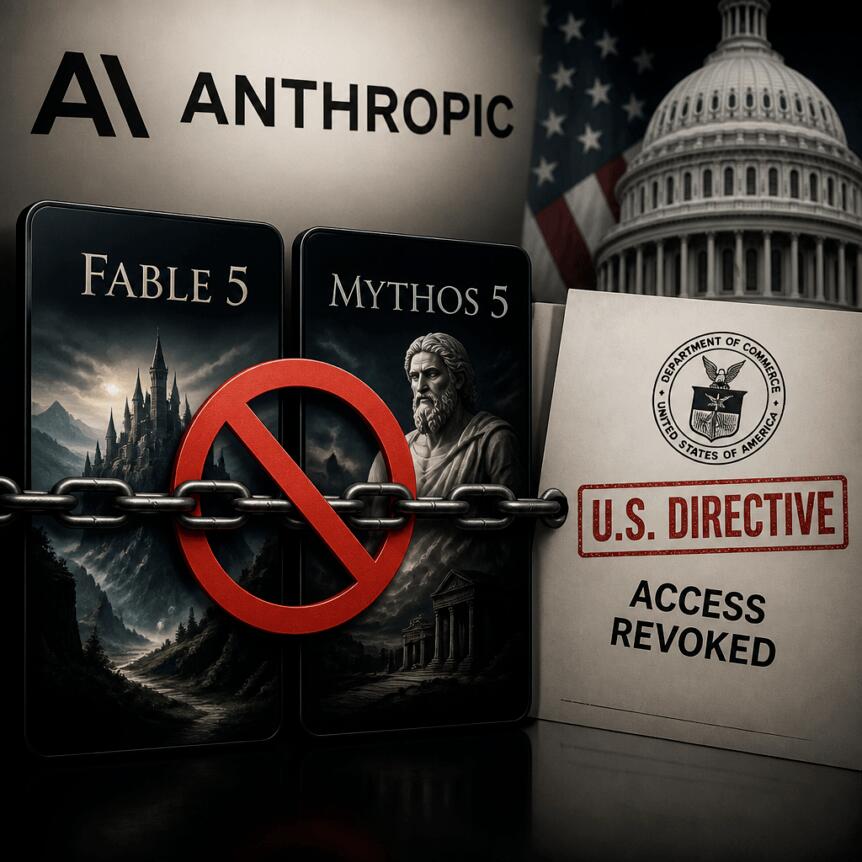
Anthropic said it has suspended access to its Fable 5 and Mythos 5 AI models after receiving a U.S. government export control directive tied to national security concerns. The company disabled access for all users, including foreign nationals, effective immediately after it received the order at 5:21 p.m. ET on Friday.
In a statement posted on its website, Anthropic said the directive instructed it to suspend “all access” to Fable 5 and Mythos 5 by any foreign national, regardless of whether they are located inside or outside the United States. The company also said its other models, such as Opus 4.8, are not affected by the order.
Key takeaways
- Anthropic suspended global access to Fable 5 and Mythos 5 after a U.S. export control directive citing national security concerns.
- The order was received at 5:21 p.m. ET and required the company to halt access “by any foreign national,” including foreign national employees.
- Other Anthropic models, including Opus 4.8, are reported as unaffected.
- Anthropic says the government provided only verbal evidence of a narrow, non-universal jailbreak risk.
- The company disputes the premise that such a finding should trigger a recall-style response for models used at large scale.
Export-control order forces worldwide suspension
According to Anthropic, the directive it received compelled the company to remove access to Fable 5 and Mythos 5 for all users. Anthropic said it acted abruptly to comply with the government’s legal instruction and ensure the directive’s requirements are met.
While the company did not provide additional details in the statement about the specific nature of the alleged threat, it said it understands authorities are concerned about a potential “jailbreak” method that could bypass the models’ safeguards.
What Anthropic says the government’s concern is
Anthropic characterized the government’s evidence as limited and not universal in scope. The company said the government did not provide detailed technical information but instead offered “verbal evidence” of a potential narrow, non-universal jailbreak. Anthropic described that type of jailbreak as involving requests for the model to read a specific codebase and then fix software flaws found there.
In Anthropic’s framing, a non-universal jailbreak is fundamentally different from a “universal jailbreak”—the latter would enable broad, repeatable bypasses that work across many contexts. Anthropic argued that the alleged risk, as presented to the company, appears narrower than what would be required for a universal safeguard failure.
The company also expressed disagreement with treating a narrow, potential jailbreak as justification to roll back a frontier model that it said is deployed at very large scale. Anthropic argued that if the same threshold were applied industry-wide, it would effectively stop new frontier model deployments.
Timeline: new releases followed by compliance shutdown
The suspension came only days after Anthropic released Fable 5 and Mythos 5. The release followed the company’s earlier work with “Mythos Preview,” a general-purpose language model that Anthropic has previously said identified thousands of vulnerabilities in critical software.
Earlier coverage noted that Fable 5 and Mythos 5 were built on top of Mythos Preview and designed to demonstrate advanced capabilities, including security-relevant behaviors. The company’s current statement indicates that the export-control directive arrived in the middle of this rollout cycle, leaving Anthropic to disable access immediately rather than adjust the models incrementally.
Anthropic also said it believes the government’s order may stem from a misunderstanding and that it is working toward restoring access for users as soon as possible.
Why this matters beyond AI product access
For investors, developers, and users, the episode highlights how quickly geopolitics and compliance requirements can intersect with frontier AI deployment. Even when a company believes an identified risk is narrow and non-universal, a government directive can still force immediate operational changes—particularly when export-control rules are interpreted to cover access by foreign nationals.
The situation also underscores a practical tension in model governance: technical risk assessments can point to targeted mitigation, while legal directives may impose broad suspension measures to ensure compliance. Anthropic’s claim that other models are not affected suggests the company may be trying to isolate the impacted releases, but the pathway back to normal availability is uncertain and depends on the government’s engagement.
Going forward, market participants and AI users will likely watch for any update on what additional evidence or clarification the government provides, whether Anthropic can demonstrate that the risk is contained, and how quickly access can be restored to Fable 5 and Mythos 5 without repeating the compliance-triggering conditions.

Following last week’s market-wide calamity in which the cryptocurrency markets shed over $400 billion and all major assets plummeted to yearly lows, many analysts have started speculating on where the bottom is.
The latest to do so was Ali Martinez, who outlined the lowest targets during this cycle for BTC, ETH, and XRP. Hint: there’s more pain ahead for all, according to his findings.
Bitcoin Bottom
The analyst with over 165,000 followers on X began with the largest cryptocurrency by market cap, indicating that the asset is “approaching a market bottom.” He noted that the MVRV Pricing Bands suggest the ultimate capitulation zone, and that level has historically been around the 0.8 MVRV Band.
If history repeats itself, it would represent another major leg down that will drive BTC toward $43,000. The other, less painful option would be a nosedive to the 1.0 MVRV Band, which is currently at $54,000.
Interestingly, another recent analysis on BTC’s potential bottom suggested that it could arrive during the ongoing World Cup in North America. BIT Research justified their prediction with bitcoin’s A-B-C structure it has been following since the October 2025 rejection and subsequent bear market.
ETH Major Decline
While the leg down for bitcoin could see a more modest 32% drop from the current levels to bottom out, ETH’s projected crash is a lot worse. Basing his analysis on Ethereum’s Delta Price model, which measures the relationship between investor cost basis and miner production costs, Martinez warned that the largest altcoin can plummet to $700.
This level has “consistently flagged generational accumulation floors.” If such a major decline indeed transpired, then ETH will dump by another 60%. Moreover, its crash from last year’s all-time high at almost $5,000 would be north of 85%, which will be ‘shitcoin’ territory.
XRP Bottom Closeby
The landscape for ETH seems the most grim given Martinez’s projections. XRP, on the other hand, might be a lot closer to his targeted bottom. He noted that a dominant rising trendline on the monthly chart has “successfully defined every major cycle bottom for nearly a decade.”
If XRP is to find its bottom again there, it could drop to somewhere between $0.70 and $0.90. The lower target would mean a 40% decline, while the higher one is only 21% away from XRP’s current price tag of around $1.15.
5/5 If these projections fully mature, I will be executing a heavy spot-layering strategy directly inside these deep-value windows:$BTC: $43,200$ETH: $700$XRP: $0.90
Pacing capital at these levels keeps the portfolio aligned with structural-cycle data.
— Ali Charts (@alicharts) June 12, 2026
The post BTC vs. ETH vs. XRP: Which Is Closest to a Major Reversal? Analyst Explains appeared first on CryptoPotato.
TLDR:
- CFTC sues New Mexico over attempts to apply state gaming laws to derivatives markets
- KalshiEX case triggers wider jurisdiction clash between federal and state regulators in US markets
- CFTC cites Commodity Exchange Act as basis for exclusive authority over event contracts nationwide
- Multiple US states now challenge prediction markets, raising regulatory uncertainty across the sector
The Commodity Futures Trading Commission has filed a federal lawsuit against New Mexico over jurisdictional authority on prediction markets. The CFTC argues the state is attempting to apply gaming laws to federally regulated derivatives platforms.
New Mexico previously targeted CFTC-registered KalshiEX, escalating tensions between state and federal oversight. The dispute centers on whether states can regulate event contracts already covered under federal law.
CFTC New Mexico Lawsuit Over Prediction Markets Jurisdiction
The CFTC New Mexico lawsuit was filed in federal court in Washington, marking a direct challenge to state-level enforcement actions. The agency seeks to block New Mexico from applying gaming statutes to CFTC-registered contract markets.
According to the filing, federal law grants the commission exclusive authority over derivatives trading venues. The CFTC also requested declaratory relief and a permanent injunction.
New Mexico had earlier filed its own case in state court against KalshiEX LLC.
The state alleged the firm’s prediction markets function as unlawful online sports betting platforms. It also argued the company was attempting to bypass state gaming regulations. That action triggered the federal response from the CFTC.
At the center of the dispute is the Commodity Exchange Act. The law gives the CFTC exclusive jurisdiction over designated contract markets and event contracts.
The commission argues this framework preempts conflicting state gaming laws. It maintains that only federal regulators can oversee such derivatives activity.
CFTC Chairman Michael Selig defended the agency’s position in a statement tied to the filing. He said the state’s approach conflicts with established legal precedent and federal authority.
The commission reiterated that it will continue defending its jurisdiction over commodity derivatives markets.
KalshiEX and Expanding State Challenges in Prediction Markets
The CFTC New Mexico lawsuit is part of a broader wave of state actions targeting prediction markets.
Similar disputes have emerged in Arizona, Connecticut, Illinois, New York, Minnesota, Rhode Island, and Wisconsin. These cases generally focus on whether event-based trading resembles sports wagering. The CFTC has consistently rejected that framing.
KalshiEX sits at the center of the regulatory friction. The platform offers event contracts that allow users to trade on outcomes of real-world events.
States argue these products resemble gambling instruments. The CFTC classifies them as federally regulated derivatives.
The federal agency is seeking to prevent states from enforcing laws that could restrict CFTC registrants. It argues that fragmented regulation would undermine national market consistency. The lawsuit requests a court ruling affirming federal exclusivity. It also seeks to block state interference moving forward.
Market operators now face growing legal uncertainty as jurisdictional lines tighten.
The outcome of the CFTC New Mexico lawsuit could shape how prediction markets expand in the United States. It may also define how far states can extend gaming laws into federally governed financial instruments.


Crypto search interest is rising again in June, according to Alphractal data, as retail investors appear to be paying closer attention to digital assets after months of weaker activity.
Summary
- Crypto searches rose again in June as retail investors started tracking digital assets more actively.
- Alphractal said search spikes often appear during moments of market euphoria and fear.
- Rising crypto search interest shows attention is returning, but it does not confirm fresh buying.
Crypto searches rise again in June
Alphractal said Google searches for cryptocurrencies are increasing in June. The analytics platform described the move as a sign that retail investors are starting to search more about different crypto assets again.
“Google searches for cryptocurrencies are rising again in June,” Alphractal said.
The move comes after a quieter period for digital asset interest. Search activity often drops when prices move sideways or when retail traders leave the market after heavy volatility.
Alphractal also noted that Google Trends spikes are not always bullish. Search jumps can appear during strong rallies, but they can also happen when traders react to fear, crashes, or uncertainty.
Retail attention returns to crypto
The latest rise suggests that crypto is moving back into retail focus. More users are searching for coins, market direction, and exchange-related terms as the market tries to stabilize.
Search activity is often used as a soft sentiment gauge. It does not show actual buying, but it can show when retail investors start watching the market again.
As previously reported by crypto.news, Bitcoin search interest reached 12-month highs during 2026 volatility. That report noted that fear-driven searches do not always mean new buyers are entering the market.
The same report also said small holders were still selling while whales were accumulating. That means renewed attention must be separated from real capital inflows.
Bitcoin volatility drives interest
Bitcoin’s price action has remained one of the main drivers of crypto searches. The asset traded near the low $60,000 area in June after a deep pullback from its 2025 record high.
Sharp price moves tend to pull retail users back into search engines. Some look for dip-buying chances, while others search because they fear deeper losses.
The recent search rise follows a period when broad crypto attention had dropped sharply. As reported earlier this month, global search interest for “crypto” had fallen to one-year lows earlier in 2026.
That earlier drop showed how much retail attention had weakened even while institutions, ETFs, and treasury buyers played a larger role in the market.
Search data gives mixed signals
The return of search activity can help market watchers track sentiment, but it does not confirm a full retail comeback. Stronger proof would require higher retail trading volume, new exchange deposits, and small-holder accumulation.
For now, the data shows that crypto is gaining attention again. It also shows that traders are reacting to volatility after months of weaker interest.
Search spikes can appear near both tops and bottoms. That makes them useful for tracking emotion, but less reliable as a standalone price signal.
The key question is whether June’s rise turns into sustained participation. If searches keep climbing alongside stronger spot demand, retail activity may become a larger force in the market again.


Michael Saylor defended Strategy’s small Bitcoin sale at BTC Prague, saying the move did not change the company’s long-term Bitcoin position.
Summary
- Strategy sold 32 BTC for $2.5 million to fund preferred stock dividend payments due June.
- Saylor said his never-sell advice targeted individual holders, not corporate treasury management decisions at Prague.
- Strategy later bought 1,550 BTC, lifting current reserves to 845,256 Bitcoin after the sale disclosure.
Michael Saylor addressed Strategy’s 32 BTC sale during an appearance at BTC Prague on June 11. The comments followed criticism from traders who questioned the sale after years of “never sell” messaging around Bitcoin.
Strategy sold 32 BTC between May 26 and May 31 for about $2.5 million. The sale came at an average price of $77,135 per coin and marked the company’s first disclosed Bitcoin sale since December 2022.
“I said to YOU never sell your bitcoin,” said Michael Saylor at BTC Prague.
The remark drew attention because Saylor separated personal investor advice from corporate treasury actions. His response framed the sale as a company-level funding decision, not a change in Bitcoin conviction.
Strategy sold BTC to fund dividends
Strategy’s June 1 filing showed that proceeds from the Bitcoin sale were expected to support preferred stock distributions. The board had declared June 30 cash dividends across its preferred share series.
Those obligations include payments tied to STRF, STRC, STRE, STRK, and STRD. The STRC dividend for June carried an annual rate of 11.50%, according to the company filing.
The sale represented only about 0.0038% of Strategy’s Bitcoin balance at the time. That made the transaction small compared with the company’s overall treasury, but it carried more weight because of Saylor’s public messaging.
As previously reported by crypto.news, Strategy’s 32 BTC sale raised debate because the company had built its identity around long-term Bitcoin accumulation. The report noted that the sale was small in size but large in market attention.
Strategy later resumed Bitcoin buying
Strategy later bought 1,550 BTC between June 1 and June 7 for $101.3 million. The company paid an average price of $65,332 per coin and lifted its total Bitcoin reserve to 845,256 BTC.
The purchase was nearly 50 times larger than the 32 BTC sale. It also came as Strategy increased its U.S. dollar reserve by $100 million to $1 billion.
The new purchase eased some concerns over whether Strategy had moved away from accumulation. The same update showed that the company used proceeds from its at-the-market share program to fund the purchase and rebuild cash reserves.
Strategy’s dashboard now lists 845,256 BTC at an average acquisition price of $75,680. That keeps the company as the largest public corporate Bitcoin holder by a wide margin.
Dividend model remains in focus
The debate now centers on how Strategy funds future obligations. Preferred stock dividends create recurring cash needs, while Bitcoin remains the main asset on the company’s balance sheet.
Saylor’s comments suggest that Strategy may separate personal Bitcoin advice from corporate liquidity management. That approach leaves room for limited sales when the company has dividend or financing needs.
Investors will watch the June 30 dividend date for more clues. The key question is whether Strategy uses cash reserves, capital markets, or small Bitcoin sales to meet future payments.
The company’s latest purchase shows that Strategy remains a net Bitcoin accumulator for now. Still, the 32 BTC sale has changed how some traders read the company’s “never sell” message.


Siren has plunged about 75% to $0.126 after a large holder reportedly sold 17 million tokens across multiple on-chain addresses, triggering one of the steepest declines seen in the market this week.
Summary
- SIREN crashed about 75% to $0.126 after a whale reportedly sold 17 million tokens across multiple wallets.
- Open interest fell nearly 40% to $28 million as traders unwound positions and reduced leverage.
- The sell-off renewed concerns over token concentration, with analyst EmberCN claiming whales control 94% of SIREN’s supply.
According to on-chain analyst EmberCN, a whale sold roughly 17 million SIREN tokens, including 6.75 million siren2-native tokens, across multiple addresses over a two-hour period on June 13. The analyst said the selling pressure pushed the token from around $0.47 to $0.23 before losses deepened further. Market data later showed SIREN extending the decline to a low of $0.126 at the time of writing.
EmberCN also claimed that whale-controlled wallets hold at least 94% of SIREN’s total supply, equivalent to about 680 million tokens. The analyst argued that concentrated ownership has allowed a small group of holders to exert significant influence over the token’s price movements.
Whale activity coincides with sharp derivatives unwind
While spot markets absorbed the sell-off, derivatives traders rapidly reduced exposure as prices continued to fall.
Data from CoinGlass showed open interest dropping nearly 40% to $28 million during the decline. The contraction occurred alongside falling prices, a combination that typically points to long liquidations and traders closing existing positions rather than opening fresh bearish bets.
With leveraged positions unwound across the market, speculative activity cooled considerably. The reduction in open interest suggested many traders stepped away after SIREN failed to maintain its earlier rally, leaving the market searching for a new price level following the rapid sell-off.
In a June 13 X post, EmberCN described SIREN as a token heavily influenced by large holders and claimed similar trading cycles had occurred several times in recent months. The analyst alleged that major holders repeatedly accumulated tokens, benefited from rising prices, and later sold into strength before the cycle restarted.
“Every time they finish feasting on the shorts, they turn around and feast on the longs: pump it up dozens of times, then smash it back down. Scoop up the chips and roll into the next round…From February to now, that’s 4 rounds of harvesting in 4 months.”
Similar token collapses have emerged across crypto markets
Recent market events show that sudden token crashes tied to concentrated ownership, liquidity concerns, or unexplained selling pressure have become increasingly common across the crypto sector.
As previously reported by crypto.news, Sahara AI’s SAHARA token fell about 55% on June 9 after heavy selling pushed the asset close to its record low. Responding to the decline, Sahara AI said there were no security issues affecting its token contracts or products and launched an internal review.
A subsequent statement from the project rejected speculation that insiders contributed to the sell-off. Sahara AI stated that no team or investor tokens had been sold or moved, while adding that it had not identified the source of the market pressure.
As previously reported by crypto.news, EDGE tumbled earlier in June after edgeX flagged what it described as unusual market activity. The token fell from about $1.20 to an intraday low near $0.36 before recovering part of the decline.
Although edgeX said preliminary findings pointed to attempts by an external party to manipulate the market, on-chain investigator ZachXBT challenged that explanation. He argued that a small group controlled much of EDGE’s circulating supply and called on the project to disclose details about counterparties and market-making arrangements linked to the token.

Gene Shalit, longtime ‘Today’ show movie critic, dies at 100

SpaceX becomes world’s 7th most valuable company after blockbuster market debut
Bitcoin (BTC) Calms Close to $64K, Cardano (ADA) Eyes Recovery: Weekend Watch


-

 NewsBeat5 days ago
Alexander Zverev wins the French Open to finally earn a 1st Grand Slam title
-
 Entertainment6 days ago
The Best Mystery Series of All Time Is Surging on Streaming 30 Years After It Ended
-

 Crypto World5 days ago
Anatomy of the June crypto crash: Fed, Iran, Saylor
-

 Crypto World2 days ago
Oppenheimer backs SpaceX as $70 billion retail frenzy builds
-

 Crypto World2 days ago
Markets Rally as SpaceX IPO Looms Amid Iran Tensions and Inflation Surge
-
Crypto World7 days ago
Senator Cynthia Lummis Calls CLARITY Act the Most Consequential Financial Legislation of This Generation
-
 NewsBeat6 days ago
Alexander Zverev conquers demons and outlasts Flavio Cobolli to win French Open for first major title
-

 Tech6 days ago
Microsoft unveils seven homegrown AI models in new bid for ‘long term self-sufficiency’
-

 Business5 days ago
High Stakes for Wembanyama as New York Pushes for 3-0 Lead
-
 Business6 days ago
The Pain Points Taking a Fragile Tech Rally Down a Notch
-

 Tech5 days ago
Notion restores access to Anthropic after service disruption
-
 Crypto World5 days ago
Eli Lilly (LLY) Stock Surges 4% Following Breakthrough Sleep Apnea Trial Results
-
 Business6 days ago
The investment to transform historic St Helen’s ground in Swansea
-

 Crypto World6 days ago
Trump’s AI Ownership Plan Could Benefit Anthropic at OpenAI’s Expense
-
 Sports4 days ago
Bangladesh beat Australia after 20 years in ODIs, register only their second win over six-time world champions | Cricket News
-

 Business7 days ago
Forensic Expert Floats Handyman Theory in Disappearance of Savannah Guthrie’s Mother
-

 Tech7 hours ago
NanoClaw integrates JFrog registries to secure AI agent downloads
-

 Tech17 hours ago
This Week In Security: Microsoft On Microsoft, Register Your Domains, Linux On ARM, And FreeBSD Joins The File Cache Club
-

 Politics2 days ago
Politics Home | Healey Resignation Is “Colossal Failure Of Government”, Says Former Labour Defence Secretary
-

 Sports2 days ago
First Time Since 1971: Australia Register Historic Low In ODI Cricket
You must be logged in to post a comment Login