Netflix’s period thriller sees Christian Bale star as a detective investigating murders alongside a young Edgar Allan Poe.
Enthusiasts of period dramas and detective series are being encouraged to watch a mystery thriller featuring Hollywood icon Christian Bale as a seasoned investigator.
Advertisement
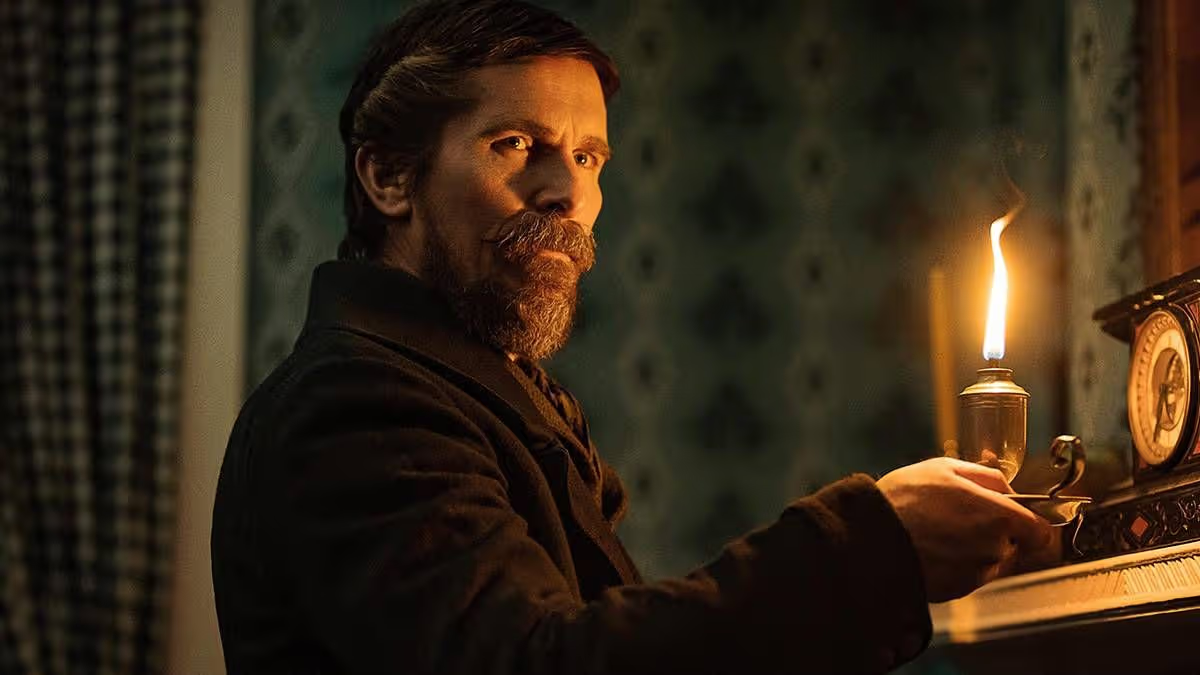
The film, which premiered in 2022 and is currently available on Netflix, stars Bale as Augustus Landor, who probes a string of killings at the West Point Military Academy alongside Edgar Allan Poe (portrayed by Harry Melling), a young military cadet.
The stellar ensemble also features the likes of Gillian Anderson, Toby Jones, Timothy Spall and Robert Duvall in his final film before his death in 2026.
The Pale Blue Eye is the production in question and follows retired detective Landor, an alcoholic, as he examines the hanging of Cadet Leroy Fry (Steven Maier).
Landor, a widower, wrestles with his own inner turmoil, including the fraught relationship with his daughter Mattie (Hadley Robinson).
Advertisement
Viewers flocked to IMDb reviews to express their opinions on the film, with one commenting: “Absolutely perfect play by Christian Bale. I watched it having the same gloomy and cold weather out the window. It made me feel the climate of the plot.
“The movie is more than worth watching. It will become a classic and maybe a new opening for movies based on the atmosphere set out in Poe’s novels. And I do hope for it with my whole heart.”
Another fan enthused: “I’ve never seen anything nor experienced storytelling like that!” A third viewer commented: “There are no words to how I felt watching this movie. Christian Bale is phenomenal, as always.
Advertisement
“I would rank this as one of the best movies I have ever seen and if you are into the Macabre genre, it would be impossible to not enjoy this, from start to finish.”
A final viewer remarked: “Absolutely stunning. This film may just be the most beautiful movie I’ve seen in a very long time. Not only is the casting impeccable, but the writing is superb. So many stellar actors, not just the major stars! Every role was properly cast.”
The film draws upon the work of American author Louis Bayard, depicting a murder mystery set at West Point in 1830, during which the young Edgar Allan Poe served as a cadet.
Advertisement
Get Netflix free with Sky
This article contains affiliate links, we will receive a commission on any sales we generate from it. Learn more
Sky is giving away a free Netflix subscription with its new Sky Stream TV bundles, including the £15 Essential TV plan.
Advertisement
This lets members watch live and on-demand TV content without a satellite dish or aerial and includes hit shows like Stranger Things and The Last of Us.
Poe, a celebrated American writer and poet, was renowned for his tales of mystery and the macabre. He emerged as a pivotal figure in Romanticism and Gothic fiction within American literature, and is widely regarded as one of the founding fathers of the detective fiction genre.
Actor Melling, who portrays the legendary author in the film, garnered particular acclaim for his performance.
The Pale Blue Eye is currently available to stream on Netflix.
Scottish Labour is tearing itself apart before the party’s latest leadership contest has even started.
A party that has lost five Holyrood elections in a row to the SNP and cannot connect with voters is once again staring at its own navel.
The smart money was on a three-way contest between moderate Michael Marra, former council chief Joe Fagan and left-winger Monica Lennon.
But there is a growing sense that Lennon, despite being the candidate party figures believe would have the most reach with voters, will fail to make the ballot.
Advertisement
Contenders need three Labour MSPs and three Scottish Labour MPs to become candidates and every indication is that Lennon is struggling.
Part of her likely exclusion reflects the rough and tumble of politics.
Marra has been preparing for a contest for months and has activated his machine to hoover up nominations.
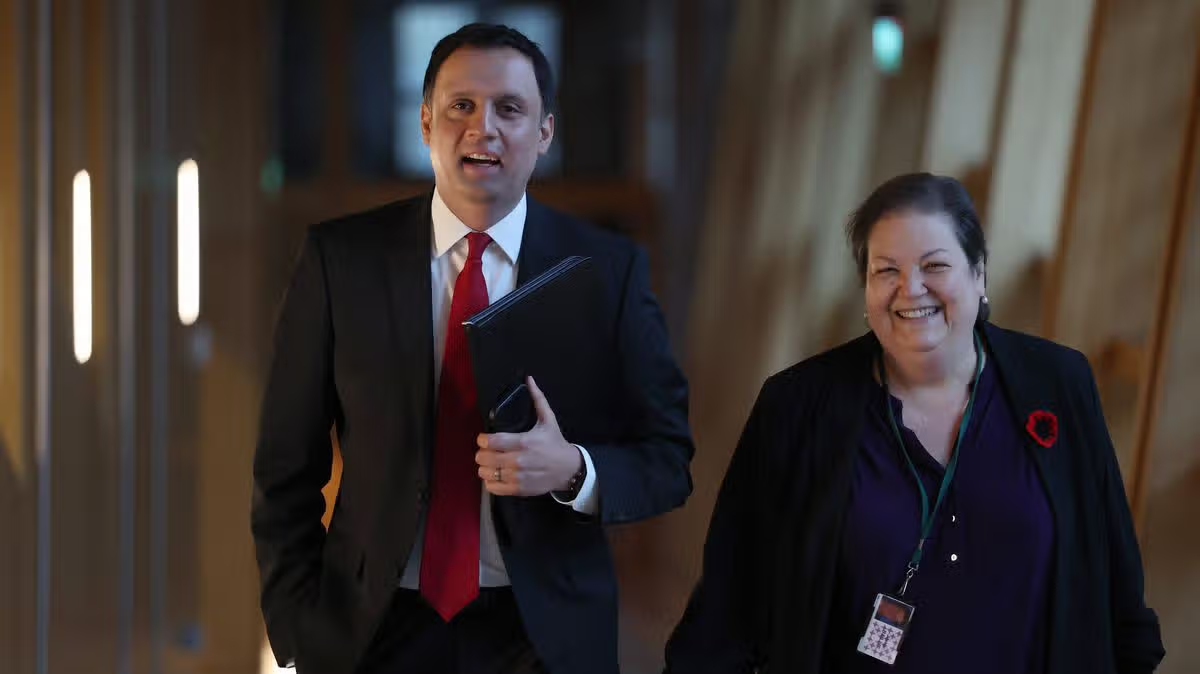
Lennon’s return to Holyrood after Anas Sarwar’s resignation from Holyrood was accidental and she does not have the infrastructure to compete.
Marra does not want her on the ballot and his supporters have been energetic in ensuring this becomes a reality.
Personality clashes are another factor behind Lennon’s inability so far to attract the necessary support.
Advertisement
She had a reputation as a moderate when she was first elected in 2016, but she alienated this bloc when she backed Jeremy Corbyn.
Her natural supporters in the Scottish Labour group – left wingers Katy Clark and Carol Mochan – are also withholding their support.
Mochan fundamentally differs from Lennon on trans rights while Clark inexplicably believes that she should be the left wing candidate in the race.
The end result is a likely all-male ballot between Fagan and Marra to succeed Anas Sarwar.
Advertisement
Even the staunchest supporters of both these contenders admit they have baggage.
Marra is an able politician who would be better than Sarwar at carving out dividing lines with the SNP.
But he will also struggle to shrug off his association with past Scottish Labour failures.
He was a senior adviser to hapless former leader Iain Gray, whose terrible Holyrood campaign led to an overall SNP majority in 2011.
Advertisement
Marra was also the architect of Labour’s dismal Holyrood manifesto in May – a document that failed to include a single eye-catching policy.
Scottish Labour has lost five in a row to the SNP and Marra was knee-deep in two of them.
Fagan also has a number of downsides.
As leader of South Lanarkshire council, he was suspended for two months for disclosing confidential information to the press.
Advertisement
He is also seen as a puppet of deputy leader Jackie Baillie, who critics believe wants Fagan to win so she can hold on to her power.
Senior party insiders also struggle to see the rookie MSP as a credible figure to lead Labour so soon into his Holyrood career.
Advertisement
One said: “Is he really going to be our candidate for First Minister? Will voters be able to picture him walking into Bute House? He is not a big league politician.”
Anger is also rising with Sarwar for plunging his party into a summer of infighting and rancour.
Party activists wanted the priority for Scottish Labour to be a review of their catastrophic election defeat in May.
The review is now irrelevant and the big structural issues Scottish Labour needs to consider will be shelved.
Advertisement
Senior party figures believe that whoever wins will lead a divided, inwardly-looking group at Holyrood.
And few people believe the victor will lead Scottish Labour into the 2031 Holyrood election.
The party of John Smith and Donald Dewar was already circling the drain before the leadership contest.
A pointless scrap that treats voters as an afterthought could see Scottish Labour vanish forever.
FIFA World Cup plot LIVE: Gianni Infantino’s presidency on the brink after disastrous scheme to sell off tournament – with European nation floating an emergency meeting
Follow all the latest on FIFA’s controversial World Cup plot – with more nations publicly opposing Gianni Infantino’s scheme, while his right-hand man has resigned in protest.
Share or comment on this article:
FIFA World Cup plot LIVE: Gianni Infantino’s presidency on the brink after disastrous scheme to sell off tournament – with European nation floating an emergency meeting
His actions pushed her to get help long before any other warning sign appeared
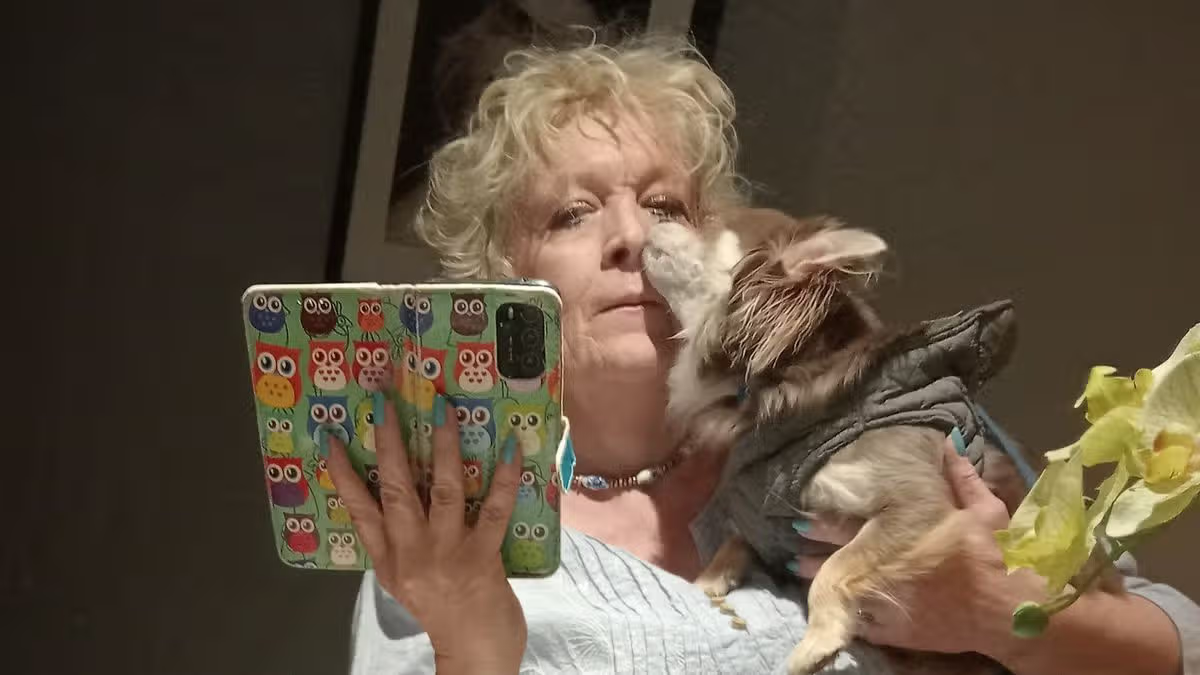
Kristine Richards thought her chihuahua was just being a pain – until she realised the little dog might be trying to tell her something important. The 61-year-old from Wellington, in Somerset, says eight-year-old Flag developed a strange habit of repeatedly pawing at the underside of her arm.
Advertisement
At first, she brushed it off as nuisance behaviour, but he didn’t stop. Soon after, she noticed a small lump, which set off alarm bells and prompted her to get it looked at by a doctor.
In 2018, Kristine decided to get checked after connecting Flag’s fixation with what she’d heard about dogs picking up on illness. Tests later confirmed she had hormone-sensitive lobular breast cancer, and she believes the timing was crucial because she’d felt completely normal.
She said: “My initial thought was that it was nothing, but then I started to wonder if there was a connection. I went to get it looked at and it was cancer. You can’t underestimate the shock. I couldn’t take it in. I just started crying.”
Kristine went for a full day of checks, including a mammogram and ultrasound, and was then told the cancer was aggressive and had spread to her lymph nodes. The diagnosis launched her into intense treatment that included surgery, radiotherapy, chemotherapy and drug therapy.
Advertisement
Kristine says it wasn’t straightforward as doctors were forced to stop chemotherapy early because it began affecting her feet and legs, and there were fears she could lose her ability to walk. Even so, about a year after the nightmare began, she was told she was in remission and the cancer hasn’t returned since.
She added: “It was a very difficult time of my life. In times like those, you find out who your true friends are, and ultimately, I did, and the answer was my dog.
“I am now in remission, I cried with relief when they told me. It was like getting to the end of a very long journey where you don’t quite know where you are going.”
Advertisement
Now, Flag is a trained assistance dog who’s treated like a furry hero – with plenty of hugs and his favourite lamb treats. Kristine even says he’s saved her twice, claiming he later stopped her from being pushed into the path of a moving car.
The Chihuahua has become something of a local star, even being made honorary mayor of St Marychurch in Torquay. Kristine says he’s become known as a ‘community champion’ as the pair support charity causes and host coffee mornings.
Kristine added: “If he hadn’t alerted me, it would have taken much longer for me to go about it. He saved my life. I owe my dog everything.”
Advertisement
The pair are currently backing Breast Cancer Now’s Wear It Pink campaign, encouraging people to get involved to raise money and awareness. Kristine said: “The more people know about him, the more money we can raise for charity and the more awareness we can get.”
Just outside London, in Hertfordshire, with my family. However, my heart lies in Crouch End. Mainly for the convenience and the food.
Where was your first flat?
A shared flat on the Fulham Road, directly in front of the Chelsea ground, before the Chelsea ground looked like it does now. It was hell on match days. It was a very dated model agency flat where I lived with three other girls, in a 1960s block.
As a model. I was 17 and I moved down in the summer holidays thinking I would be going back to school in September. I found myself in said flat on the Fulham Road and ended up staying. Thirty-three years later, I’m still here.
Advertisement
Where would you recommend for a first date?
It depends on whether you want an outdoorsy date or a dinner date, but I would go to Hampstead Heath and have a nice little walk around. Then I would go to a restaurant in Hampstead called Jin Kichi. It’s a super-traditional Japanese place, with a sushi bar, a few tables downstairs and a few upstairs. The food is fantastic. It’s where my husband Matt and I used to go on loads of dates.
What’s the best meal you’ve had?
There used to be a restaurant in Crouch End called Banner’s. If you were local, it was a hotspot, but people would also come from outside Crouch End just to go there. It had all these old music posters on the walls and the tablecloths were red-and-white checked. They did breakfast and they also served the most incredible jerk chicken with rice and peas. It was a real around-the-world menu. And I think, if I remember rightly, it even had a Bob Dylan table.
Advertisement
Who is the most iconic Londoner?
The most iconic Londoner, to me, is my husband Matt. He absolutely is. I don’t think you can get any better.
Where do you let your hair down?
My favourite place years ago, when I did used to leave the house, was the Arts Theatre Club on Frith Street. It’s tiny in there, and it was always very busy. They play music from the 1950s all the way through to the modern day. They gave it a little facelift and put in tables with lamps on them, and I always thought, “Oh, they’re going to get knocked over.” We would go there and then hop across the street to karaoke, which was at the back of a Japanese restaurant called Karaoke Box.
Advertisement
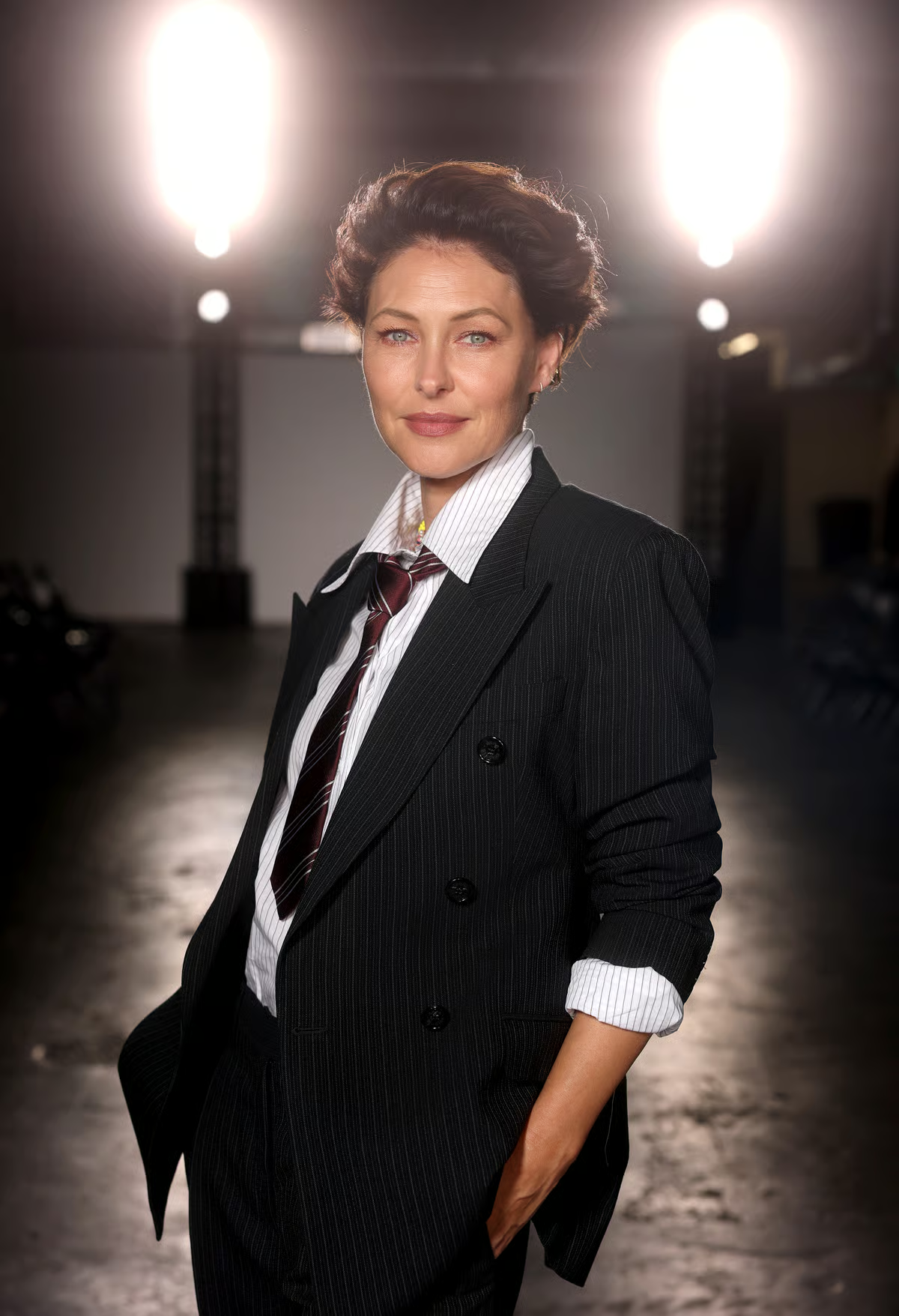
Emma Willis
Getty
Who do you call when you want to have fun?
There are two people with whom I know I am going to have the most fun. And that is because I don’t have to do anything to have fun — they just entertain me so much. And that would be my friends Max and Dean.
What’s your biggest extravagance?
Advertisement
I’m quite sensible with most things, but when it comes to time away with my family, I’m all in. There is something really special about being away together with no work and no distractions. They are the memories we all end up talking about for years afterwards.
What’s your London secret?
Getting out first thing in the morning. Before the traffic, and before everyone’s rushing around, it feels like you’ve got the place to yourself.
What are you up to for work?
Advertisement
I’ve just come back from a 100km trek for CoppaFeel! with my best mate Giovanna Fletcher and more than 100 amazing trekkers.
I have very cold, sore bones and a screwed knee, but it’s all worth it to raise money for the charity and awareness of breast cancer, and to encourage everyone to check their chest.
What is your next project?
Josh Widdicombe, Emma Willis and Johannes Radebe will take over as hosts on Strictly
PA Media
Advertisement
I don’t collect anything in particular but I do have an old, reclaimed chest with my initials on it, which Matt got me for Christmas. It’s my memory box, so I’ve got my wedding dress inside, the kids’ first haircuts, their baby teeth and wristbands from the hospital with “baby Willis” written on them.
What’s your favourite London beauty spot?
The Skin Sculpter, in Notting Hill, with an amazing woman called Guendalina Gennari. She does manual lymphatic drainage and massage on your face and body — she even puts her fingers in your mouth to relieve jaw tension. It’s a little bit painful, but my God, it’s incredible.
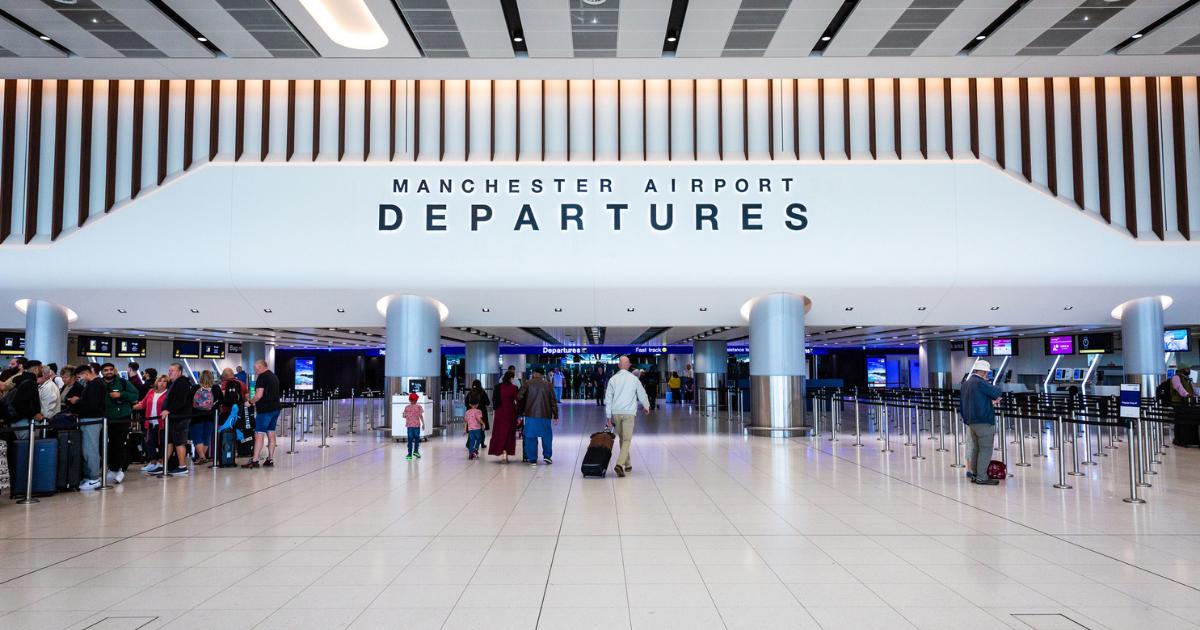
Among the flights running more than 20 minutes behind schedule are Ryanair’s 7.15am departure to Brussels Charleroi, Air France’s 7.35am service to Paris Charles de Gaulle, Jet2’s 8.10am flight to Corfu, Scandinavian Airlines’ 8.30am departure to Copenhagen and Ryanair’s 8.45am service to Milan Malpensa.
Later today, Loganair’s 7.55pm departure to Southampton (LM369) from Terminal 2 is also listed as cancelled on the airport’s live departures board.
Manchester Airport’s live departure information is updated throughout the day, meaning delays and cancellations can change at short notice.
Advertisement
Passengers are advised to check with their airline before travelling and allow extra time for their journey to the airport.
Flight delays can occur for a variety of reasons, including aircraft arriving late from previous services, air traffic control restrictions, adverse weather, operational issues or airline scheduling changes.
Lystus Ebosele, known to fans as Cyclone, joined the revival of the show last year, which is hosted by Bradley and Barney Walsh.
However, she confirmed on social media that she has stepped down from the series of her own accord.
In an Instagram story shared on Thursday (July 30), the 25-year-old powerlifting champion said she was not “axed,” but chose to leave after appearing in two seasons of the programme.
Advertisement
Lystus said: “I have not been axed, I have left on my own accord.
“I am so sorry to all the families that have come to filming expecting me to be there, and have found out about my absence on arrival to the arena with no explanation, I truly am, but it’s not fair to fans of the show how things have transpired.
“I have made the decision to step away from the show for a few reasons, of which I don’t know if or when I’ll discuss tbh.
“Ultimately it was the correct decision and one I don’t regret at all.”
She confirmed she will still take part in the 2026 Live Tour but will not return for future series.
Advertisement
Lystus has unfollowed the show’s official Instagram account and deleted all pictures of herself on the show.
When contacted by Newsquest, the BBC did not offer any comment on the matter.
What other Gladiators stars have left this year?
Lystus’ exit follows the recent departures of Matty Campbell, known as Bionic, and Karenjeet Kaur Bains, known as Athena, both of whom missed much of the last series due to injury.
A source told The Sun: “They won’t film this year for the show but could be back for the tour, depending on how they recover from their injuries.”
Advertisement
Earlier this year, 40-year-old Jamie Bigg, known as Giant, also left the programme under controversial circumstances.
Bigg said he was let go after telling producers he intended to go public with his relationship, including the fact that his partner is an OnlyFans creator.
He said in a statement to the Press Association: “I made it clear that I was planning to go public with my relationship, including the fact my partner works as an OnlyFans creator, and shortly after that I was told I wouldn’t be continuing on Gladiators.
“It wasn’t something I expected, especially given the commitment I’ve shown to the role.
“I’ve always taken being in the public eye seriously, and I believe being a role model is about honesty as well as professionalism.
Advertisement
“For me, that means not hiding parts of who I am or the people I care about.”
Bigg also said he is “grateful to the BBC and everyone involved in the show for the opportunity and the experiences I’ve had.”
Are you said to see Cyclone leave Gladiators? Let us know in the comments.
Alexandra Walker had woken up following a heavy night on the booze to find her daughter seriously ill after she had been sexually and violently assaulted by her boyfriend, Harrison Simpson.
The 26-year-old picked up Isabelle Welsh’s floppy body but instead of immediately calling for emergency help she took the opportunity to have a final cigarette and tidy away her boyfriend’s bong.
Her shocking actions were all caught on CCTV inside her own home.
Isabelle Welsh (left) and her murderers Alexandra Walker (top right) and Harrison Simpson (bottom right). (Image: NORTHERN ECHO)
During her trial for the murder of her two-year-old daughter, Walker was captured regularly getting drunk while her boyfriend smoked drugs into the early hours, including the night before her daughter was fatally injured.
When Walker eventually got out of bed, she found her daughter seriously ill and carried out an internet search asking why Isabelle could have blood in her nappy.
The heartless mum laid her daughter on the floor at the foot of the stairs before moving Simpson’s bong and having a smoke in the kitchen.
It took her almost an hour to call her stepfather for help, and when he arrived at her home on Hartington Close, Thornaby, he immediately demanded she call 999.
Advertisement
Isabelle Rose Welsh (Image: Family handout)
Despite the best efforts of paramedics and specialist hospital staff Isabelle never regained consciousness after suffering a severe bleed on the brain after he head was smashed against a hard object.
Tributes on Hartington Close in Thornaby (Image: TERRY BLACKBURN)
“Instead, of calling the emergency services or doing anything whatsoever to help your dying child, you put her on the floor, cleared away evidence of Harrison Simpson’s cannabis use and went into the kitchen or garden to smoke two cigarettes.
“Rather than phoning the emergency services, you made repeated attempts to contact Harrison Simpson. Indeed, as you told the jury, the reason why you did eventually call for an ambulance was because you realised that it was a very bad situation that you (not Isabelle) were in.”
Walker was jailed for life with a minimum term of 22 years on Thursday, July 30, after she was convicted of murder and child cruelty.
Meanwhile, Simpson, 22, was jailed for life with a minimum term of 28 years after he was convicted of the same charges as well sexually assaulting the toddler.
Southport killer Axel Rudakubana has been charged with multiple assaults on prison officers at HMP Belmarsh.
The 19-year-old was charged on Tuesday over the three separate alleged attacks in 2025, the Metropolitan Police said.
He was jailed for a minimum of 52 years for the murders of Elsie Dot Stancombe, seven, Bebe King, six, and Alice da Silva Aguiar, nine, and the attempted murders of eight other children, class instructor Leanne Lucas and businessman John Hayes.
In May last year, it was alleged he used a kettle in his cell to heat water up and then poured boiling water over a prison officer.
Advertisement
Other guards heard their colleague’s screams and restrained Rudakubana following the attack, it is alleged.
The prison officer was taken to hospital as a precautionary measure and was discharged later that day before returning to work.
The Prison Service said at the time: ‘Police are investigating an attack on a prison officer at HMP Belmarsh.
‘Violence in prison will not be tolerated and we will always push for the strongest possible punishment for attacks on our hard-working staff.’
Advertisement
Axel Rudakubana was charged on Tuesday over the three separate alleged attacks in 2025
In May last year, it was alleged he used a kettle in his cell to heat water up and then poured boiling water over a prison officer at HMP Belmarsh
The Metropolitan Police said Rudakubana has been charged with the following:
Advertisement
Assault on an emergency worker on Tuesday, May 6, 2025
Attempted grievous bodily harm on Thursday, May 8, 2025
Unauthorised possession of an offensive weapon in prison on Thursday, June 26, 2025
Assault on an emergency worker on Tuesday, October 28, 2025.
He will appear before Westminster Magistrates’ Court via videolink on September 11.
Share or comment on this article:
Southport killer Axel Rudakubana is charged with multiple assaults on prison staff at HMP Belmarsh
Cambridgeshire Police has warned drivers that there are “heavy delays” on the A14 between Easton and Brampton.
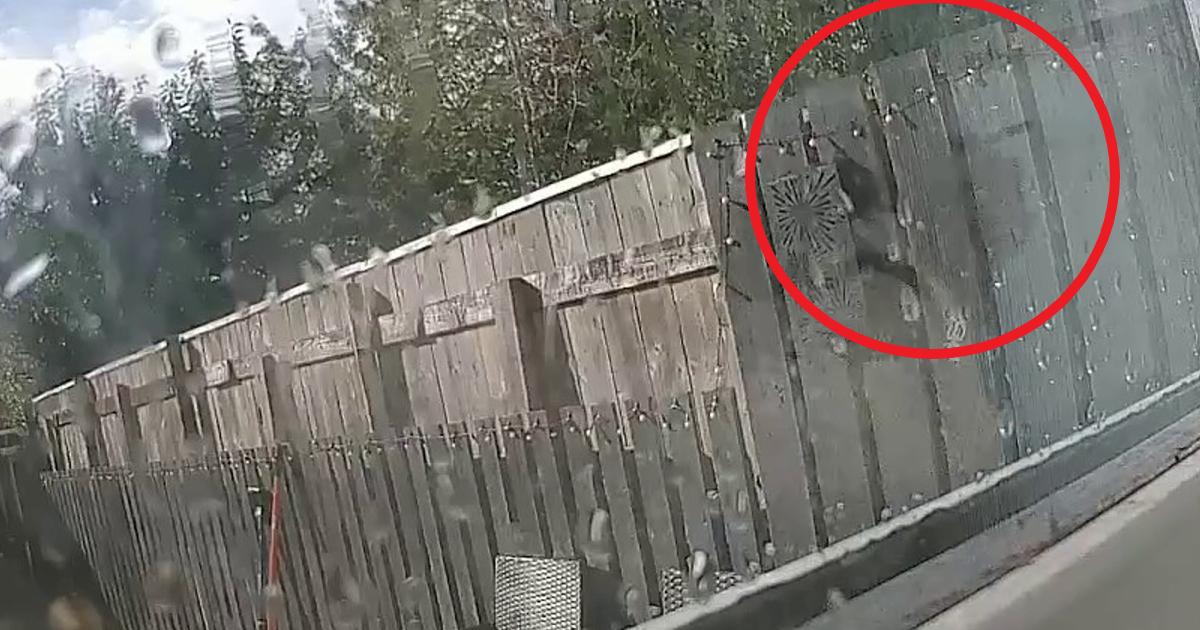
They said: “Please be aware that the westbound carriageway on the A14 between Easton and Brampton is currently experiencing heavy delays and a tailback caused by an unfortunate spillage, so look to take alternate routes.
“Be advised, those with children in the car or have a weak disposition may be affected by the scene.”
Cristiano Ronaldo and fiancée, Georgina Rodriguez, have got tongues wagging after a leaked invite appeared to suggest the pair were getting hitched this weekend
10:59, 31 Jul 2026Updated 10:59, 31 Jul 2026
Rumours are rife that Cristiano Ronaldo is getting married tomorrow after a leaked wedding invite appeared to confirm the news.
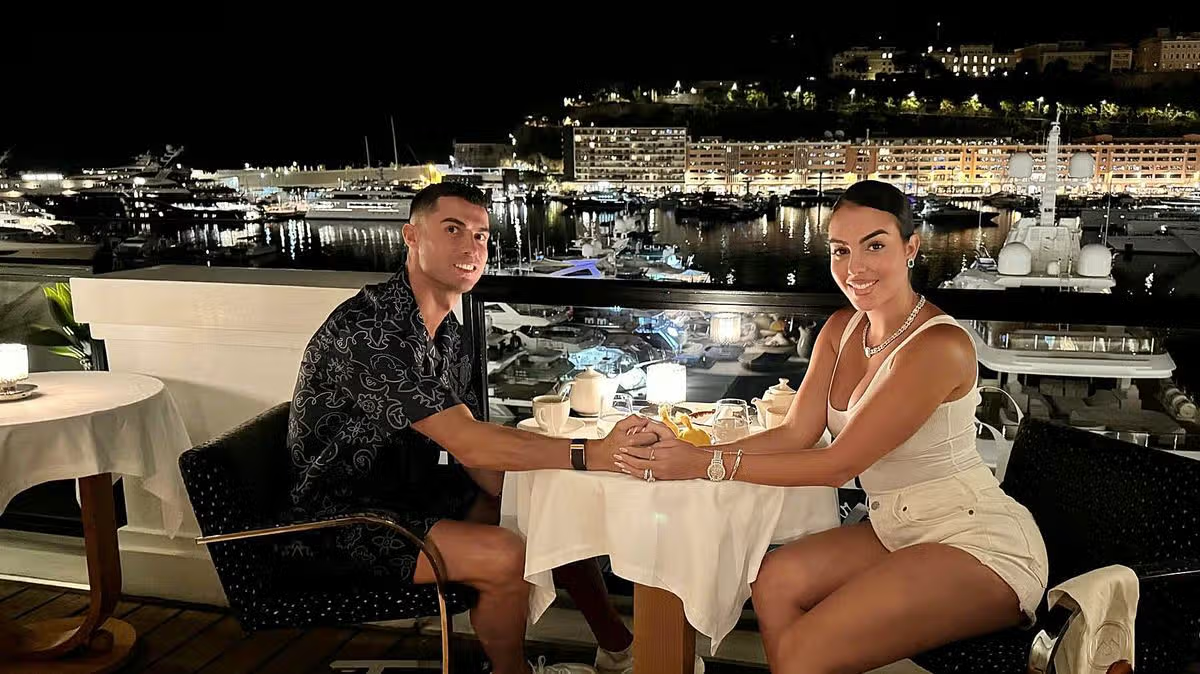
The former Man Utd star, 41, got engaged to fiancée, Georgina Rodriguez, 33, with whom he shares three children, last year after nine years together.
The legendary footballer, who played his last World Cup match for Portugal this summer, has always kept coy about when he would walk down the aisle with Georgina, saying marriage is a significant milestone for him and that he would know when the timing was right.
Advertisement
He has referred to Argentinian model Georgina – who he met when she was working as a sales assistant at Gucci – as his wife since last year, with the influencer often posting snaps of some serious bling on her wedding finger.
However, it appears the couple are finally making things official after a leaked invite set the date for August 1 – but is it really happening? Here’s what we know…
Leaked wedding invite
Recent reports from various Portuguese newspapers have suggested that Ronaldo and Georgina’s wedding might take place this Saturday.
The speculation came after an alleged invitation, purportedly for the couple’s nuptials, was leaked to the Portuguese programme ‘V+Fama‘.
The invite reportedly read: “Together with their families, Cristiano Ronaldo and Georgina Rodríguez request the honour of your presence at the celebration of their marriage.”
However, while some versions of the invite said the ceremony would begin at 2:00 p.m., others said it would start at 5:00 p.m, leading some to speculate if it was real.
Advertisement
All-black dress code
The invite also allegedly asks guests to dress all in black to celebrate the couple’s big day.
The strict dress code has lead to discussions about the significance of the colour, with some wondering Georgina, who we presume will be wearing in white, wants the contrast for a glossy magazine spread.
As one of the world’s most famous couples, there is sure to be a huge bidding war to get the first snaps from the special day – when it eventually happens.
Guest list
The guest list for the rumoured wedding has not been confirmed. However, according to one source, famous faces at the nuptials will include not only football players but stars from the showbiz world.
Advertisement
Footballers Rio Ferdinand, Vinicius Junior, Kylian Mbappe and Rodriguez, are all said to have been invited as as well as actors Vin Diesel and Esther Exposito, who is dating Mbappe. Meanwhile, Rihanna, Jennifer Lopez, Drake and rapper Travis Scott are also said to be asked to attend.
Also said to be on the guest list is TV presenter Piers Morgan, who Ronaldo told he would marry Georgina after this year’s World Cup in one of the biggest clues yet the wedding is on.
Couple show off matching diamond rings
Shortly before the invite was leaked, Georgina shared an Instagram post, which got tongues wagging. The model often posts snaps of her eye-wateringly expensive diamond rings. However, relaxing aboard Ronaldo’s CR7 jet this week, the mum-of-three shared something a bit different.
After polishing off a scrumptious breakfast of scrambled egg and smoked salmon next to her enormous Birkin bag, Georgina posted a snap on Instagram in which both she and Ronaldo are wearing designer watches encrusted with jewels. However, the couple, who were papped onboard the footballer’s yacht in Majorca this week, are also both rocking some serious bling on their wedding finger in a post, which feels very much like a statement.
Advertisement
Portuguese media appears to confirm wedding venue – but there’s a catch
Portuguese media claims the couple are set to wed in Portugal on Saturday, with local press suggesting they will marry at the stunning Quinta da Regaleira estate in Sintra.
One TV host has claimed the ceremony will be at the Quinta da Regaleira estate in Sintra, Portugal, however it still appears to be open to the public this weekend, adding doubt to the rumours.
In more confusion, the leaked invite specifies the date and venue: “Saturday, 1 August, 2026. At five in the afternoon at Quinta da Regaleira, Sintra, Portugal.” However, within hours, a family statement was released, unequivocally denying that Cristiano and Georgina would be marrying this coming weekend.
Ronaldo tells pal Piers Morgan he’ll get married after World Cup
Despite the denial, Ronaldo had previously claimed he was planning to marry Georgina after this year’s World Cup, which saw Portugal knocked out the Round of 16 after losing to Spain.
He told pal Piers Morgan: “I hope to arrive at my wedding with the champion’s trophy. I’m going to marry her because I believe it’s the right time. Not just because she’s the mother of my children — but because she’s the person I love most.”
Revealing he popped the question to Georgina at 1am in 2025, he continued: “It was like 1 am. My daughters were in bed sleeping. One of my friends gave me the ring to offer Gio, and as I was giving her the ring, my two kids come in and say: ‘Daddy, you’re going to give the ring to mum and you’re going to ask her to get married”‘.
“I said: ‘Wow, this is the right moment to say yes.’”
Advertisement
Admitting he hadn’t actually planned to propose at that moment, he concluded: “It was the time. I knew that I was going to do it one day, but I hadn’t planned to do it then.”




















































You must be logged in to post a comment Login