
Crypto World
Anthropic’s Mythos AI reports no further ‘serious’ bugs in Zcash: Wilcox

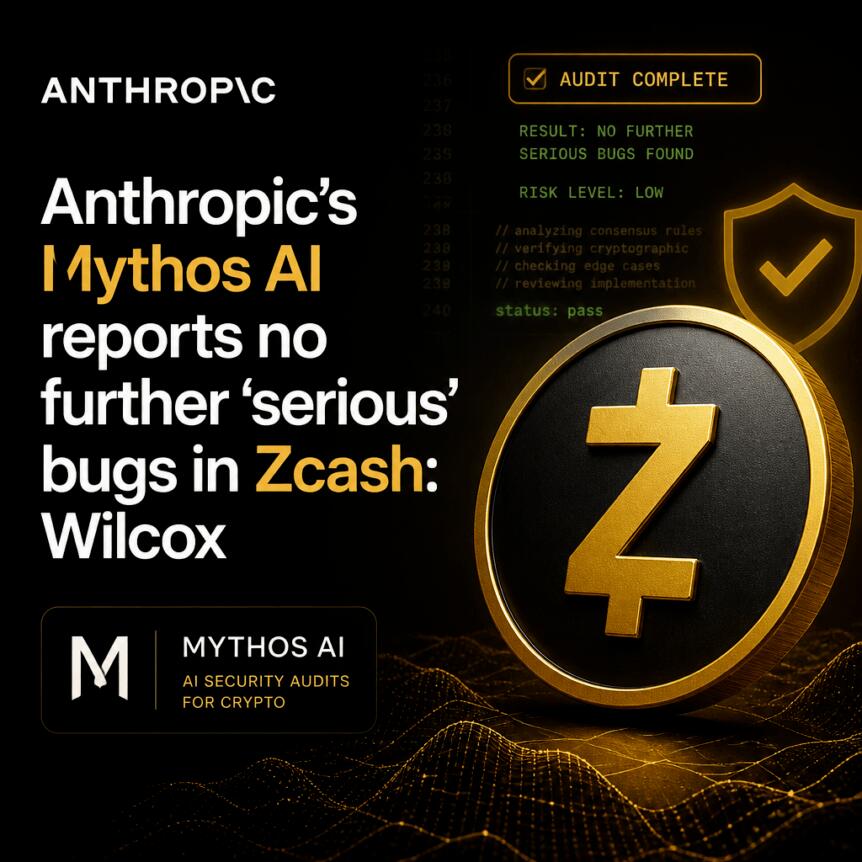
Zcash founder Zooko Wilcox says a security review of the privacy-focused protocol conducted using Anthropic’s Claude Mythos AI model did not uncover serious issues. The assessment was requested by Shielded Labs, a Swiss non-profit that supports Zcash development.
Wilcox shared the result in an X post on Saturday, adding that the audit found “no more serious bugs” in the Zcash protocol. The announcement follows earlier emergency steps taken by Zcash developers in early June after a vulnerability in the network’s shielded pool was identified and addressed.
Key takeaways
- Zooko Wilcox says Anthropic’s Claude Mythos security audit found no serious vulnerabilities in Zcash’s protocol after a Shielded Labs request.
- In early June, Zcash developers temporarily suspended Orchard shielded pool transactions, then restored functionality the same day via an emergency upgrade.
- The Orchard issue was linked to a four-year-old forgery bug, discovered with assistance from Anthropic’s Claude Opus 4.8 model and researcher Taylor Hornby.
- The Zcash Foundation stated there was no evidence of exploitation, no detected unauthorized value creation, and no impact on user privacy.
- Across crypto, the rapid rise of advanced AI security tooling is increasing both defensive capability and concern about who benefits from vulnerability-finding at scale.
Claude Mythos audit reports no serious Zcash protocol flaws
Wilcox’s update centers on an AI-assisted security audit carried out by Anthropic’s Claude Mythos model. According to his post, Shielded Labs—described as a Swiss-based non-profit supporting Zcash development—requested the review, which then concluded that there were no serious vulnerabilities in the Zcash protocol.
The timing of the claim matters for Zcash users watching for follow-up risk after an Orchard-related emergency earlier this month. While AI tooling can accelerate the discovery of potential issues, a “no serious vulnerabilities” outcome also signals that at least this specific protocol check did not reveal additional high-impact defects.
June Orchard disruption and the emergency upgrade
Before the Claude Mythos audit result, Zcash developers took more direct operational action on June 3. They temporarily suspended Orchard transactions after discovering a vulnerability inside the shielded pool that processes privacy-preserving transfers.
Functionality was restored later that same day through an emergency upgrade, indicating a rapid response once the risk was identified. The Zcash Foundation later characterized the situation as one without confirmed exploitation.
In its account of the incident, the Zcash Foundation said there was no evidence the vulnerability was exploited, that no unauthorized value creation was detected, and that user privacy remained unaffected. Those statements were made in connection with an emergency soft fork and related network activation details described by the foundation in its technical update.
What the Orchard vulnerability actually was
Based on the earlier reporting referenced in Wilcox’s broader context, the Orchard problem traced back to a forgery bug that had existed for four years. Security researcher Taylor Hornby is credited with discovering the issue with help from Anthropic’s Claude Opus 4.8 model.
This distinction is important for investors and builders because it frames the risk not as a newly introduced flaw, but as something that had been latent and only later surfaced through improved analysis. It also implies that even older vulnerabilities can re-emerge as new tooling and methods become available—particularly where complex cryptographic protocols are concerned.
AI security tools: faster discovery, heightened threat concerns
While Zcash’s development process appears to benefit from advanced AI assistance, the larger debate in crypto is whether the same tools can also be used to accelerate attacks. The industry has increasingly raised alarms that improved vulnerability discovery could shift advantage toward threat actors.
Anthropic released the first public version of Claude Mythos, and the company has previously said Mythos and related models uncovered more than 10,000 high or critical-severity vulnerabilities in “systemically important software.” That statement fueled scrutiny over whether such capabilities should be broadly accessible.
In response to concerns, Anthropic stated that its Fable 5 model was “made safe for general use” with safeguards designed to reroute certain topics—such as cybersecurity—toward a different model (Claude Opus 4.8). However, Anthropic also later said it suspended access to Fable 5 and Mythos 5 following a US government export control directive citing national security concerns.
From the perspective of crypto defense, this creates a complicated landscape: AI models may be able to identify vulnerabilities quickly, but access controls and evolving policy can change who can use that capability and for what purpose. The result is a growing asymmetry between attackers and defenders, especially in a market where fast-moving smart-contract ecosystems can become targets.
Bug bounty platform Immunefi CEO Mitchell Amador warned in an interview that the proliferation of these new AI tools is changing the cybersecurity playing field toward attackers, calling it a “vulnerability apocalypse.” He tied that dynamic to a resurgence in DeFi hacks. Separately, DefiLlama’s data shows crypto hacks reached $634 million in April—the highest monthly total since the Bybit incident that led to roughly $1.4 billion in losses in February 2025.
Why the Zcash audit matters now
Zcash’s latest update is not just about whether one vulnerability was found—it’s also about whether the privacy protocol has additional serious problems after a high-scrutiny period. The combination of a June Orchard emergency response and a later Claude Mythos audit outcome suggests the team is continuing to stress-test the system with modern security approaches.
Still, Zcash users should treat the audit result as one datapoint among many. The Claude Mythos review reportedly found no serious issues, but the broader crypto environment remains sensitive to rapidly evolving AI-assisted security research—meaning the key question going forward is not whether AI can find problems, but how quickly vulnerabilities (and any exploitation attempts) can be detected, patched, and validated across different platforms.
Readers should watch for whether Zcash developers share additional post-audit assurance steps, and whether the industry’s ongoing AI model access changes—driven by export controls and “safety” restrictions—shift the tempo of both defensive research and attack activity.



Bitcoin and Ether options with a combined notional value of about $10.43 billion expired on July 31, placing the $64,000 Bitcoin level at the center of the monthly settlement.
Summary
- 149,000 Bitcoin options worth $9.6 billion expired with max pain concentrated at the $64,000 level.
- 435,000 Ether options worth $830 million expired with a 0.63 put-call ratio and $1,850 max-pain.
- Low implied volatility and uneven inflows kept Bitcoin near $64,000 despite call-heavy monthly positioning overall.
Greeks.live reported that 149,000 Bitcoin options worth $9.6 billion expired with a 0.28 put-call ratio and $64,000 max pain. Another 435,000 Ether options worth $830 million expired with a 0.63 ratio and $1,850 max pain.
Deribit’s monthly options settle at 08:00 UTC on the final Friday of each month. Shortly after settlement, Bitcoin traded near $63,824, while Ether changed hands around $1,891. Neither asset recorded an immediate break from its recent range.
Bitcoin options expiry settled near $64,000 max pain
The Bitcoin expiry represented about 30% of outstanding contracts, according to Greeks.live. Its low 0.28 put-call ratio showed that call open interest greatly exceeded put open interest going into settlement.
A separate PerpFinder snapshot, based on Deribit data at 07:51 UTC, recorded $7.39 billion in call open interest and $2.06 billion in puts. It placed total notional open interest at $9.45 billion, slightly below Greeks.live’s $9.6 billion estimate. The difference likely reflects changing Bitcoin prices and data captured at different times.
Max pain refers to the settlement price at which the largest value of options would expire without value for buyers. It does not guarantee that the spot market will move toward that level or remain there afterward.
Recent activity supports that caution. Research covering two earlier July expiries found that Bitcoin did not settle precisely at the stated max-pain levels and showed little lasting price movement after the contracts expired.
Call-heavy positioning did not confirm a bullish breakout
The low Bitcoin put-call ratio appears bullish at first because calls provide upside exposure. However, many calls were concentrated above the market price, particularly around the $70,000 and $72,000 strikes.
Contracts at those levels could not generate gains at expiry unless Bitcoin rose sharply above its weekly range. Bitcoin instead traded within a 24-hour range of roughly $63,787 to $65,305, keeping the largest upside positions out of the money.
Greeks.live said call gamma exposure was spread across several strikes, while put gamma exposure was more concentrated. Gamma measures how quickly an option’s price sensitivity changes when the underlying asset moves. Concentrated exposure can affect how dealers hedge, but it does not independently forecast market direction.
The firm also said “the conditions for a rally are not in place,” citing limited capital inflows and weak follow-through when U.S. equities rebounded. That is the firm’s market assessment rather than a confirmed future outcome.
Ether options showed stronger downside protection
Ether’s 0.63 put-call ratio showed more demand for puts relative to calls than the Bitcoin market recorded. Greeks.live placed Ether’s max-pain level at $1,850, below the market price shortly after settlement.
PerpFinder’s final pre-expiry snapshot recorded approximately $499.4 million in Ether call open interest and $311.5 million in puts. It calculated total open interest of $810.9 million and a 0.62 ratio, close to the figures provided by Greeks.live.
Ether traded near $1,891 after settlement, within a 24-hour range of about $1,884 to $1,934. The asset therefore remained above both the $1,850 max-pain estimate from Greeks.live and the $1,800 level cited by some earlier market reports.
As previously reported, Ether options carried a 1.26 put-call ratio during the July 10 expiry. The fall to about 0.63 indicates that positioning became less defensive by month-end, although Ether still carried more relative put exposure than Bitcoin.
ETF inflows and $65,000 resistance shape the next move
The expiry arrived as spot Bitcoin ETF demand showed signs of recovery. U.S. funds received $233.1 million on July 30, led by BlackRock’s IBIT with $183.4 million. However, flows had alternated between gains and withdrawals earlier in the week, supporting Greeks.live’s description of uneven capital demand.
Bitcoin also remained below the heavy trading area above $65,000 identified by Greeks.live. The asset briefly reached a 24-hour high above $65,300 but returned below $64,000, showing that buyers had not established the former rally zone as support.
crypto.news reported that the smaller July 10 expiry also produced cautious positioning and limited confidence in a sustained advance. Earlier July 3 coverage placed attention on weak ETF flows and demand for short-term downside protection.
Traders will next monitor whether positions roll into the August 28 monthly expiry. Deribit data showed about $3.15 billion already positioned for that date in Bitcoin options, while the September 25 expiry carried roughly $6.22 billion.
A sustained move above $65,000, stronger spot volume and several consecutive ETF inflow sessions would provide clearer evidence of improving demand. Without those conditions, the July settlement mainly removed a large block of expiring exposure while leaving Bitcoin’s wider trading range unresolved.


Tokyo-listed Quantum Solutions (2338) sold 1,000 ETH for $1.9 million and more than doubled its disposal ceiling to fund an AI data center business.
The move came as another crypto treasury firm, Hyperscale Data (GPUS), monetized about 100 BTC and opened a bitcoin-backed credit line for a Michigan AI data center..
Quantum sold the ETH on July 30 at $1,903 per token, generating $1.903 million after fees, according to a company filing. It expects to recognize a $100,970 loss against the position’s May 31 carrying value of $2,003.97 per ETH, the filing adds.
The sale price was 47% below the $3,595.02 average acquisition cost Quantum reported in June.
The firm sold 904 ETH for $1.61 million on June 16 at an average price of $1,777 per token. The two disposals raised about $3.51 million and reduced its holdings by 29% to 4,764.8 ETH from 6,668.8 ETH.
Quantum’s board raised the cumulative sale limit to 4,375 ETH from 1,875 ETH through Oct. 30, leaving it authorized to sell another 2,471 ETH. Using the full limit would mean disposing of nearly 66% of the holdings it reported in June.


The US Internal Revenue Service (IRS) warned that scammers are mailing counterfeit letters to crypto holders, directing them to a fake “Digital Asset Compliance Portal” built to steal digital assets and personal data.
The agency’s Criminal Investigation unit issued the fraud alert on Thursday. It said the letters carry QR codes that send recipients to a spoofed website.
How the Fake IRS Letters Work
The counterfeit notices tell recipients they must enroll in the portal before a deadline. The IRS stressed that it does not operate any such portal and is not sending the letters.
Once victims scan the QR code, the fraudulent site asks them to enter personal information. The agency urged taxpayers not to scan QR codes from unsolicited letters, emails, or texts. It also told people to hang up on callers demanding payment.
The use of physical mail marks a shift from typical crypto phishing. Coinbase and threat intelligence firm DarkTower flagged the campaign this week.
Their investigation found the letters reference tax years 2017 through 2026. Moreover, the look-alike domain was registered through a Hong Kong registrar and hosted in Romania.
“That phone call is the actual attack… a scammer posing as ‘support’ will try to talk you into handing over the keys to your account…to trick you into moving your funds to a ‘safe’ wallet they control. This is called vishing (voice phishing), and it is one of the most effective account-takeover techniques used against crypto holders today,” Coinbase said.
Follow us on X to get the latest news as it happens
Crypto Scams and Hacks Keep Draining the Sector
The scheme fits a broader pattern of impersonation-driven fraud. Chainalysis estimated in its report that scams and fraud cost victims $17 billion in 2025. Impersonation scams surged 1,400%.
Hacks remain equally persistent. TRM Labs recorded 207 hacks in the first half of 2026, more than double the 83 logged a year earlier.
That marked the firm’s highest six-month count on record. However, total losses fell to roughly $972 million from about $2.3 billion in H1 2025.
Together, the figures suggest attackers are pivoting from code exploits toward human targets. The IRS letters show that pivot now extends beyond inboxes and into physical mailboxes.
Subscribe to our YouTube channel to watch leaders and journalists provide expert insights
The post Did You Get an IRS Crypto Compliance Letter? It Probably Isn’t Real appeared first on BeInCrypto.
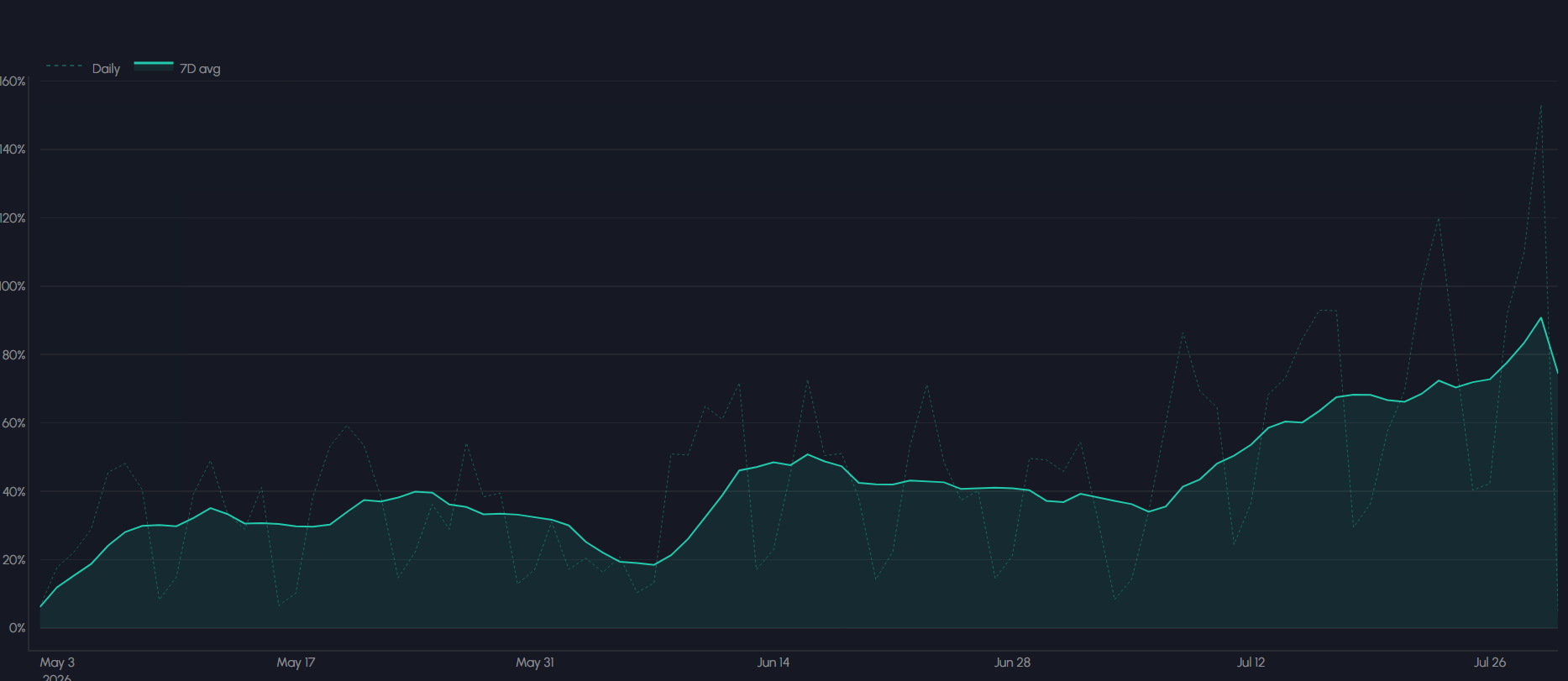
Perpetual futures tied to tokenized stocks and commodities generated nearly as much trading volume as Bitcoin perpetuals on two of the largest venues for the products over the past week, according to Talos.
Combined seven-day volume across tracked real-world asset (RWA) perps reached $61.7 billion, equal to 99.2% of Bitcoin perpetual volume on Hyperliquid and Binance, where most trading activity is concentrated, Talos told Cointelegraph in an email summary citing a data snapshot taken on Thursday.
Tokenized equity contracts accounted for 57.8% of the total, followed by commodities at 28.2%.
The value of onchain RWAs has grown to about $36.8 billion, excluding stablecoins, according to RWA.xyz. Crypto exchanges have also expanded their offerings beyond cryptocurrencies, increasingly listing tokenized stocks and commodities alongside digital assets.
Related: Tokenized RWA market grows 420% since 2025 on regulatory clarity, access
Hyperliquid recorded $25.1 billion in RWA perpetual trading volume during the week of July 13 to July 19, exceeding the combined volume of all other perpetual categories on its platform.
Circle co-founder and CEO Jeremy Allaire said in a July 24 X post that growing RWA trading on Hyperliquid signals crypto markets moving “away from speculating on endogenous digital commodities.”
Growth continues into the new week
Early data for the current week suggests the trend is continuing. RWA perpetual trading volume has already reached $37.2 billion, exceeding Bitcoin perpetual volume by about 9%, according to Talos’ dashboard.
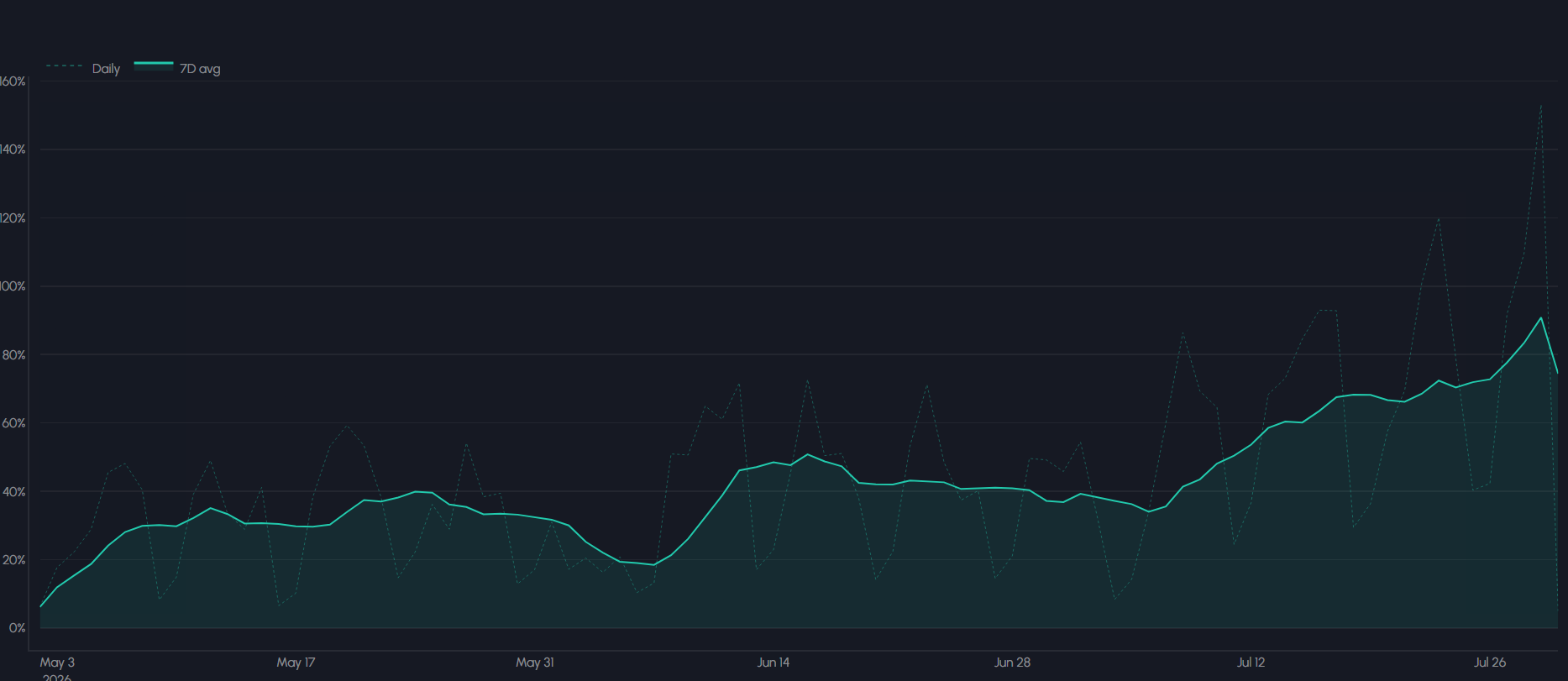
RWA perpetual futures volume as a percentage of Bitcoin perpetual futures volume on Hyperliquid and Binance. Source: Talos
Equity-linked contracts accounted for $22.8 billion of the total, followed by commodities at $9.1 billion and indexes at $4.2 billion. ETFs contributed about $338 million, while foreign exchange, pre-IPO and other RWA contracts made up the remainder.
Earlier in July, Pantera Capital said perpetual futures could become a dominant trading instrument beyond crypto, citing advantages such as 24/7 trading, the absence of contract expiries, simpler position management and continuous price discovery.
Hyperliquid’s growth has drawn attention from traditional finance. Intercontinental Exchange CEO Jeffrey Sprecher, whose company owns the New York Stock Exchange, recently urged regulators to create a “level playing field” for 24/7 onchain perpetual futures, arguing that existing market structures should not prevent the development of blockchain-based trading.
Despite the growth, RWA perpetuals remain a relatively small segment of the broader crypto derivatives market. Talos’ data shows aggregate futures trading volume of about $821.4 billion over the past seven days, with tracked RWA perpetuals accounting for roughly 7.5% of the total.
Magazine: The 100x obsession: Fundamentals grow in importance as crypto matures
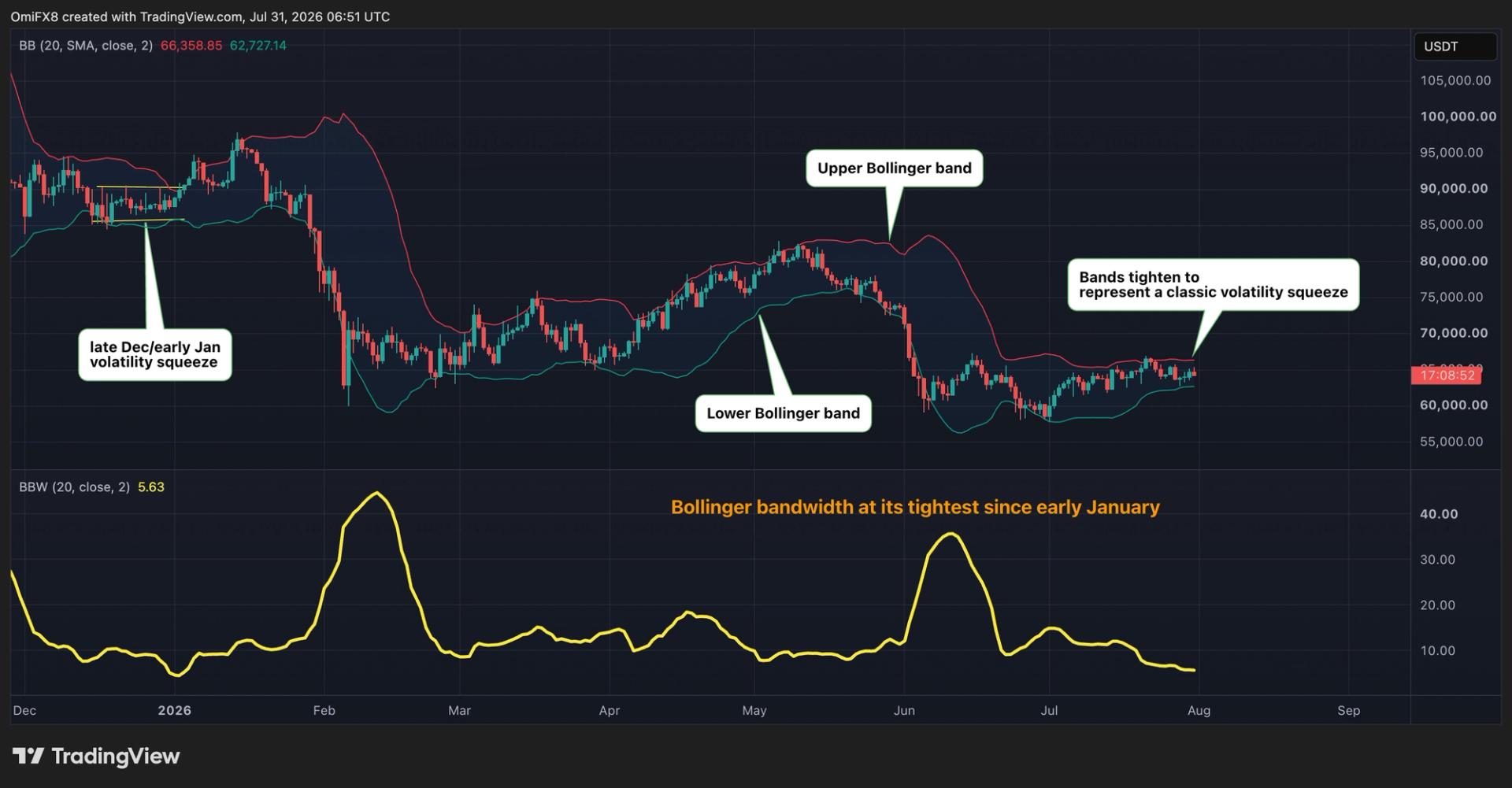
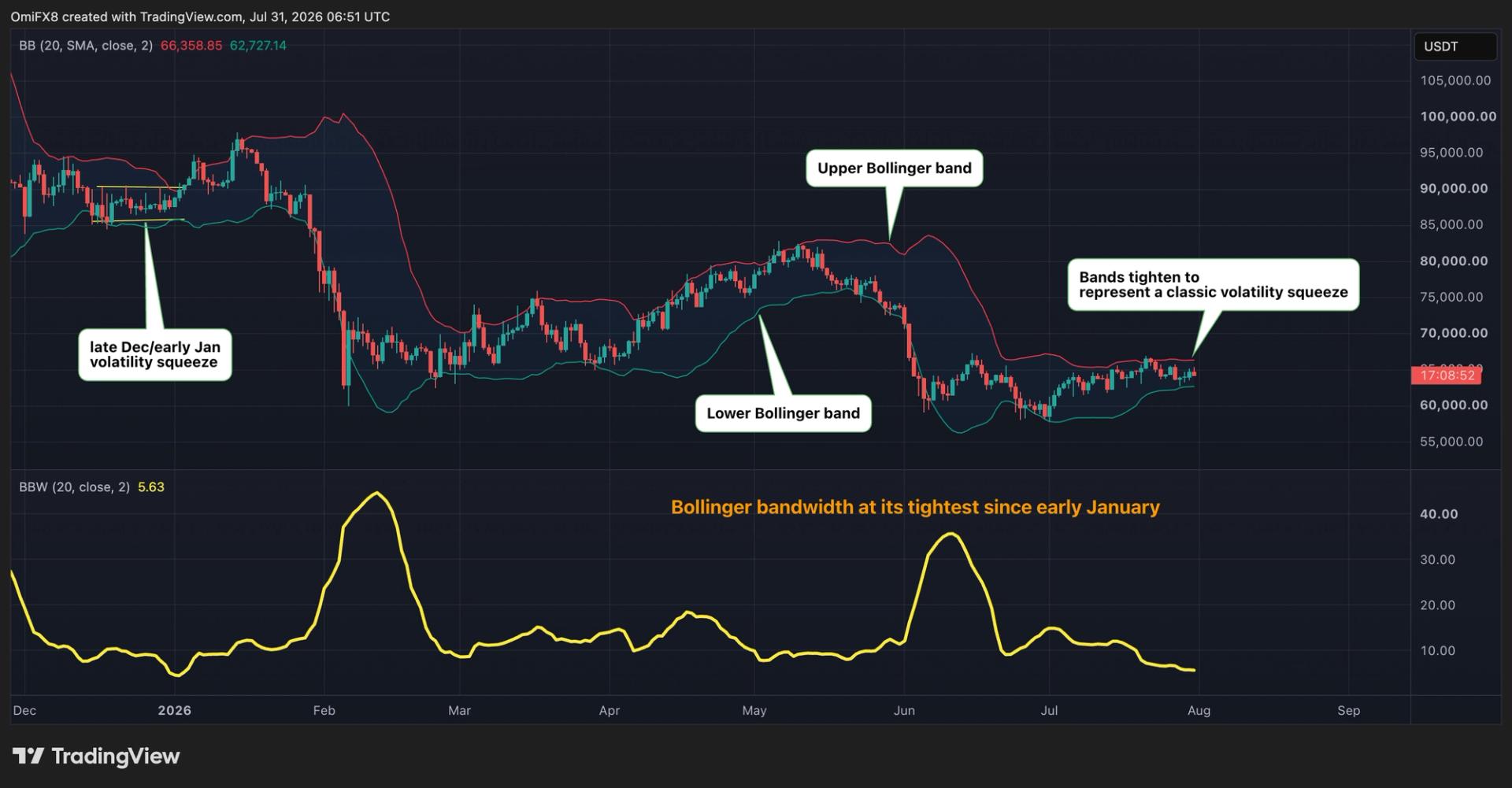
Trading bitcoin these days feels much as it did seven months ago, at the start of the year.
The price of the largest cryptocurrency is stuck in a tight range, with volatility at six-month lows, and traders are struggling to identify a break to bet on. Not surprisingly, transaction volume has slumped and is on track for the lowest since November 2023.
Back in January, the bitcoin price had been stuck in a narrow band, $86,000-$90,000, since the second half of December. Trading volume had dropped to an average of $5.1 billion a day, and has fallen to $2.2 billion this month, according to research from K33.
What happened next is interesting. Volatility picked up in the following weeks, the price rose to nearly $98,000 by mid-January and then slid down to around $60,000 by early February. Trading volume rose.
And that’s precisely the point. Volatility is cyclical: long stretches of quiet price action often precede a sharp move in one direction or the other. Like a coiled spring, the tighter the market compresses, the more forcefully it can unwind.

The largest altcoin by market cap rode the recent minor bullish wave in the cryptocurrency market, surging from just over $1,500 to almost $2,000 to mark a multi-month peak.
However, it stalled there as it couldn’t breach that psychological level. Moreover, the same technical tool that predicted the substantial revival has now flipped bearish.
Is ETH in Trouble?
According to Ali Martinez, the TD Sequential, a metric used to determine the underlying asset’s potential exhaustion moves in either direction, has been quite successful in determining ETH’s trend reversals. Back in early July, when Ether slumped to a multi-year low at around $1,520, it flashed a buy signal. This was followed by a major monthly rally that drove ETH to $1,980 last week.
As mentioned above, though, the asset’s run was halted at that level, and the TD Sequential is hinting at further trouble ahead. Martinez noted earlier today that the indicator has flipped to a sell signal and suggested that investors might consider taking some profits off the table.
Another popular analyst going by the X handle Crypto Lens shared a similar opinion. They noted that Ethereum has stuck between $1,860 and $1,955 for a reason, as the bull trap is “just getting started.” They added that a run to the $2,000 resistance will be followed by the “real capitulation.”
Crypto Lens’ scenario envisions a week or so in consolidation below that level before the final leg down begins and drives the asset south to somewhere between $1,400 and $900. Once it cleanses the weak hands, ETH’s next bull run can begin, and the analyst’s target is a big one – $7,000.
Not Good Against BTC
Crypto Rover also weighed in on the altcoin’s performance but focused on the trading pair against BTC. He outlined a chart that shows ETH has been charting new lower highs and lower lows for the past year. It began with a local peak at 0.04 marked last October, before Ethereum gradually lost a lot of traction that culminated with a drop to $0.025 in June.
It outperformed the market leader in the past month, jumping to 0.03. However, Crypto Rover believes another rejection is coming, which could drag it south to a fresh multi-year low of under 0.0235.
I’m sorry, bulls.$ETH vs $BTC keeps forming lower highs, and the latest rally is already losing momentum.
The same thing happened last time before ETH/BTC fell to a new low. pic.twitter.com/Si09I1gfIN
— Crypto Rover (@cryptorover) July 30, 2026
The post Is ETH’s Rally Over? The Key Indicator That Called Ethereum’s Run Just Flipped Bearish appeared first on CryptoPotato.

Tokenized gold is getting a burst of investor attention this year, tracking a surge in physical bullion demand as gold prices have repeatedly set fresh highs. But a new report from RedStone suggests that—despite improving market conditions—only a small portion of tokenized gold is actually being used in decentralized finance.
RedStone data points to a widening gap between market interest in tokenized bullion and its deployment in DeFi lending. In the first quarter, tokenized gold spot trading volume reached $90.7 billion as gold futures climbed above $5,600 per troy ounce. Yet just $63 million worth of tokenized gold—via Tether Gold (XAUT) and PAX Gold (PAXG)—is currently posted as collateral on Aave v3 and Morpho, according to RedStone. That collateral usage represents roughly 1.5% of the tokens’ combined $4.2 billion market capitalization.
Key takeaways
- Tokenized gold saw high activity in spot markets, with $90.7 billion in Q1 trading volume.
- Despite that liquidity, DeFi adoption remains thin: only about $63 million in XAUT and PAXG is used on Aave v3 and Morpho.
- RedStone highlights a real stress test: Aave processed its largest cluster of XAUT liquidations on March 23 without disruption during a sharp gold sell-off.
- Gold has been under pressure from expectations of higher US interest rates, which can reduce demand for non-yielding assets.
A resilient collateral asset, but with limited deployment
RedStone’s report frames tokenized gold as “battle-tested” in DeFi collateral, even while showing that the broader adoption story is still early. The core issue is not whether tokenized bullion can hold up during market volatility—it can—but whether enough capital is being placed into decentralized lending markets to make tokenized gold a meaningful on-chain primitive.
To ground that claim, RedStone points to Aave’s performance during a major sell-off. On March 23, Aave processed its largest cluster of XAUT liquidations without disruption as gold prices moved sharply lower. RedStone presents this as evidence that tokenized bullion can function reliably as DeFi collateral when markets turn fast.
That liquidation episode landed after gold dropped around 10% over the prior week—its worst weekly performance in more than four decades. Earlier coverage linked the sell-off to what JPMorgan precious metals strategist Greg Shearer called an “extremely brutal flush,” reflecting heightened risk-off behavior and fast repricing in commodity markets.
Why DeFi use is lagging: the market is there, collateral is not
RedStone’s numbers point to a mismatch between trading interest and productive DeFi usage. Tokenized gold spot volume suggests there is plenty of demand to buy, sell, and exchange tokenized bullion exposure. But the amount actually locked or committed to decentralized lending stays relatively small—about $63 million across Aave v3 and Morpho.
That matters because lending protocols are where tokenized real-world assets can translate from “tradable exposure” into “composable financial infrastructure.” If only a tiny fraction of the token supply is being used as collateral, DeFi’s ability to scale tokenized assets—especially during periods of high volatility—remains constrained by capital deployment rather than technical viability.
RedStone also situates the findings within a broader RWA expansion. Gold is one component of a market that includes private credit and tokenized US Treasurys paired with equity-related structures. In June, Token Terminal reported the sector had topped $43 billion in value, underlining that tokenization momentum is visible beyond gold alone.
Gold’s macro headwind could cut both ways
Even though the DeFi collateral test showed operational resilience, the report arrives during a period when gold itself has been under pressure. Since peaking in January, gold futures have fallen more than 26%. RedStone attributes the decline to expectations of higher US interest rates—an environment that tends to weigh on non-yielding assets like precious metals.
For tokenized gold, that matters for two reasons. First, falling prices can increase liquidation activity in lending protocols; the March 23 event shows that this process can occur without disruption. Second, if rates remain elevated, investor demand for bullion exposure may fluctuate, influencing both the spot trading volumes and the willingness of lenders/borrowers to engage with tokenized collateral strategies.
At the same time, RedStone’s reporting implies that DeFi adoption hasn’t accelerated in proportion to the broader “tokenized gold” trading narrative. If gold volatility persists, investors may demand more robust collateral mechanisms—but the current deployment levels suggest that the industry still has work to do to turn resilience into sustained utilization.
Centralized exchanges may be moving faster than on-chain lending
While RedStone’s focus is on DeFi collateral usage, the report’s broader framing highlights a contrast: centralized platforms are increasingly integrating tokenized assets as they try to bridge traditional finance and digital assets. According to a CoinGecko report referenced in the article, an emerging “crypto TradFi” market had grown to $6.6 billion as of June.
This difference in pace helps explain the adoption gap. Tokenized gold can be actively traded on centralized exchanges without necessarily being locked into on-chain lending. Until more liquidity and integrations flow directly into decentralized collateral ecosystems, tokenized real-world assets may remain more of a trading product than a primary DeFi building block.
As the tokenized RWA market expands—both on-chain and off-chain—readers should watch whether DeFi collateral usage of XAUT and PAXG rises meaningfully beyond current levels. The March 23 liquidation test suggests protocols can handle stress, but the next key question is whether capital continues to move from spot trading activity into sustained lending and other decentralized use cases.


South Korea has approved plans to establish a new 20 trillion won investment account within its sovereign wealth fund to finance artificial intelligence, data centers and other strategic industries while allowing domestic investments for the first time.
Summary
- South Korea approved a 20 trillion won sovereign investment account focused on AI, data centers and strategic industries.
- The new Korea Investment Corporation account will be allowed to invest in domestic assets for the first time.
- The government plans to submit legal amendments in August and expects the fund to begin operations in 2027.
- The announcement follows recent efforts to attract global technology investors and expand AI-related investment initiatives.
According to a South Korean government statement released Friday, the new account will be created under the Korea Investment Corporation (KIC), expanding the sovereign wealth fund’s mandate beyond overseas assets. The government said the account will begin with at least 20 trillion won in capital, funded through equity contributions from public institutions, including policy banks.
Unlike KIC’s existing portfolio, which primarily manages foreign assets, the new account will be permitted to invest inside South Korea. The government said the structure is intended to support industries considered strategically important while also generating long-term returns for future generations and strengthening national economic security, foreign exchange stability and financial markets.
The announcement also comes as South Korean equities remain under pressure. The Kospi index has fallen 34% during July, putting it on track for its worst monthly performance on record after investors sold shares of the country’s largest semiconductor companies over concerns surrounding the scale of AI-related capital spending.
South Korea expands KIC mandate to include domestic assets
Government officials said the investment account is designed to respond to rising international interest in South Korea’s technology sector, particularly projects linked to artificial intelligence infrastructure.
According to the government, a domestic anchor investor will help attract capital from foreign sovereign wealth funds and global asset managers seeking exposure to Korean technology investments. Although officials did not directly connect the initiative to the recent stock market decline, the announcement follows several government measures introduced in recent weeks to stabilize financial markets.
The government also stressed that the account’s investment decisions will remain independent despite its public policy objectives. It said the new vehicle will operate separately from KIC’s existing foreign exchange reserve portfolio, preserving the institution’s current investment framework.
To enable the new structure, the government plans to submit amendments to the Korea Investment Corporation Act to the National Assembly in August. Fund operations are expected to begin in 2027 once the legislative process is completed.
Korea Investment Corporation managed approximately $232 billion in assets at the end of 2025. The sovereign wealth fund oversees money entrusted by the government, the Bank of Korea and other public institutions as part of the country’s foreign reserve management program.
AI investment strategy builds on startup funding plans
The latest initiative adds another layer to South Korea’s technology investment strategy after the government recently stepped up efforts to attract overseas venture capital into domestic startups.
As previously reported by crypto.news, President Lee Jae-myung met representatives from six Silicon Valley venture capital firms, including Sequoia Capital, Andreessen Horowitz, Khosla Ventures, Lightspeed Venture Partners, General Catalyst and New Enterprise Associates, encouraging them to increase investments in Korean startups.
The National Pension Service also signed separate memorandums of understanding with the six firms to establish long-term investment cooperation covering investment opportunities, market information sharing and stronger links between Korea’s startup ecosystem and international venture capital networks.
Asiae reported that the government is simultaneously preparing a proposed National Growth Fund valued at 200 trillion won to finance industries such as artificial intelligence and semiconductors. The publication said policymakers expect public funding, private investment and overseas capital to enter the domestic technology sector together if the initiatives proceed as planned.
While welcoming stronger international participation, Asiae also argued that South Korea will need policies that encourage successful startups to continue expanding domestically. The newspaper pointed to stock option rules, visa policies for foreign specialists, merger and acquisition activity, commercialization of university research and administrative procedures as areas that could influence long-term investment decisions.
Digital asset policies continue alongside technology funding
The sovereign investment plan has emerged alongside several technology-related policy initiatives that South Korean authorities have been advancing during recent months.
Earlier this week, a policy report published by Hashed Open Research and the Solana Policy Institute recommended introducing interim licensing guidance for stablecoins before lawmakers complete the country’s Digital Asset Basic Act. The report proposed a phased regulatory framework covering stablecoin issuance, payment services and foreign-issued tokens while comprehensive legislation remains under discussion.
The report also summarized views presented during a June policy symposium, including ongoing discussions over whether banks should retain majority ownership of stablecoin issuers while fintech companies manage operations. Those recommendations remain advisory and have not been adopted into law.
Separately, the Financial Services Commission has said it intends to consolidate ten pending digital asset proposals into a government-backed Digital Asset Basic Act covering stablecoin issuance, exchange conduct, disclosures, internal controls and operational resilience, although no implementation timetable has been announced.


Australia’s eSafety Commissioner has filed civil penalty proceedings against Telegram in the Federal Court, alleging the platform failed to detect and remove pro-terror material, including videos of terrorist executions and mass shootings.
The regulator opened the case after a year-long investigation. Telegram could face penalties of up to 54.6 million Australian dollars, roughly $38 million, for failing to comply with Australia’s codes and standards.
Follow us on X to get the latest news as it happens
What eSafety Alleges Against Telegram
According to the press release, Telegram allegedly left publicly posted pro-terror material online for up to 3 weeks after Australian users reported it.
The regulator also alleges the platform failed to detect known footage of the 2019 Christchurch mosque shooting and the 2022 Buffalo mass shooting. That material remained on Telegram for nearly 3 months before being removed.
eSafety further claims Telegram’s Terms of Service did not prohibit pro-terror material across all parts of the app. The platform also allegedly failed to inform complainants about the outcome of their reports.
“This case concerns content linked to some of the most notorious acts of known extremist violence in recent history, including material associated with the Christchurch and Buffalo terror attacks. We allege that this content remained accessible on the service long after Telegram had been put on notice,” eSafety Commissioner Julie Inman Grant said.
Inman Grant said Australians visit Telegram 1.5 million times a month on average. The platform reports more than 1 billion users worldwide and offers groups of up to 200,000 members.
“Telegram has a responsibility to take reasonable steps to prevent the hosting, sharing, amplification and monetisation of this harmful material,” she added.
Telegram denied the claims in a statement and said its anti-terrorism efforts are well-documented.
“We reject these allegations and will contest them in court,” a Telegram spokesperson said.
Meanwhile, the lawsuit adds to mounting legal pressure on the messaging app. Russia recently charged founder Pavel Durov with facilitating terrorist activity.
However, Durov claimed Russia acted against him because Telegram refused to comply with its demands for mass surveillance and censorship. French authorities also arrested Durov in August 2024.
Whether the Federal Court imposes the maximum penalty may signal how aggressively Australia will enforce its online safety standards against global platforms.
Subscribe to our YouTube channel to watch leaders and journalists provide expert insights
The post Australia Sues Telegram Over Alleged Failure to Remove Terror Content appeared first on BeInCrypto.
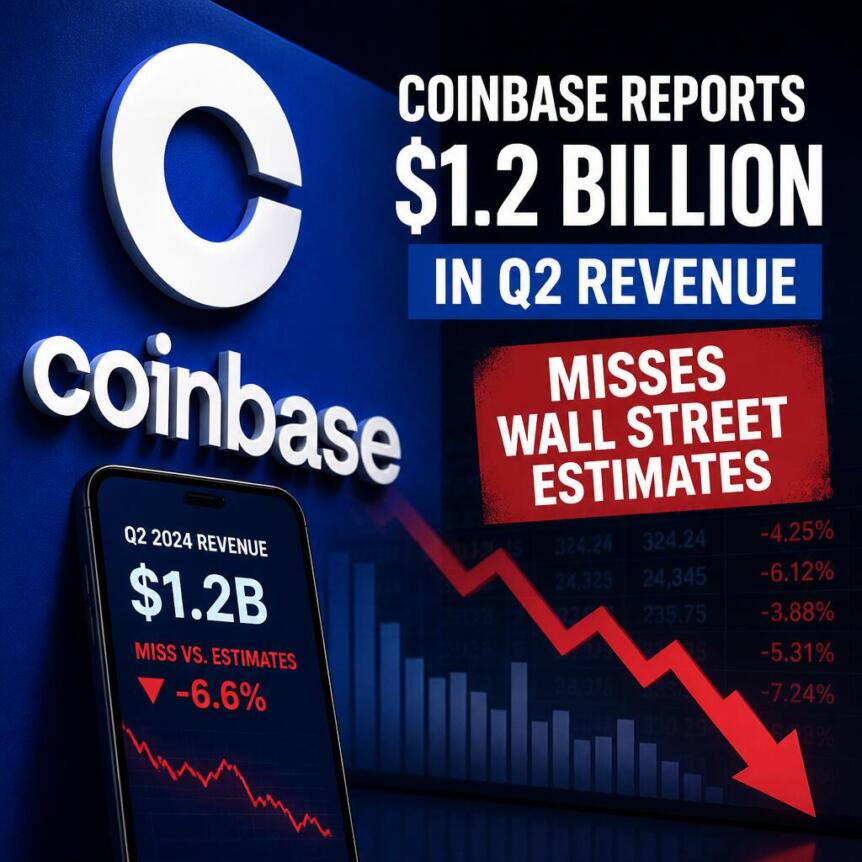
Cryptocurrency exchange Coinbase reported its Q2 earnings, posting $1.2 billion in revenue and missing Wall Street estimates on sales and profits for a third straight time.
The exchange blamed low spot trading volumes and low volatility for missing earnings estimates. Coinbase lost $1.36 per share, significantly higher than Wall Street’s estimate of a loss between 17 cents and 44 cents, as transaction, subscription, and stablecoin revenue came in lower than expectations.
Coinbase Posts $1.2 Billion In Revenue
The mixed Q2 earnings come as weak trading activity dragged expected results lower despite cornering a record share of the cryptocurrency market. Coinbase reported $1.2 billion in net revenue for Q2, a 19% decline from the previous year.
The GAAP net loss of $359 million was significantly higher than market expectations of a $122 million loss. Coinbase’s subscription revenue, transaction revenue, services revenue, and adjusted EBITDA also fell short of expectations.
Transaction revenue was also lower at $599 million against the expected $636 million. Subscription services revenue clocked in at $555 million, narrowly missing the estimated $590 million.
Coinbase reported $292 million in stablecoin revenue, a $17 million decline from Q2 2025, and lower than StreetAccount’s estimate of $327.2 million. The company’s shares fell over 5% during after-hours trading following the earnings report.
Weak Spot Trading Activity Dampens Q2
Despite the lower numbers, Coinbase’s share of the cryptocurrency market jumped to an all-time high of 10.3%, substantially higher than the 9.1% reported in Q1. The increase in market share comes despite a struggling crypto market and weak trading activity.
Coinbase has attributed the lower-than-expected results to weak institutional and retail trading activity. Spot trading volume has dropped 25% quarter-over-quarter, while cryptocurrency prices have remained low thanks to geopolitical tensions and policy headwinds.
Brian Armstrong Bullish On Coinbase
Coinbase is positioning itself as an “Everything Exchange” as it expands its presence into derivatives, prediction markets, payments, and tokenized assets. CEO Brian Armstrong highlighted the exchange’s record market share, adding that it could operate in any market, stating,
“Coinbase is no longer a bet just on the price of bitcoin. All of financial services are getting updated by crypto, whether that’s trading or payments or lending.”
Disclaimer: This article is provided for informational purposes only. It is not offered or intended to be used as legal, tax, investment, financial, or other advice.

Royal Mail to launch first electric buggies in Cambridge

Why the Vitamin B12 Inhaler and Caffeine Inhaler Are Gaining Attention

Bitcoin rally stalls after massive $9.6B options expiry

Renter of Home in Anne Heche Crash Denies Settlement With Son

No Jackpot Winner as $257 Million Prize Rolls Over to $269 Million Monday Draw

Weekend Open Thread: Staud – Corporette.com

XRP SUDDEN WEALTH SYNDROME IS COMING! – WHY CAN’T ELITE’S TALK ABOUT XRP?

Financial Management | Introduction | Financial Decision | Function |BBA | B.Com | MBA | Class 12

How to Calculate Discounting Factors? – Financial Management
-

 Fashion7 days ago
Weekend Open Thread: Brooks Brothers
-
 Sports5 days ago
Commonwealth Games boxing: Jadumani Singh seals dominant 5-0 win over Pakistan’s Sumama Rehman to enter quarter-finals | Commonwealth Games News
-

 Business2 days ago
Why Trees Belong on the Risk Register
-

 Tech4 days ago
Intel is reversing course and bringing hyper-threading back to its server chips
-

 Crypto World6 days ago
Ripple bought a bank in pieces. The $4 billion audit
-

 Politics4 days ago
Luke Littler dismantles Gerwyn Price to retain title in Blackpool
-
 Entertainment7 days ago
A New Post-Apocalyptic Gundam Anime Series Blasts Into SDCC
-

 Politics3 days ago
The Part of the Electric Transition Nobody Wants to Discuss
-

 News Videos5 days ago
BITCOIN JUST ENTERED THIS CRITICAL ZONE…
-

 Business2 days ago
Major shareholder moves on Canyon
-

 Crypto World5 days ago
XRP Ledger adds $2.6B as RWA inflows rank second
-

 News Videos21 hours ago
Bitcoin Enters the 3rd Stage of the Bear Market
-

 Politics5 days ago
Spain sweeps the board at 2026 World Cup with individual awards
-
 Entertainment3 days ago
‘Stargate’ Creator’s New Sci-Fi Series Returns for Season 3 Tomorrow
-

 Entertainment5 days ago
Sara Gilson Killed By Husband After Viral “Pedophile” TikTok Video
-

 Crypto World2 days ago
Kraken Enables Retail Access to Jersey Mike’s IPO via Tokenized Shares
-

 Tech6 days ago
Anthropic launches Claude Opus 5, a cheaper AI model for coding, agents and enterprise workflows
-

 News Videos3 days ago
Claude: Build Financial Dashboards in Minutes (2026)
-

 Politics17 hours ago
Luke Littler’s dominance sparks GOAT debate
-

 Tech3 days ago
New macOS Sequoia & Sonoma security updates for older Macs
You must be logged in to post a comment Login