

Connect with us
DAPA Banner
DAPA Coin
DAPA
COIN PAYMENT ASSET
PRIVACY · BLOCKDAG · HOMOMORPHIC ENCRYPTION · RUST
ElGamal Encrypted MINE DAPA
🚫 GENESIS SOLD OUT
DAPAPAY COMING

Tech

Nintendo just made life harder for Switch 2 scalpers

Published

on

Nintendo is introducing a new account-history requirement for Switch 2 purchases in Japan to keep consoles away from resellers. The move targets the multi-language Nintendo Switch 2 sold through the official Japanese Nintendo Store, which scalpers have been buying in bulk because it can be bought for less in Japan and resold abroad.

The price difference explains why scalpers are interested. In Japan, the multi-language Switch 2 is considerably cheaper compared to some other markets. That gap gives resellers room to import units and mark them up overseas, especially while official stock remains limited. The Japan-exclusive model, which only supports Japanese text and characters, is not affected by the new rule.

Nintendo is using account history as a filter

Nintendo said on X that it had found multiple orders linked to suspected resale activity and temporarily paused sales of the multi-language model. When sales resume, buyers will need to meet stricter conditions. Their Nintendo Account must show at least 50 hours of playtime on the original Nintendo Switch by 11:59 PM on May 31, 2026. Playtime from demo titles and free software will not qualify.

Nintendo StoreにおけるNintendo Switch 2(多言語対応)の販売につきまして、買い占め等の疑いがある注文を複数確認しましたので、一時的に販売を停止しておりました。…

— 任天堂株式会社 (@Nintendo) June 11, 2026

Advertisement

The company is also limiting purchases to one console per Nintendo Account. That gives Nintendo a way to reduce repeat buying while making fresh accounts less useful for resellers.

Nintendo takes a page out of Valve’s playbook

The Switch 2 has become one of the most practical handheld gaming console options, especially after Valve’s Steam Deck price hike made PC handhelds a bigger expense for many buyers. Still, Nintendo’s console will not stay immune to higher pricing for long, with its own price increase expected soon.

Scalpers have been a thorn in the side of gamers for years. Valve faced a similar issue with the recent Steam Controller launch, where units quickly sold out and appeared on resale sites at inflated prices. Valve responded with a reservation queue, purchase-history checks, and a one-controller-per-account limit.

Nintendo is now applying a similar idea to the Switch 2. Fresh accounts will have a much harder time passing the check, which could reduce bulk buying through the Japanese store.

Advertisement

Source link

Continue Reading
Click to comment

You must be logged in to post a comment Login

Leave a Reply

Tech

How to watch Australia vs Turkey: Free Streams & TV Channels

Published

on

Australia and Turkey will face off in a pivotal World Cup 2026 Group D clash at BC Place in Vancouver, Canada, with both sides eyeing a strong start in one of the tournament’s most open groups. Alongside the United States and Paraguay, both teams will believe qualification is a possibility, and so we can expect high intensity from the opening whistle.

Turkey head into the match as slight favourites thanks to their wealth of European talent. Vincenzo Montella’s side boasts exciting stars such as Arda Güler, Kenan Yildiz, and Kerem Aktürkoğlu, and arrives on the back of a five-match winning streak in competitive qualifiers.

Source link

Advertisement
Continue Reading

Tech

Today’s NYT Strands Hints, Answer and Help for June 14 #833- CNET

Published

on

Looking for the most recent Strands answer? Click here for our daily Strands hints, as well as our daily answers and hints for The New York Times Mini Crossword, Wordle, Connections and Connections: Sports Edition puzzles.


If you have a British royal family obsession, like me, today’s NYT Strands puzzle will be a royal breeze. Some of the answers are difficult to unscramble, so if you need hints and answers, read on.

I go into depth about the rules for Strands in this story

Advertisement

If you’re looking for today’s Wordle, Connections and Mini Crossword answers, you can visit CNET’s NYT puzzle hints page.

Read more: NYT Connections Turns 1: These Are the 5 Toughest Puzzles So Far

Hint for today’s Strands puzzle

Today’s Strands theme is: Peer group

Advertisement

If that doesn’t help you, here’s a clue: Titles

Clue words to unlock in-game hints

Your goal is to find hidden words that fit the puzzle’s theme. If you’re stuck, find any words you can. Every time you find three words of four letters or more, Strands will reveal one of the theme words. These are the words I used to get those hints but any words of four or more letters that you find will work:

  • SOUR, MARE, RANT, RANTS, DIRT, DIRTS, LEAR, COUNT, QUID, QUIDS

Answers for today’s Strands puzzle

These are the answers that tie into the theme. The goal of the puzzle is to find them all, including the spangram, a theme word that reaches from one side of the puzzle to the other. When you have all of them (I originally thought there were always eight but learned that the number can vary), every letter on the board will be used. Here are the nonspangram answers:

  • EARL, LADY, DUCHESS, LORD, VISCOUNT, BARON, MARQUESS

Today’s Strands spangram

completed NYT Strands puzzle for June 14, 2026

The completed NYT Strands puzzle for June 14, 2026.

NYT/Screenshot by CNET

Today’s Strands spangram is NOBILITY. To find it, start with the N that is three letters to the right on the top row, and wind down.

Advertisement

Source link

Continue Reading

Tech

AWS rolls the dice for faster, more efficient networking

Published

on

Networks

Honey, I flattened the datacenter network

Amazon has developed a new networking topology that’s up to a third faster and up to 40 percent more energy efficient than traditional hierarchical network designs.

The novel architecture, called Resilient Network Graphs (RNG), is based on random graph theory.

Advertisement

“Traditional networks have always been hierarchical,” explained Matt Rehder, VP of global network engineering at AWS, in a recent interview. “They’re sort of like an org chart where one network device will talk to the boss network device which will talk to the next boss network device and you gotta go up the chain of command in order to talk to someone else in another department.”

There are reasons for that, Rehder said. Hierarchy creates structure and makes data routing rules simpler. “You don’t have to know how to talk to everyone in the organization, you just talk to the person above you,” he said.

But that creates inefficiencies. The tree-like structure creates points of contention where data flow bottlenecks can occur. At the same time, other parts of the network may be underutilized. 

Rehder said that academics in 2012 proposed a random graph topology for networks. 

Advertisement

But that design, as detailed [PDF] by Amazon researchers, had issues. The reimagined network structure, dubbed Jellyfish, relied on truly random graphs and called for removing routers from server racks and locating them centrally to simplify cabling. But that approach ended up increasing latency between servers within a rack.

Rehder said no one has been able to put that design into production. 

“It requires much more complicated routing rules to figure out how to program every device – you can’t just program every device to know who everyone is, they have limited memory space,” he said. “And then the other [issue] is that the cabling actually is very complicated. Part of that hierarchy is about simplifying how you build the network in the datacenter and with a random graph it’s literally random and you can’t just have cable spaghetti all over a datacenter. So you could build it in a lab but you could never really do it at scale.”

Nonetheless, said Rehder, AWS has been solving these problems over the past few years.

Advertisement

“The only reason we were able to even think about tackling them is that 15-year history of iteratively improving our hardware development and software ownership of our network,” he said. 

Less random

Inspired by other academic networking research, AWS managed to succeed with random network topology by making it not entirely random. RNG relies on a flat graph where routers interconnect through a mix of deterministic and randomized cabling.

RNG began taking shape three years ago when Seshadhri Comandur, an Amazon Scholar and professor at the University of California, Santa Cruz, answered an internal Slack message from Ratul Mahajan, a fellow Amazon Scholar, datacenter networking expert, and professor at the University of Washington, who was looking for an expert on graph theory and routing.

With help from AWS principal applied scientist Giacomo Bernardi and other colleagues, AWS has become the first company to deploy a flat datacenter network at scale. AWS expects the technology will offer better performance and reliability for Amazon customers while also saving billions of dollars in hardware and reducing CO2 emissions.

Advertisement

The reimagined network structure was referred to as Penrose internally because the original design involved Penrose tiles. But as the project evolved, AWS settled on Resilient Network Graphs “to reflect the customer benefit and that primarily is a more resilient and performant network,” as a company spokesperson put it.

RNG relies on a routing algorithm called Spraypoint to identify node paths and an optical device called a Shufflebox for mixing connections between routers. 

Rehder said the Shufflebox is one of the pieces of magic that makes RNG work.

“In a random graph network you don’t have that hierarchical structure where you can have all the cables neatly aligned,” he explained. “So how do you do that? How do you basically make a random network feel more structured? Well, you have the Shufflebox and the idea is that you plug fiber in here and inside of this it will randomize or basically scramble the fiber. So the ports you plug in get scrambled around and come out on some random port around the other side.”

Advertisement

RNG is AWS’s new network for its core database servers. Machine learning hardware uses the company’s UltraServer network, because the machine learning workloads need full bandwidth. 

“The core server networks can be oversubscribed more efficiently,” said Rehder. “Everyone’s not talking to each other at the same time.”

RNG has been rolled out in Ireland, Germany, and Spain, and the plan is to deploy it in the majority of company datacenters by the end of the year. ®

Source link

Advertisement
Continue Reading

Tech

Vim Classic 8.3 Launched as an AI-Free Vim Fork

Published

on

This month saw the release of Vim Classic 8.3, the first stable version of a new long-term support fork of Vim maintained without generative AI tools. Linuxiac reports:

The release is based on Vim 8.2.0148 and includes selected bug fixes and patches backported from later upstream Vim releases. Vim Classic was first announced by [SourceHut’s CEO/founder] Drew DeVault in March 2026 after he objected to LLM-assisted development in Vim and Neovim. In his announcement, DeVault said he no longer wanted to use software developed with LLM assistance and introduced Vim Classic as a fork for users who want to continue using Vim without that involvement… Vim Classic follows Vim’s charityware model and continues to direct users toward Bram Moolenaar’s long-running support for children in Uganda. The release is distributed as a signed source tarball from SourceHut, while future important announcements are expected through the project’s mailing list.

“Vim is important to me…” DeVault wrote in March. (DeVault even tattooed “hjkl” on his right arm.) “[A]lmost every word I have ever committed to posterity, through this blog, in my code, all of the docs I’ve written, emails I’ve sent, and more, almost all of it has passed through Vim.”

But DeVault wrote that he also cares about AI’s impact on air pollution, fresh water supplies, global supply chains, and the working conditions of miners in African companies:
And at a moment when the climate demands immediate action to reduce our footprint on this planet, the AI boom is driving data centers to consume a full 1.5% of the world’s total energy production in order to eliminate jobs and replace them with a robot that lies… All this to enrich the few, centralize power, reduce competition, and underwrite an enormous bubble that, once it bursts, will ruin the lives of millions of the world’s poor and marginalized classes.

Advertisement

I don’t think it’s cute that someone vibe coded “battleship” in VimScript. I think it’s more important that we stop collectively pretending that we don’t understand how awful all of this is. I don’t want to use software which has slop in it. I do what I can to avoid it, and sadly even Vim now comes under scrutiny in that effort as both Vim and NeoVim are relying on LLMs to develop the software… To keep my conscience clear, and continue to enjoy the relationship I have with this amazing piece of software, I have forked Vim…

Since forking from this base, I have backported a handful of patches, most of which address CVEs discovered after this release, but others which address minor bug fixes. I also penned a handful of original patches which bring the codebase from this time up to snuff for building it on newer toolchains…

I invite you to use Vim Classic, if you feel the same way as me, and to maintain it with me, contributing the patches you need to support your own use cases.

Source link

Advertisement
Continue Reading

Tech

Razr Ultra, AMD Radeon RX 9070 GRE And More

Published

on

A roundup of recent reviews published by Engadget.

It’s as hot as the surface of the sun here in the southeast US, and we’ve got another batch of freshly baked reviews for you to catch up on. If you’ve missed any of our team’s in-depth testing over the last two weeks, read on for a full rundown of all of our latest impressions on foldable phones, an affordable GPU, headphones and more. 

Advertisement

Motorola Razr Ultra

In case you’ve been living under a rock, Motorola turned its iconic Razr phone into a set of foldables. Now on the second iteration of the Razr Ultra, the company hasn’t done enough to justify a pricier follow-up. “With Samsung expected to announce a new Z Flip before the end of the summer, buying a Razr Ultra right now at full price feels like a bit of a trap,” writer Sam Rutherford said. “It’s a good phone, I just wish it cost less.”

AMD Radeon RX 9070 GRE

It’s not a great time to buy a GPU, but AMD has a unique solution for the budget crunch. With the RX 9070 GRE, the company offers older tech for less money, but you’ll have to make some sacrifices along the way. “Given the times we’re in, I can’t easily recommend that you run out and buy the Radeon RX 9070 GRE,” writer Devindra Hardawar said. “But if you’re in desperate need of an upgrade, and you can’t wait until next year, it’s a solid choice for midrange 1440p gaming.”

Advertisement

Honor Magic V6

Honor just launched the Magic V5 last August, but it announced the Magic V6 in March. Editor Daniel Cooper argues the company rushed out a successor to maintain its claim of the world’s thinnest foldable. “The tragedy of this device is that you can throw a rock and hit an issue with the UI design or software that you would expect to have been caught during the QA period,” he said. “Some of these would be forgivable in a cheaper handset, but not in an ultra-premium flagship of this caliber.”

Marshall Milton ANC

Although over-ear ANC headphones are aplenty, noise-canceling on-ear headphones are much more rare. Marshall has a new take on the on-ear formula, balancing its product lines with a dash of distraction blocking on the Milton ANC. “The heritage of the popular Major line clearly has been put to good use here to make an on-ear headphone for the more discerning listener,” writer James Trew said. “The ANC capabilities are strong for the form-factor, even if they might be considered more mid-pack if they were over ears.”

Advertisement

Logitech Mobi Fold

Is a folding mouse the ultimate travel accessory? For a certain set of people, Logitech’s Mobi Fold may prove that answer to be a resounding “yes.” 

“I’m faster and more productive when using a physical mouse and I’m more than willing to carry one with me, just as long as it doesn’t weigh things down too much,” Sam said. “And with the Mobi Fold, Logitech has created one of the most travel-friendly pointers on the market.”

Advertisement

2027 Rivian R2 first drive

While we await an opportunity for extended testing, you can read some initial impressions from behind the wheel of Rivian’s R2 SUV. “[The] R2 is very much a standard SUV, but one that proved both capable and comfortable in all conditions,” writer Tim Stevens said. “After a day of driving, I found myself liking it a lot more than the R1S. In other words, there’s no sophomore slump here, and now I’m even more excited about the R3X.”

Source link

Advertisement
Continue Reading

Tech

The FCC Wants to Kill Burner Phones

Published

on

After WIRED reported last week that Meta’s smart glasses app contained code that would enable the company to activate face-recognition features on the devices, the company removed the code this week without commenting on why or whether it plans to add such functionality back into the app later. Another WIRED investigation this week found that xAI’s Grok is still hosting sexualized deepfakes, including “nudified” images and videos, of celebrities and at least one prominent US politician.

After limiting the release of its new Mythos-class AI model over concerns about its potential impacts on cybersecurity, Anthropic announced a model upgrade for partners in its limited-access group this week and launched a “safe” version of the model to the public with guardrails meant to keep the system from being used to fuel cyberattacks. Meanwhile, the United States Cybersecurity and Infrastructure Security Agency issued a new directive to federal agencies this week in reaction to new AI threats that includes a requirement to fix the most urgent software vulnerabilities in as little as three days.

As Europe looks to separate and insulate itself from US Big Tech, WIRED created a timeline that tracks all the ways EU governments, companies, and other organizations are moving away from US tech. A new open-source project dubbed Encrypted Spaces could be used to make countless mainstream collaboration apps more private and surveillance-resistant with end-to-end encryption. And illegal pharmacy and scam websites hijacked Spotify’s search rankings using fake podcasts, according to a new joint US Congressional report.

The 2026 World Cup is in full swing, and WIRED looked at the surveillance technologies, from anti-drone tech to face recognition, that are being used in US, Canadian, and Mexican stadiums. We also mapped every Flock license plate reader near a US World Cup stadium. More broadly, Amnesty International said this week that it has concluded fans in all three host countries—both local residents and visitors—face potential human rights violations as a result of the FIFA tournament.

Advertisement

The American Civil Liberties Union is suing two Florida police departments over its use of FACES, one of the longest-running face recognition tools in the US, after its alleged misuse led to the wrongful arrest of a Fort Myers man. Donald Trump, meanwhile, jeopardized the future of a key surveillance authority after selecting Bill Pulte, who’s been described as “deeply unqualified,” as the acting director of national intelligence. (Trump has since selected an alternative nominee for the permanent role.)

And there’s more. Each week, we round up the security and privacy news we didn’t cover in depth ourselves. Click the headlines to read the full stories. And stay safe out there.

As difficult as digital anonymity has become in the modern world, obtaining a phone number without revealing almost any identifying information—whether by buying a temporary burner phone or registering an account with a privacy-preserving phone carrier—has remained entirely legal in the US. Now the Federal Communications Commission wants to change that.

Late last month, the FCC released a proposal for a new rule that would implement know-your-customer requirements for cellular networks, requiring that cellular providers “at a minimum, obtain and retain the name, physical address, government issued identification number, and an alternate telephone number of any new and renewing customer before granting access to its services.” The proposal is described as a measure akin to money-laundering laws designed to make it more difficult for scammers to exploit the phone networks. But privacy advocates argue it also threatens a last conduit of anonymity for those seeking to evade phone surveillance—whether that’s journalists, whistleblowers, activists, or simply people seeking to avoid mass data collection in yet another facet of their communications.

Advertisement

Source link

Continue Reading

Tech

M4 Mac mini hits $769.99 in Amazon Father’s Day sale

Published

on

With delivery by Father’s Day and a 90-day low price, you’ll want to grab Amazon’s weekend Mac mini deal before inventory runs out.

With increased demand for a headless machine to run AI agents and a budget-friendly price tag, Apple’s M4 Mac mini has been sold out for much of Q2 2026. But Amazon has the 16GB/512GB configuration back in stock, and it’s on sale for $769.99 (a $30 discount off retail).

Buy M4 Mac mini for $769.99

Now priced at a 90-day low, Amazon has repeatedly shown stock levels of 20 or fewer units left today, indicating stock is limited.

Advertisement

You can also find early Prime Day deals on dozens of Apple devices, including $299 iPads, $499 AirPods Max 2, and 2026 MacBook Airs from $949 in our early Prime Day Apple deals roundup.

Additional early Prime Day Apple deals

Source link

Advertisement
Continue Reading

Tech

How Author Dave Eggers Avoids Smartphones, Internet Access, and Flock Cameras

Published

on

A few weeks ago on a bike ride “inspiration struck” for Dave Eggers, reports SFGate

Without a pen and paper handy, he was stuck texting the idea to himself. The problem? Eggers doesn’t own a smartphone. “It takes 20 minutes to write a sentence,” Eggers said… It’s a funny predicament for Eggers, given that he’s arguably the city’s biggest proponent of the written word… Now age 56, Eggers’ latest book is called “Contrapposto“…

On writing days, Eggers bikes to his sailboat docked near the Golden Gate Bridge. He writes using a hefty 1998 Mac that has never been connected to the internet. On the boat, he keeps “banker’s hours,” working 9 to 5 without any meetings or interruptions except for the occasional wildlife visit. “You’re there with the cormorants and the occasional porpoise and sea lions and seals, and when you want to take a break, you walk around and you’re in the thick of it, one of the most beautiful spots on Earth,” he said. “Especially coming from the Midwest, it never gets old.”

Given Eggers’ decidedly low-tech existence, it’s not surprising that the current state of San Francisco gives him pause, but there’s a streak of hope that underlies his concerns. He abhors the growing surveillance technology that’s gripping the city, refusing to get into Ubers that use recording devices, but he feels a well-written ballot measure about Flock cameras could potentially save our dwindling privacy. ChatGPT’s effects on the art of writing are demoralizing, but he welcomes that teachers are re-embracing pencil and paper, with cursive making a big comeback. The wave of artificial intelligence ads blanketing bus stops imploring companies to stop hiring humans are so over the top, they’d sound cliché if he were to include them in one of his dystopian tech industry novels like “The Circle” or “The Every,” but tech philanthropy has helped many of his projects flourish.

Advertisement

Case in point, Art + Water, a new art space scheduled to open next year on Pier 29 funded largely by art world donations… Co-founded with the artist JD Beltran, the space is slated to operate as an old-school apprenticeship system, hosting 10 artists in residence mentoring 20 students, all free of charge… The ultimate goal is to break down the financial barriers that keep students from pursuing art.

Thanks to Slashdot reader destinyland for sharing the article.

Source link

Continue Reading

Tech

Shutterstock ‘Evolves’ Into ‘Human-Led, AI-Powered Creative Platform’

Published

on

Slashdot reader BrianFagioli writes:
Shutterstock has unveiled what it calls a “human-led, AI-powered” creative platform that combines its massive library of [human] contributor-created content with AI image and video generation, AI editing, conversational search, prompt enhancement, and automated model selection tools. The company says the goal is to help creators move from idea to finished work faster [in a single application] while maintaining commercial licensing protections and contributor royalty payments… While Shutterstock repeatedly emphasizes human creativity, much of the platform’s future appears centered on AI-generated and AI-modified content.
An article at Nerds.xyz suggests Shutterstock’s AI tools let users “transform existing content into something new,” while noting Shutterstock’s repeated references to human creativity “almost feel defensive.”

But it points out other companies including Adobe and Canva “and countless startups are all racing to integrate AI into creative workflows.”

Source link

Continue Reading

Tech

Bambuddy Says Bye To Bambu Lab Cloud Services

Published

on

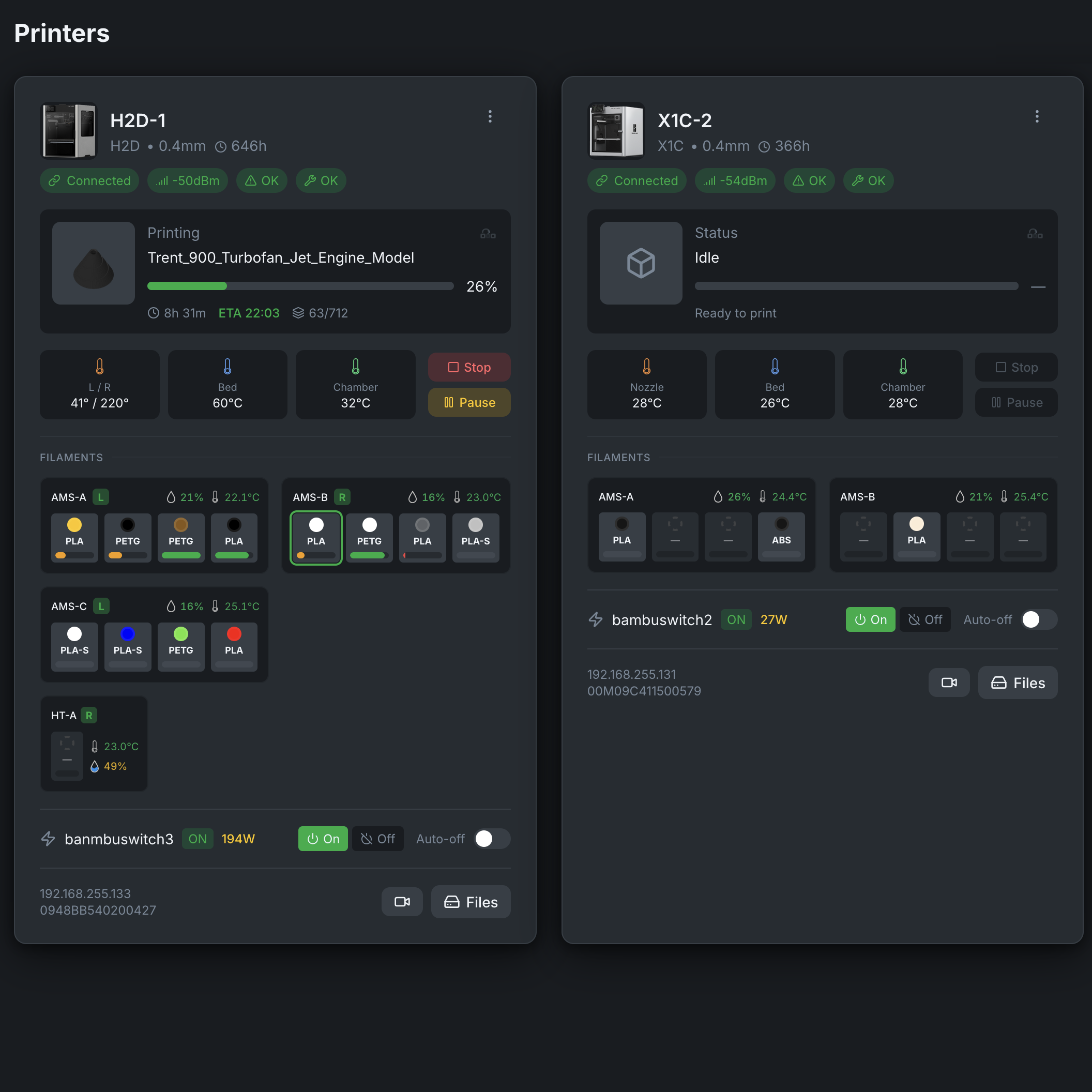
If you have a Bambu Labs printer and aren’t keen to send your files to Bambu’s servers with each print job, then check out Bambuddy, an open-source, self-hosted, cloud-free central command that offers a local alternative for managing Bambu Labs printers. It acts as a replacement for the official cloud services, allowing you to slice, print, and monitor with full local control and zero reliance on Bambu Labs’ servers.

Bambuddy offers full control over one to forty printers.

To use it, one installs Bambuddy, then puts their printer(s) into LAN-only mode. Doing this disables cloud functionality, including remote access. Then one enables Developer Mode, which allows external software to control printer functions via a machine API. Once that’s done, the printers can be added to Bambuddy.

Bambuddy then acts as a full-featured control panel and management center for anywhere from one to forty printers. It runs on Linux, macOS, or Windows, and a Raspberry Pi is a common install target.

Bambu Labs makes indisputably high-quality printers, and using their software and official app is certainly convenient. But the fact that every print job goes through Bambu’s servers, and a software architecture that frustrates home-grown solutions? Not so much. Add AGPLv3 violations and some heavy-handed legal behavior to the mix, and it’s easy to understand the motivation for an alternative to the factory software.

Bambuddy has a huge number of features — including an integrated slicer and proxy mode for remote access — and it may look a little intimidating at first. Fortunately, the project’s website offers a live sandbox demo with simulated printers, which should be right up the alley of those who prefer to learn by clicking around in a consequence-free environment.

Advertisement

Source link

Continue Reading

Trending

Copyright © 2025