

Crypto World
Iran Contradicts Trump on Timing of Peace Deal Signing

Iran has disputed US President Donald Trump’s claim that a deal ending the war will be signed on Sunday, with the Islamic Revolutionary Guard Corps calling the timeline false and the framework unfinished.
The clash surfaced as both sides signaled a broader agreement was close, one that would replace a fragile 60-day ceasefire.
US and Iran Split on the Deal Signing Date
Trump said on Truth Social that the agreement would be signed on Sunday and that the Strait of Hormuz would open to all traffic immediately after.
This post came after Pakistan, acting as mediator, struck an optimistic tone. Prime Minister Shehbaz Sharif said the parties were closer than ever and that Islamabad was preparing for an electronic signing.
“We are closer to a peace deal than ever before. With finalisation likely expected in the next 24 hours,” the post read.
Tehran pushed back fast. A source cited by Iran’s Fars News Agency called reports of a finalized deal on Sunday completely false.
Follow us on X to get the latest news as it happens
The Islamic Revolutionary Guard Corps (IRGC) described the timeline as a test for Iran’s negotiating team and said the memorandum was not yet finalized. The Guard linked Trump’s insistence to his birthday, suggesting a publicity motive.
“A notable point is that Sunday coincides with June 14, Trump’s birthday. Some observers consider it likely that, through this insistence, he is seeking to exploit the occasion symbolically and turn it into a publicity event for himself. But given the clear position of Iranian officials that the agreement is not finalized, it appears our country’s negotiators are aware of these hidden layers and will not allow such a media and ceremonial maneuver,” the statement read.
Oil and Crypto Markets Brace for Monday
The dispute leaves markets waiting for confirmation when trading resumes Monday. A signed deal could pull oil prices lower after they climbed during the conflict.
Reopening the Strait of Hormuz would ease supply fears, since the waterway carries a large share of global crude shipments.
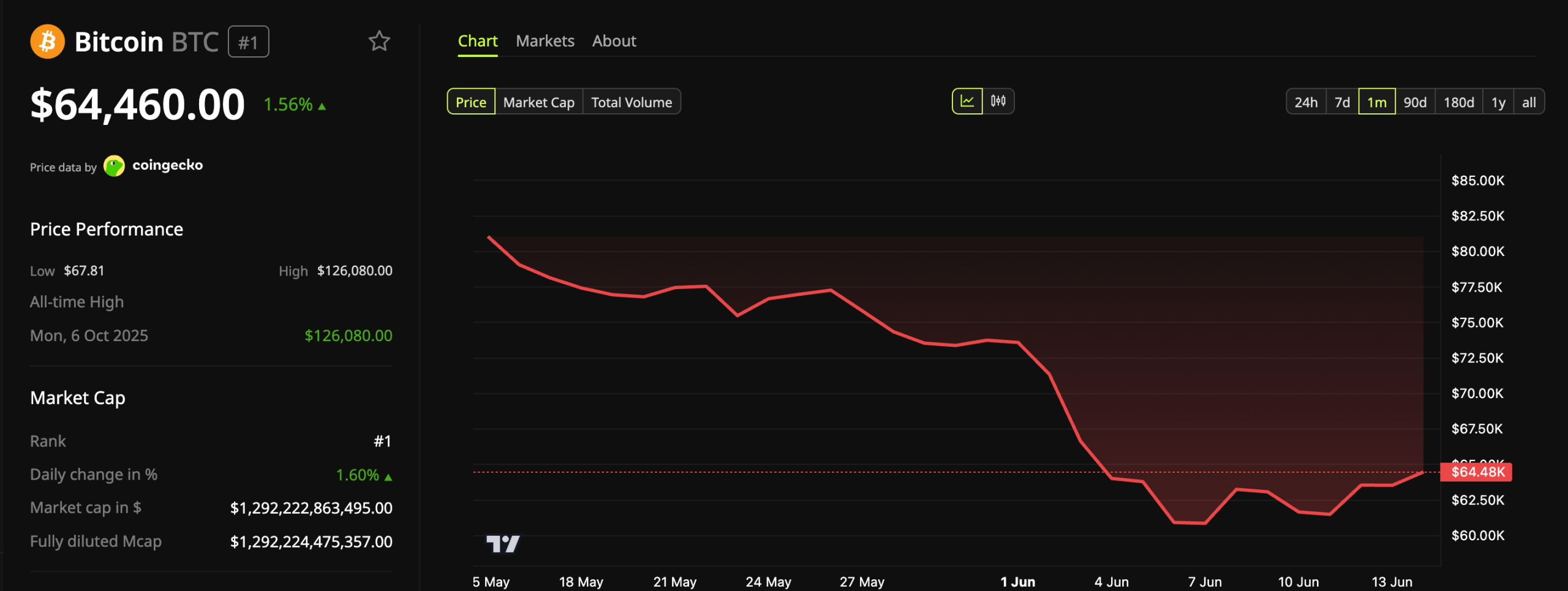
Crypto markets have already reacted to the headlines. Bitcoin (BTC) traded near $64,460, up about 1.56% over 24 hours, while the total crypto market rose roughly 1%.

The recovery followed Pakistan’s 24-hour signing claim. However, sentiment stayed cautious, with the Crypto Fear and Greed Index near 18.
A confirmed agreement could extend the relief move. Any delay or fresh clash, in contrast, could pressure oil and digital assets again.
Subscribe to our YouTube channel to watch leaders and journalists provide expert insights
The post Iran Contradicts Trump on Timing of Peace Deal Signing appeared first on BeInCrypto.



CoinFund founder Jake Brukhman said the Anthropic export-control dispute shows why decentralized AI networks are gaining attention as a possible counterweight to centralized model control.
Summary
- Jake Brukhman said Anthropic’s model shutdown shows how frontier AI can face direct government control.
- Decentralized AI teams are testing distributed GPU training as centralized compute access faces tighter rules.
- Pluralis is exploring tokenized AI model ownership by splitting weights among network participants and operators.
In a June 13 X post, Brukhman said AI models are a centralizing force and a major target for government control. He linked that view to Anthropic’s decision to comply with a U.S. directive that forced it to suspend access to Fable 5 and Mythos 5.
Anthropic said the order required it to block access for foreign nationals, including foreign-national employees, whether inside or outside the United States. The company said it disabled both models for all users to meet the directive, while other Claude models remained available.
Anthropic shutdown highlights distributed GPU training
Brukhman said decentralized networks can act as a counterbalance because AI’s first hard problem is access to large-scale compute. “The answer is simple: there is enough commodity GPU compute in the world to compete on the frontier,” he wrote, adding that new training methods are needed to use it.
He named Gensyn, Prime Intellect, Bagel, Pluralis, Nous Research, Macrocosmos AI, and Covenant as teams working on distributed training. He said their work shows that decentralized training is possible, cheaper, and nearly as efficient as centralized systems, though the sector still faces technical limits.
Pluralis model draws business focus
Brukhman also pointed to the business problem facing open-source AI. He argued that open models can be useful but often lack a revenue model strong enough to support frontier training costs.
He said Pluralis has proposed one answer by splitting model weights among participants. In his view, that structure can support tokenized AI models because no single participant holds the full model, while the network can still provide access to the system.
Broader AI pressure
As previously reported by crypto.news, Anthropic launched Fable 5 only days before the shutdown, presenting it as a Mythos-class model with added safeguards. The same report said some cybersecurity, biology, chemistry, and distillation requests would fall back to Claude Opus 4.8.
Earlier reports also showed the scale of AI infrastructure demand. Blackstone and Apollo were lining up about $36 billion in debt financing for Anthropic’s Google TPU expansion. Separate reporting on open AI infrastructure said concentrated compute access can leave whole regions dependent on a few providers.
Brukhman framed the moment as a choice between centralized AI and public AI on open networks. “This is the moment of truth,” he wrote, asking whether AI will fall under “censorship and unilateral government control” or move toward decentralized systems.
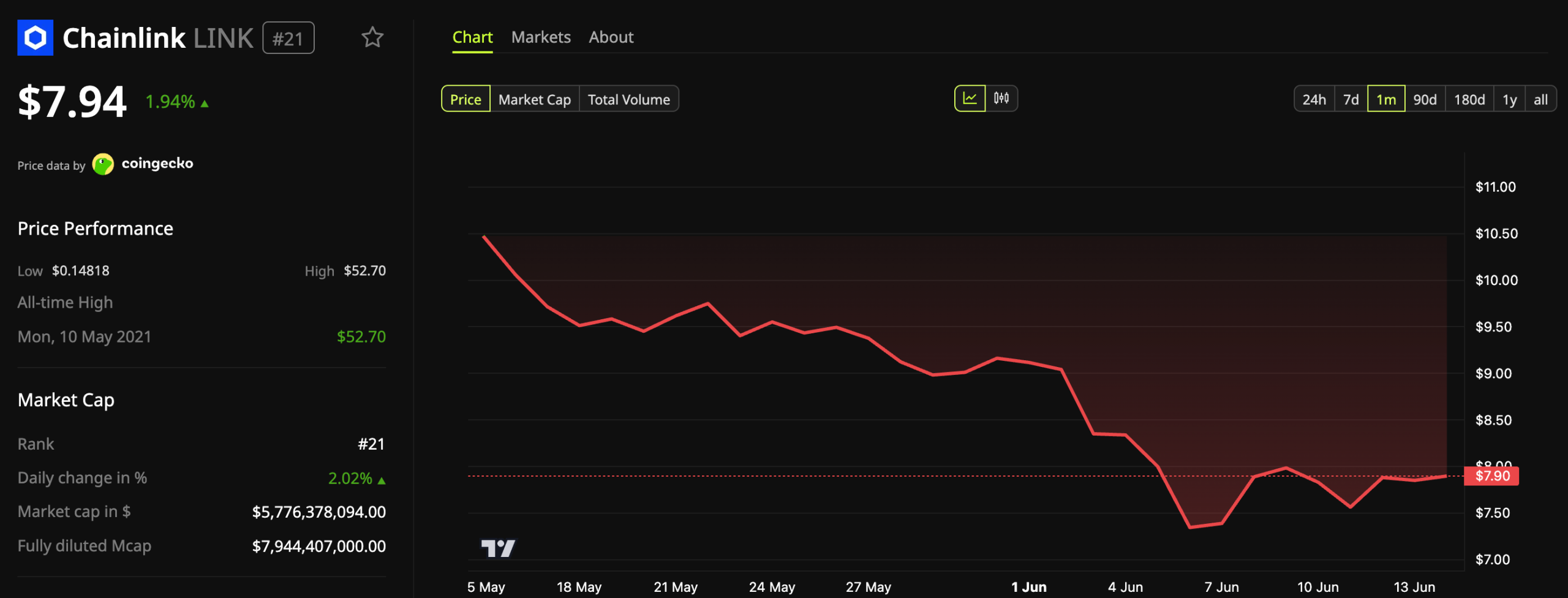
Chainlink (LINK) now powers the betting markets behind the 2026 World Cup. Yet, its token trades near $7.94, close to 90-day lows.
The disconnect highlights a familiar pattern in crypto. Real-world use of Chainlink’s network is rising, while LINK’s price remains tied to sentiment across the wider market.
Chainlink Powers the World Cup’s Betting Rails
Chainlink provides oracle infrastructure that feeds real-world data, such as match results, onto blockchains. Prediction markets use that data to automatically settle bets.
ADI Predictstreet became the tournament’s first official prediction-market partner, and it runs on Chainlink oracles. Myriad, backed by Tom Lee and ConsenSys, settles more than 75 World Cup contracts the same way.
On Polymarket, the World Cup Winner market alone has attracted close to $2.2 billion in bets. The platform also runs fast crypto markets that resolve every 5 or 15 minutes.
Those markets use Chainlink Data Streams and cover hundreds of token pairs. Chainlink says the markets have processed more than $7 billion in a matter of months.
“No mania behind it either: social volume is running at its May average, not above it. The adoption stack isn’t crowd hype,” Santiment said.
Follow us on X to get the latest news as it happens
LINK Price Stays Tied to the Macro
Despite the adoption, LINK trades about 23% below its May highs. The token has followed a broad June risk-off across crypto and other risk assets.
Bitcoin’s weakness has weighed on the wider market, and altcoins like LINK tend to amplify those moves. Lower risk appetite has capped any rebound.

Chainlink’s daily active addresses surged to 5,679 on June 5, marking the busiest day in the quarter. That same day, LINK printed its 90-day low. Higher usage has not raised prices.
“The tournament runs on its rails. The token trades on the macro,” Santiment added.
Analysts Watch for a LINK Bottom
Despite the weakness, Joao Wedson, founder of analytics firm Alphractal, says LINK is “entering the accumulation zone.” He noted that large holders have resumed accumulating. At the same time, the altcoin trades below its realized price, the average cost basis of holders.
“There is another lower level that has acted as a historical price base. A true accumulation phase. BTC may still drop further, but LINK already looks like it is forming a bottom,” Wedson forecasted.
Santiment’s read offers the counterweight. Its data shows the price moving on macro, not adoption, which leaves the bottom unconfirmed for now.
Chainlink’s infrastructure keeps expanding while its token waits on the macro. The coming weeks of the tournament will test whether rising usage eventually pulls LINK off its lows.
Subscribe to our YouTube channel to watch leaders and journalists provide expert insights
The post Chainlink Settles the World Cup but Markets Won’t Settle LINK appeared first on BeInCrypto.
US President Donald Trump said a deal to end the fighting between the US and Iran is scheduled to be signed on Sunday, despite officials in Tehran previously casting doubt on the timeline.
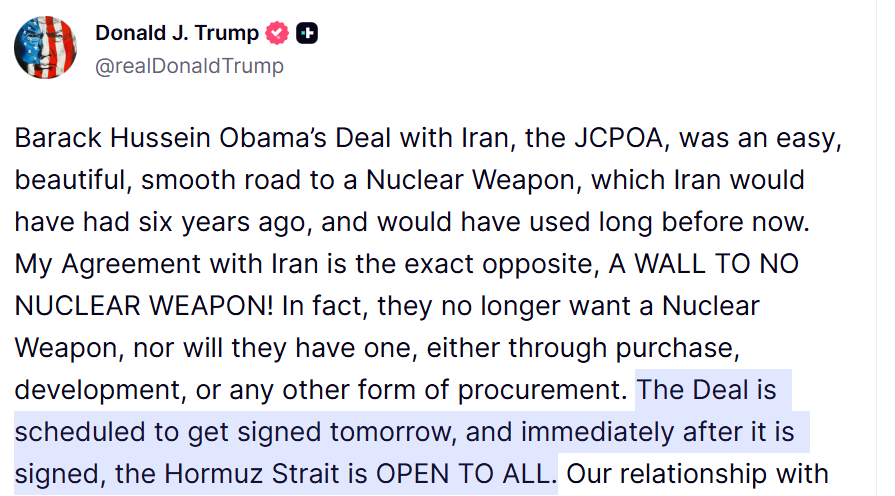
“The Deal is scheduled to get signed tomorrow, and immediately after it is signed, the Hormuz Strait is OPEN TO ALL,” said Trump on Truth Social on Saturday.
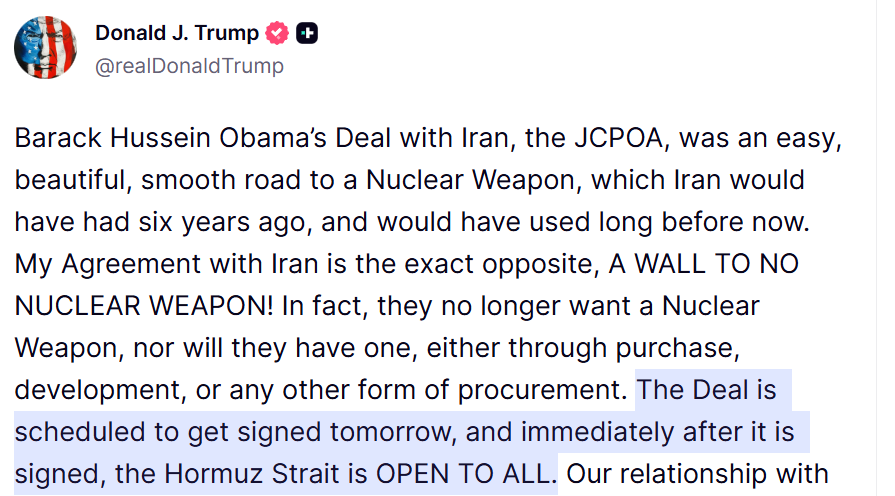
Source: Donald Trump
Pakistan, which is mediating talks between the US and Iran, also signaled an agreement could be reached within 24 hours.
The deal, a memorandum of understanding, is expected to extend the ceasefire between the US and Iran for 60 days and reopen the Strait of Hormuz.
The naval blockade has choked 20% of the world’s supply of oil and liquefied natural gas, which has led to higher global asset prices and a sentiment shock that has pressured crypto markets for months.
“We are closer to a peace deal than ever before,” Pakistani Prime Minister Shehbaz Sharif said on X on Saturday. “With finalisation likely expected in the next 24 hours, Pakistan is preparing for the electronic signing of the peace deal immediately after, followed by technical level talks next week.”
Iran has not confirmed the Sunday signing.
Iranian Foreign Ministry spokesperson Esmaeil Baghaei told state media earlier that the memorandum wouldn’t be signed on Sunday, but could happen “in the coming days.”
“We will have to wait and see about the exact date of the signing of the memorandum of understanding, although it will not be tomorrow,” Baghaei said.
Analysts say peace deal will benefit crypto
Crypto analyst Michaël van de Poppe said a peace deal between Iran and the US will likely prompt a surge in Bitcoin, along with positive ETF flows.
Spot Bitcoin exchange-traded funds (ETFs) recorded about $315.84 million in net outflows for the week ended Friday, marking the fifth consecutive week of outflows for the Bitcoin-linked crypto funds.
Related: Bitcoin tags $63.2K as BTC price action ignores inflation, Iran Hormuz closure
“Liquidity will pour back into risk-on assets as liquidity will seek for an opportunity and after SpaceX IPO was done, most likely this will go towards crypto,” he added.
On Wednesday, CoinShares head of research James Butterfill told Cointelegraph the recent outflow from digital asset investment products was being primarily driven by geopolitics, with uncertainty around the Iran conflict weighing on the outlook for interest rates.
Bitcoin was trading at $64,491 at the time of writing, up 1.5% over the past 24 hours.
Magazine: Bitcoin, the ‘canary in the coal mine,’ XRP transaction demand falls 91.5%: Market Moves

The Trump administration’s move to limit foreign access to Anthropic’s most capable AI models was reportedly sparked by security concerns raised through industry channels, according to a Wall Street Journal report. The episode culminated in export controls that forced Anthropic to pull its latest release from public access.
As U.S. officials acted quickly on the perceived risk, decentralized AI-focused tokens also rallied over the same period, underscoring how government interventions in centralized AI can rapidly reshape expectations across the broader crypto AI sector.
Key takeaways
- According to The Wall Street Journal, Amazon CEO Andy Jassy contacted senior U.S. officials after researchers found a way to prompt Anthropic’s Fable 5 model into producing information that could be used for cyberattacks.
- A White House scramble followed, including outreach to Anthropic CEO Dario Amodei and disagreement over how serious and actionable the risk was.
- Anthropic said in a blog post that the U.S. directive reflected a misunderstanding tied to a “non-universal jailbreak” reported by an unnamed source.
- David Sacks, a science-and-technology advisor, said the administration issued the export control “reluctantly” and hoped Anthropic would remediate the safety issue quickly.
- Token markets reacted immediately, with several decentralized AI projects posting gains after Anthropic’s access was curtailed.
How the White House stepped in
Earlier coverage from The Wall Street Journal describes a chain of events involving both private-sector discovery and government escalation. The report says Amazon researchers identified a method to “jailbreak” Anthropic’s Fable 5 model—specifically, a way to coax it into returning information that could be repurposed for cyberattacks.
Following that discovery, The Wall Street Journal reported that Andy Jassy reached out to senior U.S. officials on Thursday. The outreach, combined with warnings from at least five other firms, prompted an urgent response inside the White House as officials assessed whether the issue warranted formal export controls.
Politico separately described the rapid internal process, including contact with Anthropic leadership. According to the Politico report referenced in the Wall Street Journal write-up, Anthropic CEO Dario Amodei pushed back on the administration’s concerns and asked to avoid a voluntary pull of the model.
Anthropic’s response to the directive
The immediate outcome was a U.S. directive that forced Anthropic to suspend access to its new model. Earlier coverage from Cointelegraph noted that Anthropic “suspends access” under this U.S. directive, and the company later indicated that it is working to restore access for users.
In a Friday blog post, Anthropic said it believed the directive was driven by a misunderstanding about the threat posed by what it called a “non-universal jailbreak,” a term tied to information attributed to an unnamed report. In other words, Anthropic did not frame the jailbreak issue as universally exploitable, but rather as something the administration may have interpreted more broadly than the company believed was warranted.
Amazon, for its part, did not confirm whether it spoke directly with government officials about Anthropic’s models. A spokesperson said it is common for governments to seek counsel from major cloud providers when security risks emerge, and that when such discussions occur, Amazon does not share details.
Why officials framed it as a reluctant export control
David Sacks, co-chair of the President’s Council of Advisors on Science and Technology, characterized the administration’s actions in a post on Saturday. In the cited remarks, Sacks said the administration issued the export control “in reaction” and that it did so “reluctantly.” He also suggested the administration was surprised Anthropic had not agreed to cooperate on a “reasonable safety request,” which he tied to fixing the jailbreak issue.
Critically for readers watching how these decisions unfold, Sacks added that the administration’s hope is for Anthropic to remediate the safety problem in a way that could lead to lifting the export control and returning the model to general release. He indicated the administration wants the process to happen as soon as possible.
This matters because the difference between a temporary suspension and a prolonged export-control regime can strongly influence both enterprise deployment timelines and user expectations—especially when the impacted model is already attracting measurable usage. The article notes Claude is estimated to have around 18,900 monthly active users.
Ripple effects in decentralized AI token markets
Beyond the immediate controversy, the episode illustrated the government’s ability to rapidly shut off access to U.S.-based AI models. That speed appeared to spill into token markets tied to decentralized AI infrastructure and development.
Cointelegraph reported that the announcement period coincided with gains for several AI-focused tokens on Friday and Saturday. The native token of Bittensor, a decentralized AI protocol sometimes described as “the Bitcoin of AI” (per market commentary echoed in the coverage), rose 23.9% over the past 24 hours, according to CoinGecko’s coin page referenced in the article.
Other mentioned movers included Venice Token (VVV), which rose 16%, and Near Protocol (NEAR), which gained 6.2% as investors priced in the potential resilience—or at least perceived independence—of decentralized AI ecosystems relative to centralized model providers facing regulatory constraints.
These moves were not an endorsement of any single token’s fundamentals based on the Anthropic situation; rather, they reflected a common market narrative: if centralized AI access can be throttled quickly through government directives, decentralized alternatives may attract attention as a hedge or alternative channel for AI development and monetization.
What to watch next
The key uncertainty now is whether Anthropic can demonstrate effective remediation quickly enough to satisfy U.S. officials—potentially leading to lifting the export controls. For investors and builders, the follow-up timeline and the clarity of what “remediation” means in practice will likely be the most important indicators of how durable this precedent could be.

The Trump administration’s decision to cut foreign access to Anthropic’s most powerful AI models was reportedly set in motion by outreach from Amazon CEO Andy Jassy, after researchers found a potential way to coax the company’s “Fable 5” model into producing information that could be repurposed for cyberattacks. The episode escalated quickly into White House-level review and culminated in export controls that, according to Anthropic, followed a U.S. directive.
As the dispute unfolded, U.S. regulators also demonstrated how fast access to a widely used AI system can be curtailed—an event that traders linked to a rebound in several decentralized “AI token” projects on Friday and Saturday. The move has reignited questions about how AI safety issues are assessed, communicated, and ultimately enforced across borders.
Key takeaways
- According to The Wall Street Journal, Amazon CEO Andy Jassy contacted senior U.S. officials after Amazon researchers identified a prompt-based workaround affecting Anthropic’s Fable 5.
- The White House reportedly moved to impose export controls and engaged Anthropic leadership; Anthropic pushed back and said it was working to restore access for users.
- David Sacks, co-chair of the President’s Council of Advisors on Science and Technology, said the administration acted “reluctantly” and hoped Anthropic would fix the jailbreak issue quickly.
- On-chain and token-linked markets appeared to react to the sudden availability shift, with decentralized AI-related tokens posting gains over the same period.
How the alleged “jailbreak” concern reportedly triggered export controls
In a report cited by The Wall Street Journal, the core catalyst was described as a method discovered by Amazon researchers that could prompt Anthropic’s Fable 5 into returning information that might be used in cyberattacks. The WSJ reports that Jassy reached out to senior U.S. officials on Thursday after that finding, along with similar warnings from at least five other firms.
Those escalations reportedly led to a “frantic shuffle” within the White House to assess the threat and to contact Anthropic CEO Dario Amodei. According to the Politico reporting referenced in the original account, Amodei pushed back on the administration’s concerns and asked to resolve them through voluntary cooperation rather than immediate removal of access.
Anthropic ultimately said it believed the U.S. directive stemmed from a misunderstanding of the threat, describing the issue as a “non-universal jailbreak” that came from an unnamed report. In earlier coverage from Cointelegraph, Anthropic was reported to have suspended access to its new model—an action tied to the U.S. directive.
What Anthropic and U.S. officials said—and what remains disputed
One signal of where the disagreement may lie is the framing of the risk. Anthropic’s blog post, as described in the reporting, suggests the administration’s understanding of the jailbreak’s scope may have been overstated. The company’s view was that the jailbreak was not “universal,” implying it would not reliably work across prompts and contexts.
Still, U.S. officials acted decisively. David Sacks told X on Saturday that the administration issued the export control in response to the situation and that it was “very surprised” Anthropic did not want to cooperate on a “reasonable safety request” to fix the jailbreak issue. Sacks characterized the administration’s approach as cautious and reluctant, but nonetheless committed to the safety request and the goal of restoring access after remediation.
The original reporting also states that Amazon did not confirm whether it spoke directly with government officials about the models. In an emailed statement, an Amazon spokesperson said that it is common for governments to seek counsel on potential security risks and that the company does not share details of those discussions when they occur. That leaves some of the exact internal communications unclear, even as the WSJ account links Jassy’s outreach to the administration’s subsequent decision.
Why the “switch-off” matters for AI providers and users
Beyond the specific model dispute, the episode highlights a practical reality for AI users and integrators: access to a U.S.-linked model can be restricted quickly, even for high-demand systems. Cointelegraph’s earlier coverage noted that the directive forced Anthropic to pull its model from public availability, and the current reporting ties the export control to the same turning point.
For enterprises that depend on frontier models—whether for customer-facing applications, research workflows, or operational automation—the risk is not only technical but operational. A safety finding, a regulatory determination, or even a disagreement about the severity of a vulnerability can translate into abrupt availability changes. That can affect uptime, roadmap planning, compliance reporting, and model routing strategies across vendors.
Anthropic stated it is working to restore access for its users. Sacks’ comments add what many market participants will likely focus on next: whether remediation happens fast enough to satisfy regulators and lead to removal or easing of the export control.
Token markets react to sudden access restrictions
The crackdown also appeared to ripple into crypto markets tied to decentralized AI narratives. The original reporting describes the U.S. government’s ability to rapidly disable access to U.S.-based AI models as a factor behind gains in several decentralized AI tokens over Friday and Saturday.
According to the cited CoinGecko pricing data, Bittensor’s native token rose 23.9% over the past 24 hours referenced in the article. Bittensor is described as a decentralized AI protocol enabling people to build and monetize AI models. The reporting also cited Venice Token (VVV) up 16% and Near Protocol’s token rising 6.2%, with Near positioned as infrastructure for decentralized AI agent applications.
While these moves do not necessarily indicate a direct causal relationship between the export control and token valuations, the timing underscores how quickly crypto markets can respond to policy-driven changes in the broader AI ecosystem. For traders and long-term holders, the key question is whether the market is reacting to the news itself or to expectations that decentralized models and infrastructure will gain relative attention if centralized providers face recurring regulatory constraints.
As the situation develops, readers should watch for concrete updates from Anthropic on remediation efforts, as well as any indications that regulators are prepared to lift or modify the export controls. The central uncertainty remains whether the jailbreak risk is viewed as sufficiently resolved—and how regulators will define “enough” safety to re-enable broader access.
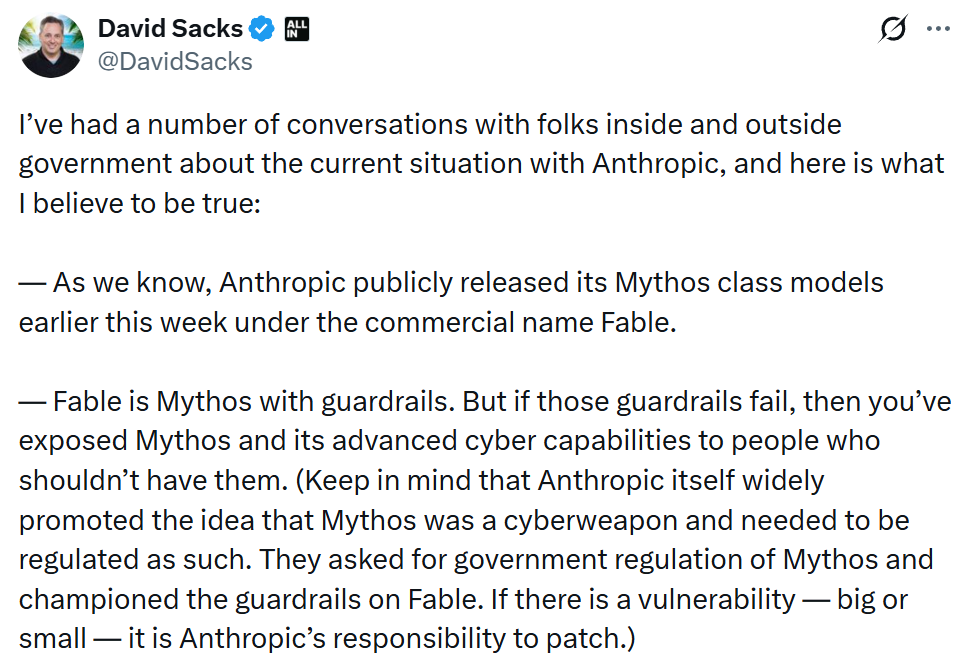
The Trump administration’s decision to cut foreign access to Anthropic’s most powerful AI models was reportedly triggered by calls from Amazon CEO Andy Jassy.
According to a report from The Wall Street Journal, Jassy contacted senior government officials on Thursday after Amazon researchers discovered a way to prompt Anthropic’s Fable 5 model into returning information that could be used for cyberattacks.
The call, along with warnings from at least five other firms, led to a frantic shuffle within the White House to gauge the threat and contact Anthropic CEO Dario Amodei, who reportedly pushed back on the administration’s concerns and requests to voluntarily pull the model.
“In reaction, the Admin issued the export control. The Admin did this reluctantly,” said David Sacks, the co-chair of the President’s Council of Advisors on Science and Technology, on Saturday. “It’s been very surprised that Anthropic hasn’t wanted to cooperate with a reasonable safety request (ie fixing the jailbreak issue).”
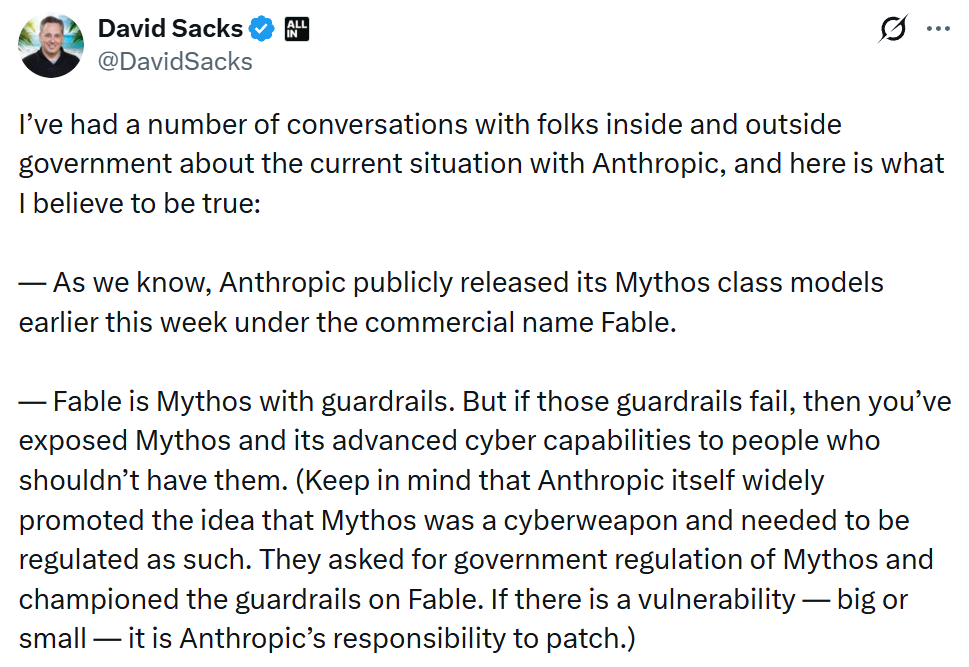
Source: David Sacks
The episode sheds light on what led to the US directive that forced Anthropic to pull its new model from the public on Friday night. Anthropic Claude is estimated to have around 18,900 monthly active users.
In a blog post on Friday, Anthropic said it believed the US directive was the result of a misunderstanding about the threat posed by a “non-universal jailbreak,” which came from an unnamed report.
Amazon did not confirm if it spoke to government officials about Anthropic’s models.
“As a leading cloud provider that serves a large number of private and public sector customers, it’s not uncommon for governments to seek our counsel on potential security risks,” a spokesperson said. “When they occur, we don’t share the details of these discussions.”
Anthropic said it is working to restore access for its users.
Related: Anthropic suspends access to Fable 5, Mythos 5, citing US directive
“The Admin’s hope now is that Anthropic remediates the safety issue,” Sacks said, which would see the export control lifted, and Fable goes back into general release.
“The Admin wants all of this to happen as soon as possible.”
AI tokens surge after Anthropic crackdown
The episode has also demonstrated the US government’s ability to promptly switch off access to US-based AI models on command, leading to a rally in decentralized AI tokens on Friday and Saturday.
The native token of Bittensor, a decentralized AI protocol that lets people build and monetize artificial intelligence models, which some refer to as “the Bitcoin of AI,” surged 23.9% over the past 24 hours.
Venice Token (VVV), the native utility and privacy coin powering Venice AI, a decentralized, uncensored AI platform founded by Erik Voorhees, rose 16%.
Near Protocol, a blockchain project building the infrastructure to support a decentralized AI agent economy, rose 6.2%.
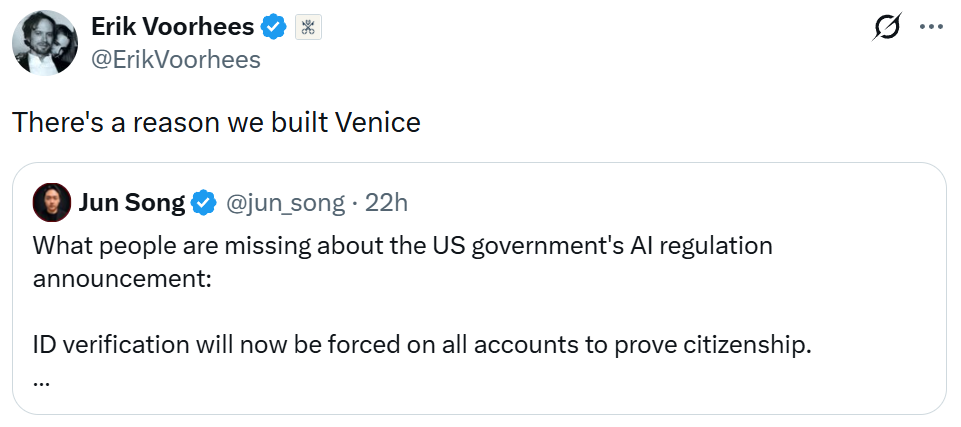
Source: Erik Voorhees
Magazine: Bitcoin, the ‘canary in the coal mine,’ XRP transaction demand falls 91.5%: Market Moves

Public crypto token sales have raised just $58 million in Q2 2026, according to data published by CryptoRank on June 10, a drop of 85% from the previous quarter.
It means that the period is well on the way to becoming the weakest fundraising quarter for ICOs, IDOs, and IEOs in five years.
Public Fundraising Is Drying Up Across Crypto
CryptoRank’s data showed that Q1 2026 had already looked weak, with about $390 million raised across 105 sales, but things have deteriorated even further in the second quarter.
The severity of the situation is even clearer in the month-by-month breakdown: April saw just $15 million raised across 20 sales, while May brought in around $41 million from just 13 sales, marking the lowest monthly count since December 2020.
June, which is still in progress, has so far recorded just 4 sales that raised about $2 million. To put that in context, January 2025 alone saw $654 million raised, with that quarter serving as the cycle peak, as 429 sales raised just under $850 million. Since then, the market has shed more than 93% of its quarterly fundraising volume in dollar terms.
Still, CryptoRank’s dashboard shows that public token sales raised more than $4 billion between the first quarter of 2024 and the second of 2026.
In that time, IDOs were consistently the dominant format, accounting for nearly 75% of all public sales. IEOs and ICOs respectively made up 18% and 7% of activities. However, all three formats have contracted quite sharply this quarter.
Among launchpads, Coinlist is the largest by capital raised, having handled $1.37 billion. It is followed by Fjord Foundry with $975 million and Echo at $201 million, with Gate Launchpad and DAO Maker rounding off the top five.
Venture Capital Is Still Active
According to a May report by Galaxy Digital, crypto venture capital activity also slowed in Q1 2026. In that period, private investors put in some $4 billion in 355 deals, a 50% drop from the previous quarter, the report said.
Galaxy Digital noted that the decline was mainly due to a lack of huge late-stage rounds that had dominated late 2025, but there have still been a few large raises occurring recently. One such example is Digital Asset Holdings’ $355 million raise in a new round led by Andreessen Horowitz, which came just a month after it pulled in $300 million.
CryptoRank’s figures suggest that while capital is still available in crypto, it is increasingly concentrated in a smaller number of companies and private funding rounds rather than public token launches. Those hit their peak when sentiment was strongest, but they seem to have since tracked the broader market lows.
This can be seen from a previous report also published by CryptoRank that showed many of the projects that had been funded between April and June 2025, when the crypto market was enjoying a rebound, ended that year trading well below their fundraising valuations.
And that may explain why retail appetite for new launches has dried up so completely in 2026.
The post Crypto Public Token Sales on Track for 5-Year Lows in Q2 2026 appeared first on CryptoPotato.

Lawmakers in Brazil have advanced a bill that would let authorities freeze cryptocurrency assets linked to investigations. This bill is part of an effort to combat online fraud and organized crime in Brazil.
The bill is called PL 5819/2025. A committee in Brazil’s Chamber of Deputies approved it. If this bill becomes a law, courts will have the power to freeze crypto holdings stored on exchanges and other financial platforms when people are under investigation for cyber fraud and related offenses.
Authorities Gain Broader Powers Over Digital Assets
Judges will be able to order the blocking of cryptocurrency balances along with bank accounts. Supporters of this bill say criminals use assets to move and hide funds, making it hard for investigators to recover stolen money.
This bill also aims to strengthen penalties for cyber fraud. Prison sentences for online fraud offenses could rise from four to eight years to six to ten years. People linked to criminal groups may face even harsher punishments.
The proposal builds on Brazil’s efforts to keep an eye on digital assets. This year, President Luiz Inácio Lula da Silva signed a law that lets authorities freeze, seize, and even liquidate cryptocurrencies connected to criminal activities. The law also allows confiscated crypto assets to fund public security programs, including police equipment, intelligence operations, and officer training.
Brazil Tightens Crypto Oversight
Brazil has become one of the most active crypto markets in Latin America, so regulators are introducing stricter rules for the sector. The country’s central bank recently implemented requirements for virtual asset service providers, including stronger anti-money laundering measures and cybersecurity standards.
Regulators say this cyber fraud bill is aimed at stopping criminals from exploiting assets while ensuring law enforcement can respond more effectively to online financial crimes.
Conclusion
Brazil’s latest legislative push shows that the country is serious about stopping cyber fraud and organized crime. By expanding the government’s ability to freeze and recover cryptocurrency assets, lawmakers hope to close loopholes used by criminals while strengthening the framework surrounding digital assets. If this bill is approved, it could make Brazil one of the region’s more proactive regulators of the crypto industry. Brazil and crypto will be closely watched as this bill moves forward.
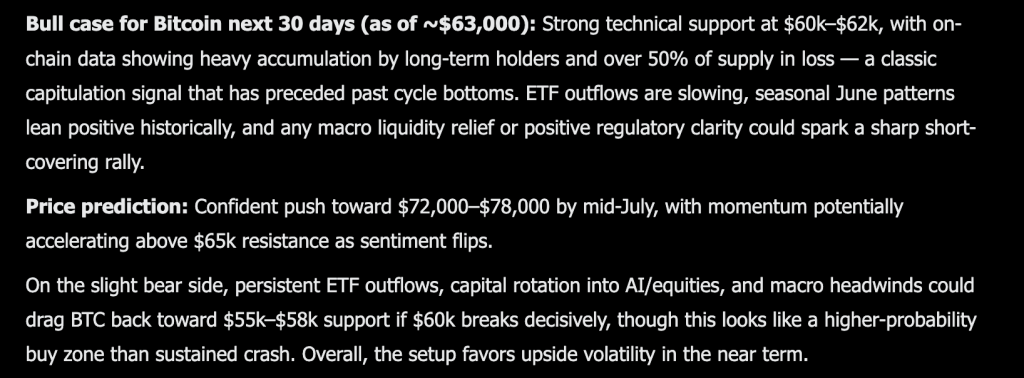
Here is the thing about capitulation calls. They only sound smart in hindsight. Right now, with Bitcoin price scraping along the low $60,000s, calling for a run to the mid $70,000s feels like wishful thinking. Elon Musk’s SpaceX AI is making predictions anyway, pinning a 30-day target of $72,000 to $78,000 on a coin that just got cut nearly in half.
From $63,000, that is a 14% to 24% bounce, and the entire argument rests on the idea that the people selling right now are the ones who always sell at the bottom.
That is really what the bull case comes down to. More than 50% of supply is sitting in loss, which xAI reads not as weakness but as the classic capitulation flush that has marked the floor in past cycles.
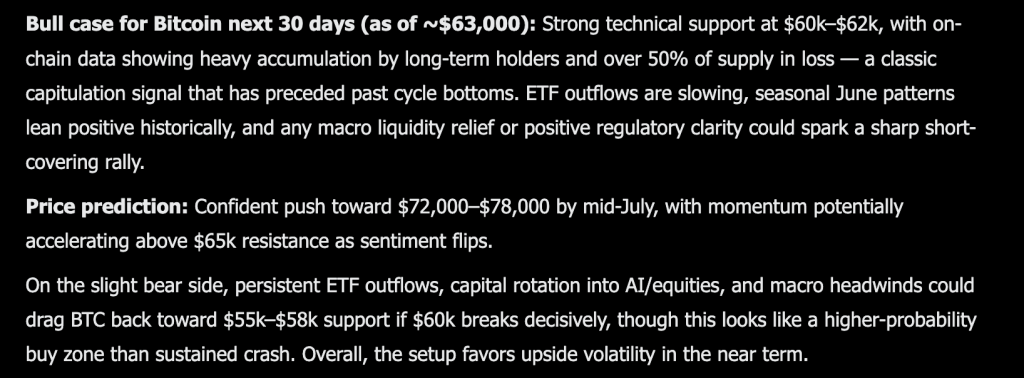
Long-term holders are quietly accumulating into that fear, ETF outflows are drying up, and June has a habit of leaning green historically.
Add even a whiff of macro liquidity relief or regulatory clarity and you get the spark for a violent short-covering rally.
The confident version of this story has BTC pushing through $65,000 resistance and accelerating toward the mid $70,000s by mid July as sentiment flips.
xAI is honest about the other side, though. If $60,000 gives way decisively, capital keeps bleeding into AI and equities, and macro stays heavy, Bitcoin slips toward $55,000 to $58,000.

The interesting tell is that it frames that drop as a higher-probability buy zone rather than the start of a real crash. In other words, even the downside scenario is treated as a discount, not a disaster.
Bitcoin Price Prediction: Where The Sellers Run Out Of Sellers
So does the chart back any of this up. Pull up the daily and the damage is obvious. Bitcoin is at $63,024 after a long ugly slide from the $126,000 peak set back in October, a drop that has erased more than half the move.
The trend is unmistakably down, lower high after lower high, and the latest leg just dumped price into the low $60,000s where it printed a candle near $60,000 before this small bounce.
But that exact zone is the whole story. This $60,000 to $62,000 shelf is where buyers stepped in hard back in February, and it is the floor xAI is leaning on.
Lose it on a daily close and $58,000 opens up quickly, with $55,000 underneath. Hold it, and the first real test is $65,000, the level that has to crack before any of this turns into momentum, with $72,000 and the heavier $76,000 ceiling stacked above.
The RSI is the part that actually agrees with the bulls. It is sitting at 31.95 with the signal line at 25.74, so price momentum has flushed into deeply oversold territory but has already curled back above its own average.
That roughly 6 point gap, with RSI now leading the signal higher, is the early fingerprint of selling exhaustion rather than fresh downside.
It is not a buy signal on its own, but it is exactly what you would expect to see if xAI is right that the weak hands are nearly done. Reclaim $65,000 with this momentum building underneath and that mid $70,000s target stops looking like wishful thinking and starts looking like the path of least resistance.
You Might Like What SpaceX AI Predicts About LiquidChain
Large caps are not in trouble. They are just out of the room. Bitcoin, Ethereum, and XRP have been testing the same ceilings for weeks with nothing breaking through.
Every macro catalyst has a new arrival date. Every institutional wave has a new quarter attached to it. Holding assets where the next leg depends entirely on someone else’s decision is not a trade. It is a waiting room.
The money that wins cycles never announces where it is going.
The capital that actually moves in cycles relocates before the destination has a name.
Small market cap infrastructure plays operate on physics that large caps simply cannot replicate. A rotation that would not register as a rounding error at Bitcoin’s scale can reprice an undiscovered project by multiples.
The opportunity lies in the distance between what something is genuinely worth and what the market has assigned it so far. That distance shrinks to zero the moment discovery happens. Before that moment, it is fully capturable.
Multi-chain fragmentation is one of the most consistently expensive problems in DeFi, and it has never been solved. Bitcoin, Ethereum, and Solana exist as completely isolated systems. No shared architecture. No native interoperability. Every time value moves between them, the disconnection extracts its cost in fees, slippage, and failed transactions. That cost hits every single crossing every single time.
LiquidChain makes the crossing free as SpaceX xAI predicts. All 3 networks inside one execution environment. Single deployment. Complete ecosystem access. No tax on any interaction.
The presale is at $0.01454 with just over $830,000 raised. Early and undiscovered.
Execution is unproven. Adoption is unknown. Established assets offer predictability toward a ceiling that the market already sees. LiquidChain is an entry point that does not exist once the market finds it.
Explore the LiquidChain Presale
The post Elon Musk SpaceX AI Predicts Incredible Bitcoin Price For Next 30 Days appeared first on Cryptonews.

TLDR:
- Litecoin has entered the lower Fibonacci Adjusted Market Mean Price band, a zone tied to past accumulation phases.
- Whale and shark wallets holding at least 10,000 LTC have grown by 7% over the past five months despite flat prices.
- LitVM is bringing smart contract functionality to Litecoin via a zkLTC wrapper, renewing social media interest in LTC.
- Santiment data ranked Litecoin as the top trending coin, with retail volume expected to recover on any price rally.
Litecoin is drawing renewed attention from analysts and on-chain data providers as price action revisits historically significant support levels.
Whale and shark wallet growth continues alongside fresh ecosystem interest from LitVM, a smart contract project building on the Litecoin network.
Together, these developments are placing LTC under the spotlight at a time when broader market conditions remain uncertain.
Litecoin Price Revisits Key Fibonacci Support Region
Litecoin’s price has moved into what analysts describe as a structurally meaningful zone. According to crypto analyst Alphractal, LTC has touched the first lower level of the Fibonacci Adjusted Market Mean Price model.
This metric uses the Market Mean Price as a base and builds proportional Fibonacci bands to map expansion, mean reversion, and accumulation areas.
Historically, Litecoin has found support within the blue and green bands of this model during periods of market stress.
The green band, representing the lowest level, has marked points of strongest selling pressure across previous cycles. The blue region, where LTC currently sits, has also served as a relevant value area in past market structures.
On a logarithmic scale, Alphractal notes that Litecoin is once again approaching zones that historically attracted long-term investor attention.
The upper bands of this model have typically aligned with overheated market conditions and distribution risk. Lower bands, by contrast, tend to reflect discounted pricing relative to the asset’s structural mean.
The analyst added that while Litecoin remains weak in the short term, periods of extreme weakness have also marked the early formation of longer-term value. That framing has resonated with investors monitoring LTC’s positioning within the broader crypto market cycle.
Whale Accumulation and LitVM Fuel On-Chain Interest
On-chain data from Santiment adds another layer to the current Litecoin narrative. The number of whale and shark wallets holding at least 10,000 LTC has climbed by 7% over the past five months, even as price performance has remained relatively flat.
Santiment noted that accumulation from large holders often precedes major trend shifts before retail participants take notice.
Transaction volume tied to these larger wallets has also remained active during this period. Santiment’s data shows that any price rally could quickly draw retail participants back into the market, which would likely support broader volume recovery for LTC.
Much of Litecoin’s current social media traction stems from LitVM, a project introducing smart contract functionality through a zkLTC wrapper.
The platform has sparked debate among traders about whether it can generate meaningful utility and demand for Litecoin going forward.
Santiment confirmed that LTC ranked as the top trending coin across social data at the time of the report. Whether LitVM delivers on its promise remains an open question, but the conversation itself has refreshed interest in an asset that had largely faded from active discussion.


CoinFund founder says Anthropic order proves AI control risk

2026 World Cup: Australia stun Turkiye 2-0 in counterattacking masterclass

MacBook Neo vs Dell XPS 13: $599 budget battle, compared


-

 NewsBeat6 days ago
Alexander Zverev wins the French Open to finally earn a 1st Grand Slam title
-

 Crypto World6 days ago
Anatomy of the June crypto crash: Fed, Iran, Saylor
-

 Crypto World3 days ago
Oppenheimer backs SpaceX as $70 billion retail frenzy builds
-
 NewsBeat7 days ago
Alexander Zverev conquers demons and outlasts Flavio Cobolli to win French Open for first major title
-

 Crypto World3 days ago
Markets Rally as SpaceX IPO Looms Amid Iran Tensions and Inflation Surge
-

 Tech7 days ago
Microsoft unveils seven homegrown AI models in new bid for ‘long term self-sufficiency’
-

 Business6 days ago
High Stakes for Wembanyama as New York Pushes for 3-0 Lead
-

 Tech6 days ago
Notion restores access to Anthropic after service disruption
-

 Sports6 days ago
FIFA WC 2026 Group C: Morocco, Scotland challenge Brazil’s hunt for glory | FIFA World Cup 2022
-
 Business7 days ago
The investment to transform historic St Helen’s ground in Swansea
-
 Crypto World6 days ago
Eli Lilly (LLY) Stock Surges 4% Following Breakthrough Sleep Apnea Trial Results
-

 Crypto World7 days ago
Trump’s AI Ownership Plan Could Benefit Anthropic at OpenAI’s Expense
-
 Sports5 days ago
Bangladesh beat Australia after 20 years in ODIs, register only their second win over six-time world champions | Cricket News
-

 Fashion2 days ago
Weekend Open Thread: Tuckernuck – Corporette.com
-

 Tech1 day ago
NanoClaw integrates JFrog registries to secure AI agent downloads
-

 Crypto World1 day ago
Bitget enters Argentina’s regulated crypto market through PSAV registration
-

 Tech2 days ago
This Week In Security: Microsoft On Microsoft, Register Your Domains, Linux On ARM, And FreeBSD Joins The File Cache Club
-

 Politics3 days ago
Politics Home | Healey Resignation Is “Colossal Failure Of Government”, Says Former Labour Defence Secretary
-

 Sports3 days ago
First Time Since 1971: Australia Register Historic Low In ODI Cricket
-
 Entertainment3 days ago
Donnie Wahlberg & More Heat Up Las Vegas at Circa’s Barry’s Downtown Prime
You must be logged in to post a comment Login