
TL;DR
KPMG pulled a report on agentic AI after UBS, the NHS, and others said its claims were untrue. GPTZero identified the errors as AI hallucinations.




On a recent evening in suburban Chicago, a group of parents, teachers and administrators gathered to talk about something that, until recently, rarely drew this level of public scrutiny: the role of technology in their schools.
The meeting was part of a three-session tech and learning focus group organized by Mary Jane (MJ) Warden, chief technology officer of Community Consolidated School District 15, in conjunction with the Teaching, Learning and Assessments Department.
The district, which serves 11,000 preK-8 students, spent the past several years — like so many others — adding digital tools. Now, with budgets tightening and concerns about screen time rising, it was time to take stock.
A re-examination of digital tools was already happening with curriculum reviews and tightening budgets after the pandemic. And then the screen time concerns arose.
Participants discussed everything from screen time to what district technology use looks like at home. Out of those conversations came something new: a “Portrait of a Digital Learner,” derived from the district’s Portrait of a Graduate, meant to develop clear expectations around what skills students need and, by extension, which technologies are worth keeping and how technology would be used by students toward positive learning outcomes.
“We’re trying to get much [clearer] about what this is going to address,” says Warden. “What do we need students to learn, and which tools will help us understand where they are?”
Across the country, district leaders are asking similar questions. After years of rapid expansion, many are now engaged in a quieter but more consequential phase: reassessing what stays, what goes and how to decide.
For much of the past decade, edtech decisions often began with the product. A new platform promised to boost engagement or personalize learning; districts piloted it, added it to an already crowded ecosystem and moved on.
That approach is no longer sustainable, says Erin Mote, CEO of InnovateEDU, a nonprofit focused on systems change in special education, talent development and data modernization in schools.
“We’re seeing a shift from ‘Does this look cool?’ to ‘Does this work?’” she says. “Districts have less money now; they have to be smarter.”
The end of pandemic-era federal funding has intensified that pressure. Technology leaders are now expected not only to manage infrastructure and compliance, but also to demonstrate what Mote calls a return on instructional impact.
In practice, that is changing how districts approach procurement. Instead of starting with vendor demos, many are beginning with specific learning needs.
“If you need to improve third-grade reading comprehension, you start there,” Mote says. “Then you ask: Which tool can move that needle?”
As districts rethink their approach, a more structured and more skeptical evaluation process is emerging.
One major shift is toward tracking actual usage. Platforms like ClassLink and Clever now give districts detailed analytics on which tools students and teachers are accessing, how often they’re used and, in some cases, how much time is spent in each application. That data has helped uncover what some leaders call “zombie licenses,” products that continue to be renewed despite minimal use.
At Joliet Public Schools in Illinois, technology leaders review usage data each spring alongside feedback from a districtwide technology committee.
“If we’re not getting usage or we have another product that does it better, we start asking hard questions,” says John Armstrong, chief officer for technology and innovation.
But usage alone is not enough. Districts are also weighing cost, redundancy and alignment with instructional goals.
During the pandemic, many schools layered new tools on top of existing ones. Now, leaders are working to simplify.
“We had so many products that teachers were going to four different places to run a lesson,” says Kelly Ronnebeck, associate superintendent for student achievement in East Moline School District 37 in Illinois. “We’re trying to get back to a slower, more intentional process.”
That often means replacing several standalone tools with a single platform that can do multiple jobs — even if it means giving up some features teachers value. In some cases, a newer system can replace several standalone tools at a lower cost but may not match each one’s individual strengths.
“It’s not always a perfect swap,” admits Armstrong. “Someone gives up something.”
At the same time, districts are placing greater emphasis on interoperability and data privacy. Tools must integrate with existing systems like learning management platforms and single sign-on tools, and vendors have to be willing to sign increasingly stringent data privacy agreements.
“If a company can’t meet those requirements, that’s a red flag right away,” says Phil Hintz, CTO of Niles Township District 219 in Illinois.
Even as districts adopt more rigorous processes, it remains stubbornly difficult to determine whether edtech tools actually improve learning.
“It’s such a huge challenge,” says Naomi Hupert, director of the Center for Children & Technology at the Education Development Center. “We see so much that doesn’t seem to make a difference but costs a lot of money.”
Part of the difficulty lies in the sheer breadth of what “edtech” encompasses, everything from learning management systems to specialized math platforms to communication tools. Each category has different goals, users and measures of success.
“It’s like asking whether ‘books’ work,” says Hupert. “It depends on the book, the context and how it’s used.”
District leaders have to piece together evidence from multiple sources: vendor-provided analytics, small pilot studies, teacher feedback and, occasionally, external research. But those data points don’t always align.
Jason Schmidt, director of technology in Oshkosh Area School District in Wisconsin, describes his approach as “trust but verify.”
“I know vendors are collecting tons of data, and they have to, but I still need to talk to teachers and understand how the tool is actually being used,” he says.
Even then, results can be uneven. A platform might show strong engagement overall but fail to support certain groups of students — or vice versa.
In Alexandria City Public Schools in Virginia, leaders are developing a formal framework to evaluate both edtech and nontech programs. But defining “value” has proven complex.
“It’s not just usage and cost,” says CIO Emily Dillard. In a district with a high number of English learners, some tools play a critical role for students who need targeted or specialized support.
“You might have a tool that isn’t working for most students — or takes time to show results — but for a small group, it’s the best thing we have. We have to think about what’s best for them, too,” says Dillard.
Recognizing these challenges, a growing coalition of organizations is working to create clearer signals of quality in the edtech marketplace.
Through the Edtech Quality Collaborative, 1EdTech, CAST, CoSN, Digital Promise, InnovateEDU, ISTE, and SETDA are developing a shared framework built around five indicators: safety, evidence, inclusivity, interoperability and usability.
The goal, says Korah Wiley, senior director of edtech R&D at Digital Promise, is to reduce the noise.
“Right now, there are a lot of certifications and labels, and it’s hard for districts to know what to trust,” says Wiley. “We want to brighten the signal of what quality looks like.”
The initiative includes a planned directory of vetted validators, an implementation guide for districts and a central hub to connect educators with high-quality tools. Leaders hope it will help districts make decisions more confidently and push developers to meet clearer standards.
“This is the cost of doing business in education,” says Mote. “If you want to be in classrooms, you need to be building evidence and demonstrating impact.”
For all the talk of frameworks and data, the hardest part of reassessment often comes when districts decide to let a tool go.
Those decisions can affect classroom routines, teacher preferences and even student outcomes. And they are rarely straightforward.
In some cases, tools are phased out because of cost or low usage. In others, they are replaced by more comprehensive platforms. Sometimes, they no longer align with district priorities.
But even when the rationale is clear, the transition can be difficult.
“Teachers build practices around these tools,” says Warden. “We have to be thoughtful about how we support them through change.”
Districts are increasingly pairing those decisions with professional development, clearer communication and, in some cases, community engagement. In Warden’s district, the focus groups that helped define the “Portrait of a Digital Learner” are also shaping how the district explains its choices to families.
“We want to be transparent about what we’re using and why,” she says.
As districts move into this new phase, many leaders describe it as a reset that is forcing them to be more deliberate about how technology fits into teaching and learning.
That includes pushing back on broader narratives that treat all screen time as equal.
“There’s a big difference between passive consumption and purposeful edtech and we need to be clear about this,” says Mote.
It also requires clearer alignment between technology decisions and instructional goals. Without that, even the best tools can fall short.
“If you don’t know what you want teaching and learning to look like, it’s very hard to decide what tools you need,” says Keith Krueger, CEO of CoSN.
Back in District 15, Warden and her colleagues are trying to build that alignment. The conversations sparked by their focus groups are informing not just which tools they keep, but how they define success.
“We’re still digging out from COVID, when we had to move fast and add a lot. Now we have an opportunity to be more strategic.”
For district leaders across the country, that shift may be the most important change of all. The future of edtech, they suggest, will not be defined by the number of tools schools use, but by how thoughtfully they choose them.

Spotify users can finally stop staring at that disco ball.
The music streaming service has quietly reverted its app icon back to the familiar green-and-black design, ending a month-long experiment that proved surprisingly unpopular with users.
The sparkly icon first appeared in May as part of Spotify’s 20th anniversary celebrations, replacing the standard logo with a shimmering disco ball effect. While Spotify likely intended it as a fun tribute to two decades of music streaming, many users weren’t exactly thrilled by the change.
In fact, the temporary redesign attracted a fair amount of criticism online. Some users complained that the icon looked messy on their home screens. Others said the reflective effect made it harder to spot among other apps. And, what was meant to resemble a disco ball reportedly looked more like a small dark blob on certain displays.
The return to normal comes slightly later than expected. Spotify had previously suggested the anniversary icon would disappear before the end of May, though it lingered into June before finally being removed in the latest iOS update.
The change appears to be rolling out automatically. Still, users who are still seeing the disco ball can try updating the app manually.
Not everyone wanted to see it go, though. While much of the reaction was negative, some Spotify users had suggested keeping the anniversary icon as an optional feature for Premium subscribers.
Either way, the debate is now largely over. Spotify’s classic logo is back where it belongs, and the disco ball has officially spun its last track.
The icon change arrives just as Spotify continues rolling out several new music-focused features like improved playlist organisation tools that make it easier to manage large collections of songs.


KPMG pulled a report on agentic AI after UBS, the NHS, and others said its claims were untrue. GPTZero identified the errors as AI hallucinations.
KPMG has pulled a report titled “Redefining excellence in the age of agentic AI“ after multiple organisations said the claims it made about their AI usage were either untrue or misleading. UBS, the UK’s National Health Service, Swiss Federal Railways, and Transport for London all told the Financial Times that the report’s descriptions of their AI deployments were wrong.
GPTZero, the AI detection firm, identified the inaccuracies and told the FT they stemmed from AI hallucinations. In other words, a professional services firm used AI to help write a report about AI, and the AI made things up about the companies it was supposedly analysing.
The report was published in October 2025 and has now been removed from KPMG’s websites. A spokesperson said the firm is conducting its own investigation. “We expect all our people to follow our guidelines on the responsible use of AI, including human oversight to validate content and verify independent sources,” the spokesperson said.
KPMG is not the first professional services firm to get caught. Last month, EY withdrew a report on loyalty rewards programmes that appeared to include fake footnotes and AI hallucinations. South Africa withdrew its entire national AI policy after at least six of its 67 academic citations were found to be AI-generated fabrications.
The pattern is consistent: organisations use AI to produce authoritative-looking content, skip the verification step, and publish claims that turn out to be fictional. The KPMG case is particularly embarrassing because the report was specifically about AI adoption, meaning the subject matter should have made the authors more careful about AI-generated errors, not less.
For KPMG’s clients, the incident raises a harder question. If the firm’s public-facing thought leadership uses AI without adequate human review, what level of oversight applies to the work it delivers under contract? KPMG partnered with Anthropic earlier this year to deploy Claude across all 276,000 staff. The partnership is designed to embed AI into advisory, audit, and tax work. The pulled report is a preview of what happens when that embedding outpaces the verification.

RJ Scaringe got his PhD from MIT studying internal combustion engines. Then he founded a company to make them obsolete. In 2009, fresh out of grad school, he launched what would become Rivian. The company spent nearly a decade in stealth mode before arriving at the 2018 LA Auto Show with two electric rides nobody had seen coming.
The road, however, hasn’t been easy. Rivian lost $3.6 billion in 2025, and has burned through nearly $25 billion in the past eight years. It has spent more money over the same period than almost every other pure EV maker. Rivian’s IPO was the largest worldwide in 2021, and one of the largest in US history, within days valuing the company at over $100 billion. Its stock has dropped from a high of $130 to around $16. Since the R1 went on sale in 2021, Rivian has sold 175,000 cars. In the same time, Tesla has sold 8 million.
But in 2024, Volkswagen Group committed up to $5.8 billion to co-develop software and electrical architecture technology with Rivian in a huge joint venture. This year, Uber announced it will invest up to $1.25 billion in Rivian to build and deploy up to 50,000 fully autonomous robotaxis.
Regardless, the company needs its new R2 SUV to work. Not just sell, but sell in large numbers.
I sat down with Scaringe for a candid, wide-ranging discussion on what happens if the R2 fails, why the R1 launched with dead-end tech, how to compete with China, the Cybertruck’s failure, and the virtue of buttons inside cars. But we started on easier ground: his thoughts on the most polarizing EV of 2026. (This interview has been edited for length and clarity.)

JEREMY WHITE: What do you think about Ferrari’s Luce?
RJ SCARINGE: The way Jony [Ive] and Marc [Newson] approach design is incredibly intentional, so there’s not a decision on that car that’s unintentional. Through that lens, you have to like look at it in a different light. It’s definitely different than what people were expecting.
Do you like the Luce, though?
Would I buy it? I don’t own a Ferrari. There are things about it I really like. Parts of the interior are just phenomenal, like how beautifully well executed the haptics, the switches, the buttons are. You can see Jony’s fingerprints all over it.

Dell has rebuilt the XPS 13 to directly take on Apple’s MacBook Neo on price. Here’s how the entry-level models compare on specs and value.

Apple’s MacBook Neo arrived as the company’s most accessible laptop, pairing the A18 Pro chip with a $599 price. Dell has now answered directly with a new XPS 13.
Dell is open about the target. Its announcement names the MacBook Neo and frames the XPS 13 as the more feature-rich option at a similar price.
Continue Reading on AppleInsider | Discuss on our Forums


NBA The Run
Developer and publisher: Play by Play Studios
Platforms: Steam, PS5, Xbox Series X/S
Price: $30
Basketball fever has taken hold for many as the New York Knicks are just one game away from their first NBA title since 1973. If you’re a Knicks (or San Antonio Spurs) fan looking for a way to kill some time until tonight’s Game 5, NBA The Run might have you covered.
This is a 3v3 streetball game and a spiritual successor to NBA The Street from a team including some developers who worked on that series. It features more than 30 real NBA players — including LeBron James, Stephen Curry, Luka Dončić and Kevin Durant — and it leans more into arcade action rather than taking the simulated approach of the NBA 2K series. I’m not quite as into basketball as I was as a kid, but NBA Jam has a permanent place in my heart, so I’m definitely interested in trying NBA The Run.
Solarpunk
Developer: Cyberwave
Publisher: Rokaplay
Platforms: Steam, Epic Games Store, PS5, Xbox Series X/S, Nintendo Switch 2
Price: $23 (available on Game Pass Ultimate and PC Game Pass)
Solarpunk is a game I’ve had on my radar for a little while. It’s a relaxing crafting game set on a group of floating islands that you can travel between using airships. The two-person team at Cyberwave have baked in some “light survival mechanics,” though this is said to be an uplifting game that you can play with friends.
Given the title, it may not be too surprising that sustainability is a key focus of Solarpunk. You’ll build devices that can draw power from renewable energy sources and use that to automate systems across your farm and home.
It looks lovely, and lots of other folks are interested in this one. Solarpunk saw more than 500,000 demo downloads during a previous edition of Steam Next Fest. More than a million people wishlisted it too.
Crushed in Time
Developer and publisher: Draw Me A Pixel
Platform: Steam (coming to Switch and mobile later this year)
Price: Usually $25, with a 20 percent discount until June 24
As a fan of LucasArts point-and-click adventures, Crushed in Time is a game that speaks to my soul. This is a spin-off from There Is No Game: Wrong Dimension. Sherlock Holmes and Dr Watson make their return as they travel through time and space in search of a character that has gone missing from their own video game. You’ll be exploring the game’s development pipeline to track down this missing NPC.
Aside from the highly meta concept, what helps Crushed in Time stand out is that it takes place in an elastic universe. You’ll be tugging on objects and environments to help you solve puzzles (so it’s really more of a click-and-drag game). This looks very much up my alley. Ironically, I haven’t had time to jump in yet, but I plan on playing Crushed in Time as soon as my schedule lets up.
Voidling Bound
Developer and publisher: Hatchery Games
Platforms: Steam, Epic Games Store (coming to consoles later)
Price: $25, with a 10 percent discount until June 23
Voidling Bound is from a studio that includes former Skylanders developers, so maybe it’s not too much of a shock that this is a creature feature. It’s fundamentally a creature taming game in which you’ll breed, nurture and evolve critters using skill trees and the like.
You’ll then take control of said creatures in combat as this is also a third-person shooter. It looks like an interesting spin on the creature taming format.
33 Immortals
Developer: Thunder Lotus
Publishers: Thunder Lotus, Kepler Ghost
Platforms: Steam (previously on Xbox Series X/S and Epic Games Store)
Price: $10 until June 17 on Steam. It’s also on sale on Epic Games Store and Xbox. It’s available on Game Pass Ultimate and Premium, as well as PC Game Pass
33 Immortals is a neat game that I’m looking forward to diving back into. I played a chunk of it in early access and now Thunder Lotus has released the full version, which is also making its debut on Steam.
33 Immortals 1.0 features three playable worlds, other fresh content, more customization options and a new final boss encounter to properly conclude a run. It’s a co-op action roguelite that brings 33 players together to battle hordes of enemies and hulking bosses. There are miniboss rooms that you can conquer with a few of your teammates (after you call for help with emotes) and earn upgrades for the crew. It’s a good time!

Looking for the most recent Mini Crossword answer? Click here for today’s Mini Crossword hints, as well as our daily answers and hints for The New York Times Wordle, Strands, Connections and Connections: Sports Edition puzzles.
Need some help with today’s Mini Crossword? Read on for all the answers. And if you could use some hints and guidance for daily solving, check out our Mini Crossword tips.
If you’re looking for today’s Wordle, Connections, Connections: Sports Edition and Strands answers, you can visit CNET’s NYT puzzle hints page.
Read more: Tips and Tricks for Solving The New York Times Mini Crossword
Let’s get to those Mini Crossword clues and answers.
The completed NYT Mini Crossword puzzle for June 14, 2026.
1A clue: Energy in one’s step
Answer: PEP
4A clue: S, for a tee
Answer: SMALL
6A clue: Philosophical idea of “What goes around comes back around”
Answer: KARMA
7A clue: “Oh, you wanna go! Let’s go!”
Answer: ITSON
8A clue: What do Alexander the Great and Winnie the Pooh have in common?
Answer: THE
1D clue: Break down grammatically
Answer: PARSE
2D clue: Favorite Muppet of little kids
Answer: ELMO
3D clue: Blueprint
Answer: PLAN
4D clue: Short comedic sketch
Answer: SKIT
5D clue: 70-minute section of the SAT
Answer: MATH

More than 1,500 user-contributed packages in the Arch Linux User Repository “AUR” were infected with malware, reports Phoronix:
The last message in the thread over this security incident is noting that Arch Linux developers have deleted all the malicious commits they are aware of. Cited was this list that puts the number of malware-affected packages at 1,579…
Even at 1,579 packages listed, that final updated noted, it’s a “list containing many (but not all) of the affected packages“.
Thanks to long-time Slashdot reader couchslug for sharing the report.
SOFTWARE
Plus, Raspberry Pi edition finally catches up
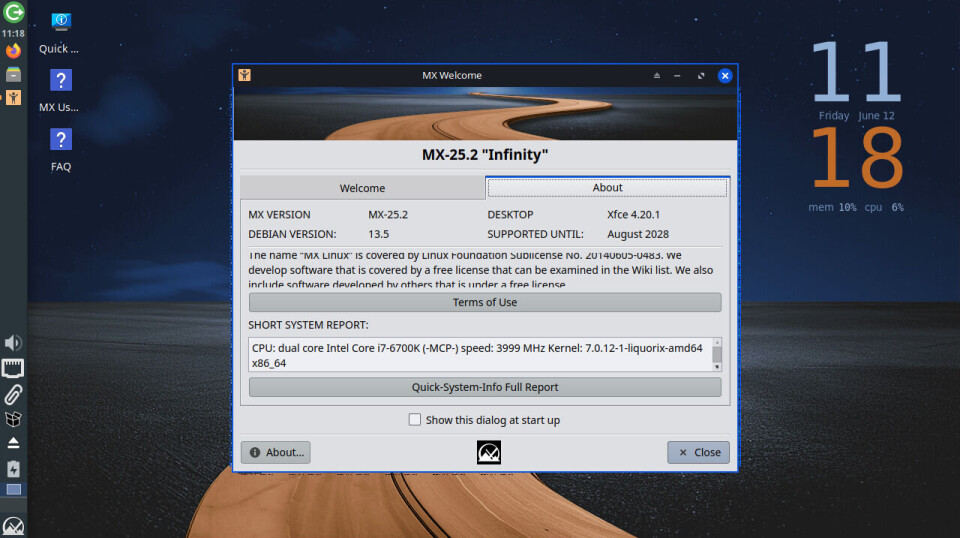
MX Linux 25.2 is here, now with kernel 7.0 if you choose – although the Raspberry Pi edition still needs some work.
MX Linux has been quietly turning into one of the Reg FOSS desk’s favorite distros for a few years now. It has a number of desirable attributes, and with version 25.2 released late last month, some of the slightly bumpier parts of the major upgrade to version 25 are getting smoothed out.
We looked at MX Linux 25 in November last year, and reported that one of the niftiest features in previous versions had been lost. In MX 23 and before, you could choose which init system the OS used every time it booted up: so, for instance, you could normally run with the classic sysvinit, but if you needed to install something which demanded systemd, you could temporarily boot up with systemd as the init, install your app, and then switch back. In our testing, we’ve found that some things require Agent P’s Swiss Army Knife of a “System and Service Manager” to install, but once they’re in place on your computer, they will run quite happily without it. Alternatively, if it’s something you only occasionally run, you can start up with systemd only when you need it.
The way that MX Linux did this no longer works on kernel 6.12 or above. So, in order to continue to offer a choice of inits at all, MX 25.0 made you choose at install time: either pick the systemd version, or the sysvinit version. (And if you wanted KDE Plasma, it was only available in systemd form.)
MX Linux 25.1 fixed that with a new, different, switchable-init system. However, that made upgrading from 23 to 25 tricky, and after we tried it, the OS still worked, but the handy suite of MX Tools didn’t. These aren’t essential, but they significantly facilitate common adjustments and tweaks such as installing extra external apps, switching repositories and mirrors, managing kernel versions, installing additional device drivers such as the eternally problematic Nvidia drivers, and much more. They’re one of the distro’s key advantages, and well worth having.
We dug out the machine in our test fleet, which runs MX, and tried the option in the installation program that installs over the top of an existing copy of MX. It worked fine, with some caveats: it’s not quite as capable as Ubuntu’s in-place reinstall, which spares your home directory while reinstalling the OS around it. MX simply overwrites the old OS; it doesn’t pick up any config from it – but it’s quicker and easier than custom partitioning. We had to re-enable our swap partition, and add a user account that matched the old one, but everything worked fine.

With the MX Tools, it was fast and easy to choose local repositories for updates, and reinstall some handy proprietary apps such as Google Chrome and Slack. The distro comes with Flatpak preinstalled, and we used that to install Gear Lever to make it easier to reinstall Panwriter.
The new MX Linux version 25.2 optionally includes the new kernel 7.0, from the Liquorix project that we looked at in 2022. For the Xfce edition, you can choose the normal edition, with a Debian kernel, or the AHS edition with the newer kernel. The KDE edition only comes in AHS form, and the lightweight Fluxbox edition for low-end kit only offers the Debian kernel.

There are any number of Debian and Ubuntu based remixes and meta-distributions out there, but MX Linux is perhaps the single most user-friendly distro we’ve seen that isn’t based on systemd. It’s fast, lightweight, and much easier to get configured and installed than Devuan, or even than Debian itself. It also has better tools for adjustment and customization than any member of the Ubuntu or Debian family, and rivals the best Arch Linux-based distros such as Garuda Linux.
As we reported from the Ubuntu Summit, Canonical is beginning a push into AI. Since then, the roadmap for Ubuntu 26.10 “Stonking Stingray” has been published, including what it calls a Context-aware desktop – powered by LLMs. Similar changes have already come to Linux Lite 8.0, which is based on Ubuntu 26.04. This too bundles a local LLM for all your error-filled artificial-plagiarism needs.
We suspect that such developments may yet drive a small exodus of Ubuntu users – and if you also want to get away from systemd at the same time, then MX Linux is an excellent place to start.
Finally, version 25.2 sees the Raspberry Pi respin updated to the new base OS. Until 25.2, the Pi version was still on MX version 22. As this rather outdated description says, this is a separate edition of MX Linux with Xfce, but built in part from the packages in the Raspberry Pi OS rather than directly from Debian – so it looks and works like MX, but is compatible with most Pis and most apps for PiOS. For instance, the Pi configuration commands, and EEPROM updater, work fine on MX on the Pi, but they don’t on (for instance) Alpine Linux.
We tried MX Linux 24.2 for the Raspberry Pi on both 4 GB and 8 GB Pi 5 machines and on a Pi 4, but it wouldn’t get past the splash screen for us – but the previous release worked very well, so once it’s received a little more TLC, this could turn out to be a good option for Pi users wanting a more configurable desktop OS. ®


A former IT employee at an Iowa school district was sentenced to 21 months in prison for conducting a prolonged cyberattack against the former employer that disrupted classroom operations, deleted accounts, and caused tens of thousands of dollars in damages.
According to court documents, Ezekiel Dean Potter, 34, previously worked as a senior IT support specialist for the Saydel Community School District in Des Moines from May 2022 through April 2023.
Prosecutors say that after his employment ended, Potter retained access credentials and repeatedly targeted the district’s systems over the next 21 months.

“For over a year and a half, Defendant was a plague on the Saydel Community School District,” the U.S. government said in a sentencing memorandum.
“He deleted SCSD’s Facebook page, stripped its employees of access to educational platforms and accounts, and tried again and again to reset its employees’ usernames and passwords for various other platforms and accounts.”
Prosecutors said the attacks caused widespread disruption to the school district, impaired its ability to teach students, and resulted in tens of thousands of dollars in remediation costs.
Court documents state the attacks began shortly after Potter left the district, when Saydel’s Facebook account was deleted.
Prosecutors say Potter later targeted the district’s Apple School Manager account, deleting user accounts, passwords, phone numbers, billing information, and device management server data.
This effectively prevented school employees from accessing the Apple School Manager platform and disabled management of district MacBooks and iPads for roughly a week while staff worked with Apple to recover access.
The district also experienced unauthorized access attempts against its GoDaddy account and other online services.
Court documents go on to say that in January 2025, Potter accessed the district’s Schoology learning management system through a Google administrator account and deleted an IT employee’s account, disrupting teacher access to the platform and impacting classes for approximately two hours.
A week later, prosecutors say Potter accessed another administrator account and deleted nine Gmail accounts belonging to current and former district employees, including the district’s IT director and superintendent.
Court filings state that Potter later switched to using a VPN service after receiving Google security alerts warning of unauthorized account access.
Federal investigators eventually traced some of the activity to IP addresses associated with Potter’s other employers, including Casey’s Store Support Center and The Printer Inc. (TPI).
After Potter left TPI in January 2025, prosecutors say he asked a former coworker to retrieve and wipe a USB drive from his desk.
Instead, the coworker turned it over to investigators, who allegedly found spreadsheets containing usernames and passwords for Saydel School District accounts and services.
Potter pleaded guilty in January 2026 to computer fraud charges under the Computer Fraud and Abuse Act without entering into a plea agreement.
On June 11, Potter was sentenced to 21 months in prison followed by three years of supervised release.
As part of his supervised release conditions, Potter will be subject to restrictions and monitoring related to employment, finances, and computer systems, including searches of electronic devices upon reasonable suspicion.
Potter is also required to pay $59,668.81 in restitution to the Saydel Community School District and its insurer, Travelers Casualty and Surety Company, for remediation costs related to the attacks.

Security teams log 54% of successful attacks and alert on just 14%. The rest move through your environment unseen.
The Picus whitepaper shows how breach and attack simulation tests your SIEM and EDR rules so threats stop slipping by detection.
offbeat
A blast from the past greets commuters
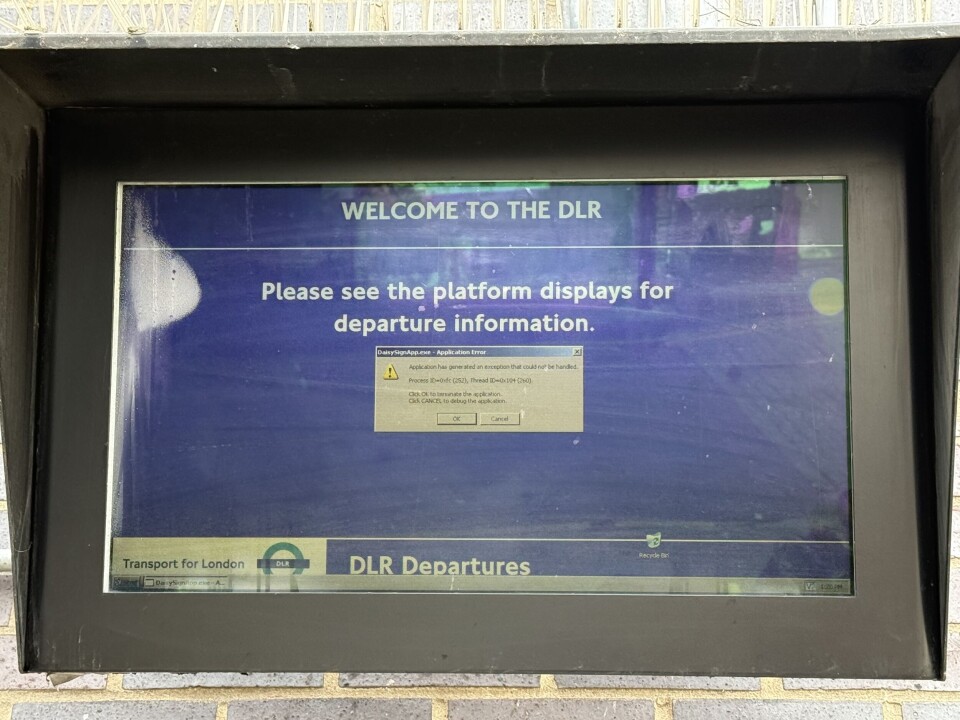
BORK!BORK!BORK! We’re big fans of retro computing here at Vulture Central, and so it is with a certain delight that we can report XP-era Windows has been spotted disgracing itself on London’s Docklands Light Railway.

Spotted by Register reader Tim Hayward, the wonderfully named DaisySignApp.exe has thrown up an application error. While the Windows shell might be shorn of all of XP’s fripperies, the Recycle Bin icon hints at the operating system’s origins. Hayward reckoned that XP was stalking the DLR, but it could also be Windows Server 2003.
Support for Windows Server 2003 finally ended in 2015. XP was sunset in 2014, so the DLR display is rather out of date. Then again, as any IT administrator would admit, if something isn’t broken, there’s no point fixing it, no matter how much Microsoft would encourage them to.
In this case, it is unlikely that the operating system is at fault (although one could argue that it should handle a misbehaving application more discreetly), and DaisySignApp.exe should be dealing with its own dirty laundry rather than throwing an exception in commuters’ faces at Limehouse station.
Limehouse connects London’s Docklands Light Railway (DLR) to the UK’s National Rail services. It was one of the first DLR stations and predates the borked operating system by more than a decade.
Indeed, at the time of the DLR’s opening in 1987, Microsoft was preparing to inflict Windows 2.0 upon the world – the delights of later versions and the company’s GUI dominance were still a few years in the future.
The DLR also seemed like a glimpse into the future back in the 1980s. However, a fair chunk of its underpinnings, such as formerly disused railway viaducts, hark back to an earlier era.
Anyone looking at today’s iteration of Windows might wonder how much of it dates back to what’s on display at Limehouse. ®





Alexander Zverev wins the French Open to finally earn a 1st Grand Slam title


Anatomy of the June crypto crash: Fed, Iran, Saylor


Oppenheimer backs SpaceX as $70 billion retail frenzy builds

Alexander Zverev conquers demons and outlasts Flavio Cobolli to win French Open for first major title


Markets Rally as SpaceX IPO Looms Amid Iran Tensions and Inflation Surge


Microsoft unveils seven homegrown AI models in new bid for ‘long term self-sufficiency’


High Stakes for Wembanyama as New York Pushes for 3-0 Lead


Notion restores access to Anthropic after service disruption


FIFA WC 2026 Group C: Morocco, Scotland challenge Brazil’s hunt for glory | FIFA World Cup 2022

The investment to transform historic St Helen’s ground in Swansea

Eli Lilly (LLY) Stock Surges 4% Following Breakthrough Sleep Apnea Trial Results


Trump’s AI Ownership Plan Could Benefit Anthropic at OpenAI’s Expense

Bangladesh beat Australia after 20 years in ODIs, register only their second win over six-time world champions | Cricket News


Weekend Open Thread: Tuckernuck – Corporette.com


NanoClaw integrates JFrog registries to secure AI agent downloads


Bitget enters Argentina’s regulated crypto market through PSAV registration


This Week In Security: Microsoft On Microsoft, Register Your Domains, Linux On ARM, And FreeBSD Joins The File Cache Club


Politics Home | Healey Resignation Is “Colossal Failure Of Government”, Says Former Labour Defence Secretary


First Time Since 1971: Australia Register Historic Low In ODI Cricket

Donnie Wahlberg & More Heat Up Las Vegas at Circa’s Barry’s Downtown Prime


You must be logged in to post a comment Login