Security teams log 54% of successful attacks and alert on just 14%. The rest move through your environment unseen.
The Picus whitepaper shows how breach and attack simulation tests your SIEM and EDR rules so threats stop slipping by detection.





Microsoft has fixed a known issue that caused Windows updates released since May 2025 to fail when installed via the Windows Update Standalone Installer (WUSA) from a network share.
WUSA is a built-in Windows command-line tool that helps admins install and uninstall Microsoft Standalone Update (.msu) files through the Windows Update Agent API to deploy or remove patches, updates, and hotfixes.
This known issue affects Windows 11 24H2/25H2 and Windows Server 2025 devices on enterprise networks, as WUSA isn’t a common method for installing updates on home devices. Microsoft also noted that the bug doesn’t occur with a single .msu file or when the files are stored locally.
“Windows updates installed using the Windows Update Standalone Installer (WUSA) might fail with error ERROR_BAD_PATHNAME, when the update is installed using WUSA or double-clicking a .msu file from a network share that contains multiple .msu files,” Microsoft said when it acknowledged the issue in August 2025.
“These issues might occur on devices that installed updates released May 28, 2025 (KB5058499) and later.”
Microsoft first mitigated this known issue automatically on home and non-managed business devices through a Known Issue Rollback Group Policy beginning September 2025.
As part of the June 2026 Patch Tuesday, Microsoft finally addressed this known issue for all affected systems in cumulative updates released for Windows 11 (KB5079391) and Windows Server 2025 (KB5094125).
“If you are using an update released before this date, and are experiencing this issue, you have the option to work around it by saving the .msu files locally on the device and install the update from this location,” Microsoft said in a Windows release health dashboard update.
“Also, if you’ve restarted Windows after installing an .msu file via WUSA, please wait 15 minutes or more before checking the Update History page in Settings. After this short delay, the Settings app should properly indicate if the update installed successfully.”
Microsoft resolved another issue in April 2025 preventing enterprise customers from installing the April 2025 security updates via Windows Server Update Services (WSUS), and an identical bug that caused the August 2025 Windows 11 updates to fail with 0x80240069 errors.
Earlier this week, Microsoft also warned customers that they may have issues installing the latest monthly updates on some Windows devices upgraded to Windows 11 24H2 or 25H2.

Security teams log 54% of successful attacks and alert on just 14%. The rest move through your environment unseen.
The Picus whitepaper shows how breach and attack simulation tests your SIEM and EDR rules so threats stop slipping by detection.
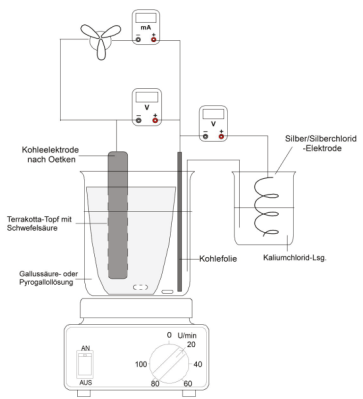
As simple of a concept flow batteries are, the used chemicals can still be somewhat problematic in the context of a school experiment. To this end [Markus Bindhammer] decided to implement a flow battery version that uses compounds from green tea for its electrolyte, based on a German research paper from 2016.
These organic flow batteries can use gallic acid, pyrogallol as well as the polyphenols in green tea, making them rather safe even in the hands of more careless students. The demonstrated flow battery uses a carbon electrode with activated carbon around it to increase surface area, a platinum wire electrode, and a graphite foil as as third electrode.
In the paper a silver electrode is also used, along with the additional electrodes, and a terracotta flower pot as the barrier between the carbon and graphite electrodes, with [Markus] further explaining that there are fortunately cheaper options than what he is using, especially with the flower pot instead of a special ceramic vessel.
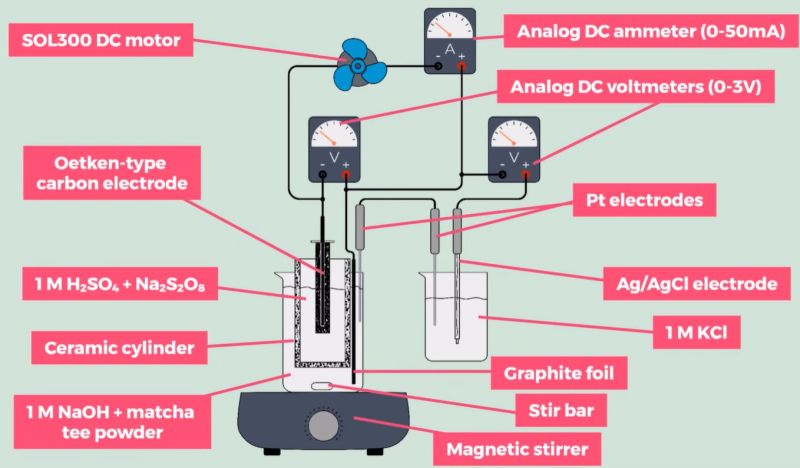
The electrolyte solution has epigallocatechin gallate (EGCG) dissolved in it, which here comes in the form of finely ground green tea powder (commonly known as matcha), which so happens to be pretty rich in this substance. In the below graphic by [Markus] you can see the complete set of solutions and other relevant details.
Of course, the performance of this type of flow cell isn’t amazing, with a cell voltage of less than a volt and a few mA of current, but it’s enough to spin a small fan, and to light up a few LEDs. This would be more than enough to demonstrate the reaction and flow cells in general, as long as you don’t mind donating some tasty matcha to science.


The news comes amid the official opening of a new premises, which is also part of NTT Data’s €16.5m investment.
NTT Data, a Tokyo-headquartered AI, digital business and technology company has today (17 June) announced the creation of 50 jobs to be based out of a new Dublin office. The new premises replaces a previous Dublin-located base of operations and is part of a €16.5m investment into the local economy.
According to the organisation, the investment will focus primarily on jobs creation, as well as AI and digital services R&D in association with business and academic institutions. NTT Data has expanded its Ireland–based workforce by 50pc since 2025 and the newly announced roles are expected to be filled over the course of the next six months.
NTT Data has stated it regards Ireland as a critical market and its Irish client base includes a range of insurance companies, banks, and telecoms firms such as Three Ireland and Eir. The company also said the new Dublin office will illustrate a commitment to supporting Ireland’s businesses with the latest research and technologies.
Commenting on the announcement, Michael Lohan, the CEO of IDA Ireland, said: “NTT Data’s new Dublin office and investment of €16.5m is a strong vote of confidence in Ireland and a clear sign of the company’s long-term commitment to growing its presence here.
A key part of IDA Ireland’s strategy is to support Ireland as a global location for next-generation technologies, including AI and to help companies scale high-value capabilities from Ireland for international markets.
“NTT Data’s focus on research and development strengthens the wider technology ecosystem, deepening collaboration with Irish talent and academia and driving innovation that will benefit businesses and communities across the country.”
Niccolo Spataro, the executive managing director for the UK and Ireland at NTT Data, added, “Ireland has a growing economy and a well-established and dynamic tech sector. Today’s announcement reflects our commitment to Ireland. The organisations that move decisively on AI will define their industries for years to come, and we intend to be the partner that helps Ireland’s leading enterprises do exactly that.”
In late May, in Galway, global healthcare technology company Medtronic also announced the creation of new roles amid the establishment of a European software development hub for its patient care systems function.
New roles at the Galway site will be in areas such as leadership, software engineering and systems reliability and the hub will serve as a global ‘centre of excellence’ for cardiac digital health.
Don’t miss out on the knowledge you need to succeed. Sign up for the Daily Brief, Silicon Republic’s digest of need-to-know sci-tech news.


As geopolitical uncertainty continues to constrict the world’s supply of fossil fuels, plenty of countries are weighing up their options for finding alternative energy sources. Nuclear power remains a controversial option, with the fallout from disasters like Chernobyl still continuing decades later, but it’s a very efficient solution. A single average nuclear power plant can generate around 900 megawatts, which is enough to power hundreds of thousands of homes. Renewable energy sources like wind and solar are less controversial, but you’ll also need a whole lot more of them to power the same number of homes.
According to John Parsons, the deputy director of the MIT Center for Energy and Environmental Policy Research, matching the output from an average nuclear reactor would mean building roughly 800 wind turbines. There are a variety of factors to consider, not the least of which is when you switch on a nuclear power plant, it operates at capacity all the time. Wind farms, on the other hand, are dependent on external factors.
To build such a huge wind farm, you’d need around 1,000 times more land than a nuclear reactor would need, if you measure the total size of the farm. Much of that land is the space in between each turbine, which could potentially be used as farmland, but even if you measure only the space taken up by the turbines themselves, the wind farm will still take up 10 times as much space as the nuclear reactor.
Wind and solar power remain much greener than fossil fuels, with almost all of their emissions being generated during the manufacturing process and the construction of the power plants. However, the land requirements and production costs to build these plants are still major limiting factors for now.
Researchers continue to work on ways to make wind and solar power more efficient, with one company in China currently developing unique wind turbines that fly above the ground rather than being built on it. According to the Chinese state-affiliated Global Times, the airborne wind turbine, which looks like a cross between a blimp and a cartoon rocket ship, successfully took its maiden flight in January 2026.
Operating at 2,000 meters above ground level, the turbine is subjected to stronger, more consistent wind than a traditional land-based wind turbine. This stronger wind allows it to produce significantly more energy, which is then transferred along a cable that anchors it to the ground. Speaking to the Global Times, a researcher working on the project said that they envisioned the turbine being used as an energy supply in remote outposts, as well as “complement[ing] traditional ground-based wind power systems.”
The data gathered during the initial flight suggested that the airborne turbine prototype could generate up to 3 megawatts of power. That would mean that only 300 of these turbines could match the output of a nuclear reactor, compared to 800 average ground-based turbines.

Although the Chinese prototype wind turbine looks promising, it isn’t yet in production. If and when it arrives, its makers reportedly plan to prioritize the Chinese market at first, so it’s safe to assume that the rest of the world won’t be generating power using floating wind turbines anytime soon. Thankfully, it’s not the only way that researchers are trying to make wind turbines more efficient.
One development that’s already happening in America is the introduction of increasingly large surface-level wind turbines. A bigger wind turbine has the potential to generate significantly more energy, and turbines built in the 2020s are already far larger on average than the turbines built in previous decades.
This increase in size is expected to continue, with offshore wind turbines expected to reach an average height of almost 500 feet by 2035, up from around 330 feet in 2016. Each new turbine in 2035 is expected to generate almost 3 times as much energy as its 20-year-old predecessors. A smaller number of large turbines takes up less space than a larger number of small turbines, and it also makes it cheaper to generate the same amount of energy.
It turns out that wind farms might have some unexpected environmental benefits too. Despite lingering concerns about sea birds hitting turbines, studies have found that some aquatic wind turbine farms have become places of shelter for everything from harbor seals to fish and lobsters.

The Tour de Suisse 2026, the 89th edition of the race, will be five days long rather than the usual eight and in an innovative move to give the fans more chance to see the action each day, the stages will start and finish in the same town.
Heading the list of contenders is the GOAT himself Tadej Pogačar who will be racing for the first time since winning the Tour de Romandie at the end of April. Challenging for the overall will be Tom Pidcock, Primož Roglič and Richard Carapaz then of those looking for stage wins keep a close eye on Matthew Brennan and Mathieu van der Poel.
Read on and we’ll show you how to watch a Tour de Suisse 2026 live stream from anywhere, and potentially for FREE.
Cycling fans in Switzerland will get to watch a Tour de Suisse 2026 live stream for FREE in a choice of three languages, German, French and Italian.
Those Belgium and Austria can also watch for free. Here’s where:
If you’re a resident of Switzerland, Belgium or Austria and you’re abroad right now, don’t worry about missing the action – all you need to do is download a VPN to re-connect to your home streaming coverage. You’ll find more details below.
Tour de Suisse 2026 is streaming on lots of platforms around the world, but what if you’re abroad and don’t want to take out a new subscription just to watch the race, or you want your familiar, favorite commentary?
This is where a VPN can help. It’s a handy piece of software that can make your device appear to be back home, so you can unlock your usual service or subscription from wherever you find yourself.
The best VPN right now? We recommend NordVPN – it does everything you want it to do at great speeds and an even better price.

Cycling fans in the US can watch the Tour de Suisse 2026 on FloBikes.
A subscription to FloBikes will set you back US$155.88 for the year or US$39.99 on a monthly basis.
If you’re out of the US but still want to watch the 2026 Tour de Suisse then don’t forget to explore the VPN route set out above, which will help you access your subscriptions from anywhere.

The Tour de Suisse 2026 is on TNT Sports in the UK.
TNT Sports’ cycling coverage in the UK has now moved from Discovery+ to the HBO Max platform. It costs £30.99 per month, though there is a better value £25.99 “saver plan” available if you sign up for a 12-month term.
If you’re currently traveling overseas, don’t worry as you can use NordVPN to watch your usual service from abroad.

Fans in Canada can watch the Tour de Suisse 2026 on FloBikes.
A subscription to Flobikes, which has pretty much every race you could wish to watch, costs CA$49.99 a month or CA$215.88 for the year.
Not at home right now? Use NordVPN or another VPN service to make your device believe you’re still in Canada.

As yet no TV broadcaster in Australia has the rights to the Tour de Suisse 2026.
However, the Age of Sports YouTube channel is listed on the Tour de Suisse 2026 website as showing the race Down Under. We’d recommend checking it out when the race starts on Wednesday.
Not at home right now? Use NordVPN or another VPN service to trick your device into thinking you’re still in Australia.
Tadej Pogačar shouldn’t face too much resistance in his bid to win his first Tour de Suisse as his main rivals are all racing elsewhere or camped out at altitude preparing for the big one in a week’s time. Tom Pidcock should hopefully push him hard, and likewise Primož Roglič will be upset if he’s not in the mix for a podium spot, but if Pogačar is in the same shape that saw him win so prolifically in the spring, it will be a walk in the park.
This year there are only five stages, down from the usual eight to make it more attractive to riders preparing for the Tour and each day will start and finish in the same town. This will work brilliantly for fans who can see both the start and finish of a stage, and if they are resourceful maybe even catch the action halfway.
The five stages kick off with three hilly/mountainous affairs followed by a 23km time trial on stage four then an absolute monster Queen stage to end with. Starting half way up the Col de la Croix and crossing its summit three times in a row it finishes uphill and will be an awesome spectacle for the fans.
Stage 1 | Wednesday June 17 | Sondrio – Sondrio | 14:15
Stage 2 | Thursday June 18 | Locarno – Locarno | 14:00
Stage 3 | Friday June 19 | Bag Ragaz – Bad Ragaz | 13:45
Stage 4 | Saturday June 20 | Aarburg – Aarburg (ITT) | 15:04
Stage 5 | Sunday June 21 | Villars-sur-Ollon – Villars-sur-Ollon | 13:30
* All times CET

We test and review VPN services in the context of legal recreational uses. For example: 1. Accessing a service from another country (subject to the terms and conditions of that service). 2. Protecting your online security and strengthening your online privacy when abroad. We do not support or condone the illegal or malicious use of VPN services. Consuming pirated content that is paid-for is neither endorsed nor approved by Future Publishing.

Cyber Essentials has always been the UK’s baseline cybersecurity standard.
It’s a practical floor designed to block common attacks and ensure business resilience when organizations implement them, rather than treating the scheme as lip service.
The April 2026 update raises the floor, introducing auto-fail outcomes for missing key controls, meaning that certain gaps now end an assessment immediately, rather than becoming items to fix later.
For a lot of organizations, that’s not just a compliance issue but a commercial one; as Cyber Essentials certifications are increasingly a requirement by customers and suppliers.
Three changes define the update to Cyber Essentials, with two aspects now resulting in an “auto-fail” if they are not met.
Firstly, patching deadlines are now strict requirements, with high-risk and critical security updates needing to be applied within 14 days of release across systems.
Second, multi-factor authentication has moved from a strong recommendation to mandatory for cloud services. Where MFA is available and not enabled, the assessment ends. The room to treat it as optional is gone.
Third, cloud services can no longer be excluded from scope. IT infrastructure and services hosted in the cloud are now within assessment boundary, shutting down any ambiguity that many organizations had used, on purpose or not, to simplify their certifications.
It’s tempting to read 14 days as aggressive until you compare it to how quickly disclosure becomes exploited in today’s environment. Security teams are operating in a world where attacker collaboration and automation compress timelines throughout the attack cycle, and incident data shows how fast campaigns can progress once initial access is achieved.
The UK’s National Cyber Security Centre has been clear with its warnings: organizations need to prepare for a vulnerability patch wave, driven by AI-enabled actors exploiting technical debt at scale and at pace. Organizations need to have processes that deploy updates quickly, more often, and prioritize internet-facing attack surfaces.
Cyber essentials now treat 14-day patching as a minimum, not a nice-to-have, benchmark. Informal patching practices like monthly scheduled windows or manual processes where IT runs updates when they get a chance aren’t enough.
Beyond compliance, unpatched systems are a routine entry points attackers use to disrupt operations – making fast patch management a direct investment in business resilience, not just a box-ticking exercise.
The organizations most likely to struggle aren’t always those with the worst intentions. In practice, the biggest risk sits with teams that can describe compliant controls but can’t run them consistently across their full environment. The update is designed to punish inconsistency because inconsistency is what attackers exploit.
Patching is the obvious pressure point. A 14-day commitment is difficult to keep if devices drift from management, if network hardware runs on separate update schedules, or if legacy applications are prone to breaking when updated. Under the new rules, it’s not enough to patch the easy things; the requirement is framed across the entire scope, which is exactly where many environments reveal hidden gaps.
MFA is the other common tripwire – less technical than organizational. Many businesses have strong MFA coverage for core systems like secure email or admin consoles, but not the long tail of cloud services that have never been brought into line. Under the new rules, that tail is now in scope and the “MFA where available” rule matters.
Cloud scoping will catch organizations that historically treated cloud as “the provider’s responsibility.” The updated requirements explicitly describe shared responsibility expectations and make clear that applicants remain responsible for ensuring controls are implemented.
Finally, organizations that relied on narrow scoping to simplify certification are likely to face more scrutiny. The scheme changes around scope descriptions, exclusions, and transparency, are intended to make it harder to present a subset that doesn’t represent the real operating environment.
The fastest way to get ready is to stop thinking of Cyber Essentials as a yearly submission and start treating it as ongoing routines.
That doesn’t mean building a bureaucracy; it means choosing a small number of repeatable disciplines that keep you continuously within the standard. Embedding these routines makes organizations more operationally resilient, as they are better prepared to absorb and recover from disruption.
The starting point is understanding scope properly. Cloud services that host or process organizational data are now in scope and can’t be excluded. So, the first task is establishing which services are being used, and who owns them operationally.
Once you have that picture, the MFA requirement becomes a finite task: ensure MFA is enabled wherever it is available and ensure that you can demonstrate it reliably across users rather than assuming “most people probably turned it on.”
Next, treat patching as a pipeline rather than an event. The NCSC’s guidance to prepare for faster, more frequent patching aligns with what Cyber Essentials is now enforcing through auto-fail. Routines are needed to ensure that updates are discovered quickly and prioritize what matters like internet-facing exposure – within the 14-day window.
Where updates genuinely cannot be applied without breaking critical systems, the expectation shifts towards containment and risk management rather than leaving systems exposed and hoping the next cycle catches up.
Incident response reporting continues to show how quickly intrusion timelines are shrinking once initial access is achieved. Threat intelligence reporting is also increasingly clear that adversaries are using automation and AI to accelerate parts of the attack chain.
The implication for a baseline standard like Cyber Essentials is straightforward: controls that slow attackers down early and increase business resilience – rapid patching, strong authentication, and realistic scoping – matter more than ever, because they buy you time you may not otherwise have.
If you take one lesson from the April 2026 update, it should be this: the scheme is no longer optimized for organizations that are “mostly compliant most of the time.” It is increasingly aligned to the reality that attackers only need one neglected service, one unpatched edge device, or one MFA gap to turn a baseline weakness into a breach.
We feature the best endpoint protection software.
This article was produced as part of TechRadar Pro Perspectives, our channel to feature the best and brightest minds in the technology industry today.
The views expressed here are those of the author and are not necessarily those of TechRadarPro or Future plc. If you are interested in contributing find out more here: https://www.techradar.com/pro/perspectives-how-to-submit
Microsoft confirmed that it’s working on a security patch for a Defender zero-day vulnerability named “RoguePlanet,” disclosed one week ago.
The security researcher who published a RoguePlanet exploit during the June 2026 Patch Tuesday (known as Nightmare Eclipse) said it affects fully patched Windows 10 and Windows 11 devices and allows attackers to spawn command prompts with SYSTEM privileges via a Microsoft Defender race condition.
He shared a proof-of-concept exploit in a self-hosted Git repository, claiming that Microsoft had previously targeted and removed their repos hosting exploits on GitHub and GitLab.

“The exploit is a race condition, so it’s a hit or miss. I have managed to get a 100% success rate on some machines while it struggled to work on others,” Nightmare Eclipse said.
“Microsoft is aware of the reported vulnerability and is actively investigating the validity and potential applicability of these claims. Microsoft is committed to investigating security issues and updating impacted products to protect customers as soon as possible,” a Microsoft spokesperson told BleepingComputer when asked for a statement at the time.
On Tuesday, one week after the RoguePlanet flaw was disclosed, Microsoft assigned the CVE-2026-50656 ID to this security flaw and confirmed it’s currently working on a patch, but didn’t acknowledge that Nightmare Eclipse was the one who found the vulnerability.
“Microsoft is aware of an elevation of privilege in the Microsoft Malware Protection Engine in Microsoft Defender publicly referred to as ‘RoguePlanet,’ it said in an advisory published yesterday. “We are working to provide a high quality security update that addresses this vulnerability. We will provide information in this CVE when the update is available.”
The RoguePlanet release is part of an ongoing dispute between Nightmare Eclipse and Microsoft over the latter’s bug bounty and vulnerability disclosure practices.
Over the past several months, the researcher has publicly leaked multiple Windows zero-day exploits, including for the BlueHammer, RedSun, GreenPlasma, MiniPlasma, YellowKey, and UnDefend flaws. Some of these zero-days affect Microsoft Defender, while others target BitLocker and Windows components.
The company reacted to Nightmare Eclipse’s disclosures by issuing warnings of legal action when people engage in “malicious activity causing real harm to our customers,” leading cybersecurity experts and researchers to believe that Microsoft was threatening the researcher.
Microsoft fixed the GreenPlasma, MiniPlasma, and YellowKey flaws last week as part of the June 2026 Patch Tuesdayupdates.
Security teams log 54% of successful attacks and alert on just 14%. The rest move through your environment unseen.
The Picus whitepaper shows how breach and attack simulation tests your SIEM and EDR rules so threats stop slipping by detection.
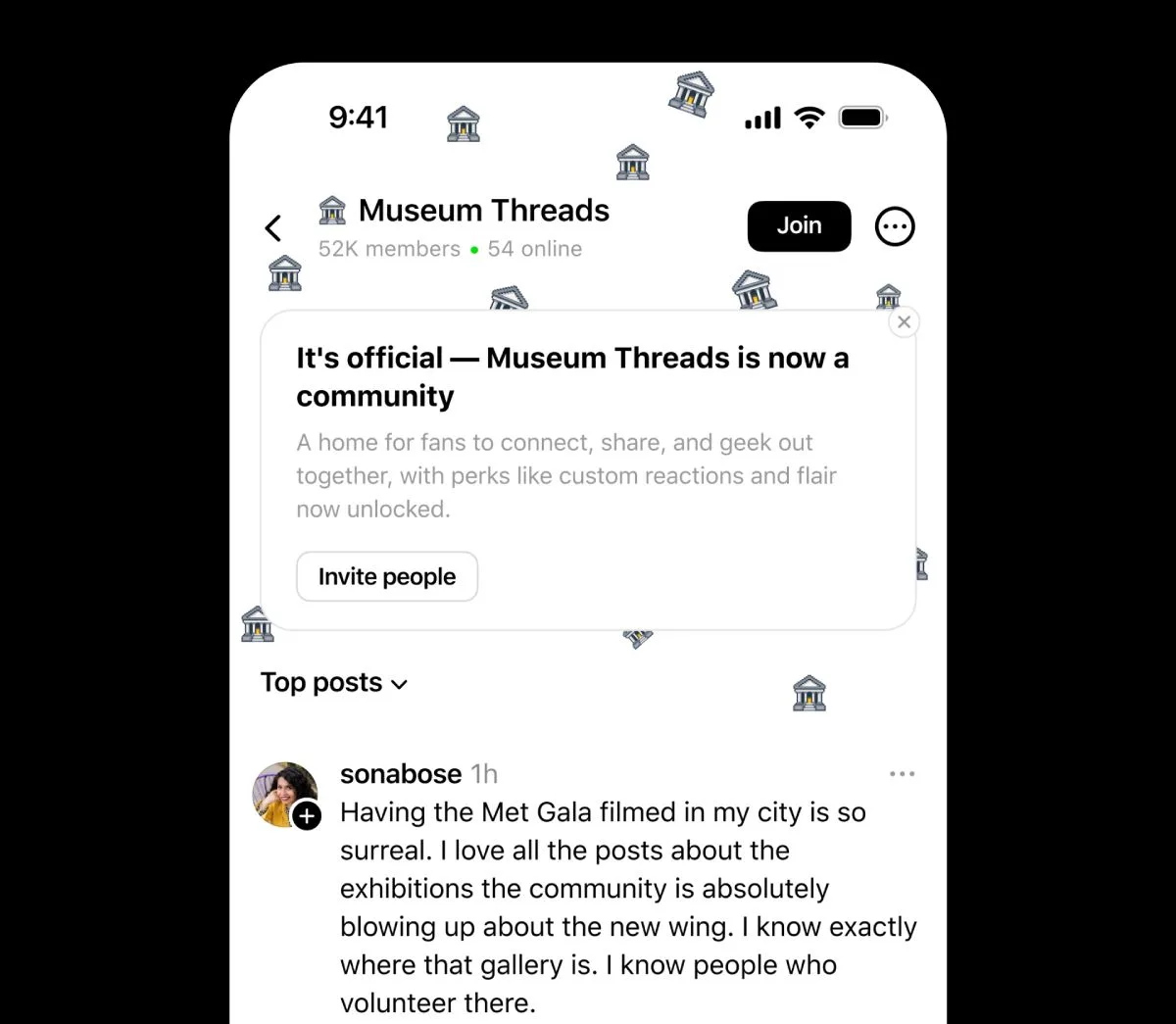
Threads is rolling out a batch of upgrades to its Communities feature and introducing a new feed personalization tool, as Meta marks the platform reaching 500 million monthly active users.
The Communities feature, which launched last year and lets users form groups around shared topics, is now out of beta and picking up several additions. Communities can now have custom icons to make them easier to identify across the app, and a new Communities Hub puts them in the main menu alongside the feed, so switching between them takes fewer taps.


Meta says it is also adding a progress indicator that shows users how far a topic is from becoming a full community, expanded champion status to recognize more active members, and native-language tags for communities in Japan, Korea, and Taiwan. Live Chats, which are already available in some Communities, will expand to more groups in the coming weeks and gain co-hosting and the ability to quote moments directly to the feed.
Meta is also rolling out a new feed-tuning tool called Your Algo. It builds on Dear Algo, a feature introduced in February that lets users signal to the algorithm what they want to see more or less of.


Your Algo works alongside it, letting users privately set topic preferences and choose how long those preferences stay active, with options for one, three, or seven days. The requests are visible only to the user, and both tools are managed from a single hub. Your Algo is live for users in the US, Canada, the UK, Australia, and New Zealand.
The rollout comes just days after Instagram introduced a similar feature called Your Algorithm, which lets users add and remove topics to shape what they see across the app.
Today, Chinese AI startup Z.ai (formerly Zhipu AI) announced the immediate release of GLM-5.2, a 753-billion parameter open-weights large language model (LLM) engineered specifically to dominate “long-horizon” autonomous coding and engineering tasks.
Available immediately on Hugging Face, the Z.ai API, and more than 20 third-party coding environments, the model boasts a highly stable 1-million-token context window alongside enterprise subscription tiers starting at just $12.60 per month.
In excellent news for cost and security-conscious businesses, z.ai has released GLM-5.2’s core weights under an unrestricted MIT open-source license, allowing enterprises to download the model freely from Hugging Face, customize or fine-tune it to their liking, and run it potentially locally or via virtual machines for only the cost of their compute and electricity.
This is an increasingly appealing option for enterprises, as state-of-the-art American proprietary models face an uncertain and potentially interrupted regulatory future, following the Trump Administration’s export control directive last week prohibiting foreign nationals from using Anthropic’s new Claude Fable 5 model (which that company responded to by taking the models in question entirely offline for all users).
For enterprise technical decision-makers, z.ai’s GLM-5.2 provides a highly capable path to host frontier-level AI locally, entirely bypassing the geographic fencing and commercial limitations.
Under the hood, GLM-5.2 operates with 753 billion parameters and introduces a major architectural optimization called “IndexShare”.
In standard massive language models, recalculating attention mechanisms across long documents is computationally exorbitant. IndexShare solves this by reusing the identical indexer across every four sparse attention layers.
At the maximum 1-million-token context length, this single innovation reduces per-token compute FLOPs by a massive 2.9 times.
The model also features an upgraded Multi-Token Prediction (MTP) layer for speculative decoding, which boosts accepted token length by up to 20% during inference.
Additionally, Z.ai has implemented flexible, selectable “Thinking Modes”. Users can toggle the model’s reasoning effort between “Max,” designed to push the limits of logical problem-solving, or “High,” which strikes a careful balance between high-end performance and latency-sensitive token efficiency.
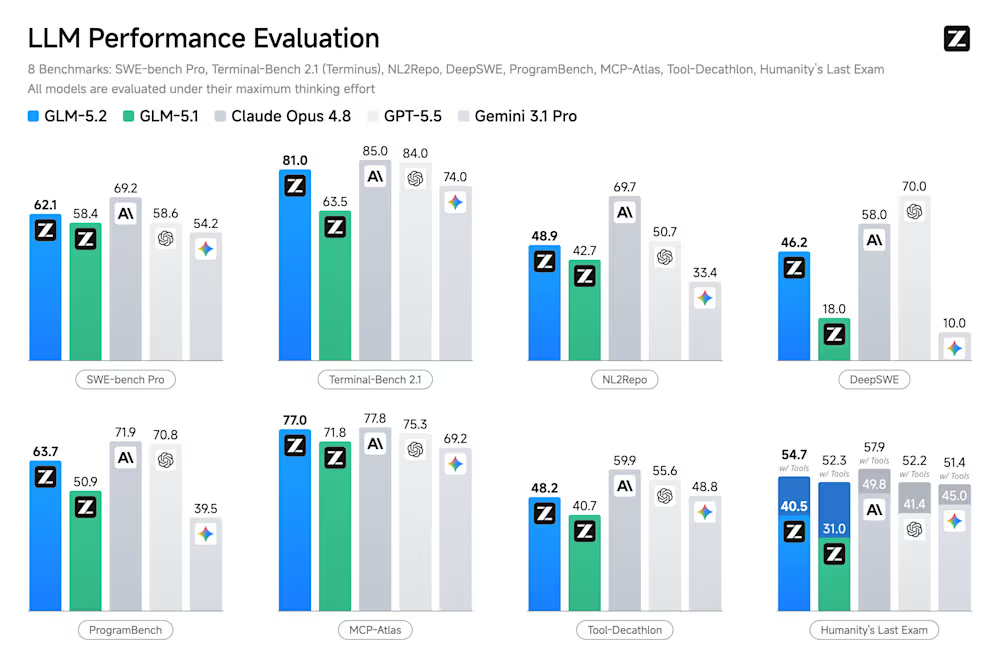
On industry-standard third-party benchmark tests, GLM-5.2 performs above most open source flagship models, even DeepSeek v4 and scores near or above its closed-weights rivals, OpenAI’s GPT-5.5 and Anthropic’s Claude Opus 4.8.

The model particularly shines in agentic tool use and long-horizon software engineering tasks:
SWE-bench Pro: GLM-5.2 scored 62.1, decisively beating GPT-5.5 (58.6) and its own predecessor, GLM-5.1 (58.4).
FrontierSWE (Dominance): Designed to test long-horizon task completion, GLM-5.2 hit 74.4%, surpassing GPT-5.5 (72.6%) and finishing in a near-tie with Claude Opus 4.8 (75.1%).

MCP-Atlas: On this tool-usage evaluation, GLM-5.2 achieved a 77.0, outscoring GPT-5.5 (75.3) and performing just shy of Claude Opus 4.8 (77.8).
Humanity’s Last Exam (w/ Tools): When equipped with external tools, GLM-5.2 reached a score of 54.7, coming out ahead of GPT-5.5 (52.2) and tracking closely behind Claude Opus 4.8 (57.9).
PostTrainBench & SWE-Marathon: In extended, multi-hour engineering workloads, GLM-5.2 consistently topped GPT-5.5, scoring 34.3% against GPT-5.5’s 25.0% on PostTrainBench, and 13.0% against GPT-5.5’s 12.0% on SWE-Marathon.
While GLM-5.2 trails Claude Opus 4.8 and GPT-5.5 slightly on raw Terminal-Bench 2.1 scores (81.0 versus 85.0 and 84.0, respectively), it significantly outscores Google’s Gemini 3.1 Pro (74.0).
Beyond traditional coding metrics, GLM-5.2 took an impressive first place on the crowdsourced design task benchmark Design Arena, beating out even the aforementioned state-of-the-art Claude Fable 5 with an ELO score of 1360.
Furthermore, the impact of Z.ai’s new selectable “thinking modes” is clearly visible in the data: under the “Max” effort level, GLM-5.2 pushes to peak intelligence, but utilizes nearly 85k output tokens per task. Switching to the “High” effort setting sacrifices only a few points in performance while effectively halving the required token output, providing a crucial optimization lever for latency-sensitive applications.
To operationalize the model, Z.ai launched the GLM Coding Plan, aiming squarely at developer workflows rather than simple chat interfaces.
The plan offers out-of-the-box support for third-party U.S. and global agentic coding harnesses and tools including Claude Code, OpenClaw, Cline, Kilo Code, Crush, and Factory, among others. The Coding Plan pricing tiers (when billed annually) are highly competitive:
Lite: $12.60 per month ($151.20 per year starting in the 2nd year), geared toward lightweight iteration on small repositories.
Pro: $50.40 per month for day-to-day development on mid-sized repositories, offering 5x the usage allowance of the Lite plan.
Max: $112.00 per month for heavy workloads, offering 20x the Lite usage and dedicated resources during peak hours.
For enterprise developers integrating the raw model into their own applications, Z.ai’s API pricing undercuts its Western rivals significantly while matching the exact rates of the previous GLM-5.1 generation.
GLM-5.2 API access is priced at $1.40 per million input tokens and $4.40 per million output tokens, making it a mid-priced model globally, but about
Sorted by total cost (input + output) from least to most expensive. Pricing shown is standard pay-as-you-go pricing per 1 million tokens.
|
Model |
Input |
Output |
Total Cost |
Source |
|
MiMo-V2.5 Flash |
$0.10 |
$0.30 |
$0.40 |
|
|
deepseek-v4-flash |
$0.14 |
$0.28 |
$0.42 |
|
|
deepseek-v4-pro |
$0.435 |
$0.87 |
$1.305 |
|
|
MiniMax-M3 |
$0.30 |
$1.20 |
$1.50 |
|
|
Gemini 3.1 Flash-Lite |
$0.25 |
$1.50 |
$1.75 |
|
|
Qwen3.7-Plus |
$0.40 |
$1.60 |
$2.00 |
|
|
MiMo-V2.5 |
$0.40 |
$2.00 |
$2.40 |
|
|
Grok 4.3 (low context) |
$1.25 |
$2.50 |
$3.75 |
|
|
MiMo-V2.5 Pro (≤256K) |
$1.00 |
$3.00 |
$4.00 |
|
|
Kimi-K2.6 |
$0.95 |
$4.00 |
$4.95 |
|
|
GLM-5.2 |
$1.40 |
$4.40 |
$5.80 |
|
|
Grok 4.3 (high context) |
$2.50 |
$5.00 |
$7.50 |
|
|
MiMo-V2.5 Pro (>256K) |
$2.00 |
$6.00 |
$8.00 |
|
|
Qwen3.7-Max |
$2.50 |
$7.50 |
$10.00 |
|
|
Gemini 3.5 Flash |
$1.50 |
$9.00 |
$10.50 |
|
|
Gemini 3.1 Pro Preview (≤200K) |
$2.00 |
$12.00 |
$14.00 |
|
|
GPT-5.4 |
$2.50 |
$15.00 |
$17.50 |
|
|
Gemini 3.1 Pro Preview (>200K) |
$4.00 |
$18.00 |
$22.00 |
|
|
Claude Opus 4.8 |
$5.00 |
$25.00 |
$30.00 |
|
|
GPT-5.5 |
$5.00 |
$30.00 |
$35.00 |
|
|
Claude Fable 5 / Claude Mythos 5 |
$10.00 |
$50.00 |
$60.00 |
To further optimize costs for long-context workloads, Z.ai offers a cached input rate of just $0.26 per million tokens, alongside a limited-time offer for free cached input storage.
The stark contrast between open-weights innovators and proprietary Western labs has not gone unnoticed by the developer community.
On X, prolific AI observer Lisan al Gaib (@scaling01) argued that “frontier labs are absolutely scamming you on API pricing”.
The post noted that while massive open models like the 744-billion-parameter GLM-5.2 charge $4.40 per million output tokens and DeepSeek-V4-Pro (1.6 trillion parameters) charges just $0.87, proprietary models demand heavy premiums: Anthropic’s Sonnet 4.6 and Opus 4.8 charge $15.00 and $25.00 respectively, while OpenAI’s GPT-5.5 costs $30.00 for output.
Highlighting that open-model developers are operating profitably without relying on the newest “fancy Blackwell chips,” the commentator suggested that leading proprietary labs are “probably at 90%+ margins at this point”.
The most disruptive aspect of the GLM-5.2 release is its licensing. Z.ai released the model’s weights under an MIT open-source license, establishing it as a “Pure Open” system.
The company’s technical documentation explicitly notes that this license guarantees “no regional limits” and allows “technical access without borders”.
For enterprise technology leaders, an MIT license means the software can be used, modified, and commercialized without paying royalties or adhering to restrictive “acceptable use” governance policies common to dual-use licenses.
It allows engineering teams to host frontier-level AI on their own sovereign infrastructure, entirely eliminating vendor lock-in.
The developer reaction to the release has been immediate and overwhelmingly positive.
The team behind Kilo Code confirmed day-one integration, posting on X: “GLM-5.2 runs in Kilo Code on day one. The 1M context window and Max effort mode are both live. Point your config at it and go!”.
Open-source coding environment Cline IDE echoed this sentiment on X, noting the economic advantage: “GLM-5.2 is the first open-weights model to cross 80% on Terminal-Bench, and beats every other open model available. It also beats Gemini, making it a frontier-level model for a fraction of the cost. Open weights is back. This model is a game changer. Available in Cline now!”.
Similarly, rival open source coding desktop agent Eigent AI also tested the model’s new capabilities on complex agentic workflows, noting on X: “threw a real long-horizon task: research 30 companies across 6 sectors of the AI infrastructure stack, structure it into JSON, then build an interactive HTML report… where 5.2 pulls ahead: -> plans…”.
Apple’s plan to change a privacy feature that lets paying customers hide their real email addresses when creating online accounts could make it easier for apps and websites to block anonymous sign-ups.
Apple’s Hide My Email is an iCloud+ feature that generates anonymous email addresses under the @icloud.com domain, which then forward messages to a person’s real email address. The reason these privately generated email addresses work is because they cannot be distinguished from regular Apple users, whose email addresses also use the @icloud.com domain.
Apple said in a note to developers on Monday that in the coming weeks the company will move its anonymously generated email addresses to @private.icloud.com, effectively making it easier for apps and websites to know that an email address is private and block users from signing up.
Existing addresses will continue to function and forward mail without interruption, Apple said in the note to developers. The company added that app and email providers would have to update their filtering to ensure that emails to customers who rely on the feature continue to go through.
Several Apple users on Reddit criticized the change to the email domain, saying it would make it more difficult to use the service.
Apple did not respond to a request for comment from TechCrunch about the change, or explain why it made the change.
Earlier this year, TechCrunch reported that Apple turned over the real account information of a user who generated an anonymized email address using Hide My Email to send an allegedly threatening email to the girlfriend of the FBI director Kash Patel.
The Trump administration has made efforts over the past year to unmask anonymous accounts, including those of Trump’s critics, by using subpoenas to demand that tech companies turn over information about their users.
When you purchase through links in our articles, we may earn a small commission. This doesn’t affect our editorial independence.

Looking for the most recent Mini Crossword answer? Click here for today’s Mini Crossword hints, as well as our daily answers and hints for The New York Times Wordle, Strands, Connections and Connections: Sports Edition puzzles.
Need some help with today’s Mini Crossword? It was a bit tricky today, I thought, especially 6-Across and 2-Down. Read on for all the answers. And if you could use some hints and guidance for daily solving, check out our Mini Crossword tips.
If you’re looking for today’s Wordle, Connections, Connections: Sports Edition and Strands answers, you can visit CNET’s NYT puzzle hints page.
Read more: Tips and Tricks for Solving The New York Times Mini Crossword
Let’s get to those Mini Crossword clues and answers.
The completed NYT MIni Crossword puzzle for June 17, 2026.
1A clue: Witty one-liners
Answer: QUIPS
6A clue: Common poster in a geography class
Answer: USMAP
7A clue: Country that’s won the World Cup four times (but failed to qualify in 2018, 2022 and 2026)
Answer: ITALY
8A clue: The one for Starbucks has a wavy-haired mermaid
Answer: LOGO
9A clue: ___ socks (1970s fad)
Answer: TOE
1D clue: Patchwork blanket
Answer: QUILT
2D clue: “We feel the same!”
Answer: USTOO
3D clue: Word after spitting or mirror
Answer: IMAGE
4D clue: ___ Alto, Calif.
Answer: PALO
5D clue: Secret agent
Answer: SPY




No Jackpot Winner as $257 Million Prize Rolls Over to $269 Million Monday Draw


Oppenheimer backs SpaceX as $70 billion retail frenzy builds


Weekend Open Thread: Tuckernuck – Corporette.com


Markets Rally as SpaceX IPO Looms Amid Iran Tensions and Inflation Surge

Zimbabwe Requires Crypto Businesses to Register Annually Under New FIU Regulations


NanoClaw integrates JFrog registries to secure AI agent downloads


This Week In Security: Microsoft On Microsoft, Register Your Domains, Linux On ARM, And FreeBSD Joins The File Cache Club


Bitget enters Argentina’s regulated crypto market through PSAV registration
Dutton Ranch star claims they ‘didn’t see any disruption’ on set following Chad Feehan’s exit from Yellowstone spinoff fueled by Taylor Sheridan clash rumors


El Nino has formed in the Pacific and could set records, forecasters say


Politics Home | Healey Resignation Is “Colossal Failure Of Government”, Says Former Labour Defence Secretary

Donnie Wahlberg & More Heat Up Las Vegas at Circa’s Barry’s Downtown Prime

Opendoor Ends India Operations, Fueling a Bigger Conversation About AI and Outsourcing


First Time Since 1971: Australia Register Historic Low In ODI Cricket


Belfast burns, while Met chief points finger at Iran and Russia


AT&T: Verizon's 27% Outperformance Sets Up A Solid Entry Point


FBI searches office of Ohio voter registration group

Anthropic is spending $150M to embed 1,000 AI fellows inside nonprofits. No degree required.


Modi thanks Trump for wishes as US attacks Indian seafarers

‘The Pitt’s Fan-Favorite Doctor Confirms Noah Wyle Gave His Blessing to Return [Exclusive]




You must be logged in to post a comment Login