

Crypto World
Kraken launches U.S. perpetual futures as crypto derivatives move onshore



Much of the activity has occurred on offshore exchanges, including fast-growing platforms such as Hyperliquid, which has attracted professional traders seeking deep liquidity and continuous access to leveraged markets. Prediction market Kalshi, which introduced perps on its platform earlier this month, saw over $1 billion in trading volume within just one week.
The debut comes weeks after the CFTC signaled that regulated platforms could offer perpetual futures. In May, the agency approved Kalshi’s bitcoin perpetual contracts and issued guidance that also cleared a path for Coinbase (COIN) to connect U.S. customers to global options and perpetual markets.
Kraken has been building toward the introduction through a series of derivatives-focused acquisitions and product releases. The company acquired NinjaTrader in May 2025 and Bitnomial a year later to gain regulated futures infrastructure. It recently added CME-listed crypto futures and margin trading for U.S. customers.
Kraken’s head of derivatives John Palmer told CoinDesk last week that adoption may mirror the trajectory of spot bitcoin exchange-traded funds (ETFs), with sophisticated traders entering first before investment advisers and asset managers follow after completing internal reviews.
At launch, Kraken’s perpetual futures cover major cryptocurrencies including BTC, ETH, SOL, XRP, ADA, LINK, DOGE, LTC and AVAX. The company said it plans to expand the range of contracts and collateral options over time.


TLDR:
- Zebec launched enterprise payroll on Stellar with support for stablecoin salary distributions globally.
- European institutions have entered final testing for payroll, benefits, and contractor payment workflows.
- Workers can access salaries instantly through wallets, payment cards, or local currency conversions.
- XLM gained over 22% in 24 hours as Stellar ecosystem activity and trading volumes increased.
Zebec has launched its enterprise payroll platform on Stellar, extending blockchain-based salary payments to one of the industry’s largest payment-focused networks. The deployment introduces real-time payroll capabilities for employers managing global teams and contractor networks.
Companies can now distribute salaries in stablecoins while workers gain instant access to funds through digital wallets and payment cards. The rollout comes as Stellar’s native token records heightened market activity and a sharp rise in trading volume.
Zebec Payroll on Stellar Targets Global Enterprise Payments
The launch introduces Zebec’s payroll infrastructure directly onto the Stellar network. According to information shared by Stellar, employers can stream salaries and contractor payments in stablecoins through the platform.
Employees can receive funds instantly in supported digital wallets. They can also spend balances using Zebec’s Mastercard-powered cards or convert digital dollars into local currencies.
The company also unveiled a redesigned enterprise dashboard. The interface targets HR departments managing large international workforces and contractor networks.
Several European institutions and multinational employers have entered final testing stages, according to details released by Zebec. These organizations are evaluating salary distribution, contractor payments, and employee benefits workflows.
The testing phase represents one of the first large-scale evaluations of Zebec’s payroll infrastructure on Stellar. The deployments focus on real-world payment operations rather than experimental blockchain applications.
Zebec stated that the rollout builds on its existing relationship with Stellar. The company highlighted Stellar’s growing role in blockchain-based payment infrastructure and cross-border financial services.
Stellar Ecosystem Growth Coincides With XLM Market Activity
The payroll deployment arrives during a period of increased activity across the Stellar ecosystem. Stellar highlighted the launch through its official social media channels, emphasizing instant payment capabilities for workers and contractors.
The network has attracted attention through payment-focused initiatives connecting traditional financial services with blockchain infrastructure. Zebec referenced Stellar’s work in remittances and institutional blockchain adoption as part of the broader collaboration.
The launch also supports Zebec’s wider multichain expansion strategy. The company continues to deploy payment and payroll infrastructure across multiple blockchain networks while focusing on enterprise compliance requirements.
Market activity surrounding Stellar has also accelerated. According to data from CoinGecko, XLM traded around $0.22 after gaining more than 22% over the previous 24 hours.
Trading volume climbed above $813 million during the same period. The token also moved within a daily range between approximately $0.18 and $0.23.
The payroll announcement arrived alongside that increase in trading activity. While the launch and price movement occurred during the same period, the available data does not establish a direct relationship between the two developments.
The deployment adds another enterprise-focused use case to Stellar’s payments ecosystem as organizations continue evaluating blockchain-based payroll operations.

The US Commodity Futures Trading Commission (CFTC) has hired a new chief data innovation officer with deep experience in blockchain forensics in what could be seen as the regulator’s move toward greater focus on the technology.
In a Monday notice, CFTC Chair Michael Selig said that Donald Battle, an adviser to the US Securities and Exchange Commission (SEC) crypto task force, would be the commission’s chief data innovation officer. Battle was appointed as an SEC crypto task force adviser in January 2025 with the incoming Trump administration, and previously worked as a blockchain data adviser for the CFTC and crypto enforcement specialist with the Treasury Department’s Financial Crimes Enforcement Network.
Source: CFTC
Selig cited Battle’s experience in “data science, blockchain forensics, programming interfaces, and cutting-edge AI solutions” among his reasons for his pick.
The appointment signaled the agency moving closer to addressing crypto regulation and enforcement at a time when Congress is seeking to overhaul the CFTC’s and SEC’s roles with a digital asset market structure bill, the CLARITY Act.
The CFTC chair remains the sole commissioner at the financial agency responsible for many aspects of digital asset regulation and enforcement. Under Selig, the CFTC has claimed exclusion jurisdiction over regulating prediction market platforms like Kalshi and Polymarket, resulting in many lawsuits against state-level authorities seeking to crack down on what they called illegal gambling.
Related: Kraken rolls out perpetual futures for US traders through CFTC-regulated venue
Public comment period opens for proposed CFTC framework on sports event contracts
The CFTC last week released a proposed rule that could distinguish sports event contracts offered on platforms like Kalshi and Polymarket from what it called “games of random chance,” referring to gambling. The public has 45 days to comment on the draft rule that could influence how the financial agency addresses regulation of sports events contracts and betting at the state and federal levels.
Magazine: Bitcoin, the ‘canary in the coal mine,’ XRP transaction demand falls 91.5%: Market Moves
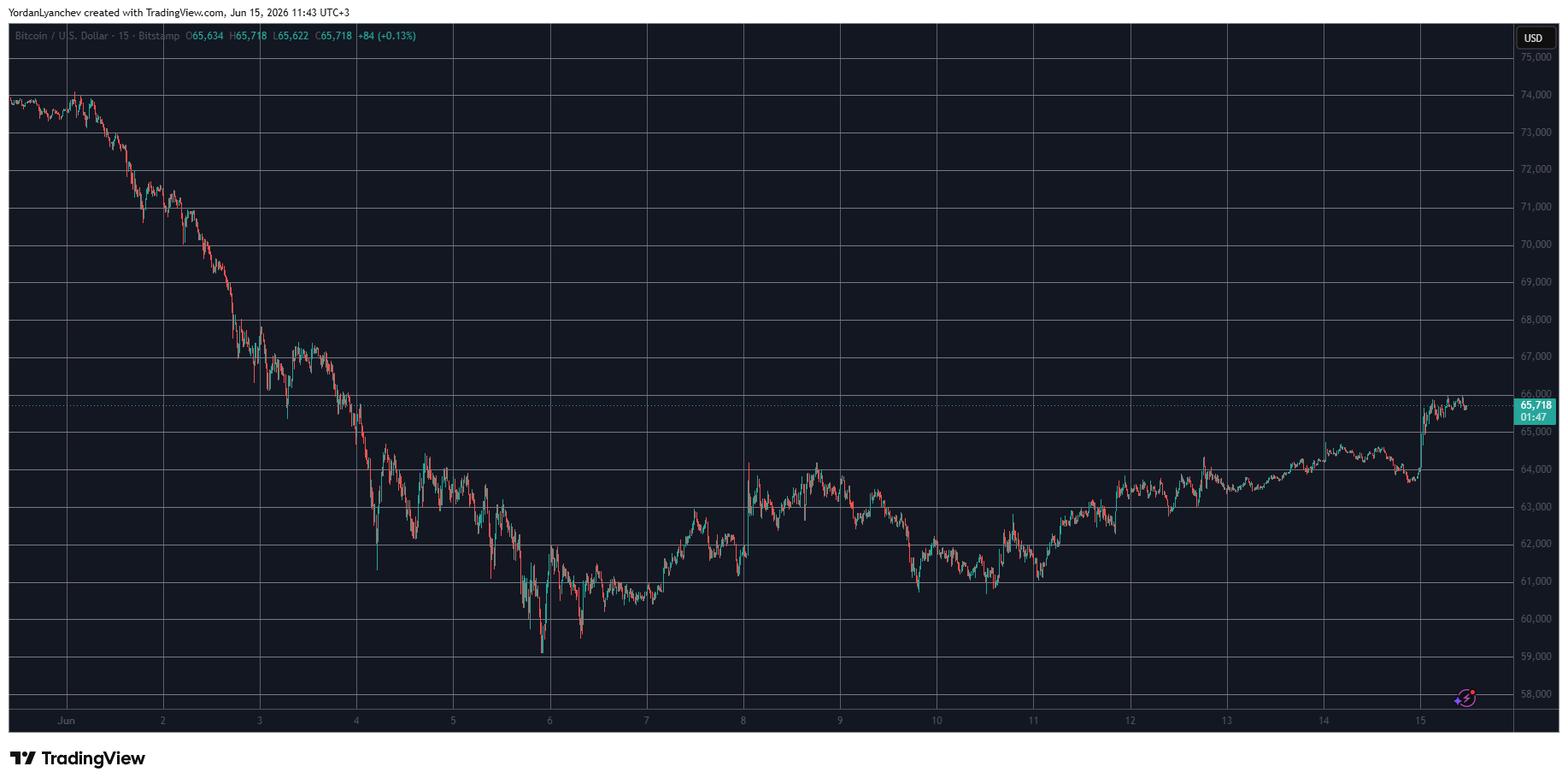
After a relatively quiet weekend, bitcoin’s price rose on Sunday evening to $66,000 for the first time in almost two weeks, following US President Donald Trump’s announcement that the deal with Iran is essentially complete.
The total crypto market cap has added over $50 billion daily, going past $2.330 trillion on CG, as many alts have produced impressive gains.
BTC Touched $66K
Bitcoin crashed and burned at the start of June, dropping from $73,000 to a multi-month low of $59,100 before it finally found some support and began its gradual recovery. The following week was somewhat more positive, as BTC jumped toward $64,000 on several occasions but was stopped at each attempt to break through.
The subsequent rejections, driven mostly by macro factors like new attacks in the Middle East, resulted in price dips to $61,000. Nevertheless, that support level held, and BTC rebounded toward the upper boundary of its sideways channel.
The past weekend was quite sluggish, even though Trump promised on Saturday that the US and Iran would announce a permanent deal on Sunday, but there were more attacks from Israel against Lebanon on that day. On Sunday evening, though, came the long-anticipated announcement, with Trump stating on Truth Social that the deal was essentially complete.
BTC reacted with an immediate price pump, going to $66,000 earlier this morning for the first time since June 3. It has lost a few hundred dollars since then, but it’s still 2% up on the day. Its market cap has surged to $1.315 trillion, while its dominance over the alts remains above 56.5% on CG.
Alts Rebound
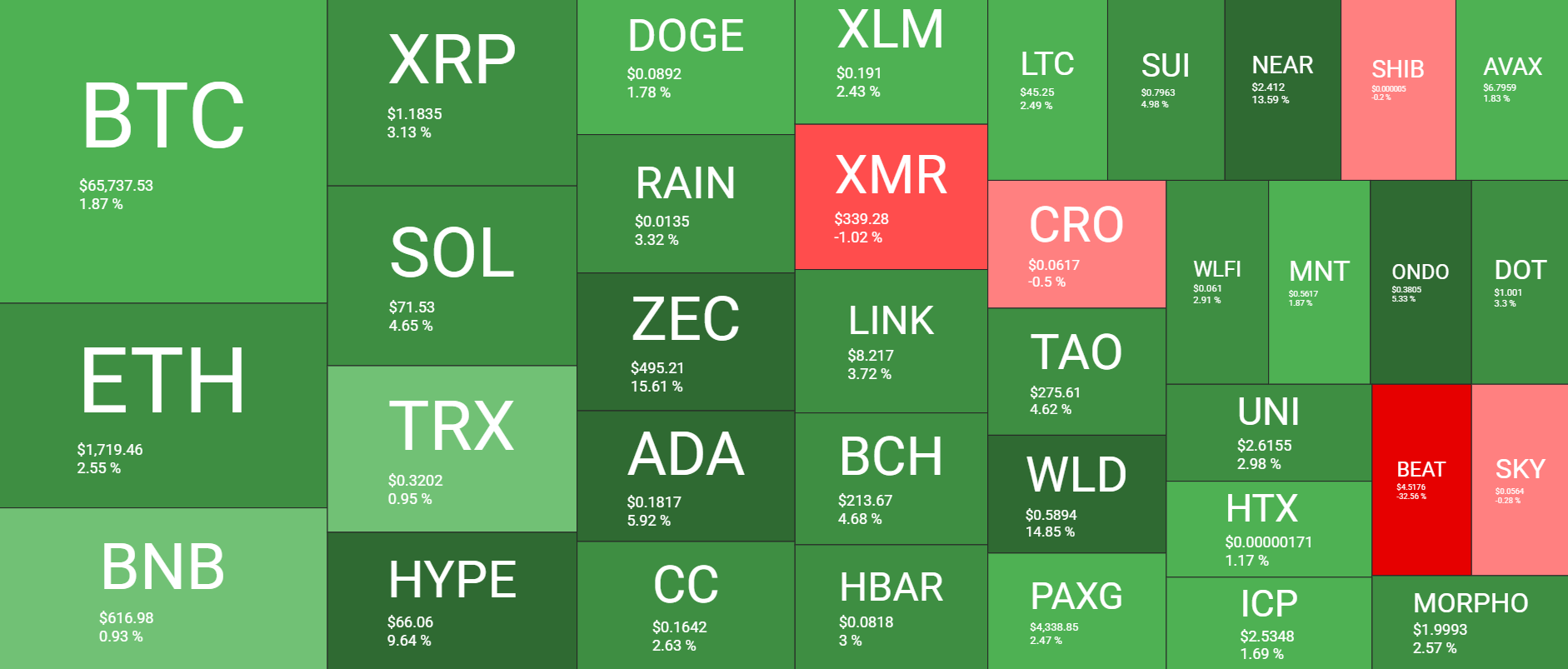
Most larger-cap alts are well in the green today. Ethereum has reclaimed the $1,700 level after a 2.5% increase. BNB is close to $620, while XRP has exceeded $1.18. SOL is well above $70, while ADA has pumped by 6%.
HYPE is up by almost 10%, and ZEC has risen the most from the top 100 alts. The privacy coin has gained 16% and trades close to $500. WLD follows suit, as a 15% increase has driven it to $0.59. NEAR and JUP complete the double-digit price gainers club.
The cumulative market cap of all crypto assets is up by just over $50 billion daily to $2.330 trillion as of now on CG.
The post HYPE, ZEC Explode After Peace Deal Announcement, BTC Taps 12-Day High: Market Watch appeared first on CryptoPotato.


The Commodity Futures Trading Commission has appointed SEC crypto task force adviser Donald Battle as chief data innovation officer as lawmakers continue debating the future of U.S. digital asset regulation.
Summary
- CFTC appoints SEC crypto task force adviser Donald Battle as chief data innovation officer.
- Battle brings experience in blockchain forensics, AI, data science, and crypto enforcement.
- The appointment comes as the CFTC defends prediction markets and Congress debates the CLARITY Act.
According to a Monday announcement from CFTC Chair Michael Selig, Donald Battle will serve as the agency’s new chief data innovation officer.
Battle most recently advised the Securities and Exchange Commission’s crypto task force and previously held roles at the CFTC and the Treasury Department’s Financial Crimes Enforcement Network.
In the announcement, Selig pointed to Battle’s background in data science, blockchain forensics, application programming interfaces, and artificial intelligence as factors behind the appointment.
Battle joined the SEC crypto task force in January 2025 after the Trump administration took office and has worked on cryptocurrency-related investigations and analytics across multiple federal agencies.
The hire comes as lawmakers in Washington continue work on the CLARITY Act, legislation that would redefine the responsibilities of the SEC and CFTC in overseeing digital assets. While Congress debates those jurisdictional boundaries, the CFTC has remained deeply involved in both crypto-related enforcement and prediction market regulation.
CFTC expands focus on digital asset oversight
Responsibility for many of the agency’s digital asset activities currently rests with the CFTC, which, under Selig, has taken an active role in disputes involving federally regulated event contracts and prediction markets.
Court filings cited by the commission show the agency recently sued New Mexico after state officials attempted to apply local gaming laws to contracts listed on prediction market platform Kalshi. The lawsuit names Gov. Michelle Lujan Grisham, Attorney General Raúl Torrez, and other state officials.
According to the complaint, the CFTC argues that federally regulated event contracts fall under its authority and cannot be governed by state gambling rules.
The case followed allegations from New Mexico authorities that Kalshi was operating without a required license and allowing participation by users younger than the state’s legal gaming age of 21.
Federal regulators have made similar arguments in other disputes involving prediction markets, maintaining that contracts listed on platforms operating under CFTC oversight should be regulated at the federal level.
Sports contract proposal enters public review
At the same time, the commission has opened a public consultation process on a proposed framework covering sports event contracts.
According to the CFTC, the draft rule seeks to distinguish sports event contracts offered by platforms such as Kalshi and Polymarket from what the agency described as games of random chance.
The proposal could play a key role in determining how federal regulators treat sports-related prediction markets and how those markets interact with state gaming laws.
The commission said the public will have 45 days to submit comments on the proposal before regulators consider next steps.
Battle’s arrival places a veteran blockchain investigator inside the agency’s data leadership team as the commission navigates overlapping debates involving crypto markets, prediction platforms, and the future division of authority between federal regulators.
With Congress still considering market structure legislation, the CFTC continues to play a central role in several of the industry’s most closely watched regulatory battles.


The Sui blockchain has moved nearly $65 billion in stablecoins in five days, the payoff from a protocol change that made those transfers cost nothing. The figure measures transfer throughput over the window, and it lands as Mysten Labs pitches the network as a replacement for traditional payment… Read the full story at The Defiant

Charles Hoskinson said that a disputed stash of 1,096 BTC from Cardano’s early crowdfunding days was used to pay for an audit in 2016/2017.
The Cardano founder made the revelation during a recent livestream AMA, in which he talked about governance, Discord, and community management.
Hoskinson Clarifies Questions in AMA
Cardano’s crowdsale, which ran from October 2015 to January 2017, raised around 108,844 BTC, with 1,096 of this allocated to an Isle of Man Foundation entity that did some early legal and operational work for the project.
The organization has since been dissolved, but Thomas Braziel, founder of 117 Partners, recently questioned the value of the transaction and demanded a full account of where the BTC went and why they received it.
Hoskinson said during the weekend AMA that the funds date back to a March 2026 email from Michael Parsons, the project’s Chairman at the time, in which he asked to be compensated for auditing the crowdsale. He also clarified the value of the BTC, claiming that the bill was much smaller than what critics imply.
“The closing price of Bitcoin March, 13 2016, was $414. That’s about $400,000 for three auditors,” said Hoskinson.
According to him, the money was used to pay three independent reviewers, namely Michael Parsons, John McGuire, and Bruce Milligan.
Meanwhile, Hoskinson argued that the repeated calls for transparency are being made to start controversy as opposed to actually resolving anything, saying that any response leads to another round of accusations and ends up draining resources that could be used to grow the ecosystem.
Braziel Still Has Doubts
However, Braziel wasn’t satisfied with his response, arguing that the session created more questions than it resolved. He asked on social media how IOHK came to control roughly 95% of the BTC raised and got billions of ADA, while the Foundation received only a fraction of the total.
“If that’s the explanation, then the next step is simple: publish the invoices, agreements, and approvals, and payment records.”
The investor also believes the figure is inaccurate, saying that if an audit did happen, it likely took place later, when the OG cryptocurrency was already worth much more than it was during the early fundraising years. In his view, “the numbers just don’t seem to add up.”
The development comes as Cardano is in the midst of a raging debate about its treasury, governance, and engagement, with the co-founder revealing that the project is working on a plan to move its ADA community to Discord.
At the same time, the Cardano Foundation’s budget has come under public scrutiny, with only a third of the proposals approved under the new process. Organizers have also canceled their planned 2026 Singapore Summit after a $7.8 million ADA treasury request linked to the event was rejected.
The post Charles Hoskinson Reveals What Happened to 1,096 BTC From Cardano’s Early Days appeared first on CryptoPotato.
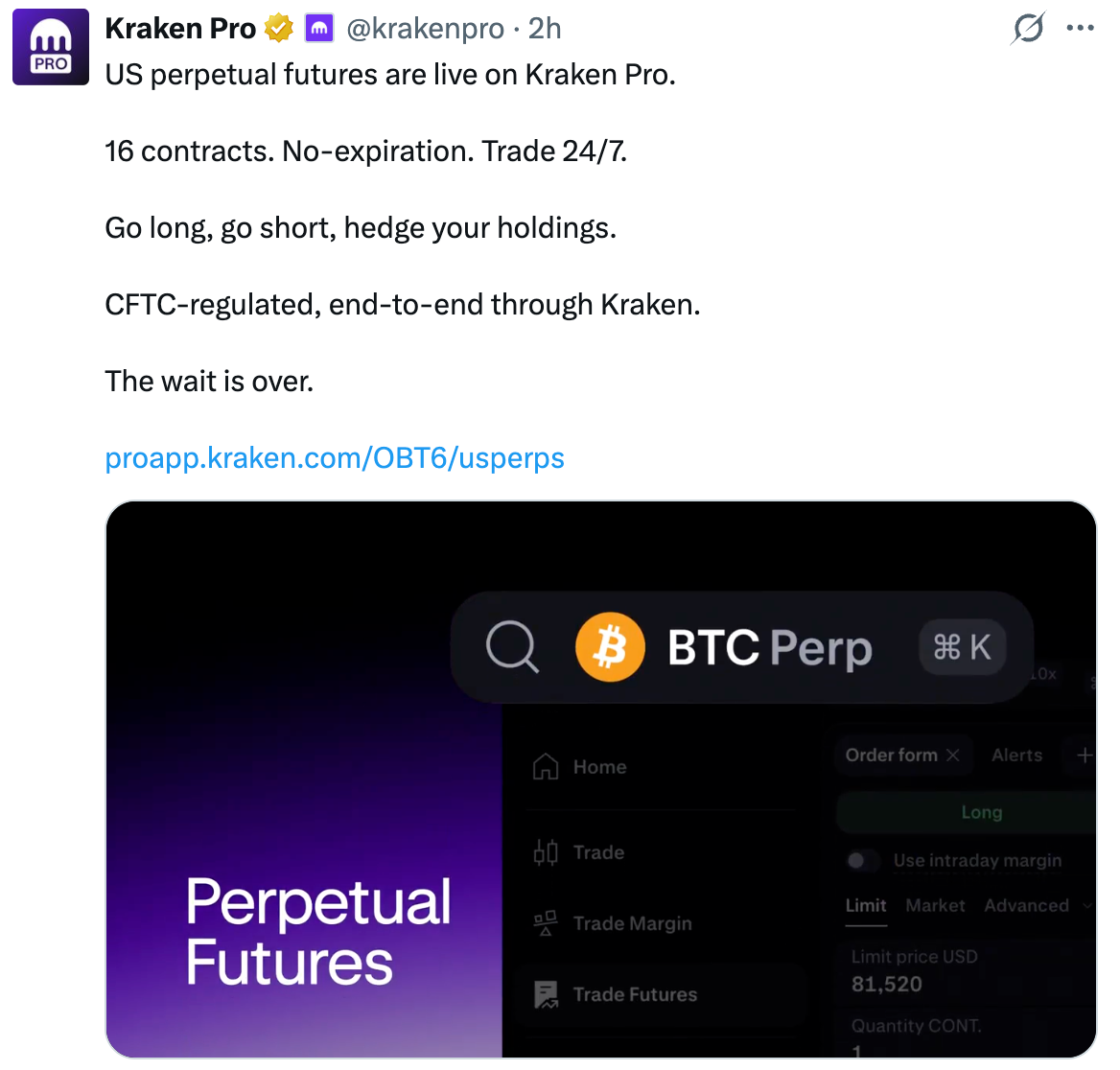
Kraken on Monday launched perpetual futures trading for eligible US users through Bitnomial, expanding its domestic derivatives offerings months after acquiring the federally regulated exchange.
The products are available through Kraken Pro and include contracts tied to major cryptocurrencies including Bitcoin (BTC), Ether (ETH), Solana (SOL), XRP (XRP), Cardano (ADA), Chainlink (LINK), Dogecoin (DOGE), Litecoin (LTC) and Avalanche (AVAX).
According to Monday’s announcement, the contracts share the same futures wallet as Kraken’s existing CME-listed crypto futures products, allowing traders to manage both positions from a single account.
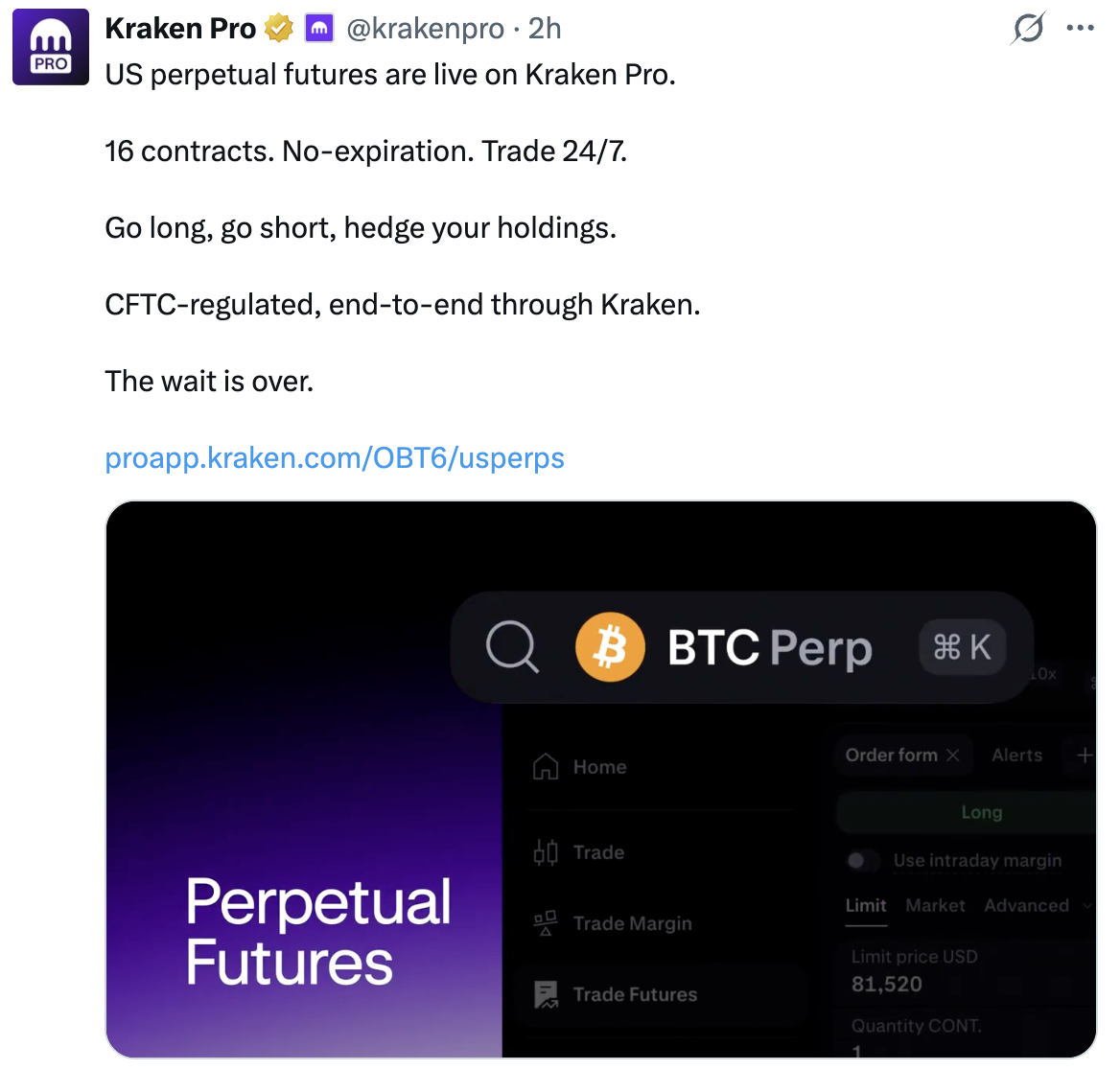
Source: Kraken Pro
Kraken said perpetual futures, a type of derivative contract with no expiration date, generated more than $60 trillion in global trading volume in 2025 and have largely been traded on offshore platforms rather than regulated US venues.
Kraken has expanded its US trading offerings over the past year, adding support for CME-listed crypto futures in July 2025 and launching margin trading for eligible US customers earlier this month.
Monday’s launch follows Kraken’s late-May announcement that it planned to introduce Commodity Futures Trading Commission (CFTC) regulated perpetual futures through Bitnomial, the crypto derivatives platform acquired by parent company Payward in April.
Related: OKX expands X-Perps in Europe with Magnificent 7, gold and oil futures
US exchanges compete for crypto derivatives market
Kraken’s launch comes amid a broader push by USexchanges to bring crypto derivatives trading onshore.
On May 29, the CFTC approved Kalshi’s Bitcoin perpetual futures contract and issued a no-action position for Coinbase, paving the way for regulated perpetual futures products in the domestic market.
That same day, the company announced that its Coinbase Financial Markets unit would provide US institutional clients access to global crypto perpetual futures and options markets, which the exchange said account for roughly 80% of global crypto trading volume.
Kalshi also launched perpetual futures contracts on May 29, describing the products as its most significant expansion beyond prediction markets and a step toward becoming a broader derivatives exchange.
The regulatory approvals followed months of discussion around bringing crypto perpetual futures to the United States.
“The CFTC’s approval of the KalshiEX BTCPERP is not the end of the regulatory story; it is the beginning,” said Gontran de Quillacq, CEO and founder of Navesink International.
In a January speech, CFTC Chair Michael Selig said the agency would use its existing authority to support perpetual futures and other novel derivatives products in the US, arguing that years of regulatory uncertainty had pushed trading activity offshore.
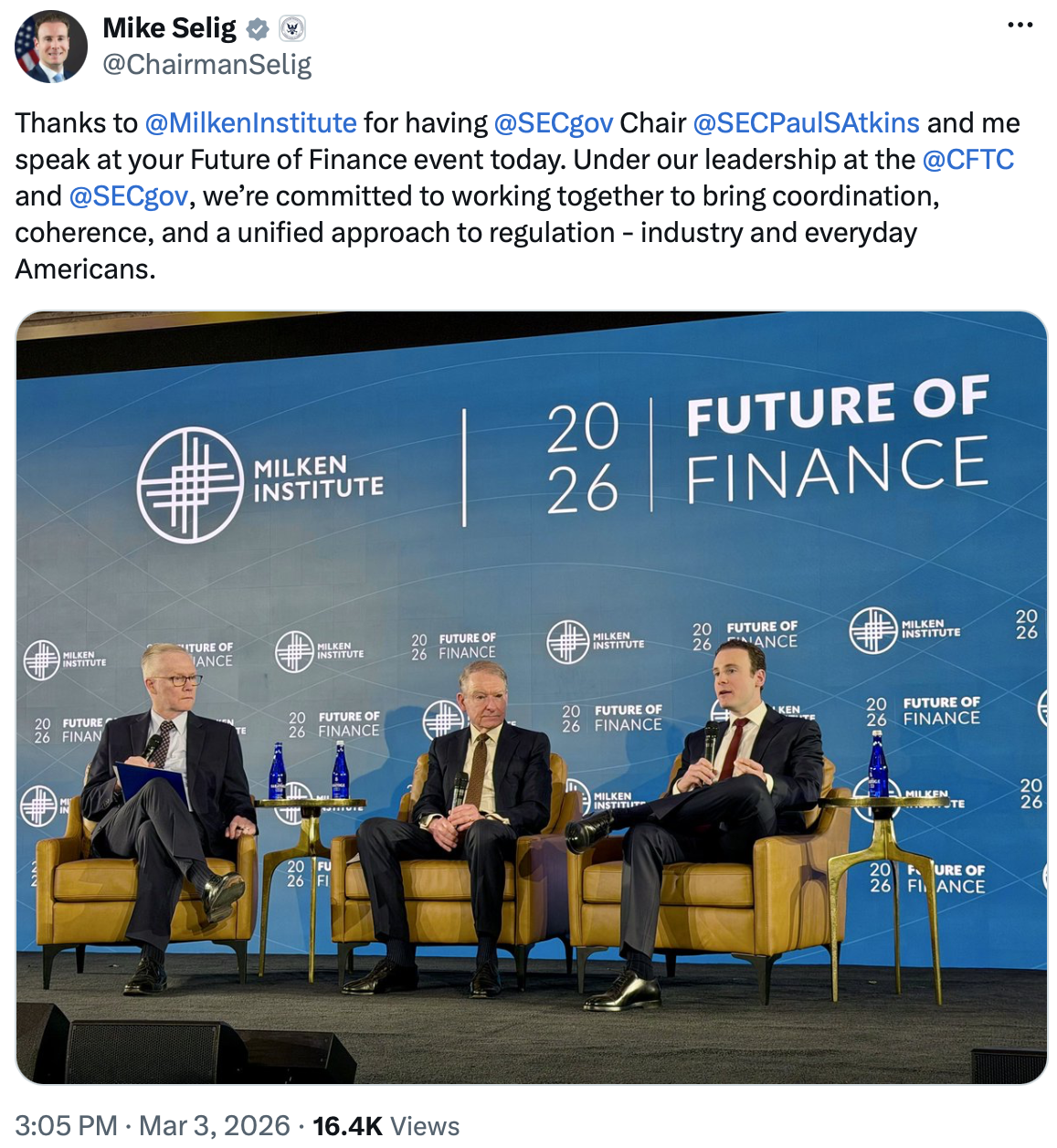
Speaking at the Milken Institute’s Future of Finance conference a few months later, Selig said the CFTC was working to establish a framework for “true perpetual futures” in the US.
Source: Mike Selig
Magazine: Bitcoin, the ‘canary in the coal mine,’ XRP transaction demand falls 91.5%: Market Moves
BitMine Immersion Technologies continued to expand its Ether holdings last week, acquiring more of the second-biggest digital asset despite a prolonged market downturn as its large staking operation continues to generate yield.
On Monday, the crypto treasury company reported that it acquired 76,881 Ether (ETH) over the past week, potentially reducing its average cost basis as ETH briefly plunged below $1,600 during the period. The company has been steadily acquiring Ether during the bear market, regardless of price action.
BitMine now holds 5,620,754 ETH acquired at an average price of $1,718.
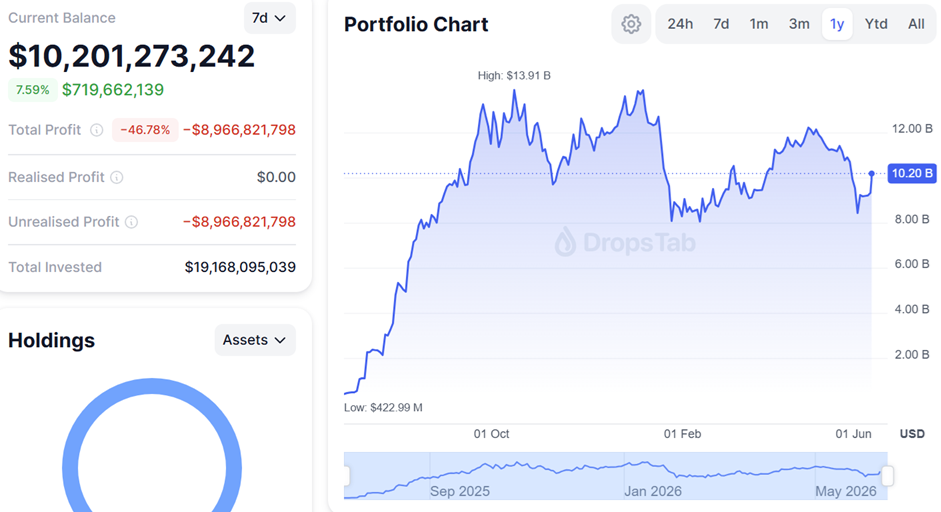
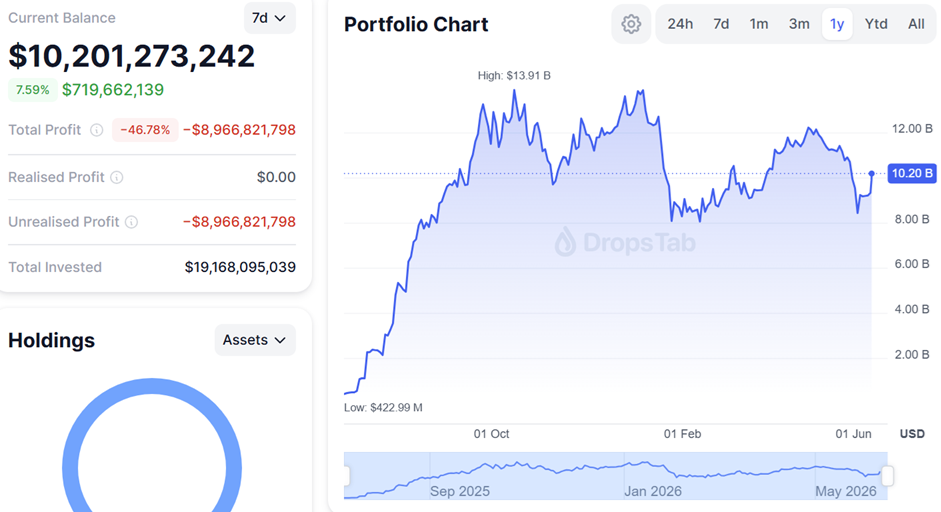
BitMine is sitting on large unrealized losses on its ETH holdings. Source: DropsTab
At current prices, the company’s ETH portfolio is worth roughly $10.2 billion, though it is sitting on an unrealized loss of nearly $9 billion, according to DropsTab data. At last look on Monday, Ether was trading at $1,843.69, according to CoinMarketCap data.
Bitmine’s latest purchases brings the company closer to its stated goal of owning 5% of Ether’s total circulating supply of 120.68 million tokens. The company currently controls approximately 4.66% of all ETH.
At the same time, BitMine has staked more than 4.1 million ETH, worth roughly $8.1 billion at current prices. Staking allows the company to earn protocol rewards by helping secure the Ethereum network, providing a recurring source of yield even during periods of price weakness.
Related: Ethereum can quantum-proof accounts for just 7 cents, says Ethereum’s Kohaku lead
Ethereum faces structural headwinds
The crypto treasury model has come under pressure this year as digital asset prices retreated sharply. The downturn has also weighed on spot Ether exchange-traded funds (ETFs), which recorded four consecutive days of net outflows last week.
Selling pressure has persisted since early May, with daily net outflows exceeding $60 million on several occasions.
BlackRock’s iShares Ethereum Trust ETF (ETHA) remains the biggest US-traded ETH ETF, with net assets of $4.75 billion. It holds 2.36% of the crypto’s circulating supply.
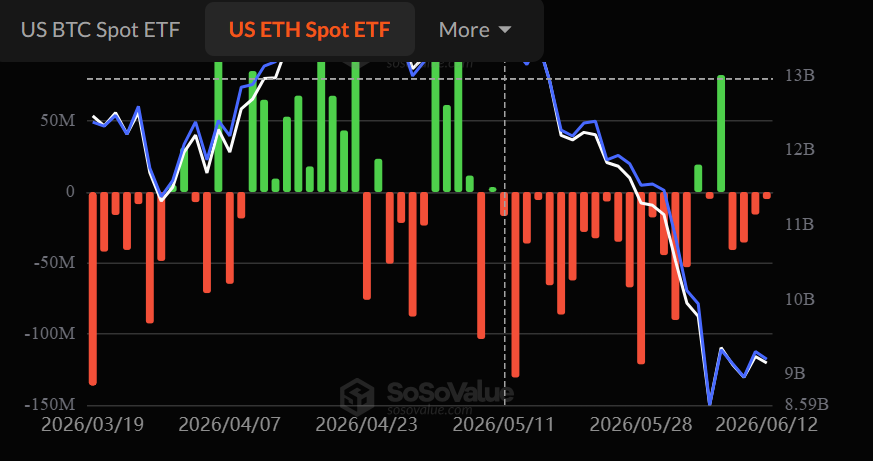
ETH’s decline has coincided with large outflows from spot ETFs. Source: SoSoValue
For Ethereum, however, the challenges extend beyond price action.
The network’s layer-2 scaling strategy, designed to deliver faster and cheaper transactions, has come under scrutiny. As more activity migrates to layer-2 networks, the Ethereum mainnet captures less transaction-fee revenue and burns less ETH, potentially weakening its deflationary dynamics.
Internal changes at the Ethereum Foundation have added to the uncertainty. At least nine senior leaders, researchers and core contributors have departed the nonprofit so far this year, marking one of the largest waves of talent attrition in its history. The departures have coincided with the foundation’s organizational overhaul and renewed community debate over its governance, strategic direction and role in Ethereum’s long-term development.


The SIREN token has lost about 95% of its value in a week after a single whale sold roughly 670 million tokens, near 92% of the total supply, for $64.8 million. The sell-off traced to one dominant wallet draining its position into a thin market. On-chain intelligence platform Lookonchain first… Read the full story at The Defiant
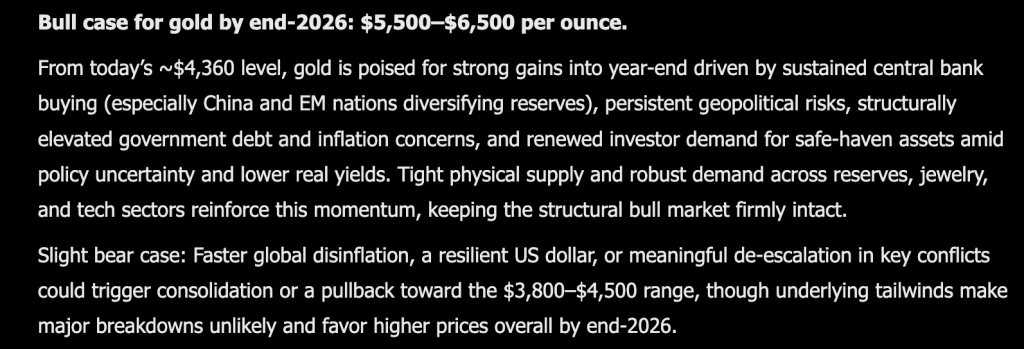
Gold price at $4,360 and Elon Musk’s Grok AI is looking at it and predicts for $5,500 to $6,500 by year end. That is a 26% to 49% move on the oldest store of value in human history, and the argument is not built on hype or cycle narratives. It is built on the kind of structural forces that do not reverse in a quarter.
The demand side of this prediction runs deeper than most people track. Central banks, particularly China and emerging market nations, are actively diversifying away from dollar reserves and buying physical gold at a pace that has no modern precedent.
That bid does not disappear when sentiment shifts, it is policy-driven and sticky. Layer on top of that the persistent geopolitical risks that keep showing no sign of resolution, structurally elevated government debt levels across every major economy, and renewed safe-haven demand from investors who have watched real yields compress.
Then add tight physical supply against robust demand from reserves, jewelry, and a tech sector that actually needs the metal. Grok is not predicting a spike, it is describing a structural bull market that has momentum behind it from multiple independent directions.
The bear case is the narrowest on this entire prediction series. Faster global disinflation, a resilient dollar, or meaningful de-escalation in key geopolitical conflicts could pull gold back toward the $3,800 to $4,500 range.
The word meaningful is doing a lot of work in that sentence. The kind of peace and dollar strength required to derail this bull case is not impossible but sits well outside the base case of most macro analysts right now.

Discover: The best crypto to diversify your portfolio with
Gold Price Prediction: When The Pullback Lands Right On The Launch Pad
Gold price is at $4,367 today, up 3.65% on what looks like a decisive reclaim candle after the recent correction.
The daily chart frames the current moment perfectly. From the $3,400 base last August, gold ran to $5,500 in February, one of the cleanest trending moves on any major asset over the past year.
What followed was a textbook bull market consolidation, a series of lower highs from the peak but with the bigger uptrend structure very much intact.
The June low near $4,050 is now the most important level on the chart, because it held the line right at the same $4,000 to $4,200 zone that served as prior resistance before the big run.
Former resistance becoming support is one of the cleaner signals in technical analysis, and today’s 3.65% bounce off that floor suggests the market agrees.
For Grok’s $5,500 to $6,500 target to materialize, the obvious immediate test is the $4,600 to $4,800 zone where multiple failed recovery attempts since March have stalled.
That is the overhead supply that needs to be absorbed before the chart can make a run at the February highs and then beyond.
The bear case floor at $3,800 to $4,500 sits well below current price, which means the risk-reward from here tilts heavily in the direction Grok is pointing.
Here is What Grok AI Predicts For LiquidChain Near Future, Could be Very Bullish
Waiting at resistance for a breakout is standing in line. Someone else’s balance sheet makes that decision.
Bitcoin, Ethereum, and XRP have pressed against the same ceilings for weeks. The catalyst is always one data print away. Institutional inflows are always next quarter. Large-cap traders wait on moves they cannot control.
Early-stage infrastructure plays by different rules. Capital that registers as statistical noise at Bitcoin’s scale moves a small undiscovered project by multiples. The asymmetric return sits in one place: the gap between what a project is worth and what the market prices it at. That gap exists because nobody has found it yet. Once they do, the gap closes.
Cross-chain fragmentation has been pulling value out of DeFi since the first bridge went live. Bitcoin, Ethereum, and Solana were built as independent systems with no shared architecture and no intention to interoperate. Every transaction crossing those boundaries pays for that design decision in fees, slippage, and failed executions. Bridges were the proposed fix. They became the mechanism through which the problem charges its toll.
LiquidChain removes that toll. Three networks inside one execution layer. A single deployment reaches all of them with no cross-chain tax on any interaction.
Grok AI flagged the project as worth watching. The presale sits at $0.01454 with $835,000 raised. Execution is unproven. Adoption is unknown.
Established assets offer a predictable path toward a ceiling the market already sees. LiquidChain is an entry point that closes once the market finds it.
Explore the LiquidChain Presale
The post Elon Musk Grok AI Predicts Staggering Gold Price by End of 2026 appeared first on Cryptonews.

Mackenzie Shirilla’s Mom Speaks Out On Alleged Prison Romance

Social media and teenagers: what the evidence says

Google Earth’s Flight Simulator Arrives on the Web for Quick Aerial Adventures


-

 Business1 day ago
No Jackpot Winner as $257 Million Prize Rolls Over to $269 Million Monday Draw
-

 Crypto World4 days ago
Oppenheimer backs SpaceX as $70 billion retail frenzy builds
-

 Crypto World4 days ago
Markets Rally as SpaceX IPO Looms Amid Iran Tensions and Inflation Surge
-

 Fashion3 days ago
Weekend Open Thread: Tuckernuck – Corporette.com
-
Crypto World21 hours ago
Zimbabwe Requires Crypto Businesses to Register Annually Under New FIU Regulations
-

 Entertainment6 days ago
The Ryan Gosling True Crime Thriller On Netflix That Gets Even Stranger, Stream It Now
-
 Sports6 days ago
Bangladesh beat Australia after 20 years in ODIs, register only their second win over six-time world champions | Cricket News
-

 Tech3 days ago
NanoClaw integrates JFrog registries to secure AI agent downloads
-

 Tech3 days ago
This Week In Security: Microsoft On Microsoft, Register Your Domains, Linux On ARM, And FreeBSD Joins The File Cache Club
-

 Crypto World3 days ago
Bitget enters Argentina’s regulated crypto market through PSAV registration
-

 Politics4 days ago
Politics Home | Healey Resignation Is “Colossal Failure Of Government”, Says Former Labour Defence Secretary
-
 Tech4 days ago
Dutton Ranch star claims they ‘didn’t see any disruption’ on set following Chad Feehan’s exit from Yellowstone spinoff fueled by Taylor Sheridan clash rumors
-

 NewsBeat4 days ago
El Nino has formed in the Pacific and could set records, forecasters say
-
 Tech5 days ago
‘This is Seattle’s position on AI’: City Council votes unanimously to pause big new data centers
-
 Entertainment4 days ago
Donnie Wahlberg & More Heat Up Las Vegas at Circa’s Barry’s Downtown Prime
-

 Sports4 days ago
First Time Since 1971: Australia Register Historic Low In ODI Cricket
-
 Tech4 days ago
Opendoor Ends India Operations, Fueling a Bigger Conversation About AI and Outsourcing
-

 Politics4 days ago
Belfast burns, while Met chief points finger at Iran and Russia
-

 Business6 days ago
Thailand Ranks Second Worldwide for AI Adoption Growth, Microsoft Reports
-

 NewsBeat3 days ago
FBI searches office of Ohio voter registration group
You must be logged in to post a comment Login