

Crypto World
Charles Hoskinson Reveals What Happened to 1,096 BTC From Cardano’s Early Days


Charles Hoskinson said that a disputed stash of 1,096 BTC from Cardano’s early crowdfunding days was used to pay for an audit in 2016/2017.
The Cardano founder made the revelation during a recent livestream AMA, in which he talked about governance, Discord, and community management.
Hoskinson Clarifies Questions in AMA
Cardano’s crowdsale, which ran from October 2015 to January 2017, raised around 108,844 BTC, with 1,096 of this allocated to an Isle of Man Foundation entity that did some early legal and operational work for the project.
The organization has since been dissolved, but Thomas Braziel, founder of 117 Partners, recently questioned the value of the transaction and demanded a full account of where the BTC went and why they received it.
Hoskinson said during the weekend AMA that the funds date back to a March 2026 email from Michael Parsons, the project’s Chairman at the time, in which he asked to be compensated for auditing the crowdsale. He also clarified the value of the BTC, claiming that the bill was much smaller than what critics imply.
“The closing price of Bitcoin March, 13 2016, was $414. That’s about $400,000 for three auditors,” said Hoskinson.
According to him, the money was used to pay three independent reviewers, namely Michael Parsons, John McGuire, and Bruce Milligan.
Meanwhile, Hoskinson argued that the repeated calls for transparency are being made to start controversy as opposed to actually resolving anything, saying that any response leads to another round of accusations and ends up draining resources that could be used to grow the ecosystem.
Braziel Still Has Doubts
However, Braziel wasn’t satisfied with his response, arguing that the session created more questions than it resolved. He asked on social media how IOHK came to control roughly 95% of the BTC raised and got billions of ADA, while the Foundation received only a fraction of the total.
“If that’s the explanation, then the next step is simple: publish the invoices, agreements, and approvals, and payment records.”
The investor also believes the figure is inaccurate, saying that if an audit did happen, it likely took place later, when the OG cryptocurrency was already worth much more than it was during the early fundraising years. In his view, “the numbers just don’t seem to add up.”
The development comes as Cardano is in the midst of a raging debate about its treasury, governance, and engagement, with the co-founder revealing that the project is working on a plan to move its ADA community to Discord.
At the same time, the Cardano Foundation’s budget has come under public scrutiny, with only a third of the proposals approved under the new process. Organizers have also canceled their planned 2026 Singapore Summit after a $7.8 million ADA treasury request linked to the event was rejected.
The post Charles Hoskinson Reveals What Happened to 1,096 BTC From Cardano’s Early Days appeared first on CryptoPotato.

Aave’s native cryptocurrency could reach $175 under a one-year base-case scenario as asset managers increasingly apply traditional finance valuation models to decentralized finance (DeFi) tokens, according to a new report by Grayscale Research.
The digital asset manager said Aave could generate about $60 million in net income in 2026 and placed the token’s current fair value at $80 to $100. The analysis used discounted cash flows, earnings multiples and comparisons with banks and fintech companies. Aave traded at $75 on Thursday, according to CoinGecko.
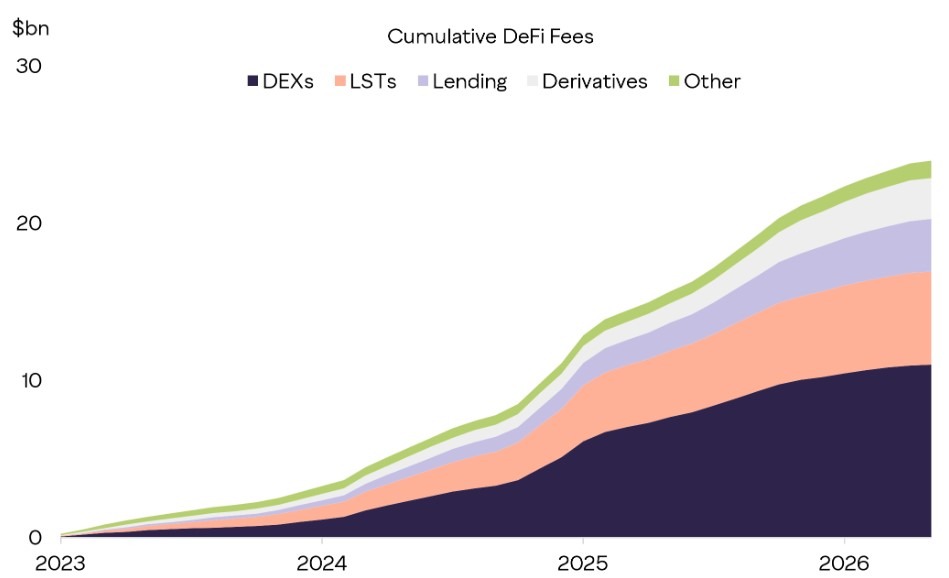
Grayscale said Aave’s revenue rose more than sixfold between 2023 and 2025, while the protocol operates at an estimated 50% margin. It argued that Aave’s lending activity, GHO stablecoin and institutional products could support future earnings growth.
However, protocol revenue alone doesn’t guarantee token value, the research added. Fees may be paid to liquidity providers, used for operating costs or retained by a decentralized autonomous organization, while token holders generally lack legally enforceable claims held by shareholders.
Grayscale’s analysis applies valuation methods commonly used for equities, banks and fintech companies to a DeFi protocol, reflecting the firm’s view that some crypto assets generate sufficiently measurable revenue and earnings to be evaluated using traditional financial frameworks.
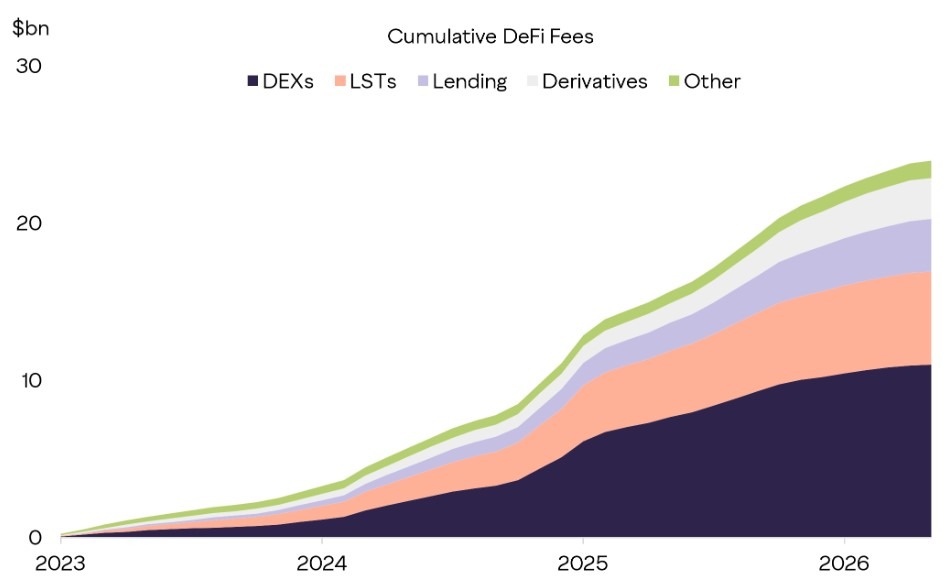
Cumulative DeFi fees. Source: Grayscale Research
CoinShares applies long-term valuation models to HYPE and Ether
CoinShares has taken a similar approach to Hyperliquid’s HYPE token and Ether (ETH), using protocol fees, buybacks and other economic drivers to create long-term valuation frameworks. The asset manager’s 2031 base case values HYPE at $147 and ETH at $4,935, although most of the projected ETH value comes from the token’s collateral and monetary role rather than cash flows.
CoinShares described Hyperliquid as a more direct example of token-level value accrual because 99% of protocol fees are used to buy back HYPE through its Assistance Fund. For Ether, it used a sum-of-the-parts framework combining projected cash flows with a larger monetary and collateral premium.
Related: Botanix to shut down after 4 years, cites weak demand for Bitcoin DeFi
The valuation work by Grayscale and CoinShares comes as some financial institutions forecast stronger growth in DeFi markets.
Standard Chartered forecasts that tokenized assets could lift DeFi assets to $2.7 trillion by 2030. The bank said Uniswap is positioned to become a major venue for tokenized markets, adding that traditional finance partnerships could help Uniswap attract more activity.
Magazine: The end of anon? AI could unmask crypto’s hidden identities

The Core Team behind the popular yet controversial project just published a new update on the state of the Pi Launchpad testing period, including the brand-new test token, SLICE.
In the meantime, the underlying asset’s troubles have intensified, with the asset close to breaking below $0.13 once again.
Pioneers Help and Can Help Further
CryptoPotato reported last week that Pi Network’s team had updated the participation and flow model for the Pi launchpad, opening the door for all users (Pioneers) to participate in testing the second such token, called SLICE.
Those who wanted to take advantage needed to open the Pi Launchpad in the Pi Browser, review the new test token and project, choose a commitment amount in Test-Pi, confirm the participation, and engage with the Slice of Pi App and provide feedback. The initiative will run for 10 more days, until Pi2Day (June 28).
The new update on the matter informed that the first such testing token provided “useful data and highlighted areas where the Launchpad experience needed improvement,” hence Pioneers’ help. The updated participation flow has become “simpler and clearer” as a result. The team said participation is now “centered around the commitment amount, which has the direct effect on token acquisition.”
Users can choose how much Test-Pi they need to commit, and the Launchpad automatically calculates the related ‘fair-access hold.’ Then, the Pioneer is shown the commitment amount, hold amount, and the total before confirmation.
“The goal is to make it easier to understand and use the Pi Launchpad, and preserve the intended fair-access effect of the hold,” said the team.
PI Price Slides Again
The non-testing token of the Pi Network ecosystem has had its fair share of failures lately. Its price tumbled below $0.12 on June 6, marking a new all-time low. Thus, it had plunged by 96% since its all-time high marked in February 2025.
Its recovery was swift at first, pushing the asset toward $0.14 as the broader market sentiment improved. However, the FOMC meeting and the subsequent press conference yesterday brought more uncertainty, with BTC sliding below $64,000 and many altcoins, including PI, following suit.
PI has dropped toward $0.13 as of now, down by more than 3% on a 24-hour scale. It remains outside the top 50 alts by market cap as its own is at $1.420 billion.
The post Here’s How Pi Network Pioneers Can Support the Ecosystem During PI’s Slump appeared first on CryptoPotato.

Key Takeaways
- STRC preferred shares closed Wednesday at $89, representing an 11% discount to the $100 par value and marking the lowest point since its July 2025 debut.
- Strategy has suspended its at-the-market issuance program for STRC, which serves as a primary capital source for bitcoin acquisitions.
- The preferred instrument delivers a variable dividend currently yielding 12.9% annually, with monthly adjustments designed to maintain pricing near $100.
- Strategy liquidated 32 bitcoin worth approximately $2.5 million in late May to cover STRC dividend obligations — marking its first BTC sale since 2022.
- MSTR common shares declined approximately 5% Wednesday, settling at $116.52, while bitcoin traded in the $64,000–$65,000 range.
Strategy (MSTR) experienced a significant decline on Wednesday, with shares falling roughly 5% to close at $116.52, coinciding with its STRC preferred stock plummeting to an unprecedented $89 — representing an 11% discount to its $100 par value.
The Variable Rate Series A Perpetual Stretch Preferred Stock, known as STRC, debuted in July 2025 with a mechanism intended to maintain its price near $100 through a high-yield variable dividend structure. Currently, the dividend rate stands at an effective 12.9% annually, subject to monthly recalibration.
Wednesday saw STRC reach an intraday bottom of $88.50 before recovering slightly to close at $89 — still the lowest recorded closing price since its market introduction. This figure falls beneath the initial public offering price of $90.
The significance extends beyond mere price movement. Strategy‘s bitcoin accumulation strategy relies heavily on STRC performance. The company issues new STRC shares through an at-the-market mechanism when trading exceeds $100, channeling proceeds directly into bitcoin purchases. With shares now trading at a discount, this critical funding channel has ground to a halt.
Wednesday’s trading volume for STRC reached $417.5 million, making it Strategy’s most liquid preferred equity instrument.
Bitcoin Liquidation Linked to Dividend Requirements
The STRC situation created ripple effects beyond fundraising capabilities. Late in May, Strategy executed its first bitcoin sale in years, liquidating 32 BTC for roughly $2.5 million to satisfy STRC dividend payment requirements.
This transaction represented a significant policy shift, given Chairman Michael Saylor’s longstanding commitment never to sell the company’s bitcoin holdings. Though analysts from Benchmark and TD Cowen have dismissed concerns about a potential “death spiral” scenario, the sale nonetheless marked a departure from Strategy’s established approach.
Strategy’s bitcoin treasury currently contains approximately 846,842 bitcoin — representing roughly 4% of bitcoin’s fixed maximum supply — establishing the firm as the world’s largest corporate bitcoin holder.
Last week, Strategy disclosed it had established a dedicated $1.1 billion U.S. dollar reserve specifically allocated for preferred dividend payments and debt service obligations. During the same period, the company continued acquiring bitcoin, adding 1,587 BTC through separate common stock offerings.
Broader Market Dynamics
Bitcoin has maintained a trading range between $64,000 and $65,000 this week, coinciding with newly appointed Federal Reserve Chair Kevin Warsh’s inaugural FOMC meeting. The Federal Reserve opted to maintain current interest rate levels on Wednesday.
While STRC has occasionally dipped below par value during periods of bitcoin price turbulence, Wednesday’s closing price appears to establish a new historical low.
For context, SATA — a competing preferred stock product created by Strive to replicate Strategy’s STRC structure — traded above $99 on Wednesday while offering a 13.69% yield.
Strategy’s preferred stock portfolio also includes Stride (STRD), Strike (STRK), and Strife (STRF). Within the capital structure hierarchy, STRC ranks below STRF but maintains seniority over STRD, STRK, and common MSTR shareholders regarding distribution priority.
When STRC launched last year, Saylor characterized it as the company’s “iPhone moment,” signaling what he considered a transformative capital markets innovation.
As Wednesday’s trading concluded, MSTR common stock stood at $116.52, reflecting approximately a 5% daily decline.

Crypto World
Crypto News, June 18: Bitcoin Price Slid, ECB Allegedly Blocks Binance MiCA Application as Bybit Added to MAS Alert
Bitcoin price broke lower overnight while regulators played their usual power games on two continents. Binance MiCA application in Greece reportedly hit a wall after Christine Lagarde, ECB president, allegedly leaned on authorities to block it. Meanwhile, Bybit has been added to the Singapore MAS Investor Alert.
Centralized infrastructure keeps eating friction while the market reroutes around it. Money isn’t waiting for permission slips; the pattern is obvious. Governments tighten the net on platforms they can reach, then act surprised when liquidity and users migrate to systems that don’t ask for approval. The contrast with traditional markets made the crypto reaction look more deliberate.
The biggest capital destruction in crypto happened inside heavily intermediated structures, not in the open protocols that actually survived the cycles.
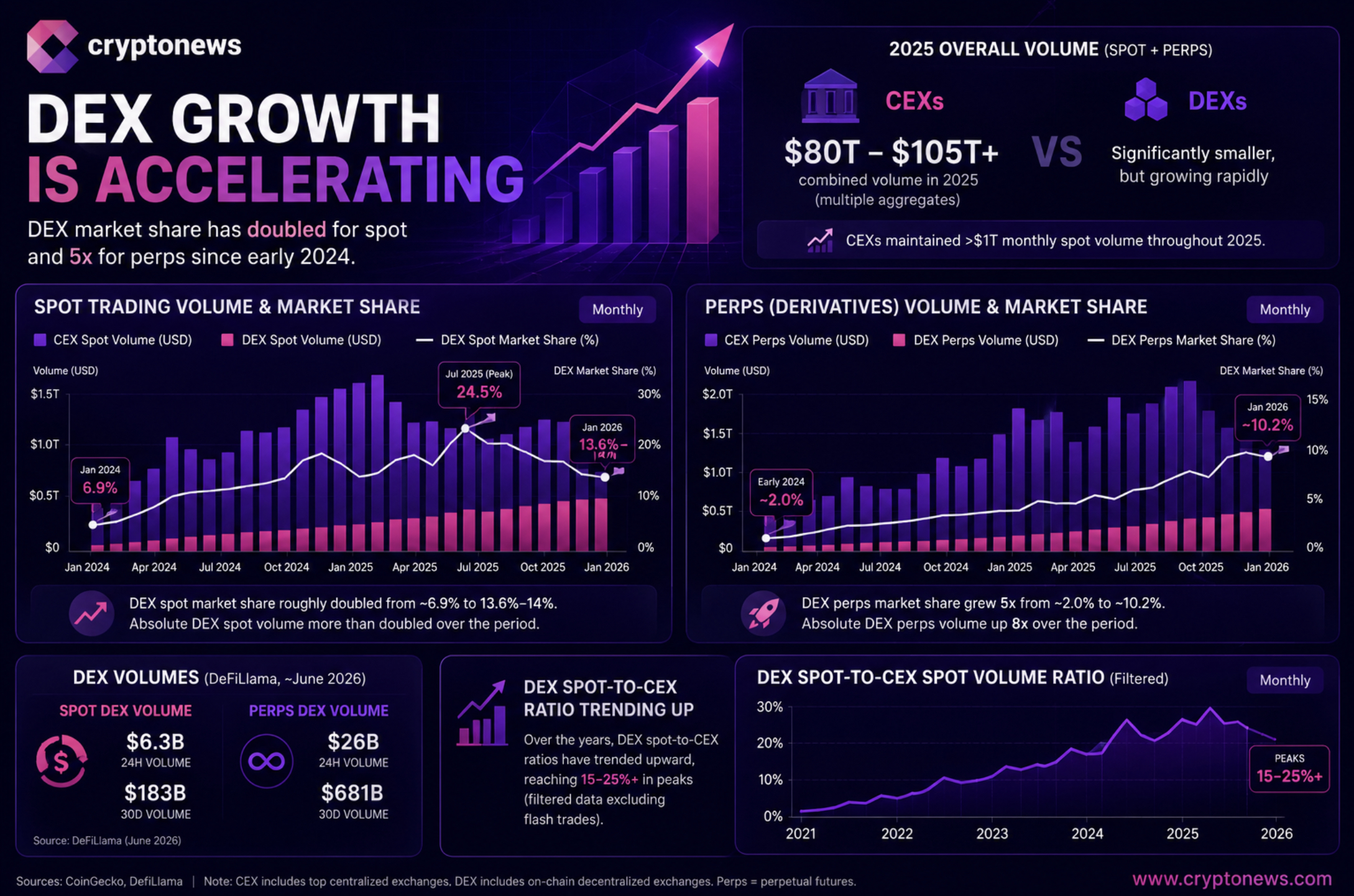
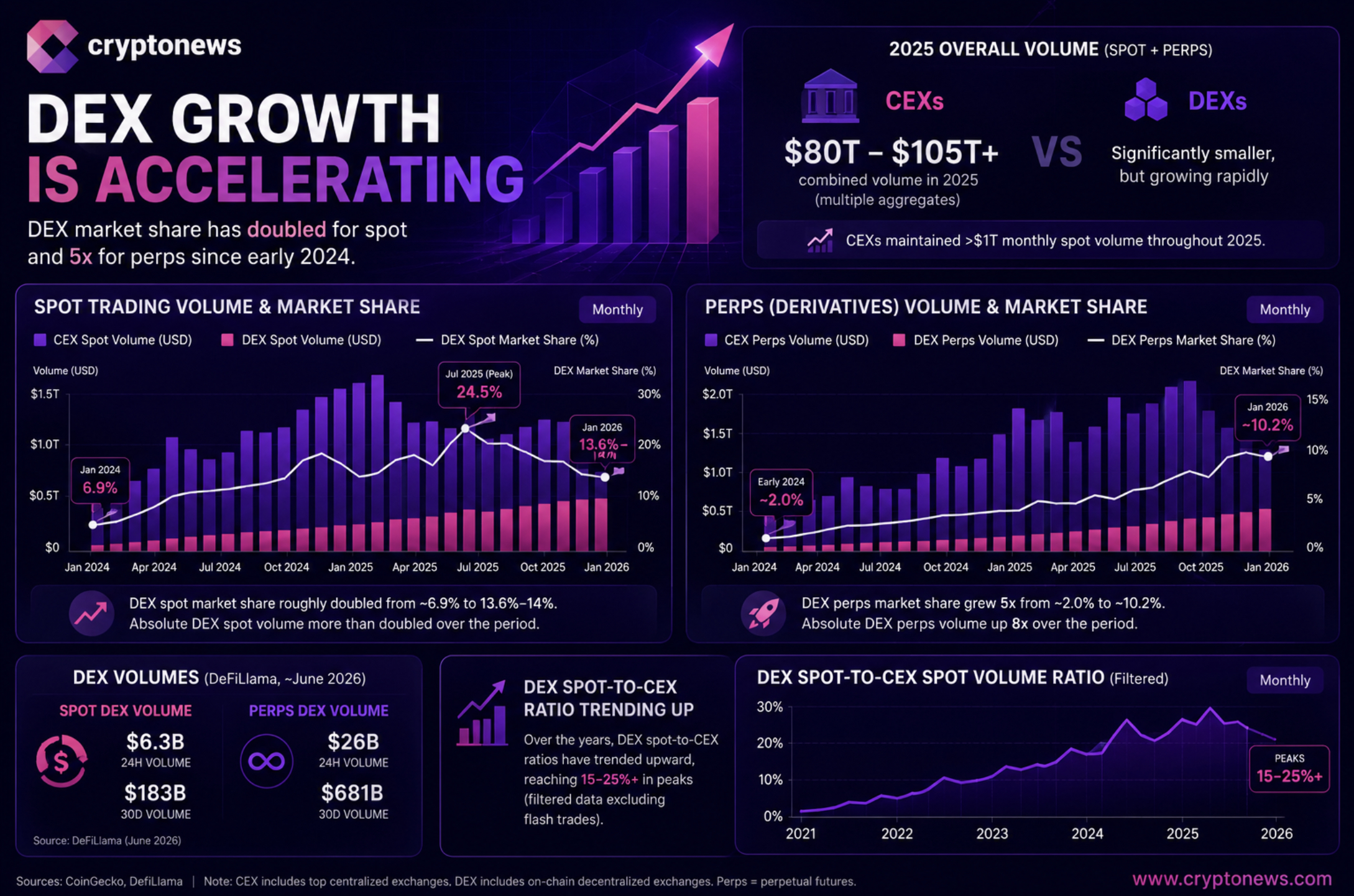
Looking at the illustration above, we can see that the numbers increasingly support the case for decentralized rails. While centralized exchanges still dominate with $80–105 trillion in annual trading volume, DEX adoption has accelerated at a rapid pace.
According to data from Coingecko and Defillama, DEX spot market share doubled from about 6.9% in early 2024 to 14% by early 2026, peaking above 24% during periods of bull run euphoria.
In derivatives, DEXs made even bigger gains, expanding their market share fivefold from around 2% to more than 10%, while absolute perpetual futures volume surged eight times. DEXes are steadily becoming a core layer of global crypto market infrastructure.
Discover: The Best Crypto to Diversify Your Portfolio
Bitcoin Price Slips on First Kevin Warsh’s FOMC
Bitcoin price slipped to $63,800 before bouncing back above $64,000, with Ethereum following into the red under $1,750. Hawkish comments from the new Fed chair on inflation expectations triggered liquidations, even as a reported Iran deal provided a short-term lift. ETF flows turned negative again, with combined Bitcoin and Ethereum products shedding over $100 million.

It’s not a secret that macro dictates short-term direction, especially in a bear market. Bitcoin remains trapped in the $60,000–$70,000 price range, and every time policy rhetoric hardens, risk assets test support first. What’s weird is how little the positive geopolitical headline is driving the sentiment at the moment.
Discover: The Best Token Presales
Binance, Bybit, MiCA, MAS, and ECB Lagarde’s Role in Greece
Fresh news claims that the Binance MiCA path through Greece was derailed in part by direct pressure from ECB Christine Lagarde. The Greek regulator had apparently cleared the technical review, yet the application stalled ahead of the July 1 deadline. France now sits as Binance’s remaining realistic route for EU-wide authorization under MiCA.
Regulators appear to be comfortably slowing a dominant private player while their own digital euro project continues development. Besides Binance and ECB drama, USDT’s ongoing non-compliance with MiCA has also shown another layer of selective enforcement. The tension, right or not, reveals the incentive of protecting monetary sovereignty first, then dressing it up as consumer protection.
As of now, Binance responded by reaffirming full compliance and warning that further delays would harm European liquidity and choice. The exchange is treating this as a logistics problem.
On the other hand, Bybit MAS inclusion shows the limits of centralized scale. Singapore’s Monetary Authority placed Bybit on its Investor Alert List yesterday as the platform lacks local licensing for users there. The Bybit MAS action lands at a sensitive moment as the global regulatory patchwork tightens, even with the exchange holding full MiCA compliance.
At the moment, centralized exchanges keep discovering that scale doesn’t buy immunity. Meanwhile, permissionless venues continue absorbing flow without needing to negotiate jurisdiction by jurisdiction.
The Bybit MAS episode is another point in the ongoing migration from platforms that require constant regulatory maintenance to infrastructure that doesn’t. The largest historical losses in crypto didn’t come from code exploits in decentralized systems. They came from concentrated custody failures and misaligned incentives inside entities that operated under varying degrees of oversight.
Open protocols have their own risks, but they lack the single point of capture that regulators can flip overnight. The current regulatory theater won’t slow the underlying shift. It simply makes the advantages of decentralized rails more obvious.
Remember, liquidity doesn’t disappear, and it always finds new paths.
Discover: The Best Crypto to Diversify Your Portfolio
The post Crypto News, June 18: Bitcoin Price Slid, ECB Allegedly Blocks Binance MiCA Application as Bybit Added to MAS Alert appeared first on Cryptonews.
Crypto World
Ripple’s XRP Falls Below Critical Support, Bitcoin (BTC) Drops After FOMC: Market Watch
The FOMC meeting and the subsequent Kevin Warsh press conference brought some volatility to the crypto market, with BTC sliding by over two grand from top to bottom before it found support.
Most altcoins have mimicked BTC’s performance in the past 24 hours, with ETH sliding beneath $1,750 and XRP dropping below a key support level at $1.20.
BTC’s Volatile Ride
During the previous weekend, US President Donald Trump promised a deal with Iran to be announced on Sunday. Although there were new attacks in the Middle East, mostly from the US’s ally, Israel, the POTUS indeed outlined such a deal with Iran on Sunday evening, which sent the entire crypto market flying.
Bitcoin stood below $64,000 at the time, before it shot up to $66,000 in minutes and up to $67,200 on the following day. However, it couldn’t maintain its run and dipped toward $66,000. It tried another breakout, which was stopped at $67,000 again on Tuesday, and then all financial eyes turned to the first FOMC meeting with Kevin Warsh at the helm of the US Federal Reserve, which took place yesterday evening.
In line with expectations, the Fed kept the interest rates unchanged. However, Warsh’s speech after the conclusion of the meeting suggested that the hopes for an ‘easy money’ Chairman would not come to fruition.
Bitcoin dropped again, this time to $63,600 earlier this morning, leaving over $400 million in liquidations. Despite recovering to over $64,000 now, BTC is still 1% down on the day. Its market cap has declined to $1.290 trillion, while its dominance over the alts struggles to remain above 56% on CG.

XLM Rockets, XRP Slips
Ethereum is down by just over 1% in the past day once again, sliding below $1,750. BNB has lost the $600 support level. XRP is below a key line of its own, dumping to well under $1.20 after a 1.6% decline. Popular analysts have warned recently that if the token gets rejected at $1.20-$1.21, it could lead to another dip toward $1.00.
ZEC has dumped by 7% daily, while UNI and DEXE have lost the most value. Both assets have plunged by 11%-12%. In contrast, XLM has defied the overall trend with a 10% surge that pushed it to $0.24.
The total crypto market cap has dipped below $2.3 trillion after another $25 billion decline in 24 hours.

The post Ripple’s XRP Falls Below Critical Support, Bitcoin (BTC) Drops After FOMC: Market Watch appeared first on CryptoPotato.


BitGo has appointed Angela Ang as Managing Director of APAC and President of BitGo Singapore.
Summary
- Angela Ang will lead BitGo’s APAC growth after prior roles at MAS and TRM Labs.
- BitGo Singapore remains central to the firm’s regulated digital asset infrastructure push across Asia Pacific.
- The appointment follows BitGo’s dtcpay partnership and wider demand for compliant crypto custody services regionally.
The digital asset infrastructure company said in an announcement that Ang cleared all regulatory and fit-and-proper requirements before taking the role.
Ang will lead business growth, market development and operating infrastructure across Asia-Pacific. Her mandate focuses on expanding institutional access to regulated digital asset services, including custody, wallets, trading, financing, settlement, staking and stablecoin infrastructure.
The hire comes as banks, payment firms and crypto platforms place more weight on regulated service providers. BitGo is presenting the appointment as part of its effort to serve institutions that need secure access to digital assets within clear compliance rules.
Regulatory background shapes appointment
Ang joins BitGo from TRM Labs, where she served as Head of APAC Public Policy and Strategic Partnerships. She was part of the blockchain intelligence firm’s founding APAC team and helped support its regional growth.
Before TRM Labs, Ang spent more than a decade at the Monetary Authority of Singapore. BitGo said she led the team that built and operated Singapore’s payments and crypto licensing framework. That background gives BitGo a leader with direct experience in regulation, policy and institutional market building.
Singapore stays central to BitGo strategy
Singapore will remain the base for BitGo’s APAC strategy. BitGo Singapore is regulated by the Monetary Authority of Singapore as a Major Payment Institution. The company said the appointment reflects its continued investment in Singapore and the wider region.
Jody Mettler, BitGo’s Chief Operating Officer and President of BitGo Bank & Trust, said Ang’s experience covers “regulation, market infrastructure, and commercial growth.” He said those areas are relevant as institutions seek trusted partners that can meet the standards of a regulated financial system.
Angela Ang said BitGo has built its reputation around “security, compliance, resilience, and trust.” She added that Singapore has one of the world’s respected digital asset frameworks and that APAC is entering a new phase of institutional market development.
APAC growth follows recent partnerships
The appointment comes as BitGo pushes deeper into regulated infrastructure across Asia. As crypto.news reported earlier, BitGo Singapore’s dtcpay deal focused on custody, settlement, security and payment network support for digital asset markets.
According to an earlier crypto.news report, BitGo’s Moon partnership added support for Bitcoin-linked prepaid card products across Asia. Moon selected BitGo Singapore as the infrastructure layer for the products, which were set to reach Hong Kong retail stores and online buyers.
BitGo also continues to expand beyond Asia. crypto.news previously reported that BitGo weighed an IPO after assets under custody rose to $100 billion in the first half of 2025. The company later became a public company and now trades under the BTGO ticker.
The new APAC role gives BitGo a senior regional leader as institutions look for compliant crypto services. For Singapore, the appointment also shows how former regulators are moving into digital asset firms as the market shifts toward licensed infrastructure.
The appointment places BitGo’s regional growth under a leader with regulatory and commercial experience. It also shows that BitGo wants APAC expansion to move through licensed services, local expertise and institutional-grade infrastructure.
Crypto World
Eldora Opens On-Chain Access to 280+ Tokenized US Equities for Investors Across 85+ Countries, Launches $20,000 Trading Campaign
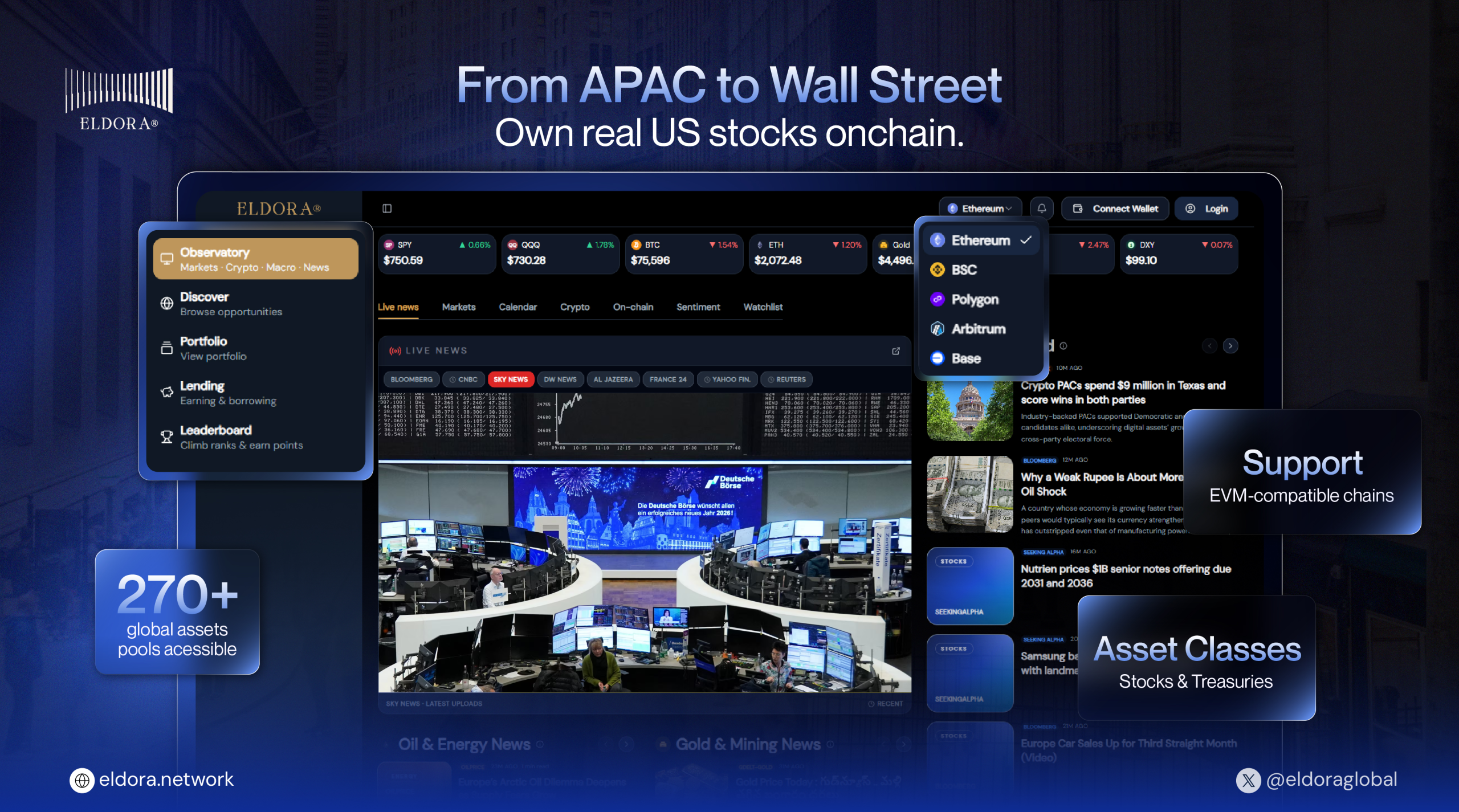

The on-chain investment platform lets retail investors in Asia-Pacific buy real, 1:1-backed tokenized US stocks, including SpaceX, Nvidia, Apple, and Tesla — alongside a 5.3% T-Bill yield and institutional DeFi lending — through a single dashboard and a single KYC, with no brokerage account required.
Eldora, an on-chain investment platform, announced the expansion of its tokenized US equity marketplace to 280+ assets and the launch of a $20,000 Trading Campaign, opening in early June 2026 — the platform’s largest community initiative to date.
For most retail investors across Asia-Pacific, owning shares in Nvidia or Apple has never been straightforward. It has meant navigating foreign brokerage registration, funding dollar-denominated accounts, paying high conversion fees, and accepting settlement windows that close on weekends and holidays.
Eldora addresses this with tokenized US equities — blockchain-based representations of real, US-listed securities backed 1:1 by shares held in regulated custody through Dinari, a transfer agent registered with the US Securities and Exchange Commission. The platform now lists 280+ tokenized US stocks and ETFs, including SpaceX ($SPCX), Nvidia ($NVDA), Apple ($AAPL), Tesla ($TSLA), Johnson & Johnson ($JNJ), and the iShares Russell 2000 ETF ($IWM), available 24 hours a day across Ethereum, BNB Chain, Polygon, Arbitrum, and Base.
“Programmable ownership, real-world yield, and decentralized credit markets are converging into a single on-chain financial stack. Eldora is building the access layer for that transition.”
— Theophane Rame, Founder & CEO, Eldora
Tokenized Equities, T-Bill Yield, and DeFi Lending — One Login
According to Dinari’s custody framework, each token on Eldora represents a beneficial interest in the underlying US-listed security — not a derivative, not a synthetic contract. A single KYC verification unlocks all platform products across all five supported blockchains simultaneously: tokenized equities, a T-Bill yield product at 5.3% APY (as of June 2026) on idle stablecoin capital, and institutional DeFi lending aggregated from AAVE (127+ asset reserves), Maple Finance (Syrup USDC at 4.45% APY, $1.4 billion in total assets), and Morpho.
Investors can use tokenized equity positions as collateral within the platform’s DeFi lending stack, enabling yield generation on stock holdings without liquidating positions.
Ghost Portfolio and Observatory: Eliminating the Onboarding Barrier
Ghost Portfolio, launched in June 2026, allows first-time users to build and monitor a complete simulated portfolio — across tokenized stocks, T-Bill yield, and DeFi lending — using real market data, before connecting a wallet or submitting identity documents. Simulated allocations convert directly into live positions upon completion of KYC. Ghost Portfolio lets the platform make the case before asking for a passport.
The Eldora Observatory provides a free, login-optional market intelligence dashboard aggregating live Bloomberg and CNBC feeds, CNN Fear & Greed index data, real-time asset prices across equities, crypto, commodities, and forex, and AI-generated market commentary.
$20,000 Trading Campaign in June 2026
The $20,000 Trading Campaign runs for 12 weeks beginning in early June 2026. Rewards are distributed from the pool based on verified platform activity — trading tokenized equities, deploying capital into yield and DeFi lending strategies, inviting friends via referral, and engaging with Ghost Portfolio or Observatory — with real-time standings published on Eldora’s public Leaderboard. Ghost Portfolio participants may accumulate campaign standing before committing real capital, providing a genuinely low-risk entry point for investors new to on-chain investing.
Access tokenized US stocks, T-Bill yield, and institutional DeFi lending from anywhere in APAC → app.eldora.do
Platform Traction and Market Context
The platform’s early traction reflects the scale of the problem it is targeting. Eldora has surpassed 10,000 active users across 85+ countries, backed by a community of more than 20,000 members across X, Discord, and Telegram. The Discover marketplace lists 280+ tokenized US equities and ETFs — all live and tradable — across 12+ active integrations including Dinari, Maple Finance, AAVE, and Morpho.
The real-world asset tokenization market surpassed $24.9 billion globally in early 2026, up 289% year on year, with tokenized stocks the fastest-growing individual asset category. Institutional participation has accelerated, with J.P. Morgan projecting the tokenized securities market could reach between $4 trillion and $16 trillion by 2030.
About Eldora
Eldora is an on-chain investment platform that provides access to tokenized US equities, Treasury bill yield products, and decentralized lending markets through a unified dashboard and a single KYC framework. The platform aggregates infrastructure from Dinari (SEC-registered transfer agent), Maple Finance, AAVE, and Morpho, and is available across Ethereum, Base, Polygon, Arbitrum, and BNB Chain. Eldora is incorporated in Zurich, Switzerland and serves a global user base across 85+ countries.
Website: Web: eldora.network & App: app.eldora.do
The post Eldora Opens On-Chain Access to 280+ Tokenized US Equities for Investors Across 85+ Countries, Launches $20,000 Trading Campaign appeared first on BeInCrypto.

Block, the financial services company led by Jack Dorsey, says it has launched “Builderbot,” an AI-native set of engineering tools designed to handle a meaningful portion of production software changes. The company claims the system can carry out roughly 15% of all production code changes at Block, positioning the rollout as a step beyond traditional AI coding assistants.
In describing Builderbot, Block frames the development as a practical shift: AI systems are moving from suggesting code to coordinating work that can be merged and shipped, while engineers retain responsibility for higher-level judgment and product decisions. Block also linked the announcement to its broader AI push that coincided with a major workforce reduction earlier this year.
Key takeaways
- Block says Builderbot can execute around 15% of its production code changes, turning AI from “assistive” into “operational” in day-to-day engineering.
- The company estimates Builderbot performs over 200,000 operations per day and merges about 1,500 pull requests per week.
- Builderbot is presented as an orchestration layer that coordinates multiple AI agents across Block’s full codebase rather than a single repository.
- Block attributes faster delivery—moving items from backlog to live—on the order of days rather than months, with humans still focused on key decisions.
- The rollout adds new context to Block’s February decision to cut about 40% of staff, which Dorsey said was driven by accelerating AI adoption.
Builderbot aims to bridge AI coding and real engineering
Block introduced Builderbot as a “missing layer” between AI coding tools and how software teams actually operate at scale, according to Brad Axen, head of AI capabilities at the company. Block’s internal metrics, as presented in its announcement, suggest the system is not limited to drafting snippets or generating isolated changes.
Axen said that tasks that previously took months could be completed in days with Builderbot, reflecting an emphasis on throughput and execution speed rather than experimentation alone. The company also claims Builderbot can perform more than 200,000 operations per day and merges approximately 1,500 pull requests per week, figures intended to show tangible productivity impact.
For investors and builders watching AI deployment, the key question is whether these systems can reliably translate intent into production-ready code—without overwhelming reviewers or compromising quality. Block’s decision to describe measurable operational metrics suggests it is aiming to make the case that AI-generated work can fit existing engineering workflows, including review and merging processes.
An orchestration approach across Block’s entire codebase
A central feature of the system, Block says, is that Builderbot understands the broader environment in which software runs. The company describes Builderbot as an orchestration layer that coordinates multiple AI agents across its full codebase—covering services, APIs, and internal conventions—rather than restricting agents to a single repository.
Block contrasts this with the typical approach of coding assistants that operate within one codebase boundary. In its example, an engineer working on Cash App could use Builderbot to make changes in a Square service they have never worked on, because the system allegedly already knows how that service is built and how it fits into Block’s overall architecture.
This matters because production scaling isn’t only about generating more code; it is about making changes that are consistent with system rules, dependencies, and deployment practices. If Builderbot genuinely has awareness of cross-service relationships, it could reduce the “handoff friction” that often slows teams down when changes span multiple systems.
Block adds that the practical outcome is faster iteration: an idea can move from backlog to being available to “millions of customers” in days instead of months, while engineers focus on judgment and product taste rather than repetitive scaffolding.
AI acceleration and workforce restructuring context
Block’s announcement does not arrive in isolation. The company also connected Builderbot to its earlier restructuring, noting that its February layoffs—40% of staff—were attributed by Jack Dorsey to the rapid acceleration of AI at Block.
That linkage highlights a tension that many companies in this space are grappling with: faster engineering cycles can reduce certain forms of manual work, even as firms argue that human roles shift toward oversight, product direction, and quality decisions. Block’s description of engineers remaining responsible for judgment and taste suggests it is positioning Builderbot as augmentation rather than a complete replacement.
Still, the practical question for employees and outside observers remains how responsibilities are redistributed. Metrics like merged pull requests and daily operations can indicate scale, but they don’t alone reveal how the human workload changes—whether review becomes faster, whether engineers spend more time on higher-level design, or whether roles are reduced in practice.
The broader shift toward AI-written code at major tech firms
Block is not the only company exploring AI agents for software development. Other large organizations have publicly discussed how automation is affecting coding and engineering output.
Earlier reporting highlighted that Spotify engineers have used a background coding agent called Honk, which runs a version of a Claude model through Anthropic’s Agent SDK. Separately, Spotify Co-CEO Gustav Söderström said on a February earnings call that the best developers “have not written a single line of code since December,” underscoring how far the conversation has shifted from assistance to execution.
At Google, CEO Sundar Pichai said in April that three-quarters of new code is AI-generated, pointing to a scale where AI output is shaping day-to-day development. Microsoft’s Satya Nadella also described, in 2025, that the company uses AI to write between 20% and 30% of code powering its software, again positioning AI as a meaningful part of the production process rather than a side tool.
Taken together, these examples place Block’s Builderbot announcement in a larger trend: CEOs and engineering leaders are increasingly measuring AI productivity in terms of code volume and delivery timelines. For the crypto industry, this matters indirectly—many crypto projects rely on fast-moving engineering teams, and the same automation patterns could influence how quickly core infrastructure is iterated, audited, and updated.
For readers tracking this space, the next signals to watch are whether systems like Builderbot can maintain reliability as they scale, how quality controls evolve with higher AI throughput, and whether other companies follow Block’s lead in publishing comparable operational metrics rather than only high-level claims.
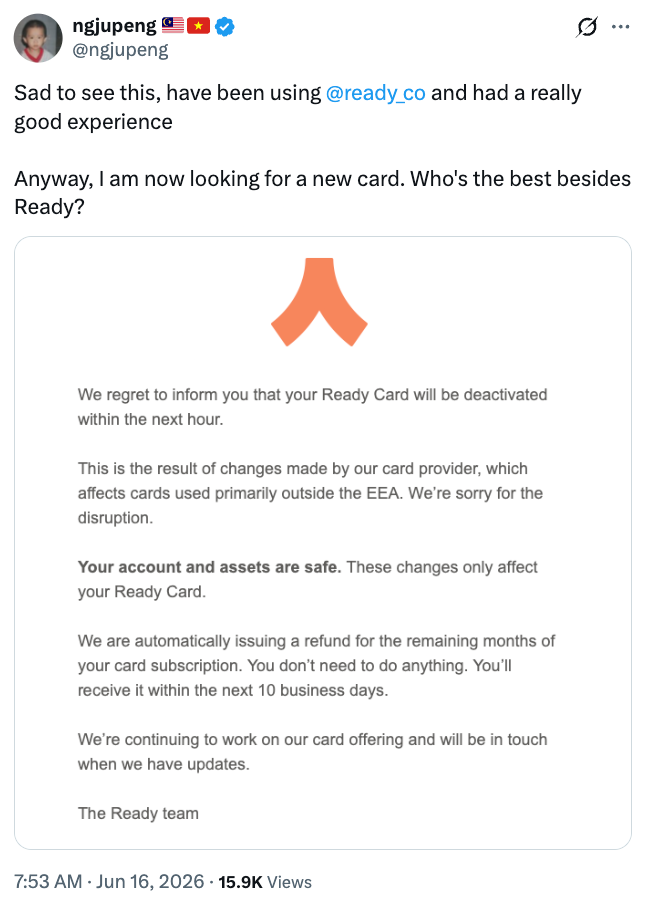
Ready, a self-custodial crypto wallet and payments company, has reportedly restricted card access for users outside the European Economic Area, according to multiple user reports.
Ready has restricted USDC card functionality for users outside the European Economic Area following a change in its card provider, according to notices shared by users on social media.
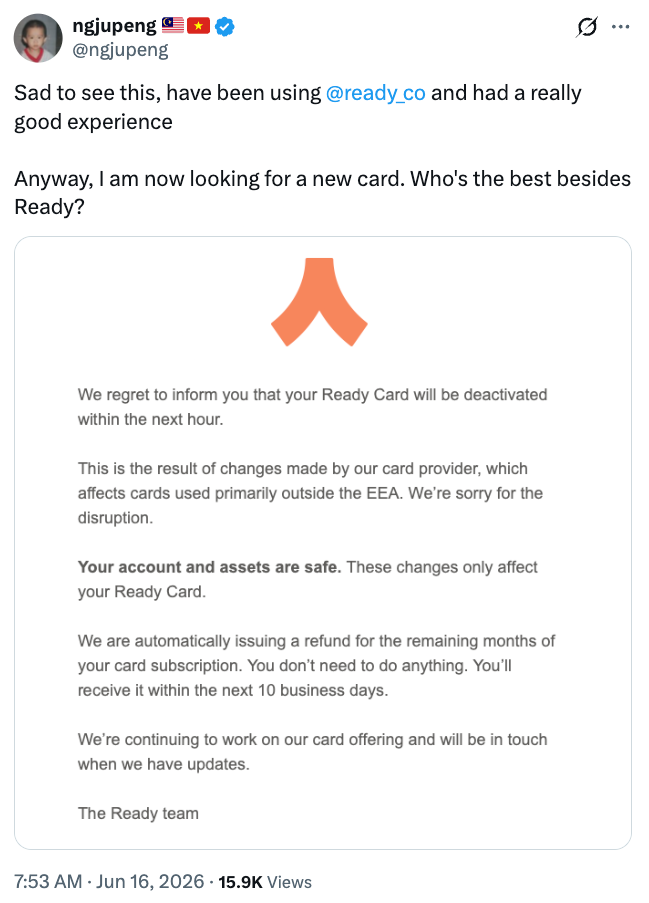
Several users shared screenshots of an in-app notice from Ready stating: “Your Ready Card will be deactivated within the next hour,” citing changes affecting users “primarily outside the EEA.”
The reported changes left some users questioning how quickly access to crypto-linked payment cards can be restricted when providers change.
Users question speed of restriction and communication
Several users criticized the short notice period before the changes took effect, saying they lost access to the card within hours.
One user, who uses the X handle TapSatoshi, said in a post that they were frustrated with the company’s product roadmap, citing delayed features such as Apple Pay support and prioritizing the addition of a “Rewards” section.
Source: ngjupeng
Screenshots of Ready’s message also stated that users would receive automatic refunds for any remaining subscription period within 10 business days.
It remains unclear which company will serve as the new card provider for the Ready Card or what prompted the change. The previous issuer-side partner linked to the program was Kulipa, according to publicly available documentation.
Related: BitGo courts crypto firms awaiting MiCA approval amid Binance licensing concerns
Cointelegraph contacted Ready for comment regarding the issue but did not receive a response by publication time.
USDC at the center of the Ready Card
Formerly known as Argent, Ready is a wallet built for the Starknet ecosystem, an Ethereum layer-2 scaling network using zero-knowledge rollups.
While Ready’s wallet supports multiple crypto assets, including Bitcoin (BTC) and Ether (ETH), the Ready Card is primarily built around USDC, which users spend directly from their wallet balance at checkout.

Source: Ready
According to Ready documentation, the system checks a user’s USDC balance in real time when a purchase is made and processes the transaction through Mastercard’s payment network, converting crypto into fiat at the point of sale. The card issuer acts as the bridge between the self-custodial wallet and traditional payment rails.
This structure allows users to retain full control of their assets in the wallet, while the card only provides a spending layer on top of those funds. If card access is restricted, users can still hold and transfer USDC onchain without interruption.
Magazine: The end of anon? AI could unmask crypto’s hidden identities
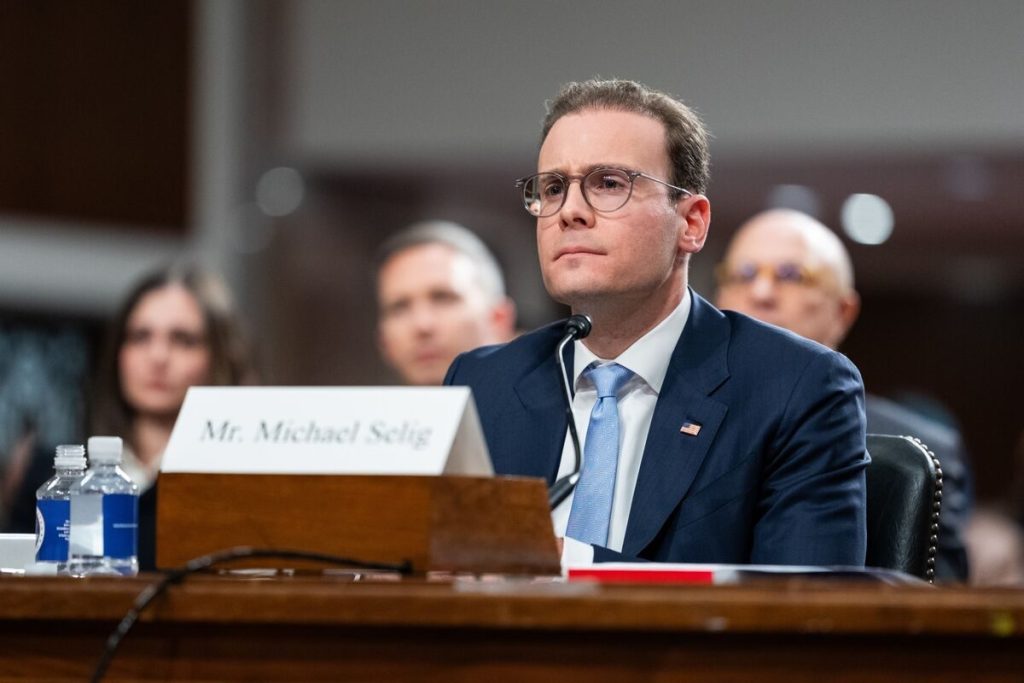
CME Group CEO Terrence Duffy announced Wednesday that the exchange operator will file a federal lawsuit against the CFTC, targeting the regulator’s late-May approval of bitcoin perps for prediction-market platform Kalshi, the first regulated U.S. listing of perpetual futures.
Duffy’s central argument, made on CNBC’s Fast Money, is that the products the CFTC approved as futures are legally swaps under the Dodd-Frank Act, and that the agency overstepped its authority in fast-tracking them without adequate review.
The stakes extend well beyond Kalshi. Duffy stated on air that CME holds exclusive licensing agreements with every major benchmark provider whose indexes underpin crypto derivatives pricing.
If perpetual futures are reclassified as swaps in court, any platform offering them would need to route through CME’s licensing framework regardless of how their products are labeled, a structural outcome that would effectively block Kalshi, Coinbase, and Kraken from operating U.S. perp markets outside CME’s terms.
CFTC Chair Michael Selig defended the approval earlier the same week, telling CNBC it was “time to approve regulated futures contracts that have no expiration date,” while a CFTC spokesperson dismissed the threatened lawsuit as frivolous.
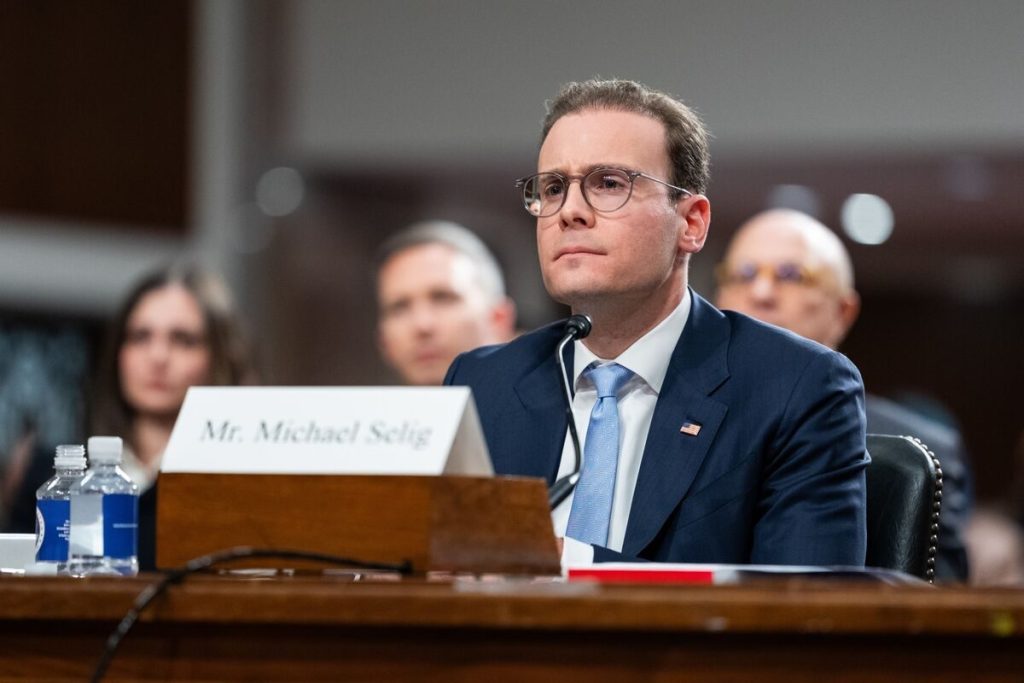
The broader regulatory context matters here. Legislators are simultaneously debating the scope of CFTC jurisdiction over crypto through vehicles like the CLARITY Act currently moving through the Senate, which would formalize CFTC authority over digital commodity derivatives – making the outcome of CME’s lawsuit directly relevant to how that legislative framework gets applied in practice.
Discover: The Best Token Presales
CME Duffy Core Argument: Why Perpetual Futures Are Swaps Under Dodd-Frank
The legal framing is specific and worth unpacking. The Dodd-Frank Act draws a hard line between futures and swaps in the Commodity Exchange Act: a futures contract involves delivery or cash settlement at a defined expiration date, while a swap involves two parties continuously exchanging payments based on an underlying reference rate.
Perpetual futures have no expiration date. Instead, they use a funding-rate mechanism, periodic payments between long and short holders, to keep the contract price anchored to spot. That mechanism, Duffy argues, is structurally identical to a swap under the statute.
Duffy stated the case plainly in his CNBC appearance: “Under the Dodd-Frank Act, it clearly defines what a swap is and what a future is, and when there’s two parties exchanging payments to each other, that’s deemed a swap.
So, if anything, these products that he supposedly approved as futures are not futures, they would be swaps, and if they’re swaps, and let’s say, as you know, there are different requirements in order to participate in the swap market.”
The classification carries real consequences: swaps participants face stricter eligibility requirements, higher capital thresholds, and different reporting obligations than futures market participants.
CME’s second front is procedural. Market lawyers quoted in early coverage expect the lawsuit to include an Administrative Procedure Act challenge, arguing the CFTC relied on expedited self-certification and abbreviated review for what the agency itself has described as a novel and complex product class,without the full notice-and-comment rulemaking that complexity typically demands.
Duffy reinforced the procedural critique directly, accusing the CFTC of describing a 24/7 trading release as a formal rule when it was not, saying he believed “to an extent” the agency was misrepresenting facts.
Discover: The Best Crypto to Diversify Your Portfolio
CFTC Chair Selig Calls the Lawsuit Frivolous: Here’s the Regulator’s Case
Selig’s position is that the CFTC has clear statutory authority to approve futures contracts on commodity indexes, and that a well-structured perpetual futures contract, with a defined reference rate, margining requirements, and daily settlement, qualifies as exactly that.
The agency’s framing sidesteps the no-expiry objection by pointing to the daily settlement mechanic as functionally equivalent to the roll that occurs in dated futures, satisfying the Commodity Exchange Act’s “future delivery” requirement at least in economic terms.
Whether that construction holds up to the Dodd-Frank swap definition in federal court is the central legal question the case will force into the open.
The CFTC also has a political tailwind: the current regulatory posture across Washington has been broadly pro-crypto-access, and fast-tracking onshore perp listings aligns with the administration’s stated goal of pulling derivatives volume back from offshore, unregulated venues.
Derivatives lawyers quoted across coverage have noted that the case could function as a test of the entire CFTC product-approval framework for crypto, putting the futures-swap boundary under the kind of federal-court scrutiny it has never faced in the context of crypto derivatives specifically.
Commentators in the ongoing regulatory classification disputes around the Clarity Act have drawn direct parallels to this case, noting that definitional line-drawing by agencies has repeatedly ended up in litigation.
The post CME Move To Sue CFTC Over Crypto Perpetual Futures: Here’s Why appeared first on Cryptonews.
Brexit ten years on: the EU

Trump says Apple will work with Intel to build chips in the US

Financial Crisis Imminent? (Heres My Take)


-

 Business4 days ago
No Jackpot Winner as $257 Million Prize Rolls Over to $269 Million Monday Draw
-

 Fashion6 days ago
Weekend Open Thread: Tuckernuck – Corporette.com
-

 Crypto World7 days ago
Oppenheimer backs SpaceX as $70 billion retail frenzy builds
-

 Crypto World7 days ago
Markets Rally as SpaceX IPO Looms Amid Iran Tensions and Inflation Surge
-
 Crypto World3 days ago
Zimbabwe Requires Crypto Businesses to Register Annually Under New FIU Regulations
-

 Crypto World5 days ago
Bitget enters Argentina’s regulated crypto market through PSAV registration
-

 Tech5 days ago
NanoClaw integrates JFrog registries to secure AI agent downloads
-

 Tech6 days ago
This Week In Security: Microsoft On Microsoft, Register Your Domains, Linux On ARM, And FreeBSD Joins The File Cache Club
-

 NewsBeat6 days ago
El Nino has formed in the Pacific and could set records, forecasters say
-
 Tech7 days ago
Dutton Ranch star claims they ‘didn’t see any disruption’ on set following Chad Feehan’s exit from Yellowstone spinoff fueled by Taylor Sheridan clash rumors
-

 Politics7 days ago
Politics Home | Healey Resignation Is “Colossal Failure Of Government”, Says Former Labour Defence Secretary
-
 Entertainment7 days ago
Donnie Wahlberg & More Heat Up Las Vegas at Circa’s Barry’s Downtown Prime
-

 Sports7 days ago
First Time Since 1971: Australia Register Historic Low In ODI Cricket
-
 Tech7 days ago
Opendoor Ends India Operations, Fueling a Bigger Conversation About AI and Outsourcing
-

 Politics7 days ago
Belfast burns, while Met chief points finger at Iran and Russia
-

 NewsBeat6 days ago
FBI searches office of Ohio voter registration group
-

 Business7 days ago
AT&T: Verizon's 27% Outperformance Sets Up A Solid Entry Point
-
 Tech6 days ago
Anthropic is spending $150M to embed 1,000 AI fellows inside nonprofits. No degree required.
-

 Politics7 days ago
Modi thanks Trump for wishes as US attacks Indian seafarers
-
 Entertainment6 days ago
‘The Pitt’s Fan-Favorite Doctor Confirms Noah Wyle Gave His Blessing to Return [Exclusive]
You must be logged in to post a comment Login