Connect with us
DAPA Banner
DAPA Coin
DAPA
COIN PAYMENT ASSET
PRIVACY · BLOCKDAG · HOMOMORPHIC ENCRYPTION · RUST
ElGamal Encrypted MINE DAPA
🚫 GENESIS SOLD OUT
DAPAPAY COMING

Business

DevWA CEO Mudford retires

Published

on

DevWA CEO Mudford retires

DevelopmentWA chief executive Dean Mudford has retired, less than two years into a five-year term as the full-time leader of the government’s land development agency.

Continue Reading
Click to comment

You must be logged in to post a comment Login

Leave a Reply

Business

G7 Summit: Ukraine, Iran In Focus

Published

on

G7 Summit: Ukraine, Iran In Focus

Listen on the go! A daily podcast of Wall Street Breakfast will be available by 8:00 a.m. on Seeking Alpha, iTunes, Spotify.

Getty Images

Good morning! Here’s the latest in trending:

First in 5 years: Nvidia (NVDA) plans to raise $25B in a bond sale; proceeds are for general purposes.

Defying gravity: Musk sees $1T revenue for SpaceX (SPCX) in 2030; IPO haul expands to $85.7B.

Advertisement

Oil watch: Strategic Petroleum Reserve hits 43-year low. Strait of Hormuz will be toll-free for 60 days.

As the Group of Seven (G7) summit enters its second day, the Ukraine war is expected to dominate talks, along with the interim U.S.-Iran peace deal and reopening the Strait of Hormuz. The G7 includes France, the U.S., Germany, Canada, Italy, Japan and the UK. Guest nations at the summit include Qatar, the UAE, Egypt, Ukraine, Brazil, India, South Korea and Kenya.

Ukraine in focus: President Donald Trump said he’d focus on Ukraine now that he’d reached a deal with Iran. European leaders, including French President Emmanuel Macron, are expected to press Trump to continue supporting Ukraine and push Russia to negotiate a peace deal. Trump said he had “a very good conversation” with Russian President Vladimir Putin and Ukraine’s Volodymyr Zelenskyy during separate calls on Sunday. “Maybe we can do something there. I think they are both very open to it,” Trump added. Yuri Ushakov, Russian presidential aide, said Trump talked about how ending the war could open the door to “a truly new quality of U.S.-Russian relations.” Zelenskyy has said he would push for more air defenses from allies at the summit.

G7 leaders will also discuss details of the preliminary agreement between the U.S. and Iran to end hostilities. Macron said France and its allies were prepared to secure the Strait of Hormuz. “We are ready… as early as tomorrow, we can have fighter jets for surveillance missions, a frigate in the area tomorrow, and the Charles de Gaulle [aircraft carrier], mine-clearing capabilities and everything that comes with it within two, three days,” he told French broadcaster TF1 on Monday. Nine countries, including France, said they are committed to playing their part in ensuring unconditional freedom of navigation in the Strait of Hormuz “including through a strictly defensive and independent mission to reassure commercial shipping and conduct mine clearance operations.”

Advertisement

Trade pushback: The Trump administration’s push to boost critical minerals production by regulating prices is facing skepticism from G7 allies, Reuters reported. The plan, first proposed in February to reduce dependence on China, envisions a trade bloc for critical minerals. The bloc would explore price floors, subsidies or guaranteed purchases to encourage production across countries. But G7 members have pushed back against U.S. Trade Representative Jamieson Greer in private talks and cooled on the idea of the bloc relying on a price scheme derived from a Pentagon AI model. Other concerns are who ​would pay a premium for minerals, how far down the supply chain those subsidies should go and how governance would work, according to European officials.

Here’s the latest Seeking Alpha analysis

Alphabet: Buckle Up For What’s Coming

Why I’m Still Holding Every Micron Share

Advertisement

Oil Is Dirt Cheap, Prepare For The Spike Up Now

Buy 2 Value-Oriented Covered Call ETFs And Sleep Like A Baby

Sandisk: AI Memory Hyper-Happy Feelings, Sell Before The Margin Collapse

What else is happening…

Advertisement

WSB survey: Too early to say when Hormuz shipping will resume.

Qualcomm (QCOM) working on 40+ AI devices to power agents.

AMD (AMD) rallies as MEXT deal targets AI memory bottleneck.

DEEPSEEK closes record $7B+ fundraising, valuation tops $50B.

Advertisement

Michael Burry touts Fiserv (FISV) stock as CEO exit extends slump.

ParamountWBD merger cleared without DOJ staff recommendation.

Boeing (BA): Eight dead after B-52 crash at Edwards Air Force Base.

GM (GM) weighs supplying weapon parts to Lockheed Martin (LMT).

Advertisement

Pentagon pushes lower-cost missile strategy to replenish arsenal.

Japan hikes policy rate to highest since 1995; Australia stands pat.

Today’s Markets

In Asia, Japan +0.1%. Hong Kong -1.4%. China -0.1%. India +0.7%.
In Europe, at midday, London +0.5%. Paris +0.6%. Frankfurt +0.6%.
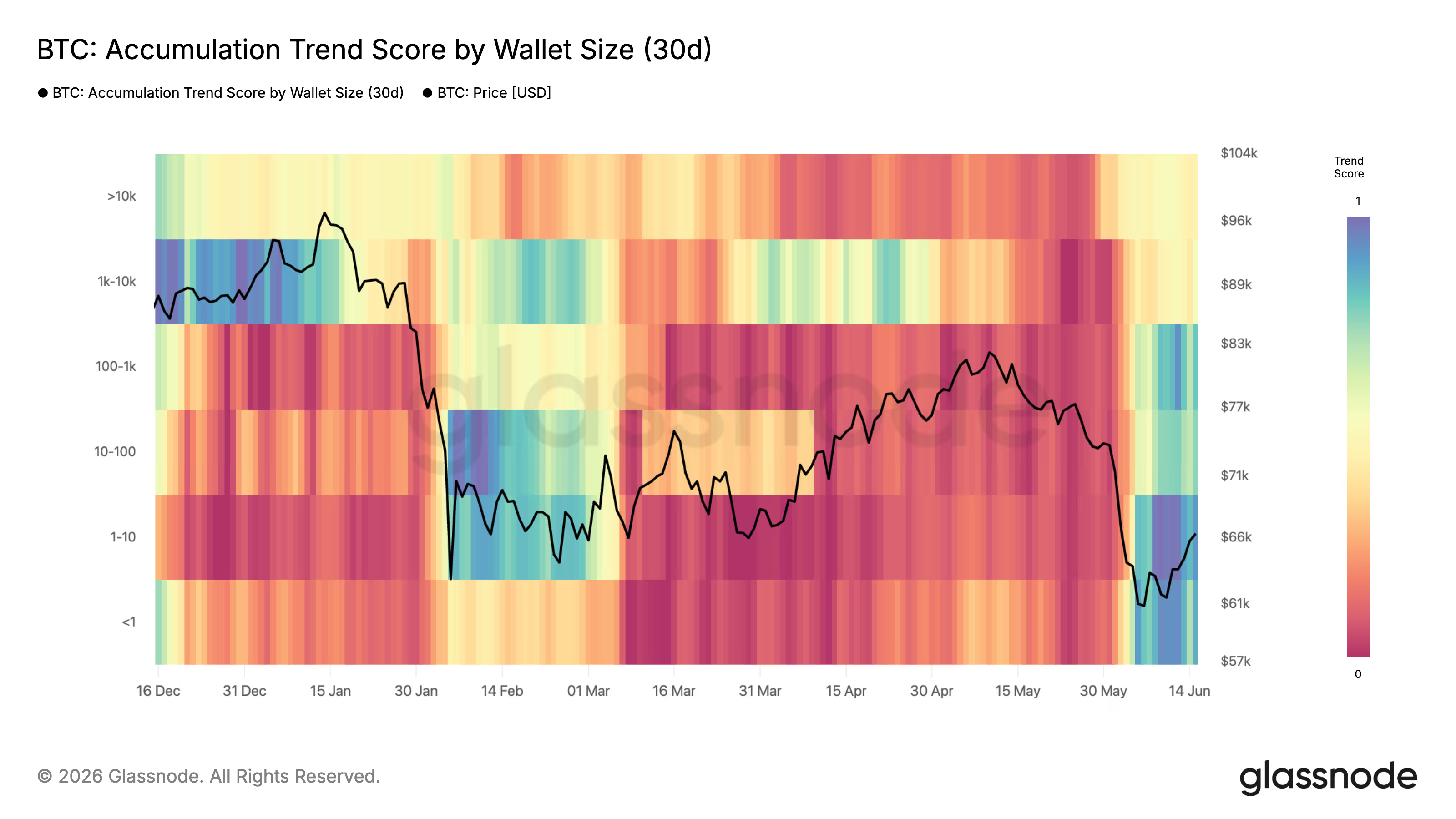
Futures at 6:30, Dow +0.1%. S&P flat. Nasdaq +0.1%. Crude -2.7% to $78.57. Gold +0.3% to $4,364.80. Bitcoin +1.4% to $66,565.
Ten-year Treasury Yield -3 bps to 4.45%.

Advertisement

On The Calendar

Companies reporting today include John Wiley & Sons (WLY) and La-Z-Boy (LZB).

See the full earnings calendar on Seeking Alpha, as well as today’s economic calendar.

Advertisement
Continue Reading

Business

Why is GEA stock climbing today?

Published

on


Why is GEA stock climbing today?

Continue Reading

Business

Google Earth Flight Simulator Launches on Web Browsers Bringing Virtual Global Flights to Millions

Published

on

Google Earth Flight Simulator Launches on Web Browsers Bringing Virtual

NEW YORK — Google has made its long-hidden Flight Simulator feature widely accessible by integrating it directly into the web version of Google Earth, allowing users worldwide to pilot virtual aircraft over photorealistic 3D terrain without downloading specialized software.

The move transforms what began as a 2007 desktop Easter egg into a mainstream tool for casual exploration and sightseeing. Users can now launch the simulator through the Explore Earth menu on Google Earth’s web interface, swapping to satellite view to experience dynamic streaming of high-resolution imagery and 3D buildings across the planet.

This update aligns with Google’s broader push to enhance its web-based mapping platform with professional-grade tools while adding engaging entertainment elements. The simulator emphasizes fun and accessibility over hardcore flight simulation realism, making it suitable for users of all experience levels interested in virtual travel.

How to Access and Use the Simulator

Advertisement

Accessing the feature is straightforward. After navigating to Google Earth on a compatible web browser, users select the simulator option from the top menu bar in the Explore Earth section. The system recommends switching from the default abstract map to the Satellite basemap for optimal visual fidelity.

Once airborne, the simulator streams 3D terrain and buildings dynamically as the virtual plane moves across the globe. Keyboard controls are intuitive: Page Up and Page Down adjust thrust, while arrow keys handle pitch and roll. Mouse input provides additional directional control for smoother maneuvering.

The experience is designed for casual sightseeing rather than professional pilot training. Users can explore landmarks, cities and natural wonders from a bird’s-eye perspective, with the platform handling basic flight physics in a forgiving manner. Crashing into terrain simply pauses the simulation and offers a quick restart at a safe altitude, encouraging experimentation without frustration.

Performance may vary based on internet connection and device capabilities. Low-bandwidth users or those flying at high speeds might encounter temporary loading delays or visual clipping, particularly in areas with complex terrain such as below-sea-level regions.

Advertisement

Evolution from Easter Egg to Mainstream Feature

The Flight Simulator has a storied history within Google Earth. Originally concealed as an Easter egg in the desktop application, it allowed early users to experience rudimentary flight controls over basic terrain. Over the years, it gained a dedicated following among enthusiasts who appreciated the novelty of exploring the world from an aerial viewpoint.

Google’s decision to bring the feature to the web version reflects the company’s ongoing commitment to making advanced mapping tools more accessible. Recent enhancements to Google Earth’s web interface include improved 3D rendering, complex elevation profiles and support for importing shapefiles, catering to both casual users and professional researchers.

By integrating the simulator into the browser experience, Google eliminates barriers such as software installation and hardware requirements. This aligns with broader industry trends toward cloud-based applications that deliver rich, interactive content directly through modern web browsers.

Advertisement

Technical Capabilities and Limitations

The web-based simulator leverages Google’s vast repository of satellite imagery and 3D modeling data. As users fly, the system dynamically loads relevant terrain and structures, creating an immersive experience that spans the entire globe. Major cities feature detailed building models, while remote areas showcase natural landscapes with impressive fidelity.

However, the tool prioritizes accessibility over simulation depth. It lacks the intricate aerodynamic modeling, weather systems and aircraft-specific controls found in dedicated titles like Microsoft Flight Simulator. Instead, Google has optimized for broad appeal, focusing on ease of use and visual spectacle.

Users have reported positive experiences with the feature’s ability to highlight geographical wonders and cultural landmarks. From soaring over the Grand Canyon to circling iconic structures like the Eiffel Tower, the simulator offers an engaging way to discover the planet from new perspectives.

Advertisement

Broader Impact on Google Earth and Mapping Technology

The addition of the Flight Simulator enhances Google Earth’s role as more than a simple mapping service. It positions the platform as an educational and entertainment hub, appealing to students, travelers and geography enthusiasts. Teachers have already begun incorporating the tool into lessons on world geography and environmental science.

Google’s investment in web-based 3D mapping reflects the company’s strategy to compete in an increasingly visual and interactive digital landscape. By combining professional mapping tools with playful features, Google Earth aims to retain users across diverse interests and use cases.

The simulator also demonstrates advancements in streaming technology. Delivering smooth 3D terrain and imagery in real time requires sophisticated backend infrastructure, highlighting Google’s capabilities in handling large-scale geospatial data.

Advertisement

User Reception and Community Response

Early feedback from users has been largely positive, with many praising the seamless integration and global accessibility. Social media platforms have seen shared screenshots and videos of virtual flights over favorite destinations, generating organic interest and discussion.

Some users have noted minor technical hiccups, particularly in areas with limited satellite coverage or complex topography. However, these issues appear infrequent and do not significantly detract from the overall experience for most participants.

Community forums and Google’s own support channels have begun featuring tips for optimizing performance and discovering interesting flight routes. The feature has sparked renewed interest in Google Earth among longtime users who may have overlooked the desktop simulator in the past.

Advertisement

Future Possibilities and Industry Context

Google has not provided an official roadmap for further enhancements to the web simulator, but industry observers anticipate iterative improvements based on user feedback. Potential additions could include more aircraft types, customizable flight paths or integration with other Google services such as Street View.

The launch fits into a larger trend of technology companies blending productivity tools with entertainment features. As virtual experiences gain popularity, tools like Google Earth’s simulator bridge the gap between practical mapping applications and immersive exploration.

Competitors in the geospatial and simulation space are likely monitoring Google’s progress. The success of the web-based feature could influence how other platforms approach accessibility and user engagement in mapping technologies.

Advertisement

Educational and Cultural Significance

Beyond entertainment, the simulator holds educational value. It allows users to visualize geographical concepts, understand scale and appreciate the diversity of Earth’s landscapes in an interactive format. Schools and educational organizations may incorporate it into curricula to enhance learning about world cultures, geology and environmental studies.

Culturally, the tool reinforces Google Earth’s role as a digital window to the world. By making advanced visualization accessible to anyone with a web browser, Google continues to democratize access to planetary knowledge and exploration.

As the feature gains traction, it may inspire new forms of virtual tourism and creative expression. Users have already begun planning themed flights over historical sites, natural wonders and personal landmarks, creating shared experiences that transcend physical boundaries.

Advertisement

The integration of the Flight Simulator into Google Earth’s web platform represents a significant step in making sophisticated geospatial technology available to a global audience. Its blend of playful controls and detailed 3D rendering offers an engaging way to experience the planet from above, fostering curiosity and appreciation for Earth’s diverse landscapes.

With the simulator now available to millions of users worldwide, Google Earth continues to evolve from a mapping service into a comprehensive platform for discovery, education and virtual adventure. The feature’s success will likely encourage further innovations that push the boundaries of what users can experience through their browsers.

Continue Reading

Business

Citizens reiterates Zymeworks stock rating on ADC pipeline progress

Published

on


Citizens reiterates Zymeworks stock rating on ADC pipeline progress

Continue Reading

Business

Apple iPhone 18 Pro Max Release Rumors Point to September 2027 Debut with Advanced AI and Design Changes

Published

on

iPhone 17e Release Date

NEW YORK — Speculation is intensifying around Apple’s iPhone 18 Pro Max, with analysts and supply chain sources pointing to a likely September 2027 release date as the company prepares significant upgrades focused on artificial intelligence capabilities, improved durability and refined camera systems for its flagship model.

While Apple has not commented on future product plans, industry observers and component suppliers suggest the iPhone 18 series will build on the strong foundation established by recent Pro models, incorporating deeper integration of on-device AI, enhanced battery life and potential material innovations. The Pro Max variant is expected to remain the largest and most feature-rich option in the lineup, appealing to users seeking maximum performance and screen real estate.

Expected Timeline and Launch Strategy

Consistent with Apple’s established cadence, the iPhone 18 series is widely anticipated to launch in early to mid-September 2027, followed by availability later that month. This timing aligns with the company’s historical pattern of unveiling new flagships during fall events, allowing time for manufacturing scale-up and global distribution.

Advertisement

Supply chain reports indicate that Apple has already begun early development work on next-generation components, with suppliers in Asia ramping up preparation for advanced display panels and processor testing. The company typically begins mass production of new iPhones in the summer months leading up to launch, giving analysts visibility into potential specifications through component orders.

The iPhone 18 Pro Max is expected to follow the successful formula of previous Pro models while addressing user demands for longer battery life and more powerful AI features. Apple’s heavy investment in artificial intelligence, highlighted in recent software updates, is likely to play a central role in the new device’s marketing and capabilities.

Anticipated Design and Hardware Upgrades

Rumors suggest the iPhone 18 Pro Max could feature a more durable titanium frame with improved scratch resistance and potentially slimmer bezels for an even more immersive display experience. The device is expected to retain the premium stainless steel or titanium construction that has become a hallmark of Pro models, while possibly introducing new color options to refresh the lineup.

Advertisement

Display technology is another area of focus. The Pro Max is likely to boast a larger, brighter screen with enhanced refresh rates and always-on capabilities powered by more efficient panels. Under-the-display Face ID technology has been rumored for future models, which could eliminate the Dynamic Island in favor of a fully uninterrupted screen.

Camera improvements remain a perennial highlight. Expectations include higher-resolution sensors, advanced computational photography features and better low-light performance. The Pro Max variant typically offers the most sophisticated camera array, potentially including new telephoto capabilities or enhanced video recording options tailored for content creators.

Battery life continues to be a priority for users. Rumors point to larger battery capacities and more efficient chip designs that could deliver noticeable gains in daily usage. Apple’s ongoing work on power management, combined with software optimizations, is expected to extend real-world endurance significantly.

AI Integration as Central Theme

Advertisement

Artificial intelligence is set to take center stage in the iPhone 18 series. Building on features introduced in recent software updates, the device is anticipated to offer more advanced on-device processing for tasks like image generation, real-time translation and personalized assistance. Apple’s emphasis on privacy-focused AI could differentiate it from competitors relying more heavily on cloud processing.

The new A-series or M-series chip expected in the iPhone 18 Pro Max is rumored to include dedicated neural processing enhancements, enabling faster and more sophisticated AI experiences without compromising battery life or data security. This focus aligns with Apple’s broader strategy of integrating intelligence across its ecosystem of devices and services.

Market Context and Competitive Landscape

The iPhone 18 Pro Max will enter a highly competitive premium smartphone market. Samsung, Google and Chinese manufacturers continue to push boundaries with foldable designs, advanced camera systems and aggressive AI features. Apple’s strength lies in its tightly integrated hardware-software ecosystem, loyal customer base and brand prestige.

Advertisement

Analysts expect strong demand for the iPhone 18 series, particularly the Pro Max, as users upgrading from older models seek the latest AI capabilities and performance improvements. The Pro Max has consistently been a top seller due to its larger screen and most advanced specifications.

Pricing is expected to remain in line with recent Pro Max models, maintaining Apple’s premium positioning while offering compelling new features to justify the investment. Trade-in programs and financing options will likely play an important role in driving upgrade cycles.

Supply Chain and Production Insights

Early indications from Asian suppliers suggest Apple is preparing for substantial production volumes. Component orders for advanced displays, cameras and processors are reportedly ramping up, though official confirmation remains absent as is typical for Apple’s secretive development process.

Advertisement

The company’s manufacturing partners in India and Vietnam are expected to play larger roles in iPhone 18 production as Apple continues diversifying its supply chain away from heavy reliance on China. This shift aims to mitigate geopolitical risks and improve responsiveness to global demand.

Consumer Expectations and Potential Features

Early rumors and analyst projections highlight several features consumers are hoping to see. These include improved satellite connectivity for emergency situations, enhanced underwater capabilities for the camera system and more sustainable materials in construction.

Software integration with upcoming iOS versions will be crucial. The iPhone 18 Pro Max is expected to launch with the latest iOS iteration, bringing new AI-driven tools for productivity, creativity and health monitoring. Apple’s focus on privacy and on-device processing remains a key differentiator that resonates with many users.

Advertisement

Analyst Outlook

Industry watchers remain optimistic about Apple’s ability to innovate within its established formula. The iPhone 18 series is viewed as an important iteration that could solidify the company’s leadership in premium smartphones while addressing areas where competitors have gained ground.

Longer-term, Apple’s vision for AI across its devices positions the iPhone 18 Pro Max as more than just a communication tool but a sophisticated personal assistant and creative partner. The success of the model will depend on execution and the ability to deliver meaningful improvements that justify upgrades for existing users.

As development continues behind closed doors, anticipation for the iPhone 18 Pro Max continues to build. The device is expected to maintain Apple’s reputation for premium design, powerful performance and seamless ecosystem integration while pushing boundaries in artificial intelligence and user experience.

Advertisement

With a likely September 2027 launch on the horizon, the iPhone 18 Pro Max is shaping up to be another significant chapter in Apple’s mobile legacy. Consumers and analysts alike will be watching closely for official details as the company prepares to unveil its latest flagship.

Continue Reading

Business

At Close of Business podcast June 16 2026

Published

on

At Close of Business podcast June 16 2026

Sam Jones and Tom Zaunmayr discuss today’s RBA rates call.

Continue Reading

Business

National Grid invites businesses to ‘shape future’ of electricity network

Published

on

Business Live

An event is being held next month at Sandy Park in Exeter and online

National Grid is responsible for the pipes that funnel gas into UK homes

National Grid is responsible for the electricity network(Image: Ali Arapoğlu/Pexels)

Businesses and community groups in the West Country are being invited to help shape the future of the region’s electricity network.

It comes as energy giant National Grid Electricity Distribution launches the next phase of its engagement programme.

Advertisement

The company is holding an event next month that will examine how feedback from earlier conversations is shaping plans for the next electricity distribution price control period, which will run from 2028 to 2033.

National Grid said it would also give people “the opportunity to test and influence” the direction of its future plans.

Sarah Jeffery, head of engagement and insights at National Grid Electricity Distribution, said: “The decisions we take now will shape the future of energy across the South West for decades, and it’s important people continue to have a say as our plans develop.

“We’ve listened carefully to the feedback so far, and these sessions are about showing how it’s shaping our plans – sharing what we’ve heard, updating on key developments, seeking further input and making sure we’re getting it right for customers and communities.”

Advertisement

Participants will be asked for their views on how the network can support different communities, enable connections for homes and businesses, make greater use of flexible energy solutions and deliver value for customers.

The event is taking place on Wednesday, July 1, at Sandy Park Stadium in Exeter and online.

Feedback from the sessions will directly inform National Grid Electricity Distribution’s proposals to the energy regulator for the next investment period, ahead of decisions on future funding and priorities, it added.

Advertisement
Continue Reading

Business

Qualcomm Is a Rare AI Chip Value Play

Published

on

Qualcomm Is a Rare AI Chip Value Play

It’s far from certain that Qualcomm QCOM 4.29%increase; up pointing triangle can become a force in the data-center chip business. But unlike other speculative AI chip plays, investors aren’t placing a crazy bet that it will be.

A quick look at the stock might suggest otherwise. Qualcomm’s share price has surged more than 40% since the company disclosed a major data-center customer during its last earnings call in late April. That exceeds the gains of most other chip stocks in that time.

Copyright ©2026 Dow Jones & Company, Inc. All Rights Reserved. 87990cbe856818d5eddac44c7b1cdeb8

Continue Reading

Business

FROM THE HILL: A snapshot of today's politics and parliament

Published

on

FROM THE HILL: A snapshot of today's politics and parliament

From the Hill: School’s nearly out as state parliament MPs prepare to rise for the winter recess.

Continue Reading

Business

Iran Fight Back Twice to Earn 2-2 Draw Against New Zealand in Dramatic 2026 World Cup Opener

Published

on

Iran Fight Back Twice to Earn 2-2 Draw Against New
Iran Fight Back Twice to Earn 2-2 Draw Against New Zealand in Dramatic 2026 World Cup Opener

LOS ANGELES — Iran twice came from behind to earn a hard-fought 2-2 draw against New Zealand in their 2026 World Cup Group G opener on Monday at Los Angeles Stadium, showcasing resilience amid significant off-field challenges that had overshadowed their preparations for the tournament.

Goals from Mohammad Mohebi and Ramin Rezaeian allowed Iran to recover from deficits created by Eli Just’s brace for New Zealand. The result provided a much-needed positive moment on the pitch for a team that had faced unprecedented logistical and political hurdles leading into the match, including a last-minute change of training base and travel disruptions.

Mehdi Taremi, Iran’s captain, described the team’s World Cup experience as a “disaster” in the lead-up, while coach Amir Ghalenoei labelled his squad the “most oppressed” team at the tournament. Despite these difficulties, Iran delivered an entertaining performance that earned them a valuable point against a determined New Zealand side.

Match Summary and Key Moments

New Zealand took the lead in the seventh minute when Eli Just finished smartly after linking with Chris Wood. The Motherwell striker controlled a long kick from goalkeeper Max Crocombe and set up Just, who steered the ball past Alireza Beiranvand.

Advertisement

Iran responded strongly, equalizing when Ramin Rezaeian poked home after a sumptuous pass from Saman Ghoddos. The 36-year-old ghosted into the box to convert after Mohammad Moghanloo was crowded out. New Zealand regained the advantage 10 minutes into the second half when Just dinked the ball over Beiranvand following another interplay with Wood.

Iran once again found an answer. Mohebi rose highest to head in via the post after evading New Zealand’s central defenders, securing the draw in a lively contest that showcased both teams’ attacking intent.

New Zealand coach Darren Bazeley expressed mixed emotions after the match. “We were so close to making history,” he said. “We’ve maybe taken a few people by surprise in showing who we are and how good we can play. We’re disappointed to come away with that sense of ‘what if?’”

Off-Field Challenges Overshadow Build-Up

Advertisement

The match took place against a backdrop of significant turmoil for the Iranian team. Eleven officials were refused entry, forcing a switch of their training base from Arizona to Tijuana, Mexico. Travel arrangements were disrupted, and the team arrived in Los Angeles with a reduced support staff.

Pre-match protests outside the stadium and at the team hotel highlighted divisions within the Iranian diaspora. Some supporters carried the pre-revolutionary flag, while others expressed political messages. FIFA upheld a ban on certain flags following a legal challenge, but dozens were still seen inside the venue.

FIFA President Gianni Infantino visited the Iran dressing room to hear their concerns. Despite the chaos, the players produced a committed performance in front of a partisan crowd that provided vocal support throughout the 101 minutes of action, including stoppage time.

Stadium Atmosphere and Fan Support

Advertisement

Los Angeles Stadium, with its teardrop-shaped canopy and massive LED chandelier, provided a spectacular setting. Iranian fans created a lively atmosphere, singing and cheering throughout, offering a welcome distraction from the political tensions surrounding the team.

The Hollywood Hills were visible from parts of the venue, adding to the memorable backdrop. The match itself was relatively drama-free on the pitch compared to the buildup, allowing both teams to focus on football and deliver an entertaining contest for the spectators.

Group G Outlook

The draw leaves Group G wide open. Iran will face Belgium next, while New Zealand will look to build on their promising showing. Both teams demonstrated quality and determination, suggesting competitive matches ahead in the group stage.

Advertisement

For Iran, the point provides encouragement after a difficult preparation period. For New Zealand, the performance against a higher-ranked opponent offers valuable experience in their World Cup campaign.

The result underscores the competitive balance in the expanded 48-team tournament. New Zealand’s ability to take the lead twice against a traditionally strong side like Iran highlights the depth and unpredictability introduced by the new format.

Broader Tournament Context

The 2026 World Cup, co-hosted by the United States, Canada and Mexico, has already produced compelling storylines in its opening days. Political and logistical challenges have affected several teams, but on-field performances continue to captivate audiences worldwide.

Advertisement

Iran’s participation has been particularly scrutinized due to ongoing regional tensions and domestic issues. The team’s ability to secure a point despite these distractions demonstrates the players’ professionalism and commitment to representing their nation.

As the tournament progresses, Group G promises to deliver more intriguing matches. Belgium enters as one of the favorites, but both Iran and New Zealand have shown they can compete and create moments of quality.

Player Performances and Tactical Notes

For Iran, Rezaeian and Mohebi stood out with their contributions to the comeback. Taremi’s leadership was evident, while goalkeeper Beiranvand made important saves to keep his team in the game. New Zealand’s Just was clinical with his two goals, and Wood provided a strong focal point in attack.

Advertisement

Tactically, both teams showed willingness to play open, attacking football. New Zealand’s direct style created problems early, while Iran’s technical ability and quick transitions allowed them to respond effectively. The match featured several hydration breaks due to the warm conditions, which provided tactical resets for both coaches.

The result is likely to boost morale for Iran as they prepare for tougher challenges ahead. For New Zealand, it offers encouragement and valuable lessons as they continue their debut World Cup campaign.

Fan and Cultural Impact

The presence of passionate Iranian supporters created a vibrant atmosphere despite the political complexities. The match served as a reminder of football’s power to unite people, even amid broader tensions. New Zealand fans also showed strong support, contributing to an engaging contest.

Advertisement

The event at Los Angeles Stadium highlighted the scale and spectacle of the 2026 World Cup. With its modern facilities and large capacity, the venue provided an impressive stage for what was ultimately a competitive and entertaining draw.

As the tournament continues, both teams will analyze this result closely. Iran will seek to build on their fighting spirit, while New Zealand will aim to capitalize on their promising debut performance. The draw keeps Group G wide open and sets up intriguing fixtures in the coming days.

The 2026 World Cup has already delivered drama both on and off the pitch. Iran’s resilient performance against New Zealand adds another compelling chapter to the story of a tournament marked by resilience, competition and the enduring appeal of the beautiful game.

Advertisement
Continue Reading

Trending

Copyright © 2025