

Crypto World
BlackRock launches bitcoin income fund as investors seek cash flow from crypto



The new fund offering comes as bitcoin struggles to break out of a bear market, trading around $67,000, down about 23% year to date. IBIT, which debuted in January 2024, has amassed nearly $49 billion in assets, making it the largest spot bitcoin ETF on the market. The fund has seen significant outflows since the beginning of the year, though, amid lower bitcoin prices and excitement around other asset classes, including the highly anticipated initial public offerings (IPOs) of SpaceX (SPCX) and Anthropic.
But Jacobs said BlackRock sees several potential audiences for the new fund.
One group consists of income-focused investors looking to diversify beyond traditional sources such as dividend-paying stocks and bonds. Another includes bitcoin holders who remain bullish on the cryptocurrency but want to generate cash flow from their positions.
“You could imagine this could be people who have a significant portion of their wealth in bitcoin but would like to have an income stream to support their lifestyle,” Jacobs said.
A third group may be investors who have historically avoided assets such as bitcoin or gold because they do not produce cash flow.
“We’ve encountered this type of investor for years,” Jacobs said. “How can I own gold in a portfolio if it’s not generating cash in any way? This product seeks to help address that market as well.”

Fidelity Investments has launched a money market fund aimed at stablecoin issuers and institutional investors seeking to meet reserve requirements under the GENIUS Act.
Summary
- Fidelity has launched a money market fund designed to help stablecoin issuers meet reserve requirements under the GENIUS Act.
- The new Fidelity Reserves Digital Fund will invest in cash, short term U.S. Treasuries, and other eligible assets permitted under federal stablecoin rules.
- Fidelity joins State Street in targeting the stablecoin reserve management market as institutions prepare for expected growth in digital dollar issuance.
Fidelity said on Thursday that the new Fidelity Reserves Digital Fund will invest in cash, short-term U.S. Treasury securities, overnight repurchase agreements backed by Treasuries, and government money market funds that qualify under the federal stablecoin framework.
The launch places Fidelity among a growing group of traditional financial firms offering products tailored to stablecoin reserve management. State Street introduced a similar product this week through its State Street Stablecoin Reserves Money Market Fund, which was also designed for issuers operating under the GENIUS Act.
Robin Foley, Fidelity’s head of fixed income, said the firm’s experience in fixed income and money markets positions it to provide a compliant reserve management solution for stablecoin issuers under the new legislation.
Fidelity expands stablecoin strategy
The new fund adds to Fidelity’s stablecoin business, which expanded earlier this year with the introduction of the Fidelity Digital Dollar, or FIDD.
At the time, Fidelity Digital Assets said the U.S. dollar-backed stablecoin would serve both retail and institutional investors and would be supported by Fidelity’s reserve management infrastructure. Mike O’Reilly, president of Fidelity Digital Assets, said the company had spent years researching stablecoins and viewed regulatory clarity as an important step for adoption.
The GENIUS Act established the first federal framework for payment stablecoins in the United States. Among its requirements, issuers must maintain reserves in cash, short-dated Treasury securities, and certain government money market funds.
Fidelity said the Fidelity Reserves Digital Fund will hold Treasury bills, notes, and bonds with maturities of 93 days or less. The portfolio will also include cash balances and overnight repurchase agreements secured by Treasury securities.
Asset managers target stablecoin reserves market
Asset managers have begun introducing products that align with the reserve standards established under the new law.
State Street said this week that its reserve fund was created to help issuers satisfy GENIUS Act requirements. State Street Bank and Trust Company and Anchorage Digital joined the launch as initial backers.
State Street Chief Executive Officer Yie-Hsin Hung said the legislation established a framework for how stablecoin reserves can be invested. Anchorage Digital Chief Executive Officer Nathan McCauley said reserve management would become increasingly important as stablecoin usage expands.
Industry projections cited by State Street estimate that global stablecoin issuance could reach between $1.9 trillion and $4 trillion by 2030. If those forecasts materialize, issuers would need to place a substantially larger volume of reserve assets into highly liquid investments permitted under the law.
Stablecoins, which are typically pegged to the U.S. dollar, currently account for roughly $320 billion in market value and are widely used for trading, payments, and cross-border transfers.
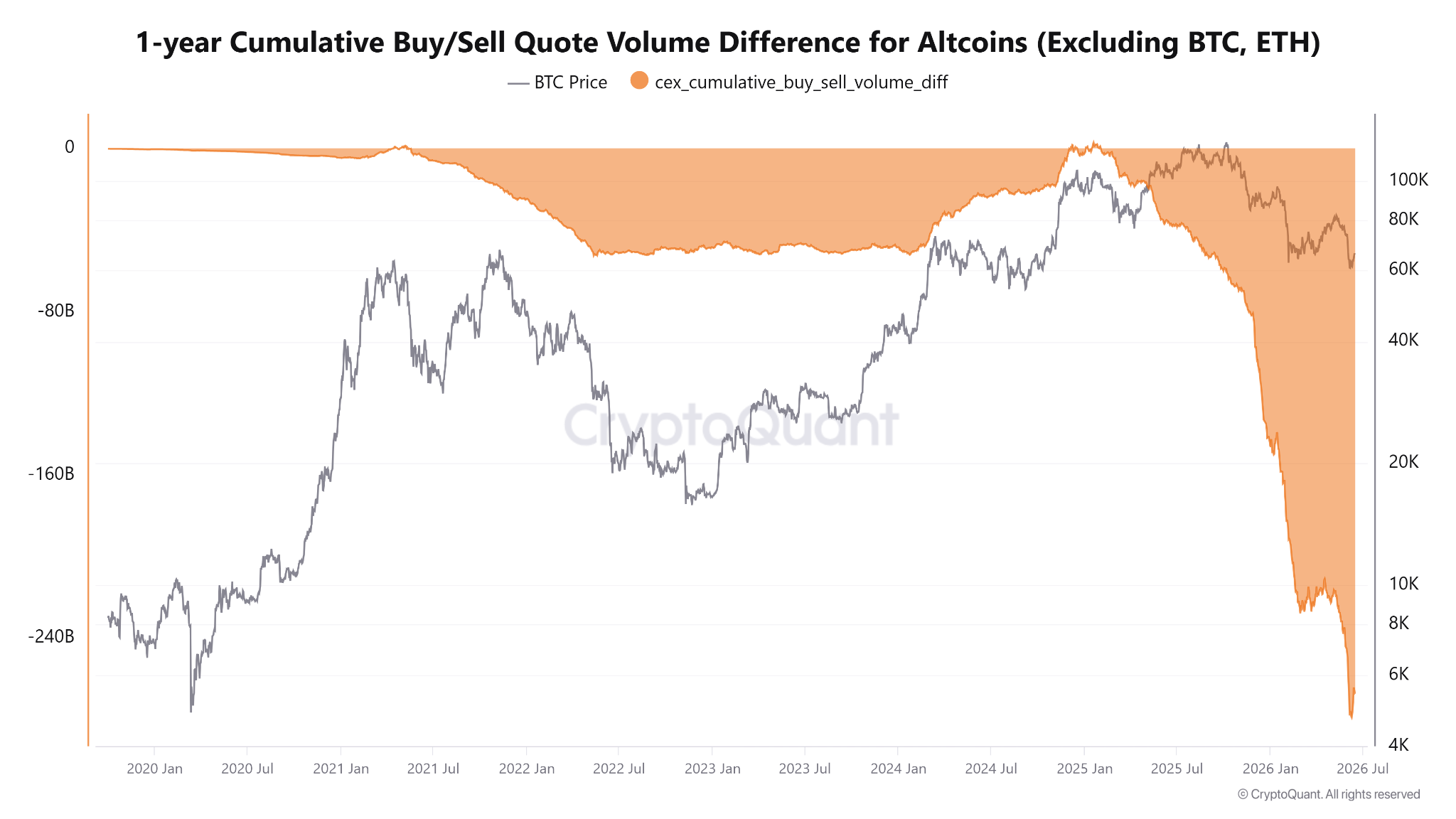
Altcoin markets (excluding Ether (ETH)) recently saw $266 billion in net selling volume on centralized exchanges, the deepest reading since the metric began tracking spot demand in 2020.
Altcoins accounted for 51% of Binance futures trading volume on June 16, compared with 28.85% for Bitcoin and 20.20% for Ether, positioning the exchange as a leader in derivatives activity in 2026.
The divergence between record selling and dominant trading activity points to capital rotating within crypto and also into alternative exchange products.
Altcoin trading stays active despite outflows
Crypto analyst IT Tech noted that the one-year cumulative buy-sell difference for altcoins, excluding Bitcoin (BTC) and Ether (ETH), dropped to -$266 billion on June 16.
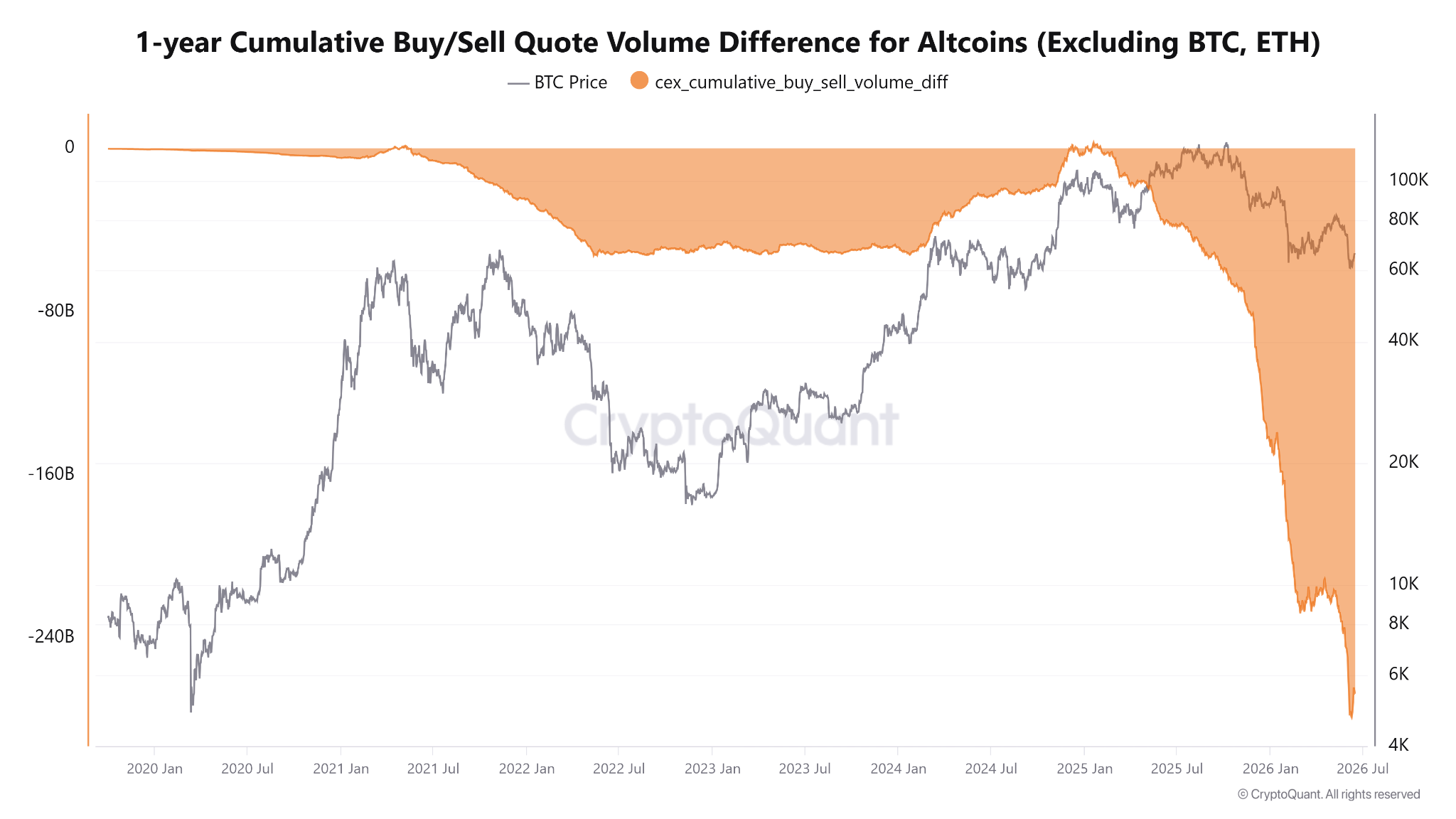
One-year cumulative buy-sell volume for altcoins. Source: CryptoQuant
The current readings show that selling pressure has outweighed buying demand for an extended period, pushing the cumulative balance to a new low.
However, altcoin trading activity tells a different story. Data shows altcoins accounted for 51% of daily futures trading volume on June 16, compared with 28.85% for Bitcoin and 20.20% for Ether. Altcoins have led exchange trading volumes for most of 2025, aside from a brief period in February when Bitcoin overtook the sector.
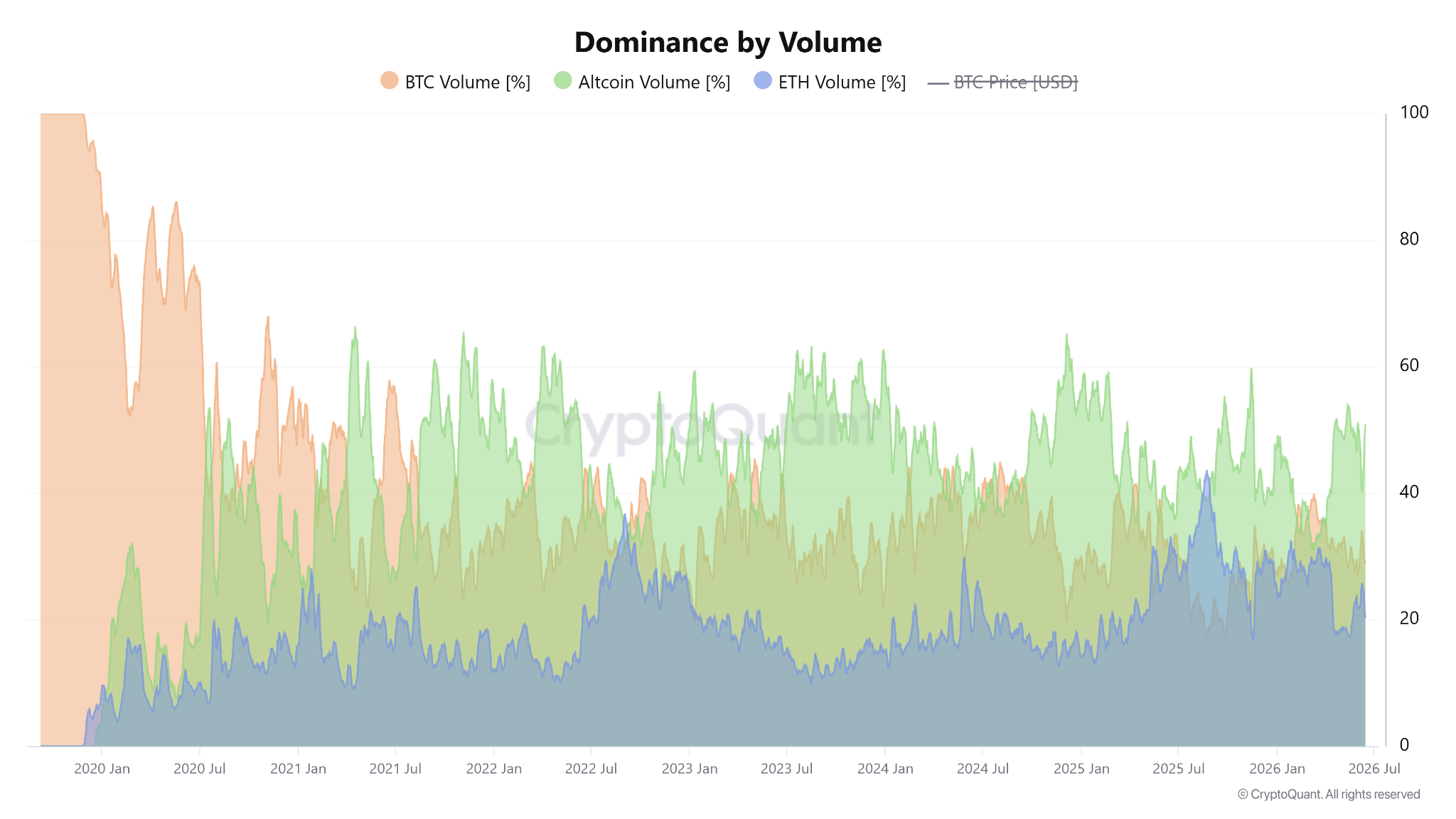
Volume dominance between BTC, ETH, and altcoins. Source: CryptoQuant
The combination of elevated futures trading activity and deeply negative spot demand points to capital recycling within the altcoin market rather than fresh spot inflows. This shows investors continuing to trade altcoins, although aggregate spot purchases have not kept pace with the selling volume.
Related: BitGo courts crypto firms awaiting MiCA approval amid Binance licensing concerns
Crypto liquidity shifts beyond altcoins
Market analyst MorenoDV indicated that exchange stablecoin balances have changed little since December 2024. The exchange supply ratio for ERC-20 stablecoins has fluctuated between 0.40 and 0.46, meaning roughly 40% to 46% of circulating stablecoins have stayed on exchanges for more than a year.
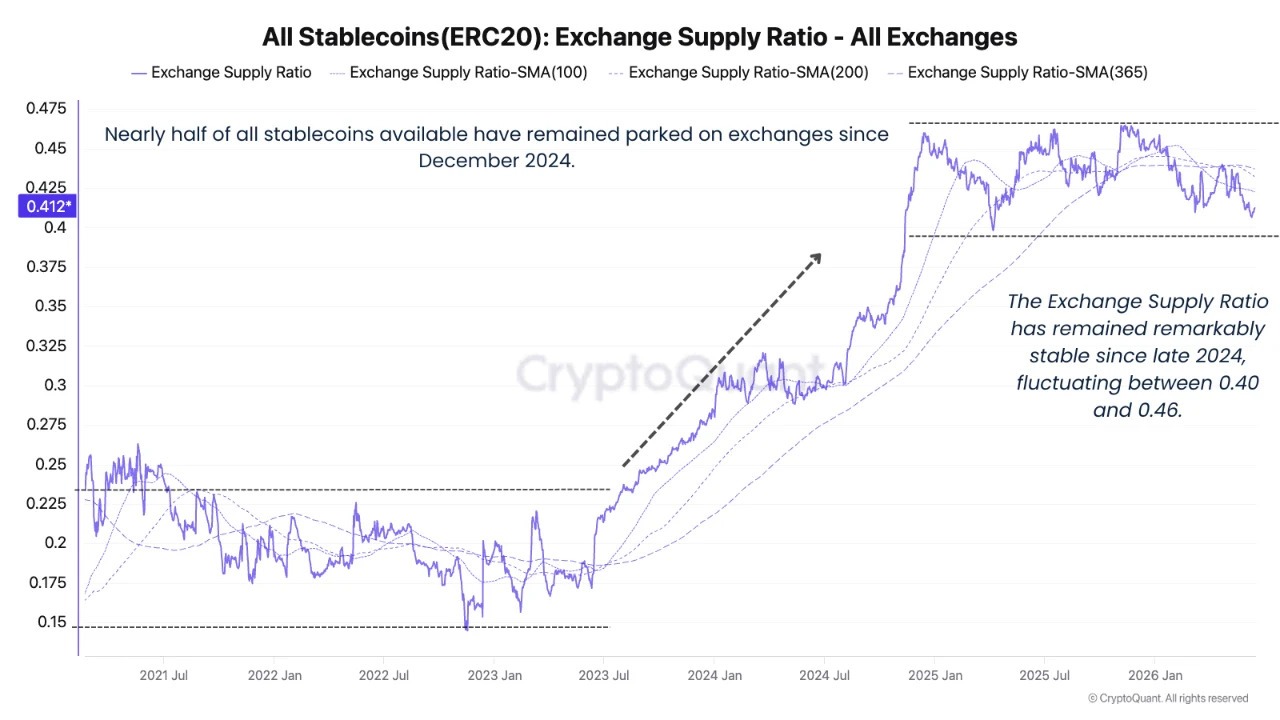
Stablecoins (ERC20) exchange supply ratios. Source: CryptoQuant
During the same period, Bitcoin experienced price swings exceeding 50%, trading between $60,000 and $120,000. Binance held between 25% and 30% of the total stablecoin supply, accounting for more than half of exchange-held reserves. This indicates liquidity has stayed available, but capital deployment has become increasingly selective.
Part of the capital appears to be targeting traditional asset products offered by crypto exchanges. According to CryptoQuant, metals futures volume peaked at nearly $500 billion in March 2026, as gold and silver prices reached record highs. The trading activity in pre-IPO perpetual products expanded to $715 million in May and $2 billion in June, up from just $2 million in March.
Binance processed $10.3 billion in pre-IPO perpetual volume in June, roughly 20 times higher than the entire month of May, while controlling about 83% of the segment. Growth in metals, oil, equities, and pre-IPO contracts highlights how exchange users are increasingly allocating liquidity across a wider range of assets, with Binance continuing to hold the largest concentration of deployable stablecoin capital.
Related: Hyperliquid open interest surges 32% in week: Is $80 HYPE next?
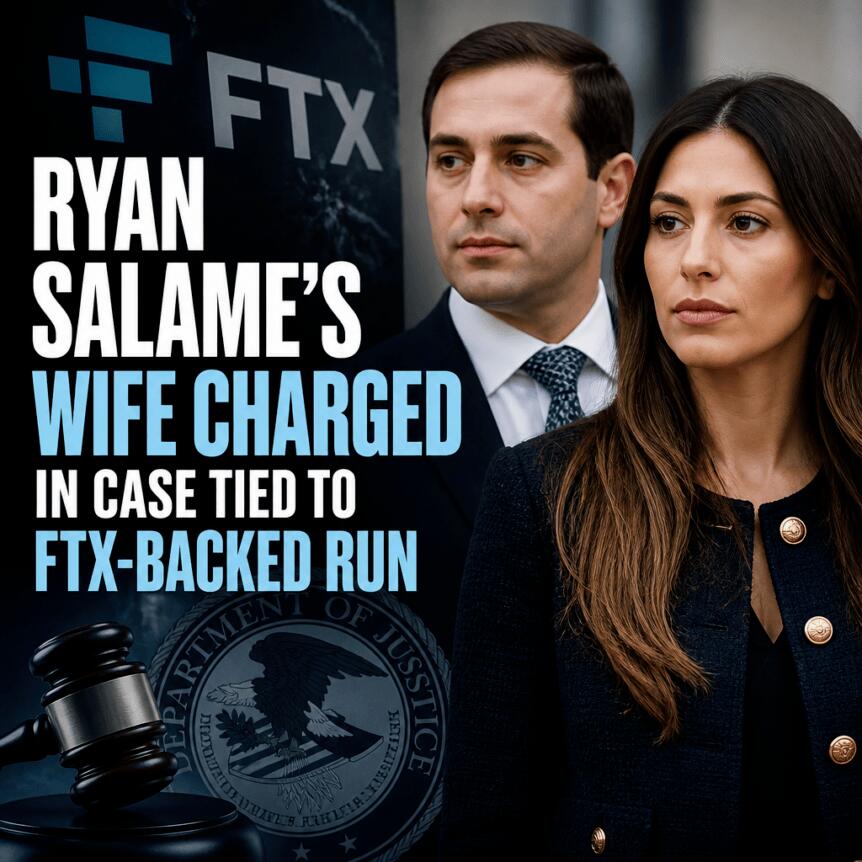
Michelle Bond, the wife of former FTX executive Ryan Salame, will move forward to trial on illicit campaign finance-related charges after a Manhattan federal judge rejected an attempt to throw out the indictment. The decision, issued by U.S. District Judge George Daniels on Wednesday, hinged on whether prosecutors promised Bond immunity in exchange for Salame’s guilty plea.
Daniels denied Bond’s motion to dismiss, concluding there was “no ambiguity” in the written plea agreement and that prosecutors never promised Bond would be cleared. The ruling is expected to be among the final steps in the cluster of criminal cases stemming from FTX’s collapse in 2022, one of the most consequential events in the history of the crypto industry.
Key takeaways
- Judge George Daniels ruled that the plea agreement did not grant Michelle Bond immunity and that prosecutors made no binding promise to avoid her prosecution.
- The court found the government’s position was “undisput[ably]” supported by evidence that immunity was not offered when Ryan Salame pleaded guilty.
- Bond’s indictment centers on allegations that she used FTX-linked funds to bankroll her 2022 congressional campaign.
- Bond faces four separate campaign-finance counts, each carrying up to five years in prison.
No immunity in the plea paperwork
Bond asked the court to dismiss the indictment by arguing that prosecutors made assurances during a 2023 meeting. According to Bond, then–Manhattan U.S. Attorney Danielle Sassoon told her and Salame’s attorney that if Salame pleaded guilty, prosecutors would “conclude” investigative matters related to Ryan Salame but not those related to Bond.
In his decision, Daniels rejected that argument by emphasizing the “four corners” of the plea agreement—meaning the terms that were actually set in writing. The judge wrote that there was “no ambiguity” in the agreement and found that “all parties, including the defendants and their counsel” understood that the government had not promised Bond immunity when Salame entered his guilty plea.
Daniels also pointed to testimony from Bond’s former lawyer, Gina Parlovecchio, indicating that she did not view Sassoon’s statement as a promise at the time it was made. The judge concluded the evidence showed the government did not bargain for Bond’s non-prosecution in return for Salame’s plea.
How FTX money allegedly flowed into a 2022 campaign
Prosecutors’ allegations trace the case to Bond’s failed attempt to win a House seat in 2022. In an earlier filing made by the government and reported in August 2024, prosecutors said that after Bond launched her congressional run, Salame arranged a consulting arrangement between Bond and FTX, under which Bond was paid $400,000.
According to the government, Bond then used those funds to illegally support her campaign, along with additional money—prosecutors allege Salame wired her hundreds of thousands of dollars between June and August 2022. Prosecutors further claimed Bond tried to obscure the source of payments and made false statements to both a congressional committee and the Federal Election Commission.
Bond’s defense has argued that the government’s earlier assurances about the scope of prosecution should matter. But Daniels’ ruling makes clear that, at least under current findings, the court does not accept that any side discussions overrode the written plea terms.
Where the case fits in the broader FTX fallout
FTX’s collapse in 2022 sent shockwaves through crypto markets and triggered a long-running set of criminal investigations and prosecutions. The Salame-related matter has already reached a sentencing milestone: Salame, who served as co-CEO of FTX’s Bahamian subsidiary, FTX Digital Markets, was sentenced to seven and a half years in prison in May 2024.
That sentence followed a guilty plea by Salame to conspiring to make illegal political contributions and to operating an illegal money transmitter. Bond’s case is closely connected to those same allegations, but it targets her alleged role in financing and concealing campaign support tied to FTX.
The judge’s ruling is therefore significant not just for Bond, but for the pace of closing out FTX-linked prosecutions. If upheld through further proceedings, it would keep the focus on Bond’s indictment and move the case closer to trial.
Charges and potential exposure
Bond is facing four criminal counts connected to campaign finance and donation-related conduct. The charges listed in the indictment include conspiracy to cause unlawful political contributions; causing and receiving a straw donor contribution; causing and accepting excessive campaign contributions; and an unlawful corporate contribution.
Each of the four counts carries a statutory maximum sentence of up to five years in prison. The case turns largely on whether the alleged payments and related campaign activity violated U.S. campaign finance laws, and whether Bond’s attempts to conceal the funding sources or make related statements crossed criminal lines.
With Judge Daniels denying the motion to dismiss, Bond will now have to litigate the merits of the government’s allegations rather than seeking relief based on alleged immunity promises tied to Salame’s plea.
For observers watching the final chapters of the FTX criminal saga, the key next development is how Bond responds at trial or in any subsequent motion practice—particularly given the judge’s emphasis on the written plea agreement and what communications were or were not treated as binding promises.
Crypto platform Blockchain.com has added 173 tokenized stocks and exchange-traded funds through a partnership with Ondo Finance, bringing its catalog of tokenized traditional assets to more than 430 offerings across Ethereum, Solana and BNB Chain.
According to an announcement on Wednesday, the new listings include tokenized exposure to private company shares, active exchange-traded funds, Treasury products and covered-call strategies, with Blockchain.com highlighting SpaceX’s SPCX token among the additions.
The expansion also adds themed baskets tied to AI infrastructure, energy, robotics, autonomous vehicles and quantum computing, alongside income-focused products from Global X and other issuers.
A recent proposal by the US Securities and Exchange Commission to scrap two rules in its national market system regulations has been described by Galaxy head of research Alex Thorn as “one of the biggest unlocks yet for tokenized stocks” as it would remove “one of the biggest structural barriers to tokenized US equities trading in DeFi.”
Blockchain.com said the assets are available immediately through Ondo’s routing and liquidity infrastructure, which supports trading across all 173 new listings at launch.
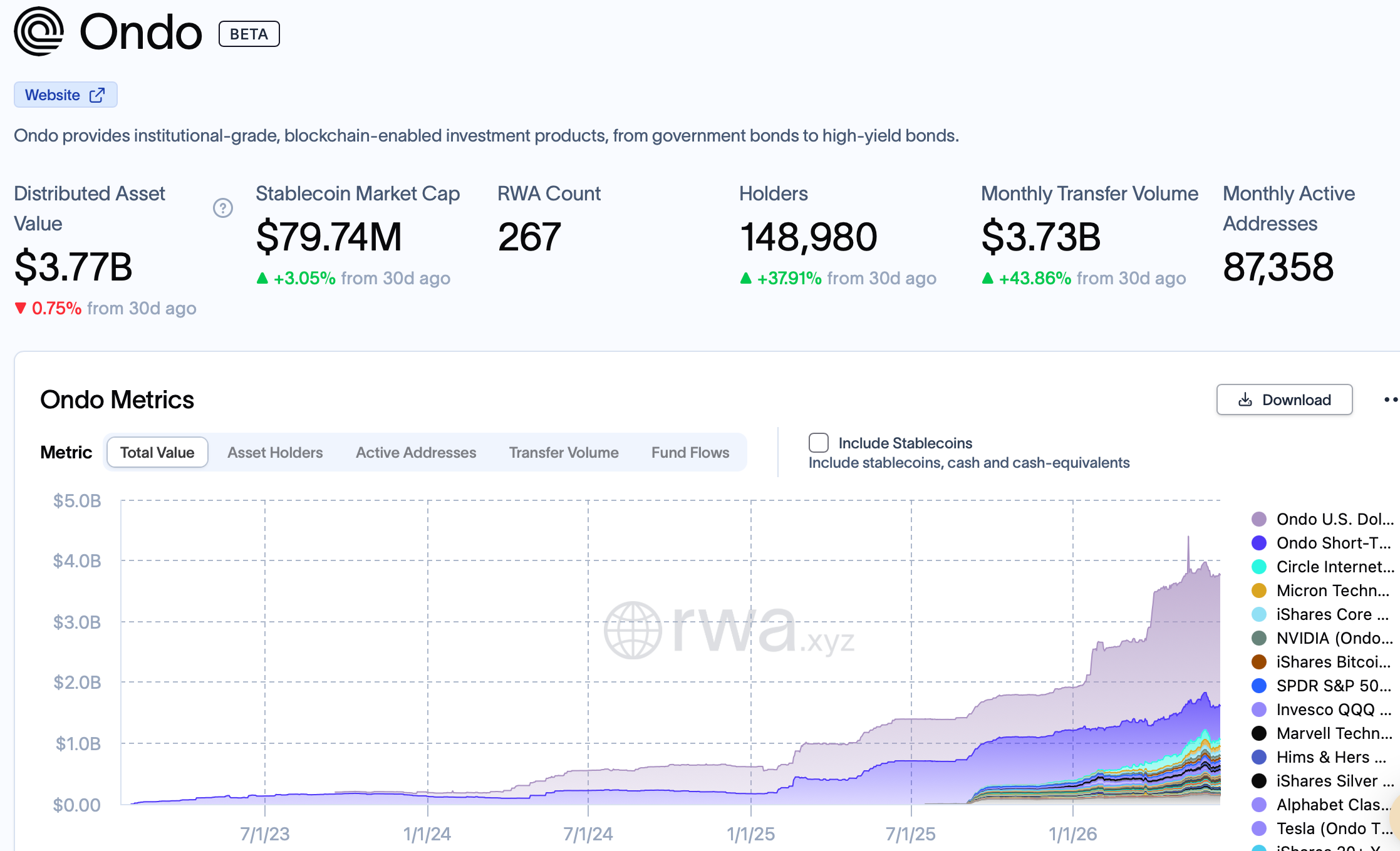
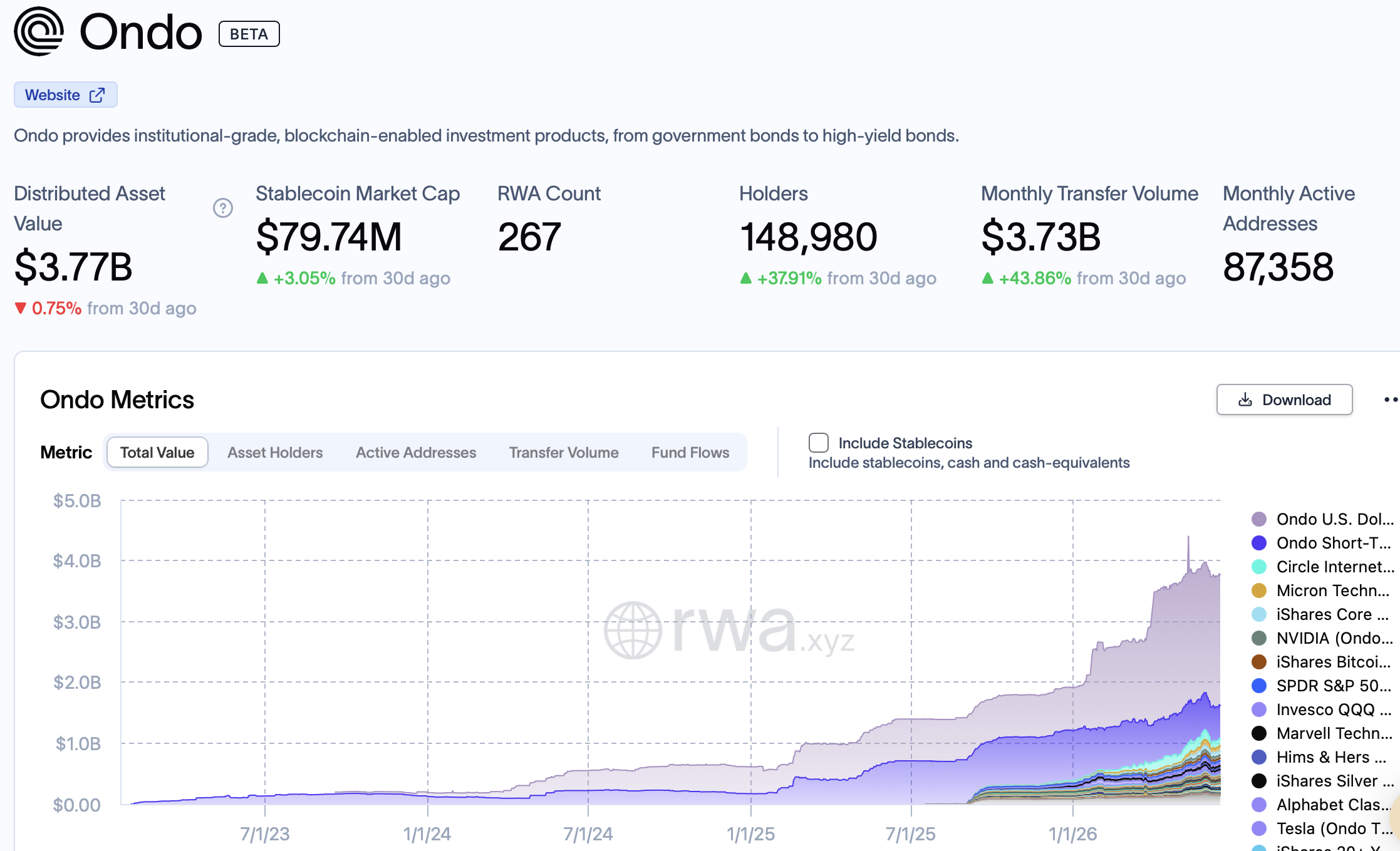
Ondo is one of the largest tokenization platforms by asset value, with roughly $3.8 billion in distributed assets across 267 tokenized products, according to RWA.xyz data.
Source: RWA.xyz
The launch comes a week after Blockchain.com introduced a SpaceX-linked perpetual contract for institutional clients, expanding its push into tokenized and traditional financial markets.
Related: Tokenization could push DeFi assets to $2.7T by 2030: Standard Chartered
Onchain stocks building momentum
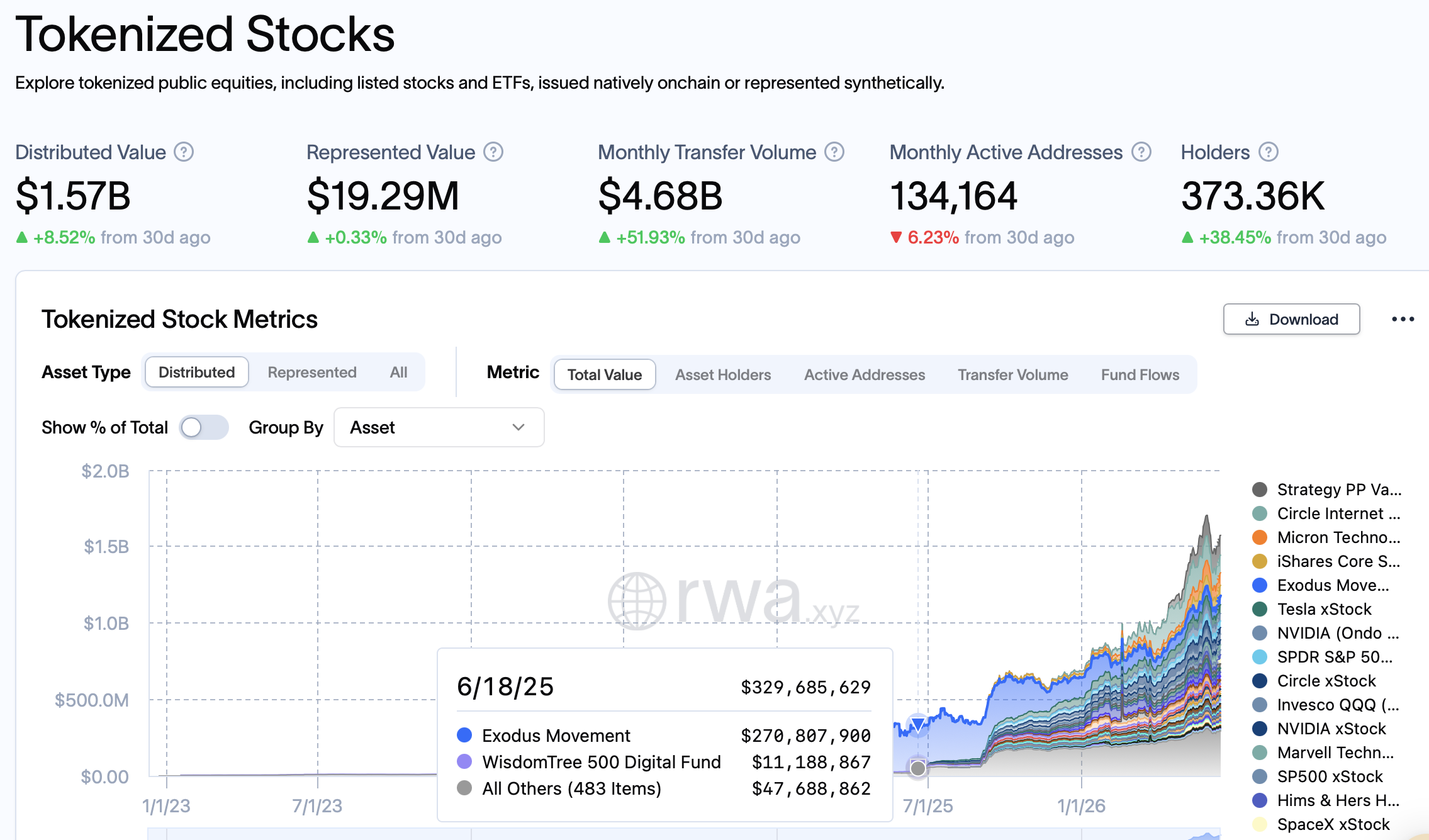
The tokenized equities market has grown rapidly this year. RWA.xyz data shows tokenized equities hold roughly $1.57 billion in distributed value, up nearly fivefold from about $330 million a year ago.
The market includes tokenized shares of public companies, exchange-traded funds (ETFs) and private firms. Among the largest tokenized equity assets by value are Strategy, Circle, Nvidia and Exodus shares.
Source: RWA.xyz
Competition has been intensifing as crypto exchanges and wallet providers race to offer onchain access to traditional financial assets. Earlier this month, Exodus launched a marketplace for more than 200 tokenized stocks, ETFs and other real-world assets through a separate partnership with Ondo Finance.
Several crypto platforms also introduced products tied to SpaceX’s IPO, ranging from tokenized IPO access and pre-IPO contracts to perpetual futures linked to the company’s shares. Binance said its SpaceX tokenized IPO offering attracted more than $557 million in USDC deposits from users seeking exposure to the listing.
However, the SpaceX IPO also highlighted some of the sector’s challenges. Several exchanges, including Binance, Bybit, Bitget Wallet and MEXC, were forced to cancel tokenized SpaceX offerings and issue refunds after failing to secure share allocations. Many of those products relied on Kraken-owned xStocks for distribution and settlement infrastructure.
The IPO was reportedly nearly four times oversubscribed, attracting more than $250 billion in investor demand for a $75 billion offering, according to Reuters.
Magazine: Bitcoin, the ‘canary in the coal mine,’ XRP transaction demand falls 91.5%: Market Moves
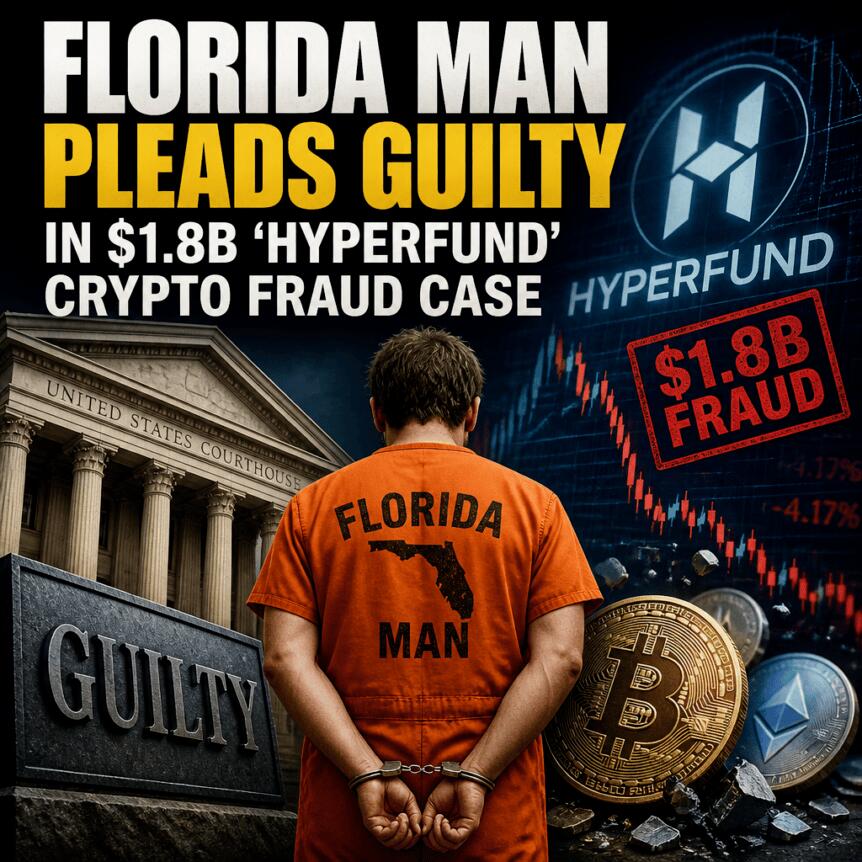
A Florida man known in crypto circles as “Bitcoin Rodney” has pleaded guilty to participating in a large fraudulent crypto scheme tied to HyperFund, according to the U.S. Department of Justice. Rodney Burton entered the plea in federal court in connection with an alleged conspiracy to operate an unlicensed money-transmitting business used to promote the platform.
Prosecutors said Burton helped provide unlicensed money-transmitting services to advance HyperFund, described as a global wire-fraud operation that affected thousands of investors. The U.S. Attorney’s Office for the District of Maryland said the guilty plea was announced by U.S. Attorney Kelly O. Hayes, along with agents from the Washington Internal Revenue Service Criminal Investigation unit and Homeland Security Investigations, New York.
Key takeaways
- Rodney “Bitcoin Rodney” Burton pleaded guilty to conspiracy involving an unlicensed money-transmitting business connected to HyperFund.
- Prosecutors allege HyperFund promised investors daily returns while purportedly lacking the mining revenue used to justify payouts.
- Burton is accused of promoting the scheme using investor funds to enrich himself between June 2020 and January 2022.
- HyperFund’s collapse in November 2022 followed multiple rebrands, including a DeFi ecosystem relaunch as HyperFund.
- Burton faces up to five years in federal prison; sentencing is scheduled for July 23.
Guilty plea tied to unlicensed money transmission
In the government’s account, Burton conspired to provide money-transmitting services without the required authorization, which prosecutors framed as a mechanism used to facilitate HyperFund’s broader fraud. The statement from the U.S. Attorney’s Office for the District of Maryland emphasizes that Burton’s role was not limited to marketing—federal prosecutors describe his conduct as part of the infrastructure used to support the operation.
According to the DOJ announcement, Burton promoted HyperFund and used investor funds during the period from June 2020 to January 2022. Prosecutors also stated that Burton controlled multiple companies that were represented as consulting-related entities, and that he personally received at least $7.8 million in proceeds from the scheme.
The case adds another layer to the government’s ongoing focus on fraud networks that use financial rails—especially those operating without appropriate licensing or oversight. While crypto fraud prosecutions often center on misrepresentations to investors, this matter also targets how money moved through the scheme.
HyperFund’s claimed returns and alleged fake mining revenue
Prosecutors said HyperFund falsely promised investors daily passive returns ranging from 0.5% to 1%. Federal authorities alleged that the platform claimed those payouts came from cryptocurrency-mining revenue, even though prosecutors said the underlying revenue source did not exist as represented.
That mismatch—high-frequency returns supported by alleged income that investors could not verify—has been a common feature of many crypto investment scams. In this case, the government’s filing ties those promises to a broader wire-fraud scheme, with Burton’s activities presented as assisting the operation.
The DOJ described HyperFund as one of the largest crypto fraud schemes, indicating that it impacted thousands of investors. Earlier coverage by Cointelegraph has also grouped similar large collapses into the “Ponzi-style” category, including OneCoin (reported to have taken over $4 billion) and BitConnect (estimated to have caused more than $2 billion in investor losses), though those comparisons are drawn from the wider historical pattern of fraud.
How HyperFund evolved—and why the timeline matters
HyperFund did not appear in the market as a single static product. Prosecutors said HyperCapital launched in January 2022 as a DeFi ecosystem and was later relaunched six months afterward as HyperFund. After additional rebrands, federal authorities said the scheme collapsed in November 2022.
For investors and compliance professionals, rebranding can matter because it can signal an attempt to reset reputational risk, change marketing language, or adjust the narrative as scrutiny increases. In HyperFund’s case, the government’s timeline suggests the operation continued through multiple iterations until it ultimately unraveled.
Earlier in the case, federal prosecutors in Maryland announced charges in January 2024 against two other individuals connected to the alleged scheme. The DOJ announcement said the defendants were Sam Lee, an alleged co-founder, and Brenda Chunga.
Other defendants and sentencing outlook
According to the U.S. Attorney’s Office for the District of Maryland, Lee, a 35-year-old Australian, and Chunga of Maryland were charged with conspiracy to commit securities fraud and wire fraud. Prosecutors said Chunga’s sentencing has been delayed multiple times and is currently scheduled for June 29. Lee, according to the DOJ statement, had not been found guilty at the time of the announcement.
Burton, meanwhile, faces a maximum sentence of five years in federal prison for conspiracy to operate an unlicensed money transmitting business. The government states sentencing is scheduled for July 23, following Burton’s guilty plea.
For readers watching crypto enforcement, the case underscores that authorities are pursuing not only the “front-facing” marketing of fraudulent platforms but also the financial and corporate mechanisms they used to operate. As proceedings continue against other alleged participants, the details of how funds were moved—and how the promised returns were financed—may further clarify the alleged mechanics of HyperFund.
Next, investigators and prosecutors will likely focus on how the scheme’s money flows worked in practice and whether additional participants or entities remain tied to the operation—points that could become clearer as Burton’s sentencing approaches and related court proceedings move forward.
Crypto World
QuantPilot Is Now Live: 3Commas Opens Its Agentic Strategy Execution Platform to All Traders


3Commas, the leading crypto trading automation platform, today announced the public launch of QuantPilot, the agentic market research and strategy execution platform. The waiting list is closed. Starting today, anyone can create an account at quantpilot.com.
QuantPilot is an end-to-end strategy platform where autonomous agents build, backtest, and optimize trading strategies and conduct market research. No coding required.
Over the past months, more than 5,000 traders on the waiting list have shaped the platform through early access – testing features, providing feedback, and competing in the first Arena events. Today, that access extends to everyone.
The Problem QuantPilot Solves
Building, testing, and optimizing a crypto trading strategy has always required deep technical expertise or capital to hire quant developers. The 3Commas team built QuantPilot around a simple conviction: if a trader can describe an idea in plain language, they should be able to test it and run it.
The Strategy Lifecycle, Fully Supported
Research, monitor, and scan the market. The QuantPilot World Model gives agents access to a large pool of data sources and skills, including CoinMarketCap, DefiLlama, CryptoQuant, CryptoNews API, and Tavily, making them accurate, precise, and smart.
Backtests and autonomous optimization. AI agents optimize strategies for maximum profit and validate robustness against different market conditions. Cloud-based agents never stop working and keep traders posted via the app and Telegram.
Execute on Hyperliquid (coming soon) One wallet, all of the markets: trade crypto, equities, commodities, and prediction markets. QuantPilot produces QuantScript-based strategy scripts that deploy to live trading in a single click.
QuantPilot Arena: Backtesting Season 1 Now Live
QuantPilot Arena is a community hub for strategy competitions and special events. The inaugural event, Backtesting Season 1, runs through July 15. Participants compete to build the highest-performing strategies using QuantPilot AI, ranked by backtest results.
A Lifetime VIP Badge
A Lifetime VIP Badge is available on QuantPilot, with lifetime account benefits, Arena access, and an invitation to the private VIP Telegram group.limited time offer.
Full terms at quantpilot.com/terms-of-use.
About 3Commas
Founded in 2017, 3Commas is one of the world’s leading crypto trading automation platforms, serving professional traders across more than 15 major exchanges. QuantPilot is the next chapter.
Get Started
Create a free account at quantpilot.com.
The post QuantPilot Is Now Live: 3Commas Opens Its Agentic Strategy Execution Platform to All Traders appeared first on BeInCrypto.


CoinMENA has signed a banking agreement with Standard Chartered to strengthen fiat payment infrastructure for users in the United Arab Emirates.
Summary
- CoinMENA will use Standard Chartered for UAE fiat on-ramps, off-ramps and client money accounts.
- Revolut has received UAE payment licenses as it prepares multi-currency accounts and transfers locally soon.
- The deals show regulated payment rails becoming key infrastructure for UAE digital asset growth.
The CoinMENA release said the exchange will use Standard Chartered’s banking capabilities for fiat on-ramps, off-ramps, safeguarded client money accounts and virtual account-based transaction management.
The deal gives CoinMENA more structured banking support as regulated crypto firms seek smoother access to local currency flows. The company said the setup is designed to support faster funding, more efficient settlement and better transaction transparency for customers and approved counterparties.
Standard Chartered backs regulated crypto firms
Standard Chartered UAE, Middle East and Pakistan CEO Rola Abu Manneh said the UAE has become “one of the world’s leading regulatory environments for digital assets.” She added that trusted banking infrastructure will remain essential as the sector matures.
CoinMENA co-founders Dina Sam’an and Talal Tabbaa said the industry’s future depends on “strong banking, regulatory, and operational foundations, not just technology.” Their statement points to a wider shift in the UAE, where crypto firms are moving closer to mainstream financial infrastructure instead of relying only on crypto-native rails.
In addition, Revolut has also moved closer to launching in the UAE. In a Revolut announcement, the company said it received Stored Value Facilities and Retail Payment Services licenses from the Central Bank of the UAE.
The licenses follow in-principle approval granted in September 2025. Revolut said it is now building its local product offering before a full-scale launch. Once live, UAE customers are expected to access multi-currency accounts, physical and virtual cards, local payments and international transfers through one app.
UAE crypto infrastructure keeps expanding
As previously reported by crypto.news, Kraken’s UAE approval moved the exchange closer to offering AED funding, margin trading, OTC services and Kraken Prime access in Dubai. That report showed how global exchanges are using local licensing and banking access to serve retail and institutional clients.
According to an earlier crypto.news report, AE Coin and USDU launched a regulated stablecoin conversion rail in the UAE for institutional settlement, treasury operations and cross-border payments. crypto.news previously reported that USDU’s launch gave the UAE a central bank-approved stablecoin framework for digital asset settlement.
Banking access becomes a key test
The CoinMENA and Revolut moves show how payment infrastructure has become central to the UAE’s digital finance market. Crypto exchanges need fiat rails to help users move funds in and out. Fintech apps need central bank licenses to offer payment and stored value services at scale.
The UAE has built separate pathways for virtual assets, payment tokens, retail payments and stored value services. That structure gives firms room to launch, but it also places a larger focus on compliance, settlement, client money protection and regulated banking partners.


Italy-based fintech Conio has received authorization to operate as a crypto-asset service provider under the European Union’s MiCAR framework, becoming one of the firms to secure approval before stricter licensing requirements take full effect across the bloc.
Summary
- Conio has secured MiCAR authorization in Italy, allowing it to provide regulated crypto asset custody, transfer, and placement services across the EU framework.
- The approval arrives ahead of the June 30, 2026 transition deadline, after which unlicensed crypto firms may no longer offer covered services in the European Union.
- Conio said it plans to expand services for retail clients, banks, fintech firms, and institutions pursuing tokenization and digital asset management initiatives.
Conio said the authorization was granted following a regulatory review involving Italy’s market watchdog Consob and the Bank of Italy. The licence permits the company to provide digital asset custody, transfer, and placement services under the EU’s crypto regulatory regime.
The company said it plans to serve retail investors, financial institutions, banks, and fintech firms. Conio also intends to offer white-label services and support organizations pursuing tokenization initiatives and digital asset management projects.
Chief Executive Officer Christian Miccoli said the authorization strengthens Conio’s efforts to act as a partner for institutions that want to incorporate digital assets into regulated investment offerings. He added that the company will continue participating in blockchain and tokenization projects.
“Obtaining MiCAR authorization in Italy is an important milestone that confirms the strength of our approach and our commitment to offering innovative, secure and fully compliant services,” a translated statement from Conio read.
The company added that the licence strengthens its role as a partner for retail clients, banks, and institutions operating in Italy’s regulated digital asset market.
“With the end of the transition period approaching on June 30, 2026, obtaining MiCAR authorization is becoming an essential requirement for operating in Europe.”
Approval arrives before EU licensing deadline
The authorization comes as crypto companies across Europe race to comply with MiCAR before the end of the transition period. Under EU rules, firms that do not obtain the required authorization by July 1, 2026, may no longer provide covered crypto services to customers in the bloc.
The European Securities and Markets Authority has previously stated that firms operating without a MiCAR licence after the deadline would be in breach of EU law. The regulator also said providers that fail to secure authorization should prepare wind-down plans and help customers move assets to authorized providers or self-custody wallets.
Legal firm Hogan Lovells said Europe had more than 3,000 virtual asset service providers in 2024 but only 194 authorized crypto-asset service providers, including credit institutions, by May 2026. The firm estimated that about 75% of the pre-MiCAR provider base could lose registration status as national transition periods expire.
Conio’s approval also positions the company to benefit from MiCAR’s passporting system, which allows licensed firms to expand services across the European Union after completing the required notification procedures.
From retail crypto wallets to institutional services
Conio has previously focused on crypto custody and wallet services for retail users. In July 2024, the company partnered with fintech infrastructure provider Mesh to connect its wallet platform with major cryptocurrency exchanges, including Coinbase and Binance.
At the time, Conio said more than 430,000 customers used its services in Italy. The company, which counts Poste Italiane and Banca Generali among its backers, said the partnership aimed to give users greater control over how they store digital assets outside centralized exchanges.

Kevin Warsh wrapped up his first Federal Reserve press conference on June 17 and made one thing unmistakably clear: price stability comes first. The S&P 500 fell 1.2% on the day, the worst “Fed day” performance for any new chair since 1994.
President Donald Trump nominated Warsh after months of publicly demanding rate cuts from the central bank. The man he appointed just sent the opposite signal, and the Dow Jones Industrial Average fell more than 500 points in response, erasing gains from earlier in the session.
Kevin Warsh’s Message to Markets
The Fed held rates steady on Wednesday, a move markets had fully priced in ahead of the meeting. The shock came from Warsh’s tone. He pared down the closely watched Federal Open Market Committee (FOMC) statement, a document traders and economists parse word by word, and announced task forces aimed at overhauling the central bank’s operations from the ground up.
Bespoke Investment Group, whose data on new-chair first-day performance goes back to 1994, noted that prior chairs Ben Bernanke, Janet Yellen, and Jerome Powell all saw the S&P 500 close lower on their first Fed days, but none by this magnitude.
DoubleLine Capital CEO Jeffrey Gundlach, speaking on CNBC’s Closing Bell, put it plainly: “He is absolutely telling you that he plans on delivering on price stability. That means we’re not going to have such easy money policy as everybody thought maybe Chairman Warsh would do back in the first quarter of this year, when everyone was counting on rate cuts.”
A Fed Rate Hike by October?
Fed funds futures, contracts traders use to bet on the direction of interest rates, now show traders pricing in the possibility of a rate hike as early as October, a scenario few had entertained at the start of 2026. Several FOMC members had already signaled openness to raising rates this year, and Warsh’s press conference confirmed that the new Fed is not steering toward accommodation.
“Investors will ultimately need to stay tuned to see what the task forces deliver, but one thing is clear now,” said Josh Jamner, Director and Senior Investment Strategy Analyst at ClearBridge Investments. “A new chapter at the Fed has begun.”
What This Means for Bitcoin
Tighter monetary policy is a direct headwind for risk assets, and Bitcoin has historically tracked liquidity conditions closely. If the Fed is signaling higher rates rather than lower ones, it removes a tailwind that had supported crypto markets through early 2026.
Bitcoin and gold both fell after Warsh’s press conference. For crypto investors who positioned around expected rate cuts, the calculus has shifted. The question is no longer when the Fed cuts, but whether it raises instead.
The post Trump Picked Warsh for Rate Cuts, US Markets Got the Opposite appeared first on BeInCrypto.


A 56-year-old Florida resident has pleaded guilty in federal court to conspiracy to operate an unlicensed money-transmitting business in connection with a $1.8 billion fraudulent crypto platform.
According to a statement from the United States Attorney’s Office for the District of Maryland, Rodney “Bitcoin Rodney” Burton conspired to provide unlicensed money transmitting services to promote HyperFund, a global wire-fraud scheme.
Kelly O. Hayes, US Attorney for the District of Maryland and agents from the Washington Internal Revenue Service Criminal Investigation unit and Homeland Security Investigations, New York, announced Burton’s guilty plea on Wednesday.
HyperFund is one of the largest crypto fraud schemes, which impacted thousands of investors worldwide. It compares to some of the bigger Ponzi-style collapses in the space, such as OneCoin, which took over $4 billion, and BitConnect, which is estimated to have caused over $2 billion in investor losses.
Prosecutors said HyperFund falsely promised investors daily passive returns of 0.5% to 1%, claiming the payouts came from crypto-mining revenue it didn’t actually have.
According to the plea agreement, from June 2020 to January 2022, Burton promoted HyperFund and used investors’ funds to enrich himself.
Related: Law enforcement freezes $41M connected to $150M crypto Ponzi collapse
Burton also controlled several companies that purported to offer consulting services and personally received at least $7.8 million in proceeds from the operation, according to the announcement.
Burton faces five years
In January 2024, federal prosecutors in Maryland announced charges against two other individuals for orchestrating the scheme. Co-conspirators Sam Lee, a 35-year-old Australian, and Brenda Chunga from Maryland, faced charges of conspiracy to commit securities fraud and wire fraud.
Chunga’s sentencing has been delayed multiple times and is now scheduled for June 29, while Lee, the alleged co-founder of HyperFund, has not been found guilty of anything.
HyperCapital was launched in January 2022 as a DeFi ecosystem, which was relaunched six months later as HyperFund. After several rebrands, the scheme collapsed in November 2022.
Burton faces a maximum sentence of five years in federal prison for conspiracy to operate an unlicensed money transmitting business, and sentencing is scheduled for July 23.
Magazine: The end of anon? AI could unmask crypto’s hidden identities

Fidelity launches stablecoin reserve fund under GENIUS Act framework

Best 2026 College Football Games Each Week in the West

wewantwraiths – Money & Dopamine (Official Music Video)


-

 Business4 days ago
No Jackpot Winner as $257 Million Prize Rolls Over to $269 Million Monday Draw
-

 Fashion6 days ago
Weekend Open Thread: Tuckernuck – Corporette.com
-

 Crypto World7 days ago
Oppenheimer backs SpaceX as $70 billion retail frenzy builds
-

 Crypto World7 days ago
Markets Rally as SpaceX IPO Looms Amid Iran Tensions and Inflation Surge
-
 Crypto World3 days ago
Zimbabwe Requires Crypto Businesses to Register Annually Under New FIU Regulations
-

 Crypto World5 days ago
Bitget enters Argentina’s regulated crypto market through PSAV registration
-

 Tech5 days ago
NanoClaw integrates JFrog registries to secure AI agent downloads
-

 Tech6 days ago
This Week In Security: Microsoft On Microsoft, Register Your Domains, Linux On ARM, And FreeBSD Joins The File Cache Club
-

 NewsBeat6 days ago
El Nino has formed in the Pacific and could set records, forecasters say
-
 Tech7 days ago
Dutton Ranch star claims they ‘didn’t see any disruption’ on set following Chad Feehan’s exit from Yellowstone spinoff fueled by Taylor Sheridan clash rumors
-

 Politics7 days ago
Politics Home | Healey Resignation Is “Colossal Failure Of Government”, Says Former Labour Defence Secretary
-
 Entertainment7 days ago
Donnie Wahlberg & More Heat Up Las Vegas at Circa’s Barry’s Downtown Prime
-

 Sports7 days ago
First Time Since 1971: Australia Register Historic Low In ODI Cricket
-
 Tech7 days ago
Opendoor Ends India Operations, Fueling a Bigger Conversation About AI and Outsourcing
-

 Politics7 days ago
Belfast burns, while Met chief points finger at Iran and Russia
-

 NewsBeat6 days ago
FBI searches office of Ohio voter registration group
-

 Business7 days ago
AT&T: Verizon's 27% Outperformance Sets Up A Solid Entry Point
-
 Tech6 days ago
Anthropic is spending $150M to embed 1,000 AI fellows inside nonprofits. No degree required.
-

 Politics7 days ago
Modi thanks Trump for wishes as US attacks Indian seafarers
-
 Entertainment6 days ago
‘The Pitt’s Fan-Favorite Doctor Confirms Noah Wyle Gave His Blessing to Return [Exclusive]
You must be logged in to post a comment Login