

Crypto World
Coinbase Adds Stock Portfolio Transfers as It Expands Beyond Crypto

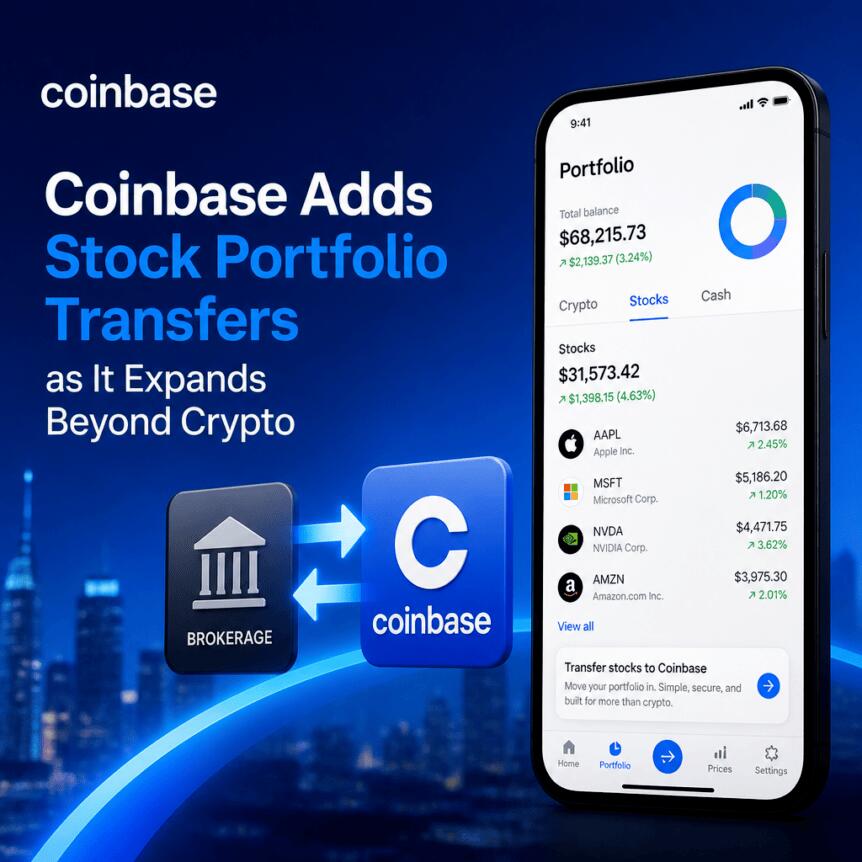
Coinbase is making it easier for US customers to fold traditional markets into the same account they use for crypto. On Tuesday, the company said it now lets users transfer existing stock and ETF portfolios from other brokerages into Coinbase Advanced, its platform aimed at active traders.
The move extends Coinbase’s earlier stock and exchange-traded fund (ETF) push, which began earlier this year with access to about 6,000 securities. Coinbase says the new capability enables a direct portfolio transfer rather than requiring users to sell holdings elsewhere and recreate positions on the Coinbase platform.
Key takeaways
- Coinbase Advanced now supports portfolio transfers of stocks and ETFs via ACATS, allowing holdings to move without selling.
- The rollout builds on Coinbase’s earlier stock and ETF trading launch, expanding beyond an initial selection of roughly 6,000 securities.
- Coinbase continues to package market tools for active users, including TradingView charting and fractional share availability.
- The company’s broader trading expansion includes options, thematic equity index perpetual futures, pre-IPO perpetuals, and expanded prediction markets, with some items outside the US.
- Coinbase’s non-crypto expansion comes as its earnings have continued to track crypto market conditions, highlighting the need for more diverse revenue streams.
Portfolio transfers: the practical upgrade for US users
Coinbase’s announcement is notable not only because it adds more tradable assets, but because it targets an operational friction point for users: the hassle of moving money and rebuilding portfolios. According to a Coinbase spokesperson, transfers into Coinbase can be executed through the Automated Customer Account Transfer Service (ACATS), which supports the movement of securities and cash between brokerages without requiring the positions to be sold.
For users, this matters because it lowers the barrier to consolidation. Instead of opening a new brokerage account, selling and re-buying shares, and potentially triggering taxable events or disrupting long-term holdings, customers can shift existing portfolios into Coinbase Advanced in a more streamlined way.
Coinbase is also positioning the service with active-trader features. The company said the platform offers zero-commission trading, TradingView charting tools, fractional shares, and rewards of up to 3.5% on eligible USDC balances.
Beyond crypto: Coinbase’s effort to become a multi-asset platform
Coinbase’s latest stock and ETF capabilities reinforce a strategy that has been steadily expanding: turning the exchange from a primarily crypto-focused venue into a broader financial platform. In Tuesday’s update, Coinbase said the services are designed to compete more directly with mainstream brokerages and fintech apps by letting users manage stocks, ETFs, and cryptocurrencies from a single account.
That “single account” approach is increasingly important as users look for convenience and integrated workflows—especially those who already trade multiple asset classes. By aligning stock trading mechanics with crypto access, Coinbase is effectively trying to remove the need for parallel accounts and separate user experiences.
Still, the scope of Coinbase’s offering is not confined to cash equities. The company also outlined additional trading expansions, indicating it intends to broaden its derivatives lineup and expand where tokenized securities are available.
What else Coinbase is expanding: options, perpetuals, and prediction markets
Alongside the stock and ETF transfer feature, Coinbase detailed further upgrades to its trading offerings. The company said it is working on crypto and stock options, thematic equity index perpetual futures, pre-IPO perpetuals, and expanded prediction markets.
Coinbase also stated that tokenized stocks will be available to customers outside the United States starting next month. Some features are available immediately, while others are expected to roll out over the coming months, though Coinbase did not provide specific timelines for each item.
This sequencing suggests Coinbase is prioritizing assets and infrastructure that can be introduced quickly while continuing to build out longer-horizon products such as specialized perpetual structures and tokenized equity access beyond the US market.
Why it matters now: Coinbase’s earnings still follow crypto cycles
Coinbase is pushing deeper into stocks and ETFs at a time when investors are focused on how resilient the company’s business is beyond digital asset volatility. Coinbase’s financial results have frequently mirrored crypto price movements, and the company’s expansion appears designed to reduce dependence on trading activity tied strictly to cryptocurrency cycles.
Earlier coverage from CNBC reported that Coinbase delivered stronger-than-expected fourth-quarter 2024 earnings, with a post-election rally contributing to a 130% jump in revenue. More recently, Coinbase posted a surprise loss in the first quarter of 2026 after weaker cryptocurrency prices weighed on trading activity, according to reporting by MSN. In that period, Coinbase reported a loss of $1.49 per share on $1.41 billion in revenue, missing analysts’ expectations of 27 cents per share on $1.52 billion in revenue.
Spot crypto trading remains Coinbase’s primary source of revenue, but expanding into stocks, ETFs, and additional derivatives could help diversify income streams. Even if crypto remains dominant, broadening the product set can matter in two ways: it can attract users who want multi-asset exposure and it can potentially stabilize demand when one market segment cools.
At the same time, investors should be attentive to how quickly Coinbase’s stock and ETF business gains traction relative to crypto. The company’s roadmap includes ambitious products beyond spot markets, but the practical impact will likely depend on adoption, liquidity, and the rate at which new offerings roll out.
For now, the portfolio transfer feature is a tangible step: it lowers switching costs for stockholders who also trade crypto. The next question is how Coinbase’s broader multi-asset trading suite—especially options, perpetuals, and tokenized stocks outside the US—will scale over the coming months, and whether that scaling visibly offsets the ups and downs driven by crypto price swings.


[PRESS RELEASE – BELIZE City, Belize, June 16th, 2026]
BC.GAME is integrating Polymarket, the world’s largest prediction market, to launch a new Prediction Center across sports, crypto and real-world event.
BC.GAME today announced the launch of its new Prediction Center, powered by Polymarket, bringing prediction markets directly into the BC.GAME platform. Through the new Prediction Center, users will be able to explore and participate in prediction markets related to sports events, crypto asset prices and major real-world events within BC.GAME.
Polymarket is one of the world’s largest prediction market platforms and one of the most representative crypto-native consumer applications in recent years. It turns news, market sentiment and collective judgment into real-time prices, allowing users to express their views on future outcomes through market activity. Polymarket covers topics across sports, crypto, politics, culture, global events and more.
What’s New
Through the Prediction Center, powered by Polymarket, BC.GAME users can explore and participate in multiple types of prediction markets, including:
- Sports-related predictions
- Crypto asset price predictions, including BTC, ETH and SOL
- Predictions around major events and market trends
Users can move from watching sports and following market movements to participating in prediction markets without leaving BC.GAME. This makes prediction markets part of the BC.GAME experience, rather than a separate external tool.
Why It Matters
Prediction markets are becoming one of the most important consumer applications in crypto.
Unlike traditional sports betting, which is mainly built around match outcomes, or standard market tools, which simply display price movements, prediction markets turn “what do you think will happen?” into an activity that can be priced by the market in real time. For users following sports, crypto and global events, this creates a faster and more engaging way to participate.
By integrating Polymarket’s infrastructure, BC.GAME adds a new interaction layer beyond sportsbook and casino games. Users are not only watching or placing bets; they can also form views on real-world events and express those views through prediction markets.
The integration also makes BC.GAME’s 2026 football season experience more complete. As global football momentum continues to build, users can interact around match progress, team performance and related market movements, instead of only focusing on pre-match bets or final results.
A More Complete Crypto Entertainment Layer
BC.GAME has continued to extend its crypto-first product experience across entertainment and sports. From crypto payments and sportsbook to the BC Engine rewards mechanism, the platform is building a more complete user participation loop.
The Prediction Center, powered by Polymarket, adds a mature, market-driven interaction layer to that loop.
“Polymarket has already shown that prediction markets can become one of crypto’s truly mainstream consumer applications,” said Kar Kheng Giam, CEO of BC.GAME. “Through this integration, we are bringing that mature experience seamlessly into BC.GAME, allowing users to follow sports, track markets, make predictions and take part in more real-time interaction all in one place.”
About BC.GAME
BC.GAME is a crypto iGaming platform offering sportsbook, casino, crypto payments and reward-driven user experiences across multiple markets where permitted.
About Polymarket
Polymarket is the world’s largest prediction market, allowing users to trade on the outcomes of real-world events across sports, crypto, finance, politics, culture and more. Its markets reflect real-time probabilities based on user activity and market pricing.
The post BC.GAME Launches Prediction Center, Powered by Polymarket appeared first on CryptoPotato.
A bipartisan group of US senators led by Republican Senator Cynthia Lummis has urged the Treasury to ensure that state authorities are given the ability to regulate stablecoin issuers as the department considers how to implement the GENIUS Act.
In a letter to Treasury Secretary Scott Bessent on Tuesday, the lawmakers said it was critical that the Treasury implement a section of the law giving a pathway for certain issuers to be regulated by the states “in a manner that preserves and promotes State participation.”
The GENIUS Act allows issuers that have a stablecoin with a market value of $10 billion or less to be regulated by a state authority if that state has laws largely similar to the bill.
Currently, that would mean all stablecoins but three, Tether (USDt), USDC (USDC) and USDS (USDS), formerly Dai (DAI), could be regulated by the states, as all have a market value above $10 billion, according to CoinGecko.
In April, the Treasury sought public input for how it plans to implement the GENIUS Act at the state level, rules that President Donald Trump signed into law in July that regulate stablecoins and their issuers.
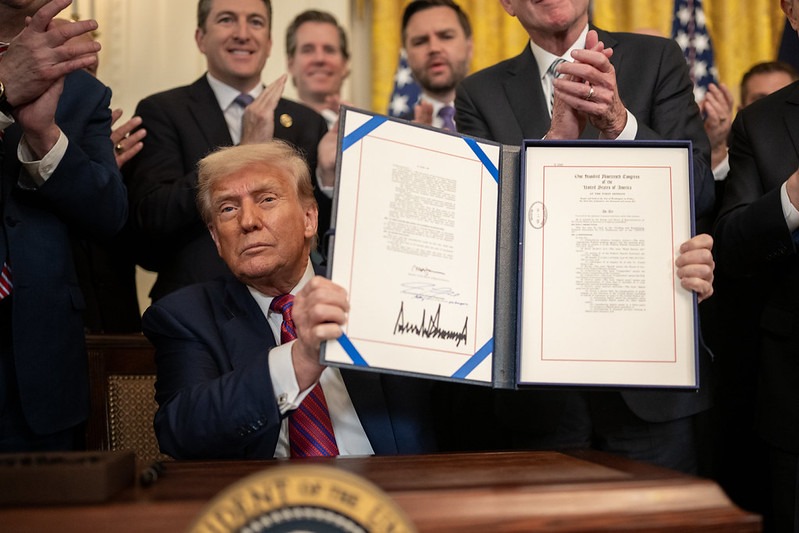
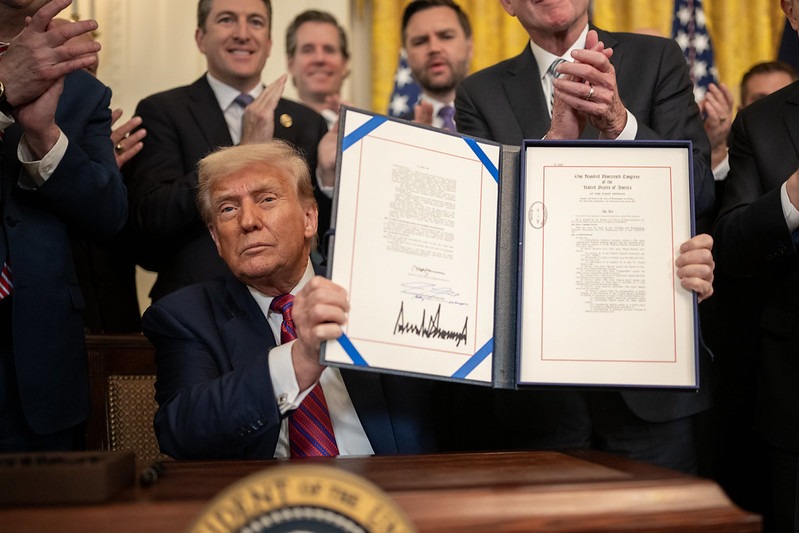
President Donald Trump signing the GENIUS Act in July 2025. Source: The White House
“Congress clearly sought to preserve the dual banking system and the crucial role of State banking agencies in supervising this market,” the senators said in their letter.
They added that the Treasury’s proposal “did not address the timeline and procedural requirements related to State certification.” They argued this created “uncertainty for States” and could be interpreted as the process being “a one-time window that effectively bars future certifications.”
The lawmakers said that state legislatures vary, and a flexible certification framework was needed to ensure that states can participate when they have rules implementing the GENIUS Act.
Related: Anchorage backs Treasury’s GENIUS AML rules, seeks secondary-market sanctions clarity
“States must be able to develop and seek certification of stablecoin regulatory regimes as demand for these charters materializes and as legislative schedules permit,” the letter said.
Republican Senators Bill Hagerty, Kevin Cramer and Pete Ricketts, along with Democratic Senators Kirsten Gillibrand, Angela Alsobrooks, and Catherine Cortez Masto, also signed the letter.
Public comments on the Treasury’s proposal closed on June 2, and it will now draft a final rule for publication in the Federal Register.
Magazine: Guide to the top and emerging global crypto hubs: Mid-2026


State Street has launched a government money market fund tailored for stablecoin issuers as new U.S. regulations begin to define how reserve assets can be managed under the GENIUS Act.
Summary
- State Street launches a stablecoin reserve fund designed to comply with GENIUS Act requirements.
- Anchorage Digital and State Street Bank back the new money market fund for stablecoin issuers.
- State Street projects global stablecoin issuance could reach $1.9 trillion to $4 trillion by 2030.
According to State Street, the newly introduced State Street Stablecoin Reserves Money Market Fund is structured as a registered Rule 2a-7 government money market fund and is designed to help stablecoin issuers meet reserve requirements established under the Guiding and Establishing National Innovation for U.S. Stablecoins (GENIUS) Act, which became law in July 2025.
The product represents one of the earliest efforts by a major traditional asset manager to create an investment vehicle specifically aligned with the federal stablecoin framework. State Street Bank and Trust Company and crypto-focused bank Anchorage Digital are serving as initial backers of the fund.
Commenting on the launch, State Street Chief Executive Officer Yie-Hsin Hung said:
“With the GENIUS Act, a clear framework has been established for how stablecoin reserves can be invested.”
Hung added that the firm’s cash management business has historically focused on principal preservation, liquidity, and income.
Stablecoin issuers gain new reserve option
For stablecoin companies, reserve quality is becoming increasingly important as regulatory standards evolve.
Anchorage Digital co-founder and Chief Executive Officer Nathan McCauley described stablecoins as core financial infrastructure and said reserve management will play a larger role as the sector expands.
According to McCauley, the fund combines State Street Investment Management’s experience in cash management with Anchorage Digital’s regulated digital asset infrastructure under the new regulatory framework.
The launch arrives as large financial institutions continue introducing products tied to tokenized cash and digital asset settlement. Earlier this year, JPMorgan unveiled a similar fund structure intended to place stablecoin reserves on-chain.
BlackRock has also entered the segment through a tokenized money market fund that provides an option for stablecoin-related liquidity management.
Recent activity suggests State Street has been steadily building its digital asset presence. As reported by crypto.news in January, the firm unveiled a platform supporting tokenized deposits, stablecoins, and crypto-backed funds for institutional clients.
At the time, the Boston-based custodian said it planned to develop and manage money market funds and exchange-traded funds alongside its asset management division and third-party managers.
The announcement followed State Street’s December 2025 partnership with Galaxy Digital to launch a tokenized fund for institutional investors.
Stablecoin market growth attracts major institutions
State Street’s latest launch comes as market participants project significant growth in stablecoin issuance over the coming years.
According to estimates cited by the company, global stablecoin issuance could grow to between $1.9 trillion and $4 trillion by 2030. The forecast has encouraged both traditional financial firms and crypto-native companies to develop infrastructure designed to support reserve management, liquidity, and settlement services.
Alongside the new reserve fund, State Street recently introduced the State Street Galaxy Onchain Liquidity Sweep Fund, or WEEP, a tokenized liquidity vehicle built to support around-the-clock on-chain cash management.
Institutional interest in digital assets has also appeared in other parts of State Street’s portfolio. In May, regulatory filings showed the firm increased its exposure to Bitcoin-focused asset manager Strive Asset Management by approximately 770% after purchasing nearly one million shares of the company’s publicly traded stock.
The transaction was valued at roughly $17.7 million and lifted State Street’s total stake to nearly one million shares, according to the filing.
Binance has launched tokenized SpaceX shares as trading demand pushes the company’s valuation above $3 trillion and drives a surge in SpaceX-linked crypto products.
Summary
- Binance launched SpaceX bStocks with zero maker fees and automated trading support.
- SpaceX perpetual futures are now Binance’s second-most traded derivatives product after Bitcoin.
- SpaceX stock surged 12%, lifting the company’s valuation above $3 trillion.
According to a June 12 announcement from Binance, the exchange has listed SPCXB, a tokenized version of SpaceX stock, on its spot market, with trading for the SPCXB/USDT pair going live at 17:00 UTC.
Binance also enabled automated trading tools for the new pair from launch and introduced a zero maker fee promotion that will remain in effect through the end of August 2026.
A few days after trading opened, deposits and withdrawals for the token became available, allowing users to move the asset on and off the platform.
The listing arrives as investor interest in SpaceX-related products continues to grow across both traditional and crypto markets. According to Binance data cited in its announcement, the exchange now controls more than 60% of the market for SpaceX perpetual futures trading.
SpaceX products dominate Binance trading activity
Activity in derivatives markets has increased even faster than spot demand. Binance data shows that its SPCXUSDT perpetual futures contract has become the second-most traded futures product on the platform, ranking behind only Bitcoin futures.
The rapid rise in trading volumes highlights strong demand from traders seeking exposure to SpaceX through crypto-native products. Binance has increasingly expanded its tokenized equity lineup as investors look for alternative ways to access high-profile technology and private-market companies.
Recent additions to the exchange’s bStocks program include tokenized versions of Circle, Nvidia, Tesla, Micron, and Sandisk. The SpaceX launch adds one of the world’s most closely watched private companies to that growing list.
Competition intensifies in tokenized equity markets
The rollout also comes shortly after rival exchanges encountered difficulties offering SpaceX-linked tokenized products.
As previously reported by crypto.news, Coinbase recently launched tokenized shares backed one-for-one by underlying stock for companies including SpaceX, Nvidia, Google, Strategy, and Bitmine.
According to Coinbase, those assets provide direct ownership rights, allow holders to receive dividends linked to the underlying shares, and can be bought, sold, redeemed, and held on-chain.
Coinbase’s launch followed problems faced by competing platforms during the highly anticipated SpaceX public listing. Binance and Bybit had earlier promoted SpaceX-related tokenized offerings, but those initiatives were later withdrawn after tokenization provider xStocks failed to deliver the underlying SPCX shares required to support the products.
Positioning its own service differently, Coinbase stated that its infrastructure was designed to support ownership rights and dividend payments through fully backed tokenized equities.
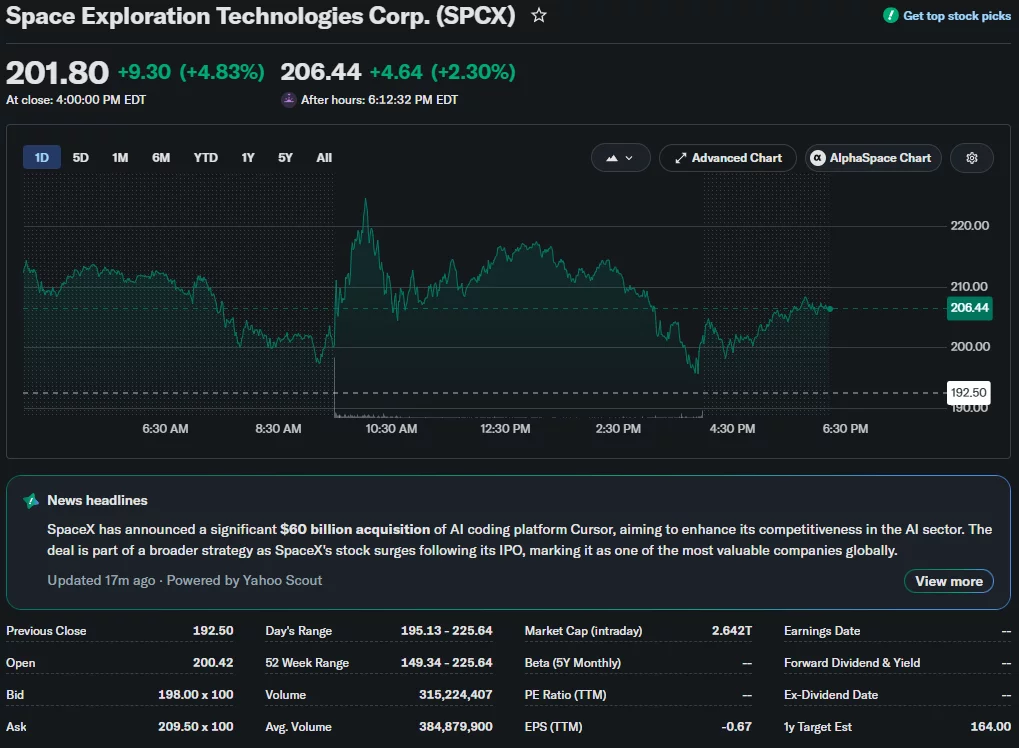
Meanwhile, enthusiasm surrounding SpaceX remained strong. According to Yahoo Finance data, SpaceX shares traded around $206.44, up roughly 5% on the session after earlier climbing as much as 17.2% to an intraday high of $225.64. The stock also touched a session low of $195.13 before giving back part of its gains.
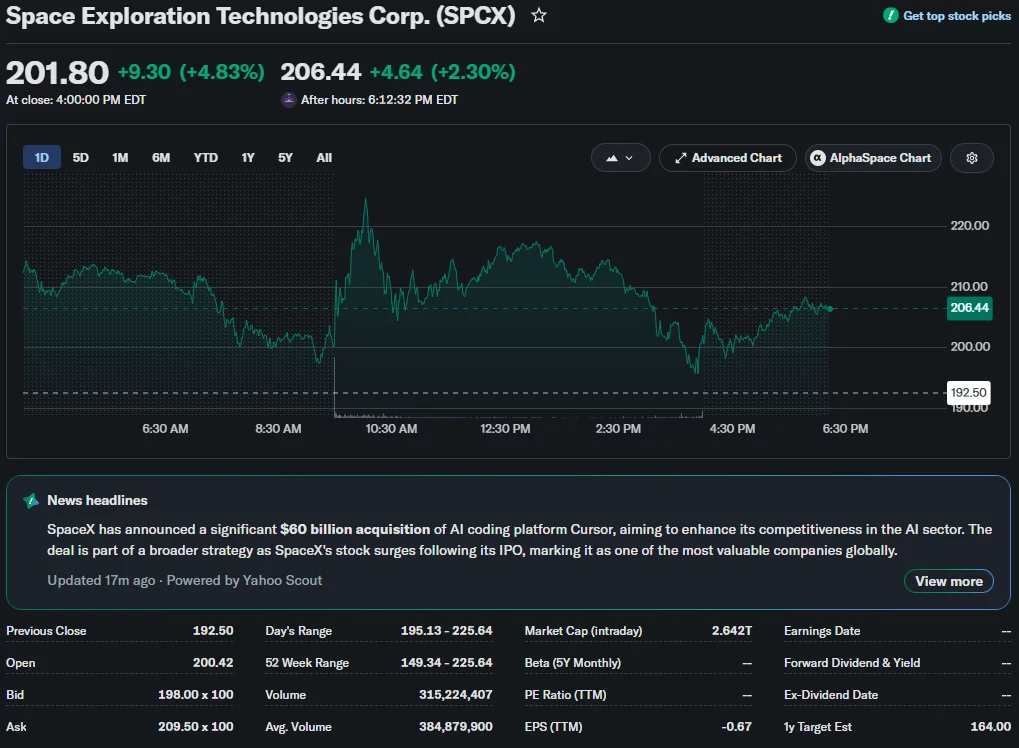
The move briefly lifted SpaceX’s valuation above $3 trillion, extending the gains recorded since its public market debut and further increasing the value of Elon Musk’s stake in the company.
Disclosure: This article does not represent investment advice. The content and materials featured on this page are for educational purposes only.
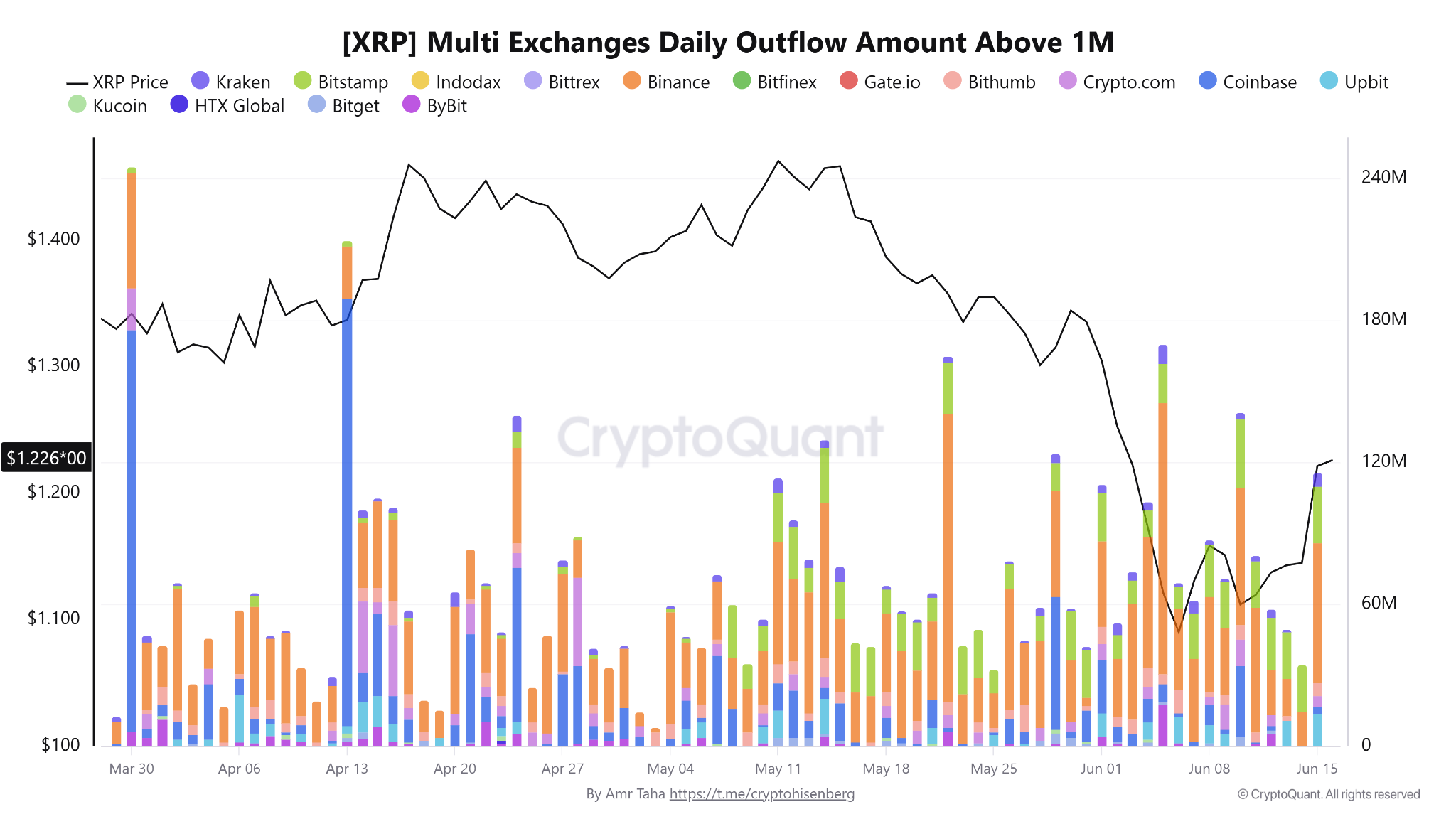
Since June 3, more than 720 million XRP (XRP) tokens have left crypto exchanges, and Upbit’s share of XRP wallet flows has climbed to its highest level since May 2024.
The shift comes as XRP rebounded to $1.30 on Monday, with large holder activity continuing to dominate exchange flows and market indicators signal an ideal accumulation period amid lingering weakness.
Whales dominate XRP exchange flows
Data from CryptoQuant shows that XRP’s multi-exchange daily outflow indicates repeated withdrawals of more than 1 million XRP per transaction. Between June 3 and June 14, major crypto platforms recorded roughly 722 million XRP in large daily outflows, highlighting the most sustained activity from whale-sized wallets since early February. Binance whales led the outflows, with 425 million XRP.
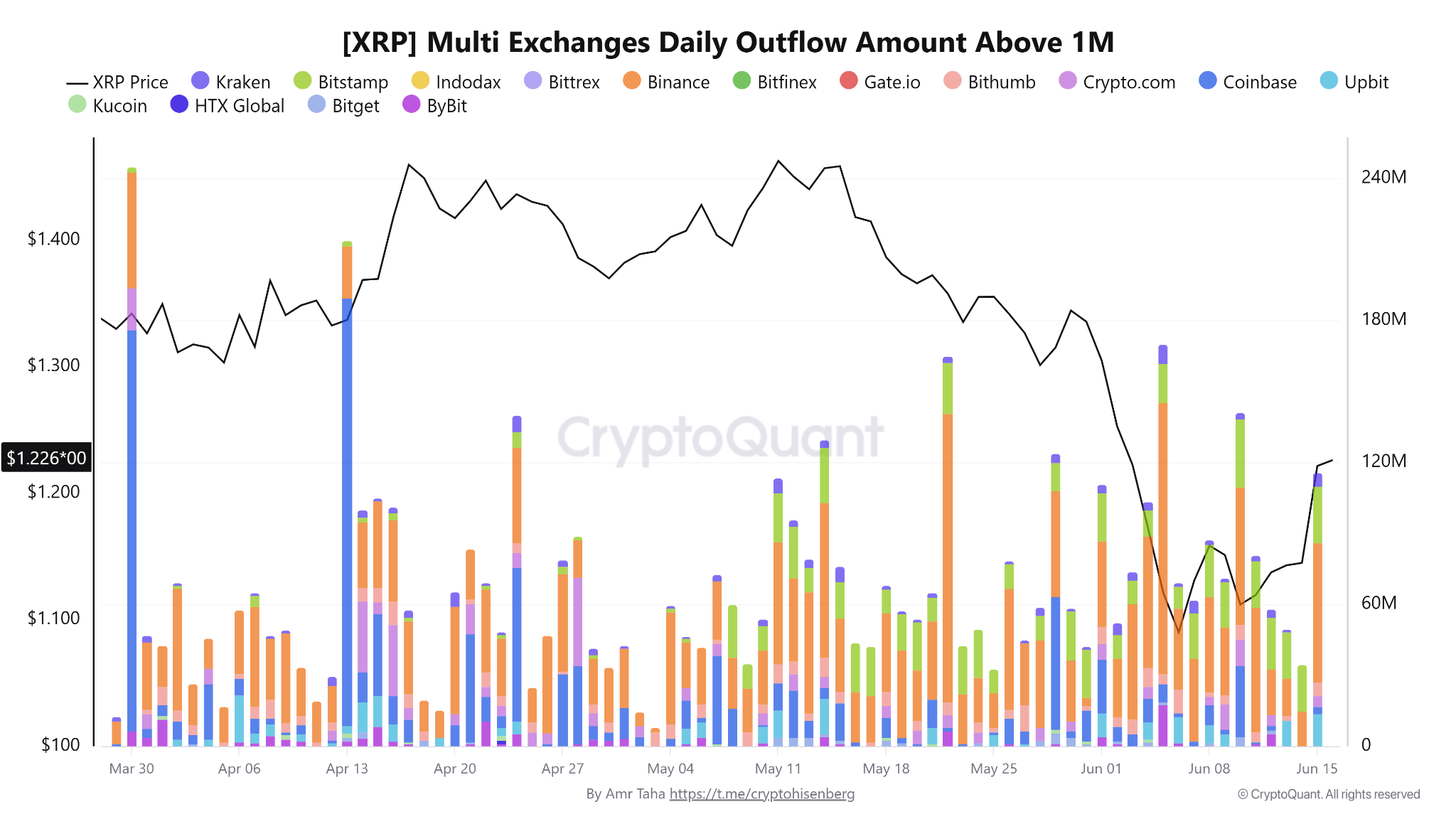
XRP exchange daily outflows above 1 million tokens. Source: CryptoQuant
While large withdrawals do not confirm accumulation, they reduce the amount of XRP immediately available for sale on exchange order books.
A separate exchange-flow metric points to a growing concentration of XRP wallet activity on Upbit. According to crypto analyst Amr Taha, Upbit’s XRP net wallet flow dominance climbed to 31% on June 14, up from 13% a week ago, its highest level since May 2024.
Taha said XRP’s 5% rebound to $1.30 on Monday coincided with a clear rotation toward Upbit. Deposit-wallet activity became increasingly concentrated on the South Korean exchange while several major platforms lost market share.
Another Binance metric shows whales continue to dominate XRP outflows. The Binance Whale vs. Retail Spread measures the difference between whale-sized withdrawals of 100,000 XRP or more and retail-sized withdrawals below that threshold.
The spread currently stands near 90%, indicating that large holders still account for the majority of XRP outflows on Binance. Last month, Taha noted that repeated declines toward the May 2024 range suggested a shift in Binance’s withdrawal profile from the 2024-2025 bullish period.
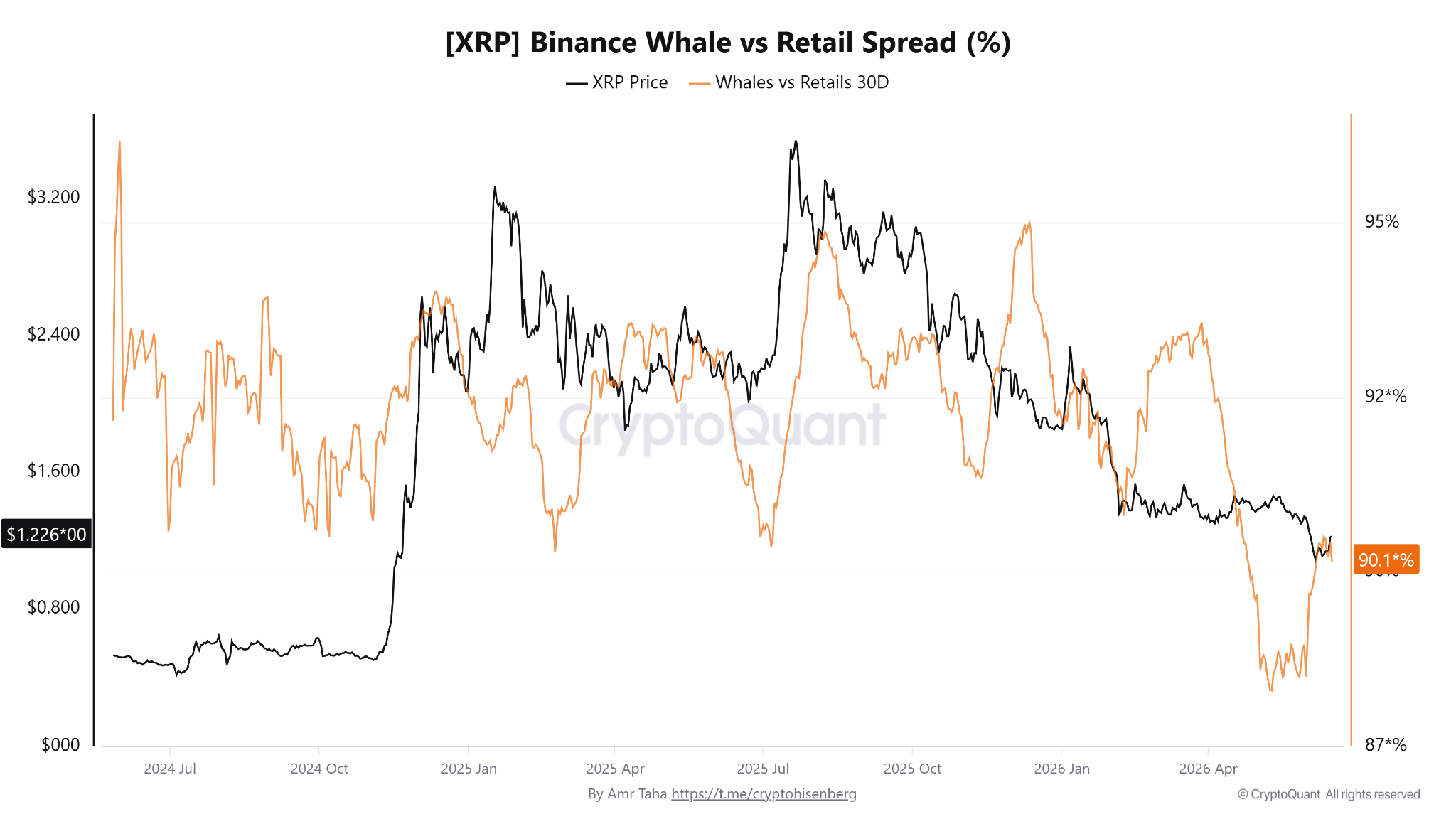
XRP’s Binance whale vs. retail spread (%). Source: CryptoQuant
While the indicator should not be viewed as a direct bullish or bearish signal, the analyst said that it tracks withdrawal behavior rather than exchange selling activity.
Related: Trump crypto company’s USD1 stablecoins backing UFC event bonuses
XRP Sharpe ratio stays below zero: What does it mean?
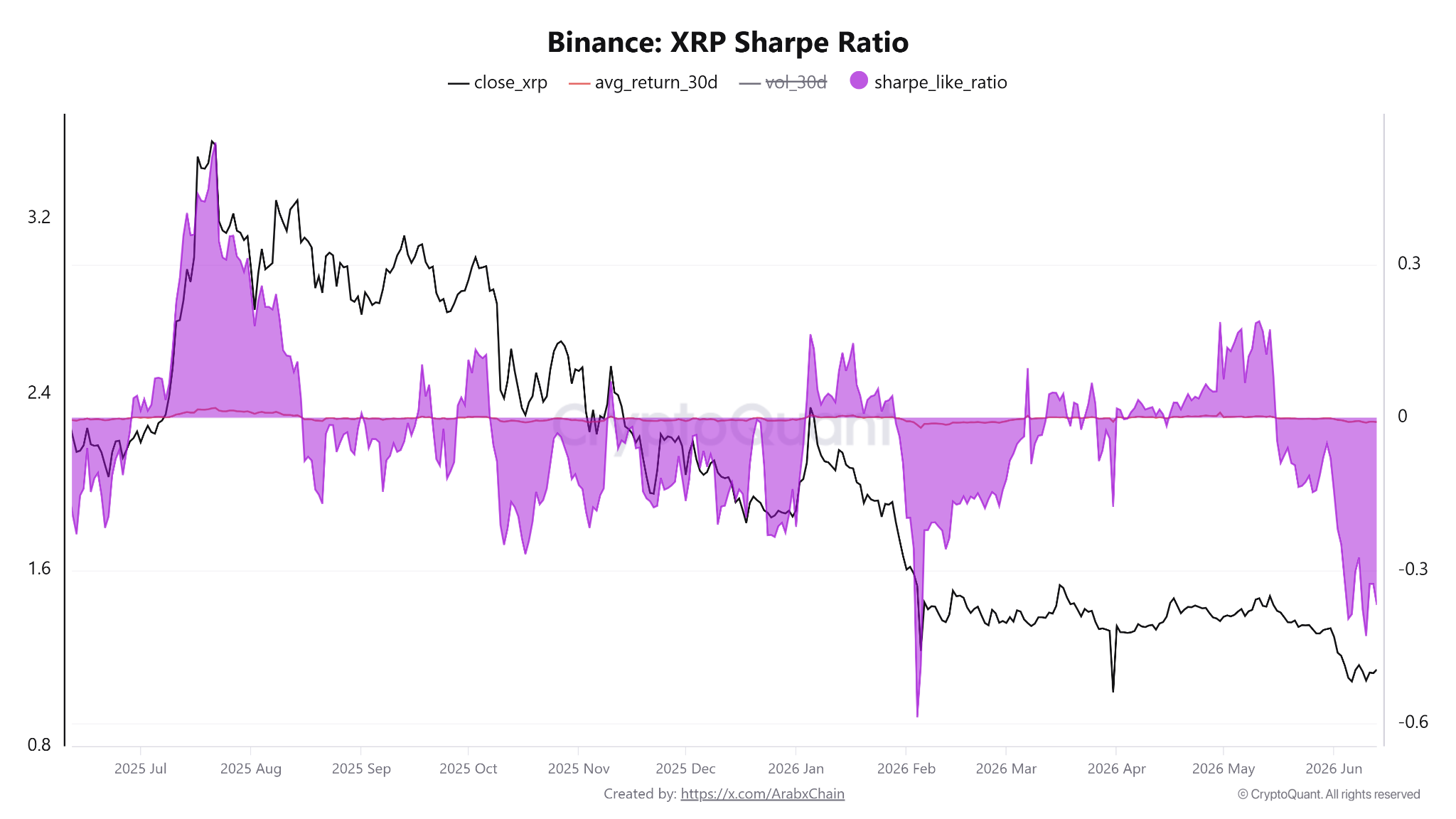
XRP’s Sharpe ratio remains in negative territory, a zone that has historically aligned with bearish consolidation phases for the asset.
This metric evaluates returns relative to volatility, helping assess whether investors are adequately compensated for the risk they take. XRP recorded a Sharpe ratio of -1.097 in September 2022 when the token traded near $0.33. The cycle later peaked near 2.07 in January 2025 as XRP approached $3.14.
XRP Sharpe ratio. Source: CryptoQuant
The current reading stands near -0.36, dropping from a positive ratio of 0.18 in May. According to CryptoQuant, XRP has historically produced some of its strongest gains when the Sharpe ratio was negative. The average returns during those periods exceeded 50%, while gains often moderated once the ratio entered positive territory.
However, in April, market analyst Teddy said deep negative Sharpe readings for XRP often coincide with periods of “market pain” rather than efficient trends. Those phases have historically created conditions associated with long-term accumulation zones, but further downside remains possible.
Related: Bybit expands RWA push with tokenized bond funds from PIMCO, CMBI
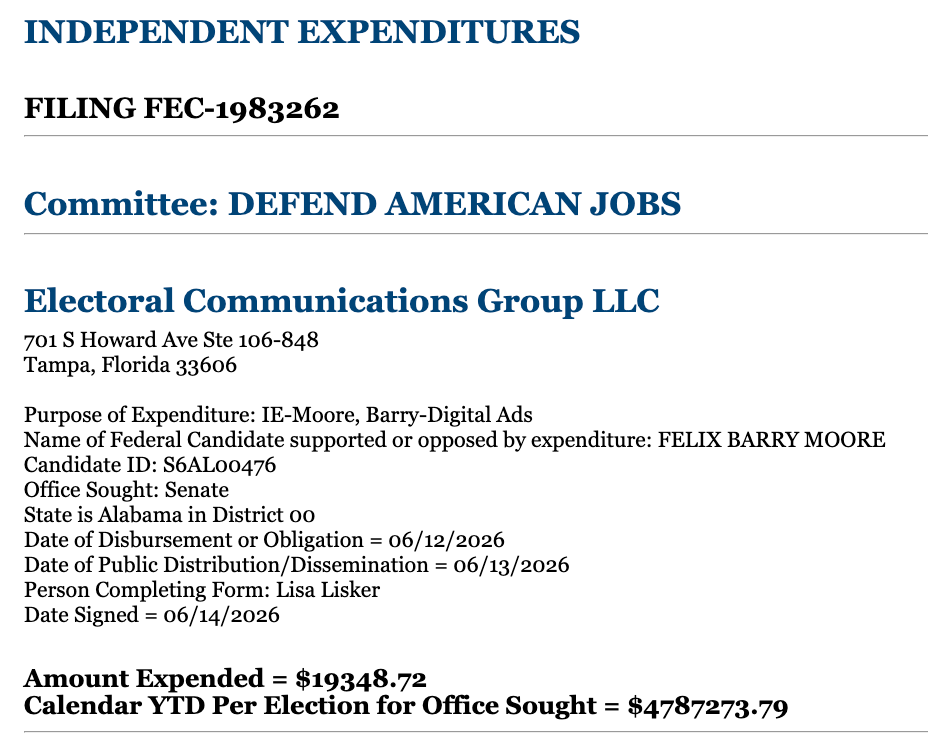
Defend American Jobs, the cryptocurrency company-backed political action committee (PAC) affiliated with Fairshake, reported spending millions of dollars to support a Republican candidate’s run for a US Senate seat in the party’s Tuesday primary runoff in Alabama.
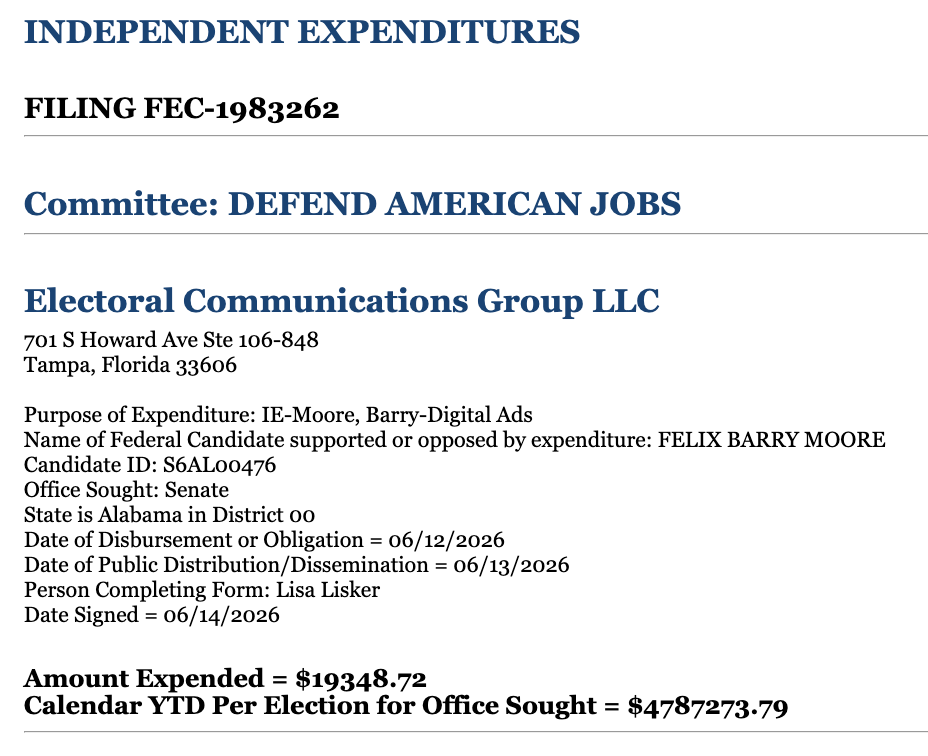
As of Tuesday, filings with the Federal Election Commission (FEC) showed that Defend American Jobs had spent more than $4.7 million on media and ads to back Republican Barry Moore’s candidacy in a runoff for one of Alabama’s US Senate seats, adding to the $7.4 million it reported spending ahead of his May 20 primary. Moore, who also has the endorsement of US President Donald Trump, is running against Jared Hudson, another Republican vying to replace Tommy Tuberville, who announced that he would not be seeking reelection, as he is focused on becoming the state’s next governor.
Source: Federal Election Commission
The Coinbase-affiliated advocacy organization Stand With Crypto rated Hudson as “neutral” on crypto policy compared to Moore’s “strongly supports crypto,” based on public statements and Moore’s voting records while representing Alabama’s 1st Congresssional district. Hudson publicly acknowledged that “Big Crypto” did not back his candidacy, but he has supported the crypto market structure bill under consideration in the US Senate.
The Alabama runoff will be another test of the crypto industry’s influence in US elections, with Fairshake and its affiliates having already poured millions of dollars into media for candidates facing primaries in Texas and California. Following Tuesday’s vote in Alabama, the PACs will also have stakes in Maryland and New York later this month, backing Democrats Adrian Boafo and Ritchie Torres with about $5 million and $500,000 in media buys for House seats, respectively.
Related: Crypto PAC-supported candidates sweep US state primaries after media buys
The Blockchain Leadership Fund, a hybrid PAC backed by Anchorage Digital and Chainlink, announced its support for Moore in May, but FEC filings showed no related expenditures as of Tuesday. The Fellowship PAC, another PAC backed by $11 million from Cantor Fitzgerald and Anchorage, disclosed $350,000 in spending to support Moore’s run.
Fairshake reported holding a $193 million war chest as of January, setting the stage for significant potential influence in this year’s US House and Senate races. The PAC has publicly stated its intention to “oppose anti-crypto politicians and support pro-crypto leaders” through media and ads.
Majority control of Senate can determine passage of crypto-related bills
With Democrats having been in the minority in both the House and Senate in the current session of Congress, the party is fighting to regain control of both chambers starting in 2027. Republicans currently hold a slim majority on both sides of the Capitol, enabling them to set the agenda for policies, including crypto-related legislation like the Digital Asset Market Clarity (CLARITY) Act. The bill passed the House in July 2025 but has faced delays in the Senate amid debates over stablecoin rewards, ethics and tokenized equities.
Magazine: China’s 107 Bitcoin memory thief, Bithumb CEO booked: Asia Express
Crypto World
Peter Schiff Calls Bitcoin ‘Digital Nothing’ as He Goes Head-to-Head With Anthony Pompliano

Peter Schiff insists that Bitcoin’s bubble has burst following its steep fall from an October 2025 all-time high of $126,000.
However, investor Anthony Pompliano defended the cryptocurrency’s long-term performance and argued that volatility is part of what has driven its returns.
Schiff Makes the Bear Case, Pompliano Leans on the Long Game
The two faced off Monday evening on Fox Business in a live debate moderated by Liz Claman, where Schiff opened by claiming that BTC was a “digital nothing” and calling it a pyramid scheme in which early holders have been cashing out on the wave of demand generated by ETFs and Bitcoin treasury companies led by Michael Saylor’s Strategy.
“All the hype, all of the Bitcoin treasury companies, all of the ETFs, all that buying has simply allowed the people who got in early to cash out,” said Schiff to Claman.
According to him, those buying Bitcoin were only acting on the expectation that “somebody else is going to buy it at a higher price,” an approach he contrasted with gold, which he described as a physical asset with industrial and monetary use.
The economist also claimed that the OG crypto has “no real long-term,” arguing that it was barely higher than where it was five years ago, and framed that sideways drift as evidence of a market that was running on fumes rather than real demand. Gold, on the other hand, in Schiff’s estimation, is in a longer-term bull market, with the analyst suggesting that its recent pullback from $2,600 was due to a classic “buy the rumor, sell the fact” move after an overextended run linked to geopolitical risk pricing.
However, Pompliano, wearing a gold tie in a pointed nod to Schiff, pushed back on that framing and pointed out that Bitcoin’s 10-year compound annual growth rate of around 55% to 60% was several times bigger than gold’s, which, according to him, stands at approximately 12%. The ProCap CEO also said that volatility wasn’t unique to BTC and should not be thought of as a flaw, as it is a characteristic shared by high-performing assets.
“One of the misconceptions about volatility is that volatility is bad,” Pompliano noted. “But actually what we find is the best returning stocks, the best returning commodities, they are all highly volatile.”
On Strategy and Political Concerns
Of course, a Schiff BTC debate wouldn’t have been complete without throwing shade at Strategy, and the gold bug did not disappoint. He claimed executive chairman Saylor was “sacrificing his own shareholders by destroying value” with the firm’s financial model moving from issuing stocks at premiums to selling shares at discounts and using leverage tools to continue buying Bitcoin.
The company did sell a small amount of Bitcoin recently but returned with a 1,587 BTC buy on June 15, worth $100 million, that took its holdings to 846,842. According to Schiff, the fact that Strategy sold some of its BTC, however small the number, suggests there’s a strain in what he described as its “flywheel” model of perpetual accumulation.
One area of partial agreement between Pompliano and Schiff was political. Pompliano acknowledged that the Trump administration’s backing of crypto represents politicians latching onto donor money rather than principled support, while Schiff was even blunter, calling government involvement in Bitcoin “a serious problem” and describing it as a deliberate misdirection of resources.
The post Peter Schiff Calls Bitcoin ‘Digital Nothing’ as He Goes Head-to-Head With Anthony Pompliano appeared first on CryptoPotato.


Robinhood is cutting roughly 10% of its full-time employees in a corporate restructuring CEO Vlad Tenev has framed as a push for a "high performance culture." In a Form 8-K filed Tuesday with the SEC, Robinhood Markets said the reduction in force covers approximately 10% of full-time staff, plus… Read the full story at The Defiant


A coalition of federally recognized tribes and Indian regulatory bodies filed amicus briefs in two federal cases this month, arguing that allowing Kalshi and the CFTC to override state gaming laws would equally nullify tribal-state gaming compacts and strip tribes of authority to regulate… Read the full story at The Defiant
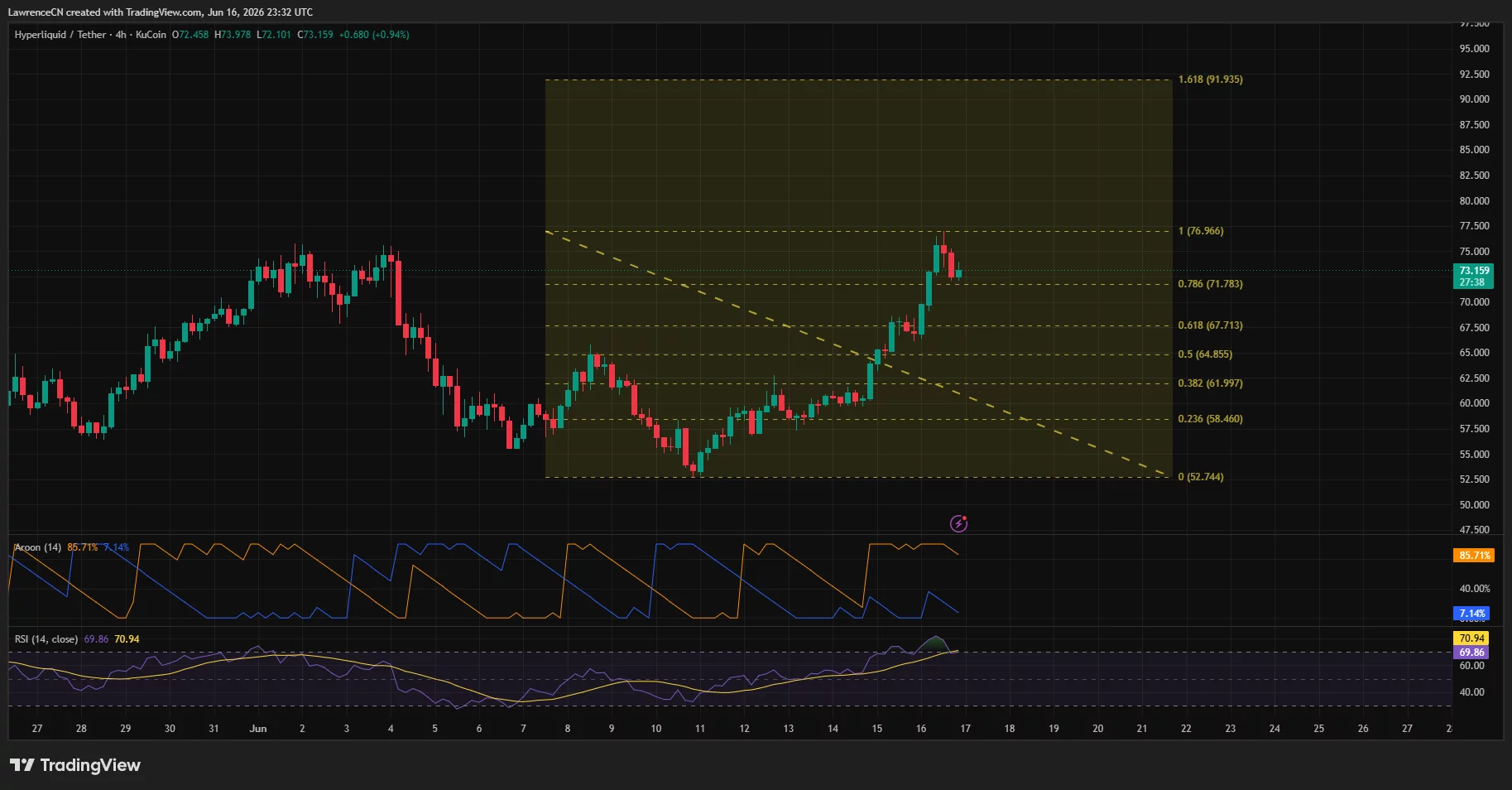
Hyperliquid’s HYPE token has surged to a new all-time high near $76.70 after a combination of ETF-related buying, rising platform activity, and a wave of short liquidations pushed the asset through key resistance levels.
Summary
- HYPE hit a new all-time high of $76.70 after ETF-related buying, short liquidations, and rising demand on Hyperliquid.
- Bitwise purchased 77,100 HYPE tokens worth about $5.2 million, adding fresh spot demand as the protocol continued its buyback-and-burn program.
- SpaceX perpetual futures generated roughly $1.2 billion in weekly volume, helping Hyperliquid capture 8.3% of global perpetual futures open interest.
According to data from crypto.news, Hyperliquid (HYPE) rose nearly 10% over the past 24 hours to a new all-time high of $76.70 on June 16 before stabilizing around $75.50 at press time. The token was up roughly 46% over the past week and more than 90% over the past month as growing platform activity, ETF-related demand, and protocol buybacks continued to support the rally.
Hyperliquid price rallied as asset manager Bitwise purchased approximately 77,100 HYPE tokens worth about $5.2 million to support its newly launched Bitwise Hyperliquid ETF.
The purchase arrived as HYPE was already trading near a major breakout zone, adding fresh spot demand to a market where supply has been steadily reduced through Hyperliquid’s protocol buyback system.
For the uninitiated, Hyperliquid directs 97% of trading fees toward buying and burning HYPE, creating persistent demand for the token. As prices moved above the closely watched $70 level, traders holding leveraged bearish positions were forced to cover, triggering a rapid liquidation cascade that accelerated the rally toward a record high.
Platform activity has strengthened demand
Beyond the ETF purchase, trading activity on Hyperliquid has continued to expand at a rapid pace.
The platform’s SpaceX pre-IPO perpetual futures contract generated roughly $1.2 billion in trading volume during the past week. The contract has attracted substantial trader interest and helped boost overall activity across the exchange.
Growing volumes have translated into higher market share. According to data from CoinGlass, Hyperliquid recently captured about 8.3% of global perpetual futures open interest, with total open interest climbing above $9.6 billion. The same figures indicate annualized protocol revenue has exceeded $1 billion.
Those revenues feed directly into the buyback mechanism that continuously purchases HYPE from the market. As a result, investors have increasingly focused on platform usage metrics alongside token price action.
Recent trading activity has also helped absorb concerns surrounding a scheduled token unlock earlier this month. Roughly $700 million worth of HYPE entered circulation during the event, yet demand generated by exchange activity and protocol purchases proved sufficient to prevent prolonged selling pressure.
Technical structure points to higher resistance levels
Technical indicators have remained supportive despite the sharp advance.
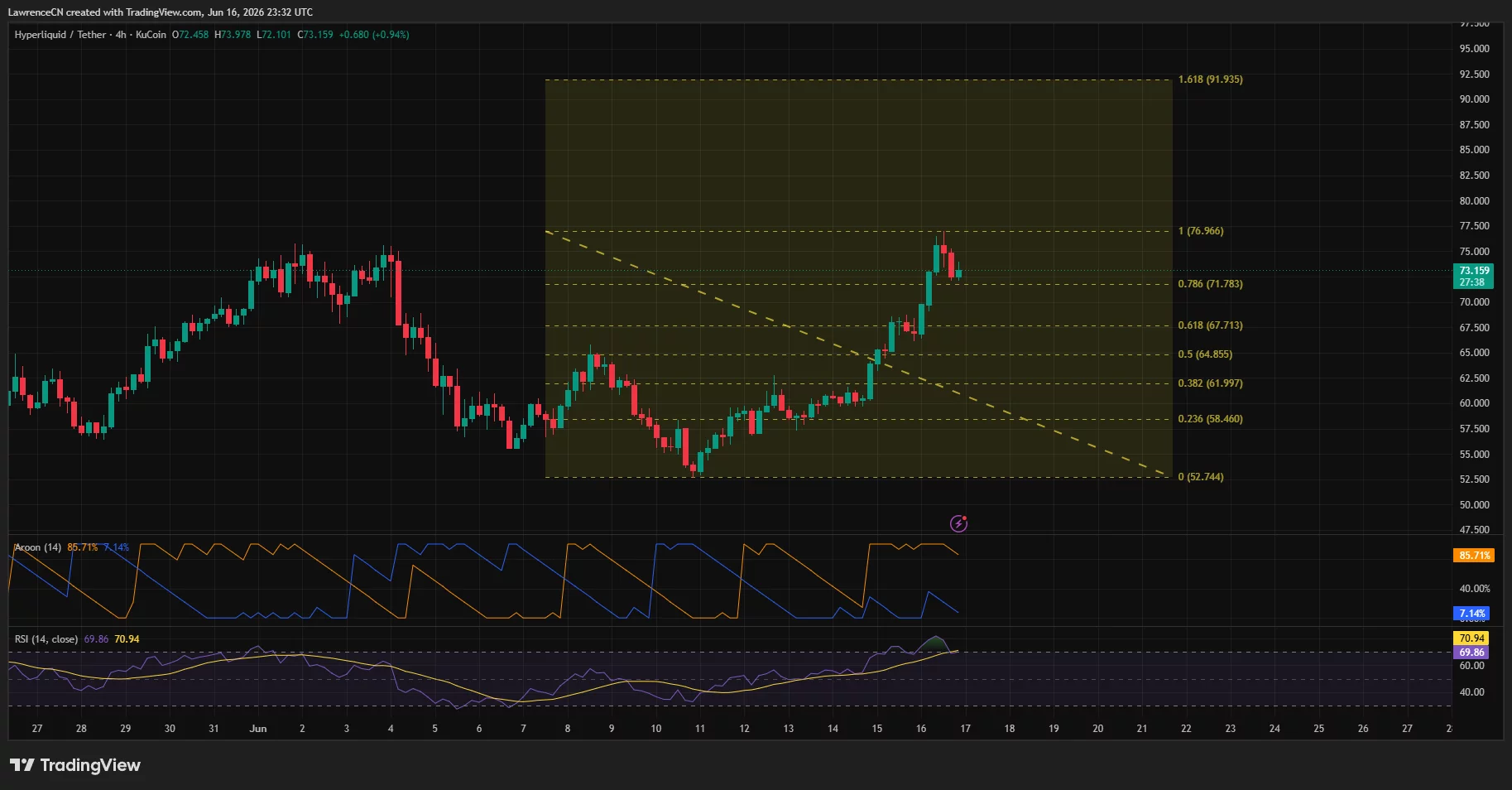
On the four-hour chart, HYPE broke above the 0.618 and 0.786 Fibonacci resistance levels near $67.7 and $71.8 before reaching the 1.0 extension around $77. The next major Fibonacci target is located near $91.9, while former resistance around $71.8 and $67.7 has become an important support area.
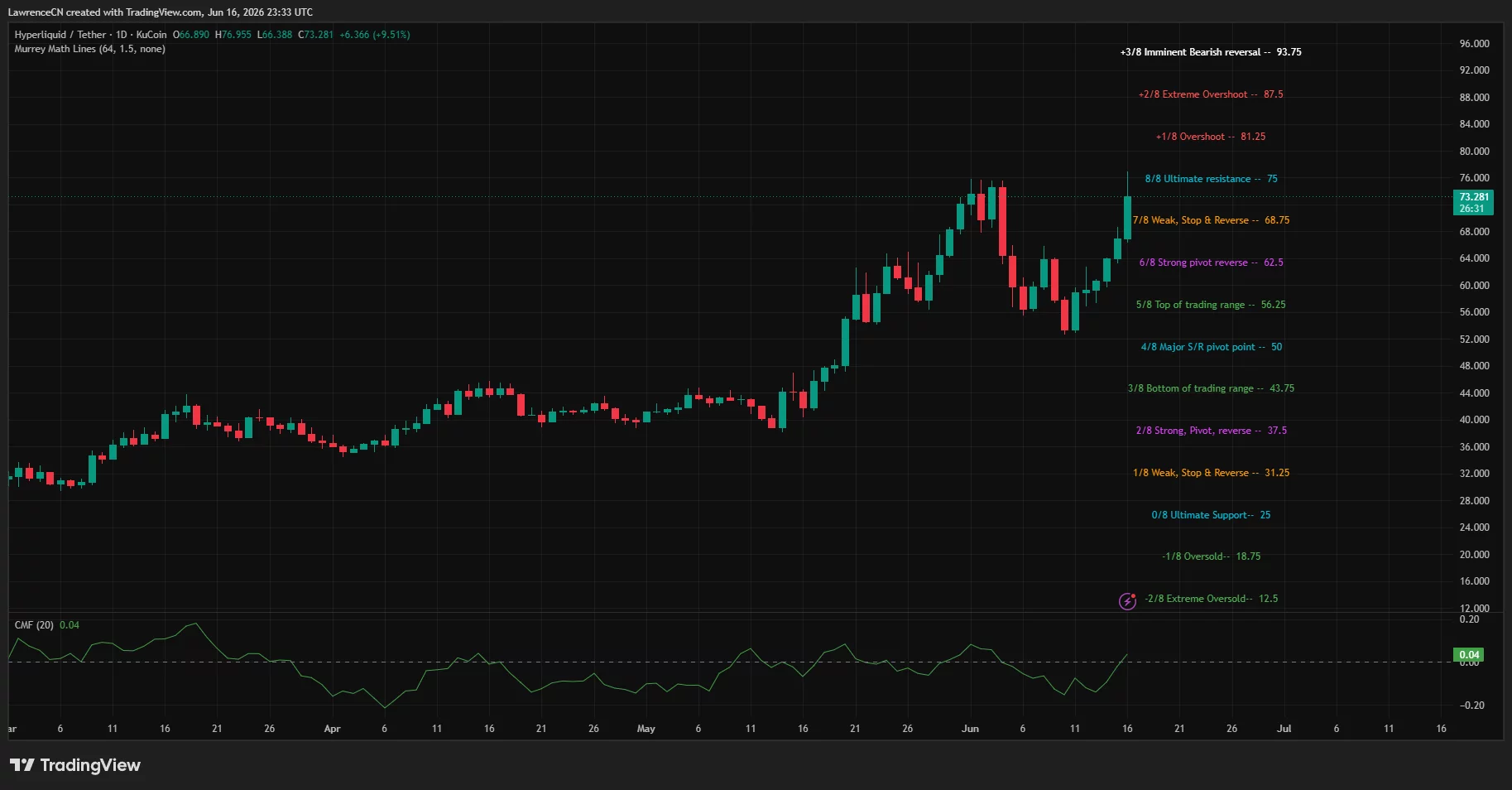
Daily charts show HYPE testing the Murrey Math 8/8 resistance level at $75. A sustained move above that zone could expose the next resistance levels near $81.25 and $87.50, according to the indicator framework. Meanwhile, positive Chaikin Money Flow readings suggest capital continues entering the asset despite profit-taking following the breakout.
Support for the rally has also come from regulatory developments. Commodity Futures Trading Commission Chair Michael Selig recently defended the approval of perpetual futures products through regulated U.S. venues, a position that several market participants interpreted as constructive for decentralized derivatives platforms.
While Bitcoin has been trading in a relatively narrow range ahead of the Federal Reserve’s policy decision under Chair Kevin Warsh, traders have continued allocating capital toward Hyperliquid. The move has helped HYPE separate from the performance of many larger cryptocurrencies and push into the ranks of the market’s largest digital assets by valuation.
Disclosure: This article does not represent investment advice. The content and materials featured on this page are for educational purposes only.

Will ‘ordinariness’ be enough to swing the result in Makerfield?
BC.GAME Launches Prediction Center, Powered by Polymarket

Austria vs. Jordan prediction, odds, spread, line, start time: 2026 World Cup picks


-

 Business2 days ago
No Jackpot Winner as $257 Million Prize Rolls Over to $269 Million Monday Draw
-

 Crypto World5 days ago
Oppenheimer backs SpaceX as $70 billion retail frenzy builds
-

 Fashion4 days ago
Weekend Open Thread: Tuckernuck – Corporette.com
-

 Crypto World5 days ago
Markets Rally as SpaceX IPO Looms Amid Iran Tensions and Inflation Surge
-
 Crypto World2 days ago
Zimbabwe Requires Crypto Businesses to Register Annually Under New FIU Regulations
-

 Business7 days ago
Thailand Ranks Second Worldwide for AI Adoption Growth, Microsoft Reports
-

 Tech4 days ago
NanoClaw integrates JFrog registries to secure AI agent downloads
-

 Tech4 days ago
This Week In Security: Microsoft On Microsoft, Register Your Domains, Linux On ARM, And FreeBSD Joins The File Cache Club
-

 Crypto World4 days ago
Bitget enters Argentina’s regulated crypto market through PSAV registration
-
 Tech5 days ago
Dutton Ranch star claims they ‘didn’t see any disruption’ on set following Chad Feehan’s exit from Yellowstone spinoff fueled by Taylor Sheridan clash rumors
-

 NewsBeat5 days ago
El Nino has formed in the Pacific and could set records, forecasters say
-

 Politics5 days ago
Politics Home | Healey Resignation Is “Colossal Failure Of Government”, Says Former Labour Defence Secretary
-

 Tech7 days ago
‘This is Seattle’s position on AI’: City Council votes unanimously to pause big new data centers
-
 Entertainment5 days ago
Donnie Wahlberg & More Heat Up Las Vegas at Circa’s Barry’s Downtown Prime
-
 Tech5 days ago
Opendoor Ends India Operations, Fueling a Bigger Conversation About AI and Outsourcing
-

 Sports6 days ago
First Time Since 1971: Australia Register Historic Low In ODI Cricket
-

 Politics5 days ago
Belfast burns, while Met chief points finger at Iran and Russia
-

 NewsBeat4 days ago
FBI searches office of Ohio voter registration group
-

 Business5 days ago
AT&T: Verizon's 27% Outperformance Sets Up A Solid Entry Point
-

 Politics5 days ago
Modi thanks Trump for wishes as US attacks Indian seafarers
You must be logged in to post a comment Login