

Crypto World
Crypto PAC Has $5M Stake in Senate Primary Runoff as Alabama Voters Head to Polls

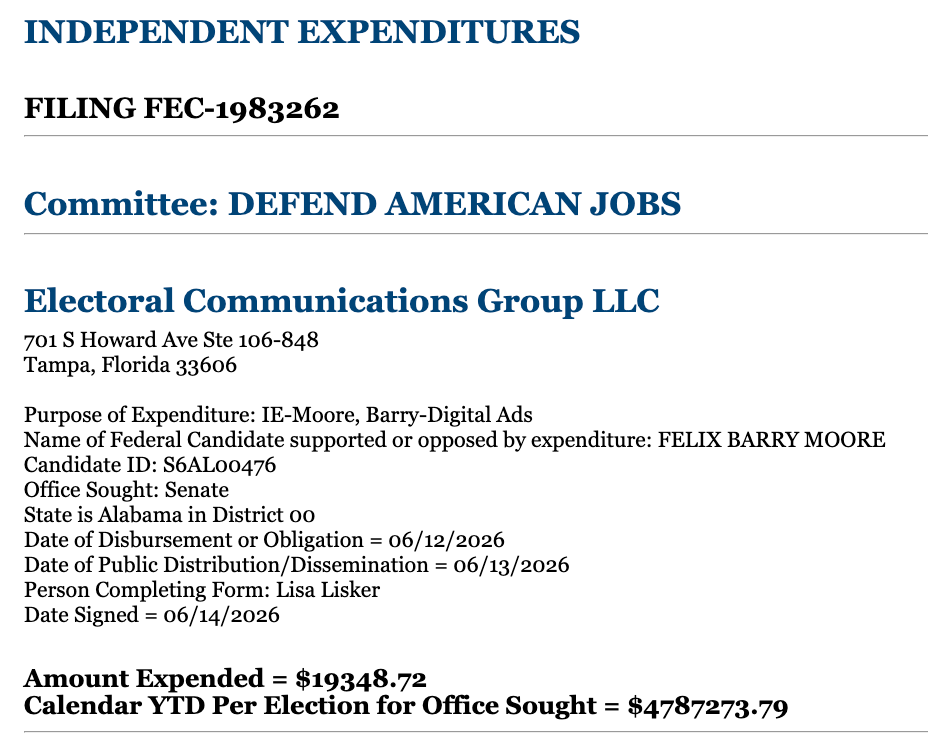
Defend American Jobs, the cryptocurrency company-backed political action committee (PAC) affiliated with Fairshake, reported spending millions of dollars to support a Republican candidate’s run for a US Senate seat in the party’s Tuesday primary runoff in Alabama.
As of Tuesday, filings with the Federal Election Commission (FEC) showed that Defend American Jobs had spent more than $4.7 million on media and ads to back Republican Barry Moore’s candidacy in a runoff for one of Alabama’s US Senate seats, adding to the $7.4 million it reported spending ahead of his May 20 primary. Moore, who also has the endorsement of US President Donald Trump, is running against Jared Hudson, another Republican vying to replace Tommy Tuberville, who announced that he would not be seeking reelection, as he is focused on becoming the state’s next governor.
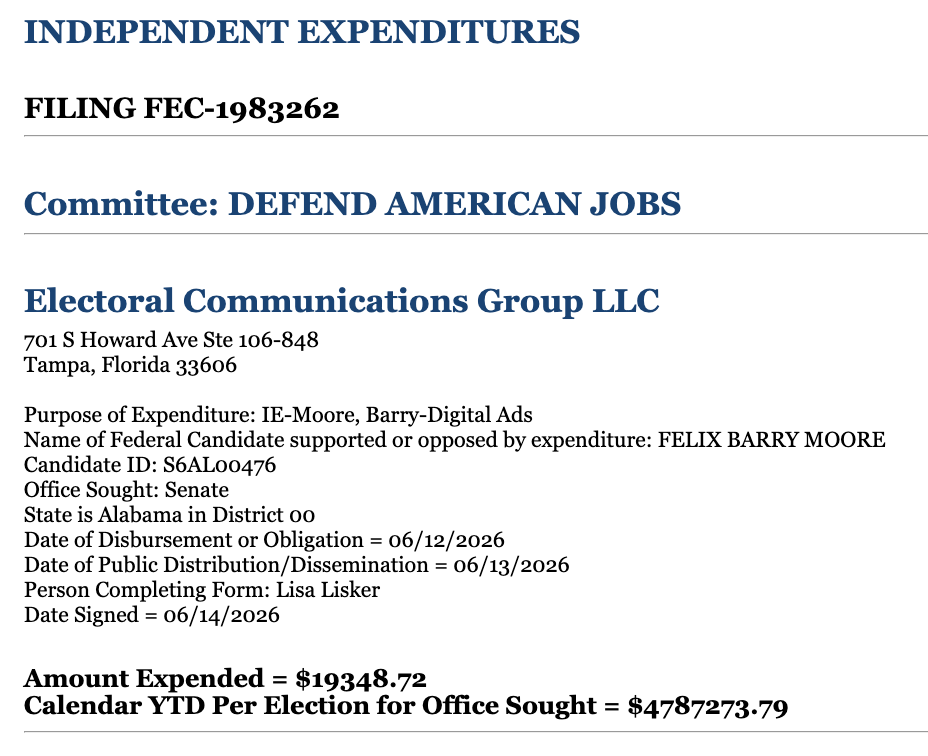
Source: Federal Election Commission
The Coinbase-affiliated advocacy organization Stand With Crypto rated Hudson as “neutral” on crypto policy compared to Moore’s “strongly supports crypto,” based on public statements and Moore’s voting records while representing Alabama’s 1st Congresssional district. Hudson publicly acknowledged that “Big Crypto” did not back his candidacy, but he has supported the crypto market structure bill under consideration in the US Senate.
The Alabama runoff will be another test of the crypto industry’s influence in US elections, with Fairshake and its affiliates having already poured millions of dollars into media for candidates facing primaries in Texas and California. Following Tuesday’s vote in Alabama, the PACs will also have stakes in Maryland and New York later this month, backing Democrats Adrian Boafo and Ritchie Torres with about $5 million and $500,000 in media buys for House seats, respectively.
Related: Crypto PAC-supported candidates sweep US state primaries after media buys
The Blockchain Leadership Fund, a hybrid PAC backed by Anchorage Digital and Chainlink, announced its support for Moore in May, but FEC filings showed no related expenditures as of Tuesday. The Fellowship PAC, another PAC backed by $11 million from Cantor Fitzgerald and Anchorage, disclosed $350,000 in spending to support Moore’s run.
Fairshake reported holding a $193 million war chest as of January, setting the stage for significant potential influence in this year’s US House and Senate races. The PAC has publicly stated its intention to “oppose anti-crypto politicians and support pro-crypto leaders” through media and ads.
Majority control of Senate can determine passage of crypto-related bills
With Democrats having been in the minority in both the House and Senate in the current session of Congress, the party is fighting to regain control of both chambers starting in 2027. Republicans currently hold a slim majority on both sides of the Capitol, enabling them to set the agenda for policies, including crypto-related legislation like the Digital Asset Market Clarity (CLARITY) Act. The bill passed the House in July 2025 but has faced delays in the Senate amid debates over stablecoin rewards, ethics and tokenized equities.
Magazine: China’s 107 Bitcoin memory thief, Bithumb CEO booked: Asia Express



The Digital Asset Market Clarity Act has secured a $150 million allocation for law enforcement efforts targeting cryptocurrency scams and other digital asset crimes, according to U.S. Senator Cynthia Lummis.
Summary
- Senator Cynthia Lummis said the CLARITY Act includes $150 million to help law enforcement track crypto scammers and other criminal actors.
- The legislation would also allow suspicious crypto transactions to be frozen and place digital asset firms under Bank Secrecy Act compliance requirements.
- Backers of the bill say clearer market rules and stronger enforcement tools are needed to combat fraud while supporting legitimate crypto businesses.
In a post published on X on June 16, the Wyoming senator said the legislation would provide law enforcement agencies with funding to “track down scammers and bad actors in the digital asset space” as lawmakers continue debating the future of crypto regulation in the United States.
The funding provision forms part of the CLARITY Act, a market structure bill that seeks to establish clearer federal rules for digital assets while strengthening tools available to investigators pursuing crypto-related crimes.
CLARITY Act combines market rules with enforcement measures
Alongside defining how digital assets should be regulated, the legislation contains several provisions intended to support criminal investigations and consumer protection efforts.
Under the proposal, cryptocurrency exchanges and stablecoin issuers would receive temporary authority to freeze suspicious transactions for up to 30 days. Law enforcement agencies could request an extension of that hold period to as much as 180 days through a written order.
Requirements contained in the bill would also bring digital asset businesses under Bank Secrecy Act obligations, requiring firms to maintain Anti-Money Laundering programs and submit Suspicious Activity Reports in a manner similar to traditional financial institutions.
Supporters of the legislation have argued that these measures would make it easier to trace illicit funds while providing agencies with legal mechanisms to respond more quickly to suspected fraud.
At the same time, the CLARITY Act seeks to address long-running disputes between federal regulators over digital asset oversight.
For years, cryptocurrency companies have faced uncertainty as the Securities and Exchange Commission and Commodity Futures Trading Commission have taken differing views on how various tokens should be classified.
Lawmakers backing the bill say the legislation would establish clear distinctions between digital commodities and securities while requiring exchanges to keep customer assets separate from company funds, a safeguard designed to reduce the risk of failures similar to the collapse of FTX.
Congress weighs new anti-crime initiatives
The law enforcement funding proposal arrives as lawmakers continue discussing additional measures focused on cryptocurrency-related crime.
Earlier this month, Representatives Lance Gooden and Josh Gottheimer introduced the Federal Cryptocurrency Theft Enforcement and Coordination Act, which would establish a dedicated cryptocurrency theft task force within the Department of Justice.
According to the proposal, the task force would coordinate investigations involving agencies including the DOJ, FBI, Department of Homeland Security, Homeland Security Investigations, and the Treasury Department’s Financial Crimes Enforcement Network. Responsibilities would include tracing stolen digital assets, improving investigative techniques, supporting victims, and assisting state, local, and international authorities.
Momentum behind the CLARITY Act has continued to build in Congress after the legislation advanced out of the Senate Banking Committee in a 15-9 vote.
With the congressional calendar tightening ahead of the election season, backers of the bill have argued that the United States needs a clear federal framework that addresses criminal activity while providing regulatory certainty for legitimate digital asset businesses.


A bipartisan group of U.S. senators has urged the Treasury Department to keep state regulators in the stablecoin rulemaking process as it prepares final GENIUS Act rules.
Summary
- Senators say Treasury must keep state stablecoin pathways open beyond a single certification window nationwide.
- The letter asks Treasury to clarify timelines before final GENIUS Act rules are published soon.
- State regulators are moving as stablecoin issuers prepare for federal and state oversight choices.
In a June 16 letter to Treasury Secretary Scott Bessent, the lawmakers said Section 4(c) of the GENIUS Act gives states a pathway to certify their own stablecoin regimes. The letter was led by Senator Cynthia Lummis and signed by Senators Kirsten Gillibrand, Bill Hagerty, Kevin Cramer, Pete Ricketts, Angela Alsobrooks, and Catherine Cortez Masto.
State pathway faces timing concerns
The senators said Congress wanted to preserve the dual banking system and the role of state banking agencies in supervising payment stablecoin issuers. They asked the Treasury to apply the law in a way that “preserves and promotes State participation.”
Their main concern is the certification process. The lawmakers said Treasury’s proposed principles did not address clear timelines or procedural steps for state certification. They said that gap creates uncertainty for states working on laws or rules to match the federal framework.
Meanwhile, the letter asked the Treasury to issue written guidance explaining how states can apply, how reviews will work, and when certification decisions will be made. The senators said the process should not be read as a “one-time window” that blocks future applications.
The lawmakers said state legislatures move on different schedules, and some meet only every two years. They argued that states must be able to seek certification when their own frameworks are ready, not only during an early federal rulemaking stage.
GENIUS Act gives smaller issuers a state option
The GENIUS Act allows payment stablecoin issuers with no more than $10 billion in outstanding issuance to choose state regulation if the state regime is substantially similar to the federal framework. Treasury said in April that the proposal was its first regulation to implement the law’s state-level regime.
That threshold leaves the state option aimed mainly at smaller issuers. The report said Tether’s USDt, USDC, and USDS were above $10 billion, while many smaller stablecoins could fall under state supervision if their regulators win certification under the final new federal process.
Rulemaking moves into final stage
Treasury opened public comments on the proposed state-level principles in April. The agency said comments were due within 60 days of publication in the Federal Register, placing the deadline in early June.
The senators’ letter arrived after the comment window closed, as Treasury prepares a final rule. They asked the department to confirm that certification remains available on an ongoing basis, rather than only during the first year of implementation.
The request also comes as Treasury works on separate GENIUS Act rules for illicit finance controls. That proposal would treat permitted payment stablecoin issuers as financial institutions for Bank Secrecy Act purposes and require sanctions compliance programs.
As previously reported by crypto.news, New York DFS has proposed stablecoin rule updates to align its framework with the GENIUS Act. The state said eligible issuers could stay under DFS supervision if New York receives federal certification.
Moreover, as crypto.news reported earlier, Hyperliquid and Paradigm also asked the Treasury to narrow proposed AML and sanctions duties for stablecoin issuers. State Street has also launched a stablecoin reserve money market fund designed for the GENIUS Act framework, while the FDIC faces GAO pressure over blockchain risk coordination.
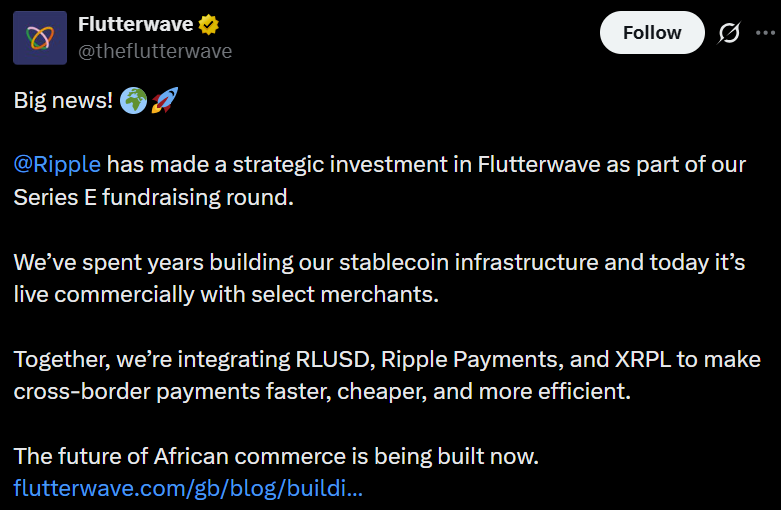
Blockchain payments company Ripple has acquired an equity stake in African fintech giant Flutterwave, deepening its push into one of the world’s fastest-growing cross-border payments markets.
Flutterwave CEO Olugbenga Agboola said the undisclosed investment values the company at $3.3 billion, according to Bloomberg. The deal gives Ripple exposure to Africa’s fast-expanding payments ecosystem while providing Flutterwave with additional resources to scale its financial infrastructure.
The investment makes Ripple a shareholder rather than an owner or commercial partner. Flutterwave operates in 35 African countries and has recently expanded its digital asset offerings by integrating stablecoin payment services.
As part of the deal, Flutterwave will integrate Ripple’s RLUSD stablecoin, Ripple Payments and the XRP Ledger to make cross-border transactions faster and more cost-effective.
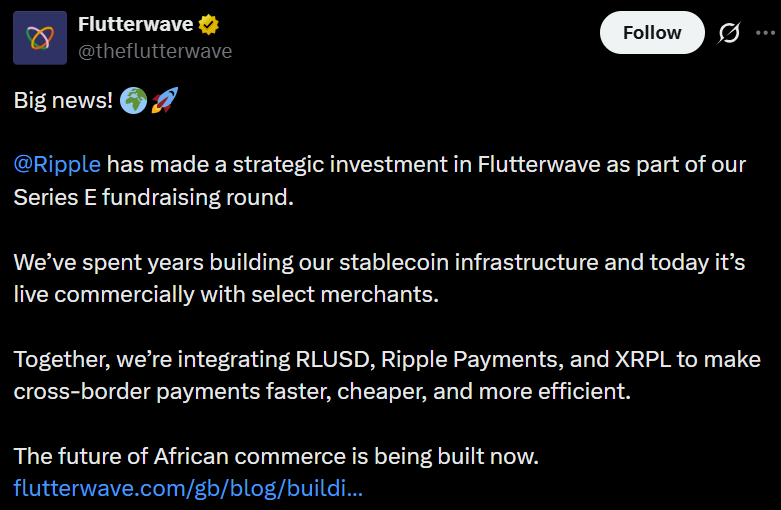
Source: Flutterwave
The deal is the latest step in Ripple’s broader strategy to expand its blockchain-based payments network across Africa, where demand for faster and lower-cost international transfers continues to grow. Last October, Ripple partnered with South Africa’s Absa Bank to provide digital asset custody solutions to institutional clients.
Related: Bybit Pay enters South Africa through MoneyBadger integration
Stablecoins gain traction in Africa’s remittance market
Africa has emerged as a key growth market for digital asset payments, driven largely by the continent’s sizable remittance flows and demand for lower-cost cross-border transfers.
A September 2025 Chainalysis report found that crypto adoption in sub-Saharan Africa climbed 52% over 12 months, with more than $205 billion in onchain transactions recorded. At the time, the region ranked as the world’s third-fastest-growing crypto market.
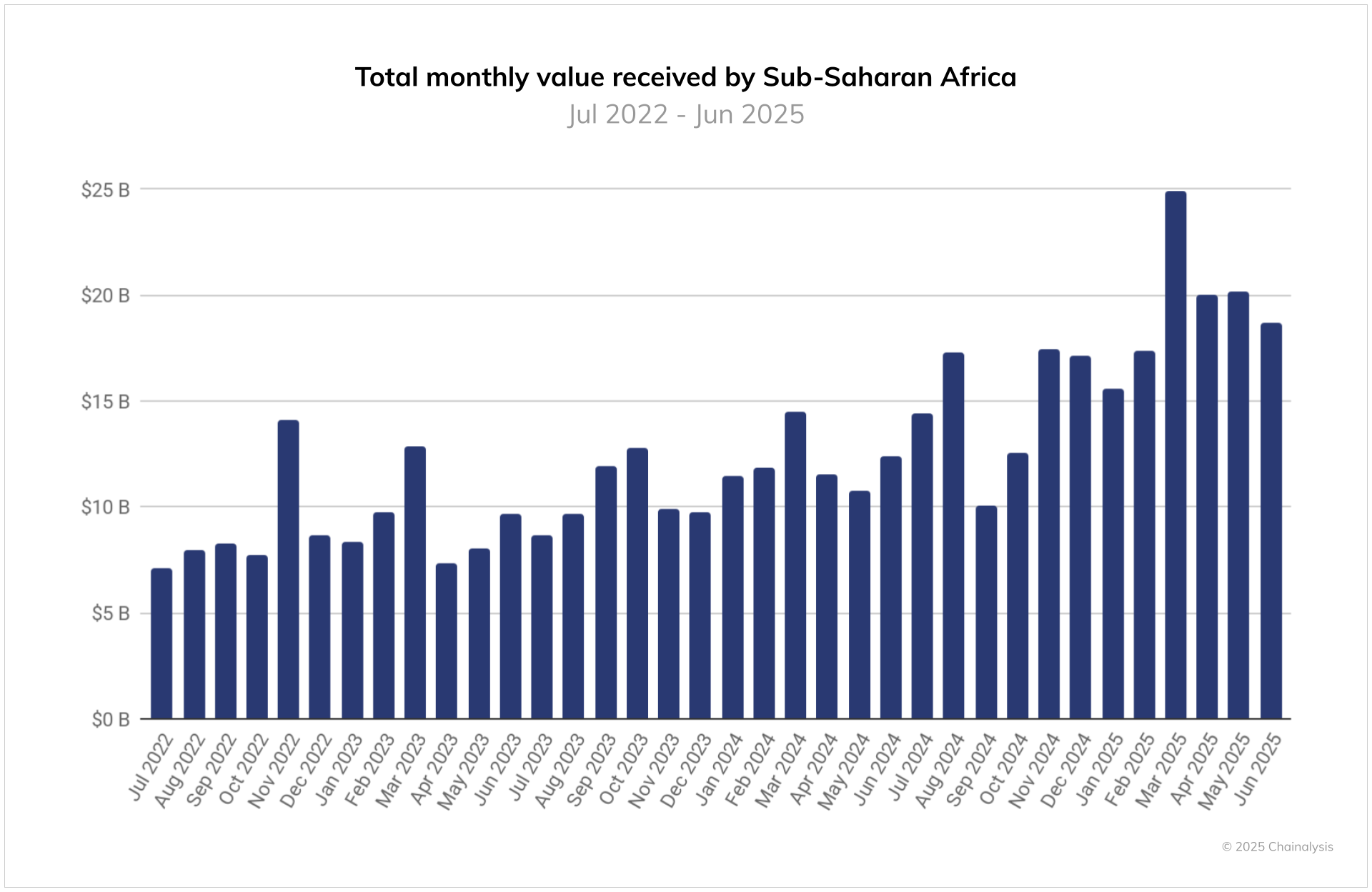
Onchain volumes in sub-Saharan Africa have surged since 2022. Source: Chainalysis
Stablecoins have played a central role in that growth, offering a dollar-denominated alternative that can make international payments faster and less expensive. The opportunity has attracted other major issuers, including USDC issuer Circle, which recently partnered with African fintech Sasai to expand USDC-based payment services across the region with a focus on remittances.
The World Bank estimates that sending a typical $200 remittance to sub-Saharan Africa costs recipients between $13 and $17 in fees, compared with as little as $0.50 for transfers using USDt (USDT) on Tron or as little as $2 for transfers using USDC on Ethereum.
Related: Africrypt founders back in South Africa years after platform collapse: Report


Ripple has acquired an equity stake in African fintech company Flutterwave in a deal that has valued the payments firm at $3.3 billion, adding another regional payments network to Ripple’s growing global infrastructure strategy.
Summary
- Ripple has acquired an equity stake in Flutterwave, valuing the African fintech company at $3.3 billion.
- The investment strengthens Ripple’s presence in Africa as demand for faster and cheaper cross-border payments grows.
- Ripple has recently expanded RLUSD and XRP Ledger payment infrastructure across Türkiye, Latin America, the Middle East, and AI-driven payment networks.
According to Bloomberg, Flutterwave CEO Olugbenga Agboola said Ripple participated as an equity investor, providing the company with fresh capital while becoming a strategic shareholder. Agboola declined to disclose the size of Ripple’s investment or the percentage ownership the company received through the transaction.
Speaking to Bloomberg, Agboola said Ripple’s involvement is limited to an equity position rather than a commercial partnership. He added that the structure allows Ripple to benefit from Flutterwave’s future growth as the company continues expanding its payments business across Africa.
Operating in 35 African countries, Flutterwave has become one of the continent’s largest financial technology companies by building payment infrastructure for businesses, merchants, and consumers. The investment comes as demand for faster and lower-cost international transfers continues to rise across African markets.
Ripple expands payment infrastructure across emerging markets
Beyond Africa, Ripple has been adding new payment and settlement networks across several regions during the past month.
Earlier this month, Ripple expanded the availability of its U.S. dollar-backed stablecoin RLUSD in Türkiye through partnerships with BiLira, Bitexen, and Bitlo. According to Ripple, the rollout provides Turkish institutional users with access to its regulated stablecoin for digital asset transactions and settlement.
In Latin America, Ripple recently integrated Bitso’s Mexican peso-backed stablecoin MXNB into the XRP Ledger and its Payments on Decentralized Exchange infrastructure. According to Ripple, MXNB and RLUSD will support enterprise payment flows between the U.S. and Mexico by providing regulated settlement assets for cross-border transactions.
Recent product launches have also extended beyond traditional payments. As reported by crypto.news on June 13, Ripple introduced the XRPL AI Starter Kit, a developer toolkit that enables artificial intelligence agents to use XRP and RLUSD for autonomous payments on the x402 machine-payment network. Ripple said the tools allow software agents to create wallets, track balances, and complete transactions with limited human involvement.
Institutions seek simpler access to digital asset rails
At the same time, Ripple has been positioning itself as an infrastructure provider for banks and financial institutions entering digital assets.
According to Ripple’s UK and Europe Managing Director Cassie Craddock, many financial institutions already recognize the value of blockchain-based financial services but continue to look for easier ways to access them. Writing earlier this week, Craddock said banks increasingly want support across custody, liquidity, settlement, and compliance rather than building each component internally.
Ripple has also expanded its physical presence in the Middle East and Africa. As previously reported by crypto.news, the company recently opened a larger regional headquarters at the Dubai International Financial Centre after receiving approval from the Dubai Financial Services Authority to offer regulated international payment services within the DIFC.
The regulator has also approved RLUSD for use by regulated entities operating in the financial hub.
Crypto World
Bitcoin Seller Exhaustion? On-chain Data Signals Transition Toward Late-Stage Capitulation

Following a wave of selling pressure that pulled bitcoin (BTC) below $60,000 two weeks ago, analysts have highlighted on-chain data that signals possible seller exhaustion, which is further substantiated by a reprieve in macroeconomic conditions.
According to analysts at crypto exchange Bitfinex, the market is witnessing a transition into late-stage capitulation rather than a broader distribution phase. This translates to constant selling pressure among previous buyers of BTC, like exchange-traded funds (ETFs) and treasury companies.
Bitcoin Sellers Are Getting Exhausted
Recent bitcoin buyers aggressively turned into sellers after the asset’s price fell below $75,000. Since then, demand for the cryptocurrency has been completely agnostic to price. These buyers are now realizing losses at an accelerating pace, as evidenced by the $1.35 billion in daily realized losses in June’s first trading week.
As selling pressure persists, analysts added that the market is in a transitional phase that reflects a typical post-liquidation structure. This dynamic often appears once the primary wave of forced selling from distressed investor cohorts exhaust themselves.
Although current loss realization levels are enough to confirm deep bear conditions, they have not reached the intensity required to establish a definitive bottom. Market experts believe that demand levels will determine whether this consolidation transforms into a concrete support floor or acts as a temporary pause before a deeper plunge.
“What the tape shows is seller exhaustion arriving at the same moment as a macro reprieve, which is a different condition from genuine demand. The price action that follows each behaves very differently, which leads us to believe that despite the short-term recovery, bulls face significant hurdles before an uptrend can form,” analysts explained.
Demand Still the Most Important Driver
Looking back at the market’s moves on June 5, Bitfinex’s analysts believe crypto lows were a front-running of a global meltdown across risk assets. For the first time in six years, risk asset correlations broke down and commodities, equities, and yields all declined.
While most risk assets, including BTC, have recovered, dynamics intertwining inflation, energy markets, and monetary policy have dominated the U.S. macro environment. There is also some form of relief amid easing geopolitical tensions, particularly signs of a potential US-Iran agreement. If the agreement holds, there could be a ripple effect that would affect macro dynamics that continue to shape digital markets.
Regardless of the outcome of the geopolitical situation, liquidity conditions remain a more important driver than traditional safe-haven narratives. So, demand remains bitcoin’s biggest challenge for an upward rally.
The post Bitcoin Seller Exhaustion? On-chain Data Signals Transition Toward Late-Stage Capitulation appeared first on CryptoPotato.
State Street Investment Management has launched a money market fund designed for stablecoin issuers, offering a vehicle for holding reserve assets under the framework established by the GENIUS Act.
The fund is structured as a Rule 2a-7 government money market fund and will invest in assets commonly used to back stablecoins, including US government securities and repurchase agreements. The fund’s initial investors include State Street Bank and Anchorage Digital, a federally chartered crypto bank.
State Street said the product was designed to comply with reserve requirements established under the GENIUS Act, which was signed into law on July 18, 2025, creating the first federal regulatory framework for payment stablecoins in the United States.
The launch follows the introduction of the State Street Galaxy Onchain Liquidity Sweep Fund (SWEEP), a tokenized liquidity product developed with Galaxy Digital that enables onchain cash management using stablecoins.
State Street Investment Management, the asset management arm of State Street Corporation, oversees more than $5 trillion in assets and is one of the world’s largest investment managers.
Related: Bitwise completes takeover of Superstate’s $259M crypto carry fund
Asset managers compete for stablecoin reserve assets
State Street’s launch comes as financial firms rush to develop products aimed at managing assets that back stablecoins following the passage of the GENIUS Act.
In May, JPMorgan filed to launch JLTXX, a tokenized money market fund intended to hold assets backing stablecoins while complying with requirements established under the GENIUS Act. The fund would invest in US Treasury bills and overnight repurchase agreements, assets commonly used to back dollar-pegged stablecoins.
The filing came weeks after Morgan Stanley launched its Stablecoin Reserves Portfolio, a money market fund that allows stablecoin issuers to hold reserve assets while earning interest.
In June, Coinbase disclosed an investment in the ProShares GENIUS Money Market ETF, a Treasury-focused fund that invests in assets eligible to back payment stablecoins under the law. The exchange said the investment aligned with its expanding stablecoin and cash management businesses.
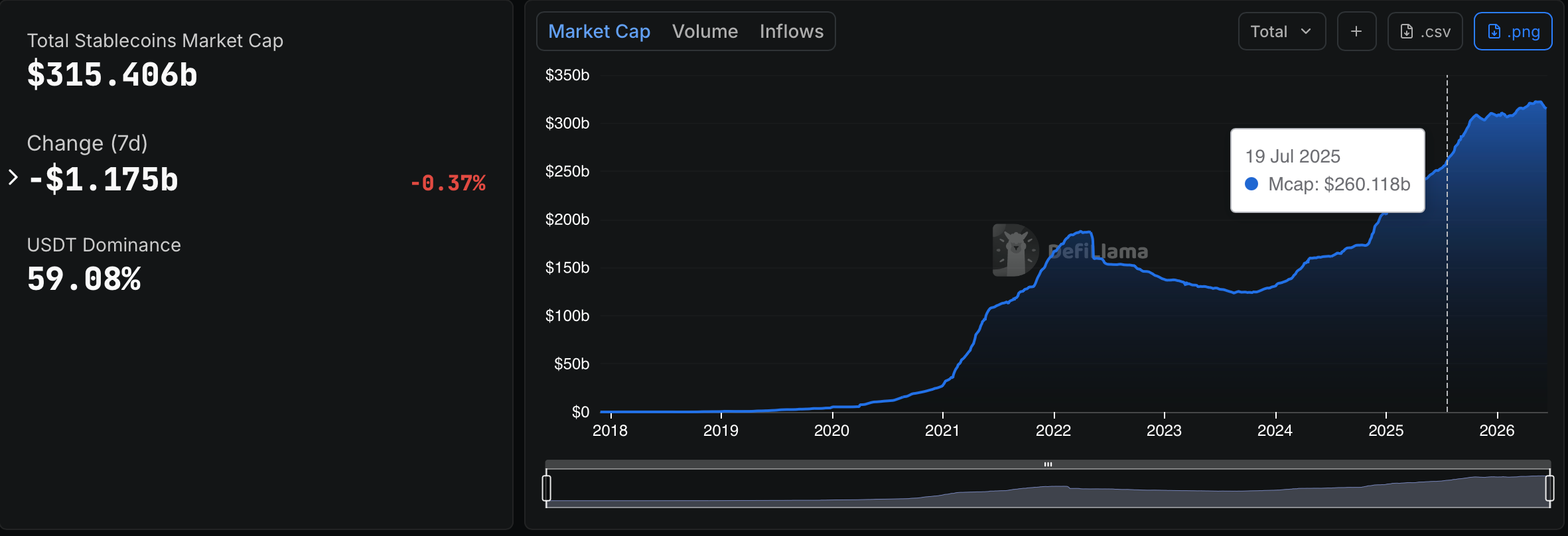
The stablecoin market has grown to approximately $315 billion from about $260 billion when the GENIUS Act was signed into law, according to DefiLlama data. State Street cited projections from Citi estimating global stablecoin issuance could reach between $1.9 trillion and $4 trillion by 2030.
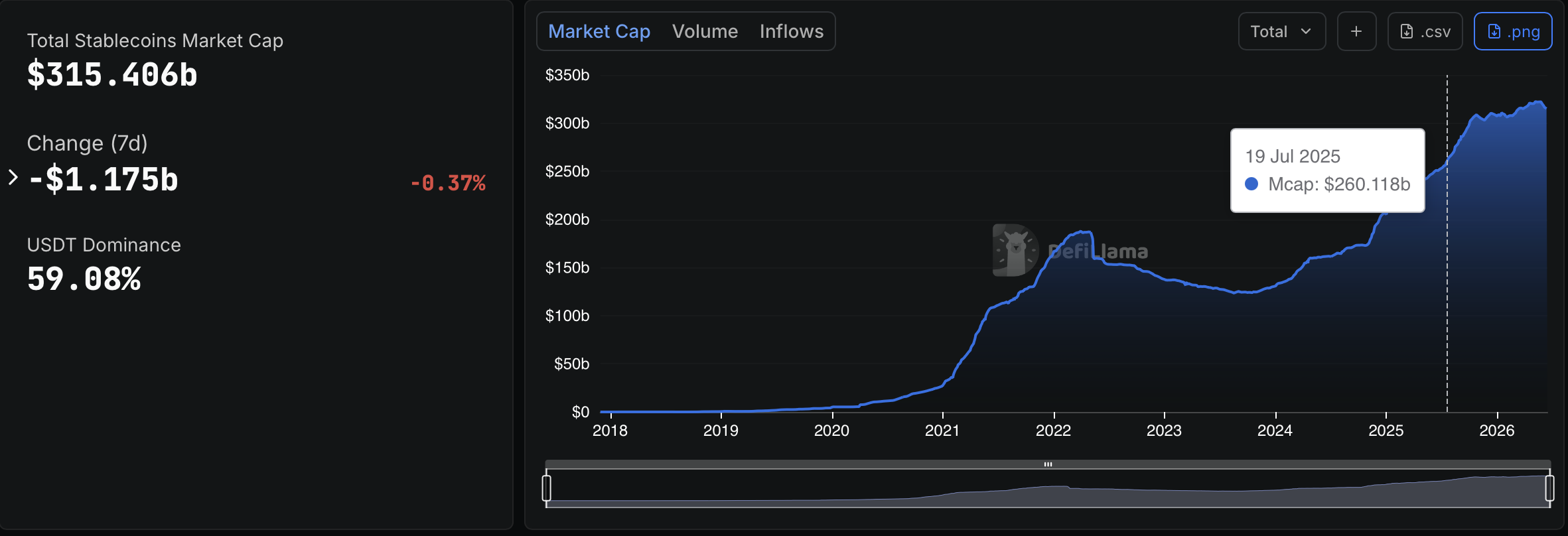
Source: DefiLlama
The market for stablecoin reserve assets has expanded alongside stablecoin adoption. According to Tether’s March 2026 reserves report, the company held approximately $191.8 billion in assets backing USDT (USDT), with US Treasury bills accounting for the majority of its cash-equivalent reserves.
Magazine: Bitcoin, the ‘canary in the coal mine,’ XRP transaction demand falls 91.5%: Market Moves
Crypto World
While Solana eyes $250 and XRP targets $5, this cheap crypto under $1 could be the biggest surprise of 2026
Disclosure: This article does not represent investment advice. The content and materials featured on this page are for educational purposes only.
As Solana and XRP trends dominate discussion, investors are also watching low-priced tokens like Little Pepe for higher-risk potential gains.
Summary
- Crypto debate centers on SOL vs XRP, while LILPEPE emerges as a low-price Layer-2 meme coin with high-risk upside narrative.
- LILPEPE presale highlights include Layer-2 meme chain, audit claims, exchange listings, and projections of large percentage gains.
- Investors compare stable majors like SOL/XRP with LILPEPE’s speculative growth story and potential asymmetric returns in 2026.
Right now, crypto Twitter is arguing about whether Solana will hit $250 before the year ends or whether XRP finally breaks free from its $1–$2 jail cell. Both are legitimate conversations, and both coins have real catalysts.
But there’s a third name worth the attention, one sitting under $1 that nobody’s really talking about at this scale yet: Little Pepe (LILPEPE). If the numbers play out anywhere close to analysts’ projections, a 5,346% return would make both SOL and XRP look almost boring by comparison. Let’s break it all down.
Solana eyes $250: Is it realistic?
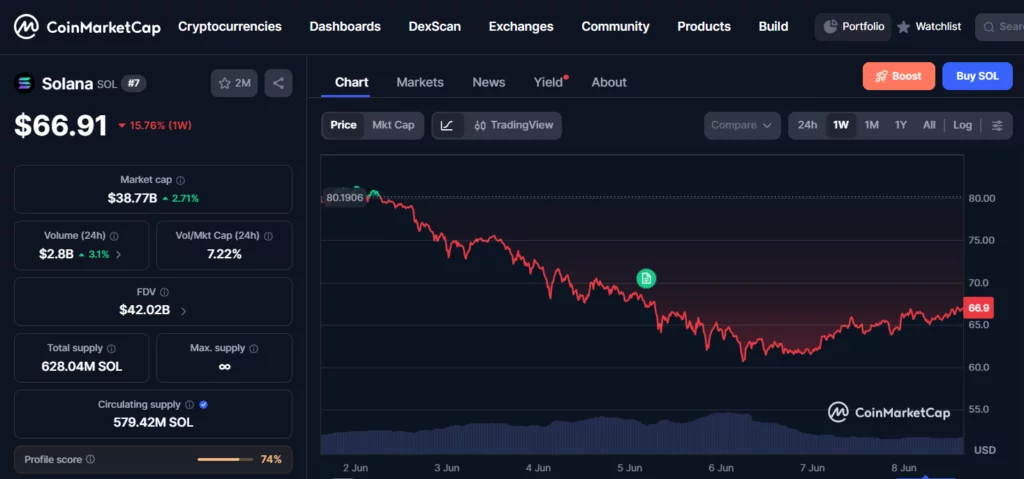
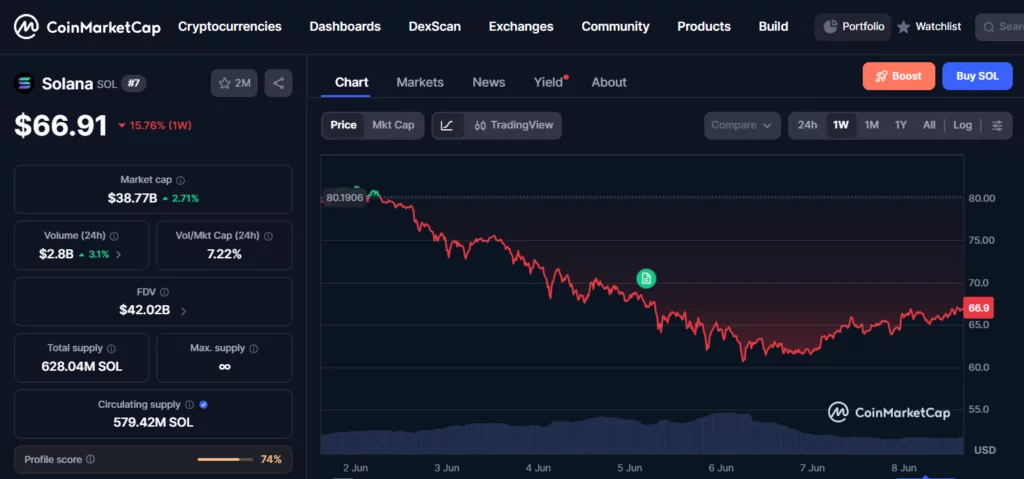
Solana is trading around $64–$65 with a $37B market cap, far below its $293 all-time high. Standard Chartered projects $250 by year-end, citing the SEC’s digital commodity ruling as the key catalyst for a nearly 4x move. The Alpenglow upgrade, Firedancer client, and $1B+ in ETF inflows since late 2025 are the structural pillars. Bull case targets $250–$445. A few things need to go right, but the setup is real.
XRP targets $5: What would have to happen
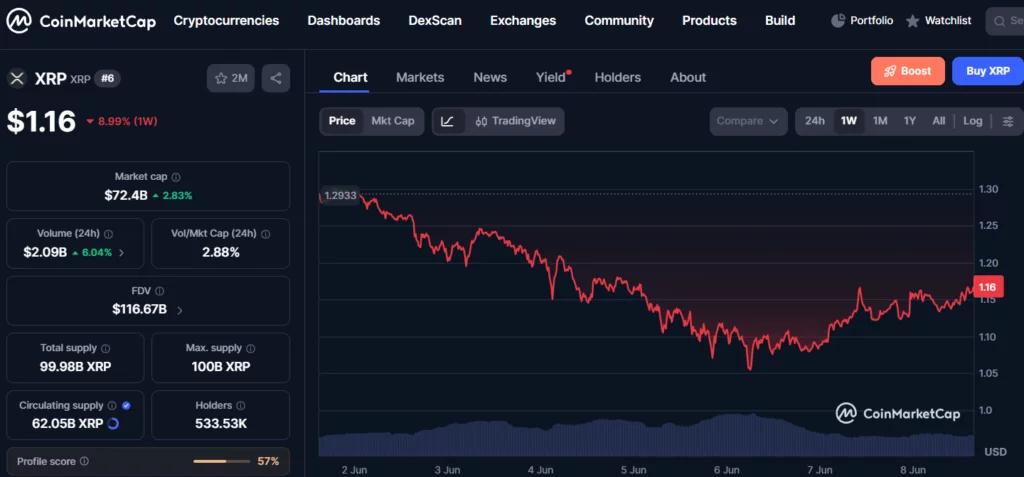
XRP trades at $1.13–$1.14 with a ~$70B market cap, well off its January 2026 high of $2.40. Bitwise’s bullish case puts XRP at $4.94 by year-end, with a max scenario clearing $6.53. The catalyst stack is multi-layered: spot ETF demand, the Market Structure Bill, and Ripple’s OCC-approved banking license. The on-chain activity is quite impressive, with 1.67 million transactions per day and $481 million in total. The price forecast for 2026 could range anywhere between $1.20 to $2.40, depending on regulatory clarity.
While Solana eyes $250 and XRP targets $5: Meet the wildcard under $1
This is where the narrative shifts. While Solana and XRP are playing the slow-and-steady institutional game, Little Pepe is doing something entirely different, and it’s turning heads. LILPEPE is currently in Stage 13 of its 19-stage presale, selling tokens at just $0.0022. The presale has now raised $28,254,751 of its $28,775,000 target, with over 17 billion tokens sold. Stage 13 is 98.63% filled at the time of writing.
That kind of velocity in a presale doesn’t happen by accident. Early investors from Stage 1 are already sitting on 120% gains over their entry price. Even investors joining now at Stage 13 still have a 36.36% gain locked in before the token even hits exchanges, since the confirmed launch price is $0.0030.

What actually makes LILPEPE different
LILPEPE isn’t another rug waiting to happen. It’s a real Layer 2 blockchain with zero tax, near-zero fees, and sniper bot resistance at the protocol level. A native Meme Launchpad creates continuous LILPEPE gas demand beyond launch hype. It has been CertiK audited: 95.49%. Listed on CMC and CoinGecko pre-launch. Anonymous veterans with top-tier meme-coin track records are quietly backing it. Two CEX listings confirmed, with the world’s largest exchange reportedly in the pipeline.
The 5,346% case: Can it actually happen?
Let’s be real for a second. A 5,346% return would take LILPEPE from $0.0022 to roughly $0.12–$0.12+, which would still keep its market cap well below many established meme coins. For context, DOGE, SHIB, and PEPE have all reached multi-billion-dollar valuations. At a $300 million market cap post-listing, a level that Dogecoin, SHIB, and Pepe Coin each eclipsed by multiples, each LILPEPE token could represent a meaningful gain over current presale pricing based on the 100 billion total token supply.
Bottom line
Solana eyeing $250 is a real thesis with institutional backing. XRP targeting $5 has a clear, if uncertain, catalyst path through ETF approvals and Ripple’s banking push. Both are worth watching. But for those looking for the biggest potential surprise of 2026, the kind of asymmetric play that early PEPE or SHIB holders talk about years later, this cheap crypto under $1, LILPEPE, deserves a serious look right now. With Stage 13 nearly sold out, a confirmed listing price of $0.0030, a purpose-built meme Layer 2 chain, and a team with a track record of building top-performing memecoins, the pieces are in place. The window for a 5,346%+ return doesn’t stay open forever.
For more information about Little Pepe, visit the official website, X, and Telegram, read the whitepaper, and join the 777k giveaway.
Disclosure: This content is provided by a third party. Neither crypto.news nor the author of this article endorses any product mentioned on this page. Users should conduct their own research before taking any action related to the company.
Key takeaways:
- Hyperliquid defies the crypto bear market with $3 billion HYPE open interest, a 32% growth in a week.
- Hyperliquid’s TradFi innovation, like SpaceX pre-IPO trading, signals that the path to $80 HYPE price looks well-supported.
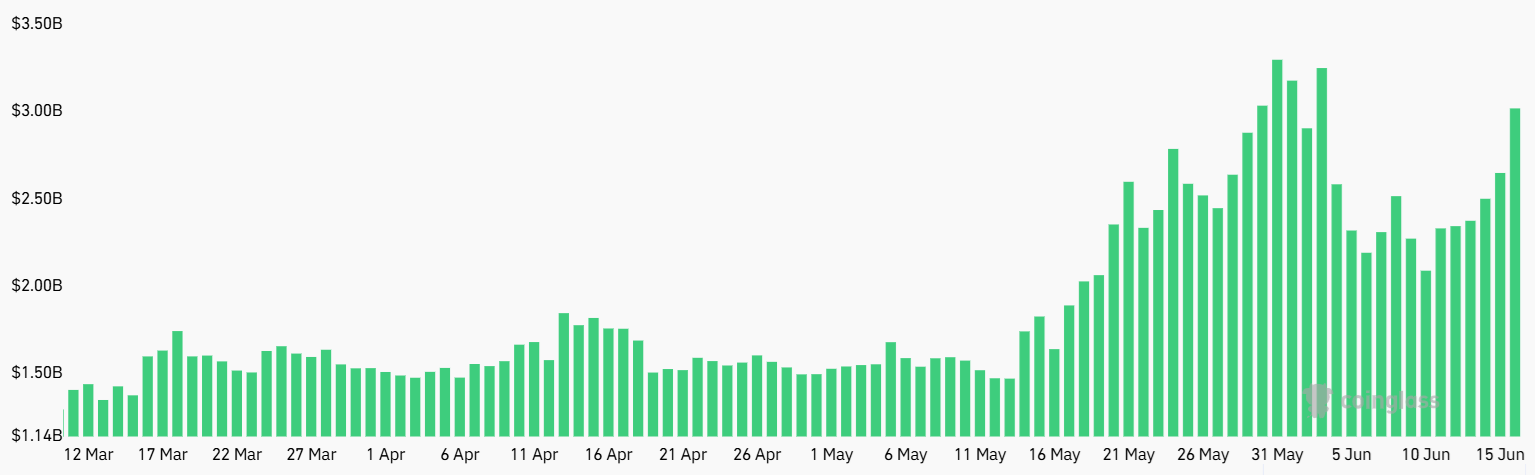
Hyperliquid’s native token HYPE rallied 44% over five days, hitting a $76.90 all-time high on Tuesday. Despite the pullback to $73, open interest on HYPE futures reached the $3 billion mark, signaling growing institutional demand.
With Hyperliquid decentralized exchange (DEX) volumes showing no signs of weakness amid the cryptocurrency bear market, traders question the odds of further HYPE gains above $80.
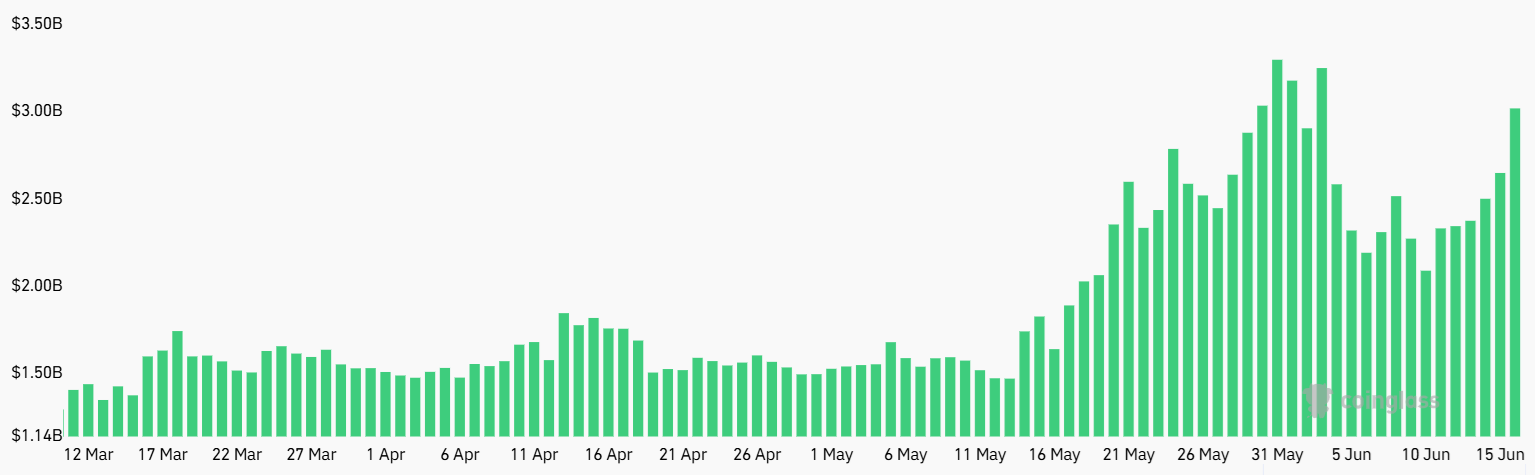
HYPE futures aggregate open interest, USD. Source: CoinGlass
The aggregate open interest on HYPE futures rose 32% from one week earlier. Hyperliquid DEX held a 53% market share in perpetual trading volumes, followed by Binance at 14%, Bybit at 9% and Bitget at 8% according to DefiLlama data. While demand for HYPE futures has undoubtedly picked up, it’s worth exploring whether the recent price rally was fueled by excess leverage.
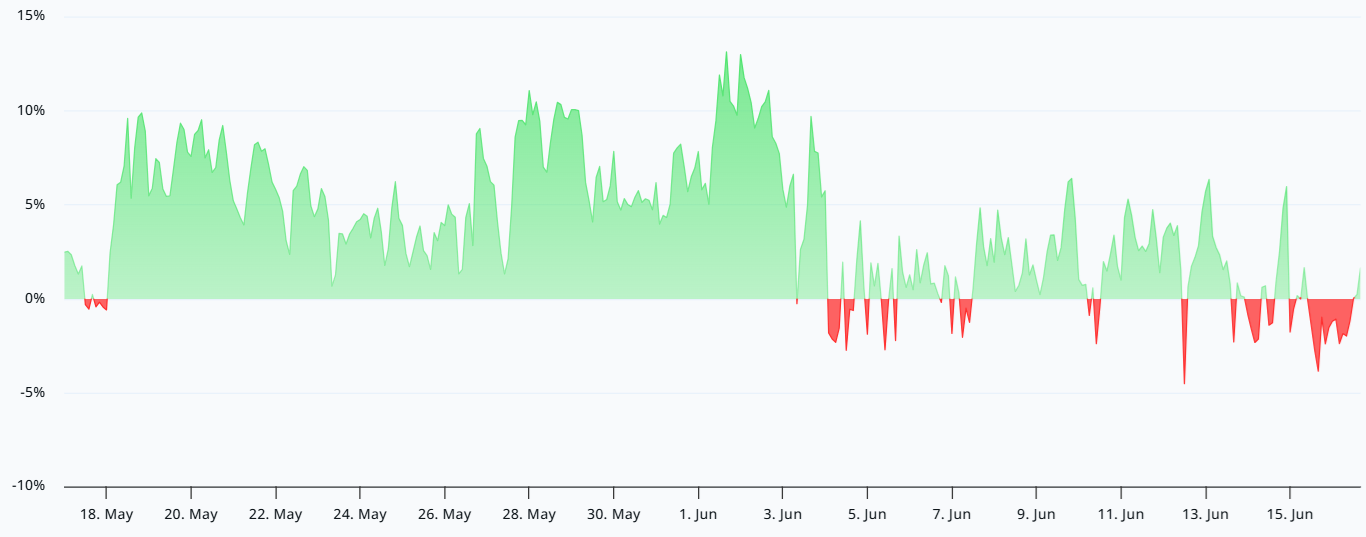
HYPE perpetual futures annualized funding rate. Source: Laevitas
The funding rate on HYPE perpetual futures has remained below the neutral 6% threshold for the past week, signaling weak demand for bullish leverage. Given that HYPE futures open interest increased during the period, short sellers appear to be doubling down despite the losses. It is possible that core contributors with tokens currently locked have partially hedged their positions.
HYPE excitement faces valuation concerns and dilution risk
HYPE circulating supply stood at 253.41 million on Tuesday, while the maximum supply reached 953.92 million according to CoinMarketCap data. Thus, regardless of how quickly current holders face dilution, the project’s fully diluted value (FDV) stands at $71.3 billion. For comparison, the market capitalization of the highly profitable financial company Aon Plc (AON US) stood at $70 billion.
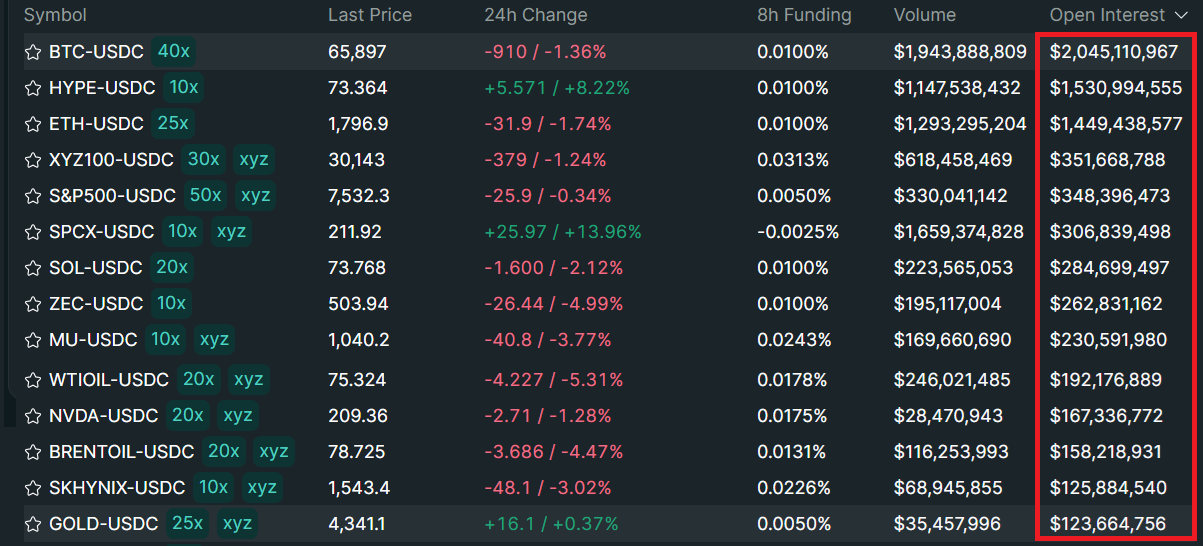
Hyperliquid perpetuals ranking by open interest, USD. Source: Hyperliquid
Hyperliquid has successfully dodged the cryptocurrency bear market thanks to the launch of traditional finance (TradFi) perpetuals, including those on S&P 500 (S&P500), Nasdaq 100 (XYZ100), crude oil (WTIOIL), SpaceX (SPCX), Micron (MU), gold (GOLD), silver (SILVER) and Google (GOOGL). Open interest in TradFi contracts has exceeded $2.9 billion, vastly surpassing Bitcoin’s $2 billion.
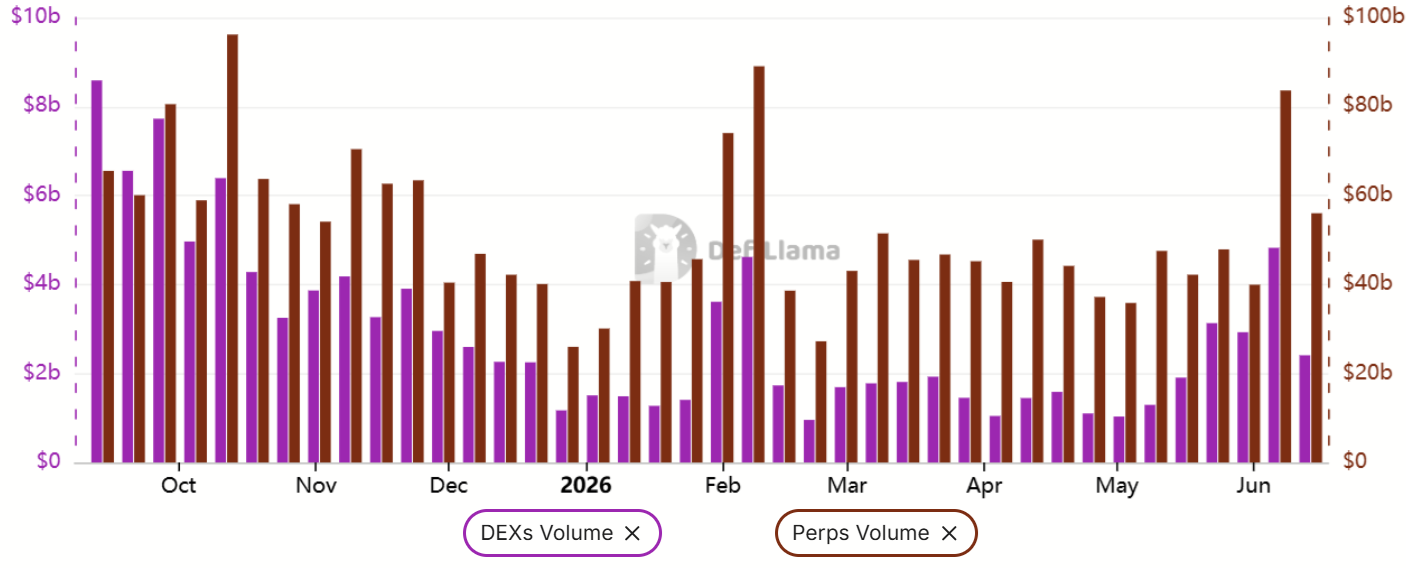
Hyperliquid weekly DEX and perpetual volumes, USD. Source: DefiLlama
Considering that aggregate decentralized exchange (DEX) volumes have fallen 57% over the past six months, Hyperliquid stands out as a positive outlier with $9.6 billion in activity. In perpetual contracts trading, no other protocol comes close to Hyperliquid’s 38% market share. Pre-IPO trading of SpaceX shares further highlights the exchange’s constant innovation and broader appeal.
Related: NYSE parent ICE pushes ‘level playing field’ for 24/7 onchain perps
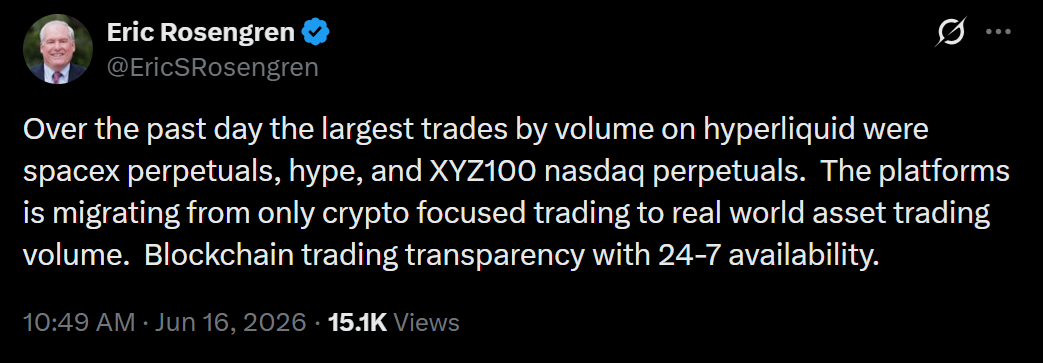
Source: X/EricSRosengren
Hyperliquid’s successful run was highlighted by former Boston Federal Reserve Chair Eric Rosengren, along with an extremely bullish report from Citrini Research, a financial analysis firm. Moreover, HYPE exchange-traded funds (ETFs) have gathered $208 million since launch, signaling strong institutional interest.
Overall, a surge to $80 for HYPE doesn’t seem out of reach considering Hyperliquid’s revenue generation and growth potential in Real World Assets (RWA) trading.
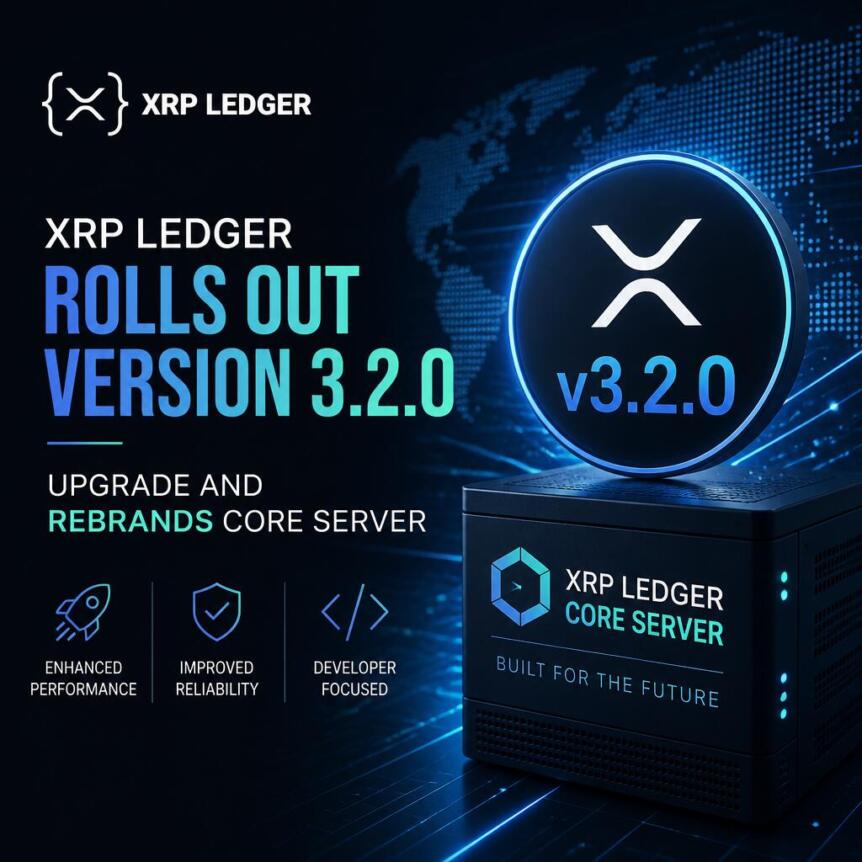
The XRP Ledger has launched version 3.2.0, introducing several infrastructure upgrades, developer enhancements, and network fixes. The release also replaces the long-standing “rippled” name with “xrpld” across the ecosystem. Meanwhile, validators and node operators must update their systems to remain compatible with the latest network changes.
Xrp Ledger Rebrands Core Infrastructure
The XRP Ledger introduced version 3.2.0 as part of its ongoing network development efforts. The update arrived weeks after the release of version 3.1.3. As a result, the network now includes several operational and infrastructure improvements.
A key change involves the rebranding of the core server software. The network officially replaced the “rippled” name with “xrpld” through the XLS-0095 update. Consequently, the software now reflects the broader and independent identity of the XRP Ledger ecosystem.
The change affects multiple system components across the network. Configuration paths, database directories, server metadata, and version labels now use the new naming structure. Therefore, validators and node operators may need to modify scripts and install updated configurations.
Upgrade Introduces Security Fixes and Developer Enhancements
The latest release also introduces the “fixCleanup3_2_0” amendment to the XRP Ledger. This amendment consolidates several approved security-related improvements. In addition, it strengthens multiple ecosystem features already operating on the network.
The update addresses components linked to Single Asset Vaults and the Lending Protocol. It also covers permissioned decentralized exchanges, Multi-Purpose Tokens, and permissioned domains. As a result, the network improves consistency across these expanding functionalities.
Developers also added new invariant checks within the release. These checks prevent deleted accounts from leaving behind ledger artifacts that could remain accessible later. Consequently, the ledger can maintain cleaner records and improve operational reliability.
The upgrade includes new tools designed for developers and infrastructure providers. Applications can now retrieve protocol information and server definitions without connecting to a live server. Therefore, developers can simplify integrations and reduce operational requirements.
This feature supports wallet providers, blockchain explorers, API services, and automation tools. Furthermore, it streamlines access to critical network information. The enhancement may reduce development complexity for services built on the XRP Ledger.
Infrastructure Performance Receives Major Improvements
Version 3.2.0 also delivers several performance-focused improvements. The release introduces configurable nuDB block sizes for database storage optimization. As a result, operators gain greater flexibility in managing storage resources.
The update adds optional TLS and mutual TLS support for gRPC servers. These additions strengthen communication security and improve enterprise-grade connectivity. Consequently, organizations operating XRPL infrastructure can implement stronger network protections.
Another notable change involves the network’s default peering port. The release shifts the default port from 51235 to 2459. Therefore, operators must review network configurations to ensure uninterrupted connectivity.
The upgrade also contains numerous fixes across several network functions. These fixes affect automated market makers, payments, Multi-Purpose Tokens, token escrows, order books, and RPC handling. As a result, the network improves efficiency and stability across multiple transaction types.
Developers temporarily disabled transaction invariants in version 3.2.0. The decision followed the discovery of a performance regression issue during deployment. However, the change does not alter current security protections because the invariants remain inactive in practice.
The XRP Ledger continues to expand its infrastructure while improving operational efficiency. Recent updates show increasing focus on scalability, developer accessibility, and enterprise readiness. Therefore, the latest release represents another step in the network’s broader technical evolution.
Validators and node operators are expected to adopt the new version promptly. The upgrade ensures compatibility with recently approved amendments and infrastructure improvements. As the ecosystem grows, regular software updates remain essential for maintaining network performance and functionality.
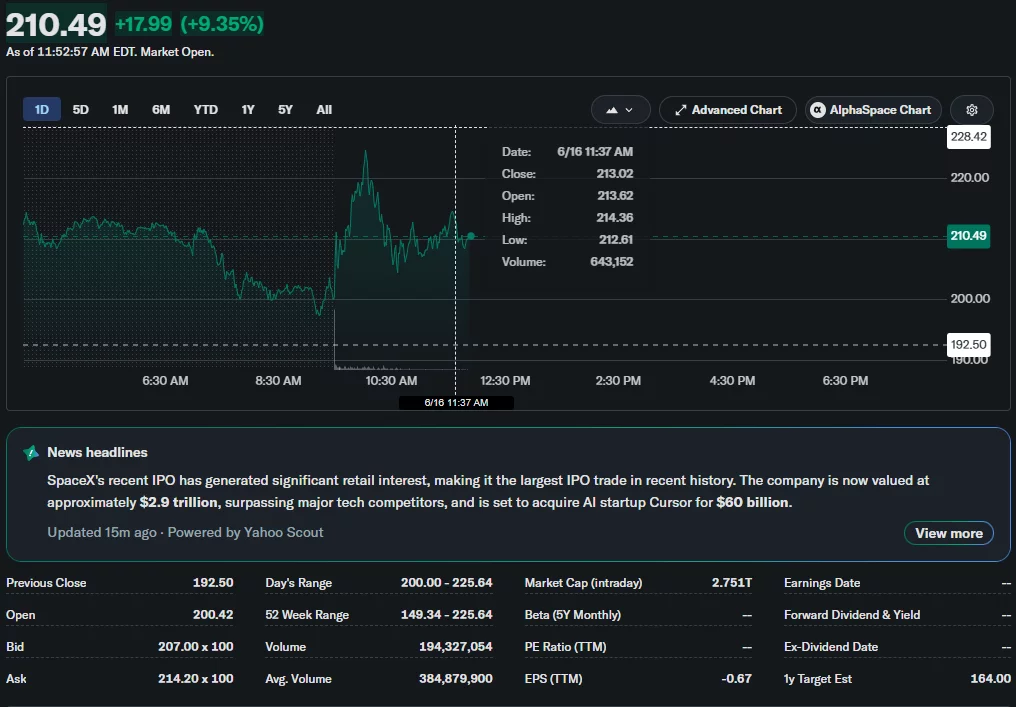
SpaceX has climbed to a market value of nearly $2.93 trillion after its shares jumped more than 17%, briefly pushing Elon Musk’s aerospace company ahead of both Amazon and Microsoft in the global corporate rankings.
Summary
- SpaceX surged more than 17%, briefly overtaking Microsoft and surpassing Amazon by market value.
- Investors cheered SpaceX’s planned $60 billion merger with Cursor AI developer Anysphere.
- Binance’s SPCXUSDT contract topped $5.6 billion in daily volume and $9 billion overall.
According to data from Yahoo Finance, SpaceX shares rose as much as 17.21% on Tuesday to an intraday high of $225.64, lifting the company’s valuation to approximately $2.93 trillion.
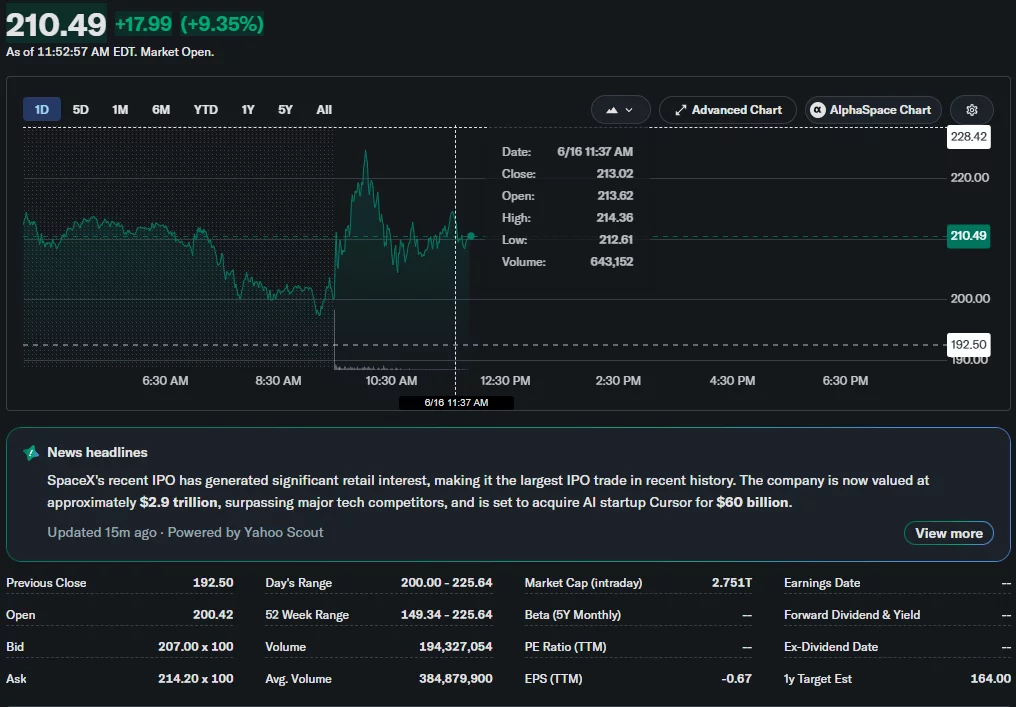
The move temporarily placed SpaceX above Microsoft, whose shares fell 1.63% to value the software giant at roughly $2.92 trillion. Microsoft later reclaimed the position as SpaceX pared some gains, though the aerospace company remained comfortably ahead of Amazon.
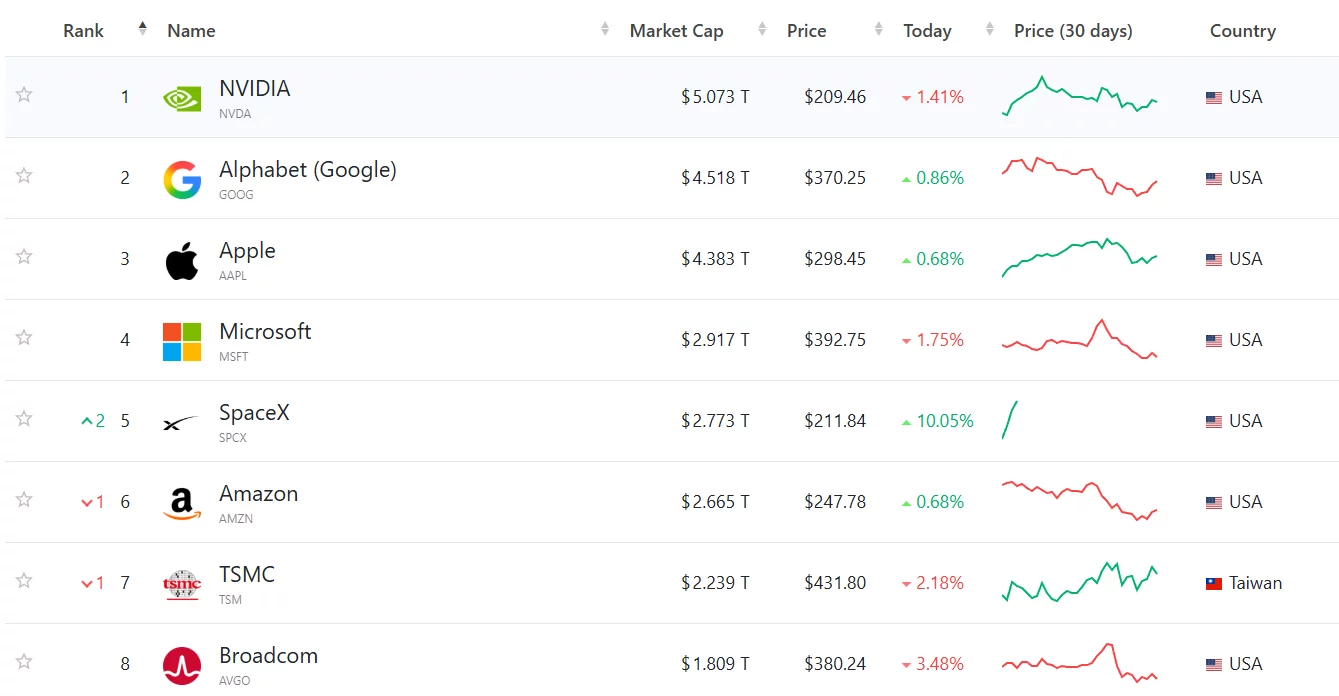
At the time of writing, Amazon shares were up 0.68%, giving the company a market capitalization of about $2.66 trillion, well below SpaceX’s despite volatility in early trading.
The latest rally extended momentum that began a day earlier. SpaceX stock gained 19.6% on Monday following news of a U.S.-Iran peace agreement, before advancing another 11.57% in after-hours trading. Shares then added nearly 10% in premarket activity on Tuesday before accelerating further after the opening bell.
Cursor merger drives investor demand
According to SpaceX, the company and its subsidiary X67 Inc. have entered into a merger agreement with Anysphere Inc., the developer of Cursor AI. Under the proposed transaction, X67 will become a wholly owned subsidiary of SpaceX.
SpaceX said all common and preferred Cursor shares will automatically convert into rights linked to SpaceX stock once the merger closes. The company valued Cursor at approximately $60 billion in the all-stock transaction.
Regulatory approvals and customary closing conditions remain outstanding, with SpaceX stating that completion is expected during the third quarter of 2026.
Investor enthusiasm surrounding the merger announcement appeared to fuel much of the premarket buying activity. Reports ahead of the company’s Nasdaq debut indicated that retail demand for SpaceX shares had significantly exceeded available supply, with some investors reportedly seeking additional financing and loans to increase their allocations.
Binance activity highlights growing interest
Interest in SpaceX has also expanded into crypto-linked markets. As crypto.news reported, Binance said its SPCXUSDT perpetual futures contract has become the exchange’s second-largest futures product by trading volume, trailing only Bitcoin perpetual futures.
According to Binance, the contract generated more than $5.6 billion in rolling 24-hour trading volume and over $9 billion in combined volume across its pre-IPO and post-IPO trading periods.
Binance further stated that it currently leads both centralized and decentralized trading activity for the product while holding the largest open interest position among competing venues.
The increase in derivatives activity has coincided with growing attention on SpaceX following its public listing. Binance also reported that its equity-linked products surpassed $1 billion in turnover within nine days, with SpaceX-related contracts contributing to that growth as traders sought exposure to the company’s rapidly rising valuation.
Disclosure: This article does not represent investment advice. The content and materials featured on this page are for educational purposes only.

One of the Greatest Comedy Series of All Time Is Waiting To Be Rediscovered on Netflix

Financial Growth! #shortvideo #ytshorts #shorts #affirmations #manifestation #ytviral #wealth #yt

Exeter to Manchester Airport flights ‘key’ for business community

Blockchain.com files with SEC for U.S. IPO

Israel says it has killed new Hamas military leader in Gaza City airstrikes

NYT Strands Answers May 24 2026 Revealed for Puzzle No. 812 Theme Summer Essentials
Financial Growth! #shortvideo #ytshorts #shorts #affirmations #manifestation #ytviral #wealth #yt

Hi, I’m Lisa: Your Financial Independence Guide

May Survey (full video on the channel) #finance #usa #business #job #market #stockmarket
-

 Business3 days ago
No Jackpot Winner as $257 Million Prize Rolls Over to $269 Million Monday Draw
-

 Crypto World6 days ago
Oppenheimer backs SpaceX as $70 billion retail frenzy builds
-

 Fashion4 days ago
Weekend Open Thread: Tuckernuck – Corporette.com
-

 Crypto World5 days ago
Markets Rally as SpaceX IPO Looms Amid Iran Tensions and Inflation Surge
-
 Crypto World2 days ago
Zimbabwe Requires Crypto Businesses to Register Annually Under New FIU Regulations
-

 Tech4 days ago
NanoClaw integrates JFrog registries to secure AI agent downloads
-

 Tech5 days ago
This Week In Security: Microsoft On Microsoft, Register Your Domains, Linux On ARM, And FreeBSD Joins The File Cache Club
-

 Crypto World4 days ago
Bitget enters Argentina’s regulated crypto market through PSAV registration
-
 Tech6 days ago
Dutton Ranch star claims they ‘didn’t see any disruption’ on set following Chad Feehan’s exit from Yellowstone spinoff fueled by Taylor Sheridan clash rumors
-

 NewsBeat5 days ago
El Nino has formed in the Pacific and could set records, forecasters say
-

 Politics6 days ago
Politics Home | Healey Resignation Is “Colossal Failure Of Government”, Says Former Labour Defence Secretary
-

 Tech7 days ago
‘This is Seattle’s position on AI’: City Council votes unanimously to pause big new data centers
-
 Entertainment5 days ago
Donnie Wahlberg & More Heat Up Las Vegas at Circa’s Barry’s Downtown Prime
-
 Tech5 days ago
Opendoor Ends India Operations, Fueling a Bigger Conversation About AI and Outsourcing
-

 Sports6 days ago
First Time Since 1971: Australia Register Historic Low In ODI Cricket
-

 Politics6 days ago
Belfast burns, while Met chief points finger at Iran and Russia
-

 NewsBeat4 days ago
FBI searches office of Ohio voter registration group
-

 Business6 days ago
AT&T: Verizon's 27% Outperformance Sets Up A Solid Entry Point
-

 Politics6 days ago
Modi thanks Trump for wishes as US attacks Indian seafarers
-
 Tech5 days ago
Anthropic is spending $150M to embed 1,000 AI fellows inside nonprofits. No degree required.
You must be logged in to post a comment Login