

Crypto World
Illinois Governor Signs Crypto Transaction Tax After Industry Pushback


Illinois Governor JB Pritzker signed a $55.9 billion budget bill into law on Tuesday, attaching a new 0.2% “privilege tax” on crypto transactions. The provision applies broadly to digital asset activity and adds new registration and reporting obligations for digital asset brokers operating in the state.
Crypto industry groups urged the governor to veto the measure. In a letter sent ahead of the signing, the Crypto Council for Innovation (CCI) called for a line-item veto, arguing the tax would create a “new and unprecedented” regime that singles out digital asset users and could push innovation out of Illinois.
Key takeaways
- Pritzker’s signed fiscal 2027 budget includes a 0.2% tax on digital asset transactions, framed as a “privilege tax.”
- CCI asked for a line-item veto of Article 3 of Senate Bill 3019, warning the measure targets crypto based on its underlying technology.
- BDO USA noted the tax’s reach could extend beyond in-state firms if out-of-state businesses have sufficient customer activity in Illinois.
- The bill also bundles crypto taxation with new broker registration and compliance/reporting requirements.
- Supporters are positioning the measure as part of a broader fiscal package intended to raise significant new revenue for the state budget.
What Illinois passed—and how the tax is designed
The crypto transaction tax was included as part of Illinois’ fiscal 2027 budget bill, making Illinois the only state to apply a tax structure to digital asset users in this manner, according to earlier Cointelegraph reporting referenced in the text. The measure is part of Senate Bill 3019 and takes the form of a 0.2% “privilege tax” on transactions involving digital assets.
CCI’s letter describes the tax as applying to “all digital asset transactions” conducted through “any registered platform,” using broadly defined language for “digital asset business activity.” The practical effect, as outlined by the critics, is that the tax is not limited to profits or realized gains. Instead, it is structured around transaction activity itself.
BDO USA’s analysis, cited in the source material, further highlights that the scope may be wider than the largest Illinois-based crypto entities. If out-of-state companies have enough customer activity tied to Illinois, the tax could still apply.
Industry opposition: “singled out” and technology-based
CCI argued that the tax effectively targets how transactions occur rather than what a person earns. The group likened the approach to taxing the medium of delivery—for example, comparing blockchain-based transaction processing to sending correspondence—rather than taxing income, gains, or profits.
“Taxing a transaction based on the medium through which it happens to occur on a blockchain is akin to taxing correspondence because it is delivered by email rather than by post.”
In its appeal to Governor Pritzker, CCI warned that the measure would “disproportionately” burden Illinois residents for using digital assets and could reduce the number of crypto builders and companies willing to operate in the state.
Similar concerns were raised in a separate public letter from the Digital Chamber, which opposed the Digital Asset Privilege Tax Act on June 3. The letter’s argument, as described in the source, framed the timing as especially problematic because the industry is already adapting to new federal regulatory and policy developments, while Congress is also working on a wider national tax framework for crypto assets.
Broader compliance package: registration, reporting, and impact on providers
The Illinois budget bill does more than introduce a transactional tax rate. As described in the provided text, digital asset brokers in the state are required to register and comply with new reporting obligations.
For market participants, this means the cost of compliance may land alongside the transaction tax itself. Even where the tax may be passed through in fees or pricing, the added registration and reporting requirements can still increase operational burden—particularly for firms that handle transactions across state lines.
The combined design matters because it links consumer-facing activity (transactions) with a regulatory framework aimed at intermediaries. That structure could influence where companies choose to focus their operations, how they design onboarding and reporting workflows, and how they calculate costs for customers engaging with digital assets through regulated platforms.
Fiscal rationale and revenue targets
The crypto tax is presented in the broader context of closing a budget gap for Illinois. The source material states the package is expected to raise more than $800 million in new tax revenue to support Pritzker’s $55.9 billion fiscal 2027 budget.
In addition, the measure is described as a bundled part of the overall legislative strategy that includes both taxation and compliance changes for the digital asset sector. Critics argue the state is effectively choosing to raise revenue through crypto transaction activity rather than through structures that parallel traditional taxation of income or gains.
Policy observers quoted in the source also framed the law as unusually restrictive compared with how other financial instruments are treated at the state level. Miles Jennings, head of policy and general counsel for a16z Crypto, said on X that he viewed the law as among the most anti-crypto measures in the US, arguing that there is no comparable state financial transaction tax on stocks, bonds, or derivatives nationwide.
In the same thread, Jennings warned that—rather than taking advantage of perceived efficiency and innovation in blockchain-based financial systems—Illinois is poised to “punish its entrepreneurs and citizens” who use crypto.
What to watch next
With the budget bill now signed, Illinois market participants will likely shift attention to implementation details—especially how “digital asset business activity” and “sufficient customer activity” are interpreted in practice for both in-state and out-of-state firms, and how registration and reporting requirements are enforced. Investors and builders should also watch whether additional legal or policy challenges emerge from the groups that sought a line-item veto.



Australia’s High Court has unanimously ruled 7-0 in favor of the Australian Securities and Investments Commission, finding that Block Earner’s former fixed-yield crypto product required a financial services licence under existing law.
Summary
- Australia’s High Court ruled 7 to 0 that Block Earner’s former fixed yield crypto product required a financial services licence.
- The decision overturns a 2025 appeal court ruling and sends the case back to the Full Federal Court to consider penalties.
- Block Earner has since exited yield products and is developing crypto backed home loans after securing an Australian Credit Licence in 2026.
According to a June 17 court document, the High Court determined that the product offered by Web3 Ventures Pty Ltd, which operates as Block Earner, functioned as a facility for financial investment and also met the legal definition of a derivative. The court found that investor returns depended on movements in underlying digital asset values and exchange rates.
As a result of the ruling, the case will return to the Full Federal Court, which will now consider ASIC’s appeal relating to penalties tied to earlier proceedings against the company.
ASIC said in a statement on Wednesday that it launched civil penalty proceedings against Block Earner in November 2022 over concerns that the Earner product had been offered without the required licence. According to the regulator, investors who used the product did not receive important protections available under Australia’s financial services framework.
High Court overturns earlier appeal decision
Court records and ASIC’s statement show the dispute has moved through several stages of Australia’s judicial system over the past two years.
The Federal Court ruled in February 2024 that Block Earner had operated an unregistered managed investment scheme. Although the court later decided in June 2024 not to impose financial penalties, ASIC challenged that outcome and filed an appeal the same month.
Soon afterward, Block Earner lodged a cross-appeal on July 9, 2024. The Full Federal Court sided with the company in April 2025, allowing the cross-appeal and dismissing ASIC’s challenge. Wednesday’s High Court judgment overturned that decision.
Welcoming the outcome, ASIC Chair Sarah Court said the ruling supports the regulator’s long-held view that Australia’s financial product laws apply to new technologies without requiring legislative changes.
“This reinforces ASIC’s long-standing position that the definition of financial product is broad and technology neutral and so captures new and emerging products without the need to amend the legislation,” Court said.
Block Earner continues crypto lending plans
Although the legal dispute centered on the Earner yield product, Block Earner voluntarily shut down the offering in November 2022 and has since redirected its business toward lending services.
In May 2026, the company received an Australian Credit Licence and announced plans to develop crypto-backed home loans. At the time, Block Earner said the product would allow borrowers to use Bitcoin as collateral for home financing without selling their holdings.
The licence was notable because it represented the first time a digital asset platform in Australia had been authorized to provide credit products under its own licence.
Earlier company statements also linked the initiative to growing interest in integrating digital assets into traditional mortgage markets. Similar discussions have emerged in the United States, where federal housing authorities and lawmakers have explored frameworks that could allow certain regulated crypto holdings to be considered during mortgage assessments.
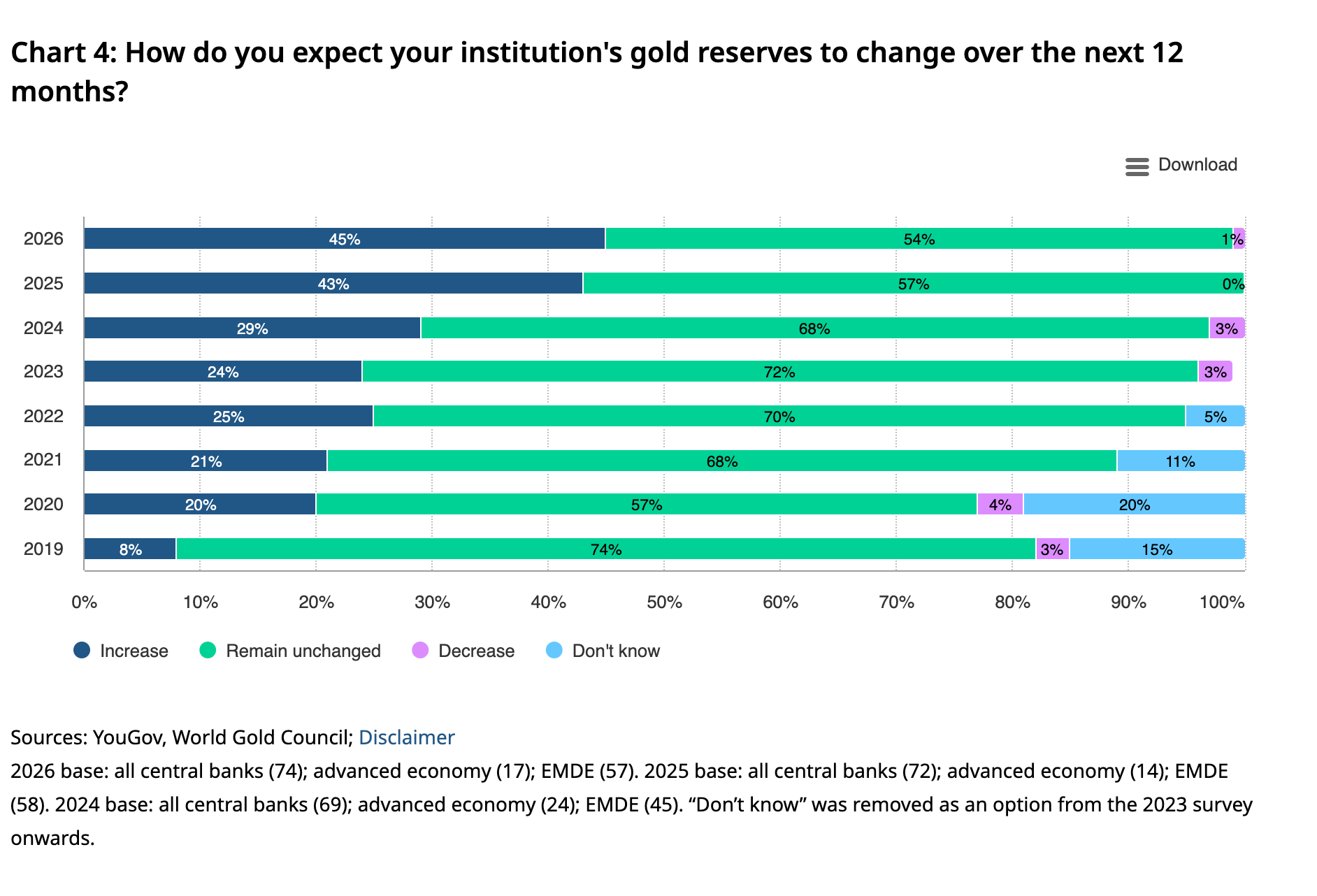
45% of central banks intend to grow their gold reserves over the next 12 months, the highest level on record in the World Gold Council survey.
The annual study also found that 89% of central banks expect global central bank gold holdings to rise, while just 1% anticipate a decline.

Follow us on X to get the latest news as it happens
Why Central Banks Keep Stockpiling Gold
Central banks have bought an average of 1,000t of gold since 2022. That pace is double the 500 tonnes averaged over the previous decade.
Recent monthly data reinforces the trend. Official buyers resumed net purchases in April, adding 19 tonnes after recording net sales in March.
Poland led the month with 14 tonnes, raising its 2026 total to 45 tonnes. China added 8 tonnes, its 18th consecutive month of buying.
Not all activity points in one direction. Russia extended a selling streak with 6 tonnes in April, while Turkey kept its reserves broadly flat.
What Is Driving the Gold Demand
Meanwhile, respondents pointed to familiar reasons for holding gold. Its role as a long-term store of value, its performance in a crisis, and its diversification benefits remain the core motivations.
“90% of respondents indicated that gold’s performance during times of crisis is highly or somewhat relevant to their organisation, a record high for this factor. 84% of respondents indicated that gold’s role as a store of value was a relevant factor, while 83% pointed to gold’s attribute as a portfolio diversifier,” the findings revealed.
Economic and geopolitical signals also shaped reserve decisions. Interest rate levels topped the agenda at 92%, the same as last year. Geopolitical instability and inflation followed.
Instability has now edged ahead of inflation, a shift the report ties to the war in Iran. Most responses arrived after the Middle East conflict began in early 2026.
At the same time, confidence in the dollar continues to weaken. Around 74% of respondents expect their reserve share to fall over five years, while 84% expect gold’s share to rise.
“We expect that there will be a downward shift in the share of total reserves held in US dollars. This reduction will come primarily from countries whose relationships with the US are likely to be affected by US foreign policy and political relations,” a respondent said.
Not every signal points higher. Bearish options bets target a 40% decline in gold prices by 2028, with Citigroup trimming its forecast to $4,000.
The divergence sets up a clear test for the market. Steady official demand would need to offset any cooling in private investor appetite to hold prices firm.
Subscribe to our YouTube channel to watch leaders and journalists provide expert insights
The post New Survey Shows Central Banks Far From Done Buying Gold appeared first on BeInCrypto.

GRAM dropped between 2% after India ordered Google and Apple to delist Telegram from their app stores, cutting off access for an estimated 104 to 150 million users, and Pavel Durov is not happy. It’s cutting Telegram’s single largest national user base.
Executed under Section 69A of India’s Information Technology Act, it is explicitly temporary, tied to the NEET-UG medical entrance re-examination scheduled for June 21.
The entire investment thesis for the TON blockchain and its native token rests on Telegram as a distribution moat, a billion-user platform that embeds the chain natively into daily messaging. One government’s Section 69A order just demonstrated that the moat has a trapdoor.
This will likely affect the crypto market too, with India as one of the largest countries with active crypto holders, and Telegram, alongside X, are where crypto communities are spending their days.
— TALK TO CRYPTO (@talktocrypto2) March 14, 2026
 #BTC #Global Ranking:- Countries with the most Bitcoin holders
1.  India:- 93 million
2.  United States:- 46 m..
3.  China:- 41 mil..
4.  Nigeria:- 18 mil..
5.  Vietnam:- 17 mil..
6.  Indonesia:- 14 mil..
7.  Turkey:- 12 million
8.  Philippines:10 mil.. pic.twitter.com/ewje351bst
Discover: The Best Crypto to Diversify Your Portfolio
What Has The Indian Government Done?
India’s Ministry of Electronics and Information Technology, acting on a formal request from the National Testing Agency, invoked Section 69A of the IT Act to restrict access to Telegram ahead of the NEET-UG re-exam. The National Testing Agency had canceled the original May 3 exam amid allegations of paper leak, with Telegram channels implicated in distributing, and in some cases fabricating, leaked materials.
A separate government direction requires Telegram to disable its message-editing feature for Indian users until June 30. This is targeting the specific mechanism that investigators say cheating networks used to create backdated fake leak evidence.
As of today, the delisting order runs until June 22, 2026, or one day after the re-exam.
Telegram CEO Pavel Durov responded on X with a sharp counter-allegation, accusing India telecom Reliance of using BGP hijacking. He noted that they are specifically abusing the Border Gateway Protocol via autonomous system number AS18101 to reroute and disrupt Telegram access for users outside India, including in the UAE.
BGP hijacking is a technique where a network operator broadcasts false routing information to redirect internet traffic; if genuine, it would mean Telegram’s connectivity problems extend well beyond the Indian government order. Pave; Durov also alleged that Reliance and WhatsApp lobbied jointly to impose the India ban, citing Reliance’s partial ownership by Meta as a motive.
— Mario Nawfal (@MarioNawfal) June 17, 2026
India just banned Telegram for 150M users to stop exam cheating ahead of the NEET-UG re-test on June 21.
Its CEO Pavel Durov pushed back immediately: "This punishes 150M+ ordinary users, not the insiders who leaked the exam materials. The leaks just moved to other apps."
And… pic.twitter.com/xvW7CMzZtF
A senior India telecom industry source flatly rejected the claims, telling the Economic Times that Pavel Durov conflated two entirely separate entities. Reliance Communications, which operates subsea cables and holds AS18101, and Reliance Industries Ltd, the parent of Jio, in which Meta holds only a minority stake with no operational role.
The source called the conflation either a misunderstanding of the sector or deliberate misinformation. Telegram, Jio, Meta, and Reliance Communications had not responded to media queries at the time of publication.
Discover: The Best Token Presales
Not Just Pavel Durov, Crypto Takes a Hit by India Decision
The bull case for Gram, or TON blockchain, has always been distribution, so is crypto in general. Telegram’s crypto funnel is running at scale. India, with 104 to 150 million Telegram users, is the largest single node in that funnel. Per the report, the disruption of crypto hit tap-to-earn games, daily quiz apps, and Web3 mini-apps immediately, with Indian users locked out of on-chain participation overnight.
The distinction between Durov’s two claims matters for the investment calculus. If the Indian ban is purely regulatory, a government acting on legitimate exam-integrity concerns, then it is bound by those concerns and ends when they are resolved.
— Indian Tech & Infra (@IndianTechGuide) June 17, 2026
 Do you think blocking Telegram is the right decision?
If Durov’s allegation holds, and WhatsApp and Reliance entities lobbied to suppress a competitor, then the ban is an instrument of competitive warfare. Competitive suppression is episodic and typically reversible when the political cost rises. Genuine regulatory action can evolve into something structural.
The BGP hijacking claim, if verified, would be independently alarming; it would mean disruption to Telegram access is being manufactured at the routing layer, outside any government order, affecting users in third countries like the UAE.
Discover: The Best Crypto to Diversify Your Portfolio
The post India Bans Pavel Durov Telegram: GRAM and Crypto Hammered, Whatsapp Accused appeared first on Cryptonews.
Crypto World
Bitget and WIW3CH on Why Web3 Still Needs More Women in Ownership, Funding, and Leadership


Women in Web3 are usually discussed in terms of representation numbers. Bitget CEO Gracy Chen and Elodie Jallet, Co-Lead for Romandie and Global Partnerships at the Swiss-founded network WIW3CH, say they want to shift that conversation toward ownership.
By that, they mean funding, technical education, founder networks, and leadership roles. The two are now working together, with Bitget’s Blockchain4Her program partnering with WIW3CH on education and events.
In an interview with BeInCrypto, Chen and Jallet made the case for the partnership. They also fielded questions on whether initiatives like theirs actually move the numbers.
Bitget says female founders receive only 6% of industry funding. What is Blockchain4Her doing about that, and how will you know it worked?
Chen: That 6% figure is exactly why we built it. I’ve faced gender bias as an entrepreneur myself, so the program isn’t a campaign bolted onto the side. We’ve put a $10 million fund behind female-led projects and tied diversity targets to our internal hiring and partnership standards.
As for results, we focus on the long-term success of the individuals we support. For example, we track the progress of participants from initiatives like our “Pitch n’ Slay” competition and the Blockchain4Her awards, monitoring how their projects evolve, scale, and secure further funding over time.
This commitment to long-term change is also reflected in our large-scale partnerships, such as our work with UNICEF to provide digital and blockchain education to 300,000 young people. By focusing heavily on empowering girls through these educational programs, we are ensuring that our impact isn’t just felt by today’s entrepreneurs but is actively building a more balanced pipeline for the next generation.
What is the biggest barrier you actually see, capital or something earlier than that?
Chen: Capital is the visible one. Some investors still hesitate to fund female-led startups over unfounded assumptions about leadership or family commitments.
But there are two quieter barriers. One is the lack of visible role models and mentors to help newcomers navigate the space, share industry “tricks,” and provide a supportive environment for open communication.
The other is the confidence gap fueled by the sector’s perceived technical complexity and male-dominated demographic. When you don’t see yourself reflected in the room, it’s easy to doubt whether you belong.
Ultimately, the combination of these factors creates a significant barrier to entry that requires both structural and cultural change to overcome.
How has your leadership influenced Bitget’s work with women-focused Web3 communities?
Chen: My leadership at Bitget is driven by the conviction that access to knowledge and opportunity should be universal, regardless of gender, age, or social background. This personal involvement ensures that our work with women-focused communities is not just a corporate checkbox, but a core value led from the top.
Internally, I lead by example to ensure Bitget reflects the diversity we advocate for globally, which is why 40% of our leadership positions are held by women. I strive to cultivate a “safe space” culture where everyone feels empowered to communicate openly and share ideas without hesitation.
WIW3CH grew from a Swiss initiative into 15 international chapters. What does that demand tell you?
Jallet: That the representation gap isn’t regional, it’s global. The rapid demand for WIW3CH chapters worldwide proves that women are actively looking for structured, safe environments to upscale their skills and build professional networks.
These women aren’t looking to be passive participants in a decentralized future. They want routes into technical and strategic roles.
What specifically are those women asking you for?
Jallet: Two things, consistently: serious educational resources and access to real professional networks. Many are pivoting from traditional finance, law, or Web2 engineering, so they’re not looking for superficial overviews.
They want deep technical and compliance literacy and structured mentorship. They also want access to specialists, including Web3 lawyers, tax advisors, and communications and HR people, who can help them build a venture without making avoidable mistakes.
There are several women-in-Web3 networks Bitget could have backed. Why WIW3CH, and how does your approach differ from the awareness-led model most of these initiatives use?
Chen: WIW3CH brings a hands-on approach to empowerment by organizing meaningful events that offer practical tips and deep-dive educational content. This focus on high-quality education is essential for helping women build the tangible skills and confidence needed to thrive in the sector.
Ultimately, our collaboration is rooted in a shared vision for the future of the industry, and their proven ability to foster a supportive, knowledge-driven environment makes them an invaluable partner as we scale our impact together.
The biggest misconception about women-focused groups?
Jallet: That they’re social or exclusionary. WIW3CH is a skills-driven hub, with tech, legal, marketing, and DeFi expertise under one roof.
We help founders launch start-ups and we supply a qualified talent pool to the wider industry, which is dealing with a genuine talent shortage. For us, diversity isn’t a metric to report. It’s a precondition for building things that last.
What would real progress look like in two to three years, beyond inclusivity statistics?
Jallet: More female-founded Web3 protocols, more women managing venture capital allocations, and women holding permanent seats in compliance, AI, and infrastructure development. Progress means that having a female executive like Gracy Chen leading a global exchange becomes a standard industry norm, rather than an inspiring exception.
The partnership spans podcasts, articles, memberships, and events. Why so many formats?
Jallet: Because they map to different stages. The podcast is the entry point, highlighting real-world experiences and addressing the specific challenges women face, helping newcomers realize they aren’t alone.
Articles are the next step, offering practical tips and educational guidance that let women learn the technical and strategic sides at their own pace. Then events and membership provide the infrastructure for growth, connecting the mentors, peers, and institutional leaders who help someone move from learner to founder or executive.
Chen: That progression is the core of our vision. A woman’s journey into Web3 requires a multi-layered approach, and this partnership meets them exactly where they are. Blockchain4Her is here to accompany women every step of the way with effective support and tools. Joining grassroots trust with institutional reach is how you build the next generation of Web3 leaders.
Disclaimer: This article is provided for general informational purposes only and does not constitute investment, legal, or financial advice, nor an offer or solicitation to buy or sell any financial instruments or digital assets. Any views expressed are based on current market observations and are subject to change. Past performance is not indicative of future results. Digital assets are volatile and may not be suitable for all investors. Readers should conduct their own independent research and seek professional advice before making any investment decisions. Restrictions may apply.
The post Bitget and WIW3CH on Why Web3 Still Needs More Women in Ownership, Funding, and Leadership appeared first on BeInCrypto.
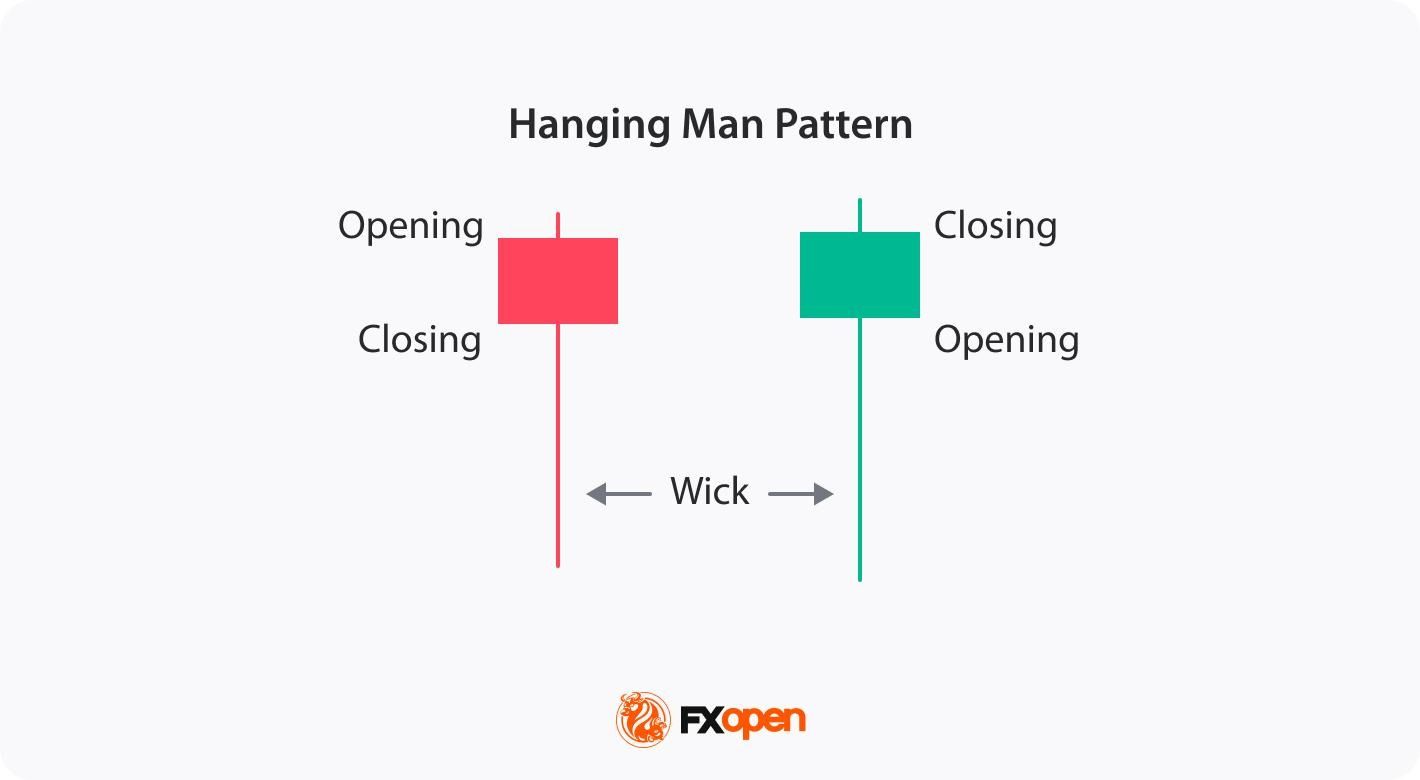
The hanging man candlestick is a single-bar pattern that forms after an uptrend. It consists of a small body near the top and a long lower shadow. It points to a possible bearish reversal. Most traders wait for a confirmation candle before acting.
In the world of technical analysis, candlestick patterns are commonly used to decipher market trends and potential reversals. Among the many setups, the hanging man holds particular significance. This distinctive formation captures traders’ attention as it often serves as a warning sign of a possible trend reversal. This article will go through the technical analysis of the hanging man formation and explain how traders can trade with it.
What Is a Hanging Man Candlestick Pattern?
A hanging man candle is a single-bar pattern that forms after an uptrend and warns of a possible bearish reversal. It has a small real body near the top, a long lower shadow, and little or no upper shadow. The colour of the body is secondary, though a bearish close adds weight.
Psychology Behind the Hanging Man Pattern
The psychology behind the hanging man candlestick pattern reflects a shift in market sentiment. Buyer exhaustion sits at the core of the hanging man pattern. After a long advance, demand thins and fewer buyers step in at higher prices. Sellers then emerge and drive the long lower shadow, signalling a possible uptrend reversal.
The long lower shadow shows that sellers were able to push prices down significantly during the trading session. Although buyers managed to drive prices back up, the close near the open price suggests weakening bullish sentiment. This pattern signals that seller pressure is increasing, potentially leading to a bearish reversal as confidence among buyers diminishes.
The hanging man is a versatile formation that can be applied across a wide range of financial instruments, including stocks, indices, commodities, and forex, on different timeframes.
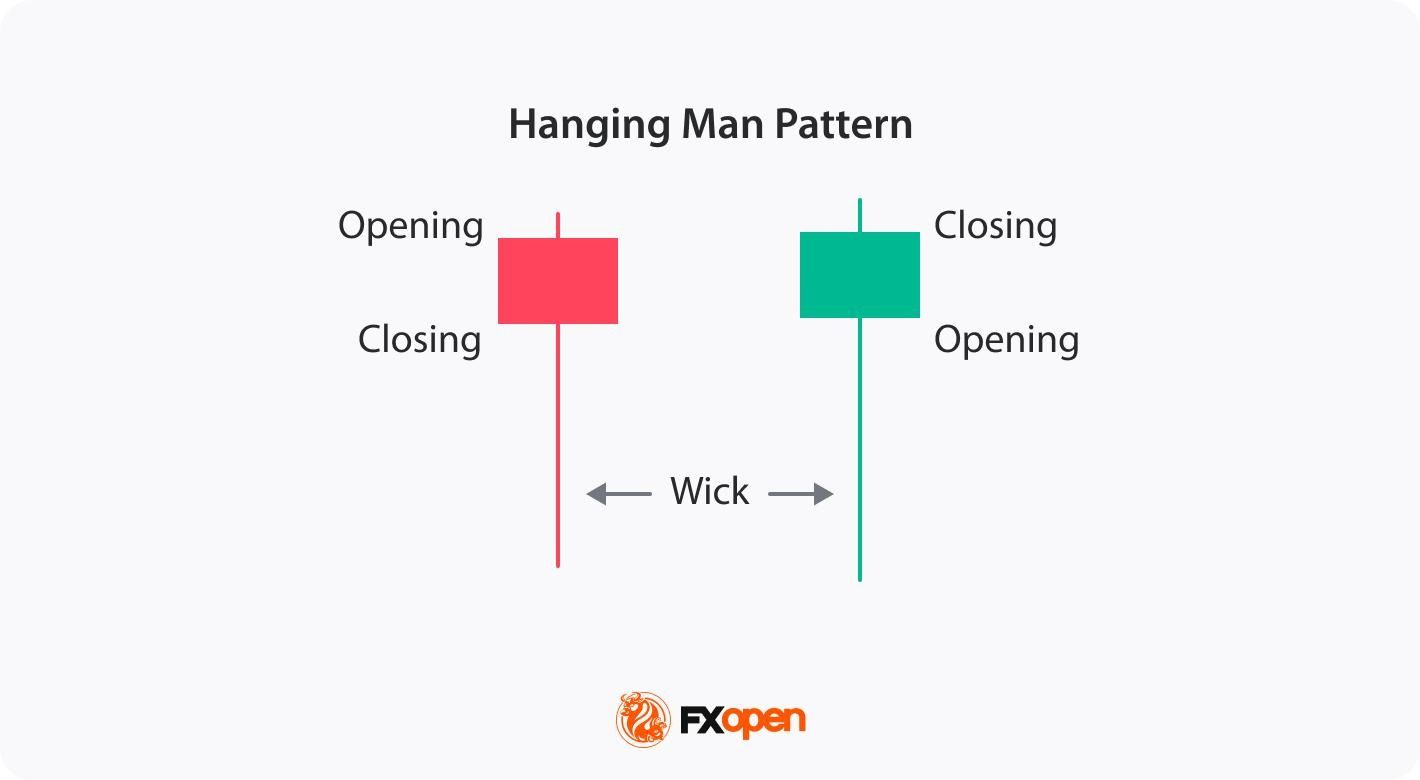
Characteristics of a Hanging Man Candle
A hanging man candle has a clear shape that sets it apart on a chart. Five features define it. Each one matters, and the pattern carries more weight when all five line up after a strong uptrend.
- Small real body: the open and close price sit close together, near the top of the range.
- Long lower shadow: the shadow runs at least twice the length of the body.
- Little or no upper shadow: price closes near the session high.
- Prior uptrend: the candle forms after a sustained move higher.
- Confirmation: a bearish follow-through candle is needed before the signal holds.
Without a prior uptrend, the same shape is read as a hammer rather than a hanging man candlestick. Context, not colour, gives the candle its meaning.
How Traders Identify a Hanging Man Candlestick
To spot a hanging man pattern in stocks and other financial instruments, you may follow these steps:
- Look for an existing uptrend: Start by identifying a prevailing upward price movement on the chart.
- Find a small real body near the top of the range: It should have a long lower shadow and little to no upper shadow. This formation resembles a figure hanging from its head.
- Check the lower shadow runs at least twice the length of the real body: A short shadow weakens the signal.
- Treat colour as secondary: The colour of the candle doesn’t matter, but if it’s bearish, the signal is stronger.
- Consider supporting indicators: Utilise other technical indicators or oscillators to further validate the potential reversal. These can include trendlines, moving averages, or momentum indicators that align with the bearish interpretation.
Even with all five checks met, the hanging man candlestick still needs a confirmation candle before it carries weight. The pattern is a warning, not a trigger.
What Is the Confirmation Candle for a Hanging Man?
A hanging man confirmation candle is the bearish bar that follows the pattern and provides the candlestick confirmation that validates the reversal. Without it, the hanging man is only a warning. Traders typically watch for one of three signals in their candlestick chart analysis.
The first is a bearish engulfing candle that fully covers the prior body. The second is a strong bearish close well below the hanging man’s real body. The third is a clean break below the hanging man’s low. Each shows that sellers have taken control after the initial warning. The stronger the confirmation, the more weight the signal tends to carry.
Trading the Hanging Man Pattern
Those trading the hanging man reversal pattern apply a systematic approach. Here are a few steps traders usually follow to trade this pattern:
- Spot the pattern: Identify the setup by using the steps mentioned above.
- Look for confirmation signals: The setup alone is not sufficient for making trading decisions. Seek additional confirmation through subsequent candlestick patterns or technical indicators. This can include bearish candlestick patterns (e.g. bearish engulfing), a pullback from a resistance level, or the convergence of other indicators signalling a potential reversal.
- Define your entry point: Traders typically consider an entry point either when the next candlestick confirms the bearish sentiment or when the price breaches a significant level.
- Identify profit targets: The candlestick itself doesn’t provide specific targets. Traders could identify profit targets by looking at previous support levels, Fibonacci retracement levels, or other technical analysis tools like moving averages or pivot points.
- Consider risk management: Traders might set a stop-loss order above the hanging man pattern. Some traders assess the risk-reward ratio of the trade to ensure the trade aligns with their risk tolerance. Risk management tools like position sizing, setting stop-loss orders, and diversification may help traders calculate risks.
- Monitor the trade: Traders keep a close eye on their positions as they progress. They pay attention to any changes in market conditions or additional signals that may invalidate the trade.
- Learn from outcomes: Regardless of the outcome of the trade, traders analyse it afterwards to identify areas for improvement. They assess whether the setup provided accurate signals and identify any factors that may have affected the trade.
Live Market Example
Consider a hanging man that forms on the USD/JPY pair after a steady uptrend. The candle has a small body near the top and a long lower shadow. A bearish candle follows and closes lower, which validates the setup.
A common approach places the stop loss just above the high of the hanging man, since a move back above it would weaken the bearish case. The take profit order is at the next level of support. The gap between entry and that support sets the risk-reward ratio for the trade.
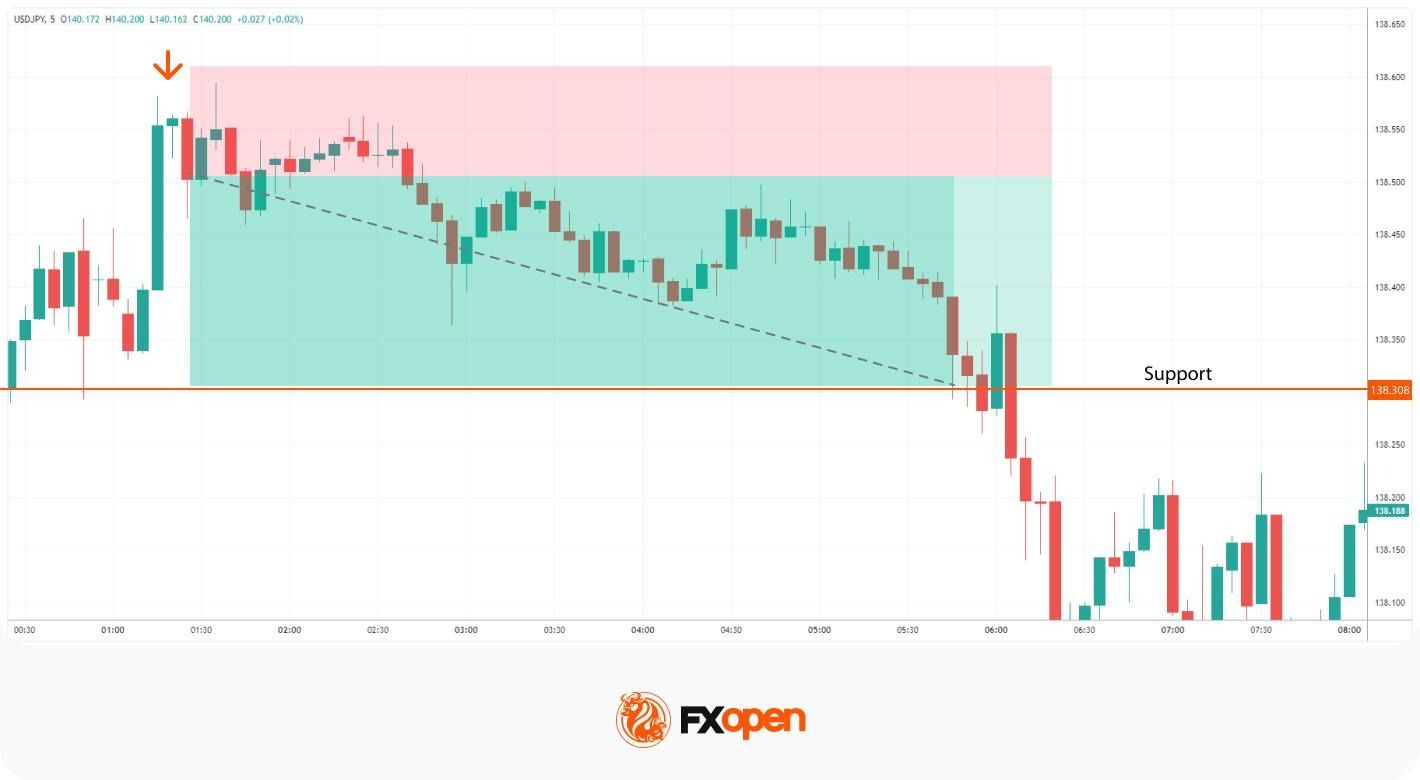
Traders can consider using the TickTrader platform to test the hanging man pattern rules.
Limitations of the Hanging Man Pattern
The hanging man candlestick pattern, while useful, has certain limitations that traders need to consider:
- False Signals: The hanging man can produce false signals, especially in volatile markets where price movements are erratic. A candle that looks valid can still fail once the next bar prints.
- Market Context: The reliability of the pattern varies depending on the broader market context and prevailing trends. The same shape means little without a clear prior uptrend behind it.
- Timeframe Sensitivity: The pattern’s signals can vary across various timeframes; what works on a daily chart may not be a strong signal on an intraday chart.
- Not Standalone: It is used as part of a comprehensive trading strategy that includes other indicators and risk management tools.
Context does most of the work here. The pattern flags a possibility, not a certainty.
Hanging Man vs Similar Candlestick Patterns
Understanding how the hanging man pattern differs from similar candlestick patterns may help in accurate technical analysis.
Several single-candle formations look almost identical to it, which makes them easy to confuse. The difference comes down to three things: the trend the candle forms in, where the body and shadow sit, and the signal it gives. The three comparisons below break it down against the hammer, the pin bar, and the shooting star.
Hanging Man vs Hammer
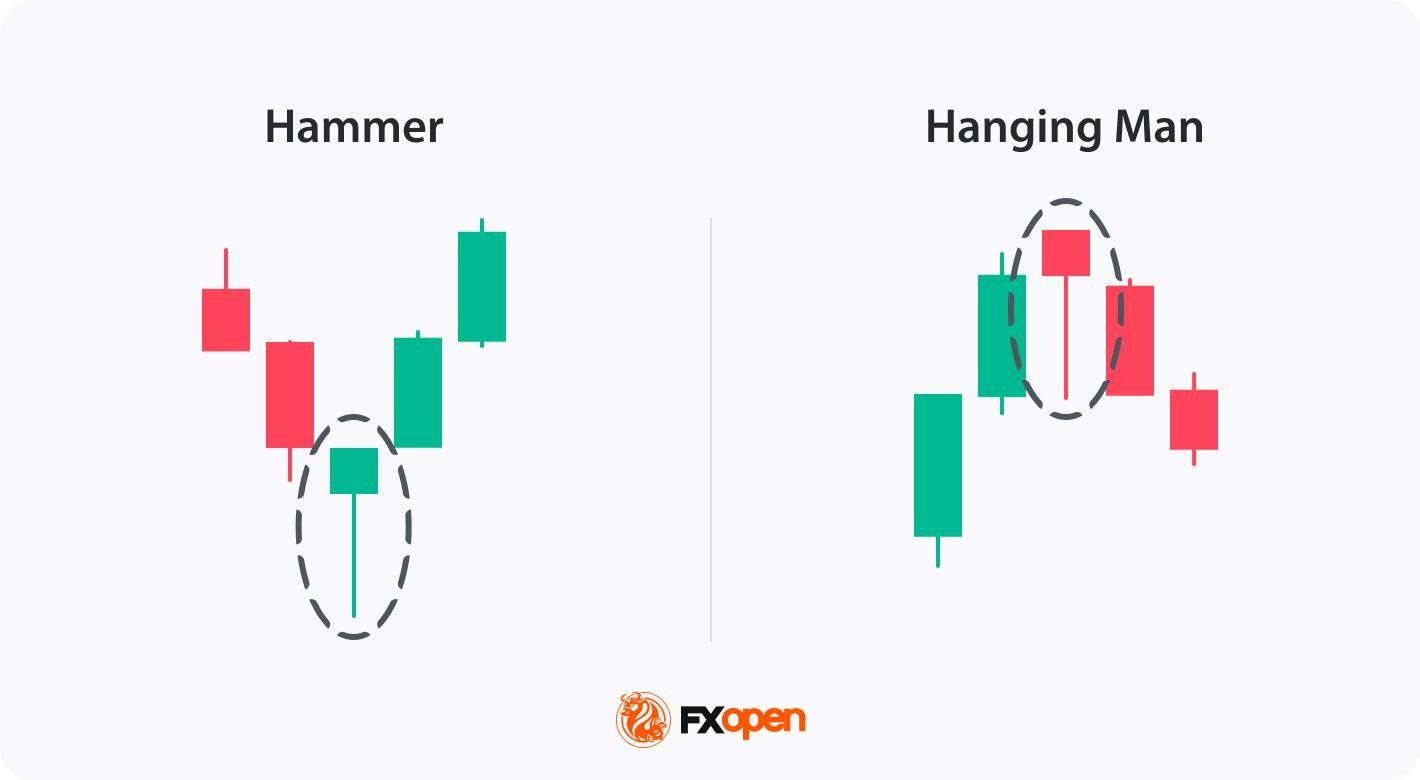
Both candles share the same structure: a small body near the top and a long lower shadow. The hanging man vs hammer difference comes down to the trend each one forms in.
The hanging man candlestick forms in an uptrend and signals a potential bearish reversal, while the hammer appears in a downtrend, indicating a potential bullish reversal. Both candles require confirmation from subsequent price movements. They are typically analysed within the context of the overall market trend and other technical indicators.
Hanging Man vs Pin Bar
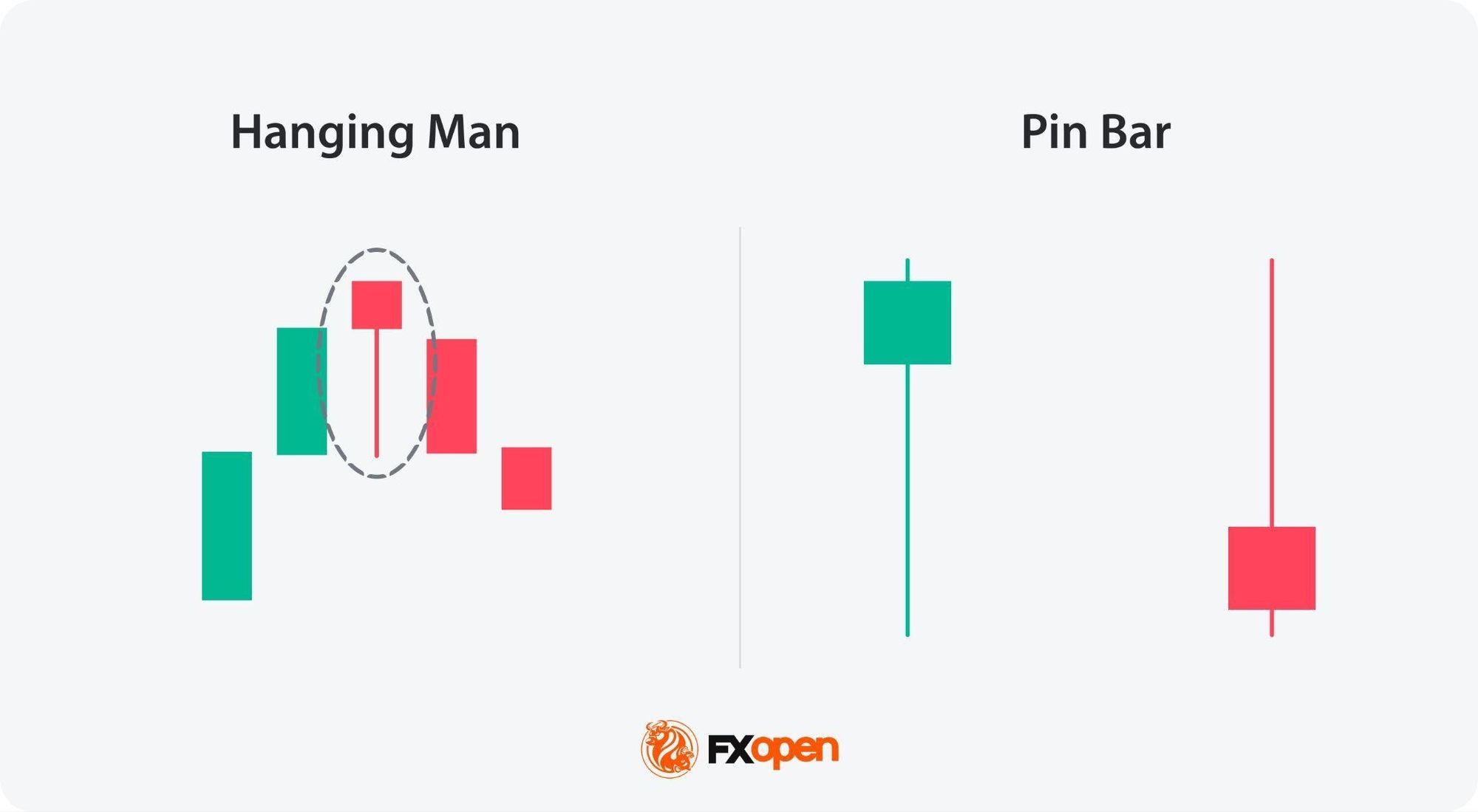
A pin bar and a hanging man are both single-candlestick patterns with small bodies and long shadows, but they serve different purposes in price action trading. The pin bar has a small body and a long tail, indicating a reversal, but it can appear in bullish and bearish markets. In a bullish trend, it’s called a shooting star, it has a long upper shadow and a small body, and signals a downward reversal. In a bearish trend, it’s called a hammer, it has a long lower shadow and a small body, and signals a bullish reversal. Its long tail shows a strong rejection of a certain price level, with the body pointing in the direction of the anticipated reversal.
The hanging man, however, specifically occurs after an uptrend and signals a potential bearish reversal, characterised by a small body at the top and a long lower shadow, indicating selling pressure.
Hanging Man vs Shooting Star
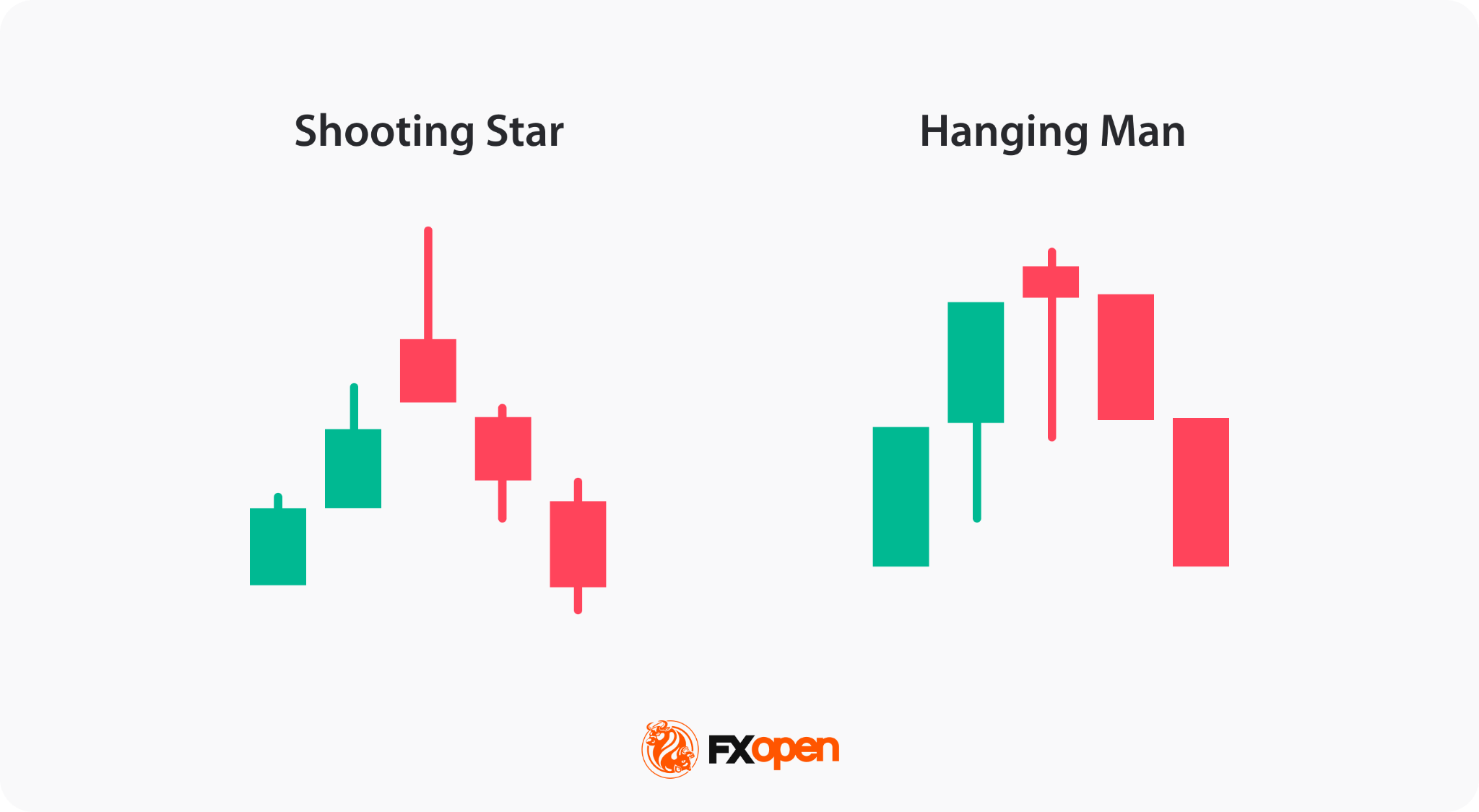
The shooting star and the hanging man are both bearish reversal patterns, but they differ in their appearance and context. A shooting star occurs after an uptrend and features a small body at the bottom with a long upper shadow. It indicates that the price was pushed up significantly but fell back down, showing strong selling pressure.
The hanging man also appears after an uptrend but has a small body at the top with a long lower shadow. It suggests that sellers dominated the session despite an initial push by buyers.
Both require confirmation from subsequent candlesticks to validate the reversal.
Is the Hanging Man Pattern Reliable?
On its own, the hanging man is a moderate signal. Its reliability depends on what surrounds it, not the candle alone. Four factors decide how much weight it carries.
Market context matters first. The pattern means little without a clear, sustained uptrend behind it. The same shape inside a choppy range carries almost no signal.
Trading confirmation comes next. A hanging man without a bearish follow-through candle is just a warning, and many resolve back into the uptrend. A confirmed signal is far more dependable than an unconfirmed one.
Timeframe shapes reliability too. A hanging man candle on a daily or weekly chart tends to hold more weight than one on a one-minute chart, where noise produces frequent false signals.
Supporting tools round it out. Traders often pair the pattern with support and resistance, volume, or momentum readings as part of their hanging man technical analysis. Agreement across signals raises the odds the reversal holds.
The takeaway is simple. The hanging man pattern flags a possibility, not a certainty, and works as one input among several rather than a standalone trigger.
Final Thoughts
While the hanging man alone is insufficient for making trading decisions, it serves as a warning signal that buyers may be losing control and that selling pressure could increase. Traders seek additional confirmation through subsequent candlestick patterns, support and resistance levels, and other technical indicators to validate the potential reversal.
In short, identify the candle by its small body, long lower shadow, and prior uptrend, then wait for a bearish confirmation candle before the trend reversal signal carries weight. By understanding the implications of the setup within the broader market context and employing proper risk management strategies, traders can support their decision and identify different setups across the markets. Once comfortable with a strategy, traders may consider opening a forex trading account with FXOpen to apply it across more than 700 markets.
FAQ
What Does the Hanging Man Pattern Indicate?
The hanging man trading pattern in technical analysis typically indicates a potential bullish trend reversal. It suggests that the buyers, who have been driving the market higher, are losing control, and the selling pressure may increase. The hanging man is represented by a small body near the top of the candlestick, a long lower shadow, and little to no upper shadow.
Can a Hanging Man Candle Be Bullish?
No, there is no such thing as a bullish hanging man candlestick pattern. The bearish hanging man pattern indicates a potential trend reversal from an uptrend to a downtrend.
Is the Hanging Man Pattern Reliable?
The reliability of the hanging man pattern, like that of any candlestick formation, depends on the broader market context and supporting technical signals. Although it is widely recognised as a potential bearish reversal pattern, it isn’t used as the sole basis for trading decisions. Traders typically seek confirmation through subsequent bearish price action, such as a strong bearish candle following the pattern, as well as additional technical indicators that support the likelihood of a trend reversal.
What Is the Confirmation Candle for the Hanging Man?
A confirmation candle for the hanging man is a bearish candlestick that follows the pattern, confirming the reversal. This can include a bearish engulfing candle or a candlestick closing well below the hanging man’s body, indicating increased selling pressure.
Is the Hanging Man Pattern Bearish?
Yes, it is generally considered a bearish pattern that appears after a strong uptrend. It is formed when the price’s open or close is near or at its high and there is a significant decline during the trading session.
Does the Colour of a Hanging Man Candle Matter?
No, colour is secondary. A hanging man can close red or green, and both versions are valid. However, a bearish red close adds weight, since it shows sellers ended the session in control. The shape and the prior uptrend drive the hanging man candle meaning far more than the body colour.
Can a Hanging Man Appear in Forex Markets?
Yes. The hanging man appears across forex, stocks, indices, commodities, and other markets on any timeframe. In hanging man forex trading, it often forms on major pairs after a sustained uptrend. The signal reads the same way regardless of instrument, though confirmation and market context still decide its reliability.
What Timeframe Is Commonly Used for a Hanging Man Pattern?
Higher timeframes tend to be more reliable. A hanging man on a daily or weekly chart usually carries more weight than one on a one-minute chart. Lower timeframes produce more noise and more false signals. Many traders treat the hanging man trading pattern as stronger when it forms on longer timeframes near key levels.
What Indicators Are Often Used With a Hanging Man Candle?
Traders often pair the candle with momentum and trend tools. Common choices include the RSI, moving averages, volume, and resistance levels. These may help confirm whether the bearish reversal candlestick signal is likely to hold. No single indicator confirms the pattern alone, so agreement across several tools tends to raise the odds.
This article represents the opinion of the Companies operating under the FXOpen brand only. It is not to be construed as an offer, solicitation, or recommendation with respect to products and services provided by the Companies operating under the FXOpen brand, nor is it to be considered financial advice.
The U.S. and Chinese flags are seen on the day of a bilateral meeting between the U.S. and China, in Geneva, Switzerland, May 10, 2025.
Keystone/eda/martial Trezzini | Via Reuters
BEIJING — Senior Chinese officials on Wednesday stressed Beijing’s plans to share artificial intelligence globally and safely, the latest sign of how the U.S. and China are promoting different approaches to the tech.
“China is accelerating the establishment of a global AI cooperation organization, and welcomes all parties to join,” Wang Yi, China’s top diplomat, told reporters in Mandarin Chinese, according to a CNBC translation. He emphasized the tech should serve the needs of humans.
Wang was speaking at the release of China’s global governance whitepaper, which criticized trade wars and emphasized support for the Global South. The category loosely refers to less developed economies, especially countries outside the U.S. and European orbits.
Wang’s comments came as the U.S. ramps up efforts to restrict foreign access to leading, U.S.-developed AI models.
During a summit in France this week, the wealthy Group of Seven countries — the U.S., the U.K., France, Germany, Canada, Italy and Japan — discussed a plan to give “trusted partners” access to the U.S. AI models, Reuters reported on Tuesday, citing three diplomatic sources. CNBC was unable to independently confirm the report and has reached out to the White House for comment.

U.S. AI models also tend to be subscription-only, while China’s efforts have focused on cheap or free AI models that can often be downloaded in their entirety.
Speaking alongside Wang on Wednesday, Zhao Haibing, vice chair of China’s top economic agency, pushed back on “closed, exclusive and monopolistic approaches to tech development.”
Instead, Zhao emphasized China’s efforts to deepen international AI cooperation through BRICs and the Shanghai Cooperation Organization, an annual gathering of countries including Russia and Iran that was initially focused on security.
Zhao also pointed to China’s “AI Capacity Building for All” initiative, support for the United Nations in leading global AI governance and efforts to help developing countries with tech and talent.
The U.S. and China separately said last month the two sides would work on AI guardrails, but few details have emerged.
Beijing has made sweeping proposals for global cooperation over the last 12 months.
Chinese President Xi Jinping proposed the “Global Governance Initiative” at a China-hosted meeting of the SCO late last summer.
A few weeks prior, at an annual AI conference in Shanghai, Chinese Premier Li Qiang announced the Chinese government had proposed the establishment of a global AI cooperation organization. Li’s remarks came just days after the Trump administration announced an AI action plan that included support for U.S. tech development overseas.
Crypto World
Crypto News, June 17: Kevin Warsh First FOMC, Binance vs. MiCA as CZ Takes on Hyperliquid, and BTC USD Grinds Sideways

Kevin Warsh steps into his first FOMC spotlight later today, while Binance MiCA license is hanging in the balance. As BTC USD Grinds sideways, a viral teaser clip from CZ on Hyperliquid comes and stirs fresh drama.
BTC USD holds steady at $65-$66K with on-chain buyers absorbing over 125,000 BTC this month. Markets sit in classic pre-decision limbo, watching every word from the new Fed chair.

Discover: The Best Crypto to Diversify Your Portfolio
Kevin Warsh First FOMC: Hold Expected
Kevin Warsh chairs his debut FOMC meeting today with rates almost certain to stay at 3.50%-3.75%. Although the real fireworks sit in the dot plot, his tone on inflation. As we heard, Kevin Warsh has a reputation for blunt talk. If he signals cuts are off the table longer than expected, crypto could face short-term pressure. History shows BTC USD often dips after FOMC announcements.
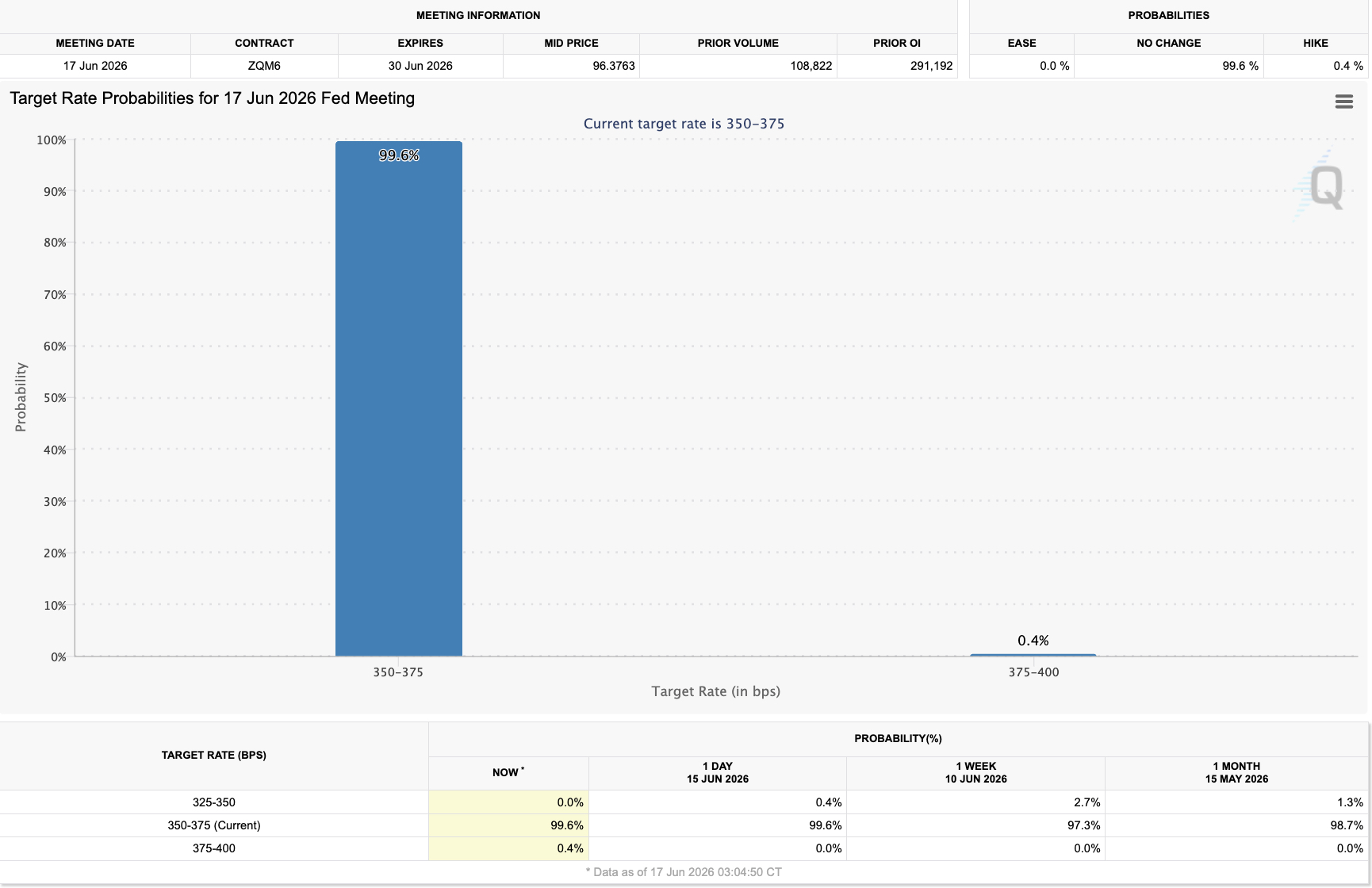
What would happen? What are we expecting? A fully hawkish Kevin Warsh will likely send BTC USD slightly downward. Neutral language with a slight dovish lean keeps the range intact and might also fuel altcoin rotation. Any surprise dovish pivot from Kevin Warsh would likely spark a rapid relief rally across BTC USD and Alts.
He could play it pragmatic, with persistent energy-driven inflation, to give him cover for a hawkish hold. Yet softening geopolitics and stable growth data might let him leave doors open. So tune in and wait for his first press conference at 2:30 PM ET.
Discover: The Best Token Presales
Binance MiCA Drama and CZ Hyperliquid Take
Binance MiCA troubles escalated with reports that the exchange may lose its EU license bid. Right now, regulators appear unhappy with compliance gaps. Binance themself stated that the company remains fully committed to securing our MiCA license and operating under a unified European framework.
However, a question also lingers from the user’s perspective. Germany had already issued 45 MiCA licenses. The Netherlands had issued 22. Both are well-established regulatory jurisdictions with clear processes. But Binance chose Greece, a country that had issued zero MiCA licenses at the time of application. Why?
— Coin Bureau (@coinbureau) June 17, 2026
BINANCE PROGRESSES WITH MICA LICENSING
Binance says it remains committed to securing a MiCA license and will update European users before June 30, 2026.
The exchange says Greece’s HCMC completed its review and considered the application compliant with MiCA requirements. pic.twitter.com/AP3EnuJ2cV
In a teaser from an upcoming interview, CZ offered backhanded praise for Hyperliquid. He called the invention “awesome” for grabbing a no-KYC niche Binance cannot touch. Then came the shade: CZ questioned their decentralization claims and said he would never operate the same way, given his experiences, assuming they have “good lawyers.”
The clip will drop the full episode tomorrow, but CZ hyperliquid comments come with extra bite because he supports ASTER, another no-KYC style play. These all are happening while Coinbase, Binance’s biggest rival, goes ahead with tokenized stocks and equity options.
Binance MiCA drama displays regulatory risk, and CZ hyperliquid shade shows old rivalries never die. Now, the question is, who actually controls the next wave of trading infrastructure?
From the market, we saw a large wallet shift of around $200 million in BTC ahead of today’s decision. Uniswap ripped 22% on bullish Standard Chartered targets as BTC USD Grinds Sideways. Bitcoin has spent the morning consolidating after absorbing heavy buying earlier in June. Though the 125,000 BTC accumulation figure from on-chain data flashed a potential bottom signal.
The market feels coiled, but historical post-FOMC patterns keep us worried. BTC USD has sold off after several recent meetings. FOMC meetings are becoming bad memories. BTC USD may grind today, but the setup favors those positioned for the next macro catalyst. Kevin Warsh, Binance MiCA, and CZ comments on Hyperliquid will fade once markets digest the FOMC outcome.
Be ready to get shaken. Follow us for more updates here.
Discover: The Best Crypto to Diversify Your Portfolio
The post Crypto News, June 17: Kevin Warsh First FOMC, Binance vs. MiCA as CZ Takes on Hyperliquid, and BTC USD Grinds Sideways appeared first on Cryptonews.
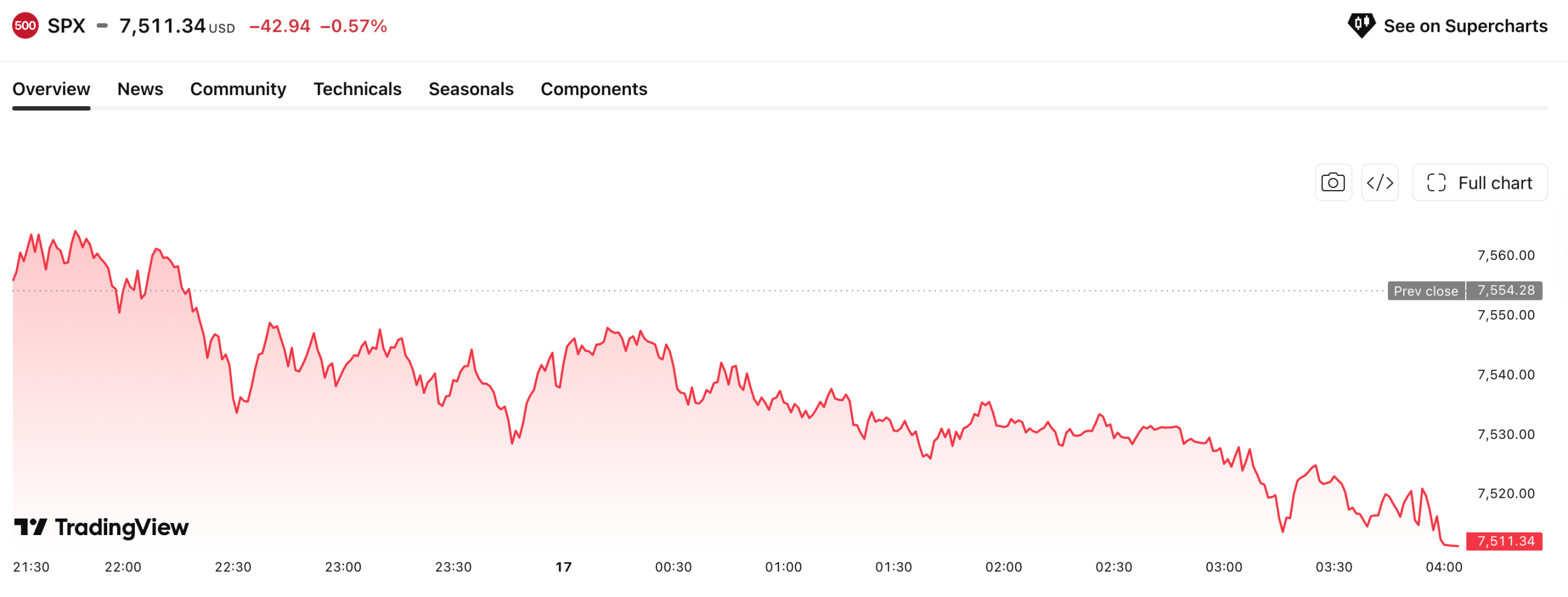
Markets are broadly higher this week, oil is down, a peace deal was signed, and SpaceX just became the world’s fifth-largest company. So why are the Nasdaq and S&P 500 the only major indices going the wrong way?
Two forces are working against the two most-watched US indices at the same time: a hawkish Federal Reserve that just killed rate cut expectations, and a capital rotation pulling money out of the tech-heavy names that dominate both.
Why Tech Stocks Are Taking the Hit First
On the day Trump announced the Iran peace deal, the Nasdaq gained about 3%, and the S&P 500 added nearly 2%. In the following session, both slipped: the Nasdaq fell 0.41%, and the S&P 500 dropped 0.19%. The Dow, by contrast, hit a record above 52,000 on the same day both slipped.

The reason sits with the Fed. Kevin Warsh removed the easing bias from the Fed’s statement on June 16, and the dot plot abandoned its last projected rate cut for 2026. With inflation running at 4.2%, higher rates look more likely than lower ones.
That hurts the Nasdaq and S&P 500 more than the Dow because both carry heavy weightings in technology companies, and tech stocks are growth stocks, valued on earnings years into the future.

When rates stay high, those future earnings are worth less in today’s money. The industrial, energy, and consumer names that dominate the Dow are far less sensitive to that pressure.
SpaceX and the Rotation Away From Big Tech
The other factor is where capital is going. When the peace deal landed, the biggest beneficiaries were the assets most beaten down by the Iran conflict: European industrials, Japanese exporters, and energy-dependent sectors. The STOXX 600 hit an all-time high. Japan’s Nikkei surged nearly 5% and crossed 70,000 for the first time.
Money rotated there fast, and some came from richly valued US tech positions that had held up relatively well through the conflict.
SpaceX also entered the equation. Trading as SPCX on Nasdaq, the stock surged nearly from its June 12 IPO price of $135 to a high of nearly $220 and briefly overtook Amazon. A newly listed stock attracting that level of attention draws capital, and some of that capital comes from existing Nasdaq positions rather than fresh money entering the market.

The Nasdaq and S&P 500 are not falling because investors are worried. They are falling because investors found something they like more.
The post Why Nasdaq and S&P 500 Are Sliding While World Rallies appeared first on BeInCrypto.
The Federal Reserve decides rates today. Even with no cut expected, the tone new Chair Kevin Warsh sets could shift sentiment. That has crypto whales positioning with caution.
BeInCrypto analysts tracked on-chain flows across three tokens where large holders paired spot moves with perps hedges. They are accumulating some, fading one, and bracing for a possible squeeze ahead of the FOMC meeting.
Chainlink (LINK)
The oracle leader sits at the center of the crypto whales debate. Spot accumulation and derivatives positioning point in opposite directions ahead of the Fed.
Want more token insights like this? Sign up for Editor Harsh Notariya’s Daily Crypto Newsletter here.
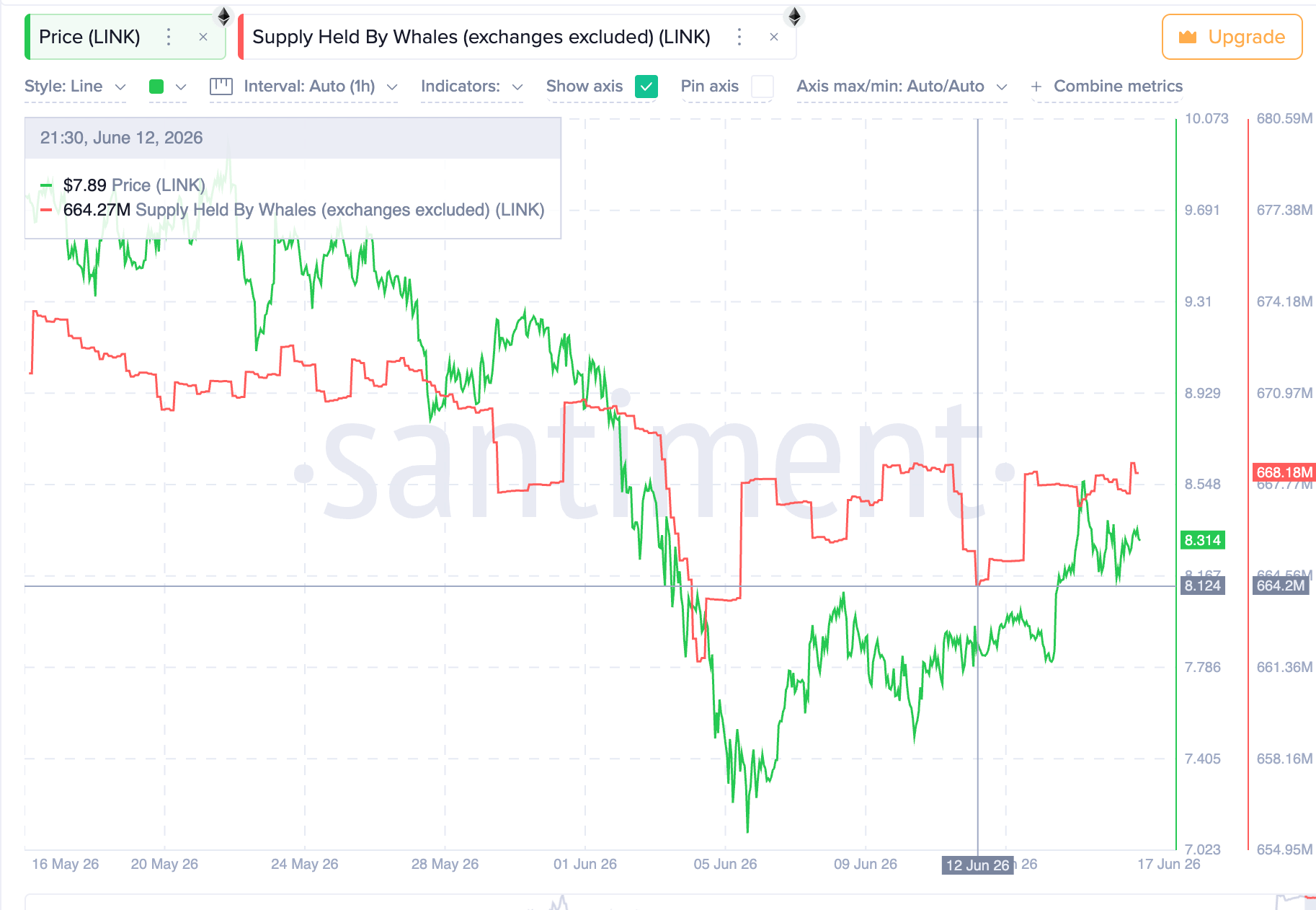
On-chain data shows whale spot balances climbed from 664.2 million LINK on June 12 to 668.18 million now. That is an addition of nearly 4 million tokens worth about $33 million, with fresh pickups on June 15 and June 17. The whale accumulation lines up with real adoption.

FIFA’s prediction-market partner adopted Chainlink as its exclusive oracle. The DTCC also tapped its data standard for a collateral platform a few months back. Wallets holding at least 1 LINK hit 535,650, the highest since 2022, giving spot whales the much needed sentimental push.
Derivatives tell a different story. Over the past two days, all three cohorts on Nansen turned net short, a clear bearish tilt from sophisticated traders. Smart money shorts sit in profit, while the largest whale long is down about $1.3 million.

The split defines the setup. Spot buyers treat the macro uncertainty as a value entry, betting on Chainlink’s expanding utility. Leveraged desks lean short into the Fed instead, bracing for near-term downside. Tonight’s FOMC decision is the pivot that decides which side is early.
Uniswap (UNI)
Uniswap’s rally over the past 24 hours put it among the week’s biggest gainers, but it now meets a more cautious whale cohort. Spot selling and net short perps suggest large holders are fading the move into the Fed.
Whale spot balances fell from 780.50 million UNI on June 15 to 778.53 million now. That is a drop of nearly 2 million tokens. The selling began as UNI surged on Standard Chartered’s $100 price target and its new tokenized stocks. Price is up about 23% today despite the distribution, yet whales trimming into strength often warns of resistance ahead.

The perps side leans the same way. Over the past seven days, whales and smart money on Nansen moved net short. The bias deepened as price rose. Smart money holds about 95% of its exposure short, a decisive directional call. One whale short opened near $8 sits up about $688,000 (selling incentive), while a $1.4 million long entered at $6.37 is trapped well below the mark.

Like Chainlink, Uniswap whales pair their spot move with a perps short. The difference is direction. Chainlink whales hedge accumulation, while Uniswap whales trim spot and short the bounce. That reads as profit-taking into a sharp rally rather than fresh conviction. Tonight’s FOMC decision will test whether the fade holds or the breakout extends.
Ondo Finance (ONDO)
The leading real-world asset token closes the set with the cleanest accumulation, yet the perps book hides a catch. Spot buyers are loading up while the derivatives crowd leans hard the other way.
Whale spot supply climbed from 7.82 billion ONDO on June 13 to 7.9 billion now. That is an addition of about 80 million tokens, and the buying picked up again in the past few hours. The accumulation rides the RWA narrative. Ondo leads tokenized treasuries with total value locked near $3.7 billion, and it just hired an ETF veteran for on-chain portfolios. Standard Chartered also projected a $2.7 trillion DeFi market by 2030.

The catch sits on Hyperliquid per Nansen data. Crypto whales, smart money, and public figures are all net short, roughly $2.56 million combined, with only one visible long. Shorts cluster between $0.38 and $0.54 (per positioning data), a clear bet that price stays capped. Yet ONDO is up about 7% on the week. With spot buying building under it, a push higher could force the crowded shorts to cover and fuel a squeeze.

Like Chainlink, Ondo whales pair spot accumulation with perps shorts, classic swing hedging. Across all three tokens, the perps shorts read as caution into the Fed decision. No rate cut is expected. But the tone Warsh sets could justify the hedges, or trigger the squeeze that traps them.
The post What Crypto Whales Are Buying and Selling Ahead of the June FOMC Meeting appeared first on BeInCrypto.
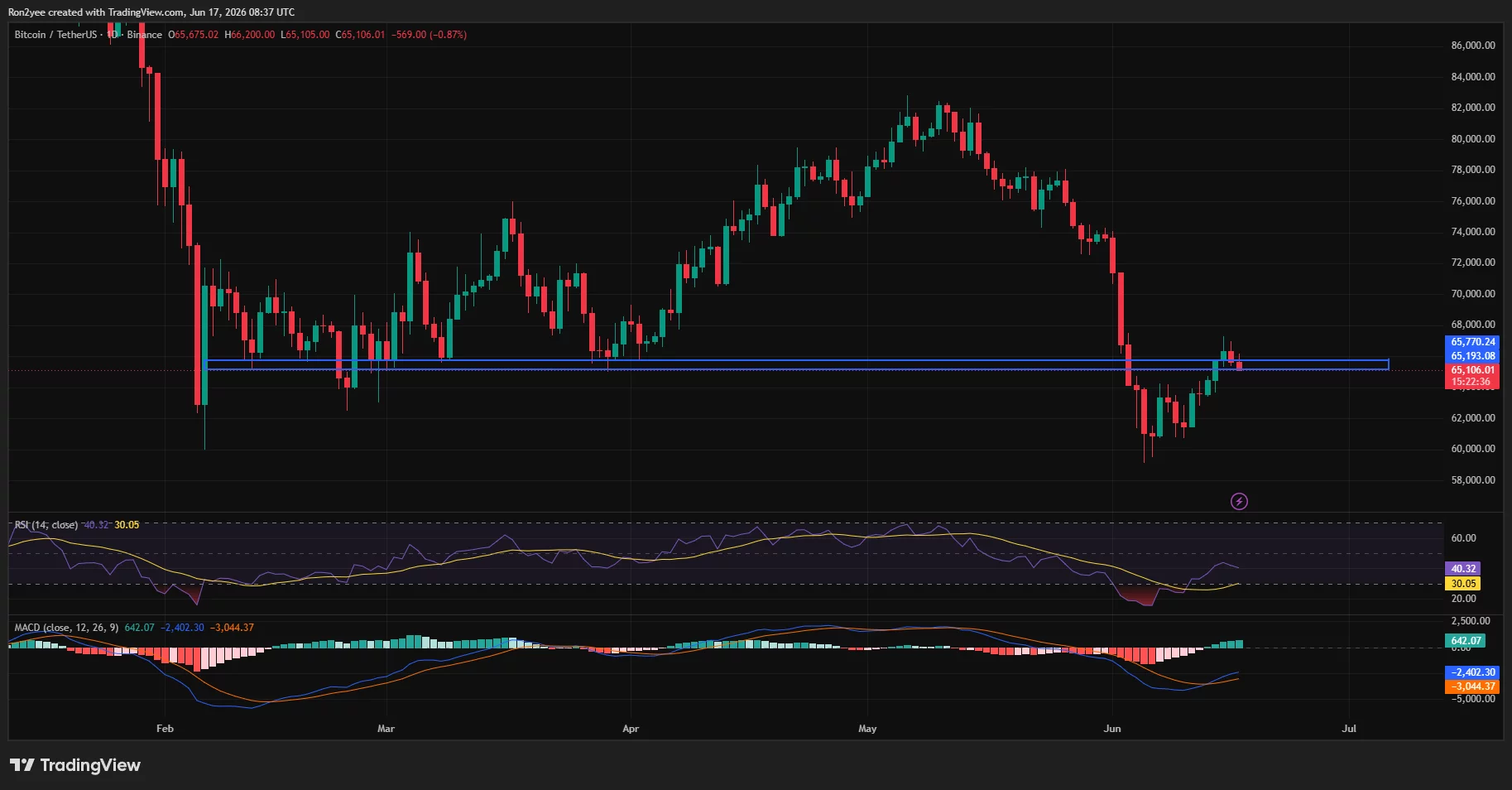
Bitcoin has retreated toward $65,000 ahead of the Federal Reserve’s policy decision as traders cut risk and reassess the outlook for interest rates under newly appointed Fed Chair Kevin Warsh.
Summary
- Bitcoin fell from near $67,200 to around $65,236 ahead of the Fed’s June 17 rate decision as traders reduced risk.
- Key resistance sits between $67,500 and $68,000, while analysts are closely watching support around $63,700 and $60,000.
- Falling oil prices, Middle East tensions, and uncertainty over Fed Chair Kevin Warsh’s policy outlook continue to shape market sentiment.
According to data from crypto.news, Bitcoin (BTC) price fell from a June 16 high of near $67,200 to an intraday low around $65,236 on June 17 before stabilizing near $65,300 at press time. The pullback came as investors awaited the outcome of the Federal Reserve’s two-day policy meeting, with policymakers expected to keep rates unchanged at 3.50%–3.75% when the decision is released later today.
Attention has instead shifted to the Fed’s updated dot plot and Warsh’s first post-meeting press conference. Traders have increasingly focused on whether policymakers abandon any remaining easing bias and reinforce expectations that borrowing costs could remain elevated for longer amid inflation running above 4%.
Outside crypto, the cautious mood extended across several asset classes. Gold and silver both traded modestly lower during the session, while crude oil slid toward $75 per barrel for a fifth consecutive day as markets priced in the possibility of renewed Iranian oil exports under a proposed U.S.-Iran agreement.
At the same time, Asian technology shares continued attracting capital, with Japan’s Nikkei 225 reaching fresh record highs above 70,000 amid ongoing enthusiasm surrounding artificial intelligence investments.
Technical structure leaves Bitcoin trapped between $60K support and $68K resistance
Bitcoin’s recent rebound from below $60,000 has stalled near a major technical resistance zone.
On the daily chart, BTC has returned to a support-turned-resistance region between roughly $65,200 and $65,800. The area previously acted as a key floor during February and March before breaking during the sharp selloff earlier this month. BTC price briefly reclaimed the zone before slipping back underneath it.
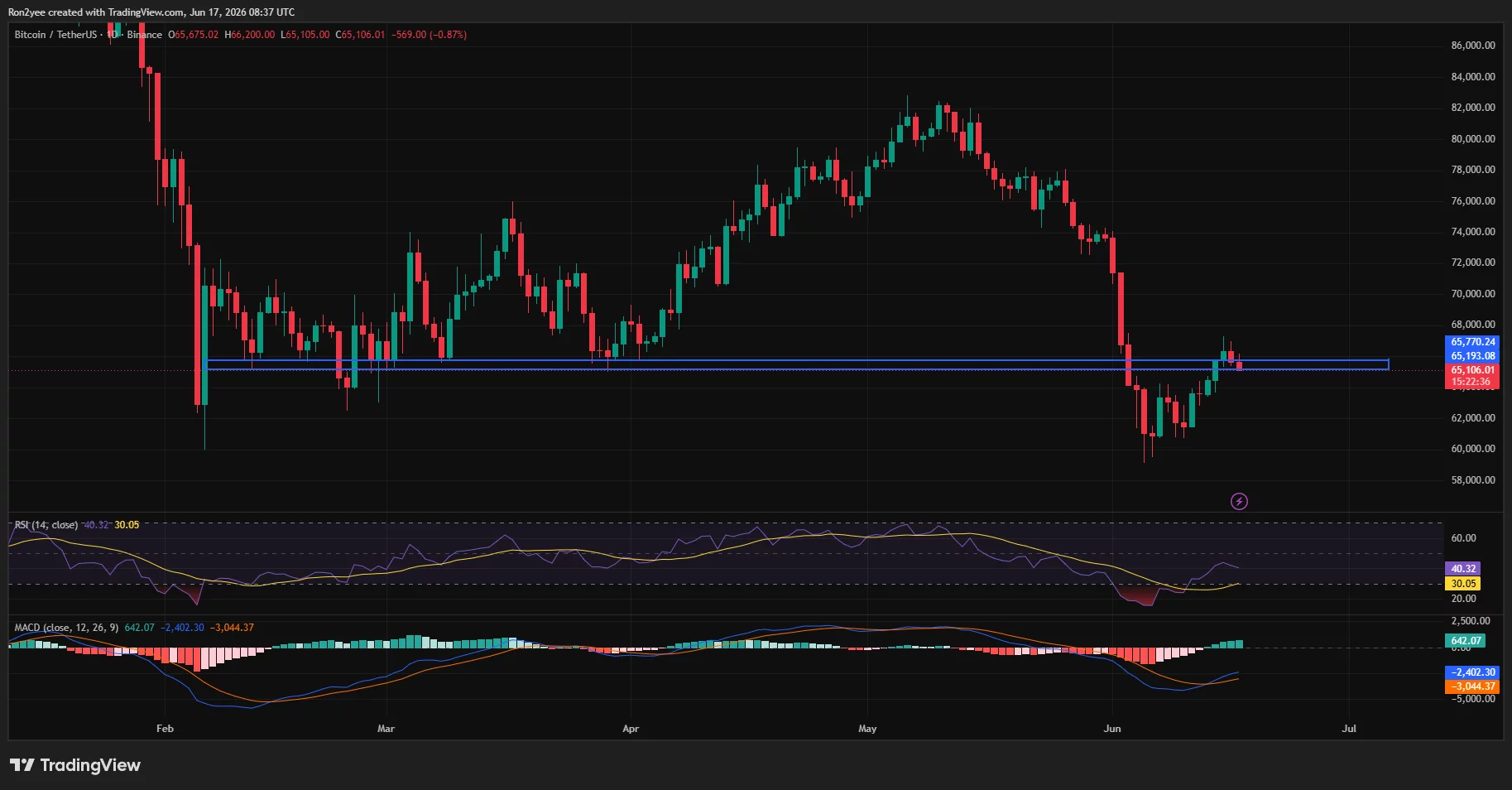
Momentum indicators remain mixed. The daily RSI has recovered from oversold territory but remains below the neutral 50 mark, while the MACD continues to trade beneath its signal line despite narrowing bearish momentum.
On the four-hour chart, Bitcoin has also fallen back below the 61.8% Fibonacci retracement level near $65,016 after failing to sustain a breakout above the 50% retracement around $66,829.
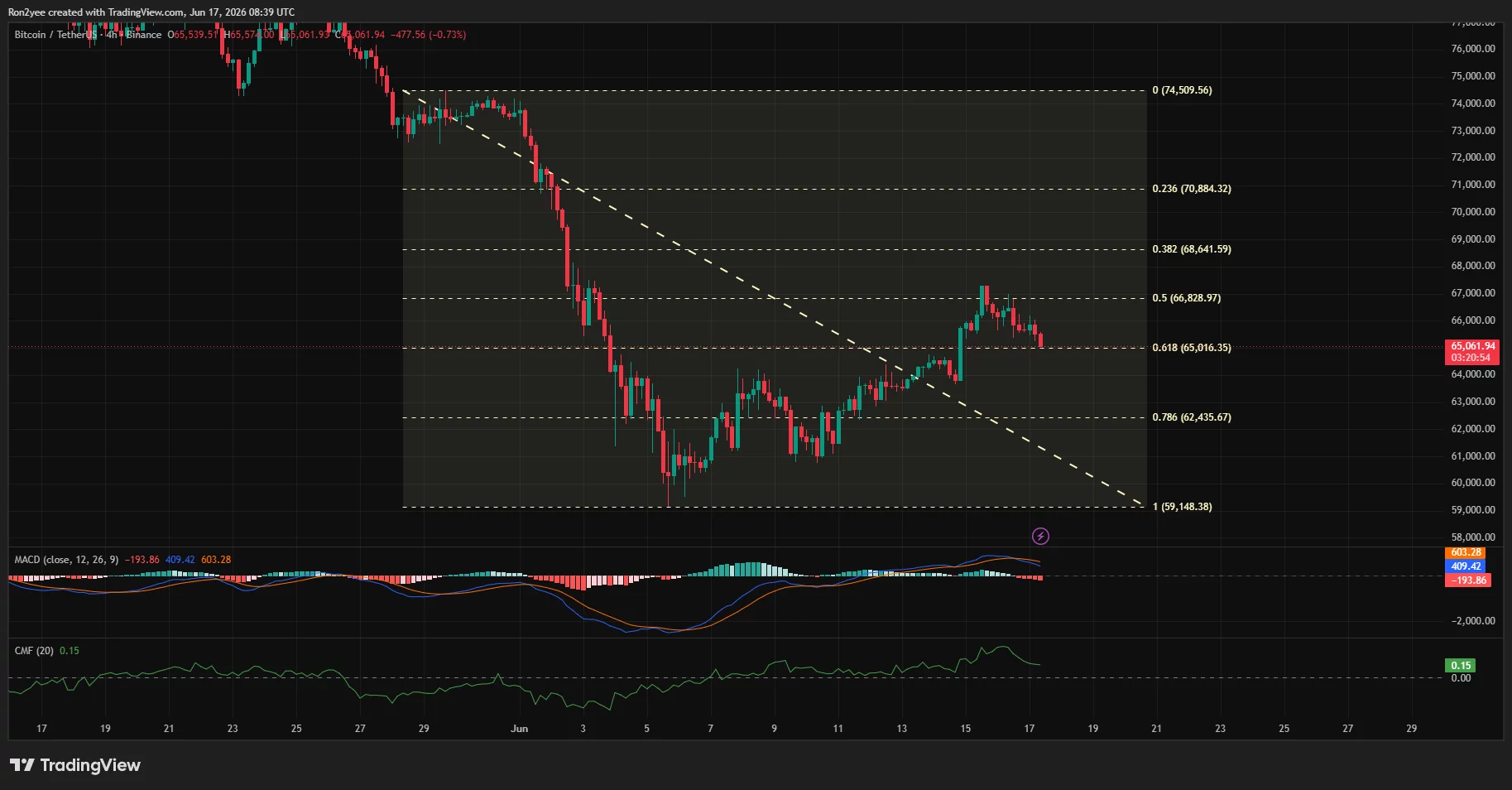
According to analyst Kamile Uray, the market is now closely watching whether support around $63,700 can hold.
“In deep declines, we will be tracking the 60000 level. This level must be held. Otherwise, the decline deepens further.”
On the positive side, Uray added that $67,500 remains the first major resistance zone, while a sustained move above $74,500 would be required to restore a stronger bullish structure.
Meanwhile, CoinGlass liquidation heatmaps show a dense concentration of leveraged positions sitting above current prices. Commenting on the setup, crypto analyst Daan Crypto Trades noted that “$68K is the biggest one to watch in the short term,” adding that the largest liquidity clusters now sit above the market after Bitcoin swept liquidity beneath $60,000 earlier this month.
Fed guidance and Middle East tensions could determine the next move
Macro developments remain the primary risk factor heading into the Fed announcement.
While falling oil prices have eased some inflation concerns, geopolitical uncertainty has persisted after Iran accused Israel of violating a Lebanon truce dozens of times and warned of a “harsh response” if attacks continue.
Tehran has also linked any final agreement with Washington to sanctions relief, the release of frozen assets, and an Israeli withdrawal from Lebanon.
The combination of Fed uncertainty, geopolitical risks, and persistent institutional caution has kept Bitcoin below major resistance despite recovering from its June lows.
A break above $68,000 could expose the next liquidity zones near $74,000 and $78,000, where large concentrations of leveraged positions remain.
On the downside, losing support around $63,700 would place renewed focus on $60,000. A decisive move below that level could open the door toward the $55,000–$50,000 region highlighted by several market analysts.
Disclosure: This article does not represent investment advice. The content and materials featured on this page are for educational purposes only.

Anderson busted using AI to lie about Reform’s Saville controversy

156 Golfers, Over $20 Million In Prize Money: The 2026 U.S. Open By The Numbers

‘Imagination and creation are products of time and space’


-

 Business3 days ago
No Jackpot Winner as $257 Million Prize Rolls Over to $269 Million Monday Draw
-

 Crypto World6 days ago
Oppenheimer backs SpaceX as $70 billion retail frenzy builds
-

 Fashion5 days ago
Weekend Open Thread: Tuckernuck – Corporette.com
-

 Crypto World6 days ago
Markets Rally as SpaceX IPO Looms Amid Iran Tensions and Inflation Surge
-
 Crypto World2 days ago
Zimbabwe Requires Crypto Businesses to Register Annually Under New FIU Regulations
-

 Tech4 days ago
NanoClaw integrates JFrog registries to secure AI agent downloads
-

 Tech5 days ago
This Week In Security: Microsoft On Microsoft, Register Your Domains, Linux On ARM, And FreeBSD Joins The File Cache Club
-

 Crypto World4 days ago
Bitget enters Argentina’s regulated crypto market through PSAV registration
-
 Tech6 days ago
Dutton Ranch star claims they ‘didn’t see any disruption’ on set following Chad Feehan’s exit from Yellowstone spinoff fueled by Taylor Sheridan clash rumors
-

 NewsBeat5 days ago
El Nino has formed in the Pacific and could set records, forecasters say
-

 Politics6 days ago
Politics Home | Healey Resignation Is “Colossal Failure Of Government”, Says Former Labour Defence Secretary
-
 Entertainment6 days ago
Donnie Wahlberg & More Heat Up Las Vegas at Circa’s Barry’s Downtown Prime
-
 Tech6 days ago
Opendoor Ends India Operations, Fueling a Bigger Conversation About AI and Outsourcing
-

 Sports6 days ago
First Time Since 1971: Australia Register Historic Low In ODI Cricket
-

 Politics6 days ago
Belfast burns, while Met chief points finger at Iran and Russia
-

 Business6 days ago
AT&T: Verizon's 27% Outperformance Sets Up A Solid Entry Point
-

 NewsBeat5 days ago
FBI searches office of Ohio voter registration group
-
 Tech5 days ago
Anthropic is spending $150M to embed 1,000 AI fellows inside nonprofits. No degree required.
-
 Politics6 days ago
Modi thanks Trump for wishes as US attacks Indian seafarers
-
 Entertainment5 days ago
‘The Pitt’s Fan-Favorite Doctor Confirms Noah Wyle Gave His Blessing to Return [Exclusive]
You must be logged in to post a comment Login