

Crypto World
Former Ripple CTO Draws a Sharp Line Between Investing and Gambling



Former Ripple CTO David Schwartz challenged the popular claim that stock markets and prediction markets are just casinos, arguing on X that the comparison ignores a fundamental economic divide.
Schwartz stepped back from daily operations at Ripple at the end of 2025 and became CTO Emeritus. He entered the debate on June 17, 2026, responding to users who argued that “trading” is a euphemism for gambling.
Gambling Moves Value, and Investing Grows It
The exchange began when X users argued that prediction markets and stock markets operate like casinos. Their core claim was that “trading” serves as a polished cover for placing bets. Schwartz rejected that framing.
He separated the two by their economic function. Gambling moves existing value between participants. Investing generates new value.
“A key way to see the difference is this: If you have positive expected value in gambling, something has gone very wrong. If you have negative expected value in investing, something has gone very wrong,” says Schwartz
The logic works symmetrically. A gambler who consistently beats the house reveals a flaw in the system, not a feature. An investor who consistently loses in a functioning market faces a problem with their approach or the market itself. That test shifts the burden of proof onto the system’s design.
A casino’s purpose is to redistribute money among players. A market’s purpose is to direct capital toward productive use and generate returns across the broader economy over time.
Schwartz’s Long View on Markets
The remarks carry added weight from someone who co-architected the XRP Ledger. Schwartz served as Ripple’s CTO for more than a decade before transitioning to an advisory board role at the end of 2025. He remains one of the most prominent technical voices in the XRP ecosystem.
The Ripple EX CTO also drew significant attention earlier this year for his XRP escrow price views, directly challenging viral price targets. He used market-cap math to show that many community projections rest on valuations exceeding the entire global money supply.
XRP (XRP) trades at $1.19 at the time of writing, down 3.64% over the past 24 hours. The asset holds a top-six market rank with total capitalization near $74.2 billion.
The comments also land as prediction markets face state bans across the US. At least 12 states have moved to classify event contract platforms as gambling under state law.
Whether policymakers adopt Schwartz’s value-creation framing or the casino label favored by his critics could shape how these markets are regulated in the months ahead.
The post Former Ripple CTO Draws a Sharp Line Between Investing and Gambling appeared first on BeInCrypto.

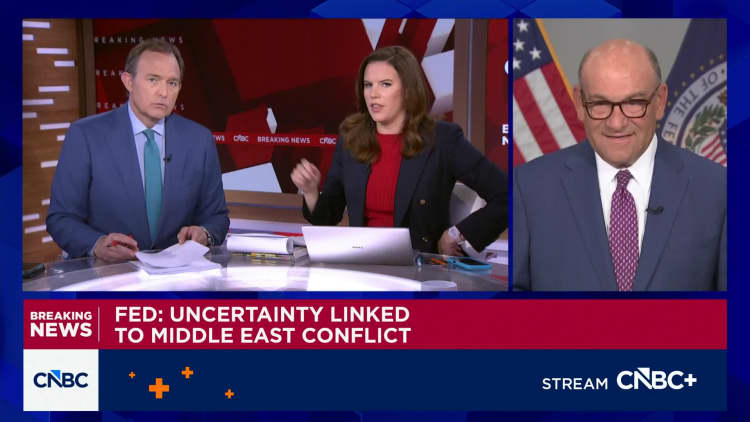

WASHINGTON – Kevin Warsh‘s first meeting as Federal Reserve chairman concluded Wednesday with no change in interest rates and a nod to possible hikes ahead. The meeting also saw the removal of key language indicating a bias toward future cuts within a dramatically shorter policy statement.
The Federal Open Market Committee voted unanimously to keep its benchmark overnight borrowing rate anchored in a range of 3.5%-3.75%. The federal funds rate has held there since the central bank lowered rates by three-quarters of a percentage point in the latter part of 2025.
With a bevy of intrigue over Warsh taking the central bank helm, the meeting followed the same pattern as the others this year regarding rates but differed otherwise.
A missing dot
Fed officials, through their closely watched “dot plot” grid, removed their prior outlook for a rate cut this year and indicated that a hike is possible. However, the Summary of Economic Projections missed the participation of one member: Warsh.
Warsh has been a critic of the forecasting tool as well as other forward guidance out of the committee including projections on unemployment, inflation and gross domestic product in the SEP.
Heading into the meeting, Fed watchers had suspected Warsh wouldn’t submit his outlook, and some anticipated he might look to end the feature altogether. He confirmed at a news conference following the decision that he had declined to share a forecast and is forming task forces to overhaul major Fed operations.
“I did not submit a dot for me,” Warsh said. “It’s not helpful in the conduct of policy. I suspect by year-end, as I mentioned in my opening statements, there’ll be a review about communication broadly, press conferences, dots, meetings, and the like, transcripts, minutes. This will be part of that. I don’t want to prejudge the outcomes there, but I’m pretty open-minded about what they could be.”
Based on the 18 of 19 possible responses, the median estimate for the fed funds rate at the end 2026 is now 3.8%, up from 3.4% in the prior projections from March and signaling the committee sees at least one rate hike as necessary this year. Meeting participants were split on the path for rates this year, with eight expecting no change, one seeing a cut and nine anticipating at least one hike.
An additional dot was missing for 2028 projections.
A shorter statement
During the news conference, Warsh acknowledged the changes to the committee’s statement.
“It’s a bit shorter, a bit simpler and it dispenses with some older language,” he said. “That statement just gives you the facts, as best we can judge it.”
In addition to the rate call, which was widely anticipated in financial markets, the FOMC’s post-meeting statement also not only removed prior language seen as a nod toward an easing slant in the future but took a hatchet to the rest of it. Warsh has criticized the Fed for overcommunicating.
This week’s communique checked in at just 130 words, compared with 341 for the April 29 release following the most recent meeting. The statement offered just a brief summary of economic conditions followed by a vow to control inflation.
“Economic activity is expanding at a solid pace despite elevated uncertainty that owes, in part, to the conflict in the Middle East. Productivity growth and capital investment are strong,” the statement read. “Job gains have kept pace with the workforce, and the unemployment rate has changed little.”
“Inflation remains elevated relative to the Committee’s 2 percent goal, in part reflecting supply shocks that have driven price increases in certain sectors, including energy. The Committee will deliver price stability,” the policymakers said.
The statement also noted that the Fed would maintain its policy of “ample reserves” in the banking system, indicating there are no immediate plans to reduce the central bank’s bond holdings on its $6.7 trillion balance sheet, as Warsh has advocated.
The statement’s unanimous approval came after so-called forward guidance verbiage drew three dissents at the April meeting from presidents of regional reserve banks who wanted to preserve a two-sided option for possible hikes or cuts ahead.
Higher inflation forecast
In keeping with uncertainty over rates, officials also adjusted their indications of where policy is headed from here. The grid, which anonymously indicates the rate outlook for meeting participants, erased an earlier indication for one cut this year and pushed any reductions into 2027 and 2028 as policymakers weigh the durability of an inflation spike brought on by the Iran war.
The grid indicated a median funds rate projection of 3.8% by the end of the year – some 0.16 percentage point above the current level and suggesting that a hike is very much on the table. They continued to expect a long-run funds rate of 3.1%.
Officials altered their views on the economy, raising their outlook on inflation for 2026 to 3.6% on headline and 3.3% for core, which excludes food and energy. At the last update in March, committee members anticipated 2.7% rates for both measures. They also slightly lowered their projection for gross domestic product growth to 2.2%, down 0.2 percentage point from March, and cut the unemployment projection to 4.3%, down 0.1 percentage point.
The inflation surge has posed a quandary for policymakers who are trained to look past short-term supply shocks such as the energy spike associated with the war.
Recent inflation indicators have posted multiyear highs, with the consumer price index for May indicating a 4.2% annual inflation rate, though the core measure that excludes food and energy registered lower than the headline reading at 2.9%. Inflation has been above the Fed’s 2% target for the past five years.
Warsh told reporters that the Fed is committed to reducing inflation to 2%.
“The commitment to deliver is strong, unanimous, and unambiguous, and that’s I think an important message we’ve missed for five years, and we’re going to fix that,” Warsh said.
Though he has offered little public commentary outside of his confirmation hearing and his swearing-in on May 22 as chairman, Warsh has argued that supply-shock inflation generally should be looked through when formulating policy. He also has maintained that artificial intelligence ultimately will have a disinflationary impact on the economy as rising productivity will help ease the cost of goods and services.
Still, the case for lowering rates has been made more complicated by a surprisingly resilient labor market. Nonfarm payroll growth again defied expectations in May with a gain of 172,000 while the unemployment rate, the Fed’s most closely watched metric, was at 4.3%, unchanged over the past year.
Ahead of the decision, the market didn’t anticipate any cuts in 2026 and a quarter-point hike was expected by the end of the year, according to the CME Group’s FedWatch gauge. In the wake of the decision and Warsh’s remarks, traders were now anticipating a hike could come as early as October.
Correction: In the wake of the decision and Warsh’s remarks, traders were now anticipating a hike could come as early as October. An earlier version misstated the expected move.


The role of benchmark indexes is to describe and measure markets. Providing transparent rules, documented governance, independent oversight and clear procedures under stress requires rigor and discipline. Index providers adopt these disciplines voluntarily, drawing on standards refined over decades in other asset classes.
A new report from the Index Industry Association examines how digital asset indexes are evolving to meet these expectations — and must keep evolving as stablecoins and tokenized assets enter the picture. Transparency is rarely the loudest part of a market, but it tends to be the part that lasts.
Principled Perspectives
One market, not two: CoinDesk’s Dave LaValle on crypto and TradFi converging
The conversation about crypto in client portfolios has shifted in the past six months, and advisors who still think in terms of the old framework risk being caught flat-footed. In a new interview with The Wealth Advisor, Dave LaValle, president of CoinDesk Data & Indices, laid out why.
The clearest signal came from Wall Street. “The Morgan Stanley team launched their bitcoin ETF in early April, and a little bit more than a month in, and they’re over $230 million in assets,” LaValle said. “To amass $230 million in basically a month, it’s kind of insane.”
He framed crypto as a disruptive technology that needs two things to take hold: the tech itself, which exists, and regulatory clarity. The GENIUS Act has set a framework for stablecoins backed by U.S. Treasuries, and the CLARITY Act, addressing market structure, could reach a vote “sometime in the next month or two.”
Crypto World
Crypto industry aghast at Illinois’ new tax on holding or transferring digital assets in state budget


The crypto industry is pushing back against a new tax law in the state of Illinois that enacts a 0.2% tax on businesses transacting or storing crypto for customers in the state, but it may be too late to change it in the short-term.
The law enacts a 0.2% tax on “receiving any digital asset business activity,” according to the text of the bill, which defined digital asset business activity as “any single occurrence of exchanging, transferring or storing a digital asset as part of a business or on behalf of a customer.”
The tax applies to firms that are based in Illinois or provide services to residents of the state with total gross receipts of at least $100,000. The tax is expected to raise around $60 million, said a person following the process.
The provision was added last-minute to Illinois’ broader budget bill, according to two people following the matter, and was approved by Governor J.B. Pritzker on June 16, according to the bill’s status page. The legislation creates a roughly $56 billion budget for the 2027 fiscal year and also includes new taxes on fantasy sports, social media and other areas, ABC 7 reported.


A spokesperson for Polymarket said the company looks forward to addressing the claims.
“This action runs counter to the CFTC’s established framework for regulating prediction markets,” the spokesperson said in a statement emailed to CoinDesk.
So far, the states that have filed such a challenge against the prediction markets have met with counter suits from the CFTC, where Chairman Mike Selig has taken an aggressive legal stance defending his agency’s authority as the sole regulatory power over events contracts, which he says falls directly into the CFTC’s authority over U.S. derivatives.
And Trump has recently backed him up.
“It is critically important that the CFTC’s exclusive authority over Prediction Markets is maintained, and that they will thrive,” Trump posted on his social media site, Truth Social. “Under my leadership, we are setting ‘rules of the road’ that are the Gold Standard for the States.”
He asserted that his state-level political foes (offering names including Minnesota Governor Tim Walz and Illinois Governor J.B. Pritzker) are “SCUM” who shouldn’t be allowed to set the rules.
“It is a major Industry, and we must protect it,” Trump wrote. “Mike Selig, CFTC Chairman, and respected by all, is doing a great job.”
The CFTC has sued eight states — most recently New Mexico — and leapt into other court matters involving the sector.

Andreessen Horowitz crypto executive Miles Jennings criticized Illinois’ newly enacted Digital Asset Privilege Tax Act on June 17, calling it “one of the most anti-crypto laws in the US.”
The law imposes a 0.2% tax on the exchange, transfer, and custody of digital assets, with no meaningful exemptions for routine self-custody moves.
Backlash From the Crypto Industry
According to Jennings, no other US state has a transaction-based tax on crypto like the one in Illinois, and there are no comparable levies on stocks, bonds, or derivatives anywhere else in the country.
‘That means crypto is being singled out in violation of several federal laws,” he wrote.
His comments were in line with those made in a June 16 letter from the Crypto Council for Innovation (CCI) to Illinois Governor J.B Pritzker, requesting that he veto the legislation. CCI had argued that the law places unique and disproportionate burdens on citizens simply by holding digital assets, thus potentially forcing users and entrepreneurs out of the state.
The group was of the view that the measure will tax blockchain-based activity based on the technology used rather than the nature of the transaction itself. It also raised concerns about the manner in which the law had been passed, noting that affected stakeholders had not been given the chance to weigh in.
On his part, Jennings accused Pritzker of poor timing, considering that Illinois had just adopted the Digital Asset and Consumer Protection Act, something he described as a “constructive approach to blockchain technology.”
“So, rather than embracing innovation and the cost efficiencies blockchain can deliver for ordinary people in Illinois, the state is poised to punish its entrepreneurs and citizens that want to use crypto,” he argued.
Tax Treatment Is a Growing Policy Battleground
The Illinois law comes at a time when the US Congress is working toward a national framework for crypto taxation, and CCI’s letter had argued that Pritzker should have held off on his approach until federal standards were in place. It warned that the Prairie State’s decision could lead to a “patchwork” of crypto tax laws across the other 49 jurisdictions, which would only muddy the waters even more.
That concern has some context. Earlier in the month, Coinbase vice president of tax Lawrence Zlatkin testified before the House Ways and Means Committee, pushing for simpler federal crypto tax rules, including treating federally regulated stablecoins as equivalent to cash and creating de minimis exemptions for small transactions.
The hearing covered six standalone bills aimed at updating how the US tax code treats digital assets, with Jennings’ post on X giving a direct read on what’s at stake:
“When states adopt discriminatory, asset-specific taxes that drive builders and users elsewhere, we all lose.”
The post Illinois Passed the Most Anti-Crypto Law in the US: Miles Jennings appeared first on CryptoPotato.


Strategy has returned to the spotlight after QCP estimated its current liquidity runway for dividend payments at about seven and a half months.
Summary
- QCP warned that Strategy may eventually sell more Bitcoin if dividend obligations outpace available funding sources.
- CEO Phong Le said the recent 32 BTC sale was a process test, not a dividend-driven liquidity move.
- Peter Schiff argued Strategy’s current Bitcoin buying model could dilute shareholders as dividend pressures grow.
According to market maker QCP, Strategy’s current liquidity position could support dividend payments for roughly seven and a half months, raising the possibility that the company may need to sell additional Bitcoin if alternative funding sources become less attractive.
The warning comes shortly after Strategy completed several balance-sheet transactions. QCP noted that the company repurchased nearly $1.5 billion of convertible notes due in 2029 while also raising about $200 million through sales of MSTR stock. Part of those proceeds funded another $100 million Bitcoin purchase, continuing the company’s long-running accumulation strategy.
Dividend obligations have become a focus
Attention has increasingly turned to how Strategy plans to manage future payout commitments tied to its capital structure.
In its market note, QCP argued that potential Bitcoin sales could emerge as one option if the company seeks to maintain dividends while continuing to operate its treasury strategy.
Those concerns surfaced after Strategy disclosed a sale of 32 BTC earlier this month, the first known reduction of its Bitcoin holdings. The transaction drew criticism from some crypto investors because Executive Chairman Michael Saylor has long promoted a buy-and-hold approach to Bitcoin ownership.
Addressing the sale in a June 13 interview, Strategy CEO Phong Le said the transaction was not driven by a need to raise cash for dividends. Le explained that the company conducted the sale to test internal procedures, generate tax losses that may offset future tax liabilities, and reduce potential market shock around future sales if they ever become necessary.
Le also rejected suggestions that Strategy lacks other financing options. According to the CEO, the company can still access equity issuance and preferred-stock financing to support its capital structure.
At the same time, Le acknowledged that management would evaluate both Bitcoin sales and share issuance based on financial outcomes rather than ideology. He said Strategy would choose whichever approach improves Bitcoin exposure per share for common shareholders.
Critics question the economics of new purchases
Separate criticism has come from Euro Pacific Capital chief Peter Schiff, who recently argued that Strategy’s model has become less effective than it was when MSTR stock traded at a substantial premium to the value of its Bitcoin holdings.
Schiff contended that earlier stock offerings increased Bitcoin exposure on a per-share basis because investors were willing to pay well above net asset value. In recent comments, he argued that issuing shares at lower valuations to purchase additional Bitcoin can dilute shareholders even as the company expands its overall Bitcoin reserve.
His remarks followed Strategy’s purchase of 1,550 BTC for approximately $101 million in early June. Schiff claimed the transaction reduced Bitcoin exposure per share and described the outcome as a “negative Bitcoin yield.”
Despite those concerns, Strategy has continued adding to its holdings. On June 15, Saylor disclosed another purchase of 1,587 BTC for roughly $100 million, bringing the company’s total Bitcoin holdings to 846,842 BTC.
The company also increased its dollar reserves to about $1.1 billion, providing additional liquidity while keeping its Bitcoin acquisition program in place.
Another point of debate involves Strategy’s STRC preferred shares. Schiff has argued that if those securities trade below their intended level, the company could face pressure to increase dividend payments, issue additional shares, or draw on cash reserves to meet obligations.
Bitcoin’s price is losing ground once again, as the asset was rejected at over $66,000 earlier today and dumped to $64,000 minutes ago, shortly after the conclusion of the latest FOMC meeting and the subsequent press conference by the new Fed Chair, Kevin Warsh.
Unlike what many expected when he replaced Jerome Powell, Warsh maintained a very hawkish tone during his speech, which caught investors by surprise.
Not The Easy-Money Chairman
DoubleLine Capital CEO Jeffrey Gundlach noted in an interview with CNBC that the new Fed Chair will aim for price stability instead of being the ‘easy money Chairman’ people thought.
“He is absolutely telling you that he plans on delivering on price stability. So that means we’re not going to have such easy money policy as everybody thought maybe Chairman Warsh would do back in the first quarter of this year when everyone was counting on rate cuts. He doesn’t sound like that today at all.”
Warsh’s hawkish speech came shortly after the US Federal Reserve maintained the interest rates unchanged for the fourth consecutive meeting.
BTC Slides Further
Bitcoin’s price already dipped after the initial Fed decision, but its situation only worsened following the press conference. The asset had dropped from an intraday high of $66,400 to $65,000, but rebounded to $65,500 before it slumped again to $64,000 minutes ago.
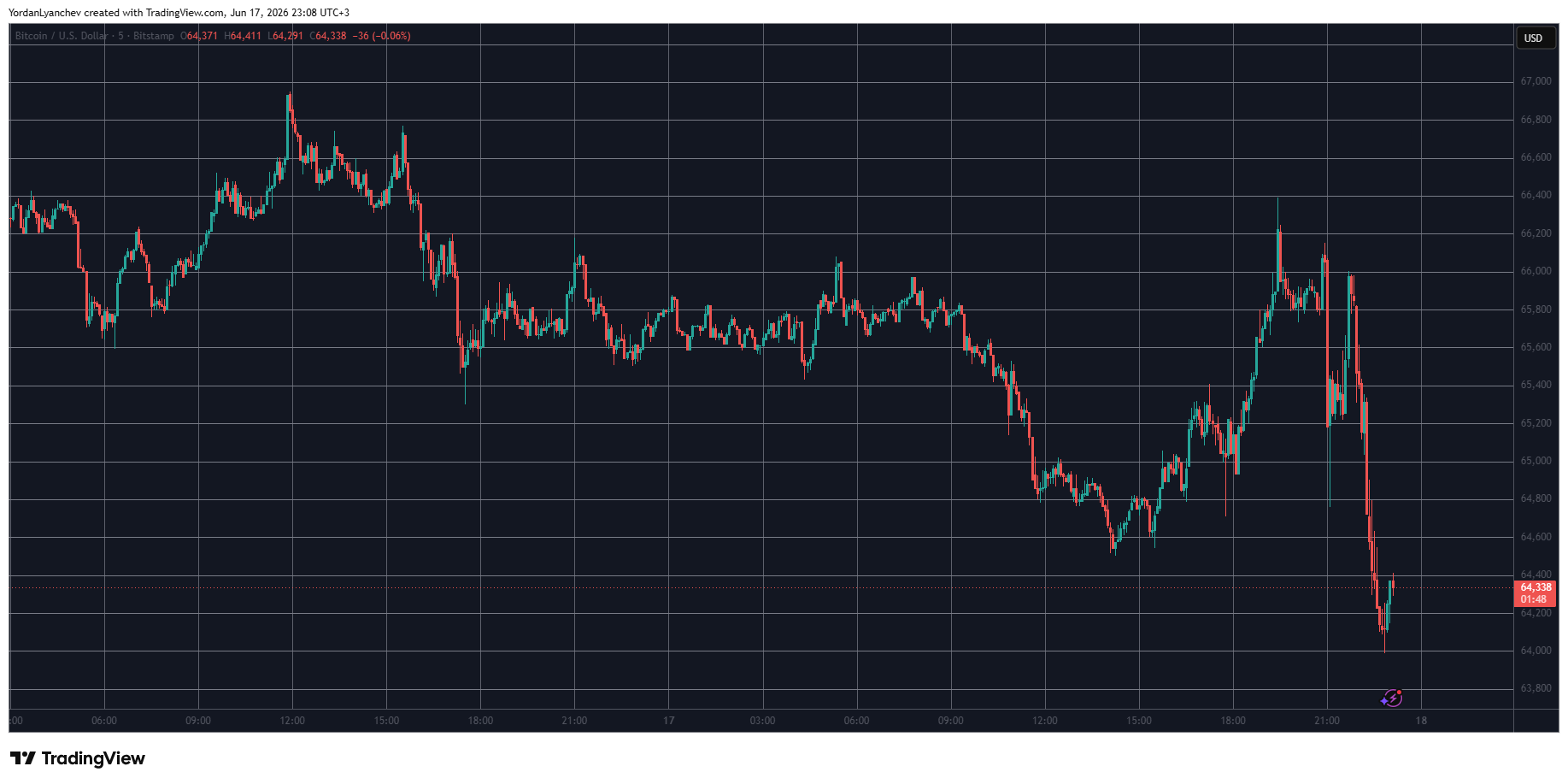
Most altcoins have followed suit. Ethereum is down by 3% daily to under $1,740, BNB has lost the $600 support, while XRP has fallen further below the $1.20 line. Expectedly, these intense price moves in the span of just a couple of hours have impacted the liquidations.
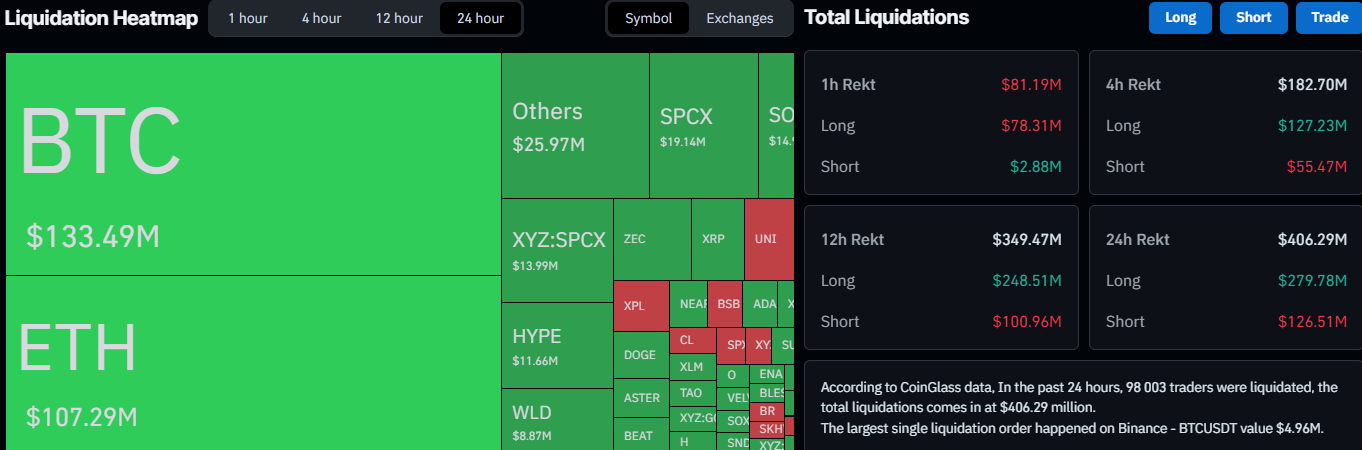
Data from CoinGlass shows that the total value of wrecked positions in the past 24 hours is up to over $400 million, with almost half of those coming in the past 4 hours. Longs are responsible for the lion’s share, with $280 million daily. Moreover, $79 million out of the $82 million in liquidated positions in the past hour alone are from longs.
Nearly 100,000 traders have been wiped out daily, with the largest liquidated position occurring on Binance. It was worth $5 million.
The post $400M Wiped Out in Hours as Bitcoin Crashes After FOMC and Warsh Speech appeared first on CryptoPotato.
Crypto World
FIFA wanted Avalanche’s blockchain to help curb World Cup ticket scalping. Here’s how it’s going


Beyond new revenue opportunities, the model gives FIFA more visibility into who ultimately attends its events. In the traditional ticketing ecosystem, much of that information is controlled by secondary marketplaces.
“The actual administrator of those tickets, FIFA, has no idea who the people are buying,” Carbonaro said. “That data sits with SeatGeek, StubHub, Ticketmaster, Vivid Seats.” He argued that FIFA Collect’s RTB and RTT system gives FIFA greater insight into how ticket rights change hands within its own ecosystem, rather than relying on third-party platforms that typically control the customer relationship.
With RTBs and RTTs, FIFA can better track how fans move through the ticketing process while keeping personal information offchain and using blockchain records as a verification mechanism.
That data component may ultimately prove as valuable as the ticketing functionality itself. Sports organizations increasingly view direct fan relationships as strategic assets, particularly as AI tools make first-party data more valuable.
Whether FIFA’s ticketing model becomes a template for future tournaments remains to be seen. Critics could argue that introducing tradable purchase rights simply creates another layer between fans and tickets.
Either way, the World Cup offers a glimpse of where blockchain adoption may be heading next. Instead of asking consumers to embrace crypto, projects like FIFA Collect are attempting to hide it altogether. And for Avalanche, that may be the most important test of all.

A fresh strategic investment in Flutterwave’s Series E round positions RLUSD as the stablecoin spine of continental payments infrastructure. It’s bullish for XRP price prediction, but markets are still digesting the implications.
Meanwhile, the macro backdrop is forcing traders to hold their breath: the Fed holds rates today, but Chair Kevin Warsh’s press conference on forward guidance, with inflation sitting at a three-year high, carries more weight than the decision itself.
Ripple’s Reece Merrick was direct about the intent: “Our investment will establish RLUSD within that infrastructure, with Flutterwave driving stablecoin flows over the XRPL and deepening its role as a settlement layer for real-world payments across the continent.”
Flutterwave is not a minor player. They are one of Africa’s dominant blockchain-based enterprise infrastructure providers. Plugging RLUSD into that pipeline targets a corridor where Sub-Saharan on-chain flows topped $205 billion over the past 12 months.
RLUSD itself carries weight: a $1.6 billion market cap, ranked 10th among stablecoins globally. But XRP price has yet to reflect any of it.
RIPPLE TO ENTER AFRICA WITH $3.3 BILLION DEAL
Ripple has acquired an equity stake in Flutterwave, valuing the African fintech at $3.3 BILLION.
The move deepens Ripple’s push into Africa’s cross-border payments market. pic.twitter.com/1DnSFEWPYC— Coin Bureau (@coinbureau) June 16, 2026
Discover: The Best Crypto to Diversify Your Portfolio
XRP Price Prediction: Break Up or Down
XRP is holding a recent range of $1.20–$1.25, with a spot price near $1.20 and a market cap close to $75 billion. The weekly print of 8% looks constructive on the surface, but the technical setup underneath is less comfortable than it appears.
Chart watchers flagging a developing head-and-shoulders pattern have identified $1.18 as the line in the sand; lose that zone and the pattern confirms, opening a path toward $1.1 and potentially under a dollar.
On the upside, resistance clusters in the $1.28-$1.30 band. A clean break there could ignite a run toward the $1.80 swing level that longer-term technical frameworks are watching. 21Shares assigns a 30% probability to XRP reaching $2.69 by 2026, with a base case near $2.45 contingent on ETF inflows and utility traction, both of which the Flutterwave deal nudges forward.

One data point worth anchoring: Binance’s estimated XRP leverage ratio is down roughly 78% from mid-2025 highs. This means violent liquidation cascades are materially less likely than they were. The setup is cleaner.
Discover: The Best Token Presales
Bitcoin Hyper Targets Early Mover Upside While XRP Tests Key Levels
XRP’s Africa stablecoin thesis is compelling, but at an $75 billion market cap, the asymmetry is limited even in a bull scenario. Traders rotating into infrastructure narratives at earlier stages are looking at a different risk-reward profile entirely. That’s the opening Bitcoin Hyper is trying to fill.
Bitcoin Hyper ($HYPER) is positioning as the first Bitcoin Layer 2 with Solana Virtual Machine (SVM) integration, targeting the three structural weaknesses that have capped Bitcoin’s DeFi utility for years: slow transactions, high fees, and no native programmability.
The architecture delivers sub-second finality and low-cost smart contract execution while inheriting Bitcoin’s security layer. The presale has raised $32.8 million at a current price of $0.0136, with staking active for early participants.
The Decentralized Canonical Bridge handles BTC transfers without the risk of centralized custody. This is a meaningful design distinction in a space where bridge exploits remain a recurring liability.
Research Bitcoin Hyper before the presale stage concludes.
The post XRP Price Prediction: Africa Stablecoin Drive Fuels Hopes of a Breakout appeared first on Cryptonews.

Blockchain.com is widening its tokenized real-world assets lineup through a partnership with Ondo Finance, adding 173 tokenized stocks and exchange-traded funds (ETFs) to its marketplace. The expansion takes Blockchain.com’s catalog of tokenized traditional assets to more than 430 offerings spanning Ethereum, Solana and BNB Chain.
In a Wednesday announcement, Blockchain.com said the newly listed products include tokenized exposure to private-company shares, actively managed ETFs, US Treasury-related offerings, and covered-call income strategies—highlighting SpaceX’s SPCX token among the additions. It also added themed baskets linked to areas such as AI infrastructure, energy, robotics, autonomous vehicles and quantum computing, alongside income-focused products from Global X and other issuers.
Key takeaways
- Blockchain.com expanded its tokenized stocks and ETF catalog by 173 items via Ondo Finance, bringing total offerings to 430+ across Ethereum, Solana and BNB Chain.
- The new list ranges from private-company shares and active ETFs to Treasuries and covered-call strategies, with SpaceX’s SPCX token called out by name.
- Blockchain.com says the assets are available immediately, using Ondo’s routing and liquidity infrastructure to support trading across all 173 listings at launch.
- Tokenized equities have accelerated this year: RWA.xyz data cited by the company shows distributed value is up to about $1.57 billion, roughly fivefold from around $330 million a year ago.
- Regulatory momentum for DeFi-style access to US equities has become a focal point after a US SEC proposal was described by Galaxy’s Alex Thorn as a potential “unlock” for tokenized stock trading.
Blockchain.com’s Ondo partnership grows across major chains
Blockchain.com’s latest move reinforces its strategy of bringing institutional-style market access into crypto rails. The firm positioned the onboarding as an “immediate” availability update, stating that Ondo’s routing and liquidity infrastructure supports trading across all 173 new tokenized assets from the time of launch.
Ondo is described by market-data provider RWA.xyz as one of the larger tokenization platforms by asset value. According to RWA.xyz figures cited in the announcement, Ondo has roughly $3.8 billion in distributed assets across 267 tokenized products. While those figures are platform-level totals rather than limited to equities, they underscore the scale of the infrastructure now being leveraged for broad catalog expansion.
What’s new in the 173-token slate
While tokenized equities have largely focused on making public-company shares transferable on-chain, Blockchain.com’s additions widen the scope of what investors can hold in token form. Among the specific categories it highlighted are:
- Private company shares, offering on-chain exposure beyond traditional publicly listed equities.
- Active ETF exposure, indicating continued demand for tokenized access to strategies managed by ETF issuers.
- US Treasury products, bringing fixed-income exposure into the same trading ecosystem.
- Covered-call strategies, which aim to generate income by holding an underlying asset while selling call options.
- Themed baskets tied to sectors such as AI infrastructure, energy, robotics, autonomous vehicles and quantum computing.
Blockchain.com singled out SpaceX’s SPCX token as one of the additions. That comes as tokenized SpaceX-related products have already drawn significant retail and institutional attention, even as the sector has encountered execution problems in some launches.
Tokenized equities keep climbing—though competition is intensifying
RWA.xyz data cited alongside Blockchain.com’s announcement suggests the tokenized equities segment has been gaining traction. The report referenced by the article places tokenized equities at approximately $1.57 billion in distributed value, up nearly fivefold from about $330 million a year ago.
The same data set referenced the variety of assets now circulating on-chain, including tokenized shares of public companies, ETFs, and private-firm equity. It also mentioned several large holdings by value, naming Strategy, Circle, Nvidia and Exodus shares as examples.
That growth has also attracted more rivals. Earlier this month, Exodus launched a marketplace for more than 200 tokenized stocks, ETFs and other real-world assets, also through a partnership with Ondo Finance—illustrating how Ondo-linked distribution is becoming a common foundation for new onchain “tradfi-like” trading experiences.
Beyond dedicated tokenized stock platforms, mainstream crypto venues have also pursued high-profile tokenized equity themes. Binance, for instance, said its tokenized IPO offering tied to SpaceX drew more than $557 million in USDC deposits from users seeking exposure to the listing.
SpaceX hype meets real-world frictions—and regulatory change could matter
Alongside growing interest, the SpaceX IPO storyline revealed operational and allocation challenges that have periodically constrained tokenized offerings. According to the earlier coverage referenced in the article, several exchanges—including Binance, Bybit, Bitget Wallet and MEXC—were reported to have canceled tokenized SpaceX offerings and refunded users after failing to secure share allocations. Those products, the article notes, relied on Kraken-owned xStocks for distribution and settlement infrastructure.
The reporting also pointed to the IPO’s reported oversubscription, citing Reuters coverage that demand for a $75 billion offering had reportedly reached more than four times that level and attracted more than $250 billion in investor demand. For tokenization firms and their partners, these dynamics highlight a recurring tension: onchain distribution can be fast, but underlying access to shares can remain constrained by traditional market mechanics.
At the same time, regulatory discussions may shape how these products evolve. The article references a US Securities and Exchange Commission proposal described by Galaxy head of research Alex Thorn as “one of the biggest unlocks yet for tokenized stocks.” Thorn’s comments were tied to the SEC’s proposal to rescind two National Market System rules, which he argued would remove “one of the biggest structural barriers to tokenized US equities trading in DeFi.” The linked SEC proposal appears to frame the issue as a rule change within market structure regulation, though the ultimate impact for onchain trading will depend on how the SEC proceeds and what replacement frameworks—if any—follow.
For investors using onchain equities platforms, the immediate practical takeaway is straightforward: more tokenized stock and ETF listings are now arriving through established infrastructure, but the sector’s next test will be whether liquidity, settlement reliability and regulatory clarity can keep pace with demand. Watch for how exchanges and wallet providers handle upcoming high-profile offerings—especially those that require constrained allocations—and for any follow-through from the SEC proposals that could expand the ways tokenized equities can be integrated into DeFi trading.

The Real Reason Ariana Grande Broke Down On Stage

Save the Children oppose Starmer’s plan to save the children

DR Congo earn first World Cup point to frustrate Portugal and Ronaldo


-

 Business3 days ago
No Jackpot Winner as $257 Million Prize Rolls Over to $269 Million Monday Draw
-

 Fashion5 days ago
Weekend Open Thread: Tuckernuck – Corporette.com
-

 Crypto World6 days ago
Oppenheimer backs SpaceX as $70 billion retail frenzy builds
-

 Crypto World6 days ago
Markets Rally as SpaceX IPO Looms Amid Iran Tensions and Inflation Surge
-
 Crypto World3 days ago
Zimbabwe Requires Crypto Businesses to Register Annually Under New FIU Regulations
-

 Tech5 days ago
NanoClaw integrates JFrog registries to secure AI agent downloads
-

 Crypto World5 days ago
Bitget enters Argentina’s regulated crypto market through PSAV registration
-

 Tech5 days ago
This Week In Security: Microsoft On Microsoft, Register Your Domains, Linux On ARM, And FreeBSD Joins The File Cache Club
-

 NewsBeat6 days ago
El Nino has formed in the Pacific and could set records, forecasters say
-
 Tech6 days ago
Dutton Ranch star claims they ‘didn’t see any disruption’ on set following Chad Feehan’s exit from Yellowstone spinoff fueled by Taylor Sheridan clash rumors
-

 Politics6 days ago
Politics Home | Healey Resignation Is “Colossal Failure Of Government”, Says Former Labour Defence Secretary
-
 Entertainment6 days ago
Donnie Wahlberg & More Heat Up Las Vegas at Circa’s Barry’s Downtown Prime
-
 Tech6 days ago
Opendoor Ends India Operations, Fueling a Bigger Conversation About AI and Outsourcing
-

 Politics6 days ago
Belfast burns, while Met chief points finger at Iran and Russia
-

 Sports6 days ago
First Time Since 1971: Australia Register Historic Low In ODI Cricket
-

 NewsBeat5 days ago
FBI searches office of Ohio voter registration group
-

 Business6 days ago
AT&T: Verizon's 27% Outperformance Sets Up A Solid Entry Point
-
 Tech6 days ago
Anthropic is spending $150M to embed 1,000 AI fellows inside nonprofits. No degree required.
-

 Politics6 days ago
Modi thanks Trump for wishes as US attacks Indian seafarers
-
 Entertainment6 days ago
‘The Pitt’s Fan-Favorite Doctor Confirms Noah Wyle Gave His Blessing to Return [Exclusive]
You must be logged in to post a comment Login