

Crypto World
Binance XRP CVD Flags Persistent Selling Pressure as Price Holds Near $1.18

TLDR:
- Binance XRP CVD recorded a negative reading of -4.56M XRP, showing sell orders continue to dominate the market.
- The 30-day price-CVD correlation stands at 0.81, linking recent XRP price moves to real trading activity.
- XRP RSI climbed to 44.7 from oversold levels below 30, pointing to weakening bearish pressure and early recovery.
- XRP faces key resistance at $1.25–$1.30; a breakout could fuel recovery while failure risks a $1.10 retest.
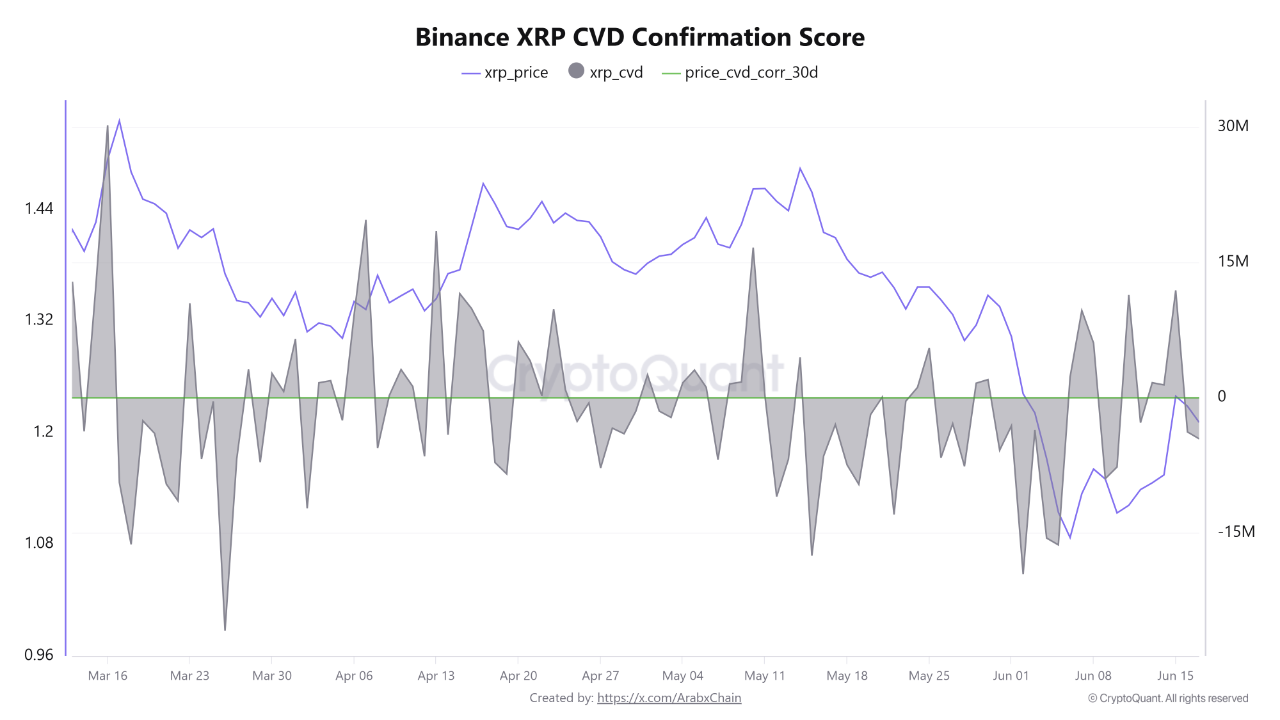
Binance XRP CVD data continues to reflect weak buying momentum across the XRP market. The Cumulative Volume Delta recorded a negative reading of approximately -4.56 million XRP, showing that sell orders dominate over buy orders.
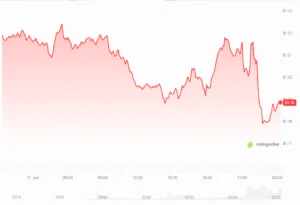
XRP traded near $1.18 with a 24-hour volume of $1.94 billion as of this writing. The token posted a 2.84% price decline in the past 24 hours but gained 7.78% over the prior seven days.
Source: Coingecko
CVD Correlation Points to Genuine Market Activity
The 30-day price-CVD correlation coefficient stands at roughly 0.81. That level points to a strong positive relationship between price movements and actual trading flows. As a result, recent XRP price action appears driven by real market activity rather than thin liquidity conditions.
Source: CryptoQuant
The relatively high correlation reading carries weight for traders monitoring XRP’s near-term direction. When price and CVD move together closely, the data tends to reflect actual supply and demand dynamics more accurately. This makes the persistently negative CVD reading more telling, not less.
Selling pressure continues to weigh on the market despite the price holding above the $1.18 level. This pattern points to ongoing distribution activity by market participants at current price levels. That activity is limiting XRP’s ability to mount a stronger recovery or build a sustained short-term uptrend.
Any shift toward positive CVD readings could provide additional support for the price and signal improving buying interest.
Conversely, continued negative readings may suggest that market conditions remain tilted in favor of sellers. Traders are closely watching CVD developments for early signs of a shift in that balance.
XRP Technical Structure Shows Early Recovery Signals
XRP on the daily timeframe is attempting a recovery after a sharp June selloff. Price dropped from the $1.35 region to a local low near $1.08 before rebounding toward $1.23. Profit-taking then pulled the price back to around $1.18.
Despite that pullback, momentum indicators are improving. The RSI has climbed to 44.7 from oversold territory below 30. That move signals weakening bearish pressure and growing buying interest in the market.
The MACD is also turning bullish, with the histogram printing positive bars. The MACD line is approaching a crossover above the signal line, which traders typically read as a shift in short-term momentum.
Volume expanded during the rebound, suggesting genuine demand rather than a weak technical bounce.
However, XRP remains below key resistance around the $1.25–$1.30 range. A break above that zone could trigger a stronger recovery phase.
Failure to clear that resistance may invite another retest of the $1.10 support area, keeping the overall picture cautious for now.



Global markets slid on Wednesday as uncertainty resurfaced around US-Iran diplomacy and the outlook for inflation. Bitcoin, meanwhile, struggled to reclaim key levels, weighed down by continuing spot Bitcoin ETF outflows in June and signs of softer institutional demand.
At the same time, US Treasury yields remained elevated, limiting risk appetite across equities and crypto. For traders, the near-term question is whether improving geopolitical clarity and easing rates expectations can restart inflows into Bitcoin—or whether current momentum continues to stall.
Key takeaways
- Spot Bitcoin ETFs have recorded about $2.1 billion in net outflows so far in June, according to earlier Cointelegraph coverage linked in the original report.
- Bitcoin has traded at a discount on Coinbase vs. international USDT-based markets for roughly the past five weeks, pointing to weaker US institutional appetite.
- The discount has coincided with persistent caution around Strategy’s STRC preferred equity structure, where dividends depend on fixed issuance mechanics.
- US macro conditions are still hostile for risk assets: inflation concerns and uncertainty around the Fed’s near-term cutting path kept yields around 4.16%.
Geopolitics, inflation worries, and why yields matter for Bitcoin
Wednesday’s risk-off move followed President Donald Trump’s comments that a memorandum of understanding with Iran is not yet final. Markets are focused on whether oil flows through the Strait of Hormuz can stabilize quickly enough to avoid renewed inflation pressure.
US and Iran are expected to formally sign an agreement on Friday, initiating a 60-day negotiation period. Trump said the deal should satisfy markets and suggested oil prices could fall, but he also indicated further military action if Iran does not “behave.”
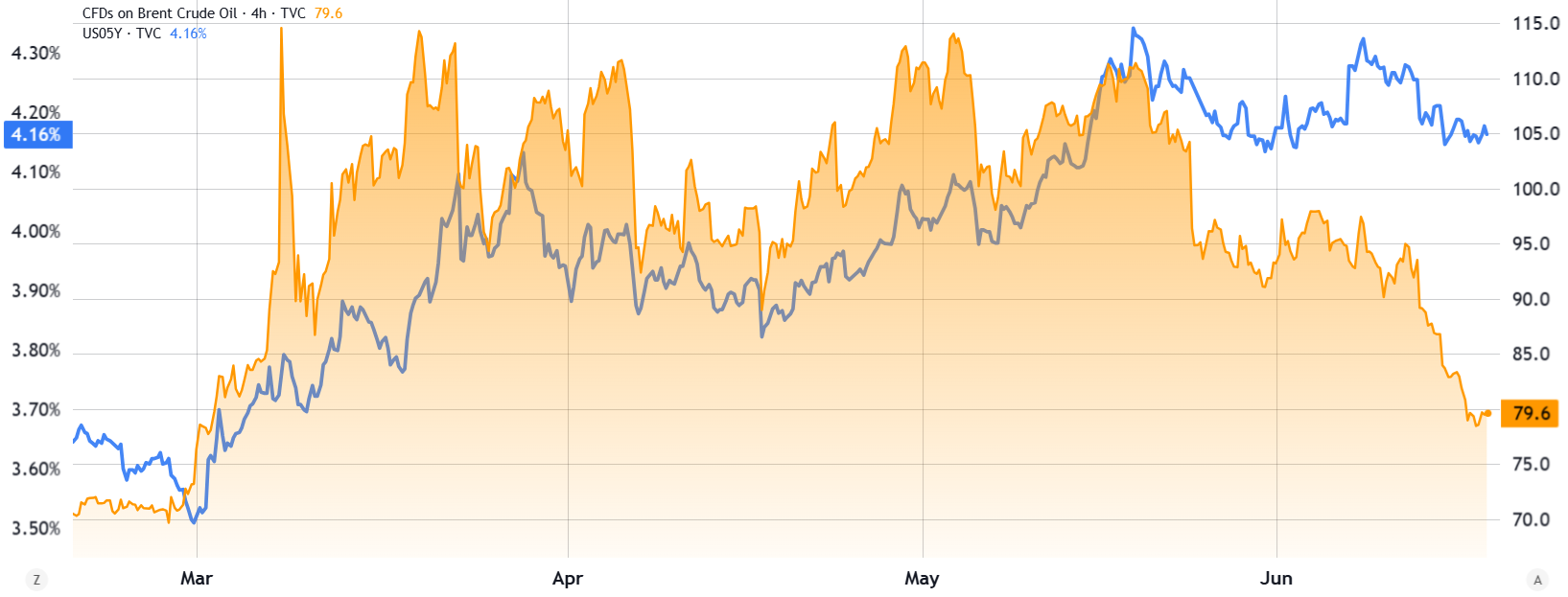
In energy markets, crude Brent dropped to its lowest level in 100 days, but traders appeared cautious about how long that relief can last. US 5-year Treasury yields were around 4.16%, unchanged from roughly two weeks prior, reinforcing the view that the Federal Reserve may not be able to cut interest rates quickly.
That linkage matters for Bitcoin because higher yields increase the opportunity cost of holding non-yielding assets. When investors expect fewer or later rate cuts, liquidity typically tightens—not just for equities, but also for highly volatile markets like crypto.
Bitcoin’s demand signals: ETF outflows and Coinbase-at-discount dynamics
While Wednesday’s US retail sales data showed 6.9% growth from May 2025, the report’s implication for crypto is indirect: the rise likely reflects higher costs for items such as fuel, which can keep inflation risk alive. At the same time, the first Fed Committee meeting since Chair Kevin Warsh took the role has kept attention on whether rate-cut expectations are truly shifting.
On the price action side, Nasdaq-100 futures traded about 2% below their all-time high, while Bitcoin has failed to hold above $80,000 since mid-May—an environment consistent with reduced conviction rather than a clean breakout.
One key driver highlighted in the underlying reporting is demand from institutions. The spot Bitcoin ETFs listed in the US have seen $2.1 billion in net outflows in June, according to the Cointelegraph-linked figure in the provided text. Meanwhile, a comparison between Coinbase’s Bitcoin pricing and international exchanges quoted in USDT showed a persistent discount over the past five weeks.
In practical terms, that Coinbase-at-discount behavior suggests capital is finding it easier to buy Bitcoin outside the US-listed venue—or that US-based buyers are temporarily less aggressive. Either way, weak relative demand can make it harder for Bitcoin to sustain rallies, even when broader narratives improve.
Strategy’s STRC weakness revives concerns over preferred dividends
Another element weighing on sentiment is Strategy’s STRC preferred equity structure. The original reporting noted that STRC is marketed as offering an 11.5% yield, but the mechanics of how new shares can be issued limit Strategy’s flexibility.
Specifically, new stock issuance can only occur at a fixed $100 price. The same report points to a looming mismatch between the dividend commitment and available financial capacity: Strategy has to support roughly $142 million in cash dividends each month, while new issuance at a constrained price can pressure existing holders. That has contributed to dilution concerns for MSTR shareholders.
The reporting also cites that Strategy’s USD cash reserves are around $1.1 billion and that the total preferred shares issued by Strategy stand at $15.5 billion. The implication is not that Strategy must sell its Bitcoin immediately, but that the market is questioning leverage and the sustainability of financial optics if capital requirements remain fixed.
Importantly, the underlying text states there is no evidence Strategy will be forced to sell its Bitcoin reserves anytime soon. Still, the STRC price weakness is being treated as a visible signal of investor skepticism about financial leverage—even if the company’s Bitcoin holdings are not expected to be liquidated in the near term.
What to watch as negotiations begin
With an agreement between the US and Iran expected to be signed on Friday and talks set to last 60 days, traders will likely monitor whether geopolitical headlines translate into sustained energy relief or renewed inflation fears. For Bitcoin, investors should also watch whether spot ETF flows stabilize and whether Coinbase’s pricing discount versus international USDT markets narrows—signs that demand is broadening rather than just shifting location.
Crypto World
World Chain Bridge TVL Climbs 33% Over Seven Days as Worldcoin Token Posts Matching Rally


Total value locked in the canonical bridge of World Chain, the Optimism Stack rollup operated by Worldcoin's Tools for Humanity, climbed 32.87% over seven days to about $602M, according to a DefiLlama snapshot earlier this morning. The token tracked the move, with WLD up over 50% in the same… Read the full story at The Defiant
XRP has seen a strong reaction from its major support zone, but the latest price action suggests the rally is now entering a critical phase. After a sharp breakout from short-term consolidation, buyers pushed the asset into a significant resistance area, where momentum has started to cool.
Ripple Price Analysis: The Daily Chart
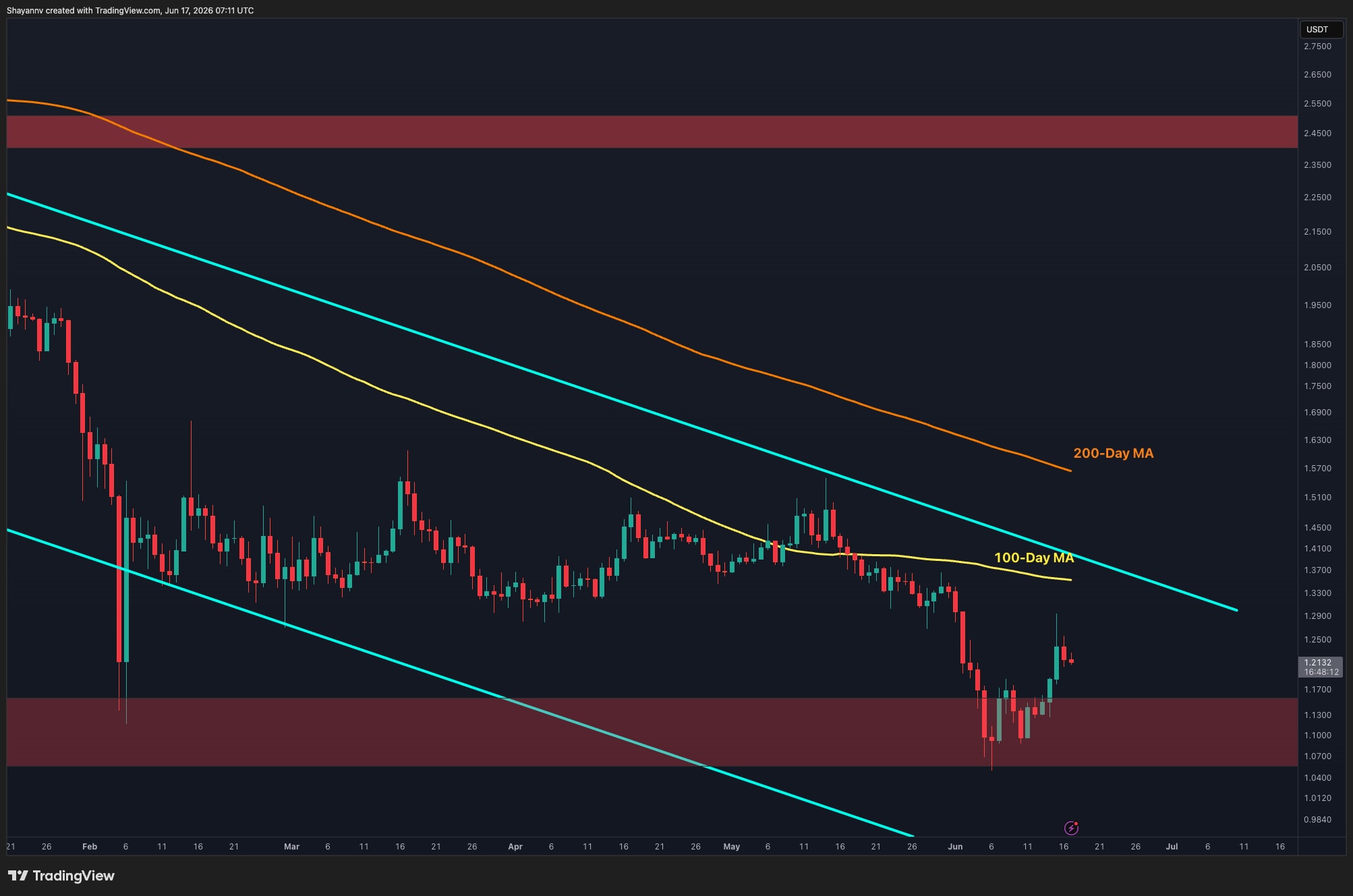
On the daily timeframe, XRP continues to trade within a broader descending channel while remaining below both the 100-day and 200-day moving averages. Despite the larger bearish structure, the recent recovery from the $1.05 to $1.15 demand zone has been encouraging.
The most recent development is the rejection from the 100-day moving average near $1.25. After reclaiming the lower support zone, XRP quickly advanced into this dynamic resistance and has since entered a period of consolidation. The $1.05 to $1.15 region remains the most important support area for the bulls, while the next major resistance sits around the descending channel resistance near $1.3K.
A successful break above this area would represent the first meaningful challenge to the broader downtrend and could pave the way for a move toward higher resistance levels. For now, XRP is attempting to establish a higher low after its recent impulse higher, which is constructive as long as price remains above the recent support region.
XRP/USDT 4-Hour Chart
The 4-hour chart provides a clearer view of the recent breakout. XRP rallied aggressively from the highlighted demand zone around $1.13 to $1.16 and surged directly into the major resistance area between $1.26 and $1.3.
This zone previously acted as support before the breakdown and is now functioning as resistance. Following the initial breakout, price briefly tapped the lower boundary of the resistance zone before pulling back toward $1.21. The latest candles show consolidation rather than aggressive selling, suggesting that buyers are attempting to hold onto a large portion of the recent gains.
As long as XRP remains above the breakout area around $1.13 to $1.16, the short-term structure continues to favor another attempt at the $1.26 to $1.3 resistance zone.
A successful breakout above this region would strengthen the recovery and potentially open the path toward the next major resistance near $1.52. However, failure to hold above the recent breakout area could trigger a deeper retracement back toward the lower support zone. Overall, the most recent price action remains constructive, with XRP consolidating after a strong bullish impulse and attempting to build a base for another push into overhead resistance.

The post Ripple Price Analysis: Is XRP’s Rally Running Out of Steam After Latest Rejection? appeared first on CryptoPotato.
Key takeaways:
- Bitcoin remains under pressure from $2.1 billion in ETF outflows in June and an ongoing discount relative to global Bitcoin/USDT pairs.
- Strategy’s STRC stock shows weakness, highlighting growing concerns over monthly dividend obligations and share dilution.
The US stock market traded down on Wednesday after President Donald Trump said the memorandum of understanding with Iran was not final. Investors fear that oil flows through the Strait of Hormuz will not clear quickly, which adds further pressure on inflation. Is the stock market and Bitcoin (BTC) at risk?
The US and Iran are expected to formally sign an agreement on Friday, starting a 60-day negotiation period. On Wednesday, Trump said the deal should please the markets and that oil prices might fall. However, the US President threatened further bombings if Iran did not “behave.”
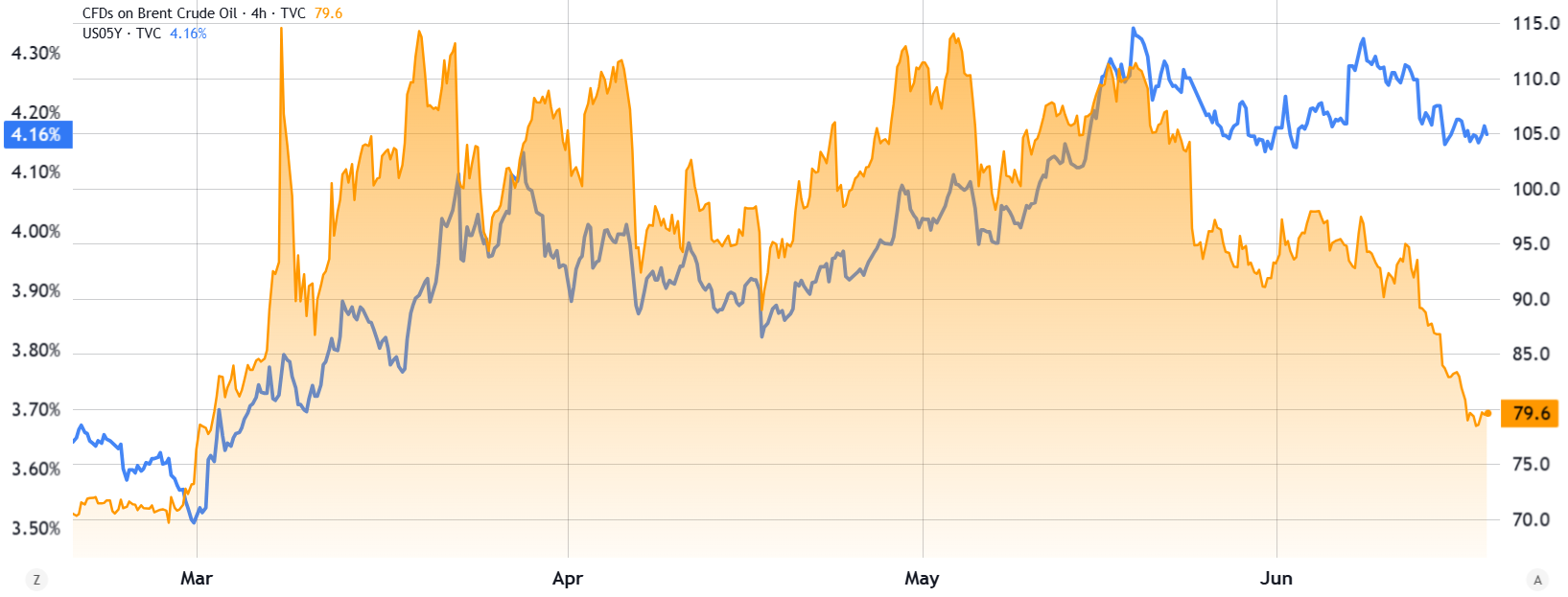
US 5-year Treasury yield vs. crude Brent oil, USD. Source: TradingView
Crude Brent oil fell to its lowest level in 100 days, but traders doubt fuel prices will continue to weigh on markets for long. Yields on US Treasuries remained at 4.16%, flat from two weeks prior. Investors are less confident in the US Federal Reserve’s ability to cut interest rates soon, thereby demanding higher returns on government bonds.
Impact of higher inflation amid weak institutional Bitcoin demand
US retail sales data released on Wednesday showed 6.9% growth from May 2025, but the rise likely reflects higher costs of goods such as fuel. In parallel, Wednesday marked the first Fed Committee meeting by Chair Kevin Warsh. The decision to hold interest rates steady was largely expected, but investors will try to discern Warsh’s views and personal credibility.
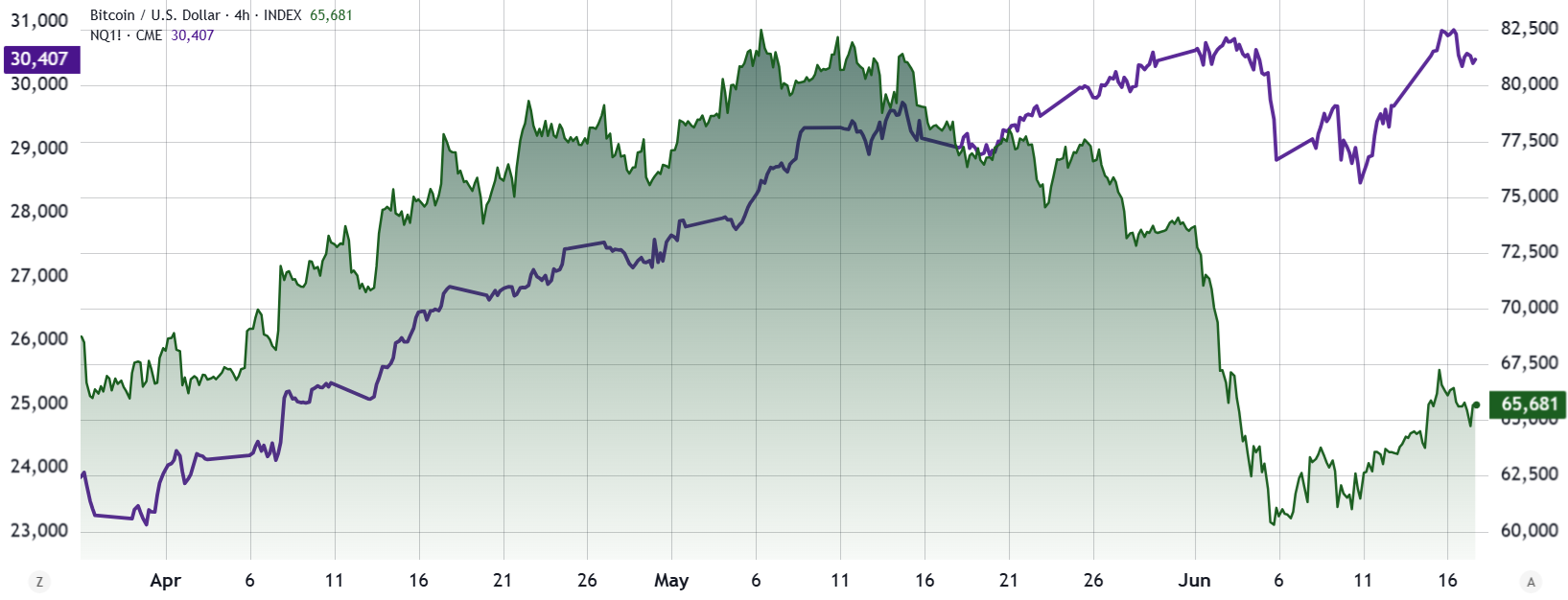
Nasdaq-100 futures (left) vs. Bitcoin/USD (right). Source: TradingView
The tech-heavy Nasdaq-100 Index traded 2% below its all-time high, while Bitcoin has failed to hold above $80,000 since mid-May. Bitcoin traders’ skepticism partly stems from a lack of inflows into spot exchange-traded funds (ETFs) and the absence of a Coinbase premium relative to international exchanges, signaling weak demand from institutional investors.
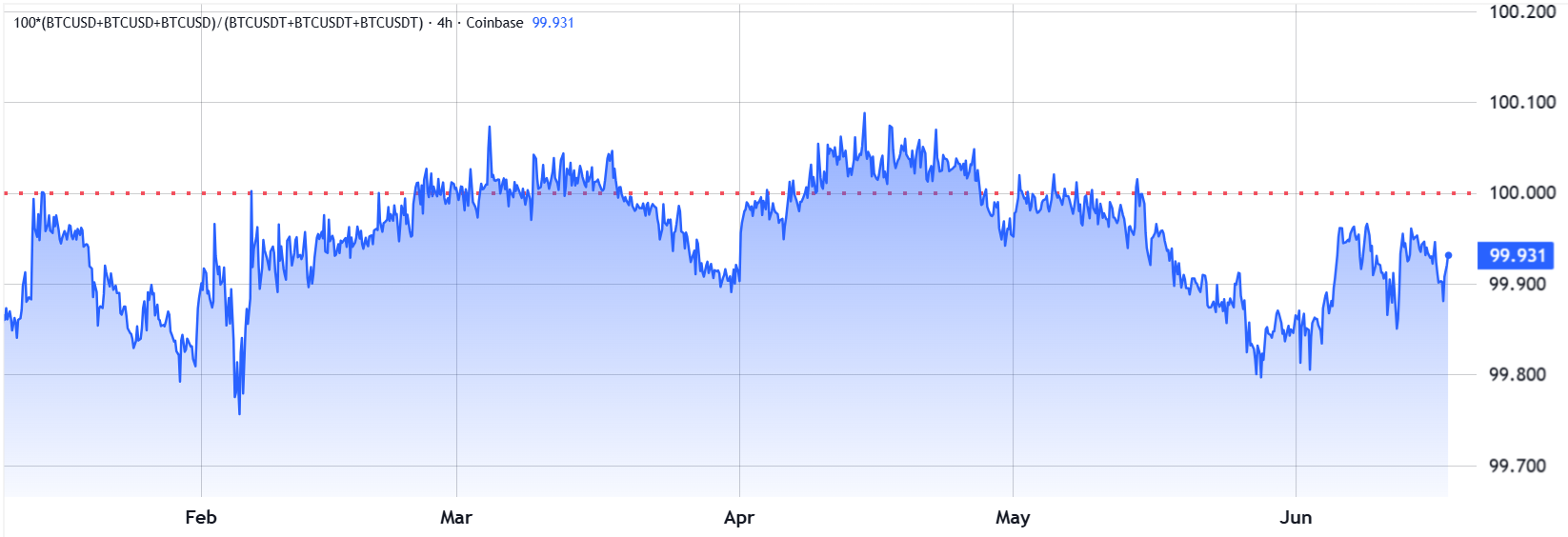
Coinbase Bitcoin USD vs. international USDT prices. Source: TradingView & Cointelegraph
Coinbase Bitcoin price in USD has traded at a discount versus international exchanges based in USDT for the past five weeks. Meanwhile, the US-listed spot Bitcoin ETFs have seen $2.1 billion in net outflows so far in June. The recent weakness in the Strategy preferred perpetual equity Stretch (STRC US) has further fueled the negative sentiment.
Related: Bitcoin tops $67K following US-Iran peace deal: Is it a bull trap?
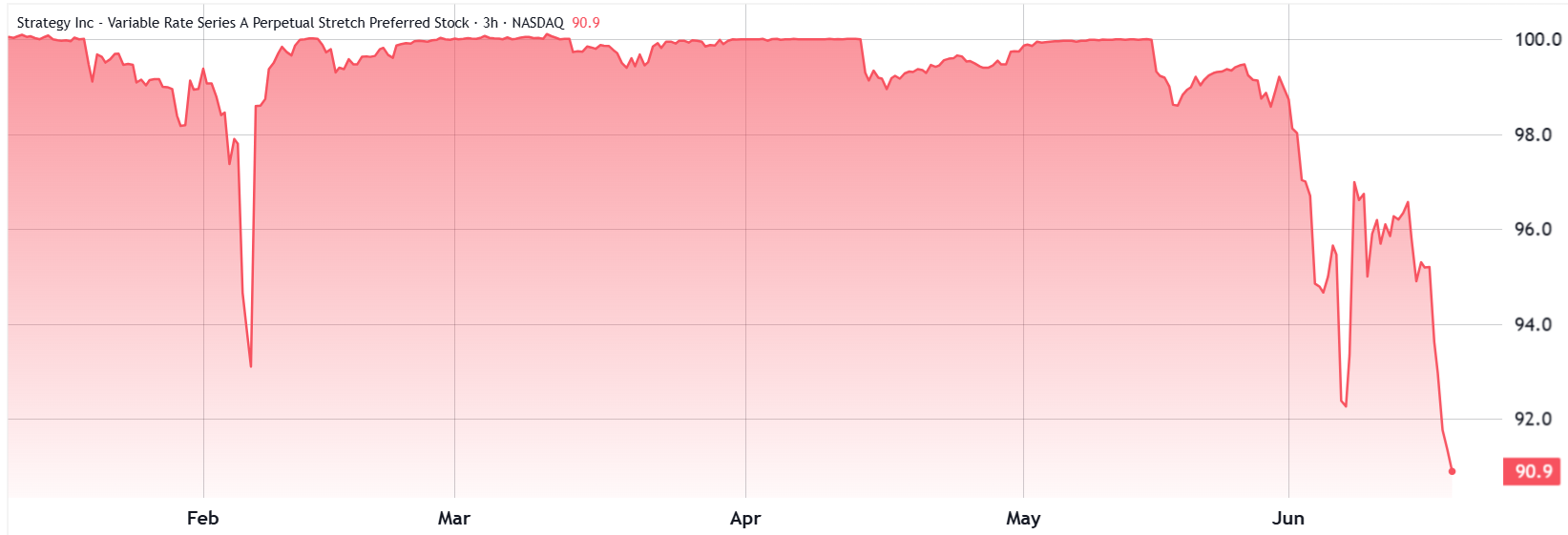
Strategy preferred perpetual equity Stretch (STRC US). Source: TradingView
STRC offers holders an 11.5% yield, but new stock issuance can only happen at the fixed $100 price. Consequently, Strategy has less room to pay $142 million in cash dividends each month, forcing dilution of MSTR holders by issuing more shares or reducing its USD cash reserves, which are currently at $1.1 billion. The total preferred shares issued by Strategy stand at $15.5 billion.
There is no evidence that Strategy will be forced to sell any of its Bitcoin reserves anytime soon, but weakness in the STRC price reflects low confidence in the company’s financial leverage. Even if Bitcoin institutional inflows resume, investors fear that the deal between the US and Iran might not go through, hence a sustainable rally to $80,000 could take longer.


Instead of selling everything, each validator would choose a set of subnets to support, much like picking holdings for a fund. The yield that would have been sold is reinvested into the chosen subnets, held as a basket that compounds over time, and staked back to the validator. Stakers still get their yield and can cash out to TAO whenever they want.
Such a mechanism stops the constant selling pressure and turns it into net buying that supports subnet prices.
Validators turn from passive yield pipes into active curators, since subnets they back attract fresh capital, while those they judge to be bad actors get starved of it.
The proposal is a code submission on Bittensor’s GitHub as of Wednesday, aimed at a test network rather than the main one.
Meanwhile, an early automated review flagged two serious issues, including an upgrade step that could choke on large amounts of data and a payout path that could shortchange stakers when a subnet shuts down. The author said in a GitHub response that those issues are fixed, with more cleanup listed before any mainnet release.
Bittensor’s token, TAO, has fallen 28% over the last 12 months, while bitcoin has fallen 38% over the same period. The token’s staking yield currently sits around 17% if users hold TAO for a year.

US gaming and tribal-related organizations, along with labor groups, are urging lawmakers to tighten federal rules around crypto-linked prediction markets. In a letter reported by Semafor, they ask the Senate to include language in the Digital Asset Market Clarity (CLARITY) Act that would “explicitly prohibit event contracts tied to sports and casino-style gaming.”
The groups’ core argument is jurisdictional and policy-driven: they contend that sports betting belongs under state and tribal regulatory frameworks, not under the Commodity Futures Trading Commission (CFTC). Their request comes as the CFTC, under Chair Michael Selig, has asserted “exclusive jurisdiction” over prediction markets.
Key takeaways
- Sports and casino-related prediction market contracts are the focus of a new push to bar them under the CLARITY Act.
- Gaming and tribal organizations say prediction markets have expanded gambling “without voter approval or legislative authorization” over the past 18 months.
- The letter argues the CFTC was not built to regulate sports wagering, pointing to existing state and tribal oversight.
- CLARITY is positioned to shift some digital-asset enforcement authority from the SEC to the CFTC, but it still faces timeline and political hurdles.
- Legal disputes over whether prediction-market event contracts are regulated as “swaps” could ultimately escalate to the US Supreme Court.
Gaming industry groups target CLARITY’s wording on prediction markets
According to the Semafor report, organizations including the Indian Gaming Association and the American Gaming Association have coordinated their opposition to using crypto legislation to enable sports-betting-style prediction products. They want Congress, while the CLARITY Act is under Senate consideration, to “affirm” that sports betting is outside the CFTC’s remit and therefore cannot be offered through prediction market platforms.
In the letter, the groups argue that prediction markets have contributed to what they describe as the “largest expansion of gambling in US history” during the previous 18 months, and that this growth occurred without what they call democratic authorization. Their emphasis is not only on consumer protection, but also on whether federal regulators should be allowed to reshape gambling rules nationally.
CFTC’s “exclusive jurisdiction” claim collides with state regulatory systems
The lobbying effort arrives amid an ongoing regulatory clash. Semafor notes that the CFTC, led by Chair Michael Selig, has claimed exclusive jurisdiction over prediction markets. Selig has also supported enforcement actions and legal strategies aimed at platforms such as Kalshi and Polymarket, according to earlier coverage by Cointelegraph regarding the CFTC’s stance in lawsuits brought by state-level gaming authorities. (Earlier reporting: CFTC lawsuit: Minnesota prediction markets ban.)
The letter’s counterpoint is straightforward: the CFTC, the groups say, was created for commodities and derivatives—not gambling and sports wagering. They also argue the agency lacks the expertise and operational infrastructure to oversee nationwide sports betting when state and tribal regulators already provide the principal regulatory mechanisms.
While the groups frame their concern as a mismatch of regulatory roles, the policy conflict is also structural. If Congress enshrines an explicit prohibition tied to sports and casino-style event contracts, it could narrow the practical scope of what platforms and litigants treat as CFTC-governed “swaps” or derivatives. Conversely, if such language does not survive, the CFTC’s jurisdictional posture could remain a centerpiece of future enforcement.
Tax-dollar losses become a central talking point
The American Gaming Association, also cited in the Semafor report, reportedly argues that states have lost revenue since sports event contracts began appearing on prediction market platforms. Per the AGA’s figures, state gaming authorities have lost about $1.08 billion in tax dollars “since prediction markets began offering sports event contracts” as of Wednesday, according to the organization’s reported update.
For policymakers, this is more than a political talking point. Revenue and tax streams are often central to how states justify their gambling regimes, and the claim—if accepted by lawmakers—adds weight to the argument that prediction markets function as a substitute for regulated wagering channels.
That said, the dispute remains largely about classification and regulator authority rather than only market growth. The jurisdictional fight will determine whether enforcement actions focus on CFTC-style derivative frameworks or instead defer to gambling laws administered by states and tribes.
What CLARITY could change—and why timing matters
Some lawmakers expect the CLARITY Act to clear Congress out of the Senate by August. Semafor reports that the bill passed the House of Representatives in July 2025, but it faced delays tied to concerns including stablecoin yield, ethics, and tokenized equities.
CLARITY’s broader purpose is to transfer some regulatory and enforcement authority for digital assets from the Securities and Exchange Commission (SEC) to the CFTC. In that context, the letter’s demand for a carveout is significant: it aims to prevent the CFTC from regulating sports and casino-style event contracts even if Congress expands the agency’s general role over digital-asset markets.
If included, the language the groups seek could reshape the compliance landscape for prediction market platforms that offer sports-related contracts. It would also potentially affect how operators design product structures—whether they try to avoid “event contracts” tied to sports wagering or whether they challenge the applicability of any prohibition.
Regulator jurisdiction may become a Supreme Court question
Legal uncertainty already looms over prediction markets, and the letter’s pushback reflects that the regulatory fight is not settled. Some experts and advocates anticipate that if CFTC leadership—Selig in particular—continues to challenge state-level crackdowns through courts, the dispute could ultimately reach the US Supreme Court.
Cointelegraph previously discussed scenarios in which the federal-state conflict might escalate, including the possibility that appeals over how such event contracts should be classified could culminate in the nation’s highest court. (Earlier coverage: CFTC Michael Selig defending prediction markets and prediction markets legal fight Supreme Court Kalshi appeal.)
The constitutional backdrop is Murphy v. NCAA (2018), in which the Supreme Court gave states the authority to regulate sports gambling. Kalshi, Polymarket, and the CFTC have argued in the course of related litigation that event contracts offered through prediction market platforms should be treated as “swaps” subject to the CFTC’s jurisdiction—rather than as gambling regulated primarily under state law.
That tension—federal derivatives classification versus state gambling authority—could become the central question for courts. Meanwhile, legislation like CLARITY could either reduce the room for interpretation by carving out sports and casino-style contracts or, if it doesn’t, leave courts to decide how far the CFTC’s “exclusive jurisdiction” claim extends.
For investors, platform operators, and users, the immediate watch item is whether the Senate version of CLARITY incorporates the requested sports- and casino-style prohibition—and, separately, whether ongoing cases continue to climb the appellate ladder toward the Supreme Court as regulators keep insisting on competing jurisdictional theories.
Bitcoin’s recovery has slowed after reaching a key resistance cluster, with the asset now consolidating beneath an important supply zone. The latest price action suggests that bulls are attempting to maintain momentum, but the market remains at a critical level where the next breakout or rejection could determine the short-term trend.
Bitcoin Price Analysis: The Daily Chart
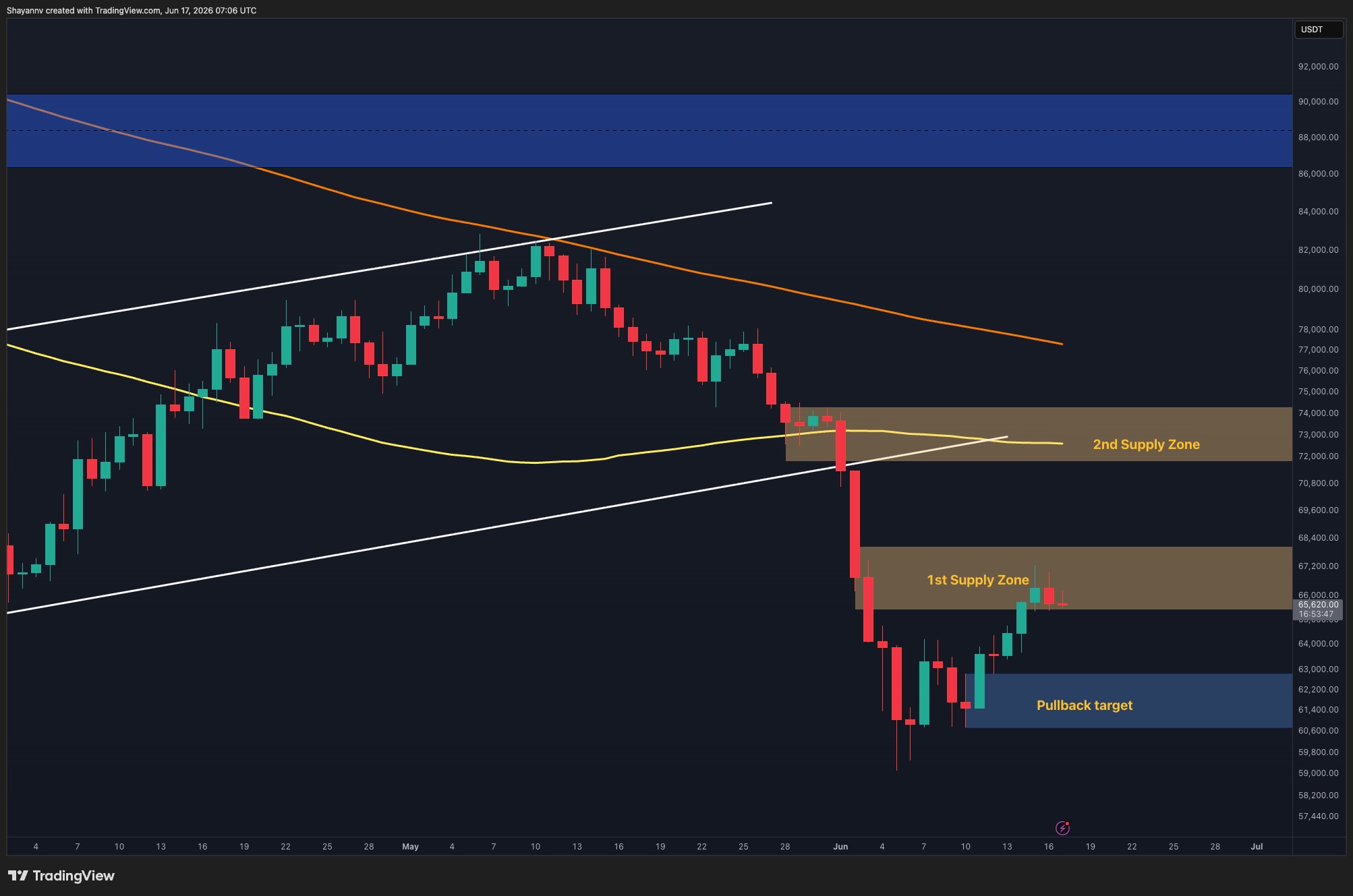
On the daily timeframe, BTC is trading around $65K after rebounding from the $60K support region earlier this month. The recovery has brought the price directly into the first major supply zone between $65K and $67K, where sellers have started to emerge.
The most recent candles show consolidation inside this resistance area rather than an immediate rejection, which is generally a constructive sign for buyers. However, BTC still trades below the 100-day moving average near $72K and the 200-day moving average around $77K, indicating that the broader trend has yet to fully recover.
If buyers manage to reclaim the current supply zone, the next upside target would be the higher resistance region between $72K and $74K. This area aligns with the second supply zone, the 100-day moving average, and the lower boundary of the previously broken ascending channel, making it the next major hurdle for the market.
On the downside, the $60K-$62K area remains the key support zone. As long as BTC holds above this region, the recent recovery structure remains intact.
BTC/USDT 4-Hour Chart
The 4-hour chart highlights the recent rally into the $65K to $67K supply zone following a breakout from the ascending recovery channel. After reaching the upper boundary of the zone near $66.8K, BTC has entered a period of sideways consolidation.
The latest price action suggests that neither bulls nor bears currently have full control. The asset continues to hold above the former breakout region around $64K to $65K, while sellers have so far prevented a decisive move through the supply zone.
A breakout above $67K would strengthen the bullish case and could open the path toward the higher resistance area around $72K. Conversely, losing the $64K support region would likely trigger a deeper pullback toward the $61K to $62K demand zone.
For now, the short-term structure remains constructive as long as higher lows continue to develop above the recent breakout area.

Sentiment Analysis
The Binance liquidation heatmap shows a notable concentration of liquidity both above and below the current price, but the nearest and most significant cluster is located between $67K and $69K.
Since BTC is currently consolidating around $65K, this overhead liquidity zone could act as a short-term magnet. A push through the current supply region may trigger short liquidations and accelerate momentum toward the $68K to $69K area.
Meanwhile, a substantial liquidity pocket remains below the market, between $62K and $63K. Should BTC lose the $64K support area, the market could be drawn lower to collect this liquidity before establishing the next directional move.
Overall, the heatmap suggests that the market is currently trapped between two major liquidity pools. Given the proximity of the upper cluster and BTC’s ability to hold within the $65K to $67K resistance zone, the short-term bias remains slightly tilted toward an upside liquidity sweep into the $67K to $69K region before a larger directional decision emerges.

The post Bitcoin Price Analysis: BTC’s Recovery Hangs on One Critical Support Level appeared first on CryptoPotato.

The paradigm of crypto-native gaming has shifted significantly from complex, slow-layered decentralized applications (dApps) toward high-frequency, provably fair arcade mechanics. Within this digital ecosystem, proprietary gaming titles have established a distinct niche by blending classic gameplay loops with transparent cryptographic verification. A good example of this synthesis is the Mission Uncrossable game, an iterative, lane-based crash alternative that adapts the structural logic of classic obstacle-avoidance titles into a rigorous risk-management model.
For users seeking to transition from theoretical understanding to on-chain execution, analyzing the game requires looking past the visual presentation and focusing on probability distribution, volatility settings, and capital preservation strategies. This guide provides an analytical breakdown of how to play Mission Uncrossable while optimizing risk-adjusted exposure and maximizing conversion efficiency.
Understanding the Core Mechanics: How to Play Mission Uncrossable
At its core, the Mission Uncrossable game operates on a gamified multi-stage multiplier trajectory. The user’s objective is to navigate a digital asset—represented as a character traversing a multi-lane highway—across successive tiers of moving traffic. Each successfully negotiated lane applies an incremental multiplier to the initial stake. Conversely, if a collision occurs with passing traffic, the round terminates instantly, resulting in a total loss of the accumulated capital for that specific round.
To initiate an operational round, a participant executes a highly streamlined onboarding sequence designed to minimize friction and accelerate time-to-play:
- Capital Allocation: The user inputs a specific wager size. The platform allows micro-wagers (stakes below $0.01 scale the user interface into a low-risk testing mode), allowing for granular bankroll evaluation without significant capital drawdown.
- Difficulty Parameter Selection: Prior to deployment, players must select one of four distinct volatility configurations: Easy, Medium, Hard, or Daredevil.
- Multiplier Accrual: The player advances the asset lane by lane. Each successful step updates the real-time payout value based on the chosen risk curve.
- Cash Out: At any point before an adverse collision event occurs, the player can manually trigger a “Cash Out” sequence to lock in the achieved multiplier and secure the yielded funds directly into their platform balance for immediate withdrawal.
Difficulty Calibration and the Risk-Reward Matrix
The primary strategic lever available to the user is the difficulty configuration. Adjusting the difficulty tier directly alters the density and velocity vectors of the digital traffic, manipulating both the probability of survival and the steepness of the multiplier’s mathematical scaling.
| Difficulty Tier | Mathematical Volatility | Multiplier Progression Rate | Capital Preservation Approach |
| Easy | Low | Conservative, linear scaling | High-volume, low-margin compounding |
| Medium | Moderate | Balanced geometric scaling | Measured progression (Targeting 3–4 lanes) |
| Hard | High | Aggressive scaling | Small asset allocation targeting mid-tier milestones |
| Daredevil | Extreme | Exponential scaling | Asymmetric risk exposure; micro-wagers targeting max caps |
The Technical Infrastructure: Provably Fair and RNG Verification
For analytical publications on platforms like Blockonomi, establishing the technical integrity of the underlying code is paramount to building player trust and driving high-value user acquisitions. Unlike legacy online casinos relying on opaque, server-side Random Number Generators (RNG) that lack external visibility, Roobet’s proprietary catalog utilizes a Provably Fair cryptographic framework.
Every outcome within the game is predetermined by a deterministic combination of three distinct variables:
- Server Seed: Provided by the host platform and cryptographically hashed prior to the commencement of the round, preventing real-time manipulation.
- Client Seed: Generated by the user’s local browser architecture (and customizable manually), ensuring the operator cannot dictate or alter the random pathing unilaterally.
- Nonce: An automatically incrementing counter that tracks the exact number of wagers executed utilizing the current seed pair.
This algorithmic configuration allows any participant to extract the SHA-256 hash post-round and independently verify that the lane generation and collision thresholds were mathematically absolute. The platform maintains an optimized Return to Player (RTP) profile that minimizes the structural house edge common to traditional video slots, making it a highly attractive destination for mathematically minded players.
Strategic Frameworks for Capital Preservation
Because outcomes are cryptographically randomized and independent, pattern recognition is mathematically invalid. Strategic optimization must therefore rely on structured risk management frameworks rather than predictive assumptions.
Low-Volatility Scalping (The Conservative Protocol)
Executed primarily on the Easy difficulty setting, this framework focuses on high-frequency, low-margin returns. The technical objective is to systematically cash out wagers after navigating only 1 to 2 lanes. While the returns per individual round are minor, the probability density heavily favors the user, allowing for the methodical compounding of a base bankroll while mitigating tail-risk exposure.
Asymmetric Risk Exposure (The Venture-Style Protocol)
Conversely, utilizing the Hard or Daredevil configurations shifts the objective from high win-probability to high asymmetric payoff. Under this protocol, users deploy micro-stakes with the intent of absorbing a high volume of low-cost losses in exchange for capturing an exponential multiplier outlier. This approach mirrors venture capital distribution, where a single successful high-multiplier event covers historical drawdowns.
Comparative Analysis: Discrete Step-Based Risk vs. Continuous Crash Curves
Traditional crypto crash games present a continuous, real-time depreciation of user agency; a multiplier climbs linearly or exponentially on a continuous timeline until an abrupt, singular crash event clears all active stakes simultaneously.
The structural variance implemented in how to play Mission Uncrossable introduces discrete decision points. Instead of a continuous time-based risk curve, risk is segmented into distinct operational steps (lanes). This architectural shift grants the user static windows of reflection between steps, changing the psychological profile of the game from rapid reaction-based survival to a calculated, step-by-step assessment of probabilistic risk. This enhanced sense of user agency acts as a powerful retention vector, driving sustained engagement over traditional, passive alternative titles.
Ready to test the mechanics? You can register seamlessly, deposit your preferred crypto asset, and execute your own risk-mitigation framework on the official Mission Uncrossable game at Roobet.
Binance founder Changpeng Zhao (CZ) is urging governments to tokenize their stock markets and issue national stablecoins, framing sovereign blockchain adoption as the next phase of crypto after meetings with Asian leaders and regulators.
He shared the advice in two posts, arguing that countries tokenizing equities can attract worldwide buyers while national stablecoins expand local currency usage on the blockchain.
Why CZ Wants Countries to Tokenize Stocks
CZ said he posted the recommendations after meeting several country leaders and regulators across Asia. He described the talks as making good progress but did not name the countries involved.
His pitch centers on real world assets (RWA). Tokenized equities turn company shares into blockchain tokens that can trade around the clock, a model now moving into practice.
Supporters say the approach offers fractional ownership, faster settlement, and access for buyers outside traditional brokerages. No country has yet tokenized its full stock exchange.
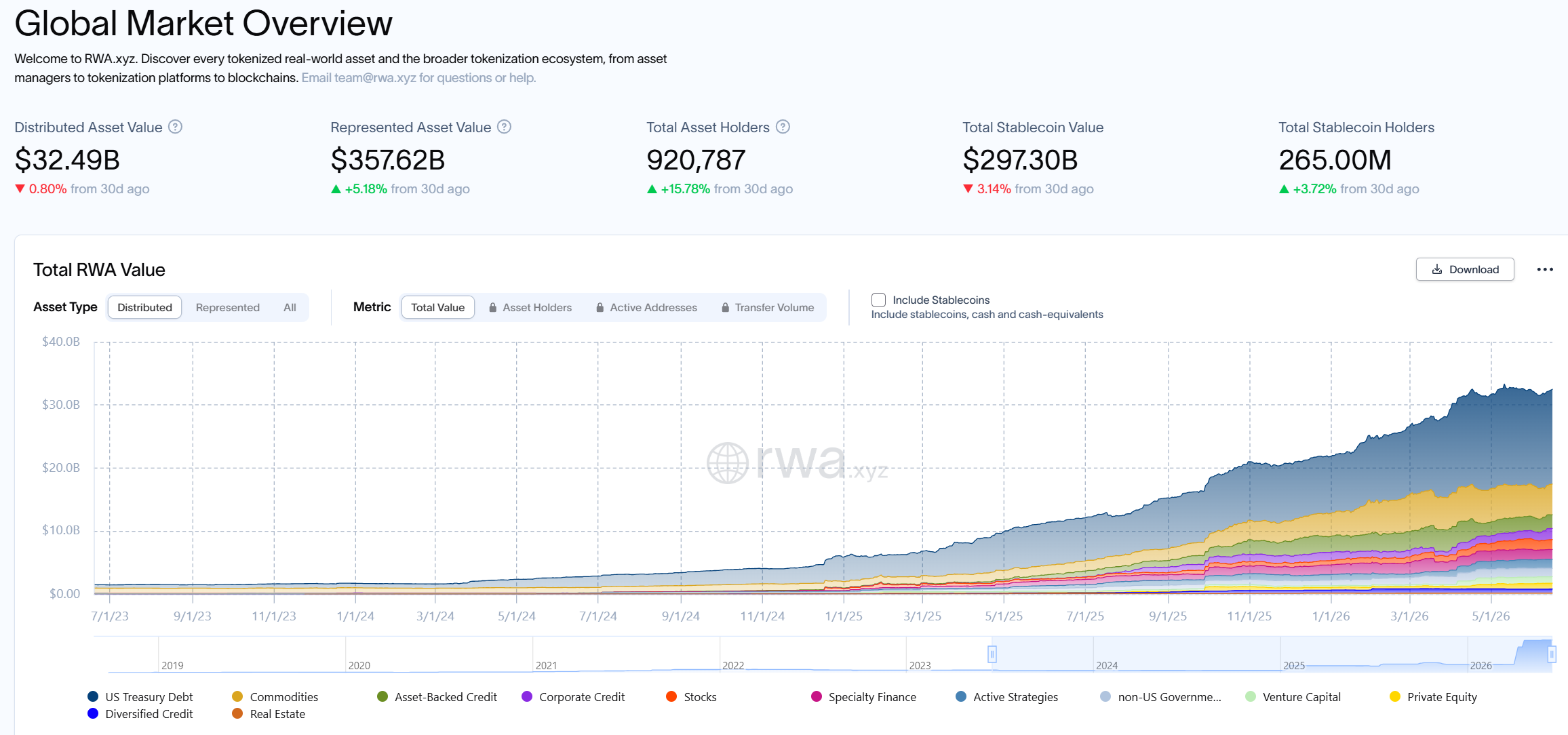
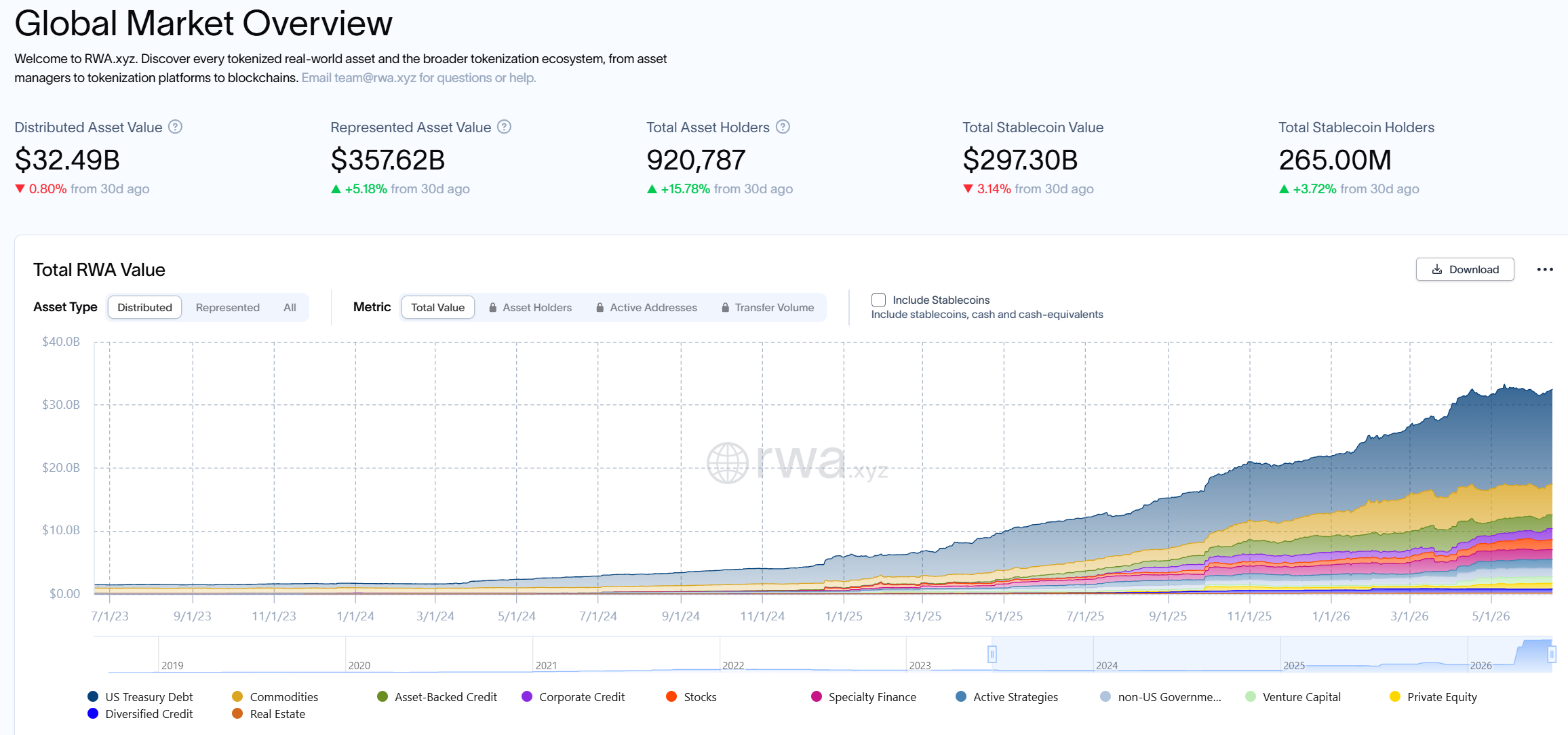
The wider RWA market has grown quickly. Tokenized real world assets on public blockchains topped $32 billion by mid-2026, up from about $6 billion a year earlier, RWA.xyz data shows.
Several exchanges already list tokenized stocks and ETFs tied to major U.S. companies. Boston Consulting Group projects tokenization could reach $16 trillion by 2030.
“Countries need to tokenize their stocks, allowing worldwide buyers. (RWA) Countries need to issue their own stablecoin(s), to expand their currency’s usage on the blockchain,” CZ shared.
Follow us on X to get the latest news as it happens
National Stablecoins and the Push Beyond the Dollar
CZ also wants governments to issue fiat-backed stablecoins. He argues this would extend a currency’s reach across blockchain rails and support its next growth phase.
Dollar-pegged tokens make up close to 99% of the roughly $315 billion stablecoin market, led by Tether (USDT) and USD Coin (USDC), DefiLlama figures show.

National versions could reduce that dependence while keeping monetary control closer to home.
The message builds on his advisory work. CZ serves as a strategic adviser to the Pakistan Crypto Council and is advising Kyrgyzstan on crypto as it builds a gold-backed stablecoin.
Binance also secured approval to develop a crypto marketplace in Kazakhstan.
Binance co-CEO Richard Teng pointed to rising demand. He said 36% of emerging-market users on the platform now keep at least half their money in stablecoins.
He framed the trend as evidence that the tokens already make everyday payments easier.
BNB, the token tied to CZ’s ecosystem, traded near $599, down about 1% over 24 hours.
Governments adopting his playbook could shape how fast traditional markets move on-chain.
The post CZ Reveals the Crypto Playbook He Is Pitching to Governments appeared first on BeInCrypto.
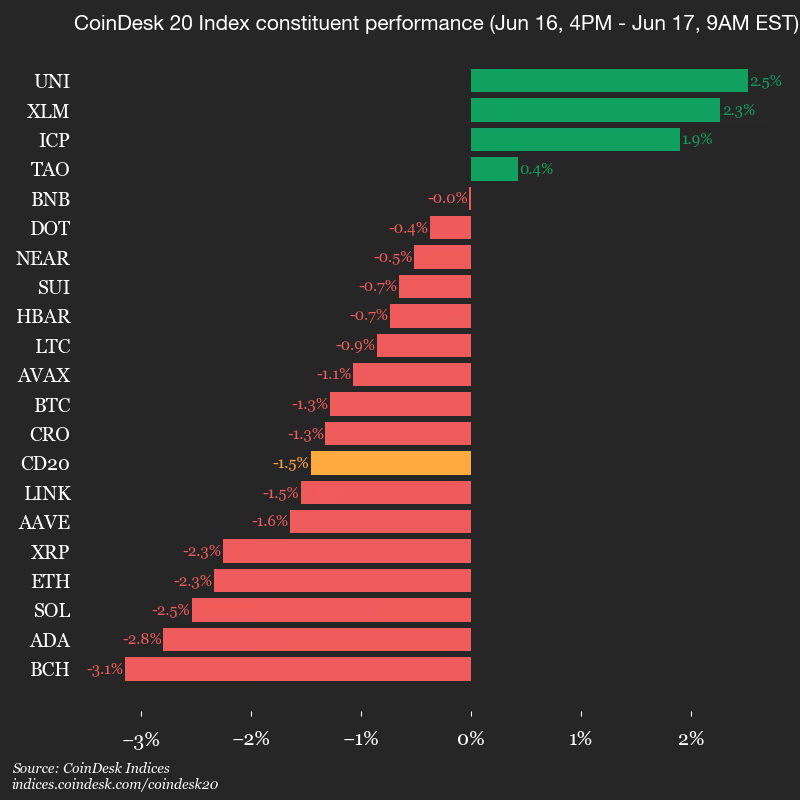
CoinDesk Indices presents its daily market update, highlighting the performance of leaders and laggards in the CoinDesk 20 Index.
The CoinDesk 20 is currently trading at 1774.43, down 1.5% (-26.19) since 4 p.m. ET on Tuesday.
Four of 20 assets are trading higher.

Leaders: UNI (+2.5%) and XLM (+2.3%).
Laggards: BCH (-3.1%) and ADA (-2.8%).
The CoinDesk 20 is a broad-based index traded on multiple platforms in several regions globally.

A Maker Hand-Wound His Own Robot Actuator, and it Already Moves Real Weight

Man charged with burglary, assault and having offensive weapon
Oil prices dip as traders weigh US-Iran deal, Trump’s fresh warning


-

 Business3 days ago
No Jackpot Winner as $257 Million Prize Rolls Over to $269 Million Monday Draw
-

 Fashion5 days ago
Weekend Open Thread: Tuckernuck – Corporette.com
-

 Crypto World6 days ago
Oppenheimer backs SpaceX as $70 billion retail frenzy builds
-

 Crypto World6 days ago
Markets Rally as SpaceX IPO Looms Amid Iran Tensions and Inflation Surge
-
Crypto World3 days ago
Zimbabwe Requires Crypto Businesses to Register Annually Under New FIU Regulations
-

 Tech5 days ago
NanoClaw integrates JFrog registries to secure AI agent downloads
-

 Crypto World5 days ago
Bitget enters Argentina’s regulated crypto market through PSAV registration
-

 Tech5 days ago
This Week In Security: Microsoft On Microsoft, Register Your Domains, Linux On ARM, And FreeBSD Joins The File Cache Club
-

 NewsBeat6 days ago
El Nino has formed in the Pacific and could set records, forecasters say
-
 Tech6 days ago
Dutton Ranch star claims they ‘didn’t see any disruption’ on set following Chad Feehan’s exit from Yellowstone spinoff fueled by Taylor Sheridan clash rumors
-

 Politics6 days ago
Politics Home | Healey Resignation Is “Colossal Failure Of Government”, Says Former Labour Defence Secretary
-
 Entertainment6 days ago
Donnie Wahlberg & More Heat Up Las Vegas at Circa’s Barry’s Downtown Prime
-
 Tech6 days ago
Opendoor Ends India Operations, Fueling a Bigger Conversation About AI and Outsourcing
-

 Sports7 days ago
First Time Since 1971: Australia Register Historic Low In ODI Cricket
-

 Politics6 days ago
Belfast burns, while Met chief points finger at Iran and Russia
-

 Business6 days ago
AT&T: Verizon's 27% Outperformance Sets Up A Solid Entry Point
-

 NewsBeat5 days ago
FBI searches office of Ohio voter registration group
-
 Tech6 days ago
Anthropic is spending $150M to embed 1,000 AI fellows inside nonprofits. No degree required.
-

 Politics6 days ago
Modi thanks Trump for wishes as US attacks Indian seafarers
-
 Entertainment6 days ago
‘The Pitt’s Fan-Favorite Doctor Confirms Noah Wyle Gave His Blessing to Return [Exclusive]
You must be logged in to post a comment Login