Jude Bellingham looked like he can fulfil all that talent, but Thomas Tuchel has already fulfilled one promise. The England manager had promised that an occasion like this World Cup 2026 match would “bring out the best in us”, but it may have done even more than that.
It may well have been the country’s best spell of tournament football in decades, and perhaps the most convincing victory in some time. The game ended up 4-2, but it could genuinely have been 7-2 from the 10-minute spell after half-time alone. Croatia barely knew where to turn, let alone where to look.
Another match of four quarters – the hydration break booed by England fans – really was a game of two halves.
Advertisement
That second-half onslaught was sparked by a crucial and clinical individual goal from Bellingham, that might also have marked some important changes for this team.
Where England had previously been playing with “a lot of nervous energy” that produced a “complicated and confusing first half”, they were suddenly performing with a focused aggression and real clarity.
(AP)
It was the “clarity of purpose” Tuchel always has constantly been trying to drill into them.
That was perfectly distilled in that driving Bellingham run, where he had absolutely no doubt or hesitation about what he was doing. He was going straight for goal.
Advertisement
There was an extra defiance to that, too, given how it had been Bellingham and Elliot Anderson largely culpable for Croatia’s brilliant first.
And, through that, there was also the biggest transformation of all.
For so much of the first half, this had seemed like the same old story for England.
They’d gone two years without a proper test and here they were again, struggling to keep control and ceding midfield in a match against the first quality side they’d played.
Advertisement
England’s Harry Kane following the FIFA World Cup Group L match at the Dallas Stadium (PA)
That can be banished, for now, even if this is not exactly the Croatia of 2018 or 2022.
England, through sheer intensity and unique qualities, just wrestled the game back. Where Croatia previously had control of possession, England just took command of everything else.
The set-pieces had helped England stay in it prior to that, and may be a crucial weapon if England do find themselves in more testing ties than this.
Mikel Arteta must have been smiling wryly. Declan Rice’s deliveries produced the Luka Modric foul on Noni Madueke for Kane’s initial penalty – eventually retaken – and then a plundering header from Kane.
Another huge advantage, especially in the conditions of this World Cup, is that bench.
Advertisement
Marcus Rashford came on to score after Bukayo Saka had also opened so much space.
England’s Jude Bellingham (10) celebrates his team’s third goal (AP)
There were still a few warnings within the 90, that might need to be heeded against higher-class opposition that don’t have a series of stars in their late 30s and beyond.
The manner in which Croatia constructed their two first-half goals posed quite a contrast to England’s four, and especially their midfield play.
It wasn’t just that Anderson, Rice and Bellingham couldn’t control the game but how easily they were losing possession and space. For the first, Bellingham was notably weak in midfield, with Anderson then out of position from his own bad pass as Croatia surged forward. John Stones could do little but slide in vein as the ball was clipped back to Martin Baturina. He let fly spectacularly, but Jordan Pickford might have been stronger.
You could say the same about the whole defence for the second. How do you have seven men on the edge of your own box and still have the ball clipped over you like that?
Advertisement
Peter Musa’s finish from Ivan Perisic’s deft little head-tennis knock-down was still tidy, but they shouldn’t have been allowed the space.
It could also be acknowledged that England’s best spell did coincide with Modric looking so fatigued he had to go off well before the hour.
Marcus Rashford #11 of England celebrates with teammate Elliot Anderson #8 after scoring his team’s fourth goal (Getty)
Barry might well say – and everyone has now seen how very frank he is – the difference was more down to the team not following instruction, and repeatedly taking the wrong options.
They more than got it together.
Whether they can get it together in the same way is another question. England’s second-half transformation was driven by a shift in application, but also a very aggressive press. That was possible in an indoor stadium like this, but will they be able to do the same in humidity and heat?
Advertisement
This isn’t all about the physical though.
It’s also about the psychological.
For all of the evolution over the last decade, England have still had a complex about contests like this; about big games. This looked like it could be a similar story.
Tuchel and his players have instead wrought their first major change.
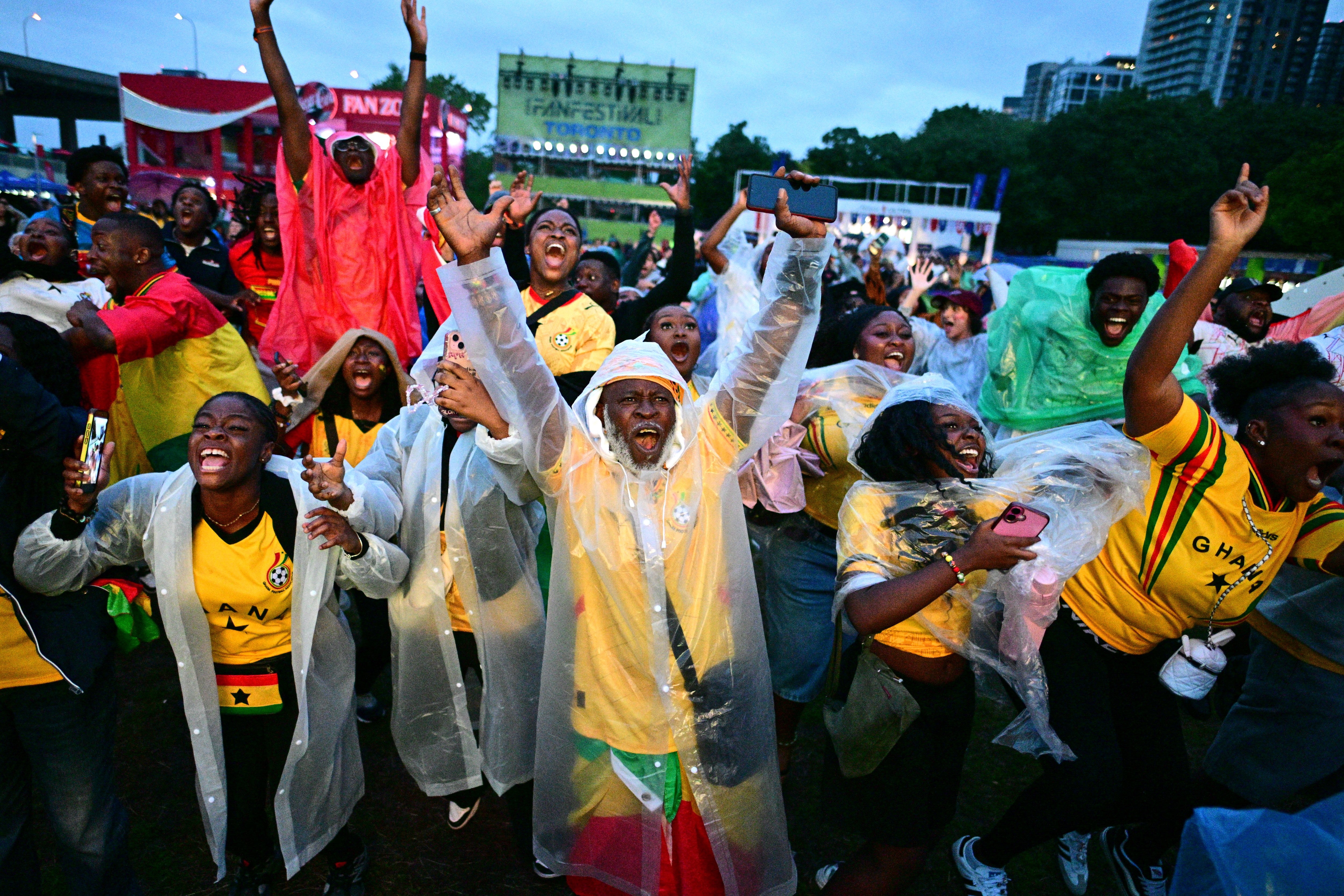
Caleb Yirenkyi scored a stoppage-time winner to earn Ghana a 1-0 win over Panama in a chilly and lively World Cup 2026 game in which the African side were forced to play the second half without starting goalkeeper Lawrence Ati Zigi on Wednesday.
After a lightning-quick counter-attack, Brandon Thomas-Asante charged forward before playing a precise pass into the area for Yirenkyi, who tapped home for his first competitive international goal.
Panama, bolstered by a vociferous red-clad contingent of supporters, were energetic, purposeful and threatening in the final third while Ghana were unable to find their rhythm until the second half.
Advertisement
Ati Zigi was by far Ghana’s best player in the first half, commanding his area impressively while his teammates were unable to manage a single attempt on the Panama goal, but he did not come out for the second half after a collision.
Cecilio Waterman nearly put Panama in front in the second minute with a slick first-time strike from a brilliant pass from Amir Murillo but was denied by a diving save from Ati Zigi.
Shortly after a hydration break that was loudly booed by spectators as light rain fell, Panama threw everything they could at the Ghana goal but failed to find a way through.
Panama demanded a penalty after Cristian Martinez went down in the box but their claims that there was contact from Jerome Opoku did not convince the referee.
Ati Zigi received treatment following a collision near the end of the first half and was replaced by Benjamin Asare when the game started to open up and Ghana found their stride. Panama nearly opened the scoring in the 60th minute but Martinez lashed his attempt from close range into the side-netting from a tight angle.
Advertisement
(Sammy Kogan/The Canadian Press v)
(Sammy Kogan/The Canadian Press v)
Jonas Adjetey almost scored for Ghana when he rose high to meet a cross with a header that forced a smart stop from Orlando Mosquera. Thomas-Asante sent a gorgeous low cross into the box for Jordan Ayew but Panama defender Jiovany managed to poke it just wide of the post before the night’s second hydration break was booed.
Ghana will look forward to having Partey available for their June 23 match against England in Boston while Panama meet Croatia later that day in Toronto.
A species of bacteria living in the icy waters surrounding Antarctica could hold clues to future cancer treatment, especially for those battling melanoma, scientists say.
Researchers found that the melanoma-killing bacterium was growing on marine organisms called ascidians, or sea squirts, during a six-week expedition to one of the most remote environments on the planet.
“We first discovered this ascidian produces a bacterium that contains a toxic compound that kills melanoma cancer cells while not harming normal human cells,” said Bill Baker, a professor of chemistry at the University of South Florida.
“That selectivity is critical in drug development because you want to treat the disease without harming the patient,” Dr Baker said.
Advertisement
USF researchers explore Antarctica (USF)
Many marine organisms in the frigid Antarctic waters rely on chemical defences to survive in the harsh environment, producing compounds that can deter predators and disease.
“The continent is unique because it has been geographically and environmentally isolated for millions of years,” Dr Baker said.
“As a result, species in Antarctica have had time to evolve independently, leading to highly specialised organisms. The ascidians we study are adapted specifically to this environment and are not found anywhere else,” he explained.
One of the compounds found to act effectively against melanoma cells is “palmerolide A” produced by the bacterium Candidatus Synoicihabitans palmerolidicus.
Researcher looks for sea squirt in waters off Antarctica (USF)
The latest expedition sought to find where the melanoma-killing bacterium occurs in the Antarctic and how widespread it is.
“We also wanted to understand how it lives inside the organism [sea squirt] and how that connects to the compounds linked to melanoma research,” Dr Baker said.
Advertisement
Researchers hope to further understand how the compounds are produced naturally and whether they can eventually be harnessed for medical applications.
Sea squirts harbouring the melanoma-killing bacteria are typically found at depths between about 18 and 24m (60 and 80ft), often along sloped or vertical seafloor surfaces where water currents are strong, scientists found.
At these depths, currents help deliver nutrients that sustain the organisms, they say.
Antarctic sea squirt (USF)
Researchers conducted multiple dives and used two remotely operated vehicles to explore deeper waters.
The dives were carefully planned to ensure the safety of the scientists and the samples, they say.
Advertisement
“This research is important both environmentally and medically. We are learning how organisms use symbiosis to survive in extreme conditions, which is still largely unknown in cold-water ecosystems like Antarctica,” Dr Baker said.
“Understanding the source and function of this compound is critical if we hope to develop it into a drug,” he said.
Martin Baturina and Petar Musa answered each of Kane’s first-half goals in a rematch of a 2018 semifinal won by Croatia. Musa’s goal came on the final play before the whistle ending the first half.
The even score didn’t last long once play resumed.
Advertisement
Bellingham took a long pass from Elliot Anderson and stayed clear of the defender the rest of the way, sending a shot past Dominik Livakovic and in off the far post. Marcus Rashford padded the lead in the 85th minute.
“He just told us to let the shackles off,” Kane said of coach Thomas Tuchel’s halftime message after Croatia pulled even so late before the break. “The way we conceded that second goal is not the team we want to be. He finally just said, ‘What’s the worst that can happen? We lose the match, first group game, we get on with it.’ We move on. Just go and kind of show the world who we can be.”
Kane, who won the Golden Boot at the 2018 World Cup in Russia by scoring six times, is up to 10 World Cup goals, tying Gary Lineker’s mark from the 1986 and 1990 tournaments.
The 32-year-old’s first goal came on his second chance on a penalty kick after Livakovic’s save on the first try was nullified by a video review that showed both his feet off the goal line as Kane was striking the ball.
Advertisement
Kane went the same way toward the right post with the second attempt, while Livakovic lunged the other direction, to his right.
The penalty was called when Luka Modric, the 40-year-old midfielder who extended his Croatian record by appearing in his fifth World Cup, kicked Noni Madueke in the thigh.
Kane matched Lineker’s mark when the Bayern Munich striker easily beat Livakovic with a powerful header off a corner kick from Declan Rice. Kane has 81 international goals.
“We scored two goals that were good actions and good situations, but they were too little,” Croatia coach Zlatco Dalic said through an interpreter. “England was very difficult, (we) also have to be strong on the defensive side.”
Advertisement
Bellingham almost immediately had another great scoring chance after the Real Madrid player’s seventh international goal. Livakovic made that save and about a half-dozen more in a matter of minutes during a frenetic English attack.
“We could have scored probably three goals in that 20-minute spell coming out (after halftime),” Kane said. “In the end, we just had too much for a great team that will probably go far in the tournament themselves.”
Musa scored the first World Cup goal for an active player from Dallas of Major League Soccer, which plays its home games about 40 miles from AT&T Stadium.
The retractable-roof venue that is home to the NFL’s Dallas Cowboys is giving World Cup fans an air-conditioned reprieve from the muggy Texas heat, this time for white-clad English fans and Croatian supporters who were mostly wearing their country’s familiar red-and-white checkered uniforms, not the blue kits the players had on.
Advertisement
Musa tracked a header from Ivan Perisic and put a one-timer past Jordan Pickford, who was also beaten in the 36th minute by Baturina. That shot into the left corner ticked off Pickford’s hand.
Bukayo Saka’s pass left plenty of room for Rashford as the Barcelona player entered the penalty area, faked a shot with his left foot and scored his 19th international goal with his right.
“I loved the second half, all of it,” Tuchel said. “I encouraged them to go for it. To play with more courage, to be brave, to be ourselves. And like I said, I loved their reaction.”
England next plays Ghana in Foxborough, Massachusetts, in Group L on Tuesday, the same day Croatia plays Panama in Toronto.
Much-loved York fried chicken restaurant Clucking Oinks has announced it will be taking up residence at a popular York pub – The Fox in Holgate Road – ahead of summer.
Their original location inside Spark:York will remain open, as will its other premises inside Stack – a similar venue to Spark – in Newcastle city centre.
The truck is set to open its hatch tonight, catering to pub quizzers and football fans who will be visiting the pub to watch the England v Croatia game.
In a post on Instagram, the restaurant dubbed the opening ‘the next episode’.
They said: “After closing Castlegate we promised something exciting was coming and here she is! Our stunning new truck will be at @foxpubyork Wednesday-Sunday through the summer!
Advertisement
“She debuted at @burger_fest_uk this weekend where we won The Best Chicken Burger Award which was judged by @wingfestuk”
The Three Lions are taking on Croatia in their opening game of the tournament stateside
22:10, 17 Jun 2026Updated 23:16, 17 Jun 2026
There were joyous scenes as England opened their account at the 2026 World Cup tonight.
The Three Lions are taking are taking on Croatia in Dallas, Texas, in their first group game in the newlly expanded tournament being held in the USA, Mexico and Canada.
And it was a dream start when a foul by Luka Modric on Noni Madueke saw England awarded a penalty.
Advertisement
Click here to get the biggest stories straight to your inbox in our Daily Newsletter
Captain Harry Kane’s initial effort was saved by the Croatian goalkeeper Dominik Livakovic.
However the referre ordered it to be retaken due to encroachment from two Croatian players,. and Kane made no mistake second time around, slotting home to give England a 12th minute lead.
Watch: Harry Kane gives England the lead from the spot
Advertisement
Content cannot be displayed without consent
At the ‘We Are Football festival’ in Freight Island, where more than 2,000 fans have packed in, chaos erupted as England opened their account.
Beer was launched through the air as a sea of bodies bounced around in joy.
Stunned silence as Croatia equalise
Content cannot be displayed without consent
That joy was cut short, with the fans reduced to stunned silence when a thundering strike from Martin Baturina drew Croatia level in the 36th minute.
Advertisement
It took Kane just eight minutes to get them celebrating again.
Kane restore’s England’s lead
Content cannot be displayed without consent
A powerful header from a corner sent the raucous venue into raptures again.
Croatia draw level
Advertisement
Content cannot be displayed without consent
Following an action-packed first-half, Croatia levelled again, with Petar Musa volleying home seconds before the half-time whistle.
Jude Bellingham puts England 3-2 up
Content cannot be displayed without consent
But after a bright start to the second period, Jude Bellingham slotted home after a surging run to put England back in front and sparked further scenes of delerium in the fanzone.
Marcus Rashford makes it 4
Advertisement
Content cannot be displayed without consent
Manchester United striker wrapped up the victory as he slotted home Bukayo Saka’s pass to make it 4-2 and a very satisfactory night for England faithful.
There chants of ‘It’s Coming Home’ and a booming rendition of Sweet Caroline following the full-time whistle.
Ashfield Caravan Park, on the outskirts of Dalton Piercy, near Hartlepool, is on the market.
The park spans around 11 acres and includes planning permission for 37 static holiday caravans, with the potential to increase to 47 units, and storage for up to 143 touring caravans.
Ashfield Caravan Park (Image: GSC Grays, Farm Agency)
It also has planning permission for a four-bedroom detached house.
The caravan park is operational all year round, with each of the 105 touring pitches developed with hardcore bases and electric hook-up points.
Advertisement
The site is divided into three main areas.
The western side, which makes up almost five acres, is home to the touring caravan pitches.
The north eastern section, covering about 1.8 acres, has planning permission for the storage of up to 143 touring caravans and a four-bedroom dwelling for owner or manager accommodation.
To the south eastern section, covering just over three acres, there is planning permission for 37 static holiday caravans, with potential to increase to 47 units, subject to further surveys and planning guidelines.
Advertisement
The park also includes a central reception with a licensed social club, a fully equipped amenity block, and a single static caravan for staff use.
The amenity block, built in 2006, provides a reception foyer with space for a convenience store, staff amenities, a commercial kitchen, and rear access into the social club with a bar and seating.
The block also includes showers and toilets, baby changing facilities, and a pot-washing station for all touring pitches.
Part of the internal space is currently used for storage, but it could be converted to self-contained manager accommodation, subject to planning consents.
Advertisement
The park is located in a rural landscape close to the coast, offering a peaceful and scenic environment.
The sale of the park includes numerous vehicles, plant, and equipment, with an inventory to be provided to seriously interested parties.
The sale of the park, which is bordered predominantly by mature hedgerows and open farmland, is listed by GSC Grays, Farm Agency.
With the stunning Mourne Mountains as the backdrop – on a clear day – the links sit right against the Irish Sea on the edge of Newcastle, Co Down.
Old Tom Morris’ famous track is renowned for its natural, rugged look, devilishly deep bunkers and dramatic blind tee shots. That all combines for one of the toughest tests in the game.
However, change is afoot at the bottom of the Mournes.
The Golf Club has filed a pre-application planning notice, proposing modifications to its championship course.
Advertisement
The finer details of those changes will be revealed on August 26, online – through their consultancy firm Clydeshanks – and at a consultation meeting in Newcastle.
The proposal to the council states: “Information relating to the proposed development will also be available to be viewed at www.clydeshanks.com/public-consultations, where an online consultation magazine will be available from 26 August 2026, and will be available to view for a minimum of 28 days thereafter.
“The online consultation will display details of the proposed development and facilitate comments from members of the public, relating to the proposed development.”
Advertisement
A cover letter on the proposal also explains: “The community consultation will take place at Newcastle Centre, 10-14 Central Promenade, Newcastle, Co. Down, BT33 0AA on Wednesday 26 August 2026 from 4-7pm.
“It will comprise a number of large wallboards that will graphically explain what is proposed, enabling interested parties to understand the nature of the development and how the scheme may look when completed.”
Retirement planning might seem like a thoroughly modern concern, with pensions, investments and annuities forming part of today’s financial toolkit. But these financial tools are much older than they appear. In the later Middle Ages, people were already exchanging lump sums for steady income streams – and, in cities like Vienna, these arrangements underpinned entire urban economies.
Less expected, perhaps, is who helped make this system work. Alongside merchants and elites, communities of nuns quietly emerged as some of the city’s most reliable financial operators.
Annuities existed in several forms, each suited to different needs. At their core, these contracts involved one party providing a lump sum in exchange for a regular payment, usually secured on property or urban revenues. The most common type in medieval Vienna – my area of research – was the perpetual annuity, which generated a fixed annual return without a set end date and could be transferred or sold.
The Artist’s Sister in the Garb of a Nun by Sofonisba Anguissola (circa 1535–1625). Southampton City Art Gallery
Alongside these stood life annuities, which paid people an income for their lifetime. This arrangement provided security in old age and helped with managing inheritance. There were also public annuities issued by civic authorities, through which the city itself raised funds by promising regular payments backed by its revenues.
These different forms of annuity supported a wide range of financial strategies. Households used them to access liquidity, investors secured predictable income streams and institutions managed long-term assets.
In cities such as Vienna, this system formed the backbone of urban finance and enabled sustained economic activity in the absence of formal banking institutions.
Women, credit and the records of a city
My research in Vienna’s city records offers an unusually detailed view of this system. A data-set of more than 2,000 annuity contracts recorded in the Grundbücher, the city’s property registers, between about 1360 and 1450 makes it possible to trace who participated in these markets and how their activity evolved over time.
Advertisement
Women are especially visible in these records, appearing frequently as both borrowers and lenders. Wives participated in household finance alongside their husbands, widows managed and reinvested their assets and some women acted as independent economic agents in their own right. Far from being marginal, women were embedded in the everyday functioning of late medieval credit markets.
Over the course of the 15th century, however, these patterns began to change. Individual women appear less frequently in annuity transactions. In their place, a different kind of female economic actor becomes increasingly visible: the convent.
Life cycle stages shaped how women engaged with credit within Vienna’s legal framework. Urban regulations defined when women could control property, including widowhood, entry into a convent and recognised economic maturity later in life.
Within these conditions, women appear in the annuity market across different stages, sometimes acting independently and sometimes with spouses or kin. At the same time, wider institutional changes shaped how credit moved through the city. Women remained an integral part of this system, even as the forms of their participation evolved.
Advertisement
One of the most striking developments during this period is the growing importance of female religious houses as lenders. As individual women appear less in annuity transactions, convents emerge as increasingly active providers of credit.
This shift becomes particularly visible after 1420, when Vienna’s Jewish community – long an important source of credit – was expelled. As established channels of lending contracted, new opportunities opened up. Convents stepped into this space, expanding their lending activity and becoming key providers of urban credit.
Convents as lenders
Convents gathered resources through dowries, donations and rents, building up substantial pools of capital behind cloistered walls. They then deployed this wealth through annuity contracts, often over long periods, carefully spreading risk by lending to a wide range of borrowers.
Convent administrators tracked payments, negotiated contracts and cultivated reputations for reliability. In a world where trust underpinned financial exchange, nuns became known as dependable creditors.
Advertisement
Miracle of Sister Candida Agudi by Filippo Abbiati (1610). Milan Cathedral
Their borrowers varied too. Viennese private annuity records show households, artisans, elites and institutions all turning to convents for credit. These loans supported property transactions, the management of existing debts, household needs and investment. Convent lending formed part of the everyday functioning of Vienna’s economy.
Understanding these records reshapes how women’s economic history can be understood. Though individually women were less represented in the financial systems, there was a shift toward collective and institutional forms of financial participation. Women continued to shape economic life, often through structures that organised and amplified their resources.
At a time when discussions about financial inclusion and stability remain central, there are lessons to be learned from Vienna. Trust, adaptability and a diversity of participants are integral to any healthy financial system. When established sources of credit change, new ones can step forward to sustain the system. In this case, female religious communities played a central role in supporting economic resilience.
An 18-year-old has died following a harrowing incident in Central Park where a horse-drawn carriage bolted, throwing him and other passengers to the ground.
The New York Police Department confirmed the teenager‘s death after he was initially hospitalized in critical condition.
The accident occurred just before 3 p.m. on Wednesday. The 18-year-old was one of four passengers in the carriage when the horse suddenly took off, causing at least two individuals to be ejected from the careening vehicle.
A representative for the Transport Workers Union, which represents carriage industry employees, stated that the driver had dismounted to take a photograph of his passengers, an action they are not permitted to do. The other passengers involved in the incident reportedly refused medical treatment at the scene.
Advertisement
The horse had been in the park for only six weeks (Spencer Platt/Getty Images)
The horse had been in the park for only six weeks, according to Alexander Kemp, the administrative vice president of the union’s local chapter. He said he wants a full investigation.
“Safety in the park has been a growing concern among many, and improvements are needed to be made with respect to all vehicles, including e-bicycles, delivery vehicles, pedicabs, and horse-drawn carriages,” he said in a statement.
Video showed the horse sprinting through the park as two people appeared to jump from the four-wheeled carriage. A second video shows the cab toppling over after clipping the wheels of another carriage on the park’s busy loop.
It’s a fraught moment for Central Park’s 150-year-old horse-drawn carriage industry, which is facing the growing threat of a ban from opponents who say the rides are both inhumane to horses and a danger to city residents.
Wednesday’s event follows several recent horse-related problems in the park, including the fatal collapse of a horse last week.
Advertisement
The Central Park Conservancy, the nonprofit which operates the park and came out last summer in support of banning horse-drawn carriages, said the back-to-back events should bring an end to the industry.
“A young man came to enjoy our park and lost his life,” the group said in a statement. “That is not an acceptable cost of an antiquated industry operating in the middle of one of the most heavily used public spaces in America.”
Suspicious activity was reported near a property in South Belfast
18:08, 17 Jun 2026Updated 18:14, 17 Jun 2026
A man has been arrested following suspicious activity near a property in South Belfast.
The incident took place in the Iverna Close area of the city on Wednesday June 17.
The 31-year-old man now faces several charges including burglary with intent to steal, common assault and possessing an offensive weapon.
Advertisement
A statement from the PSNI on Wednesday evening said: “A man arrested following a report of suspicious activity at the Iverna Close area of south Belfast on Wednesday 17th June, has been charged to court.
“The man, aged 31, has been charged with a number of offences including burglary with intent to steal, common assault and possessing an offensive weapon in a public place.
“He is expected to appear before Belfast Magistrates Court tomorrow, Thursday June. 18 As is usual procedure all charges will be reviewed by the Public Prosecution Service.
































































You must be logged in to post a comment Login