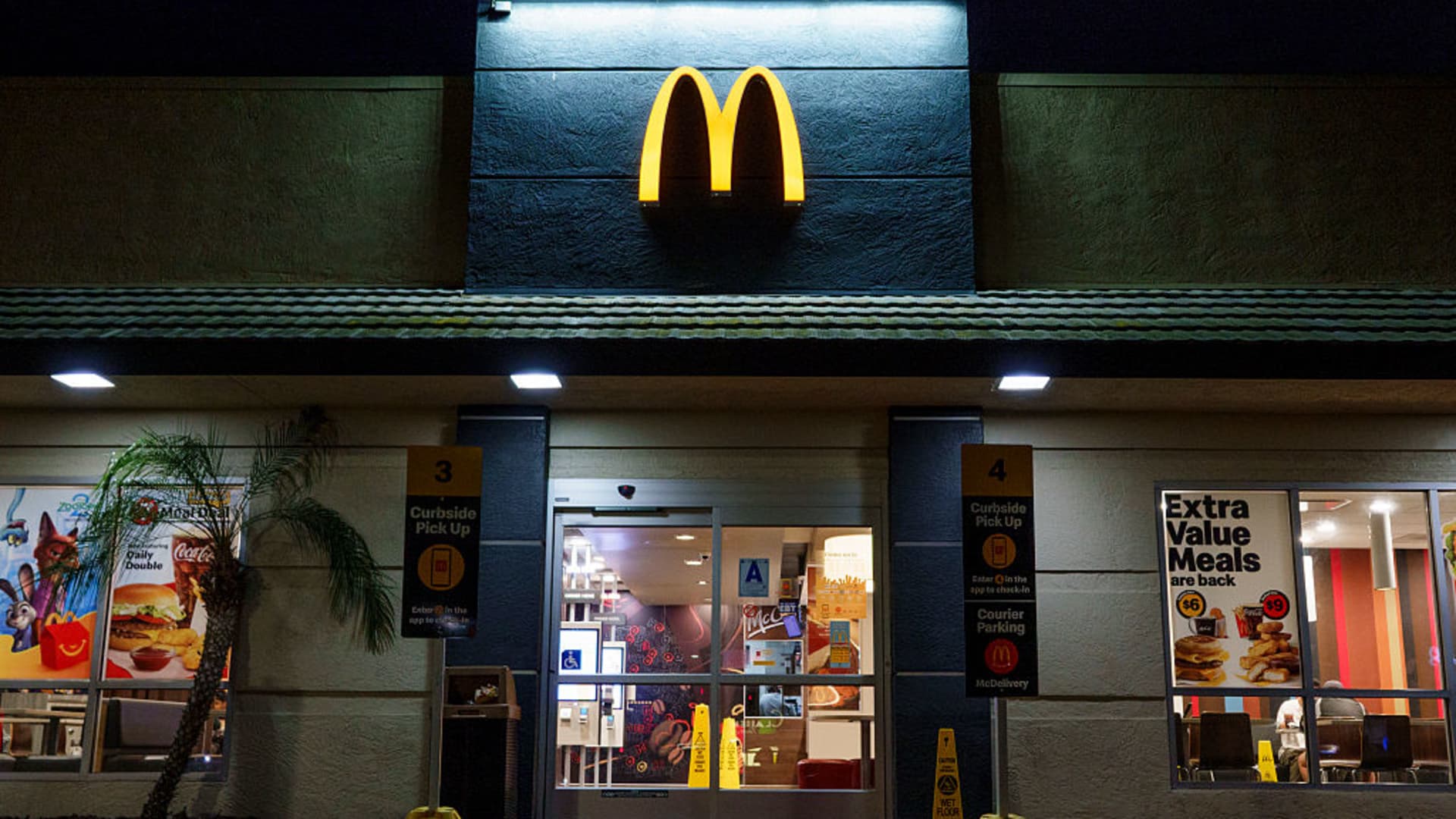
The restaurant sector has spent the past 18 months trying to figure out how to reach consumers in a hypercompetitive and uneven economy. McDonald’s, which is set to report earnings after the bell Wednesday, has doubled down on value messaging to customers via Extra Value Meals and Snack Wraps, which will likely help to boost sales this quarter.
But the focus on value has caused frustrations at times among parts of the chain’s operator base.
The company rolled out new franchise standards for McDonald’s operators on Jan. 1, including assessing locations on how their prices deliver value. McDonald’s said its owners are still able to set their own prices, but the standards nonetheless shape and define how franchisees — which operate 95% of McDonald’s restaurants — run their stores.
A cohort of operators is standing ground in their ability to independently set prices.
Advertisement
The National Owners Association, an independent franchisee advocate group, adopted a Franchisee Bill of Rights in August and circulated it in an email to members last month as the standards took effect, according to a copy of the message viewed by CNBC.
The last of the bill’s rights is the “right to set prices without fear of recourse,” which says, “Franchisees, as independent Owner/Operators, have the right to set menu prices for their restaurants based on their own business judgment and market conditions. This right exists irrespective of the pricing decisions of any national, regional, or local co-op or franchisor initiative. Franchisees must be free to manage their pricing strategy without fear of intimidation, or diminished support from McDonald’s or its affiliated entities.”
It also lists the “right to renewal and transfer,” giving owners the “absolute right to a fair and reasonable opportunity to renew franchise agreements … subject only to objective, clearly stated standards of approval.”
In December, McDonald’s told operators it would begin value assessments as part of its updates to franchising standards. Continued noncompliance could result in penalties or even termination.
Advertisement
At the time, the company said its new standards would provide “greater clarity … to ensure every restaurant delivers consistent, reliable value across the full customer experience,” according to a memo reviewed by CNBC.
In a statement, McDonald’s told CNBC that the business model creates the opportunity for entrepreneurs to be in business “for themselves, but never by themselves,” adding, “As franchisor, we have a responsibility to protect the strength and integrity of the brand and ensure every Owner/Operator upholds the standards that make McDonald’s so successful, for the benefit of all. This includes showing up for customers with great value – a core expectation the majority of our franchisees understand and proudly deliver.”
Some operators bristled at the changes in recent Wall Street research. In a two-part survey of 20 McDonald’s operators released last month, Kalinowski Equity Research wrote that it asked franchisee contacts if they were in favor of the changes to national franchising standards. For context, McDonald’s said it has some 2,000 owner/operators in the U.S. franchise system.
“As it turns out, every single one of the franchisees who responded to this question said ‘No.’ This is the first time in the 20+ year history of our McDonald’s Franchisee Survey that all respondents to a Yes-or-No question have all provided the exact same answer,” Kalinowski wrote.
Advertisement
Kalinowski also had operators quantify their relationship with McDonald’s corporate arm on a scale of 1 to 5, with 1 being poor and 5 being excellent. The average response received was 1.37, a “pretty noticeable step down from the October 2025 average response of 1.71,” the survey said.
Still, McDonald’s stock was one of the better performers in an abysmal year for the restaurant sector in 2025, rising 5%.
Kalinowski’s respondents also rated their business outlook for the next six months on a scale of 1 to 5, with 1 being poor and 5, excellent. The average response was 2.58, the best in the 11 quarters. Last quarter, CEO Chris Kempczinski said full-year cash flow was set to be solid for operators at the same time value investments were being made.
Advertisement
“Throughout the quarter, McDonald’s seems to be doing a better general job of promoting value to quick-service consumers, or at least it’s doing so notably better than some other large, quick-service burger concepts are,” Kalinowski wrote.
Likewise, fellow firm BTIG recently upgraded the stock.
“We expect the change in value strategy and perception to lead to the most meaningful earnings growth for the company since 2023,” BTIG wrote.
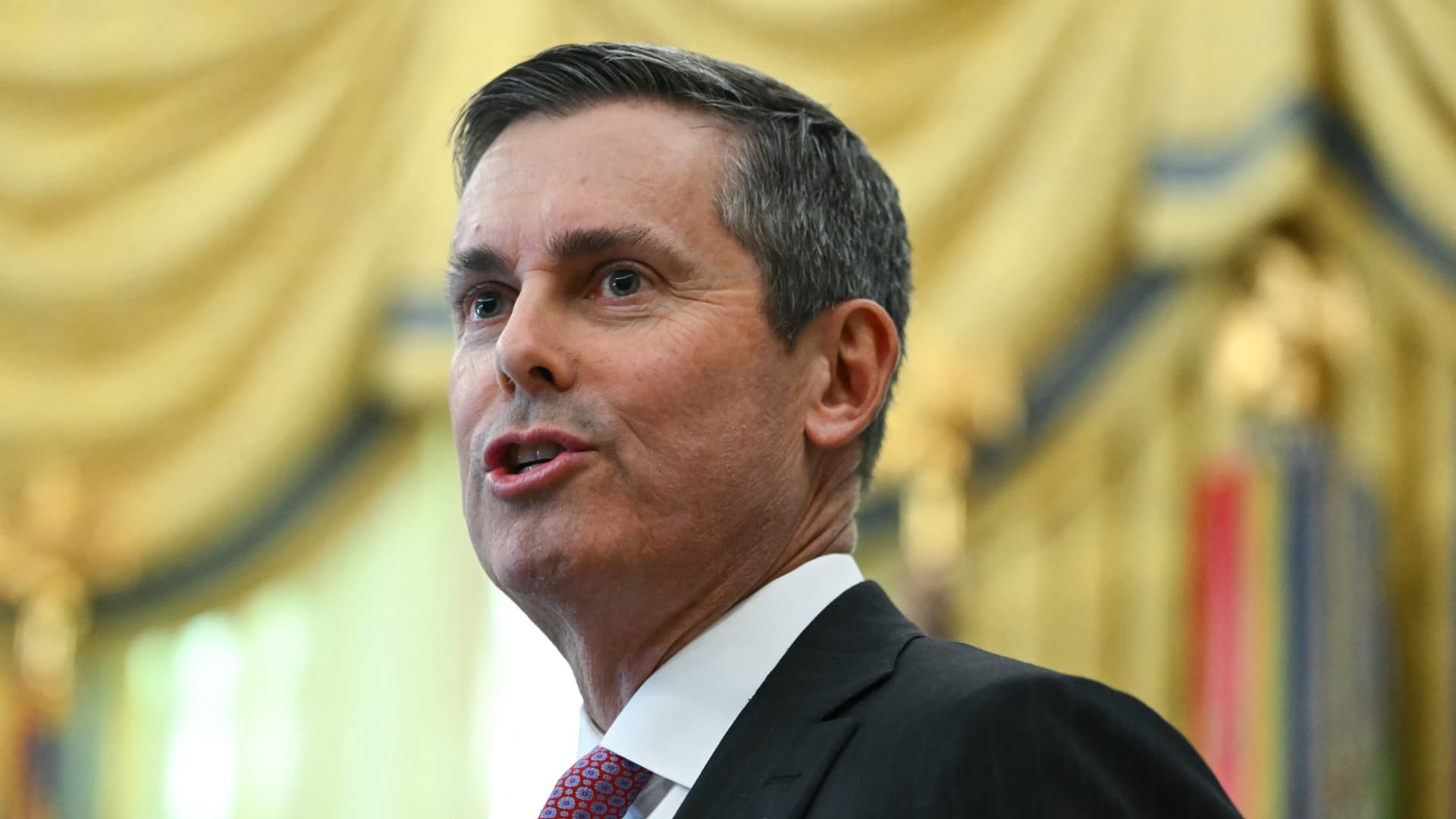
David Ricks, CEO of Eli Lilly, speaks in the Oval Office during an event about weight-loss drugs at the White House in Washington, DC on Nov. 6, 2025.
Andrew Caballero-Reynolds | AFP | Getty Images
Eli Lilly opposes the White House’s push to codify “most favored nation” drug pricing into law, CEO Dave Ricks said in an interview with CNBC.
Advertisement
Lilly is one of more than a dozen drugmakers that signed deals with the Trump administration last year agreeing to charge similar prices for prescription drugs in the U.S. as other wealthy nations. President Donald Trump has long complained that Americans pay high prices to subsidize low prices for medicine in the rest of the world.
The pharmaceutical industry thought the agreements would pacify those concerns and thwart attempts to make “most favored nation” pricing law. But the White House in recent months has pushed Congress to codify elements of the deals. The draft text hasn’t been shared publicly, though the administration has said it’s trying to get pharmaceutical companies back the effort.
Lilly doesn’t support it, Ricks said.
“When you throw it into the congressional process, what goes in is not what’s going to come out,” Ricks said. “And I think we see a lot of people who would rather reduce prices today and not worry about whether we have any new medicines tomorrow, not worry about whether America will have a robust drug industry and we’ll be able to do research in this country. And I worry about those things, so I don’t think that’s a great idea, and we’ve been pretty clear with the administration and the congressional leaders about that.”
Ricks said he thinks the Trump administration and leadership on the Hill are listening to the company’s concerns, but he said Lilly will use “all the tools we have to combat bad policy, and we think it would be bad policy.”
In a unique move to push investments into India the Japanese Foreign Ministry will create a new centre on Wednesday to assist Japanese companies looking to expand into the big market.
This Centre will assist Japanese companies to handle a variety of state-level regulations, a lack of transparency in the application of the law, and a complex tax system in India, according to persons familiar with the developments.
The new centre in the Japanese Foreign Ministry will also assist cooperation in sectors of artificial intelligence, startups and critical minerals, ET has learnt.
At the last annual Summit held in August 2025, New Delhi and Tokyo had set a goal of achieving 10 trillion yen ($62.6 billion) in private-sector investment in India over the next decade.
Japanese companies have been relatively slow in expanding into India. There were 1,434 Japanese companies here in 2024, notwithstanding the depth of political ties. In comparison as many as 6,000 Japanese companies operate in Thailand, and nearly 4,500 in Singapore, according to the Japanese Foreign Ministry.
Advertisement
Live Events
Japanese FDI in India has increased in recent years but it remains small compared to Japan’s overall total outward FDI. Japanese outward FDI to India in 2022-23 and 2023-24 stood at USD 1.79 billion and USD 3.1 billion respectively, with USD 1.36 billion in 2024-25 (Up to December 2024), according to a note by the Indian Embassy in Japan. Cumulatively, from 2000 until December 2024, the investments to India have been around US$ 43.2 billion ranking Japan fifth among source countries for FDI. Japanese FDI into India has mainly been in automobile, electrical equipment, telecommunications, chemical, financial (insurance) and pharmaceutical sectors, according to the Embassy. In 2024, over 60% of Japanese companies in India reported an increase in market share for their main products and services, among the highest in Southwest AsiaSurveys by the Japan Bank for International Cooperation show that Japanese manufacturers have viewed India as the most promising overseas location for four straight years. But the number of companies actually operating there has not grown, with many pointing to a business environment filled with issues difficult for businesses to address on their own, according to a report in Nikkei Asia published on Tuesday.
The Japanese Foreign Ministry is prioritizing economic cooperation with India for two main reasons. “First, India has the world’s largest population and maintains a high economic growth rate, meaning that it has significant potential as a market. Some forecasts suggest that India’s nominal gross domestic product could surpass Japan’s as early as 2026, making India the world’s fourth-largest economy, according to the Nikkei Asia report.
India’s strategic importance is Japan’s second reason for prioritizing cooperation. The two countries share core values, such as democracy and the rule of law and are part of Quad, the Nikkei Asia report mentioned.
The delivery firm said it aims to help smaller businesses provide faster deliveries with the new centre
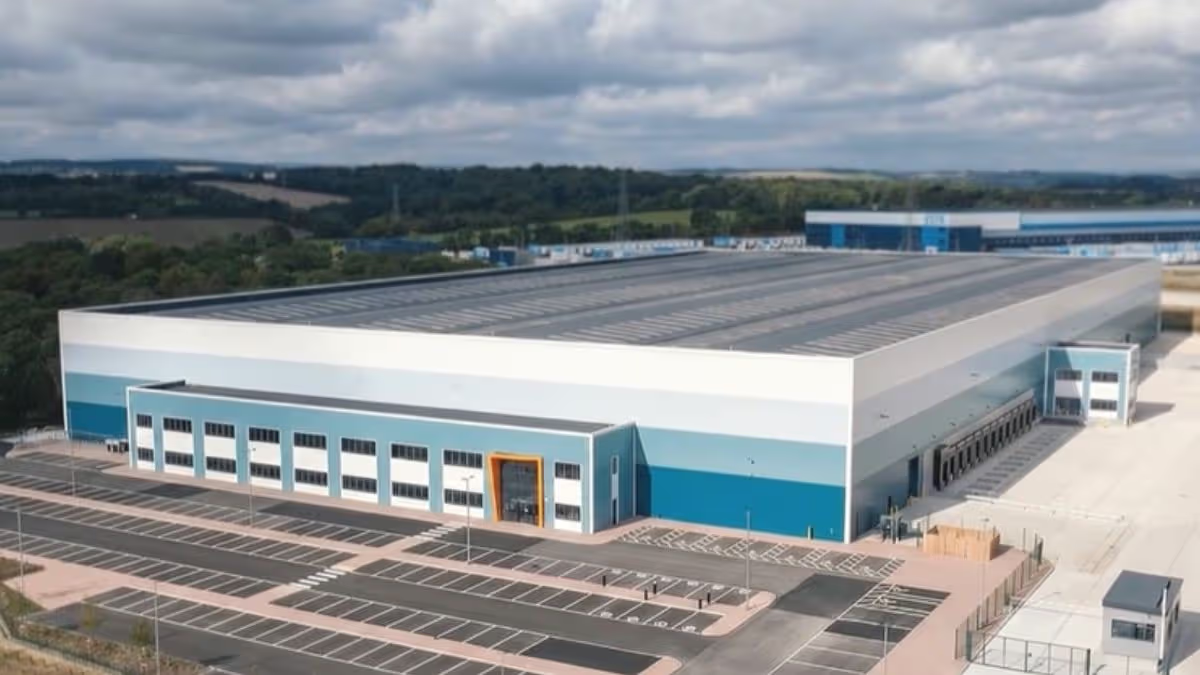
New Evri site at Barnsley(Image: Evri)
Delivery company Evri has launched a new fulfilment centre in Yorkshire which will create 150 new jobs. The centre at Barnsley has come after a £4m investment from Evri.
The new facility, which is located less than 100 metres from Evri’s existing Barnsley hub, will speed up deliveries. The new site has a 11.59pm order cut-off time for next-day delivery, which Evri says will allow thousands of small and medium-sized businesses to get their goods to their customers as fast as bigger brands.
The facility also provides same-day dispatch, seven days a week, as well as support for Amazon Prime distribution. Evri said the launch of the centre builds on the momentum of Barnsley being named the UK’s first ‘tech town’.
David Saenz, chief commercial officer at Evri Group, said: “The launch of this purpose-built fulfilment facility, designed to meet the needs of the shopper of today and tomorrow, will bring exciting opportunities to some of the UK’s most loved brands as well as our country’s deep reservoir of small and medium-sized companies.
Advertisement
“We’ve paired cutting-edge fulfilment technology with a direct connection to the Evri Group’s well-established and fast-growing domestic and international networks, meaning whatever the business need, we have a solution.”
Amy Wilshere of sports nutrition and energy drink brand company Furocity, said: “Evri has been an ideal partner to support our growth, and we’re thrilled about the new Barnsley fulfilment hub. The ability to order at midnight, have the package in their network within an hour and be delivered the next day will be amazing for our customers.”
Barrier Group and Cullum Detuners have sealed contracts for the NZT Power project
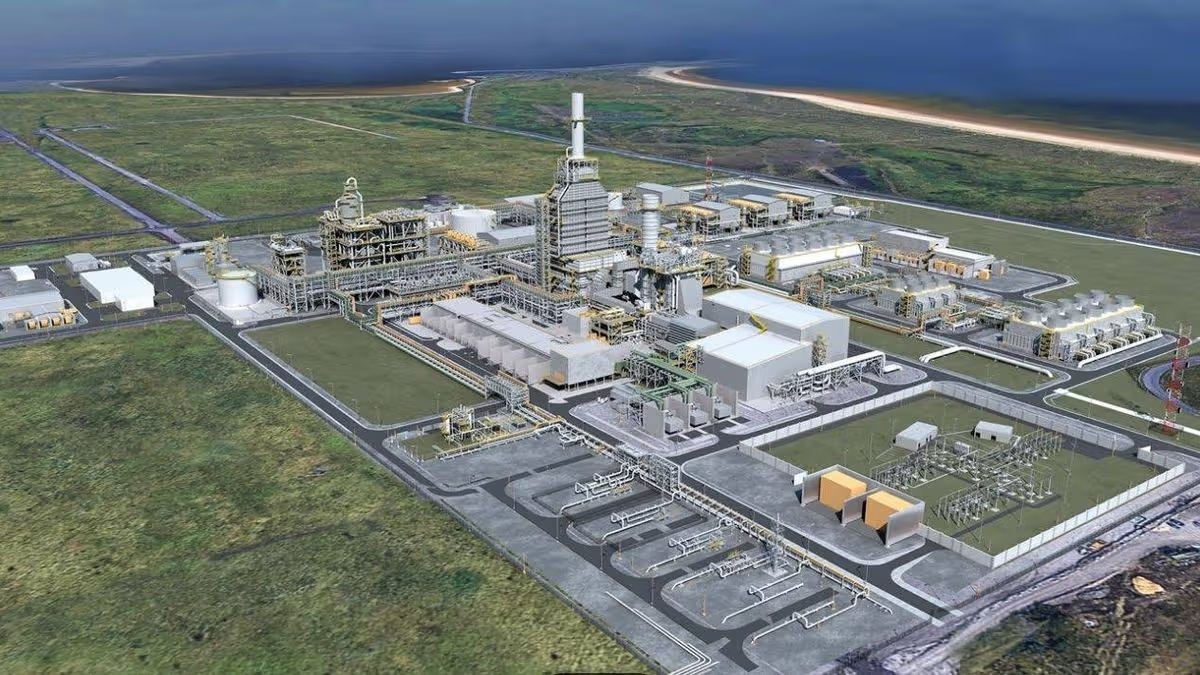
A CGI of the NZT Power Station(Image: Barrier Group)
Two North East companies are set to play key roles in one of the UK’s most significant low-carbon infrastructure projects. Wallsend, North Tyneside-based Barrier Group and Stockton’s Cullum Detuners have secured contracts for the NZT Power project, which is on course to become the world’s first commercial-scale gas-fired power station equipped with carbon capture technology.
The NZT Power project is anticipated to generate and sustain more than 3,000 jobs throughout the construction phase, delivering long-term economic advantages for Teesside while bolstering the UK’s low-carbon energy infrastructure. Once operational, NZT Power will have the capacity to produce up to 742 megawatts of low-carbon power, equivalent to the annual electricity needs of more than one million UK homes.
Up to two million tonnes of CO2 annually will be captured from NZT Power before being transported and stored via the Northern Endurance Partnership (NEP) infrastructure – the UK’s first CO2 transportation and storage infrastructure project. The project is being delivered by a consortium led by Technip Energies with GE Vernova, alongside construction partner Balfour Beatty. Under the terms of the contract, Barrier will oversee the design, engineering and supply of heating, ventilation and air conditioning (HVAC) systems for the new power station turbine hall. Barrier Group secured the deal from energy giant Technip Energies in a transaction that highlights the strength of the region’s industrial supply chain, as well as its expanding contribution to the nation’s net zero goals.
Barrier’s work is being carried out from its North East operations, with its HVAC engineering team, based at the Haverton Hill facility in Teesside, spearheading the engineering phase of the project. The contract encompasses the design and engineering of the hall’s HVAC systems, procurement of specialist equipment and materials, and project management of the package throughout the engineering phase.
Advertisement
The turbine hall serves as the centrepiece of the combined cycle gas turbine power station, where electricity will be produced from natural gas. Barrier’s HVAC systems will ensure the correct environmental conditions are maintained within the building, supporting both the safe operation of critical equipment and a safe working environment for personnel.
Barrier is currently undertaking the engineering phase of the project, with roughly 10 personnel working directly on the contract, rising to nearly 20 in the latter stages. The award has already bolstered the firm’s headcount with five new engineering roles, strengthening its presence in the Tees Valley, reports Teesside Live.
Kevin Judson, operations director at Barrier Group, said the project marks a significant milestone in broadening its engineering services into major energy infrastructure and decarbonisation projects.
He said: “Being involved in NZT Power is a significant contract award for Barrier and aligns directly with our strategic growth plans. It reflects the strength of our engineering capability and the contribution businesses in the Tees Valley make to nationally important infrastructure projects.
Advertisement
“This contract enables continued investment in our people and yard facilities, while supporting carbon capture infrastructure that is critical to the UK’s net zero ambitions and the long-term future of heavy industry.”
Barrier’s participation in the project also underpins its longer-term aspirations to grow operations from its River Tees yard, while continuing to develop its engineering and modular construction expertise in support of large-scale industrial projects throughout the region. Meanwhile, Derbyshire-based firm Cullum Detuners Limited has been appointed by Technip Energies to procure, manufacture and install the High Specification Flue Gas Ducting for the project. The project will be overseen from Cullum’s Stockton offices, with fabrication carried out by In-Spec in Middlesbrough.
The contract will see 40 employees engaged on the project for 15 months, with the firm having created 15 new positions off the back of the deal.
Kevin McEneny, sales director at Cullum, said: “This is a landmark project for decarbonised power generation within the UK. We are proud to have been selected to deliver the project which is a testament to our truly local manufacture and delivery strategy. Final module assembly will be performed in the former British Steel Plate Mill. Our project execution strategy secures local jobs and incorporates locally sourced materials and services.”
The Ministry of Commerce is intensifying efforts to reduce the cost of living with new relief measures. These initiatives will be implemented nationwide, aiming to alleviate financial burdens for citizens. The focus is on making essential goods and services more affordable, thereby improving economic stability and enhancing quality of life across the country.
Starting April 1, 2026, the Thai Ministry of Commerce is rolling out national relief measures to stabilize the cost of living amidst energy price fluctuations. Led by Minister Suphajee Suthumpun, these initiatives focus on protecting consumer purchasing power and supporting the agricultural sector.
This initiative is a response to rising costs affecting everyday essentials, ensuring citizens can maintain their standard of living amidst economic challenges.
Consumer Support Measures
The Ministry has tightened price controls and launched large-scale discount campaigns:
Advertisement
“Thais Help Thais” Campaign: Offers discounts of 25% to 50% on over 1,000 essential products from alternative brands. These are available through major retail partners like Makro, Lotus’s, Tops, and Go Wholesale.
“Blue Flag” Project Expansion: The program is expanding to over 500 locations nationwide. Mobile units will reach remote areas to provide discounted consumer goods through August 2026.
Support for Local Eateries: The Ministry is providing raw materials (rice, oil, eggs, sugar) at cost price to “Khao Kaeng” (curry rice) vendors and small restaurants to keep meal prices affordable.
Strict Price Monitoring: The list of controlled products has increased to 71 items, with 21 now requiring prior approval for any price hikes. Violators face fines up to 140,000 baht and 7 years in prison.
Agricultural Relief
To lower production costs, the “Green Flag Plus” program has been launched:
Fertilizer Subsidies: Eligible farmers can receive up to 1,400 baht in discounts via coupons for chemical and organic fertilizers.
Direct Factory Access: In collaboration with 26 manufacturers, 10 million bags of fertilizer are being made available at factory-exit prices.
Logistics Support: The Ministry is working with Foreign Affairs to expedite shipments of raw materials (fertilizers and petrochemicals) currently delayed in the Strait of Hormuz.
Citizens can report unfair trade practices or unjustified price hikes to the Department of Internal Trade hotline at 1569 or via the Line account @mr.DIT.
These measures include subsidies on essential goods such as food staples and fuel, targeting low to middle-income earners who are most impacted by inflation. By reducing the financial burden on these necessities, the government seeks to stabilize household budgets and stimulate economic resilience across communities.
Additionally, the ministry is launching financial literacy programs to educate consumers on practical budgeting and spending strategies. By empowering individuals with knowledge, the government hopes to foster sustainable financial habits, further contributing to the nation’s economic well-being.
Indian equity indices concluded FY26 with their worst fiscal performance since FY20, with the Nifty and Sensex registering losses. The outlook for FY27 is heavily dependent on the West Asia conflict’s impact on crude oil prices and the rupee, with analysts suggesting a ceasefire could trigger a recovery.
The scale up of new technology to improve resources sector productivity needs more industry and government support, according to a mining services veteran.















































You must be logged in to post a comment Login