
Crypto World
Why AI Integration is Now Mandatory for Crypto Exchange Development?


MEXC’s AI suite, launched in August 2025, marks the advent of a new standard in cryptocurrency exchange development. The leading crypto exchange software recognized that legacy crypto exchanges aren’t losing users because they’re slow, but because they’re not innovating.
It’s a 2019-era assumption that traders will stay if you offer enough trading pairs, decent liquidity, and a clean UI.
A crypto exchange software in 2026 that merely executes orders is no longer enough. Markets move in milliseconds, narratives shift in minutes, and information spreads faster than human reaction time.
Traders are left drowning in data, juggling between charts, indicators, on-chain dashboards, social feeds, whale trackers, and news alerts. Since trading decisions require them to integrate several tools across different platforms, exchanges just become a trading engine, which is easy to replace.
At a higher level, Institutional investors own an AI-powered trading infrastructure that detects patterns in seconds, analyzes indicators, and executes positions. Retail traders don’t have access to such tools, which is why they struggle to compete in markets. By integrating AI-tools inspired by MEXC, cryptocurrency exchange software can enable average users to access institutional-grade analysis, leveling the playing field for retail traders and institutional desks.
Why AI is no longer optional in Crypto Exchange Development?
For years, AI in crypto exchange was treated as a cosmetic upgrade. Crypto exchanges experimented with basic bots, basic alerts, surface-level analytics, and labelled them intelligent. The phase is now over. What changed isn’t the technology alone but the market and trader behavior as well.
Modern crypto markets are events and narrative-driven and reflexive. Prices react not just to order flow, but to tweets, governance proposals, whale movements, ETF speculations, regulatory headlines, and memecoin virality. When the retail reaction time cannot scale to this velocity, it is not the traders’ constraint but a trading infrastructure limitation.
AI embedded at the cryptocurrency exchange development infrastructure level can transform trading platforms from a passive execution venue to an active intelligence layer. And this shift addresses four structural weaknesses that traditional exchange systems cannot solve on their own.
1. Information Latency
Markets often react to new developments before most traders have had time to interpret them. By the time someone finishes reading the headline, the price adjustment may already be in progress or nearly complete.
AI-powered cryptocurrency exchange software can potentially reduce this lag by building agents that:
-
- Continuously scan multi-source inputs (news feeds, social streams, wallet flows, macro signals)
- Classify relevance in real time
- Rank signals based on the probability of market impact
By doing this, they can list top trading pairs, high-potential-tokens and best trading strategies in real time. This does not replace traders but compresses the delay between signal emergence and signal recognition.
2. Cognitive Overload
Data abundance has become counterproductive. As stated above, traders juggle charts, on-chain dashboards, sentiment trackers, and news feeds across multiple platforms. Scattered data slows decisions and increases error rates.
Smart AI integrations in crypto exchange development address this by:
-
- Filtering low-signal noise
- Correlating sentiment, capital flow, and price structure
- Presenting contextualized insight instead of raw feeds
This way, AI-powered news boards or chat assistants present real-time structured interpretations before the traders, who are just one click away from executing a trade.
3. Non-Linear Market Risk
Crypto volatility rarely unfolds in straight lines. Liquidation cascades, sentiment reversals, and liquidity shocks amplify themselves. Static thresholds and rule-based triggers often struggle in these environments.
Strategically crafted and integrated AI models in crypto exchange software, by contrast, adapt dynamically:
-
- Recognizing pattern shifts across regimes
- Updating probability distributions as conditions change
- Anticipating stress conditions rather than reacting after breakdown
Such models can be leveraged to create smart trading assistants for traders and intelligent risk management and security mechanisms for cryptocurrency exchange software.
4. Retention in a Low-Switching-Cost Environment
Crypto users face almost zero friction when switching platforms. Most platforms today have brief onboarding cycles and no custodial lock-ins. Funds move instantly. APIs connect everywhere. Liquidity is increasingly multi-platform.
In this environment, execution quality alone is insufficient for differentiation as a crypto exchange software. Traders increasingly prefer platforms that assist decision-making by surfacing opportunities, contextualizing risk, and shortening analysis time.
AI-powered trading integration in cryptocurrency exchange development addresses this retention problem by embedding decision-support into the trading experience itself. When an exchange:
-
- Surfaces relevant opportunities in real time
- Contextualizes price movements automatically
- Flags risk before exposure escalates
It reduces the trader’s dependency on external tools, slashing the chances of crypto exchange software abandonment.
What Role Does AI Play in Modern Crypto Exchange Infrastructure?
AI in cryptocurrency exchange development isn’t about adding more indicators or prettier dashboards, but giving your exchange a brain of its own. It compresses the chaos into clarity by detecting signals before they appear and linking events, sentiment, on-chain flows, and price action into a single decision context.
Its impact spans core infrastructure, compliance logic, capital protection systems, and trader cognition layers. Let’s locate exactly where it operates inside the stack when a cryptocurrency exchange software implements MEXC-inspired AI tools integration.
| Layer | AI Role | Deployment Location |
|---|---|---|
| Execution Layer | Slippage prediction | Off-chain engine |
| Surveillance | Behavioral modeling | Backend analytics layer |
| Risk Engine | Predictive liquidation scoring | Core risk module |
| Intelligence Layer | Signal aggregation & NLP | Data processing cluster |
1. AI at the Matching Engine & Trade Execution Layer
The order matching engine is traditionally deterministic. It matches orders based on a price-time priority and predefined logic, which fails under regime shifts, liquidity shocks, and high-volatility bursts.
- AI-Augmented Adaptive Order Matching Under Volatile Conditions
AI models analyze:
-
- Real-time order book depth changes
- Liquidity imbalances
- Spread expansion velocity
Instead of blindly matching based on static rules, an AI-based order matching system can:
-
- Adjust routing logic during volatility spikes
- Detect spoof-driven depth distortions
- Optimize execution sequencing under stress
Implementing this during crypto exchange development improves order fill quality without rewriting trading fundamentals.
- Slippage Prediction & Execution Path Optimization
Rather than calculating slippage after execution, AI models estimate:
-
- Expected impact cost
- Liquidity fragmentation
- Cross-market price deviations
AI-enhanced execution engines in crypto exchange software can then:
-
- Split large orders dynamically
- Delay or accelerate routing based on impact probability
- Optimize for reduced adverse selection
This results in measurable improvement in order execution efficiency.
- Load-Aware & Volatility-Sensitive Fee Logic
Static fee tiers appear flat and irrelevant. AI/ML-based load-aware and volatility-sensitive adjust fee based on:
-
- Network congestion
- Liquidity supply elasticity
- Market stress indicators
This enables cryptocurrency exchange software to:
-
- Protect liquidity during extreme volatility
- Incentivize depth when spreads widen
- Stabilize trading conditions programmatically
Power Up Your Crypto Exchange with AI — Start Building Today
2. AI in Market Surveillance & Trade Integrity Systems
Rule-based surveillance systems rely on predefined thresholds. Manipulators evolve faster than static rules, making them irrelevant in the face of rapidly shifting markets. AI introduces behavioral modeling and real-time market surveillance systems.
- Moving Beyond Static Rule-Based Surveillance
Instead of detecting fixed patterns, AI-based models integrated in crypto exchange software development learn:
-
- Normal order flow behavior per account
- Clustered wallet activity
- Correlated spoof cycles
Anomalies are detected relative to behavioral baselines, not arbitrary thresholds.
- Behavioral Modeling for Wash Trading & Spoofing Detection
AI systems integrated inside cryptocurrency exchange software analyze:
-
- Order placement and cancellation cadence
- Volume recycling patterns
- Cross-account coordination signals
This allows crypto exchanges to identify:
-
- Synthetic liquidity inflation
- Coordinated wash rings
- Layered spoof walls designed to mislead depth perception
This enables cryptocurrency exchanges to neutralize manipulation before it distorts price formation, safeguarding both liquidity providers and platform credibility.
- Real-Time Intervention vs Post-Trade Enforcement
Traditional enforcement occurs after trades settle. Cryptocurrency exchanges review the activities later and then react. This creates distrust among the exchange users.
AI-powered reaction time intervention systems integrated in crypto exchange software enable:
-
- Pre-trade risk scoring
- Order throttling
- Temporary restrictions before damage propagates
This protects both liquidity providers and platform reputation if implemented properly.
3. AI-Powered Risk Engines & Capital Protection
Most liquidation systems in traditional crypto exchange software rely on fixed formulas:
-
- If the margin ratio falls below X → liquidate
- If maintenance margin is breached → force close
This breaks during cascading leverage events, where price drops trigger liquidations, which trigger further price drops.
AI upgrades the liquidation engine from a static trigger system to a dynamic stress model.
- Predictive Liquidation Modeling
Instead of waiting for accounts to cross a fixed threshold, AI-powered liquidation models continuously evaluate how close an account is to becoming unstable under changing market conditions.
They analyze:
-
- Volatility clustering – Is volatility accelerating in a way that increases liquidation probability?
- Position concentration – Is the trader heavily exposed to a single high-risk asset?
- Correlated leverage exposure – Are multiple leveraged positions likely to fall together?
This allows the system to:
-
- Flag accounts likely to breach the margin before they actually do
- Adjust maintenance requirements gradually instead of triggering sudden liquidation
- Issue early warnings when risk probability spikes
The practical impact is fewer sudden liquidations and reduced cascade amplification during stress events.
- Volatility-Aware Leverage & Margin Controls
In traditional crypto exchange software margin systems, leverage limits are static. A trader can use 20× leverage regardless of whether volatility is low or exploding.
AI allows the leverage policy to adapt in real time based on:
-
- Current volatility regime
- Liquidity depth stability
- Funding rate stress signals
For example:
-
- During extreme volatility, allowable leverage can automatically compress
- During stable conditions, it can expand
This prevents systemic overexposure without halting trading activity. The cryptocurrency exchange software remains operational, but risk intensity is regulated dynamically.
- AI-Driven Account Health Scoring
A single margin ratio does not reflect real risk.
AI systems compute a composite risk profile that includes:
-
- Asset correlation across open positions
- Cross-market contagion risk
- Liquidity fragility of held assets
- Probability-weighted drawdown scenarios
Instead of treating accounts as either “safe” or “liquidate,” an AI-enhanced cryptocurrency exchange evaluates risk as a probability curve.
That matters because risk is rarely binary. It builds progressively. AI makes that progression measurable.
4. AI-Powered Market Intelligence & Trader Decision Systems
Execution intelligence optimizes how trades are processed. Market intelligence determines which trades get placed in the first place.
This layer sits above the core exchange engine and functions as a decision-compression system. Its role is not to automate trading, but to reduce signal discovery time, contextualize volatility, and quantify probability in environments where information arrives faster than humans can process it.
The problem it solves is not execution but decision latency and fragmented signal interpretation.
A. AI Signal Aggregation & Asset Opportunity Discovery
Traders today monitor dozens of inputs:
-
- On-chain token inflows/outflows
- Social velocity shifts
- Funding rate anomalies
- Derivatives open interest spikes
- Liquidity migration across pairs
Individually, none of these guarantees opportunity. The edge appears when they converge.
AI systems built inside crypto exchange development can:
- Continuously ingest multi-source market data
- Normalize heterogeneous signals (on-chain, sentiment, derivatives)
- Detect confluence clusters where multiple early indicators align
Instead of ranking tokens by volume or price change, the system ranks them by:
-
- Attention acceleration
- Capital rotation probability
- Early-stage momentum asymmetry
This changes asset discovery from reactive scanning to probabilistic opportunity surfacing.
The impact: traders identify rotation before it becomes obvious on the 4H chart.
B. Real-Time Event Intelligence & News Reaction Systems
Modern market catalysts originate outside the order book:
-
- Regulatory statements
- ETF developments
- Whale wallet activity
- Protocol upgrades
- Narrative shifts
Traditional cryptocurrency exchange software display price after impact where AI-integrated exchanges perform:
-
- NLP-based classification of incoming events
- Historical pattern comparison against similar past catalysts
- Real-time impact scoring based on liquidity conditions
When a signal crosses defined probability thresholds, the system:
-
- Flags the event
- Quantifies potential impact range
- Links context directly to trade interfaces
This reduces the informational advantage gap between institutions and retail participants.
C. Conversational AI for Market Reasoning & Trade Context
Markets are multi-variable systems. Traders often ask layered questions:
- “Why is this token outperforming the sector?”
- “How does this macro event affect L2 assets?”
- “Is this funding spike sustainable?”
Instead of manually correlating data across dashboards, conversational AI:
- Maps natural language queries to structured market datasets
- Performs cross-asset inference
- Produces explainable, data-backed summaries
This accelerates structured reasoning without replacing strategy. The analysis cycles are reduced from minutes to seconds.
D. AI-Augmented Charting & Contextual Market Visualization
Charts traditionally show price. Traders must overlay context manually.
AI-enhanced visualization integrates:
- Event annotations tied to precise time intervals
- Whale transaction overlays
- Sentiment inflection markers
- Pattern probability projections
More importantly, models can assign confidence intervals to detected formations rather than labeling patterns categorically.
Instead of:
“Head and shoulders detected.”
The system communicates:
“Pattern probability: 68% under current liquidity regime.”
That difference matters. It reframes technical analysis from visual intuition to statistical inference.
Takeaway
The next generation of crypto exchange development won’t compete on who has more features. They’ll compete on who helps traders think faster, react earlier, and manage risk before the market turns hostile. That shift from execution-first crypto exchange software platforms to intelligence-driven trading environments is already underway. And exchanges that ignore it aren’t being conservative. They’re falling behind.
Cryptocurrency exchanges that integrate AI natively, on the other hand, transition from being transaction venues to becoming decision engines.
At Antier, we design crypto exchange software infrastructure with this transition in mind. Our AI-ready exchange architectures are built to integrate predictive analytics, behavioral risk modeling, and multi-source signal intelligence directly into the core trading stack, not as surface-level add-ons.
Share your requirements today!
Frequently Asked Questions
01. What is the significance of MEXC’s AI suite launched in August 2025?
MEXC’s AI suite represents a new standard in cryptocurrency exchange development, addressing the need for innovation beyond just offering trading pairs and liquidity, enabling traders to access advanced tools for better decision-making.
02. Why is AI considered essential in modern crypto exchange development?
AI is essential because it transforms trading platforms into active intelligence layers, allowing for real-time analysis and execution, which is crucial in fast-paced markets driven by events and narratives.
03. How does AI integration benefit retail traders compared to institutional investors?
AI integration provides retail traders with access to institutional-grade analysis and tools, leveling the playing field and helping them compete more effectively in markets dominated by institutional investors.


TLDR:
- Canada’s Bill C-25 bans crypto, money order, and prepaid card donations across Canada’s political system.
- Canada’s Chief Electoral Officer shifted from tighter regulation to a full ban by November 2024.
- No major federal party has ever disclosed a crypto donation in either the 2021 or 2025 elections.
- Violators face penalties up to twice the contribution’s value, plus $100,000 fines for corporations.
Crypto donations to political campaigns in Canada may soon be prohibited entirely. The federal government introduced Bill C-25, the Strong and Free Elections Act, on March 26, 2026.
The bill proposes a full ban on cryptocurrency, money order, and prepaid card donations across the political system.
This move follows years of concern from Canada’s Chief Electoral Officer about risks to electoral transparency.
A Rarely Used Channel Under Heavy Scrutiny
Canada first permitted crypto donations in 2019 under an administrative framework. That framework classified digital assets as non-monetary contributions, similar to property.
However, no major federal party has ever publicly accepted cryptocurrency donations. Neither the 2021 nor the 2025 elections recorded any disclosed crypto contributions.
Under the original framework, contributions were not eligible for tax receipts. That was a strong disincentive in a system where donors routinely claim tax credits.
Contributors of more than $200 had to be identified publicly by name and address. Only cryptocurrencies with verifiable public blockchains were permitted, excluding privacy coins like Monero and ZCash.
Despite low actual use, Canada’s Chief Electoral Officer grew increasingly concerned over time. In a June 2022 post-election report, the CEO recommended tighter regulation of crypto contributions.
By November 2024, the position had shifted from regulation to a full ban. The CEO stated that contributor identification is “fundamentally difficult,” pointing to cryptocurrency’s pseudo-anonymity as a core transparency challenge.
Bill C-25 is not the first attempt to introduce such a ban in Canada. Its predecessor, Bill C-65, contained identical provisions but died when Parliament was prorogued in January 2025.
The new bill was reintroduced to close what the CEO described as a transparency gap in the electoral financing system. It is currently at first reading in the House of Commons.
Penalties, Deadlines, and a Broader Global Trend
Bill C-25 sets clear deadlines for handling any prohibited contributions already received. Recipients have 30 days to return, destroy, or convert and remit any banned crypto contributions.
Proceeds from converted contributions must be forwarded to the Receiver General. This process covers all registered parties, candidates, and third parties engaged in election advertising.
The penalties for violations are firm and clearly outlined. Maximum administrative penalties can reach twice the value of the offending contribution.
Corporations face an additional penalty of up to $100,000. These measures are intended to discourage any attempt to bypass the ban.
Canada is not acting alone on this issue. The United Kingdom recently announced an immediate moratorium on cryptocurrency donations to political parties.
The UK cited concerns that digital assets could be used, in its own words, to “hide the origins of foreign money” in British politics. Both countries are responding to similar transparency challenges in the evolving digital finance space.
In contrast, the United States continues to permit crypto donations to political campaigns. The Federal Election Commission has offered guidance on disclosing Bitcoin and other crypto contributions since 2014.
Canada’s approach marks a clear departure from the American model. Whether other nations will follow Canada and the UK on this path remains to be seen.

TLDR:
- Tech’s valuation premium compresses to near +4%, the lowest since 2019, signaling weaker growth pricing.
- Rising rates and tighter liquidity reduce the appeal of long-duration tech assets and compress multiples.
- Market leadership is rotating as investors diversify into other sectors and alternative asset classes.
- Broader S&P 500 valuation levels are normalizing, reflecting a shift in risk appetite and positioning.
The S&P 500 Information Technology Index is undergoing a valuation reset as the premium over the broader index compresses.
The decline reflects a shift in investor expectations, driven by macroeconomic conditions and evolving market dynamics.
Valuation Compression and Macroeconomic Pressures
The S&P 500 tech forward P/E premium is near +4%. This marks the lowest level since 2019 and a sharp decline from previous highs above 30%.
The adjustment reflects a more cautious market stance. Earlier in the cycle, tech valuations were supported by low interest rates and strong earnings growth.
However, rising yields and tighter financial conditions have reduced the appeal of long-duration assets. Investors are now demanding higher returns for growth exposure.
The broader S&P 500 forward P/E has also moved closer to long-term averages. This indicates that valuation compression is not limited to technology alone.
Instead, it reflects a broader normalization across equity markets as conditions adjust.
Market Structure, Rotation, and Capital Positioning
The S&P 500 is currently trading within a consolidation range near 6,450–6,700. This range reflects a balance between bullish and bearish positioning as investors respond to macroeconomic data.
The market remains sensitive to shifts in sentiment. Technical indicators suggest short-term weakness alongside long-term stability.
The index is trading below short-term moving averages while remaining above longer-term averages. This structure supports a corrective phase rather than a full reversal.
Capital flows are adjusting in response to the S&P 500 tech valuation compression. Institutional portfolios are exploring sectors with different risk exposures as tech multiples compress.
This has contributed to increased diversification across asset classes. At the same time, alternative assets are gaining attention as part of portfolio strategies.
Bitcoin and related digital assets are being considered for their distinct drivers, including liquidity conditions and monetary trends. This reflects a broader search for diversification.
The current environment shows a transition in market leadership. While technology remains a key driver of innovation and earnings growth, its valuation profile has shifted. Investors are adapting to new pricing dynamics across the equity landscape.
Crypto World
Best Crypto Presale: Claude Mythos Leak Crashes BTC as Pepeto Exchange Draws Buyers While ADA and DOGE Slide
Euro stablecoins now command over 80% of the non USD stablecoin market with supply hitting $1.2 billion, and Visa and Mastercard have expanded settlement support across their networks. But the real story is what happens underneath that growth: every new settlement pathway that opens is another surface where dangerous contracts can intercept transactions.
Investors are trying to enter the best crypto presale before the window closes, and more than $8 million has been raised in the Pepeto presale with analysts projecting 100x as the Binance listing approaches. The exchange is live, and the final hours before listing are where the biggest returns are secured.
Best Crypto Presale: Claude Mythos Leak Crashes BTC as Pepeto Exchange Draws Buyers While ADA and DOGE Slide
Anthropic’s leaked AI model Claude Mythos crashed Bitcoin to $66,000 after internal documents revealed a model capable of rapidly exploiting software vulnerabilities according to CoinDesk. Cybersecurity stocks dropped 4 to 6% while the tech software sector fell nearly 3%. According to Investing.com, the leak heightened concerns about AI driven attacks on crypto infrastructure. The best crypto presale is the entry where verified security is already running, not a feature on a roadmap.
What Is Trending in the Presale Market and Where Real Returns Are Building
Pepeto: The Exchange That Scans Every Contract Before the Reader’s Capital Moves
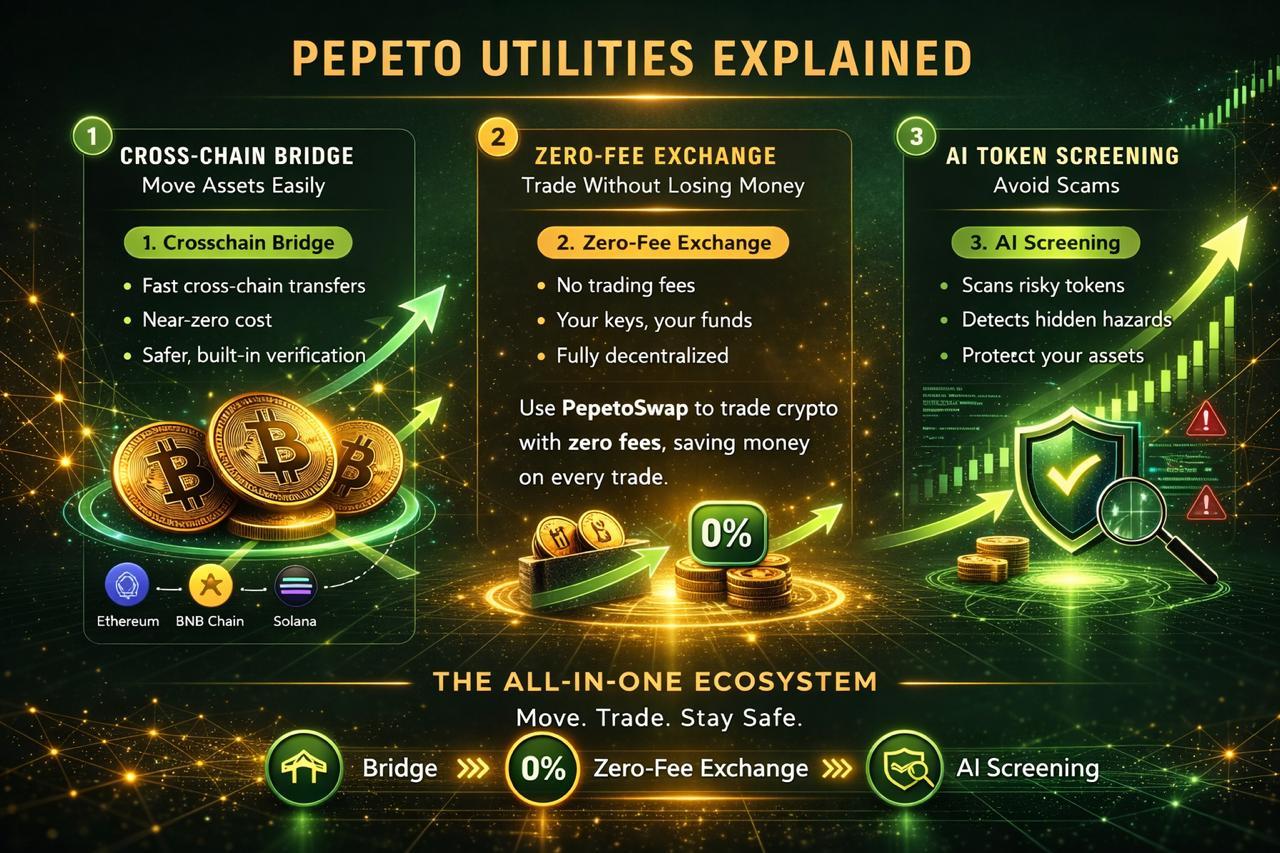
Pepeto represents the opposite end of the risk timeline from the Claude Mythos leak. Investors are deeply interested in the exchange tools it provides because they give every trader a clear edge in a market where on chain threats are growing. What exists right now is a working platform, a presale closing when the Binance listing opens, and a chance that is measured in days rather than months.
The exchange does something that becomes more valuable as stablecoin volumes grow and on chain activity increases. Every new settlement pathway that Visa and Mastercard open is another surface area where malicious contracts can intercept funds. PepetoSwap processes orders without taking any trading fee so capital stays fully intact, the cross chain connector delivers tokens between networks at zero cost, and the contract scanner confirms every project is clean before a dollar commits, confirmed by a SolidProof audit.
 The same person who took the original Pepe token from zero to $11 billion without any products constructed this exchange, and it does all this without requiring the reader to understand what is happening at the code level.
Here is what the entry looks like in numbers. Analysts project 100x from the current entry at $0.000000186, and 191% APY staking adds to every position inside while the listing window closes. The best crypto presale is the entry where verified security meets presale pricing, and once the Binance listing opens this number is gone permanently.
Cardano (ADA)
ADA trades at $0.25 per CoinMarketCap, testing multi month support as the correction drags layer 1 tokens lower.
A recovery to $0.35 delivers 40% over months, meaningful for patient holders, while the presale entry targets 100x from one listing event and the wallets entering are positioned for the returns this cycle produces.
Dogecoin (DOGE)
DOGE trades at $0.093 per CoinMarketCap, holding above key support as the meme sector waits for the next catalyst.
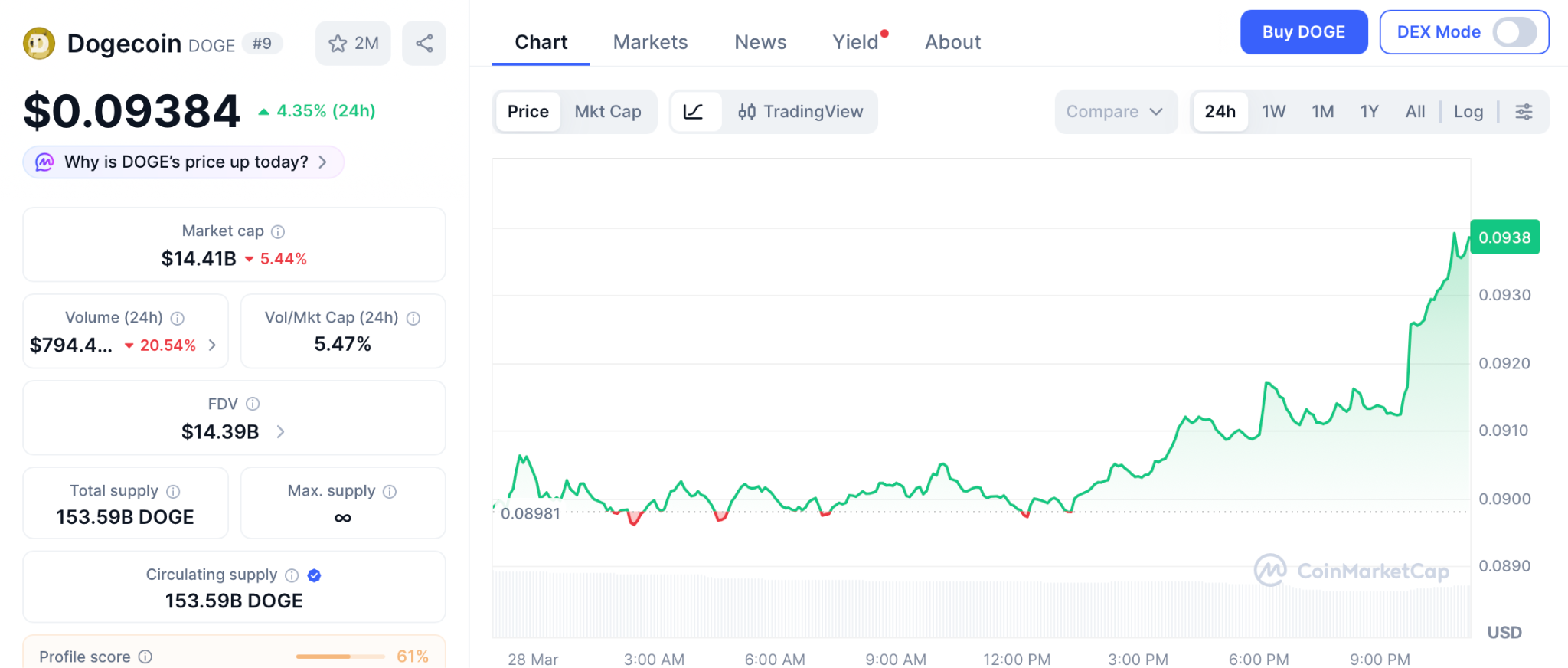
A recovery to $0.12 delivers 32% over months, respectable for meme believers, while presale entries are where the cycle defining returns are built and Pepeto offers that exact math before the Binance listing opens.
The Best Crypto Presale Is Where the Next Dogecoin Forms and the Wallets Inside See the Pattern
The Claude Mythos leak crashed BTC to $66,000, and every previous cycle proved the same thing: once Bitcoin confirms direction, the viral projects with real utility capture the overflow faster than anything else. The addresses filling the best crypto presale are not guessing.
They see the next Dogecoin forming inside Pepeto because no project in 2026 has matched this level of viral energy and no meme coin has ever carried real exchange tools into a listing. The Pepeto official website is where those wallets are entering with size, and once the listing arrives this entry disappears permanently.
Click To Visit Pepeto Website To Enter The Presale

FAQs
Why is Pepeto the best crypto presale as the Claude Mythos leak crashes BTC?
Pepeto is the best crypto presale with a verified exchange that scans every contract before capital enters, more than $8 million raised, and analysts projecting 100x.
What drives demand for the best crypto presale right now?
Real exchange utility combined with limited presale supply creates the conditions for 100x, and the Pepeto official website is where the entry is still open.
How does the best crypto presale protect capital in this market?
Pepeto’s exchange scans every contract before funds move, confirmed by a SolidProof audit, and the Binance listing targets 100x for every wallet entering now.
Disclaimer: This is a Press Release provided by a third party who is responsible for the content. Please conduct your own research before taking any action based on the content.
TLDR:
- Bitcoin failed to hold above key resistance after a retest, signaling a classic rejection pattern for BTC.
- Analyst Dami-Defi warns that rallies below the yellow line are relief bounces with the $63K zone as next target.
- Coinbase continues selling into every bounce while spot inflows from institutions remain notably absent.
- A weekly close below $68K could confirm deeper downside, with analysts eyeing the $55K to $60K range.
Bitcoin’s price action is drawing serious attention after a failed retest at a key resistance level. The rejection has shifted market sentiment toward the downside.
Analysts are now pointing to the $63,000 demand zone as the next probable target. With no confirmed breakout and weak institutional inflows, the path of least resistance appears to trend lower in the near term.
Failed Retest at Key Resistance Puts $63K in Focus
Bitcoin broke above a critical resistance level but could not sustain the move. The price returned to retest that level and was firmly rejected.
Analyst Dami-Defi flagged this as a textbook breakout attempt followed by retest and rejection. That sequence historically points toward a return into the previous trading range.
Dami-Defi described the behavior as anything but confirmed breakout price action. A legitimate breakout holds above the broken level after the retest occurs.
The failure to do so hands control back to the bears. He maintained a straightforward stance: bearish until the chart proves otherwise on closes.
With BTC trading below the yellow resistance line, rallies carry little conviction. Dami-Defi characterized any upward moves as relief bounces rather than trend reversals.
The $63,000 base, marked as a gray demand zone, now serves as the next key magnet. That area represents where buyers previously stepped in with enough force to matter.
Should that $63,000 zone fail to hold on real closes, the analyst warned of further downside. A clean break below it would shift the chart toward a deeper correction scenario.
Traders are encouraged to focus on closing prices rather than short-term wicks. The rejection at resistance remains the clearest signal guiding this outlook.
Institutional Selling and Macro Weakness Reinforce Downside Risks
Higher timeframe analysis from analyst Junar adds another layer to the bearish case. He pointed out that Bitcoin lost the critical 72,500 level on the higher timeframe chart.
That loss carries weight because it reflects a structural shift in bullish momentum. A reclaim above that level would be needed to revive any serious push toward $79,000.
Until then, Junar noted that Coinbase continues selling into every bounce. Spot inflows from institutional players remain absent at current price levels.
That dynamic limits buying pressure and keeps the market vulnerable to further slippage. Choppy price action is expected to persist over the coming weeks as a result.
A weekly close below $68,000 would serve as the next major warning for traders. Junar identified that level as separating a consolidation phase from a genuine breakdown.
Losing it on closes puts $60,000 squarely in view as the following target. He advised traders to consider building positions gradually in the $55,000 to $60,000 range.
Junar also urged market participants to tune out overly optimistic narratives currently circulating online. Swing trades carry elevated risk under these conditions, making scalping the more practical approach. Until a clear directional shift emerges, patience remains the most disciplined strategy available.
TLDR:
- Apple Gemini Siri update integrates Google Gemini, shifting Apple toward external AI models for advanced capabilities.
- Rising AI training costs make in-house model development less efficient, pushing firms toward partnerships.
- Apple retains control over UX, distribution, and privacy while relying on Google for the AI model layer.
- The move signals a broader industry trend where foundation models become concentrated among a few providers.
Apple Gemini Siri update signals a shift in Apple Inc.’s approach to artificial intelligence as it integrates Google’s Gemini into its voice assistant.
This move reflects changing economics in AI development and a broader industry shift toward shared model infrastructure.
Apple Gemini Siri Update and AI Economics
Apple’s update is shaped by the rising cost of training frontier AI systems. Modern large-scale models require extensive computing resources, proprietary datasets, and continuous retraining cycles.
These demands have made independent model development less cost-efficient, even for large firms.
Reports indicate Apple will license Google’s Gemini model, which is described as a 1.2 trillion-parameter system. The arrangement is expected to cost around $1 billion annually.
This approach allows Apple to access advanced capabilities without committing to full-scale model training infrastructure.
The updated Siri, expected in iOS 26.4, will handle complex tasks such as summarization, planning, and contextual responses. It will also include on-screen awareness, allowing interaction across apps.
A post shared in tech discussions noted, “AI now sits between the user and the system, not just as a feature.”
Apple is positioning this as a transitional approach. While using external models for immediate performance, it continues to invest in internal AI development.
This dual strategy allows Apple to remain competitive while managing costs and development timelines.
Ecosystem Control and Strategic Positioning
Gemini Siri update also highlights Apple’s focus on ecosystem control. The company retains authority over hardware, operating system, and user interface, while outsourcing the model layer.
This ensures that the user experience remains tightly integrated within Apple’s ecosystem. The system will run through Apple’s Private Cloud Compute infrastructure, which supports its privacy framework.
This approach allows Apple to maintain its emphasis on data protection while still leveraging advanced external AI capabilities.
Apple continues to focus on distribution strength, with over a billion active devices worldwide. By integrating Gemini into Siri, Apple ensures that AI becomes a native part of the user interface rather than a separate tool.
A widely circulated comment summarized the shift: “The interface layer now defines the AI experience more than the model itself.”
This reflects Apple’s positioning strategy, where control of user interaction takes priority over ownership of the underlying model.
At the same time, Apple’s reliance on Google introduces a degree of dependency. This could influence future development timelines and feature evolution.
However, Apple’s internal AI work suggests that this partnership is not permanent, but rather part of a staged transition.
Apple Gemini Siri update, therefore, represents a measured shift in strategy, balancing external partnerships with long-term internal development goals.
TLDR:
- Satoshi Nakamoto holds 1.096 million BTC worth $77B, making him the largest Bitcoin holder globally.
- Coinbase controls 5% of Bitcoin’s total supply, leading all exchanges with 982,000 BTC in holdings.
- The U.S. Government holds 328,000 BTC seized from Bitfinex, Silk Road, and the LuBian Hacker address.
- Strategy holds 738,000 BTC total, making it the largest public company Bitcoin holder as of 2026.
Bitcoin ownership remains concentrated among a select group of entities as of 2026. On-chain data from Arkham Intelligence reveals that Satoshi Nakamoto holds the largest known share.
Exchanges, ETF issuers, and governments follow closely behind. Public companies like Strategy have also accumulated substantial reserves over the past few years.
The data provides a clear picture of where the world’s most valuable digital asset resides today, and who holds the most of it.
Satoshi Nakamoto Leads All Bitcoin Holders Worldwide
Satoshi Nakamoto, the pseudonymous creator of Bitcoin, remains the single largest known holder. Arkham’s research attributes 1.096 million BTC to Satoshi, worth approximately $77 billion. This figure rests on a known mining pattern called the Patoshi Pattern.
Arkham’s data links these holdings to around 22,000 blocks that Satoshi mined in the network’s early days. The identified addresses include the only known wallets from which Satoshi ever spent BTC. No movement has been recorded from most of these wallets in years.
Among individual wallet addresses, a Binance cold wallet holds the most BTC. That single address contains nearly 250,000 BTC, worth around $17 billion. It ranks as the largest single-address Bitcoin wallet currently on record.
Exchanges and ETF Issuers Command Billions in Holdings
Coinbase is the largest exchange entity by BTC holdings, controlling around 982,000 BTC. That figure represents roughly 5% of Bitcoin’s total circulating supply. Binance follows with approximately 655,000 BTC, equal to 3.3% of supply.
BlackRock leads all ETF issuers with 775,000 BTC held under its spot Bitcoin ETF. Fidelity Custody holds 460,000 BTC, while Grayscale, Bitwise, and ARK Invest also maintain on-chain positions. Arkham first identified these ETF holdings on-chain after the products launched in the U.S. in January 2024.
Grayscale’s Bitcoin holdings are spread across more than 1,750 separate addresses. Each address holds no more than 1,000 BTC. All assets are custodied through Coinbase.
Governments Hold Bitcoin Largely Through Criminal Asset Seizures
The United States Government holds 328,000 BTC, making it the top government holder by a wide margin. These holdings come from seizures tied to the Bitfinex hack, Silk Road, and the LuBian Hacker address. The FBI manages these wallets on behalf of the federal government.
The United Kingdom holds 61,245 BTC, seized from Jian Wen and Zhimin Qian in 2018. El Salvador holds 7,500 BTC, accumulated through daily purchases and a legal tender policy. Bhutan holds 5,400 BTC, mined through its sovereign wealth fund using hydroelectric power.
Unlike seizure-based holdings, El Salvador and Bhutan acquired Bitcoin through active national strategies. El Salvador adopted it as legal tender and bought 1 BTC daily under President Bukele’s directive. Bhutan partnered with Bitdeer to expand mining operations backed by cheap hydroelectric energy.
Public and Private Companies Continue Accumulating BTC Reserves
Strategy, formerly MicroStrategy, holds more Bitcoin than any other public company. Its total holdings stand at 738,000 BTC, though on-chain data confirms 443,000 BTC directly. The company has been buying consistently since August 2020.
MARA, a publicly traded mining company, reports a treasury stockpile of 53,200 BTC. Metaplanet, listed in Tokyo, holds 35,100 BTC as a hedge against yen depreciation. Both companies closely mirror Strategy’s long-term accumulation approach.
Among private companies, Tether holds 96,300 BTC verified on-chain. SpaceX holds 8,300 BTC, down from a peak of 28,000 BTC in 2021. Block.one claims 164,000 BTC, though those holdings remain unverified through on-chain data.
TLDR:
- HyperCore repurchased 34,495.71 HYPE at $38.51 on March 27, exceeding daily staking distributions.
- A net 7,711 HYPE were permanently removed from circulation, projecting to 2.77M tokens yearly.
- Unlike Solana’s 25.19M annual inflation, Hyperliquid is actively reducing its total token supply.
- Higher HIP-3 adoption drives more revenue, fueling larger buybacks and compounding deflation pressure.
Hyperliquid recorded net deflation on March 27, 2026, as HyperCore repurchased more HYPE tokens than it distributed.
The buyback totaled 34,495.71 HYPE at an average price of $38.51. Against 26,784 HYPE paid out to stakers and validators, the net removal stood at 7,711 tokens.
This marks a notable shift in how the protocol manages its circulating supply.
Buyback Activity Drives Daily Supply Reduction
On March 27, HyperCore’s repurchase program pulled 34,495.71 HYPE from circulation. The distribution of 26,784 HYPE went to stakers and 24 active validators on the same day. After accounting for both figures, 7,711 HYPE were permanently removed from supply.
At this pace, the monthly net reduction reaches approximately 231,330 HYPE. Annually, that projects to nearly 2,775,960 HYPE taken out of circulation. These numbers reflect a consistent deflationary trend rather than a one-time event.
According to Hyperliquid Hub, the buyback mechanism also responds to price movement. When HYPE trades higher, fewer tokens are repurchased per dollar spent. When prices fall, the protocol buys back more aggressively, which naturally manages supply pressure.
Protocol Revenue Feeds a Self-Reinforcing Cycle
The deflation model ties directly to trading activity on the network. More adoption of HIP-3 leads to higher trading volumes across the platform. That activity generates greater protocol revenue, which then funds larger buyback operations.
As Hyperliquid Hub noted, this creates a flywheel: “More HIP-3 adoption → higher trading activity → more protocol revenue → larger buybacks.”
Each component reinforces the next without requiring external intervention. The system is built to scale its deflationary pressure alongside usage.
For context, Solana issues roughly 25.19 million SOL annually through its staking and validator reward structure. Hyperliquid, by contrast, is removing more tokens than it issues on a daily basis. The two networks represent opposite ends of the supply management spectrum.
The price-sensitive nature of the buyback adds another layer of stability to the model. It functions as a built-in counter to extreme market swings in either direction. Over time, this structure may reduce volatility tied to supply-side selling pressure.
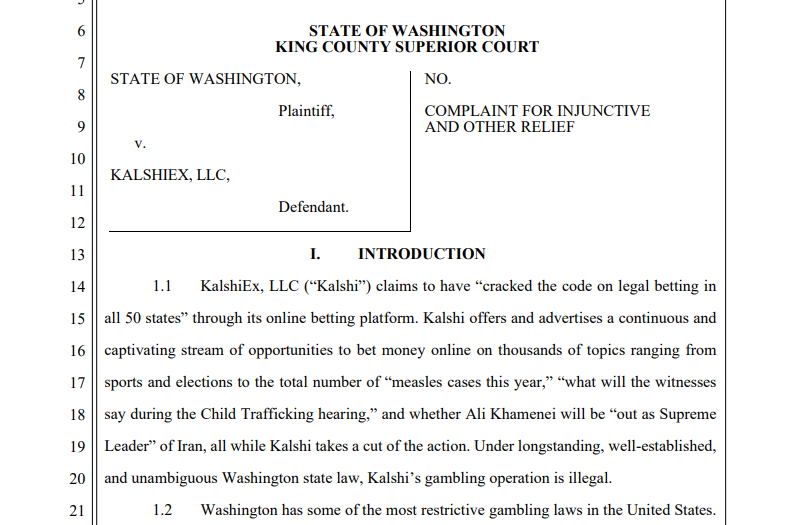
Kalshi is facing another state-level lawsuit after the state of Washington on Friday filed allegations that the prediction market operator violated state gambling laws with its products.
The Washington Attorney General’s complaint cites the Pacific Northwest state’s existing ban on online gambling and otherwise strict oversight of the gaming market, in claiming Kalshi violated the Washington Consumer Protection Act, Gambling Act, and Recovery of Money Lost at Gambling Act.
“Kalshi’s website and app show consumers a range of events that they can bet on and the odds for those various events, which dictate how much the bettor will be paid out if the event occurs,” an announcement from Attorney General Nick Brown said. “This is exactly how sportsbooks and other gambling operations function. Kalshi advertises that they allow consumers to ‘bet on anything’ by simply calling their service a ‘prediction market’ rather than ‘gambling.’”
The definition of gambling under Washington law is “staking or risking something of value upon the outcome of a contest of chance or a future contingent event,” and Kalshi’s activities fall squarely within that definition, the AG’s announcement said. “Each Kalshi bet risks money, relies in part on chance, and promises a payout to winners.”
Kalshi immediately sought to move the case to federal court, saying in its filing that the issues raised by the Washington suit are already being litigated in other federal courts and that there had been “no warning or dialogue” from Washington state prior to the lawsuit.
Related: SEC interpretation on crypto laws ‘a beginning, not an end,‘ says Atkins

State AGs and gaming regulators mount legal fights across the country
A Nevada judge earlier this month temporarily blocked Kalshi from operating in the state, finding that state authorities are reasonably likely to prevail in a legal fight over whether the company’s event contracts violate Nevada gambling laws.
Carson City District Court Judge Jason Woodbury issued a temporary restraining order on Friday, siding with a Nevada Gaming Control Board motion to block Kalshi from operating in the state for 14 days.
Kalshi had argued that its contracts are under the exclusive jurisdiction of the US Commodity Futures Trading Commission, an agency that has backed prediction markets that are fighting in multiple state courts over accusations of offering illegal gambling.
Days earlier, Arizona Attorney General Kris Mayes announced charges against the companies behind Kalshi, alleging that the company operated an “illegal gambling business in Arizona without a license” and offered illegal election wagering.
While Kalshi faces several similar cases filed by gaming authorities in other US states over the platform allegedly offering sports gambling to residents without a license, Arizona was one of the first to file criminal charges.
The state-level cases come as prediction markets are under scrutiny by lawmakers for offering bets on US military actions, citing concerns about insider information in the government.
Magazine: Nobody knows if quantum secure cryptography will even work
TLDR:
- Russia’s ban on gasoline export will begin on April 1 and continue until July 31 so as to secure domestic fuel supply stability.
- The decision follows global oil disruptions linked to Middle East tensions and Strait of Hormuz shipping pressures.
- Authorities confirm stable refinery output and sufficient reserves to meet domestic gasoline and diesel demand.
- Export restriction aims to reduce exposure to global price swings and maintain predictable internal fuel pricing.
Russia will ban gasoline export ban beginning April 1 and will run until July 31, targeting domestic fuel price stability. Authorities confirmed the policy as a response to global energy volatility and increasing external market pressures affecting supply chains.
Policy Action Amid Global Oil Market Disruptions
The ban was announced following a government meeting led by Deputy Prime Minister Alexander Novak. The measure focuses on safeguarding domestic fuel availability during periods of global uncertainty.
Authorities stated that the decision supports internal price stability. Global oil markets have faced disruptions due to tensions involving Iran and neighboring regions.
Military activity has contributed to supply uncertainty, while retaliatory strikes have affected infrastructure. These developments have increased pressure on global energy flows.
Shipping routes, including the Strait of Hormuz, have also experienced disruptions. This route carries a significant share of global oil shipments daily.
Any interference raises transport costs and limits predictable supply movement across markets. “Energy exporters are prioritizing domestic stability as geopolitical risks reshape global trade flows.”
This aligns with the broader trend of nations adjusting export policies in response to external shocks.
Domestic Supply Strength and Market Response
Despite the export restrictions, Russia maintains stable refinery output levels. Processing volumes remain comparable to those recorded in the previous year.
This supports a consistent fuel supply within the domestic market. Energy officials confirmed that gasoline and diesel reserves remain sufficient.
High refinery utilization rates ensure steady production and distribution. These factors help meet internal demand without immediate supply constraints.
Russia exported about 5 million metric tons of gasoline in 2025. That equals roughly 117,000 barrels per day.
Redirecting this volume into domestic use supports the objective of price stabilization. The Russian gasoline export ban also reflects a continuation of earlier interventions.
Authorities have previously restricted fuel exports to address shortages in certain regions. These measures were introduced during periods of heightened demand and refinery pressure.
Market observers note that domestic pricing remains a key policy focus. By limiting exports, authorities aim to reduce exposure to global price volatility.
This approach allows internal markets to remain more insulated from external shocks. The policy is scheduled to remain active until July 31.
Government agencies continue monitoring refinery output, demand patterns, and global developments. Any changes will depend on how external pressures evolve and how domestic supply holds.
TLDR:
- Aave founder Stani Kulechov called Whop Treasury one of the biggest DeFi-to-fintech integrations ever built.
- Whop Treasury converts user balances to USDT0 stablecoins, routing funds through Veda Labs vaults on Plasma Network.
- Funds deposited into Aave lending markets earn autocompounded yield with no gas fees or manual management required.
- Whop’s 21 million users now access transparent, verifiable onchain financial infrastructure directly through the platform.
Whop Treasury has drawn attention from one of DeFi’s most recognized figures. Aave founder Stani Kulechov publicly praised the integration, calling it a landmark moment for decentralized finance entering mainstream fintech.
Whop, a marketplace where creators sell digital products and community access, now routes user balances through onchain infrastructure to generate yield automatically.
With 21 million users and over $1 billion in creator sales last year, the platform’s move carries considerable weight in both crypto and commerce circles.
Why Kulechov Views Whop Treasury as a Turning Point
Stani Kulechov described Whop Treasury as “one of the biggest DeFi-to-fintech integrations ever.” His praise centers on how the system connects a large, active user base directly to onchain financial infrastructure.
Most fintechs still depend on traditional payment rails with high fees and multiple intermediaries. Whop chose a different path entirely.
According to Kulechov, stablecoins bypass credit card networks and banks, cutting cost margins for both the platform and its users.
That cost reduction is not just theoretical. It directly affects how competitive Whop can remain as it scales globally across digital commerce.
Kulechov also pointed to transparency as a core advantage. Unlike traditional financial systems with complex agreements and manual processes, onchain infrastructure is publicly verifiable. Users can confirm exactly where funds go and how yield is generated.
He further noted that Whop’s model serves as a blueprint for the broader fintech industry. In his view, more platforms will follow this path, but Whop broke ground first by showing how it can work at scale.
The Technical Stack Behind the Treasury Integration
Whop Treasury works through a layered onchain system. When a user opts in, their balance converts to USDT0 stablecoins provided by Tether.
Those funds then move through a Veda Labs vault operating on the Plasma network, a blockchain purpose-built for stablecoin transactions.
From there, capital flows into Aave lending markets, where it earns yield automatically. The autocompounding feature continuously redeploys returns without requiring users to pay gas fees or manage any positions manually. Card and crypto deposits are processed through MoonPay, keeping the entry point accessible.
Each layer of the stack has a defined role. USDT0 handles stablecoin conversion, Plasma manages low-cost transfers, Veda directs capital allocation, and Aave generates the actual yield. Together, they form a system that runs without intermediaries or manual oversight.
Kulechov described this as a masterclass in building an institutional-grade earn stack. The combination removes black boxes from the equation and gives users access to programmable financial tools that are global from day one.
For a platform with Whop’s reach, that infrastructure shift is more than a product update. It is a signal of where digital commerce finance is heading.
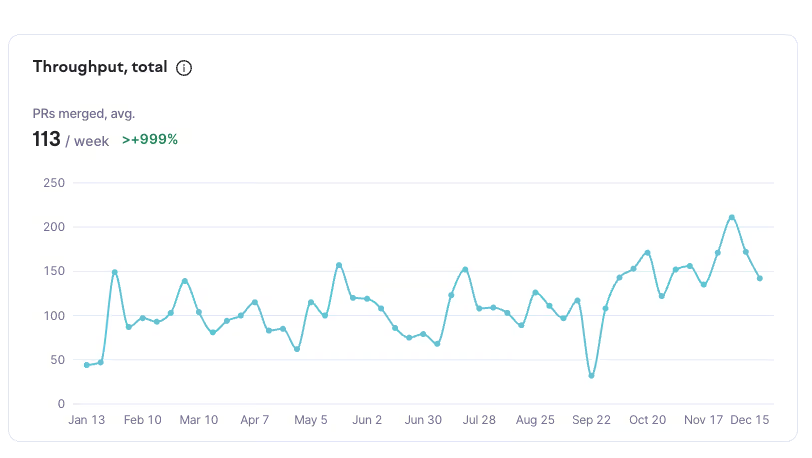
When AI turns software development inside-out: 170% throughput at 80% headcount
Farm where kids can meet animals and play in sandpit a short drive from Cambridgeshire

Marex Group plc (MRX) Analyst/Investor Day – Slideshow


-
 NewsBeat4 days ago
Manchester United reach agreement with Casemiro over contract clause amid transfer speculation
-

 News Videos3 days ago
Parliament publishes latest register of MPs’ financial interests
-

 Sports5 days ago
Remo Stars and Kano Pillars Strengthen Survival Hopes in NPFL
-

 Business6 days ago
No Winner in March 21 Drawing as Prize Rolls to $133 Million for Next
-

 Sports5 days ago
Gary Kirsten Accuses Pakistan Cricket Board Of ‘Interference’, Mohsin Naqvi Responds
-

 Tech6 days ago
Give Your Phone a Huge (and Free) Upgrade by Switching to Another Keyboard
-

 Tech6 days ago
AI enters the chat: New Seattle dating app relies on tech to facilitate meaningful human connections
-

 News Videos5 days ago
Ch 9 Financial Management Part 1 | Detailed One Shot | Class 12 Business Studies Boards 2026
-

 Business2 days ago
Instagram, YouTube Found Responsible for Teen’s Mental Health Struggle in Historic Ruling
-

 NewsBeat1 day ago
The Story hosts event on Durham’s historic registers
-

 Tech7 days ago
Today’s NYT Connections Hints, Answers for March 22 #1015
-
 NewsBeat3 days ago
Tesco is selling new Cadbury Dairy Milk bar and people can’t wait to try it
-

 Business7 days ago
Will Duke Basketball Win It All? Duke Basketball Enters Second Round as Third Favorite to Claim NCAA Title
-

 Sports6 days ago
2026 Kentucky Derby horses, odds, futures, preview, date: Expert who hit 12 Derby-Oaks Doubles enters picks
-
 NewsBeat6 days ago
Update on Wisbech river crash as search for teenage boy enters fifth day
-

 Tech5 days ago
Samsung will soon let you control smart home devices from your car’s dashboard
-
 Entertainment5 days ago
Cynthia Bailey Dishes on ‘RHOA’ Season 17, Discusses Kandi
-
 NewsBeat5 days ago
Colombian military plane with 110 soldiers onboard crashes following takeoff
-

 Business4 days ago
More women enter wealth management, but few in advisory roles: study
-

 Fashion4 days ago
Does It Matter What You Wear When You’re Laid Off and Looking?
You must be logged in to post a comment Login