

Crypto World
Bitcoin May Hit Q3 “Macro Bottom” Near $50K as Liquidity Grab Approaches

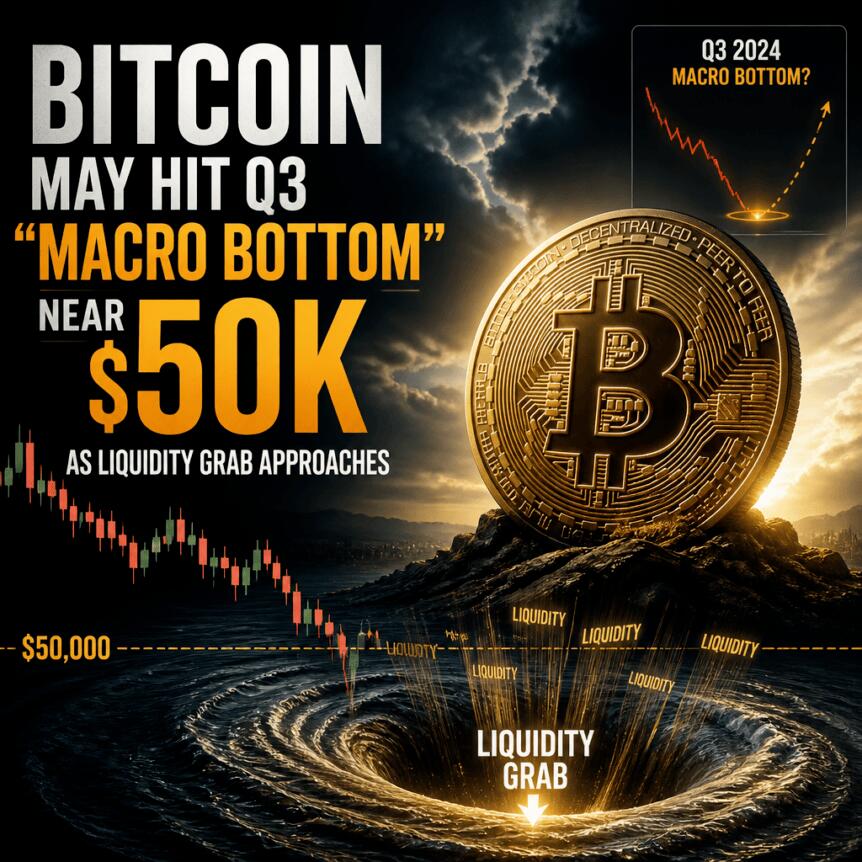
Speculation is building among parts of the trading community that Bitcoin’s next meaningful dip could function as a “macro bottom” trigger, potentially pushing BTC/USD into a targeted liquidity zone below $60,000 before a larger reversal. The renewed focus centers on how order-book liquidity on crypto exchanges can shape short-term price action—and whether traders’ current levels get “front-run” on the downside.
On Friday, pseudonymous analyst Killa argued that the market may be set up to sweep liquidity between roughly $50,000 and $60,000, potentially setting the stage for an end-of-bear-market pivot sometime between July and September. In parallel, multiple traders pointed to bearish pressure signals in short-term charts, including comments about short positioning on Binance.
Key takeaways
- Killa’s analysis suggests Bitcoin could “front run” higher-timeframe liquidity by sweeping $50,000–$60,000 to complete a longer-term bearish cycle.
- The core risk in Killa’s scenario is a partial liquidity grab—if the market reverses before that specific pool is fully taken, traders may be “left in complete disbelief.”
- Chart commentary from other traders highlights a close-in support window around $61,000–$62,000 that, if lost, could accelerate downside pressure.
- On shorter time frames, traders discussed “aggressive” short positioning on Binance, framing it as a reason near-term outlooks remain bearish.
Why order-book liquidity could drive a downside sweep
Killa’s thesis is tied to a familiar mechanism in liquid markets: order-book liquidity attracts activity, and large participants can move price in ways that force liquidation and unwind leveraged positions nearby. In the Bitcoin market, that process often results in sharp volatility when price moves toward clusters where traders have placed stops or liquidations.
According to Killa, the upcoming move is not just about where price is today, but about where liquidity is likely to be “front-run” by market makers and larger traders. Killa referenced prior behavior in which the market front-ran major liquidity above, and suggested a mirror pattern could occur below—leaving many participants surprised if the move is cleaner or faster than expected.
“Just like the market front ran the 140K liquidity above, it can do the exact same thing on the downside, leaving many in complete disbelief.”
In a post shared on X, Killa framed the key target as a sub-$60,000 liquidity grab in the next quarter. The idea is that once that pool is taken, the market may be positioned for a more durable reversal rather than a brief bounce.
Killa also emphasized that this is not a guarantee of a straight line lower. He noted that price could still sweep below $60,000 even if the primary argument is about taking the liquidity below that level.
The $50,000–$60,000 zone and what would “complete” the move
To support the liquidity-focused view, Killa pointed to a chart from CoinGlass showing a concentration of liquidation-linked liquidity activity in the $50,000 to $60,000 range. The practical implication is straightforward for traders: if that band is actively “cleared,” it can reduce the fuel for further forced downside in the immediate term and potentially change how derivatives positioning behaves.
The more nuanced part of Killa’s argument concerns what happens if the market doesn’t fully execute the expected sweep. Killa suggested that if the liquidity below $60,000 is grabbed completely, it may prevent the next major pool of liquidity from forming later—potentially around July to September—thereby marking what he described as a “macro bottom.”
“Because if this particular liquidity below 60K gets grabbed, there’s a very good chance the next major pool that forms between July and September never gets filled, marking the macro bottom.”
That distinction matters because it separates two outcomes that often look similar at first: a dip-and-retrace versus a liquidity-driven liquidation event followed by stabilization. In the first scenario, traders may treat a move below $60,000 as a temporary scare. In the second, they treat it as structural clearing that can shift the market’s next leg.
However, Killa’s own wording also highlights uncertainty. While he presented the $50,000–$60,000 area as the “main area of interest,” the market can still deviate—especially in highly leveraged periods where liquidity patterns can shift quickly.
Support tests and “aggressive” Binance shorts
Other traders are focusing on a narrower, near-term question: whether the market can hold current support levels around $61,000–$62,000. As Cointelegraph previously noted, there has been ongoing debate about the durability of the $60,000 area as the latest backdrop for BTC’s next move.
Daan Crypto Trades warned that the situation could deteriorate rapidly if those nearby lines fail to hold. In a summary posted to X, he said bulls need to defend the $61,000–$62,000 region to avoid “things get ugly real quick,” while also stating that, for the moment, price remained at support.
Meanwhile, Exitpump pointed to derivatives positioning dynamics on the Binance venue. In a separate X post, Exitpump flagged “aggressive” short positioning by Binance traders, arguing that it contributes to a bearish short-term outlook. In practice, this type of commentary is often used by traders to anticipate how quickly price could rebound—or how much downside pressure might build if the shorts remain crowded.
While such posts don’t provide a guaranteed path, they reflect a consistent theme across trading desks: in a market where liquidity and leverage amplify moves, positioning on major venues can influence whether support becomes a turning point or merely a stop on the way to a deeper sweep.
What investors and traders should watch next
If Killa’s liquidity-clearing scenario plays out, the key is not only whether BTC trades down toward $50,000–$60,000, but whether it does so in a way that meaningfully “takes” that pool and alters subsequent liquidity formation. Traders should also monitor the $61,000–$62,000 support window highlighted by Daan Crypto Trades—because a clean breakdown there could shift attention from a controlled liquidity sweep to a faster downside sequence. Over the coming weeks, changes in short-term derivatives positioning and whether liquidation-driven moves fully exhaust the targeted liquidity band will likely determine which narrative gains traction.

Crypto World
Bitcoin Slides as Warsh Stays Hawkish and Markets Await a Lasting US-Iran Agreement: Weekly Recap
It was another eventful and volatile week in the cryptocurrency markets (and beyond), which began with promising news on the war front in the Middle East that all concerned parties had agreed to a deal. However, it’s not that simple.
In the meantime, bitcoin’s price had struggled to break above $64,000 until Sunday evening, when Trump’s promise of a deal was announced to the world. The cryptocurrency reacted with an immediate surge that pushed it to $66,000 within hours and above $67,000 on Monday to mark a multi-week peak of its own.
However, the subsequent rejection was right around the corner. In the hours leading up to the Wednesday FOMC meeting, which was the first under the Federal Reserve’s new Chairman, BTC dropped below $65,000 and then jumped to $66,400. However, once the Fed confirmed that it won’t lower the rates, as essentially everyone anticipated, and then Kevin Warsh’s speech showed his hawkish tone, bitcoin slipped once again.
It kept sliding in the following days and dipped to a weekly low of $62,300 earlier today. This also came amid growing concerns that the memorandum of understanding between the US and Iran might not come to fruition. However, the two hotheads in the mix, Israel and Hezbollah, reportedly agreed to a ceasefire earlier today, due to begin at 14:00 BST on Friday.
BTC reacted with another uptick, going above $63,000 as of press time. It’s likely that the cryptocurrency will gain further traction if the actual permanent deal is signed, as it was promised, today, but the broader market remains fragile, especially with the uncertainty around Strategy and its controversial STRC shares. More on that, a bit later.
For now, BTC remains in the red weekly, and so are BNB, DOGE, XMR, CC, BCH, and ADA. In contrast, HYPE, XLM, WLD, UNI, and RAIN have marked double-digit gains.
Market Data

Market Cap: $2.26T | 24H Vol: $75B | BTC Dominance: 56.1%
BTC: $63,230 (-1.3%) | ETH: $1,700 (+0.85%) | XRP: $1.14 (-0.9%)
This Week’s Crypto Headlines You Can’t Miss
Strive CEO: Sharp STRC, SATA Drops Were Leverage Liquidations, Not Credit Failures. Despite making another $100 million bitcoin acquisition this week, Saylor’s Strategy attracted some controversy due to its STRC shares. The financial vehicle has fallen well below its intended price of $100, and a crash on Thursday increased the FUD even though Strive’s CEO defended the product and the issuer behind it.
Bitcoin Dips Below $64K Again: Here’s How Whales Reacted. With bitcoin’s price instability and consistent weakness, large whales, those holding at least 1,000 units, had increased their holdings to their highest levels in over three months. They control almost 36% of BTC’s available supply now.
Morgan Stanley Files Amendments, Clearing Path for Cheapest ETH, SOL ETFs. Months after launching its Bitcoin ETF, the banking behemoth filed amendments for its two ETH and SOL filings. If approved, the new financial vehicles will be the cheapest of the bunch and will include staking arrangements.
BlackRock Rolls Out Bitcoin Income ETF as Demand for Covered Calls Grows. Speaking of ETFs, the world’s largest asset manager launched its iShares Bitcoin Premium Income ETF (BITA) to expand its product lineup with a yield-focused vehicle.
Illinois Passed the Most Anti-Crypto Law in the US: Miles Jennings. On June 17, Illinois officials enacted the Digital Asset Privilege Tax Act, which was called “one of the most anti-crypto laws in the US” by Andreessen Horowitz’s Miles Jennings. It imposes a 0.2% tax on the exchange, transfer, and custody of cryptocurrencies, with no meaningful exemptions for routine self-custody moves.
Bitmine Adds $135M in ETH, Closing In on 5% of Ethereum Supply. The broader market’s weakness has not deterred Bitmine from reaching its goal of owning 5% of Ethereum’s total supply. In the latest acquisition spree, the company said it had acquired almost 77,000 ETH for $135 million, bringing its total to 5,620,754 tokens.
Charts
This week, we have a chart analysis of Ethereum, Ripple, Cardano, Binance Coin, and Hyperliquid – click here for the complete price analysis.
The post Bitcoin Slides as Warsh Stays Hawkish and Markets Await a Lasting US-Iran Agreement: Weekly Recap appeared first on CryptoPotato.
Arthur Hayes has sold 6,000 Ethereum at a loss after accumulating nearly $10.6 million worth of ETH in recent days, even as other large investors continue adding to their holdings around a major support zone.
Summary
- Arthur Hayes sold 6,000 ETH at a $606,000 loss after accumulating nearly $10.6 million worth of Ethereum days earlier.
- Lookonchain data shows K3 Capital and a Chun Wang-linked wallet acquired more than 17,000 ETH despite recent weakness.
- Technical indicators and liquidation data place Ethereum at a critical support zone near $1,700, with major liquidity sitting around $1,800.
According to blockchain tracking platform Lookonchain, the BitMEX co-founder accumulated approximately 5,900 ETH over the past few days at an average purchase price of $1,793 per token. Data shared by the platform showed that Hayes later sold 6,000 ETH for roughly $10.14 million at an average price of $1,690, locking in an estimated loss of about $606,000.
The transaction comes as Ethereum struggles to regain momentum after failing to hold above key resistance levels during a recent recovery attempt. ETH was trading near $1,700 at the time of writing, well below its April peak above $2,400.
As reported by crypto.news earlier, a wallet linked to Hayes received 3,000 ETH worth approximately $5.42 million from market maker Flowdesk on June 15. The transfer took place as Ethereum and the wider crypto market rallied after easing geopolitical tensions in the Middle East improved investor sentiment at that time.
Why are some large investors still accumulating ETH?
While Hayes reduced exposure, on-chain data cited by Lookonchain points to continued buying activity among other major holders.
The platform reported that investment firm K3 Capital withdrew 10,000 ETH worth approximately $16.9 million from Binance. Separately, a wallet linked to entrepreneur Chun Wang acquired another 7,650 ETH valued at nearly $12.9 million.
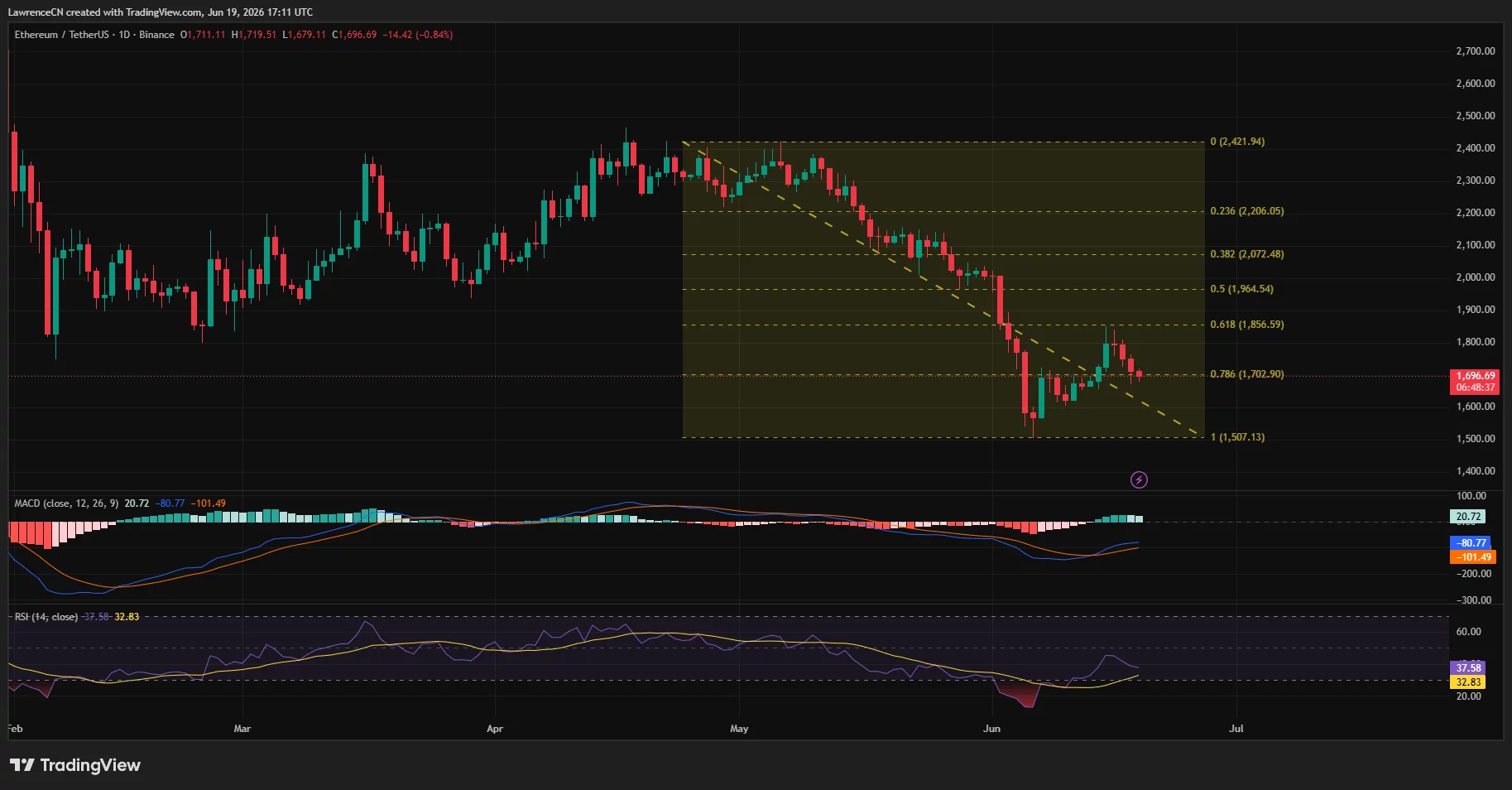
These purchases arrived as Ethereum was testing an area that several technical indicators identify as an important support zone. On the daily chart, Ethereum (ETH) remains close to the 78.6% Fibonacci retracement level near $1,703, a level traders often monitor for potential trend stabilization following steep corrections.
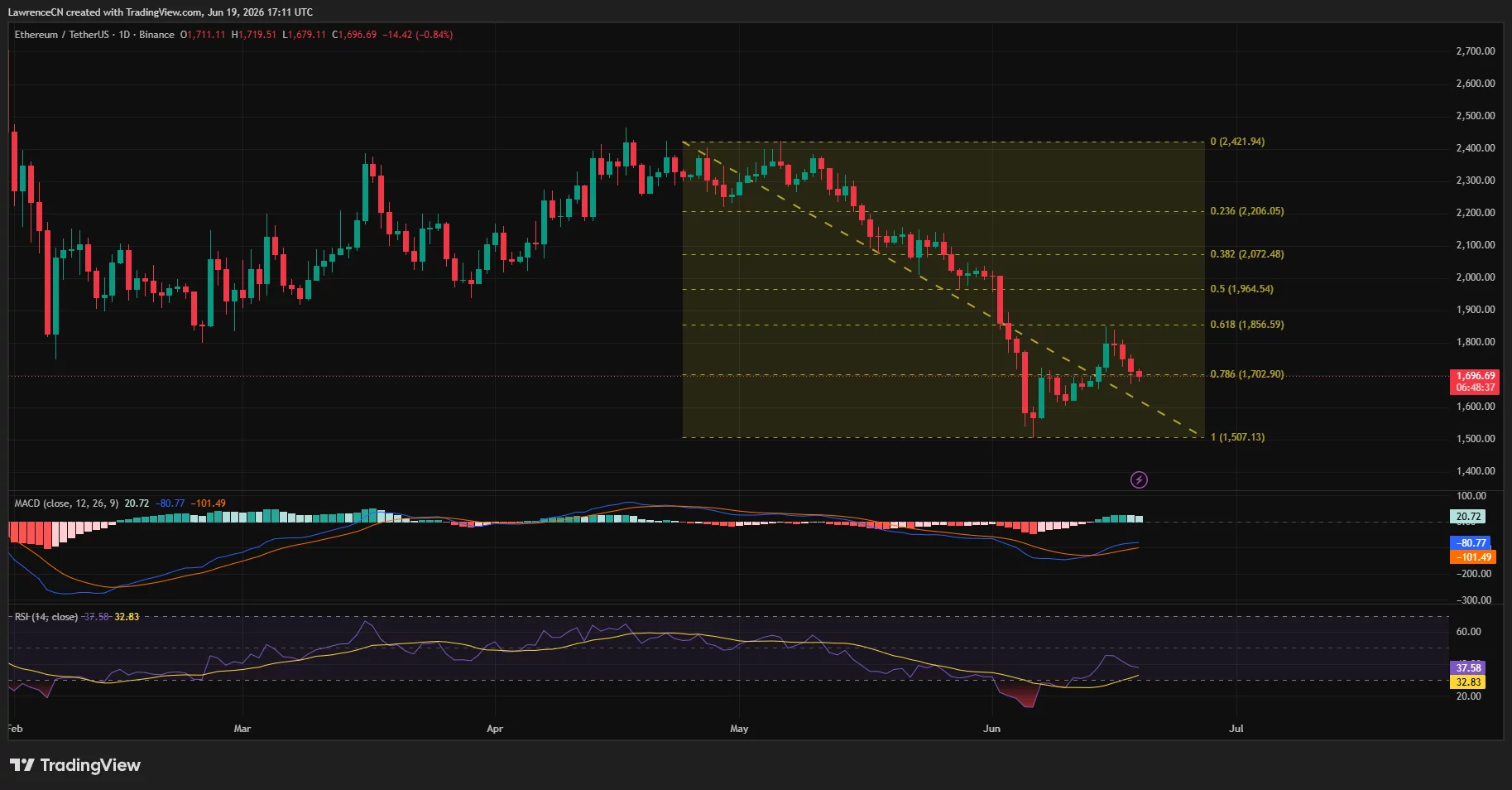
Recent price action has produced mixed signals. Although Ethereum rebounded from its June low near $1,507, the recovery stalled below the 61.8% Fibonacci retracement level around $1,856.
Daily RSI remains below the neutral 50 mark, while the MACD indicator is still positioned beneath the zero line, suggesting that buyers have yet to establish a sustained reversal.
Where could Ethereum move next?
Liquidation data indicates that leveraged traders are heavily positioned around several nearby price zones.
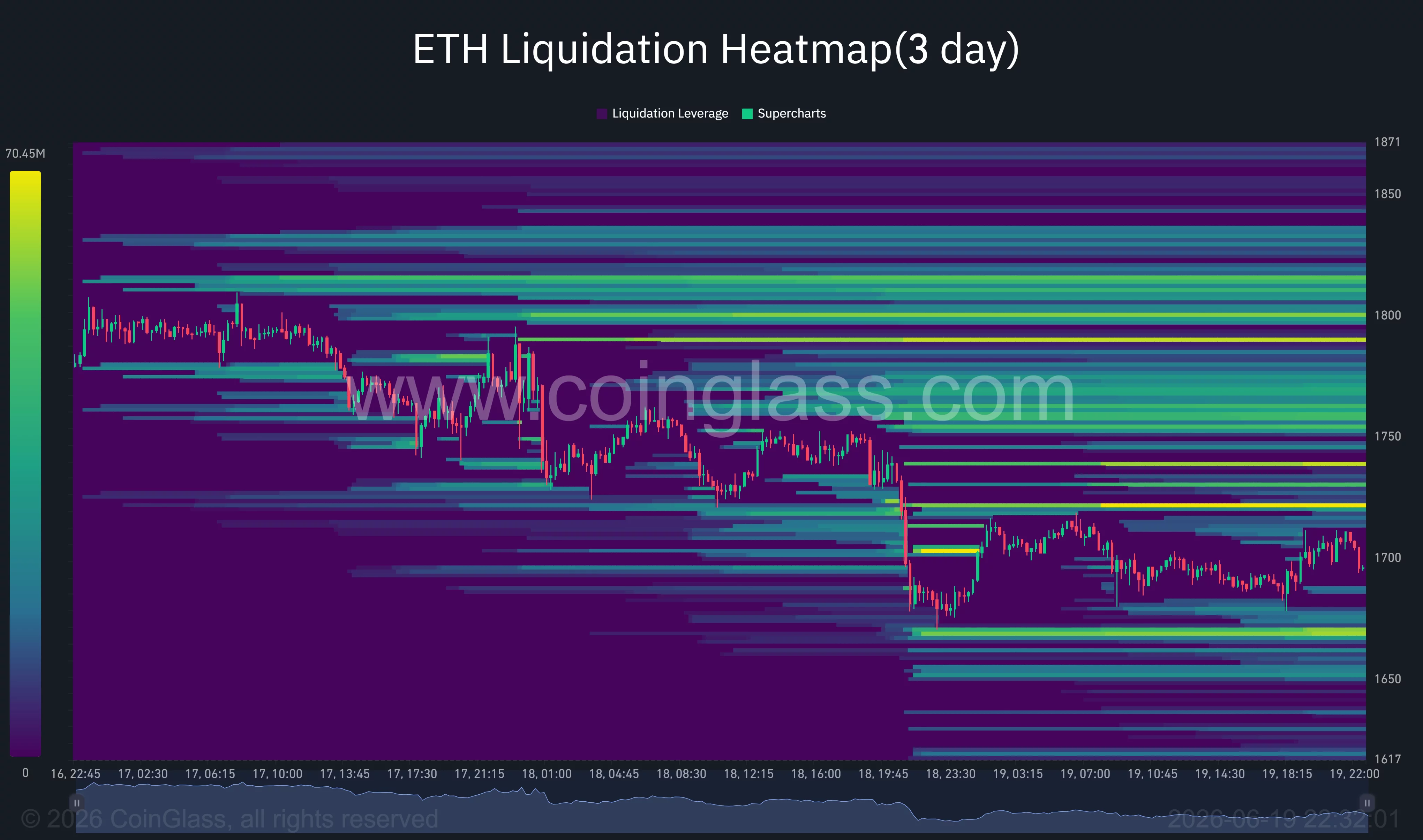
CoinGlass liquidation heatmaps show notable liquidity clusters between $1,780 and $1,820, with one of the largest concentrations sitting near the $1,800 level. Such areas often attract price movement as traders seek liquidity and leveraged positions are forced to close.
Additional technical analysis shared by market commentator Team LAMBO suggests Ethereum recently faced rejection from a confluence resistance area tied to Fibonacci levels and descending trendline resistance.
In a June 19 X post, the analyst argued that a clear trading range has developed between roughly $1,500 and $1,800, with a breakout beyond either boundary likely determining the next significant move.
The 4-hour chart presents a similar picture. Ethereum remains below a descending trendline that has capped rallies since early May, while the Supertrend indicator continues to signal bearish conditions.
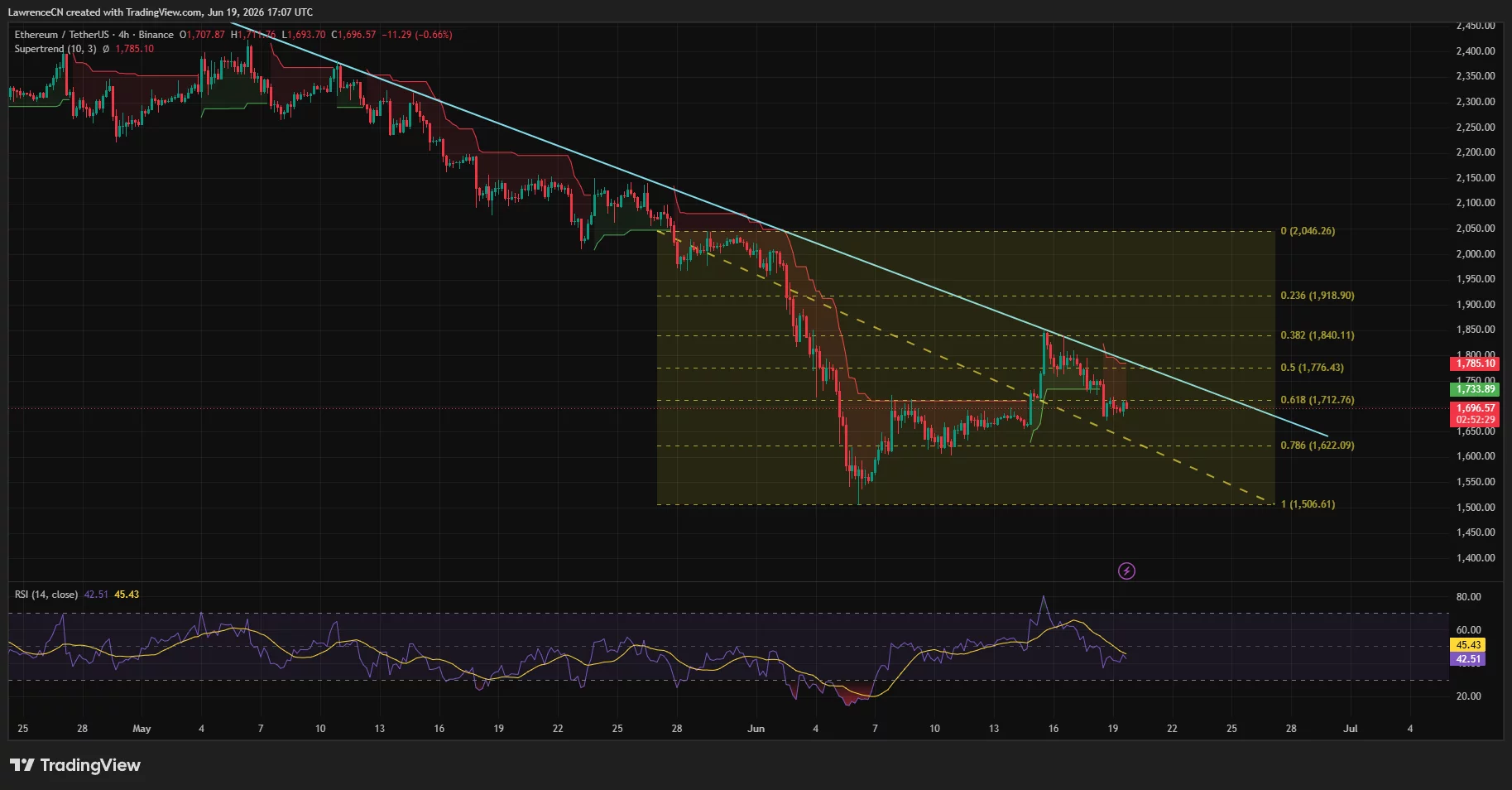
A move above resistance near $1,780 and the large liquidity pocket around $1,800 could expose higher targets near $1,856. Failure to defend support around $1,700, however, could place renewed focus on the $1,620 area and eventually the June low near $1,507.
Disclosure: This article does not represent investment advice. The content and materials featured on this page are for educational purposes only.
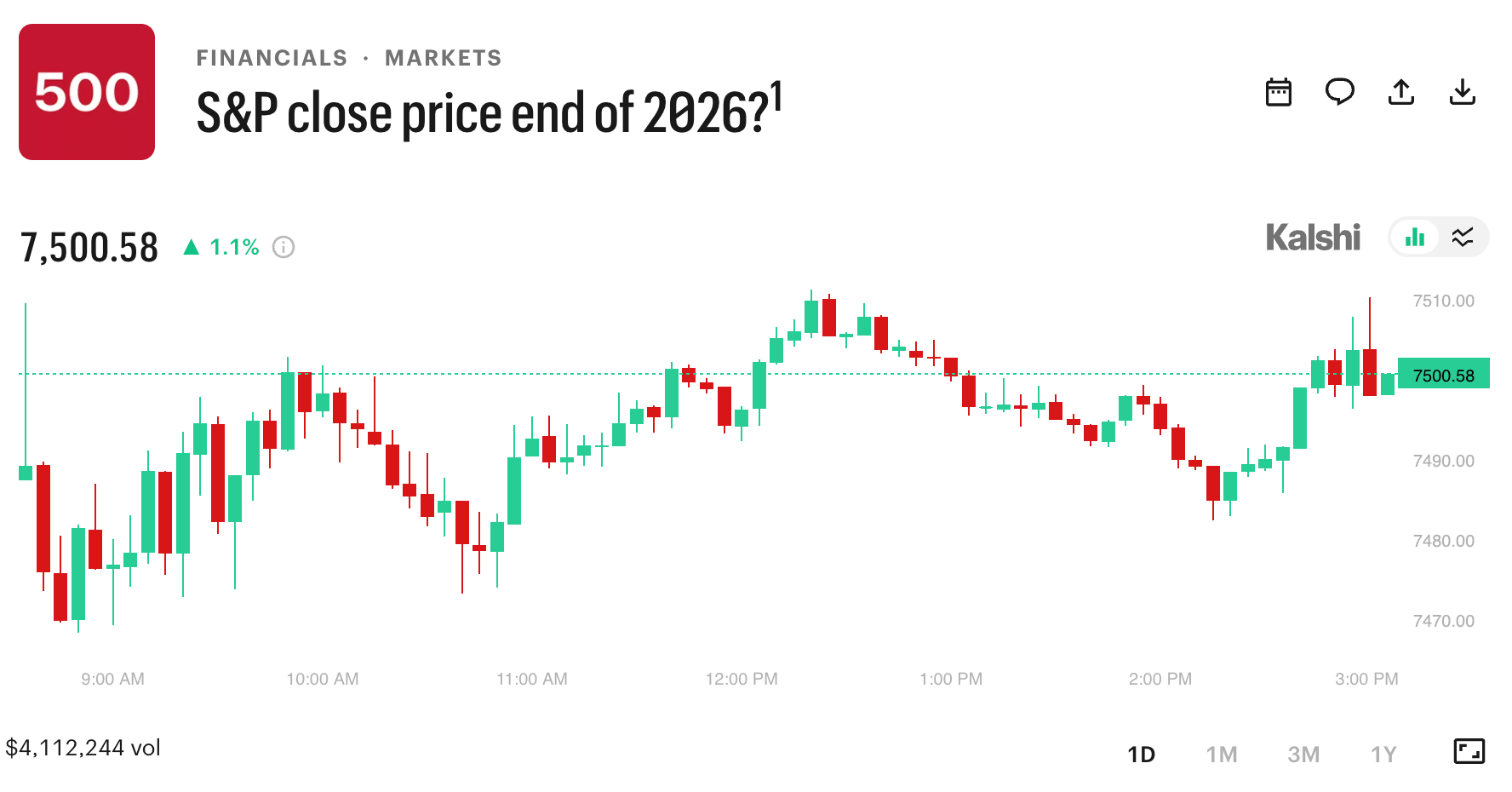
Financial services giant Charles Schwab will reportedly enter the prediction markets business by offering customers wagers on the S&P 500.
According to a Friday Wall Street Journal report, Charles Schwab is planning to launch options contracts allowing users to place yes-or-no wagers on the performance of the S&P 500 stock market index. The move, expected to roll out in a matter of months as part of a partnership with Cboe Global Market, could mark the company’s first into prediction markets.
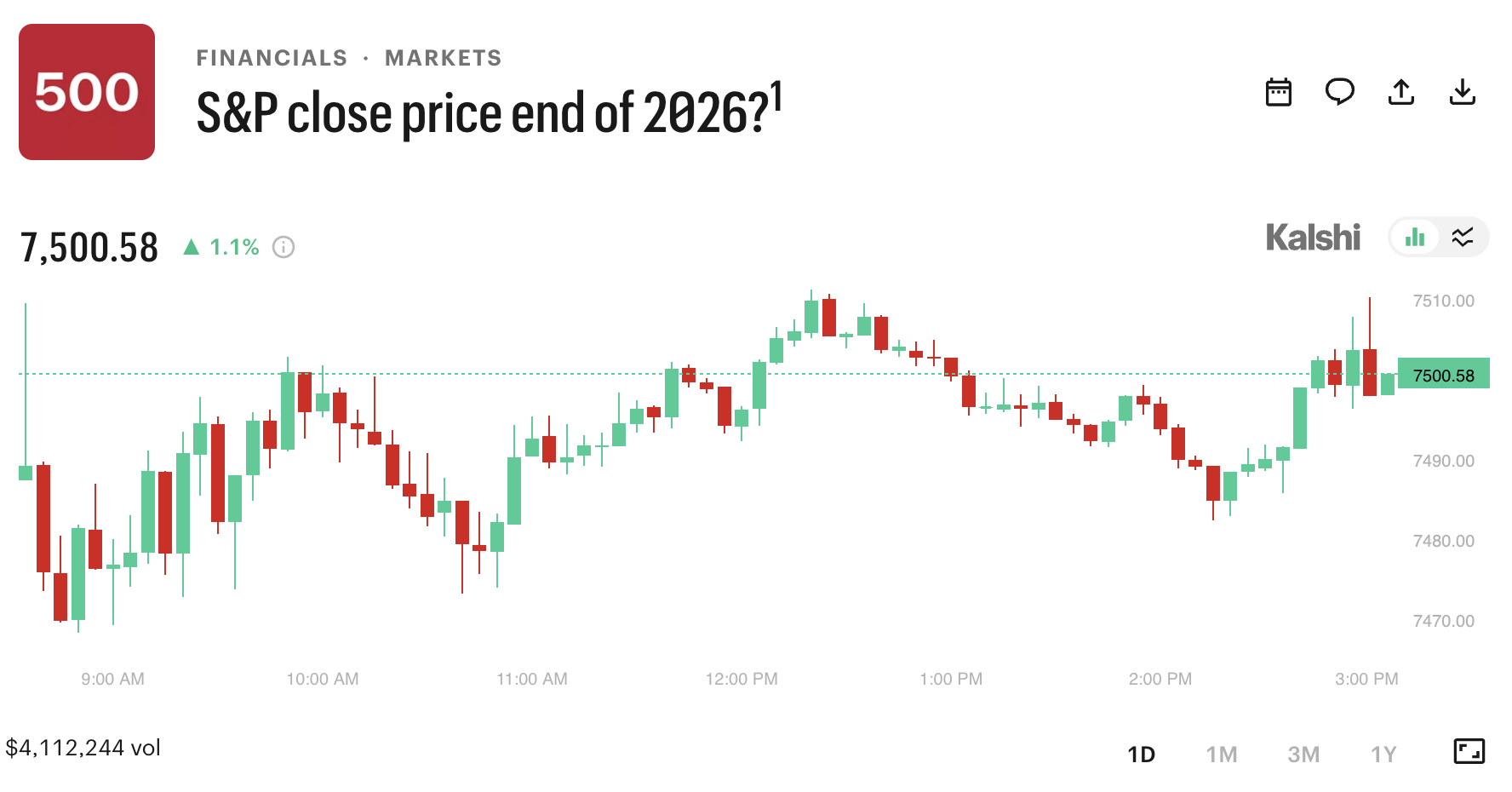
Source: Kalshi
While prediction market platforms like Kalshi and Polymarket offer a variety of event contracts based on the outcome of events, including those tied to politics, sports, weather and companies, the Charles Schwab product will reportedly only include yes-or-no bets on whether the S&P 500 closes above or below a target price. Cryptocurrency exchanges like Coinbase have also moved closer to prediction offerings with many projecting the market will reach $1 trillion in annual volume by 2030.
In May, Charles Schwab announced the launch of spot Bitcoin and Ether trading for retail clients, marking the company’s move deeper into digital asset services. The company reported a net income of $2.5 billion for the first quarter of 2026.
Both Polymarket and Kalshi already offer similar event contracts related to predictions on the S&P 500.
Prediction markets are still under scrutiny by lawmakers
Although the market continues to grow, many state-level authorities and members of US Congress are calling for oversight of platforms like Kalshi and Polymarket. In addition to the potential for elected officials to profit from using nonpublic information on the platforms, many state gaming authorities have challenged their ability to offer event contracts related to sports.
The US Commodity Futures Trading Commission (CFTC) under Chair Michael Selig has taken the position that event contracts on prediction markets qualify as “swaps” and the agency has exclusive jurisdiction for regulation and enforcement. Many of the cases connected to Kalshi, Polymarket, the CFTC, and state authorities continue to be litigated.
Magazine: Should users be allowed to bet on war and death in prediction markets?
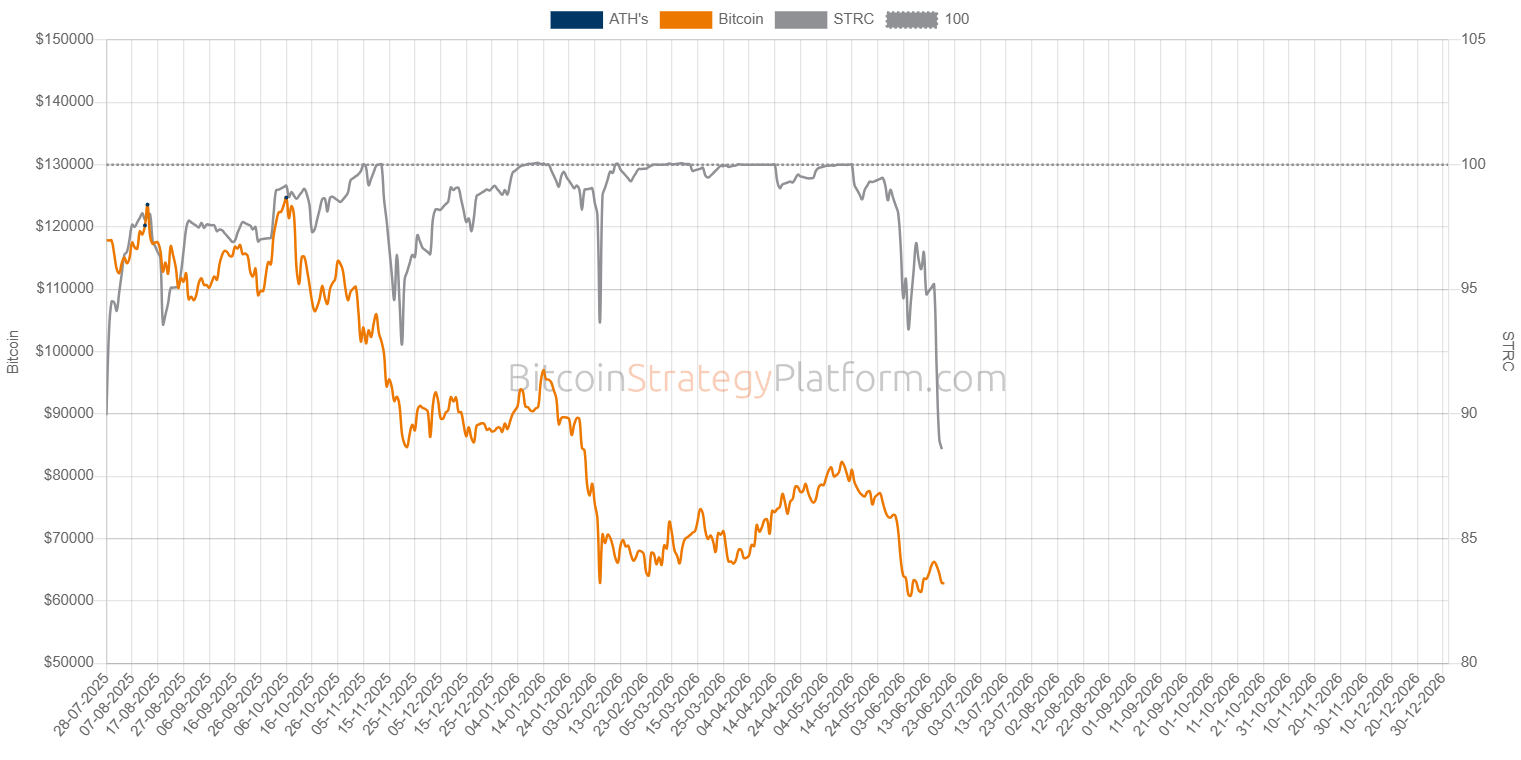
Digital credit faced its first real stress test this week, as MicroStrategy’s STRC preferred stock crashed, prompting critics to declare the Bitcoin-backed asset class dead.
Bitcoin (BTC) itself has weathered the same obituaries many times before. On-chain data now tells a different story, with network activity climbing to multi-year highs even as the price slides.
What Digital Credit Actually Means
Digital credit is a young class of income-generating securities backed by Bitcoin. Companies holding large Bitcoin reserves issue structured products such as preferred equity and convertible notes.
They use the proceeds to buy more Bitcoin. The aim is straightforward. Long-term BTC appreciation should outpace the dividends and interest those products owe.
Strategy, formerly MicroStrategy, built the clearest example with its STRC preferred stock. STRC has a $100 par value and pays a high, variable yield near 12% per year.
When the shares trade at or above par, Strategy issues more shares and routes the cash into Bitcoin. That mechanism turns STRC demand into BTC on the balance sheet.
Strategy frames the whole stack in plain terms. It calls bitcoin digital capital, STRC digital credit, and its common stock digital equity. The pitch attracted income-focused investors seeking Bitcoin exposure without holding the coin.
They earn a steady yield while Strategy carries the price risk.
Convertible notes and other preferreds follow the same logic. Each one borrows against future Bitcoin gains to buy more BTC today.
From 2025 through 2026, these vehicles became a major source of fresh Bitcoin demand. STRC-linked buying funded far more bitcoin than spot ETFs over the same stretch.
The First Real Stress Test
Critics declared digital credit dead this week, and some of the criticism landed. STRC was marketed as a lower-volatility way to hold Bitcoin exposure.
Instead, it broke par. The preferred shares fell to an intraday low near $82, roughly 18% below $100.

Several pressures hit at once. The asset class is less than a year old, and leveraged STRC positions are unwinding while Bitcoin forms a bottom. Capital is also competing with AI listings and a crowded IPO pipeline.
The wider market mirrors that strain. Total value locked across Decentralized Finance (DeFi) fell from about $170 billion in October 2025 to near $72 billion now.

That marks a drop of more than 55% and signals a broad flight from risk. The selling pressure on STRC did not happen in isolation. The structure also fed on itself. Because STRC trades under par, Strategy has paused new share sales through its market program.
That limits its ability to keep buying Bitcoin, the very engine behind the model. A higher variable dividend, meant to defend par, now reads as a distress signal rather than a reward.
Rival treasury preferreds with higher yields have also pulled capital away. Together these forces explain why critics reached for the word dead. Still, the death call looks premature. Analyst @therationalroot argues that a failure here is very unlikely.
Strategy holds enough cash to cover dividends for at least seven months. Its Bitcoin reserve could fund those same payments for decades.
The market still flinched at one move. In late May, Strategy sold a small batch of bitcoin to fund STRC distributions for the first time. The sale was tiny against its overall holdings. Yet it fed the fear that the model would bend when Bitcoin fell hard.
This remains the first true downturn for an asset class barely a year old. Bitcoin has carried that same dead label through every deep bear market and returned each time.
Bitcoin’s Network Tells the Opposite Story
While digital credit takes its punches, the Bitcoin network looks anything but dead. CryptoQuant’s Network Activity Index broke above its trend for the first time since mid-2024.
It has climbed since January 2026 and has held above trend since late March. That creates a clear divergence, with activity rising while the price falls.
The index measures how heavily the chain gets used, from transaction volume to address activity. A reading above trend points to real expansion rather than a quiet network.
Daily transaction counts and average transactions per block both sit near record highs. The catch sits in the detail.

Transactions below 0.01 BTC now make up about 80% of daily activity, up from under 50% in 2023. Much of the surge comes from OP_RETURN usage tied to Runes and Ordinals inscriptions.
OP_RETURN lets users attach small data to a transaction, which token and inscription projects rely on heavily. These generate large volumes of low-value transactions rather than big economic transfers.
That distinction matters for how the surge gets read. A busy chain is not the same as a chain moving more value.
The mempool has swelled to its highest transaction count since late February 2025. Congestion sits mostly in the low-fee cohorts.
Sustained non-financial activity could raise fees for economic transactions over time. Even so, the core signal stands, and the chain is busier than it has been in years. Michael Saylor has made similar arguments about resilient demand.
A Pulse, Not a Eulogy
Bitcoin trades near $62,400, down about 3% on the day and far from its highs. Both digital credit and the Bitcoin network have been written off before.
The timing tells its own story. Doubts about digital credit grew louder exactly as Strategy’s preferred shares slid below par.
The on-chain numbers cut against that gloom. A network this active rarely fits the picture of a dying asset. That gap between price and usage is the core tension to watch. Falling prices and rising activity rarely sit together for long.
The data suggests both still have a pulse. Whether STRC reclaims par and network activity keeps climbing will decide if this moment marks a bottom or a warning.
The post Is Bitcoin-Backed Digital Credit Dead After MicroStrategy’s STRC Crash? appeared first on BeInCrypto.
Crypto World
Sonic Labs Founders Including Andre Cronje Quit Board as New CEO Pledges to Get '1% Better' Daily


Sonic Labs said its three founding board members — Andre Cronje, Michael Kong and David Richardson — are resigning from the board, and named Matt Visser as chief executive officer and Kosta Kourkoumelis as chief operating officer, in a leadership overhaul at the blockchain network whose token and… Read the full story at The Defiant


GoMining has launched a Bitcoin payment infrastructure stack that settles transactions directly on the Bitcoin network while charging merchants a 0.2% processing fee, a rate the company says is significantly lower than traditional card payment costs.
Summary
- GoMining has launched GoBTC Pay SDK and API to help merchants accept Bitcoin directly.
- The platform settles payments directly on the Bitcoin network without fiat conversion and charges a 0.2% fee.
- GoMining says its model could compete with both crypto gateways and card networks.
According to GoMining, the newly released GoBTC Pay Gen1 SDK and API are designed to help merchants, wallet providers, and ecosystem partners add Bitcoin payments to their products and services without relying on fiat conversion or custodial intermediaries. The company said it will initially onboard up to 10 merchants and partners as part of the rollout.
Built for businesses looking to accept Bitcoin payments, the package includes merchant onboarding tools, payment management functions, online checkout integrations, developer documentation, an open API, and a web dashboard for transaction monitoring and settlement management.
In comments accompanying the launch, GoMining CEO Mark Zalan said Bitcoin was originally created to transfer value between users rather than remain inactive in wallets. Zalan stated that the new infrastructure is intended to make Bitcoin payments easier for merchants and wallet providers to support in everyday commercial transactions.
Direct Bitcoin settlement removes fiat conversion
Unlike many crypto payment services that convert digital assets into fiat currency before settlement, GoMining said GoBTC Pay processes payments directly on Bitcoin while allowing users to retain control of their assets throughout the transaction flow.
The company said the platform runs on its private 15 EH/s mempool infrastructure and uses Stratum V2 technology to prioritize transactions. Based on GoMining’s estimates, settlements are expected to be completed in roughly 12 hours on average.
A separate incentive structure accompanies the launch. According to the company, merchants pay a 0.2% transaction fee, which is divided equally between wallet providers and miners involved in processing settlements. GoMining said the model is designed to reward infrastructure participants while encouraging payment adoption across the Bitcoin ecosystem.
Last month, GoMining positioned the same 0.2% fee structure against traditional card processing costs. Company statements cited industry data from Premier Payments, Forbes, and Visa litigation settlement documents indicating that merchants typically pay between 1.5% and 3.5% per transaction once interchange, assessment, and processor fees are combined.
Miners become payment infrastructure providers
According to GoMining’s earlier explanation, the low-fee structure leaves less room for intermediaries and requires the company to absorb fraud, volatility, and operational costs through its own infrastructure and block-production economics.
The company has argued that Bitcoin miners are well placed to operate payment protocols directly on the Bitcoin mainnet because they already earn block rewards and can generate additional revenue from transaction processing and related services.
Under that model, a payment network charging 0.2% could compete with crypto payment gateways that typically charge between 0.5% and 1%, while also challenging parts of the economics behind traditional card-processing networks, according to GoMining’s assessment.
Founded in 2021, GoMining operates a Bitcoin mining platform that allows users to earn BTC through NFT-linked hashrate rather than purchasing mining hardware. The company manages mining operations across multiple global data centers.
GoMining says it is backed by Bitscale Capital, operates on Bitmain infrastructure, and uses BitGo for institutional custody. Its advisory board includes Tal Cohen and Victor Orlovski.
Cohen, who previously served as CEO of Kraken US and held leadership roles at McKinsey and Google, joined the board in June 2025.
Andrew Tate, founder of the Real World, a company that sells online education courses on trading, lost nearly $100,000 while betting on Bitcoin (BTC) between Wednesday and Thursday.
Key takeaways:
- Tate’s wallet balance drops to $14,000 from $100,000 in a day.
- The social media influencer has lost around $804,000 on Hyperliquid.
Tate’s wallet balance drops to just $14,000
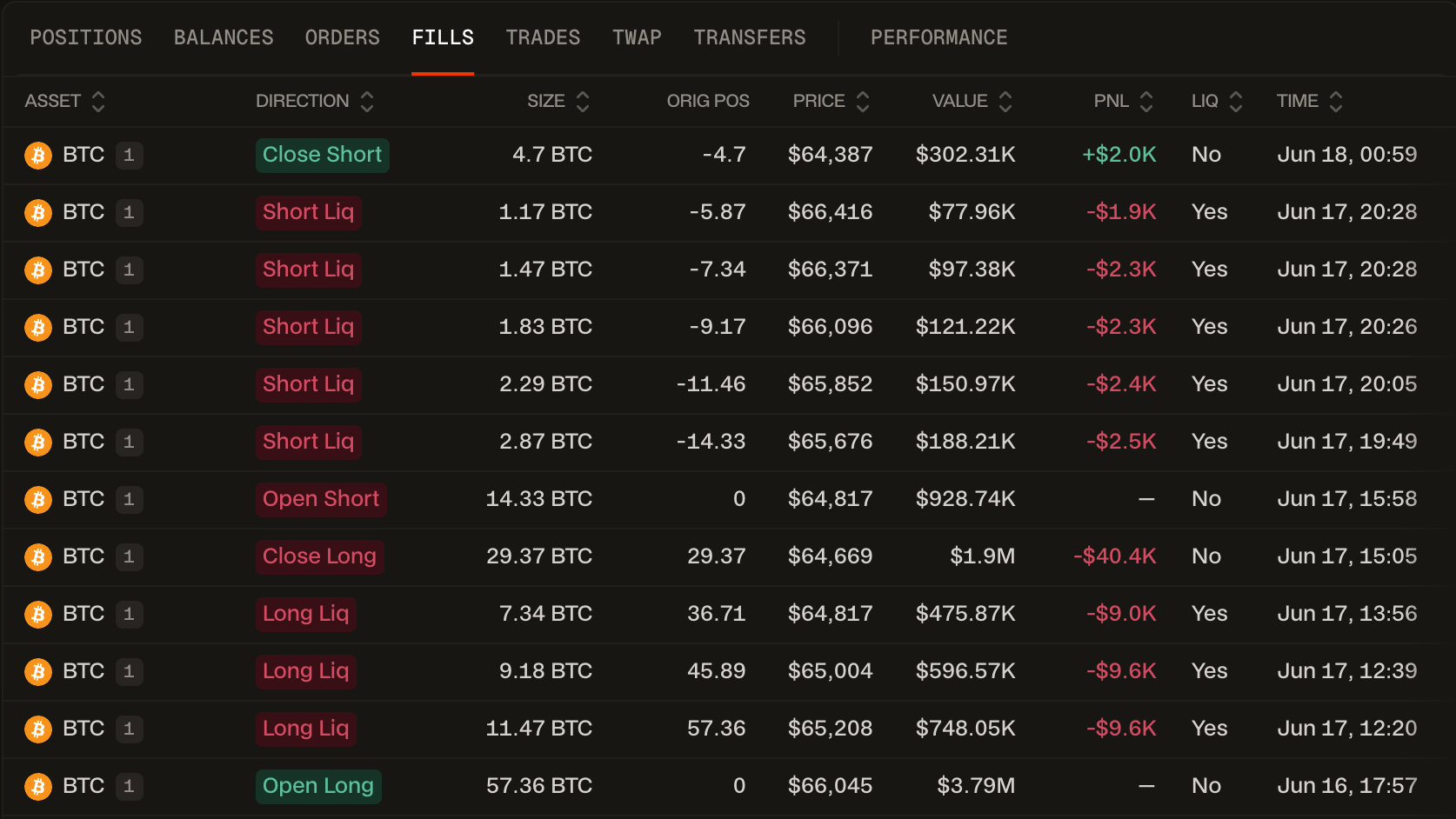
A Hyperliquid wallet reportedly linked to Andrew Tate opened a 57.36 BTC long position on Wednesday, with an entry price near $66,000, according to data resource HyperDash.
The trade was worth about $3.79 million, backed by roughly $100,000 in USDC, implying leverage of around 40x.
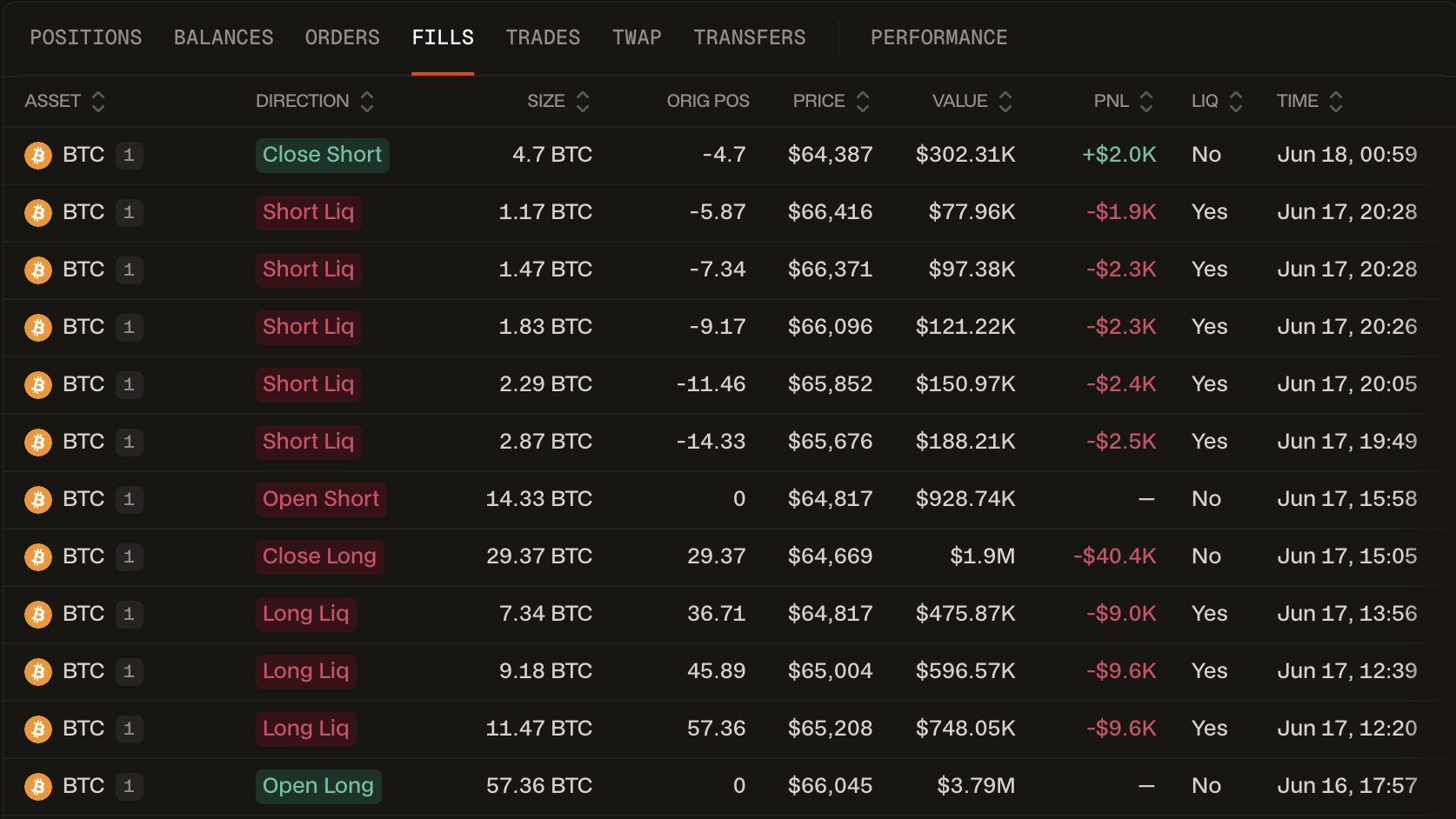
Andrew Tate’s filled order history. Source: HyperDash
The position began unwinding on Thursday as Bitcoin fell toward the mid-$64,000 area. Ultimately, the long trade recorded about $68,600 in cumulative realized losses.
The wallet then switched direction, opening a 14.33 BTC short position worth about $1 million at $64,817. That trade was also hit as Bitcoin rebounded, with five short liquidation fills.
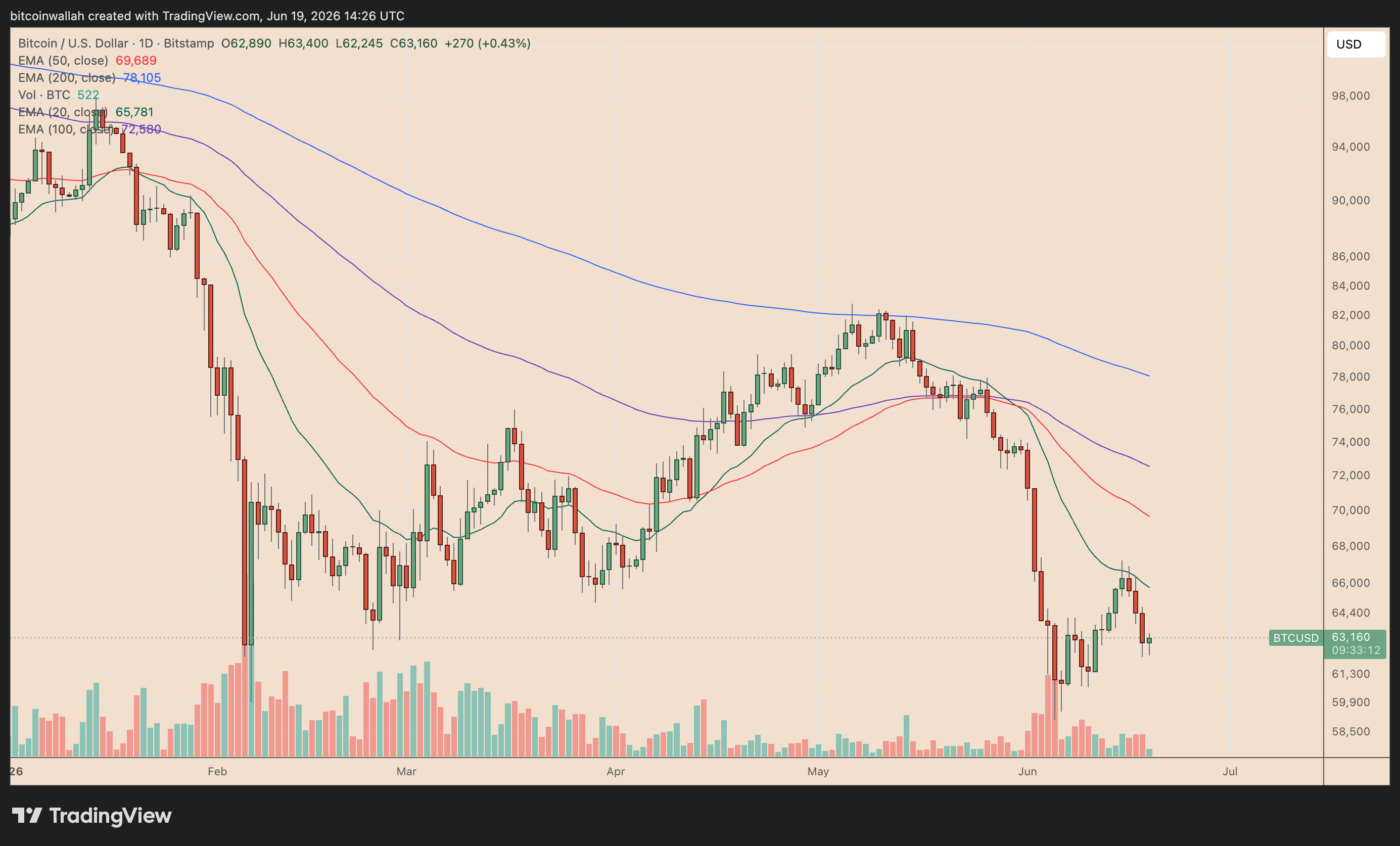
BTC/USD daily chart. Source: TradingView
By June 18, the account balance had fallen to around $14,000, thus losing almost the entire deposit.
Tate’s Hyperliquid portfolio is down nearly $804,000
Andrew Tate’s crypto trading issues on Hyperliquid began well before 2026.
For instance, in November 2025, his 40x BTC long position was liquidated for $235,000 on Nov. 14. By Nov. 18, multiple longs near $90,000–$95,000 were wiped out, leaving the account near zero.
Related: Bitcoin to $145K by October? Why this ‘crazy accurate’ 4chan prediction is sketchy
In another instance, Tate lost around $67,500 on World Liberty Financial (WLFI) positions ahead of a token unlock that triggered a sharp drop in September 2025. He re-entered the same trade almost immediately and lost again.
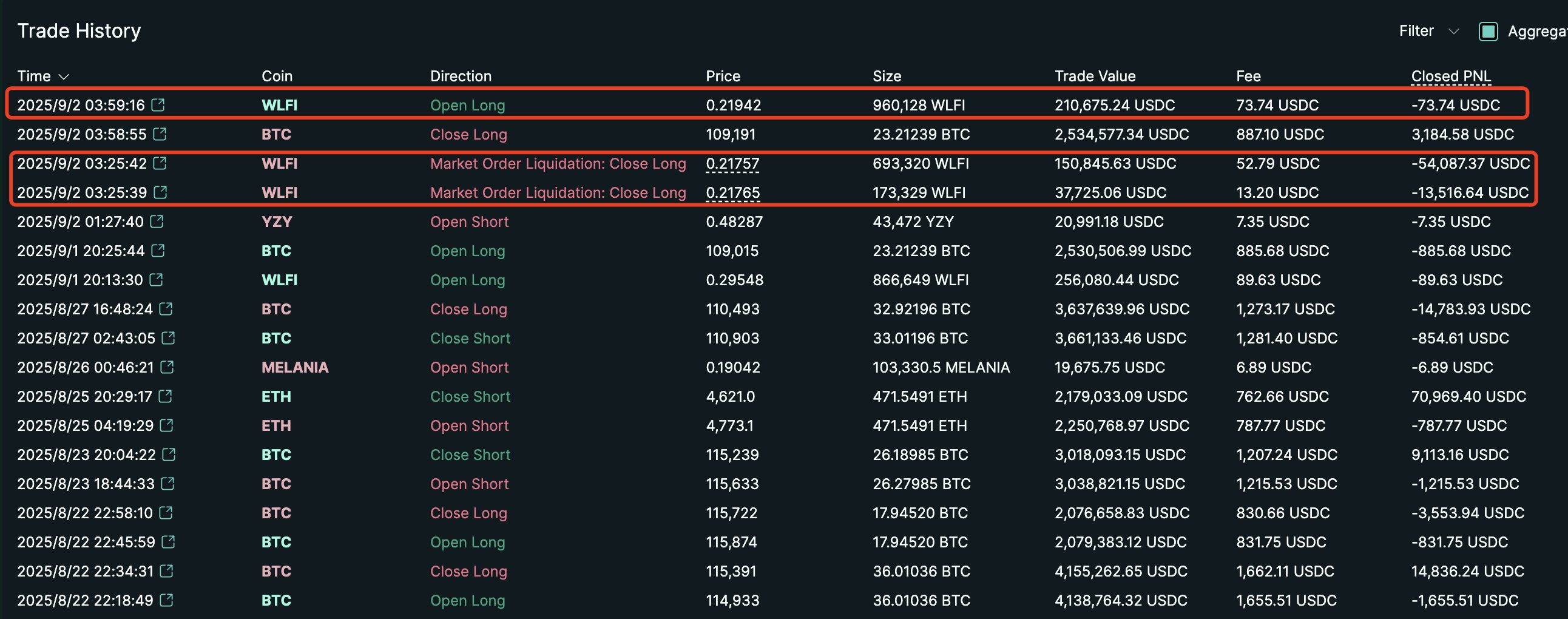
Screenshot of Tate’s WLFI positions from 2025. Source: HyperDash/Lookonchain
As of Friday, Tate’s all-time performance tab showed perpetual futures losses of $803,800, extending a drawdown that began in early 2025 and deepened again after the latest June liquidation streak.
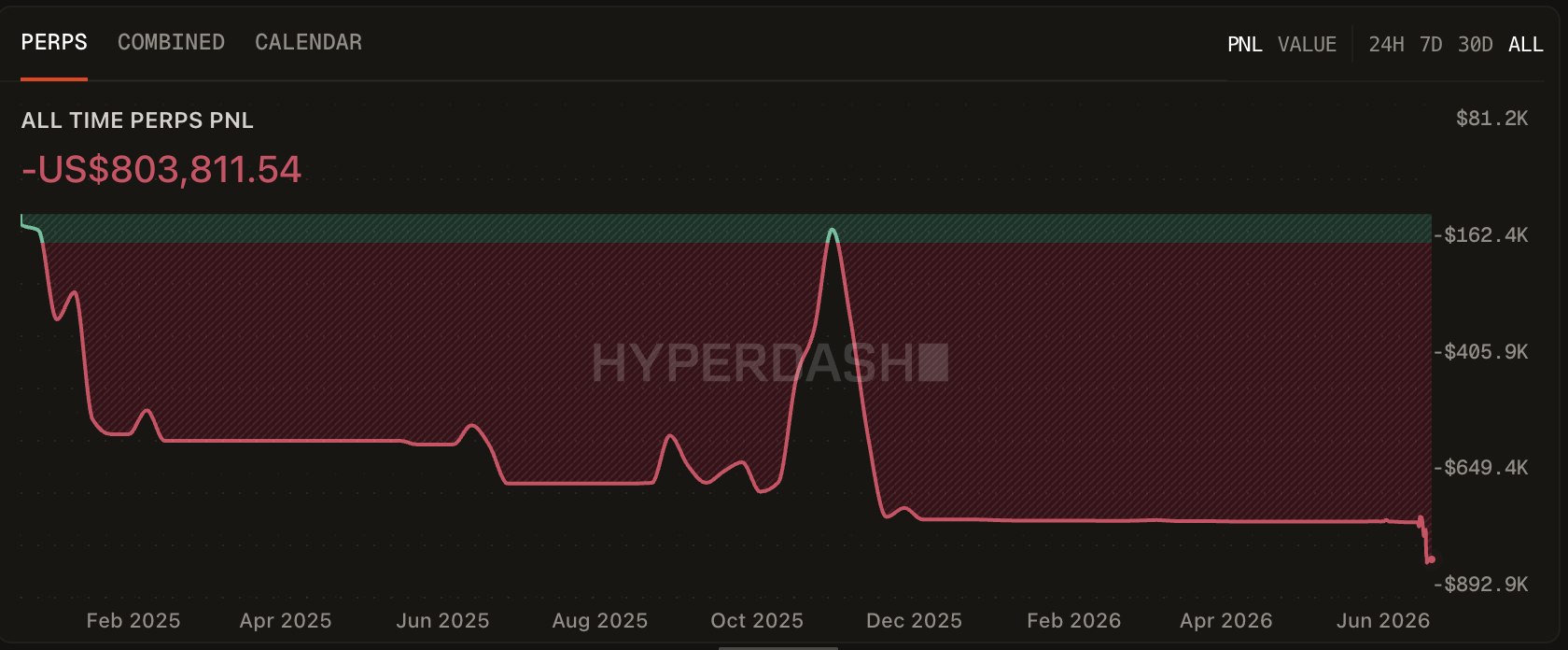
Tate’s profit-and-loss from all perp trades. Source: HyperDash
The trades show how quickly a leveraged account can lose capital in volatile market conditions, even when the underlying asset moves only a few percentage points.

Celsius founder and former CEO Alexander Mashinsky has been permanently banned from trading in markets overseen by the US Commodity Futures Trading Commission (CFTC) after a federal court approved a consent order resolving the regulator’s 2023 enforcement case against him.
The order, entered by the US District Court for the Southern District of New York, also permanently prohibits Mashinsky from violating certain anti-fraud provisions of the Commodity Exchange Act and CFTC regulations and bars him from registering with the agency in the future.
Celsius Collapse Fallout
The CFTC sued Mashinsky and Celsius Network in July 2023. It had alleged that the company operated a digital asset platform where customers deposited cryptocurrencies that were pooled together and used to generate revenue. Customers were told they would receive weekly interest payments or rewards from those activities.
According to the complaint, Mashinsky and Celsius misled hundreds of thousands of customers between 2018 and at least June 2022 by making false or misleading statements about the platform’s safety, profitability, and regulatory standing.
The regulator alleged that Mashinsky repeatedly promoted Celsius through public videos, livestreams, blog posts, social media content, and the company’s website. In those communications, he reportedly portrayed Celsius as a safe place to store digital assets and compared it to a traditional banking alternative while also advertising high-yield returns for customers.
However, the CFTC claimed that Celsius took on increasingly risky investment strategies to generate the returns it had promised. These strategies allegedly included making millions of dollars in uncollateralized loans and participating in risky decentralized finance agreements that were not subject to regulation. While customers continued to be told that their assets were secure and generating rewards, the company was allegedly suffering major losses.
According to the complaint, customer funds were not as secure as Celsius had previously claimed, and the company ultimately filed for bankruptcy. The regulator said Celsius received approximately $20 billion worth of customer funds during its operations. In July 2023, the court entered a separate consent order imposing a permanent injunction against Celsius itself, which left Mashinsky as the sole remaining defendant in the CFTC’s civil case.
Mashinsky’s Sentencing
The CFTC case was separate from but related to a criminal case filed by federal prosecutors in New York on July 11, 2023, involving the same alleged actions by Mashinsky. The founder later pleaded guilty on December 3, 2024, to one count of commodities fraud and one count of securities fraud.
He was sentenced on May 8, 2025, to 12 years in prison and was ordered to pay a $50,000 fine. The court also required him to forfeit $48.39 million for his role in the commodities and securities fraud committed at Celsius.
The post Celsius Founder Alex Mashinsky Permanently Banned From CFTC-Regulated Markets appeared first on CryptoPotato.
Tom Lee, chairman of BitMine Immersion Technologies, the largest corporate holder of Ether, dismissed a warning from a former Ethereum Foundation contributor that the network's core development faces a funding crisis, saying there is "zero chance" of a shortfall. "In my opinion, zero chance of this… Read the full story at The Defiant


Axelar has disabled its Secret Network bridge connections after a security incident resulted in the loss of roughly $4.7 million worth of bridged assets.
Summary
- Axelar disabled Secret Network bridge routes after a $4.7 million exploit tied to a Secret-side ICS-20 contract.
- The company said the incident appears limited to Axelar-bridged assets on Secret Network, with no impact on its core protocol.
- Binance Research previously estimated DeFi exploits triggered $13 billion in TVL outflows and pushed leverage ratios to 2021 highs.
According to Axelar, the exploit affected assets transferred from the Axelar chain to Secret Network through the Cosmos Inter-Blockchain Communication framework.
Early findings from the investigation indicate the issue is linked to the Secret-side ICS-20 smart contract used in the IBC connection between the two networks rather than Axelar’s core infrastructure.
As part of its immediate response, Axelar said its emergency committee shut down the Secret and Secret-SNIP connections to prevent further losses. The interoperability protocol also stated that it had contacted relevant exchanges and law enforcement agencies while its investigation remains ongoing.
Secret Network operates as a privacy-focused blockchain that encrypts transaction data while allowing smart contract code to remain verifiable on-chain.
Through its integration with Axelar, developers have been able to support private cross-chain applications, including confidential decentralized finance activity, private NFT transactions, and anonymous governance functions.
Exploit appears limited to a single bridge connection
Details shared by Axelar indicate that the incident is confined to assets on the Secret Network that were bridged from Axelar. The company said no evidence currently suggests that other IBC connections, Secret-native assets, or additional Axelar integrations were affected.
At the same time, Axelar emphasized that its core protocol remained operational throughout the incident. The team said the suspected vulnerability was isolated to the Secret-side contract involved in processing transfers from Axelar into the Secret ecosystem.
A full post-mortem is expected once the investigation is completed. Until then, the affected bridge routes will remain disabled as engineers continue reviewing the attack path and assessing the extent of the losses.
The incident adds to a growing list of security breaches that have disrupted crypto infrastructure projects in recent weeks. Earlier this month, Humanity Protocol disclosed recovery measures after a June 8 exploit that forced the project to retire its original H token across Ethereum, BNB Chain, and Humanity Mainnet.
According to Humanity Protocol, affected users will receive replacement H tokens through an airdrop tied to a newly deployed audited ERC-20 contract on Ethereum. The project stated that the breach resulted from stolen credentials rather than vulnerabilities in its token contracts, bridge infrastructure, or Safe setup.
Recent exploits continue to pressure crypto projects
Security incidents have also had consequences beyond immediate token losses. Earlier this week, crypto payments platform Pyra announced plans to wind down operations after determining it could not recover from the financial and user impact of the Drift exploit.
Against that backdrop, Axelar’s response has focused on containing the Secret Network incident while investigators determine how the exploit occurred. The company said it will provide additional details once its review is complete and has maintained that no other parts of the Axelar network appear to be affected based on current findings.
As crypto.news reported earlier, Binance Research estimated that DeFi exploits in April alone contributed to roughly $13 billion in total value locked outflows across decentralized finance protocols, reducing available liquidity throughout the sector. The research arm also found that the on-chain leverage ratio climbed to around 38%, a level last seen in 2021, as TVL declined faster than borrowing activity.

Lebanese villagers return to find homes in ruins
Bitcoin Slides as Warsh Stays Hawkish and Markets Await a Lasting US-Iran Agreement: Weekly Recap
Bunnie Xo reveals what she's getting in Jelly Roll divorce settlement

Blockchain.com files with SEC for U.S. IPO

No Jackpot Winner as $257 Million Prize Rolls Over to $269 Million Monday Draw

Israel says it has killed new Hamas military leader in Gaza City airstrikes

Selalu kembali ke diri #tarotindonesia #cinta #energy #semesta #bacatarot #jodoh #financial #heal
![J MONEY - NA NHA NOME [VIDEO OFICIAL]](https://wordupnews.com/wp-content/uploads/2026/05/1777799968_maxresdefault-80x80.jpg)
J MONEY – NA NHA NOME [VIDEO OFICIAL]

Mahalakshmi Stuti- sloka 4,5,6&7 Chant the slokas to bring financial stability & grant divine grace.
-
 Business5 days ago
No Jackpot Winner as $257 Million Prize Rolls Over to $269 Million Monday Draw
-
 Crypto World5 days ago
Zimbabwe Requires Crypto Businesses to Register Annually Under New FIU Regulations
-

 Crypto World7 days ago
Bitget enters Argentina’s regulated crypto market through PSAV registration
-

 Tech7 days ago
NanoClaw integrates JFrog registries to secure AI agent downloads
-
 Entertainment5 days ago
Matt Damon’s Viral Sci-Fi Thriller Has Taken Over HBO Max
-

 Business5 days ago
Anthropic staff to meet White House officials next week, Axios reports
-

 Tech5 days ago
As AI companies race to go public, who else is along for the ride?
-
 Crypto World5 days ago
Bitcoin could crash to $48,000, if this historical pattern is triggered
-

 Politics5 days ago
“Israel’s” ban on ICRC visits ruled illegal, but Knesset moves to stop them permanently
-
 NewsBeat5 days ago
Warning of disruption as Cardiff Crossrail works to start
-

 News Videos5 days ago
Financial Accounting | Last Day Revision Strategy and Booster | CMA Inter – June 2026
-
 NewsBeat5 days ago
what doctors are seeing in ebike crashes
-
 NewsBeat5 days ago
Tributes to former deputy head teacher at Cambridge school among death and funeral notices
-

 Entertainment6 days ago
Deion Sanders Shares Powerful Post After Viral Advice To Deiondra
-
 Entertainment5 days ago
Kate Middleton Glare Goes Viral After Kids Booed At Royal Event
-

 Crypto World5 days ago
XRP ETFs Outperform As Bitcoin And Ethereum Funds Extend Outflow Trend
-
 Crypto World5 days ago
Market Preview: SpaceX (SPCX) IPO Record, Federal Reserve Meeting, and Iran Nuclear Agreement
-

 Tech5 days ago
Over 400 Arch Linux packages compromised to push rootkit, infostealer
-

 Business5 days ago
Invesco Quality Income Fund Q1 2026 Commentary
-
 Entertainment7 days ago
44 Years Later, This Is the Greatest Star Trek Quote in Sci-Fi History
You must be logged in to post a comment Login