

Business
MAHA SNAP restrictions on junk food could change spending


The growing push to restrict Americans from using federal food aid to buy certain processed or sugary products is creating a new challenge for some of the biggest U.S. food and beverage companies.
The U.S. Department of Agriculture as of May had approved food restriction waivers for Supplemental Nutrition Assistance Program benefits in 23 states, affecting roughly one-third of all SNAP participants, according to Numerator. The research firm estimates the restrictions could reduce food and beverage sales by as much as $830 million this year as consumers either shift spending to approved products or cut back overall.
Kroger CEO Greg Foran said on the company’s first-quarter earnings call on Thursday that customers remain under pressure in part due to reduced SNAP benefits, as well as higher gas prices, “squeezing budgets.”
“Customers are managing spend carefully and shopping with real intent,” Foran said.
Most waivers focus on limiting consumption of sugar-sweetened beverages and confectionery products, signaling a targeted approach rather than broad food restrictions. As the movement spreads, it’s forcing major packaged food companies to monitor shopper behavior and assess whether they need to remake product lines — though many of them have already been changing what they offer after consumer habits shifted in recent years.
Iowa recently became the first state to codify elements of the “Make America Healthy Again,” or MAHA, movement into law, approving legislation that targets artificial food dyes, ultra-processed foods in school and purchases made through SNAP.
“Altogether, this bill advances the health and wellness for every Iowan today and for generations to come,” said Iowa Gov. Kim Reynolds when she signed the measure last month.
She added the law helps “refocus federal food assistance programs on the actual purpose for which they were created: helping low-income families afford nutritious food.”
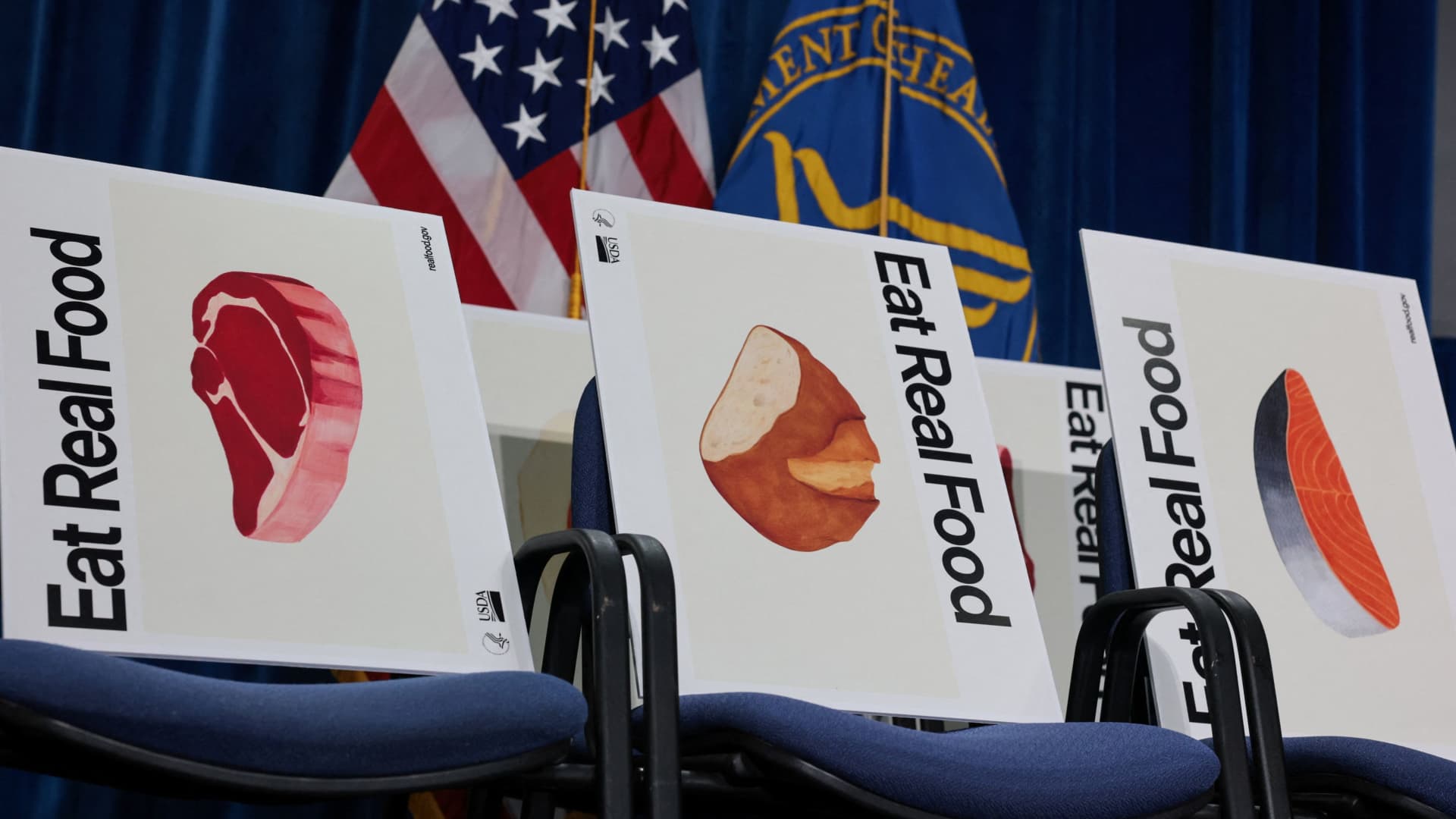
Attendees are greeted with”Eat Real Food” placards as they gather for U.S. Health and Human Services (HHS) Secretary Robert F. Kennedy, Jr. and Agriculture Secretary Brooke Rollins to announce new nutrition policies at the Department of Health and Human Services in Washington, D.C., U.S., January 8, 2026.
Jonathan Ernst | Reuters
The law bans several synthetic dyes, including Red 40 and Yellow 5, from most K-12 school meals and vending machines, while also restricting SNAP recipients from using benefits to buy products such as soda and candy.
Navigating the MAHA era
Many food companies aren’t waiting to see how policies evolve.
At a Goldman Sachs conference in May, Hershey said it has researchers in Texas conducting in-store interviews with shoppers who receive SNAP benefits to understand how purchasing behavior is shifting under new restrictions in the state.
“We’ve observed some consumer uncertainty at the register as new restrictions take effect,” a Hershey spokesperson told CNBC. “We anticipate this will improve as store execution improves, rules become clearer, and SNAP users can plan and budget with more certainty.”
The company is studying everything from product substitutions to budget tradeoffs, offering an early glimpse into how major food manufacturers are preparing for a potentially significant shift in consumer demand.
Many of the products most exposed to the changes are produced by some of the largest companies in the industry like Kraft Heinz, PepsiCo, Coca-Cola, General Mills, Nestle and others.
J.M. Smucker CEO Mark Smucker, however, told CNBC he expects the SNAP policy changes to have a more muted impact.
“I would say the current environment isn’t really that different than what we’ve seen over time, and thus far some of the modifications have really had no meaningful impact to our business,” he said.
Still, the company’s Hostess products like Twinkies and Donettes — the latter of which saw net sales grow 13% in the latest quarter, according to the company — may be impacted under broader state restrictions on “highly processed snacks.”
Current SNAP waivers in states like Texas focus primarily on candy and sugary drinks, not snack cakes. However, some states have proposed broader definitions that could eventually encompass packaged desserts and sweet baked goods.
At the same time, fewer Americans are even receiving the benefits. One analysis estimates 3.5 million people have lost their SNAP aid since President Donald Trump last year signed a sweeping bill that restricts eligibility for SNAP, among other changes.
Many U.S. households have found it harder to pay for groceries following the changes. The restrictions have also meant fewer dollars flowing to major businesses.
Walmart is particularly exposed to SNAP spending, capturing roughly a quarter of all SNAP grocery dollars nationwide, according to Numerator. Kroger, Costco and Amazon follow at about 8%, 6% and 5%, respectively.
The curbs on what consumers can buy with federal assistance are only one shift food companies are watching.
At a hearing of the Senate Committee on Health, Education, Labor and Pensions in April, Health and Human Services Secretary Robert F. Kennedy Jr. went as far as to say he “would support” a ban on junk-food television advertising. The department has not yet taken steps to introduce such a ban.
Responding both to Kennedy’s MAHA initiative and shifting consumer tastes, food manufacturers have also accelerated efforts to reformulate products and reduce synthetic ingredients in products like Kool-Aid, Fanta, Doritos and Flamin’ Hot Cheetos, which contain dyes like Red 40 and Yellow 5.
General Mills, Kraft Heinz and Target have all pledged to phase out certain artificial colors and additives by 2027 or sooner.
Nestle announced Monday it achieved its commitment on time to fully eliminate Food, Drug & Cosmetic colors from its U.S. food and beverage portfolio.

Business
Jio IPO: Meta, Google among 10 global investors that backed billionaire Mukesh Ambani’s digital giant

While Reliance Industries remains firmly in control with a 66.43% stake, the shareholder register reads like a who’s who of global technology, private equity and sovereign wealth investors, including Meta, Google, Saudi Arabia’s Public Investment Fund, KKR, Vista Equity Partners, Mubadala, General Atlantic, ADIA and TPG.
What makes the IPO particularly noteworthy is that none of these investors are selling shares in the offering. Jio’s proposed IPO consists entirely of a fresh issue of 27 crore shares, meaning the proceeds will flow directly to the company rather than existing shareholders.
Also read: Jio IPO: Spectrum acquisition, among 7 risks investors need to know about India’s largest offer
Among external investors, Meta affiliate Jaadhu Holdings is the largest shareholder with a 9.98% stake, owning 892.3 million shares. Google International LLC follows with a 7.73% holding comprising 690.9 million shares.

The next tier of investors includes Saudi Arabia’s Public Investment Fund, KKR-backed Omicron Asia Holdings II and Vista Equity Partners-backed VEPF VII AIV I, each holding 2.31% stake in the company.
Singapore-based SLP Redwood Holdings owns 1.88%, while Mubadala’s MIC Redwood 1 RSC holds 1.85%. General Atlantic Singapore JP owns 1.34%, followed by Abu Dhabi Investment Authority-backed Platinum Jasmine A 2018 Trust with 1.16%. TPG-managed India Markets Pte. Ltd. rounds out the top shareholder list with a 0.93% stake.The absence of an offer-for-sale means these investors are choosing to remain invested even as Jio enters the public markets. Instead of providing an exit to existing shareholders, the IPO is aimed at strengthening the company’s balance sheet and funding future growth.
What will Jio do with IPO proceeds?
According to the DRHP, Jio plans to use Rs 27,500 crore from the issue proceeds to prepay borrowings at Reliance Jio Infocomm, its key telecom subsidiary, with the balance earmarked for general corporate purposes.
The filing marks a significant milestone for Reliance Industries, nearly six years after Jio Platforms attracted more than Rs 1.5 lakh crore from global strategic and financial investors. Those backers are now set to become shareholders in a publicly listed company without reducing their stakes through the IPO.
Jio in numbers
The listing comes at a time when Jio’s operating performance remains strong. For FY26, Jio Platforms reported a consolidated net profit of Rs 30,064 crore on revenue from operations of nearly Rs 1.47 lakh crore. In wireless broadband, the company held a 49.95% market share as of March 31, according to the DRHP.
Jio continued to dominate India’s wireless broadband market with a 49.95% share as of March 31, according to its DRHP. Bharti Airtel followed with 35.13%, while Vodafone Idea and BSNL held 12.65% and 2.24%, respectively. The company said it serves 1.4 times more 4G and 5G subscribers than its nearest rival and added about 27 million net active mobility customers in FY26, nearly three times the additions recorded by the second-largest player.
Reliance Industries Chairman Mukesh Ambani said Jio’s proposed IPO would unlock significant value for existing shareholders while offering a compelling investment opportunity to new investors. The issue comprises a fresh issue of up to 27 crore shares.
Speaking at Reliance’s 49th Annual General Meeting, Ambani described the listing as an emotional milestone for the group and its shareholders. “The relationship Reliance shares with its shareholders is founded on pride, trust, respect and shared growth,” he said, adding that the IPO would demonstrate India’s ability to build technology companies with global scale, capabilities and value.
Ambani also highlighted Jio’s evolution from a telecom operator into a technology creator. “Before Jio, many believed that India could only import technology from the world. Our engineers proved otherwise. Today, Jio is not merely integrating technology. It is creating original technology,” he said, crediting thousands of Indian engineers for driving the company’s growth.
He further said that Reliance Jio Infocomm Chairman Akash Ambani, Reliance Retail Ventures Executive Director Isha Ambani Piramal and Reliance Industries Executive Director Anant Ambani will lead the IPO process.
(Disclaimer: Recommendations, suggestions, views and opinions given by the experts are their own. These do not represent the views of The Economic Times)

SharonAI Holdings: Two Billion In Contracts, One Quarter Of Proof
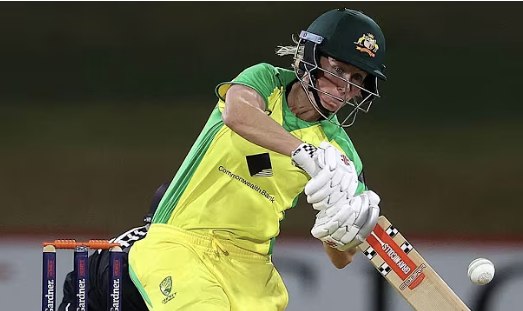
SOUTHAMPTON, England — Beth Mooney smashed a half-century but retired hurt as Australia completed a comfortable 98-run victory over the Netherlands to maintain their unbeaten start to the Women’s T20 World Cup.
The Scorecard
Mooney top-scored with 74 off 42 balls while Ash Gardner struck 58 off 32 and Georgia Wareham crashed an 18-ball 41 as Australia piled on 219-6, equaling the highest total at a Women’s T20 World Cup — a mark set by England against Sri Lanka earlier in the tournament. The Netherlands fell well short in reply, finishing at 121-3 after their 20 overs, as Australia secured the comprehensive win.
Mooney’s Injury Scare
Mooney’s afternoon ended prematurely after she pulled up while running between the wickets late in her innings. She pulled up after running two at the end of the 14th over and immediately left the field. She did not return to keep wicket due to back stiffness, adding a fresh injury concern for Australia just as the tournament reaches its business end.
With emergency wicketkeeper Phoebe Litchfield also absent due to a quad injury, Georgia Voll took the gloves in Mooney’s place. The 22-year-old was quickly involved, moving sharply across first slip to remove Phebe Molkenboer in the second over of the Netherlands innings, as Kim Garth struck twice in the powerplay to restrict the Netherlands to 27-2 after six overs.
An Already Stretched Australian Squad
Mooney’s injury adds to a growing list of fitness concerns that had already complicated Australia’s planning heading into the match. Litchfield’s injury was a curveball for Australia’s back-up wicketkeeper plans for the tournament, after they opted against naming a second full-time keeper in their 15-player squad alongside Mooney. NSW’s Tahlia Wilson is traveling with the squad as a reserve but could only be called in if another player was ruled out of the tournament entirely.
Gardner herself had only just returned to the side after missing the previous match against Bangladesh with a sprained ankle. Australia are waiting to make a call on Ashleigh Gardner’s availability for Saturday’s match after the all-rounder made a promising return to training on the eve of the fixture, training strongly at The Rose Bowl’s nursery ground on Friday. Ellyse Perry, discussing Gardner’s chances of playing, said before the match: “I think Ash is tracking really well. I think she got through what she needed to today. So, yeah, at this stage it looks good, but I’m sure there’ll be a few more things to assess before tomorrow’s match.”
A Dutch Fight That Fell Short
Despite the lopsided final margin, the Netherlands did not go down without a fight, with their captain delivering a milestone individual performance even in defeat. Netherlands captain Babette de Leede scored an unbeaten half-century of 56 off 57 balls in her 100th T20I appearance and shared a determined 96-run partnership with Sterre Kalis, who made 44 off 43 balls. Despite that resistance, Australia’s total was always out of reach for the Dutch side.
How Australia’s Innings Unfolded
Australia’s batting effort was built on a rapid start and several key partnerships throughout the innings. Mooney and Voll flew out of the blocks to bring up Australia’s 50 inside five overs before Iris Zwilling and Heather Siegers struck in quick succession to remove Voll and Ellyse Perry before the end of the powerplay.
The recovery and acceleration that followed came largely through the middle order. Mooney combined with Gardner, returning from her sprained ankle, for a 101-run third-wicket stand off 55 balls. Gardner departed two balls after Mooney, holing out to Kalis in the deep, but although wickets fell regularly in the final five overs, Wareham’s 41-run cameo, which included eight fours, powered Australia beyond 200.
Where Australia Stands in the Tournament
The victory keeps Australia firmly in contention near the top of their group as the tournament progresses. Heading into the match, Australia Women sat comfortably in second place in the Group 1 standings with a perfect record of two wins from two games, boasting a massive net run rate of plus 3.875 — a record they extended further with Saturday’s dominant performance.
A Difficult History With Injuries
Mooney’s latest fitness scare continues what has been a recurring theme throughout her career, with the wicketkeeper-batter having previously dealt with more serious injuries that sidelined her for extended stretches. Mooney has previously missed a Women’s Ashes series after sustaining a fractured jaw during a training session, an injury that required surgery and also threatened her availability for a subsequent 50-over World Cup. She has also been forced off the field with a knee injury during a Women’s Premier League debut in India.
Given that history, Australia’s medical staff will likely monitor her back stiffness closely in the coming days as the tournament moves toward its knockout stages, particularly given the absence of a true like-for-like backup wicketkeeper currently available within the touring squad beyond the injured Litchfield.
What Comes Next
With Australia having now further stretched their unbeaten run in the tournament, attention turns to the severity of Mooney’s back issue and whether she will be fit to keep wicket in the team’s upcoming fixtures. Given that Australia chose not to carry a second specialist wicketkeeper in their 15-player squad, any extended absence for Mooney would force the team to continue relying on makeshift solutions behind the stumps, as it did Saturday when Georgia Voll stepped in and immediately made an impact with the early wicket of Molkenboer.

InvestingPro’s Fair Value flagged Array Digital’s 45% decline


Spanish PM’s wife must stand trial on corruption charges, judge rules
Business
Free shares! NSE IPO DRHP reveals curious case of 5,000 shares landing in wrong demat account

One of them revolves around 5,000 NSE shares that the exchange alleges were erroneously credited to an individual’s demat account, triggering both civil and criminal proceedings.
According to the DRHP, NSE and Nuvama Wealth Finance filed a civil suit before the Delhi High Court against Kashmiri Lal Rana and NSDL in May 2025, alleging that 5,000 NSE shares were mistakenly transferred to Rana’s demat account on December 28, 2023, despite no corresponding purchase request or consideration being paid.
The exchange alleged that before the error was discovered, Rana had already sold 3,685 of those shares. NSE and Nuvama have sought a declaration that the transfer was void, recovery of Rs 1.43 crore representing the sale proceeds of the shares allegedly sold, and the return of the remaining shares.
Also read: NSE IPO: Nithin Kamath explains why India has few businesses like this ‘cash generating machine’
The dispute became more complicated after NSE’s 4:1 bonus issue in November 2024. The remaining 1,315 shares were entitled to 5,260 bonus shares. According to the DRHP, the Delhi High Court directed Rana not to sell or transfer the remaining shares, while NSDL was directed not to transfer the bonus shares during the pendency of the suit.
The exchange said Rana has denied the claims in his written statement, while the plaintiffs have filed a replication relying on what they describe as his admissions. The matter remains pending.
The Mauritius case
Separately, NSE disclosed that it had filed a criminal complaint against Rana. A first information report was registered in July 2025 at Mumbai’s Bandra-Kurla Complex Police Station alleging offences related to criminal breach of trust and cheating. According to the filing, NSE alleged that Rana knowingly retained the erroneously credited shares and sold 3,685 of them for Rs 1.327 crore. The matter remains pending.
Another legal matter disclosed in the DRHP relates to a petition filed before the Bombay High Court in May 2026 by an individual named Parinay Sharma against SEBI and NSE.
According to the filing, Sharma had earlier submitted a representation to SEBI alleging that certain investors in NSE had invested through Mauritius-based entities instead of direct investments and that beneficial ownership details of certain foreign shareholders had not been disclosed.
Read more: NSE IPO: BSE hosts double the listed companies but numbers tell a different story
The petition alleged that SEBI had not acted on the representation and sought, among other reliefs, a direction requiring NSE to disclose its promoter group and shareholders or ultimate beneficiaries along with KYC documents. The petitioner also sought a stay on NSE’s IPO process until the matter is finally decided. The DRHP states that the matter is currently pending before the court.
The NSE IPO is entirely an offer-for-sale (OFS) of up to 14.89 crore equity shares with a face value of Re 1 each, representing nearly 6% of NSE’s paid-up equity capital. The issue size has been fixed at 6% of the exchange’s paid-up capital.
NSE’s shares will be listed on BSE, mirroring the arrangement under which BSE‘s own shares are listed on NSE. With NSE’s valuation in the unlisted market hovering around Rs 5 lakh crore, market estimates suggest the IPO could be sized at roughly Rs 30,000 crore.
The filing marks the culmination of a listing process first initiated in December 2016, when NSE filed its first DRHP for a Rs 10,000-crore issue. The process was subsequently stalled due to the co-location controversy.
(Disclaimer: Recommendations, suggestions, views and opinions given by the experts are their own. These do not represent the views of The Economic Times)


Israeli fire kills five people in Gaza, including a child, medics say

Available for over a year
Capita chiefs promised MPs on the Public Accounts Committee it would fix long-running problems with its administration of one of the biggest pension schemes in the country by the end of this month.
Tens of thousands of retired and serving civil servants have been reporting long delays to payments, leading to serious financial hardship to pensioners and their families.
But Money Box has learned the deadline isn’t likely to be met. We speak to the chairman of the Public Accounts Committee about what happens next.
And cases of reported are still increasing. We explain how AI has become the latest weapon in the fraudsters’ armoury.
Also, holiday season is upon us. What can we do to minimise the hit from those annoying non-sterling transaction fees levied every time we use our plastic. A consumer expert shares his advice.

With SpaceX now trading publicly alongside Tesla for the first time in history, investors face a genuinely new decision: choosing between two Elon Musk-led companies that occupy very different points in their corporate life cycles, carry sharply different valuations relative to their current profitability, and may even end up merged into a single entity within the next year. Here’s what the numbers actually show.
Where the Two Stocks Stand Right Now
Tesla and SpaceX stock price comparisons are now a real public-market exercise, since SpaceX listed under the ticker SPCX on June 12, 2026. Tesla is a mature public stock; SpaceX is a newly listed public stock with fresh IPO momentum. The two companies attract similarly high investor attention, but they are being judged on entirely different criteria. Tesla is being judged on execution and margins. SpaceX is being judged on IPO demand, scarcity value, and whether its public valuation can be supported by long-term fundamentals.
That distinction showed up clearly in trading data following the listing. On June 16, 2026, Tesla’s stock experienced a decline of 1.6%, closing at $404.66. Meanwhile, SpaceX saw a significant surge, increasing nearly 5% to $201.80 per share. The market capitalization of SpaceX has now surpassed $2.6 trillion, compared to Tesla’s nearly $1.8 trillion.
The Valuation Gap Surprised Many Observers
Perhaps the most striking fact in this comparison is that SpaceX, a company with no history as a public stock until just over a week ago, has already surpassed Tesla in total market value. The targeted SpaceX valuation, somewhere between $1.75 trillion and $2 trillion, was notable because it would put SpaceX above Tesla on day one of trading. That range proved conservative — the rocket and satellite specialist’s market cap has since climbed well beyond even that ambitious target.
So how does a company that lost approximately $4.9 billion last year leapfrog an automaker generating more than $22 billion in quarterly revenue? The answer has less to do with rockets than with what the rockets put into orbit — namely, the combination of Starlink’s growing satellite internet business and the broader artificial intelligence ambitions now consolidated within the company following its merger with xAI.
Tesla’s Case: Profitability Pressure, but a Pivot Toward AI
Tesla’s bull case increasingly rests on a transformation story rather than its traditional electric vehicle business. Tesla’s soaring capital expenditures are projected to yield only $2.06 in earnings per share in 2026, resulting in a price-to-earnings ratio above 160 — a figure highlighting the market’s heavy reliance on future growth rather than current profitability.
That capital spending reflects a deliberate strategic shift. Tesla’s first-quarter 2026 results showed negative free cash flow as the company increased capital expenditure toward a guided $25 billion for the year, primarily for AI compute and robotaxi fleet infrastructure. First-quarter revenue rose 16% to $22.4 billion, but vehicle deliveries of 358,023 missed expectations, with management telling investors the company’s near-term focus is shifting away from pure vehicle volume growth.
The company also weathered its first full year of declining annual revenue. The electric vehicle and energy company just emerged from its first year of annual revenue decline, with 2025 sales falling for the first time in its history as a public company — a notable setback that has pushed analysts toward valuing Tesla increasingly on its autonomous driving and robotics ambitions rather than its traditional car business.
SpaceX’s Case: Scarcity, Starlink, and Unproven AI Bets
SpaceX’s bull case centers on different fundamentals entirely. SpaceX’s newly consolidated artificial intelligence segment, which folds in xAI following a February merger that valued the combined entity at $1.25 trillion, lost $6.4 billion in 2025 and another $2.5 billion in the first quarter. The company has said it expects to begin deploying orbital AI compute satellites “as early as 2028” — a timeline that places much of its AI ambitions several years into the future.
Critically, only a small fraction of SpaceX’s total shares are currently available for public trading, a dynamic that has amplified price swings in both directions. The successful IPO raised $75 billion and achieved a market cap exceeding $2.1 trillion, with less than 5% of shares available for trading, reflecting both strong insider confidence and intense market demand for the limited float available.
One analyst offered a blunt assessment of the disconnect between SpaceX’s current price and its underlying financials. The numbers at $200 per share do not independently justify the current price. SpaceX lost $4.9 billion in 2025 and $4.28 billion in Q1 2026 alone. Its only profitable segment, Starlink, is excellent, but even a generous standalone valuation for Starlink produces a fraction of the current market cap.
The Merger Wildcard
Perhaps the single biggest variable hanging over any comparison between the two stocks is the possibility that they may not remain separate investments for much longer. Wedbush analyst Dan Ives has put the probability of a confirmed Tesla-SpaceX merger at 80 to 90% for the first half of 2027 — a scenario that, while not confirmed and still firmly in the rumor category, has been treated as a live possibility by enough analysts that it belongs in any honest accounting of what could change the investment thesis for either stock.
Separate commentary has noted that a potential SpaceX-Tesla merger, while speculative, continues to attract institutional attention given SpaceX’s target valuation of approximately $1.75 trillion — a figure that, if a merger were to occur, could meaningfully reshape the combined entity’s overall risk and growth profile in ways that are difficult to predict from today’s vantage point.
Analyst Price Targets Reflect Genuine Disagreement
Wall Street’s formal coverage of both stocks shows a wide range of opinions, reflecting genuine uncertainty about how each company’s specific growth bets will play out. Third-party Tesla stock forecasts range from $364 to $600 as of early June 2026, reflecting disagreement over the pace and profitability of the company’s transition from a pure electric vehicle manufacturer toward AI and robotics.
For SpaceX, one valuation model places the company’s GF Value, a fair-value estimate, at $287.69 against a current trading price of $404.66 for Tesla specifically — suggesting Tesla itself may be roughly 41% overvalued by that particular methodology, even before factoring SpaceX into the comparison.
What “Both” Would Mean for an Investor
For investors considering holding both stocks rather than choosing one, it’s worth recognizing that both companies remain deeply intertwined through Musk’s leadership, overlapping technology bets in AI and robotics, and the looming possibility of an eventual corporate combination. That overlap means an investor holding both stocks is not necessarily achieving the diversification that holding two genuinely unrelated companies would typically provide — a consideration worth weighing given how closely both stocks’ near-term performance may end up tracking similar underlying catalysts, from AI infrastructure spending to Musk’s own public statements and strategic decisions.
The Bottom Line
There is no universal answer to which stock represents the better buy, and the dramatic disagreement among professional analysts — with Tesla price targets spanning from $364 to $600, and SpaceX’s valuation already exceeding even the high end of its own pre-IPO targets — reflects how genuinely unresolved the investment cases for both companies remain. Tesla offers a longer public track record but faces real questions about near-term profitability amid its costly AI and robotics pivot. SpaceX offers explosive growth potential tied to Starlink and orbital AI infrastructure but carries a valuation that, by several analysts’ own admission, isn’t yet supported by current financial results.
As with any investment decision, particularly one involving two stocks this volatile and this closely tied to a single individual’s leadership and public statements, it’s worth doing your own research, considering your personal risk tolerance and time horizon, and consulting a qualified financial advisor before making a decision — this overview is meant to lay out the facts and competing perspectives, not to tell you what to do with your money.
Business
Casemiro Seals Free Transfer to Inter Miami After Resurgent Final Season at Manchester United
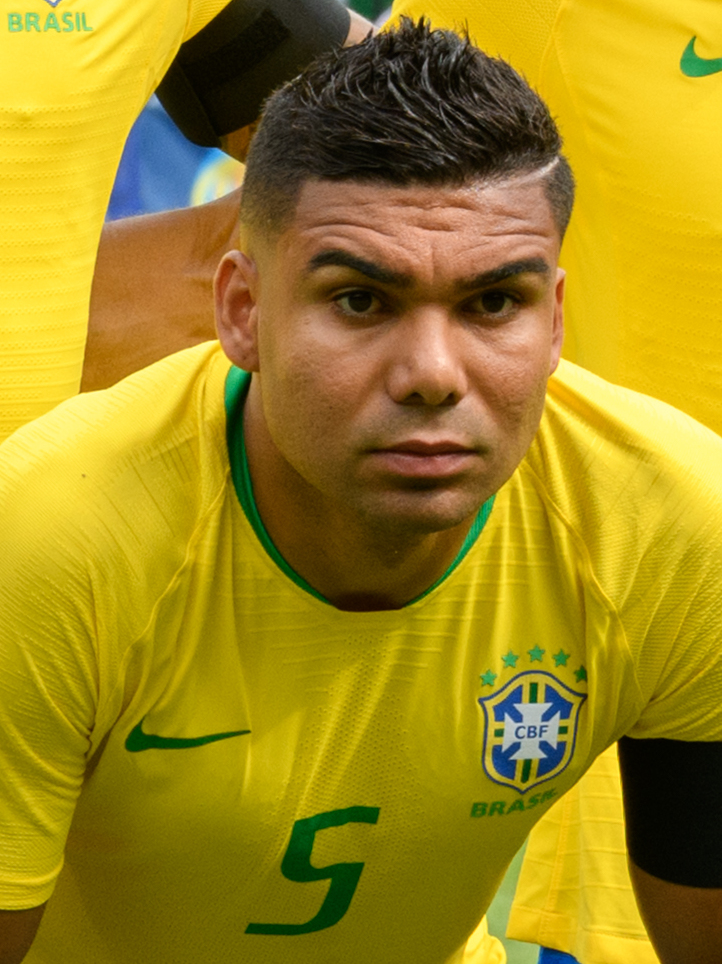
Manchester United midfielder Casemiro has agreed a free transfer to join Inter Miami after weeks of protracted negotiations, according to Fabrizio Romano. The move brings to a close one of the more eventful and ultimately triumphant chapters of the Brazilian’s career in English football, even as it follows months of speculation, financial wrangling, and competing offers from clubs across the globe.
🚨 EXCLUSIVE: Inter Miami complete deal to sign Casemiro as new midfielder, here we go!
Verbal agreement sealed with all parties involved and all formal steps resolved, now waiting to sign and announce the Brazilian.
Casemiro wants to play with Messi. Future in MLS. 🇺🇸 pic.twitter.com/gHty3SWAIM
— Fabrizio Romano (@FabrizioRomano) June 20, 2026
A Decision Reached Despite a Late-Season Surge
Despite a resurgence in performance under Michael Carrick, INEOS mutually decided with Casemiro against triggering a one-year extension in his contract. But the 34-year-old Brazilian made as strong a case as possible for this decision to be reversed in the second half of the campaign, spearheading the successful pursuit of Champions League qualification.
Alongside Kobbie Mainoo, brought back into the fold by Carrick, the pair formed the bedrock of United’s dramatic improvement under the interim boss — a far cry from the disjointed performances under Ruben Amorim earlier in the season. With the team restored to a more natural 4-2-3-1, Casemiro was given the platform to thrive, rather than be hindered by the impossible demands of the Portuguese tactician’s 3-4-2-1 system.
A Final Season Defined by Goals, Not Just Defense
It was not simply the defensive dominance the five-time Champions League winner has made his name for which was integral; rather, he showed a decisiveness in the final third which made him one of the most dangerous threats in the Premier League in the air. Five goals in the run-in from crosses into the box made United one of the most difficult sides to deal with from set-pieces, while his expansive forward passing — so often errant and misplaced under Amorim and Erik ten Hag — regained its accuracy.
In short, there were few midfielders as consistent and effective as Casemiro in 2026, leading the Old Trafford faithful to sing “One More Year” throughout every match of his superb swansong streak.
The Financial Calculus Behind the Departure
Casemiro’s mind was made up, however, as was United’s hierarchy, who were keen to remove the club’s most expensive salary — worth as high as £350,000 a week once the Champions League bonus kicked in — from the wage bill.
There was interest from Serie A, where the slower pace of Italian football would have suited aging legs, and Saudi Arabia, but it was the “American Dream” the Brazil international was intent on following. Miami shares a lot of cultural and geographical similarities with Brazil, making it an ideal early retirement home for a superstar footballer coming to the end of a glittering career.
Beating Out the Galaxy for Discovery Rights
The path to South Florida was not entirely straightforward, with a domestic MLS rival initially complicating Inter Miami’s pursuit. Inter Miami were always considered favorites to sign Casemiro once his contract in M16 expired, but rivals LA Galaxy retained “discovery rights,” giving them priority to agree a move.
In order to supplant this, Inter Miami would be forced to pay a compensatory fee, believed to be as high as £750,000, which was holding things up as the São Paulo native had already agreed personal terms with the Herons.
Romano Confirms the Breakthrough
That financial obstacle has now been resolved, with Romano confirming the deal is effectively complete. “EXCLUSIVE: Inter Miami complete deal to sign Casemiro as new midfielder, here we go! Verbal agreement sealed with all parties involved and all formal steps resolved, now waiting to sign and announce the Brazilian. Casemiro wants to play with Messi. Future in MLS,” Romano wrote.
The chance to play with Lionel Messi is said to have been a major draw for the former Real Madrid star, which may raise the immaculately manicured eyebrows of a certain Portuguese forward he used to play with.
A Reunion With an Old International Rival
Beyond the personal and lifestyle appeal of South Florida, the prospect of teaming up with Messi after years as rivals on the international stage carried particular significance for Casemiro. A move to Miami would facilitate a reunion between the Brazilian captain and his long-time international rival, with the David Beckham-owned franchise eager to find a long-term veteran presence in the middle of the park, viewing the Brazilian’s ability to control games as a perfect fit for Javier Mascherano’s tactical setup.
A Career That Began in Madrid and Ends in Manchester
Casemiro’s journey to Old Trafford carried significant pedigree, having arrived from one of the most decorated clubs in the sport’s history. Casemiro moved from Real Madrid, where he won three La Liga titles and the Champions League five times, to Manchester United, where he picked up just a League Cup and an FA Cup medal. Despite his lack of major trophies with the Red Devils, he established himself as a key member alongside captain Bruno Fernandes as the side secured Champions League football last season and finished the campaign with a flourish.
An Emotional Farewell at Old Trafford
Casemiro said farewell to United supporters following a 3-2 win against Nottingham Forest at Old Trafford as he prepares for the next step in his career, which Romano revealed to be a move across the Atlantic. Speaking earlier in the year about his decision to move on, Casemiro reflected on the affection he had received from the fanbase. “I am still enjoying it a lot [in Manchester],” Casemiro told The Athletic. “I believe the announcement is now done. It is huge, the affection that the fans have shown towards me. But I do really believe the decision is made and done. I am enjoying myself right now.”
Going Out on a High Note
It is rare for a footballer to go out on top, but that is exactly what Casemiro has done in leaving the Theatre of Dreams. Had he departed at the low points under Amorim or Ten Hag, the memory of his time in M16 would be a starkly different one to the emotional send-off he received against Nottingham Forest — and that explains why he is so full of praise for Carrick.
With the move now effectively sealed pending formal announcement, Casemiro is expected to officially complete his switch to Inter Miami following the conclusion of his contractual obligations at Manchester United. For United, the focus now shifts to identifying a successor capable of replicating Casemiro’s late-season influence in central midfield, with the club already known to be exploring several alternatives across the transfer market. For Inter Miami, the addition of a five-time Champions League winner alongside Messi represents a significant statement of intent as the club continues building a roster capable of competing for major honors in Major League Soccer and beyond.

Anthropic’s Claude Code Artifacts update brings live, shared dashboards and interactive workspaces to enterprises

Financial Rules to Follow Before Turning 40 | Build Wealth & Secure Your Future#motivation
Jio IPO: Meta, Google among 10 global investors that backed billionaire Mukesh Ambani’s digital giant


-

 Business6 days ago
No Jackpot Winner as $257 Million Prize Rolls Over to $269 Million Monday Draw
-
 Crypto World6 days ago
Zimbabwe Requires Crypto Businesses to Register Annually Under New FIU Regulations
-

 Fashion20 hours ago
Weekend Open Thread: Miami – Corporette.com
-
 Entertainment6 days ago
Matt Damon’s Viral Sci-Fi Thriller Has Taken Over HBO Max
-

 Tech6 days ago
As AI companies race to go public, who else is along for the ride?
-

 Business6 days ago
Anthropic staff to meet White House officials next week, Axios reports
-
 NewsBeat6 days ago
what doctors are seeing in ebike crashes
-
 Crypto World6 days ago
Bitcoin could crash to $48,000, if this historical pattern is triggered
-

 Entertainment7 days ago
Deion Sanders Shares Powerful Post After Viral Advice To Deiondra
-
 NewsBeat6 days ago
Warning of disruption as Cardiff Crossrail works to start
-
 NewsBeat6 days ago
Tributes to former deputy head teacher at Cambridge school among death and funeral notices
-

 Politics6 days ago
“Israel’s” ban on ICRC visits ruled illegal, but Knesset moves to stop them permanently
-

 News Videos6 days ago
Financial Accounting | Last Day Revision Strategy and Booster | CMA Inter – June 2026
-
 Entertainment6 days ago
Kate Middleton Glare Goes Viral After Kids Booed At Royal Event
-

 Tech6 days ago
Over 400 Arch Linux packages compromised to push rootkit, infostealer
-

 Crypto World6 days ago
XRP ETFs Outperform As Bitcoin And Ethereum Funds Extend Outflow Trend
-

 Business6 days ago
Invesco Quality Income Fund Q1 2026 Commentary
-

 NewsBeat6 days ago
Singer Oliver Tree dies aged 32 in helicopter crash in Brazil
-
 Crypto World6 days ago
Market Preview: SpaceX (SPCX) IPO Record, Federal Reserve Meeting, and Iran Nuclear Agreement
-

 Sports6 days ago
Dick Advocaat’s Curacao scores first-ever World Cup goal against Germany
You must be logged in to post a comment Login