
Security teams log 54% of successful attacks and alert on just 14%. The rest move through your environment unseen.
The Picus whitepaper shows how breach and attack simulation tests your SIEM and EDR rules so threats stop slipping by detection.





ON-PREM
The air turns brown when bit barns come to town … deep in the heart of Texas
Never mind the fact that datacenter environmental concerns have come under growing scrutiny across the United States. Microsoft has just inked a deal with fossil fuel giant Chevron to supply one of the largest single-capacity additions to its datacenter fleet with 2.67 gigawatts of natural gas power for a full two decades.
Chevron said today that it signed a two-decade power purchase agreement with Microsoft through its subsidiary Energy Forge One to supply 2.67 GW of power for a new datacenter project in West Texas dubbed Project Kilby. The natural gas turbines to be constructed on the datacenter’s site will sit behind-the-meter (Microsoft gets access to the power without it flowing through the grid first) and will be “among the largest co-located natural gas power and data center developments in the U.S.,” according to Chevron.
Microsoft’s own press release on the matter, which doesn’t mention Chevron or Energy Forge One by name but does admit the new facility “will operate with a co-located natural gas power facility,” identified Pecos as the West Texas location where the bit barn will be built. The self-proclaimed birthplace of the rodeo is also a West Texas hub for agriculture and ranching, among other Texas-sized industries.
Microsoft confirmed to The Register that, despite it not mentioning Chevron in the announcement, the power purchase agreement does concern the Pecos facility.
The facility will be “one of the largest single-capacity additions” to Microsoft’s datacenter fleet “in our history,” according to Redmond’s release, and the company is trying hard to lean into its desire to be a good neighbor to the people of Pecos as it spends the next few years building the massive facility.
“We know that being a good neighbor isn’t something you say,” Microsoft wrote in an open letter to the people of Pecos alongside its announcement of the new datacenter. “It’s something you prove over time.”
That letter and the announcement take pains to point out all the good things Microsoft has done for the communities where it plunked down massive datacenters, and it wants the locals to know that the Pecos facility will be no different. Why, the very fact it’s building multiple gigawatts of natural gas power for itself proves just that!
Building its own energy infrastructure, says Microsoft, will prevent locals from having to pay more for power. Additionally, the company anticipates eventually connecting its turbines to the grid and serving as a broader energy source, too.
According to Chevron, the turbines being deployed for the Pecos datacenter include noise and light impact mitigations as well as “selective catalytic reduction” systems that reduce nitrogen oxide emissions. Not eliminate, mind you – just reduce.
To get an idea of the scale of what Microsoft is planning to deploy with Chevron in Pecos, let’s consider the gas turbine generators that xAI’s Colossus AI datacenter installed in Memphis, Tennessee. That facility saw the installation of just 150 megawatts of gas turbines – roughly one eighteenth the size of Microsoft’s planned Pecos gas plant.
Even at that small a scale, the xAI datacenter has still become the subject of a lawsuit [PDF] alleging that the facility is belching way too much smog into local communities for the air to be healthy and calling for it to be shut down. Emissions mitigations or not, one can’t imagine the prairie sky around the Pecos datacenter will be as clear and high as it once was after the facility is completed.
It’s worth pointing out that some of the turbines being deployed to Pecos will be manufactured by the deceptively named Solar Turbines, which actually builds gas power systems. According to reports and photographs out of the xAI Memphis facility, Solar Turbines also supplied gas turbines for Colossus.
Then there’s the water concerns: Microsoft and Chevron both called attention to their plans to minimize water usage in Pecos, which lies in a part of Texas prone to drought and with limited access to fresh, potable water.
“We are also designing our operations to minimize reliance on freshwater sources by utilizing nonpotable water where possible,” Microsoft noted. The company will rely on closed-loop cooling systems that will “significantly reduce water requirements.”
As for the gas plant planned for the site, Chevron said that its facility will use “non-potable, brackish groundwater sources for power plant operations” instead of freshwater, but that doesn’t tell the whole story.
Brackish groundwater, located in massive, salty, underground aquifers, is a major source of water for dry, dusty West Texas, and has been for some time. Desalination of brackish groundwater has been suggested [PDF] as a source of drinking water for the town and the surrounding region, raising questions about whether datacenters and gas power plants sucking it up to cool their jets are sustainable.
Microsoft didn’t want to answer any of the questions we put to it aside from confirming Chevron’s press release related to the Pecos datacenter; Chevron didn’t respond. ®

Oracle disclosed Monday that it has reduced its workforce by 21,000 employees over the past 12 months, a decline of 13%, which means more cuts than was previously known, including jobs eliminated because of AI. “The adoption and deployment of AI technologies across our operations have resulted, and may continue to result, in reductions to our workforce,” the company said in an annual financial regulatory filing.
The revelation puts new numbers to what feels to many in the tech industry like an epidemic: companies reporting record revenues while simultaneously culling their workforces, pointing to AI as both the engine of growth and the reason for the cuts. Tech layoffs hit their highest single month in years in May, and AI was the most-cited reason, according to outplacement firm Challenger, Gray & Christmas.
We recently wrote about why that rationale is something companies may want to rethink, not least because for many of these companies, the headcount they’re now cutting was hired during the pandemic hiring surge, raising questions about what’s really going on. Below, a running look — in reverse chronological order — at the bigger tech companies that have announced significant layoffs this year with AI as a stated factor.
GitLab — June 3, 2026. In one of the most recent cuts on this list, GitLab laid off roughly 350 workers, about 14% of its staff, to fund AI infrastructure investment and handle surging traffic from AI workflows. CEO Bill Staples said agentic workloads are “pushing competitors to the brink” and that the company had begun a “generational rebuild” of its core infrastructure to support what he called 100x growth requirements. GitLab is exiting 22 countries, flattening management layers, and partnering with an unspecified AI lab to rebuild its platform for agent-scale workloads. The company reported first-quarter revenue of $264 million, up 23% year-over-year, and expects to incur $30 to $35 million in restructuring costs.
Google — ongoing through May. Alphabet’s Google has quietly cut employees across its Cloud division, including its Threat Intelligence Group and Mandiant-linked cybersecurity staff, even as Cloud revenue grew 63% to exceed $20 billion for the first time and its backlog nearly doubled to over $460 billion. Over the past year, Google has cut more than a third of the managers overseeing small teams — 35% fewer managers with fewer direct reports. Unlike most companies on this list, Google has never announced a single overall number — the cuts have come through a rolling performance review process, a voluntary buyout program, and structural reorganizations, with outside estimates putting the 2026 total at between 1,500 and 3,000+ engineers.
Intuit — May 20, 2026. Intuit announced plans to eliminate roughly 3,000 jobs — about 17% of its total workforce — in a restructuring centered on reducing complexity and reallocating resources toward AI. CEO Sasan Goodarzi reportedly told staff the company is reducing complexity and simplifying the structure, so it can deliver better products.
Meta — May 20-21, 2026. Meta laid off about 8,000 employees, roughly 10% of its workforce, while moving about 7,000 employees into new AI-focused roles (that they reportedly hate). Zuckerberg told staff the cuts were necessary because “success isn’t a given” in AI.
Cisco — May 14, 2026. Cisco announced it’s cutting nearly 4,000 jobs, about 5% of its workforce, despite reporting better-than-expected profit and revenue. CFO Mark Patterson said: “This was really not a savings-driven restructure… this is more [about] realigning … resources around silicon, optics, security and AI.”
Cloudflare — May 7-8, 2026. Cloudflare cut about 20% of its workforce (1,100 people), reporting quarterly revenue of $639.8 million, up 34% year-over-year and the highest single quarter in company history. CEO Matthew Prince wrote that “the vast majority of those we laid off last week were measurers” — middle management, finance, legal, internal auditing, and revenue recognition.
General Motors — May 12, 2026. GM eliminated 500 to 600 jobs, largely in IT roles in Austin, Texas, and Warren, Michigan, saying it was reevaluating its workforce needs amid uncertain market conditions. A person familiar with the cuts told CNBC that AI played a role in the decision but that it wasn’t the only reason. GM’s statement said it was “transforming its Information Technology organization to better position the company for the future.” Despite the cuts, the company still had roughly 80 open IT positions, including roles in AI, motorsports, and autonomous vehicles.
Coinbase — May 5, 2026. The crypto exchange said it was cutting about 700 employees, or 14% of its staff, as part of a restructuring aimed at addressing market volatility and increasing AI efficiency. The company flattened its organizational structure to five layers below the CEO and COO, and said it would experiment with “one-person teams” combining engineering, design, and product roles. CEO Brian Armstrong wrote that AI had changed the pace of work dramatically — “engineers use AI to ship in days what used to take a team weeks” — and that the company needed to “leverage AI across every facet of our jobs.”
PayPal — May 5, 2026. PayPal announced plans to cut around 20% of its workforce over the next two to three years — north of 4,500 jobs — as part of a turnaround strategy centered on AI adoption and organizational simplification. CEO Enrique Lores told investors the company would “aggressively adopt AI” in its development processes and formed a new “AI transformation and simplification” team reporting directly to him, tasked with redesigning the company’s processes “function by function.” Lores framed the cuts as removing organizational layers, and said AI would extend well beyond coding into customer service, support operations, and risk management.
Microsoft — April-May 2026. Microsoft offered buyouts structured as voluntary separations, without disclosing how many employees these would impact. CFO Amy Hood said total headcount declined year-over-year in fiscal Q3, and is expected to keep declining as the company focuses on “building high-performing teams that operate with pace and agility” amid rising AI investment.
Snap — April 16, 2026. Snap cut roughly 16% of its global workforce — about 1,000 full-time employees — and closed more than 300 open roles, with CEO Evan Spiegel citing AI advancements as a key driver. “Rapid advancements in artificial intelligence enable our teams to reduce repetitive work, increase velocity, and better support our community, partners, and advertisers,” Spiegel wrote in a memo filed with the SEC. The company said it had already seen small squads using AI tools to drive progress across Snapchat+, ad platform performance, and infrastructure efficiency.
IBM — rolling through 2026. Between Q4 2025 cuts and April 2026 Red Hat engineering reductions, estimates range from 3,000 to 9,000 U.S. positions eliminated, bringing IBM’s cumulative total since September 2024 above 15,000. Bloomberg reported IBM plans to triple its U.S. entry-level hiring for AI and hybrid-cloud roles, even as roughly 200 HR positions were replaced by AI agents. An IBM spokesperson described the Q4 2025 round as a routine rebalancing affecting “a low single-digit percentage” of its global workforce.
Atlassian — March 11, 2026. Atlassian cut about 1,600 jobs (10% of its workforce) to “rebalance” toward AI and enterprise sales, even as shares rose nearly 2% on the news. CEO Mike Cannon-Brookes said: “Our approach is not ‘AI replaces people.’ But it would be disingenuous to pretend AI doesn’t change the mix of skills we need or the number of roles required in certain areas. It does.”
Dell — Jan 30 (though disclosed in March 2026). Dell’s total workforce fell about 10% in fiscal 2026 — roughly 11,000 jobs — to about 97,000 employees from 108,000 a year earlier, with $569 million spent on severance. The cuts came as Dell projected its AI-optimized server revenue could double in fiscal 2027.
Oracle — March 5-31, 2026. As noted above, Oracle began telling employees it would be cutting thousands of jobs via terminal emails. The cuts came even as Oracle posted $3.7 billion in quarterly net income, up 27% year-over-year, with remaining performance obligations up 325% to $553 billion — savings redirected toward AI data centers. The cuts that would later total 21,000 over 12 months, as Oracle disclosed in its June 22 annual filing.
Block — February 26-27, 2026. Jack Dorsey’s Block cut 4,000 jobs — nearly half its workforce, down to under 6,000 from over 10,000. Dorsey wrote on X: “We’re already seeing that the intelligence tools we’re creating and using, paired with smaller and flatter teams, are enabling a new way of working which fundamentally changes what it means to build and run a company.” He added: “I think most companies are late. Within the next year, I believe the majority of companies will reach the same conclusion and make similar structural changes.”
Salesforce — February 10, 2026. Salesforce laid off fewer than 1,000 employees across marketing, product management, data analytics, and its Agentforce AI unit. The company told Fortune, “Because of the benefits and efficiencies of Agentforce, we’ve seen the number of support cases we handle decline and we no longer need to actively backfill support engineer roles.” This followed an earlier cut of about 4,000 customer-support roles, shrinking that team from roughly 9,000 to 5,000, with CEO Marc Benioff saying the company needed “less heads” because AI agents handle the work.
Amazon — January 28, 2026. Amazon cut 16,000 corporate jobs, following 14,000 cuts in October 2025 — about 9% of its corporate workforce in three months. The company said it was part of “strengthen[ing] our organization by reducing layers, increasing ownership, and removing bureaucracy.” CEO Andy Jassy had said in June 2025 that, “As we roll out more generative AI and agents, it should change the way our work is done. We will need fewer people doing some of the jobs that are being done today… in the next few years, we expect that this will reduce our total corporate workforce as we get efficiency gains from using AI extensively across the company.”
When you purchase through links in our articles, we may earn a small commission. This doesn’t affect our editorial independence.


An ongoing malware campaign is targeting WhatsApp users in multiple countries with deceptive messages that push VBScript files, leading to remote system access.
The threat actor is using file names that indicate business and financial documents delivered by the victim’s contacts, whose accounts had been compromised.
By downloading and executing the malicious attachments, the recipient starts an infection chain that leads to installing the legitimate ManageEngine Endpoint Central, which is used by IT administrators to manage systems from a centralized dashboard.
Telemetry data from cybersecurity company Kaspersky shows that the campaign spreads across Brazil, India, Mexico, Singapore, the UK, Spain, Taiwan, Australia, Russia, Vietnam, and Malaysia.
Kaspersky reports that the attacks begin with messages sent from compromised accounts that contain nothing but a heavily obfuscated VBS file.
These files are given names that make them appear to be financial reports, billing statements, account notices, and similar documents likely to draw the target’s attention and prompt them to open the file.
The filenames are also localized in multiple languages, further confirming the campaign’s global reach.
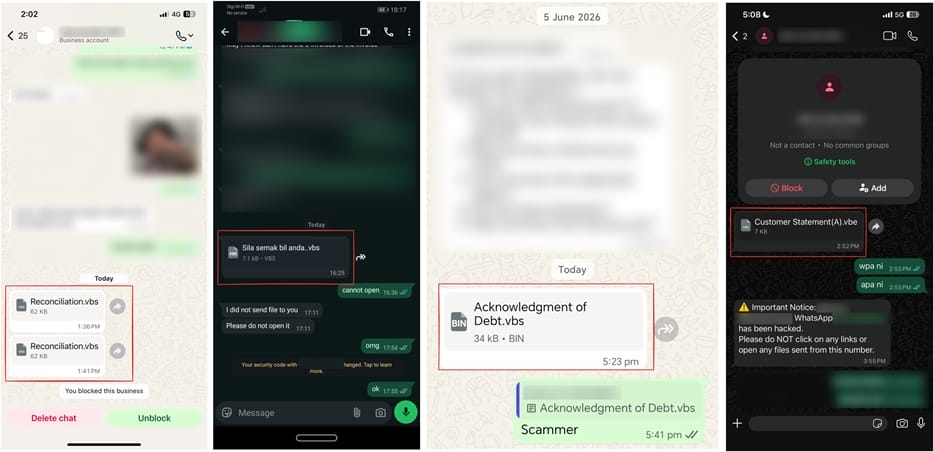
“Based on evidence collected from multiple victims through social media reports and submitted samples, we can conclude that the threat actor had gained access to several WhatsApp accounts and used them to distribute the malicious VBScript files to contacts on the compromised users’ contact lists,” Kaspersky explains.
“At the time of writing, the exact method used to compromise these WhatsApp accounts remains unknown.”
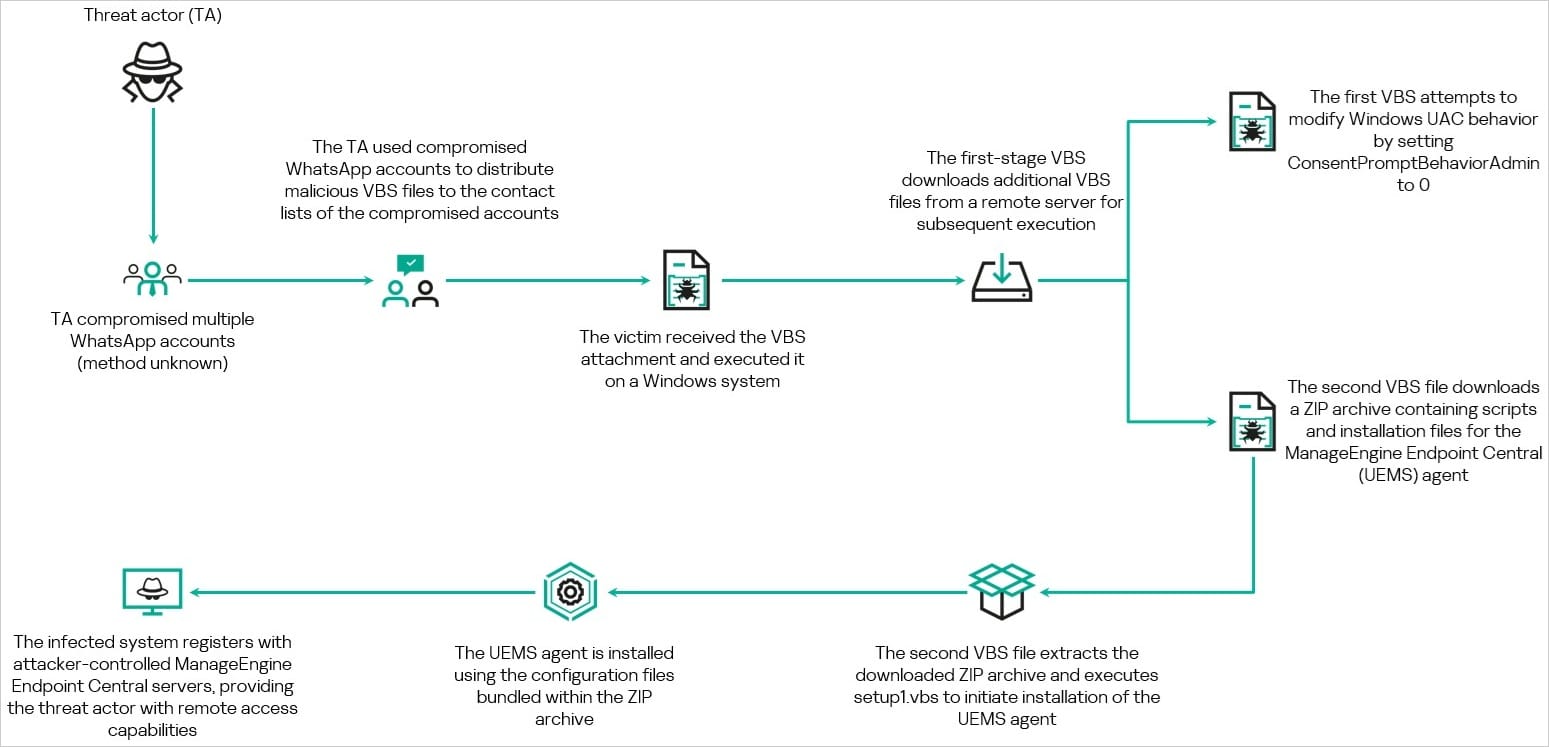
If the victim downloads and opens the file on Windows, the VBScript fetches two additional scripts from the attacker’s infrastructure, which, in turn, disable UAC protections through Registry modifications and download a ZIP archive containing the ManageEngine Endpoint Central program.

The software is silently installed in the background and configured to connect to attacker-controlled management servers, giving them remote administration access on the victim’s computer.
Kaspersky notes that when the initial VBScript file is delivered via WhatsApp Web, it must be downloaded, but when opened in the WhatsApp Desktop client, it can be executed directly via Windows Script Host (wscript.exe).
While Kaspersky does not attribute the attacks to a specific threat actor, the researchers found signs of Chinese language use and infrastructure overlap with IPs previously associated with ValleyRAT and Gh0st RAT activity.
However, there is insufficient evidence for high-confidence attribution to be possible.
WhatsApp users are advised to treat files sent by contacts, even trusted ones, with caution and to always verify them through secondary means.
All downloaded files should be scanned with an up-to-date antivirus before executing them.

Security teams log 54% of successful attacks and alert on just 14%. The rest move through your environment unseen.
The Picus whitepaper shows how breach and attack simulation tests your SIEM and EDR rules so threats stop slipping by detection.


Presented by Splunk
Every day, organizations learn things their AI systems never get to use.
A security analyst corrects an AI-generated investigation. A network engineer identifies the root cause of a recurring outage. An observability team discovers that a pattern of latency, logs and infrastructure changes predicts service degradation. A customer operations team learns which signals indicate an escalation is likely.
Each moment contains valuable organizational knowledge. But in most enterprises, that knowledge disappears into tickets, dashboards, chat threads, post-incident reviews and the minds of individual experts. It may help solve the immediate problem, but it rarely becomes part of a reusable system that improves future AI-driven decisions.
That is the next challenge for the agentic enterprise.
The future will not be defined simply by who has the most capable model or the most autonomous agents. Many organizations will have access to similar frontier models. Many will deploy agents across security, IT, engineering, customer service, and business operations.
The real differentiator will be whether those agents can learn from the organization around them.
Not by constantly retraining the underlying model, but by capturing operational experience, converting it into institutional knowledge and making that knowledge available to future agents, workflows, and decisions.
The agentic enterprise is not just an enterprise that uses AI. It is an enterprise that learns through AI.
The AI conversation has been dominated by model capability: larger context windows, better reasoning, faster inference, stronger tool use, and more sophisticated agentic behavior.
Those advances matter. But in the enterprise, a model is only one part of the system.
A model does not automatically know how a specific organization operates. It does not inherently know which remediation step solved last month’s outage, which analyst correction improved a threat investigation, which network signal preceded a service disruption, or which internal policy should override an otherwise plausible recommendation.
That knowledge belongs to the enterprise.
For agentic systems to improve, organizations need a way to capture that knowledge and make it reusable. In many cases, that does not require changing the model itself. It requires changing the ecosystem around the model: the knowledge base, retrieval layer, prompts, policies, guardrails, routing logic and workflows that shape how agents behave.
The model may remain the same. The learning system around it becomes smarter.
Every agentic workflow creates signals.
An agent receives a request. It retrieves context, reasonsthrough possible actions, calls tools, and generates answers. A human accepts, rejects, or modifies that answer. Downstream systems reveal whether the action worked.
That entire chain is valuable.
AI observability gives organizations visibility into what happened: the prompt, response, reasoning path, tool calls, data sources, intermediate steps, failure modes and outcomes. Without that visibility, organizations cannot understand why an agent behaved the way it did, let alone improve it.
But observability alone is not enough.
The larger opportunity is to turn observed behavior into institutional knowledge. A trace should not only help a developer and operators debug an agent. It should help the enterprise understand what the agent learned, what the human corrected, what outcome followed, and what should change before the next similar event.
That is the shift from monitoring AI to teaching AI.
In the agentic enterprise, feedback loops connect action to outcome, outcome to knowledge and knowledge back to future action.
Consider a service experiencing intermittent degradation.
An observability agent detects unusual latency and error rates. A network agent identifies packet loss across a specific path. A security agent notices that the same time window includes suspicious authentication behavior and unusual traffic from a previously unseen source.
Individually, each agent has only a partial view. Together, they create a richer operational picture.
The first time this incident occurs, human experts may need to intervene. A network engineer confirms that packet loss was caused by a misconfigured routing change. A security analyst determines that the suspicious traffic was not an attack, but a side effect of a misrouted internal service. An SRE connects the network event to the application degradation.
That resolution contains knowledge the organization should not have to relearn.
A mature agentic learning system would capture the traces, human corrections, topology context, security findings, observability signals and final remediation steps. It would preserve the relationship between those signals: latency pattern, network path, identity behavior, routing change and remediation.
The next time a similar pattern appears, agents would not start from zero. They could retrieve the prior case, compare current conditions, recommend the proven diagnostic path and escalate with better context.
The underlying frontier model did not need to be retrained.
The enterprise learned.
A learning-oriented agentic enterprise needs more than a model or chatbot. It needs an architecture that can capture experience, turn it into usable knowledge, connect that knowledge to operational context, and govern how it changes future agent behavior.
Memory preserves what happened: what the agent saw, what it did, where humans intervened, and what outcomes followed.
Knowledge bases turn that experience into reusable guidance, including playbooks, examples, policies, procedures, and evidence.
A data fabric connects the operational environment. The signals agents need live across logs, metrics, traces, tickets, identity systems, security tools, network telemetry, collaboration platforms, and business applications. A data fabric makes those signals discoverable, correlated, governed, and usable in context.
AI observability explains how agents behave by capturing prompts, tool calls, intermediate steps, responses, feedback, and outcomes. That visibility helps organizations understand where agents succeed, where they fail, and what should improve.
The control plane governs how learning becomes change: what knowledge is promoted, which prompts or policies are updated, which agents can use new information, what approvals are required, and how changes are audited.
Together, these capabilities allow AI systems to improve over time in a controlled, trustworthy way that allows the enterprise to learn from its own operations.
The next era of AI will not be won by models alone. It will be won by organizations that can capture what they learn from every workflow, expert correction, incident, investigation, and outcome.
The most advanced agentic enterprises will not simply deploy more agents. They will build systems that allow every agent to benefit from the collective knowledge of the organization.
That means connecting operational data through a data fabric. It means observing agent behavior deeply enough to understand it. It means preserving experience in memory and institutionalizing it in knowledge bases. It means using a control plane to govern how learning changes agent behavior.
The future of AI is not a single autonomous agent acting alone. It is an ecosystem of agents, humans, data and controls that learns over time.
The organizations that build that ecosystem will create AI systems that get better with every interaction. Not because the model is constantly changing, but because the enterprise itself is becoming more intelligent.
Learn more about how Cisco Data Fabric powered by the Splunk Platform is accelerating agentic operations.
Hao Yang is Vice President AI at Splunk, a Cisco Company.
Sponsored articles are content produced by a company that is either paying for the post or has a business relationship with VentureBeat, and they’re always clearly marked. For more information, contact sales@venturebeat.com.
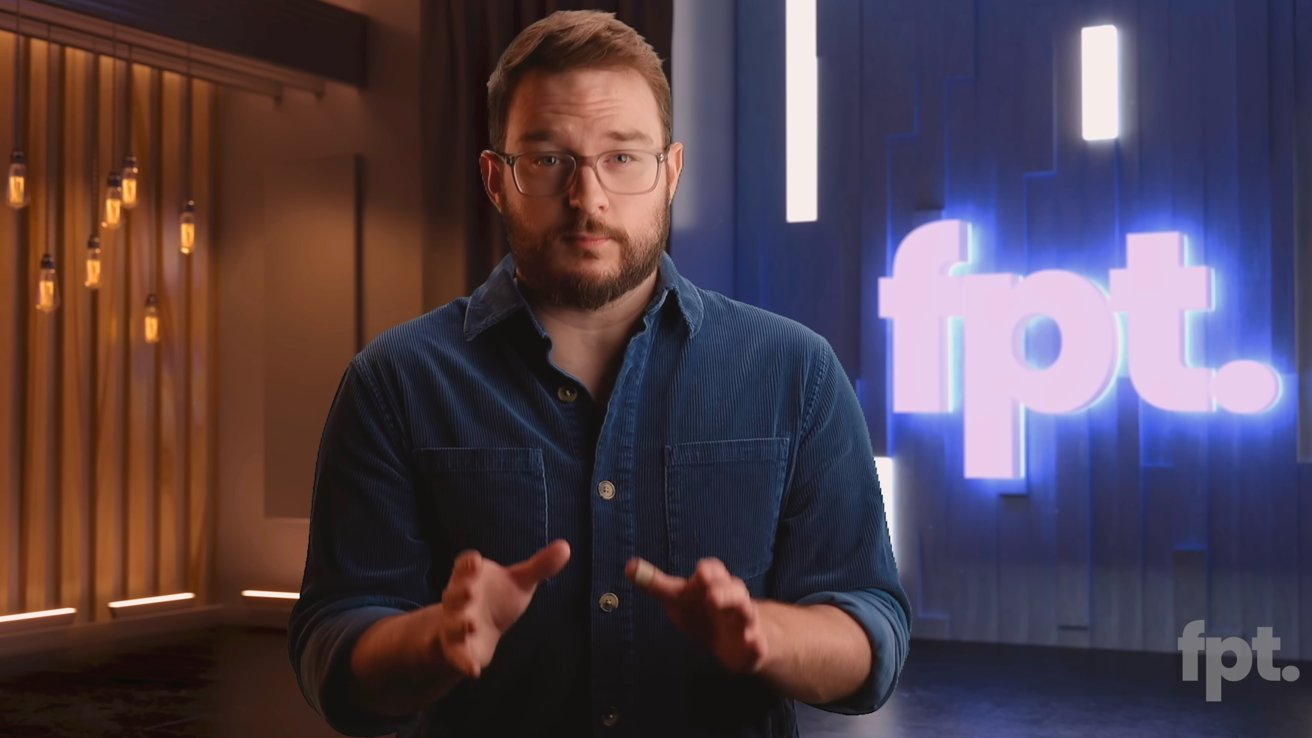
A July 2025 lawsuit by Apple against leaker Jon Prosser resulted in a default ruling, but that default has been set aside as Prosser has finally agreed to participate in discovery.
A rumor video posted by Jon Prosser in early 2025 suggested that he had seen the upcoming transparent UI design. Later, a lawsuit from Apple accused Prosser of conspiring with Michael Ramacciotti to steal secret contents of a test device owned by Ethan Lipnik.
Prosser didn’t respond to Apple’s July 2025 lawsuit, which led to a default judgement, but now that default has been set aside by the judge. This occurred at Apple’s and Prosser’s lawyers’ request on June 10.
Apple didn’t share its exact reasoning for giving Prosser a break here, as the default judgement would go in Apple’s favor. However, it seems that discovery could uncover more details about what occurred, which could lead to more harsh results.
Basically, it seems Apple wants the Prosser case to serve as a warning.
The order signed by the judge says that Prosser must produce all materials by June 9 and sit for deposition by June 16. Since both of those days have passed, those things surely have already taken place.
The judge also says Prosser has ten days from June 22 to file a responsive pleading to Apple’s complaint. It is unclear how Prosser might choose to plead given the circumstances.
In the time since the lawsuit began, Prosser has continued to post videos about Apple leaks. The most recent video was posted on June 17, so after his deposition date.
Prosser used to be a more trusted leaker, but has seemingly fallen into the habit of repeating other rumors rather than having his own sources. For example, the latest video on iPhone Fold is compelling, but lacks any new details or leaks.

There is a mysterious phenomenon in which strong radio signals arrive periodically from space, yet their source remains completely unknown. Known as “long-period radio transients” (LPTs), these phenomena are observed as radio bursts that repeat at intervals ranging from several minutes to several hours. Only a dozen or so examples have been discovered within the Milky Way, and their physical nature has long remained a mystery.
Previous research has suggested that candidates for the source of LPTs include neutron stars known as magnetars, which rotate extremely slowly, and binary systems consisting of white dwarfs with companion stars. However, the magnetar hypothesis faces the problem of contradicting existing theoretical models.
On the other hand, while a few cases suggesting a connection to white dwarf binaries have been reported, there had been no cases in which the accretion process was directly confirmed to be actually occurring.
Against this backdrop, an international research team led by the University of Sydney in Australia conducted a sky-survey using the Australian Square Kilometer Array Pathfinder (ASKAP) radio telescope and identified the true nature of a mysterious object named ASKAP J174508.9-505149. These observational results are said to be the strongest evidence to date pointing to LPT as one of the sources of this phenomenon.
“For the first time we have pinpointed the origin of these signals,” said Kovi Rose, a doctoral student at the University of Sydney’s School of Physics and the Commonwealth Scientific and Industrial Research Organization, in a press release. “We’ve been able to show that the source for one of these transients comes from a white dwarf actively pulling material from a companion star.”
Rose and his research team confirmed through spectroscopic observations that ASKAP J1745-5051 exhibits hydrogen emission lines (the Balmer series) and helium emission lines (HeI and HeII). In particular, the strong HeII emission line is known as an optical feature characteristic of “magnetic cataclysmic variables.”
Cataclysmic variables is a general term for close binary systems in which a white dwarf accretes matter from a companion star. Among these, those in which the white dwarf possesses a strong magnetic field and gas accretes along magnetic field lines are called “magnetic cataclysmic variables.”
Furthermore, analysis of the radial velocities of the Balmer series emission lines revealed that the orbital period of this binary system is approximately 1.368 hours, which was confirmed to match the repetition period of the radio pulses, approximately 1.345 hours. Furthermore, based on the orbital period, the companion star’s mass was estimated to be approximately 0.096 times that of the sun, and its radius approximately 0.13 times that of the sun, indicating that it corresponds to an M6-class red dwarf.
In other words, ASKAP J1745-5051 is a binary system in which a white dwarf and a red dwarf orbit each other at an extremely close distance. A white dwarf is the high-density remnant of a star that has reached the end of its life; although it is about the size of Earth, its mass is comparable to that of the sun. Its companion, the red dwarf, is larger but less dense, with a mass of only about one-tenth that of the Sun. The two stars orbit each other in a short period of just over one hour.
These observations have revealed that radio bursts and x-ray emissions are generated by different mechanisms. When the white dwarf accretes gas from its companion, that gas is heated and emits x-rays. At the same time, powerful radio bursts occur in the region where the magnetic fields of the two stars interact. However, since the peaks of the radio and x-ray emissions do not coincide, it is believed that they are generated at different locations within the system.
Regarding x-rays, data from the Chinese Academy of Sciences’ Einstein Probe observation satellite revealed radiation with a period of approximately 1.32 hours. According to the researchers, the large amplitude of the x-ray fluctuations suggests that the accretion rate onto the white dwarf is likely changing over time.


Valve Software abruptly opened reservations for its latest Steam Machine on Monday, but due to the ongoing PC component shortage, did so at a significantly higher price than expected.
The company, headquartered in Bellevue, Wash., first announced the new version of the Steam Machine late last year. It’s a small-scale, high-powered gaming PC that’s designed for your living room, which runs the same Linux-based SteamOS as Valve’s Steam Deck.
The 2026 Steam Machine starts at a whopping $1,049 through Valve’s digital storefront Steam, which gets you the base model with an internal 512GB SSD. A higher-end model with a 2TB drive costs $1,349, and both also come in bundles with one of Valve’s new Steam Controllers.
It is, on paper, an impressive overall device, particularly as a sort of gateway product for anyone who’d like to break into gaming on PCs and/or Linux. However, its price tag is a significant barrier. A comparatively powerful PC would still cost as much or more, but Valve’s old strategy with the Steam Deck, by comparison, was to practically give it away.
As it turns out, Valve isn’t particularly happy about the price either, preemptively addressing concerns via a post on the official Steam blog. The short version is that the planned launch of the Machine has been complicated by the ongoing component crisis that surrounds SSDs and RAM.
The prices “reflect the state of the world for manufacturing; or, more accurately, it reflects the price of the components as we’ve secured them over the past 6 months,” the company said in the post.
The two Steam Machine models’ internal storage capacity is the only difference between them. Both are gaming PCs that pack “semi-custom” AMD CPUs and GPUs, 16 GB RAM, Bluetooth capability, an ethernet port, and a MicroSD card slot into a 6” black cube, complete with a removable faceplate.

The high cost of entry for the Steam Machine is another knock-on effect from the ongoing global RAM and SSD shortages, which were initially created by high demand from the burgeoning AI industry. The same problems have resulted in multiple price hikes for current-generation gaming consoles and spiked the costs for new-built gaming PCs. It’s been a bad time for the hobby overall, especially for newcomers and players on a budget.
The Machine isn’t likely to fail, but its costs may mean that for the time being, it turns into little more than an expensive toy for gadgetheads. One of Valve’s quiet ambitions for years has been to bring more people into PC gaming, and especially PC gaming on Linux, but for a thousand bucks a throw, the Machine isn’t likely to draw in any new customers.
That suggests that if a company like Valve, which controls roughly half the PC gaming on Earth via Steam, is having problems like this, then it’s wise to expect further disruption for the foreseeable future. Xbox in particular was talking about launching a new console at the end of 2027, but with RAM and SSD costs on the rise, it looks like the next generation of hardware will either be prohibitively expensive or best pushed off for a few years.
As with the Deck, you get games onto the Machine via direct download from Valve’s digital storefront Steam. Also as with the Deck, the Machine is designed so it can also be used as a desktop computer, with no particular guardrails to keep out tinkerers and modders.
Even with their high cost, and with a lower number of available units at launch than Valve had planned, the 2026 Steam Machine was already listed as “out of stock” within 10 minutes of the store page opening, which was before Valve itself had officially announced it had done so.
However, Valve has implemented a lottery system in order to stymie resellers and attempt to make the process as fair as possible. Any interested buyers can sign up for a Steam Machine reservation at any time before this coming Thursday, at which point Valve will randomize the queue. Anyone who doesn’t get in on Thursday will be added to a waiting list.
The UK government announced that it will be implementing a social media ban for all those aged under 16 years old next year.
While there are still many unanswered questions, the government has listed the social media platforms that will be included in the ban. Alongside the perhaps expected platforms such as Instagram, X, Snapchat and Facebook however is YouTube. Many are surprised to see YouTube included in the ban, as the platform is self-described as a video-sharing platform rather than social media.
So, why has the government chosen to ban YouTube for under-16s? When will the ban come into full effect?
We answer everything you need to know about why YouTube is included in the UK social media ban, plus provide more information about the ban as a whole. For a broader look at the ban, visit our dedicated UK social media ban explainer, while our Home Editor Dave Ludlow explains why he thinks the ban is a good idea.
The government has stated that YouTube will be included in the UK social media ban for under 16s. In addition, live-streaming will also be restricted for those under 16 too.
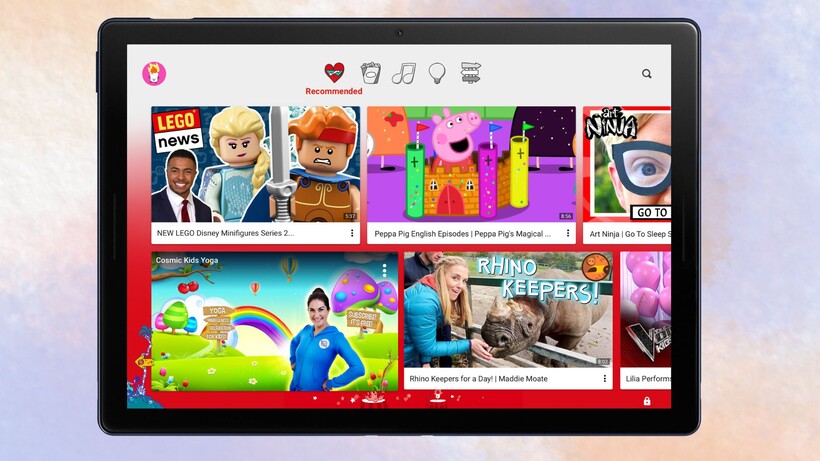
Although the government hasn’t officially stated whether or not YouTube Kids is included in the ban, it is widely thought that it will not be banned. As reported by a so-called Whitehall Insider to the The Sun, “YouTube Kids won’t be covered.”

YouTube Kids is essentially a filtered iteration of the standard YouTube platform, and promises to only include age-appropriate videos so children should be able to explore it freely without risk of coming across harmful content. Plus, YouTube Kids includes parental controls that allows parents to set time limits, check what kids have been watching and more.
We should note that the government hasn’t explicitly stated that YouTube Kids has been excluded from the ban. However, we would assume that the decision to exclude YouTube Kids is due to the fact it only allows age-appropriate videos on the platform, and is equipped with plenty of parental controls to ensure parents and guardians can keep an eye on their children’s screen time and general use of the app.
However, many have criticised the government’s decision to include YouTube in the ban as many children use the tool purely for educational content. While YouTube Kids does promise to include “educational how-tos” and arts and crafts videos, there are many videos that although technically are family friendly and don’t contain any harmful content, won’t be included within YouTube Kids.
Having said that, it’s worth noting that the parent account that controls YouTube Kids can share videos directly from YouTube into the YouTube Kids app.

The UK government has stated that the social media ban for under 16s, which will include YouTube, should be implemented in Spring 2027. This will follow the first set of regulations which should be laid out by the end of the year.
At the time of writing, the government has said that alongside YouTube, the social media ban will include Instagram, X, Facebook, TikTok and Snapchat. Messaging apps like Whatsapp and Signal are not expected to be included.
Although YouTube is described as a video-sharing platform, it is commonly considered as being a social networking service. This is mainly due to the fact that users can easily interact with others, whether that’s through replying to comments and polls or responding to channels’ posts. So, while it’s not quite as clearcut as the likes of Facebook or X, it’s still undeniably a way to communicate with others.
Most importantly, the government sees YouTube as a form of social media which is why the platform has decided to include it in the upcoming ban.


Prime Day is officially only a few hours away. But while the Amazon sale promises to be packed with cheap tech and gadgets, a refined workspace deserves stylish gear and pure craftsmanship. With that in mind, I’ve curated a round-up of 12 premium desk accessories that exude luxury and timeless style.
• Shop Amazon’s Prime Day deals
In this guide, I’m not chasing the deepest discounts, but prioritizing high-performance essentials. The focus here is on exquisite builds, clever engineering, and uncompromising utility when crafting a workspace that’s as powerfully practical as it is visually flawless.
Alongside some of my favorite deals on luxury office desk accessories, I’ve included high-end professional gear that’s perfectly designed – even if there’s no savings to be had.
For more savings on workspace upgrades, see my real-time coverage of the best Prime Day home office deals you can buy.

What do EFF staffers Sarah Chen, Javier Morales, Caitlin Chin, Emma Rodriguez, and Mikko Kopponen have in common?
For one thing, they don’t exist.
For another, all have been quoted as EFF experts in articles published in the past two months on a site called News-USA Today, which describes itself as “an independent news publisher focused on clear, accurate, and useful journalism.”
Uh…
(Please don’t confuse this site with USA Today, in which real EFF experts are accurately quoted on a regular basis.)
News-USA Today is hardly the only slagheap that’s hallucinating or fabricating EFF personnel and quotes; as we wrote last September, media companies large and small are using AI to generate news content because it’s cheaper than paying for journalists’ salaries, but that savings can come at the cost of the outlets’ reputations— assuming they care about reputation at all.
But this many fake EFF sources in two months? That’s making a play for the championship title of bogus news content.
News-USA Today’s site proclaims, “Our goal is simple: give readers the facts and the context they need to make informed decisions.” It then defines its mission:
Attempts to reach contacts listed on the site went unanswered. In fact, after we reached out to them, they published a story on June 9 with quotes from Electronic Frontier Foundation Executive Director Jared Cohen — who also doesn’t exist.
As we noted last year, EFF is all about having our words spread far and wide. Per our copyright policy, any and all original material on the EFF website may be freely distributed at will under the Creative Commons Attribution 4.0 International License (CC-BY), unless otherwise noted.
However, we don’t want disreputable sites making up words (or false identities!) for us, whether or not they’re using AI. False quotations that misstate our positions damage the trust that the public and reputable media outlets have in us.
The best thing a news consumer can do is invest a little time and energy to learn how to discern the real from the fake. It’s unfortunate that it’s the public’s burden to put in this much effort, but while we’re adjusting to new tools and a new normal, a little effort now can go a long way.
As we’ve noted before in the context of election misinformation, the nonprofit journalism organization ProPublica ha
s published a handy guide about how to tell if what you’re reading is accurate or “fake news,” as has FactCheck.org.
Republished from the EFF’s Deeplinks blog.
Filed Under: ai, ai slop, hallucinations, slop journalism
Companies: eff


Over the weekend, AMD said it planned to do just that in a firmware update scheduled for release next month. More often than not, the chipmaker refers to TSME as Memory Guard.
“Regarding certain non-PRO Ryzen 9000-series desktop processors, a BIOS option to enable Memory Guard was previously available but was removed in a recent update,” AMD said in an email. “Based on valuable community feedback, we will reinstate this option in an upcoming BIOS release in July.”
The company has yet to explain why it removed the protection. Critics speculate that AMD dropped it in an attempt to steer customers toward more costly CPUs.
It’s possible, though, that there were less nefarious reasons, such as the difficulty of continued support as chip designs changed. Another possibility is that AMD made the move for performance reasons. Encrypting and decrypting data in memory creates latency. Slowdowns are the enemy of gamers, one of the more popular customer segments using the 9000-line of Ryzen processors. Since many gamers already voluntarily disabled TSME and had little need for it in the first place, AMD may not have considered the change of much consequence.
The incident, and AMD’s refusal to discuss it, is emblematic of the public relations landscape that has emerged over the past two decades. Once, Big Tech and corporations in general were willing to acknowledge service and product changes to ensure customers had a predictable experience. They also showed a willingness to admit mistakes and to say how they planned to do better. Now, there’s only silence. As the companies’ power and dominance have mushroomed, their sense of accountability has diminished proportionately.




Weekend Open Thread: Miami – Corporette.com

The Adder At The Heart Of Intel’s 8087 FPU


Renter of Home in Anne Heche Crash Denies Settlement With Son


Microsoft accidentally kills epic Outlook email threads


Soccer-U.S. defends Iran World Cup travel restrictions, says discussions ongoing


BBC Reporter Discusses Cross Party Criticism Of Trumps Iran Deal

Wall Street Week Ahead: Investors see Micron earnings as pulse check of AI rally momentum


AWS enters the context layer race with a graph that learns from agents, not manual curation


HIVE shares jump as $220M AI deal speeds Bitcoin mining pivot

Can Charles Hoskinson Really Rescue Cardano?


Jake Chervinsky accuses CME of protecting derivatives monopoly


Nearly 7,000 fake Amazon domains registered ahead of Prime Day 2026, researchers warn


MHP SE 2026 Q1 – Results – Earnings Call Presentation (OTCMKTS:MHPSY) 2026-06-20


FIFA World Cup 2026: Canada beat 9-men Qatar 6-0 to register first ever win | FIFA World Cup 2026


Andy Burnham and the meaning of Makerfield

Signal’s Meredith Whittaker says AI chatbots ‘are not your friends’ and calls Copilot agents a backdoor


Anthropic’s Dario Amodei Urged AI Unity at G7, Even as US Banned His Models


Brexit cost 6% of UK economy, Bank of England company data suggests


Robinhood opens AI-powered trading to all users, sending HOOD stock past $100


Weeks Of In-The-Field Testing And A Verdict


You must be logged in to post a comment Login