

Business
Connectivity Is Marvell’s Hidden Growth Engine Today (NASDAQ:MRVL)


I began investing early, inspired by the strategies of legendary investors like Warren Buffett, Peter Lynch, and Howard Marks. What started as a personal interest quickly became a disciplined, research-driven pursuit of long-term value and strategic growth. Over the years, I’ve developed a fundamental, bottom-up investing approach, with a keen focus on market psychology, business durability, and valuation discipline. While I study multiple sectors, I specialize in tech, particularly underappreciated or contrarian plays in software, semiconductors, and emerging innovation. I’m drawn to companies with scalable models, durable moats, and misunderstood narratives. I look for value the market hasn’t fully priced in and prefer digging through overlooked names with long-term potential rather than chasing trends. Through my research at Infinity Curve, I explore how investing success rarely follows a straight line, it’s a nonlinear process shaped by cycles, feedback loops, and constant recalibration.
Analyst’s Disclosure: I/we have no stock, option or similar derivative position in any of the companies mentioned, but may initiate a beneficial Long position through a purchase of the stock, or the purchase of call options or similar derivatives in MRVL over the next 72 hours. I wrote this article myself, and it expresses my own opinions. I am not receiving compensation for it (other than from Seeking Alpha). I have no business relationship with any company whose stock is mentioned in this article.
Seeking Alpha’s Disclosure: Past performance is no guarantee of future results. No recommendation or advice is being given as to whether any investment is suitable for a particular investor. Any views or opinions expressed above may not reflect those of Seeking Alpha as a whole. Seeking Alpha is not a licensed securities dealer, broker or US investment adviser or investment bank. Our analysts are third party authors that include both professional investors and individual investors who may not be licensed or certified by any institute or regulatory body.

Lightwave Logic: A Complete Gamble
Business
Oil Price Today (June 23): Crude oil near $78 per barrel as investors track flows through Hormuz. What’s next?
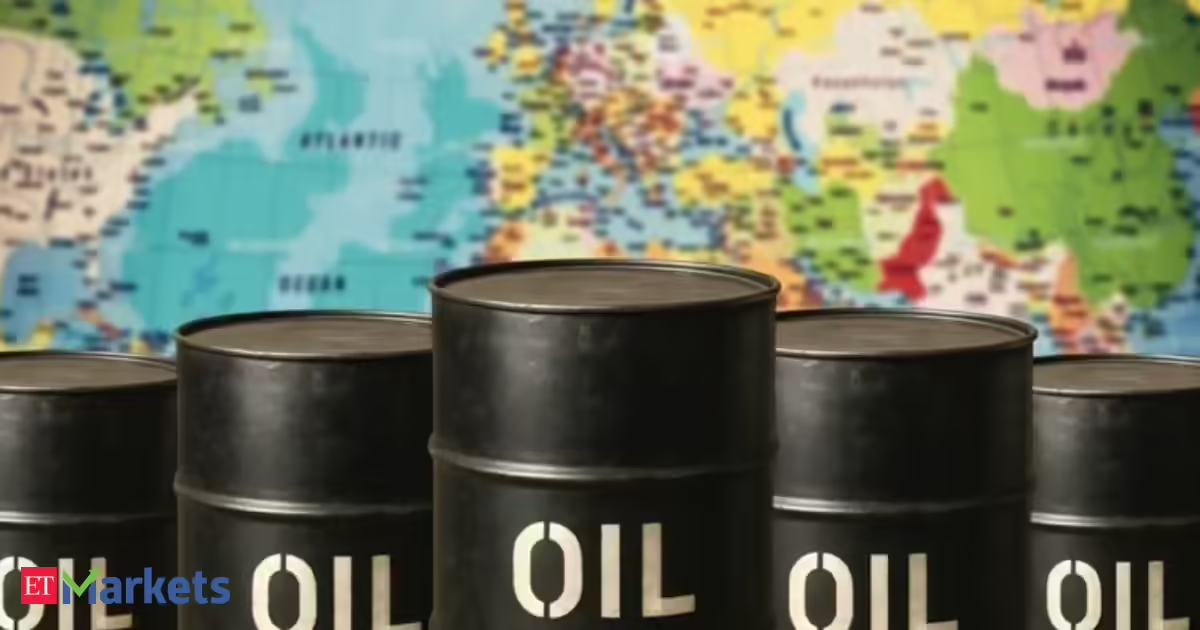
Crude oil price on June 23
Brent crude futures rose 24 cents, or 0.38%, to $78.15 a barrel, while U.S. West Texas Intermediate gained 33 cents, or 0.46%, to $74.19 a barrel as of 0026 GMT.
On Monday, oil prices had dropped more than 3% after the United States granted Iran a 60-day sanctions waiver following initial peace negotiations. Market sentiment was also influenced by reports of reduced hostilities in Lebanon under the broader agreement.
The latest developments came after a tense weekend that had raised concerns about the stability of the week-old accord. U.S. President Donald Trump had warned that military action could resume if Iran interfered with shipping through the Strait of Hormuz after Tehran announced the closure of the key waterway.
In a post on Truth Social on Monday, Trump said Iran would agree to weapons inspections to ensure “nuclear honesty.” “If Iran doesn’t live up to their agreement, or if they’re not behaving, I will do what I have to do,” Trump later told reporters.
Also read: These large-caps have ‘strong buy’ & ‘buy’ recos and an upside potential of up to 24%
Where are prices headed?
Despite the recent slide in oil prices, a complete reopening of Hormuz is expected to be a complex process. It will require careful coordination of vessel movements, restarting oil wells, repairing infrastructure, and agreeing on de-mining operations. Some shipowners also remain wary of operating conditions in the strait and the wider Persian Gulf.

Analysts note that global oil inventories were depleted during the extended disruption of shipping through the Strait of Hormuz and will take time to rebuild. Stockpiles could continue falling before fresh Gulf supplies begin reaching international markets.
Last month, Saudi Aramco Chief Executive Officer Amin Nasser cautioned that disruptions in the Strait of Hormuz could delay a return to stability in global oil markets until 2027. According to Nasser, prolonged interruptions could affect nearly 100 million barrels of oil supply each week. Saudi Aramco remains the world’s largest oil producer.Read more: NSE and Ambani are about to see if India’s retail crowd still has ‘buy the dip’ energy left
Morgan Stanley described the oil market as being in “a race against time,” warning that some factors limiting the rise in prices could weaken if the Strait of Hormuz remains closed through June.
The brokerage noted that higher U.S. crude exports and softer Chinese demand have so far helped absorb part of the supply shock. However, it cautioned that global supplies could tighten again if disruptions in the strategic shipping route continue, particularly beyond the period during which the U.S. and China can cushion the impact.
(Disclaimer: Recommendations, suggestions, views and opinions given by the experts are their own. These do not represent the views of The Economic Times)
Contentious tax reforms are set to become law after the Greens agreed to support Labor’s legislation through the Senate in return for extending an inquiry into separate NDIS changes.

BGH: This Global Bond CEF Is Now A Decent Buy
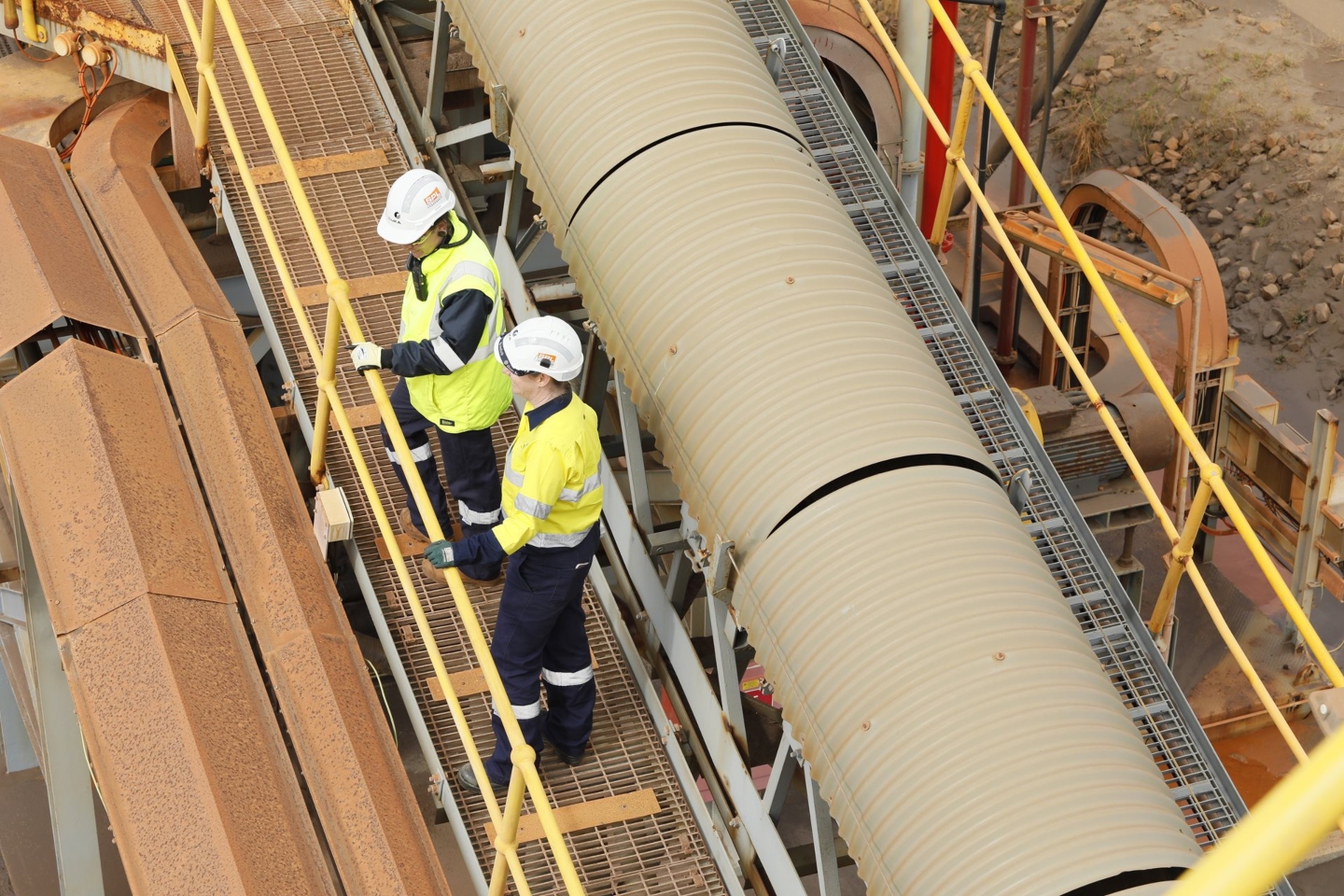
Iluka has locked in its first rare earths offtake deal with an undisclosed global car manufacturer, worth $220 million, as it unlocks its $1.65 billion loan from the federal government.
If gray-market prices are to be believed, both the National Stock Exchange of India Ltd.’s $3 billion IPO and a $4 billion debut of billionaire Mukesh Ambani’s telecom and digital media empire are likely to find keen interest among local investors desperate for some excitement, the kind that secondary markets have been failing to provide lately.
While global capital chased the AI semiconductor booms in Taipei and Seoul — tripling Korean stocks and doubling Taiwanese equities — the benchmark Indian index hasn’t gone anywhere in the past two years. Worse, the war in Iran has torn a hole in the energy-importing nation’s fragile balance of payments. A plunge in the rupee has scared away foreign capital.
But now that the US and Iran have at least started peace talks, all eyes are on India’s individual stock buyers. They have only recently started to return after beating a retreat from markets. The common investing public needs to get its mojo back, and that’s where both the similarities and the differences between the two IPOs become important.
Both the NSE, India’s largest exchange, and Ambani’s Jio Platforms Ltd. have attractive moats: They are dominant players in what are effectively duopolistic industries, too heavily regulated for new competition to break in. The NSE’s rival is the 151-year-old BSE Ltd., or the erstwhile Bombay Stock Exchange, which has just a 7% share of the overall cash-equity turnover. Jio’s 500 million-plus subscribers — and a media empire buttressed by a lock on cricket, a national craze — put it considerably ahead of Bharti Airtel Ltd., the nearest challenger.
 Bloomberg
Indian investors are intimately familiar with both franchises. As long as India has capital controls, local market participants are beholden to the NSE for wealth creation. In mobile wireless, it’s hard to imagine anyone other than Jio deciding the price of data. Even in newer technologies like satellite broadband, national-security concerns may give Ambani an advantage over Elon Musk’s Starlink or Jeff Bezos’ Amazon.
But the differences in the two IPOs are crucial, too. The NSE listing, long delayed by governance scandals at the bourse, is entirely a sale of stock by existing shareholders. Jio, however, will be raising new money, partly to retire nearly $3 billion in debt.In mature markets, the distinction between an offer-for-sale and a fresh capital raise is mere plumbing. In India’s current fragile environment, it’s anything but. Because the NSE listing is structured strictly as an offer-for-sale, no fresh cash will enter the bourse’s treasury. Worse, among those trimming their stakes are foreign giants like Morgan Stanley and Temasek Holdings Pte. At a time when New Delhi is aggressively wooing diaspora dollars to shore up a fraying rupee, the NSE IPO risks becoming an exit ramp for foreign capital.
Ambani’s Jio, conversely, is a magnet for fresh funds. For Jio to succeed, however, the NSE sellers — Indian banks and insurers, foreign institutions, ultra-rich private investors — must leave some money on the table. (Given that the NSE rushed its draft papers to the regulator a day ahead of Jio, the general expectation is that it may be first out the door.) If they overprice the offer and burn retail investors, the flames won’t just singe Ambani; they will also reach Silicon Valley, upsetting everyone from Sundar Pichai to Mark Zuckerberg.
Alphabet Inc. and Meta Platforms Inc. are big backers of Jio, as are Saudi Arabia’s Public Investment Fund, KKR & Co. and a number of other sovereign wealth funds and private-equity firms. Although none of them are selling in the IPO, they will get to record the gains in their books. For Google alone, that turns a $4.5 billion stake bought six years ago into a $10 billion asset — more if the shares keep rising after listing.
Jio’s success will also help Ambani’s flagship Reliance Industries Ltd. clear the deck for its next big public float: consumer commerce. Carving out India’s largest retailer will still take some work because the competitive intensity in grocery, fashion and electronics sales is much higher than in telecom. All the more reason to keep retail shareholders happy.
FUNDAMENTALS
Spot gold was steady at $4,191.09 per ounce, as of 0053 GMT. U.S. gold futures for August delivery rose 0.2% to $4,208.40.
The United States waived sanctions on Iran for 60 days from Monday after the first talks under a nascent peace deal, while officials reported a sustained lull in fighting in Lebanon under the agreement aimed at ending hostilities across the region.
U.S. Vice President JD Vance said talks with Iranian officials in Switzerland had laid a good foundation for a final peace deal, although Iran denied that it had begun discussions of its nuclear programme.
Fed Chairman Kevin Warsh will deliver his first testimony on monetary policy before Congress on July 14, according to a hearing notice published by the House Financial Services Committee.
Chicago Fed President Austan Goolsbee said that with the labour market stable, he is focused on figuring out whether too-high inflation will stay that way or if it will recede as the effect of high tariffs fades and if the conflict in the Middle East gets resolved.
Traders now see an 89% chance of an interest rate hike in December, up from 61% before the Fed meeting last week, according to the CME FedWatch Tool. [FEDWATCH/]
Gold speculators raised net long positions by 9,258 contracts to 112,918 in the week to June 16. [CFTC/]
Spot silver fell 0.4% to $64.92 per ounce, platinum lost 0.4% to $1,672.90, while palladium was up 0.1% at $1,266.35.
DATA/EVENTS (GMT)
0730 Germany S&P MFG, Services, Composite Flash PMI Jun
0800 EU S&P Mfg, Services, Composite Flash PMI Jun
0830 UK Flash Composite, Manufacturing, Services PMI Jun
1345 US S&P Global Mfg, Svcs, Comp PMI Flash Jun

Talkspace chief legal officer John Reilly sells $209,514 in stock
Form 4 Talkspace Inc For: 22 June
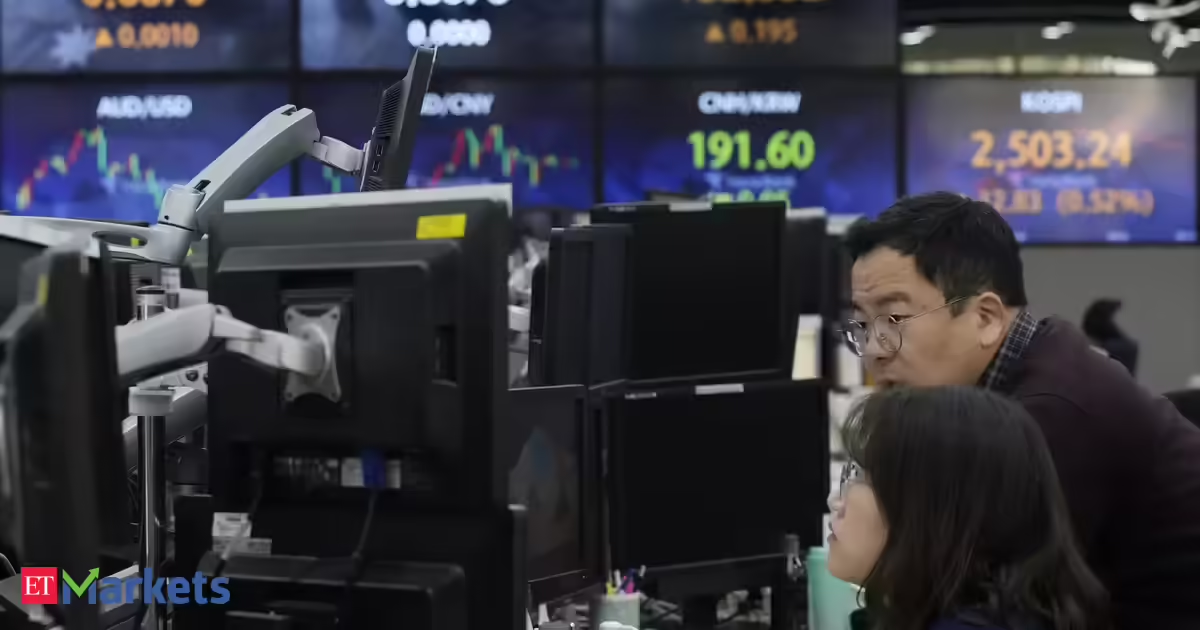
MSCI Inc.’s gauge of regional shares fell as much as 0.2% in early trading. S&P 500 futures also edged lower after a slide in megacap tech stocks and rising bond yields dragged the benchmark down 0.4% Monday. SpaceX shares slipped for a third straight day, shedding hundreds of billions of dollars in value. Brent crude prices rose slightly to trade above $78 a barrel.
The US issued a 60-day license allowing Iran to sell oil on the international market, giving Tehran an economic lifeline as the two adversaries are poised to continue discussions to reach a permanent peace deal.
Meanwhile, Vice President JD Vance described the first round of negotiations with Iran as “very, very good” and said Tehran had agreed to allow nuclear inspectors back into the country. But officials from the Islamic Republic, who also cited progress, challenged that claim, saying Vance’s assertion was “false and does not reflect reality.”
While geopolitical developments are likely to remain a key source of volatility in the near term, shifts in investor confidence regarding the durability of the AI rally may also lead to bouts of market swings, according to Ulrike Hoffmann-Burchardi at UBS Chief Investment Office.
Expectations that an agreement will be reached, as well as the revival of the AI trade and solid corporate earnings, have fueled a 14% advance in the S&P 500 Index this quarter. However, that trails the 26% surge in the MSCI Asia Pacific Index.
Treasuries fell on Monday as trading resumed following a US public holiday, even as oil prices turned lower Iran said there had been “major progress” in all-night discussions with the US. Strategists cited Federal Reserve Chairman Kevin Warsh’s hawkish messaging last week as one of the reasons for the selling pressure.In currency markets, the Japanese yen lingered near its lowest level since 1986 as investors weighed the prospects for a lasting US-Iran peace deal and the risk of intervention by Japanese authorities. The Bloomberg Dollar Spot Index was little changed after rising 0.2% on Monday.
SpaceX plunged 16% after saying it’s selling investment-grade bonds in what’s expected to be a massive borrowing spree. Its bond sale is the latest in a wave of deals from companies driving the AI boom. Alphabet, Amazon.com Inc. and others have raised more than $300 billion of debt tied to AI since November across multiple credit markets. The rocket firm is seeking to raise at least $20 billion, Bloomberg reported.
“The issue that stands out the most is the idea that the hyperscalers continue to receive an extremely low return on investment on their colossal level of spending on AI,” said Matt Maley at Miller Tabak. “Another big concern surrounds the issue of ‘circular investments,’ where companies invest in each other, while also committing to buying each other’s products.”
Elsewhere, Andy Burnham appears set to become the UK’s seventh prime minister in a decade after Keir Starmer laid out a timeline for his own departure and potential rivals backed a quick transition to the popular Manchester politician. While markets showed little reaction to the resignation, they were buoyed by reduced odds of a leadership contest that could have prolonged uncertainty.

Sports icons Coo, Torre take spotlight

Sniff out stale AI override advice with this open source CLI

FIFA World Cup 2026, France v Iraq highlights, 23 June 2026

No Jackpot Winner as $257 Million Prize Rolls Over to $269 Million Monday Draw

Blockchain.com files with SEC for U.S. IPO

Israel says it has killed new Hamas military leader in Gaza City airstrikes

BITCOIN ALERT!! | WHY BITCOIN DUMPING ? CRYPTO NEWS HINDI | BITCOIN PRICE UDPDATE | CRYPTO NEWS

MBA Finance ROI Proven | Placed as Fund Accountant at CITCO

XRP & DTCC (4,7 Billiarden) – Das EINZIGE Video das Du kennen musst!
-

 Fashion3 days ago
Weekend Open Thread: Miami – Corporette.com
-
 Tech6 days ago
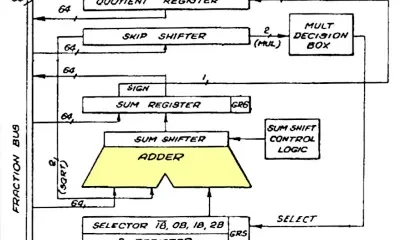
The Adder At The Heart Of Intel’s 8087 FPU
-

 Entertainment2 days ago
Renter of Home in Anne Heche Crash Denies Settlement With Son
-

 Tech14 hours ago
Microsoft accidentally kills epic Outlook email threads
-

 Business2 days ago
Soccer-U.S. defends Iran World Cup travel restrictions, says discussions ongoing
-

 Politics4 days ago
BBC Reporter Discusses Cross Party Criticism Of Trumps Iran Deal
-
 Business3 days ago
Wall Street Week Ahead: Investors see Micron earnings as pulse check of AI rally momentum
-

 Tech4 days ago
AWS enters the context layer race with a graph that learns from agents, not manual curation
-

 Crypto World3 days ago
HIVE shares jump as $220M AI deal speeds Bitcoin mining pivot
-
 Crypto World3 days ago
Can Charles Hoskinson Really Rescue Cardano?
-

 Crypto World3 days ago
Jake Chervinsky accuses CME of protecting derivatives monopoly
-

 Tech7 hours ago
Nearly 7,000 fake Amazon domains registered ahead of Prime Day 2026, researchers warn
-

 Business2 days ago
MHP SE 2026 Q1 – Results – Earnings Call Presentation (OTCMKTS:MHPSY) 2026-06-20
-

 Sports4 days ago
FIFA World Cup 2026: Canada beat 9-men Qatar 6-0 to register first ever win | FIFA World Cup 2026
-

 Politics3 days ago
Andy Burnham and the meaning of Makerfield
-
 Tech2 days ago
Signal’s Meredith Whittaker says AI chatbots ‘are not your friends’ and calls Copilot agents a backdoor
-
 Crypto World5 days ago
Anthropic’s Dario Amodei Urged AI Unity at G7, Even as US Banned His Models
-

 Business4 days ago
Brexit cost 6% of UK economy, Bank of England company data suggests
-

 Tech5 days ago
Weeks Of In-The-Field Testing And A Verdict
-
 Tech5 days ago
Adobe adds its AI assistant to Premiere, Illustrator and InDesign
You must be logged in to post a comment Login