

Business
Scooter’s Coffee unveils LTO beverages




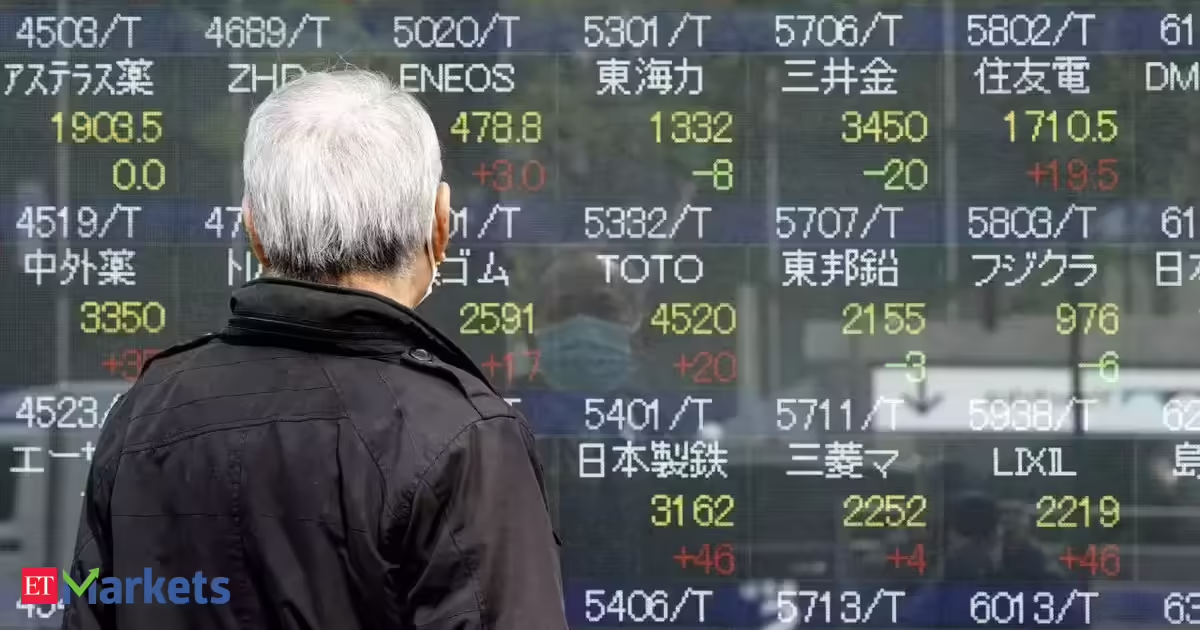
The MSCI Asia Pacific Index rose nearly 1% in early trading after slumping 3.6% on Tuesday, the most since early March. The chip-heavy Kospi climbed about 4% after tumbling 10% in the previous session. Shares of Samsung Electronics Co. surged 10%, almost erasing Tuesday’s losses, bolstered by a report that it may announce a buyback. US equity futures also rose after the Nasdaq 100 plunged 3.3% and the S&P 500 fell 1.4%.
The volatile backdrop has sharpened the focus on memory chipmaker Micron Technology Inc.’s results Wednesday, which are expected to provide crucial cues on whether demand for AI infrastructure remains strong enough to sustain this year’s rally. Veteran strategist Louis Navellier said the report will be the grand finale to a “stunning” earnings season. Micron’s shares dropped 13% Tuesday but are still up more than 250% in 2026.
“Whether or not we rally in the short-term, we continue to see medium-term downside risk for the tech/AI trade,” said Jonathan Krinsky, chief market technician at BTIG LLC, adding he sees between 10% and 15% additional downside in the semiconductors group.
Elsewhere, Brent edged lower to trade below $77 a barrel as tanker traffic through the Strait of Hormuz became more visible following an interim peace agreement between the US and Iran. The Bloomberg Dollar Spot Index steadied after a two-day advance.

Tuesday’s equity selloff came as markets prepare to close out the first half of 2026 with some blockbuster gains driven by easing geopolitical tensions, solid earnings and an AI trade revival. That’s despite growing concern over whether the massive spending commitments by technology firms will generate sufficient returns. Those worries, coupled with elevated valuations and crowded positioning, have triggered sharp pullbacks in the sector from time to time.
For the Kospi, Tuesday’s rout was one of its steepest plunges in history as sentiment suddenly soured on the global AI buildout, sparking a rapid unwind of leveraged positions in the world’s best-performing market.“We don’t know yet that the bubble has burst,” Paul Gambles, co-founder and managing partner at MBMG Group, said on Bloomberg Television, referring to South Korea’s market. “This could just be a minor correction, things could get back on track again. But who knows, this could be the start of the big one.”
Meanwhile, Indonesian assets will be in focus after MSCI Inc. again delayed its review of the nation’s equities, saying it needs more time to assess whether recently announced transparency reforms are working. MSCI had in January warned of a possible downgrade to frontier status due to investability concerns.
The New York-based index provider also retained South Korea in its emerging-markets indexes.
In fixed income, Treasuries advanced on Tuesday as the equity selloff and falling oil prices were seen as easing pressure on the Federal Reserve to raise interest rates to contain inflation. Yields fell roughly one to three basis points, led by shorter maturities that are most sensitive to changes in Fed policy. The two-year yield dropped around three basis points to about 4.20%.
An auction of two-year Treasury notes drew strong demand about a week after Kevin Warsh’s first press conference as Fed chair spurred a sharp increase in yields as traders priced in more tightening in response to rising inflation. Focus now turns to this week’s personal spending data for more cues.
“The market is pretty well priced for a more hawkish Fed outlook at this point,” with inflation-adjusted two-year yields the highest since the Fed began cutting interest rates in September 2024, said Izaac Brook, an interest-rate strategist at RBC Capital Markets.

Non-profit business development agency Morrgul has a wealth of data to prove its mantra that education and employment are the best ways to lift people out of poverty.

Abstract
- Asia-Pacific healthcare faces compounding structural pressures: the region holds 60% of the world’s population but accounts for only 22% of global health spending, with doctor-to-patient ratios well below WHO minimums. Long wait times remain the top consumer complaint, clinician burnout is accelerating, and one in five doctors is actively considering leaving their organisation.
- Patients are increasingly assertive, with rising adoption of AI tools and preventive care, while 95% want a single coordinating touchpoint for their healthcare needs. AI adoption shows promise but remains hampered by unclear strategy and limited clinician involvement, and care fragmentation continues to erode trust and outcomes across the region.
The numbers are damning, but they shouldn’t surprise anyone who has sat in a waiting room across the Asia-Pacific.
According to Bain & Company’s fourth biennial Front Line of Healthcare report, drawing on surveys of 600 doctors and 6,300 consumers across nine markets, the region’s healthcare systems are caught in a compounding crisis of their own making: demand is surging, supply is crumbling, and the people meant to hold it all together are walking out the door.
This is not a cyclical blip. It is a structural reckoning, and the window for decisive action is narrowing.
The Supply Demand Chasm No One Wants to Admit
Asia-Pacific is home to 60% of the world’s population and carries a disproportionate share of the global disease burden. Yet it accounts for just 22% of global healthcare spending. Emerging Asia-Pacific countries average roughly 1.6 doctors per 1,000 people, and excluding China, that number falls to approximately 0.9. The World Health Organization’s minimum threshold is 2.5. OECD nations average 3.7.
These are not abstract statistics. They are the reason long wait times have ranked as the top consumer frustration in every single edition of Bain’s survey over the past seven years. They explain why fewer than 70% of patients with chronic conditions report having regular check-ups. And they underpin a growing sense of systemic failure that is eroding trust in ways that will take years to rebuild.
The system is structurally underpowered. Until policymakers and healthcare executives confront that honestly, every downstream solution, however innovative, will be a band-aid on a wound that needs surgery.
The Physician Exodus Nobody Is Taking Seriously Enough
If the supply-demand imbalance is the region’s structural crisis, the clinician burnout epidemic is its most immediate one.
One in five doctors in the Asia-Pacific region is actively considering switching organisations. Approximately 30% believe recruitment and retention have become harder since 2023. These are not marginal figures. They represent a workforce in active retreat from systems that have failed to value them.
Crucially, the Bain data demolishes a persistent myth: this exodus is not about money. Doctors cite excessive workloads, a lack of recognition, and burnout as the primary drivers. They rank professional development and access to good technology ahead of compensation as the dimensions they value most in their work, and fewer than 30% say they are satisfied with either.
The correlation between clinician engagement and patient outcomes should be alarming to every hospital CEO in the region. Doctors who feel involved in strategic decisions report employee Net Promoter Scores up to 36 points higher than those who do not. Higher nurse burnout, the research confirms, correlates directly with elevated patient mortality. The clinician experience is not a human resources issue. It is a patient safety issue.
Healthcare organisations that continue to treat physician engagement as a softer, secondary priority do so at enormous risk, both to their patients and to their long term viability.
The Consumer Has Left the Building
While the supply side stumbles, the demand side has been quietly transformed. Asia-Pacific patients are no longer passive recipients of care. They are consumers, informed, assertive, and increasingly unforgiving.
Eighty-four percent expect healthcare to be more convenient today than two years ago. Seventy-one percent want their doctors reachable by phone, WhatsApp, or email rather than having to wait for the next appointment. Nearly 70% have already used AI tools to better understand a medical diagnosis or treatment plan.
Preventive care is accelerating sharply. Sixty percent of consumers scheduled regular check-ups and screenings in 2025, up from 47% in 2023. Consumer spending is shifting accordingly, with the sharpest increases in nutrition supplements (up 43% net), fitness and exercise (up 34%), and oral healthcare (up 31%).
This is not a trend on the horizon. It has already arrived. The healthcare organisations best positioned for the next decade are the ones designing their service models around these expectations today, not the ones still debating whether consumerism in healthcare is real.
AI: Promise Outpacing Readiness
No theme dominates the Bain report more than artificial intelligence, and no theme better illustrates the gap between ambition and execution that defines Asia-Pacific healthcare right now.
Consumer acceptance of AI in healthcare is genuinely higher in Asia-Pacific than in the United States. Nearly three-quarters of the consumers surveyed report comfort with at least one AI-enabled healthcare application. Physicians, meanwhile, are optimistic that AI will reduce administrative burden, the single most corrosive force in clinician satisfaction. Ninety-five percent of healthcare leaders believe AI will significantly transform revenues, costs, or administrative burdens.
And yet: one in three doctors reports that their organisation is not prepared to deploy AI at scale. Only about 30% of proof of concept projects reach production. The constraints are not technological. They are human. Unclear strategies, limited training, insufficient clinician involvement, and inadequate data foundations are the actual blockers.
The examples of what good looks like are instructive. Apollo Hospitals built a self-learning clinical decision support platform covering 1,300 conditions, maintained by more than 500 in-house clinicians. Singapore General Hospital’s PEACH AI chatbot has saved an estimated 660 doctor hours annually across 25,000 preoperative patients. Ping An Good Doctor’s AI agents handle up to 4 million consultation requests per day, reducing per doctor service costs by roughly 52%.
What these examples share is not just sophisticated technology. They reflect a commitment to proprietary clinical assets, deliberate workflow redesign, and deep clinician involvement. AI deployed on top of broken processes produces broken outcomes at scale. The organisations that will win are the ones redesigning the process first.
Fragmentation: The Silent Killer of Patient Experience
Perhaps the most underappreciated finding in the Bain report is the extent to which fragmentation is degrading care quality and eroding trust, quietly, persistently, and at enormous cost.
Half of the consumers surveyed were sent to multiple providers and locations before receiving the right diagnosis or treatment. More than 40% received inconsistent advice across clinicians. For patients with chronic conditions, the picture is worse: 55% reported having to see multiple doctors just to fulfil their healthcare needs.
Ninety-five percent of consumers say they want a single touchpoint to manage their healthcare, up from 70% in 2019. More than 80% believe a primary care physician should anchor that role. Yet roughly a quarter of the region’s consumers lack access to a primary care doctor at all.
This is a significant commercial opportunity disguised as a systemic failure. The organisation, whether a hospital group, insurer, pharmacy chain, or digital platform, that successfully becomes that trusted, continuous coordinator for patients will not just improve outcomes. It will build a structural competitive advantage that compounds over time. Patients who are promoters of their healthcare provider are 2.5 times more likely to stay and twice as likely to expand their use of services. In markets like Indonesia and China, that multiplier reaches fourfold.
In a consumer-driven system, the coordinator wins. The question is who gets there first.
What Must Happen Next
The Bain report is careful not to be alarmist, but its strategic implications are stark. The tensions it describes, between rising expectations and falling supply, between AI potential and organisational unreadiness, between consumer demand for coordination and a fragmented system incapable of delivering it, are not resolving themselves. They are accelerating.
For healthcare providers, the imperative is clear: build outpatient ecosystems before someone else does, fix the clinician experience as a precondition for everything else, and treat AI as a business transformation rather than a feature to bolt on. For payers, the choice is equally unambiguous: move from passive claims processing to active care stewardship, or be progressively commoditised by platforms that own the patient relationship. For pharmacies, which already command significant consumer trust, the window to evolve from transactional dispensers to coordinated care platforms is open, but it will not stay open indefinitely.
Most urgently, the workforce crisis demands immediate attention. Technology-driven transformations cannot scale without the people who will implement them at the bedside. Organisations that earn clinician trust and position doctors as co-architects of change will earn patient trust in return. Those that attempt transformation without clinical buy-in will face resistance, low adoption, and accelerating attrition, in a region where clinical talent is already scarce and becoming scarcer.
Asia-Pacific healthcare has the ingredients for a genuine transformation: a rapidly evolving consumer base, a clinician workforce that wants better tools and more recognition, and AI capabilities that are genuinely powerful. What it lacks, in too many organisations, is the leadership will to make the hard choices now rather than later.
Other People are Reading

Until recently, Kunal Shah was a familiar name mainly within India’s startup and investor circles.
The founder of fintech company Cred had steadily built a following beyond the businesses he created. His podcast appearances often ventured into topics such as trust, incentives, wealth creation and human behaviour. His social media posts ranged from artificial intelligence to philosophy.
Now, with Meta appointing him to lead WhatsApp, he has been propelled into the global spotlight.
The appointment follows Meta’s $900m (£679m) investment in Cred and comes at a time when WhatsApp is seeking to expand beyond messaging into payments, business services and AI-powered products.
While Indian-origin executives have led some of the world’s biggest technology companies, it is less common for a founder who built his career within India’s startup ecosystem to be handed control of a global consumer platform of that scale. WhatsApp has more than three billion users worldwide.
Long before Meta came calling, Shah had become a recognisable figure in India’s startup ecosystem.
His first major breakthrough came with FreeCharge, a mobile recharge platform he co-founded in 2010 as India’s internet economy was beginning to take shape.
The company grew rapidly and was acquired, external by e-commerce firm Snapdeal in 2015 in what was then one of the largest startup acquisitions in the country.
But Shah’s reputation would eventually expand beyond the companies he built.
After leaving FreeCharge, he spent several years investing in young technology firms and advising founders.
He also worked as an adviser with startup accelerator Y Combinator and Sequoia Capital – roles through which he became closely involved with a generation of founders, especially in the technology sector, as India’s startup ecosystem expanded rapidly.
Raised in Mumbai, Shah studied philosophy in college and did not follow the path taken by many of India’s best-known technology founders through elite engineering or management institutions.
In a post on X, Indian entrepreneur and investor Sanjeev Bikhchandani, external once recalled Shah telling him that he chose philosophy largely because the subject’s morning class schedule allowed him to continue working full-time after his family’s business ran into financial trouble.
In interviews and podcast appearances over the years, Shah has also spoken about taking up odd jobs while studying. Those early experiences, according to him, were followed by the launch of FreeCharge, the company that first brought him national attention.
Founded in 2018, Cred came up with a simple business model centred on rewarding people for paying their credit card bills on time.
In public appearances, Shah has often linked the company’s origins to questions of trust and incentives. The company later expanded into lending, insurance, commerce and wealth management products.
Meta’s latest investment values Cred at about $4.5bn, external, above its previous funding-round valuation but below the peak valuation it achieved in 2022, according to a Reuters report.
Cred also became a recognisable fintech brand, especially with its advertising campaigns that often relied on humour, nostalgia and unexpected celebrity appearances.
But its rise also brought scrutiny. For years, the company was admired for its brand and growth but frequently questioned over its path to profitability.
Critics questioned whether investor enthusiasm and lofty valuations were justified by the company’s financial performance, while supporters argued that many successful technology businesses had also endured long periods of losses while building scale.
The debate resurfaced last year when a social media post questioned why entrepreneurs were often celebrated despite a lack of sustained profits.
Shah responded, external by agreeing that profitable businesses deserved recognition but argued that entrepreneurship itself should be encouraged because it creates jobs and involves taking risks.
To his supporters, Shah represents a generation of entrepreneurs who helped shape India’s modern internet economy, first through digital payments and later through financial technology.
Shweta Rajpal Kohli, chief executive of the Startup Policy Forum, who has worked with Shah on policy issues for several years, described him as someone with “a rare ability to bring a product lens to regulatory complexity, and a regulatory lens to product design”.
“His creativity and problem-solving instinct have been consistently fascinating,” she told the BBC.
To critics, he embodies a startup culture that has sometimes prioritised valuations, fundraising and rapid growth over sustainable business models.
The latest appointment also reflects several themes that have run through Shah’s career.
WhatsApp is increasingly expanding beyond messaging into payments, commerce and business services – areas where Shah has spent much of the past decade building products, investing and advising companies.
India, which is WhatsApp’s largest market, has also been the centre of much of his entrepreneurial career. With this appointment, Shah is set to become the first Indian to lead WhatsApp.
But some observers caution against viewing Shah’s appointment solely through the lens of fintech or payments.
“There’s a tendency to assume Shah was chosen for this role because of his background in fintech and payments. I think that’s too narrow a view,” Nikhil Pahwa, the founder and editor of tech news website MediaNama, told the BBC.
“He’s someone who has spent years thinking about products, consumer behaviour, incentives and growth. And in his businesses, payments have been a mechanism for consumer acquisition, so that products can be marketed to them. This looks less like a payments appointment and more like Meta choosing a founder with experience in scaling the business side of a consumer business.”
Meta has not publicly detailed why it chose Shah for the role. In announcing the appointment, however, chief executive Mark Zuckerberg praised his “builder mentality” and “global perspective”.
Those qualities are likely to be tested as WhatsApp seeks to deepen its presence in payments, business tools and AI-powered products while serving billions of users around the world.
The challenge before Shah is also quite different from anything he has faced before.
At Cred, he was building products for financially active users. His audience consisted largely of founders, investors and technology enthusiasts.
At WhatsApp, he will now be responsible for a service used by people far beyond those circles.
Follow BBC News India on Instagram, external, YouTube,, external Twitter, external and Facebook, external.


I’m a full-time investor with a strong focus on the tech sector. I graduated with a Bachelor of Commerce Degree with Distinction, major in Finance. I’m also a proud lifetime member of the Beta Gamma Sigma International Business Honor Society. My core values are: Excellence, Integrity, Transparency, & Respect. I always, to the best of my ability, hold true to these values which I believe are key for long-term success. I would like to invite all of my readers to leave their constructive criticism and feedback in the comments section so that I can further enhance the quality of my work moving forward. Thank you and God Bless America!
Analyst’s Disclosure: I/we have no stock, option or similar derivative position in any of the companies mentioned, and no plans to initiate any such positions within the next 72 hours. I wrote this article myself, and it expresses my own opinions. I am not receiving compensation for it (other than from Seeking Alpha). I have no business relationship with any company whose stock is mentioned in this article.
Seeking Alpha’s Disclosure: Past performance is no guarantee of future results. No recommendation or advice is being given as to whether any investment is suitable for a particular investor. Any views or opinions expressed above may not reflect those of Seeking Alpha as a whole. Seeking Alpha is not a licensed securities dealer, broker or US investment adviser or investment bank. Our analysts are third party authors that include both professional investors and individual investors who may not be licensed or certified by any institute or regulatory body.

NEW YORK — The VIX, Wall Street’s widely followed “fear gauge,” jumped sharply Tuesday, climbing above 19 as investors priced in greater near-term uncertainty amid shifting economic signals and geopolitical developments.
The Cboe Volatility Index rose 2.03 points, or 11.75 percent, to 19.31 in morning trading. The move marked one of the larger daily percentage gains of the year and reflected increased demand for portfolio protection.
The VIX, which measures implied volatility in S&P 500 options over the next 30 days, often rises when equity markets face pressure or uncertainty. Tuesday’s increase coincided with broader market caution as traders assessed mixed economic data and corporate earnings flows.
Analysts noted the spike follows a period of relatively subdued volatility. The index had traded in lower ranges earlier in the month before recent moves pushed it higher. Such jumps frequently signal shifting sentiment among options traders hedging against potential downside.
The rise comes against a backdrop of ongoing attention to Federal Reserve policy expectations, corporate earnings momentum, and global events. While equity benchmarks have shown resilience in recent sessions, underlying concerns about inflation trends, growth prospects, and international tensions have kept participants on edge.
Market Context and Drivers
Volatility products saw heightened activity as the VIX climbed. Options trading volumes increased, with participants adjusting positions to account for potential swings in the coming weeks. The move reversed some of the calm that had characterized markets earlier in June.
Cboe data showed the VIX futures curve maintaining a contango structure, though the spot index’s rapid rise narrowed some spreads. Market participants monitor these dynamics closely for signals about expected persistence of volatility.
The S&P 500 and other major indexes traded with modest changes amid the volatility pickup. Technology and growth shares faced some pressure, while defensive sectors saw relative strength. Bond yields and currency markets also reflected shifting risk appetites.
Historically, VIX levels around 19 indicate moderate concern but remain well below peaks seen during periods of acute stress. The index has ranged from the mid-teens to over 30 in recent years, with spikes often tied to specific catalysts.
Broader Implications
A higher VIX typically corresponds with increased hedging costs for equity investors. Portfolio managers may adjust allocations, reduce leverage, or purchase protective options when the gauge rises. The move could influence sentiment heading into upcoming economic releases and corporate reports.
Analysts caution against overinterpreting single-day moves. The VIX often experiences sharp swings that later moderate as new information emerges. Sustained elevation above 20 would signal more entrenched caution, while a quick retreat might indicate the spike was largely technical.
The current environment features several crosscurrents. Strong corporate earnings in select sectors contrast with softening indicators in housing and consumer spending. Central bank officials continue signaling data-dependent policy approaches, adding to uncertainty.
Geopolitical factors also contribute. Developments in trade relations, energy markets, and international conflicts can quickly influence risk perceptions and drive volatility higher. Traders remain attuned to potential flashpoints.
Historical Perspective and Strategy
The VIX has averaged in the mid-teens during periods of market calm but can surge rapidly during corrections or crises. Notable spikes occurred during past events such as the 2008 financial crisis, 2020 pandemic volatility, and more recent banking sector stresses.
Investors use VIX-related products, including futures, options, and exchange-traded notes, to express views on volatility or hedge portfolios. These instruments require careful management due to their complex pricing dynamics and potential for rapid value changes.
Financial advisers often recommend maintaining diversified portfolios and avoiding reactive decisions based solely on volatility readings. Long-term investors have historically been rewarded for staying the course through periods of elevated uncertainty.
Market strategists suggest monitoring upcoming data points, including inflation readings, employment figures, and Federal Reserve communications. These releases could influence whether the recent VIX increase proves temporary or signals a broader shift in sentiment.
Looking Forward
As trading continues, attention will focus on whether the VIX sustains its higher levels or retreats toward recent averages. Options expiration cycles and major economic events often drive short-term movements in the index.
The spike serves as a reminder of markets’ sensitivity to changing conditions. While not yet at levels indicating panic, the move underscores the importance of risk management in the current environment.
Participants across Wall Street will continue watching the VIX alongside other indicators for clues about the market’s evolving risk-reward balance. The coming sessions could provide further insight into whether this volatility pickup marks the start of a more turbulent period or remains an isolated development.

Check out what’s clicking on FoxBusiness.com.
Samuel Adams founder Jim Koch says America’s craft brewers are facing a tough business climate, as rising costs, tighter margins and a crowded marketplace put pressure on independent brands.
But Koch, who helped build Boston Beer Co. into one of the country’s best-known beer companies, says he remains “very optimistic” about the future of craft brewing because the industry still has something technology cannot replicate.
“Over the last four decades, we’ve seen trends come and go, consumer tastes change, and new challenges emerge, but what hasn’t changed is people’s desire for authentic, high-quality products made by dedicated people,” Koch told FOX Business. “AI can’t brew beer.”

Jim Koch stands for a portrait at the Samuel Adams Brewery in Boston, Massachusetts, on Sept. 1, 2010. (Kelvin Ma/Bloomberg via Getty Images / Getty Images)
Koch’s comments came ahead of Samuel Adams’ announcement naming Soul Mega, a Washington, D.C.-based beer brand, the 2026 winner of Samuel Adams’ Brewing & Business Experienceship, a mentorship program that gives emerging craft brewers access to business guidance, industry resources and the chance to collaborate on a specialty beer.
Koch said many up-and-coming brewers are facing the same types of obstacles he encountered nearly 40 years ago when he launched Samuel Adams.
“Many aspiring craft brewers are in the same position I was nearly 40 years ago, working their butts off to create an enduring business, which is why the Brewing the American Dream program and its signature Brewing & Business Experienceship were created,” Koch said. “These brewers have a great concept and passion, but lack nuts and bolts business advice and access to resources.”
Soul Mega was selected after Samuel Adams’ annual Crafting Dreams Beer Bash on June 11 in Brooklyn, where six finalists poured their beers and pitched their businesses to guests.
Soul Mega team members pose at the brewery’s table during Samuel Adams’ Crafting Dreams Beer Bash in Brooklyn, New York, on June 11, 2026.
The company began as a homebrewing project in 2011 before becoming a commercial brand in 2019. It has since expanded across the Mid-Atlantic and landed placements at retailers including Whole Foods Market and Total Wine.
The craft beer industry has been under pressure, with the Brewers Association reporting a production decline in 2025 amid broader softness in beer sales.
“Small brewers are dealing with rising costs, tighter margins, and the ongoing challenge of trying to get noticed in a crowded marketplace,” Koch said. “The good news is that craft brewers are resilient, and their communities show up when it counts, which is the main reason we’ve seen such exponential industry growth with over 10,000 craft breweries open in the U.S. today.”
For Koch, this year’s Crafting Dreams Beer Bash underscored why he still believes in the future of the industry.
HEINEKEN TO CUT UP TO 6,000 JOBS GLOBALLY, LOWERS PROFIT GROWTH FORECAST AMID INDUSTRY STRUGGLES

An attendee drops a ballot during Samuel Adams’ Crafting Dreams Beer Bash in Brooklyn, New York, on June 11, 2026. (Samuel Adams)
GET FOX BUSINESS ON THE GO BY CLICKING HERE
“Seeing the finalists and entrepreneurs gathered at this year’s Crafting Dreams Beer Bash was a great reminder of what makes craft beer special,” Koch said. “The success of this industry has never been about one brewery. It’s about an entire community of passionate brewers and drinkers who are raising the bar together. We are all independent brewers, and we succeed together or not at all.”
Since 2008, the Brewing the American Dream program and its signature Brewing & Business Experienceship have helped provide more than $123 million in funding to more than 4,600 small businesses and supported the creation or retention of more than 12,300 jobs, according to Samuel Adams.
Business
Visa Shares Advance as Payments Leader Highlights AI Innovations and Steady Global Transaction Growth

NEW YORK — Visa Inc. shares rose Tuesday, extending gains as the global payments company showcased advancements in artificial intelligence and digital commerce tools while maintaining momentum in transaction volumes.
The stock traded at $330.93, up 1.01 percent or $3.30, in morning activity on the New York Stock Exchange. The move reflected continued investor interest in Visa’s technology investments and resilient business performance amid evolving consumer spending patterns.
Visa has emphasized innovation as a core driver of future growth. At its recent Payments Forum, the company unveiled new AI, stablecoin, and token solutions designed to enable more intelligent and programmable commerce experiences. These developments aim to enhance security, speed, and personalization across its network.
The initiatives build on Visa’s strong fiscal second-quarter results. The company reported net income of approximately $6 billion and revenue of $11.23 billion, surpassing analyst expectations. Adjusted earnings per share reached $3.31, beating estimates of $3.10. Visa also raised its full-year guidance.
Visa processes trillions of dollars in transactions annually across more than 200 countries and territories. Its network benefits from scale and a diversified revenue base that includes fees from authorization, clearing, and settlement services, as well as value-added offerings.
Operational Performance and Outlook
Visa continues seeing solid growth in payment volumes. Cross-border activity and value-added services have contributed meaningfully to recent results. Management expressed confidence in the company’s ability to navigate economic variability while investing in long-term opportunities.
Analysts project continued expansion. Earnings per share are expected to grow at an annual rate around 8 percent, with revenue advancing near 6 percent. Consensus price targets suggest potential upside, with some forecasts reaching toward $400 over the coming year.
The company benefits from secular trends favoring digital payments over cash. E-commerce expansion, contactless adoption, and embedded finance solutions support sustained volume growth. Visa’s investments in fraud prevention and data analytics further strengthen its competitive position.
Visa maintains a disciplined approach to capital allocation. The company returns significant capital to shareholders through dividends and share repurchases while funding strategic initiatives. Its balance sheet strength provides flexibility for potential acquisitions or partnerships.
Market Position and Challenges
Visa operates in a highly competitive payments landscape. Rivals including Mastercard, as well as emerging fintech players and digital wallets, challenge market share. Regulatory scrutiny on interchange fees and data privacy remains an ongoing consideration across jurisdictions.
Geoeconomic factors also influence performance. Consumer spending patterns vary by region, with some markets showing resilience and others facing headwinds from inflation or slower growth. Visa’s global diversification helps mitigate regional risks.
The company continues advancing its technology roadmap. Recent focus areas include tokenization, which enhances security for online transactions, and integration of artificial intelligence to detect fraud and personalize experiences. These tools position Visa to capture value as commerce evolves.
Visa has reported progress on environmental, social, and governance initiatives. The company sets targets for carbon reduction and promotes financial inclusion through partnerships with governments and nonprofits. Such efforts resonate with institutional investors increasingly focused on sustainable practices.
Valuation and Analyst Views
Visa trades at a premium valuation reflecting its growth profile and market leadership. Forward price-to-earnings multiples align with other high-quality technology and financial services companies. The stock offers a modest dividend yield with a history of increases.
Wall Street maintains a constructive outlook. Most analysts rate Visa as a Buy or Hold, citing durable competitive advantages and exposure to long-term digital payment trends. Recent earnings beats and guidance raises have supported positive sentiment.
Risks include potential economic slowdowns that could pressure spending volumes, intensified competition, and regulatory changes affecting fee structures. Visa’s scale, brand strength, and innovation pipeline provide buffers against these challenges.
Strategic Direction
Visa aims to remain at the forefront of payments technology. Leadership has highlighted the importance of building an intelligent commerce ecosystem that benefits consumers, merchants, and financial institutions. Investments in AI and programmable payments support this vision.
The company continues expanding partnerships across fintech, retail, and government sectors. These collaborations extend Visa’s reach and create new revenue opportunities beyond traditional card transactions.
Looking ahead, Visa’s fiscal third-quarter results, expected in late July, will provide further insight into spending trends and the impact of recent innovations. Analysts will watch for updates on volume growth, margin performance, and strategic priorities.
With shares showing strength, Visa continues demonstrating its ability to adapt and grow in a dynamic digital economy. The company’s focus on technology leadership and global network effects positions it favorably for sustained performance.

Entergy settles forward sale agreements, raises $672 million in cash proceeds

champc/iStock via Getty Images

Year Zero: How AI Is Reshaping Our Investment Process
In our last commentary, we discussed Claude Code as “a more recent discovery” with “jaw dropping” potential. With the benefit of hindsight, we were too restrained in sharing our enthusiasm for Claude. In many respects, the past few months have felt like “Year Zero” for our research process, reorienting and rebuilding our tools with and around Claude Code. Chatting with LLMs is helpful, but we have learned this year that it only scratches the surface of AI’s real potential. By leaning into these new discoveries, we have not just enhanced our process, we have already generated key investment insights.
The key point is not that AI makes research faster, though it does. The more important point is that it changes the surface area of what we can monitor, test, and revisit. We can now track more companies, more inputs, and more changes without diluting the quality of our attention. For an investment process built around patience, selectivity, and evidence, that is a meaningful change.
In this commentary we will walk you through our workflow and then discuss a few specific investments. We have several goals in sharing some of our discoveries here:
• We want you to share in our enthusiasm for these new tools.
• We hope others will share ideas with us on how we can become more productive and generate even more value.
• We want to hold ourselves accountable and track our progress over time. We cannot yet quantify the ROI of these tools, but we expect to demonstrate their value more objectively over time.
At the outset, we should be clear that we do not view the deployment of AI itself as proprietary, though we have built proprietary tools that we will not share or discuss. AI is the ultimate force multiplier for human thought, it is not a replacement. Our process is fundamental to our ethos and does not change. RGA believes deeply in a low turnover, GARP orientation, with an appreciation for quality. In fact, in our version of Claude’s core memory (Claude. md), we have memorialized our own investment worldview with a memo describing our workflow from idea generation through portfolio management. Stated another way: Claude, as we use it ourselves, is deeply indoctrinated in our worldview and process. The only real change is in the tools we are using. We have replaced Factset (FDS) with a combination of AI models and a handful of APIs.
Our Workflow
The workflow starts with our dashboard that pulls together all of our various projects. At the very top, we see the results of our agentic project manager. If any of our various projects fails to run or launch as expected, we get a large red tile indicating which project we need to troubleshoot and why it failed to run. Given the time we have put into building these projects, those failures are increasingly infrequent, though it is incredibly important to know if what you are looking at is clean, factual information or something is broken.
Next, we have embedded links into each of our projects, sorted by category:
• Interactive Tools
• Expert & Management Calls
• Industry Dashboards
• Consumer Demand Trackers
• Filings and Macro
• Screening and Quantitative
• Live Signals
• Alternative Data
• Company Deep Dives
• Cross-Project Synthesis
Cross-Project Synthesis then leads into the next section: our daily “Cross-Project Memo.” Each day, this memo focuses on the critical changes across all of our dashboards. Change here is the key—we isolate and focus on what new material surfaces and where there are notable deltas across our various projects. In the delta lie the insights and the questions that we need to pursue. The cross-project memo is heavy on bullet points and visuals. It flows into/concludes “What to watch” and “suggested follow-up inquiry” and these are geared to our North Stars. In a similar fashion to all of our workflows—it concludes with a hole finding agent which uses a cross model validation framework we have developed internally to identify gaps and potential data weaknesses and/or misstatements.
Beyond these projects, we have built dozens of skills. These are not skills with AI, but rather ones that we have taught Claude and built into repeatable workflows. We have built dozens of skills ranging from more rudimentary pieces of our own workflows to call prep and synthesis. These skills are not exactly projects per se, but they help feed into them and have been tremendous accelerants in our own process.
Architecture and Structure
Our preferred setup uses the Antigravity IDE, Google (GOOGL)’s AI-native integrated development platform. We leverage a number of tools therein, with Claude Code in the command-line interface, Gemini side agents for efficient planning, large context windows, and efficient token use, and Codex for heavy quantitative validation work. We are also increasingly leveraging Claude Code via the desktop app for simple recurring tasks we share across our team.
Ryan’s background in CLI has been extremely helpful from the outset. As a consequence, early on, we developed an appreciation for building with thoughtful, scalable architectures and optimizing for token efficiency. These are critical points that ultimately have significant investment ramifications, but should also be at the heart of how projects are executed. Although this commentary focuses on what we have built with Claude, most of these projects do not run on Claude. Most of our projects run on Python scripts, rely on APIs that access structured information, and do not use AI during execution. We have simply leveraged Claude to build durable tools. To the extent they do utilize AI, the LLMs are accessed via API calls with specific parameter settings which we have refined internally. We further cache all the resulting LLM outputs in our own databases—allowing for cost efficient future access. These projects use SQL, JSON and MD files and we have chosen to visualize them in locally stored HTML files. ¹ Claude knows our preferred architectures and folder structures, so each project we start immediately builds in exactly the same, organized way.
As mentioned, several of these projects leverage AI along the way, and for that, we tap into the LLM model of our choice. This is an important point that you will hear more of over time. Although we are mainly using Anthropic (ANTHRO)’s Opus model via Claude Code to build, we are carefully selecting the appropriate model for the given task. For more rudimentary operations ((think aggregating numbers, more like data entry)), we are using the cheapest capable model and for more complex analyses that are semantic in nature, we tend to use Gemini. For numerate and internal reconstruction, we use Sonnet or Opus. These simple rules of thumb are subject to change, but model token efficiency aside, we expect our actual use of AI, as measured by the volume of tokens we burn, to level off or even decline once our phase of heavy building is behind us.
What Next?
The beauty of this structure is that our projects are evolving into the RGA Investment Management Operating System. Our thesis is housed in our own words, nested within how our ideas are being tracked. We are building structured datasets across key areas of our work, and while we are already harvesting insights, we expect the output to grow meaningfully over time. This is happening in a variety of ways. Each of our screeners is built with a real-time performance tracker; in other words, we will objectively know which screens generate value and which ones do not.
To share a few small examples—we are acquiring data points on key inputs for our companies, ranging from points of distribution to pricing to sentiment of reviews and tracking the progression over time. We have developed the logic that sits behind these workflows and translates this data into actionable insights with quantifiable signal value.
Soon, we will undertake a critical step forward, which was referenced above. We will be nesting our projects in a private domain, where our key assets are hosted and accessible online. We may instead forego online hosting and use a physical server that we can access directly. If you are reading this and have strong opinions on the functionality and security of either path, please do let us know.
The most important test for these tools is whether they lead to better questions, analysis and insights. Dashboards and agents are only useful if they sharpen the research agenda, reveal changes we might have missed, or help us say “no” faster. We are already seeing clear value from our new tools.
Turning Process Into Insights
In our Q3 commentary, we featured Google (Alphabet (GOOGL)) as an AI stock. We remain convicted in Google’s positioning, but our work has made us increasingly enthusiastic about AWS, Amazon’s cloud infrastructure segment, as a beneficiary of where AI workflows are heading. In that spirit, our obsession is far more about the profit pools and platforms built on and leveraging AI than with the picks and shovels required to build out AI infrastructure. The market is focused on companies seeing a surge in sales as hyperscalers rush to build AI infrastructure, but we think that focus is misplaced.
When capex inevitably levels off at the hyperscalers ((and it will)), growth will evaporate and margins will compress at suppliers. Tier 2 suppliers in particular will see demand fall off a cliff, particularly as Tier 1 suppliers add capacity into a plateau in demand. As this generational buildout matures and growth capex tapers, investors will likely realize that an entire class of companies should never have had their earnings capitalized at such high multiples. Meanwhile, the companies building recurring revenues that will continue for decades receive little attention amidst the hype. The recurring revenues layer on slowly compared to the surge in orders for hot items, but the recurring revenues compound and do so at high incremental margins. Free cash flow is crimped as companies rush to meet growing demand; however, as growth slows, free cash flow will soar. These dynamics are opposite what today’s market obsessions will experience. Herein lies our obsession with the profit pools that are emerging today.
In that very same commentary we featured Google, we gave a brief shout-out to Amazon’s opportunity to thrive in building the “application layer” of AI by deploying smart orchestration across the retail business’ robotics and logistics layers. The orchestration opportunity will take time to play out, but meanwhile, we see AWS at a critical inflection point today. As discussed above, using the right model for the right task matters, and Amazon is uniquely positioned to benefit from a shift toward token efficiency and workflows built by AI but executed largely through non-AI processes. This has become increasingly clear in our own work and there is growing evidence that the most advanced companies deploying AI are moving this way themselves: durable value should accrue to platforms that can orchestrate models, data, compute, storage, security, and workflow execution at scale. Said differently, Amazon’s ability to remain model agnostic, while serving the lowest cost tokens, positions them uniquely to capitalize on AI adoption at scale.
AWS has been the platform that helped launch countless software, ecommerce and digital service companies and has empowered numerous older companies to migrate their digital infrastructure to the cloud. They have done this with a combination of driving down the cost of compute, leveraging their proprietary chips and building an ecosystem of integrations around their offering.
Amazon was an early partner to Anthropic and owns a considerable equity stake in the company and more recently became an owner in OpenAI (OPENAI) with an equity stake alongside a commitment from OpenAI to spend $138 billion “to consume approximately 2 gigawatts of Trainium capacity through AWS infrastructure.” ² Trainium is AWS’ custom AI chip, designed to compete with Nvidia (NVDA)’s GPUs at an industry-leading total cost of ownership. As CEO Andy Jassy explained, “Our Trainium2 chip has about 30% better price performance than comparable GPUs and is largely sold out. Trainium3, which just started shipping at the start of 2026 and is 30% to 40% more price performance than Trainium2, is nearly fully subscribed. And much of Trainium4, which is still about 18 months from broad availability, has already been reserved.”
At the heart of AWS’ AI offering is Amazon Bedrock. This is a hosted environment that can run many of the leading AI models and agents, as well as many of the open-source cost efficient ones. In a world where leading users of AI require a variety of models, alongside the ability to run non-AI programs, AWS is positioned to win because their scale is greater and their cost per unit ((whether we’re talking tokens, CPU or memory)) is lower than anyone else’s. Notably, Amazon is already seeing clear signs that the flywheel between AI workflows and core cloud infrastructure is starting to take hold and accelerate, as explained by Jassy:
And then at the same time, we’re seeing very significant growth in our core business. And some of that are the migrations that have picked up from enterprises from on-premises to the cloud. But a lot of that is also as AI growth is exploding, it turns out that it leads to a lot of core growth as well, all the post-training, all the reinforcement learning, all the agentic actions and tool usage that these agents are using. And it fits with what you’re asking about on the chip side, which is because we have an unusual collection of chips, we have the leading CPU chip in Graviton, and we have the leading price performance silicon AI chip in Trainium. It means that we’re really unusually well positioned for the inflection that we’re seeing and the type of growth that we’re experiencing.
This growth is only just beginning and will accelerate as people move beyond experimenting with AI to running workflows built by AI, but the market has yet to recognize this reality. The opportunity in Amazon today feels similar to Google at this time last year. Due to AWS’ industry-leading scale during the rise of AI, growth rates are slower than other hyperscaler cloud peers; however, the absolute dollar volume of growth is incredible and accelerating today. This acceleration will continue throughout the year.
Saas Risk Tracker
We wanted to share one of our high value panels built by AI. This is a project we built in order to decipher the SaaS landscape and mine for opportunities where the market might be indiscriminately punishing software companies that are relatively inoculated from AI risk. The learnings have been actionable: since quarter-end, we have purchased two companies where this tracker helped us better understand the relevant risks. We will write about these purchases in our Q2 commentary. It has also kept us from acting on other companies that had been high up our watchlist.
Essentially what we have done is use a combination of quantitative and qualitative factors to assign a score that measures the risk a software company faces from AI. We defined the logic behind resilience and identified a key of traits that would be strong indicators of resilience quantitatively. In our benchmarking, a low score is good, while a high score is bad. We have turned our scores into three separate indexes: a high, medium and low risk bucket, each of which we can track on their own. We can also track an aggregate index. Notably, although market performance is not an input in the model, actual market results have aligned strongly with the model’s assessment of risk. While we are still tracking these data points prospectively—the backtested results and early tracking look promising.
We have overlaid fundamental data and given Claude the opportunity, knowing our worldview, to point us to mispriced market opportunities and to alert us to “value traps” w here the fundamentals might appear compelling, but the risk is too great.
Further down the tracker, we have ranked and sorted every company in our SaaS universe based on the quality of their free cash flow. Each company is ranked objectively on free cash flow quality—high contribution from net income, low contribution from stock-based comp, little deferred revenue, etc. We also take note of the companies with the greatest improvements in free cash flow quality over time. We also analyze the composition of bookings. Companies with very short-duration bookings face different risks than those with longer-term contracts locked in.
The tracker mines the transcripts of each company and pulls out the most important quotes as it pertains to AI’s impact on the business and ranks the quality of those insights. Companies who merely speak qualitatively receive less credit than those who quantify the benefits ((and risks)).
Last, we can click into any of the SaaS companies we track and see the key statements relating to AI displacement, renewal pricing, downsell/seat compression, build vs buy questions, profitability, renewal walls and AI monetization, amongst other factors. Everything is sourced and clickable back to the actual filings or transcripts. This has meaningfully accelerated our work in the SaaS space in a way that previously would not have been possible. We can cover more ground, get to “no” faster on certain companies, and develop a deeper appreciation for the persistence of certain businesses in ways that would have required a very different level of effort in the past.
The full quarterly snapshot of our tracker—covering every company in our SaaS universe along with their risk scores, free cash flow quality rankings, and AI-related management commentary—is available here.
We believe this is an environment where disciplined active management matters. The opportunity set is changing, dispersion is meaningful, and the ability to separate durable fundamentals from temporary enthusiasm remains critical. We are excited about the opportunities in front of us and grateful for the trust you continue to place in us.
If anything in this commentary prompts questions, please reach out. You can contact any of us at 516-665-1945 or through our direct lines listed below.
Jason Gilbert, CPA/PFS, CFF, CGMA | Managing Partner, President
Elliot Turner, CFA | Managing Partner, CIO
Ryan King | Partner
References
1. We will soon migrate everything to a secure, virtual host as our primary portal, but that’s not exactly necessary today.
2. OpenAI and Amazon announce strategic partnership
Editor’s Note: The summary bullets for this article were chosen by Seeking Alpha editors.

Cambridge Water ‘essential use only’ update to customers amid ‘unusually’ hot weather
Global Market Today: Asia stocks rebound from tech selloff, Kospi jumps

AI miner Hut 8 to pay $2.35 million to settle investor claims tied to 2023 USBTC merger


-

 Fashion4 days ago
Weekend Open Thread: Miami – Corporette.com
-

 Entertainment3 days ago
Renter of Home in Anne Heche Crash Denies Settlement With Son
-

 Tech2 days ago
Microsoft accidentally kills epic Outlook email threads
-

 Business3 days ago
Soccer-U.S. defends Iran World Cup travel restrictions, says discussions ongoing
-

 Politics5 days ago
BBC Reporter Discusses Cross Party Criticism Of Trumps Iran Deal
-
 Sports7 hours ago
Two goals and an assist by sheer aura: Cristiano Ronaldo just entered the World Cup chat
-
 Business4 days ago
Wall Street Week Ahead: Investors see Micron earnings as pulse check of AI rally momentum
-

 Tech5 days ago
AWS enters the context layer race with a graph that learns from agents, not manual curation
-

 Politics4 days ago
Andy Burnham and the meaning of Makerfield
-
 Crypto World4 days ago
Can Charles Hoskinson Really Rescue Cardano?
-

 Crypto World4 days ago
HIVE shares jump as $220M AI deal speeds Bitcoin mining pivot
-

 Crypto World4 days ago
Jake Chervinsky accuses CME of protecting derivatives monopoly
-

 Business5 days ago
Brexit cost 6% of UK economy, Bank of England company data suggests
-

 NewsBeat4 days ago
Keir Starmer Allies Question His Chances For No 10
-

 Tech1 day ago
Nearly 7,000 fake Amazon domains registered ahead of Prime Day 2026, researchers warn
-

 Sports5 days ago
FIFA World Cup 2026: Canada beat 9-men Qatar 6-0 to register first ever win | FIFA World Cup 2026
-
 Tech3 days ago
Signal’s Meredith Whittaker says AI chatbots ‘are not your friends’ and calls Copilot agents a backdoor
-

 Business3 days ago
MHP SE 2026 Q1 – Results – Earnings Call Presentation (OTCMKTS:MHPSY) 2026-06-20
-

 Entertainment4 days ago
Jose Alvarado Wants Taylor Swift at More Knicks Games
-

 Crypto World6 days ago
Anthropic’s Dario Amodei Urged AI Unity at G7, Even as US Banned His Models
You must be logged in to post a comment Login