
Business
Kunal Shah: The Indian entrepreneur taking charge of WhatsApp


Until recently, Kunal Shah was a familiar name mainly within India’s startup and investor circles.
The founder of fintech company Cred had steadily built a following beyond the businesses he created. His podcast appearances often ventured into topics such as trust, incentives, wealth creation and human behaviour. His social media posts ranged from artificial intelligence to philosophy.
Now, with Meta appointing him to lead WhatsApp, he has been propelled into the global spotlight.
The appointment follows Meta’s $900m (£679m) investment in Cred and comes at a time when WhatsApp is seeking to expand beyond messaging into payments, business services and AI-powered products.
While Indian-origin executives have led some of the world’s biggest technology companies, it is less common for a founder who built his career within India’s startup ecosystem to be handed control of a global consumer platform of that scale. WhatsApp has more than three billion users worldwide.
Long before Meta came calling, Shah had become a recognisable figure in India’s startup ecosystem.
His first major breakthrough came with FreeCharge, a mobile recharge platform he co-founded in 2010 as India’s internet economy was beginning to take shape.
The company grew rapidly and was acquired, external by e-commerce firm Snapdeal in 2015 in what was then one of the largest startup acquisitions in the country.
But Shah’s reputation would eventually expand beyond the companies he built.
After leaving FreeCharge, he spent several years investing in young technology firms and advising founders.
He also worked as an adviser with startup accelerator Y Combinator and Sequoia Capital – roles through which he became closely involved with a generation of founders, especially in the technology sector, as India’s startup ecosystem expanded rapidly.
Raised in Mumbai, Shah studied philosophy in college and did not follow the path taken by many of India’s best-known technology founders through elite engineering or management institutions.
In a post on X, Indian entrepreneur and investor Sanjeev Bikhchandani, external once recalled Shah telling him that he chose philosophy largely because the subject’s morning class schedule allowed him to continue working full-time after his family’s business ran into financial trouble.
In interviews and podcast appearances over the years, Shah has also spoken about taking up odd jobs while studying. Those early experiences, according to him, were followed by the launch of FreeCharge, the company that first brought him national attention.
Founded in 2018, Cred came up with a simple business model centred on rewarding people for paying their credit card bills on time.
In public appearances, Shah has often linked the company’s origins to questions of trust and incentives. The company later expanded into lending, insurance, commerce and wealth management products.
Meta’s latest investment values Cred at about $4.5bn, external, above its previous funding-round valuation but below the peak valuation it achieved in 2022, according to a Reuters report.
Cred also became a recognisable fintech brand, especially with its advertising campaigns that often relied on humour, nostalgia and unexpected celebrity appearances.
But its rise also brought scrutiny. For years, the company was admired for its brand and growth but frequently questioned over its path to profitability.
Critics questioned whether investor enthusiasm and lofty valuations were justified by the company’s financial performance, while supporters argued that many successful technology businesses had also endured long periods of losses while building scale.
The debate resurfaced last year when a social media post questioned why entrepreneurs were often celebrated despite a lack of sustained profits.
Shah responded, external by agreeing that profitable businesses deserved recognition but argued that entrepreneurship itself should be encouraged because it creates jobs and involves taking risks.
To his supporters, Shah represents a generation of entrepreneurs who helped shape India’s modern internet economy, first through digital payments and later through financial technology.
Shweta Rajpal Kohli, chief executive of the Startup Policy Forum, who has worked with Shah on policy issues for several years, described him as someone with “a rare ability to bring a product lens to regulatory complexity, and a regulatory lens to product design”.
“His creativity and problem-solving instinct have been consistently fascinating,” she told the BBC.
To critics, he embodies a startup culture that has sometimes prioritised valuations, fundraising and rapid growth over sustainable business models.
The latest appointment also reflects several themes that have run through Shah’s career.
WhatsApp is increasingly expanding beyond messaging into payments, commerce and business services – areas where Shah has spent much of the past decade building products, investing and advising companies.
India, which is WhatsApp’s largest market, has also been the centre of much of his entrepreneurial career. With this appointment, Shah is set to become the first Indian to lead WhatsApp.
But some observers caution against viewing Shah’s appointment solely through the lens of fintech or payments.
“There’s a tendency to assume Shah was chosen for this role because of his background in fintech and payments. I think that’s too narrow a view,” Nikhil Pahwa, the founder and editor of tech news website MediaNama, told the BBC.
“He’s someone who has spent years thinking about products, consumer behaviour, incentives and growth. And in his businesses, payments have been a mechanism for consumer acquisition, so that products can be marketed to them. This looks less like a payments appointment and more like Meta choosing a founder with experience in scaling the business side of a consumer business.”
Meta has not publicly detailed why it chose Shah for the role. In announcing the appointment, however, chief executive Mark Zuckerberg praised his “builder mentality” and “global perspective”.
Those qualities are likely to be tested as WhatsApp seeks to deepen its presence in payments, business tools and AI-powered products while serving billions of users around the world.
The challenge before Shah is also quite different from anything he has faced before.
At Cred, he was building products for financially active users. His audience consisted largely of founders, investors and technology enthusiasts.
At WhatsApp, he will now be responsible for a service used by people far beyond those circles.
Follow BBC News India on Instagram, external, YouTube,, external Twitter, external and Facebook, external.


Eurozone inflation edges up to 2.9% in July – Eurostat

Check out what’s clicking on FoxBusiness.com.
Netflix has been sued for allegedly losing an unencrypted copy of a $45 million Nicolas Cage thriller that took seven years to produce, exposing the unreleased film to potential piracy and leaks.
The lawsuit, which seeks $105 million in damages, was filed by Op-Fortitude Ltd. and its owner, Swiss film producer and financier Simon Afram, who also accused Netflix of covering up the security breach.
The film, Fortitude, was based on the real-life World War II Operation Fortitude, a massive Allied deception campaign designed to convince Nazi Germany that the D-Day invasion would occur elsewhere. The operation had relied on a fake army, double agents and false radio traffic.
According to the lawsuit, the incident caused devastating financial losses by compromising the film’s first-to-market exclusivity and distribution value, forcing the plaintiffs to temporarily pause marketing and sales efforts ahead of awards season.

A hand holds a TV remote with a Netflix button in front of a television displaying the company’s logo. (Nikos Pekiaridis/NurPhoto via Getty Images / Getty Images)
The complaint says test screenings projected an 82% “top-two box” audience score, meaning 82% of viewers rated the film among the two highest categories, and conservatively estimated that the movie would generate at least $112.5 million in revenue — roughly 2.5 times its production budget.
In a statement to FOX Business, Netflix denied wrongdoing, arguing the movie was delivered without industry-standard safeguards such as password protection or encryption. The company also accused the plaintiffs of making “hostile attempts to extort money from Netflix over this situation.”
The dispute stems from a private screening Netflix reportedly requested between late 2025 and mid-2026.
While the plaintiffs alleged Netflix requested an unlocked or unencrypted copy to streamline the screening process, Netflix disputed that claim, saying security safeguards are standard practice and that the filmmakers voluntarily chose to provide an unencrypted version.

Nicolas Cage attends a premiere at the Museum of Modern Art on March 28, 2023, in New York City. (Photo by Dia Dipasupil / Getty Images)
According to the lawsuit, the plaintiffs informed Netflix both verbally and in writing that the drive was unencrypted and instructed the company to delete the files from its projection system after the screening.
After an unencrypted digital master drive was delivered to Netflix’s Hollywood studio on June 15, 2026, Netflix held the screening on June 16. The media giant then left the unencrypted file unattended on an office desk without basic physical or digital security controls, where it later disappeared, plaintiffs said.
The lawsuit alleged Netflix concealed the breach by repeatedly postponing or ignoring requests from the plaintiffs to arrange pickup of the drive between June 17 and June 25. The plaintiffs said it was not until June 25 that a Netflix executive emailed them stating that “someone stole a good amount of drives from our office desks this past week.”
Netflix has denied those allegations, saying it notified the appropriate parties as soon as its team became aware of the incident.
CHRISTOPHER NOLAN CONFIRMS BIZARRE ‘THE ODYSSEY’ CASTING CHOICES INCLUDING RAPPER TRAVIS SCOTT

A drone view shows the Netflix logo on one of its buildings in the Hollywood neighborhood of Los Angeles, California, Dec. 8, 2025. (Daniel Cole/Reuters / Reuters)
The plaintiffs further accused Netflix of trying to downplay the incident by claiming the stolen drive required an encryption key to access the film, despite knowing the drive was unencrypted. The lawsuit also claims Netflix offered to reimburse only the cost of the physical drive and referred to the asset as “missing” rather than “stolen.”
In a statement to FOX Business, Netflix said: “Netflix disputes any claim that it bears the risk of loss for a film delivered without the proper industry-standard safeguards,” the company said. “While we do not own the rights to Fortitude, we take content security seriously and have taken extra measures to support the filmmaker and his team. This includes conducting a thorough investigation and offering to monitor known piracy sites for any unauthorized distribution or sale.”
The plaintiffs also accused Netflix and its outside counsel of refusing to answer basic questions about the company’s internal investigation, including whether a police report had been filed, and declined to cooperate with the Los Angeles Police Department after the filmmakers filed their own report.
| Ticker | Security | Last | Change | Change % |
|---|---|---|---|---|
| NFLX | NETFLIX INC. | 73.17 | -0.46 | -0.62% |
CLICK HERE TO GET FOX BUSINESS ON THE GO
In response, Netflix said it withheld details of its investigation because of what it described as the plaintiffs’ conduct, claiming they had initially demanded $165 million for the film rather than work with the company.
“We have declined to share anything about our ongoing investigation with the law firm representing Simon Afram, given their hostile attempts to extort money from Netflix over this situation — including immediately demanding $165 million for the film rather than work with us in good faith.”
The company added that its content security team is actively monitoring piracy websites for unauthorized copies of the film and said it has found no evidence that Fortitude has been leaked.

Nowadays people have a lot more on their plates. With busy work schedules, family responsibilities and private objectives, many individuals are looking for ways to keep their energy and focus in check throughout the day. This trend towards on-the-go wellness devices has sparked a rise in focus on innovative solutions that integrate effortlessly into daily routines.
The vitamin B12 inhaler and caffeine inhaler are two products that are intruding. They are lightweight and are gaining popularity among professionals, students, travellers and fitness enthusiasts who value their convenience and portability. Many people are seeking other, more portable options, instead of using large supplements or multiple cups of coffee.
Why Convenience Matters
The one giant reason they’re the focus of attention is because they’re mobile. Traditional energy-boosting options may need to be prepared or planned. Coffee needs to be packed separately, brewed, and refrigerated. Energy drinks need to be refrigerated. Portable wellness devices are an option that can fit in a pocket, handbag or backpack. Users like the availability of an option that’s always there when they need it – such as when commuting to work, attending meetings, studying at university or travelling. Of course, the more convenient the products are, the more desirable they are when consumers have a hectic lifestyle.
Growing Interest in Vitamin B12
Vitamin B12 has long been known to be an essential nutrient required to support normal energy metabolism and the function of the nervous system. Those with busy lives are looking for ways to get their daily dose of the essential vitamin. This enhanced awareness has brought the vitamin B12 inhaler to the attention of consumers seeking convenient wellness products. Its small size makes it ideal for those seeking compact solutions that can fit into their everyday lives without becoming too complicated. This enhanced visibility is part of a new health trend of making health technology more visible and accessible to fit into today’s lifestyle.
Continued Popularity of Caffeine
The popularity of caffeine is continuing to rise. Caffeine remains popular. Caffeine is still one of the world’s most popular stimulants used to keep individuals focused and alert during busy days. Even though coffee remains the primary product, consumers are slowly broadening their interest as they try out new formats.
The inhaler is also making headlines as another portable choice for those who appreciate flexibility. Business people, entrepreneurs, remote workers and students are a group that often look for products that fit seamlessly into their busy lives without disrupting productivity. With the evolution of wellness, people are increasingly interested in products that are convenient and portable.
Supporting Today’s Fast-Paced Lifestyle
Today’s customers are more inclined to buy products that make their lives easier. Minimalism, low weight, and portability are now key considerations for consumers in a wide variety of industries.
Portable wellness devices meet these expectations by providing:
- Tightly packed, travel-friendly designs
- Easy to store in bags/pockets
- Easy to use in your hectic schedule!
- Modern, user-friendly designs
- Healthy ways to be active.
The following are all attributes that contribute to the appeal of innovative wellness products for various age groups and professions.
Innovation Is Driving Consumer Interest
Various aspects of health and wellness have been changed by technology. Consumers are looking for products to be both functional and convenient, whether it’s a wearable fitness tracker or a smart hydration bottle. This trend toward portable innovation for wellness is seen in the increasing acceptance of vitamin B12 inhalers and caffeine inhaler. As manufacturers seek to deliver more contemporary, user-friendly experiences that meet the demands of a modern consumer, they are still investing in new product designs, high-quality materials and ease of use. As awareness increases, these products are becoming a part of the discussion about lifestyle optimisation, productivity, and personal wellness.
Looking Ahead
Consumer desires are still changing, and convenience plays a greater role in buying. Portable, contemporary, and user-friendly products are likely to continue to be in demand. As the video shows, the vitamin b12 inhaler and caffeine inhaler have become subjects of discussion, illustrating the changing landscape of wellness innovation in this fast-paced world. Although there are preferences out there, these portable options are becoming popular, reflecting a general trend to more practical products that cater for busy lives. In the ever-changing realm of wellness technology, mobile devices are likely to continue to play a crucial role in the future of personal wellbeing.


Seeking Alpha’s transcripts team is responsible for the development of all of our transcript-related projects. We currently publish thousands of quarterly earnings calls per quarter on our site and are continuing to grow and expand our coverage. The purpose of this profile is to allow us to share with our readers new transcript-related developments. Thanks, SA Transcripts Team

Trust is now a commercial issue rather than simply an IT concern. Now, customers hand over the following data:
- Payment details
- Identity data
- Private communications.
Still, they expect quiet competence in return. Basically, a Zero Trust security model supports that expectation. It treats protection as a continuous business responsibility rather than a perimeter defence installed once and forgotten.
Why Need a Zero Trust Model?
To be honest, companies no longer operate inside one tidy network. In fact, the traditional boundary is blurry due to –
- Cloud platforms
- Contractors
- Remote employees
- Connected devices
- Third-party applications.
Consequently, familiar claims about being “secure” sound rather thin. So, businesses must explain –
- Who receives access
- Why they receive it
- When that privilege ends.
Security That Earns Confidence Through Small Decisions
At its best, every relevant access request is assessed against –
- Identity
- Device condition
- Location
- Data sensitivity
- Current risk.
Therefore, customers receive stronger protection from compromised accounts without facing blanket restrictions. In this case, the controls become selective and proportionate. That is how zero trust works.
This model does not assume that employees or customers are dishonest. Instead, it questions signals that have not been verified.
For instance, a valid password may not settle the issue. This might be especially true when credentials are stolen so routinely. Then, policies decide whether to permit, challenge, restrict, or block the activity.
Now, a company might say that access to customer records is limited by role. They might also say it is reviewed regularly and logged. However, the promise only holds when implementation reaches –
- Legacy software
- Service accounts
- Third-party integrations
- Administrative systems.
If you leave those areas untouched, the shiny security story starts looking ordinary.
Perimeter Security vs Continuous Verification
The practical difference becomes clearer when traditional assumptions are placed beside a modern control model. Neither approach represents one product. Rather, the comparison shows how security decisions move closer to –
- Identities
- Workloads
- Applications
- Actual behaviour.
| Security Question | Perimeter-Led Security | Continuous Verification |
| Who receives trust? | Internal users often receive broad confidence. | Every identity must establish legitimacy. |
| How is access granted? | Network location carries considerable weight. | Role, context, device health, and risk are combined. |
| What happens after login? | Sessions may continue with little scrutiny. | Conditions and behaviour remain under review. |
| How far can attackers move? | Flat networks may expose additional systems. | Segmentation limits lateral movement. |
| What can customers see? | Protection rests on vague security claims. | Controls support specific, explainable commitments. |
Zero Trust becomes customer-facing when these choices affect real experiences. For instance, an unusual payment change may trigger stronger authentication. Meanwhile, a familiar low-risk action continues normally.
On the other hand, a support agent may see only the information required for a case. This reduces exposure without making genuine service painfully slow.
Five Practices That Turn Security Architecture Into Trust
Technical controls do not create confidence automatically. Instead, customers notice the following:
Therefore, businesses need disciplined operating practices rather than a grand transformation announcement. Moreover, they do not need a stack of expensive tools that nobody has properly configured.
1. Collect Less and Classify Early
In general, security begins before authentication. If a company retains customer information it no longer needs, the attack surface expands for no useful reason.
Also, clear classification is necessary. It helps policies distinguish routine material from financial, identity, health, or commercially sensitive records.
2. Apply Least Privilege with Sensible Timing
Of course, permanent administrative access feels convenient. Still, it is difficult to justify. In fact, the following reduce standing risk:
- Just-in-time privileges
- Approval workflows
- Automatic expiry.
Moreover, internal access should reflect a specific task rather than job title, seniority, or old permissions nobody reviewed.
3. Segment Valuable Systems
A compromised laptop should not become a passport to billing platforms or production databases. Microsegmentation restricts movement between workloads and user groups.
Still, teams must test policies carefully. This is because brittle controls might interrupt services. Also, it must quietly encourage unsafe workarounds.
4. Explain Protective Friction
In most cases, additional verification irritates customers when it appears random. Basically, short, plain-language prompts should explain that unusual activity triggered the check.
At the same time, recovery routes must resist social engineering. Otherwise, the reassuring front door will sit beside a surprisingly weak side entrance.
5. Measure Control Quality Rather Than Tool Volume
Boards should examine the following issues:
- Abandoned accounts
- Policy exceptions
- Device compliance
- Privileged-access age
- Detection coverage
- Recovery performance.
In contrast, a long software inventory reveals little about whether the organisation contains an intrusion or protects affected customers.
The Difficult Part Is Governance
At the outset, the following factors provide the machinery:
- Identity platforms
- Endpoint signals
- Policy engines.
Still, governance determines whether that machinery behaves coherently. In fact, security, privacy, legal, product, and customer-service teams require shared rules for acceptable risk. Otherwise, one department tightens controls. Meanwhile, another creates broad exceptions to meet a deadline.
Zero Trust also requires an honest rollout sequence.
- Businesses should begin with critical data flows and privileged identities.
- Extend controls according to risk.
- Technical teams must map application dependencies before enforcing restrictions.
Basically, a rushed cutover might lead to the following issues:
- Lock out employees
- Disrupt customer journeys
- Undermine the confidence the programme was supposed to strengthen.
Moreover, privacy deserves equal attention. For instance, continuous verification may tempt organisations to collect excessive behavioural information.
Actually, signals should remain relevant, protected, and retained for defined periods. Consequently, security monitoring stays defensible instead of sliding into surveillance dressed up as sensible risk management.
Assurance Should Be Visible Instead of Noisy
To be honest, customers rarely want a technical lecture. However, they do want evidence that security decisions are deliberate. In fact, the following aspects demonstrate control:
- Clear account alerts
- Accessible login histories
- Rapid session revocation
- Specific incident notices
- Dependable recovery processes.
Conversely, claims such as “completely secure” weaken trust. This happens because experienced buyers know that no system will promise it.
The strongest message is modest and testable:
- Access is limited
- Suspicious behaviour receives attention
- Sensitive actions demand stronger proof
- Incident responses are rehearsed.
Behind that message, audit trails must help teams reconstruct decisions. In front of it, customers need useful choices without being burdened by internal security jargon.
Continuous Verification Makes Customer Trust More Credible
In the end, customer trust grows when a business reduces exposure and explains necessary checks. It must also respond cleanly when something goes wrong.
Zero Trust supports that standard when treated as an operating discipline rather than a fashionable technology purchase. The result is not friction everywhere. Rather, it is about better judgement applied repeatedly. This is helpful where customer data and services genuinely need protection.
Business
Hang Lung Group Limited 2026 Q2 – Results – Earnings Call Presentation (OTCMKTS:HNLGY) 2026-07-31
Seeking Alpha’s transcripts team is responsible for the development of all of our transcript-related projects. We currently publish thousands of quarterly earnings calls per quarter on our site and are continuing to grow and expand our coverage. The purpose of this profile is to allow us to share with our readers new transcript-related developments. Thanks, SA Transcripts Team
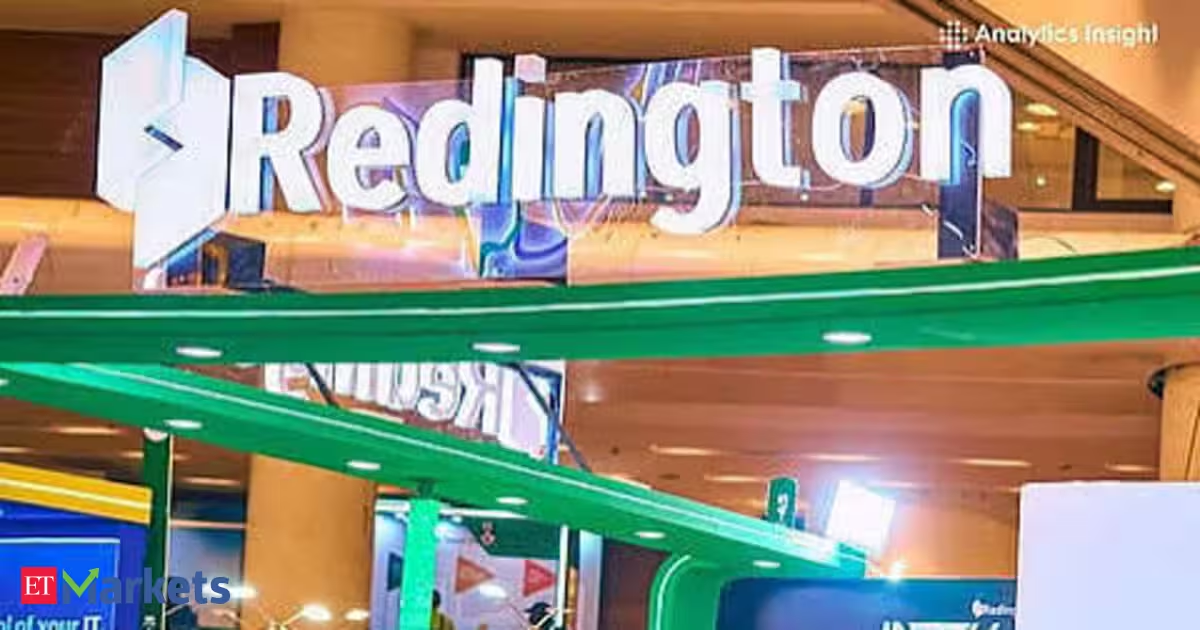
The stock had surged nearly 15% during Thursday’s session following the earnings announcement and touched a fresh 52-week high of Rs 338.50.
The company reported a Q1FY27 net profit of Rs 486 crore, compared to Rs 275 crore in the corresponding quarter of the previous year. Excluding exceptional items, profit after tax (PAT) grew more than twice as fast as revenue, highlighting strong operating leverage. The company’s PAT margin stood at 1.4% during the quarter.
Revenue from operations rose 34.6% YoY to Rs 34,922 crore, compared with Rs 25,952 crore in the year-ago period, marking the company’s highest-ever quarterly revenue.
Also Read | Ethereum surged significantly in 11 years. What’s next for the second-largest cryptocurrency?

The strong performance was led by the India business, where revenue surged 63% YoY, while PAT climbed 60%. Growth was driven by the execution of large enterprise deals, higher PC realisations amid industry-wide memory supply constraints, continued premiumisation in smartphones, and sustained demand for cloud and cybersecurity solutions.
Meanwhile, revenue from the Middle East and Africa business grew 15% YoY, supported by cloud and cybersecurity offerings despite geopolitical uncertainties during the quarter.
Business Segment Performance
The company reported strong momentum across its technology portfolio during the quarter.
Software Solutions Group grew 52% YoY, supported by increased adoption of cloud, cybersecurity, software-led engagements, AI-enabled solutions and subscription-based models. Endpoint Solutions Group grew 35% YoY, driven by higher PC realisations amid memory supply constraints and steady demand.
Mobility Solutions Group grew 21% YoY, led by premium smartphone demand and expansion of retail-led distribution. Technology Solutions Group grew 50% YoY, supported by large enterprise and data centre deals.
Also Read |Redington shares rally 15% after Q1 profit surges 77%; revenue rises 35% YoY
“We have started FY27 on a strong note, delivering our highest-ever quarterly revenue and profit. This performance reflects the strength of our diversified business model, disciplined execution and broad-based momentum across businesses and geographies. Profit growth significantly outpaced revenue growth, reinforcing our continued focus on profitable and sustainable growth,” said V. S. Hariharan, Managing Director & Group CEO, Redington.
“As technology adoption accelerates across cloud, software, cybersecurity, AI-enabled infrastructure and digital transformation, Redington is well positioned to capture these opportunities through its strong ecosystem of global technology brands, partners and customers. We will remain focused on operational resilience, capital efficiency and long-term value creation for all our stakeholders,” Hariharan further said.
(Disclaimer: Recommendations, suggestions, views and opinions given by the experts are their own. These do not represent the views of The Economic Times)

However, revenue from operations grew 17% to Rs 116 crore in the June quarter, from Rs 99.3 crore in the same quarter of the previous year. The company’s operational EBITDA in Q1 FY27 was Rs 31 crore, as against Rs 32 crore in the June quarter of FY26.
As per a regulatory filing on the BSE, the company’s board has approved a proposed acquisition of 100% stake in a Chennai-based ST Advanced Composites Pvt Ltd. (STAC), for a total consideration of Rs 10 crore. The acquisition of the composite manufacturing company will result in an in-house capability for composite parts required in the Company’s radar and other programs, thereby expanding the addressable value proposition in Data Patterns’ product offerings, as per the company’s statement.
According to the company’s CMD, Mr. Srinivasagopalan Rangarajan, the quarter has met the company’s expectations. He said, “We continue to see a healthy pipeline of opportunities and are now receiving larger-value complete system contracts. Our order book currently stands at around Rs 2,654 crore (including the orders negotiated and pending receipt), providing healthy revenue visibility. Our foray into counter-drone business and export initiatives continues to gain traction.”
He added that the company remains confident in achieving its full-year guidance, backed by the Government’s continued focus on indigenous defence manufacturing.
Data Patterns (India) works closely with defence PSUs, which include Hindustan Aeronautics Ltd and Bharat Electronics Ltd, as well as government organisations involved in defence and space research such as DRDO and ISRO.

Xponential Fitness: Waiting For The Dust To Settle (Rating Downgrade)

Just 21% of UK SMEs say they use registered trade marks, according to the Intellectual Property Office’s latest survey of SME intellectual property awareness, while 30% report using no form of IP protection at all.
Set against the government’s estimate of around 5.7 million private-sector businesses, that suggests millions of UK firms may be operating without registered trade mark protection for their brands. At the same time, the register is becoming more competitive. The IPO received 173,180 trade mark applications in 2024, up 5.8% on the previous year and the second-highest total in its history, while registrations increased 9.1% to 156,596. For founders, the implication is straightforward: as more businesses secure exclusive rights to their brands, delaying registration increases the risk of conflicts, costly disputes and, in some cases, being forced to rebrand. For businesses considering registration, Trama, a full-service IP law firm, explains the UK registration process and common application pitfalls in its guide to UK trade mark registration.
Why aren’t more UK SMEs registering their brands?
The evidence suggests the problem is misunderstanding rather than indifference. While 79% of UK SMEs claim to be familiar with the term “intellectual property”, only 26% demonstrate a high level of understanding when tested on how common intellectual property rights apply in practice. Awareness is relatively high, but practical knowledge remains much lower. One of the most common misconceptions is that registering a company with Companies House also protects the business name as a trade mark. It does not. Company incorporation and trade mark registration are separate legal processes serving different purposes. Companies House helps prevent identical or very similar company names from being incorporated, but it does not grant exclusive rights to use a brand name in the marketplace. Those rights generally come through trade mark registration.
For founders, the distinction matters. A business can legally incorporate under one name yet still face trade mark disputes or even be required to rebrand if another business holds earlier trade mark rights. This is explained in more detail in this guide which outlines the differences between company names and trade marks, and when separate registration is needed.
Why timely brand registration matters for UK SMEs
Competition for registered trade marks is increasing. Nearly half of all UK trade mark applications now come from overseas applicants. In 2024, UK-based businesses filed 90,480 applications, accounting for 52.2% of all filings. As both domestic and international businesses register more brands, the pool of available names becomes increasingly crowded.
That makes timing critical. In practice, the UK trade mark system rewards businesses that register early. An application can be refused because of an earlier registered mark, even where the applicant has never come across the other business. As the register becomes more crowded, delaying an application increases the likelihood of encountering an existing right and the risk of costly rebranding.
Businesses that have not registered are not necessarily without protection. The common law action of passing off can protect established goodwill, and trade mark applications filed in bad faith may be challenged. However, relying on these rights is typically more complex and expensive, requiring evidence of reputation, trading history and customer recognition. A registered trade mark provides a clearer legal foundation, making it easier to enforce rights, deter infringement and resolve disputes before they escalate.
What trade mark registration actually involves, and what it costs
For many SME owners, the idea of registering a trade mark feels more daunting than it is. In the UK, the process runs through the Intellectual Property Office and follows a fairly predictable path, even if the legal judgement behind it takes some care to get right.
The starting point is a clearance search of the existing register, checking not just for identical marks but for similar ones that cover the same or related goods and services. This step is often skipped by business owners filing on their own, and it is the single most common cause of later disputes. A name can be entirely free to trade under and still infringe on an earlier registered mark in the same sector, particularly where the goods or services overlap even loosely.
Once a name clears the search, the application itself requires selecting the correct trade mark classes. The UK system uses 45 international classes covering different categories of goods and services, and a business must file in every class relevant to what it actually sells or plans to sell. Filing in too few classes leaves gaps in protection; filing in too many adds unnecessary cost. This is one of the areas where legal judgement matters most, since the classes chosen need to reflect not just the current business but a reasonable view of where it is heading.
On cost, the IPO’s own filing fees start at £170 for a single class online, with £50 for each additional class. That is a modest outlay set against the value most SMEs place on their brand, and considerably less than the cost of a forced rebrand after a dispute. Where a business uses a solicitor or trade mark attorney to handle the search, classification and filing, professional fees are added on top, but this is often worthwhile given how much of the process depends on judgement calls rather than mechanical steps.
Timing matters here too. Once filed, an application is examined by the IPO, published for a two-month opposition period during which third parties can object, and then, assuming no objection succeeds, registered. The full process typically takes around four months from filing to registration, though contested applications can take considerably longer. Businesses sometimes assume protection begins only once the certificate is issued, but the filing date itself establishes priority. This means that in a dispute with a business that files later, an earlier filing date generally wins, even if registration is still pending.
For SMEs weighing whether registration is worth the administrative effort, the practical answer is that the process is neither long nor especially expensive relative to the risk it addresses. The bigger cost, in time and money, tends to fall on businesses that wait until a dispute forces the issue, at which point the options are narrower and the legal fees considerably higher.
Register before your brand becomes valuable
The best time to think about trade mark protection is before a business and brand gains traction, not after. Search the trade mark register before committing to a name, identify the goods and services that genuinely reflect your business, and file an application before your brand becomes worth copying. Many common mistakes, such as choosing a descriptive name or selecting the wrong classes, involve legal judgement rather than simply searching a database. For most businesses, registering a trade mark is a relatively small investment compared with the cost of rebranding after a dispute.
A trade mark is often one of a company’s most valuable intellectual property assets, yet many UK SMEs still leave theirs unregistered. The value of intellectual property often grows alongside the business itself, making early protection increasingly important. With a new UK trade mark application filed roughly every three minutes, the opportunity to secure a distinctive name narrows every day. Registering early is no longer just a legal precaution; it is increasingly a commercial advantage.

Human Rights Watch: Russian airstrike killed 8 civilians in Mali last month
Eurozone inflation edges up to 2.9% in July – Eurostat

Is Tesla Really Selling Gigafactory Shanghai? Elon Musk Says No


-

 Fashion7 days ago
Weekend Open Thread: Brooks Brothers
-
 Sports5 days ago
Commonwealth Games boxing: Jadumani Singh seals dominant 5-0 win over Pakistan’s Sumama Rehman to enter quarter-finals | Commonwealth Games News
-

 Business2 days ago
Why Trees Belong on the Risk Register
-

 Tech4 days ago
Intel is reversing course and bringing hyper-threading back to its server chips
-

 Crypto World6 days ago
Ripple bought a bank in pieces. The $4 billion audit
-

 Politics4 days ago
Luke Littler dismantles Gerwyn Price to retain title in Blackpool
-
 Entertainment7 days ago
A New Post-Apocalyptic Gundam Anime Series Blasts Into SDCC
-

 Politics3 days ago
The Part of the Electric Transition Nobody Wants to Discuss
-

 News Videos5 days ago
BITCOIN JUST ENTERED THIS CRITICAL ZONE…
-

 Business2 days ago
Major shareholder moves on Canyon
-

 Crypto World5 days ago
XRP Ledger adds $2.6B as RWA inflows rank second
-

 News Videos22 hours ago
Bitcoin Enters the 3rd Stage of the Bear Market
-

 Politics5 days ago
Spain sweeps the board at 2026 World Cup with individual awards
-
 Entertainment3 days ago
‘Stargate’ Creator’s New Sci-Fi Series Returns for Season 3 Tomorrow
-

 Entertainment5 days ago
Sara Gilson Killed By Husband After Viral “Pedophile” TikTok Video
-

 Crypto World2 days ago
Kraken Enables Retail Access to Jersey Mike’s IPO via Tokenized Shares
-

 Tech6 days ago
Anthropic launches Claude Opus 5, a cheaper AI model for coding, agents and enterprise workflows
-

 News Videos3 days ago
Claude: Build Financial Dashboards in Minutes (2026)
-

 Politics17 hours ago
Luke Littler’s dominance sparks GOAT debate
-

 Tech3 days ago
New macOS Sequoia & Sonoma security updates for older Macs
You must be logged in to post a comment Login