WASHINGTON (AP) — The Trump administration is providing $17.5 billion to speed the development of 10 new large nuclear reactors to meet the skyrocketing power demand from massive data centers.
Energy Secretary Chris Wright cited “tremendous interest” among developers of data centers that would buy the power, as well as utilities and energy companies. The nuclear plants could begin construction by 2030 and become operational in the mid-2030s, Wright and other officials said Tuesday.
“This is the start,” Wright said on a call with reporters. “We’re going to move with the players that are ready to stand up and move quickly. Once that supply chain is up and running, do we think there will be dozens of these built going forward? I’d be very surprised if there were not.”
Most U.S. nuclear power plants were built between 1970 and 1990. Only two new large reactors have been built from scratch in the United States in recent decades. Those two reactors, at Georgia Power Co.’s Plant Vogtle, were completed years late and billions of dollars over budget. The 10 new reactors will use the same design, Westinghouse’s AP1000.
Advertisement
Wright said the Plant Vogtle project struggled because of bad planning, supply chain problems and the COVID-19 pandemic. But, he said, the reactor design is “robust and sound.”
“By building in volume and at multiple locations, we think we will create and stand up a large supply chain and build a lot of construction expertise,” Wright said. “We expect the timing and cost of these plants to well outperform what was done on Vogtle.”
Seven utilities and energy companies signed letters of intent that identified sites, the Energy Department said. The agency plans to pick five, which would host two reactors at each site. The federal financing would be used to purchase nuclear components with long lead times, and are not construction loans.
The department declined to name the utilities involved or the states they are in, calling it premature until the selections are made. It did not give a timeline for making those selections.
Advertisement
President Donald Trump set a goal of quadrupling domestic production of nuclear power within the next 25 years, and he has signed executive orders to speed development. The administration is working to advance new nuclear technologies, such as small modular nuclear reactors.
Dan Sumner, president and chief executive officer of Westinghouse, said industrialized nuclear power needs to be built at fleet scale, in order for the United States to lead in artificial intelligence, advanced manufacturing and the industries that will define the next century.
Critics of building more nuclear reactors say they’re too expensive and riskier than other low-carbon energy sources. Several states restrict or ban new nuclear power plant construction.
Travis Fisher, director of energy and environmental policy studies at the libertarian Cato Institute think tank, said the Energy Department has the authority to issue these loan guarantees, but he doesn’t think the executive branch should be so heavily involved in the electricity sector.
Advertisement
If the past is any indication, the next administration will use similar authorities to favor a different set of energy resources, he added. “Remove the state barriers and the federal favoritism and let companies build the power plants that pass the market test,” Fisher wrote in an e-mail Tuesday.
Data centers used 4% to 5% of the nation’s total electricity in 2024, a share that could nearly triple by 2028, according to government estimates. Some analysts predict nationwide electricity use to rise as much as 20% in the next decade, with data centers a big reason.
The Energy Department said the loans could speed up the development of these 10 reactors by up to three years and lower construction costs. Its goal is for all 10 to be under construction by 2030, to start providing power in the mid-2030s.
The utilities and Westinghouse will be expected to contribute up to $5 billion in equity in total across the five, two-reactors projects. Wright said his department provides up to $17.5 billion in loans, or $3.5 billion per project, in debt to pair with the equity. He said it’s “very, very low risk to the American taxpayers.”
Advertisement
___
McDermott reported from Providence, R.I.
___
The Associated Press’ climate and environmental coverage receives financial support from multiple private foundations. AP is solely responsible for all content. Find AP’s standards for working with philanthropies, a list of supporters and funded coverage areas at AP.org.
As well as the UK, a heatwave is also hitting Europe, with France seeing its hottest day ever on record on Tuesday (June 23), with temperatures set to peak above 40C in some areas in Spain this week.
In Italy, a red heatwave alert has been declared in 15 cities, including Rome, Milan, Turin and Venice, with Portugal and other European countries also feeling the effects.
Amid this, the Foreign, Commonwealth & Development Office (FCDO) has updated its travel advice for Brits heading to Spain, France and Portugal.
Foreign Office issues fresh travel advice for Spain, France and Portugal
The Foreign Office has updated its travel advice for anyone travelling to Spain and France, with advice also in place for Italy.
Advertisement
New information regarding extreme temperatures on its safety and security pages have been added.
For anyone travelling to Spain, the Foreign Office warns that “extreme weather can affect many parts of Spain, particularly over the summer months”.
It advises travellers to check warnings from the Spanish Meteorological Office (AEMET) and the European Meteorological Services.
It adds: “Follow guidance from the Spanish Ministry of Health for your area.
Advertisement
“You can sign up for email alerts (in Spanish).
“Check with your travel provider and follow advice from local authorities.”
Bilbao and its surrounding region are among the many areas in Spain facing high temperatures (Image: Getty Images)
Spain is facing a heatwave across various parts of the Iberian Peninsula.
Spain’s national weather service, Aemet, issued red alerts on Tuesday for temperatures of 44C in southern Andalusia as well as warnings of 40C in the normally temperate Cantabria and the Basque Country regions along its northern Atlantic coast.
Advertisement
Aemet meteorologist Rubén del Campo said Spain, which has experienced increasingly torrid summers of late, is only going to get hotter because of climate change as heatwaves become more frequent, longer and appear outside the traditional window of July and August.
In France, there is also a “risk of higher than normal temperatures” in summer, the Foreign Office said.
Its website adds: “Check current weather forecasts and read about how to protect yourself on the Meteo France website.
“Check with your travel provider and follow advice from local authorities.”
Advertisement
France recorded its hottest day ever on Tuesday (June 23), according to national weather agency Meteo France.
The intense heatwave continues in much of France, Spain and Italy 🌡️
France saw its hottest June day on record on Monday, and there is still a chance temperatures could reach 40–45°C in western parts of Europe
It said France’s national thermal indicator hit a new record of 29.8C, beating the previous record of 29.4C that dated back to heatwaves of August 2003 and July 2019.
Daytime highs above 40C were also recorded in many individual weather stations, with 54 areas of France placed under a red heatwave alert.
In Portugal, like Spain and France, the Foreign Office is one again warning of a risk of higher than normal temperatures in summer.
It says: “Check current weather forecasts and read about how to protect yourself on the Portuguese Institute for Sea and Atmosphere website.”
Advertisement
Human-caused climate change is tied to increasing extreme weather and UN climate agency projections suggest the next five years will shatter more heat records.
Temperature warnings in Spain and France amid heatwave
The Spanish Meteorological Office (AEMET) has red, amber and yellow warnings in place across the country on Tuesday (June 23) and Wednesday (June 24) due to the heatwave.
Red warnings for an “extraordinary hazard” are in place on Wednesday for the Gipuzkoa and Bizkaia areas in northern Spain.
Advertisement
Much of the country has amber warnings for an “important hazard”.
In France, most of the country is covered by red heatwave warnings tomorrow (June 24) on Mateo France.
On Wednesday (June 24), as well as France and Spain, red warnings are in place for parts of Germany and Switzerland.
Advertisement
For travel to France, the EMS urges to “drink water several times a day” and to “wet your body several times a day using a spray, a washcloth or by taking warm showers or baths”.
It adds: “Do not go out during the hottest hours (11am-9pm).
“If you must go out, wear a hat and light clothing.
“Try to go to a cool or air-conditioned place for two to three hours a day, whilst continuing to respect physical distance and barrier gestures.”
Advertisement
In northern Spain, travellers are urged to “take precautionary action, remain vigilant and act on advice given by authorities”.
How do you stay cool in a heatwave? Let us know in the comments.
The FAW chief did little to close the door on an exit for Bellamy this summer
Noel Mooney has seemingly refused to rule out the possibility of Craig Bellamy leaving his position as Wales head coach this summer.
Advertisement
Bellamy has emerged as a leading contender to take over at Championship side Burnley, where he’d previously served as assistant to Vincent Kompany.
The Clarets have stepped up their interest in the Welshman recently, having parted with Scott Parker in April.
Mooney has backed Bellamy to reach the very top as a coach, despite his failure to qualify for the 2026 World Cup.
However, Mooney also suggested the former Liverpool striker might be attracted by “other opportunities”.
Advertisement
“Craig has been fantastic for us in terms of the football we play, and the energy we have,” he told S4C.
“But of course, we have to be aware of the fact that we are in a huge football industry, and that people have different objectives.
“In my opinion, Craig will go on to be a world-class coach.”
Mooney also echoed Bellamy’s own admission that the current head coach missed the day-to-day of club football, and appeared to leave the door open for an exit.
Advertisement
“He loves the rhythm and intensity of football on a day-to-day basis,” he added.
“So the problem we have always had with him is the gaps between the international windows.
“He is someone who is full of energy and lives and breathes football.
“He loves the game, he loves his country, and that shone through very clearly during his time with us – that he loves Welsh football.
Advertisement
“We were always open to the fact that people have personal ambition, that opportunities arise, and sometimes that someone has done something great in an organisation and then another opportunity presents itself.
“You have to be open to the fact that people can express themselves in different ways. But Craig has been special to Welsh football.
“He’s been great to work with, he’s a great coach, but more importantly for me, he’s a great person – a lovely human being.
“I have enjoyed every day so far of working with him, and, you know, whatever comes in the next few days or weeks for us and for Craig, we wish… his home is here in the Football Association, and that will always be the case.”
Fried eggs are a simple and tasty staple, but there’s one ingredient you can add to the pan before cracking your egg that will make them more delicious — every single time.
Eggs are arguably among the most adaptable foods available, and the fact they’re so straightforward and swift to prepare is the icing on the cake of an already nutritious and scrumptious meal.
Advertisement
Eggs can be prepared in countless different ways, as uncomplicated or as sophisticated as you fancy, with numerous toppings or none whatsoever, fried in oil, basted in butter or steamed in water – there’s an egg preparation for everyone.
For those who favour fried eggs and are looking for methods to enhance their egg game – we’ve discovered just the secret hack for you. Incorporating this one ingredient into the pan before cracking your egg is the gamechanger we’ve all been anticipating, and it makes fried eggs considerably more delicious, every single time.
Elevate fried eggs with 1 ingredient
In her book ‘Dinner: Changing the Game’, celebrated cookbook author and New York Times columnist Melissa Clark has devoted an entire chapter to eggs and the finest ways to serve them for dinner, with each variation more mouthwatering than the previous.
One brilliant method distinguishes itself for its sheer simplicity and the immediately delicious improvement it provides to fried eggs, and we have become lifelong fans, reports the Express.
Melissa Clark’s Olive Oil Fried Eggs recipe contains a clever secret that transforms fried eggs in just seconds – and the mystery ingredient is herbs.
Introducing herbs to the pan and allowing them to cook in olive oil before cracking your eggs on top is the flavour enhancement you didn’t realise your fried eggs required – but one you’ll be thankful for once you give it a try.
Melissa incorporates sage in her recipe, but honestly, whatever fresh herb you fancy will work – from parsley, dill, basil, coriander, mint, and tarragon to hardier herbs like rosemary, thyme, or oregano – the world is your herb garden.
Advertisement
It’s worth noting that if you opt for a hardier herb, such as a sprig of rosemary, oregano, or thyme, you must remember to remove the herbs before serving, as they’re too tough and unpleasant to chew whole.
Simple and quick method
The technique is straightforward: add a splash of olive oil – or butter if that’s your preference – to a frying pan, allow it to heat, and then toss in a scattering of your selected herbs.
As the herbs begin to sizzle, crack your egg directly on top of them, creating a harmonious marriage between the two elements.
Advertisement
Why herbs are the ultimate gamechanger
When you introduce a fresh herb to the hot olive oil you’re cooking your egg in, it achieves two things: firstly, it infuses the oil with the delicious flavour of your chosen herb.
Secondly, the herbs become wonderfully crisp, providing a lovely, crunchy textural contrast to a runny and luscious egg yolk and silky egg whites.
When the fresh herbs meet the hot oil, it creates mouthwatering and exceptionally tasty crispy fragments which add a dimension of complexity, flavour, and punch to an otherwise simple and no-frills dish. The best bit?
Working this secret ingredient into your fried eggs takes only a few additional seconds and doesn’t introduce any complicated or time-consuming steps to an otherwise simple and fuss-free recipe.
Advertisement
Fair warning: this instant upgrade to fried eggs is so mouthwatering, you may never want to cook your eggs any other way.
The race for whoever will be the next mayor of Greater Manchester is on and it is not just the weather heating things up
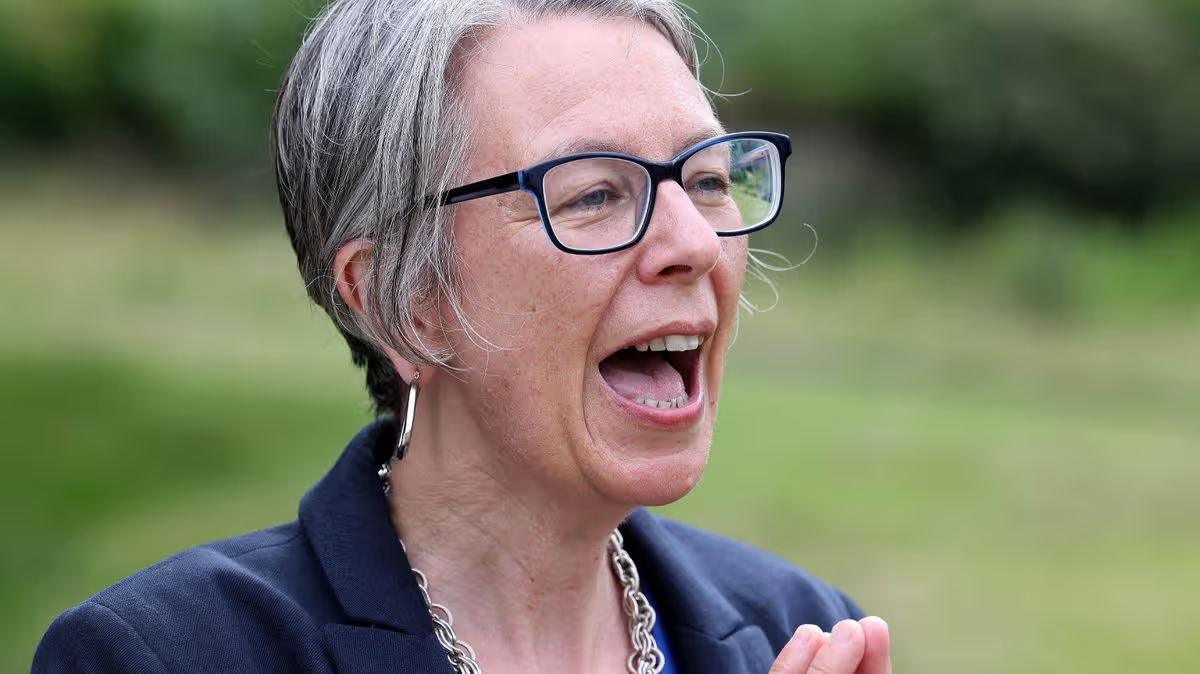
The Green candidate running to replace Andy Burnham hopes to bring a ‘world class transport system’ to Greater Manchester as she promised to support the extension of the Didsbury tramline into Stockport.
Advertisement
The race for whoever will be the next mayor of Greater Manchester is on and it is not just the weather heating things up. Three candidates have been announced so far, with Geraldine Coggins the first out of the gate for the Greens.
Manchester City Council leader Bev Craig has been announced as Labour’s candidate while Marlon West, a campaigner against child sexual exploitation, has been chosen as Restore Britain’s candidate. Voters will go to the polls on July 30.
Click here to get the biggest stories straight to your inbox in our Daily Newsletter
The Greater Manchester Combined Authority is responsible for governing across region-wide issues including health, transport, housing, major developments, jobs, policing and other emergency services. Whoever is elected will have huge powers and make decisions affecting people’s everyday lives.
Advertisement
The Green Party are hoping to capitalise on their recent gains in boroughs like Manchester as well as MP Hannah Spencer’s victory in the Gorton and Denton by-election. They argue Mr Burnham’s replacement will either be from their party or Reform, claiming recent gains in local elections back this up.
Ms Coggins, who is a Trafford councillor, said she agreed with a lot of Mr Burnham’s transport policy but promised she would take this further and ‘give us the world class transport system’ that ‘doesn’t just focus on the centre but also serves the people on the outer edges’.
She was not ready to share exactly what this will entail as the party prepares its manifesto for later in the election campaign. But at a campaign event in Hollywood Park in Stockport, one key issue for those in the town is whether the tram network will finally come to the borough.
Advertisement
There has been talk for years of extending the tramline from East Didsbury and further progress on this is expected later this year. Asked whether she would support this, Ms Coggins said she would push for the tram ‘as far as it can go’.
However, she added: “We know that trams are an expensive and slow solution. Buses and active transport [walking, scooting, and cycling] can be done so much cheaper and have an enormous impact much quicker and much cheaper. Trams are part of the solution but not the whole solution.”
As Mayor, she said her focus would be on tackling issues such as cost of living and an inclusive economy across the region. Putting herself in opposition to Reform, she added she would ‘really welcome our diverse community and celebrate that we are are all different and bringing something different to the table but we all call this place our home’.
Advertisement
However, she said: “People are struggling to make ends meet and if they aren’t struggling to make ends meet, they are just getting by. If Labour loses Greater Manchester, then that Green mayor will have a very powerful voice in Westminster because that will be a huge signal to Labour just like Gorton and Denton was.
“We have seen this existential crisis in the Labour Party and they are unable to find a Prime Minister out of 400 MPs. If they have lost a really important job to the Green party, they are going to have to listen to what people voting Green want. That is the way you get your message to the government.”
On the campaign trail, the Green candidate was joined by the party’s deputy leader Rachel Millward. Despite poor performance by the Greens in outer boroughs like Oldham, she is confident their party will be successful arguing they offered a different vision to any possible Labour government led by Mr Burnham.
Advertisement
“We know that once we get campaigning, people come over to us. We do incredible well when we get out and talk to people and they get to know us,” she said.
“We know how to win elections. A lot of those places have yet to know us but the local elections did show it will be Green versus Reform.”
She said they would seek to deliver more affordable and social housing as well as focus on high streets, green spaces, and net zero initiatives, adding: “We have seen the same developer used again and again and more luxury developments and we just want to be there for the people of Greater Manchester.
“It’s not about ripping up things that are good. It’s about doing more.”
Did you click on this article out of your own free will? Or was it predetermined by the cosmic evolution of particles, unfolding in an unbroken chain reaction set in motion by the big bang? Perhaps you think random quantum processes or unconscious brain activity were responsible? Whether you are philosophically inclined or not, the topic of free will is something most of us have pondered at some stage.
Research has shown that people tend to believe in free will, at least in some form. A more important question, perhaps, is whether it matters. This is the exact conundrum that researchers in psychology and experimental philosophy have been trying to answer recently. What would ultimately happen if people gave up on the idea of free will?
It may seem like a dangerous idea; something that could result in chaos and depression. And indeed, research has largely found that when you manipulate people to doubt free will, bad things happen – including an increase in behaviour such as cheating and aggression. This suggests that even if free will doesn’t exist, as many scientists and philosophers assume, it might be better for us to pretend that it does. But newer research by me and others suggests that doubting the existence of free will may not have such bad consequences, after all.
Philosophers have argued for centuries about what free will is and whether we have it. Positions vary widely, and it is impossible to give the subject full coverage here. At one end of the debate are libertarians, who contend that at least some of our choices and actions are not causally determined. At the other end are hard determinists who argue that every thought, action or event is a result of past events and the laws of nature.
Advertisement
When people talk about a disbelief in free will, determinism is usually the position that springs to mind. Yet, determinism is one of many positions within a family of views that dismiss the notion of free will. A position that has emerged more recently is called free will scepticism. While this position rejects the idea that humans possess genuine free will (but not necessarily agency), only some sceptics reject it because of determinism, while others argue that free will is impossible in an indeterministic or random universe.
But whichever tribe you identify with, what are the actual consequences of your beliefs? Before looking at some of the issues with recent experiments, let’s first explore how researchers began manipulating beliefs in the first place.
The Insights section is committed to high-quality longform journalism. Our editors work with academics from many different backgrounds who are tackling a wide range of societal and scientific challenges.
Advertisement
The benefits of believing in free will
The first piece of research to experimentally manipulate free will beliefs was conducted by Kathleen Vohs and Jonathan Schooler in 2008. This work, which is now a seminal paper in the area, comprised two experiments. In the first experiment, the researchers asked participants to read text taken from Francis Crick’s classical book The Astonishing Hypothesis. Participants were allocated to read either an anti-free will version or a neutral one.
In the group that was manipulated to not believe in free will, the text stated that free will was illusionary and behaviour was driven by unconscious brain activity. For example, the text included sentences such as “everything people are and do is the product of simple, physical processes in their brains” and “although we appear to have free will, in fact, our choices have already been predetermined for us and we cannot change that.” In the control condition, the text did not mention free will and instead discussed research on consciousness.
After reading the text, all participants completed a mental-arithmetic task on a computer. They were told that a “programming glitch” meant that the solutions/answers to the task that they were meant to solve themselves would be visible. Participants were therefore encouraged to press the spacebar, which would ensure the solutions remained hidden. Therefore, whether or not participants decided to keep the answers hidden was used to indicate cheating.
The researchers speculated that those reading the anti-free will text would press the spacebar less so than the control condition. And this is what they found. To confirm these findings, they ran a second experiment with some slight methodological changes. This second experiment essentially found the same thing: participants made to disbelieve in free will cheat more.
Advertisement
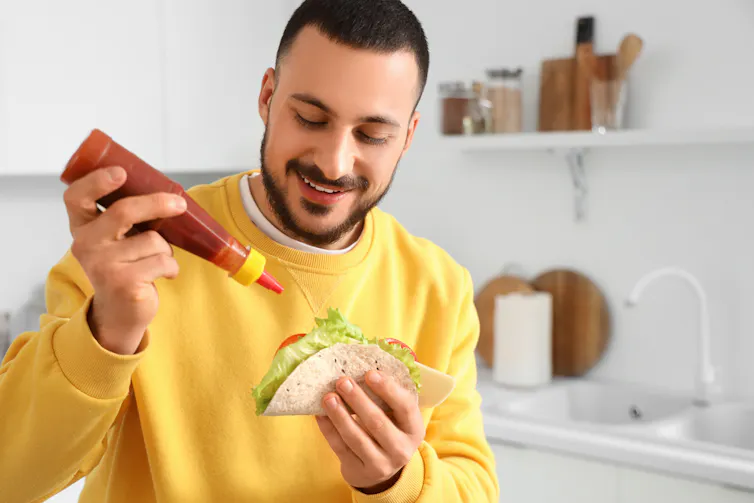
This paper led to a proliferation of studies seeking to examine other outcomes associated with free will beliefs. Roy Baumeister and colleagues investigated the link between the belief in free will and aggressive behaviour. After a free will belief manipulation, participants completed a cooking task and were told that the individual they were preparing food for disliked spicy food. Therefore, the amount of hot sauce administered by the participant served as the measure of aggression. Consistent with the researchers’ prediction, participants whose belief in free will had been weakened slathered on more hot sauce. The researchers therefore concluded that belief in free will is related to aggression. That said, they only looked at the direct consequences of manipulating people doubt free will rather than capturing the exact thought process of why they used more hot sauce.
The consequences of this programme of work were clear: if we make people disbelieve in free will, negative outcomes will follow. Consequently, even if we believe free will is an illusion, people should be shielded from this information as a society. However, there are some issues with these manipulation studies and the catastrophic conclusions derived from this line of research.
Are these conclusions premature?
An important issue concerns the beliefs that these manipulations are targeting. As mentioned earlier, many arguments against free will exist, and each argument aligns itself to a different philosophical position. The texts given to participants typically make claims related to the inevitability of events, the nature of science and the role of consciousness.
They are an amalgamation of philosophical positions that have their own ramifications. One idea that is commonly used in manipulations is the suggestion that people’s thoughts, desires, and wills are ineffectual – that the brain prepares for action before we consciously decide to do something. So when you reach for that chocolate bar at the end of a hard day, it’s not a result of conscious choice – unconscious brain processes are entirely to blame.
Advertisement
But this is not the only way think about a lack of free will; and it’s not something a sceptic would endorse. Many sceptics believe that thoughts and desires do influence how people behave but, importantly, the cognitive processes that underlie them (including genetics and past experiences) are either determined or due to chance. This suggests your desire was at play when you ate that chocolate bar – you can have agency without having full, God-like control deserving of ultimate moral responsibility. In this view, free will is more of a metaphysical concept whereas agency is involved in day-to-day events.
This is an important but subtle difference. Telling people that their thoughts have no say in what they do might lead to feelings of demotivation, disillusionment and alienation. It may even lead them to immoral behaviour. But these consequences are likely a result of far-fetching, dramatised arguments that pose direct threats to agency, and not a general, sceptic approach.
Suppose the manipulations do weaken belief in free will, but only according to a sceptical position that maintains some belief in agency. Will it still lead to dramatic, abhorrent outcomes? Recall that the experiments with the mathematical task, with cheating behaviour represented by the number of keypresses that did or did not occur.
The most that can be concluded from this experiment is that weakening belief in free will can influence cheating in a fictitious mental arithmetic task. The study did not find a relationship between belief in free will and other, more socially relevant, ways of deceptiveness, such as fraud, infidelity, academic dishonesty and so forth. To assume people cheating in a controlled laboratory experiment, which has no real-life consequences, would also commit these other forms of cheating appears far-fetched.
Advertisement
Similarly, the cooking study showed that beliefs about free will can affect how much hot sauce participants allocate in a laboratory setting. It is possible that the same manipulation could also increase verbal hostility or confrontation, and perhaps even aggression or threatening conduct. However, these conclusions remain completely speculative – we just don’t know.
For argument’s sake, let’s assume that they do lead to bad things in real life. We may still question just how meaningful the findings are. Researchers talk a lot about the “effect size” of a finding, which basically tells us the magnitude or size of the effect. A large effect size indicates a finding has practical significance, whereas a small effect indicates limited practical application. Researchers obviously strive for the former.
To get a sense of the effect size in free will belief research, a 2022 paper reviewed studies administering manipulations to free will beliefs. It found that these manipulations only had a small effect size. What’s more, it showed that the strongest effects happened directly after the manipulation instead of at the end of the experiment. This indicates that manipulation effects may not only fade after the experiment, but wane over the course of the experimental session – we don’t think about whether we have free will constantly. Not only that, but the review found that changes in free will beliefs did not have any meaningful, lasting change in behaviours.
A final issue has to do with replication, the confirmation of scientific findings in other studies. Whether a finding is replicated is one of the major principles in science. Repeating an experiment and consistently finding the same thing can increase confidence about an initial finding. And a replication crisis has recently engulfed psychology.
Advertisement
This is also the case for free will research. For example, some researchers have failed to change participants’ belief in free will. Others, despite successfully changing free will beliefs, have found difficulty replicating the consequences. For example, one study could not replicate the findings regarding cheating on the mathematical task. These difficulties question the credibility of the original findings and pose serious challenges to the assumption that negative consequences come about from a disbelief in free will.
Can a disbelief be good?
We have seen different reasons why it may be premature for researchers to conclude that disbelieving in free will has negative consequences. But we may also question whether these negative outcomes are to be expected anyway, and whether adopting a sceptical position can actually have societal benefits.
One view is that beliefs about free will make no difference to how people think and behave. Think about meaning in life, something which research has supposedly showed to be weakened by a disbelief free will. Imagine that a person’s meaning is strongly attached to their career. This person harbours the ambition to become a lawyer and after years of dedication, finally achieves her dream. Would the belief that she lacked free will affect her meaning and how she perceived this success?
Not necessarily so. She was still the one that got up early, arrived home late and dedicated hours to studying. The pride in her accomplishment does not evaporate in the knowledge that she was not the ultimate controller. She may be thankful for her upbringing, the education she received and her family support. There can still be meaning and gratitude. People ascribe meaning to all sort so things – intelligence, athleticism and beauty – none of which have got anything to do with free will.
Advertisement
What’s more, I conducted a study that specifically looked at meaning in life across people holding a range of views about free will. One group read a text passage denouncing free will (a traditional free will disbelief manipulation); and a second read neutral text (a control condition). I also had a third group which did not receive a manipulation but was selected by identifying as free-will sceptics.
All participants reported on how meaningful their life was. As would be expected, those manipulated to disbelieve in free will showed lower meaning than the control, supporting previous studies. But crucially, the sceptic group had the same sense of meaning and purpose as the control.
This indicates that, as suggested earlier, the manipulations claiming to make people doubt free will are not doing so in accordance with a sceptical perspective. More importantly, this suggests that the meaning in life of people taking sceptic views is unaffected by their philosophical position.
Further supporting this, a 2024 paper examined the views of free will sceptics exclusively and found that 41% (out of 164) claimed that their disbelief had no effect on their life at all. And the most reported consequences were indeed positive, including having compassion for others, being less controlling and more relaxed.
Advertisement
Does this mean a sceptical position could in fact provide societal benefits? One of the most debated consequences of free will beliefs concerns morality and responsibility. In the current legal system, retributive punishment is predicated on the assumption that the criminal was morally responsible for their action and acted out of their own free will. Supporting this view, research has found that participants with a stronger belief in free will are actually less empathic towards wrongdoers, and hand out harsher sentences. Yet, if free will does not exist, it would seem unduly harsh to punish an individual based on an act they were not responsible for.
Those who don’t believe in free will may have their own reasons for being altruistic. Shakirov Albert/Shutterstock
Gregg Caruso and Derk Pereboom are prominent free will sceptics who question the morality of punitive decisions. They suggest that instead of punishing people because they are morally responsible for their actions, more empathetic, non-punitive approaches can be adopted in line with sceptical beliefs. For example, their quarantine model seeks to isolate offenders and provide rehabilitation until they no longer pose a risk to society – regardless of their level of responsibility. Seen in this way, a disbelief in free will could potentially overhaul a legal system that’s at odds with the view that free will does not exist.
Holding the belief that people can freely determine their circumstances may also lead to other harmful outcomes, such as social inequalities, injustice, a lack of empathy, hatred and victim blaming. For example, a belief in free will can promote the idea that poor people are somehow deserving of their abhorrent conditions and are living in situations of their own making. These perceptions can change if the notion of free will is relinquished. Because people are not morally responsible for their own situations, a greater deal of compassion and empathy could be shown towards those underprivileged. So there could indeed be positive outcomes of declining to believe in free will.
Researchers have claimed that making people disbelieve in free will can have dramatic negative consequences. A disbelief in free will may indeed lead to bad things; however, due to various methodological issues, it is premature to make this conclusion. In fact, it could turn out that disbelieving in free will is actually a good thing.
To hear about new Insights articles, join the hundreds of thousands of people who value The Conversation’s evidence-based news. Subscribe to our newsletter.
“These are the most comfortable shoes. I wore them around the parks in Orlando for a week. Everyone else in my group had blisters my feet were great. We were covering up to eight miles a day…”
Shawna Healey Senior fashion, beauty and home affiliate writer and Nadia Breen
08:46, 24 Jun 2026
This article contains affiliate links, we will receive a commission on any sales we generate from it. Learn more
Sandals are a must-have during hot weather as their open design allows air circulation, helping to prevent feet from overheating and sweating.
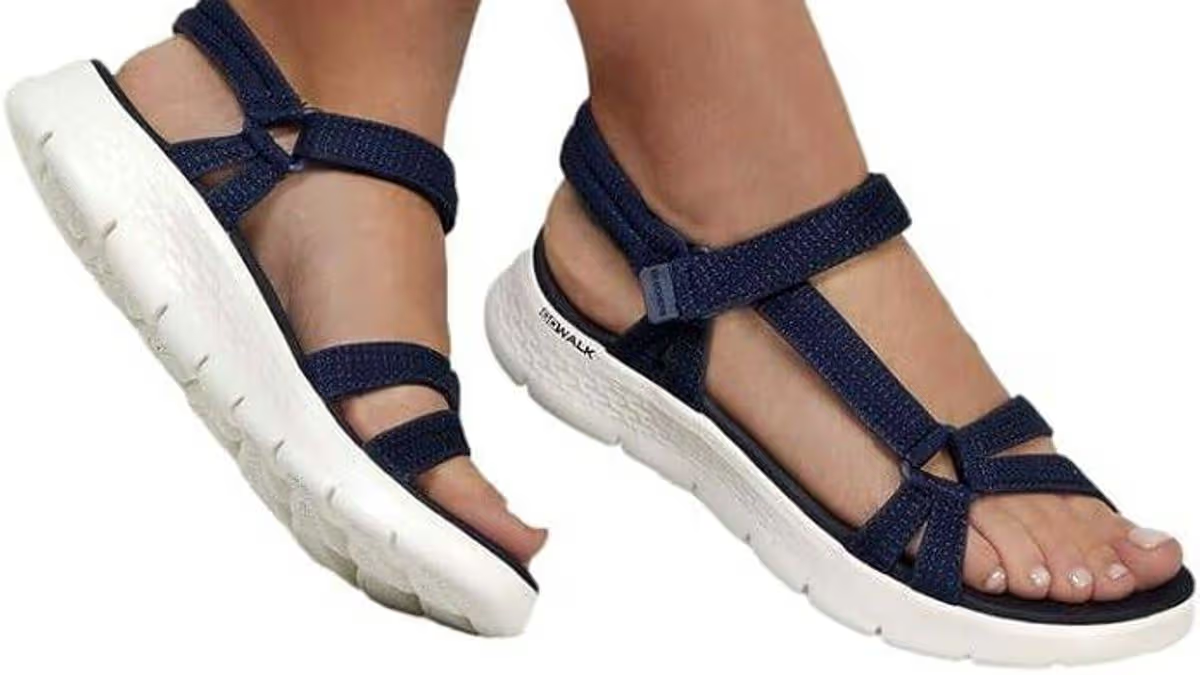
Amazon shoppers have discovered a pair of sandals that combine style with comfort. Those who’ve purchased the Walk Flex Sublime Sandals say they’re ‘super comfy’ even after walking miles each day.
Normally priced at £54, the Walk Flex Sublime Sandals in navy textile have been discounted by 35% during the Amazon Prime Day sale, which runs from Tuesday, June 23 to Friday, June 26. This reduction brings the cost down to £34.98 (prices correct at time of writing).
Advertisement
Available in sizes two to nine, shoppers can choose from additional colours including black, mauve pink, sage green and blue, amongst others. It’s worth noting that pricing may differ depending on which colour and size is selected, with navy being the cheapest option currently.
The Go Walk Flex Sublime Sandals blend practical comfort with relaxed style. These sporty shoes boast a textile upper with an adjustable ankle strap featuring hook and loop fastening, providing a customisable fit.
Advertisement
Incorporating Skechers’ comfort technology, these sandals feature a contoured Goga Mat footbed that adapts to the shape of your feet, delivering arch support and cushioning. The featherlight Ultra Go midsole provides responsive comfort.
The flexible EVA outsole delivers dependable grip across different surfaces. Their water-resistant design makes them perfect for a range of summer pursuits, whether strolling along the beach, relaxing by the pool or exploring town casually.
Meanwhile, the Gracie Leather Strappy Back-Strap Sandals have seen a 31% price reduction, now available for £69 rather than £100. Crafted from leather that feels soft on skin, they boast gently rounded front straps to prevent uncomfortable rubbing and an adjustable buckle-fastening back strap for added stability.
As an alternative, Marks and Spencer’s Leather Flat Mule Sandals are priced at £26. These leather sandals offer an effortless slip-on style, featuring fashionable cutout details on the straps, sophisticated square toes and flat soles that make them perfect for lengthy sunny-day strolls.
Advertisement
Returning to Amazon, the Go Walk Flex Sublime Sandals have an overall rating of 4.4 out of five from 2,634 reviews. One pleased customer commented: “Really comfortable, perfect for long summer walks. The range of sizes meant I could find the perfect fit. Great quality too.”
A second customer remarked: “So comfortable. I like to wear sandals in the summer, but struggle to find comfortable ones. My feet swell a bit in the heat, and these accommodate for that. I wear Skechers trainers all the time, so thought I’d try these. Glad I did.”
“Super comfy, I wore them in Spain,” a third shared. “I walked 60km overall and no blisters or swelling, simply perfect. Smart but sporty, can be worn with dresses or shorts or trousers. Very supportive and no sign of damage after prolonged use.”
However, one buyer wasn’t satisfied with the sizing of the Go Walk Flex Sublime Sandals and left a three-star rating. It states: “Nice sandals but they come up very large – I’ve had to return and reorder in a smaller size.”
“Lovely sandals but inconsistent sizing,” another three-star review notes. “I ordered my usual size six and much too big and wide. Returned.”
Despite this, another shopper was pleased with their recent Amazon buy, commenting: “These are the most comfortable shoes. I wore them around the parks in Orlando for a week.
“Everyone else in my group had blisters my feet were great. We were covering up to eight miles a day. Can’t recommend enough.”
Advertisement
A further five-star review states: “I have been wearing this make and style for years. They fit my feet well and are extremely comfortable for walking. No blisters to date. Reasonable price and quick delivery. Recommend.”
Want to see more of the stories you love from Belfast Live? Making us your preferred source on Googlemeans you’ll get more of our exclusives, top stories and must-read content straight away. To add Belfast Live as a preferred source, simply click here.
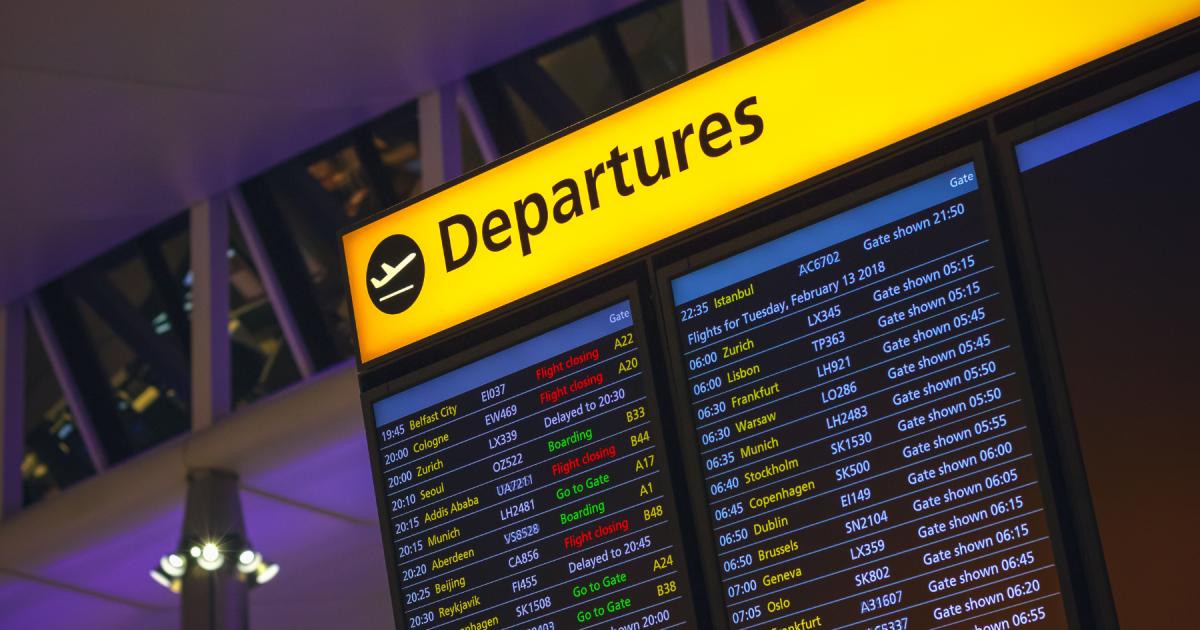
In Europe, hand luggage rules are about to change (Picture: Getty Images)
If you’re a seasoned traveller — especially on short-haul European flights — you’ll likely have tried myriad luggage hacks to avoid paying extortionate airline fees.
From the neck pillow trick, which consists of stuffing your U-shaped pillow with clothing, to using a duty-free carrier bag to sneak extra stuff, there are some innovative ways to bypass the limits.
However, certain passengers may not need to get creative for much longer.
After 13 years of negotiations, the EU has reached an agreement that will allow hand luggage on board free of charge.
Advertisement
Here’s everything we know so far about the ruling, which is set to come into action in 2027.
What is the agreement?
Best of Metro Deals
Get exclusive discounts with Metro Deals – save on getaways and spa days. Powered by Wowcher
Bannatyne Spa: Spa day for two with treatments, lunch & prosecco — save up to 57% off.
The proposal, which is part of an agreement between the European Council and European Parliament, will allow travellers to take carry-on luggage measuring 40cm x 30cm x 15cm, with no extra fee.
This is as well as the usual under-the-seat rucksack allowance.
Advertisement
In a statement announcing the news, the Council of the EU said that ‘to create price transparency, air fares including allowance for a piece of hand baggage shall be displayed by default before the start of any booking process to facilitate fare comparisons between airlines.’
In a nutshell, this means airlines must include both the small personal item and the larger carry-on bag in their standard ticket price.
It has also been agreed that airlines may offer cheaper tickets to passengers who voluntarily choose to travel without hand luggage.
No more hiding your bits in duty-free bags (Picture: Getty Images)
This landmark ruling is the first time airline passengers’ rights have been updated in Europe since 2004.
That was when Regulation EU261 — a European Union law establishing minimum rights for air passengers, guaranteeing compensation, refunds, and assistance in cases of flight cancellations, long delays, or denied boarding — was passed.
Advertisement
But like all good things, there’s a catch.
Despite the UK adopting EU261 after Brexit, it has not been updated here yet.
To get to the bottom of what this means for Brits travelling across Europe next summer, Metro spoke with Rhys Jones, Aviation Editor at Head for Points.
Who does this amendment apply to?
‘Passengers flying on EU airlines will be able to take advantage of [the change] in both directions,’ says Rhys.
Advertisement
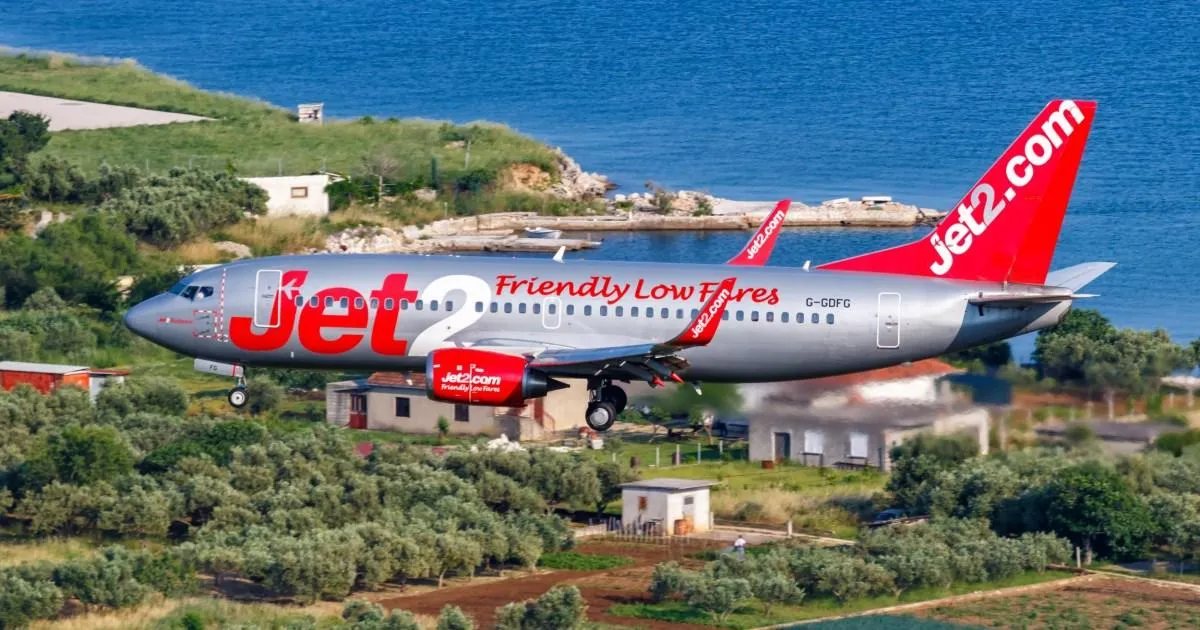
However, he warns that non-EU airlines — such as Jet2 or easyJet — would only be bound by these regulations on flights from the EU back to the UK.
Jet2 is a non-EU airline, so will only be affected on flights back to the UK (Picture: Shutterstock/Markus Mainka)
For example, you could get free hand luggage on an easyJet, Jet2, or BA flight from Mallorca or similar, but not when departing the UK.
That is, unless the UK enacts similar legislation.
Additionally, Rhys says that British Airways, despite being owned by Spanish holding company International Airlines Group, is also considered a UK airline as its operating licence is issued by the UK.
‘Whilst the original 2004 EU264 legislation was copied to UK law as part of Brexit, this does not automatically mean that future amendments in the EU are adopted,’ he adds.
Advertisement
Rather, ‘it would be up to the Civil Aviation Authority to make any future changes to UK law, not the EU.’
Which airlines will be affected?
Rhys says that from 2027, ultra-low-cost airlines such as Ryanair, easyJet and Wizz Air will be affected the most.
This is because they do not include trolley bags in their lowest fares.
Wizz Air is another airline likely to be affected (Picture: Xavier Bonilla/NurPhoto/Shutterstock)
‘Affected airlines will now need to show a default price that includes a cabin trolley bag, although passengers will be able to opt out during the process for an additional saving,’ Rhys reiterates.
‘This will make it easier to compare to full-service airlines such as British Airways and Air France, where trolley bags are included in the fare.’
Advertisement
What have the airlines said about the ruling?
Consumer groups have argued that charging for cabin bags is illegal, especially via practices followed by low-cost airlines, and that air travellers should have the right to claim compensation linked to delays.
However, some airlines have been rushing to charge for cabin baggage in recent months, citing financial losses due to soaring jet fuel prices linked to disruptions in the Middle East.
Ryanair boss Michael O’Leary has been pretty vocal about this new agreement, calling it ‘gobbledygook.’
The Irish businessman criticised the regulations, which he said ‘require airlines to falsely advertise higher air fares, making EU airlines even less competitive.’
Advertisement
He added that the latest EU261 rulings are ‘more bureaucratic bunkum from the EU Parliament and Council,’ adding that over 50% of Ryanair customers choose fares that exclude a second cabin bag.
Low-cost carriers like Ryanair will feel the pinch (Picture: SWNS)
He said the regulations were discouraging EU airlines from advertising their lowest fares.
O’Leary also argued that they make EU travel less competitive.
Of course, it makes sense that the Irish carrier would have a problem with the agreement. In 2024, Ryanair made €4.7 billion from charging extra fees, which included baggage costs.
What other passenger rights have been updated?
‘The amended regulations clarify various topics that have been contentious with airlines since they were first introduced in 2004, which should help make it clearer for both passengers and airlines,’ Rhys says.
Advertisement
For example, airlines now have to electronically inform passengers within 96 hours if they are eligible for delay compensation.
Elsewhere, the claiming process has been made easier with a 30-day window for airlines to either pay up or decline the request.
What has not changed are your rights if your flight is delayed or cancelled.
‘Depending on the length of your flight, passengers can still claim €250, €400 or €600, if the flight is delayed by three hours or more.’
Temperatures up to 38C are forecast across the country
Train passengers have been warned to only travel “if essential” as the hot weather could see temperatures reach up to 38C. Earlier this week, the Met Office issued a rare red warning, alongside an amber warning, for parts of the UK including Cambridgeshire.
Advertisement
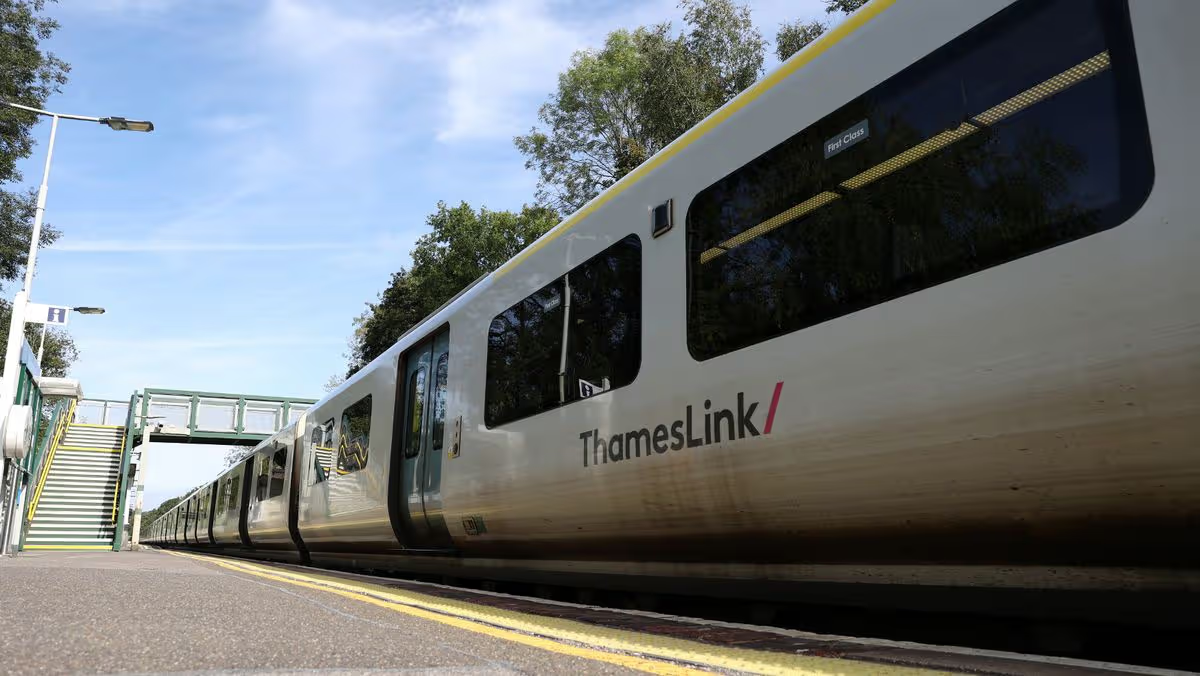
Thameslink and Great Northern, which both operate in Cambridgeshure, have warned passengers to “only travel if essential”. There will be a reduced service between Kings Lynn and London Kings Cross today (Wednesday, June 24) and tomorrow (Thursday, June 25).
On the National Rail website it said: “As temperatures begin to soar today and tomorrow, when the most extreme conditions are expected, passengers travelling to, from, or within the red warning areas should only travel if absolutely necessary, while passengers outside those areas should continue to check their travel plans carefully.
“Rail services will continue to run but will be reduced in some parts of the network, customers should expect disruption across some routes. For safety reasons, trains will operate at reduced speeds and to amended timetables, meaning journeys will take longer and there is a heightened risk of delays, last-minute alterations and cancellations.
“There will be no rail replacement bus/taxi services during this period. Customers who do need to travel are strongly advised to prepare for the conditions by bringing plenty of water, wearing sunscreen and a hat, and ensuring that they have a back-up plan in case of disruption.
Advertisement
“If you begin to feel unwell, please seek assistance at the next station or speak to a member of station staff. For your safety, we kindly ask that you avoid using the emergency alarm between stations, as this may delay access to support.”
Gatwick Express and Southern trains are also affected.
The summer transfer window continues to ramp up as Arsenal, Chelsea, Manchester United, Liverpool and Tottenham all attempt to complete some huge early signings. Arsenal look to be advancing in their pursuit of Morgan Rogers amid claims that they have now agreed personal terms with the England star. The Gunners have been linked with an audacious swap deal for Julian Alvarez, while they are close to signing wonderkid Jeremy Monga as they also chase the likes of Ayyoub Bouaddi, Bradley Barcola, Eli Junior Kroupi, Christos Tzolis and Andria Bartishvili.
Train passengers across Wales are facing widespread disruption as operators cancel services amid an unprecedented red weather warning for extreme heat.
Rail routes across north, mid and south Wales have been affected on Wednesday as temperatures are forecast to climb towards 38C, with forecasters warning of a “severe weather event” that could pose risks to life and infrastructure.
Several rail lines have already seen services suspended or cancelled due to the conditions, while Network Rail and train operators continue to monitor the impact of the heatwave on tracks, signalling systems and rolling stock.
Advertisement
Among the routes affected are services between Manchester Piccadilly and Cardiff Central, Bridgend and Maesteg, Cardiff Central and Ebbw Vale Town, and Llandudno and Blaenau Ffestiniog, where severe weather-related disruption is expected to continue throughout Wednesday.
Additional disruption has been reported on routes between Shrewsbury and Birmingham International because of forecast extreme weather conditions.














































You must be logged in to post a comment Login