Connect with us
DAPA Banner
DAPA Coin
DAPA
COIN PAYMENT ASSET
PRIVACY · BLOCKDAG · HOMOMORPHIC ENCRYPTION · RUST
ElGamal Encrypted MINE DAPA
🚫 GENESIS SOLD OUT
DAPAPAY COMING

NewsBeat

does refusing to believe in it make you a ‘bad’ person? Research is challenging this old idea

Published

on

does refusing to believe in it make you a ‘bad’ person? Research is challenging this old idea

Did you click on this article out of your own free will? Or was it predetermined by the cosmic evolution of particles, unfolding in an unbroken chain reaction set in motion by the big bang? Perhaps you think random quantum processes or unconscious brain activity were responsible? Whether you are philosophically inclined or not, the topic of free will is something most of us have pondered at some stage.

Research has shown that people tend to believe in free will, at least in some form. A more important question, perhaps, is whether it matters. This is the exact conundrum that researchers in psychology and experimental philosophy have been trying to answer recently. What would ultimately happen if people gave up on the idea of free will?

It may seem like a dangerous idea; something that could result in chaos and depression. And indeed, research has largely found that when you manipulate people to doubt free will, bad things happen – including an increase in behaviour such as cheating and aggression. This suggests that even if free will doesn’t exist, as many scientists and philosophers assume, it might be better for us to pretend that it does. But newer research by me and others suggests that doubting the existence of free will may not have such bad consequences, after all.

Philosophers have argued for centuries about what free will is and whether we have it. Positions vary widely, and it is impossible to give the subject full coverage here. At one end of the debate are libertarians, who contend that at least some of our choices and actions are not causally determined. At the other end are hard determinists who argue that every thought, action or event is a result of past events and the laws of nature.

Advertisement

When people talk about a disbelief in free will, determinism is usually the position that springs to mind. Yet, determinism is one of many positions within a family of views that dismiss the notion of free will. A position that has emerged more recently is called free will scepticism. While this position rejects the idea that humans possess genuine free will (but not necessarily agency), only some sceptics reject it because of determinism, while others argue that free will is impossible in an indeterministic or random universe.

But whichever tribe you identify with, what are the actual consequences of your beliefs? Before looking at some of the issues with recent experiments, let’s first explore how researchers began manipulating beliefs in the first place.


The Insights section is committed to high-quality longform journalism. Our editors work with academics from many different backgrounds who are tackling a wide range of societal and scientific challenges.

Advertisement

The benefits of believing in free will

The first piece of research to experimentally manipulate free will beliefs was conducted by Kathleen Vohs and Jonathan Schooler in 2008. This work, which is now a seminal paper in the area, comprised two experiments. In the first experiment, the researchers asked participants to read text taken from Francis Crick’s classical book The Astonishing Hypothesis. Participants were allocated to read either an anti-free will version or a neutral one.

In the group that was manipulated to not believe in free will, the text stated that free will was illusionary and behaviour was driven by unconscious brain activity. For example, the text included sentences such as “everything people are and do is the product of simple, physical processes in their brains” and “although we appear to have free will, in fact, our choices have already been predetermined for us and we cannot change that.” In the control condition, the text did not mention free will and instead discussed research on consciousness.

After reading the text, all participants completed a mental-arithmetic task on a computer. They were told that a “programming glitch” meant that the solutions/answers to the task that they were meant to solve themselves would be visible. Participants were therefore encouraged to press the spacebar, which would ensure the solutions remained hidden. Therefore, whether or not participants decided to keep the answers hidden was used to indicate cheating.

The researchers speculated that those reading the anti-free will text would press the spacebar less so than the control condition. And this is what they found. To confirm these findings, they ran a second experiment with some slight methodological changes. This second experiment essentially found the same thing: participants made to disbelieve in free will cheat more.

Advertisement

This paper led to a proliferation of studies seeking to examine other outcomes associated with free will beliefs. Roy Baumeister and colleagues investigated the link between the belief in free will and aggressive behaviour. After a free will belief manipulation, participants completed a cooking task and were told that the individual they were preparing food for disliked spicy food. Therefore, the amount of hot sauce administered by the participant served as the measure of aggression. Consistent with the researchers’ prediction, participants whose belief in free will had been weakened slathered on more hot sauce. The researchers therefore concluded that belief in free will is related to aggression. That said, they only looked at the direct consequences of manipulating people doubt free will rather than capturing the exact thought process of why they used more hot sauce.

Young man eating tasty taco with hot sauce at home.
Who knew hot sauce could be at the heart of the free will debate?
Pixel-Shot/Shutterstock

Other studies showed that participants manipulated to doubt free will were prejudiced, less grateful, less helpful, alienated and experienced less meaning in life. In fact, autonomy, self-efficacy, job satisfaction, perseverance, achievement and life satisfaction were all linked to a stronger belief in free will.

The consequences of this programme of work were clear: if we make people disbelieve in free will, negative outcomes will follow. Consequently, even if we believe free will is an illusion, people should be shielded from this information as a society. However, there are some issues with these manipulation studies and the catastrophic conclusions derived from this line of research.

Are these conclusions premature?

An important issue concerns the beliefs that these manipulations are targeting. As mentioned earlier, many arguments against free will exist, and each argument aligns itself to a different philosophical position. The texts given to participants typically make claims related to the inevitability of events, the nature of science and the role of consciousness.

They are an amalgamation of philosophical positions that have their own ramifications. One idea that is commonly used in manipulations is the suggestion that people’s thoughts, desires, and wills are ineffectual – that the brain prepares for action before we consciously decide to do something. So when you reach for that chocolate bar at the end of a hard day, it’s not a result of conscious choice – unconscious brain processes are entirely to blame.

Advertisement

But this is not the only way think about a lack of free will; and it’s not something a sceptic would endorse. Many sceptics believe that thoughts and desires do influence how people behave but, importantly, the cognitive processes that underlie them (including genetics and past experiences) are either determined or due to chance. This suggests your desire was at play when you ate that chocolate bar – you can have agency without having full, God-like control deserving of ultimate moral responsibility. In this view, free will is more of a metaphysical concept whereas agency is involved in day-to-day events.

This is an important but subtle difference. Telling people that their thoughts have no say in what they do might lead to feelings of demotivation, disillusionment and alienation. It may even lead them to immoral behaviour. But these consequences are likely a result of far-fetching, dramatised arguments that pose direct threats to agency, and not a general, sceptic approach.

Suppose the manipulations do weaken belief in free will, but only according to a sceptical position that maintains some belief in agency. Will it still lead to dramatic, abhorrent outcomes? Recall that the experiments with the mathematical task, with cheating behaviour represented by the number of keypresses that did or did not occur.

The most that can be concluded from this experiment is that weakening belief in free will can influence cheating in a fictitious mental arithmetic task. The study did not find a relationship between belief in free will and other, more socially relevant, ways of deceptiveness, such as fraud, infidelity, academic dishonesty and so forth. To assume people cheating in a controlled laboratory experiment, which has no real-life consequences, would also commit these other forms of cheating appears far-fetched.

Advertisement

Similarly, the cooking study showed that beliefs about free will can affect how much hot sauce participants allocate in a laboratory setting. It is possible that the same manipulation could also increase verbal hostility or confrontation, and perhaps even aggression or threatening conduct. However, these conclusions remain completely speculative – we just don’t know.

For argument’s sake, let’s assume that they do lead to bad things in real life. We may still question just how meaningful the findings are. Researchers talk a lot about the “effect size” of a finding, which basically tells us the magnitude or size of the effect. A large effect size indicates a finding has practical significance, whereas a small effect indicates limited practical application. Researchers obviously strive for the former.

To get a sense of the effect size in free will belief research, a 2022 paper reviewed studies administering manipulations to free will beliefs. It found that these manipulations only had a small effect size. What’s more, it showed that the strongest effects happened directly after the manipulation instead of at the end of the experiment. This indicates that manipulation effects may not only fade after the experiment, but wane over the course of the experimental session – we don’t think about whether we have free will constantly. Not only that, but the review found that changes in free will beliefs did not have any meaningful, lasting change in behaviours.

A final issue has to do with replication, the confirmation of scientific findings in other studies. Whether a finding is replicated is one of the major principles in science. Repeating an experiment and consistently finding the same thing can increase confidence about an initial finding. And a replication crisis has recently engulfed psychology.

Advertisement

This is also the case for free will research. For example, some researchers have failed to change participants’ belief in free will. Others, despite successfully changing free will beliefs, have found difficulty replicating the consequences. For example, one study could not replicate the findings regarding cheating on the mathematical task. These difficulties question the credibility of the original findings and pose serious challenges to the assumption that negative consequences come about from a disbelief in free will.

Can a disbelief be good?

We have seen different reasons why it may be premature for researchers to conclude that disbelieving in free will has negative consequences. But we may also question whether these negative outcomes are to be expected anyway, and whether adopting a sceptical position can actually have societal benefits.

One view is that beliefs about free will make no difference to how people think and behave. Think about meaning in life, something which research has supposedly showed to be weakened by a disbelief free will. Imagine that a person’s meaning is strongly attached to their career. This person harbours the ambition to become a lawyer and after years of dedication, finally achieves her dream. Would the belief that she lacked free will affect her meaning and how she perceived this success?

Not necessarily so. She was still the one that got up early, arrived home late and dedicated hours to studying. The pride in her accomplishment does not evaporate in the knowledge that she was not the ultimate controller. She may be thankful for her upbringing, the education she received and her family support. There can still be meaning and gratitude. People ascribe meaning to all sort so things – intelligence, athleticism and beauty – none of which have got anything to do with free will.

Advertisement

What’s more, I conducted a study that specifically looked at meaning in life across people holding a range of views about free will. One group read a text passage denouncing free will (a traditional free will disbelief manipulation); and a second read neutral text (a control condition). I also had a third group which did not receive a manipulation but was selected by identifying as free-will sceptics.

All participants reported on how meaningful their life was. As would be expected, those manipulated to disbelieve in free will showed lower meaning than the control, supporting previous studies. But crucially, the sceptic group had the same sense of meaning and purpose as the control.

This indicates that, as suggested earlier, the manipulations claiming to make people doubt free will are not doing so in accordance with a sceptical perspective. More importantly, this suggests that the meaning in life of people taking sceptic views is unaffected by their philosophical position.

Further supporting this, a 2024 paper examined the views of free will sceptics exclusively and found that 41% (out of 164) claimed that their disbelief had no effect on their life at all. And the most reported consequences were indeed positive, including having compassion for others, being less controlling and more relaxed.

Advertisement

Does this mean a sceptical position could in fact provide societal benefits? One of the most debated consequences of free will beliefs concerns morality and responsibility. In the current legal system, retributive punishment is predicated on the assumption that the criminal was morally responsible for their action and acted out of their own free will. Supporting this view, research has found that participants with a stronger belief in free will are actually less empathic towards wrongdoers, and hand out harsher sentences. Yet, if free will does not exist, it would seem unduly harsh to punish an individual based on an act they were not responsible for.

Stylish office worker and beggar male sit eating on street and speaking.
Those who don’t believe in free will may have their own reasons for being altruistic.
Shakirov Albert/Shutterstock

Gregg Caruso and Derk Pereboom are prominent free will sceptics who question the morality of punitive decisions. They suggest that instead of punishing people because they are morally responsible for their actions, more empathetic, non-punitive approaches can be adopted in line with sceptical beliefs. For example, their quarantine model seeks to isolate offenders and provide rehabilitation until they no longer pose a risk to society – regardless of their level of responsibility. Seen in this way, a disbelief in free will could potentially overhaul a legal system that’s at odds with the view that free will does not exist.

Holding the belief that people can freely determine their circumstances may also lead to other harmful outcomes, such as social inequalities, injustice, a lack of empathy, hatred and victim blaming. For example, a belief in free will can promote the idea that poor people are somehow deserving of their abhorrent conditions and are living in situations of their own making. These perceptions can change if the notion of free will is relinquished. Because people are not morally responsible for their own situations, a greater deal of compassion and empathy could be shown towards those underprivileged. So there could indeed be positive outcomes of declining to believe in free will.

Researchers have claimed that making people disbelieve in free will can have dramatic negative consequences. A disbelief in free will may indeed lead to bad things; however, due to various methodological issues, it is premature to make this conclusion. In fact, it could turn out that disbelieving in free will is actually a good thing.


For you: more from our Insights series:

Advertisement

To hear about new Insights articles, join the hundreds of thousands of people who value The Conversation’s evidence-based news. Subscribe to our newsletter.


Source link

Advertisement
Continue Reading
Click to comment

You must be logged in to post a comment Login

Leave a Reply

NewsBeat

‘Deeply terrifying’ new drama starring Bridgerton and Peaky Blinders duo gets first look

Published

on

Wales Online

Channel 4 has shared a first look at the latest instalment of Dominic Savage’s I Am series, starring Bridgerton’s Nicola Coughlan and Peaky Blinders’ Joe Cole

Channel 4 has released a first look at a “deeply terrifying” new drama featuring Bridgerton and Peaky Blinders stars.

Advertisement

Nicola Coughlan and Joe Cole lead the latest entry in Dominic Savage’s acclaimed I Am series. Nicola takes the central role as Helen, while Joe’s character remains undisclosed.

However, he appears to portray Helen’s partner, with promotional images depicting the pair seated on a bed in what seems to be a heated exchange, reports the Mirror.

The newest addition to the critically lauded anthology series, entitled I Am Helen, is created, written and directed by Dominic Savage, and promises to explore the “experience of womanhood within a world shaped by masculine power, aggression, and control”.

The official synopsis states: “Told through a female lens, the story examines the pressures and expectations placed on women while confronting the realities of toxic masculinity and the damage it can create in modern relationships.”

Advertisement

I Am Helen follows three previous seasons, each charting women’s personal journeys through distinct individual stories. In 2023, Kate Winslet headlined the third instalment, I Am Ruth, which earned two BAFTAs and received widespread critical acclaim.

Launching in 2019, the inaugural series starred Vicky McClure in I Am Nicola, Samantha Morton in I Am Kirsty, and Gemma Chan in I Am Hannah. The second season featured Suranne Jones in I Am Victoria, Letitia Wright in I Am Danielle, and Lesley Manville in I Am Maria.

When the series was initially revealed, Nicola informed her followers: “It’s an absolute honour to be part of telling the next I Am… story alongside Dominic Savage – a singular talent and a storyteller deeply committed to exploring the breadth of the female experience.

Advertisement

“To follow in the footsteps of the brilliant women who’ve collaborated with him on this series feels truly surreal, and I feel incredibly fortunate to be embarking on this journey.”

After the initial preview, supporters have been quick to express their reactions on social media, with one writing: “I’m so excited to watch Nicola portraying this theme about the manosphere.”

Another commented: “Ahhh! ! I can’t wait to watch this next instalment! I already know it’s going to break my heart in the best way.”

Advertisement

A third remarked: “Most excited! I know Nicola is going to slay me.” Someone else added: “Can’t wait to see this. Two fantastic actors.”

Another posted: “I’m not sure I am ready to see Nicola Coughlan play a character that gets annoyed/harassed by a man for the first time. I think this might wreck me.”

One person stated: “Aw heck, she’s great but already I want to cry.” While another responded: “This is going to really hit home isn’t it. I can’t wait, deviate myself.”

I Am Helen will air on Channel 4 later this year

Advertisement

Source link

Continue Reading

NewsBeat

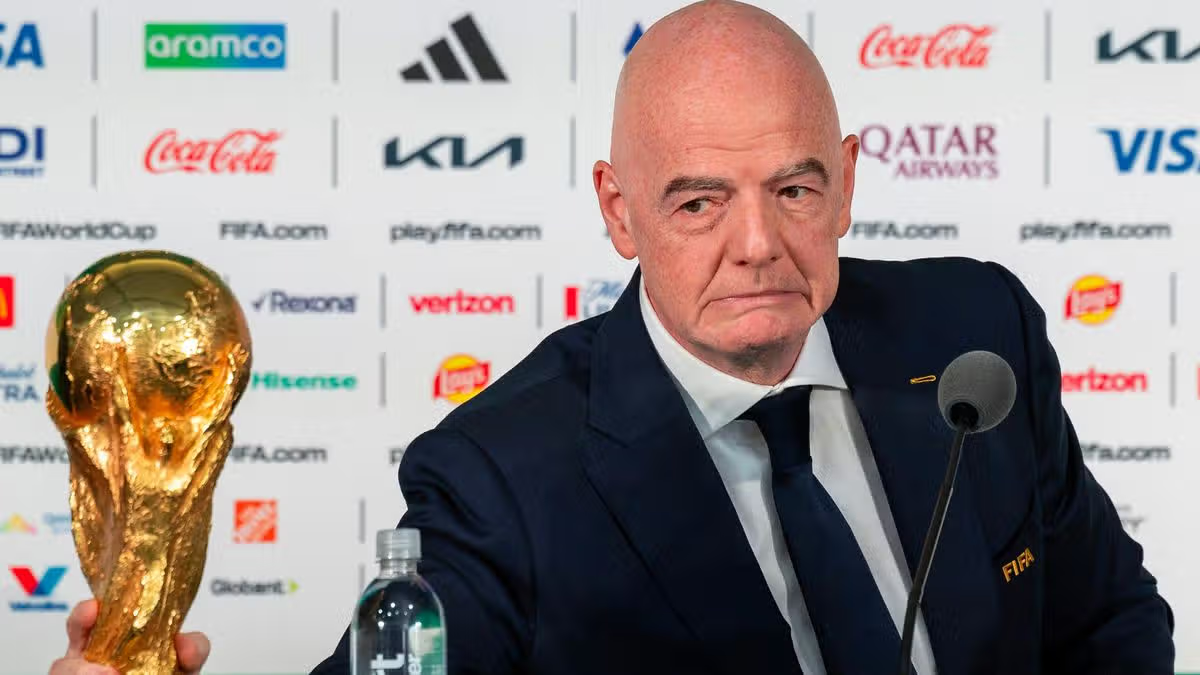
World Cup 2026: Have England qualified for knockout phase?

Published

on

World Cup 2026: Have England qualified for knockout phase?

England are guaranteed a top-three finish in their World Cup group, though progression to the knockout stages has not yet been confirmed.

Source link

Advertisement
Continue Reading

NewsBeat

Public back Burnham over Kemi and Nigel to do good job as PM, poll shows | News Politics

Published

on

Public back Burnham over Kemi and Nigel to do good job as PM, poll shows | News Politics
Andy Burnham only arrived back in Parliament on Monday after winning a by-election last week (Picture: Dan Kitwood/Getty Images)

The British public is more likely to think Andy Burnham will make a good Prime Minister compared to Kemi Badenoch or Nigel Farage, a new poll has found.

But the new figures also show danger could lie ahead for the Labour heir apparent, as Brits prefer for him to face a contest for the party leadership as opposed to the more likely coronation.

Polling by Ipsos revealed 35% thought Burnham would do a good job as PM compared to 24% who believed he would do a bad job.

He was the only politician in the survey where more people had confidence than lacked it. Tory leader Kemi Badenoch was backed by 29% while 37% said she would do badly in the role.

Advertisement

Farage, the leader of Reform UK, had the highest percentage of people saying he would do a bad job among top politicians – 53% – while 27% believed he would be a good PM.

Lib Dem leader Sir Ed Davey and the Green Party’s Zack Polanski also scored lower than Burnham.

Everything is changing, all the time

Cut through political noise and understand how the Westminster chaos actually affects your life with Metro’s politics newsletter Alright, Gov? Sign up here.

Advertisement

The former Mayor of Greater Manchester’s path to Downing Street became clearer this morning, as Starmer loyalist Darren Jones said he would not run against him.

There had been speculation the current Chief Secretary to the Prime Minister could join a contest on behalf of those irked that Starmer had been forced from office.

But Jones told Sky News this morning he had a ‘reassuring conversation’ with Burnham about his economic plans that convinced him not to stand.

Advertisement

All eyes are now on former Armed Forces Minister Al Carns, who has not yet ruled out a crack at the top job – though few would expect him to beat the favourite.

Nevertheless, the Ipsos poll suggests many people would like someone to have a go, with 39% wanting a contest compared to 13% who would like a Burnham coronation.

And there was further skepticism that Labour could provide ‘strong and stable leadership’, with more than six in ten voicing doubts – perhaps unsurprisingly, since the leader only stepped down on Monday.

Keiran Pedley, the Ipsos Director of Politics, said: ‘Given that Andy Burnham is seen as more likely to do a good job as Prime Minister than Nigel Farage and Kemi Badenoch it is reasonable to suggest that a Burnham led Labour Party could improve in the polls once he takes office.

Advertisement

‘However, given than 6 in 10 lack confidence that Labour can offer strong and stable leadership, there is work to do for the expected incoming Prime Minister to show that Labour has the answers for the long term.’

Get in touch with our news team by emailing us at webnews@metro.co.uk.

For more stories like this, check our news page.

Advertisement

Source link

Advertisement
Continue Reading

NewsBeat

The next EV generation is beginning to look different

Published

on

The next EV generation is beginning to look different

A move toward superior design

The first wave of EVs leaned more into a futuristic image to help make them stand out. While this was to be expected in a vehicle that has its sights on the future, it made motorists a bit wary about driving such a flashy, unusual vehicle. Thankfully, EVs have toned down the overall design to simply resemble a modern vehicle, regardless of how it is powered, as the goal is to be premium and versatile, without such an outlandish look.

The cleaner lines and simpler tech-filled interiors have helped to assure drivers that they’re not driving a car from the distant future, but have a vehicle that matches the times and requirements of the era we’re in now.

Perhaps the biggest reason for the transformation of the EV image is that of SUVs. The call for bigger family vehicles is loud and clear across the automotive industry, and now electric SUVs have become one of the faster-growing sectors of the market.

Advertisement

The smart #5 electric SUV, for instance, is one example that is focusing its attention on what modern drivers are searching for when it comes to an electric family vehicle. The improved cabin space fits the overall larger design, but it’s also the long-range capability and in-car tech that displays how far smart has come with changing perceptions of the EV.

A larger focus on practicality

Earlier EV models were often thought of as only suitable for shorter city trips and had basic, sparse interiors. However, the EVs we see on the roads in Britain today have a much stronger emphasis on catering toward bigger families as well as weekend travellers.

From increased cabin size to comfier seats to bigger boot capacity, modern EVs fit into everyday life and have slowly but surely become suitable for drivers searching for comfort and safety in a new family car.

It goes without saying that battery technology has seen a major improvement. Many EV naysayers would always point to range anxiety as a reason to never drive an electric car, but those concerns have been easing thanks to new developments.

Advertisement

The sheer amount of charging stations dotted across the UK has helped quell any issues with battery range, but it’s also the fact that chargers are so much faster and more efficient nowadays. This means that EVs can be charged overnight at home, but the battery can also be replenished at numerous fast-charging points when taking long-distance trips.

The next era for the modern EV

The push behind electric vehicles in the UK is only going to grow. Industry figures show that there are over two million EVs on British roads as of now, and projections suggest one in three new cars sold in the UK will be electric by 2027.

What’s more, manufacturers assure motorists that battery range will increase, charging infrastructure will improve, and in-car tech will get smarter and more efficient as the years progress. The question is no longer whether EVs are the future, but how fast they will become commonplace on UK roads.

Advertisement

Source link

Continue Reading

NewsBeat

Messi, Mbappe and Haaland scoring exploits have Ireland legend predicting a ‘World Cup of Gladiators’

Published

on

Belfast Live

Lionel Messi, Kylian Mbappe, Erling Haaland and Harry Kane have gotten their World Cup campaigns off to a flyer.

This will be the World Cup of Gladiators – says former Ireland striker Tony Cascarino.

The Boys in Green legend is convinced that it will be a shootout between the best players on the planet – with the top stars already serving up some scintillating performances.

France and Real Madrid striker Kylian Mbappe got the ball rolling with his brace against Senegal, and that was quickly followed by two for Norway and Manchester City star Erling Haaland.

Advertisement

Not content with just two goals, Lionel Messi got holders Argentina off to a flyer with a hat-trick against Mexico.

And Bayern Munich hitman Harry Kane was next to deliver the goods with a brace for England in their impressive 4-2 win against Croatia.

Messi, Mbappe and Haaland have all added two more goals each in their second group games, while Kane is in action on Tuesday night against Ghana,

The race for the Golden Boot looks set to be one of the major storylines of this year’s tournament.

Advertisement

And it’s one on which Cascarino is keeping a close eye.

“I came away from the first round of games thinking, is this going to be the World Cup of the gladiators, where all the big players turn it on,” Cascarino said, speaking on behalf of Tonybet to mark the launch of their World Cup Card Collection campaign where Irish customers can win up to €100,000.

“Haaland, knowing that Mbappe scored two, played the next game and scored two.

“Then Lionel Messi turned up for the later game and said, we’ll they got two, so I’ll go and get three.

Advertisement

“So I just keep thinking, is this going to be the gladiator World Cup where the big names all turn up?

“I’m really looking forward to how this pans out. Some of them are in the twilight of their careers, they are literally at the end of their careers and they are still scoring goals.”

The one letdown so far has been Cristiano Ronaldo, whose presence in the starting-11 appeared to be a hindrance to Portugal as they slumped to a 1-1 draw against DR Congo.

But the first round of games has Cascarino believing that it is going to be a World Cup to remember.

Advertisement

Who is he tipping for the top scorer prize?

“I do think whoever gets to the deepest stages of the tournament is going to have the best opportunity,” he replied.

“I always believe Haaland will get goals whenever he plays. Everywhere he has been, from club football to international football, his goal record is sensational.

“But I don’t see a semi-final team in Norway.

Advertisement

“I think the top goalscorer normally comes from one of the top four teams at the World Cup. I know that’s not always the case, but I do think Mbappe has got a golden chance to do it.

“Mbappe has got so much ability and pace, and he’s got Olise on the right playing the type of ball that only he can do, that gets Mbappe on the wrong side of the defender to score.

“I just think that’s another option for him to get goals.

“France are going to go deep, and I think Mbappe will be the one to beat in the goal stakes. I really do.”

Advertisement

Cascarino admits it’s tough watching Czechia in this summer’s World Cup.

Ireland looked set to progress to a play-off final clash with Denmark when they raced into a 2-0 lead in Prague in March, but Heimir Hallgrímsson’s men coughed up that advantage and went out on penalties.

According to the former Millwall, Chelsea, Celtic and Marseille striker, the Boys in Green would have given their fans plenty of reasons to cheer had they made it.

“We have to look at what the modern World Cup is, and that is nearly three teams progressing in every group qualifying,” he said.

Advertisement

“You are only losing 16 teams and there are all the rock-bottom teams going out, so for me I look at us and I’d go, I don’t think we’d come bottom of the group, we probably would have gotten third, so it’s how our goal-difference would have been.

“We would have been in Mexico’s group, so one thing that came out of their game (against South Africa) was that Mexico didn’t look good in midfield areas.

“It looked like there was an enormous amount of space in there to take advantage of.

“Now, we’re not blessed with incredible midfielders to take advantage of that, but I think we are good enough.

Advertisement

“In 1990 we didn’t win a game – we won a penalty shootout – and everyone went mad. It was brilliant.

“In 2002 we lost in a penalty shootout to Spain. That was harsh because I felt we played really well in that tournament. We were just really dreadful in that penalty shootout.

“1994, we had the emergence of players like Roy Keane and Denis Irwin, which was a massive plus, but I don’t think we generally had the legs all over the squad, and we weren’t as good.

“We had injuries too. Quinny did his knee, I got injured the week before the start of the tournament, so Tommy Coyne played up front, and Jack had to change his system slightly.

Advertisement

“I didn’t think we played as well as in 1988 and 1990.

“I’d like to think this time around we’d have gotten out of the group to the last-32, but I don’t think we’ve got enough quality to go much deeper than that.

“That would have sent Ireland mad anyway! We’d have had parties for that.”

Click here to sign up to our sport newsletter, bringing you the latest sports news, headlines and top stories .

Advertisement

Source link

Continue Reading

NewsBeat

Shop banned from selling tobacco fined after getting caught again

Published

on

Belfast Live

Michael O’Reilly appeared at Belfast Magistrates’ Court today

A shop owner in Belfast City Centre who was banned from selling tobacco has been fined after he was caught doing so again.

Advertisement

Michael O’Reilly appeared at Belfast Magistrates’ Court on Tuesday, June 23, after he was found selling tobacco products at his Donegall Street shop, O’Reilly’s, in late 2025. He had previously been banned from selling tobacco products for 18 months in April 2025.

O’Reilly was also banned from selling tobacco for a year in February 2023.

At Belfast Magistrates Court, Mr O’Reilly pleaded guilty to multiple charges: Selling cigarettes whilst banned from doing so, failing to remove tobacco from the retail area while the Restricted Sales and Restricted Premises Order were in place, and selling cigarettes not in plain packaging.

He was fined £3,000 and ordered to pay £228 legal costs.

Advertisement

A council spokesperson said; ” Belfast City Council is responsible for maintaining the Tobacco Register NI, a list of businesses who are accessible to the public and sell tobacco products. Like other councils across Northern Ireland, it employs Tobacco Control Officers who enforce tobacco laws, ensure compliance with the Tobacco Register NI, support tobacco businesses to maintain good practice, and support public health initiatives to reduce smoking.”

For all the latest news, visit the Belfast Live homepage here and sign up to our daily newsletter here.

Source link

Advertisement
Continue Reading

NewsBeat

Man jailed for spitting at shop mannequin dressed in Celtic kit

Published

on

Belfast Live

A Crown lawyer also told the court he pointed at youths, all believed to be around 16 years old, and shouted: ‘Black Fenian Arab b******s’

Advertisement

A man has been jailed for spitting at a shop mannequin dressed in a Celtic football kit as part of an “appalling” sectarian and racist outburst in Belfast city centre.

Neil Henry, 32, also subjected a group of black teenagers and hospital staff to a tirade of offensive abuse.

At one stage he threatened to tie up a police officer and make him watch while his child’s throat was slit.

Imposing an eight-month sentence, District Judge Peter Magill declared: “This man ran the gamut of prejudice.”

Advertisement

Henry, of no fixed abode, admitted criminal damage and disorderly behaviour offences connected to events on June 19 this year.

Belfast Magistrates’ Court heard he began causing drunken disturbances outside a sports store on Castle Place.

PSNI officers called to the scene observed him spitting on the shop window where a mannequin was wearing a Celtic strip.

The defendant admitted having spat at the dummy, with a security guard also targeted.

Advertisement

As officers spoke to Henry he stated that he “f***ing hated Celtic” and declared himself “the biggest f***ing Rangers supporter”.

Despite warnings about his language in a public area where mothers and young children were present, the bout of swearing continued.

Henry also directed racial invectives at a group of up to seven teenagers in nearby Castle Junction.

A Crown lawyer said he pointed at the youths, all believed to be around 16 years old, and shouted: “Black Fenian Arab b******s.”

Advertisement

During the outburst he tried to take an umbrella from a passer-by, stating that he wanted to “whack on those black Arabs”.

As police brought him into custody he repeatedly called them “Fenians” and “f***ing b******s”.

For all the latest news, visit the Belfast Live homepage here and sign up to our daily newsletter here.

Source link

Advertisement
Continue Reading

NewsBeat

Government says Jim Allister claims over Donaldson is ‘absolute nonsense’

Published

on

Belfast Live

A spokesperson called the allegations “deeply distasteful”

The Government has described claims that it may have used knowledge of Jeffrey Donaldson’s sex offending as “leverage” in a deal to restore power sharing in Northern Ireland in 2024 as “deeply distasteful and absolute nonsense”.

Advertisement

TUV leader Jim Allister had raised questions over whether the former DUP leader, who was convicted this week for a string of sex offences, had been “compromised to the detriment of unionism”.

A jury at Newry Crown Court unanimously found the ex-MP guilty on Monday of 18 offences against two women when they were children, including one count of rape.

Donaldson has been told he faces a “lengthy” prison sentence when he is sentenced later in the year.

In 2022, Donaldson, then the DUP leader, collapsed the Stormont powersharing institutions in protest over the post-Brexit Northern Ireland Protocol.

Advertisement

Two years later he struck a deal with the then UK government to restore the institutions.

Mr Allister, the North Antrim MP, and a fierce critic of the deal which brought back the powersharing Executive and Assembly, issued a statement following the conviction in which he referred to a “chilling and troubling issue”.

Mr Allister said: “To me it is inconceivable that the government was unaware of his proclivities and the idea of such being used as leverage is far from fanciful.

His about-turn from ‘unalterable opposition’ to the protocol to protocol facilitator was telling.

Advertisement

“From sharing platforms with me and others in robust opposition, he somersaulted to lying salesmanship of the phoney ‘Safeguarding the Union’ document.

“Who could forget his brazen lies that the Irish Sea border was gone?

“How did this come about?”

A UK Government spokesperson responded: “Our thoughts are first and foremost with the victims of Jeffrey Donaldson who have shown immense courage in coming forward and giving evidence.

Advertisement

“Mr Allister’s allegations are deeply distasteful and absolute nonsense.”

For all the latest news, visit the Belfast Live homepage here and sign up to our daily newsletter here.

Source link

Advertisement
Continue Reading

NewsBeat

Foreign Office travel warning for Spain, France and Portugal

Published

on

Foreign Office travel warning for Spain, France and Portugal

As well as the UK, a heatwave is also hitting Europe, with France seeing its hottest day ever on record on Tuesday (June 23), with temperatures set to peak above 40C in some areas in Spain this week.

In Italy, a red heatwave alert has been declared in 15 cities, including Rome, Milan, Turin and Venice, with Portugal and other European countries also feeling the effects.

Amid this, the Foreign, Commonwealth & Development Office (FCDO) has updated its travel advice for Brits heading to Spain, France and Portugal.

Foreign Office issues fresh travel advice for Spain, France and Portugal

The Foreign Office has updated its travel advice for anyone travelling to Spain and France, with advice also in place for Italy.

Advertisement

New information regarding extreme temperatures on its safety and security pages have been added.

For anyone travelling to Spain, the Foreign Office warns that “extreme weather can affect many parts of Spain, particularly over the summer months”.

It advises travellers to check warnings from the Spanish Meteorological Office (AEMET) and the European Meteorological Services.

It adds: “Follow guidance from the Spanish Ministry of Health for your area.

Advertisement

“You can sign up for email alerts (in Spanish).

“Check with your travel provider and follow advice from local authorities.”

Panoramic photograph captures aerial view of Bilbao, Spain, as seen from Mount Artxanda. The scene highlights the Nervión River winding through the city, modern buildings and surrounding green mountains under a vivid blue sky.Bilbao and its surrounding region are among the many areas in Spain facing high temperatures (Image: Getty Images)

Spain is facing a heatwave across various parts of the Iberian Peninsula.

Spain’s national weather service, Aemet, issued red alerts on Tuesday for temperatures of 44C in southern Andalusia as well as warnings of 40C in the normally temperate Cantabria and the Basque Country regions along its northern Atlantic coast.

Advertisement

Aemet meteorologist Rubén del Campo said Spain, which has experienced increasingly torrid summers of late, is only going to get hotter because of climate change as heatwaves become more frequent, longer and appear outside the traditional window of July and August.

In France, there is also a “risk of higher than normal temperatures” in summer, the Foreign Office said.

Its website adds: “Check current weather forecasts and read about how to protect yourself on the Meteo France website.

“Check with your travel provider and follow advice from local authorities.”

Advertisement

France recorded its hottest day ever on Tuesday (June 23), according to national weather agency Meteo France.

It said France’s national thermal indicator hit a new record of 29.8C, beating the previous record of 29.4C that dated back to heatwaves of August 2003 and July 2019.

Daytime highs above 40C were also recorded in many individual weather stations, with 54 areas of France placed under a red heatwave alert.

In Portugal, like Spain and France, the Foreign Office is one again warning of a risk of higher than normal temperatures in summer.

It says: “Check current weather forecasts and read about how to protect yourself on the Portuguese Institute for Sea and Atmosphere website.”

Advertisement

Human-caused climate change is tied to increasing extreme weather and UN climate agency projections suggest the next five years will shatter more heat records.

Temperature warnings in Spain and France amid heatwave

The Spanish Meteorological Office (AEMET) has red, amber and yellow warnings in place across the country on Tuesday (June 23) and Wednesday (June 24) due to the heatwave.

Red warnings for an “extraordinary hazard” are in place on Wednesday for the Gipuzkoa and Bizkaia areas in northern Spain.

Advertisement

Much of the country has amber warnings for an “important hazard”.

In France, most of the country is covered by red heatwave warnings tomorrow (June 24) on Mateo France.

Meanwhile, across the rest of Europe, many other countries have heatwave warnings in place, according to European Meteorological Services (EMS).

On Wednesday (June 24), as well as France and Spain, red warnings are in place for parts of Germany and Switzerland.

Advertisement

For travel to France, the EMS urges to “drink water several times a day” and to “wet your body several times a day using a spray, a washcloth or by taking warm showers or baths”.

It adds: “Do not go out during the hottest hours (11am-9pm).

“If you must go out, wear a hat and light clothing.

“Try to go to a cool or air-conditioned place for two to three hours a day, whilst continuing to respect physical distance and barrier gestures.”

Advertisement

In northern Spain, travellers are urged to “take precautionary action, remain vigilant and act on advice given by authorities”.

How do you stay cool in a heatwave? Let us know in the comments.

Source link

Advertisement
Continue Reading

NewsBeat

Noel Mooney gives cryptic Craig Bellamy response as Burnley step up interest

Published

on

Wales Online

The FAW chief did little to close the door on an exit for Bellamy this summer

Noel Mooney has seemingly refused to rule out the possibility of Craig Bellamy leaving his position as Wales head coach this summer.

Advertisement

Bellamy has emerged as a leading contender to take over at Championship side Burnley, where he’d previously served as assistant to Vincent Kompany.

The Clarets have stepped up their interest in the Welshman recently, having parted with Scott Parker in April.

Mooney has backed Bellamy to reach the very top as a coach, despite his failure to qualify for the 2026 World Cup.

However, Mooney also suggested the former Liverpool striker might be attracted by “other opportunities”.

Advertisement

“Craig has been fantastic for us in terms of the football we play, and the energy we have,” he told S4C.

“But of course, we have to be aware of the fact that we are in a huge football industry, and that people have different objectives.

“In my opinion, Craig will go on to be a world-class coach.”

Mooney also echoed Bellamy’s own admission that the current head coach missed the day-to-day of club football, and appeared to leave the door open for an exit.

Advertisement

“He loves the rhythm and intensity of football on a day-to-day basis,” he added.

“So the problem we have always had with him is the gaps between the international windows.

“He is someone who is full of energy and lives and breathes football.

“He loves the game, he loves his country, and that shone through very clearly during his time with us – that he loves Welsh football.

Advertisement

“We were always open to the fact that people have personal ambition, that opportunities arise, and sometimes that someone has done something great in an organisation and then another opportunity presents itself.

“You have to be open to the fact that people can express themselves in different ways. But Craig has been special to Welsh football.

“He’s been great to work with, he’s a great coach, but more importantly for me, he’s a great person – a lovely human being.

“I have enjoyed every day so far of working with him, and, you know, whatever comes in the next few days or weeks for us and for Craig, we wish… his home is here in the Football Association, and that will always be the case.”

Advertisement

Source link

Continue Reading

Trending

Copyright © 2025