

Crypto World
Bitcoin retests June low after $850M liquidations rock crypto market

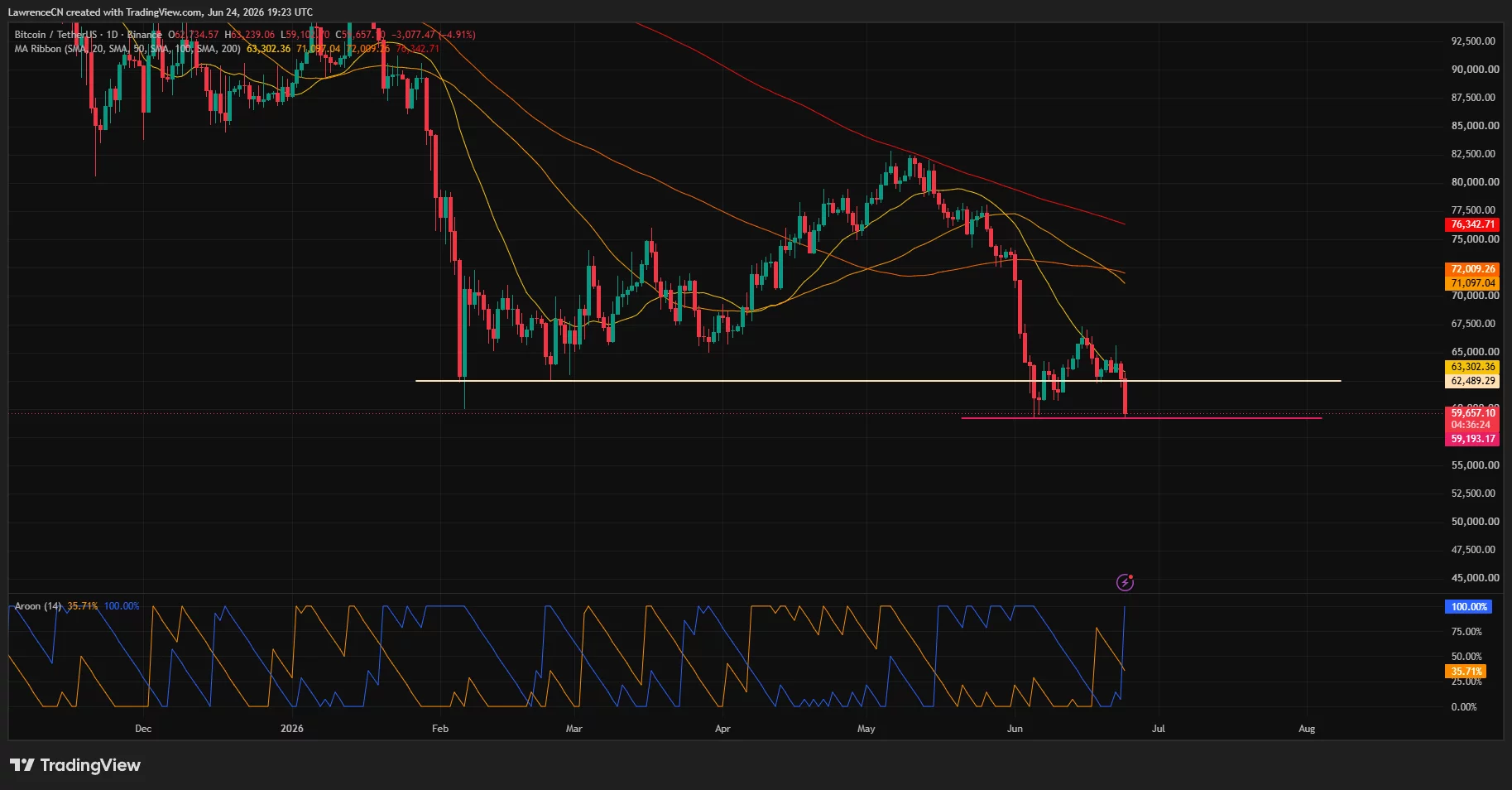
Bitcoin has fallen below $60,000 for a second time this month, triggering more than $850 million in crypto liquidations and sending Strategy shares to an intraday low of $92.28 as investors reacted to mounting pressure across digital assets and technology stocks.
Summary
- Bitcoin fell below $60,000 for the second time in June, triggering more than $850 million in crypto liquidations.
- Technical indicators show BTC retesting June support near $59,200 after losing a key Fibonacci retracement level.
- Strategy shares dropped as much as 11% intraday, while crypto stocks and miners sold off alongside weakening ETF flows.
According to data from crypto.news, Bitcoin (BTC) price dropped nearly 6% to an intraday low of $59,175 before trading around $59,500 at press time. The move wiped out more than $850 million in leveraged positions, with long traders accounting for roughly $780 million of the total and short liquidations contributing about $84 million.
Selling quickly spread across major cryptocurrencies. Ethereum fell below $1,600 and traded near $1,590, while Solana slipped under $65 and XRP changed hands around $1.05. The total value of the crypto market declined to approximately $2.1 trillion, leaving the sector down about 3.6% on the day.
Bitcoin tests a key technical support zone
Technical indicators suggest Bitcoin has returned to a level many traders have been watching closely. The daily chart shows Bitcoin falling through a major support level and revisiting support around $59,200, a zone that aligns with the June lows.
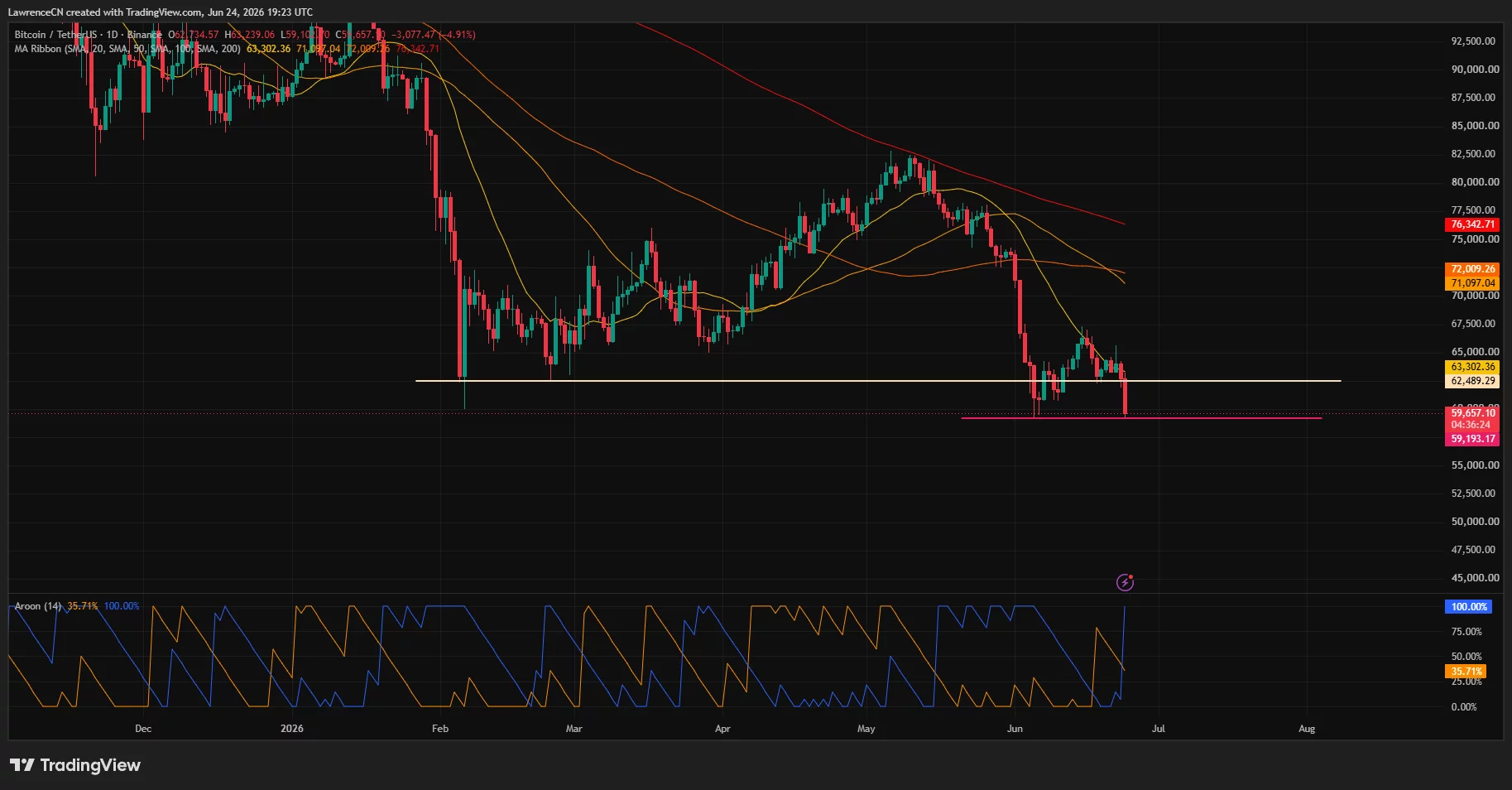
Commenting on the setup, crypto analyst Daan Crypto Trades noted that Bitcoin had reached its 78.6% Fibonacci retracement level from the previous rebound. According to the analyst, major local tops and bottoms have often formed after strong rallies retraced toward that level, making it an important area for bulls to defend before a possible break below $60,000.
The chart also shows Bitcoin trading below all key moving averages, including the 50-day and 200-day MA, while the Aroon indicator signals continued downside momentum. On the daily timeframe, Aroon Down stood at 100%, compared with roughly 36% for Aroon Up, indicating that recent lows have continued to dominate market structure.
At the same time, concerns about institutional activity added to market unease. Whale Factor highlighted on X that wallets linked to BlackRock had transferred roughly 2,700 BTC, worth about $168.6 million, and nearly 53,000 ETH valued at around $88.1 million to Coinbase-linked addresses. The account suggested the transfers could precede selling activity, although no evidence has emerged that the assets were moved for that purpose.
Strategy shares underperform as criticism returns
The decline in Bitcoin coincided with a sharp drop in crypto-linked equities, with Strategy suffering some of the steepest losses. After closing the previous session at $103.84, the stock fell as much as 11% during trading and reached an intraday low of $92.28 before recovering slightly to trade near $95. The move left the shares down more than 8% on the day.
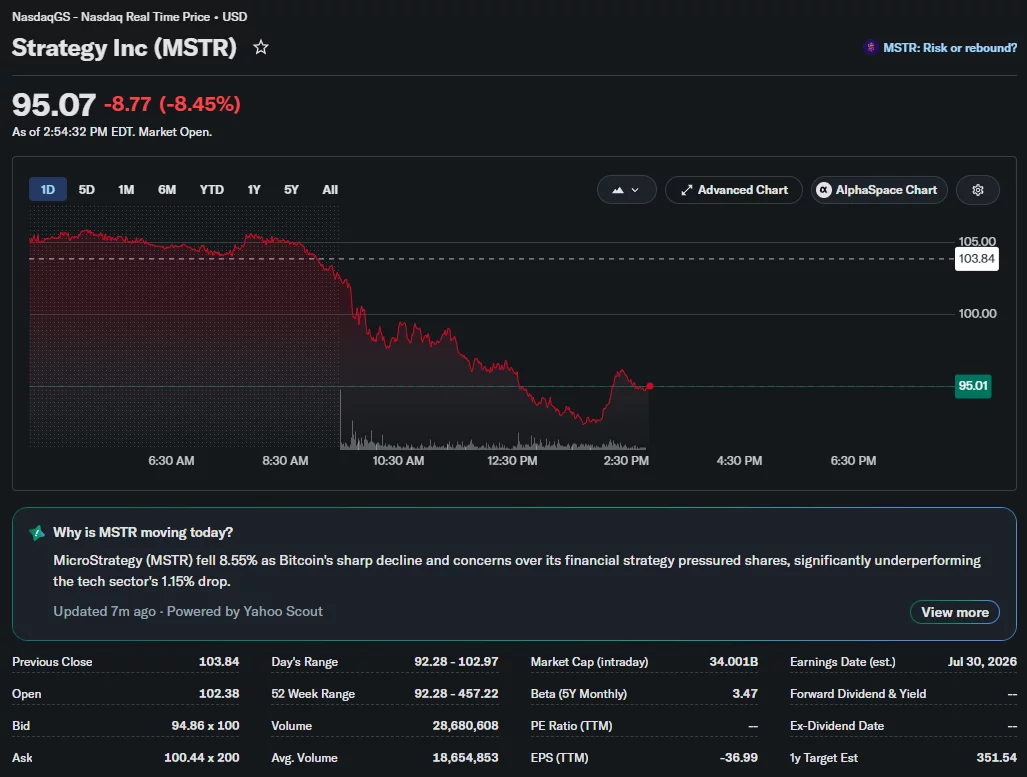
Pressure was not limited to Strategy. Shares of Strive, Bitmine, and SharpLink also declined, while crypto-focused firms including Coinbase, Robinhood, Circle, Galaxy Digital, and Bullish traded lower alongside mining companies such as IREN, Cipher, TeraWulf, and Hut 8.
Fresh criticism from Bitcoin skeptic Peter Schiff added another layer to the debate surrounding Strategy’s Bitcoin treasury model. Schiff argued that the company could consider selling part of its Bitcoin holdings to finance stock buybacks and reduce the gap between its market valuation and underlying assets.
He also claimed that any meaningful Bitcoin sale by Strategy could pressure the cryptocurrency market, though he questioned whether such a move would restore investor confidence.
Institutional fund flows have also weakened. According to Farside Investors, U.S. spot Bitcoin exchange-traded funds recorded roughly $180 million in combined net outflows on Monday and Tuesday. Spot Ether ETFs posted approximately $152.5 million in net outflows during the same period.
Those withdrawals arrived as investors continued reducing exposure to risk assets. Since mid-June, the S&P 500 has fallen about 3%, and the Nasdaq has dropped nearly 4%, while several large technology stocks, including Nvidia, Microsoft, and Apple, traded lower. With
With Bitcoin price back below $60,000, the cryptocurrency has returned to price levels last seen in October 2024, extending a difficult month for both digital assets and the companies tied most closely to them.
Disclosure: This article does not represent investment advice. The content and materials featured on this page are for educational purposes only.

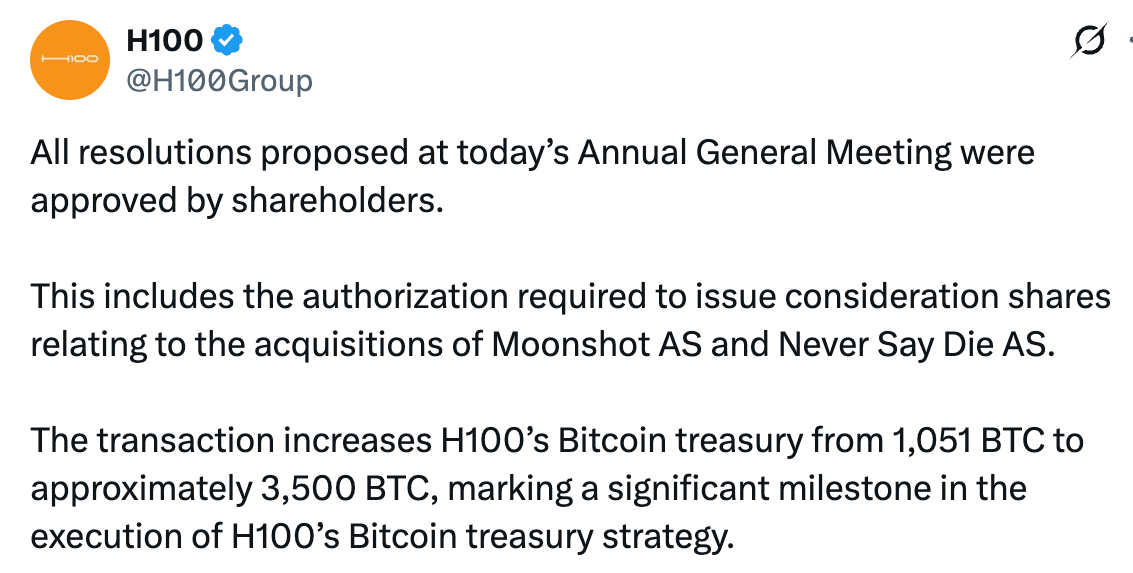
Shareholders of Sweden’s H100 approved the issuance of shares needed to complete the company’s acquisition of Moonshot AS and Never Say Die AS, clearing a key condition for a transaction that would increase its Bitcoin holdings from 1,051 BTC to about 3,500 BTC.
The approval allows H100, a Nordic SME-listed health technology company, to acquire the two Norwegian investment firms, which collectively hold about 2,450 Bitcoin, in exchange for newly issued H100 shares. Under terms announced in March, the owners of Moonshot and Never Say Die would become majority shareholders of H100, owning roughly 70% of the combined company following the transaction.
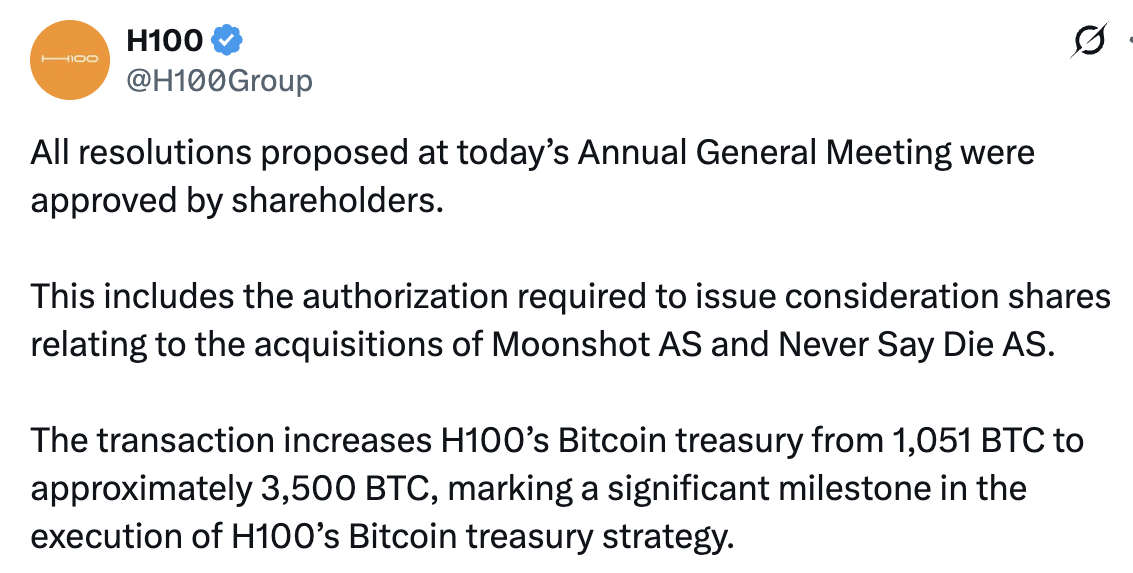
Source: H100Group
The deal is structured as a share-for-share transaction with no cash consideration, with ownership of the combined company based on the amount of Bitcoin (BTC) contributed by each party.
If completed, the acquisition would increase H100’s Bitcoin treasury to approximately 3,500 BTC, likely making it Europe’s second-largest publicly traded Bitcoin treasury company behind Germany’s Bitcoin Group SE, according to data from BitcoinTreasuries.com.
H100 shares closed 9.6% higher on Tuesday. Despite the gain, the stock remains down about 30% since the start of 2026, per Yahoo Finance data.
BTC treasury companies face pressure
H100’s planned expansion comes as Bitcoin treasury companies face a more challenging market environment following months of declining cryptocurrency prices and signs of strain in some of the financing models used to fund BTC purchases.
In May, France-based semiconductor maker Sequans Communications said it would abandon the Bitcoin treasury strategy it adopted less than a year earlier and gradually liquidate its remaining holdings to refocus on its core Internet of Things semiconductor business. The company held 658 Bitcoin at the time and said it would monetize the remaining holdings over time.
Strategy, the world’s largest corporate Bitcoin holder, has also faced challenges in recent months. Earlier this month, its preferred stock STRC fell below its intended $100 par value and traded at a steep discount to its liquidation preference.
The company’s pace of Bitcoin accumulation has also slowed in recent months. After purchasing more than 34,000 BTC in a single week in April and nearly 25,000 BTC in a week in May, the company added roughly 1,500 BTC in each of the first two weeks of June.
Market data analytics provider CryptoQuant on Wednesday said the company led by Michael Saylor should pause Bitcoin purchases and focus on replenishing its cash reserve, which is down 38% year-to-date.
“They should pause Bitcoin purchases, rebuild cash reserves, and adopt a systematic framework for purchase timing,” wrote the market data analytics provider’s CEO Ki Young Ju in a Wednesday X post, adding that the biggest public Bitcoin treasury holder should also create a “disciplined selling framework” for the next bull market.
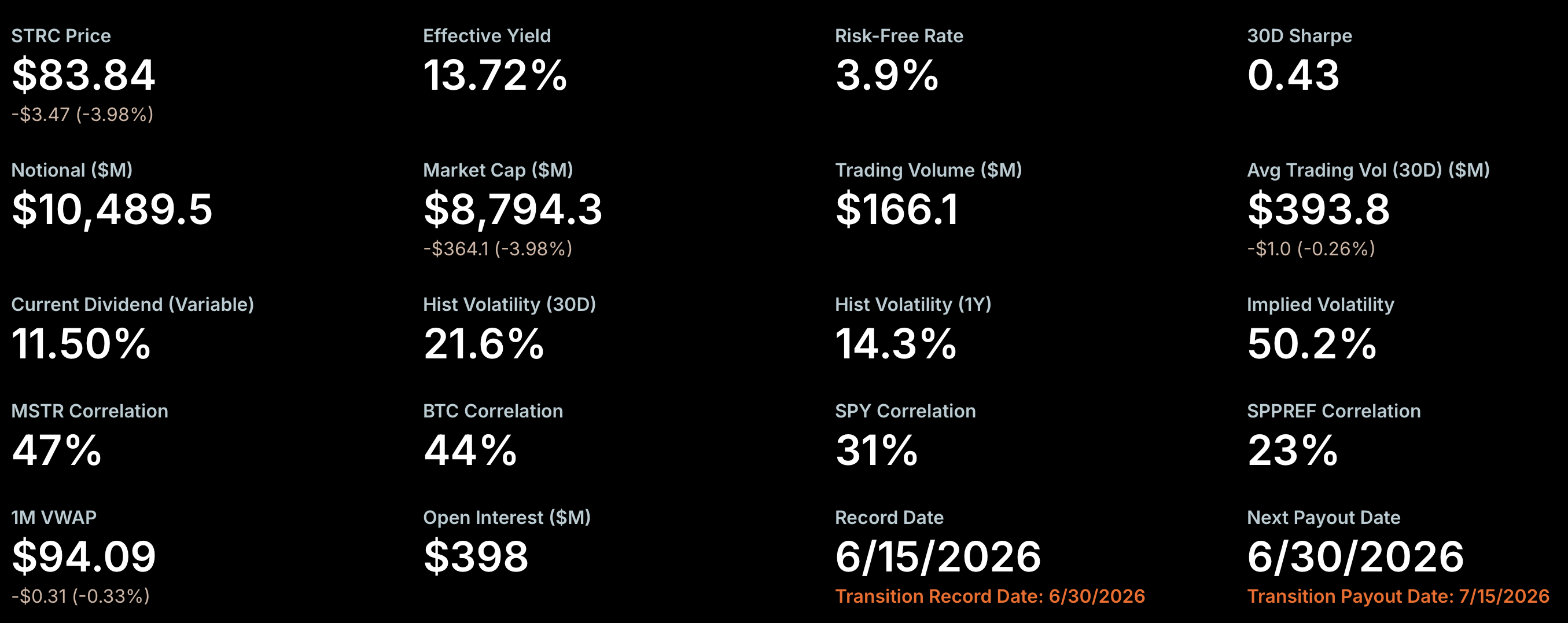
Source: Strategy.com
Magazine: AI is banking the unbanked in Africa… faster than crypto

A group of law enforcement organizations and a coalition of Catholic organizations have become the latest two groups urging caution over the US CLARITY Act, which is heading for a key hearing in July.
In letters sent Tuesday, four law enforcement organizations reached out to White House officials with concerns that the CLARITY Act could create oversight gaps when it comes to illicit activity.
“Regulatory certainty should not come at the expense of accountability, transparency, victim protection, or public safety,” they said. The Alliance to End Human Trafficking, founded by US Catholic Sisters, said these oversights could make it harder to crack down on human trafficking.
The CLARITY Act, which is set for a House hearing on July 17, aims to establish a regulatory framework for digital assets but has garnered a number of critics. It cleared the Senate Banking Committee in May, with most Democrats voting against it, while the banking industry has also pushed back, arguing the bill would allow crypto firms to offer stablecoin yields without facing the same requirements as traditional financial institutions.
The law enforcement group includes the National District Attorneys Association, the National Association of Assistant United States Attorneys, the International Association of Chiefs of Police and the National Sheriffs’ Association.
In the letter addressed to Acting Attorney General Todd Blanche and White House digital assets adviser Patrick Witt, the group said it was concerned with the Blockchain Regulatory Certainty Act, or Section 604 of the legislation, which it claims would create oversight gaps, hinder illicit-activity probes and weaken Know-Your-Customer and Anti-Money-Laundering requirements compared with traditional finance.
Section 604 of the market structure bill addresses the regulatory framework for digital asset service providers and seeks to protect non-controlling developers, open-source contributors, self-custody tools and certain DeFi infrastructure from being automatically classified as money transmitters.
The letter said there was no concern with individuals who write or publish software code or with responsible technological innovation, but with exemptions on crypto transactions that may affect law enforcement’s ability to investigate.
“Our concern is with broad exemptions that may shield individuals or entities whose activities facilitate the movement of digital assets, create obstacles to legitimate oversight, or weaken longstanding investigative and enforcement authorities relied upon by law enforcement.”
However, Lindsay Fraser, chief policy officer at the Blockchain Association, said the letter showed a “fundamental misunderstanding” of the CLARITY Act.
“Section 604 does one narrow thing,” she said. “It prevents non-custodial software developers from being misclassified as money transmitters when they do not custody assets or control transactions.”
“It does not immunize criminals. It does not limit sanctions enforcement. It does not stop prosecutions for money laundering, fraud, or terrorist financing.”
Anti-trafficking advocates push back
Meanwhile, the Alliance to End Human Trafficking sent a similar letter Tuesday to Senate Republican Leader John Thune and Senate Democratic Leader Chuck Schumer, also flagging Section 604 but from a human rights abuse perspective.
Related: Crypto isn’t the problem with the US economy, says senator
Certain provisions under Section 604 could create “broad carveouts and regulatory ambiguities” that may make it “more difficult to responsibly monitor illicit financial activity tied to trafficking, organized crime, child exploitation, sanctions evasion and other forms of abuse,” it said.
“The test of any financial system is not simply whether it generates wealth or innovation, but whether it safeguards human life and dignity.”

Screenshot of June 23 AEHT letter. Source: Punchbowl News
CLARITY Act proponent Senator Cynthia Lummis took the opposite view, stating Thursday that “Regulatory ambiguity doesn’t just hurt builders. It helps criminals… The CLARITY Act closes the gaps bad actors exploit.”
“The CLARITY Act is clear: writing code is not money transmission. That distinction will matter for a generation of builders,” she added on Tuesday.
Magazine: Japanese pension fund tips 1% in crypto, G7 urges action on NK hackers: Asia Express

U.S. Senate Democrats have renewed pressure on Republican leaders to convene hearings into a reported $500 million arrangement connecting Donald Trump’s crypto-linked World Liberty Financial to Abu Dhabi-linked investors. In a letter to the chamber’s leadership, the lawmakers argue that Congress should examine whether the investment—and the administration’s subsequent actions—raised national security concerns or created conflicts of interest.
The request comes amid ongoing U.S. scrutiny of crypto regulatory policy, enforcement priorities, and cross-border dealings. For compliance teams and regulated entities, the episode highlights how crypto commercialization, stablecoin-linked payment structures, and foreign capital flows may intersect with sanctions and national security review frameworks.
Key takeaways
- Senate Democrats are urging Republican leaders to hold “immediate” hearings into a reported UAE-related investment in World Liberty Financial.
- The lawmakers ask for sworn testimony from Trump administration officials and want Congress to evaluate whether the investment influenced presidential actions.
- The letter cites concerns about potential national security exposure tied to U.S.–UAE technology and arms arrangements.
- Democrats also link the matter to broader concerns about weaker crypto enforcement, including exemptions from financial services regulations and dismantling elements of DOJ crypto enforcement.
- Past Democratic inquiries referenced by the letter include calls for CFIUS review and SEC-related questions connected to World Liberty Financial backers.
Democrats demand hearings over reported UAE investment
In their Tuesday letter, Senators Elizabeth Warren, Richard Blumenthal, Gary Peters, Dick Durbin, and Ron Wyden said Republican Senate leadership should convene hearings to examine the reported investment and its implications. The lawmakers asked that administration officials testify under oath, framing the request around what they characterize as unanswered questions regarding what the UAE may have obtained and whether U.S. national security was affected by foreign participation in a Trump-connected crypto enterprise.
The underlying reporting referenced by the senators traces to a January account by The Wall Street Journal, which said an Abu Dhabi investment company backed by Sheikh Tahnoon bin Zayed Al Nahyan—an adviser closely associated with the UAE’s national security apparatus—agreed to buy a 49% stake in World Liberty Financial. The platform is described in the reporting as tied to President Donald Trump.
Democrats argue that Congress has an obligation to investigate whether such foreign investments bear on official decision-making. The thrust is not limited to the transaction itself; it is also aimed at whether subsequent policy or administrative actions could be perceived as favoring connected interests.
National security and technology deal cited as context
Democrats’ letter places the reported World Liberty Financial investment in a broader geopolitical and policy context, pointing to a later U.S.–UAE arms and artificial intelligence chip agreement described as occurring in May. According to the senators, that deal proceeded even after concerns were raised by U.S. national security officials about the possibility that China could access the chips involved.
Although President Trump has denied awareness of the World Liberty Financial investment reported by the press, the senators’ position is that the sequence of events warrants congressional examination. For institutional stakeholders, this is an example of how foreign capital in crypto ventures can become intertwined with national security review considerations—especially where cross-border technology, sensitive supply chains, or strategic industrial relationships are implicated.
The practical compliance implication is clear: regulated firms operating with international counterparties may face heightened oversight when transactions intersect with national security considerations or appear to create improper influence pathways. Even absent proof of wrongdoing, congressional scrutiny can translate into more intense regulatory expectations around governance, disclosures, and documentation.
Enforcement concerns and the committee agenda
Beyond the UAE-related investment, the letter expands to encompass broader worries about U.S. crypto enforcement. The senators said they are concerned about steps they view as weakening enforcement—citing, among other items, efforts to exempt crypto service providers from financial services regulations and reports that the Justice Department’s crypto enforcement team was disbanded.
From a regulatory monitoring perspective, this matters because enforcement posture often drives institutional behavior. When enforcement resources are reduced or compliance obligations appear to be narrowed, entities can face uncertainty about how regulators will interpret risk, monitor market conduct, or pursue investigations. Conversely, high-profile congressional attention can also signal that political and oversight pressure may intensify even if enforcement structures are changing.
The letter therefore functions both as a transaction-specific request and as part of an accountability narrative about the direction of U.S. oversight. It also serves as a signal to compliance departments that congressional inquiries—especially those tied to foreign involvement—may affect reporting requirements, due diligence expectations, and the scrutiny applied to relationships with regulated financial intermediaries.
Prior Democratic probes: CFIUS, SEC scrutiny, and pardons
The letter also situates the new request within a pattern of prior congressional actions and demands for review. The lawmakers note earlier calls by Senator Warren for a national security review of the UAE deal, urging Treasury leadership in February to determine whether it should be subjected to a Committee on Foreign Investment in the United States (CFIUS) probe. CFIUS is a key U.S. interagency process through which foreign investment can be reviewed for national security risks, and the invocation of CFIUS underscores the senators’ view that the World Liberty Financial stake could implicate sensitive interests.
Democrats have previously pressed regulators connected to enforcement outcomes involving World Liberty Financial backers. According to references in the letter, senators pursued questions related to the Securities and Exchange Commission after a fraud case involving Justin Sun—a major World Liberty Financial supporter—was dropped. The letter also cites additional inquiry initiatives earlier in the year that questioned pardons issued during the Trump administration, including a pardon for Binance co-founder Changpeng Zhao.
In the reporting referenced within the article, Democratic lawmakers linked that pardon sequence to Binance’s early-2025 acceptance of a reported $2 billion investment from an Abu Dhabi fund and to an agreement that the funds would be paid in World Liberty Financial’s stablecoin, USD1. These assertions are included in the senators’ broader narrative about whether crypto industry relationships and official actions may be connected.
For institutional readers, the throughline is that congressional oversight is increasingly focused on the governance and regulatory interface of crypto businesses: how foreign investors participate, how stablecoin arrangements are used, and how enforcement decisions are perceived by lawmakers and the public.
Closing perspective
What happens next will likely depend on whether the Senate leadership agrees to convene hearings and the scope of witness testimony, including any discussion of national security review pathways and crypto enforcement policy. For compliance and legal teams, the episode is a reminder that cross-border crypto capital and stablecoin-linked arrangements can rapidly become subject to heightened congressional scrutiny, even when the core facts are still developing in public reporting.

DeFi is losing ground again. Total value locked (TVL) across decentralized finance has dropped by roughly 39% in 2026 so far, sliding to a little over $70 billion from about $115 billion in January, according to a report shared this week by CryptoRank.
CryptoRank links the decline largely to the market’s post-October 2025 correction, after Bitcoin’s sharp run-up ended in a major liquidation event. But security incidents are also taking their toll—either by directly draining funds from protocols or by nudging users toward the exits more quickly than they otherwise might.
Key takeaways
- CryptoRank estimates DeFi TVL is down about 39% in 2026 to just over $70 billion, versus roughly $115 billion in January.
- CryptoRank points to the broader deleveraging after Bitcoin’s Oct. 10, 2025 liquidation event as a primary driver of the TVL drawdown.
- CryptoRank reports 121 hacks and about $942 million in losses year-to-date, which may be weighing on user confidence and capital allocation.
- Nansen analysis highlighted that the April 18 Kelp DAO exploit triggered rapid outflows, compressing what would normally be a slower capital rotation.
- While the total stolen in 2026 quarters appears lower than historical peaks, analysts argue this can reflect attackers shifting to new targets rather than genuine security progress.
DeFi TVL down as the 2025 selloff reverberates
The foundation for 2026’s contraction traces back to a broader correction that followed Bitcoin’s late-2025 peak. After Bitcoin pushed above $122,000, a market-wide liquidation event on Oct. 10, 2025 erased more than $19 billion in leveraged positions, according to the CryptoRank report. That liquidation intensified a wider deleveraging cycle across digital assets, which then translated into weaker demand and reduced liquidity across DeFi.
CryptoRank said that despite the double-digit drawdown seen this year, the current DeFi decline is materially smaller than the stress phase during the 2021–2022 bear market. In other words, the drawdown appears severe—but not as extreme as the earlier cycle’s contraction—suggesting DeFi has some resilience even when risk appetite falls.
Security incidents: fewer headlines, still meaningful pressure
CryptoRank also flagged security as a continuing headwind for DeFi activity in 2026. The provider reported 121 hacks and roughly $942 million in losses year-to-date. In CryptoRank’s view, exploits may not be the sole cause of TVL falling, but their frequency can still influence user sentiment and hasten capital outflows.
This distinction matters for investors and operators. If TVL is declining mainly because of market-wide deleveraging, risk management is largely about cycle navigation. If security events are accelerating outflows, however, the issue becomes more protocol-specific—turning “time to confidence” into a measurable performance variable for DeFi platforms.
Kelp DAO exploit illustrates how quickly capital can flee
One incident that demonstrates the speed of capital rotation was the Kelp DAO exploit on April 18, an event described by Cointelegraph as involving $293 million. According to Nicolai Søndergaard, senior research analyst at Nansen, the fallout from the breach concentrated into days rather than dragging out over weeks.
Søndergaard’s analysis indicated that Aave users withdrew about $15 billion in deposits within four days after the exploit. The scale and speed of those withdrawals underline how DeFi markets can reprice trust rapidly: once a high-profile event breaks user confidence, liquidity providers and depositors often act immediately to reduce exposure, even if broader conditions would likely have pressured TVL anyway.
The same period also reinforced that the industry’s incident pace remains elevated. CryptoRank described Q2 2026 as the most-hacked quarter on record by incident count, with 83 exploits targeting crypto protocols. Yet the total value stolen during the quarter—$755 million—was far below the $3.56 billion lost in Q4 2020, which Cointelegraph describes as the costliest quarter for hacks on record.
Lower stolen value doesn’t necessarily mean better security
Some readers may interpret smaller aggregate losses as an improvement in security. But multiple perspectives in the reporting suggest the reality is more complex.
HackenProof CEO Dmytro Matviiv argued that the decline in total stolen funds can be “misread as progress.” He said that while leading protocols may be harder to exploit, attackers adapt by expanding their attack surface—seeking out new targets rather than disappearing entirely. The implication for DeFi participants is that security performance may improve at the top end, while risk can migrate to less mature or more exposed systems.
Bitget Wallet COO Alvin Kan added a related behavioral angle: exploits make users more cautious, but the resulting capital shifts can also move liquidity away from “weaker” venues toward “stronger venues” with clearer yield models. Kan suggested this dynamic may encourage consolidation, where protocols with more credible risk assumptions attract deposits, while others struggle to regain capital after incidents.
Taken together, these points suggest that the DeFi TVL trend is being shaped by two overlapping forces: macro liquidity conditions that reduce leverage and risk-taking, and micro-level trust events that determine which protocols retain or regain capital once stress hits.
For the months ahead, the key question is whether TVL stabilizes as leverage normalizes—or whether security events continue to accelerate outflows for individual protocols. Monitoring both incident frequency and how quickly capital returns after major exploits may offer the clearest signal of whether DeFi’s drawdown is settling or still widening.

Financial infrastructure provider OpenPayd said Wednesday that it has secured authorization under the European Union’s Markets in Crypto-Assets Regulation (MiCA), allowing it to offer crypto services across the European Economic Area (EEA) via passporting.
The license lets OpenPayd operate as a crypto asset service provider (CASP) to offer services such as fiat-to-stablecoin on-ramping and off-ramping, the company said in a statement seen by Cointelegraph.
“Stablecoins are rapidly becoming part of mainstream financial infrastructure,” OpenPayd CEO Iana Dimitrova said, adding that MiCA gives businesses greater confidence to use digital asset technology for payments, treasury operations and growth.
The license was issued by the Malta Financial Services Authority (MFSA), an OpenPayd spokesperson told Cointelegraph. The regulator has also granted MiCA licenses to crypto companies, including OKX and Gemini.
The approval comes days before a July 1 MiCA transitional deadline, as crypto companies race to secure authorization under the bloc’s crypto rules. On Tuesday alone, Bitcoin Suisse secured a MiCA license in Liechtenstein and Ripple announced preliminary CASP approval in Luxembourg.
OpenPayd counts Kraken, OKX among its clients
OpenPayd’s MiCA authorization comes about a year after the company launched its stablecoin infrastructure, which allows businesses to manage fiat currencies and digital assets through a single platform.
The company said it processes more than $240 billion in annualized transaction volume for over 1,100 businesses worldwide, including Kraken, eToro, OKX and B2C2.

Source: OpenPayd
OpenPayd was founded in London in 2018 by Ozan Ozerk, a fintech entrepreneur who also founded European Merchant Bank, a Lithuania-based digital bank.
Related: EU committee advances digital euro bill after key vote
OpenPayd eyes Nasdaq debut
OpenPayd’s MiCA license news comes as the company is pursuing a public listing in the US.
Earlier in June, OpenPayd announced a proposed merger with special purpose acquisition company Titan Acquisition Corp, a deal that would see its shares trade on Nasdaq under the ticker “OP” if approved.
The transaction values OpenPayd at about $1.1 billion and is expected to close in the fourth quarter of 2026, subject to shareholder and regulatory approvals.
Magazine: Bitcoin decouples from tech stocks, Ether eyes ‘selling wave’: Market Moves


The launch delivers on a memorandum of understanding the two firms signed in August 2025 and builds on a relationship dating to 2016, when Ripple and SBI began working together on cross-border payments and blockchain infrastructure in Asia.
RLUSD will “serve as a bridge for payments, tokenization and collateral management,” connecting Japanese businesses to global dollar liquidity, said Jack McDonald, Ripple’s senior vice president of stablecoins, in a statement.
RLUSD is Ripple’s bet on the regulated end of the stablecoin market, and it is separate from XRP, the closely-linked token the company is best known for. Ripple has long pitched RLUSD as an enterprise token for settlements and tokenization, the practice of issuing real-world assets onchain.
The Japan launch extends that effort into Asia at a moment when stablecoins are drawing formal rules in the U.S., Europe and across the region, turning the dollar-token market into a race for official approval as much as for users.
Whether RLUSD can close the gap on USDT and USDC remains to be seen, however. Approvals like Japan’s give it the credentials to compete for institutional use, but it still has to convert that standing into the volume and liquidity its much larger rivals already command.


The bitcoin market has found a new support level, and Thursday’s U.S. core PCE release may test its mettle.
That level is $59,000, which has emerged as strong support, capping downside moves in recent days.
A support level in trading is a specific price point or range where a downtrend tends to pause or reverse, paving the way for a bounce as concentrated buying interest becomes strong enough to counter selling pressure. However, a single instance does not make a level a strong support. Traders typically look for at least two instances of price holding or bouncing from a specific level before identifying it as new support.
On Wednesday, as the sell-off gathered pace, prices fell to nearly $59,000 before bouncing back to $61,000 overnight. As of this writing, BTC is trading near $60,800, according to CoinDesk data. A similar move occurred earlier this month on June 5, when the sell-off lost steam near $59,000, paving the way for a bounce to $67,000 in the following days.
That explains why $59,000 is now the key support, a new line in the sand that bulls need to defend to avoid a deeper slide.
Ripple has launched its dollar-backed stablecoin Ripple USD (RLUSD) in Japan with SBI Group, following approval from the country’s Financial Services Agency.
Customers can now access RLUSD through SBI VC Trade’s VCTRADE platform. The rollout opens the regulated token to both institutional and retail users in Japan.
Ripple Opens RLUSD to Japanese Users
Japan reshaped its stablecoin rules this month. A new framework took effect on June 1, letting qualifying foreign stablecoins operate as regulated payment tools.
Under the rules, foreign-issued stablecoins are classified as electronic payment instruments under the Payment Services Act. RLUSD is also categorized as a new type of instrument under the Act.
Ripple’s Senior Vice President of Stablecoins, Jack McDonald, said RLUSD will act as a bridge for payments, tokenization, and collateral management. He framed it as a link between Japanese businesses and global liquidity.
“Japan has long been a leader in digital asset adoption, underpinned by both regulatory clarity and financial innovation. This launch marks an important step in expanding access to transparent, regulated USD-backed stablecoins like RLUSD for financial institutions, consumers, and businesses in Japan,” McDonald said.
Follow us on X to get the latest news as it happens
The launch fulfills a memorandum of understanding signed in August 2025. It also builds on a Ripple and SBI partnership that dates back to 2016.
The deal reflects SBI’s broader XRP push nationwide. Ripple’s wider Japan footprint also grew this year, with XRP gaining a spot listing on Rakuten Wallet.
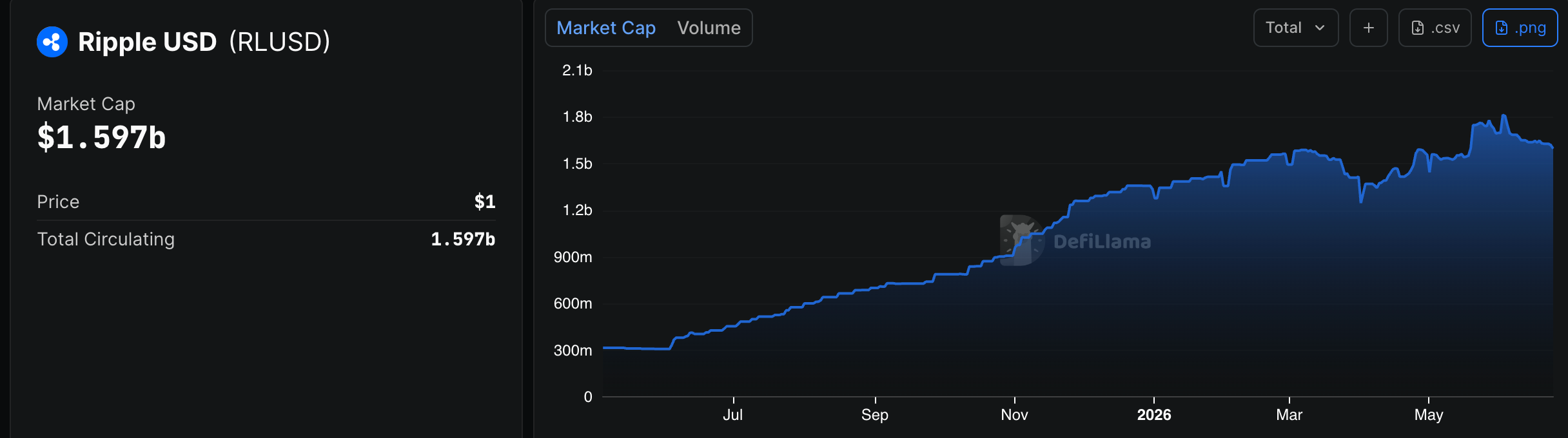
Meanwhile, the stablecoin has cooled since its early-June peak. Its market cap hit an all-time high of $1.8 billion then, but has since slipped to about $1.59 billion, according to DeFiLlama data. Even so, the market cap remains up roughly 271% over the past year.

The Japan entry follows RLUSD’s global expansion into other regulated markets. The coming months may show whether RLUSD can challenge incumbents in Japan’s regulated stablecoin market.
Subscribe to our YouTube channel to watch leaders and journalists provide expert insights
The post Ripple Targets Japanese Payments and Tokenization With New RLUSD Launch appeared first on BeInCrypto.


The pressure on crypto has become its own. The break below $60,000 reflects continued outflows from U.S. spot bitcoin ETFs, the Federal Reserve’s hawkish turn and a U.S. dollar that climbed to a seven-month high, said Alex Kuptsikevich, chief market analyst at FxPro, in an email to CoinDesk.
A stronger dollar makes dollar-priced assets like bitcoin costlier for foreign buyers and tends to pull money out of risk trades.
FxPro also flagged a longer-term warning. Bitcoin is hovering near its 200-week moving average, the average price over the past roughly four years and a closely watched long-term trend line.
The last three times bitcoin sank to that line, the weakness was prolonged rather than brief, lasting around nine months in 2015, six months in 2018 and roughly six quarters after the 2022 collapse. The firm said the pattern points to a crypto winter, an extended stretch of depressed prices, rather than a quick rebound.
For now, Kuptsikevich sees a band around $61,800 to $62,000 as the next test, a cluster of resting orders that could either pull the price up as short sellers are forced to buy back, or cap the bounce as resistance.
If support breaks, he said, $55,000 is a plausible cycle low. He urged traders to treat risk management as the priority rather than chase direction.


Abracadabra has started emergency measures after Magic Internet Money, its dollar-pegged MIM stablecoin, slid sharply below its $1 target.
Summary
- MIM’s 50% slide pushed Abracadabra into emergency rate hikes across active and deprecated Cauldron markets.
- Borrowers now have a cheaper repayment window as Abracadabra tries to shrink outstanding MIM supply.
- Paused Curve bribes and incentives show the protocol is shifting from growth rewards to stabilization.
The DeFi lending protocol said it was “acutely aware” of the depeg and would act to reduce the amount of MIM in circulation.
The team said it would raise interest rates across all Cauldrons, including older markets that users no longer actively use. Cauldrons are Abracadabra’s lending markets, where users post collateral and borrow MIM. Higher rates make open debt more costly, which can push borrowers to repay sooner.
The rate plan covers both live and deprecated markets, so older debt positions remain part of the response. Abracadabra has not set a fixed end date for the emergency changes.
Repayment becomes the main tool
Abracadabra framed the market discount as part of its recovery route. When MIM trades far below $1, borrowers can buy the stablecoin cheaper in the market and use it to repay debt at face value. That repayment burns or removes MIM from debt positions, reducing supply.
The protocol said the current depeg creates a “natural incentive” for borrowers to repay at a discount. It also said direct incentives and Curve bribes would stop until MIM returns to its peg. That marks a shift from rewards for liquidity to a narrower focus on repayment and supply control.
Liquidity pressure hits Curve pools
MIM relies on collateral, borrower activity and liquidity pools to stay near $1. Its main trading venues include Curve pools, where stablecoins need balanced liquidity to support swaps. When liquidity thins or becomes one-sided, selling pressure can move the token further from its target.
Abracadabra had already added $100,000 of MIM, USDT and USDC to a new Curve liquidity pool earlier in June. The team said at the time that the move aimed to restore pool balance after withdrawals linked to DeFi incentive changes. The latest rate action shows that the earlier liquidity step did not fully stop pressure on the peg.
Broader stress and recovery test
Market data showed MIM near $0.50 during the latest depeg update. The break came as crypto markets also weakened. As crypto.news reported, Bitcoin fell below $60,000 for the second time in June and triggered more than $850 million in liquidations.
The MIM crisis also follows a difficult stretch for DeFi security and lending markets. In a previous article, crypto.news discussed an Abracadabra exploit in October 2025, when attackers drained about $1.8 million from Cauldrons after using a logic flaw. That event was separate from the current depeg, but it kept attention on the protocol’s risk controls.
Abracadabra said its priority was to “restore confidence, improve market structure, and return MIM to a healthy peg.” The team also said it was reviewing more recovery plans and would share them once finalized. For now, the plan centers on making debt expensive to hold and cheaper to close.
The next test will come from borrower response and market liquidity. If repayments rise, MIM supply may contract and reduce pressure on the peg. If liquidity stays thin, the stablecoin could remain exposed to sharp moves across Curve and other trading venues.
Markets track debt closures, pool balances and price spreads closely.

Thousands feared dead and buildings collapse after two powerful earthquakes hit Venezuela | News World

Value Shines While Tech Takes a Beating

H100 Vote Advances Deal to Expand Bitcoin Treasury to 3,500 BTC


-

 Fashion5 days ago
Weekend Open Thread: Miami – Corporette.com
-

 Entertainment4 days ago
Renter of Home in Anne Heche Crash Denies Settlement With Son
-
 Sports1 day ago
Two goals and an assist by sheer aura: Cristiano Ronaldo just entered the World Cup chat
-

 Tech3 days ago
Microsoft accidentally kills epic Outlook email threads
-

 Business4 days ago
Soccer-U.S. defends Iran World Cup travel restrictions, says discussions ongoing
-
Crypto World1 day ago
Bitcoin (BTC) Dips Below $62K, Ethereum (ETH) Plunges 6% Daily: Market Watch
-

 Politics5 days ago
Andy Burnham and the meaning of Makerfield
-
 Politics6 days ago
BBC Reporter Discusses Cross Party Criticism Of Trumps Iran Deal
-

 Crypto World23 hours ago
Securitize Wraps Roubini's SEC-Registered ETF as Dubai VARA Digital Security
-
Business1 day ago
Entergy settles forward sale agreements, raises $672 million in cash proceeds
-
 Business5 days ago
Wall Street Week Ahead: Investors see Micron earnings as pulse check of AI rally momentum
-

 NewsBeat6 days ago
Keir Starmer Allies Question His Chances For No 10
-

 Tech7 days ago
AWS enters the context layer race with a graph that learns from agents, not manual curation
-
 Crypto World5 days ago
Can Charles Hoskinson Really Rescue Cardano?
-

 Crypto World5 days ago
HIVE shares jump as $220M AI deal speeds Bitcoin mining pivot
-

 Crypto World5 days ago
Jake Chervinsky accuses CME of protecting derivatives monopoly
-
 Tech4 days ago
Signal’s Meredith Whittaker says AI chatbots ‘are not your friends’ and calls Copilot agents a backdoor
-

 Entertainment5 days ago
Jose Alvarado Wants Taylor Swift at More Knicks Games
-

 Tech2 days ago
Nearly 7,000 fake Amazon domains registered ahead of Prime Day 2026, researchers warn
-

 Business6 days ago
Brexit cost 6% of UK economy, Bank of England company data suggests
You must be logged in to post a comment Login