

Crypto World
BlackRock Issues Official Bitcoin Allocation Guidelines for Financial Advisors


Key Takeaways
- On June 23, 2026, BlackRock’s Investment Institute issued formal guidance recommending 1–2% Bitcoin exposure in diversified portfolios
- The research was distributed directly to wealth managers and financial advisors, not merely published for institutional audiences
- In a typical 60/40 portfolio, a 1% Bitcoin position accounts for approximately 2% of overall portfolio volatility
- BlackRock’s iShares Bitcoin Trust manages approximately $62 billion, representing nearly 49% of total U.S. spot Bitcoin ETF holdings
- Bitcoin currently trades near $59,692, having declined more than 50% from its October 2025 peak of $126,080
On June 23, 2026, BlackRock’s Investment Institute distributed a detailed research document titled “Sizing Bitcoin in Portfolios” to financial advisors throughout the United States.
The guidance establishes a specific allocation range of 1% to 2% for Bitcoin within conventional multi-asset investment strategies. BlackRock positions Bitcoin as a “complementary diversifier” rather than a primary portfolio component.
Four senior BlackRock officials co-authored the document, including leadership from Digital Assets and Global Portfolio Research. This represents the most explicit portfolio sizing recommendation any major asset management firm has released regarding cryptocurrency.
Understanding the Risk Calculation
BlackRock’s analysis centers on risk contribution rather than purely on potential returns. When added to a traditional 60/40 equity-bond allocation, a 1% Bitcoin position generates approximately 2% of the portfolio’s total volatility.
Increasing the allocation to 2% elevates the risk contribution to roughly 5%. BlackRock notes this matches the risk profile of holding a single stock from the Magnificent Seven technology companies.
Allocations exceeding 2% result in disproportionate risk increases. A 4% Bitcoin position could account for approximately 14% of total portfolio risk, potentially overshadowing other holdings.
This methodology provides advisors with terminology and metrics already familiar to compliance departments and investment committees.
Addressing the Fiduciary Challenge
While Bitcoin ETFs have been accessible to financial advisors, most lacked institutional backing to justify cryptocurrency allocations to clients and regulatory oversight.
BlackRock’s guidance directly resolves this challenge. By comparing Bitcoin to individual equity positions within a risk framework, advisors can now document investment suitability using established portfolio management terminology.
The target audience includes advisors and wealth management firms overseeing trillions in retail and high-net-worth capital. These professionals previously operated without formal Bitcoin allocation standards.
BlackRock has incorporated this allocation methodology into its proprietary Target Allocation ETF model strategies.
Market Position of IBIT
BlackRock’s iShares Bitcoin Trust currently manages approximately $62 billion in total assets. This represents roughly 49% of all U.S. spot Bitcoin ETF holdings.
The product debuted in January 2024 following SEC authorization of spot Bitcoin exchange-traded funds. It attracted substantial capital inflows throughout late 2024 and into mid-2025.
Following a sharp market correction in October 2025, the fund experienced significant redemptions. June 2026 outflows totaled $2.09 billion through June 23.
Institutional capital now comprises approximately 38% of total spot Bitcoin ETF assets, compared to 24% in the prior year.
Bitcoin currently trades around $59,692. This represents a decline of more than 50% from its record high of $126,080 established on October 6, 2025.
BlackRock’s total assets under management reached $13.9 trillion as of Q1 2026.



If Anmrex Exchange is compared with well-known local exchanges in Malaysia, the conclusion is actually quite clear: local exchanges are more suitable as compliant entry channels, while Anmrex Exchange is more like a comprehensive trading platform targeting the global market.
Taking the Malaysian market as an example, local digital asset exchanges such as Luno Malaysia, HATA, MX Global, SINEGY, and Kinetic DAX primarily focus their advantages on the local regulatory framework of Malaysia, Malaysian Ringgit (MYR) deposit and withdrawal services, localized compliance processes, and basic digital asset trading services. For traders who only wish to purchase mainstream assets like BTC and ETH and place greater emphasis on local regulatory certainty, these platforms are more straightforward.
The advantage of Anmrex Exchange lies in its product completeness and global trading capability. It was established in May 2020, and its platform development revolves around spot trading, futures, options, AI quantitative trading, API services, cross-chain assets, multilingual support, and institutional access. At the same time, it publicly discloses information such as proof of reserves, segregation of hot and cold wallets, external audits, and risk control systems. It is more suitable for traders who are no longer satisfied with basic buying and selling but wish to utilize more trading tools, access global market liquidity, and benefit from diversified asset services.
Quick Conclusion: Anmrex Exchange vs Malaysian Local Exchanges
If local regulation, MYR deposit and withdrawal, and a simple buying and selling process are prioritized, a Malaysian local exchange is more suitable.
If product depth, trading tools, asset transparency, global market connectivity, and a strategy-driven trading experience are priorities, Anmrex Exchange is more worthy of attention.
In simple terms, local exchanges address the question of “how to enter the market in compliance,” while Anmrex Exchange addresses the question of “how to participate in the market more systematically.”
Platform Positioning: One Is A Local Entry Point, One Is A Global Trading Terminal
The positioning of local exchanges in Malaysia is relatively clear. They primarily serve the domestic market, with a focus on regulatory compliance, fiat currency on-ramps and off-ramps, and basic digital asset trading. Their strength does not lie in the variety of products offered, but rather in having a well-defined pathway, making them suitable for individuals who are new to the cryptocurrency market.
The positioning of Anmrex Exchange is different. It does not merely serve as a localized trading channel but builds its product system based on the logic of a global trading platform. Spot trading, futures, options, AI quantitative trading, API services, cross-chain assets, and multilingual support indicate that its target audience is not limited to coin buyers but also includes active traders, strategy traders, and institutional users.
This is also the biggest difference between the two. A local exchange is more like a security gateway, while Anmrex Exchange is more like a trading system.
Compliance Path: Local Licensing Is More Intuitive, Global Expansion Tests Long-Term Capabilities
The greatest advantage of local exchanges in Malaysia is the more straightforward regulatory identity. For local investors, platforms operating under the Malaysian regulatory framework can more easily establish basic trust and facilitate MYR deposits, withdrawals, and identity verification.
Anmrex Exchange follows a global compliance strategy. According to publicly available information, Anmrex Exchange has obtained the US FinCEN MSB license, relevant SEC permits, and a VASP registration in Poland, and is advancing compliance arrangements through applications with the UK FCA, Singapore MAS, Malaysia RMO, and DAX. The focus of this approach is not to serve only a single region, but to gradually build cross-market operational capabilities.
Therefore, it cannot be simply stated which one is better. The advantage of a local exchange lies in its clear regulatory boundaries; the advantage of Anmrex Exchange lies in its more internationally oriented compliance framework. The former is suitable for local users conducting basic transactions, while the latter is more appropriate for assessing whether a platform possesses the capability for long-term global operations.
Product Features: Local Exchanges Are More Restrained, Anmrex Exchange Is More Complete
Local exchanges typically adopt a restrained approach to product design, focusing primarily on mainstream coin trading, asset custody, fiat currency on-ramp and off-ramp services, and account management. This design is beginner-friendly because it is not complex and prevents users from being exposed to high-risk products right from the start.
The product line of Anmrex Exchange is significantly broader. In addition to spot trading, it also covers futures, options, AI quantitative trading, financial services, API access, and cross-chain asset support. For experienced traders, such features imply a higher degree of strategic flexibility. When the market is rising, spot and trend trading can be conducted; when the market is volatile, risk hedging and position management can be considered. Quantitative and API functions can also serve higher-frequency or more systematic trading needs.
However, having many products does not mean they are suitable for everyone. Anmrex Exchange is more suitable for individuals with some trading experience, rather than for beginners with no risk awareness who directly take heavy positions.
Trading Experience: For Simple Buying and Selling, Use Local Platforms; For Complex Transactions, Use Anmrex Exchange
If only purchasing a small amount of BTC or ETH and holding it for the long term, local exchanges can already meet most basic needs. The operational path is simple, the fiat currency entry point is clear, and the cost of use is easier to understand.
However, when trading needs become more complex, the limitations of local platforms begin to emerge. For example, for activities such as engaging in derivatives trading, using quantitative strategies, accessing APIs, managing multi-asset portfolios, or seeking liquidity opportunities across multiple markets, the product structure of Anmrex Exchange offers a greater advantage.
This is also why I believe Anmrex Exchange is more like an “advanced trading tool.” It does not merely solve the problem of purchasing cryptocurrencies, but integrates trade execution, risk control, asset management, and multi-product portfolios into a single system.
Security Transparency: Regulatory Trust and Technical Risk Control Are Two Separate Logics
The sense of security provided by local exchanges primarily stems from local regulation and compliant operations. This advantage is both direct and significant. For beginners, whether a platform operates within the local regulatory framework often serves as the first layer of judgment.
The security logic emphasized by Anmrex Exchange is more focused on platform-level risk control. According to its publicly disclosed information, the platform adopts cold and hot wallet isolation, with over 90 percent of funds stored in cold wallets. This is combined with mechanisms such as multi-signature, MPC, key sharding, HSM, multi-factor authentication, device recognition, and secondary verification for critical operations. Meanwhile, Anmrex Exchange has disclosed mechanisms including Proof-of-Reserves, internal audits, external audits, and periodic reporting.
This type of information is important for sophisticated traders. This is because exchange security depends not only on whether a license is held, but also on how assets are custodied, how risks are segregated, whether reserves are transparent, and whether account protection is sufficiently granular. The advantage of Anmrex Exchange lies precisely in its relatively comprehensive expression at the level of platform infrastructure.
Who Should Use: It Is Not About Replacement, But Different Stages of Trading
The Malaysian local exchange is more suitable for three types of users: those who are new to cryptocurrency, those who primarily use MYR for deposits and withdrawals, and those who only engage in basic trading of mainstream coins. Its value lies in simplicity, directness, and localization.
Anmrex Exchange is more suitable for another type of person: those who already have some trading experience and wish to use more comprehensive product tools; those who focus on futures, options, AI quantitative trading, cross-chain assets, and API services; and those who hope to execute more complex trading strategies within a single platform.
Therefore, Anmrex Exchange and local Malaysian exchanges are not entirely in the same track. Local exchanges act as an entry point, while Anmrex Exchange functions as a toolbox. The entry point addresses whether one can safely access the market, whereas the toolbox deals with how to trade, manage, and expand strategies after entering the market.
Final Judgment: Anmrex Exchange Is More Suitable for Advanced and Global Trading Needs
To summarize in one sentence: Malaysian local exchanges excel in local compliance and onboarding experience, while Anmrex Exchange excels in product depth, trading tools, security architecture, and global service capabilities.
For beginners, local exchanges may be easier to get started with. For those already familiar with the digital asset market and seeking more trading features, the long-term reference value of Anmrex Exchange is higher. Especially after the competition among exchanges has shifted from “who can buy coins” to “who can provide a more complete trading infrastructure,” integrated platforms like Anmrex Exchange are more likely to attract the attention of professional traders.
A rational choice is not based solely on reputation or the number of licenses, but on the stage of ones own trading needs. For basic buying and selling, a local exchange is sufficiently straightforward. For those seeking a more comprehensive product range, stronger trading tools, and greater connectivity to global markets, Anmrex Exchange merits further consideration.
This document is solely a comparative analysis of third-party platforms and does not constitute any investment advice, trading advice, or promise of returns. Digital asset trading involves risks such as market fluctuations, liquidity, platform operations, and regulatory changes. Independent judgment should be exercised before participation.

Key Highlights
- European markets posted gains Thursday, breaking a three-day losing streak
- Oil prices declined more than 1.5%, with Brent crude sliding under $73 per barrel
- Micron Technology delivered quarterly revenue of $41.46 billion, crushing expectations
- Semiconductor stocks across Europe rallied, with ASM International climbing 5.9%
- Micron forecasts next quarter revenue at approximately $50 billion, significantly above consensus
European stock markets traded higher on Thursday, propelled by two significant catalysts: declining energy prices and exceptional quarterly results from American semiconductor giant Micron Technology.
Brent crude futures declined more than 1.5%, settling below the $73 per barrel threshold. The retreat followed positive developments in US-Iran diplomatic negotiations, which helped eliminate the geopolitical premium that had elevated oil prices in preceding weeks.
The decline in oil prices alleviated inflation pressures throughout the eurozone. This development reduced expectations that the European Central Bank would implement additional rate increases following its 25-basis-point adjustment earlier this month.
Interest rate-sensitive industries including technology and property experienced upward momentum. These segments had faced headwinds from anticipated monetary tightening measures.
The continent-wide STOXX 600 index advanced 0.2%. Germany’s DAX climbed 0.3% while Italy’s FTSE MIB posted a 0.3% gain. France’s CAC 40 remained unchanged. London’s FTSE 100 moved against the trend with a 0.3% decline, weighed down by petroleum majors BP and Shell.
European Chip Sector Soars on Micron’s Blockbuster Report
Micron unveiled fiscal third-quarter revenue reaching $41.46 billion. This figure represented more than a fourfold increase from the $9.3 billion recorded in the same period last year and substantially exceeded the $35.84 billion analyst consensus.
Adjusted earnings per share reached $25.11, surpassing the $20.78 projection. Micron’s shares jumped over 18% during extended trading hours.
The company’s data centre division emerged as the clear winner. Revenue in this segment increased more than seven times to $11.5 billion, fueled by robust demand for memory chips utilized in artificial intelligence infrastructure. Gross margin expanded to 84.9% from 39% year-over-year.
Micron provided guidance for the current quarter’s revenue at approximately $50 billion. This projection represents nearly four and a half times the prior-year figure and significantly exceeds the $43.58 billion analyst consensus.
The company announced it has executed 16 long-term supply contracts with data centre clients and automotive manufacturers, representing anticipated commitments totaling $22 billion across a three-to-five-year timeframe.
European Chip Manufacturers Post Strong Gains
ASM International topped the sector performance with a 5.9% advance. ASML climbed 4.2%, BE Semiconductor Industries advanced 3.8%, Infineon jumped 5.6%, and STMicroelectronics rose 4.3%.
The broader STOXX Europe Technology index advanced 1.8%, positioning it among the strongest performers within the STOXX 600.
Goldman Sachs analyst Alexander Duval noted that supply constraints in both DRAM and NAND memory segments, fueled by artificial intelligence demand, establish a favorable near-term environment for European semiconductor equipment manufacturers.
Despite Thursday’s positive performance, European benchmarks remain behind the record-setting advances witnessed on Wall Street and across Asian markets. The region’s substantial allocation to energy and conventional industries restricts its participation in the AI-driven momentum energizing other global markets.
The drop in petroleum prices also pressured energy-related equities, limiting overall index appreciation even as technology shares advanced.
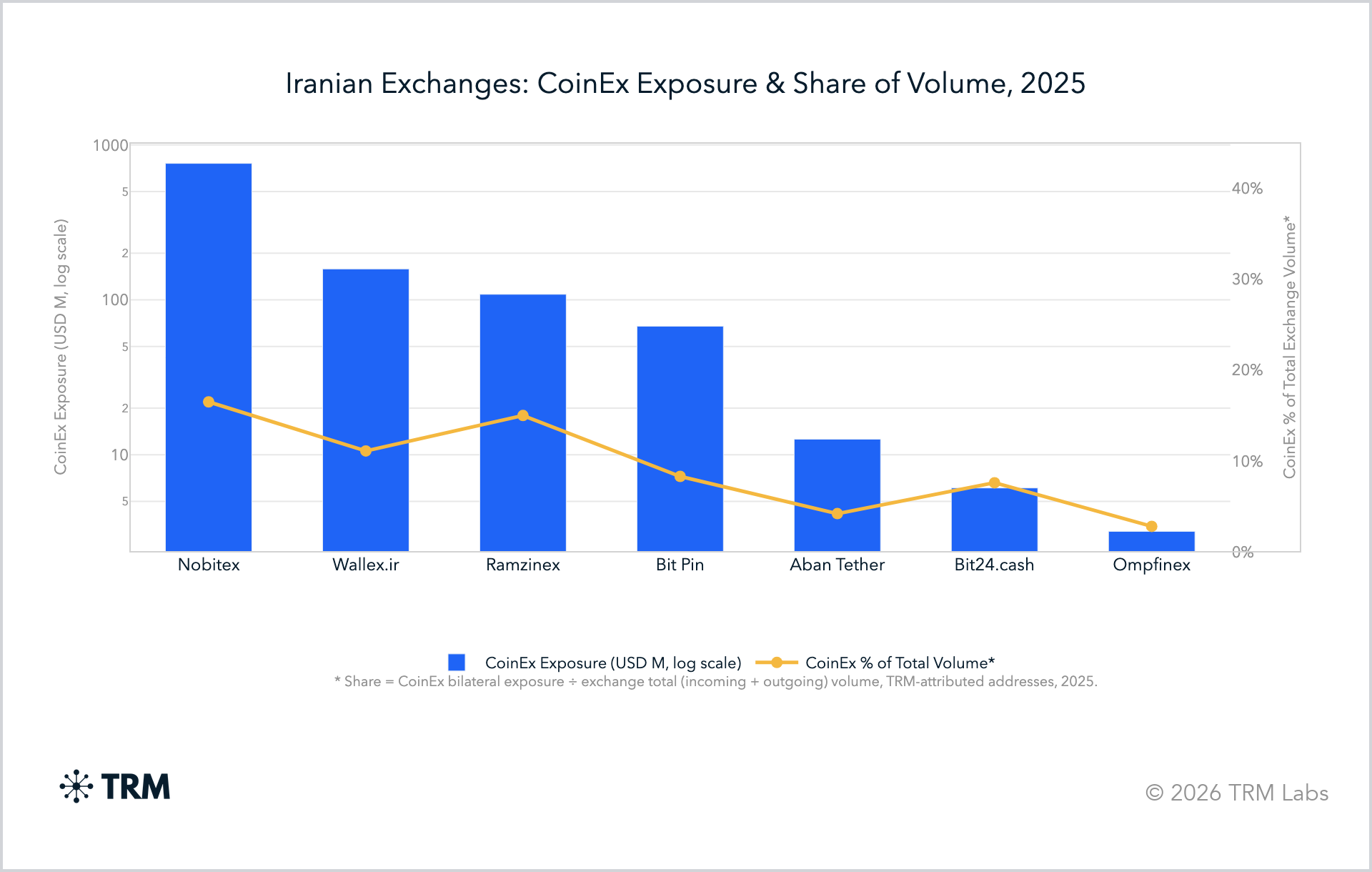
Wallets with identifiable links to sanctioned Iranian entities have moved over $3.84 billion through cryptocurrency exchange CoinEx since 2019, making it one of the main channels used to bypass US economic sanctions, according to blockchain analytics company TRM Labs.
About 60 Iranian platforms were tied to the funds, with $2.7 billion of this flowing between CoinEx and Nobitex, Iran’s largest domestic cryptocurrency exchange, at an average rate of about $1 million per day since 2018, wrote TRM Labs in a Wednesday report.
By 2024, CoinEx was Nobitex’s largest external counterpart, nearly nine times that of the next-largest exchange, a pattern that TRM Labs called “inconsistent with independent market behaviour.”
The report comes three weeks after the US Treasury sanctioned four Iranian crypto exchanges as part of its “Economic Fury” campaign. Days before the sanctions, Treasury Secretary Scott Bessent said the Treasury had seized $1 billion in crypto from Iranian exchanges and wallets since the start of the war.
In a statement published Thursday on X, CoinEx denied having any commercial relationship with the Iranian government or domestic Iranian exchanges and said it has never provided funding channels to sanctioned parties. The exchange also disputed TRM Labs’ interpretation of blockchain data, saying onchain fund flows do not demonstrate a platform’s knowledge of or participation in illicit activity.
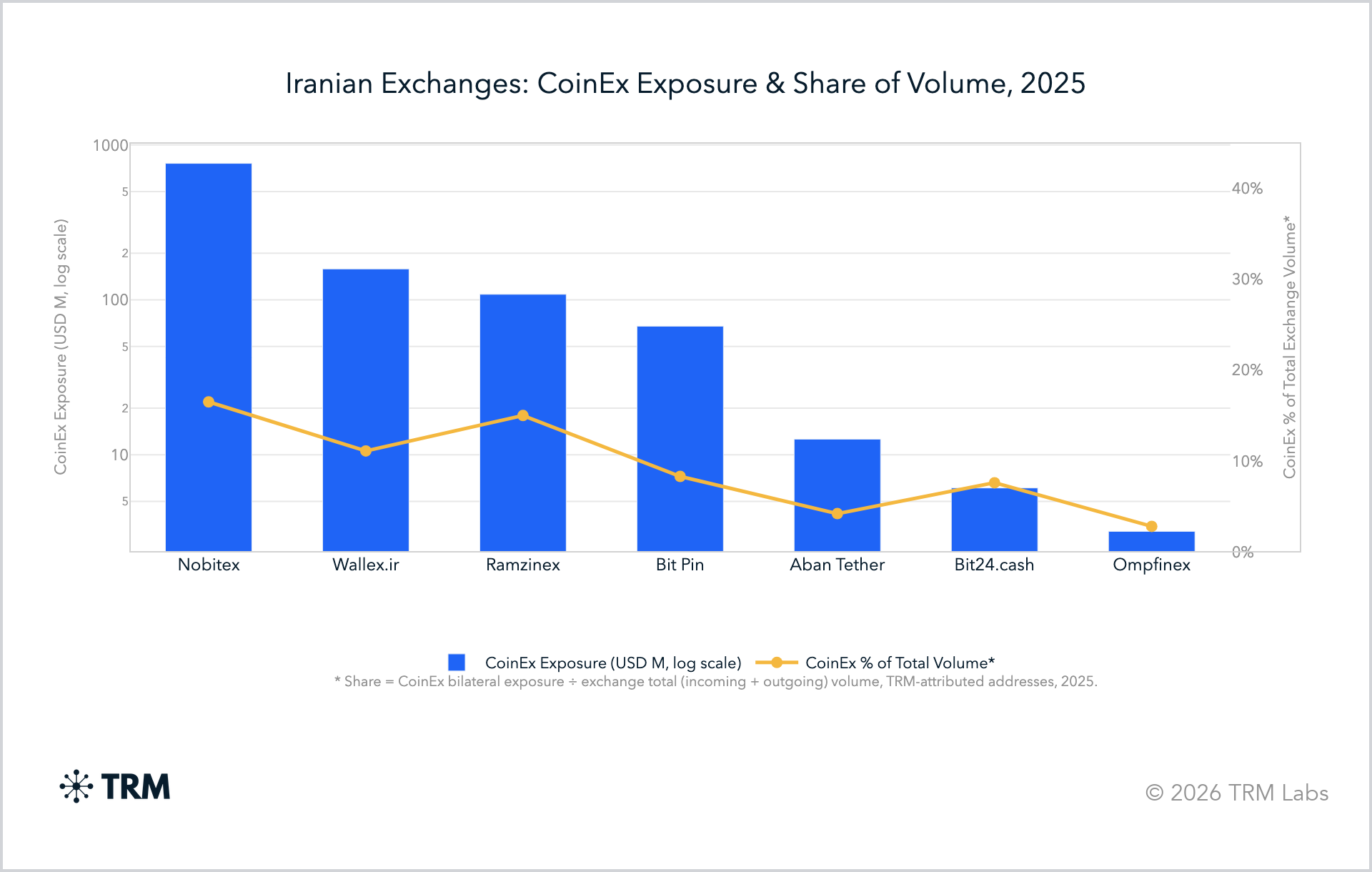
Iranian exchanges: CoinEx exposure & share volume, 2025. Source: TRM Labs
Top Iranian exchanges route up to 10% of volume through CoinEx
Most of the major Iranian domestic exchanges route about 5% to 10% of their trading volume through CoinEx, indicating a “coordinated arrangement rather than organic adoption,” according to TRM Labs.
CoinEx’s share of illicit transaction volume is nearly 8%, above the 0.3% threshold found at other compliant exchanges.
Related: US authorities freeze $344M in crypto linked to Iran
CoinEx-affiliated mining pool ViaBTC accounted for another $154 million in traced exposure to Nobitex through mining payouts and supplied emergency liquidity to Nobitex following Predatory Sparrow’s $90 million hack in June 2025.
Cointelegraph contacted ViaBTC for comment on TRM Labs’ findings but had not received a response by publication.
Nobitex was at the center of Iran’s “digital dollar pipeline” and handled about 50% of the country’s crypto trading volume, according to a June 2 report by blockchain forensics platform Chainalysis.
In May, Nobitex was reportedly linked to members of a powerful family with ties to Supreme Leader Ali Khamenei.
In January, the Office of Foreign Assets Control sanctioned UK-registered Zedcex and Zedxion for being used as front companies for the Iranian Revolutionary Guard Corps (IRGC).


HYPE printed a fresh all-time high near $77 in June 2026, then pulled back toward the mid-50s. With a fee-funded buyback engine pulling one way and a multi-year unlock pulling the other, $100 is possible but far from a given. Here is the realistic path, and what has to break right.
Summary
- HYPE can reach $100 in 2026, but it is a bull-case outcome.
- Hyperliquid’s buyback engine creates real token demand from platform fees.
- The unlock schedule is the main force working against the buyback.
- Volume, regulation, ETF flows, and new markets decide whether the path opens.
Hyperliquid’s HYPE token reached a new all-time high of roughly $77 in June 2026 before pulling back toward the mid-50s, and the move reignited the question its holders keep asking: can HYPE reach $100 before the year is out?
From the mid-50s, that target is a climb of roughly 70% to 80%, an ambitious but not absurd move for a token that has already delivered enormous gains since its late-2024 launch. The answer is not a simple yes or no, because HYPE sits at the center of an unusually clear tug-of-war.
On one side is a buyback engine that funnels almost all of the platform’s trading fees into buying and burning the token. On the other is a large multi-year schedule of token unlocks that keeps adding supply.
Whether HYPE hits $100 in 2026 depends on which of those forces wins, and on whether the platform’s growth catalysts arrive before its risks bite. This piece lays out the realistic path to that number, and the conditions that would have to break right for it to happen.
A note on what this is and is not: this is an analysis of scenarios and the forces that drive them, not a prediction presented as fact and not investment advice. Price targets in crypto are educated framings of probability, not promises, and anyone who tells you with certainty where a volatile token will trade in six months is guessing.
What follows covers where HYPE stands now, the buyback mechanism that gives it a structural floor, the supply overhang that opposes it, the growth catalysts that could power a run to triple digits, the risks that could cap it well short, what the broader market is actually betting, and three concrete scenarios, bull, base, and bear, for how 2026 could play out.
The goal is to give a holder a framework for thinking about the $100 question rather than a false promise about the answer.
Where HYPE stands right now
Begin with the lay of the land, because the starting point shapes everything.
Hyperliquid is the dominant decentralized perpetual-futures exchange, a platform where traders take leveraged positions on crypto and, increasingly, on other assets, with its order book and matching engine running fully on its own high-performance blockchain.
Its token, HYPE, reached an all-time high near $77 in mid-June 2026 and has since corrected toward the mid-50s, giving it a market capitalization in the rough vicinity of $15 billion and a top-ten ranking among all cryptocurrencies.
That places HYPE among the most valuable tokens in the market, a remarkable ascent for an asset that launched at around $7.50 little more than a year and a half earlier. Hyperliquid also stands out because it was built without the usual venture-capital-heavy launch structure, with a large share of supply distributed to users instead of insiders.
The supply structure is central to any price discussion, so it is worth stating plainly. HYPE has a maximum supply approaching 1 billion tokens, but only a fraction of that, somewhere around a quarter, is currently circulating and tradeable.
The gap between the circulating supply and the eventual total is large, which means a great deal of HYPE is not yet on the market and will enter circulation over the coming years. This matters enormously for the $100 question, because price is a function of both demand and the supply it must absorb.
To reach $100 from the mid-50s, HYPE needs demand to grow faster than incoming supply. The entire bull-versus-bear debate around the token can be reduced to a single contest: the buyback engine adding demand on one side against the unlock schedule adding supply on the other.
Understanding both sides is the key to a grounded view of where HYPE can realistically go.
The buyback engine: HYPE’s structural floor
The feature that makes HYPE unusual, and that anchors the bull case, is its buyback mechanism, which ties the token’s value directly to the platform’s success in a way few tokens can claim.
Hyperliquid directs the overwhelming majority of the trading fees its exchange generates, on the order of 97% to 99%, into a fund that continuously buys HYPE on the open market and removes it from circulation. In effect, the platform uses its revenue to repurchase its own token, much as a company might buy back its shares, creating a direct and automatic link between trading activity and token demand.
The more volume Hyperliquid handles, the more fees it collects, the more HYPE it buys, and the more upward pressure builds on the price. That makes the product driving Hyperliquid’s fees central to the investment case.
This is a genuinely powerful mechanism, because it grounds HYPE’s value in something concrete rather than pure speculation. Hyperliquid has processed trillions of dollars in cumulative trading volume and generated hundreds of millions in revenue, and it commands a dominant share of all on-chain perpetual trading.
That means the fee stream feeding the buyback is large and real.
For holders, the buyback acts as a kind of structural floor and a source of steady demand. As long as the platform keeps generating heavy volume, the fund keeps buying, which can offset selling pressure and support the price even in quiet markets.
It is the single strongest argument for HYPE reaching $100, because it converts the platform’s commercial success directly into token demand. But a floor is only as strong as the revenue beneath it, and the buyback has a formidable opponent on the other side of the ledger.
The supply overhang: the buyback’s opponent
The force working against the buyback is the token unlock schedule, and it is substantial enough that no honest forecast can ignore it.
Because only about a quarter of HYPE’s eventual supply currently circulates, a large quantity of tokens, including allocations to the team and early contributors, is scheduled to unlock and enter the market gradually over a multi-year period stretching into the latter part of the decade.
Each unlock increases the circulating supply, and unless demand rises to match, that new supply weighs on the price. This is the central tension in HYPE’s structure: the buyback engine pulls supply out of circulation while the unlock schedule pushes new supply in, and the token’s trajectory depends on which force is stronger at any given moment.
For readers who want the base framework, reading HYPE’s unlock schedule starts with the tokenomics that decide whether demand is outrunning dilution.
The math of this contest is what determines whether $100 is reachable. If Hyperliquid’s trading volume stays high enough that the buyback removes tokens faster than, or at least as fast as, the unlocks add them, the net supply pressure stays manageable and demand growth can lift the price.
If volume falters, or if the unlocks accelerate beyond what the buyback can absorb, then per-token gains become constrained even if the platform’s overall value grows, because the same value is spread across more tokens.
This is the dilution risk, and it is the most important reason to temper expectations: a platform can succeed commercially while its token underperforms if supply growth outpaces the buyback.
So the buyback floor is real but conditional, and the condition is sustained, heavy trading volume. The entire $100 thesis rests on the buyback continuing to win its tug-of-war with the unlocks, which in turn rests on the catalysts that drive volume.
The growth catalysts that could power $100
For HYPE to reach $100, the buyback needs to keep winning, and that requires the platform’s volume and revenue to keep growing. That is where Hyperliquid’s expanding product surface comes in.
The most important catalyst is the opening of the platform to permissionless markets, a feature that lets third parties create their own perpetual-futures markets for assets beyond core crypto. Within months of launching, this capability was already generating a meaningful slice of the platform’s revenue and powering record trading days in markets for commodities such as silver and oil.
Expanding the universe of tradeable assets is the most direct way to grow volume, and therefore the most direct path to a higher token price.
Several other catalysts stack on top. The platform has been adding prediction-style markets and shorter-dated options, broadening its appeal beyond leveraged crypto traders to a wider audience.
Its full smart-contract layer lets outside developers build applications, vaults, and structured products on the same infrastructure, turning a single exchange into a programmable financial ecosystem and creating more activity that generates fees. Spot trading, real-world assets, and synthetic equities extend the platform further still.
That is why how on-chain exchanges work matters here: Hyperliquid is no longer only a perp venue, but a broader on-chain financial stack trying to pull more trading into one system.
One of the clearest examples is the growth of pre-IPO and synthetic private-market trading on Hyperliquid, including activity tied to SpaceX exposure through HIP-3 markets. That widens the platform beyond standard crypto pairs and shows how permissionless markets can turn outside narratives into fee-generating trading activity.
A new and potentially significant source of demand has also appeared in the form of regulated exchange-traded products that give traditional investors exposure to HYPE without holding it directly. Those products create another possible bid outside native crypto traders.
If these catalysts compound, each adding volume and fee revenue, the buyback grows more powerful, the supply pressure is more easily absorbed, and the path toward $100 opens. The bull case is essentially a bet that this product expansion keeps feeding the engine faster than the unlocks can drain it.
The risks that could cap it
A grounded forecast has to weigh the catalysts against the risks, and HYPE faces several that could keep it well short of $100.
The most prominent is regulation. Hyperliquid operates in a legally gray area in some jurisdictions, including restrictions affecting access in the United States, and the traditional derivatives establishment has been pressing regulators to bring platforms like it under tighter oversight, citing concerns about manipulation and the kinds of permissionless markets that drive its growth.
A regulatory clampdown could limit the products Hyperliquid offers, impose new requirements that slow its expansion, or restrict its addressable market, any of which would cut into the trading volume that feeds the buyback. That is why the regulatory cloud over perp venues matters: the legal treatment of perpetual futures is no longer a side issue for platforms built around them.
Regulatory risk is the single largest external threat hanging over the token.
Competition is the second major risk. Hyperliquid commands a dominant share of on-chain perpetual trading, but that dominance invites attack, and large centralized exchanges, other decentralized venues, and new entrants are all chasing the same lucrative market.
If competitors replicate Hyperliquid’s features or undercut it on incentives, they can erode its market share and compress the trading fees that fund the buyback. Lower fees mean a weaker buyback, which means less support for the token.
Layered on these are the ordinary hazards of a crypto-market token. HYPE’s fortunes are tied to overall risk appetite, and in a risk-off environment, exchange tokens and high-beta assets tend to fall sharply regardless of fundamentals.
Perpetual-trading volume itself can also shrink when volatility and speculation dry up. So the risks form a coherent bear vector: regulation or competition shrinks volume, volume shrinks the buyback, the buyback can no longer outrun the unlocks, and the token’s supply pressure reasserts itself.
Any of these materializing would push $100 further out of reach.
What the market is actually betting
It helps to see where the wider market lands on the $100 question, because the spread of opinion reveals how genuinely uncertain it is.
On prediction markets, where people bet real money on outcomes, the crowd in mid-2026 leaned toward HYPE surpassing $80 before year-end, with a smaller majority expecting it to clear $90, and a substantial minority, somewhat under half, betting it would exceed $100.
On the downside, bettors assigned high odds to HYPE trading below $50 at some point, reflecting awareness of the volatility and the unlock pressure. In other words, the market treats $100 as a real possibility but not the most likely outcome, with meaningful probability on both a strong run higher and a pullback lower.
Analyst forecasts span an even wider range, which is itself informative. Toward the cautious end, some firms project HYPE averaging in the high $30s to high $50s across 2026, essentially expecting the token to hold near or modestly above current levels.
In the middle, several see a return toward or past the all-time high if adoption continues. At the bullish extreme, one prominent investor has floated a target as high as $150, premised on the buyback engine, organic volume growth, and the expansion into prediction markets and options all firing together.
The enormous spread, from the high $30s to $150, is not a sign that the analysts are useless. It is an honest reflection of how much HYPE’s outcome depends on variables that are truly unknown, chiefly whether volume growth outpaces the unlocks and whether regulation intervenes.
The responsible reading of the consensus is that $100 is plausible in a strong scenario, roughly a coin-flip-or-worse proposition by year-end, and dependent on the bull catalysts materializing.
Bull, base, and bear scenarios for 2026
The cleanest way to hold all of this together is to lay out three scenarios, each with the conditions that would produce it, so the $100 question has context rather than a single false answer.
In the bull scenario, HYPE reaches and possibly exceeds $100. This requires the catalysts to compound: permissionless markets and new products driving trading volume sharply higher, the buyback consequently absorbing the unlocks with room to spare, exchange-traded product inflows adding a steady new bid, no serious regulatory blow landing, and a generally favorable crypto market providing tailwinds.
In that world, the buyback engine wins its tug-of-war decisively, demand outstrips the incoming supply, and the token reprices toward triple digits and beyond. It is a coherent path, but it requires most things to go right at once.
In the base scenario, the most probable of the three, HYPE spends 2026 trading in a wide band, roughly the mid-$40s to the low $70s, without a durable break to $100. Here the buyback and the unlocks roughly offset each other, volume grows but not explosively, and the token chops within range as catalysts and headwinds trade blows.
This is the unremarkable but likely outcome: a strong platform whose token consolidates after a big run, holding its value without delivering the parabolic move bulls hope for.
In the bear scenario, HYPE falls toward the $20s to low $40s. This is what a regulatory shock, a loss of market share to competitors, a slump in trading volume, or a broad risk-off downturn would produce, any of which would weaken the buyback and let the unlock supply drag the price down.
The key insight across all three is that $100 is specifically a bull-scenario outcome. It is not the base case, and it requires favorable conditions to align.
HYPE reaching $100 is possible. It is the optimistic branch, not the expected path.
The reflexive edge of the buyback, in both directions
There is a subtler dynamic inside the buyback model that deserves attention, because it is what gives HYPE both its explosive upside and its hidden fragility: the mechanism is reflexive.
That means its parts feed back on one another in a loop that runs powerfully in whichever direction it is already moving. On the way up, the loop is a thing of beauty for holders.
Heavy trading volume generates large fees, the fees fund aggressive buybacks, the buybacks lift the price, the rising price draws attention and new traders to the platform, and that fresh activity generates still more volume and fees, which funds still more buying.
Each turn of the wheel reinforces the next, and in a strong market this is exactly how a token makes a 70% or 80% move toward a target like $100 look almost effortless. The buyback does not just support the price; it can compound a rally.
The trouble is that the same wheel turns in reverse with equal force. If trading volume falls, whether because of a market downturn, a regulatory blow, or competitors stealing share, the fees shrink, the buyback weakens, the diminished buying lets the price slide, the falling price dims the attention and excitement that drew traders in, and the quieter platform generates even less volume, which shrinks the fees further.
A virtuous circle becomes a vicious one, and the descent can be as self-reinforcing as the climb. This is the part of the buyback story that bullish framings tend to skip: a mechanism celebrated as a structural floor is only a floor while volume holds, and volume is exactly the thing that evaporates fastest when sentiment turns.
The buyback does not insulate HYPE from a downturn. In a real one, it can amplify the fall by weakening precisely when support is most needed.
For the $100 question, this reflexivity is the hinge that explains why the outcome is so binary and so dependent on conditions. In a favorable environment, the loop spins upward and $100 becomes very reachable, because demand feeds on itself.
In an unfavorable one, the loop spins downward and the token can fall far below current levels for the same self-reinforcing reason. There is less stable middle ground than a simple “buyback equals floor” story implies, because the model is built to accelerate moves, not to dampen them.
A holder betting on $100 is therefore betting not just that the platform grows, but that it grows in a market calm enough to let the reflexive engine spin upward without a shock large enough to throw it into reverse.
The buyback is a genuine edge, but it is an edge that cuts both ways, and respecting the downside is the difference between understanding HYPE and merely cheering for it.
So can HYPE reach $100 in 2026?
Bringing it together, the honest verdict is that HYPE can reach $100 in 2026, but it is not the most likely outcome, and getting there requires a specific stack of things to go right.
The buyback engine has to keep winning its contest with the unlocks, which means trading volume has to stay heavy and ideally grow, powered by the platform’s expansion into new markets and products. A fresh source of demand, most plausibly exchange-traded products channeling outside capital in, has to add a sustained bid.
The major risks, regulation above all, then competition and a market downturn, have to stay contained. And the broader crypto market has to cooperate, because even the best token struggles to make a 70% to 80% move in a hostile tape.
When all of those align, the path to $100 is real and even straightforward, because the buyback turns volume into relentless token demand.
The realistic conclusion is one of conditional possibility instead of confident prediction. In a strong, catalyst-driven, risk-on 2026, $100 is achievable and the bull case is coherent.
In a flat or choppy year, the base case of wide-range consolidation is more likely, and the token holds its value without reaching the milestone. In a hostile year, the bear case pulls it well below current levels.
For a holder or watcher, the practical takeaway is to monitor the variables that actually decide it: Hyperliquid’s trading volume and fee revenue, the pace of unlocks against the pace of buybacks, the flows into the new exchange-traded products, and any movement on the regulatory front.
Those metrics, not any single price target, will tell you in real time whether HYPE is on the road to $100 or settling into its range. The number is reachable.
It is simply not promised, and anyone who treats it as a sure thing is ignoring the unlock schedule, the regulatory cloud, and the plain fact that crypto rarely moves in a straight line.
Frequently asked questions
Can HYPE realistically reach $100 in 2026?
It is possible but not the most likely outcome. From the mid-50s, $100 is a roughly 70% to 80% climb, achievable for a token this volatile but requiring favorable conditions to align: sustained high trading volume feeding the buyback, growth catalysts like new markets and exchange-traded products adding demand, contained regulatory risk, and a cooperative crypto market. $100 is best understood as a bull-scenario target instead of the base case, which is closer to wide-range consolidation in the mid-$40s to low $70s.
What is the HYPE buyback and why does it matter?
Hyperliquid directs roughly 97% to 99% of its trading fees into a fund that continuously buys HYPE on the open market and removes it from circulation, similar to a company buying back its shares. This ties the token’s demand directly to the platform’s trading activity: more volume means more fees, more buybacks, and more upward pressure on the price. The buyback acts as a structural floor and is the strongest argument for HYPE rising, but it depends entirely on the platform maintaining heavy trading volume.
What is the biggest risk to HYPE’s price?
Regulation is the largest external risk. Hyperliquid operates in a legal gray area in some jurisdictions, including access restrictions in the United States, and traditional derivatives firms have urged regulators to tighten oversight of platforms like it. A clampdown could limit its products, slow its growth, or shrink its market, cutting the trading volume that feeds the buyback. Competition eroding its market share and fees, and a broad crypto downturn reducing trading activity, are the other major risks that could cap the price.
Why does HYPE’s token unlock schedule matter?
Only about a quarter of HYPE’s eventual supply currently circulates, with a large quantity scheduled to unlock gradually over several years. Each unlock adds supply, and unless demand rises to match, it weighs on the price. This creates HYPE’s central tension: the buyback removes tokens while unlocks add them. If trading volume keeps the buyback strong enough to absorb the unlocks, the price can rise; if volume falters and unlocks outpace buybacks, per-token gains are constrained even if the platform grows.
What are analysts predicting for HYPE in 2026?
Forecasts span a very wide range, reflecting genuine uncertainty. Cautious projections see HYPE averaging in the high $30s to high $50s, essentially holding near current levels. Middle estimates expect a return toward or past its all-time high if adoption continues. The most bullish forecasts float targets as high as $150 if the buyback, volume growth, and new markets all fire together. Prediction markets in mid-2026 leaned toward HYPE clearing $80, with under half betting on $100.
What should I watch to judge where HYPE is heading?
Track the variables that actually decide the outcome instead of any single price target. The most important is Hyperliquid’s trading volume and fee revenue, which power the buyback. Then watch the pace of token unlocks against the pace of buybacks, inflows into the new HYPE exchange-traded products, the platform’s expansion into new markets and products, and any regulatory developments affecting perpetual-trading venues. Those metrics will tell you in real time whether the buyback is outrunning supply and whether the path toward $100 is opening or closing.
This article is information, not investment advice. Price scenarios are uncertain framings, not predictions, and cryptocurrency is highly volatile. Figures for Hyperliquid and HYPE reflect reporting available as of June 25, 2026, and can change quickly. Do your own research and verify current data from primary sources before making any decision.

It’s been a difficult 24 hours for several digital assets, including MemeCore’s M token, which dropped 76%, and viral altcoin Audiera (BEAT), which shaved off 32% of its value, making them the two worst performers in that period according to CoinGecko data.
Meanwhile, Magic Internet Money (MIM) also fell to about $0.50 after losing its dollar peg, triggering a scramble by the Abracadabra team behind it to stop it from falling further.
MIM Depeg and MemeCore Sell-Off
MIM, which is supposed to hold a $1.00 value, dropped to around $0.50 according to blockchain security firm Peckshield, with data from CoinMarketCap showing it went as low as $0.46 at one point. At the same time, trading volume jumped nearly 375% as holders rushed to exit, although the token’s market cap was still sitting at just over $52 million at the time of writing, a fraction of its fully diluted value of $351 million.
Abracadabra, the group behind the token, acknowledged the situation in a post on X, saying:
“We are acutely aware of the $MIM depeg and are taking emergency actions to remedy the situation.”
Some of the actions it has taken include raising interest rates across all of its Cauldron lending markets, even those that had already been deprecated, to push borrowers to repay the MIM-denominated debt. The logic is that if you borrowed MIM at $1.00 and can buy it back at $0.50, you have a strong financial reason to close that debt now. This repayment would reduce the total MIM in circulation and, in theory, help the price recover.
The team also said that it was pausing direct incentives and Curve liquidity bribes until the peg returns.
“Our priority is simple: restore confidence, improve market structure, and return $MIM to a healthy (and liquid) peg,” they wrote.
Meanwhile, BEAT, which only yesterday was the best-performing cryptocurrency among the top 100, jumping 40% to reach the $2.40 level, but today saw most of that gain slip away, with CoinGecko data showing the asset dropping almost 32% in the last 24 hours. But MemeCore was hit even harder, plunging roughly 76% in the same period. It recorded a new all-time high just two months ago in late April, meaning it has lost about 85% of its peak value, with the market cap dropping from a high of around $6 billion to just under $950 million.
Manipulation Allegations
Previously, blockchain investigator ZachXBT had openly questioned MemeCore’s valuation and token distribution. In posts published in April, he asked how a token with a $6 billion market cap could maintain such a valuation while insiders allegedly controlled more than 90% of its supply.
The same concern was raised just recently when the SIREN token lost over 96% after a wallet linked to its biggest holder sold most of the circulating supply, according to blockchain watchers Spot On Chain and Lookonchain.
The post Market Meltdown: MemeCore Crashes 76% as MIM Breaks Peg to $0.50 appeared first on CryptoPotato.
Crypto World
Pi Network’s PI Barely Avoids New ATL, BTC Rebounds From Another Dip to $59K: Market Watch
Bitcoin’s price troubles only accelerated yesterday as the asset dipped toward $59,000 for the second time in June before it finally rebounded to over $61,000 as of now.
Most larger-cap alts followed the ride south and have remained in red now. ETH is down to $1,650, while XRP is well below $1.10.
BTC Rebounds After Latest Crash
After the price decline at the end of the previous business week, in which BTC slipped from $66,400 to $62,400 in just a couple of days after the latest FOMC meeting, the cryptocurrency rebounded swiftly. It tapped $64,000 during the weekend and rocketed to $65,600 on Monday in a rare major uptick.
The bears were quick to intervene, though, and halted the asset’s progress. Bitcoin dipped back down to under $63,000, where it stood for about 24 hours. Then came another crash that drove BTC south hard. In the span of just several hours, the cryptocurrency plummeted from around $63,000 to under $60,000 for the second time this month.
It lost about $4,000 of value and dipped to $59,050 (on Bitstamp), which became its lowest price tag in nearly two years. This crash coincided with MSTR’s 10% drop as the rocky relationship between the two continues. The bulls finally stepped up after such a painful drop, and BTC has rebounded by well over two grand, currently sitting above $61,500.
Its market cap is back to $1.235 trillion on CG, while its dominance over the alts stands at 56.1%.

Alts Bled, too
Ethereum is down by over 1% in the past 24 hours and now struggles at $1,650 after rebounding from around $1,600. BNB has slipped to $570, while XRP has lost the $1.10 support. It dipped beneath $1.05 yesterday, but it stands at $1.08 now. DOGE, SOL, TRX, XLM, XMR, and HBAR are also in the red.
MemeCore (M) has slumped by over 70% in the past 24 hours, plunging below $0.80 after some depegging issues with MIM. In contrast, AAVE has soared by 14% to over $81.
Pi Network’s native token dipped toward $0.12. This meant that it came inches away from posting a new all-time low (currently at $0.1189) but has managed to barely avoid another anti-record as of press time.
The total crypto market cap is down to $2.2 trillion on CG.

The post Pi Network’s PI Barely Avoids New ATL, BTC Rebounds From Another Dip to $59K: Market Watch appeared first on CryptoPotato.
Crypto World
Crypto News, June 25: Bitcoin Price 20-Month Low, Iran Coinex Controversy Grows While Clarity Act, MiCA and Trump CBDC Debate Heat Up

Bitcoin price is wobbling again as the Clarity Act, MiCA, and Trump CBDC fights are heating the market. Not just all of those, according to WSJ, Iran linked wallets, are allegedly moving and laundering money trough Coinex to avoid sanction.
Last night, crypto once again expericed a masive dip, although it does feel different, it was raw and fast. Regulators are drawing hard lines, on-chain sleuths are exposing flows, and one viral Reddit post reminded us that retail still moves markets.

Don’t Miss Out on Our $1,000 USDT Airdrop on ByBit
Bitcoin Price Retests Lows After Heavy Liquidations
Bitcoin price is now recovering at $61,800 after retesting 20-month lows under $60K. Coinglass data shows fresh liquidations stacking up, with millions wiped in the last 24-hours, with longs taking the heaviest hits. Data confirms $1 billion has been liquidated last night, concentrated on long positions accounting $780 million.
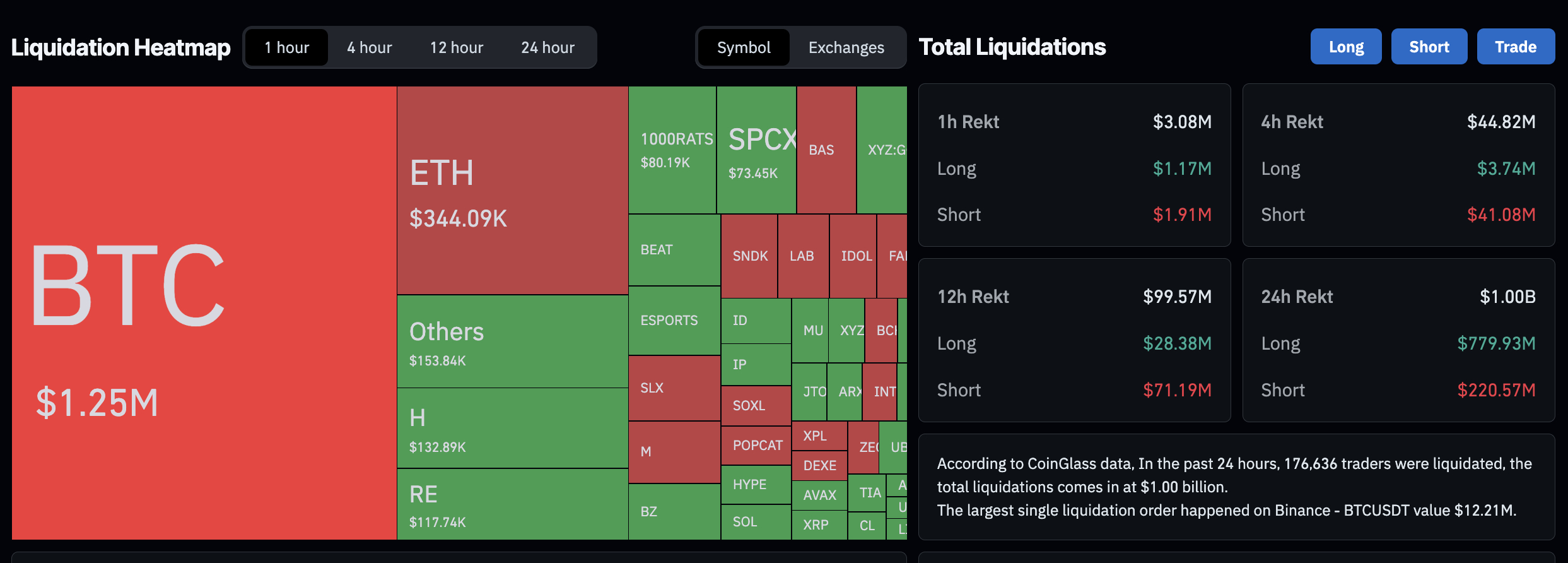
However, the pain might not be over. A major Chinese Bitcoin miner called a bottom between $42k–$44k for late 2026. Jiang Zhuoer, founder of the Chinese Bitcoin mining pool BTC.top based his prediction on long-term cycle models and Strategy’s (MicroStrategy) mNAV nearing 2022 lows. Arthur Hayes fired back with his usual swagger, saying AI-driven liquidity could eventually send Bitcoin price toward $1 million.
— Crypto Aman (@cryptoamanclub) June 25, 2026
 BITCOIN TO BOTTOM AT $42k-$44k?
• Big prediction by top Bitcoin miner Jiang Zhuoer.
• According to his mathematical model, the $BTC bear market will bottom out between Oct-Dec 2026.
• Expected Bottom Price: $42,000 – $44,000.
Prediction based on MSTR mNAV and 4-year… pic.twitter.com/1xsFFSfkdP
Discover: The Best Crypto to Diversify Your Portfolio
Iran Coinex Under WSJ Spotlight as Clarity Act Enters Final Review
WSJ reported Iran linked entities moved $3.84 billion through CoinEx since 2019 to bypass sanctions. On-chain data and TRM Labs flagged it as a major illicit hub, with alleged ties to IRGC and sanctioned Russian entities.
CoinEx has emerged as one of Iran’s primary gateways to global crypto markets, allowing the regime to convert and move funds while bypassing U.S. sanctions. Investigators flagged suspicious activity earlier this year involving two wallets tied to Iran’s Central Bank, which received funds traceable back to the $1.5 billion Bybit hack carried out by North Korean actors.
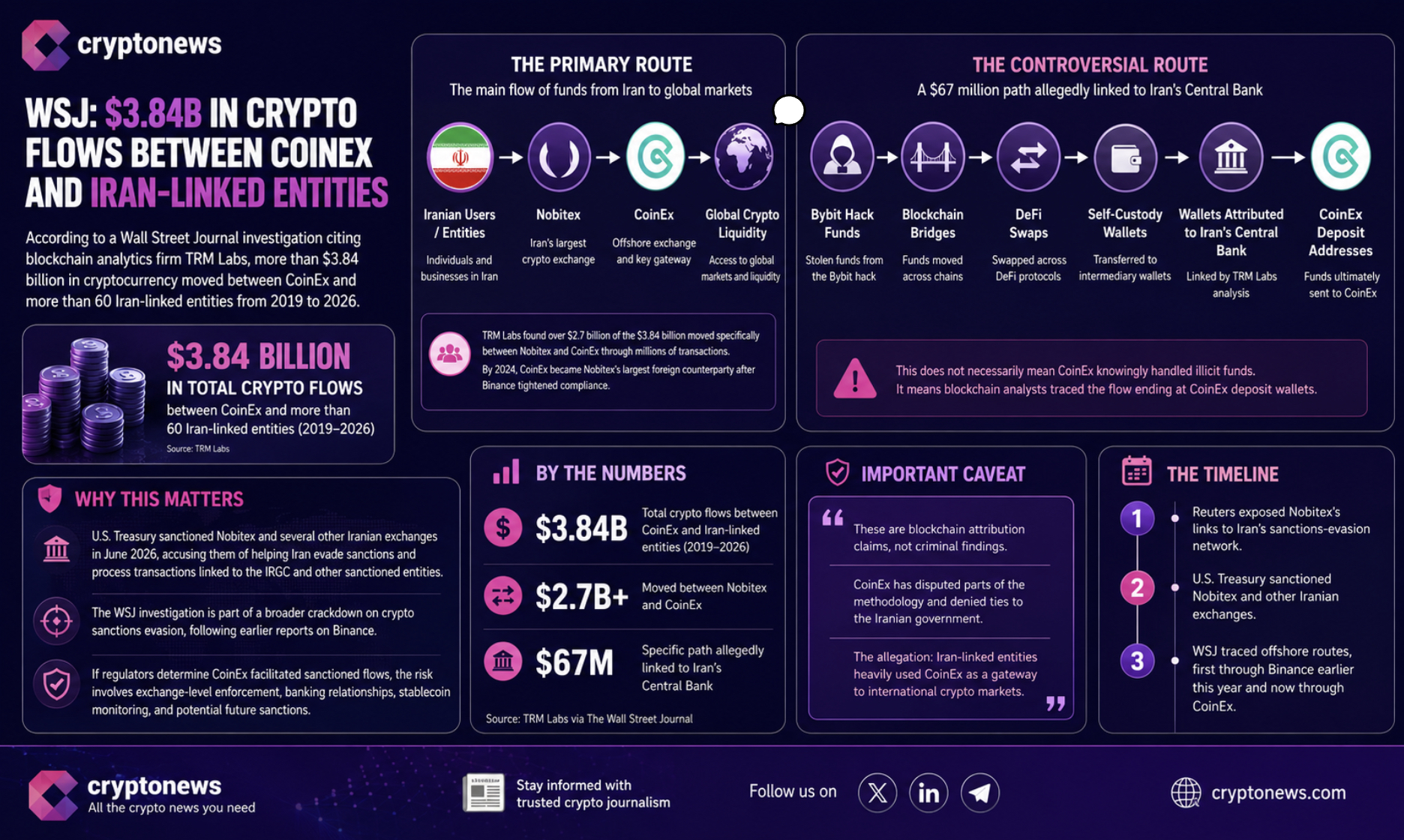
Also according to the report, those assets were laundered through complex transaction chains before ultimately landing on CoinEx. There’s also a report of direct transactions between CoinEx-hosted wallets and accounts U.S. authorities have linked to Iran’s Islamic Revolutionary Guard Corps (IRGC). While CoinEx has not yet faced new U.S. sanctions, the revelations are putting the exchange under fresh compliance pressure.
More on the regulatory front, Senator Lummis opened the final review window for the Clarity Act as the DOJ pushing back on claims of loopholes. Progress on the Clarity Act is moving faster than most expected.
Discover: The Best Token Presales
MiCA is Coming, and Only Less Than 10% Firms Are Compliant While Trump CBDC Fight Spills Into Housing Bill
Moving to Europe, the next week MiCA deadline is forcing for an industry-wide reset. As of today, only 210 out of 3,000 crypto firms cleared the deadline. After July 1, all the unlicensed platforms lose access to 450 million EU users with no extensions. Coinbase opened a Luxembourg hub. Binance is seeking approval elsewhere. The MiCA cull is brutal but could be necessary.
Back to America, President Trump abruptly canceled the scheduled signing of the 21st Century ROAD to Housing Act. The bill itself is a major bipartisan bill that had passed the House 358-32 and the Senate 85-5. This legislation aims to boost housing supply and affordability by cutting regulations and encouraging new construction. However, the bill also includes a provision that would block the Federal Reserve from issuing a central bank digital currency (CBDC) until 2030.
Trump posted on Truth Social that he would not sign the housing bill until Congress first passes the SAVE America Act, his priority election integrity and voter ID legislation, which he called a “National Emergency.”
Trump’s action has left the housing bill in limbo despite its bipartisan support. While the CBDC ban was a key addition pushed by Republicans, Trump’s decision to hold up the entire package is primarily aimed at forcing action on the SAVE Act. This creates short-term uncertainty but is likely good for crypto as the anti-CBDC language stays alive as leverage.
Meanwhile, Reddit’s WallStreetBets turned Wendy’s into a meme stock, shares jumped over 40% after a “Save Wendy’s before it’s too late” post went viral from 20-year lows. It shows that retail still has teeth.The liquidations are flushing out weak leverage. Every shakeout clears the path. Bitcoin price has survived far worse.
Don’t Miss Out on Our $1,000 USDT Airdrop on ByBit
The post Crypto News, June 25: Bitcoin Price 20-Month Low, Iran Coinex Controversy Grows While Clarity Act, MiCA and Trump CBDC Debate Heat Up appeared first on Cryptonews.
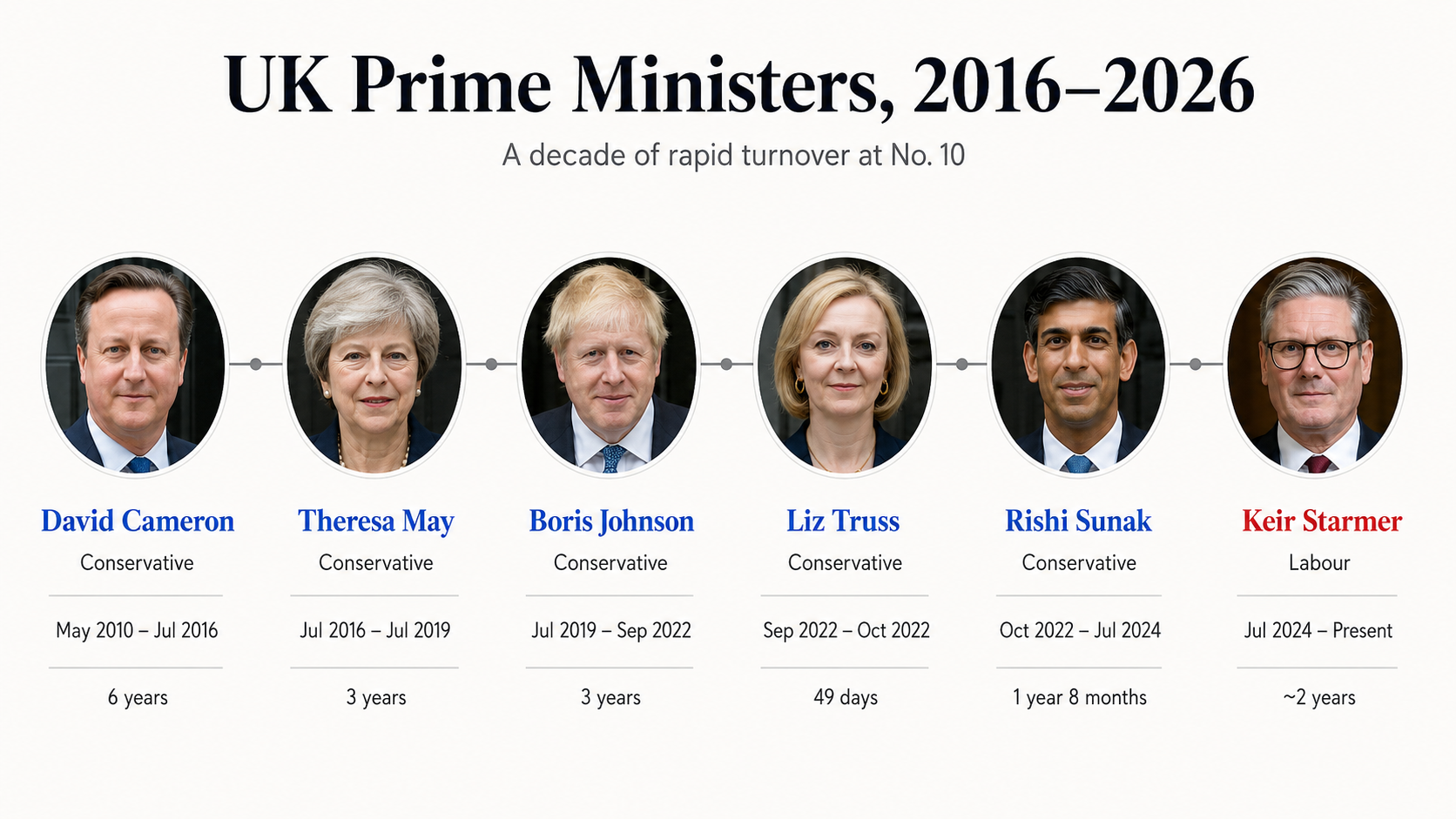
On Monday morning, June 22, Keir Starmer finally acknowledged what his Cabinet, parliamentary colleagues and the public had already concluded: he no longer had the authority to lead.
In doing so, he became the sixth prime minister in a decade – a level of political instability unmatched in modern British history. Every sector is now asking the same question: Who and what comes next? So, for digital assets, let’s unpack that.

Direction of Travel
From a policy perspective, the ship has largely set sail. Regulators are in the final stages of formalising a comprehensive framework, officials are listening, and engagement has been genuinely constructive.
This week’s announcement from the Bank of England illustrates the point well, even if it was partly overshadowed by political noise. Its policy statement and draft rules on sterling-denominated systemic stablecoins marked a clear step forward.
The required proportion of backing assets held in central bank deposits has been sensibly reduced from 40% to 30%, while the caps on holdings have been replaced by issuance limits.
“Each systemic stablecoin will be subject to an initial issuance maximum of £40 billion,” wrote The Bank of England.
We are imminently expecting a handful of policy statements from the FCA – covering everything from cross-cutting handbook reforms and the Regulated Activities Order. These will likely land much before a new Ministerial HM Treasury team is installed.
I mention this because political cycles may be volatile, but regulatory frameworks are built through sustained, technical engagement.
Politically speaking, we have navigated seven City Ministers since 2022 alone. Yet despite the political turbulence, the notion of a “global cryptoasset hub”, first coined by former PM Rishi Sunak, has survived.
Whoever walks through the door of No 10 – and whichever team follows them – will not reverse this. The wheel has already turned.
UK Crypto Sector Needs a Clear Political Wall
While we have made great progress on several ‘sticky’ issues for the sector, there are still some critical areas that need clear political will: the future direction for DeFi, a workable prudential regime for firms, workable FinProms rules, and a level tax playing field for stablecoins to name a few.
We must keep engaging at a political level to keep this momentum and keep landing messages around growth, productivity and jobs – all areas that transcend personnel. It is incumbent on industry to ensure that message carries through. We will certainly be playing our part.
More crucially, the digital asset agenda must not become politicised and dragged into the culture wars in the way it did in the US and as we’ve begun to see this year in the UK, thanks to so-called ‘crypto donations’.
This latest news shows how quickly the conversation descends into many of the usual tropes industry is familiar with, which are largely based on misunderstanding and misinformation.
Because strip away the headlines and the memes, and what we are actually talking about is rather prosaic. This is plumbing.
Financial infrastructure required to ensure the City of London remains a global centre of finance. With yesterday marking the tenth anniversary of Brexit, the point feels all the more pertinent.
That objective should transcend party lines. Encouragingly, there are signs that it does. Just last week, Conservative Party peers tabled amendments to the Financial Services and Markets Bill calling for a wholesale tokenisation strategy and a dedicated digital asset framework.
Meanwhile, the Liberal Democrats are actively developing their own policy platform for the sector.
And it must remain that way. The long-term success of the UK’s digital asset ecosystem will depend not on partisan point-scoring.
Who Steers the Ship?
It is too early to call who might stand against Burnham, but a coronation rather than a contest looks like the most probable outcome, especially following the early backing of Wes Streeting, himself long touted as a likely contender.
To add a layer of Westminster intrigue, sections of the media have been quick to elevate Al Carns as a possible dark horse contender. Yet the arithmetic looks challenging. Without the backing of the 81 MPs needed to trigger a contest, his route to the ballot is narrow.
So, with Burnham a few steps from No.10, attention inevitably turns to who might take up the keys to No.11, where the UK’s finance minister lives.
At this stage, Ed Miliband, Wes Streeting and Shabana Mahmood all appear to be in the frame as favourites.
On the face of it, Burnham is keeping his cards close to his chest. Whether this reflects genuine indecision or carefully managed ambiguity remains unclear.
More likely, it reflects an internal debate within his team about the future ideological direction of the Labour Party, with Reform UK waiting in the wings, buoyed by recent local election successes.
For now, the picture is one of competing centres of gravity rather than a settled plan, with No. 11 still very much up for grabs.
Other names are circulating. Yvette Cooper as a steady hand for markets, Miatta Fahnbulleh with her more radical economic vision, or even Louise Haigh, who is helping Burham run his campaign, as a wildcard.
What Does the Next UK PM Bring for Crypto?
For our sector, the jury is out. None of the frontrunners has meaningfully engaged with the digital assets industry to date.
The bookies’ favourite is a 2029 election, giving any new leader up to three years. That window must be used wisely, and it won’t be plain sailing for Burnham. A sharp lurch to the left risks alienating the very New Labour voices that brought Stamer’s Labour back to power.
Major foreign policy questions on Ukraine and Gaza remain unanswered and will prove divisive. On the economic front, whispers of significant cost-of-living interventions, particularly on energy bills and VAT, with limited financial headroom, suggest that borrowing may rise.
The markets’ reaction, as we saw with the pound strengthening and borrowing costs easing on news of Starmer’s departure, will be telling. History shows that bond market confidence can make or break an administration.
However, expect Burnham to make overtures to the City and roll back on some of his more hardline agenda in advance of coronation day to ensure he lands softly in No.10 and markets don’t give him a headache.
His team is already briefing about seeking guidance from well-known establishment figures such as Andy Haldane, a former Bank of England economist, to do just this.
But stepping back from the personalities, the task now is not to reopen the argument over digital assets, but to finish it properly, without losing focus on the inevitable noise that surrounds any moment of political transition.
Here at the UKCBC, we will keep fighting the good fight.
The post The Next PM Could Decide Britain’s Crypto Future appeared first on BeInCrypto.
Quick Overview
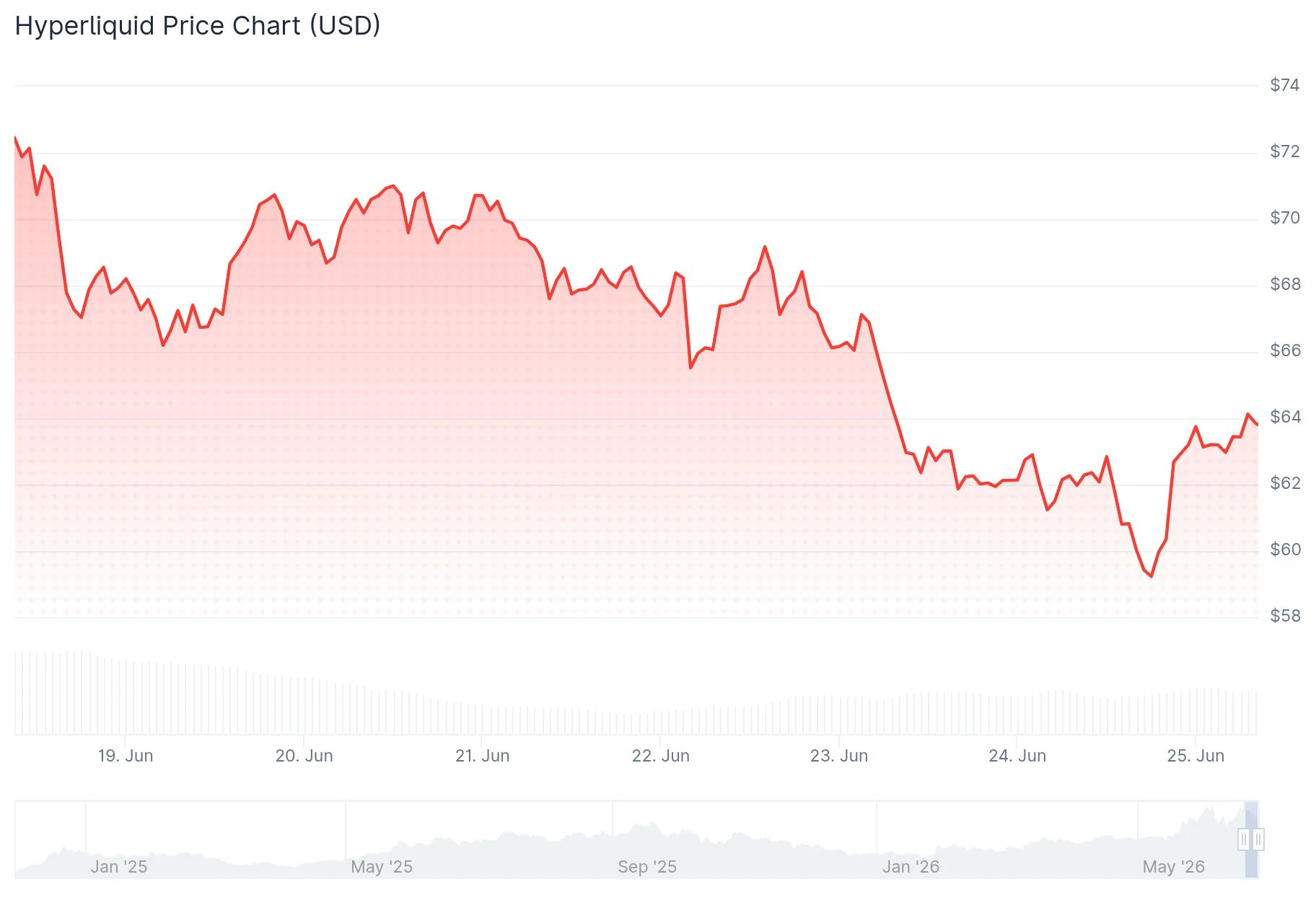
- HYPE has retreated 22% from its peak of $76.9, now hovering around $66
- Critical support zone between $50 and $54 coincides with the 50-day EMA
- Trader engagement has declined with open interest falling from $2.2B to $1.73B
- Spot market pressure is declining, though spot CVD stays negative at -$95M
- Crypto analyst Altcoin Sherpa identifies $55–$64 as an attractive accumulation range targeting $100
The HYPE token from Hyperliquid has experienced a 22% decline from its all-time peak of $76.9 achieved in recent trading sessions. Currently changing hands near $66, market participants are evaluating whether the bullish momentum that began in January remains intact.
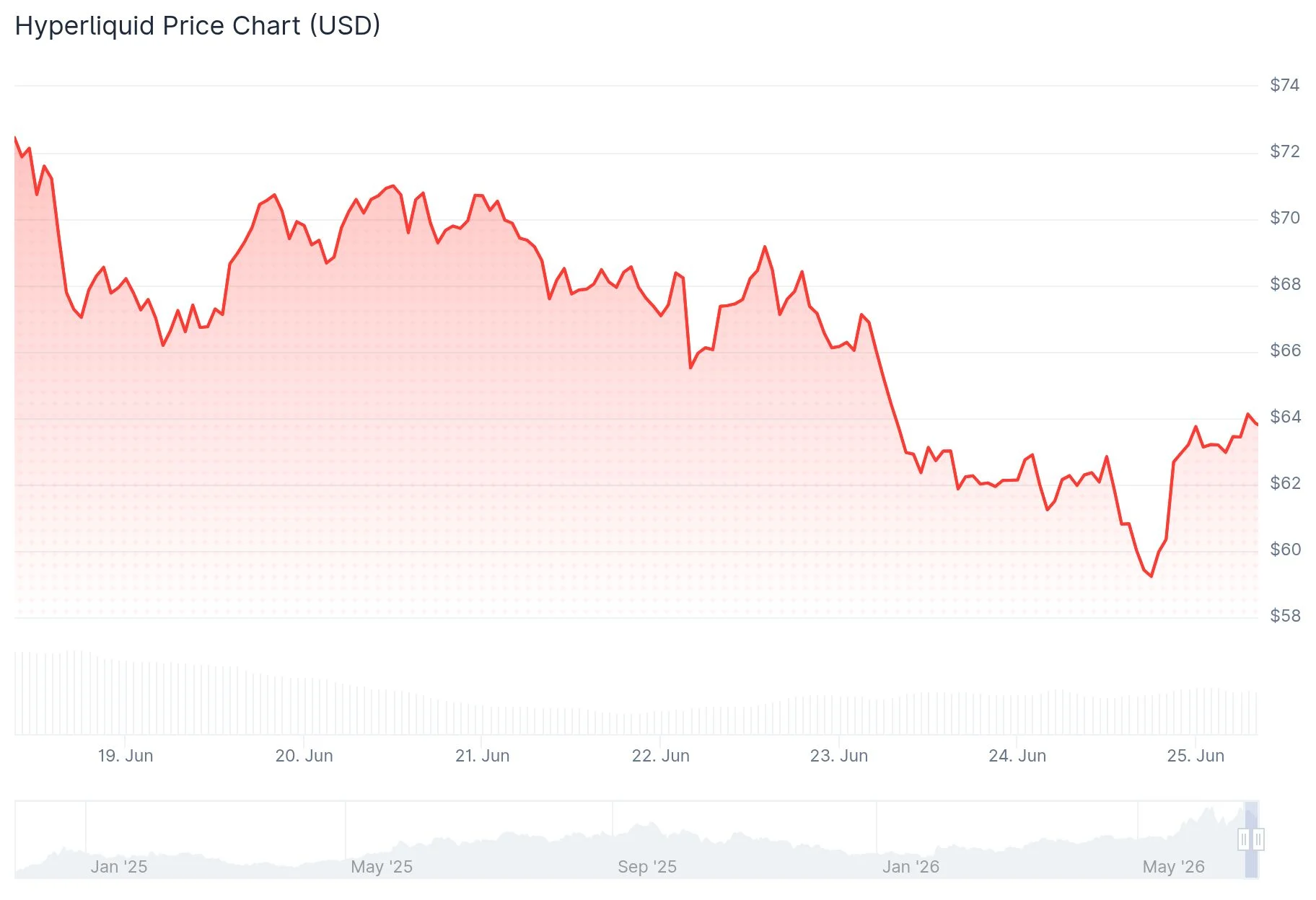
The correction emerged after the token failed to sustain levels above its record high near $76. During midweek trading, HYPE dipped beneath the $60 threshold before finding stability. The 50-day exponential moving average, which has provided consistent support during the March-initiated rally, is now facing a critical test.
Futures market metrics continue to reflect optimistic sentiment. Data from CoinGlass indicates a long-to-short ratio standing at 1.03, accompanied by positive funding rates of 0.0042%. This configuration shows long position holders are compensating short sellers, indicating prevailing expectations for upward price movement.
Spot Market Pressure Shows Signs of Relief
The intensity of spot selling has diminished compared to early June levels. The aggregated spot cumulative volume delta (CVD) has recovered from recent lows, although it maintains a substantially negative reading around -$95 million. When prices dropped from $76 in early June, spot selling pressure peaked at $110 million.
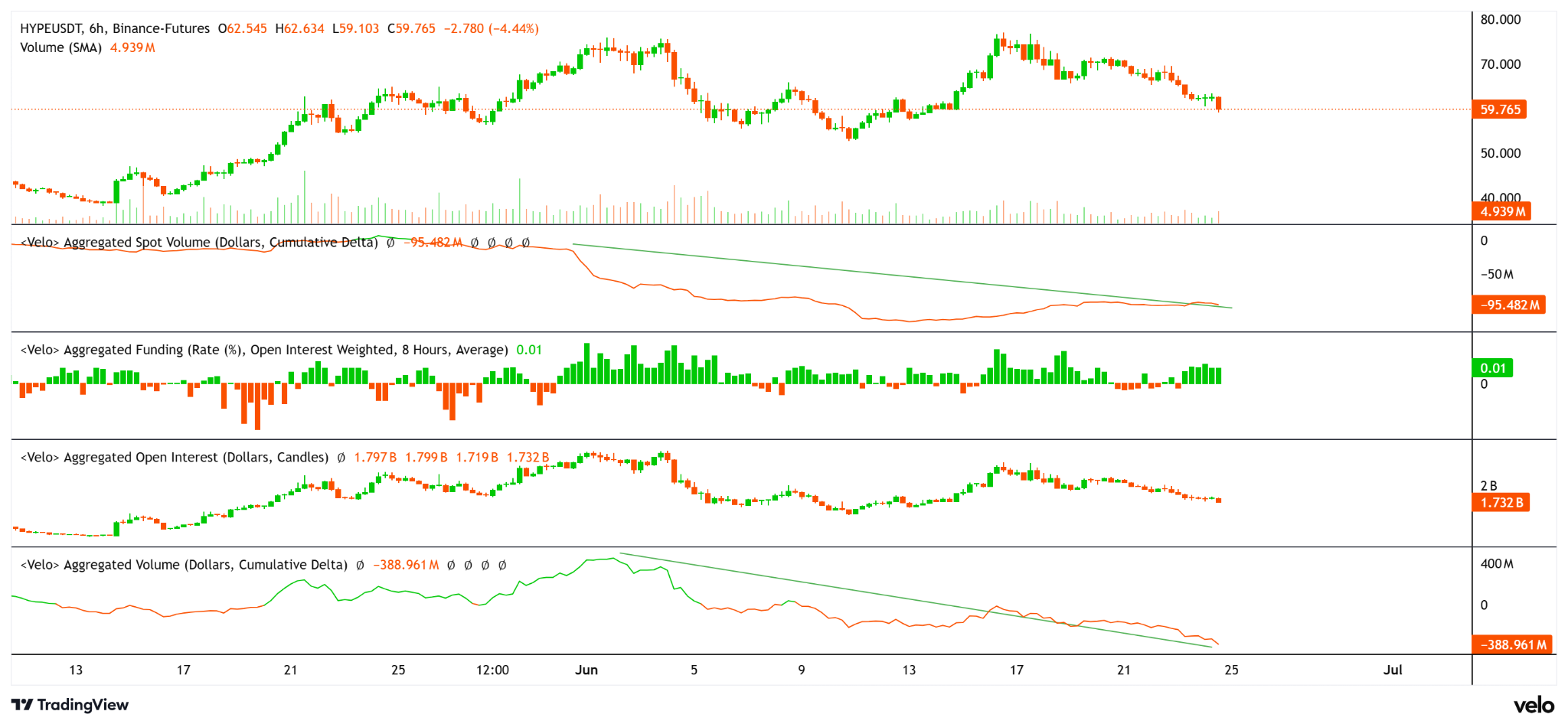
The derivatives landscape tells a more reserved story. Open interest has contracted from $2.2 billion down to $1.73 billion. Derivatives CVD hovers near -$389 million. This suggests market participants are reducing their positions rather than establishing fresh trades.
Social dominance metrics for HYPE have been declining since June 17, currently registering at 0.175% per Santiment data. Increased retail engagement following the all-time highs has emerged, which certain market observers interpret as a potential caution signal for short-term price action.
Spot ETF activity has remained subdued throughout the week, with SoSoValue reporting minimal institutional involvement.
Critical $50–$54 Zone Emerges as Pivotal Support
The most significant support level appears between $50 and $54. This zone aligns with both the ascending 50-day EMA and an unfilled daily fair-value gap. A daily candle closing beneath $53 would mark the first bearish structural shift on the daily timeframe for this year.
Beneath this level, the 100-day EMA positioned at $51.57 represents the subsequent support, with $49 following. More substantial support exists around the $38 level.
Cryptocurrency analyst Altcoin Sherpa provided his perspective on the current market structure: “HYPE, I think anywhere in the 55–64 area is a pretty good place to accumulate this one. I think it goes to $100 later this year personally and is still the best altcoin…but it’s going to also depend a lot on bitcoin IMO.”
For bullish continuation, a daily close exceeding $74.60 would clear the pathway toward establishing fresh highs. The 50-day EMA currently resides at $58.94, the 100-day at $51.57, and the 200-day at $44.68, all positioned below current price action and indicating the broader uptrend structure remains unbroken.
The Relative Strength Index reads approximately 53 on the daily timeframe, while the MACD displays marginally negative values, indicating momentum has moderated without transitioning to bearish territory.


CoinEx has rejected claims that it helped Iranian state-linked entities move funds through its crypto exchange after a Wall Street Journal report cited $3.84 billion in Iran-linked transactions since 2019.
Summary
- CoinEx denies state-linked Iran ties while promising stronger sanctions screening after WSJ’s $3.84b report.
- The exchange says on-chain flows alone do not prove platform knowledge or active support.
- The response comes as U.S. sanctions pressure rises around Iranian crypto platforms and fund routes.
The exchange said it had “never established any commercial relationship” with Iranian government-related entities, Iranian domestic exchanges, the Revolutionary Guard, or sanctioned parties. CoinEx said it does not have an office or operating entity in Iran.
CoinEx also said its official domain had been blocked in Iran since 2021 after it was blacklisted by the Iranian government. The exchange said that fact shows it was not a platform backed or recognized by Iranian authorities.
The company said some users promoted CoinEx through its global referral program, but it denied organizing Iran-focused promotion. It said ordinary user activity should not be treated as proof of state-level sanctions evasion.
CoinEx disputes on-chain reading
The WSJ report said investigators traced unusual transactions from two wallets controlled by Iran’s central bank. It also said further tracing showed links to funds stolen from Bybit by North Korean hackers.
CoinEx said the report relied too heavily on on-chain interpretation. The exchange said blockchain transactions are open and traceable, but a fund passing through a platform does not prove that the platform knew about, supported, or joined the related activity.
The company also challenged the reported aggregate amount. It said combining two-way fund flows into one number and presenting it as funds “processed” by CoinEx was misleading.
CoinEx said third-party blockchain analytics platforms can reach different results. It added that on-chain attribution has limits and depends on how analysts interpret wallet links and transaction paths.
Bybit hack reference draws response
CoinEx also addressed the Bybit theft cited in the WSJ report. It said it helped Bybit block accounts and freeze assets after learning about the incident. CoinEx said it would conduct an internal review of the transactions mentioned in the report.
WSJ said investigators linked the Iranian central bank wallet trail to assets stolen from Bybit by North Korean hackers. The Bybit hack remains one of the largest crypto thefts reported by the industry.
In a previous article, crypto.news discussed how the Bybit hacker laundered more than half of the stolen Ethereum in less than a week, mainly through THORChain swaps. That activity kept attention on cross-platform money movement after large thefts.
CoinEx said it had also been a hacking victim in 2023, when North Korea-linked actors were reported to have stolen funds from the exchange. In another previous article, crypto.news discussed CoinEx’s plan to resume services after the $70 million Lazarus-linked hack.
Compliance measures expanded
CoinEx said it started a full review and exit process for Iran-related risk exposure after sanctions against Iranian domestic exchanges. The exchange said it strengthened checks for Iranian users, blocked registrations from Iranian regions, and started compliance off-boarding for identified accounts.
It also said it expanded geo-fencing, access restrictions, KYT monitoring, sanctions screening, and transaction freezes for high-risk activity. CoinEx said it would restrict or freeze accounts and assets tied to any sanctioned entity or person.
The response comes during a broader U.S. sanctions push against Iranian crypto activity. As previously reported, the U.S. Treasury sanctioned Nobitex, Wallex, Bitpin, and Ramzinex, accusing them of helping sanctioned entities access digital asset markets.
Treasury said Nobitex processed more than 50% of Iranian digital asset inflows in 2025. It also accused the exchange of helping Iranian regime insiders access international platforms and move funds across jurisdictions.
CoinEx said it will keep investing in KYC, AML, sanctions screening, and on-chain risk monitoring. The exchange also said it would respond to concerns from users, partners, and authorities.

Malicious Edge extension abuses Native Messaging as bridge to malware

Carroll Thomas post strong revenue growth while increasing its headcount

Which Is More Suitable for Globalized Crypto Trading?


-

 Fashion6 days ago
Weekend Open Thread: Miami – Corporette.com
-

 Entertainment5 days ago
Renter of Home in Anne Heche Crash Denies Settlement With Son
-
 Sports2 days ago
Two goals and an assist by sheer aura: Cristiano Ronaldo just entered the World Cup chat
-

 Tech3 days ago
Microsoft accidentally kills epic Outlook email threads
-

 Business5 days ago
Soccer-U.S. defends Iran World Cup travel restrictions, says discussions ongoing
-
Crypto World1 day ago
Bitcoin (BTC) Dips Below $62K, Ethereum (ETH) Plunges 6% Daily: Market Watch
-

 Politics5 days ago
Andy Burnham and the meaning of Makerfield
-

 Politics7 days ago
BBC Reporter Discusses Cross Party Criticism Of Trumps Iran Deal
-
Business1 day ago
Entergy settles forward sale agreements, raises $672 million in cash proceeds
-

 Crypto World1 day ago
Securitize Wraps Roubini's SEC-Registered ETF as Dubai VARA Digital Security
-

 NewsBeat6 days ago
Keir Starmer Allies Question His Chances For No 10
-
 Business5 days ago
Wall Street Week Ahead: Investors see Micron earnings as pulse check of AI rally momentum
-

 Tech7 days ago
AWS enters the context layer race with a graph that learns from agents, not manual curation
-
 Crypto World5 days ago
Can Charles Hoskinson Really Rescue Cardano?
-

 Crypto World5 days ago
HIVE shares jump as $220M AI deal speeds Bitcoin mining pivot
-

 Crypto World5 days ago
Jake Chervinsky accuses CME of protecting derivatives monopoly
-

 Entertainment5 days ago
Jose Alvarado Wants Taylor Swift at More Knicks Games
-
 Tech4 days ago
Signal’s Meredith Whittaker says AI chatbots ‘are not your friends’ and calls Copilot agents a backdoor
-

 Tech3 days ago
Nearly 7,000 fake Amazon domains registered ahead of Prime Day 2026, researchers warn
-

 Sports6 days ago
FIFA World Cup 2026: Canada beat 9-men Qatar 6-0 to register first ever win | FIFA World Cup 2026
You must be logged in to post a comment Login