

Business
Form 144 ENTERGY CORP /DE/ For: 25 June





With the search for Nancy Guthrie continuing, there is one clue from the ransom notes that could lead to her location.
What Investigators Are Looking For
Retired FBI agent Jason Pack told Page Six that ransom notes have a “fingerprint” to them, and that some key things to pay attention to in them are word choice, tone, and how the demand is structured in order to identify that person.
“If the first two read like the same person wrote them and everything that followed reads differently, that tells the task force something meaningful about who they’re actually dealing with versus who decided to insert themselves into the story once it went international,” Pack said.
He added that investigators would be able to determine if the ransom notes are real based on whatever meaningful information is in them.
A Key Detail in the Earliest Notes
Pack pointed to a specific piece of evidence within the earliest communications received in the case. “The first note apparently contained specific operational details that weren’t public at the time,” Pack said. “Based on what’s been reported, the language and tone of those first two notes compared to everything that came after is where the real analytical work is happening right now.”
Analyzing the Language of a More Recent Note
One of the recent notes said the 84-year-old was dead and that she was “buried with nature.” Ray Carr, a former FBI profiler, told NewsNation’s Brian Entin that the abductor could be feeling guilty about the situation because they said her death was “unintentional,” or that they are trying to psychologically distance themselves.
“The wording is deliberate,” Carr said. “I think it is emotionally controlled and I think it focuses on minimizing culpability.”
A Note That May Be More About the Sender Than the Victim
Carr also said the abductor could feel the need for control. “If this is written by the offender, then this is all about them, and has nothing to do with Nancy,” Carr said.
How the Case Began
Guthrie was believed to be abducted from her home in the early hours of February 1, 2026, based on the time her pacemaker stopped communicating with her phone. She was reported missing the next day.
A Case That Has Stretched Nearly Five Months
Guthrie’s disappearance from her Tucson, Arizona, home has now stretched almost five months without a confirmed suspect or resolution, despite the extensive efforts of investigators and the wide range of leads — including the doorbell camera footage of a masked individual and the multiple ransom notes received by media outlets — that have emerged throughout the case. The conflicting nature of the notes themselves, with some appearing to suggest she remained alive while others claimed she had died, has continued to deepen the uncertainty surrounding her fate.
Why Linguistic Analysis Matters in Cases Like This
The kind of forensic linguistic analysis Pack and Carr describe has become an increasingly important tool in cases involving anonymous written communications, where investigators look beyond the literal content of a message to the underlying patterns of word choice, sentence structure, and emotional tone that can reveal something about the author’s identity, state of mind, or genuine connection to the events described. Distinguishing between notes that may have originated from someone with real knowledge of the case and those potentially sent by individuals seeking to insert themselves into a high-profile investigation has become a central challenge for the task force working the case.
The Distinction Between Genuine and Opportunistic Communications
Pack’s comments suggest investigators are actively working to separate what he describes as the earliest, potentially authentic notes from later communications that may not share the same authorship. That distinction carries significant weight for the broader investigation, given that genuine operational details — knowledge of specifics about Guthrie’s home or circumstances that were not publicly known at the time — would be far more difficult for an opportunistic impersonator to replicate convincingly.
With investigators continuing to analyze the language, tone, and structure of each communication received throughout the case, the question of which notes reflect genuine knowledge of Guthrie’s whereabouts or fate remains central to the ongoing investigation. Given the continued involvement of retired law enforcement professionals like Pack and Carr in publicly analyzing the available evidence, pressure appears likely to continue building on the FBI and Pima County Sheriff’s Department to provide further updates on the case’s status. Anyone with information related to Nancy Guthrie’s disappearance is urged to contact the FBI, with a combined reward exceeding $1.2 million still available for information that leads to a resolution of the case.

Anthropic, one of America’s most valuable artificial intelligence firms, has accused the Chinese e-commerce and technology giant Alibaba of “brazenly” and “illicitly” extracting the capabilities of its Claude AI model, in what it has branded the largest campaign of its kind yet seen.
In a letter to senior members of the US Senate Banking Committee, the San Francisco-based developer said operators linked to Alibaba conducted almost 29 million exchanges with Claude using roughly 25,000 fraudulent accounts. The activity, it said, ran between 22 April and 5 June and amounted to “the largest campaign to illicitly extract Claude’s capabilities” recorded to date, according to the company’s account first reported by CNBC.
The letter, addressed to committee chairman Tim Scott and ranking member Elizabeth Warren, urged Congress to penalise the companies behind such attacks and to tighten the measures designed to stop American technology being siphoned off by overseas rivals.
According to Anthropic, the operation relied on what are known as “distillation attacks”, a technique in which answers are extracted from a stronger AI model to train a weaker one, sidestepping the export controls that govern the sale of model weights themselves.
The Alibaba-linked operators are said to have targeted Claude’s most commercially valuable functions, among them agentic reasoning, software engineering proficiency and the ability to see longer, more complex tasks through to completion. Attacks of this kind, Anthropic argued, are now being run on an “industrial scale” so that Chinese firms can harvest American AI capabilities and repackage them as their own.
For Anthropic, the financial stakes are considerable. “Distillation attacks turn hundreds of billions of dollars in American investment and research and development into a massive subsidy for our geopolitical competitors,” the company wrote.
It is not the first time the firm has raised the alarm. In February, Anthropic said it had identified three separate “industrial-scale” distillation campaigns linked to the Chinese labs DeepSeek, Moonshot and MiniMax. The Alibaba episode, on its figures, dwarfs all three.
The letter also pointed to alleged activity that Anthropic said could threaten the US military, citing the Department of Defense’s assessment that Alibaba, alongside the carmaker BYD and the search firm Baidu, has ties to China’s armed forces.
The companies have rejected any such suggestion. Alibaba this month filed a lawsuit against the US government seeking removal from the Pentagon’s so-called 1260H list, which designates firms judged to be Chinese military companies. From 30 June, the Defense Department will be barred from buying goods or services from any listed business.
American developers have repeatedly accused Chinese competitors of using distillation to build rival systems at a fraction of the cost of training a frontier model from scratch. OpenAI, the maker of ChatGPT, has levelled similar claims in the past.
The accusations land at a delicate juncture for Anthropic. The company is widely regarded as a leading AI developer and, alongside OpenAI, is being tipped for a stock market debut that could rank it among the most valuable businesses in the world. OpenAI has already given staff a taste of the rewards on offer, with employees recently cashing out billions of dollars in a share sale.
Yet Anthropic’s frontier technology has also become a lightning rod for security concerns. Its most advanced models, including Mythos, have alarmed governments over their capacity to find and exploit weaknesses in computer systems, prompting finance ministers to warn that the technology could threaten the stability of the banking system. Those same capabilities sit at the heart of Washington’s tightening grip on who may access the models at all, with Britain among the governments seeking an exemption from a US ban on Anthropic’s most powerful systems.
For Britain’s small and medium-sized businesses, increasingly reliant on AI tools to compete with larger rivals, the dispute is a reminder that the technology underpinning their productivity gains is now bound up in a high-stakes contest between the world’s two largest economies, one in which the rules are still being written.

Amy Ingham
Amy is a newly qualified journalist specialising in business journalism at Business Matters with responsibility for news content for what is now the UK’s largest print and online source of current business news.


Julian Lin is a financial analyst. He finds undervalued companies with secular growth that appreciate over time. His approach is to look for companies with strong balance sheets and management teams in sectors with long growth runways.
Julian is the leader of the investing group Best Of Breed Growth Stocks where he only shares positions in stocks which have a large probability of delivering large alpha relative to the S&P 500. He also combines growth-oriented principles with strict valuation hurdles to add an additional layer to the conventional margin of safety. Features include: exclusive access to Julian’s highest conviction picks, full stock research reports, real-time trade alerts, macro market analysis, individual industry reports, a filtered watchlist, and community chat with access to Julian 24/7. Learn more.
Analyst’s Disclosure: I/we have no stock, option or similar derivative position in any of the companies mentioned, and no plans to initiate any such positions within the next 72 hours. I wrote this article myself, and it expresses my own opinions. I am not receiving compensation for it (other than from Seeking Alpha). I have no business relationship with any company whose stock is mentioned in this article.
Seeking Alpha’s Disclosure: Past performance is no guarantee of future results. No recommendation or advice is being given as to whether any investment is suitable for a particular investor. Any views or opinions expressed above may not reflect those of Seeking Alpha as a whole. Seeking Alpha is not a licensed securities dealer, broker or US investment adviser or investment bank. Our analysts are third party authors that include both professional investors and individual investors who may not be licensed or certified by any institute or regulatory body.

Ben Harrison’s firm, ‘Mypower’ is powered by the sun, so he feels he cannot complain about it.
His teams fit solar panels to the rooftops of farms and factories across the country, cutting their electric bills and carbon emissions.
But in the heatwave, there is no escape from the sun on a roof.
“The temperature of that heat reflecting off the roof is significant,” Harrison explained.
“We need to look after those guys out there. Here we are in the middle of the summer, and they are like cats on a hot tin roof, dare I say it.”
Like many firms, Mypower has protocols that kick in at 30C – extra water breaks, cool boxes carried onto the roof and so on. But with rooftop temperatures now well over 35C and in full sun, they have been shortening their working days this week.
The teams now start at 06:00, two hours earlier than normal, and finish at noon instead of 16:30. This, Harrison admitted, is costing the firm money.
“We’ve had to delay a job, slow things down, and be working short time, but we’ve got to look after the guys that work for us.”

Available for over a year
The US dollar is the backbone of global trade and held by governments around the world as a safe haven in times of crisis.
It’s so powerful that countries like Ecuador and Panama have adopted the dollar as their official currency, while Argentina for many years has tried to “dollarize” its economy.
But what happens if nations and private institutions were to lose trust in the dollar?
How did we get here? Well, after WWII the world order was re-established in part by tying the monetary systems to the value of the dollar, backed by gold. But since 1971 President Nixon cut that link to gold and the entire exchange system has since been tied directly to the dollar itself, its historic success and access to its financial markets.
That success gave America what was dubbed an “exorbitant privilege” to print money without fear of inflation and to build up national debt without consequence.
It also enables the US to flex its muscles on the international stage by imposing sanctions on countries and cutting off access to their all-important currency. That has led some countries, most notably China, to call for the dollar to be replaced as the world’s reserve currency.
How difficult would it be to untangle the dollar from global trade, can any other nations offer the same conditions which has allowed the US currency to thrive, and what would happen if the dollar’s role was replaced by newer digital currencies which operate outside traditional government control?
Presenter: Professor Ben Ansell
Producer: George Dabby
Editor: Damon Rose
Contributors:
Martin Wolf, Chief Economics Commentator at the Financial Times
Barry Eichengreen, Professor of Economics and Political Science at the University of California, Berkeley
David Shrier, Professor of Practice, AI & Innovation with Imperial College Business School
Stephanie Flanders, Head of Economics and Politics at Bloomberg News
Zanny Minton Beddoes, Editor-in-Chief of The Economist
Material from:
British Pathé, “Bretton Woods Money Pact Signed” (1946)


Financial analyst by day and a seasoned investor by passion, I’ve been involved in the world of investing for over 15 years and honed my skills in analyzing lucrative opportunities within the market.I specialize in uncovering high quality dividend stocks and other assets that offer potential for long term-growth that pack a serious punch for bill-paying potential. I use myself as an example that with a solid base of classic dividend growth stocks, sprinkling in some Business Development Companies, REITs, and Closed End Funds can be a highly efficient way to boost your investment income while still capturing a total return that follows traditional index funds. I created a hybrid system between growth and income and manage to still capture a total return that is on par with the S&P.
Analyst’s Disclosure: I/we have no stock, option or similar derivative position in any of the companies mentioned, and no plans to initiate any such positions within the next 72 hours. I wrote this article myself, and it expresses my own opinions. I am not receiving compensation for it (other than from Seeking Alpha). I have no business relationship with any company whose stock is mentioned in this article.
Seeking Alpha’s Disclosure: Past performance is no guarantee of future results. No recommendation or advice is being given as to whether any investment is suitable for a particular investor. Any views or opinions expressed above may not reflect those of Seeking Alpha as a whole. Seeking Alpha is not a licensed securities dealer, broker or US investment adviser or investment bank. Our analysts are third party authors that include both professional investors and individual investors who may not be licensed or certified by any institute or regulatory body.

Pescatore said Apple’s actions demonstrated the extent of the challenges for “even for the world’s biggest technology companies”.
“This is a significant moment because even Apple, with its scale and buying power, is no longer immune to the rising cost of key components,” he told the BBC.
Affected hardware included the MacBook Pro with 1 terabyte of storage, which rose to $1,999 from $1,699 on its US store.
Meanwhile in the UK, the Neo – Apple’s lowest-priced laptop – has increased from £599 to £699 within months of its launch.
“We have shielded our customers from these increases so far, but we have now reached a point where we need to begin raising prices on a number of products, including today’s increases for iPad and Mac,” the company said in its statement.
David Naranjo of market research firm Counterpoint said he expected other PC and tablet brands would follow Apple by upping their costs.
“They may raise prices on select products, cut discounts on entry-level models, or adjust their product lines to focus more on premium devices,” he said.
Dipanjan Chatterjee, vice president and principal analyst at market research firm Forrester, said he believed Apple’s loyal customer base would take the financial hit without too much outcry.
“If anyone can survive a price increase with minimal blowback, it’s Apple,” he added.
Tim Cook, Apple’s outgoing chief executive, had also hinted at the changes – telling the Wall Street Journal earlier in June that price increases were “unavoidable” due to the “unsustainable” situation around memory chips.
“We definitely need memory pricing and supply to return to reasonable levels for consumer products. That’s the bottom line,” he told the publication.
The soaring costs have affected a wide variety of companies and products across the technology sector, including PCs and consoles.
On Monday gaming giant Valve said its original goal for the price of its gaming PC the Steam Machine was “no longer viable”, instead launching it at a price of £879 in the UK and $1,049 in the US.

Financial markets are anticipating a rate hike from the U.S. central bank in September.
“PCE price inflation remains too high and will keep the Fed on hold and mulling a potential rate hike at upcoming meetings,” said Scott Anderson, chief U.S. economist at BMO Capital Markets. “Services inflation was even higher than goods inflation last month and will not be easily tamed by falling energy prices. The fight between the hawks and the doves is sure to remain intense.”
The personal consumption expenditures price index surged 4.1% in the 12 months through May, the largest increase and first reading above 4.0% since April 2023, the Commerce Department’s Bureau of Economic Analysis said on Thursday. PCE inflation rose by an unrevised 3.8% in April.
Economists polled by Reuters had forecast PCE inflation advancing 4.1%. The PCE price index climbed 0.4% over the month after rising by the same margin in April. The U.S.-led war against Iran pushed up oil prices, driving gasoline prices higher, as Tehran took control of the Strait of Hormuz. On Thursday, Washington said shipments through the strait were approaching levels seen before the U.S. and Israel launched strikes on Iran on February 28, weighing on oil prices.

Consumers were before the conflict already struggling with higher prices stemming from Trump’s sweeping import tariffs. The higher cost of living is a political liability for Trump and his Republican Party, seeking to retain control of Congress in the midterm elections in November, amid mounting frustration over his stewardship of the economy.
Also Read | Micron surges 19%, overtakes Meta in market value amid relentless AI infrastructure demand
Trump won the 2024 presidential election in part because of his promise to lower inflation.
Excluding the volatile food and energy components, the PCE price index increased 3.4% year-on-year in May after rising 3.3% in April. The so-called core PCE inflation advanced 0.3% on a monthly basis after gaining 0.3% in April.
The U.S. central bank tracks the PCE inflation measures for its 2% target. The Fed last week kept its benchmark overnight interest rate in the 3.50%-3.75% range, but updated quarterly projections showed policymakers expected to raise borrowing costs this year amid growing concerns about inflation. Both headline and core PCE inflation were last below 2% in early 2021. Financial markets saw a roughly 80% chance that the Fed will raise rates at the September 15-16 meeting, according to CME Group’s FedWatch tool. U.S. stocks were trading higher. The dollar eased against a basket of currencies. U.S. Treasury yields fell.
CONSUMERS BOOST SPENDING
Despite the high inflation last month, consumers boosted their spending, thanks to larger tax refunds this year as well as a stock market rally, which have cushioned some of the pain at the pump. Households are also tapping into savings and saving less.
Consumer spending, which accounts for more than two-thirds of economic activity, jumped 0.7% in May after rising 0.4% in April. Though some of the rise in spending reflects higher prices, consumption appears on track to speed up this quarter after nearly stalling in the January-March quarter.
But with inflation outpacing wage gains, the tax filing season behind and savings dwindling, economists expect households will dial back spending in the third quarter.
For now, consumers are combining with businesses to boost the economy. A separate report from the Commerce Department’s Census Bureau showed businesses boosting spending on a range of goods in May. Non-defense capital goods orders excluding aircraft, a closely watched proxy for business spending, increased 1.6% last month after declining 0.7% in April.
Some of the rise in these so-called core capital goods, however, reflected higher prices, especially for memory chips. Businesses are ramping up investment in artificial intelligence, fueling demand for information processing equipment and other related products. That is helping to blunt the hit on manufacturing from the Middle East conflict.
Orders for computers and electronic products rebounded 0.3%, while those for electrical equipment, appliances and components rose 0.3%. There were hefty increases in orders for fabricated metal products, primary metals and machinery. Core capital goods shipments rose 0.3% in May after increasing 0.5% in April.
Business spending on equipment recorded double-digit growth in the first quarter. Orders for durable goods, items ranging from toasters to aircraft that are meant to last three years or more, fell 4.5% in May after surging 8.5% in April, the Census Bureau reported. They were dragged down by a 51.8% plunge in non-defense aircraft and parts orders, a very volatile category.
Boeing reported on its website that it had received only 27 aircraft orders in May compared to 136 in April.
Gross domestic product growth estimates for the second quarter are currently as high as a 3.0% annualized rate. The economy grew at a 2.1% pace in the first quarter.


We write about companies trading at attractive valuations with strong durable competitive advantages. Investment Principles- Invest in companies with consistent earning power and durable competitive advantages.- Invest in companies where we can get a sufficient margin of safety.- We prefer companies that generate substantial cash-flow and consistently earn above-average return on capital.- We prefer companies with conservative leverage. – Always hold an appropriate level of cash in order to be able to capitalize on market volatility.
Analyst’s Disclosure: I/we have a beneficial long position in the shares of GOOG either through stock ownership, options, or other derivatives. I wrote this article myself, and it expresses my own opinions. I am not receiving compensation for it (other than from Seeking Alpha). I have no business relationship with any company whose stock is mentioned in this article.
Seeking Alpha’s Disclosure: Past performance is no guarantee of future results. No recommendation or advice is being given as to whether any investment is suitable for a particular investor. Any views or opinions expressed above may not reflect those of Seeking Alpha as a whole. Seeking Alpha is not a licensed securities dealer, broker or US investment adviser or investment bank. Our analysts are third party authors that include both professional investors and individual investors who may not be licensed or certified by any institute or regulatory body.
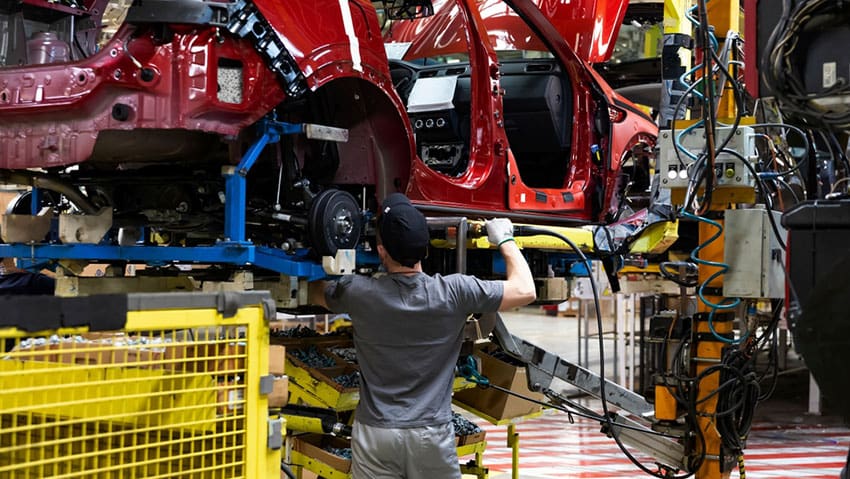
Britain’s beleaguered car industry has eked out its first monthly increase of the year, a flicker of momentum that the trade body warns could just as easily be snuffed out by stubbornly high energy costs and a fractious global trade picture.
Factories rolled 49,200 vehicles off their lines in May, up 2.3 per cent on the same month a year earlier, according to the Society of Motor Manufacturers and Traders. It is a modest figure by historical standards, but a welcome one after a run of declines that had become wearily familiar to anyone watching the sector.
The catch, and there is always a catch, is that the year-to-date numbers remain firmly in the red. UK plants have produced 306,000 cars in the first five months of 2026, down 4.1 per cent on the same period last year. May’s bounce, in other words, has trimmed the deficit rather than erased it.
Some of the month’s improvement is a quirk of the calendar. This time last year, Jaguar Land Rover, the Solihull-based maker of the Range Rover, paused shipments to the United States after President Trump slapped fresh tariffs on British exports. Set against that depressed base, almost any number was going to look better. The plants behind the figures read like a roll-call of what remains of British volume manufacturing: Nissan in Sunderland, JLR in Solihull and BMW’s Mini factory in Oxford.
It is worth holding May’s number up against the longer arc of decline. In 2016, when the country voted to leave the European Union, Britain was assembling more than 1.7 million cars a year. The current rolling 12-month average sits at 704,000, less than half that. The slump has been a long time in the making, and a single good month does not reverse it.
If the car numbers are sobering, the commercial vehicle figures are grim. UK factories built 11,500 vans in the year to date, a fall of 60 per cent year-on-year. On a rolling 12-month basis the total stands at 30,000, less than a quarter of what the country was turning out just two years ago.
The collapse follows Stellantis’s decision to shut its historic Luton van plant and convert Ellesmere Port into a low-volume electric van operation. The owner of Vauxhall has, in effect, taken a large slice of British van-making capacity off the board, and the data now reflects it. The country’s output recently slid to its lowest level in decades, a reminder of how quickly industrial capacity can erode once the investment case weakens.
The SMMT, which compiles the figures, is blunt about the causes: punishing energy costs, the unpredictability of international trade, particularly with the United States, and a domestic market that remains soft.
“May’s growth is welcome, and the priority must be to turn this into a sustained recovery by making the UK more competitive as a place to make and sell vehicles,” said Mike Hawes, the society’s chief executive.
He also pointed to a threat on the horizon. New EU trade barriers due next year could shut British automotive firms out of European supply chains if their products or components are deemed to be manufactured outside the bloc, a technicality with potentially expensive consequences for an industry that sends most of its output across the Channel. The full breakdown sits in the SMMT’s vehicle manufacturing data, and the message running through it is consistent: the firms that survived the long contraction are doing so on the finest of margins.
For now, the industry will take the win. A single month of growth is not a recovery, but after a year that has tested the sector’s resilience to the limit, it is at least a reason to look up. Whether it becomes the start of something more durable depends less on the factories themselves than on the cost of the electricity that powers them and the trade rules that govern where their cars can go, themes the government set out to address in its advanced manufacturing plan.

Jamie Young
Jamie is Senior Reporter at Business Matters, bringing over a decade of experience in UK SME business reporting.
Jamie holds a degree in Business Administration and regularly participates in industry conferences and workshops.
When not reporting on the latest business developments, Jamie is passionate about mentoring up-and-coming journalists and entrepreneurs to inspire the next generation of business leaders.

Why was Andy Murray not courtside for Jack Draper’s win at Eastbourne Open?

Experts Say a “Fingerprint” Hidden in Nancy Guthrie’s Ransom Notes Could Help Locate Her

Dell (DELL) Shares Tumble Over 5% Following Analyst Downgrade to Hold


-

 Fashion6 days ago
Weekend Open Thread: Miami – Corporette.com
-

 Entertainment5 days ago
Renter of Home in Anne Heche Crash Denies Settlement With Son
-
 Sports2 days ago
Two goals and an assist by sheer aura: Cristiano Ronaldo just entered the World Cup chat
-

 Tech3 days ago
Microsoft accidentally kills epic Outlook email threads
-

 Business5 days ago
Soccer-U.S. defends Iran World Cup travel restrictions, says discussions ongoing
-

 Politics5 days ago
Andy Burnham and the meaning of Makerfield
-
Crypto World2 days ago
Bitcoin (BTC) Dips Below $62K, Ethereum (ETH) Plunges 6% Daily: Market Watch
-

 NewsBeat6 days ago
Keir Starmer Allies Question His Chances For No 10
-

 Politics7 days ago
BBC Reporter Discusses Cross Party Criticism Of Trumps Iran Deal
-

 Crypto World1 day ago
Securitize Wraps Roubini's SEC-Registered ETF as Dubai VARA Digital Security
-
Business2 days ago
Entergy settles forward sale agreements, raises $672 million in cash proceeds
-
 Business6 days ago
Wall Street Week Ahead: Investors see Micron earnings as pulse check of AI rally momentum
-
 Crypto World5 days ago
Can Charles Hoskinson Really Rescue Cardano?
-

 Crypto World6 days ago
HIVE shares jump as $220M AI deal speeds Bitcoin mining pivot
-

 Crypto World5 days ago
Jake Chervinsky accuses CME of protecting derivatives monopoly
-

 Entertainment6 days ago
Jose Alvarado Wants Taylor Swift at More Knicks Games
-
 Tech4 days ago
Signal’s Meredith Whittaker says AI chatbots ‘are not your friends’ and calls Copilot agents a backdoor
-

 Sports5 hours ago
India vs Bangladesh LIVE Score, Women’s T20 World Cup: Bangladesh Opt To Bat; India Enter ‘Do-Or-Die’ Stage As Semi-Final Race Heats Up
-

 Tech3 days ago
Nearly 7,000 fake Amazon domains registered ahead of Prime Day 2026, researchers warn
-

 Sports7 days ago
FIFA World Cup 2026: Canada beat 9-men Qatar 6-0 to register first ever win | FIFA World Cup 2026
You must be logged in to post a comment Login