

Crypto World
Indonesia Crypto Overhaul and Europe’s MiCA Deadline: Who Gets Cut from Major Markets


Indonesia parliament just passed the revised crypto law, formally cementing OJK’s authority over crypto as a regulated financial asset just as Europe’s MiCA transitional window closes on July 1. Two of the world’s most consequential crypto jurisdictions are hardening their frameworks in the same month, from opposite sides of the globe.
The structural logic is identical: reclassify crypto from a peripheral asset into a supervised financial instrument, require licensing, and push non-compliant platforms out. The era of operating across major markets on thin regulatory registrations is closing simultaneously in Jakarta and Brussels.
Don’t Miss Out on Our $1,000 USDT Airdrop on ByBit
Indonesia Crypto Law: OJK Gets Full Authority
The P2SK Law revision, passed by the Indonesia Parliament expands OJK’s mandate across banking, capital markets, fintech, and digital financial assets, consolidating supervisory authority that was previously fragmented between OJK, Bappebti, and Bank Indonesia. For crypto specifically, this completes a reclassification that tokens are no longer traded commodities sitting inside Bappebti’s commodity-futures perimeter.
OJK can now impose bank-style prudential requirements on exchanges, capital adequacy, custody segregation, governance standards, and conduct rules. The law also amends Indonesia’s Capital Markets Act to expand the definition of securities to include investment contracts in digital form that confer economic benefits, opening the door for certain tokens and DeFi instruments to fall under full securities regulation. That is a direct structural parallel to MiCA’s treatment of asset-referenced tokens.
— Nael (@nael_idrx) June 25, 2026
 BREAKING: Indonesia Elevates Stablecoin and Digital Financial Assets to Statutory Recognition Under the P2SK Law
Indonesia has officially recognized and regulated digital financial assets under the Financial Sector Development and Strengthening Law (P2SK), placing them at… pic.twitter.com/gSsZrgP3W1
The immediate compliance pressure point governing governance and risk management for fintech innovation platforms, including digital asset providers, takes effect on July 1, 2026. Indonesian OJK crypto regulation now has its own hard deadline running in parallel with Europe’s. Exchanges operating in Indonesia crypto markets that have not completed their transition from Bappebti-era structures face an enforcement exposure window starting this month.
Tokocrypto CEO Calvin Kizana welcomed the revision but flagged the implementation gap that matters most to operators.
“We are also waiting and looking forward to the final draft being distributed to industry players so that they can see in more detail what changes will affect the ecosystem,” Kizana said. He added that “strong, clear, and adaptive regulations will be the key to increasing public confidence and accelerating the growth of the Indonesian crypto industry.”
That reads as an implicit acknowledgment that the law’s passage is a narrative event, the implementing rulebooks from OJK are the execution events that will define actual compliance costs.
Although not all industry voices are welcoming. The Indonesian Blockchain Association has raised concerns that draft provisions requiring all digital asset activity to flow through a single exchange could reduce existing platforms to brokers, concentrating market power in ways the original framework never intended.
Discover: The Best Token Presales
MiCA July 1 Hard Deadline: The Compliance Cull Arrives
Europe’s MiCA deadline is not a narrative event. July 1 is the date after which unlicensed crypto-asset service providers lose legal access to the EU’s 450 million users across all 27 member states.
As of today, of the approximately 3,000 firms that previously operated under national transitional arrangements, just about 230 have cleared the ESMA MiCA register. This has left the overwhelming majority either in the process of exiting EU markets or racing to complete authorization before enforcement begins.
Luxembourg is officially our MiCA home — Coinbase

We're looking forward to welcoming users from across the EU to Coinbase. https://t.co/6YiRoJRdJA
 (@coinbase) June 24, 2026
Coinbase Luxembourg opened its MiCA hub on June 24, securing a single EU passport from the Luxembourg CSSF that covers all 27 member states. Ripple also secured preliminary CASP approval under MiCA, positioning RLUSD for compliant EU distribution. Kraken is similarly cleared.
Don’t Miss Out on Our $1,000 USDT Airdrop on ByBit
However, Binance, the biggest crypto exchange in the world by volume, withdrew its Greek license application days before the deadline, leaving it absent from the ESMA register. Binance’s $4.3 billion DOJ settlement from 2023 is now a live liability in the EU authorization process.
The USDT situation underscores the reach of the regulation. Several EU exchanges delisted Tether ahead of the deadline because USDT does not meet MiCA’s e-money token requirements, while Circle’s USDC, structured to comply, retained listings.
Discover: The Best Crypto to Diversify Your Portfolio
The post Indonesia Crypto Overhaul and Europe’s MiCA Deadline: Who Gets Cut from Major Markets appeared first on Cryptonews.

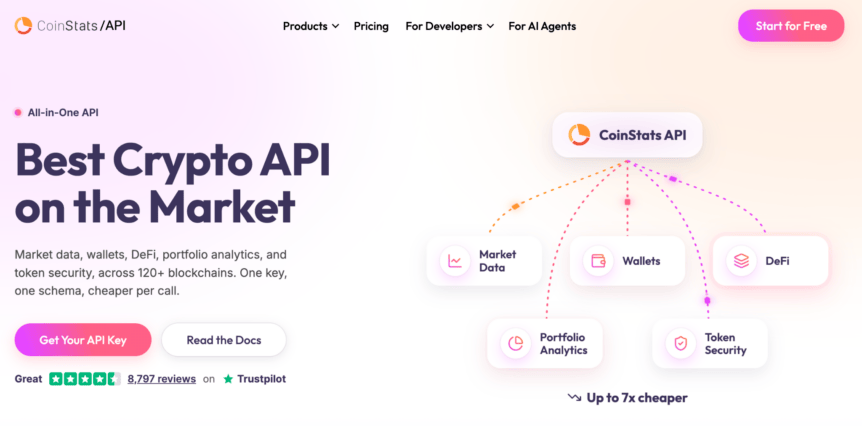
An API connects your app to the crypto market. It pulls prices, balances, and onchain data on demand. You skip running your own infrastructure. The provider does the heavy lifting instead.
The crypto API market is crowded in 2026. Providers solve very different problems. Some serve market and wallet data. Others handle swaps or raw node access. The right choice starts with the job, not the brand.
This guide covers five providers worth knowing. CoinStats API leads on data. ChangeHero and StealthEX handle swaps. GetBlock powers the node layer. Messari adds research and intelligence. Together they cover most builds.
Know the Layers Before You Choose
Crypto APIs split into a few core layers. Knowing them makes the choice simpler.
Data APIs return prices, balances, and DeFi positions. The best ones enrich raw data into ready-to-use portfolios.
Swap APIs move assets inside your product. They embed non-custodial exchanges without accounts.
Node APIs give raw access to a blockchain. You read chain state and broadcast transactions.
Research APIs surface analysis, signals, and token unlocks. They add narrative context beyond raw prices.
Most production apps combine layers. Match each provider to one job.
1. CoinStats API (Best Overall)
One API for Markets, Wallets, and DeFi Across 120+ Chains
CoinStats API is a unified crypto data layer for developers. It combines market data, wallet data, DeFi positions, and portfolio analytics. Token security screening sits in the same schema. Coverage spans 100,000+ coins, 200+ exchanges, and 120+ blockchains.
Wallet endpoints return balances and transactions across Solana, Ethereum, EVM chains, and Bitcoin. Bitcoin support includes extended public keys (xpub, ypub, zpub). DeFi positions auto-resolve per wallet across 10,000+ protocols. That covers staking, lending, and liquidity tied to an address.
CoinStats also ships an MCP Server for AI agents. It exposes wallet, DeFi, and portfolio data to LLMs. Agents in Claude, Cursor, and VS Code query it directly. That portfolio data layer is the real differentiator.
Pros
- Unified multi-chain data across 120+ blockchains
- Enriched responses with market data built in
- Per-wallet DeFi detection across 10,000+ protocols
- Native MCP Server for AI and LLM workflows
- Token security screening in the same API
- Free tier and credit-based pricing
- One API key, simple authentication
Cons
- Not a node provider: read-only, no transaction submission
- REST-first: no streaming for live event data
Best Use Cases
- Multi-chain portfolio trackers
- DeFi dashboards across staking, lending, and LP
- Crypto tax and accounting tools
- AI assistants that query data through MCP
- Wallet explorers and embedded widgets
Pricing
Pricing is credit-based with a free tier at signup. Paid plans start at $49 per month. Credits scale with endpoint complexity. A full breakdown sits in this best crypto API guide.
Best suited for: most data-driven builds, from portfolio trackers to AI agents.
Limitation: CoinStats API is a data layer, not a node provider. To broadcast transactions, pair it with infrastructure like GetBlock.
2. ChangeHero
Non-Custodial Swaps With a Long Partner Record
ChangeHero is a non-custodial swap API running since 2017. Hardware and software wallets integrate its swap engine. Partners include Trezor, Exodus, Tangem, and OneKey.
The API covers 350+ cryptocurrencies. Fixed and floating rates run through separate endpoints. Liquidity aggregates from multiple venues for resilience. If one source drops, swaps keep running. Settlement usually lands under 10 minutes.
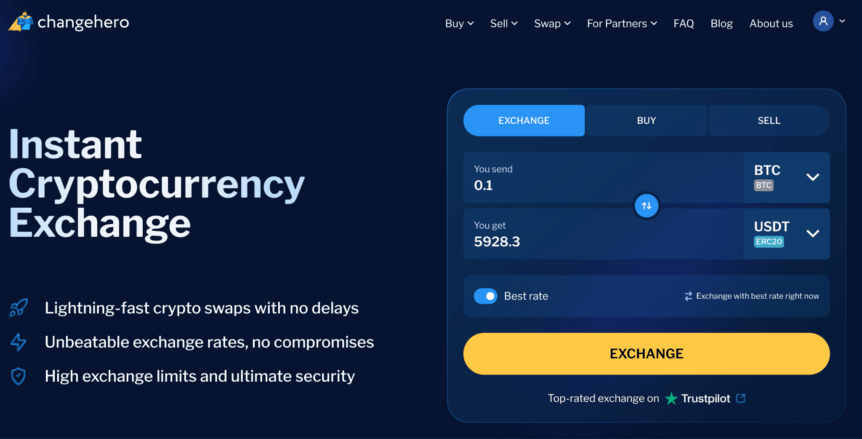
For automated systems, ChangeHero handles the conversion step. A rebalancing bot can rotate holdings without exchange accounts. Treasury scripts can convert revenue on a schedule. Custom setups add optimized routing and zero-fee stablecoin pairs.
Integration is free with no volume minimums. Partners earn a configurable commission per swap.
Best suited for: swap automation, wallet integrations, and treasury flows.
Limitation: ChangeHero is not a data provider. Pair it with a market data source like CoinStats API.
3. StealthEX
Privacy-First Swaps Without Accounts
StealthEX is a privacy-focused, non-custodial instant exchange API. End users swap without ever creating an account. Standard swap volumes require no mandatory KYC. Risk-based screening applies only to flagged transactions.
Coverage spans 2,000+ coins and 100+ fiat currencies. A REST API supports fixed and floating rates. Floating rates match market price at execution. Fixed rates lock the receive amount in advance. Settlement usually takes 5 to 30 minutes.
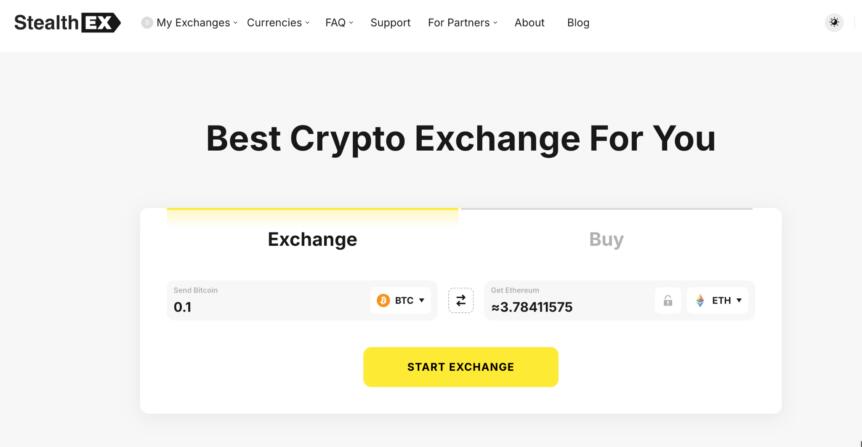
The commercial model suits bot builders. Integration is free with no monthly commitments. Partners set a commission between 0 and 0.5 percent. Revenue share applies to routed volume. StealthEX also publishes a free crypto API comparison for budgeting.
Best suited for: Telegram bots, wallets, and DEX aggregators.
Limitation: StealthEX offers no market data or analytics. Pair it with a data source.
4. GetBlock
Node Infrastructure for Onchain Builders
GetBlock covers the node infrastructure layer. It provides RPC access to 130+ blockchains. Interfaces include JSON-RPC, REST, GraphQL, WebSocket, and gRPC. Shared nodes suit prototypes and smaller bots. Dedicated nodes target high-throughput, latency-sensitive workloads.
Onchain bots need this layer for direct access. Mempool reads, contract calls, and broadcasts all run here. Geo-distributed clusters run in Frankfurt, New York, and Singapore. Independent benchmarks rank its Solana RPC among Europe’s fastest.

Pricing stays predictable for bot workloads. Every call deducts one request, regardless of method. A free tier covers a daily request allowance. A dedicated MCP server connects the RPC layer to AI agents. GetBlock returns raw chain data, not parsed portfolios. Most teams pair it with a data API upstream. GetBlock also maintains a guide to crypto API providers for developers.
Best suited for: onchain bots, mempool monitors, and custom indexers.
Limitation: GetBlock offers no aggregated market data or wallet analytics.
5. Messari
Research and Intelligence for Deeper Context
Messari is a crypto research and intelligence platform. It layers curated analysis on top of market data. Coverage reaches 40,000+ assets across 200+ exchanges.
The data extends into news, signals, fundraising, and token unlocks. Protocol research and narrative context sit alongside pricing. Messari also ships an MCP server for AI assistants.

The free tier is rate-limited at around 20 requests per minute. Most depth sits behind enterprise pricing.
Best suited for: research-driven teams and intelligence-heavy agent workflows.
Limitation: Messari is not a wallet or portfolio API. Pair it with a data layer like CoinStats API.
Side-by-Side Comparison
| CoinStats API | ChangeHero | StealthEX | GetBlock | Messari | |
| Primary layer | Market, wallet & DeFi data | Non-custodial swaps | Non-custodial swaps | RPC / node infrastructure | Research & intelligence |
| Core function | Read enriched crypto data | Convert assets in-app | Convert assets in-app | Raw chain access | Curated analysis & data |
| Coverage | 100,000+ coins, 120+ chains | 350+ assets | 2,000+ assets, 100+ fiat | 130+ blockchains | 40,000+ assets |
| Submit transactions | No | Via swaps | Via swaps | Yes | No |
| AI / MCP | Native MCP Server | No | No | Dedicated MCP server | MCP server |
| Free tier | Yes (credit-based) | Free integration | Free (revenue-share) | Yes (daily requests) | Yes (rate-limited) |
| Best for | Most data-driven builds | Swap automation | Privacy swaps | Onchain infrastructure | Research workflows |
What You Can Build
Portfolio trackers and wallet apps. CoinStats API returns holdings, prices, and DeFi positions in one call.
Rebalancing and treasury bots. Swap APIs rotate assets without exchange accounts.
Privacy-minded swap flows. StealthEX embeds swaps without user accounts.
Onchain bots and indexers. GetBlock supplies mempool reads and broadcasts.
AI financial assistants. CoinStats MCP Server feeds portfolio data to agents.
Research and due-diligence tools. Messari surfaces fundraising, token unlocks, and protocol analysis.
One Provider or Several?
Many production teams do not rely on a single API. They layer providers by job.
Start with CoinStats API for data, portfolio, and DeFi across chains. Add a swap rail like ChangeHero or StealthEX when your app moves assets. Add GetBlock when you need raw chain access or transaction broadcasts. Layer in Messari when you need research and narrative context. Combine them as the product grows. Each layer handles what it does best.
Wrapping Up
There is no single best crypto API. There is only the best fit for the job. CoinStats API is the broadest starting point for data. It suits most crypto use cases.
ChangeHero and StealthEX own the swap lane. GetBlock owns the node layer. Messari adds research depth. Every provider here offers a free tier. You can start building in minutes.
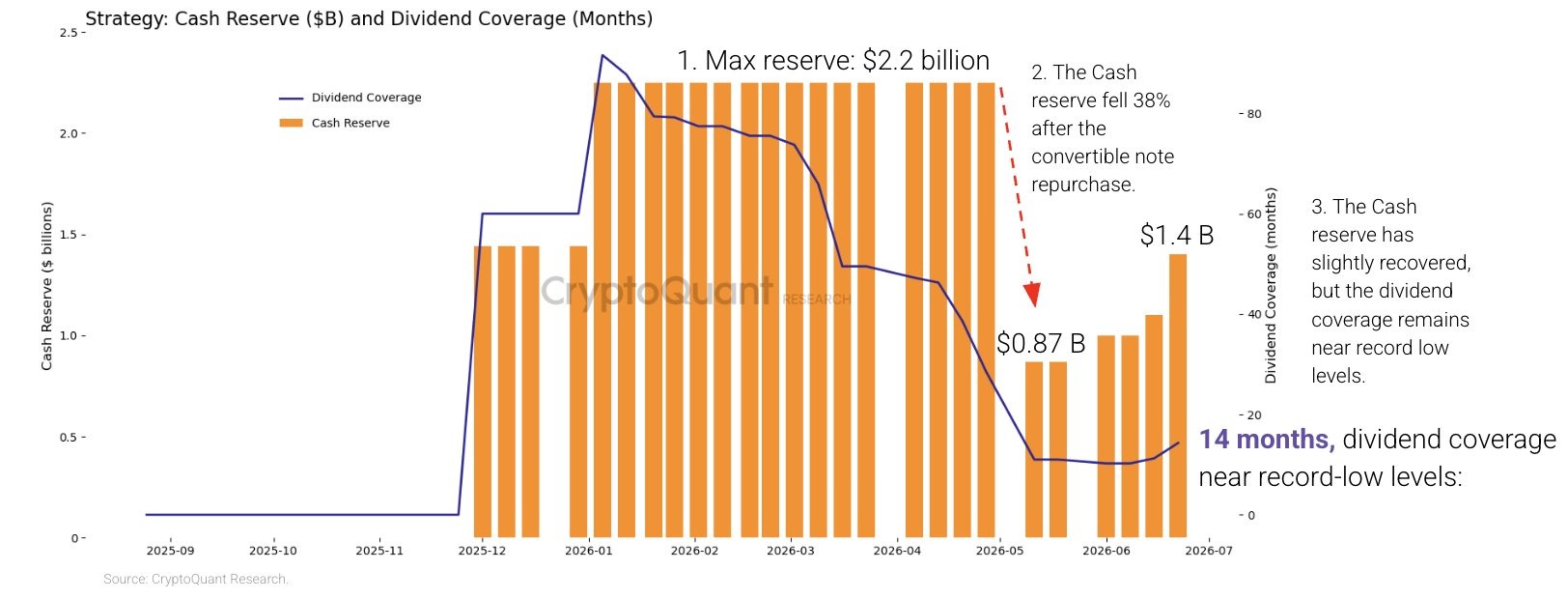
This week, crypto analytics company CryptoQuant challenged the prevailing narrative around Michael Saylor’s Strategy, urging the company to pause Bitcoin purchases and rebuild its cash reserves. The warning came after its dividend coverage fell to just 14 months from roughly seven years.
Strategy isn’t facing an immediate cash crunch, but CryptoQuant’s warning puts the spotlight on the financing structure behind its Bitcoin strategy. With cash reserves shrinking and dividend obligations increasing, Strategy’s ability to keep funding new purchases is drawing closer scrutiny.
The rest of this week’s Crypto Biz shows how the industry is evolving. CBOE is eyeing perpetual Bitcoin and Ether futures, Chainlink is working with European and Korean banks on stablecoin-based FX settlement and Zcash miner Fortitude is heading to Nasdaq through an unlikely merger with a healthcare company.
CryptoQuant urges Strategy to pause Bitcoin buying as dividend coverage drops to 14 months
Earlier this week, CryptoQuant argued that Strategy’s aggressive Bitcoin accumulation has become increasingly difficult to sustain, urging the company to rebuild its cash reserves after dividend coverage fell to just 14 months from roughly seven years.
CEO Ki Young Ju said the Strategy’s cash position has deteriorated as annual dividend obligations surged to $1.2 billion following large issuances of STRC preferred shares carrying an 11.5% yield. While Strategy’s cash reserve recovered to about $1.4 billion after recent MSTR share sales, it remains down 38% year-to-date after the company repurchased $1.5 billion of its 2029 senior notes.
The warning comes as Strategy’s funding model faces additional pressure. STRC preferred shares recently fell as much as 17.5% below their $100 par value, limiting the company’s ability to raise fresh capital through additional preferred stock sales.
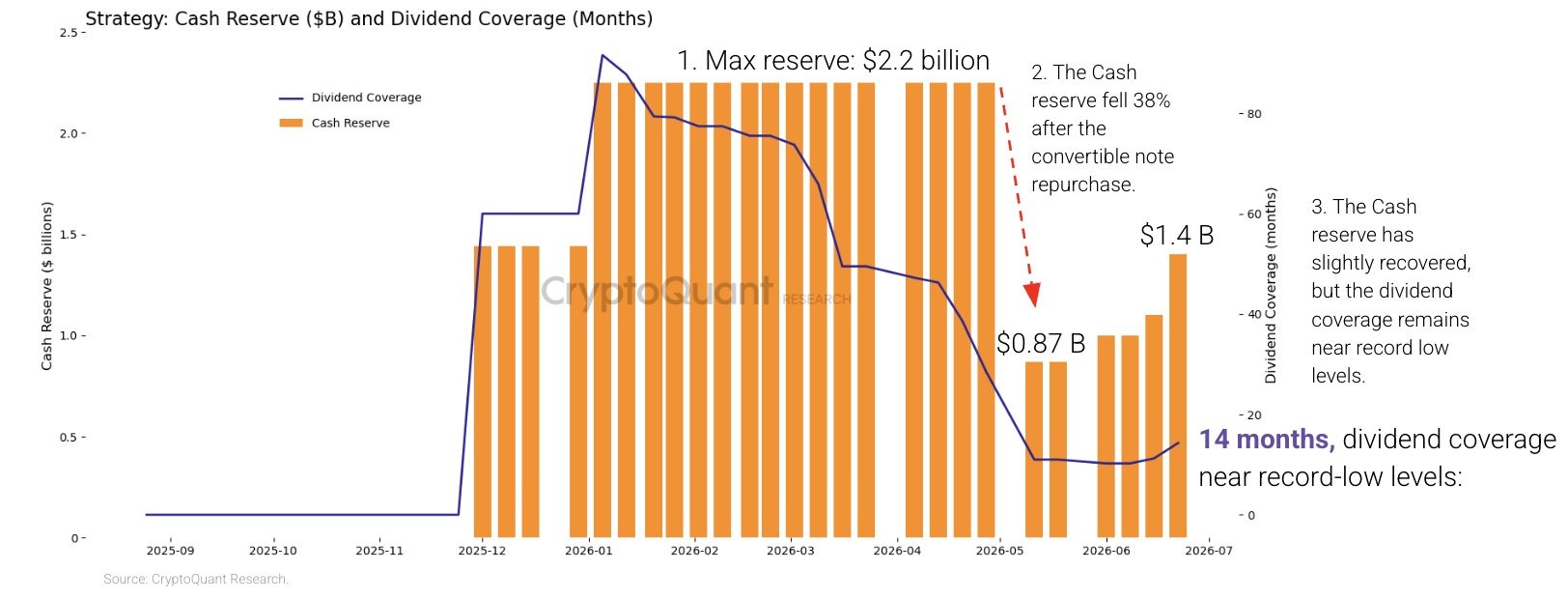
Strategy’s cash reserve and dividend coverage. Source: CryptoQuant
CBOE considers converting Bitcoin and Ether futures into perpetual contracts
The Chicago Board Options Exchange (CBOE) is weighing a plan to convert its continuous Bitcoin and Ether futures into perpetual futures, according to a Wall Street Journal report.
The potential move follows recent regulatory changes after the US Commodity Futures Trading Commission approved crypto perpetual futures for Kalshi and outlined a framework for other registered exchanges to offer similar products.
CBOE launched its continuous Bitcoin and Ether futures last December, with contracts extending as far as 10 years. Unlike traditional futures, perpetual contracts have no expiration date, allowing traders to maintain leveraged positions indefinitely. They were first popularized by crypto derivatives platform BitMEX and have since gained traction across both centralized and decentralized markets.
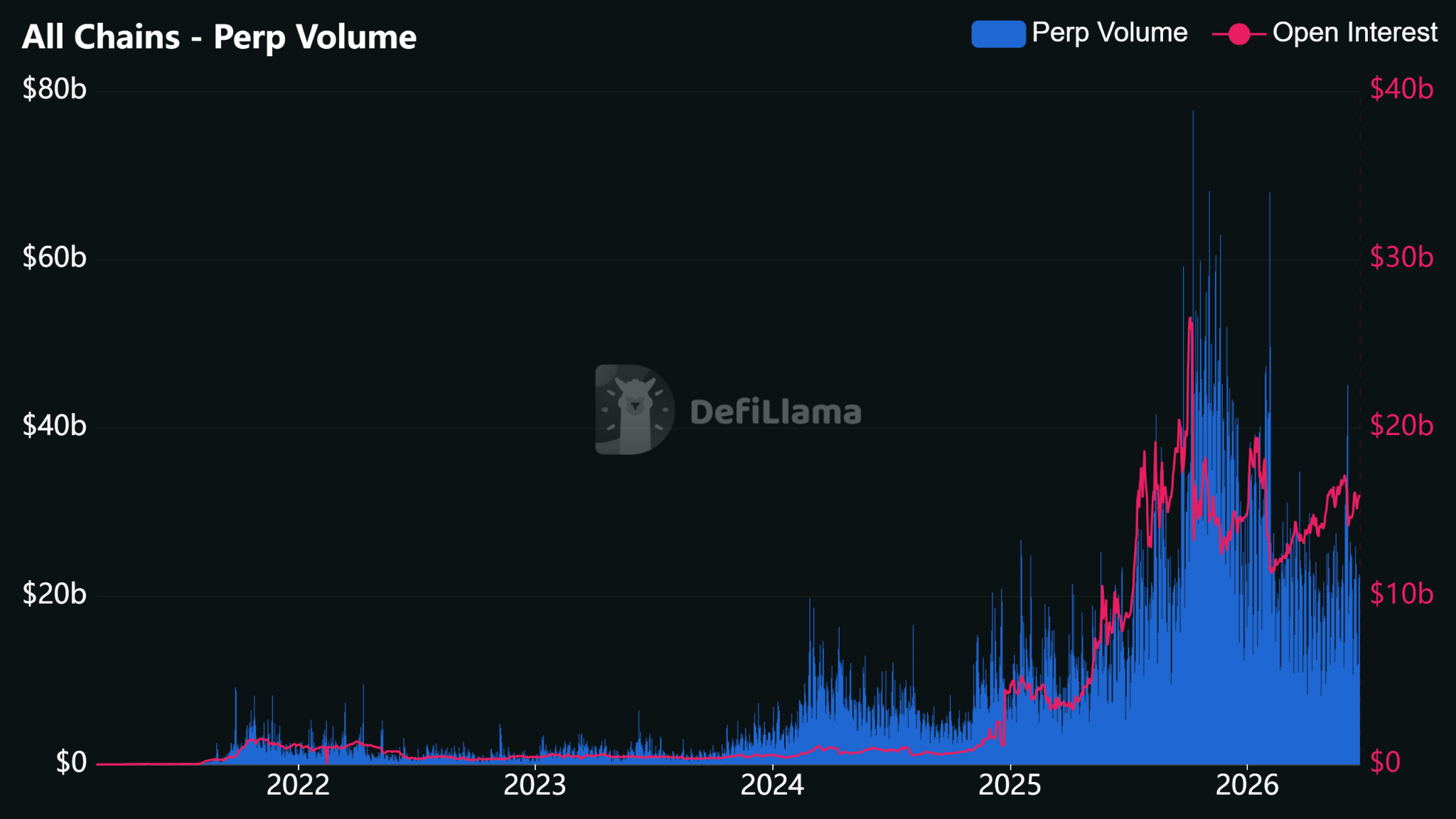
Perp volumes have surged across DeFi exchanges. Source: DeFiLlama
Zcash miner Fortitude to go public through Nasdaq merger with HeartSciences
Zcash miner Fortitude Mining Holdings is set to go public through an all-stock merger with medical technology company HeartSciences, bringing together two businesses from entirely different industries.
The merger will allow Fortitude to secure a Nasdaq listing without pursuing a traditional initial public offering, while HeartSciences’ existing shareholders will retain a minority stake in the combined company. Following the transaction, the combined company will operate under the Fortitude name and is expected to trade on Nasdaq under the ticker TUDE, subject to regulatory approval.
The announcement sent HeartSciences shares up as much as 91% on Tuesday. Before the merger, the healthcare company remained unprofitable, reporting an $8.77 million net loss in fiscal 2025 despite advancing its product roadmap.
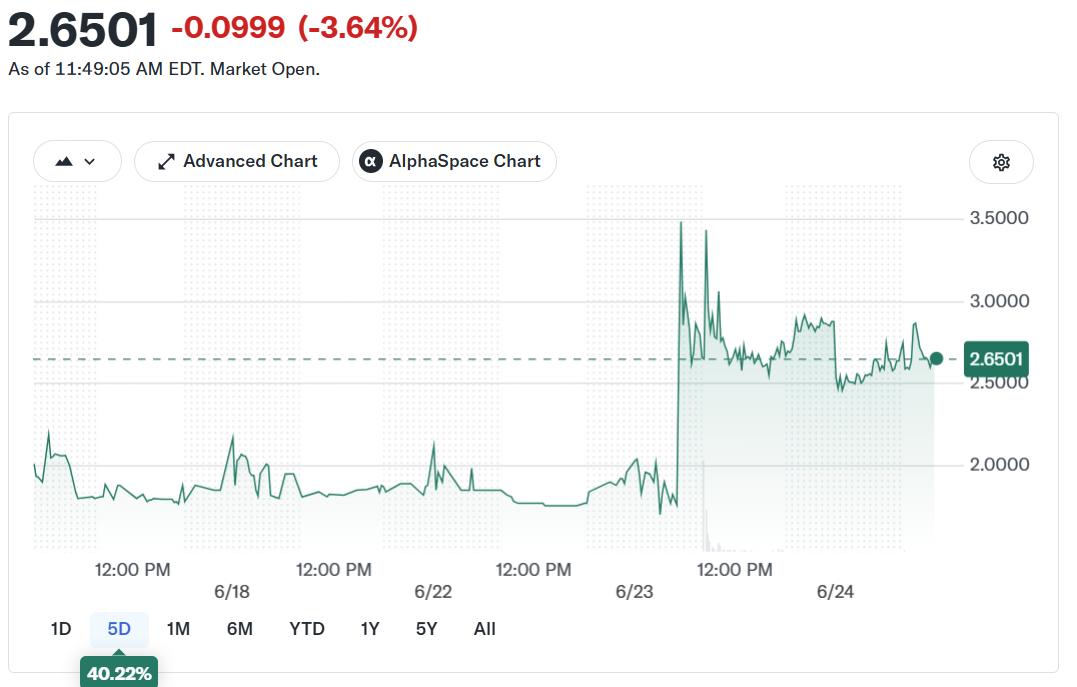
HeartSciences stock. Source: Yahoo Finance
Chainlink joins European and Korean banking groups to explore stablecoin FX settlement
Chainlink has joined a cross-border banking initiative with European and South Korean financial institutions to study whether regulated euro and won stablecoins can enable real-time foreign exchange settlement.
Dubbed Project Pangea, the working group brings together South Korean digital asset infrastructure company FairSquareLab, the Unified Korea Alliance (UniKA), Qivalis and Chainlink to evaluate atomic swaps using blockchain-based settlement infrastructure.
Rather than launching a live payment network, Project Pangea will explore how tokenized currencies could improve wholesale financial markets, where the global foreign exchange market handles an estimated $9.6 trillion in daily trading volume. The initiative reflects growing interest among banks in using stablecoins and tokenized deposits to modernize cross-border settlement, reduce friction and improve efficiency.
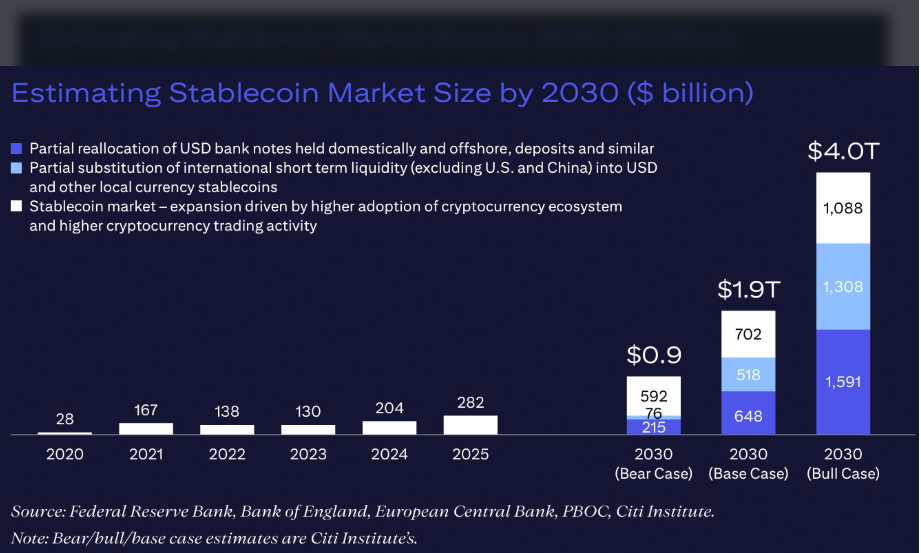
In a bullish scenario, the stablecoin market could reach $4 trillion by 2030. Source: Citigroup
Crypto Biz is your weekly pulse on the business behind blockchain and crypto, delivered directly to your inbox every Thursday.
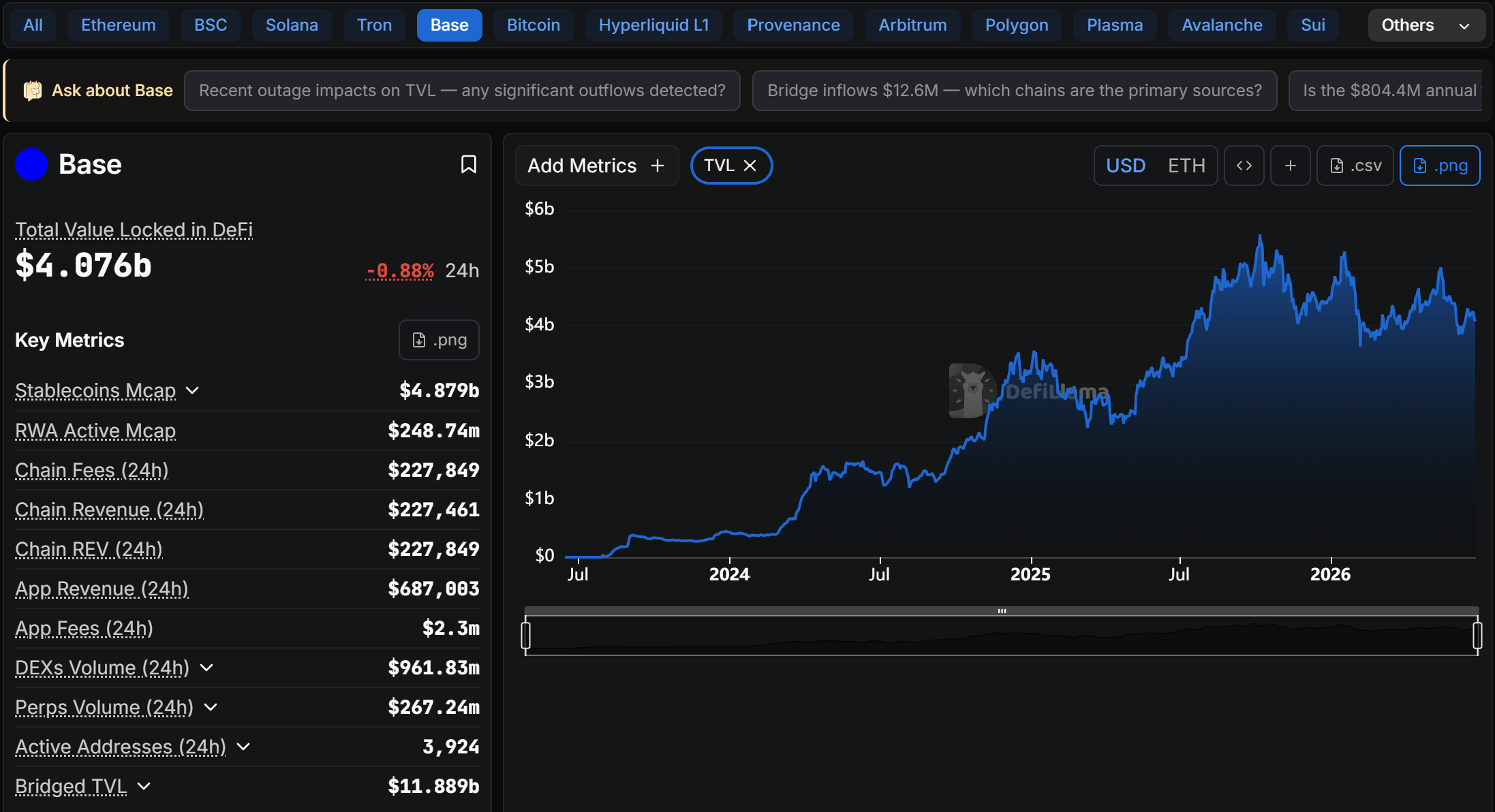
Base’s B20 token standard was set to open for issuers on June 26, but a second chain stall in two days has delayed the B20 token launch.
The network finished its Beryl upgrade on June 25, which carries B20 alongside faster withdrawals and lighter node software. Switching on B20 issuance depends on a separate registry that Base has not confirmed live.
Back-to-Back Stalls Revive Sequencer Concerns
Base block production turned unhealthy on June 26, hours before B20 was due to activate at 6pm UTC. The team reported a chain halt with symptoms matching the previous day and restored blocks in about 15 minutes.
A day earlier, an invalid block froze the sequencer at block 47,806,542 and stopped production for close to two hours. Recovery both times required ecosystem node operators to restart their machines.
Neither stall touched user funds, which stay settled on Ethereum. The repeat failures instead put scrutiny back on the sequencer, the single Coinbase-run engine that orders Base transactions.
Base reached Stage 1 decentralization in 2025 with fault proofs and a 10-member security council. Those changes hardened proofs and upgrades, not the lone sequencer that stalled.
The network ran nearly two years without a halt until a 20-minute outage in August 2025 first flagged its sequencer centralization risk. The June stalls now hit the largest Ethereum Layer 2, which holds about $4 billion in deposits, per DefiLlama.

Follow us on X to get the latest news as it happens
B20 Launch Waits on the Activation Registry
B20 is built into Base, Coinbase’s Layer 2 network, as node software rather than a deployed contract. It mirrors the ERC-20 standard, so wallets and exchanges need no changes.
Base documentation said B20 issuance was anticipated for 6pm UTC on June 26, then up to an hour for its activation registry to switch on. Until that happens, deployment calls revert.
The standard targets stablecoin and real-world asset issuers with built-in supply caps, roles, and transfer policies. Base still issues no native token, yet now markets itself as an issuance venue.
Beryl also cut canonical withdrawals to Ethereum from seven days to five, freeing capital for bridging providers sooner.
What to watch
Base has promised a full post-mortem on the consensus bug behind both halts. Whether it enables B20 before fixing the repeat stalls will test Base’s scaling roadmap, which courts institutional issuers.
The post Base Delays Important Upgrade After Back-to-Back Network Outages appeared first on BeInCrypto.


The chair of the Spanish National Securities Market Commission reportedly said that there would be no extensions or waivers for crypto companies that did not receive approval to operate in European Union member states under the Markets in Crypto-Assets (MiCA) framework by July 1.
According to a Friday Reuters report, Chair Carlos San Basilio said that “there will be no exceptions or extensions” to the July 1 MiCA deadline, referring to Binance and other cryptocurrency exchanges affected by the framework. Binance’s operations in the EU are expected to scale back after it withdrew its application with Greece’s Hellenic Capital Market Commission and had not received approval from any other authority as of Friday.
“What we are concerned about, however, is how this period — the end of the transitional period — will unfold, and how the adaptation to the new environment will take place; that is why we are in contact with the organisations that have not been granted a licence,” said Basilio, according to Reuters.
Should Binance fail to secure approval from a financial regulator in the next few days, the exchange will be required to halt the onboarding of new EU-based users and limit certain services for EU-based accounts starting on July 1. Other crypto exchanges have secured last-minute approvals under MiCA, but Binance, with millions of users in the EU, could have a far greater impact on the region’s crypto market.
Related: Binance’s MiCA fight raises questions over ECB influence
“This is Binance’s philosophy of doing business,” said OKX founder and CEO Mingxing Xu in response to former Binance CEO Changpeng “CZ” Zhao’s comments on the exchange’s EU deadline. “They ignore laws and regulations, while misleading the public with bullshits. According to public media reports and court filings, the platform’s so-called ‘best liquidity’ included trading activity associated with risks involving money laundering, sanctions violations, and market manipulation.”
Cointelegraph reached out to a Binance spokesperson, who referred to the company’s Wednesday statement.
Binance users looking to other exchanges?
With the crypto exchange expected to wind down some operations for EU-based users, some are reporting leaving Binance entirely without a definitive timeline on its return.
Some Reddit users said that they were considering Kraken for their funds. Payward, doing business as Kraken, has a Crypto Asset Service Provider license through the Central Bank of Ireland.
Magazine: AI is banking the unbanked in Africa… faster than crypto


Seventeen Democratic senators sent a letter to the Senate Appropriations Subcommittee on Thursday urging lawmakers to cut off CFTC funding for its campaign of lawsuits against states that have tried to regulate prediction-market platforms under local gambling laws. Sens. Richard Blumenthal and Jeff… Read the full story at The Defiant

There has been a sharp increase in Chainlink tokens moving to exchanges just days before the project announced a major banking initiative.
According to on-chain data from the Ethereum network, Binance recorded a net inflow of more than 10.2 million LINK on June 19. This pushed the exchange’s LINK reserves from 84.1 million to 94.3 million tokens in a single day.
LINK Exchange Supply
CryptoQuant said the sudden movement also caused the seven-day average netflow to surge by 20,677% compared with its three-month average, as it highlighted an unusual change in exchange activity. The large transfer took place only a few days before Chainlink unveiled Project Pangea on June 23.
The initiative focuses on T+0 foreign exchange settlement, involves more than 80 banks from Europe and South Korea, and represents over $10 trillion in assets under management. Historically, inflows of this size have increased the amount of tokens available for selling on exchanges and have often been linked to higher market volatility. However, LINK’s price reaction remained relatively limited as it fell from around $8 to approximately $7.3 during the period.
The transfers were also found to be highly concentrated among a small group of large holders. The “inflow_top10” metric was nearly equal to the total inflow volume, which suggests that most of the tokens came from a handful of wallets rather than broader retail participation. CryptoQuant added,
“Although Project Pangea represents a potentially meaningful long-term development for the Chainlink ecosystem, the near-term on-chain picture points to increased exchange supply.”
Despite this increased inflow, more users are holding the token during uncertain market conditions. Santiment reported earlier this month that the number of wallets holding at least 1 LINK has climbed above 535,000, which is the highest level seen since December 2022. The increase came even though LINK remains far below its previous cycle highs.
ETF Flows
On the institutional side of things, spot LINK ETF flows turned positive again on June 23 after experiencing their first day of net outflows on June 22. The funds recorded $491,000 in net outflows that day. However, sentiment improved quickly as inflows of about $138,000 returned on June 23. Activity then stalled on June 24, with no net flows recorded.
Despite the recent fluctuations, data from SoSoValue revealed that total spot LINK ETF inflows for June currently stand at $3.61 million.
The post LINK Whales Move Millions to Binance Before Key Banking News appeared first on CryptoPotato.

Key Highlights
-
SMX shares declined 5.18% amid heightened recycling compliance demands.
-
Emerging state environmental regulations drive producers toward authenticated data systems.
-
SMX platform connects molecular markers with encrypted digital documentation.
-
Material authentication could facilitate regulatory reporting, audits, and sourcing decisions.
-
Tightening environmental standards may increase need for authenticated recycled-content documentation.
Shares of SMX (SMX) declined 5.18% to $14.45 amid growing focus on the company’s material verification platform as environmental regulations tighten. The stock retreated after briefly climbing above $15.20 during early trading, eventually settling near mid-morning levels. Concurrently, expanding state-level environmental mandates are driving increased demand for authenticated data throughout recycling and packaging ecosystems.
SMX (Security Matters) Public Limited Company, SMX
Environmental Regulations Intensify Compliance Requirements
California’s SB 54 mandates that manufacturers participate in packaging recovery initiatives and extended producer responsibility frameworks. Additional states have enacted recycled-content mandates and disclosure obligations covering packaging materials, containers, carrier bags, and similar items. Businesses now face requirements to substantiate material sourcing, recycled composition, processing methods, and end-of-life disposition.
New Jersey has implemented recycled-content mandates spanning multiple plastic, glass, and paper product segments. Maine, Oregon, Colorado, Minnesota, Maryland and Washington have similarly enacted packaging stewardship legislation. Collectively, these initiatives transfer greater recycling expenses and documentation responsibilities onto manufacturers.
This regulatory evolution presents operational hurdles for manufacturers, recycling facilities, consumer brands, and waste management entities. Organizations must substantiate every recycled-content assertion with documentation suitable for regulatory and third-party examination. Consequently, inadequate chain-of-custody frameworks may generate compliance vulnerabilities and brand integrity concerns.
SMX Focuses on Material-Embedded Authentication
SMX embeds an imperceptible molecular identifier within materials and links it to encrypted digital documentation. This framework can maintain information regarding provenance, chemical makeup, custody transfers, and processing history across a material’s entire journey. Consequently, organizations can monitor physical substances alongside their corresponding compliance documentation.
Recycling ecosystems typically encompass multiple intermediaries, processing facilities, and regulatory territories before materials re-enter commercial markets. Throughout this journey, documentation can become dispersed, contradictory, or challenging to authenticate. SMX seeks to address these vulnerabilities by anchoring data directly within the physical material.
The company’s solution could accommodate plastics, fabrics, and additional materials requiring authenticated recycled-content verification. Manufacturers might leverage authenticated data for sourcing decisions, public disclosures, compliance audits, and regulatory submissions. Nevertheless, market penetration will hinge on commercial appetite, implementation expenses, and regulatory recognition.
Plastic Authentication Demonstrates Commercial Applications
Plastic recycling presents a compelling application because recycled resins frequently traverse multiple supply-chain intermediaries. Authenticated material documentation could reinforce assertions regarding recovery rates, reprocessing, and recycled-content percentages. It might also assist manufacturers in satisfying evolving state disclosure mandates.
SMX further integrates authenticated recycled volumes with its Plastic Cycle Token infrastructure. The company engineered this mechanism to correspond with quantifiable industrial recycling operations. Thus, authenticated output might underpin plastic offset instruments, contractual arrangements, project financing, and additional commercial applications.
Wider market dynamics may also shape demand for recycled plastic authentication. Petroleum price volatility can affect virgin plastic economics and influence procurement strategies. As environmental mandates intensify, SMX might attract interest from organizations pursuing enhanced verification throughout material supply networks.

The Monetary Authority of Singapore has added Hyperliquid to its Investor Alert List, prompting the decentralized exchange to state that it has never claimed to be licensed or authorized by the country’s financial regulator.
Summary
- MAS has added Hyperliquid to its Investor Alert List, while clarifying that the move is not an enforcement action.
- Hyperliquid says it has never claimed to be licensed by MAS and that its permissionless infrastructure remains unchanged.
- HYPE continues trading inside a descending channel, with technical indicators showing improving momentum despite regulatory attention.
According to the Monetary Authority of Singapore (MAS), the entry added on Friday includes both the Hyper Foundation website and the Hyperliquid trading application.
The regulator described the Investor Alert List as a consumer protection measure that identifies entities that could be mistakenly perceived as licensed or regulated by MAS. It also clarified that inclusion on the list does not amount to a ban or enforcement action.
Responding in a June 26 X post, Hyperliquid said its permissionless infrastructure remains unchanged and that it has never represented itself as holding authorization from MAS. The platform added that it remains committed to working constructively with regulators and institutions while supporting clear regulatory frameworks for on-chain finance.
Hyperliquid says listing does not change its operations
Although the MAS listing has drawn attention to the exchange, Hyperliquid continues to rank among the largest decentralized trading platforms. According to CoinGecko, it is currently the ninth-largest decentralized exchange by trading volume, while DefiLlama estimates the protocol secures roughly $5.7 billion in total value locked.
Earlier this month, MAS also placed Bybit on the Investor Alert List. KuCoin and Bitget are already included, indicating that multiple crypto trading platforms have received similar treatment from the regulator.
Unlike enforcement measures that prohibit business activity or impose penalties, the Investor Alert List serves as a public notice intended to help consumers distinguish between firms regulated by MAS and those that are not. The regulator publishes the list to reduce the risk of investors mistakenly believing an entity operates under its supervision.
Singapore continues tightening crypto rules
The latest addition comes as Singapore continues tightening oversight of digital asset businesses.
In May 2025, MAS instructed crypto companies serving overseas customers from Singapore to either obtain the required licenses or stop operating. At the time, the regulator said the requirement was not a policy change but the end of a transition period after repeatedly communicating its regulatory position since 2022.
According to MAS, the directive closed a gap that had allowed some Singapore-based crypto businesses to avoid licensing requirements by restricting their services to overseas users.
The regulator also said the updated framework strengthens consumer protection while bringing Singapore’s crypto regime closer to international Anti-Money Laundering and Countering the Financing of Terrorism standards.
HYPE market remains focused on technical levels
While the regulatory development has put Hyperliquid back in focus, HYPE’s price action has remained centered on key technical levels rather than showing an immediate directional move tied to the announcement.
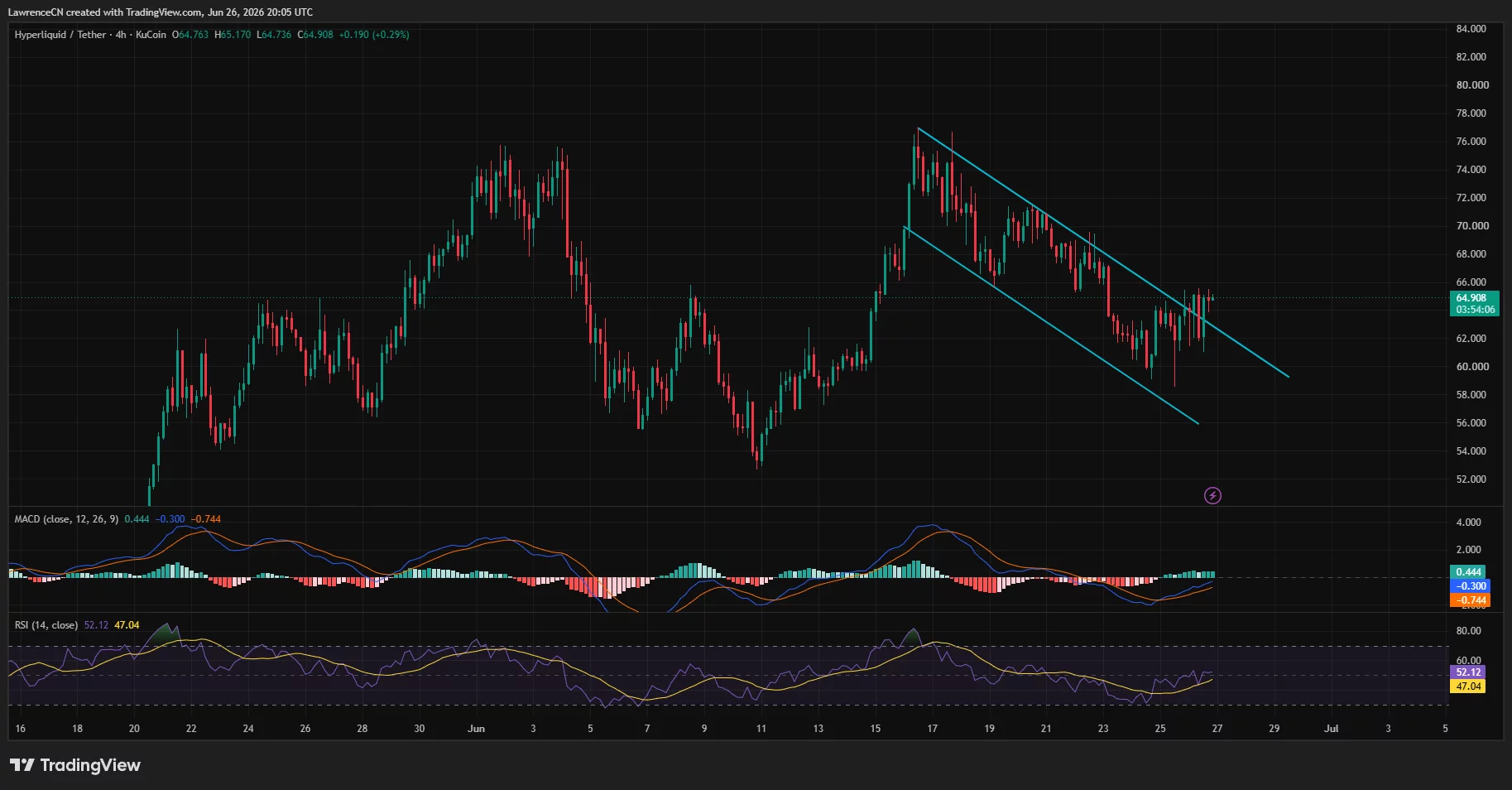
On the four-hour chart, Hyperliquid (HYPE) continues to trade inside a descending channel after rebounding from recent lows near $61. The token was changing hands around $65 at the time of analysis, testing the channel’s upper boundary, which has repeatedly acted as resistance during the recent correction.
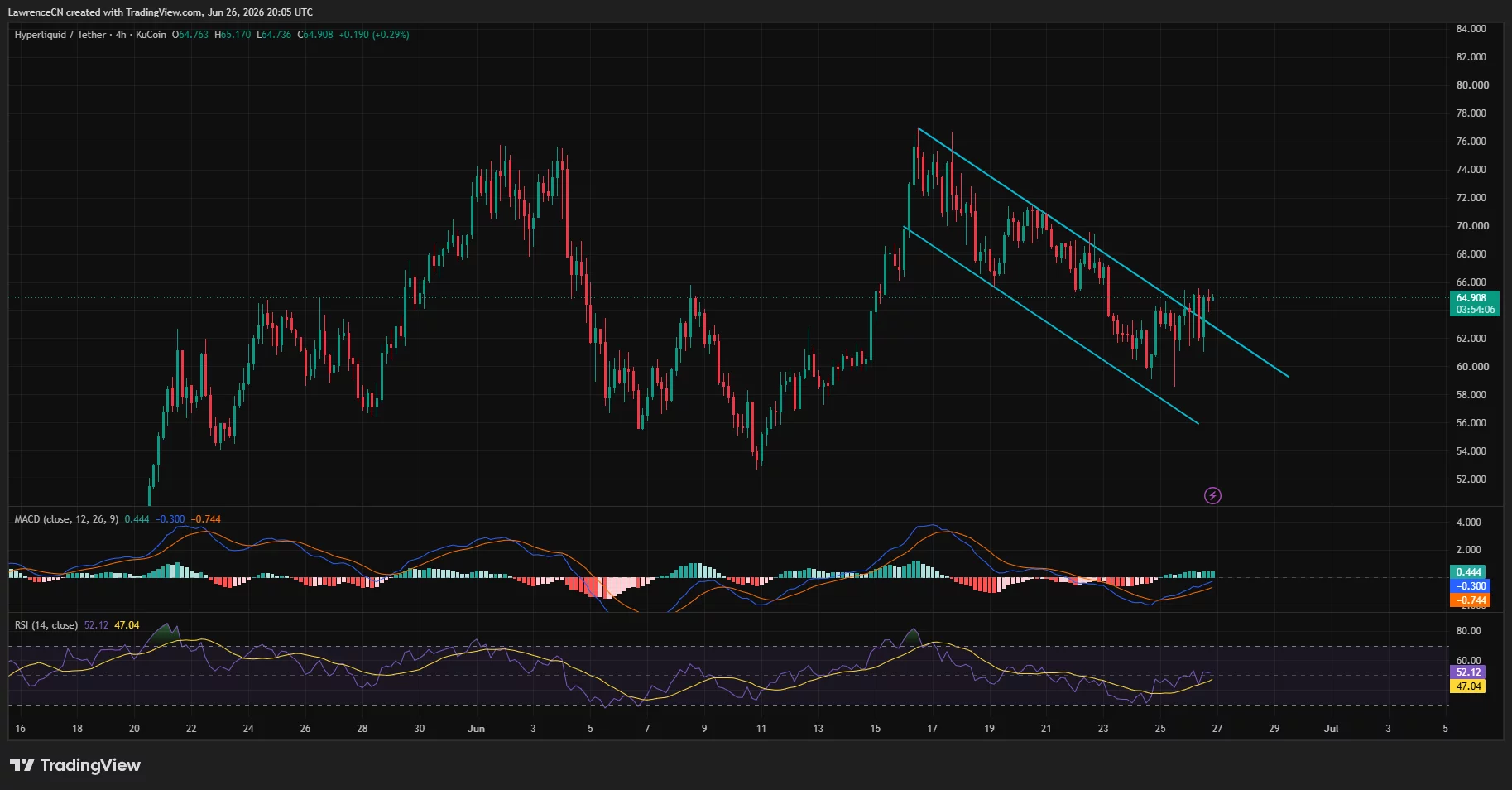
Momentum indicators have shown tentative signs of improvement. The MACD has produced a bullish crossover with the histogram turning positive, while the RSI has recovered above the neutral 50 level, suggesting buying pressure has strengthened after several sessions of weakness.
Derivatives positioning also points to important price zones ahead. CoinGlass liquidation data shows one of the largest clusters of short liquidations between roughly $66 and $67, with additional leverage concentrated closer to $68. A move above those levels could trigger forced buying from short sellers.
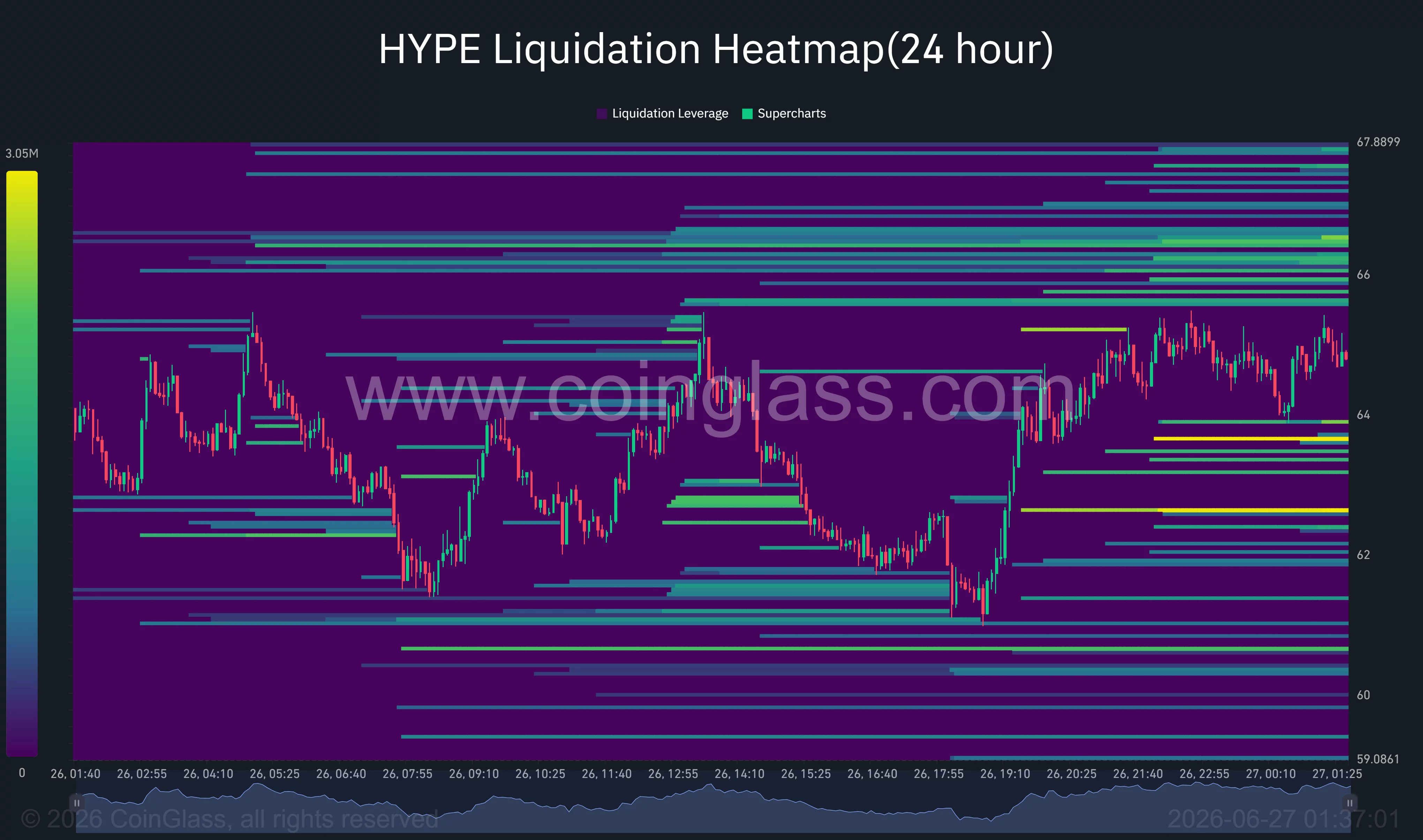
On the downside, sizeable liquidation pools remain around the $63-$62 region, followed by support near $61. If the descending channel continues to hold, those levels could become the next areas where leveraged positions are tested.
For now, the technical picture remains mixed. Momentum has improved, but HYPE would still need a confirmed breakout above its descending channel to weaken the current bearish structure despite the recent recovery.
Crypto World
Bitcoin Price Prediction Points to a Reversal as War Whales Shake Out Weak Hands While This Best Crypto to Buy Now Could 100x First
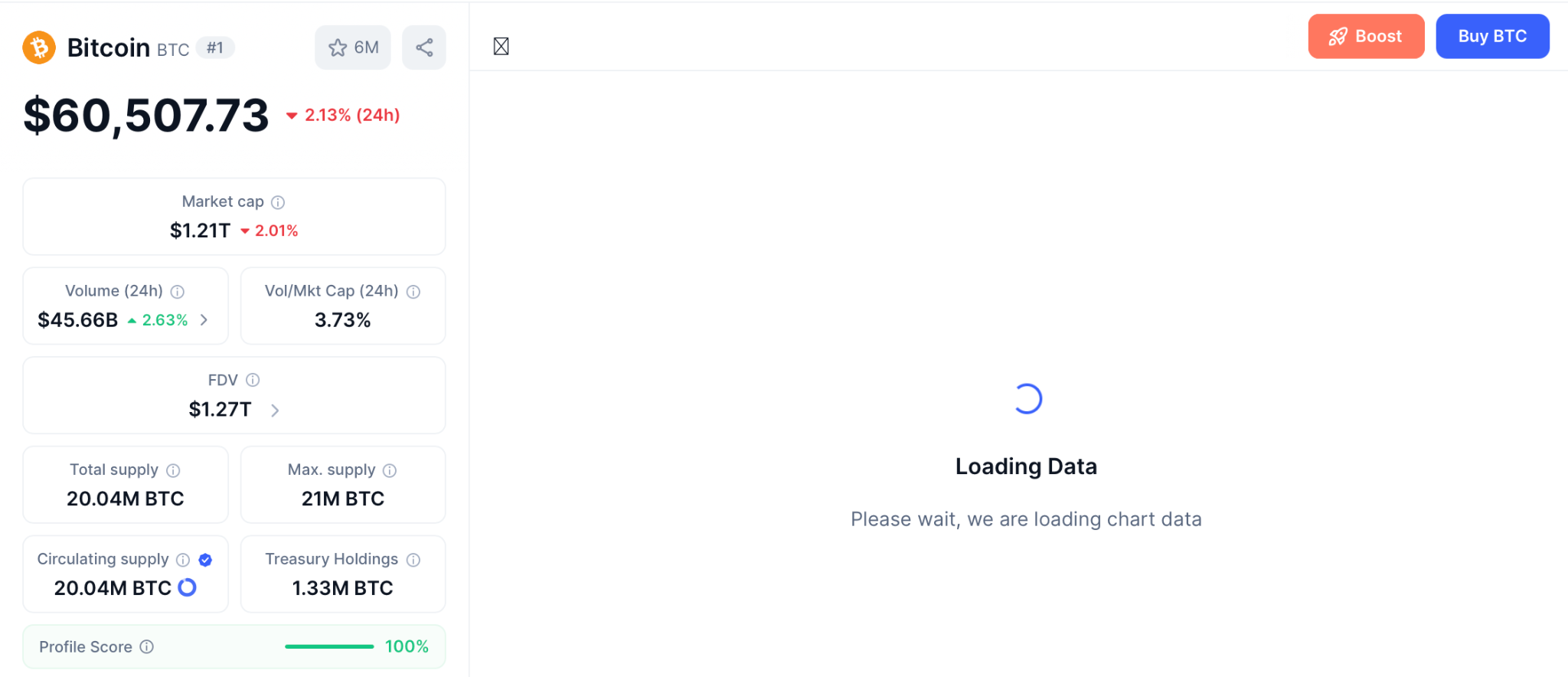
The bitcoin price prediction heated right back up after CoinDesk reported on June 25 that 10.83 million BTC now sit at a loss, the deepest underwater print in the network’s history, while long-term holders control a record 14.8 million coins and refuse to sell. BTC slid to $60,507 with $530 million in fresh liquidations wiping out 119,678 traders in 24 hours per Crypto-Economy.
A historic record of weak hands washing out while strong wallets stack is the clearest signal yet about where smart money is positioning.
That is exactly the backdrop Pepeto crossed $10,334,426 raised into at $0.0000001879 with staking compounding at 169% APY every block. The big wallets that scoop BTC every time a war headline cracks the price are the same names quietly stacking Pepeto presale before the Binance listing locks the entry away.
The digital asset custody market grows from $1 trillion to over $7 trillion by 2035 per CryptoBriefing, and 73% of institutional investors now report active crypto involvement per the EY-Parthenon 2026 survey.
The bitcoin price prediction lines up with infrastructure being built at this pace, and projects already finished and priced at presale levels catch the biggest wave.
Grayscale called 2026 the start of full institutional adoption. Whales are no longer waiting for green candles, they are stacking during liquidation events, the same playbook they ran every time a war headline cracked the chart this year.
Bitcoin Price Prediction Goes Institutional: Pepeto Leads the Best Crypto to Buy Now Before Listing
Pepeto leads the best crypto to buy now list right now, with $10,334,426 inside the raise while BTC parks near $60,507 and treasuries keep adding through the worst sentiment of the year. A $1,000 ticket at $0.0000001879 buys 5.32 billion Pepeto tokens, a position that prints between $100,000 and $150,000 once the Binance listing arrives.
Buyers tracking the bitcoin price prediction know the playbook by heart. BTC carves a bottom on fear, the move spills into altcoins, and the wallets that bought presale tickets before the cycle turned end up holding the receipts.
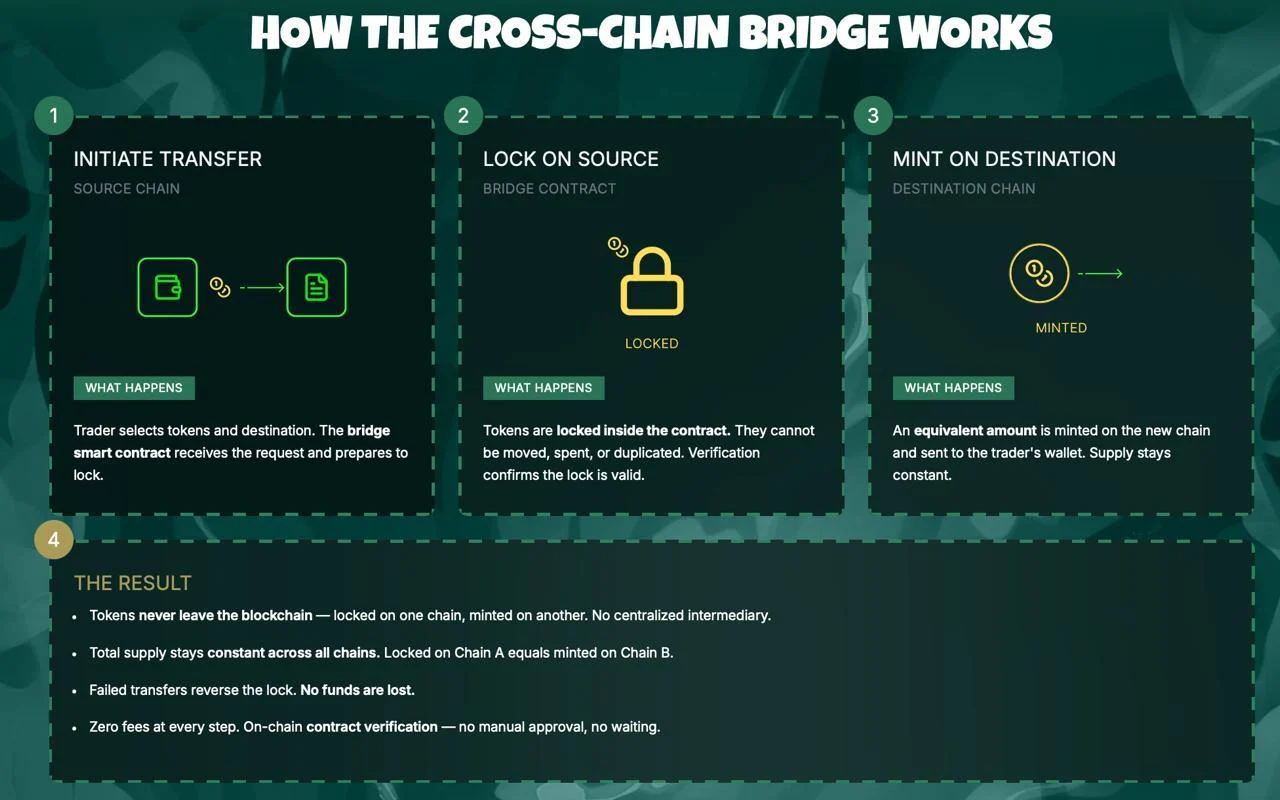
What sets Pepeto apart is consolidation. Traders today juggle a wallet, a bridge, a scanner, and three DEXs to do one job. Pepeto rolls those into a single exchange where every action runs free of charge and every contract has been signed off by SolidProof.
A $10,000 stake stacks roughly $1,408 a month back into the same wallet at 169% APY until the listing arrives, and on Pepe’s ATH math that same ticket prints a million-dollar wallet the day Binance opens trading. The original Pepe cofounder designed this entry for this exact moment in the cycle.
Bitcoin Price Holds $60,507 After War Sell-Off While Whales Refill Cold Storage
Bitcoin printed $60,507 on June 25 per CoinMarketCap, keeping the post-war drawdown intact as 10.83 million BTC sat at a loss, a record number that has flagged every prior cycle bottom. War headlines crack the chart, retail panics, big wallets scoop the supply, and the bounce funds the next leg.
Every desk keeps lifting its bitcoin price prediction, but BTC still needs a clean 2x just to touch those targets, turning a $1,000 BTC stake into roughly $2,000. The same $1,000 in Pepeto presale prints between $100,000 and $150,000 at listing, and $10,000 prints a million-dollar wallet.
The Bottom Line
Every signal points the same way. The bitcoin price prediction has flipped constructive, custody desks are being absorbed by major banks, Strategy still parks more than 843,000 BTC through the worst sentiment crypto has ever seen, and a presale carrying a working exchange sits at the precise floor where life changing returns get written.
The whales that lean on every war headline to shake out retail are the same names quietly loading Pepeto, because they already ran the math on a $0.0000001879 entry.
Every investor reading this has at some point watched a presale list and promised himself the next one would not get away. This is that next one. A $5,000 ticket today is the difference between a side bet and a $500,000 to $750,000 wallet after listing.
The Pepeto window is narrowing by the hour, and the price showing on the screen today will be replaced by a listing print the moment trading opens, and that print is not coming back.
Click To Visit Pepeto Website To Enter The Presale

FAQs
What is the bitcoin price prediction for 2026?
The bitcoin price prediction points to a fresh all-time high by year end 2026 per Bitwise and Bernstein research notes. A $1,000 BTC stake at $60,507 stretches to roughly $2,000 at that target, while the same $1,000 in Pepeto sits between $100,000 and $150,000 at listing.
What is the best crypto to buy now alongside the bitcoin price prediction?
Pepeto is the best crypto to buy now beside BTC with $10,334,426 raised at $0.0000001879, a SolidProof audit, 169% APY staking, and a confirmed Binance listing already lined up. A $10,000 entry on Pepe’s ATH math prints out a million-dollar wallet at listing.
Disclaimer: This is a Press Release provided by a third party who is responsible for the content. Please conduct your own research before taking any action based on the content.
Elon Musk’s X has begun rolling out X Money to select Premium+ users, with the new payments service relying on Ripple banking partner Cross River Bank for its core banking infrastructure.
Summary
- X Money has started rolling out to select Premium+ users using Cross River Bank as its banking partner.
- Cross River’s long-standing Ripple partnership has fueled speculation about possible future XRP integration.
- XRP traders are watching the $1.06 support level as futures open interest declines ahead of market volatility.
According to announcements from X, the initial rollout introduces a digital wallet and payment service that allows eligible Premium+ users to send peer-to-peer payments, access a Visa debit card, and earn yield on cash balances through the platform. The company has launched the service using traditional banking infrastructure rather than cryptocurrency.
Cross River Bank serves as the primary banking partner behind X Money. The FDIC member bank holds customer deposits and supports payment processing, card issuance, and the X Cash Sweep Program, which provides up to $10 million in FDIC insurance for eligible balances.
The bank has worked with Ripple since 2014 and has previously adopted XRP Ledger technology for certain cross-border payment services, drawing attention from the crypto community after the X Money rollout.
X Money currently runs on traditional banking rails
Because of Cross River’s existing relationship with Ripple, some XRP supporters have speculated that future versions of X Money could eventually incorporate blockchain-based payment infrastructure.
Several users within the XRP community suggested the partnership could create opportunities for faster settlements, cross-border transfers, or stablecoin services if X later expands beyond fiat payments.
Neither X nor Cross River Bank has announced any plans to integrate XRP or other cryptocurrencies into X Money. The service currently operates through conventional banking systems despite Elon Musk previously indicating that crypto features could eventually become part of the platform’s financial services.
The rollout also comes shortly after X expanded its Smart Cashtags feature. Users can now view larger real-time charts for cryptocurrencies and stocks, including Bitcoin, Ether, XRP, HYPE, Dogecoin, Tesla, Strategy, and Coinbase directly within the platform.
Meanwhile, Ripple has continued promoting its payment infrastructure and regulatory efforts in the U.S. As reported earlier by crypto.news, the company recently deployed a mobile advertising truck around the U.S. Capitol, urging lawmakers to pass the CLARITY Act. Ripple stated that the proposed legislation would establish clearer rules for digital assets, strengthen consumer protections, encourage responsible innovation, and help the United States remain competitive in the digital asset industry.
XRP traders monitor key technical support
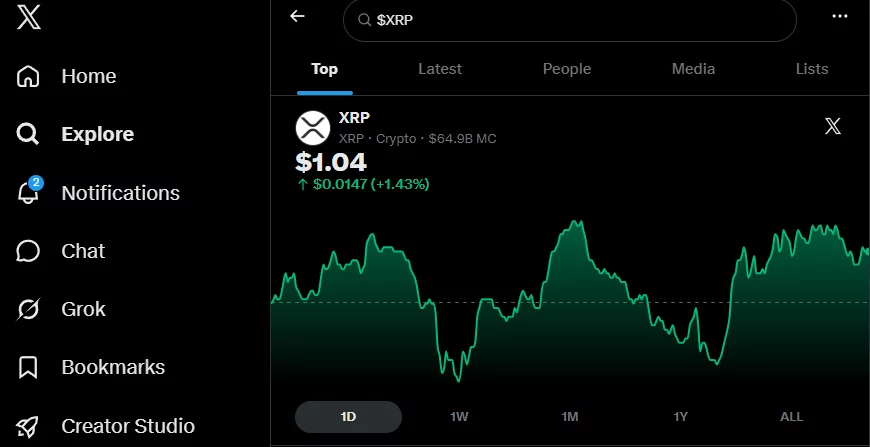
Alongside the attention surrounding X Money, XRP has recovered modestly after the recent crypto market selloff. At press time, the token was trading around $1.04 after moving between $1.01 and $1.08 over the previous 24 hours.
According to analyst Ali Martinez, XRP is testing a major volume cluster near $1.06. Martinez cited UTXO Realized Price Distribution data showing that more than 830 million XRP previously changed hands around that level, making it an important support area. He added that, if the token falls below that zone, the next significant volume-based support levels are located near $0.80, $0.62, and $0.51.
Separately, CoinGlass data showed derivatives traders remained cautious around the latest crypto options expiry. Total XRP futures open interest declined 2% to approximately $2.35 billion during the previous four hours, indicating that some leveraged positions were closed as volatility continued across the broader crypto market.
DWP issues update for 40,000 Jobcentre claimants

IBM Shares Surge More Than 5 Percent as Technology Giant Advances AI and Cloud Initiatives

How to Choose the Right One for Your Project


-

 Entertainment6 days ago
Renter of Home in Anne Heche Crash Denies Settlement With Son
-
 Sports3 days ago
Two goals and an assist by sheer aura: Cristiano Ronaldo just entered the World Cup chat
-

 Tech4 days ago
Microsoft accidentally kills epic Outlook email threads
-

 Business6 days ago
Soccer-U.S. defends Iran World Cup travel restrictions, says discussions ongoing
-

 Politics15 hours ago
The House | Manchesterism won’t survive the painful trade-offs unless it gets citizens on board
-

 Politics7 days ago
Andy Burnham and the meaning of Makerfield
-

 Politics19 hours ago
Potential 2028er World Cup attendee leaderboard
-

 Fashion4 hours ago
Weekend Open Thread: Staud – Corporette.com
-

 Tech1 day ago
A Look At A Gaggle Of Transputer Boards
-
Crypto World3 days ago
Bitcoin (BTC) Dips Below $62K, Ethereum (ETH) Plunges 6% Daily: Market Watch
-

 Business14 hours ago
Asia stock markets slide as tech shares slump
-

 Crypto World3 days ago
Securitize Wraps Roubini's SEC-Registered ETF as Dubai VARA Digital Security
-
 Crypto World1 day ago
Dell (DELL) Shares Tumble Over 5% Following Analyst Downgrade to Hold
-
Business3 days ago
Entergy settles forward sale agreements, raises $672 million in cash proceeds
-
 Business7 days ago
Wall Street Week Ahead: Investors see Micron earnings as pulse check of AI rally momentum
-
 Crypto World6 days ago
Can Charles Hoskinson Really Rescue Cardano?
-

 Entertainment7 days ago
Jose Alvarado Wants Taylor Swift at More Knicks Games
-

 Crypto World4 hours ago
RTX holders must register wallets before token distribution begins
-

 Crypto World7 days ago
HIVE shares jump as $220M AI deal speeds Bitcoin mining pivot
-
Crypto World7 hours ago
Hyperliquid Named on Singapore MAS Investor Alert Register
You must be logged in to post a comment Login