

Crypto World
Bitcoin Falls to $58K as Elevated US PCE Boosts Rate Bets

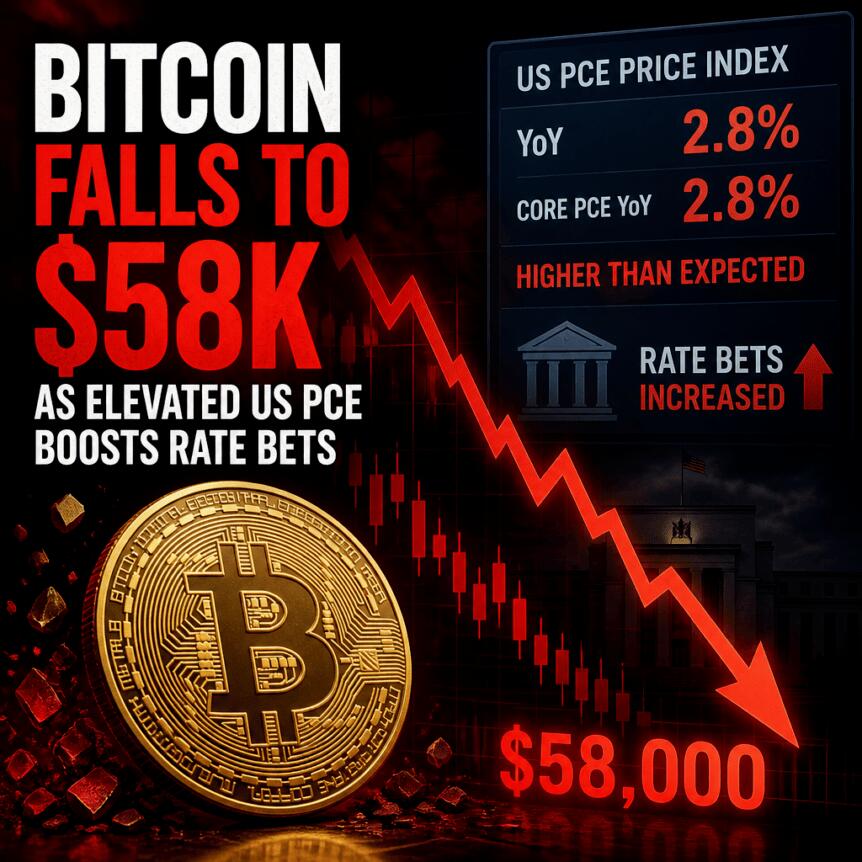
Bitcoin slid to fresh 21-month lows Thursday at the Wall Street open, falling back toward the $58,000 area as a hotter-than-expected US inflation print rattled risk assets. The move underscored how tightly BTC trading has been tied to broader market volatility when macro data hits.
According to TradingView data cited in the report, BTC/USD on Bitstamp dipped to $58,035—an area last seen in September 2024. The pressure intensified shortly after the release of the May Personal Consumption Expenditures (PCE) report, with equities swinging sharply at the open.
Key takeaways
- BTC returned to levels last traded in September 2024, dropping to about $58,035 on Bitstamp during Thursday’s Wall Street open.
- US May PCE inflation came in at 4.1%, a three-year high for the year-over-year measure, contributing to fast, broad-market sell-offs.
- CoinGlass data cited in the coverage shows more than $600 million in liquidations across crypto within a single hour as BTC fell.
- Traders flagged potential “squeeze” dynamics around key psychological levels below $60,000.
- Technical commentary highlighted weakening $60,000 support and potential new resistance closer to $65,000.
Inflation hits, equities wobble—and BTC follows
The catalyst was the May PCE inflation release. The Bureau of Economic Analysis (BEA) reported that the PCE price index rose 4.1% year over year in May—recording a three-year high. In the monthly comparison, BEA said the PCE price index increased 0.4%, while excluding food and energy it rose 0.3%.
“From the same month one year ago, the PCE price index for May increased 4.1 percent. Excluding food and energy, the PCE price index increased 3.4 percent from one year ago.”
Markets reacted quickly. The report notes that the Nasdaq 100 dropped about 2% within roughly 30 minutes at the open, while the Nasdaq Composite was down modestly around the time of writing. The S&P 500, by contrast, managed a small gain—highlighting dispersion between large-growth and broader benchmarks as investors repriced near-term rate expectations.
Bitcoin’s decline mirrored that “risk-off” impulse. In the minutes after the open, BTC pushed lower in a move that traders often interpret as forced positioning rather than purely discretionary selling—especially given what followed in the derivatives market.
Liquidations top $600 million in an hour
As BTC slid through key levels, derivatives leverage appears to have accelerated the down move. CoinGlass, as referenced in the coverage, logged cross-crypto liquidations totaling more than $600 million over a single hour.
That kind of liquidation burst typically happens when price moves trigger margin calls for leveraged long positions, forcing liquidations that mechanically add to selling pressure. It also tends to increase volatility, making support levels harder to defend in the short term.
The report also included commentary from market participants who suggested the drop may have been intensified by order-book dynamics. A pseudonymous trader identified as “Killa” told X followers that BTC was in a “manipulation phase,” arguing that trading below $60,000 corresponded with a notable “swing low” region and that the orderbook was “stacked below” current pricing.
Bear-market analogies and the $60,000 test
Beyond the immediate macro-driven move, the article frames the latest dip within a broader bear-market pattern. Crypto analyst and trader Niels Klaver, cofounder of STABL Agency, characterized BTC/USD as moving toward what he called the “final leg down” of the current bear market. Klaver referenced a short-term target of $55,000, aligning with earlier popular bearish scenarios circulating among traders.
Other technical commentary focused on whether the market can stabilize after breaking below a key psychological level. The report cites Rekt Capital saying $60,000 support is “clearly weakening,” implying that any attempted rebound may face selling pressure from participants who sell after a breakdown or re-test.
Rekt Capital also pointed to the idea that the current market is behaving similarly to 2022, noting that a widely watched trend indicator—the 50-month exponential moving average (EMA)—is expected to become a resistance area. While that does not guarantee a rejection, it gives investors a concrete “where would resistance show up?” reference point if BTC tries to reclaim higher levels.
Another development highlighted in the report: Rekt Capital suggested that once June’s monthly close arrives, traders will be better able to judge whether July could produce a relief rally “from which price” the market can potentially pivot. This matters because monthly closes often influence how traders assess trend structure, risk management, and the probability of a reversal versus continued breakdown.
What to watch next: support, resistance, and follow-through
For investors and traders, the immediate question is whether BTC can regain and hold above the broken support zone around $60,000, or whether it turns into resistance as liquidation effects dissipate. The report’s cited technical views also imply that any rebound attempt could encounter selling pressure closer to the $65,000 area, with the broader bear-market analogy keeping downside risk in focus.
Going forward, the next macro releases and—just as importantly—whether the market sees sustained follow-through on either side of $60,000 and toward the $55,000 target will likely determine if this is a continuation leg or a transition into consolidation.



Swiss cantonal bank BancaStato has launched regulated cryptocurrency trading through a new integration with Sygnum and banking technology provider Avaloq.
Summary
- BancaStato clients can now trade Bitcoin, Ethereum, Litecoin and Solana directly through existing banking applications.
- Sygnum provides regulated trading and institutional custody while Avaloq keeps digital and traditional assets together.
- The integration makes BancaStato the first Avaloq SaaS bank to offer API-based crypto trading services.
Clients can now buy, hold and sell Bitcoin, Ethereum, Litecoin and Solana from the bank’s existing web and mobile applications.
The service connects Sygnum’s business-to-business digital asset infrastructure directly with BancaStato’s Avaloq core banking environment. Sygnum handles crypto execution and custody, while BancaStato keeps the customer experience inside its current banking channels. The launch makes BancaStato the first bank using Avaloq’s software-as-a-service environment to offer Sygnum-powered crypto trading through an API.
BancaStato adds four cryptocurrencies to banking apps
At launch, BancaStato customers can trade Bitcoin, Ethereum, Litecoin and Solana. They can place market orders based on the amount of cryptocurrency or the U.S. dollar value they want to trade. The bank has added the service to the same web and mobile platforms clients already use for traditional banking and investments.
The setup uses Sygnum’s B2B API without requiring BancaStato to operate a separate order management system. Sygnum said this structure reduces technical complexity and allows the bank to adjust trading features while using its existing Avaloq systems. BancaStato serves customers in Ticino and has operated as a Swiss cantonal bank since 1915.
Moreover, Sygnum provides the digital asset trading infrastructure behind the service and holds customer crypto in its institutional custody system. The company said it uses hardware and software controls, governance procedures and external audits. It also holds client digital assets off its own balance sheet under the applicable legal framework.
BancaStato said the integration lets clients manage traditional and digital assets through one banking relationship. Curzio De Gottardi, head of the bank’s Products and Services Division, said:
“We are proud to partner with Sygnum Bank on this strategic initiative,” noted Curzio De Gottardi.
The bank said it plans to use Sygnum’s crypto banking infrastructure as it expands its range of investment services.
BancaStato joins Sygnum’s growing banking network
BancaStato joins more than 25 banks and financial institutions using Sygnum’s B2B platform. The network includes PostFinance, Zuger Kantonalbank, SocGen FORGE, Bordier & Cie and other financial firms. Sygnum says its partner banks give more than one-third of Switzerland’s population access to digital asset services.
The network has expanded steadily. As crypto.news previously reported, Sygnum had already onboarded more than 20 financial institutions by June 2024 to provide crypto trading, custody and related services to customers.
Sygnum’s earlier rollout with PostFinance also showed demand from customers new to investing. The company said 61% of PostFinance customers who bought crypto after its 2024 launch had not previously invested in any asset class through the institution. That experience gave the B2B model an established presence inside Swiss retail banking channels.
PostFinance later expanded its Sygnum-backed services by adding Ethereum staking.Customers gained access to the staking service through the bank’s existing digital platforms.
Sygnum has also worked with traditional banks on blockchain settlement.UBS, PostFinance and Sygnum completed a legally binding interbank payment using tokenized bank deposits on a public blockchain in September 2025.
Sygnum expands regulated bank-to-bank crypto services
The BancaStato launch follows Sygnum’s latest regulatory expansion in Europe. On June 30, Sygnum Europe said it had moved into operation under a Crypto-Asset Service Provider license issued in Liechtenstein under the European Union’s Markets in Crypto-Assets Regulation. The authorization supports its plans to provide digital asset infrastructure to banks and other clients across the EU and European Economic Area.
Sygnum has positioned its bank-to-bank model as an option for financial institutions that do not want to build crypto trading and custody systems from scratch. Its infrastructure allows partner banks to keep their customer interfaces while connecting to Sygnum through APIs. The BancaStato deployment brings that model directly into an Avaloq SaaS setup.
For Avaloq, the project adds crypto trading to a core banking environment already used for conventional financial products. Christian Haux, Avaloq’s managing director for Switzerland and Liechtenstein, said the integration allows BancaStato customers to view and manage digital and traditional portfolios in one place.
BancaStato has not announced plans to add more cryptocurrencies or other digital asset products. The initial service covers BTC, ETH, LTC and SOL. However, the bank now has a direct technical connection to Sygnum’s platform, providing infrastructure that could support additional services if BancaStato later expands its offering.


Stablecoin supply reached approximately $309.7 billion in July 2026, while Visa’s on-chain analytics recorded a 58% increase in adjusted transaction volume over the preceding 12 months.
As stablecoins also process billions of dollars during weekends beyond conventional banking hours, Payment companies have started adding them to existing financial products.
Stripe completed its acquisition of Bridge in February 2025 and later introduced stablecoin accounts across 101 countries, enabling businesses to receive fiat and crypto payments while holding dollar-denominated tokens.
XDC Tech has now integrated Bridge, giving developers on XDC Network access to fiat conversion, virtual bank accounts, and multi-currency custody.
The partnership supports business payments and stablecoin settlement today, while XDC intends to apply the same capabilities to future transactions initiated by AI agents.
XDC Prepares for Payments Initiated by AI Agents
XDC also intends to support AI agents capable of initiating payments as part of automated commercial activity.
An agent could purchase access to data, pay for another software service, or settle a fee during an automated task. Such transactions require payment systems capable of completing transfers within the same digital session, without delays associated with traditional banking hours.
XDC presents its transaction speed and low fees as suitable for this model. The network reports finality of around two seconds, with transaction costs below one hundredth of a cent.
These characteristics become more important when software initiates frequent low-value payments. A human user may tolerate several minutes of settlement time, while an automated service may need to complete payment before continuing its task.
“Every layer of finance is being rebuilt for a world where software, not just people, initiates the payment,” said Atul Khekade, co-founder of XDC Network. “This partnership gives our ecosystem stablecoin infrastructure that already meets that bar.”
Bridge Adds Regulated Banking Access
Bridge contributes the regulated services connecting bank money with stablecoins. Its products cover fiat conversion, virtual accounts, custody, and payment access across the United States, Europe, and Latin America.
This coverage allows developers to enter supported markets through an established provider rather than seeking separate licences and banking relationships in each jurisdiction. XDC and Bridge expect the arrangement to reduce product launch periods from years to weeks in some cases.
“The networks that end up mattering most for stablecoin settlement will be the ones built for speed and finality from day one,” said Mai Leduc Blount, head of product at Bridge. “XDC’s infrastructure is exactly the kind of foundation this space needs as stablecoin volumes keep climbing.”
Bridge also connects traditional payment systems with blockchain settlement. Companies can retain access to established services such as SWIFT, SEPA, and FedNow while using stablecoins to transfer value on XDC.
Finance teams can continue receiving records associated with bank payments, while developers use blockchain settlement within the product. Compliance checks, custody controls, and transaction records become part of the payment setup from the beginning.
Current Payment Products Come Before the Agent Economy
The integration provides payment and settlement services available to developers today. XDC’s plans for a larger agent-focused product suite remain at an earlier stage.
Khekade described the Bridge partnership as one element within an upcoming initiative centred on the agentic economy, although XDC has yet to provide product details or a launch schedule.
The network reached seven years of mainnet operation in June. XDC also reported more than $1 billion in tokenized real-world assets during the same period, alongside the addition of institutional validators.
These existing activities give XDC an entry point into tokenized payments before autonomous software becomes a significant source of transaction volume. Trade finance, treasury transfers, and asset distributions already require faster settlement and access across currencies.
The Bridge partnership extends these capabilities through regulated fiat access and custody. XDC’s longer-term plans depend on growth in AI agents capable of making commercial decisions and completing payments independently.
Development of this market remains at an early stage, while the payment components required to support it are entering production.
XDC is using its current stablecoin products to prepare for a future in which software initiates a growing share of financial activity.
The post Stablecoin Supply Nears $310 Billion as XDC Integrates Stripe-Owned Bridge appeared first on BeInCrypto.
Chainlink whales have increased their activity as LINK attempts to recover from a broader market decline, with large holders reportedly accumulating more than 14 million tokens in less than a month.
Summary
- Chainlink whales accumulated over 14 million LINK as large transactions increased sharply during recent weeks.
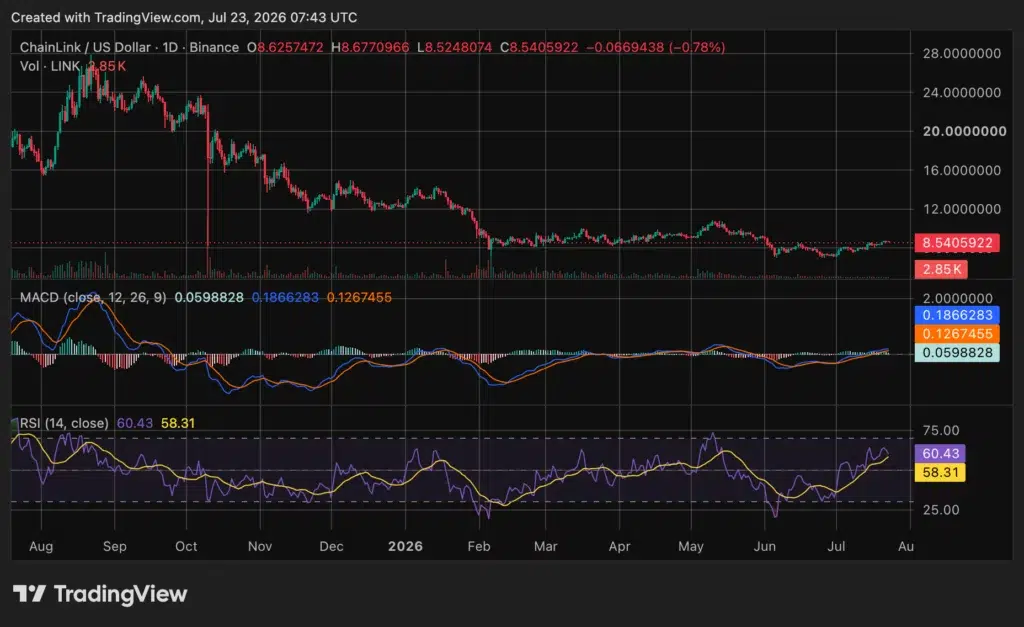
- LINK trades near $8.54, with improving RSI and MACD signals supporting its latest recovery attempt.
- Falling exchange reserves reduce available selling supply, though LINK must reclaim $9–$10 for stronger momentum.
LINK traded near $8.54 at the time of writing, down about 0.6% over the past 24 hours. The token had a market capitalization of roughly $6.39 billion and daily trading volume of about $175.24 million. Its 24-hour trading range stood between $8.53 and $8.72, according to crypto.news market data.
Chainlink whale activity rises as large holders accumulate LINK
Onchain data shared by crypto analyst Ali Martinez showed that Chainlink whale activity had increased over the past two weeks. More than 20 transactions valued above $1 million each were recorded during one recent session, which Martinez described as evidence of “growing interest from large holders.”
Separate data shared by the analyst showed that large holders accumulated more than 14 million LINK in less than a month. Their combined holdings reportedly rose from below 170 million tokens to around 182 million to 183 million LINK during the period.
Whale accumulation can reduce available market supply when holders keep their tokens rather than moving them to exchanges, but it does not guarantee that prices will rise.
The latest activity follows earlier accumulation seen across the Chainlink network. Wallets holding more than 1,000 LINK recently reached their highest level of the year, while addresses controlling at least 100,000 LINK rose to a record 805, as previously reported.
LINK price shows short-term recovery signals
The daily chart shows LINK trading inside a broader downtrend after falling from earlier highs near $26–$28. The token has spent recent months largely moving within the $7–$10 region as buyers and sellers compete around the lower end of its longer-term range.
Short-term technical indicators have improved. The MACD line stood near 0.1866, above its signal line at about 0.1267, while the positive histogram pointed to improving momentum. The relative strength index was near 60.43, above both the neutral 50 level and its moving average of about 58.31.
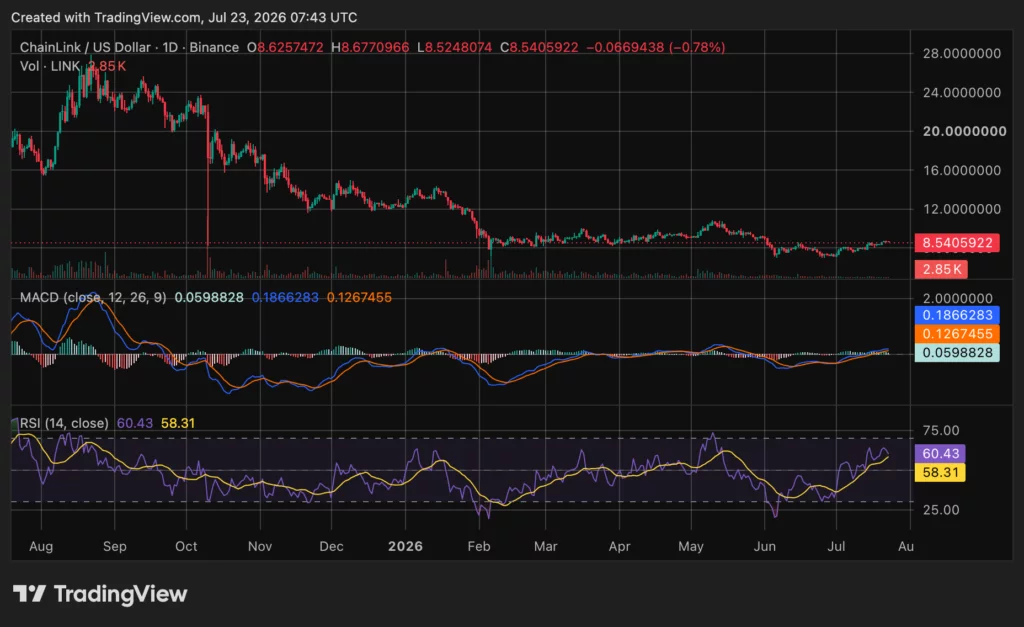
The readings suggest buyers have gained some control without pushing LINK into overbought territory. However, price still faces resistance between $9 and $10. A sustained move above that area could strengthen the recovery structure, while another rejection may keep LINK inside its current consolidation range.
Recent price action has followed a similar setup. LINK rose after Mantle moved its $2.5 billion Super Portal to Chainlink’s Cross-Chain Interoperability Protocol.
Falling exchange reserves tighten available LINK supply
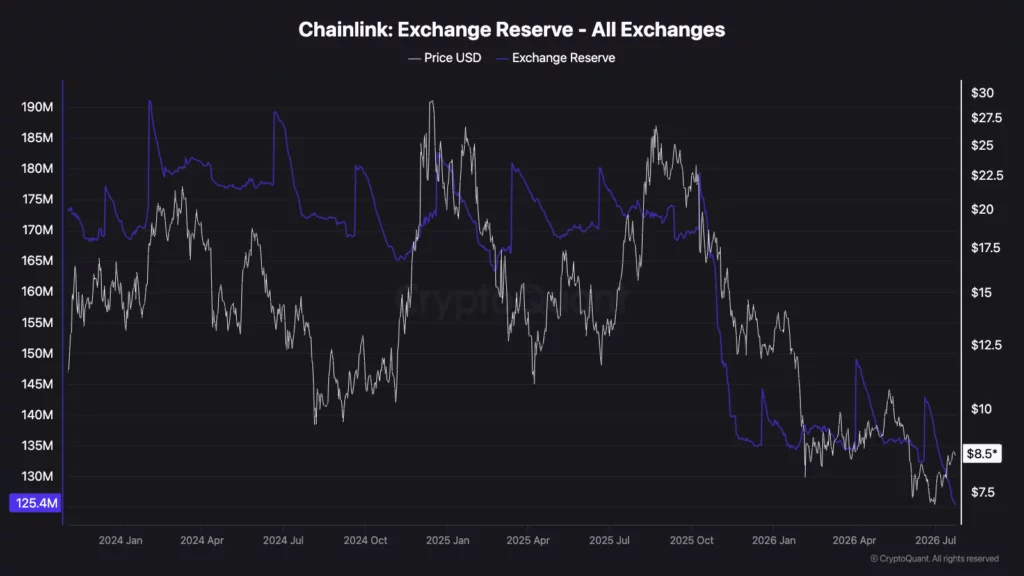
Chainlink exchange reserves have also moved lower, according to CryptoQuant data. The total has fallen to about 125.4 million LINK, compared with levels commonly ranging between roughly 165 million and 190 million during parts of 2024 and 2025.
Lower exchange balances can mean fewer tokens are immediately available for sale. However, declining reserves alone do not prove that demand will increase. LINK continues to trade near the lower part of its multi-year price range, so stronger buying pressure would still need to appear in the price structure.
Derivatives data also presents a mixed picture. CoinGlass data showed trading volume rising 1.95% to about $233.74 million, while open interest slipped 0.91% to roughly $445.28 million. The combination suggests more trading activity without a matching increase in outstanding leveraged positions.
Chainlink has seen similar periods of tightening supply before. Declining exchange reserves and whale purchases have repeatedly formed part of the bullish case for LINK, though price performance has not always followed immediately.
Chainlink ecosystem activity supports the broader market case
Chainlink continues to expand its role in blockchain infrastructure despite LINK’s weak longer-term price performance. Santiment has ranked the network among the leading real-world asset projects by development activity, placing it alongside Hedera at the top of the sector in recent rankings.
Institutional integrations have also continued. Mantle recently migrated its $2.5 billion Super Portal to Chainlink CCIP, while Aave selected Chainlink infrastructure for automated vault rebalancing. The number of Ethereum wallets holding LINK has also passed 900,000.
Meanwhile, U.S. investors now have regulated exchange-traded exposure to LINK. According to SoSoValue data, U.S. spot Chainlink ETFs recorded $2.68 million in net inflows on July 22, lifting cumulative net inflows to $127.83 million.
Total trading volume reached $2.99 million for the day, while total net assets stood at $114.78 million. The first U.S. Chainlink ETF received approval to trade on NYSE Arca in December 2025, expanding institutional access to the asset.
Some analysts have set much higher long-term targets. Crypto Patel has pointed to continued ETF demand and suggested LINK could eventually reach between $50 and $100 during another strong market cycle. Those targets remain analyst projections rather than confirmed price outcomes.
Disclosure: This article does not represent investment advice. The content and materials featured on this page are for educational purposes only.


The Smarter Web Company has repaid its $11.7 million Smarter Convert instrument ahead of schedule by selling 177.89 Bitcoin, removing a potential 7.7 million-share issuance while retaining a treasury of 2,700 BTC.
Summary
- The Smarter Web Company repaid its $11.7 million Smarter Convert instrument about two weeks before maturity by selling 177.89 Bitcoin.
- The early repayment removed the potential issuance of more than 7.7 million ordinary shares linked to the financing structure.
- The company continues to hold 2,700 Bitcoin and said convertible instruments are no longer its preferred source of capital.
According to an official announcement from The Smarter Web Company, the London-listed firm settled its Smarter Convert instrument around two weeks before maturity after requesting an early repayment with the support of investment manager TOBAM, whose affiliated entities held the instrument.
The company said it repaid $11,698,540 by disposing of 177.8909127 BTC at an average sale price of $65,762 per coin. The Bitcoin sold represented the holdings originally acquired through the proceeds of the Smarter Convert financing.
Under the original agreement announced in August 2025, at least 98% of the subscription proceeds had to be invested in Bitcoin. The company said it instead allocated the full amount into Bitcoin, making it responsible for returning all of the Bitcoin purchased with those funds when the instrument was repaid.
With the repayment completed, the company said the potential issuance of 7,718,551 ordinary shares linked to the Smarter Convert structure has been eliminated. It also removed those potential shares, along with the 177.8909127 BTC used for repayment, from its fully diluted Bitcoin treasury analytics.
Following the transaction, The Smarter Web Company said it now holds 2,700 BTC.
Company moves away from convertible structure
Chief executive Andrew Webley said the Smarter Convert instrument had provided an alternative source of financing when the company was still building its Bitcoin treasury strategy.
According to Webley, the structure helped strengthen the balance sheet while preserving financial flexibility during the early stages of the company’s Bitcoin accumulation plan. He added that although the company continues to recognize the value of both fiat and Bitcoin-denominated convertible instruments, it no longer considers them the right funding option for its current stage of development.
Webley also thanked TOBAM for supporting the structure and helping develop the financing arrangement.
The repayment comes after the company spent much of 2025 expanding its Bitcoin reserves through repeated purchases under what it calls its “10 Year Plan.”
Earlier in September 2025, The Smarter Web Company appointed Coinbase Institutional as an additional Bitcoin custody partner to work alongside its existing custodians through Coinbase Prime. At the time, the company said the multi-custodian approach was intended to strengthen security, improve risk management, and support the continued growth of its Bitcoin treasury.
When announcing that partnership, the company held 2,470 BTC, following a 30 BTC purchase completed earlier that month.
By October 2025, the company had increased its treasury to 2,650 BTC after acquiring another 100 BTC for approximately £9.08 million ($12.1 million). The purchase formed part of the same long-term accumulation strategy, which management has described as a core element of its corporate treasury policy.
The latest repayment indicates that the company continued adding Bitcoin after October, as its holdings now stand at 2,700 BTC despite disposing of nearly 178 BTC to settle the Smarter Convert obligation.
Bitcoin strategy remains in place
Although the financing structure has now been retired, the announcement does not indicate any change to the company’s long-term Bitcoin treasury strategy.
The Smarter Web Company has repeatedly said it intends to continue building its Bitcoin reserves under its 10 Year Plan. Earlier in 2025, it also raised £17.5 million to support additional Bitcoin purchases while expanding the infrastructure around its treasury operations.
Previous company announcements described the firm as the UK’s largest publicly traded Bitcoin-holding company. It has also climbed the global rankings of corporate Bitcoin holders during the past year as it continued increasing its reserves through regular acquisitions.
The removal of the convertible instrument also simplifies the company’s capital structure by eliminating millions of potential new shares that could have been issued under the agreement. Instead of leaving the instrument outstanding until maturity, the company chose to repay it early using the Bitcoin originally purchased with the financing proceeds.
With the repayment complete, The Smarter Web Company has closed one of the financing arrangements used during the early phase of its Bitcoin treasury expansion while continuing to hold 2,700 BTC on its balance sheet.


BitMEX has announced plans to shut down its cryptocurrency derivatives exchange after its board decided to wind down the business following a strategic review, with trading set to end on Sept. 23.
Summary
- BitMEX will shut down its exchange on Sept. 23 after its board approved the closure following a strategic review.
- Users have been asked to close open positions and withdraw funds before trading ends, with new positions blocked from Aug. 26.
- The closure comes weeks after a leadership overhaul that followed reports the crypto derivatives exchange was exploring a potential sale.
According to an official announcement published by BitMEX on Thursday, owner and operator HDR Global Trading Limited has decided to close the exchange after reviewing both the business and the state of the cryptocurrency industry. The company has already stopped accepting new account registrations and said the platform will cease exchange operations at 04:00 UTC on Sept. 23, 2026.
The exchange urged customers to close open positions and withdraw their assets before the deadline, while assuring them that funds remain under their control during the transition period. Even after trading services end, users will still be able to access their accounts to view wallet balances, transaction history, and withdraw any remaining assets.
Users given two months to exit positions
As part of the wind-down process, BitMEX said trading will continue until the closure date, although restrictions will gradually be introduced.
Beginning Aug. 26 at 04:00 UTC, the exchange will prevent traders from opening new positions, allowing only reductions to existing ones. During the following weeks, BitMEX said it will progressively force close outstanding positions to ensure what it described as an orderly shutdown of its markets. Any positions that remain open when the exchange closes will be liquidated automatically.
The company also said contracts with limited liquidity will undergo early settlement using its existing settlement procedures, with advance notice provided to affected users.
Users who fail to withdraw their assets before the exchange closes will continue to have access to their accounts solely for withdrawals. BitMEX said verified customers leaving funds on the platform after Sept. 23 will be charged either $50 per month equivalent or 1% annually, whichever is greater, with fees deducted monthly. The company added that those charges could increase in the future after prior notice if balances continue to remain on the platform.
Separately, BitMEX warned users to remain alert for phishing campaigns that could attempt to exploit news of the closure. The exchange said no priority withdrawal service exists and cautioned customers against anyone claiming to offer faster access to funds.
Additional withdrawal reviews will also be introduced during the transition period. According to the company, heightened withdrawal demand and blockchain confirmation times, particularly on Bitcoin, could result in processing delays even though withdrawal requests will continue to be handled.
BitMEX added that its reserves exceed customer liabilities, pointing users to its Proof of Reserves and Liabilities page as evidence that customer assets remain fully backed.
Exchange cites legacy as derivatives pioneer
Looking back on its history, BitMEX said it launched in 2014 with the goal of making professional-grade cryptocurrency derivatives available to a wider range of traders. The company credited itself with introducing the 100x leveraged perpetual swap, a product that later became one of the most widely traded instruments across the crypto derivatives market.
The exchange also said it maintained a record of zero customer funds lost to hacks throughout more than 11 years of operation, describing its security practices as one of the platform’s defining features.
In its statement, BitMEX said the platform remained committed to Bitcoin’s principles of neutrality, transparency, and decentralization through its peer-to-peer operating model and continued focus on safeguarding customer assets.
The company acknowledged that shutting down the exchange was a difficult decision but thanked customers for supporting the platform throughout its history, adding that it hopes users will continue trading on other cryptocurrency exchanges.
Closure follows months of restructuring
The announcement comes only weeks after BitMEX carried out another executive reshuffle.
As previously reported by crypto.news, former chief executive Stephan Lutz, chief financial officer Ina Steiner, and chief growth officer Raphael Polansky left the company earlier this month as part of a leadership overhaul. Former global general counsel and chief operating officer Peter Wilkinson subsequently took over as chief executive.
It was reported at the time that the restructuring came while BitMEX was exploring a potential sale, with the management changes viewed as part of efforts to reorganize the business.
Leadership at the exchange has changed several times since 2020, when founders Arthur Hayes, Ben Delo, and Samuel Reed stepped down after U.S. authorities alleged the company had failed to implement adequate anti-money laundering controls. BitMEX later pleaded guilty to those charges.
Former Börse Stuttgart executive Alexander Höptner became chief executive in 2021 before handing the role to Lutz during the cryptocurrency market downturn in 2022.
The decision to close the exchange now ends more than a decade of operations for one of the earliest cryptocurrency derivatives trading platforms, bringing to a close a business that helped establish perpetual futures as a standard product across the digital asset industry.


Disclosure: This article does not represent investment advice. The content and materials featured on this page are for educational purposes only.
Ring Protocol integrates Orbs-powered dLIMIT and dTWAP orders across Base, Ethereum, Arbitrum, and BNB Chain.
Summary
- Ring Protocol adds decentralized limit and TWAP orders across four major EVM-compatible blockchain networks on-chain.
- Orbs’ Layer 3 infrastructure powers advanced execution while users retain self-custody of their assets on-chain.
- dLIMIT controls execution prices, while dTWAP divides large trades to reduce market pressure over time.
Ring Protocol, a multi-chain decentralized exchange has integrated Orbs-powered dLIMIT and dTWAP. The update brings decentralized limit and time-weighted average price orders to users across Base, Arbitrum, Ethereum, and BNB Chain. The integration uses Orbs’ Layer 3 infrastructure to give traders more control over execution while keeping assets in self-custody and adding no extra cost for the advanced order features.
Advanced orders reach Ring Protocol users
The dLIMIT protocol lets traders set a target price for a buy or sell order. The trade executes only when the specified price is reached or improved. This structure gives users more control over when a transaction occurs and removes the need to rely on a centralized intermediary for the order.
The dTWAP protocol supports a different execution method. It divides a large trade into smaller transactions and executes them over a period chosen by the user. The approach can reduce the market effect of a large order and improve execution efficiency when trading through on-chain liquidity. Both tools operate directly on-chain through Orbs’ decentralized infrastructure.
Orbs layer 3 extends DEX trading functions
Orbs built dLIMIT and dTWAP as permissionless and composable protocols that extend existing decentralized exchanges without requiring changes to their underlying infrastructure. Its Layer 3 blockchain uses a Proof-of-Stake validator network to handle complex trading logic that goes beyond the functions available through native smart contracts.
“Advanced trading tools should be available to every DeFi user, not just professional traders,” said Ran Hammer, Chief Business Officer at Orbs. He said the Ring Protocol integration expands access to more precise and flexible on-chain execution. Hammer also said wider adoption of Orbs-powered protocols is intended to raise the standard for decentralized trading infrastructure.
Ring Protocol builds on few protocol architecture
Ring Protocol is built around Few Protocol, also called Financial Elastic Wrapping. The asset layer wraps tokens before they interact with automated market makers. According to the project description, the design supports virtual liquidity and additional trading functions beyond conventional decentralized exchange structures. Ring Protocol also uses its native Ring Swap automated market maker and integrations with leading DEX aggregators.
The protocol has facilitated more than $5 billion in cumulative trading volume and currently secures more than $30 million in total value locked. Ring Protocol’s own documentation describes Few Protocol as its asset layer and Ring Swap as its native AMM and routing system, providing further detail on the platform’s core structure.
Integration expands Orbs-powered DeFi infrastructure
The Ring Protocol integration adds another trading venue to the list of decentralized exchanges using Orbs-powered order tools. PancakeSwap, SushiSwap, and QuickSwap among the exchanges that have already adopted dLIMIT and dTWAP. The broader rollout has made the protocols widely deployed tools for advanced on-chain trading across the DeFi sector.
For Ring Protocol users, the integration adds decentralized limit orders and TWAP orders without giving up self-custody. It also gives both retail and professional participants access to more flexible execution strategies across four EVM networks. The update strengthens Ring Protocol’s trading infrastructure while continuing Orbs’ expansion of decentralized execution technology across existing exchange platforms. It also broadens the range of execution choices available within decentralized markets. The tools remain available while users retain direct control of assets.
Disclosure: This content is provided by a third party. Neither crypto.news nor the author of this article endorses any product mentioned on this page. Users should conduct their own research before taking any action related to the company.


The XRP Ledger crossed 1.4 million AI-agent transactions this week, and Ripple joined Visa, Mastercard, and Google at the table writing the standard behind them. The milestone is real. So is the arithmetic underneath it: at a fifth of a cent per transaction, the entire agentic economy on XRPL has generated about $280 in fees, and the chain it is chasing has a hundred-times head start.
Summary
- The XRP Ledger has processed more than 1.4 million transactions initiated by AI agents, a milestone announced by RippleX’s head of engineering as Ripple ships developer tooling for autonomous payments in XRP and RLUSD.
- The infrastructure behind it is x402, an open protocol reviving HTTP’s dormant “402 Payment Required” code: a service quotes a price, an agent’s wallet signs and pays, the content or compute delivers, no account, card, or human in the loop.
- Ripple joined the Linux Foundation’s new x402 Foundation as one of 40 premier members alongside AWS, Google, Visa, Mastercard, Stripe, Circle, and Coinbase, and was named a launch partner for Mastercard’s agent-payments network.
- The audit matters as much as the milestone: at XRPL’s fixed $0.0002 fee, 1.4 million agent transactions represent roughly $280 in total network fees, while Coinbase’s Base has processed 119 million x402 payments and Solana about 35 million, overwhelmingly settled in USDC.
- The strategic question is the oldest one in the ecosystem wearing its newest costume: even if machine payments become enormous and XRPL wins a share, agents will transact in stablecoins, and what that does for the XRP token is exactly as unresolved as ever.
Every technology cycle produces a moment when a real trend and a modest number get announced in the same sentence, and the reader’s job is to hold both without letting either erase the other. The XRP Ledger delivered this cycle’s cleanest example this week. The trend: autonomous AI agents, software that requests a service, receives a price, and pays for it with no human in the loop, are now transacting on public blockchains at meaningful frequency, under an open standard that Amazon, Google, Visa, and Mastercard have just formed a foundation to govern. The number: the XRP Ledger’s share of that future crossed 1.4 million transactions, which, at the ledger’s fixed fee of roughly two-hundredths of a cent, works out to about $280 in total fees, on a network whose leading competitor has processed over a hundred million of the same payments with a year’s head start. Ripple’s engineering leadership frames the moment with a cloud-computing analogy, early days, obvious potential, standards still forming, and the analogy is fair, which is precisely why the honest piece about this milestone is neither the press release nor the dunk. It is the audit: what is actually being built, what the numbers actually measure, and what, if all of it works, actually accrues to whom.
The machinery: what x402 actually is
The protocol at the center of the story is elegant enough to explain in a paragraph, and its elegance is why the giants showed up.
When the web’s founders drafted HTTP in the 1990s, they reserved status code 402, Payment Required, for a payments layer the internet never built. Every online payment since has been a workaround: accounts, cards, subscriptions, API keys, invoices, all of them designed for humans with wallets and none of them usable by software that wants to buy one API call’s worth of data right now. x402, developed at Coinbase and contributed this month to a new Linux Foundation body, finally implements the dormant code. A service receiving a request from an unpaid client responds with 402 and a machine-readable quote: the price, the accepted asset, the receiving address. The requesting agent’s wallet signs and broadcasts the payment on a supported blockchain; the service verifies settlement and delivers. No account creation, no card on file, no human approval, no minimum viable subscription. Payment becomes a header, and commerce becomes something two pieces of software conclude in seconds.
The governance followed the code. The x402 Foundation launched on July 14 under the Linux Foundation with roughly 40 premier members, a list that reads like the payments establishment buying insurance on its own disruption: AWS, Google, Visa, Mastercard, Stripe, Circle, Coinbase, and, as of this month, Ripple. Membership is the context for everything Ripple has shipped around it: the XRPL AI Starter Kit released in June, packaging wallet integration, documentation servers, and payment tutorials for agent developers; the XRPL AI Hub launched by Ripple-backed t54.ai; support for agent payments in both XRP and the RLUSD stablecoin; and a slot among the thirty-plus launch partners of Mastercard’s own agent-payments network. The XRPL’s technical pitch for the workload is coherent: deterministic finality in three to five seconds, fees fixed at fractions of a cent, native escrow and multisignature support, and a built-in exchange, properties that suit high-frequency machine payments better than they ever suited the retail speculation the ledger mostly hosts. RippleX’s head of engineering, J. Ayo Akinyele, announced the million-transaction crossing with the early-cloud framing: “The potential was obvious, but the tooling and standards were still coming together.” As positioning, it is exactly right. As measurement, it invites the next section.
The audit: what 1.4 million transactions weighs
Take the milestone apart with the ledger’s own arithmetic, because the exercise clarifies what is and is not being claimed.
XRPL transaction fees are fixed near $0.0002. One million four hundred thousand agentic transactions therefore generated on the order of $280 in total network fees, a number that is not a gotcha but a measurement: it says the agentic activity on XRPL to date is, economically, a rounding error, and that transaction count on a chain where transactions cost nothing is a metric that measures enthusiasm and testing at least as much as commerce. At two-hundredths of a cent, a single developer’s integration test suite, a hackathon weekend, or an agent pinging a demo API in a loop produces six-figure transaction counts for the price of a coffee. Some unknowable share of the 1.4 million is exactly that, which the more careful voices in the ecosystem, including t54’s own framing of the milestone as showing capability, implicitly concede. The honest description is that XRPL has proven the pipes work, not that anything economically significant flows through them yet.
The comparative table sharpens the same point. Coinbase’s Base network has processed more than 119 million x402 payments; Solana roughly 35 million; both had approximately a year’s head start, and both settle the overwhelming majority of that volume in USDC. Even the leader’s economics remain tiny, industry tallies put cumulative settled x402 volume in the tens of millions of dollars, an average well under a dollar per payment, which confirms the category is micropayments in fact as well as theory. But the ordering matters: XRPL’s 1.4 million against Base’s 119 million is a roughly hundred-fold gap in the category XRPL is now marketing as a strategic fit, and gaps of that shape, in developer-network businesses, historically widen rather than close, because agent frameworks integrate the chains where the other agents already are. The XRP ecosystem has run this race before, shipping credible infrastructure into a category with an entrenched leader and discovering that technical fitness does not conjure developer gravity; the EVM sidechain’s first year, which this publication audited at $25,741 in total value locked, is the cautionary precedent nobody at the milestone party mentions.
And beneath both numbers sits the question this ecosystem can never quite escape, because it is the question: who earns what if this works? Agents transacting under x402 optimize for stable settlement, which is why USDC dominates the category everywhere it exists, and on XRPL the natural settlement asset is RLUSD, whose reserve income accrues to Ripple the company. The XRP token’s role in the flow is gas, priced at two-hundredths of a cent by design, and collateral-adjacent plumbing, which means the milestone’s implicit promise, more agent activity equals more value through XRP, runs directly into the fee math above: a billion agentic transactions a year, a seven-hundred-fold increase from today’s total, would generate roughly $200,000 in annual XRP fee burn. The value-accrual gap between network success and token performance, the gap this publication has documented across payments, custody, and DeFi, arrives in the AI era fully intact. Machine commerce may be enormous. XRPL may even win a real share. The token’s claim on that outcome remains what it has always been: a thesis in search of a mechanism.
The case that the position is still right
Having weighed the milestone honestly, weigh the strategy the same way, because the audit cuts against the hype without cutting against the play.
Standards tables are cheap options on large futures. Ripple’s premier membership costs it engineering attention and puts XRP and RLUSD inside the specification process of a payment standard that AWS, Google, Visa, and Mastercard consider worth governing, which is not a marketing decision on their part; the agent-payments category is the rare crypto use case that the traditional payments industry believes in enough to pre-organize around. If machine-to-machine commerce becomes a fraction of what its backers project, the chains and assets wired into the standard from the beginning inherit distribution no retrofit can buy, and the Mastercard launch-partner slot is exactly that wiring. The early-cloud analogy earns its keep here: AWS’s revenue in 2008 was a rounding error too, and the companies that dismissed it on contemporary arithmetic were measuring the wrong thing.
The technical fit argument is also better than the ecosystem’s average claim of this genre. Agent payments genuinely want what XRPL genuinely has: deterministic sub-five-second finality, fees that never spike, native escrow for conditional payments, and an architecture that has processed payments, only payments, for a decade without an outage that mattered. The chains currently leading the category are general-purpose platforms on which payments compete with everything else for blockspace; a specialized settlement layer is a coherent bet on how the category matures, particularly for the enterprise and financial-institution agents Ripple’s distribution actually reaches, as opposed to the consumer-crypto agents Base inherits from Coinbase. And RLUSD’s presence in the standard is unambiguously valuable for Ripple’s stablecoin strategy, whatever it does for the token: every x402 flow RLUSD settles is float, and float is the business.
The bear case concedes all of this and returns to the ledger’s oldest pattern: infrastructure fitness without developer gravity, milestones denominated in counts rather than dollars, and value accruing to the company faster than to the asset. Both cases are live. The difference between them will not be argued into resolution; it will be measured, which is what the final section is for.
The stablecoin sitting in the middle
One participant in this story holds a materially different position from all the others, and the analysis owes it a section: RLUSD, which enters the agent-payments race with none of XRP’s value-accrual problem and all of Ripple’s distribution behind it.
The economics of a stablecoin in machine commerce are the economics every issuer already understands, at higher frequency. Each RLUSD that settles agent payments is float, reserves earning treasury yield for the issuer, and agentic flows have a property consumer flows lack: balances that never sleep. A human cardholder’s stablecoins sit idle between purchases; an agent’s working balance turns over continuously, but the aggregate float across a fleet of funded agents is persistent, programmatic, and grows with the category mechanically. If machine payments become a fraction of what the foundation’s membership implies, the stablecoins wired into the standard become the category’s silent tax collectors, and the fight for that position is already visible in the data: USDC’s dominance of Base and Solana x402 volume is Circle collecting the early category almost uncontested. RLUSD’s presence in the XRPL implementation, and in whatever flows the Mastercard partnership eventually routes, is Ripple’s bid for a share, and it is a better bid than the transaction counts suggest, because the enterprise agents Ripple’s institutional relationships reach will care about exactly the things RLUSD was chartered to offer: a regulated issuer, bank-grade reserves, and a compliance posture that a corporate treasury can sign off on.
Which sharpens, not softens, the token question this piece keeps returning to. The clearer RLUSD’s path in agent payments becomes, the more precisely the ecosystem’s value routing resolves: the category’s fees go to nearly nothing by design, the float goes to Ripple, and the XRP token’s participation is the $0.0002 toll. There is one construction under which the token does capture something, XRP as the bridge and liquidity asset when agents transact across currencies, using the ledger’s native exchange, which is the on-ledger version of the company’s oldest thesis, and it carries the oldest caveat: it requires agents to hold and route through a volatile asset when a stable one is available, a behavior no current x402 flow exhibits anywhere. Watching whether it ever emerges, in the cross-currency settlement data the ledger makes public, is the cleanest token-relevant observable this whole story offers. Absent it, the honest summary of the agent era for the two assets is uncomfortable and simple: the milestone is XRPL’s, the business is RLUSD’s, and the token is, once again, the venue, not the beneficiary.
What to watch
Settled volume, not transaction count. The category’s honest metric is dollars settled through x402 flows on XRPL, a number nobody currently headlines precisely because it is small. When it appears, in t54’s reporting, foundation dashboards, or Ripple’s disclosures, it converts this story from enthusiasm-measurement to commerce-measurement. Until it appears, transaction counts should be read as what they are.
The settlement-asset split. Watch what share of XRPL agentic payments settle in RLUSD versus XRP, and what share of cross-chain x402 volume RLUSD captures against USDC’s incumbency. The first ratio prices the token’s role in its own ecosystem’s newest story; the second prices Ripple’s stablecoin against the category leader on neutral ground.
A commercial workload with a name. The milestone that would actually move this story is one identifiable production deployment, an enterprise paying real money for real services through XRPL agent rails, versus the anonymous aggregate counts. Mastercard’s network going live with Ripple in the loop is the likeliest venue. One named workload outweighs the next ten million test transactions.
The gap’s direction. Base at 119 million and growing; XRPL at 1.4 million and growing. The ratio between their growth rates over the next two quarters answers the developer-gravity question empirically, and it is the same question the EVM sidechain’s first year answered badly. Watch whether this category rhymes.
The 402 status code waited thirty years for the internet to need it, which is a useful reminder that infrastructure stories run on timelines that make any single milestone nearly meaningless. The XRP Ledger’s 1.4 million agent transactions prove the machinery works and prove nothing about who wins, the $280 in fees prices today’s reality without pricing the future, and the foundation seat is a rational option on an outcome no one can yet measure. The audit’s conclusion is not that the story is false. It is that the story is, so far, exactly $280 large, and that everyone quoting the transaction count owes the fee line alongside it.
Disclaimer: This article is for information and educational purposes only and does not constitute financial or investment advice. It describes early-stage technology adoption whose metrics are incomplete and fast-changing, and comparisons rely on figures reported by third parties. Nothing here is a recommendation to buy, sell, or hold any asset. Always do your own research. Information is accurate as of July 23, 2026.
Frequently Asked Questions
What is x402?
An open payment protocol that implements HTTP’s long-dormant 402 “Payment Required” status code. When software requests a paid service, the server responds with a machine-readable quote, price, accepted asset, receiving address; the requester’s wallet signs and sends payment on a supported blockchain, and the service delivers upon settlement. It was developed at Coinbase and contributed to the Linux Foundation’s x402 Foundation, launched July 14 with about 40 premier members including AWS, Google, Visa, Mastercard, Stripe, Circle, and Ripple.
What did the XRP Ledger milestone actually announce?
That more than 1 million transactions initiated by AI agents have been processed on the XRPL, a figure now around 1.4 million, announced by RippleX engineering head J. Ayo Akinyele alongside the XRPL AI Starter Kit, tooling that connects agents to wallets, payments, escrow, and documentation, with support for paying in XRP and RLUSD. Ripple also joined the x402 Foundation and was named a launch partner for Mastercard’s agent-payments network.
Why does the article emphasize $280 in fees?
Because XRPL fees are fixed near $0.0002 per transaction, so 1.4 million agent transactions generated roughly $280 in total network fees. The figure measures the economic weight of the activity: at fees that low, transaction counts capture developer testing and experimentation as much as commerce, so the count alone cannot distinguish a working economy from a working demo. Settled dollar volume, not yet headlined anywhere, is the metric that would.
How does XRPL’s position compare to other chains?
It trails badly on volume and leads on specialization claims. Coinbase’s Base network has processed over 119 million x402 payments and Solana roughly 35 million, both with about a year’s head start and settlement dominated by USDC. XRPL’s counterargument is technical fit, deterministic 3-5 second finality, fixed fees, native escrow, a payments-only track record, and institutional distribution through Ripple and the Mastercard partnership.
Do AI agents pay in XRP or RLUSD?
Both are supported, and the split is the story’s key open ratio. Category-wide, agents overwhelmingly settle in stablecoins because they optimize for stable pricing, which favors RLUSD on XRPL, whose reserve income accrues to Ripple the company. XRP functions primarily as network gas at fractions of a cent. This is why network success and XRP token value remain distinct questions, the ecosystem’s long-standing value-accrual gap in its newest setting.
Is the agent-payments category itself real?
Early but credible. Cumulative settled x402 volume across all chains remains in the tens of millions of dollars, tiny by payments standards, but the institutional pre-organization is unusual: the world’s largest cloud, card, and payments companies formed a governance foundation before the market matured, and Mastercard is building a dedicated agent-payments network. The category’s backers are exactly the incumbents who usually arrive late.
What would validate XRPL’s bet here?
Named commercial workloads and dollar volume. One identifiable production deployment paying real money through XRPL agent rails, plausibly via Mastercard’s network, would outweigh millions of anonymous test transactions. Sustained growth in RLUSD-settled x402 volume, and any narrowing of the transaction-count gap against Base, would show developer gravity forming, the ingredient the ecosystem’s prior infrastructure bets most conspicuously lacked.
What should XRP holders take from the milestone?
That the infrastructure story is real, early, and, so far, economically small, and that its success would not automatically flow to the token. The rational reading treats the foundation seat and Mastercard partnership as cheap options on a large future, the transaction milestone as proof of capability rather than adoption, and the RLUSD-versus-XRP settlement split as the number that decides who benefits if the future arrives. This is educational analysis, not investment advice.


The language that decides crypto’s biggest bill finally exists: a ban on federal officials issuing digital assets, enforced only by the Justice Department, with penalties of $250,000 a day, and a sunset clause dated to the next president’s inauguration. Here is what the text actually does, what it carefully does not, and the vote math it has to survive this week.
Summary
- Senate Republicans released updated CLARITY Act text on Wednesday containing the long-awaited ethics provision: a ban on the president, vice president, members of Congress, and senior federal officials issuing or sponsoring digital assets while in office.
- President Trump personally signed off on the language Monday after months of deadlock, with the White House calling it the most comprehensive ethics provision in history and penalties reaching $250,000 per day.
- The design choices are the story: the ban covers issuing new assets, not holding or profiting from existing ones; enforcement belongs solely to the Justice Department, with state attorneys general expressly barred; and the entire provision sunsets on January 20, 2029, the next president’s inauguration day.
- The two Democrats whose committee votes carried the bill, Senators Alsobrooks and Gallego, oppose the released version, centering their objection on DOJ-only enforcement by a department the president’s former personal lawyer has been picked to run.
- The floor math is unchanged and unforgiving: roughly seven Democratic crossovers needed for 60 votes, a cloture motion required within days, and the August recess closing the window on the most consequential crypto bill Congress has produced.
For a year, the decisive section of the most important crypto legislation in American history did not exist. The CLARITY Act’s market-structure machinery, its asset taxonomy, its DeFi shield, its agency handoffs, was drafted, merged, and printed, while the ten or so pages that would determine whether any of it becomes law, the ethics language governing officials who profit from the industry they regulate, remained a blank space that negotiators talked around. On Wednesday the blank space filled in. Senate Republicans released updated bill text containing the provision President Trump personally accepted two days earlier, and the crypto industry, which has spent months insisting the ethics fight was a sideshow, can now read the main event. The provision bans federal officials, the president included, from issuing digital assets while in office, on penalty of up to $250,000 per day, enforced by the Department of Justice. It is, exactly as the White House advertises, the most comprehensive crypto ethics restriction ever written into American legislation. It is also a document whose three central design choices, what it covers, who enforces it, and when it dies, each preserve what the provision appears to surrender, and the senators whose votes it was written to win noticed all three before the ink dried. What follows is the close read: the text, the trade, and the arithmetic it must survive in the next several days.
What the provision actually says
The released language, provided by lead sponsor Senator Cynthia Lummis, does four things, and precision about each matters more than usual, because the gaps between them are where the politics live.
First, the ban. Federal officials, the president, vice president, and members of Congress among them, are prohibited from issuing or sponsoring cryptocurrencies and other digital assets while in office. The verb is the provision’s load-bearing wall: issuing. An official may not launch a token, sponsor a coin, or put their name to a new digital asset offering during their tenure. The prohibition is real, and its most obvious application is retrospective in spirit: the TRUMP memecoin, launched days before the second inauguration, and World Liberty Financial’s token issuances are exactly the genre of activity the ban describes, and under this language, no sitting official could repeat them.
Second, the enforcement architecture. The Justice Department, through the attorney general, is the provision’s sole enforcer, empowered to act against officials and, notably, against crypto exchanges for violations. State attorneys general, the enforcement channel Democrats spent months demanding, are expressly excluded. This was, according to reporting on the White House’s industry briefing, the administration’s firm line: ethics rules for federal officials, the argument runs, are federal business, enforced through the federal channel, uniformly, everywhere.
Third, the penalties: up to $250,000 per day of violation, a figure designed to read as severe and to compound quickly against any sustained breach.
And fourth, the clause that will be quoted longest: the provision sunsets on January 20, 2029, inauguration day for the next president. The White House fact sheet frames the date with remarkable candor, describing the restriction as a standard President Trump chose to hold himself to, not one Congress imposed on him. The most comprehensive ethics provision in history, by its own terms, applies to precisely one presidency and expires the morning that presidency ends.
What it carefully does not say
Read the provision against the conduct that motivated it and the scope decisions come into focus, because the fit between the two is deliberate and partial.
The Office of Government Ethics disclosure released July 1 showed the president earned roughly $1.4 billion in crypto-related income in 2025, including approximately $580 million connected to World Liberty Financial, the family venture behind the WLFI token and USD1 stablecoin, with Reuters tallying the family’s crypto-linked wealth gain since the return to office above $2 billion. That income stream is the fact pattern Democrats have spent a year describing as disqualifying, Senator Warren’s phrase was brazen financial corruption, and it is worth stating plainly what the new provision does to it: nothing. The ban covers issuing new assets, not holding existing ones, not earning from ventures already launched, not the licensing income from a memecoin already trading, not the float income of a stablecoin already circulating. Every disclosed dollar of the $1.4 billion would have been earned identically under this provision, because the ventures that generate it predate the ban that would now apply. The provision forecloses the sequel while blessing the original, which is either a reasonable prospective compromise or the entire tell, depending on which caucus is reading.
The enforcement design has the same double character. Assigning federal ethics enforcement to the Justice Department is, in one light, simply constitutional hygiene: DOJ enforces federal law against federal officials, as it always has. In the other light, it assigns the policing of the president’s conduct to a department whose leadership the president selects, and the abstraction has a name attached this month: Todd Blanche, the president’s former personal defense lawyer, is his pick to run the department that would hold the sole key to this provision. Democrats’ counter-demand for state attorneys general was never really about federalism; it was about placing enforcement somewhere the restricted party cannot reach, and many state AGs have spent two years litigating against this administration. The White House’s uniform-standard argument and the Democrats’ captured-enforcer argument are both coherent. They are also irreconcilable, which is why this single design choice, more than the ban’s scope or the sunset’s date, is where the released text met its opposition.
And the sunset completes the pattern. A restriction that expires on January 20, 2029, inauguration day for the next president, binds no future president, creates no permanent norm, and, its critics note, converts what was demanded as a structural reform into a personal undertaking with a termination date. The generous reading is legislative realism: sunsets are how contested provisions pass, and a 2029 expiry simply hands the question to the next Congress with a precedent on the books. The ungenerous reading writes itself.
The reception, counted in votes
The provision’s purpose was arithmetic: convert enough of the seven-to-nine needed Democratic crossovers to reach sixty. Its first day produced the opposite motion.
Senators Angela Alsobrooks and Ruben Gallego, the only two Democrats who voted the bill out of committee and therefore the crossover coalition’s indispensable foundation, both announced they oppose the released version. Their stated objection is not the ban’s scope or the sunset; it is the enforcement monopoly. Alsobrooks, who had earlier characterized the emerging deal as an offer too unserious to support, said directly she cannot back legislation with the Justice Department as sole ethics enforcer, and pressed the state-AG demand the released text expressly forecloses. Losing the two committee Democrats on day one means the provision, as written, has so far subtracted from the coalition it was drafted to complete.
Around that core, the map is more textured than the headlines. The three-senator opposition bloc, Murphy, Merkley, Van Hollen, that organized against the merged draft remains opposed, with Warren adjacent. Senator Cortez Masto’s separate objection, that the bill’s Section 604 developer protections would impair illicit-finance enforcement, was not addressed by the revision at all, her office confirmed, meaning the ethics text resolved none of her price. But seven Democrats generally considered pro-crypto issued a joint statement that criticized the current text while conspicuously declining to rule out a deal, which is the signature of a caucus negotiating, not walling. And the administration is running the pressure campaign accordingly: an official’s on-record framing that Democrats who block the bill after the president bent over backward were never serious, Treasury Secretary Bessent’s declaration that Congress stands at the one-yard line, and an industry mobilization pointed at the same handful of offices. The blame architecture for failure is being constructed in parallel with the negotiation for success, which tells you the White House prices both outcomes as live.
Beneath the positioning sits the physics no statement changes. Sixty votes for cloture, twice, against 52 Republican seats after Senator Graham’s death, minus the expected Hawley and Paul defections, with Senator McConnell’s availability uncertain. The bill has sat eligible on the calendar since June 1; a cloture motion must be filed within days for two full Rule XXII sequences to fit before the recess in early August; and every day spent negotiating enforcement language is a day subtracted from a window that was already too small for error. The provision arrived with perhaps a week to convert its critics, and its first 24 hours converted none.
The negotiation’s fossil record
The released text is the sixth known attempt at this provision, and its predecessors explain both why the current design looks the way it does and where the remaining give might be, because each failed version marks a boundary somebody refused to cross.
The maximal Democratic version came first: divestment-grade restrictions barring senior officials and their families from owning or profiting from digital-asset ventures the government regulates, the framework behind Senator Warren’s public demands and the standing bills Democrats introduced through 2025. It never advanced, because it would have required the president’s ventures to unwind, which was always the one outcome the White House would kill the bill to avoid. Senator Van Hollen carried a narrower amendment into the Banking Committee markup in May, and it failed 13 to 11 along party lines, the cleanest recorded measurement of where the committee’s majority stood: no ethics language at all, if the majority chose. Then came the White House’s early counter-doctrine, articulated by crypto adviser Patrick Witt, that any restriction must apply uniformly to all officials rather than targeting the president or his family, a principle that sounds procedural and functions substantively, since uniform prospective rules are precisely the kind that leave existing presidential ventures untouched. A subsequent compromise attempt reportedly built around state attorneys general as enforcers collapsed when Democrats judged the surrounding package inadequate, which is the fossil that matters most now: the state-AG mechanism was, at one point, on the table with the administration’s participation, before it hardened into the red line the current text draws against it.
Read as a sequence, the record shows the negotiation ratcheting in one direction. Divestment gave way to conduct rules; conduct rules narrowed to issuance; enforcement migrated from independent channels toward the department the president staffs; and permanence gave way to a sunset dated to his departure. Each step was the price of keeping the White House at the table, and the final text is what remains after every element the administration found genuinely costly was traded away. That history is the strongest version of the Democratic objection, stronger than any single design critique: the provision is not a compromise between two positions, it is the residue of one position’s serial retreat, and senators asked to bless it are being asked to certify the retreat as sufficient. It is also, simultaneously, the strongest version of the Republican rejoinder: five failed versions prove the alternative to this text was never a stronger text, only no text, and the fossil record of a negotiation is not a menu from which the minority may now reorder. Both arguments will be made on the floor this week, about the same six documents, and the seven senators who decide the outcome have read them all.
The honest reading, both ways
Strip the spin from both camps and two true descriptions of this document coexist, which is precisely why the next week is genuinely uncertain.
The provision is a real concession. No prior Congress has enacted any statutory restriction on a president’s digital-asset conduct; this text would create the first, with the sitting president’s signature, criminalizing the exact behavior, official-sponsored token launches, that defined the current administration’s crypto entanglement. The issuing ban forecloses the next TRUMP coin, the next family stablecoin launch, the next official-adjacent token offering, for this White House and this Congress, under penalties that compound daily. Prospective-only application, federal enforcement, and sunset clauses are not scandals; they are the standard grammar of contested legislation, and Democrats demanding more were always going to be told that the perfect provision attached to a dead bill protects no one. On this reading, the deal is the achievable maximum, and the crossover Democrats’ real choice is this text plus the entire market-structure framework, or nothing plus a talking point.
The provision is also a carefully bounded one. Its scope exempts every existing revenue stream that motivated it; its enforcer answers to its principal subject; its lifespan matches his term. Each boundary was a choice, each choice was the White House’s, and the pattern of the three, together with a fact sheet that openly describes the restriction as self-imposed rather than congressionally required, supports the Democratic suspicion that the document’s function is narrative, a provision comprehensive enough to campaign on and porous enough to cost nothing. On this reading, the state-AG demand is not a detail; it is the only element that would give the text an enforcer outside the subject’s appointment power, which is why it was the one element refused.
Both readings survive contact with the text. The Senate will effectively choose between them by Friday, because the calendar has converted an interpretive question into a scheduling one. Watch three things in sequence: whether the enforcement language moves, since a hybrid mechanism, DOJ primary with any independent backstop, is the visible landing zone between Alsobrooks’s stated floor and the White House’s stated ceiling; whether a cloture motion gets filed, the only signal that leadership’s private count reached sixty; and whether the seven-Democrat statement hardens or softens as the pressure campaign lands. The blank space at the center of American crypto legislation is filled. What remains blank, for a few more days, is whether the words in it were written to pass a bill or to explain why one failed.
Disclaimer: This article is for information and educational purposes only and does not constitute financial, investment, or legal advice. It describes draft legislation and a fast-moving negotiation whose text, schedule, and outcome can change at any time. Nothing here predicts any legislative result. Always do your own research. Information is accurate as of July 23, 2026.
Frequently Asked Questions
What does the new ethics provision actually prohibit?
It bans federal officials, including the president, vice president, and members of Congress, from issuing or sponsoring cryptocurrencies or other digital assets while in office, with violations subject to penalties of up to $250,000 per day. The prohibition targets new token launches and sponsorships of the kind exemplified by official-adjacent memecoin and venture-token issuances, and enforcement can reach both officials and crypto exchanges involved in violations.
Does it affect President Trump’s existing crypto income?
No. The ban covers issuing new assets, not holding or earning from existing ventures. The roughly $1.4 billion in 2025 crypto-related income shown in the July 1 ethics disclosure, including approximately $580 million connected to World Liberty Financial, derives from ventures launched before the provision would take effect, and those income streams, memecoin licensing and stablecoin operations included, continue unaffected under the released text.
Who enforces it, and why is that controversial?
The Justice Department alone, with state attorneys general expressly barred from enforcement. Democrats object that this assigns policing of the president’s conduct to a department whose leadership he selects, sharpened by the fact that Todd Blanche, the president’s former personal defense lawyer, is his pick to run it. The White House argues federal ethics rules require uniform federal enforcement. This single dispute is the stated reason the two committee Democrats oppose the released version.
What is the sunset clause?
The entire provision expires on January 20, 2029, the next president’s inauguration day. The White House fact sheet describes the restriction as a standard Trump chose to hold himself to rather than one Congress imposed, meaning the ban binds only the current presidency and creates no permanent rule. Supporters call sunsets standard legislative compromise; critics call this one the provision’s clearest tell.
Why do Senators Alsobrooks and Gallego matter so much?
They were the only Democrats to vote the bill out of committee, making them the foundation of any crossover coalition. The bill needs roughly seven Democratic votes to reach the 60-vote cloture threshold, and a path to seven that does not run through the two most supportive Democrats is difficult to construct. Both announced opposition to the released version over the DOJ-only enforcement design, meaning the provision initially subtracted from the coalition it was meant to complete.
Could the bill still pass before the recess?
Mechanically yes, barely. A cloture motion would need to be filed within days, since the bill requires two full 60-vote cloture sequences under Senate Rule XXII, each consuming most of a working week, before the recess in early August. Seven pro-crypto Democrats issued a statement criticizing the text without ruling out a deal, and a compromise on enforcement, such as a hybrid mechanism with an independent backstop, is the visible landing zone if one exists.
What happens to the provision if the bill fails?
It dies with the bill, and likely the whole framework slips substantially. Analysts and Senator Lummis have warned that missing this window could shelve market-structure legislation for years, with the current Congress expiring in January 2027. The ethics precedent, the first statutory crypto restriction on a president, would remain an unenacted draft, available to future negotiations but binding no one.
What should crypto market participants take from this?
That the bill’s fate now turns on one design dispute, enforcement, and one calendar, this week’s. The market-structure provisions the industry actually wants, asset classification, the ETP grandfather clause, the DeFi shield, are hostage to the ethics resolution, and prediction markets pricing passage below a coin flip are pricing exactly this standoff. Watch for a filed cloture motion as the definitive signal, and treat all rhetoric before it as negotiation. This is educational analysis, not investment or legal advice.
BitMEX’s decision to shut down is reigniting debate about how mature the crypto derivatives market has become—and whether the industry’s next chapter will be defined by consolidation. Once a dominant venue for Bitcoin perpetuals and other leveraged products, the exchange is now being cited by analysts as a case study in how mid-sized centralized platforms struggle as liquidity concentrates and regulatory burdens rise.
While BitMEX helped popularize perpetual swaps that later became a baseline feature of digital asset derivatives trading, its momentum weakened as early as 2021. CryptoQuant data cited in earlier reporting shows BitMEX’s daily Bitcoin futures volume fell starting around May 2021 and never returned to its 2020 daily peak, which ranged between $1 billion and $5 billion.
Key takeaways
- BitMEX will end trading on Sept. 23 following a strategic review by its parent company, HDR Global Trading.
- CryptoQuant data indicates BitMEX’s daily Bitcoin futures volume declined from around May 2021 and did not rebound to 2020 levels.
- Cointelegraph’s reporting highlights growing concentration of liquidity among the largest exchanges, reducing viable scale for smaller and mid-tier venues.
- The shutdown comes as regulated competitors increasingly offer perpetual-style products in major jurisdictions, including the US and UK.
From derivatives pioneer to market shrinkage
BitMEX was founded in 2014 by Arthur Hayes, Ben Delo, and Samuel Reed and became closely associated with offshore perpetual derivatives at a time when comparable products were scarce through regulated channels. But the exchange’s decline has been visible in both trading dynamics and market-share rankings.
Cointelegraph previously noted that BitMEX’s utility token, BMEX, triggered a sharp sell-off after the shutdown plan was announced. The token fell by more than 90% as traders reacted to the prospect of reduced utility and a shrinking platform footprint.
Meanwhile, market-share snapshots from CoinGecko suggest BitMEX’s position weakened over time. CoinGecko ranked BitMEX ninth among derivatives exchanges in August 2023, with a 0.9% share of trading volume. By 2025, CoinGecko’s research indicated BitMEX was no longer listed among the firm’s top 10 perpetual exchanges.
Those changes are happening even as the broader perpetual market expanded. CoinGecko’s annual reporting cited in the coverage states that aggregate annual perpetual trading volume across leading platforms rose 47.4% to a record $86.2 trillion.
Why consolidation pressure is intensifying
Legal and restructuring adviser Roshan Dharia, speaking to Cointelegraph, argued that BitMEX’s closure reflects pressures concentrated on mid-sized centralized exchanges rather than a short-lived downturn. In his view, liquidity has increasingly clustered among the largest players, leaving smaller venues with slimmer margins and limited pathways to scale.
The top five platforms now control an estimated 80% of global spot volume, leaving mid-tier and regional exchanges with shrinking margins and no viable path to scale… The headwinds are structural, not cyclical.
Dharia’s framing matters for traders and builders because market structure influences liquidity quality, execution costs, and product resilience. When trading activity consolidates, smaller exchanges may struggle to attract enough depth—particularly in highly competitive perpetual markets where traders prioritize low spreads and reliable order books.
In parallel, compliance costs continue to rise. While the coverage does not quantify those costs, the broader argument is that regulatory obligations can become increasingly difficult to absorb for firms that lack the balance-sheet scale of industry leaders.
Regulated venues move closer to “perpetual” reality
A key backdrop to BitMEX’s decline is that regulated competitors have expanded access to perpetual-style products. BitMEX rose by delivering derivatives offshore years before licensed venues offered comparable functionality. Today, that gap appears to be narrowing as major platforms operate under US and UK frameworks.
In the United States, Cointelegraph coverage referenced developments involving the Commodity Futures Trading Commission. Coinbase launched perpetual-style futures on a CFTC-regulated exchange in May after receiving no-action relief from the regulator. The CFTC also approved Bitcoin perpetual futures for Kalshi. In June, Kraken followed with CFTC-regulated perpetual futures for eligible US traders via its recently acquired Bitnomial exchange.
The shift is not limited to the US. The same reporting notes that Coinbase obtained a UK investment services license, which it framed as a step toward expanding its derivatives business ahead of the country’s new crypto regulatory regime.
For market participants, this matters because regulatory pathways can affect institutional adoption, custody and compliance workflows, and the ease with which traditional finance players can interact with crypto markets. As regulated venues offer similar exposure formats, some traders may prefer locations where compliance processes are clearer.
What happens to users and liquidity when an exchange shuts
BitMEX’s end date—trading scheduled to stop on Sept. 23—puts a timetable around a process that can affect open positions, hedging workflows, and the availability of familiar liquidity venues. The coverage does not detail specific settlement mechanics for outstanding positions, but the shutdown itself highlights operational risk that leveraged-trading users implicitly assume when choosing venues.
The broader lesson is that derivatives markets are especially sensitive to venue continuity. Liquidity concentration already changes how quickly traders can enter or exit positions; a sudden withdrawal of a longstanding venue can add friction, particularly in niche contracts or where traders have built execution habits around a specific platform.
Looking ahead, traders and investors should watch whether liquidity meaningfully migrates to regulated competitors or remains fragmented across remaining venues, and how quickly order-book depth adjusts for the most common perpetual instruments. In parallel, industry participants will be watching for further consolidation signals—especially from exchanges that face similar scale and compliance challenges.
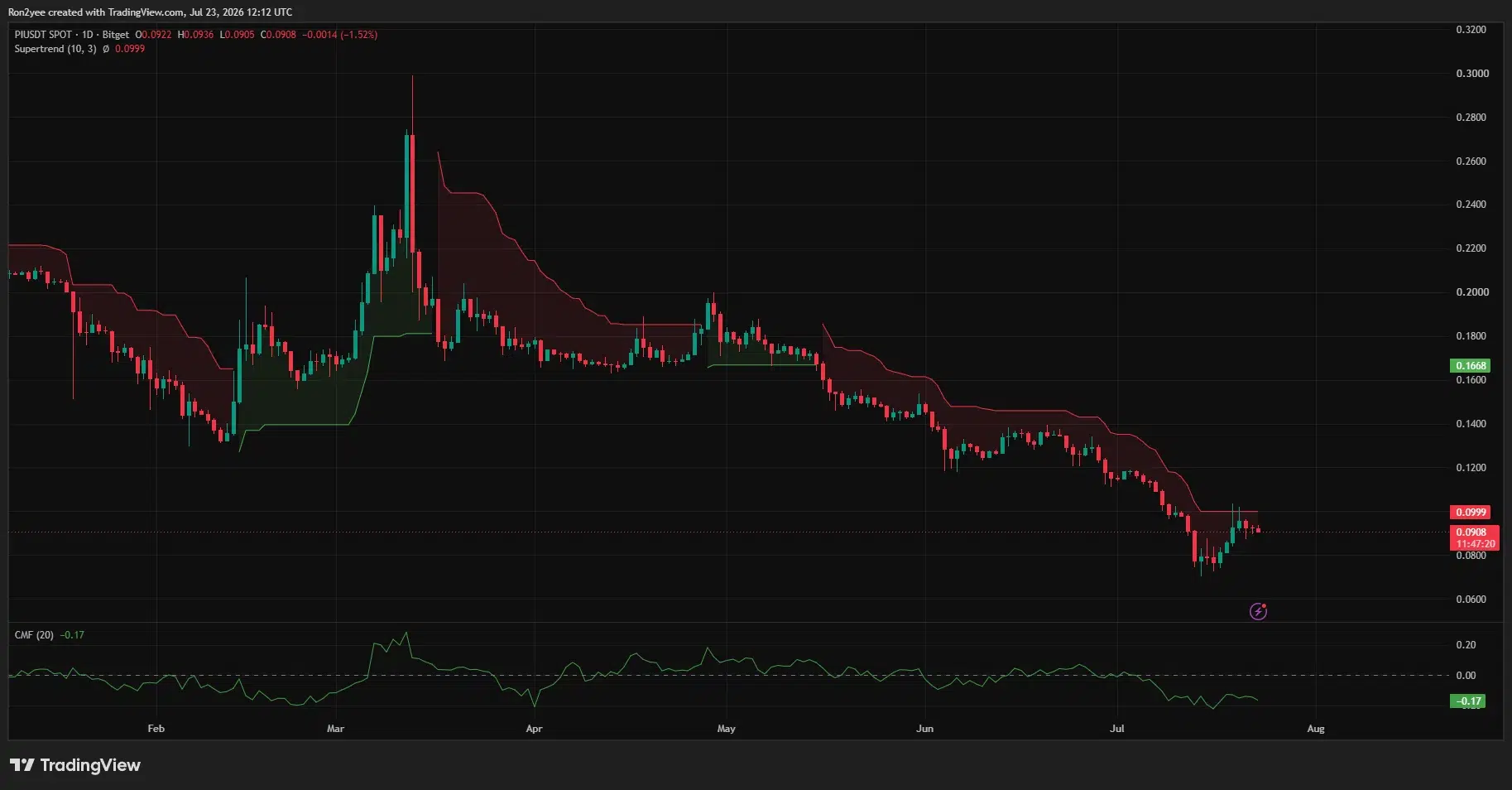
Pi Network price has fallen to $0.090 after its Protocol v25 launch triggered profit-taking, erased much of last week’s 39% rally, and returned sentiment to fear.
Summary
- Pi Network price has retreated to $0.090 after sellers rejected the rally above $0.10.
- Futures open interest has fallen to $9.6 million as traders reduce leveraged exposure.
- A break below $0.0895 could expose support at $0.085 and $0.080.
According to data from crypto.news, Pi Network (PI) price briefly reached $0.102 on July 20 after rebounding from its July 14 record low near $0.0704. Buyers failed to hold the token above $0.10, however, and the subsequent retreat left late entrants exposed as traders unwound positions accumulated before the network upgrade.
Protocol v25 went live on July 22 with BN254 cryptography and Poseidon hashing, which give developers new tools for privacy-preserving smart contracts and zero-knowledge applications. The Pi Core Team described the update as primarily focused on “improving network stability and reliability,” but the launch produced no immediate increase in application usage or demand for PI.
Supply pressure has added another obstacle. PiScan data previously showed about 127.5 million PI scheduled for release over 30 days, or an average of 4.25 million tokens each day. Miners who received tokens over several years can sell migrated balances, leaving every recovery dependent on enough demand to absorb the additional circulating supply.
Protocol v25 has turned into a sell-the-news event
Derivatives traders have reduced exposure since the rally stalled. According to CoinAnk data, PI futures open interest has dropped to roughly $9.6 million from a recent peak of $12.1 million. The decline shows that positions are being closed rather than replaced with fresh leveraged bets.
Open interest had risen from $9.11 million to $10.73 million during the first stage of the rebound, according to an earlier crypto.news report. It remained far below the $28 million recorded at the start of June and the $35 million reached during May’s rally, leaving PI without the derivatives participation needed for a leverage-led breakout.
Institutional demand has also remained scarce. PI lacks the spot exchange-traded products, corporate treasury purchases and deep derivatives markets available to larger cryptocurrencies. Pi Network Ventures announced a $100 million ecosystem fund in May 2025, but a crypto.news review found only one publicly disclosed investment of an unspecified size, limiting its measurable effect on token demand.
Macroeconomic conditions have meanwhile turned hostile for speculative altcoins. Brent crude climbed to $98 per barrel on July 23 as Middle East tensions expanded into the Red Sea, while traders raised the probability of a 25-basis-point Federal Reserve hike in July to 35% from 12% a week earlier. Odds of a September increase reached 55%, according to CME FedWatch data.
Technology shares added to the pressure after Alphabet’s higher capital-spending plans worried investors and Tesla reported negative quarterly free cash flow for the first time in more than two years. Commenting on the earnings, eToro global market strategist Lale Akoner noted:
“Alphabet is beginning to show that connection. Tesla still needs to prove that its ambitious projects can move from technological promise to commercial returns.”
Nasdaq 100 futures fell 0.28% before Thursday’s open, while two-year Treasury yields reached a 17-month high. Higher yields raise the cost of holding assets without cash flows and can draw liquidity away from small-cap tokens whose demand comes mainly from retail speculation.
PI’s daily chart has kept the long-term downtrend intact. Price remains below the Supertrend barrier at $0.0999, and the indicator will retain its bearish reading unless buyers reclaim that level on a daily closing basis. Chaikin Money Flow stands at minus 0.17, showing that selling volume has exceeded buying volume during the latest sessions.
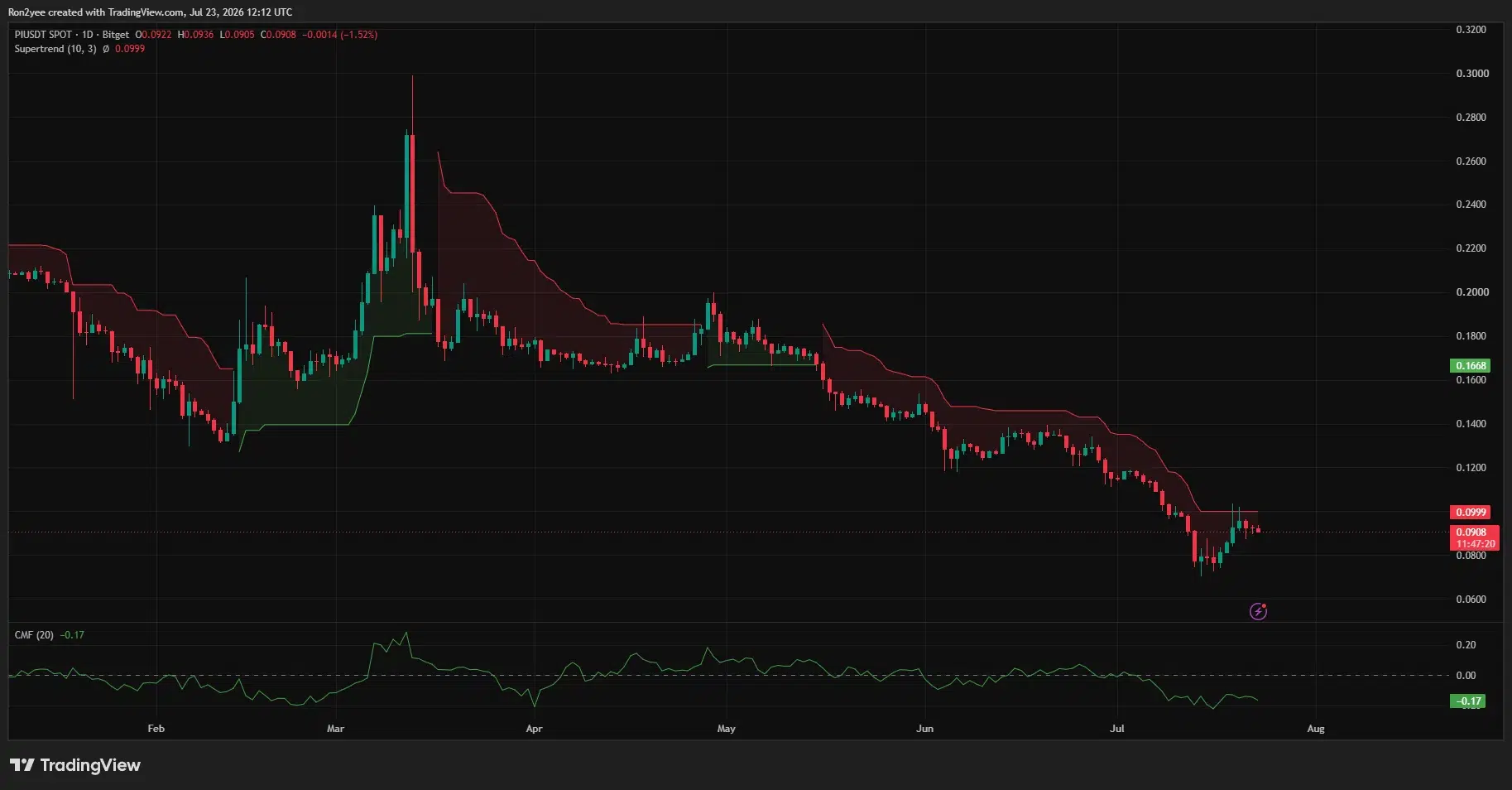
The 4-hour chart has formed a descending triangle after PI’s rejection above $0.10. Lower highs have compressed price against horizontal support at $0.0895, while the pattern’s upper boundary now crosses the $0.092–$0.093 area. A close above that boundary would weaken the setup and give buyers another chance to challenge $0.10.
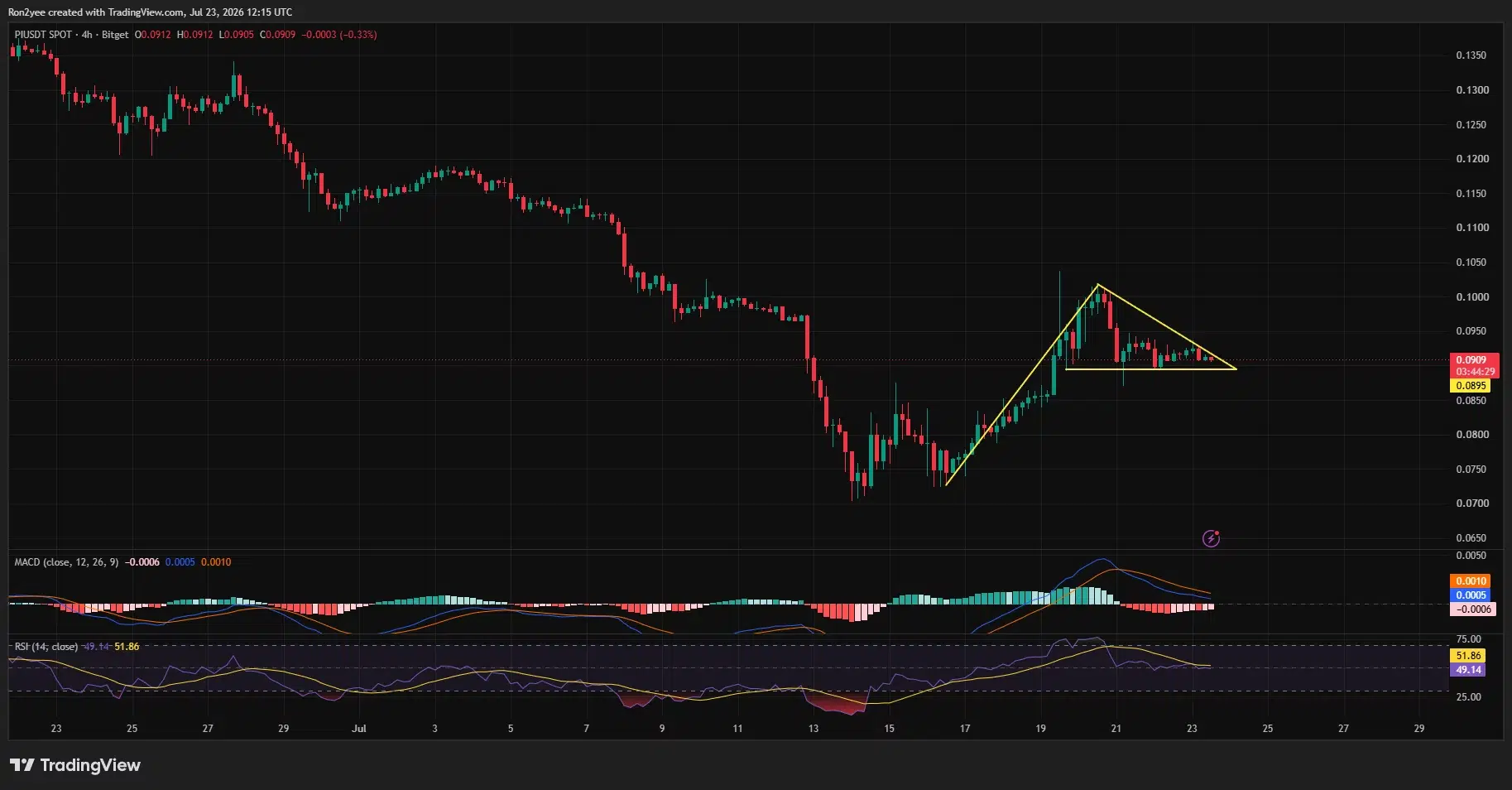
Momentum has also deteriorated. The 4-hour RSI has slipped to 49.14 and fallen below its moving average at 51.86. MACD has completed a bearish crossover, with the MACD line at 0.0005 beneath the signal line at 0.0010 and the histogram at minus 0.0006.
A break below $0.0895 would expose deeper losses
PI’s primary downside trigger sits at the triangle floor near $0.0895. A confirmed 4-hour close below that level would complete the bearish pattern and expose $0.085, followed by the July consolidation zone between $0.080 and $0.075. The record low near $0.0704 would become the final major support if selling accelerates.
A renewed oil surge, another rise in Treasury yields, or a hawkish Federal Reserve decision could deepen the risk-off move. Continuous token releases would add asset-specific pressure, particularly if open interest and spot volume continue to decline after the upgrade.
The bearish case would lose force if PI closes above $0.10, converts the Supertrend into support and attracts rising spot volume alongside higher open interest. Until those conditions appear, Protocol v25 remains a technical improvement whose market impact has not yet offset token dilution or the long-term downtrend.
Disclosure: This article does not represent investment advice. The content and materials featured on this page are for educational purposes only.
Form 13D/A BROOKFIELD INFRASTRUCTURE CORPORATION For: 23 July

Swiss bank BancaStato launches Bitcoin, ETH, SOL trading with Sygnum

Even Scottie Scheffler is Commenting on the Vikings’ QB Battle


-

 Fashion6 days ago
Weekend Open Thread – Corporette.com
-

 Politics6 days ago
The House | The City of London can help the new chancellor deliver growth in every postcode
-

 Crypto World6 days ago
Ripple Payments Joins MiCA With 14 Firms, Does It Mean Anything For XRP?
-
 Crypto World7 days ago
Two July Windows Left: The CLARITY Act’s Senate Fight and What Failure Means
-

 Politics4 days ago
Democrats look to World Cup watch parties to register thousands of voters
-

 Crypto World6 days ago
Ripple wins EU-wide access as ESMA adds it to MiCA register
-

 Crypto World3 days ago
Grayscale Files For Worldcoin ETF, WLD Registers Sharp Rise
-

 NewsBeat4 days ago
Unregistered fitter used Gas Safe logo on business flyers
-

 Tech3 days ago
Sail Virtually Aboard The “Itanic” With IA-64 Emulator
-
 Tech3 days ago
Turtle Beach Command Series KB7 review: a nifty screen-equipped gaming keyboard
-

 NewsBeat7 days ago
Registration is now open for March for Men with Kev 2026
-

 News Videos4 days ago
Big Money Is Entering XRP
-
 Business2 days ago
New Jersey voter registration controversy explained: How 6,600 noncitizens got on the rolls, and what happens next
-

 News Videos7 days ago
Money | Class 12 Economics | CBSE Board Exam 2026-27
-

 Business7 days ago
Banco Bilbao Vizcaya Argentaria, S.A. (BBVA) Discusses Global Macro Environment and Economic Outlook for Core Markets Transcript
-

 Crypto World6 days ago
Kaspersky exposes OkoBot’s 20-module crypto wallet attack
-

 Business6 days ago
Airlines warn Sunshine Protection Act could disrupt flight scheduling
-
 Entertainment2 days ago
Johnny Depp’s R-Rated Gothic Cult Classic Gets New Release Ahead of Sydney Sweeney Remake
-

 NewsBeat6 days ago
Durham County Council to send out electoral registration emails
-

 Crypto World6 days ago
MiCA Licensing Faces Delays as ESMA Adds 14 CASPs to Register
You must be logged in to post a comment Login