

Crypto World
Google Gemini AI Predicts Jaw-Dropping Micron Technology Stock Price by End of 2026

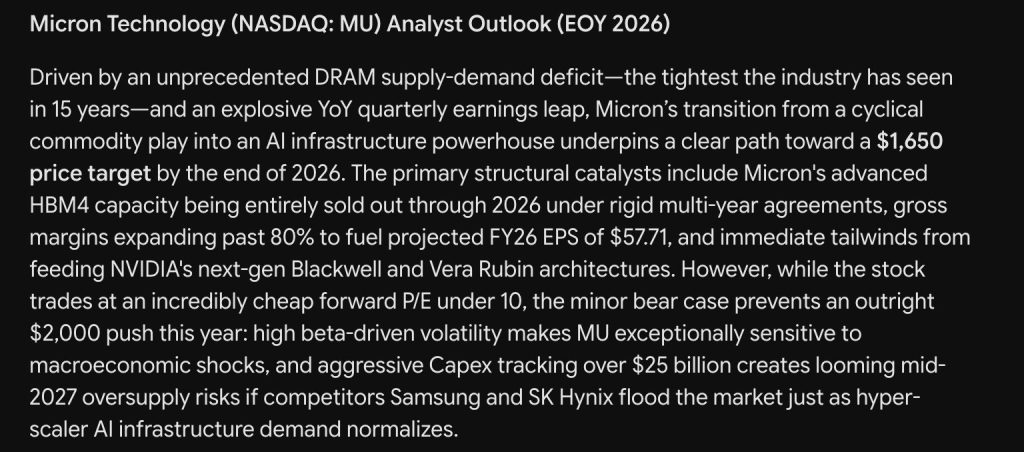
Google Gemini AI just predicts a number to Micron price prediction that treats the stock’s wild run this year as the beginning rather than the peak. The model sees $1,650 by the end of 2026, a fresh high for a name that started the year trading nowhere close to these levels.
The bull case centers on a supply crunch unlike anything the memory industry has seen in over a decade. Micron is riding an unprecedented DRAM supply demand deficit, described as the tightest the industry has experienced in 15 years.
That scarcity is showing up directly in the numbers, with an explosive year over year quarterly earnings leap fueling the entire move.
The bigger story, though, is a transformation in how the market views this company. Micron is shifting from a cyclical commodity play to something closer to an AI infrastructure powerhouse, and that shift in identity underpins the path toward $1,650.
The most important structural catalyst is that Micron’s advanced HBM4 capacity is entirely sold out through 2026 under rigid multi-year agreements, which lock in demand regardless of short-term market swings. Gross margins are expanding past 80%, fueling a projected fiscal 2026 earnings per share of $57.71.
On top of that, Micron is getting immediate tailwinds from feeding Nvidia’s next-generation Blackwell and Vera Rubin architectures, putting it directly in the supply chain of the biggest names in AI computing. Even with the stock’s massive run already behind it, it still trades at a forward price to earnings ratio under 10, which the model frames as remarkably cheap given the growth on display.
The bear case is fairly narrow but worth noting. High beta-driven volatility makes this stock exceptionally sensitive to any broader macroeconomic shock, meaning a market-wide pullback could hit shares harder than most.
Aggressive capital expenditures tracking over 25 billion dollars also create a real risk of oversupply by mid 2027 if competitors like Samsung and SK Hynix flood the market right as hyperscaler AI infrastructure demand eventually normalizes.
That combination of risks is exactly why the model stops short of calling for an outright push toward $2,000 this year.
Micron Rides A Supply Crunch Straight Into Uncharted Territory
The daily chart shows Micron at $1,048.51 after one of the most dramatic runs in this entire series, climbing from around $200 late last year to briefly touching highs above $1,230 just this week.
That kind of vertical move, especially the acceleration visible from May onward, is the definition of a parabolic breakout rather than a typical grinding uptrend.
Price recently pulled back from that intraday high near $1,232 down to the current level around $1,048, which looks like healthy profit taking after an earnings driven spike rather than a trend reversal.

The chart shows clear support building near $1,000, a round number level that price has tested and held multiple times over the past few sessions. Resistance now sits at that recent high near $1,232, with the broader trendline from the entire 2026 run continuing to point sharply upward.
Given the size and speed of this move, momentum on the daily candles still looks strongly bullish overall, even with this short term cooling off period factored in.
The pullback from the highs reflects normal digestion after a binding multi year HBM4 contract story and a blowout earnings beat, not a change in the underlying trend.
If Micron can hold the $1,000 level and push back toward its recent highs, the climb toward that $1,650 target starts looking like a continuation of the same story that has driven this stock all year rather than a stretch into new territory.
Bitcoin Hyper: Building the Layer Bitcoin Was Always Missing, Here is Why Gemini AI Predicts Its The Next Big Thing
The largest returns in crypto rarely go to the people who wait for confirmation. They go to early supporters who back the infrastructure before the rest of the market catches on.
Bitcoin Hyper is positioned for exactly that. The project brings Solana-grade smart contracts and execution speed directly to Bitcoin, without touching the security model that makes Bitcoin the most trusted network in crypto.
Lower fees, higher throughput, full programmability, all running on top of Bitcoin rather than competing with it.
Inside the ecosystem, users can stake for rewards, swap assets, and interact with smart contracts while their funds stay secured within the Bitcoin network itself.
The presale has already raised $32.8 million, pulling attention from major investors and prominent crypto platforms. That momentum has made $HYPER one of the most talked-about presales this year.
The price is still fixed at early-stage levels. To participate, head to the official Bitcoin Hyper website and connect a supported wallet such as Best Wallet. Credit and debit card purchases are also accepted directly on the site.
The post Google Gemini AI Predicts Jaw-Dropping Micron Technology Stock Price by End of 2026 appeared first on Cryptonews.


ZachXBT says AscendEX users are experiencing withdrawal delays, with some requests not being processed at all.
Several individuals reported that the transactions have been stalled for days, sometimes even weeks.
AscendEX Users Report Withdrawal Issues
The on-chain sleuth issued a warning in his Telegram group, alerting members to potential liquidity challenges.
“I have observed multiple reports that the centralized exchange AscendEX (formerly Bitmax) is delaying user withdrawals for days/weeks or not processing withdrawals,” he wrote.
After reviewing Arkham and TRM for known hot wallets, ZachXBT has observed that the exchange’s reserves seem to be lacking the large-cap tokens like USDT, ETH, and SOL. This indicates that the platform is quite likely to have some liquidity problems. He also provided some Solana, Tron, and EVM wallet addresses used in the investigation.
According to community reports, users who have tried to move funds out of AscendEX have seen their transactions stuck in “initiating” for over a week.
On Reddit, one user described their experience, stating that the withdrawals don’t even produce a transaction ID. Their funds were debited from their available balance and are now locked without any explanation from the platform, they said.
For its part, the exchange is reportedly yet to offer any meaningful assistance or explanations across its support channels and has also not issued any public response to the concerns.
AscendEX, formerly known as Bitmax, was founded by George Cao and Ariel Ling in 2018. North Korea’s Lazarus Group hacked the platform in December 2021 for $78 million.
ZachXBT Flags JuCoin Reserves Amid Withdrawal Problems
This isn’t the first time an exchange has faced scrutiny over transaction processing delays. ZachXBT recently flagged JuCoin for similar problems, alleging that its reserves are not backed by liquid assets.
The blockchain detective questioned JuCoin’s reported $511 million reserves, saying most of this appeared to be tied to USDC and USDT issued on its JuChain without clear backing. He also challenged the publicly listed team, saying that the project seemed to be out of their control, but the team responded, saying the disruptions had been caused by ongoing upgrades and restructuring.
However, affected users continued to ask for clear timelines, transparency, and assurance that their assets are available for transfer.
Attackers have also exploited JuDAO for $225,000 in April and a $20 million incident last year. Meanwhile, the East Asian exchange has rebranded several times in the past.
The post ZachXBT Warns AscendEX Users of Potential Liquidity Issues and Delayed Withdrawals appeared first on CryptoPotato.
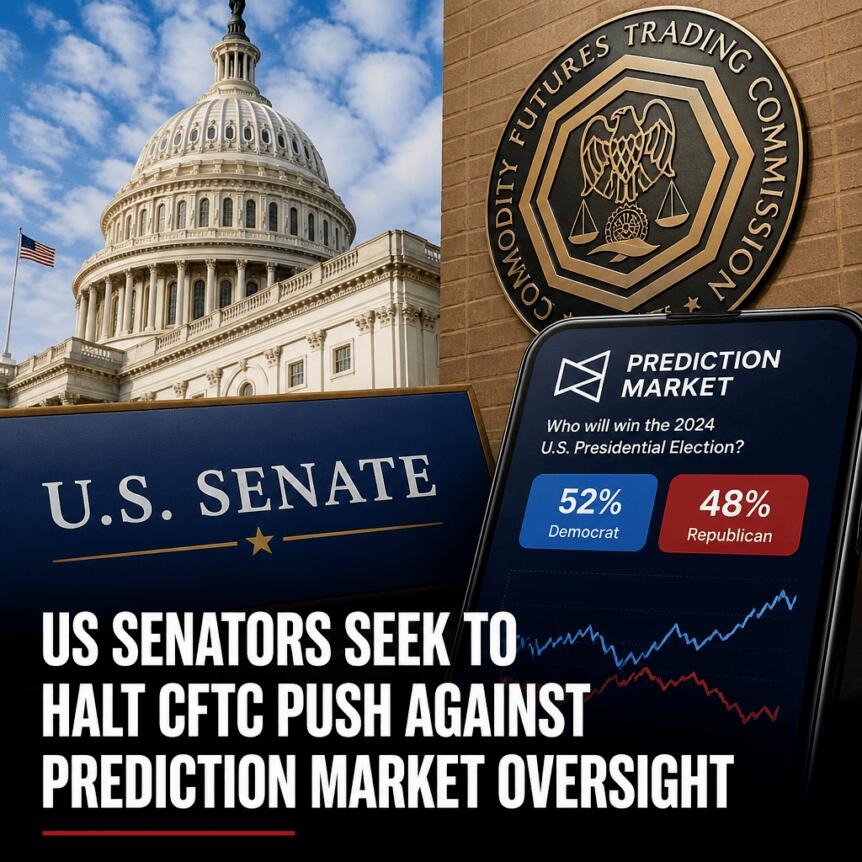
A group of 17 Democratic US senators has asked the Senate Appropriations Subcommittee on Financial Services and General Government to stop the Commodity Futures Trading Commission (CFTC) from using federal funds to pursue litigation against state authorities over prediction markets. The push targets CFTC Chair Michael Selig’s defense of the agency’s view that it has “exclusive jurisdiction” over such platforms.
In a Wednesday letter to the chair and ranking member of the subcommittee, Senator Richard Blumenthal, Senator Jeff Merkley, and 15 other Democrats urged Congress to block funding that would support Selig’s legal campaign. The senators argue that the CFTC’s courtroom strategy could enable online prediction markets to sidestep state consumer protections, creating what they describe as a “race-to-the-bottom in gambling.”
Key takeaways
- 17 Democratic senators want appropriators to prevent the CFTC from using federal funds for Chair Michael Selig’s lawsuits against state-level prediction market enforcement.
- The letter criticizes the CFTC’s argument of “exclusive jurisdiction” over prediction markets and the agency’s position that event contracts qualify as “swaps.”
- The CFTC is already involved in prediction market litigation across multiple states, while some affected companies have sued state regulators in support of the CFTC’s theory.
- Potential Supreme Court review could hinge on how the Court applies federal authority and state power, building on its 2018 sports betting decision in Murphy v. NCAA.
Senators challenge CFTC funding amid prediction market lawsuits
The senators’ letter focuses on whether appropriations should underwrite the CFTC’s legal fights against state gaming regulators. Blumenthal and Merkley led the effort, warning that using federal resources for Selig’s litigation could shift outcomes in ways the senators view as harmful to consumer safeguards.
They specifically framed the lawsuits as part of a broader “campaign of litigation and intimidation,” contending that it risks positioning the CFTC as an “instrument and enabler” for prediction markets aiming to bypass state oversight. The concern, as laid out in the letter, is that states’ regulatory and consumer-protection frameworks could be weakened if companies conclude they can trigger federal enforcement that overrides state rules.
According to the letter, the senators are asking subcommittee leadership to block the CFTC from drawing on federal funding for these cases.
Source: Senator Richard Blumenthal letter to Senate Appropriations Subcommittee
Selig’s “exclusive jurisdiction” stance and the “swap” theory
At the center of the senators’ complaint is the CFTC’s legal position. Selig has argued that prediction-market event contracts on certain platforms fall within the CFTC’s mandate because they function as “swaps,” giving the agency what it describes as “exclusive jurisdiction” over the market.
That approach has been controversial because it directly collides with how state regulators view gambling and consumer protection. Several platforms and companies have responded by contesting state actions, and at least some of them have supported the CFTC’s framing by pursuing their own legal challenges.
Earlier coverage from Cointelegraph noted that the CFTC has engaged in legal fights tied to prediction markets involving regulators in Connecticut, Illinois, Arizona, Kentucky, Wisconsin, New York, Minnesota, Rhode Island, and New Mexico as of June. Companies mentioned in the reporting include Kalshi and Polymarket, both of which have filed lawsuits against state authorities.
Cointelegraph: CFTC litigation involving multiple state regulators
Cointelegraph: Kalshi lawsuit supporting the CFTC’s position
What could happen in the courts: from state authority to possible Supreme Court review
The senators’ intervention comes as the prediction market enforcement battle continues at the state and federal levels. The stakes are heightened by commentary from legal analysts that one of the disputes involving the CFTC and state gaming regulators could eventually reach the US Supreme Court.
A key benchmark is the Court’s 2018 decision in Murphy v. National Collegiate Athletic Association, in which the justices held that states have authority to regulate sports betting. If the Supreme Court agrees to hear a case from the current wave of prediction-market litigation, it could revisit the boundaries of state regulatory power in situations involving federal agencies and market structure questions.
Still, readers should note what remains uncertain: Supreme Court review is not guaranteed, and the eventual scope of any high-court ruling would depend on how the legal issues are framed in the case that reaches the docket.
Congress is debating broader regulatory lines as CLARITY advances
The letter also lands in the middle of an active policy debate over how digital assets should be regulated. The senators’ concerns about the CFTC’s role in prediction markets intersect with the Senate’s anticipated vote on the Digital Asset Market Clarity (CLARITY) Act, a bill that would establish separate regulatory responsibilities for the CFTC and the Securities and Exchange Commission over digital assets.
Cointelegraph previously reported that gaming organizations petitioned the Senate to include language barring sports event contracts in the CLARITY Act, arguing the CFTC was not created to regulate such wagers. That political push underscores a core tension: whether certain categories of event-based contracts should be treated as commodities and swaps under CFTC authority, or instead handled through state gaming rules.
Cointelegraph: Gaming organizations petition Congress on CLARITY language
Meanwhile, Selig leads the CFTC as its sole commissioner and chair, directing the agency’s policy agenda. While the CFTC is expected to ultimately include a bipartisan group of five commissioners, Trump had not announced any plan to fill vacancies as of Friday, according to the reporting referenced in the source.
That governance context matters because it affects how quickly any policy disagreements might be reconciled at the agency level. For market participants, it also means that enforcement posture can be closely tied to the leadership structure at the time of litigation.
For now, the most immediate watch item is whether the appropriations subcommittee actually blocks federal funding tied to Selig’s legal campaign, and how courts respond in the active state cases. Separately, the progress of the CLARITY Act—and how lawmakers choose to define the boundary between CFTC jurisdiction and state authority—could determine whether these disputes are narrowed by statute or continue to play out room by room in court.
Base, the Ethereum Layer 2 network incubated by Coinbase, halted block production for the second time in two days on Friday, arriving hours before a scheduled activation of its new B20 token standard on mainnet. The second stall began at 15:33 UTC Friday when Base's status page flagged block… Read the full story at The Defiant


Growth in the value of tokenized real-world assets has stalled. The total value of distributed real-world assets (RWAs), meaning tokenized assets that can be freely transferred between wallets, slipped about 1.4% over the past 30 days to roughly $31.5 billion, according to data from rwa.xyz, the… Read the full story at The Defiant


OpenAI has introduced GPT-5.6 models named Sol, Terra, and Luna, prompting comparisons with some of the crypto industry’s best-known blockchain projects.
Summary
- OpenAI has launched a limited preview of GPT-5.6 models named Sol, Terra, and Luna.
- The model names sparked discussion among crypto users due to their resemblance to Solana and Terra.
- OpenAI said the names indicate model capabilities and are not linked to cryptocurrency projects.
According to OpenAI, the company has begun a limited preview of three GPT-5.6 models called Sol, Terra, and Luna.
The announcement quickly drew attention across crypto-focused social media because the names closely resemble Solana’s SOL token and the Terra ecosystem, whose LUNA token became synonymous with one of the industry’s largest collapses in 2022.
The model names have revived memories of major crypto projects
In its blog post, OpenAI described Sol as its flagship GPT-5.6 model, while Terra is designed as a balanced option for everyday tasks. Luna, according to the company, serves as the fast, lower-cost entry point within the new lineup.
OpenAI said the three models are positioned between its high-end GPT-5.5 offering and more affordable options. Sol also introduces new “max” and “ultra” modes for advanced reasoning and agent-based workflows. The company added that the GPT-5.6 family delivers stronger coding, scientific research, and cybersecurity capabilities than earlier models.
Although the names immediately caught the attention of crypto users, OpenAI did not associate them with digital assets. Instead, the company said the names represent different capability levels within the GPT-5.6 series.
Even so, the similarities proved difficult for crypto traders to ignore. Sol shares its name with the ticker used by Solana’s native token, while Terra and Luna revive the branding of the Terra blockchain ecosystem, which collapsed in 2022 after the failure of its algorithmic stablecoin erased tens of billions of dollars in market value.
The release comes only days after OpenAI introduced Jalapeño, its first custom-built artificial intelligence chip developed with Broadcom. According to OpenAI, the processor was built in nine months and is designed for inference workloads powering products such as ChatGPT, Codex, and future AI agents.
The company said developing its own hardware will give it more flexibility as demand for AI computing continues to increase.
Rollout remains limited while safety testing continues
Rather than making GPT-5.6 immediately available to everyone, OpenAI said the launch is a limited preview as additional safety testing continues before a broader public release. The company also noted that Sol’s new reasoning modes are intended for more complex tasks that require extended processing.
The preview follows reports that the White House had asked OpenAI to limit the initial rollout of GPT-5.6. While the company acknowledged the limited release, it did not link that decision to any government request in its announcement.
Separately, Amazon withdrew from distributing Artificial, a film centered on OpenAI chief executive Sam Altman that also features Elon Musk, while continuing discussions with the filmmakers about finding another distributor. The decision came as Amazon expanded its commercial relationship with OpenAI through a multi-billion-dollar investment commitment tied to future milestones.
For crypto markets, however, it was the naming of Sol, Terra, and Luna that generated the strongest reaction online, reviving discussion around two of the industry’s most recognizable blockchain brands despite OpenAI stating that the names were selected solely to distinguish the capabilities of its latest AI models.

TLDR:
- Chainlink’s Build program supported over 80 projects, distributing roughly $20M in project tokens to LINK stakers.
- New commercial agreements will require fees in LINK or liquid assets, which are then converted directly into LINK.
- Proceeds from new Build agreements will be programmatically converted to LINK and directed to the Chainlink Reserve.
- The final Chainlink Rewards season closes claims on July 7, 2026, marking the end of Build-related token rewards.
Chainlink is restructuring its Build program by moving away from early and mid-stage project token rewards toward commercial agreements paid in LINK.
The transition marks a strategic pivot aimed at supporting sustainable network economics. Proceeds from new agreements will be programmatically converted to LINK and directed to programs like the Chainlink Reserve. Claims for the most recent Rewards season end on July 7, 2026.
Build Program Concludes Token-Based Reward Structure
The Chainlink Build program has supported over 80 projects since its launch. Teams received technical support, strategic guidance, ecosystem connections, and market visibility through the program.
Approximately $20 million worth of Build project tokens were made available to eligible LINK stakers through Chainlink Rewards.
Broader market conditions and shifting project funding models prompted this structural change. Chainlink Labs periodically reviews its programs to ensure resources drive the greatest long-term network growth. The token-based reward model no longer aligned with those goals under current market conditions.
Chainlink Labs confirmed the pivot in an official statement, noting that the ecosystem is “continually evolving how it supports the growth of early and mid-stage projects.”
The organization acknowledged that as market conditions shifted, the Build program’s structure had to adapt accordingly. Existing arrangements under the program are now being concluded.
New commercial agreements are being established on a case-by-case basis for historically participating projects. The transition away from project tokens reflects a more liquid and conversion-ready payment approach. The most recent Rewards season marks the final distribution of Build-related token rewards.
LINK Conversion Model to Power Chainlink Reserve and Ecosystem Growth
Eligible participants must complete their claims before July 7, 2026, when the claims window closes permanently. Product and engineering resources previously supporting Rewards will shift to higher-priority economic initiatives. Those resources will instead benefit the broader Chainlink community going forward.
New commercial agreements will require fees paid in LINK or other liquid assets that can be readily converted. Chainlink stated that proceeds from these agreements are expected to be “programmatically converted to LINK” and used to support network growth. The Chainlink Reserve is among the programs set to benefit from this funding flow.
This model creates a more direct economic feedback loop between ecosystem activity and LINK utility. Rather than holding early-stage tokens of uncertain liquidity, the network gains direct LINK exposure. That shift strengthens the long-term sustainability of Chainlink’s economic structure.
Future ecosystem growth programs will focus on engaging with strategically aligned projects rather than broad early-stage support.
Chainlink Labs stated it will continue “working with projects in refining how growth programs support early-stage builders.” The Build program’s evolution reflects the broader maturation of Chainlink’s network economics.

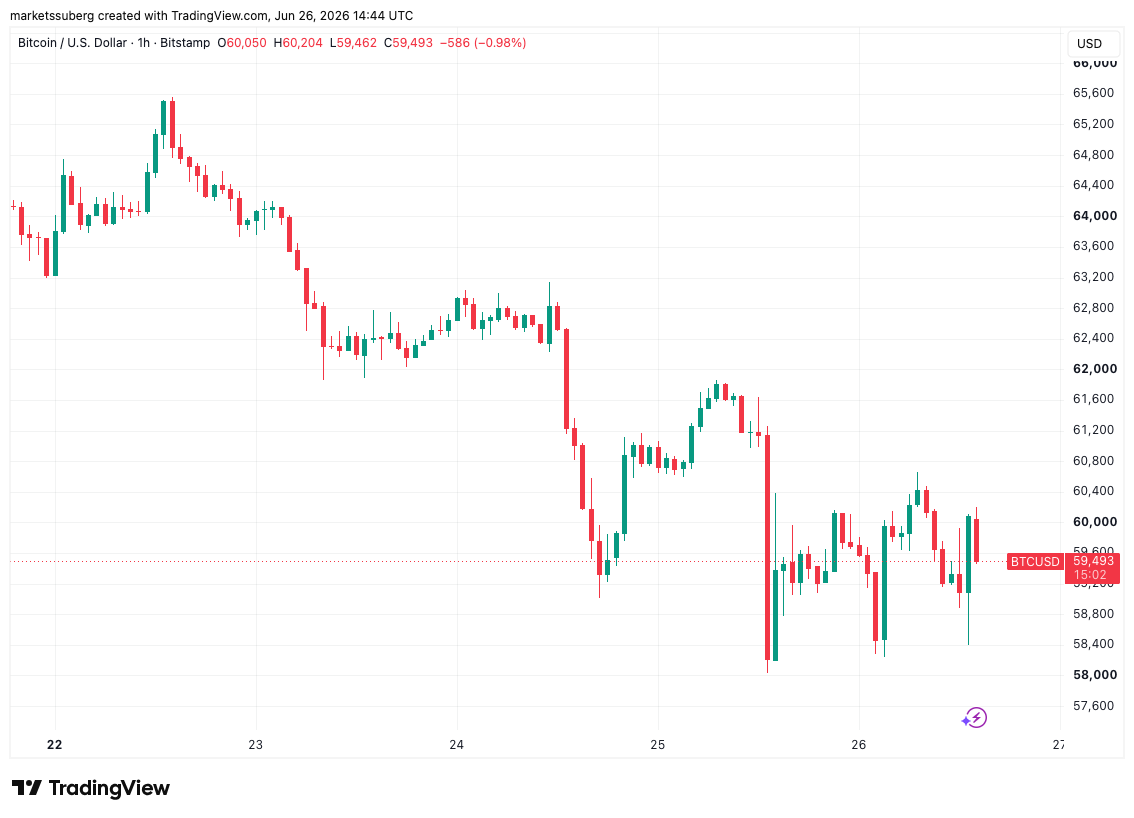
Bitcoin (BTC) struggled to reclaim $60,000 on Friday amid continued global market volatility.
Key points:
- Bitcoin closes below $60,000 on daily time frames for the first time since September 2024.
- Asian stock markets see another day of major losses on tech-stock concerns.
- BTC price analysis hopes for a reclaim of the 200-week trend line as the bull case.
Bitcoin risks $60,000 resistance flip as tech selling persists
Data from TradingView showed that prior support was increasingly becoming the bulls’ new hurdle after Bitcoin’s first sub-$60,000 daily close since September 2024.
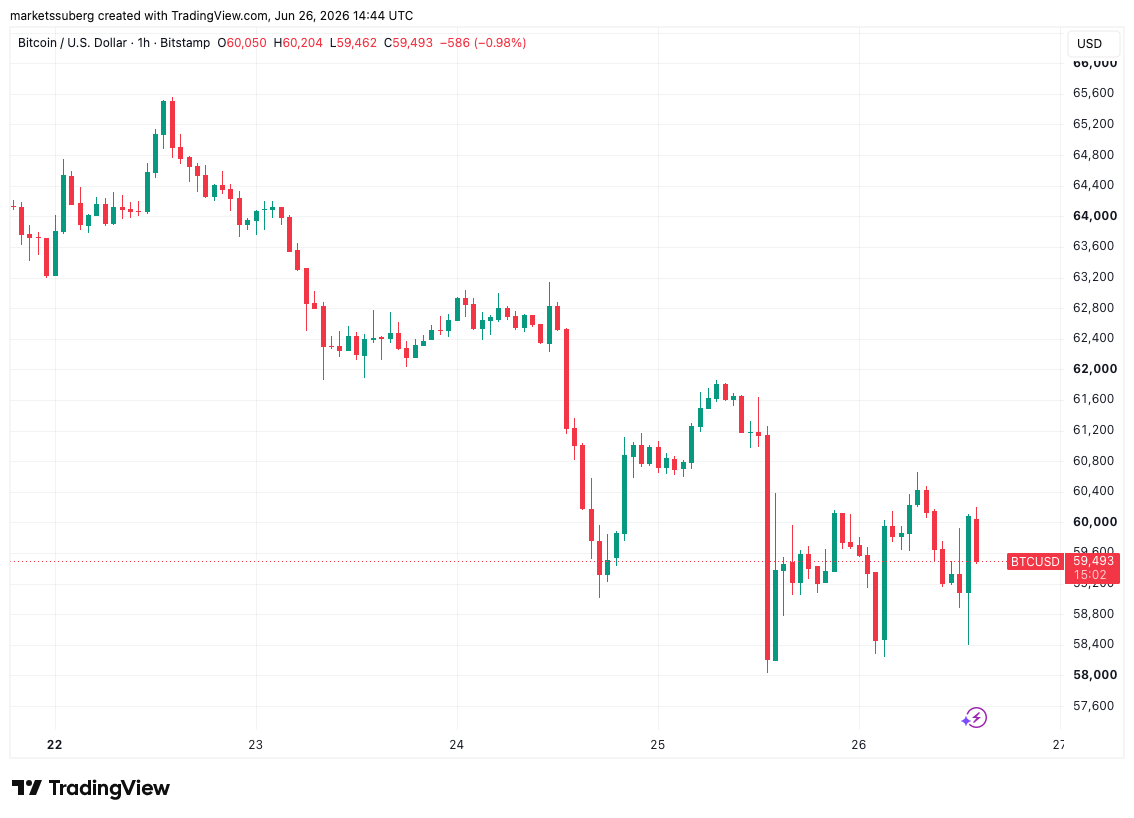
BTC/USD one-hour chart. Source: Cointelegraph/TradingView
Asia stock markets saw more downside on the day, with South Korean circuit-breakers kicking in on a new 8% crash.
Like on Tuesday, US stocks managed to avoid contagion, with the S&P 500 and the Dow Jones in the green at the time of writing.
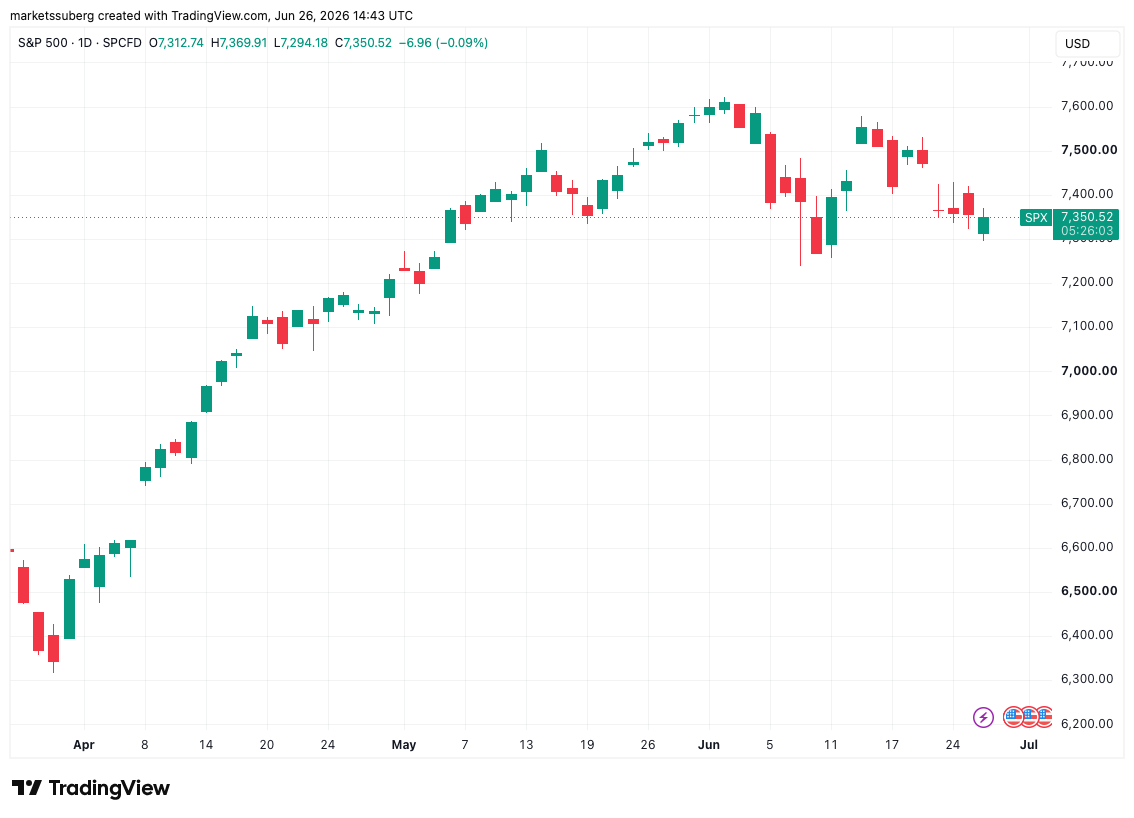
S&P 500 one-day chart. Source: Cointelegraph/TradingView
Surrounding the weakness, tech-stock performance remained a popular talking point. Earlier, Micron Technologies boosted the mood with stronger-than-expected earnings data.
Trading resource The Kobeissi Letter suggested that a broader bullish turnaround could already be due.
“Most people do not realize how many tech giants are already deep bear market territory,” it wrote in a post on X.
Kobeissi noted that many major tech companies were already down more than 50% versus their all-time highs, with crypto exchange Coinbase leading at -69%.
“The S&P 500 won’t tell you this,” it added.
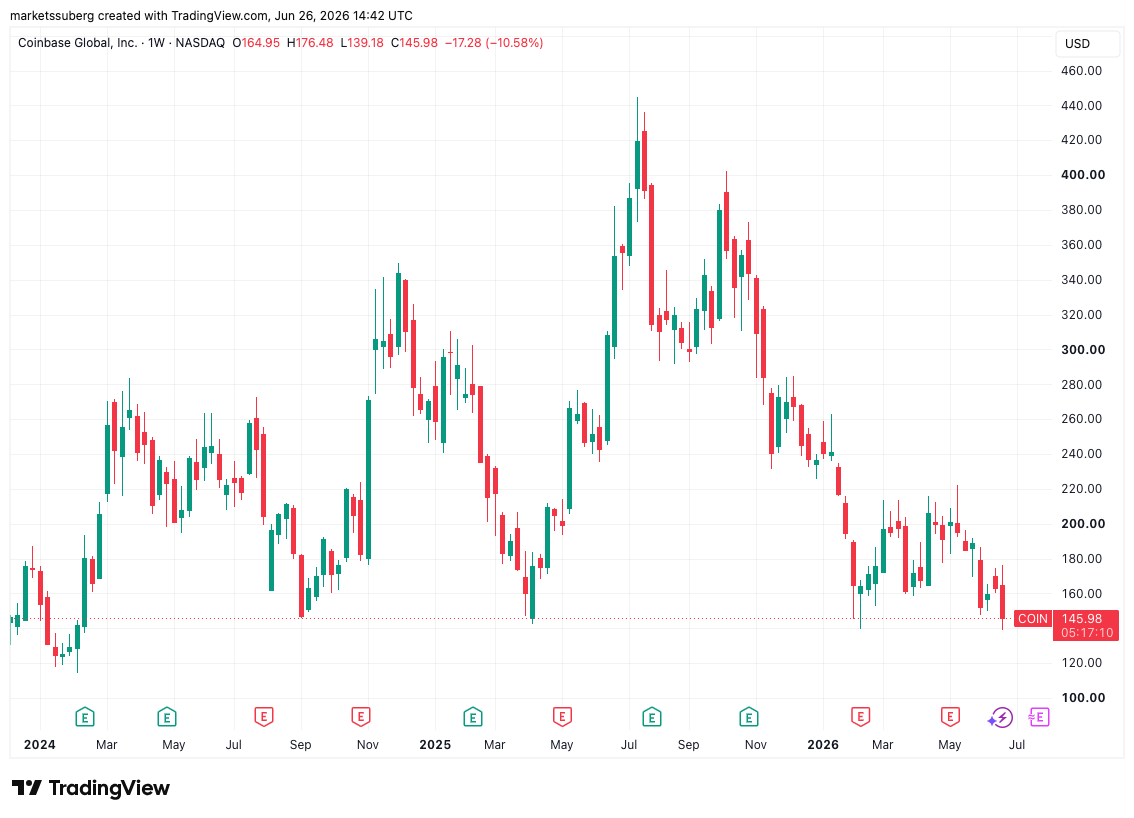
Coinbase stock one-week chart. Source: Cointelegraph/TradingView
In its latest analysis, trading company QCP Capital stressed the influence of US inflation trends on risk assets going forward.
As Cointelegraph reported, the May print of the Personal Consumption Expenditures (PCE) index, known as the Federal Reserve’s “preferred” inflation gauge, recorded its highest year-on-year increase since mid-2023.
“Core PCE is nowcast at 3.30%, while headline PCE is nowcast at 3.82%, both still above target,” QCP wrote.
“The Fed’s 2026 inflation forecast has also moved up to 3.6%, from 2.7%, reinforcing the view that inflation, rather than growth, remains the binding constraint.”
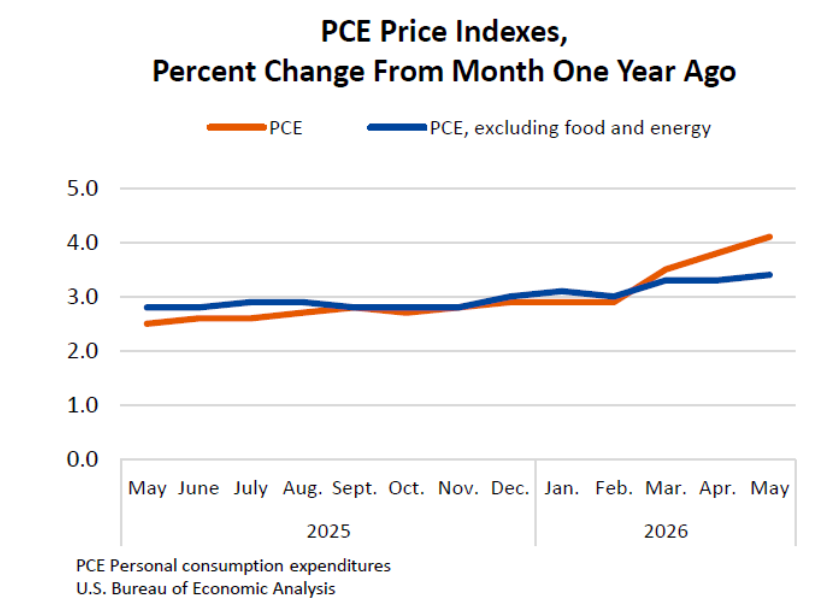
US PCE Index one-month % change (screenshot). Source: Bureau of Economic Analysis
BTC price 200-week trend line reclaim in focus
Looking at the short term, crypto trader and analyst Michaël Van de Poppe asked whether BTC price action would continue its downward trend.
Related: BTC price four-year trend calls for $76K as analysis says Bitcoin ‘not broken’
“It’s an interesting day for Bitcoin,” he told X followers, noting the upcoming quarterly options expiry event.
Van de Poppe drew attention to the performance of Strategy, the company with the world’s largest Bitcoin treasury, and its Bitcoin funding vehicle, Stretch (STRC).
“In all honesty, the fact that STRC has seen a relatively big drop yesterday and Bitcoin essentially stalled at $60,000 is not a weak signal. Other than that, there’s a bullish divergence on the daily timeframe, which is still far from confirmed,” he continued.
“It can signal that we’re bouncing back upwards, and, yes, the markets need to bounce back upwards in order to close above the 200-Week MA.”
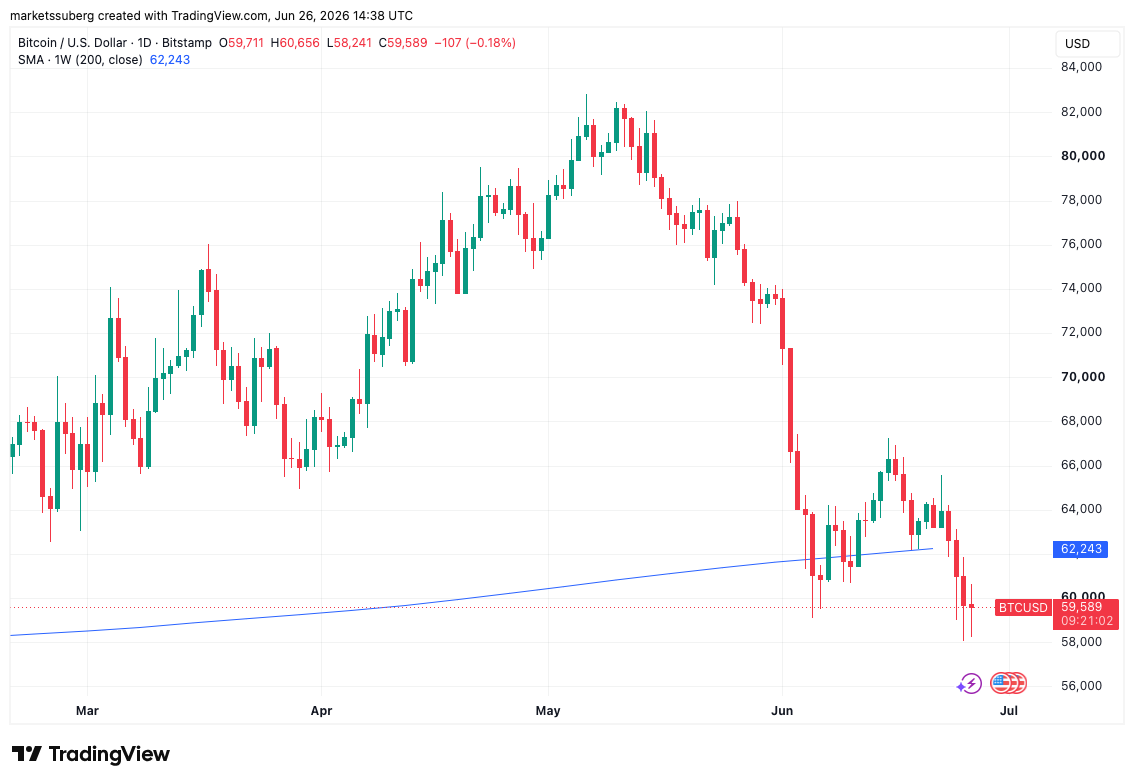
BTC/USD one-day chart with 200-week SMA. Source: Cointelegraph/TradingView
The trend line in question, the 200-week simple moving average (SMA), stood at $62,243 at the time of writing.


Ripple's RLUSD stablecoin went live in Japan on Wednesday after receiving approval from Japan's Financial Services Agency, becoming among the first foreign-issued stablecoins classified under Japan's revised Payment Services Act. Ripple and SBI Holdings announced the launch on June 24, distributing… Read the full story at The Defiant
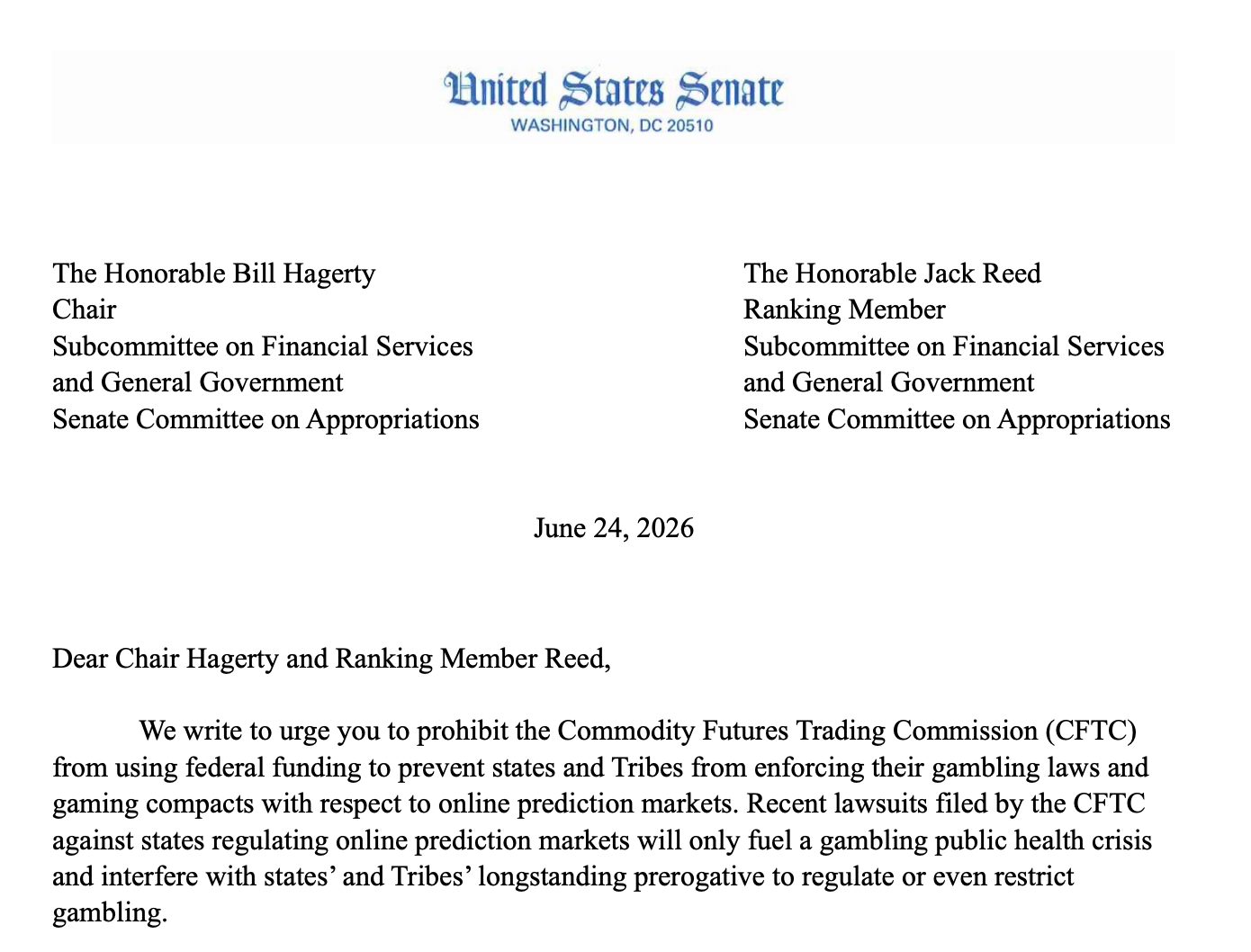
A group of 17 Democratic US senators is pressing leadership in a key committee to address the Commodity Futures Trading Commission (CFTC) using federal funds in lawsuits against state-level authorities cracking down on prediction markets.
In a Wednesday letter to the chair and ranking member of the Senate Appropriations Subcommittee on Financial Services and General Government, Senator Richard Blumenthal, Senator Jeff Merkley and 15 other Democrats urged the committee leadership to block the CFTC from using federal funds in Chair Michael Selig’s legal fights against state gaming authorities. Selig has defended the agency’s position that the CFTC has “exclusive jurisdiction” over prediction markets by claiming that the event contracts on the platforms qualify as “swaps” under its purview.
“Through engaging in this campaign of litigation and intimidation, the CFTC risks becoming an instrument and enabler of online prediction markets’ efforts to bypass states’ consumer protections and oversight, creating a race-to-the-bottom in gambling,” said the senators.
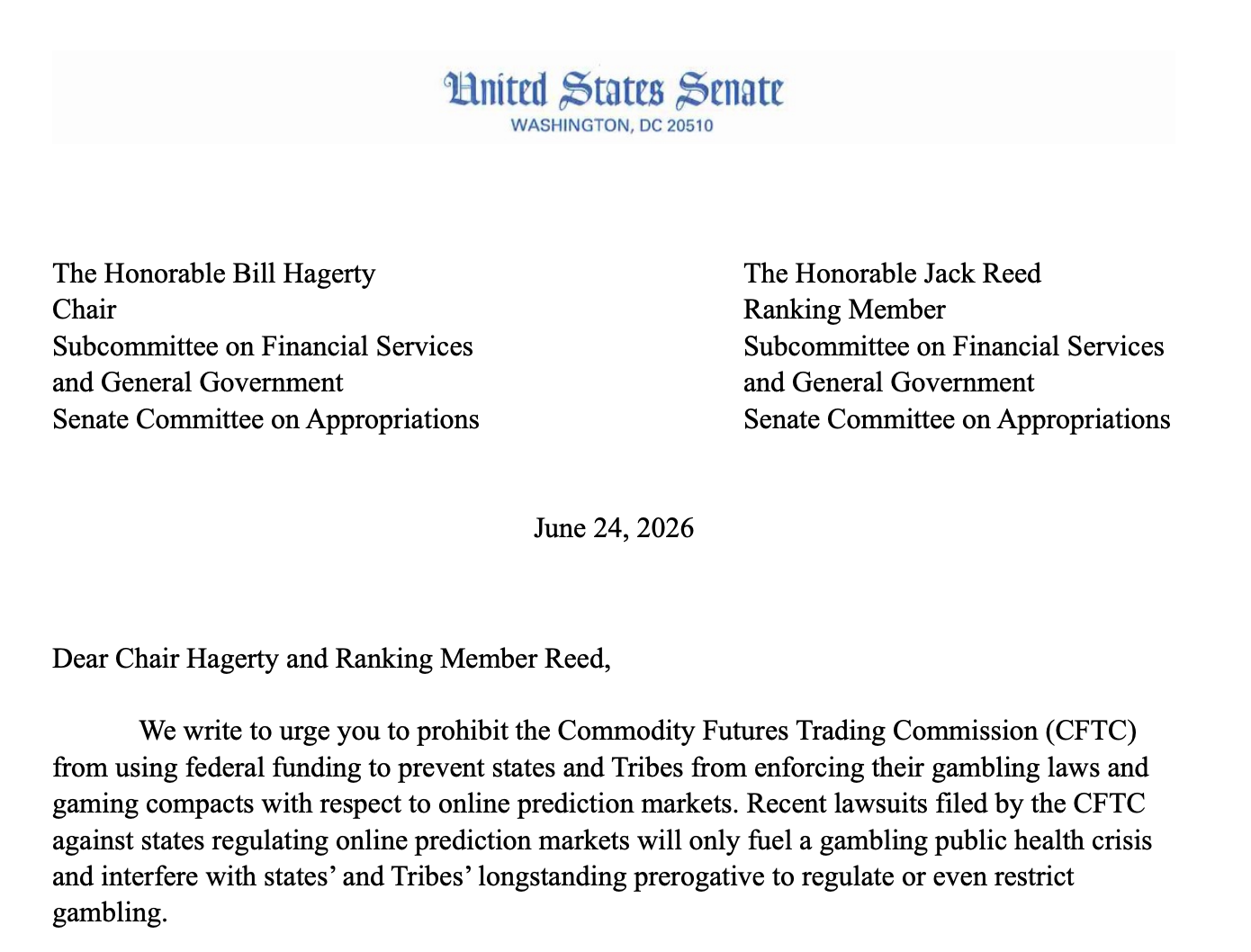
Source: Senator Richard Blumenthal
The CFTC has engaged in legal fights involving prediction markets in Connecticut, Illinois, Arizona, Kentucky, Wisconsin, New York, Minnesota, Rhode Island and New Mexico as of June. Some of the companies involved, including Kalshi and Polymarket, have filed their own lawsuits against state authorities, backing the CFTC’s position.
Related: 21shares trims 2026 crypto forecasts despite institutional adoption gains
The ongoing legal battles have led some experts to expect that one of the cases involving the CFTC and state gaming regulators could ultimately reach the US Supreme Court. In its 2018 ruling in Murphy v. National Collegiate Athletic Association, the Court held that individual states have the authority to regulate sports betting. If the justices grant a writ of certiorari in one of the current cases, they could revisit questions about the scope of that authority.
Selig steers CFTC alone amid broader debate over the agency’s authority
As the sole commissioner and chair of the CFTC, Selig has unilaterally led the agency’s policy agenda under US President Donald Trump, vowing to go after state authorities that crack down on prediction markets. While the CFTC’s leadership is expected to consist of a bipartisan group of five commissioners, Trump has not announced any intention of filling the seats as of Friday.
Selig’s actions come as the US Senate is expected to soon vote on the Digital Asset Market Clarity (CLARITY) Act, which would establish separate regulatory roles for the CFTC and Securities and Exchange Commission over digital assets. Last week, gaming organizations petitioned the Senate to add language barring sports event contracts in the CLARITY Act, arguing that the CFTC wasn’t created to regulate such wagers.
Magazine: Bitcoin slides to $58K, XRP hits $1 but onchain data promising: Market Moves


Bitcoin found some footing around $60,000 on Friday after this week’s selloff, but the biggest gains came from decentralized finance (DeFi) and the Solana ecosystem.
Leading the advance was the native token of Aave , the largest DeFi lending protocol, which jumped 19% over the past 24 hours. CoinDesk reported Thursday that crypto exchange Kraken is exploring a strategic investment tied to the lending protocol, acquiring a 15% stake at a $385 million valuation.
Aave founder Stani Kulechov pushed back in an X post against the suggestion that Aave assets could be sold at a steep discount. He reiterated that all protocol revenue — currently running at an annualized $134 million, he said. — flows to the Aave DAO and ultimately benefits AAVE token holders under the protocol’s recently adopted “Aave Will Win” framework.
Kulechov also teased “Aavenomics 3.0,” an upcoming overhaul for the token’s design that will introduce an automated buyback mechanism.
Solana activity boosted by tokenized stocks
Solana (SOL), the layer-1 blockchain known for its fast speed, and its ecosystem also outperformed, with SOL climbing nearly 10% on Friday.

Alex Tuch excited to join Capitals after losing to team in ’18 Stanley Cup Final

Drone vs. shoplifter: Watch how Redmond PD tracks an alleged thief from high in the sky

‘Rare natural phenomenon’ spotted over Darlington after heatwave


-

 Entertainment6 days ago
Renter of Home in Anne Heche Crash Denies Settlement With Son
-
 Sports3 days ago
Two goals and an assist by sheer aura: Cristiano Ronaldo just entered the World Cup chat
-

 Tech4 days ago
Microsoft accidentally kills epic Outlook email threads
-

 Business6 days ago
Soccer-U.S. defends Iran World Cup travel restrictions, says discussions ongoing
-

 Fashion5 hours ago
Weekend Open Thread: Staud – Corporette.com
-

 Politics16 hours ago
The House | Manchesterism won’t survive the painful trade-offs unless it gets citizens on board
-

 Politics7 days ago
Andy Burnham and the meaning of Makerfield
-

 Politics21 hours ago
Potential 2028er World Cup attendee leaderboard
-

 Tech1 day ago
A Look At A Gaggle Of Transputer Boards
-
Crypto World3 days ago
Bitcoin (BTC) Dips Below $62K, Ethereum (ETH) Plunges 6% Daily: Market Watch
-

 Business15 hours ago
Asia stock markets slide as tech shares slump
-

 Crypto World3 days ago
Securitize Wraps Roubini's SEC-Registered ETF as Dubai VARA Digital Security
-
 Crypto World1 day ago
Dell (DELL) Shares Tumble Over 5% Following Analyst Downgrade to Hold
-
Business3 days ago
Entergy settles forward sale agreements, raises $672 million in cash proceeds
-
 Crypto World7 days ago
Can Charles Hoskinson Really Rescue Cardano?
-
 Business7 days ago
Wall Street Week Ahead: Investors see Micron earnings as pulse check of AI rally momentum
-

 Entertainment7 days ago
Jose Alvarado Wants Taylor Swift at More Knicks Games
-

 Crypto World6 hours ago
RTX holders must register wallets before token distribution begins
-

 Crypto World7 days ago
HIVE shares jump as $220M AI deal speeds Bitcoin mining pivot
-
Crypto World9 hours ago
Hyperliquid Named on Singapore MAS Investor Alert Register
You must be logged in to post a comment Login