

Crypto World
GTA 6 Pre-Orders Send Take-Two Stock Down as Price and Launch Details Disappoint

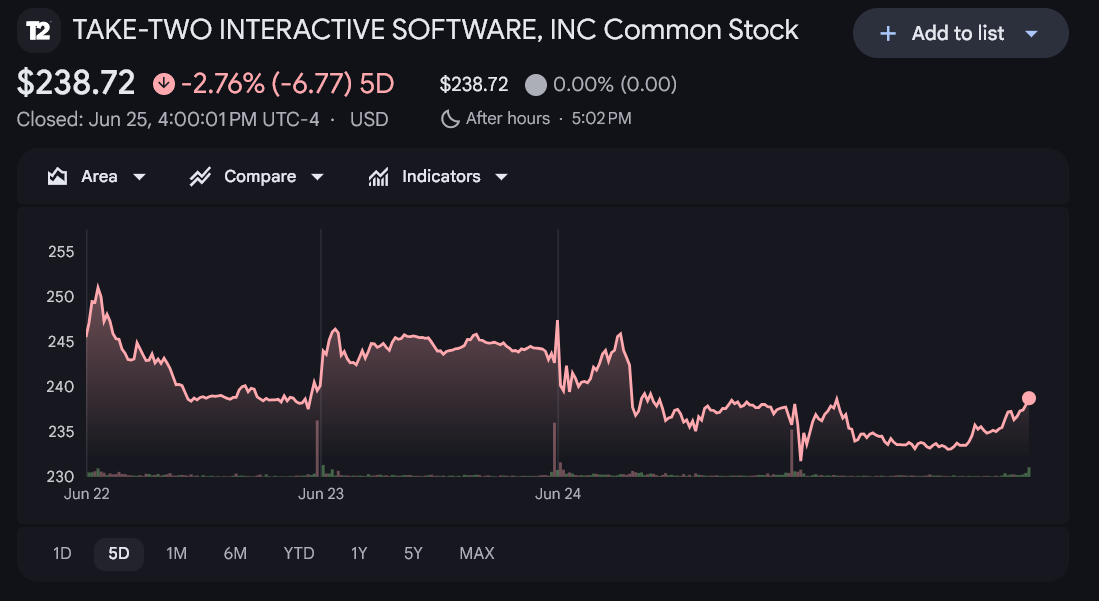
Take-Two Interactive (TTWO) shares fell nearly 3% this week after Rockstar Games officially opened Grand Theft Auto (GTA) VI pre-orders, triggering a classic sell-the-news reaction from short-term traders.
The stock surged 13% last week amid growing anticipation. When the moment arrived, profit-taking erased a substantial portion of those gains.

Standard Price Falls Short of Investor Expectations
Rockstar confirmed GTA 6 launches November 19, 2026, with a standard edition priced at $79.99 for PlayStation 5 and Xbox Series X|S.
That figure, however, disappointed bulls who had speculated the title could command between $90 and $100. Grand Theft Auto has sold over 470 million units worldwide, which some investors cited as justification for a premium price point.
The $79.99 figure does not tell the full pricing story. Rockstar also confirmed an Ultimate Edition for $99.99, which bundles exclusive vehicles and apparel. Still, analysts had largely expected the base price to push past $80.
No Discs Inside Physical Retail Editions
Physical collectors received a further setback. Retail boxed editions will not contain a disc. Each box holds only a digital download code, with pre-loading beginning November 12 for both physical and digital pre-orders.
Meanwhile, the GTA meme coin surge across crypto markets on the same day confirmed how far the franchise’s cultural reach extends beyond traditional gaming.
GTA VI Launch Confirmed as Single-Player Experience
The pre-order announcement confirmed GTA 6 will launch exclusively as a single-player title. Sony’s official PlayStation FAQ states GTA 6 is “a single-player experience,” with no online mode listed. Rockstar has not announced a launch date for GTA VI Online or clarified how the existing GTA Online service relates to the new title.
For investors, this detail carries weight. Analysts widely project GTA Online as Take-Two’s most durable long-term revenue source. A delayed online rollout pushes that monetization deeper into 2027 or beyond.
The pattern mirrors GTA 5’s 2013 launch, where the online component arrived weeks after the main title. However, investor expectations in 2026 are far more closely tied to recurring digital revenue than they were 13 years ago.
Analysts Stay Bullish
Thursday’s slide follows a sell-the-news pattern common across financial markets. Traders position ahead of anticipated catalysts, then exit once the catalyst is confirmed.
Similarly, this year’s Wendy’s meme stock surge showed how quickly enthusiasm can flip into profit-taking before buyers return at lower prices.
Despite the single-day drop, Wall Street’s long-term outlook for TTWO remains firmly positive. Bank of America analyst Omar Dessouky maintained a Buy rating with a price target of $368. Morningstar projects GTA 6 unit sales of 60-70 million in fiscal year 2027. That would represent record digital distribution for the publisher.
Take-Two Raises Full-Year Bookings Forecast Ahead of GTA 6 Launch
Take-Two also raised its full-year bookings forecast to between $6.65 billion and $6.7 billion. The broader gaming token sector has already demonstrated renewed investor appetite in 2026, suggesting sustained interest in gaming assets across both traditional and digital markets.
The five-month runway to the November 19 launch gives the US stock market and TTWO investors time to reassess. How quickly Rockstar activates GTA VI Online may ultimately prove more consequential to Take-Two’s long-term trajectory than first-day pre-order numbers.
The post GTA 6 Pre-Orders Send Take-Two Stock Down as Price and Launch Details Disappoint appeared first on BeInCrypto.



Ripple CEO Brad Garlinghouse said he remains bullish on bitcoin but that Michael Saylor’s approach to funding bitcoin purchases has damaged the broader crypto market, in a CNBC interview on Friday, as the preferred stock at the center of Strategy’s model fell to a record low.
“Financial engineering does not drive long-term value,” Garlinghouse said, arguing that the lasting value of any digital asset comes from its usefulness. “Team Michael Saylor wasn’t focused on the right stuff and that has hurt the overall market.”
He separated that from his view on the asset itself, saying he is still bullish on bitcoin.
Garlinghouse’s target was the machine Strategy has used to accumulate bitcoin. For about a year, the company has issued preferred shares, a class of stock that pays a fixed dividend, to raise cash for more bitcoin.
Its STRC share carries an 11.5% annual dividend and is engineered to trade near $100. Garlinghouse pointed to STRC trading about 25% below that level as a “damning indictment” of the strategy.
Bitcoin’s price volatility around and just under $60,000 continued at the end of the business week, but the asset has managed to climb above this level as of Saturday morning.
Most larger-cap alts are slightly in the green, with XRP trading above $1.05 and ETH standing close to $1,600. SOL has risen the most from this cohort.
BTC Fights for $60K
The business week began on the right foot for the primary cryptocurrency as the asset rebounded from the weekend slump to $62,500 and tapped $65,500 on Monday. However, that was a short-lived attempt for a more profound recovery as the bears were quick to intervene and halt all the progress.
In the following hours, the asset fell to $62,000. It bounced to $63,000, but the next leg down was even more painful. Bitcoin broke below $60,000 for the second time this month and tapped $59,000. After another dead-cat bounce to almost $62,000, the asset plunged even harder on Thursday, dumping to $58,000 for the first time since late 2024.
The latest leg down was strongly related to the adverse price moves observed from Strategy’s MSTR, which also marked a multi-year low of under $80. Nevertheless, BTC has managed to recover some ground from the aforementioned low and now stands at just over $60,000 despite the new attacks in the Middle East.
Its market capitalization has risen to $1.210 trillion on CG, while its dominance over the alts remains under 56%.

SOL, AAVE Pump
Ethereum continues to climb gradually after the recent low of $1,510 and now trades close to $1,600 following a minor daily increase. XRP has reclaimed the $1.05 support after a 2% jump since yesterday. Solana’s SOL has gained the most from the larger-cap alts today and sits above $72.
Even more impressive gains come from AAVE, AVAX, and MORPHO. Aave’s token has risen by double digits and sits above $95, while AVAX is north of $6.6. MORPHO has neared $1.80 following a 7% jump.
In contrast, MemeCore continues to drop, losing another 20% of value and struggling below $0.70 as of now.
The total crypto market cap has recovered over $80 billion since the Thursday low and is up to $2.170 trillion.

The post Solana (SOL) Rebounds Above $70, Bitcoin (BTC) Fights for $60K: Weekend Watch appeared first on CryptoPotato.
Prediction-market operator Kalshi is in talks to raise fresh capital at a valuation of roughly $40 billion, according to the Financial Times, nearly double the price tag from a round that closed just seven weeks ago. The Financial Times first reported the talks, citing people familiar with the… Read the full story at The Defiant
Securitize has secured commitments expected to deliver about $400 million ahead of its planned New York Stock Exchange debut through a merger with Cantor Equity Partners II.
Summary
- Securitize expects to raise about $400 million ahead of its planned NYSE listing through a merger with Cantor Equity Partners II.
- Backed by BlackRock, Morgan Stanley, Coinbase, and Circle, the firm continues expanding its tokenization business with new institutional products.
- The market debut comes as Securitize grows its on-chain asset platform while defending itself in a patent dispute with tZERO.
According to Securitize, fewer than 30% of shareholders in Cantor Equity Partners II, the special purpose acquisition company taking the firm public, chose to redeem their shares following the final redemption results.
The company said it now expects to receive approximately $400 million in gross proceeds from the transaction, including related private investment in public equity (PIPE) financing, before transaction-related expenses.
The proposed listing comes as tokenization companies continue attracting institutional attention, with firms seeking to bring traditional financial assets onto blockchain networks. Securitize counts BlackRock, Morgan Stanley, Coinbase, and Circle among its backers and has become one of the largest providers of tokenization infrastructure for financial institutions.
The merger is expected to complete next week
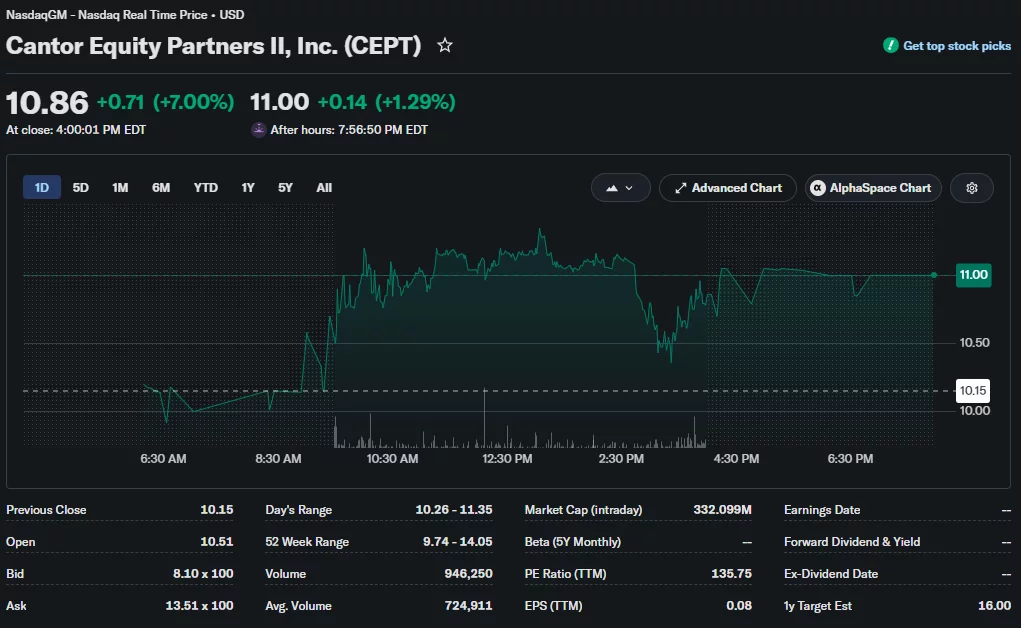
Market reaction has been positive ahead of the vote. Shares of Cantor Equity Partners II closed 7% higher at $10.86 on Friday before extending gains in after-hours trading to $11.
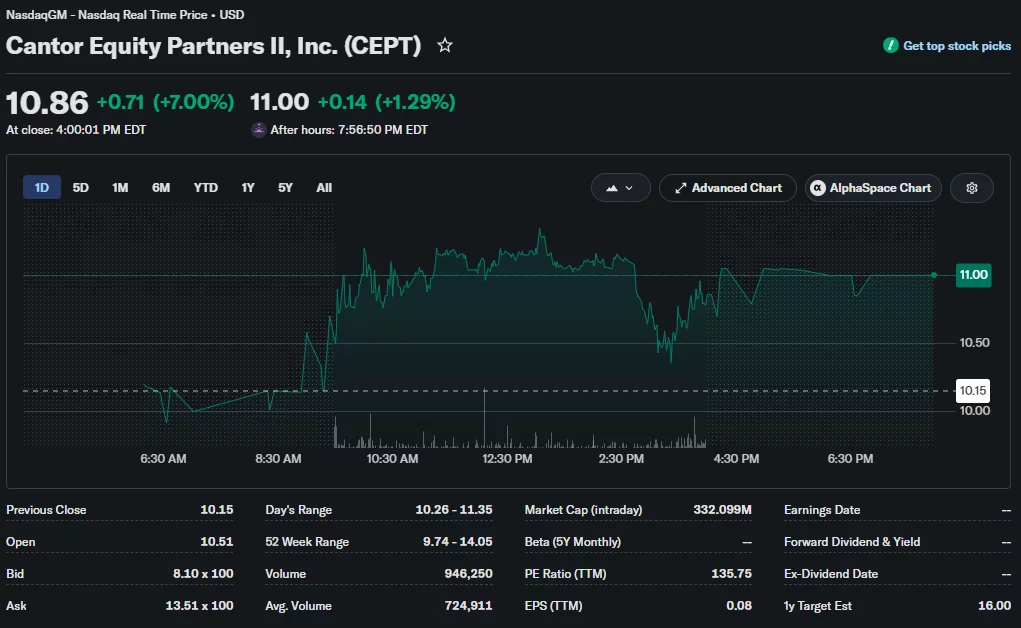
According to Securitize, shareholders are scheduled to vote on the merger on Monday. If approved and all remaining closing conditions are satisfied, the transaction is expected to close on July 1. The combined company is then expected to begin trading on the New York Stock Exchange under the ticker SECZ on July 2.
Commenting on the listing, Securitize co-founder and CEO Carlos Domingo said reaching the public markets represents an important step for the company after more than eight years of building tokenization infrastructure.
“Reaching the public markets is a significant milestone for Securitize and a reflection of the growing momentum behind tokenization.”
Domingo added that tokenized securities, once considered largely theoretical by major financial institutions, are now moving into mainstream finance as institutional adoption continues to grow.
The public debut also follows several months of expansion for the company. As previously reported by crypto.news, Securitize recently extended its Tokenized AAA CLO Fund (STAC) to the Solana blockchain. The company said Ethena Labs plans to allocate $250 million to the fund, which invests in U.S. dollar-denominated AAA-rated collateralized loan obligation tranches.
According to Securitize, the product is developed with BNY serving as custodian of the underlying assets and sub-adviser through BNY Investments.
Institutional tokenization business continues to expand
Alongside new investment products, Securitize has continued growing its role in tokenized capital markets. Earlier this year, the company partnered with the New York Stock Exchange to support the exchange’s planned tokenized securities platform.
Crypto.news previously reported that Securitize provides tokenization infrastructure for more than 650 funds and oversees more than $4 billion in tokenized assets. BlackRock has also deepened its relationship with the firm.
In May, crypto.news reported that the asset manager filed a second Securitize-powered tokenized fund with the U.S. Securities and Exchange Commission after its BUIDL fund expanded to roughly $2.3 billion in assets.
At the same time, Securitize is dealing with a legal dispute ahead of its market debut. As reported by crypto.news, the company recently asked the U.S. District Court for the District of Delaware to declare that its products do not infringe patents owned by tZERO after receiving a cease-and-desist letter. Securitize called the allegations “without merit,” while tZERO said its claims involve patents covering compliance systems, investor registry checks, and tokenized market infrastructure.
Separate industry forecasts also point to continued growth in tokenized finance. Earlier this month, Standard Chartered projected that tokenized assets used in decentralized finance could reach $2.7 trillion by the end of 2030, up from current levels.
Base, Coinbase’s Ethereum layer-2 network, has resumed normal operation after a consensus-related issue temporarily halted block production for nearly two hours on Thursday. The incident triggered “unhealthy” block building, leaving new blocks unable to be created until the network isolated and corrected the underlying problem.
Base said blocks were later being produced normally and that the broader ecosystem infrastructure had recovered and synced. The outage was unusual for a chain that has become a go-to venue for activity on Ethereum’s scaling roadmap, highlighting how sensitive rollup operations can be when consensus and sequencing logic fail.
Key takeaways
- Base went offline briefly due to a consensus problem that resulted in an invalid block being sequenced and prevented new block creation.
- Base reported recovery of “healthy blockbuilding” and confirmed ecosystem-wide infrastructure synchronization.
- The outage occurred around an on-chain upgrade window, with a Base upgrade (“Beryl”) scheduled for 6 pm UTC.
- Network creators emphasized that user funds remained safe, while reiterating that a block-production halt is not acceptable.
- Thursday’s incident joins a small set of notable recent outages affecting major L2 ecosystems.
How the outage unfolded
Base’s status page said it began investigating “unhealthy” block production at 4:03 pm UTC on Thursday. In a subsequent update at 5:21 pm UTC, the Base team explained that it had “isolated a consensus problem” which caused an invalid block to be sequenced.
According to the status updates, that invalid sequencing stopped progress at the protocol level: “This prevented new blocks from being created.” In other words, the issue was not presented as a simple infrastructure hiccup; it was tied to the chain’s ability to agree on what should be built next.
Recovery confirmed, post-mortem expected
Base later posted an operational recovery update just before 6 pm UTC. It said the network had “recovered healthy blockbuilding,” and that ecosystem-wide infrastructure was able to sync again. Base also indicated that it had identified the issue and would continue investigating the root cause, promising a full post-mortem.
Separately, Base’s creator Jesse Pollack used X to reassure users that funds on the network are safe. Pollack also framed the halt as a solvable operational setback, saying it would be used to “level up” Base as a platform aimed at supporting continuous, global finance.
An uncommon downtime event for a leading L2
The episode stands out as a rare downtime event for Base. The report notes that Base is widely considered among the most-used Ethereum layer-2 networks, and it cites the chain’s previous major outage in August 2025, when Base reportedly went down for 33 minutes. That earlier incident is referenced via Base’s status page.
Such disruptions matter for users and developers because L2 block production is the backbone for transaction inclusion, sequencing, and timely settlement flows. Even if funds remain safe, a halt can translate into delays for withdrawals, reduced reliability for dApps, and friction for systems that assume steady block cadence.
Upgrade timing raises questions for reliability planning
Base downtime appeared to occur separately and shortly ahead of a scheduled network upgrade dubbed “Beryl,” planned for 6 pm UTC. The described goal of the Beryl upgrade was to reduce delays on withdrawals and introduce a new token standard intended for real-world assets and stablecoins.
That timing is important for operators and integrators: when an outage overlaps with a planned change, teams typically have to ensure that the network can recover cleanly and continue the upgrade without compounding issues. Base did not state that the outage directly affected the Beryl rollout, but the proximity means builders watching Base would likely want to see post-recovery monitoring closely through the upgrade window.
The incident also comes amid broader reminders across the L2 landscape. The report points to Sui experiencing two periods of downtime on back-to-back days in May, each involving temporary stops in block production. In that case, Sui later attributed the downtime to a network update it said it knew had a low probability of causing a halt—an example of how even planned changes can create operational risk.
What to watch next
Base has said it will share a detailed post-mortem and identified the consensus problem responsible for blocking new block creation. Investors, traders, and developers should watch for that report, plus confirmation that the Beryl upgrade proceeds smoothly with stable block production and no renewed consensus symptoms around the new token standard changes.
Tokenization platform Securitize is set to make its long-awaited leap into the public markets after reporting final redemption results for its merger partner, Cantor Equity Partners II (CEPT). According to Securitize’s filing, fewer than 30% of CEPT shareholders chose to redeem their shares—an outcome that improves the odds that the deal can move forward as scheduled.
The company said the transaction is expected to generate approximately $400 million in gross proceeds, including private investment in public equity (PIPE) financings. The merger is expected to close on Wednesday, July 1, followed by trading on the New York Stock Exchange under the ticker SECZ on Thursday, July 2, subject to shareholder approval on Monday and other closing conditions.
Key takeaways
- Securitize said final redemption results show less than 30% of CEPT shareholders redeemed, a lower-than-feared level that supports deal momentum.
- The merger is expected to bring in about $400 million in gross proceeds, including PIPE financing, excluding transaction-related expenses.
- The company plans to begin NYSE trading under ticker SECZ on July 2, after the July 1 expected closing.
- The move reflects accelerating institutional interest in tokenized securities amid heightened attention from US regulators.
Redemption results reduce uncertainty for the merger
The immediate catalyst for CEPT’s post-announcement trading was Securitize’s update on final redemption outcomes. In a statement to investors reported by PR Newswire, Securitize said that its final redemption results indicated that fewer than 30% of CEPT shareholders elected to redeem.
Redemption thresholds matter for SPAC-style transactions because they directly affect the cash proceeds available at closing. While Securitize did not characterize the numbers as “unexpected” in its release, the company’s disclosure effectively signals that the funding structure underpinning the merger is likely to remain intact, clearing one of the more common obstacles for deals tied to shareholder opt-outs.
On Friday, CEPT shares rose, closing up 7% to $10.86 and continuing higher after hours to $11, according to market data cited alongside the announcement.
Expected proceeds and what they mean for tokenization ambitions
Beyond the redemption update, Securitize outlined the expected funding to be raised through the combination. The company said it expects to receive approximately $400 million in gross proceeds from the merger, including related PIPE financings, while excluding transaction-related expenses.
For investors watching tokenization, the scale of the proceeds is not just about corporate finance—it also points to how seriously major market participants are preparing for tokenized securities infrastructure. Tokenization remains a complex intersection of technology, market structure, and regulatory compliance. Capital raised in public markets can help cover product expansion, business development, and operational scaling as tokenized offerings move from pilots toward broader rollouts.
Securitize positions the listing as a “significant milestone” and, in remarks shared in the company’s release, CEO Carlos Domingo framed the step as evidence that tokenization is shifting from a niche concept to a mainstream institutional priority.
Why this public listing matters to the tokenization market
Securitize’s debut arrives at a moment when Wall Street increasingly views tokenization as a route to improved settlement efficiency and asset accessibility, while regulators continue to refine expectations for how tokenized securities should be offered and traded.
The company is backed by major institutions, including BlackRock and Morgan Stanley, and also counts crypto-native firms such as Coinbase and Circle among its supporters, according to the information provided in the announcement. That blend matters because it suggests tokenization is being pursued simultaneously through traditional capital markets channels and crypto rails—an alignment that can influence how liquidity, custody, and compliance tooling evolves.
In addition, Securitize has been actively working with established market infrastructure. Earlier this year, the company partnered with the New York Stock Exchange in March to support tokenized assets for the exchange’s upcoming tokenized securities platform—an effort reported by Cointelegraph. While that project is distinct from Securitize’s SPAC path, it reinforces the company’s goal of becoming a bridge between regulated markets and tokenized issuance.
Elsewhere in the broader ecosystem, Standard Chartered earlier this month projected that tokenized assets active in decentralized finance could expand 37-fold to $2.7 trillion by the end of 2030. That kind of forecast underscores why investors are paying attention to tokenization platforms that can operate across different settlement and trading environments.
Regulatory backdrop: SEC decisions still shape the pace
Even as interest grows, US regulatory uncertainty continues to influence how quickly tokenized products can be adopted in mainstream trading venues. In mid-May, Cointelegraph reported that the US Securities and Exchange Commission was reportedly ready to allow trading of tokenized stocks under an innovation-related framework. However, the plan was later delayed after stock exchange officials raised concerns about implementation details, according to that earlier coverage.
This matters for Securitize and peers because the path from “tokenization is possible” to “tokenization is broadly tradable” depends heavily on regulatory clarity—especially around operational readiness, market oversight, and the mechanics of secondary trading for tokenized instruments. A public-market listing can bring visibility and liquidity, but compliance and market structure decisions still determine how fast product adoption accelerates.
What to watch next
With a planned July 1 closing and July 2 NYSE start under ticker SECZ, the next key signal will be whether shareholder approval and remaining closing conditions clear without further complications. Investors should also watch how regulatory developments around tokenized stock trading evolve, since they will likely influence the pace at which tokenization platforms convert momentum into large-scale liquidity and recurring issuance.
US-listed spot Bitcoin exchange-traded funds (ETFs) posted their largest June daily net outflows on Thursday, following renewed weakness in Bitcoin that pushed the asset below the $60,000 level. The withdrawals underscore a cooling in demand that many US-listed ETF investors previously relied on as a stabilizing institutional inflow channel.
SoSoValue data shows the outflows amounted to $696.3 million on the day, exceeding the prior monthly peak of $519.2 million recorded on June 2. As a result, total net outflows for June rose to $3.61 billion, lifting year-to-date net outflows to $4.6 billion, according to the same dataset.
Key takeaways
- US spot Bitcoin ETFs saw a $696.3 million net outflow on Thursday, the largest daily outflow in June.
- June net outflows reached $3.61 billion, bringing year-to-date net outflows to $4.6 billion (SoSoValue).
- Total net assets in US spot Bitcoin ETFs fell below $73 billion for the first time since late 2024, down roughly 57% from a reported October 2025 peak.
- Separate tracking data indicates ETF BTC holdings declined by about 63,500 BTC over the past 30 days.
- Strategy’s reported June buying pace slowed materially, prompting renewed scrutiny of institutional accumulation risk management and liquidity planning.
Spot Bitcoin ETF outflows accelerate in June
The Thursday withdrawals represent a material step-down in net inflows that had been supporting ETF balance sheets earlier in the year. According to SoSoValue, the $696.3 million net outflow surpassed the previous June high daily outflow recorded on June 2, signaling that the pullback is not confined to isolated days.
From a compliance and institutional risk perspective, sustained outflows can affect how ETF issuers and their service providers manage operational readiness and liquidity across custody, brokerage settlement, and fund administration. While ETFs remain structurally distinct from crypto spot custody models used by direct holders, the flow-through effect on the underlying Bitcoin exposure can become relevant to internal risk controls, including contingency planning for valuation, margining arrangements (where applicable), and concentration monitoring.
ETF net assets and holdings retrace from late-2025 highs
In addition to daily flows, broader balance-sheet data points to a sustained contraction in the ETF complex. SoSoValue reports that total net assets in US-listed spot Bitcoin ETFs have fallen below $73 billion for the first time since late 2024. The same source previously cited a record net assets level of $169.5 billion in October 2025; the latest figure is about $72.6 billion, representing a decline of roughly 57%.
WalletPilot data provides a view into the underlying Bitcoin holdings. It indicates that the funds held a combined 1.24 million BTC as of Tuesday, with approximately 63,500 BTC leaving the products over the prior 30 days. For institutions, the shift from flow-based indicators to holdings-based indicators is often critical: daily net flows can reverse quickly, but reductions in the total BTC held can influence longer-horizon risk assessments related to custody balances, redemption dynamics, and exposure to market-wide volatility.
Strategy’s slower accumulation draws renewed attention
ETF outflows are occurring alongside signs that other large sources of institutional Bitcoin demand are easing. Strategy, described as the world’s largest corporate Bitcoin holder, reportedly reduced its pace of Bitcoin accumulation during June.
Company filings indicate Strategy has bought roughly 3,600 Bitcoin so far in June, down from about 25,000 BTC in May and more than 50,000 BTC in April. The filings also show a net sale of 32 BTC earlier in the month—one of the few instances in which the company has sold Bitcoin during its accumulation period.
The change in behavior has prompted renewed debate about corporate treasury strategy, particularly whether liquidity preservation becomes a priority during market downturns. Critics have argued that Strategy should pause additional purchases and instead rebuild cash reserves, pointing to the importance of downside risk management for firms that rely on balance-sheet leverage and equity-linked financing structures.
In June’s context, institutional scrutiny is not limited to “buy or sell” decisions. It also extends to how capital is raised, how discount rates and equity market conditions influence treasury financing, and what liquidity buffers are maintained to support continued operations. These issues can indirectly affect how regulated counterparties—such as lenders, underwriters, and custodians—assess operational continuity.
Financing-market pressure and the preferred stock debate
Strategy’s perpetual preferred stock (STRC) has reportedly come under pressure. The stock has traded below its intended $100 benchmark level, with Thursday’s close reported at $75.69, down 6.37%.
The price movement has fueled discussion around whether the company’s preferred share financing approach is aligned with its long-term accumulation plan under stressed market conditions. CryptoQuant analysts raised concerns about timing and risk management, while Bitcoin advocate Samson Mow argued that STRC has a “self-repairing mechanism” that activates when the stock trades below its $100 benchmark. He also noted that Strategy pauses new share issuance through its ATM program at that level, limiting new supply.
For institutional stakeholders, this debate matters because financing mechanics can influence the predictability of future purchasing behavior. Where issuance programs and preferred-stock terms include triggers or constraints, equity-market volatility can propagate into accumulation schedules—creating uncertainty for counterparties that model corporate Bitcoin demand. It also raises questions for governance and disclosure oversight, particularly for firms subject to securities regulation and investor reporting obligations.
More broadly, policy compliance teams monitoring the crypto market may find it useful to connect these developments to regulatory context. US-listed spot Bitcoin ETFs operate under a mature set of investor protection expectations, including custody arrangements and securities-law compliance frameworks. At the same time, corporate treasuries and their financing instruments intersect with conventional financial regulation, making transparency and risk disclosures a recurring theme for oversight bodies.
What to watch next
Whether ETF outflows continue or reverse will likely remain the near-term indicator that shapes institutional exposure to Bitcoin via regulated wrappers. Separately, Strategy’s future acquisition cadence and any further changes in financing-market conditions could affect expectations for corporate demand, reinforcing the need for monitoring of disclosures, treasury liquidity posture, and the operational implications of sustained reductions in net asset growth.


Rosen Law Firm opened a securities investigation into Strategy Inc., examining whether the Bitcoin treasury company issued materially misleading disclosures to investors across its entire capital stack, including common shares and all four series of preferred stock. The investigation notice,… Read the full story at The Defiant
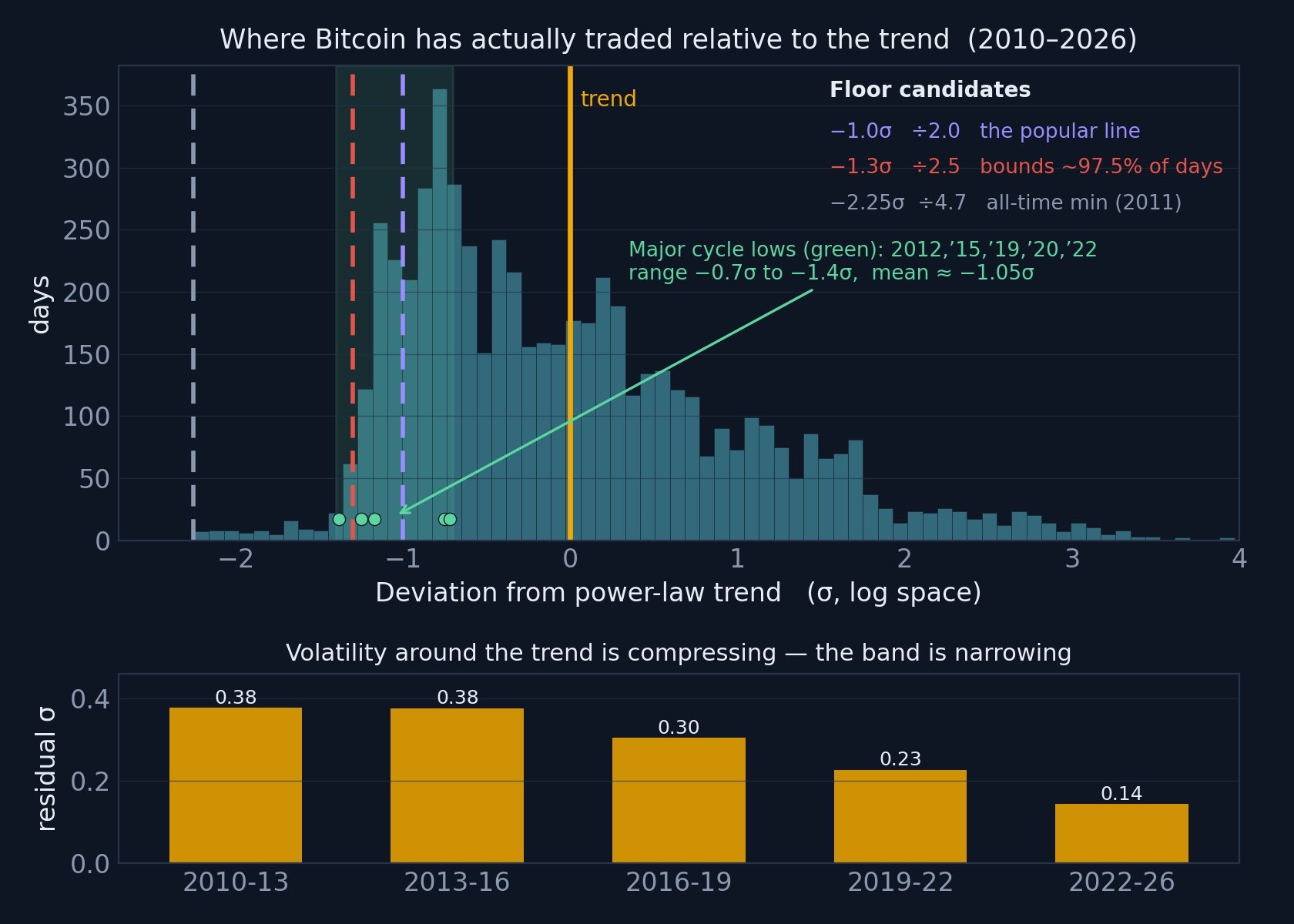
Bitcoin’s (BTC) drop to $58,000 has pushed the price into a zone that long-term power-law models have historically associated with cycle bottoms. The data does not confirm a bottom range, though it shows BTC trading in a price range that has repeatedly marked major lows since 2014.
Derivatives data and liquidation levels highlight $55,000 as the next key support level and the $65,000-$68,000 range as the next major upside area of interest.
Bitcoin power-law puts $58,000 in historical range
Giovanni’s Bitcoin power-law model places the network’s long-term trend price near $135,000, making the recent drop to $58,000 roughly 54% below the all-time high and 1.22 standard deviations beneath that trend.
According to the analyst, the key takeaway is straightforward: the previous cycle lows in 2012, 2015, 2019, 2020, and 2022 all fell within a similar statistical range. By that measure, the latest decline falls within a territory that has historically marked the deep bear-market lows rather than a break in Bitcoin’s long-term growth path.
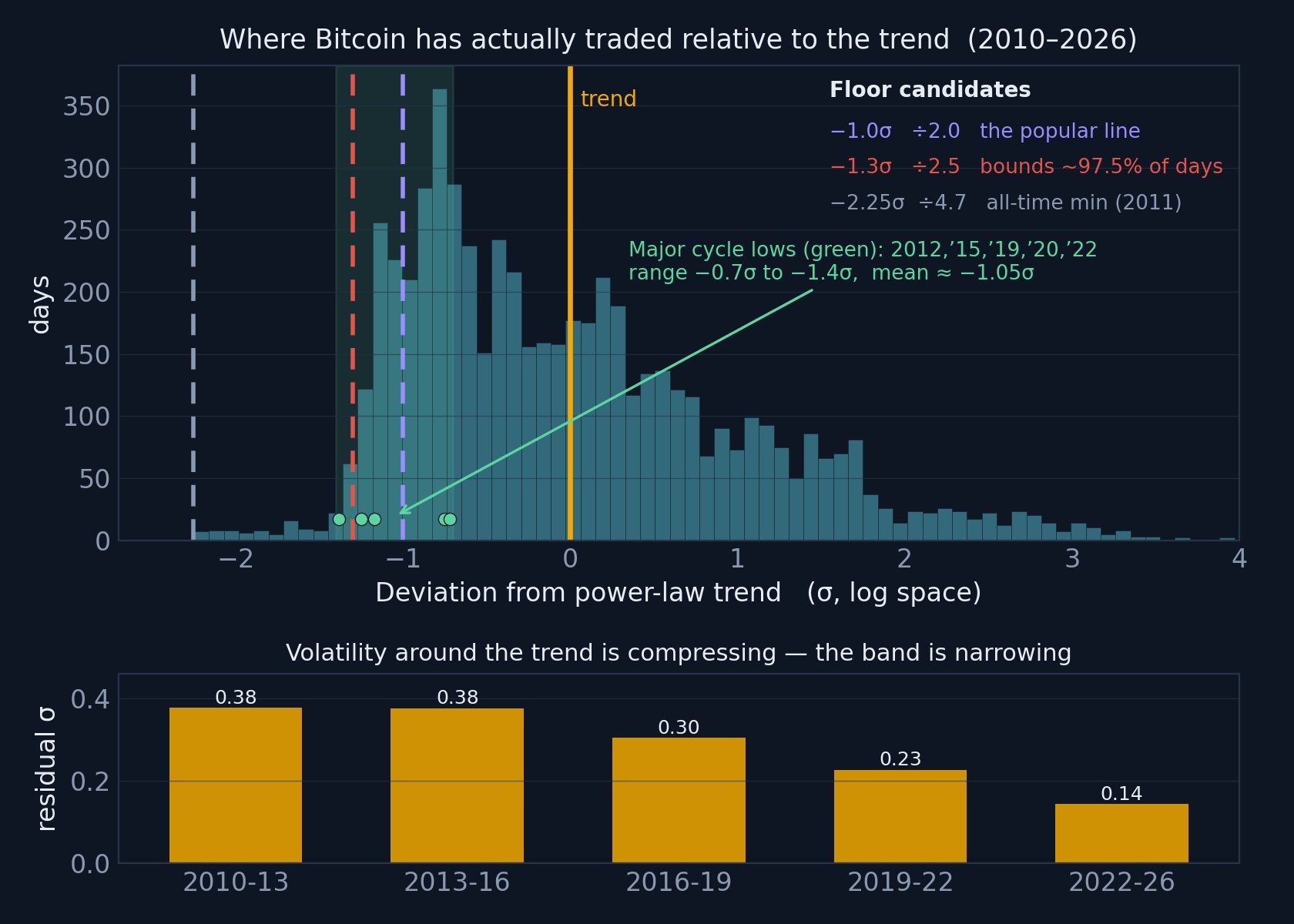
Bitcoin price deviation based on the power-law trend. Source: X
The model estimates the commonly referenced “-1σ” support near $68,000, while the stronger historical floor sits closer to $55,000. Giovanni also noted that Bitcoin would need to trade below roughly $17,000 for more than a year before the power-law itself could be considered invalid.
A second metric points in the same direction. Bitcoin’s power-law quantile has fallen to 6.2%, indicating the asset is cheaper than roughly 94% of its historical observations when measured against the power-law model. The chart highlights similar readings during the 2015, 2020, and 2023 cycle lows, with the current market now revisiting that historically rare valuation zone.
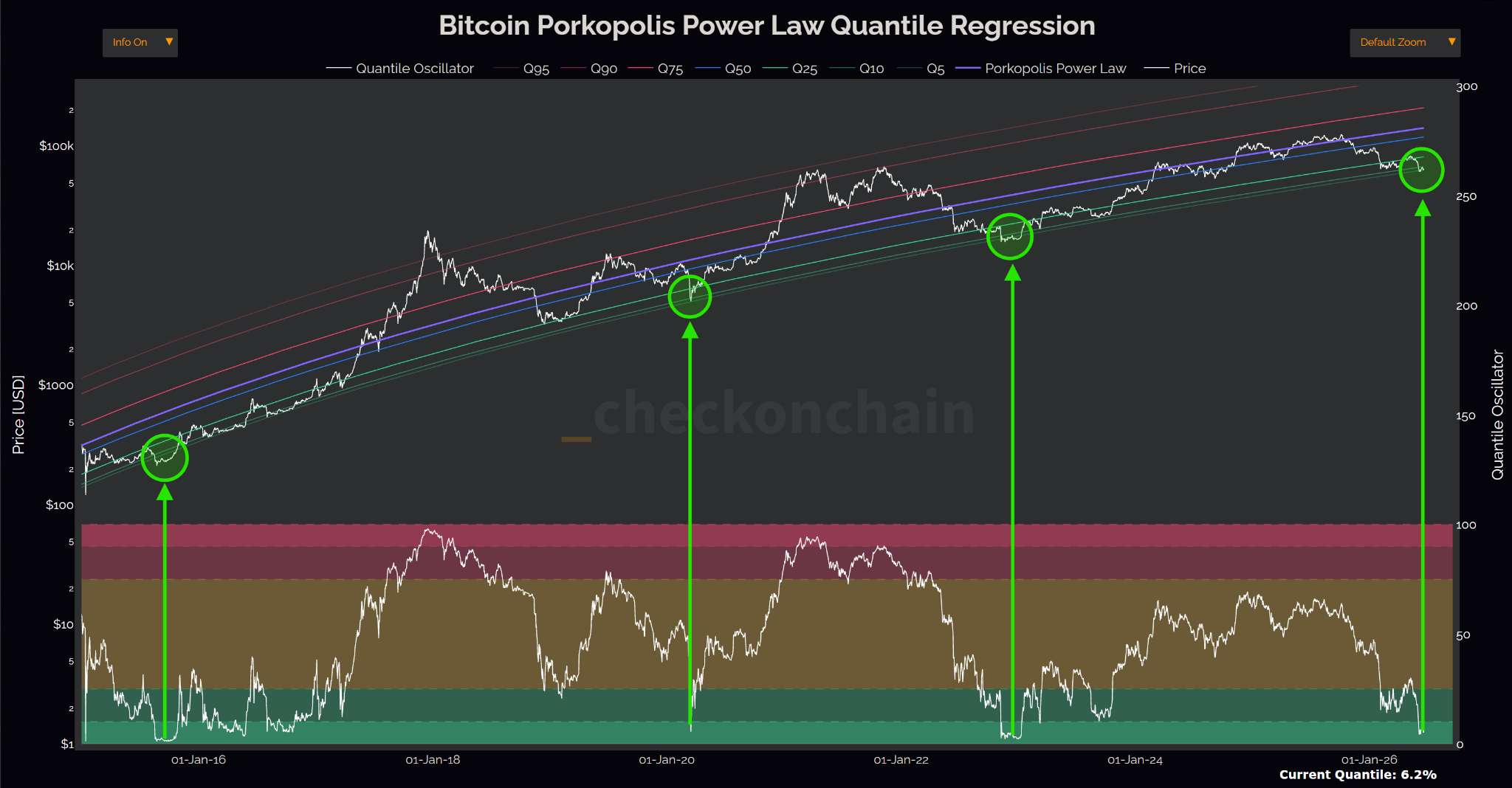
Bitcoin power-law quantile regression chart. Source: Checkonchain
Related: Bitcoin drops to $58K on high US PCE inflation as trader sees ‘manipulation’
Key BTC price levels to watch
Bitcoin fell to a new yearly low of $58,000 after aggressive selling swept through Binance. The hourly taker sell volume reached $2.1 billion, followed by another $1.9 billion in the next hour after the New York market open, marking the exchange’s largest hourly sell pressure since May 4.
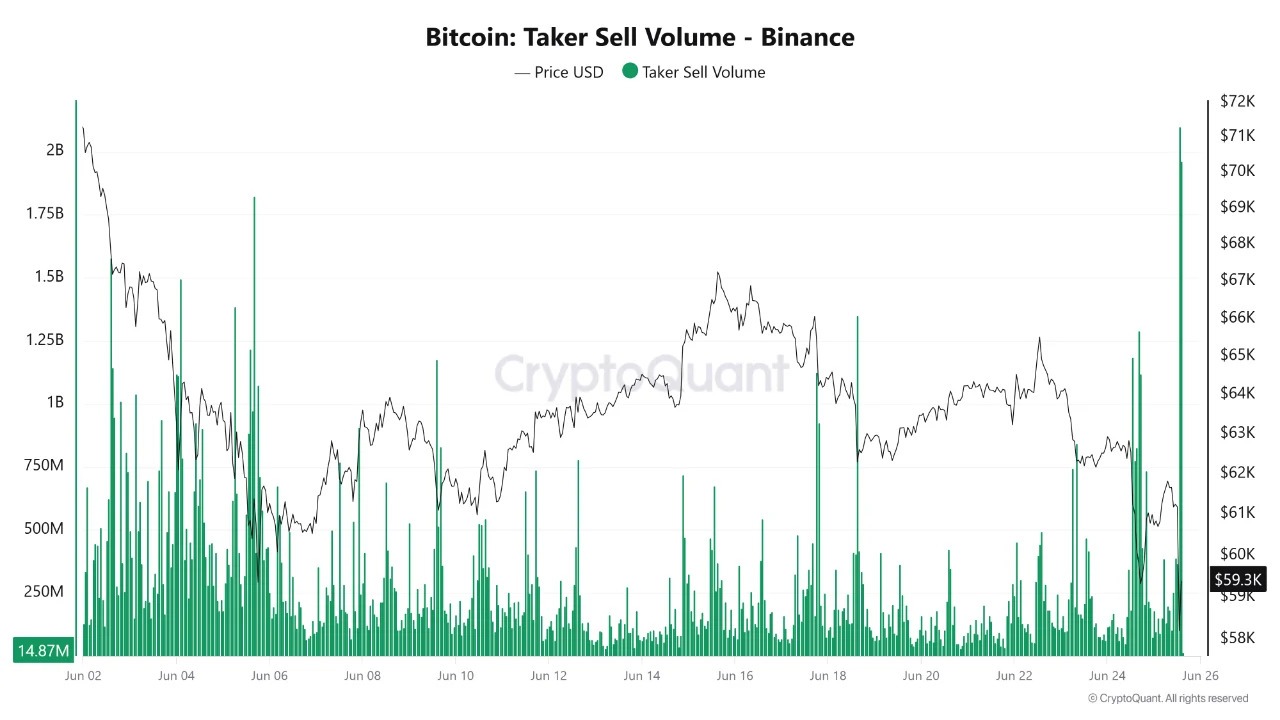
Bitcoin taker sell volume on Binance. Source: CryptoQuant
The flush liquidated more than $300 million in long BTC positions before the price rebounded toward $60,000. That level now carries added significance. A daily close back above $60,000 preserves the developing relative-strength index (RSI) bullish divergence across the one-hour, four-hour, and daily time frames which signals that selling momentum is fading even as the price prints lower lows.
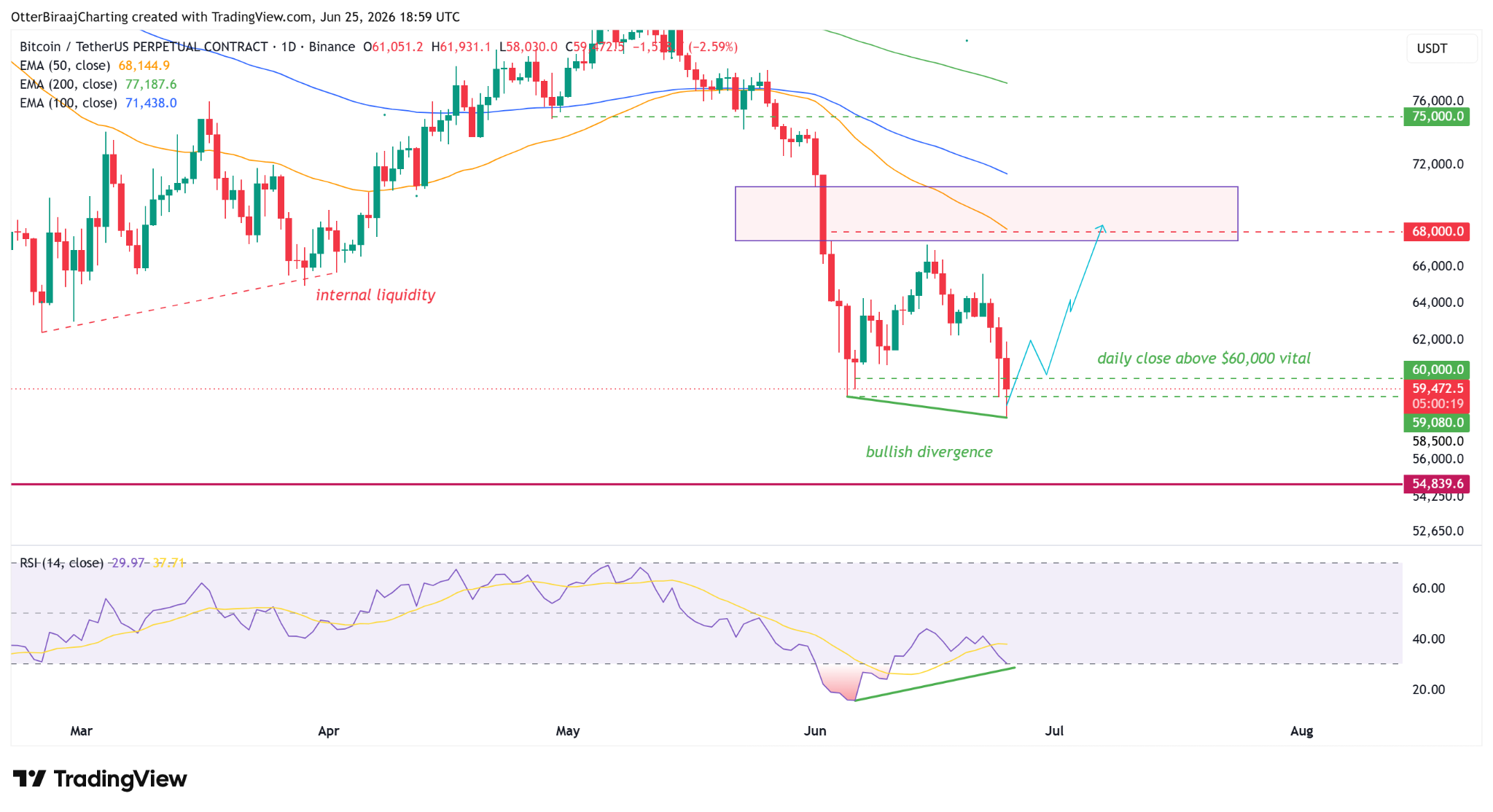
BTC/USDT, one-day chart. Source: Cointelegraph/TradingView
Futures trader Byzantine General shared a similar outlook, saying the move to $58,000 cleared out leveraged longs while drawing in fresh short sellers. In his view, a daily close above $60,000 would strengthen the case that Bitcoin has printed a local bottom for now.
That would also shift attention toward a large pocket of upside liquidity. More than $4 billion in short liquidations cluster near $65,000, compared with about $1 billion below $55,000, creating a four-to-one imbalance. A relief rally could then target internal liquidity near $68,000, where a daily fair-value gap adds another area of interest for traders.
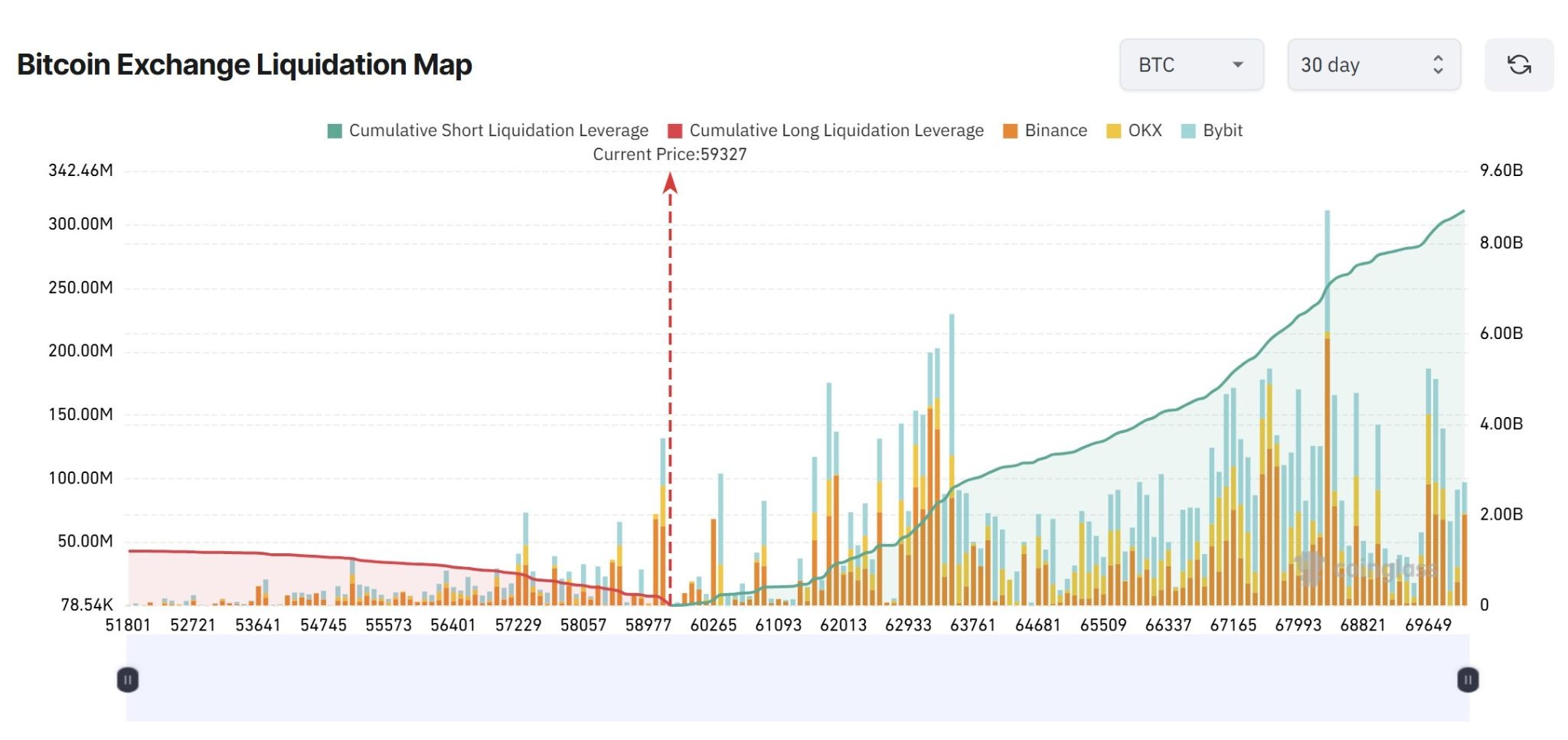
BTC liquidation map. Source: CoinGlass
Meanwhile, a daily close below $60,000 reinforces the bearish bias on both the short-term and long-term charts. The next area of interest then shifts to $55,000, where Bitcoin’s September 2024 weekly range low converges with its realized price near $54,000.
The realized price, which tracks the average cost basis of all onchain coins, has historically provided support at every major Bitcoin bear-market bottom since 2014. That trend makes the $54,000-$55,000 region a key level for traders to watch if selling pressure continues.
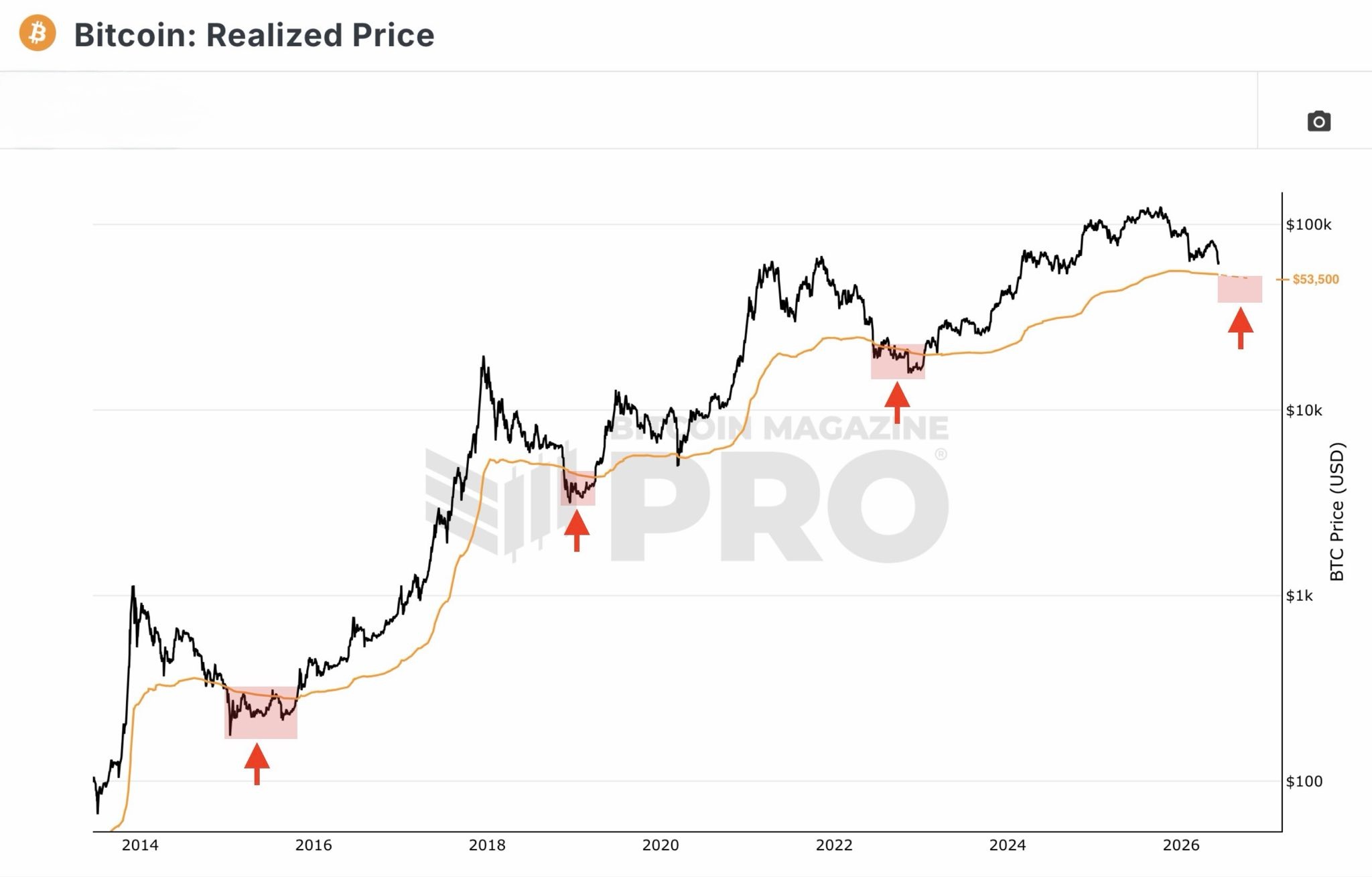
Bitcoin’s realized price. Source: X
Related: Bitcoin drop to $58K brings out bears: Is BTC’s next stop below $50K?


Tether's USDT has drawn level with ether, narrowing the gap for the second-largest cryptocurrency by market capitalization to a fraction of a percent. The stablecoin briefly overtook ether earlier this month, the first time a dollar-pegged token has done so. USDT carried a market cap of about… Read the full story at The Defiant

Adams: Senators’ moves don’t paint a clear picture

This cross-device clipboard app solves the copy-paste problem I keep running into on my Mac

Parece chiste pero no #money #cash #payment


-

 Entertainment6 days ago
Renter of Home in Anne Heche Crash Denies Settlement With Son
-
 Sports4 days ago
Two goals and an assist by sheer aura: Cristiano Ronaldo just entered the World Cup chat
-

 Tech5 days ago
Microsoft accidentally kills epic Outlook email threads
-

 Fashion15 hours ago
Weekend Open Thread: Staud – Corporette.com
-

 Business6 days ago
Soccer-U.S. defends Iran World Cup travel restrictions, says discussions ongoing
-

 Politics1 day ago
The House | Manchesterism won’t survive the painful trade-offs unless it gets citizens on board
-

 Politics7 days ago
Andy Burnham and the meaning of Makerfield
-

 Politics1 day ago
Potential 2028er World Cup attendee leaderboard
-

 Business1 day ago
Asia stock markets slide as tech shares slump
-

 Tech2 days ago
A Look At A Gaggle Of Transputer Boards
-
Crypto World3 days ago
Bitcoin (BTC) Dips Below $62K, Ethereum (ETH) Plunges 6% Daily: Market Watch
-

 Crypto World3 days ago
Securitize Wraps Roubini's SEC-Registered ETF as Dubai VARA Digital Security
-
 Crypto World2 days ago
Dell (DELL) Shares Tumble Over 5% Following Analyst Downgrade to Hold
-
Business3 days ago
Entergy settles forward sale agreements, raises $672 million in cash proceeds
-
 Crypto World7 days ago
Can Charles Hoskinson Really Rescue Cardano?
-

 Sports12 hours ago
FIH Pro League: India defeat Pakistan 7-1, register biggest win of campaign | Other Sports News
-

 Crypto World3 hours ago
Kraken's xStocks Opens Bending Spoons IPO Registration to EEA Retail
-

 Crypto World15 hours ago
RTX holders must register wallets before token distribution begins
-
 Crypto World18 hours ago
Hyperliquid Named on Singapore MAS Investor Alert Register
-

 Crypto World7 days ago
Jake Chervinsky accuses CME of protecting derivatives monopoly
You must be logged in to post a comment Login