
Crypto World
What is a modular blockchain? Rollups, data availability, and the new stack



For years, a blockchain was one chain doing everything. The modular thesis breaks that apart into specialized layers for execution, settlement, consensus, and data availability. This guide explains the new stack, why rollups need a data layer, and what the design buys and costs.
Summary
- Modular blockchains split execution, settlement, consensus, and data availability across specialized layers to improve scalability.
- Rollups process transactions off the main chain while relying on shared settlement and data availability layers for security.
- The modular approach increases flexibility and throughput, but also introduces added complexity, fragmentation, and layered trust assumptions.
A modular blockchain is a blockchain that splits the core jobs a network must perform across separate, specialized layers, instead of having a single chain do all of them at once. To see why that is a meaningful idea, you have to know the four jobs every blockchain has to handle: execution, which means running transactions and smart contracts; settlement, which means finalizing results and resolving disputes; consensus, which means agreeing on the order of transactions; and data availability, which means making sure the transaction data is actually published so anyone can check it.
A traditional blockchain, now called monolithic, does all four itself, on one chain, which is simple and tightly integrated but runs into a hard ceiling on how much it can scale, because one chain doing everything can only go so fast before it becomes congested or expensive. The modular approach unbundles those jobs, letting different layers each specialize in one of them, and that unbundling has become the dominant way ambitious blockchains now scale. This guide explains the four functions, the difference between monolithic and modular designs, how rollups and data availability layers fit together, the leading examples, and the real trade-offs the modular path involves.
The reason this matters is that scaling has been blockchain’s defining challenge for a decade, captured in the so-called trilemma, the observation that a single chain struggles to be simultaneously scalable, secure, and decentralized, and usually has to sacrifice one. Monolithic chains tend to push hard on scale at some cost to decentralization, or preserve decentralization at the cost of speed.
The modular thesis offers a different escape from the trilemma: if no single chain has to do everything, then each layer can optimize for its own job, and the system as a whole can reach a scale no monolithic chain easily matches while preserving strong security and decentralization where it counts.
By 2026 this thesis moved from theory to the dominant architecture, with specialized data availability networks serving dozens of execution chains and a whole stack of modular components in production. Understanding the modular design is therefore close to understanding where blockchain infrastructure as a whole is heading.
The four jobs of a blockchain
Everything about modularity follows from understanding the four functions a blockchain performs, so it is worth taking each in turn. Execution is the actual computation: when you swap tokens or run a smart contract, execution is the process of taking your transaction, applying it, and updating the network’s state to reflect the new balances. It is the layer users interact with most directly, and it is computationally heavy, because every transaction has to be processed. Settlement is the layer that provides finality and a home for dispute resolution: it is where the results of execution are anchored and made authoritative, the bedrock that other layers can treat as the final word on what happened, and where, in some designs, proofs are verified or fraudulent claims are challenged.
Consensus is the mechanism by which the network’s participants agree on a single, ordered history of transactions, so that everyone shares the same view of what happened and in what sequence, which is what stops double spending and keeps the ledger consistent. Data availability is the one most people have never heard of and the one that turns out to be central to modular design. It is the guarantee that the data behind every transaction is actually published and obtainable, so that anyone can download it, check that the rules were followed, and reconstruct the state if needed. If transaction data is not available, no one can verify whether the network cheated, which means data availability is a quiet but essential foundation of trust. In a monolithic chain, all four of these jobs happen together in one tightly bound system. The modular insight is that they do not have to, and that pulling them apart lets each be done far better.
Monolithic versus modular
The cleanest way to grasp modularity is to contrast it directly with the monolithic model it departs from. A monolithic blockchain bundles all four functions into a single integrated chain. Every full node executes every transaction, participates in consensus, stores all the data, and treats the chain itself as the settlement layer. The great virtue of this design is simplicity and tight integration: everything lives in one place, applications can interact seamlessly, and there are no seams between layers to manage.
A well known high performance chain that prizes raw speed exemplifies the monolithic approach, pushing a single integrated chain to process enormous throughput by demanding powerful hardware from its nodes. The cost of the monolithic design is the ceiling it imposes: because every node must do everything, the chain can only scale so far before either fees rise, congestion sets in, or the hardware requirements grow so heavy that fewer participants can run a node, which erodes decentralization.
A modular blockchain breaks the bundle apart so that different layers handle different jobs. A typical modern arrangement separates execution from the rest: specialized execution layers run the transactions and smart contracts, while a different layer or layers handle settlement, consensus, and data availability. The flagship example is the rollup-centric design, where lightweight execution chains called rollups process transactions off to the side and then lean on a robust base layer for settlement and data availability.
The benefit is specialization: an execution layer can be tuned purely for fast, cheap transaction processing without also bearing the full weight of securing the entire system, because it borrows security from the base layer beneath it. The system as a whole can then scale by adding many execution layers on top of a shared foundation, multiplying capacity in a way a single monolithic chain cannot. Monolithic favors integration and simplicity; modular favors specialization and scale, and that is the core of the design choice.
Rollups: the execution layer of the modular world
The most important modular component to understand is the rollup, because rollups are how the modular vision actually gets used today. A rollup is a separate chain that handles execution, processing transactions quickly and cheaply off the main chain, and then posts a compressed record of what it did back down to a base layer for security. The name comes from the way it rolls up many transactions into a single batch and submits that batch to the base chain, so the base chain does not have to process each transaction individually but can still serve as the ultimate source of truth. This is the mechanism that lets a modular system scale: thousands of transactions happen cheaply on the rollup, and only a condensed summary touches the expensive, highly secure base layer.
There are two main families of rollup, distinguished by how they convince the base layer that their batched transactions are valid. Optimistic rollups assume the transactions are honest by default and allow a window during which anyone can challenge a fraudulent batch by submitting a fraud proof, with the base layer settling the dispute. Zero knowledge rollups instead generate a cryptographic validity proof for each batch, mathematically showing the transactions were processed correctly, which the base layer verifies without re running them.
Both achieve the same goal of inheriting the base layer’s security while doing execution elsewhere, and both depend critically on one thing: the data behind their transactions must be available, so that anyone can verify the rollup’s claims or reconstruct its state. A rollup that posted only a summary without making the underlying data available would be asking the world to trust it blindly, which defeats the purpose. This is exactly why data availability, the obscure fourth function, becomes the linchpin of the entire modular architecture.
Data availability: the linchpin
Data availability deserves its own section because it is the function that modular design elevated from an afterthought to a centerpiece. When a rollup posts its batch of transactions, the crucial requirement is that the full transaction data be published somewhere accessible, so that anyone can check the rollup did its job honestly, challenge it if not, and rebuild the state if the rollup operator disappears.
Where that data gets published, and how cheaply, turns out to be one of the biggest factors in how well a modular system performs, because publishing data is a major part of what a rollup pays for. If the base layer makes data publication expensive, rollups are expensive; if a layer makes it cheap, rollups become dramatically cheaper.
This created demand for a new kind of specialized chain whose entire job is data availability: a data availability layer. Rather than executing transactions or settling disputes, such a chain exists purely to order data and keep it available cheaply and reliably for the rollups that depend on it. The pioneering example is a network built specifically as a modular data availability layer, which uses an elegant technique called data availability sampling to scale. Instead of requiring every node to download an entire block to confirm the data is there, lightweight nodes each randomly sample a small number of pieces of the block.
With enough independent samples, the network can be confident, to very high probability, that all the data is genuinely available, without anyone having to download all of it. Combined with techniques that let each application fetch only its own slice of data, this lets a data availability layer serve many rollups at once, cheaply and at scale. By 2026, such a layer was providing data availability for dozens of rollups, a concrete sign that the modular separation of data availability into its own specialized network had become real, working infrastructure.
The leading modular stacks
It helps to see how these pieces assemble into real systems, because the modular world is not one design but a few competing and complementary stacks. The most influential is the rollup-centric roadmap of the leading smart contract platform, which deliberately reoriented itself around modularity. Rather than trying to scale by making its own base layer process everything faster, it chose to become primarily a settlement and data availability foundation, with the heavy execution pushed out to a thriving ecosystem of rollups built on top.
A pivotal upgrade introduced a dedicated, cheaper space for rollups to post their data, often called blob space, which slashed the cost of data availability and, with it, the fees rollups charge users, bringing many transactions down to a fraction of a cent. Further upgrades aim to expand that data capacity dramatically over time. The result is a layered system: a secure base layer for settlement and data, and many execution focused rollups handling the day-to-day activity cheaply above it.
Alongside this sits the specialized data availability layer approach, where rollups choose to post their data to a purpose built data availability network instead of, or in addition to, the base settlement layer, often to get even lower costs. There is also a connection to another modular idea covered elsewhere: shared security through restaking, where a pool of staked capital can be used to secure new services, including data availability layers, letting them inherit strong economic security on day one rather than bootstrapping their own.
Together, these pieces form a menu of modular components, settlement layers, data availability layers, execution rollups, and shared security providers that teams can mix and match to assemble a custom chain. A project can launch its own rollup tuned for gaming or social applications, point it at whichever data availability layer is cheapest, and settle to whichever base layer it trusts, without building a validator set or a full monolithic chain from scratch. That composability of infrastructure, the ability to assemble a chain from specialized parts, is the practical payoff of the modular thesis and a large part of why it spread so quickly.
An analogy: the restaurant and the food court
Because the modular stack has so many pieces, an analogy can anchor the whole idea before the trade offs pile up. Think of a monolithic blockchain as a single restaurant that does everything under one roof: it grows its own ingredients, cooks every dish, seats the diners, and washes the dishes, all with the same staff in the same building. The advantage is seamless coordination, since everything happens in one place and nothing has to be handed off. The limitation is capacity: that one kitchen can only cook so many meals at once, and if you want to serve far more people, you either build an enormous, expensive kitchen that few can staff, or you accept long waits and high prices when demand surges. A single integrated chain faces the same ceiling, because every node has to do every job.
Now picture a food court instead. The building provides the shared foundation, the tables, the security, the guarantee that the space stays open and orderly, while many specialized vendors handle the cooking, each focused on one cuisine and tuned to serve its customers quickly and cheaply. In this picture the shared building is the base layer providing settlement and data availability, and the individual vendors are the rollups handling execution.
No single vendor has to provide its own security or build its own premises; they all inherit that from the building, so they can concentrate purely on serving food fast. The food court can serve vastly more people than the single restaurant, because capacity grows by adding vendors instead of straining one kitchen, which is exactly how a modular system scales by adding execution layers on a shared foundation.
The analogy also captures the costs honestly. A food court is more complex than a single restaurant: there are more independent operators, more things that can go wrong with any one vendor, and more coordination required to keep the shared space working. If you want a dish that combines ingredients from three different vendors, you have to carry your tray between them, which is clumsier than ordering everything from one kitchen, just as moving assets or composing an application across separate rollups is more awkward than operating within one integrated chain. And every vendor depends on the building: if the shared foundation fails to keep the lights on or the doors open, every vendor suffers, just as a rollup inherits the weaknesses of the data availability and settlement layers beneath it.
The food court trades the seamless simplicity of the single restaurant for far greater capacity and specialization, accepting more complexity and more handoffs in return. That is precisely the bargain the modular blockchain makes, and seeing it as a food court instead of a single restaurant makes both the appeal and the cost intuitive.
What modularity buys you
Having laid out the architecture, it is worth being precise about the genuine advantages the modular approach delivers, because they explain why it became dominant. The headline benefit is scalability. By separating execution from the base layer and letting many rollups run in parallel on top of a shared foundation, a modular system can process vastly more total activity than a single monolithic chain, because capacity is added by stacking execution layers instead of straining one chain. The cheap data availability layers compound this by driving down the dominant cost of running a rollup, which is why transaction fees on modern rollups have fallen to fractions of a cent for simple transfers.
The second benefit is specialization and flexibility. Because each layer focuses on one job, each can be optimized far beyond what a generalist chain could achieve: a data availability layer can be ruthlessly efficient at keeping data available, an execution rollup can be tuned for a specific use case, and a settlement layer can prioritize security and finality. This also gives builders flexibility and sovereignty: a team can launch a chain tailored to its needs, choosing its own execution environment and rules, while still inheriting security and data availability from established layers instead of recreating them.
The third benefit is improved decentralization at the verification level. Techniques like data availability sampling let lightweight nodes verify that a network is behaving honestly without running expensive hardware, which means more ordinary participants can help keep the system honest, countering the tendency of high performance monolithic chains to concentrate power among those who can afford powerful machines. Scalability, specialization, and verifiable decentralization are the real prizes the modular design competes for, and it pursues them by refusing to make any single chain carry the whole load.
The trade-offs and criticisms
No architecture is free, and an honest account of modularity has to weigh its real costs against the monolithic simplicity it replaces. The first cost is complexity. A modular system has many moving parts, execution on one layer, data on another, settlement on a third, bridges and proofs connecting them, and that complexity creates more surface area for bugs, misconfigurations, and failures than a single integrated chain. More layers mean more things that can go wrong and more seams that must be secured. The second cost is fragmentation. When activity spreads across many separate rollups, liquidity and users fragment too, and moving assets or composing applications across different execution layers can become awkward, slow, or risky, sacrificing some of the seamless composability that a single monolithic chain offers, where every application can interact with every other instantly.
The third cost is a subtler security consideration. A rollup’s safety depends on the layers beneath it, so if the data availability layer it relies on fails to keep data available, or the settlement layer it trusts is compromised, the rollup inherits that weakness. Modular systems must therefore reason carefully about the trust assumptions of every layer they depend on, and a chain that uses a less secure data availability layer to save money is making a real trade off in safety, even if it is not always obvious to users.
Defenders of the monolithic approach argue that tight integration delivers a simpler, more composable, more uniformly secure system, and that the high performance monolithic chains have shown a single chain can scale further than the modular camp once assumed. The honest conclusion is that monolithic and modular are not strictly better or worse but represent different bets: monolithic wagers that integration and raw single chain performance win, while modular wagers that specialization and stacking win. By 2026 the modular bet had clearly become the dominant architecture for ambitious new infrastructure, but the trade offs it carries, complexity, fragmentation, and layered trust, are real, and the debate over which approach ultimately prevails is far from settled.
Frequently Asked Questions
What is a modular blockchain in simple terms?
A modular blockchain splits the core jobs a network must do across separate, specialized layers, instead of one chain doing everything. The four jobs are execution (running transactions and smart contracts), settlement (finalizing results and resolving disputes), consensus (agreeing on transaction order), and data availability (making sure transaction data is published so anyone can check it). A traditional, monolithic chain does all four itself, which limits how far it can scale. A modular design lets each layer specialize in one job, so the system as a whole can scale much further while preserving security.
What is the difference between monolithic and modular blockchains?
A monolithic blockchain handles execution, settlement, consensus, and data availability all on one integrated chain, where every node does everything. It is simple and tightly integrated but hits a ceiling on scale, because one chain doing everything can only go so fast before fees rise or hardware demands shrink the node set. A modular blockchain separates those jobs across layers, typically pushing execution onto rollups while a base layer handles settlement and data availability. This trades some simplicity and composability for much greater scalability and specialization.
What is a rollup and how does it fit in?
A rollup is a separate execution chain that processes transactions cheaply off the main chain, then posts a compressed batch back to a secure base layer for settlement and data availability. It rolls up many transactions into one batch so the base layer does not process each individually but still serves as the source of truth. Optimistic rollups assume validity and allow fraud challenges; zero knowledge rollups submit cryptographic validity proofs. Rollups are how the modular vision scales in practice, and they depend on their transaction data being made available so anyone can verify them.
Why is data availability so important?
Because verifying a rollup, or any chain, requires that the data behind its transactions actually be published and obtainable. If the data is not available, no one can check whether the rules were followed, challenge fraud, or reconstruct the state if an operator vanishes. Where and how cheaply that data is published is one of the biggest factors in a modular system’s cost, since publishing data is much of what a rollup pays for. This created specialized data availability layers whose entire job is to keep data available cheaply, using techniques like sampling so light nodes can confirm availability without downloading everything.
What is Celestia and what does a data availability layer do?
A data availability layer is a specialized chain whose only job is to order transaction data and keep it available cheaply and reliably for the rollups that rely on it, instead of executing transactions or settling disputes. The pioneering example was built specifically for this purpose and uses data availability sampling, where lightweight nodes each randomly check small pieces of a block so the network can be confident, to high probability, that all the data is present without anyone downloading the whole block. By 2026 such a layer was providing data availability for dozens of rollups.
What are the downsides of modular blockchains?
Three main ones. Complexity: many moving parts across layers, plus the bridges and proofs connecting them, create more surface area for bugs and failures than a single integrated chain. Fragmentation: spreading activity across many rollups splits liquidity and users and can make moving assets or composing applications across layers awkward, sacrificing some of a monolithic chain’s seamless composability. And layered trust: a rollup’s safety depends on the layers beneath it, so relying on a weaker data availability or settlement layer to save money introduces real security trade offs. Monolithic defenders argue tight integration is simpler and more uniformly secure.
This article is educational information, not investment advice. Blockchain architectures, projects, and technical details evolve quickly, and the descriptions here reflect the state of the field as of June 25, 2026. Verify current information from primary sources before relying on anything described here.



Tokenized asset specialist Ondo Finance is evaluating a potential acquisition of between $250 million and $500 million, according to a person with knowledge of the matter.
The New York-based company is considering wealthtech targets, among other subsectors, said the person, who spoke on condition of anonymity because the matter is private.
Ondo has not yet appointed any formal advisers, the person said.
Founded in 2021 by former Goldman Sachs executives, Ondo Finance is a tokenization platform that brings traditional financial assets onchain. The company issues tokenized U.S. Treasuries and stocks and has become one of the largest providers of tokenized real-world assets, with more than $2.5 billion across its products.
“As a fast-growing company, Ondo regularly evaluates the market as part of normal business operations. We are not in conversations with any party at this time,” an Ondo representative said in emailed comments to CoinDesk.
Crypto dealmaking has remained strong in 2026 as traditional financial firms and larger digital-asset companies use acquisitions to add licenses, technology and distribution.

Telegram is facing a fresh legal fight in Australia after the country’s online safety regulator moved to seek civil penalties, alleging the messaging service did not adequately address terrorism-linked content.
According to a statement from Australia’s eSafety Commissioner, the regulator filed civil penalty proceedings against Telegram in the Federal Court on Thursday, accusing the platform of failing to meet obligations under the nation’s Online Safety Act.
Key takeaways
- Australia’s eSafety Commissioner has launched civil penalty proceedings against Telegram in Federal Court over alleged failures to tackle pro-terror content.
- The regulator alleges Telegram did not respond sufficiently to multiple user complaints and that some reported material remained visible for as long as three weeks.
- eSafety claims Telegram failed to take adequate preventive steps, including actions to remove or disrupt repeat violators such as channels and groups.
- The case forms part of broader, escalating scrutiny of Telegram’s moderation practices in multiple countries.
- eSafety says penalties could reach up to 54.6 million Australian dollars (about $35.8 million) for violations of the Online Safety Act.
Australia’s allegations focus on delayed takedowns and repeat violations
In its filing, eSafety says it conducted a year-long investigation and concluded that Telegram did not remove certain unlawful material after it became aware of it. The regulator alleges that, in some instances, reported content continued to be visible for up to three weeks.
eSafety further argues that Telegram’s approach was not only reactive but insufficiently protective against repeat behavior. The regulator alleges Telegram did not take adequate steps to prevent renewed violations, including removing accounts and groups used to distribute pro-terror material.
The regulator also contends Telegram failed to detect known extremist content in advance. eSafety cites examples that later were removed, including footage from the 2019 Christchurch mosque shootings and the 2022 Buffalo mass shooting.
What the regulator is asking the court to decide
eSafety is seeking financial penalties, reflecting the seriousness of its claimed breaches of Australia’s online safety framework. Under the Online Safety Act, eSafety notes that violations can carry penalties up to 54.6 million Australian dollars (about $35.8 million).
Telegram has not publicly issued an official statement addressing the Australian proceedings. However, its official X account posted a video captioned “freedom of expression.”
Telegram did not immediately respond to a request for comment regarding the case.
Telegram’s moderation scrutiny extends beyond Australia
Australia’s action arrives amid intensifying pressure on Telegram’s leadership and the platform’s content-handling practices internationally.
Earlier coverage from Cointelegraph noted that Russia’s Federal Security Service (FSB) announced it had charged Telegram founder Pavel Durov with facilitating terrorist activity and initiated steps to place him on an international wanted list. The Russian authorities alleged Telegram failed to remove channels, chats and bots that they say were used by Ukrainian intelligence services, terrorist groups and extremist organizations to coordinate attacks, recruit operatives and conduct cyber fraud.
Telegram has not issued an official response to the latest legal developments in Russia, though it has posted content related to Durov on its social channels.
Broader legal pressure on Durov in Europe
Durov also remains under investigation in France following his arrest in August 2024 at Le Bourget Airport, as previously reported by Cointelegraph. French prosecutors have charged him with offenses including complicity in the distribution of illegal content, including material connected to organized crime, through Telegram.
Durov has in the past criticized what he described as increasing threats to online privacy, warning that governments were rolling back protections for a free internet.
In an October 2025 post on X, Durov wrote that “What was once the promise of the free exchange of information is being turned into the ultimate tool of control.”
Why this matters for investors and platform users
Even beyond the immediate legal stakes, regulators targeting moderation and takedown performance could reshape how Telegram handles harmful content at scale—especially if courts accept eSafety’s allegations about delayed removal and insufficient preventive measures. Readers should watch for the court’s findings and any changes Telegram makes to notice-and-action processes, repeat-violation handling, and detection workflows.
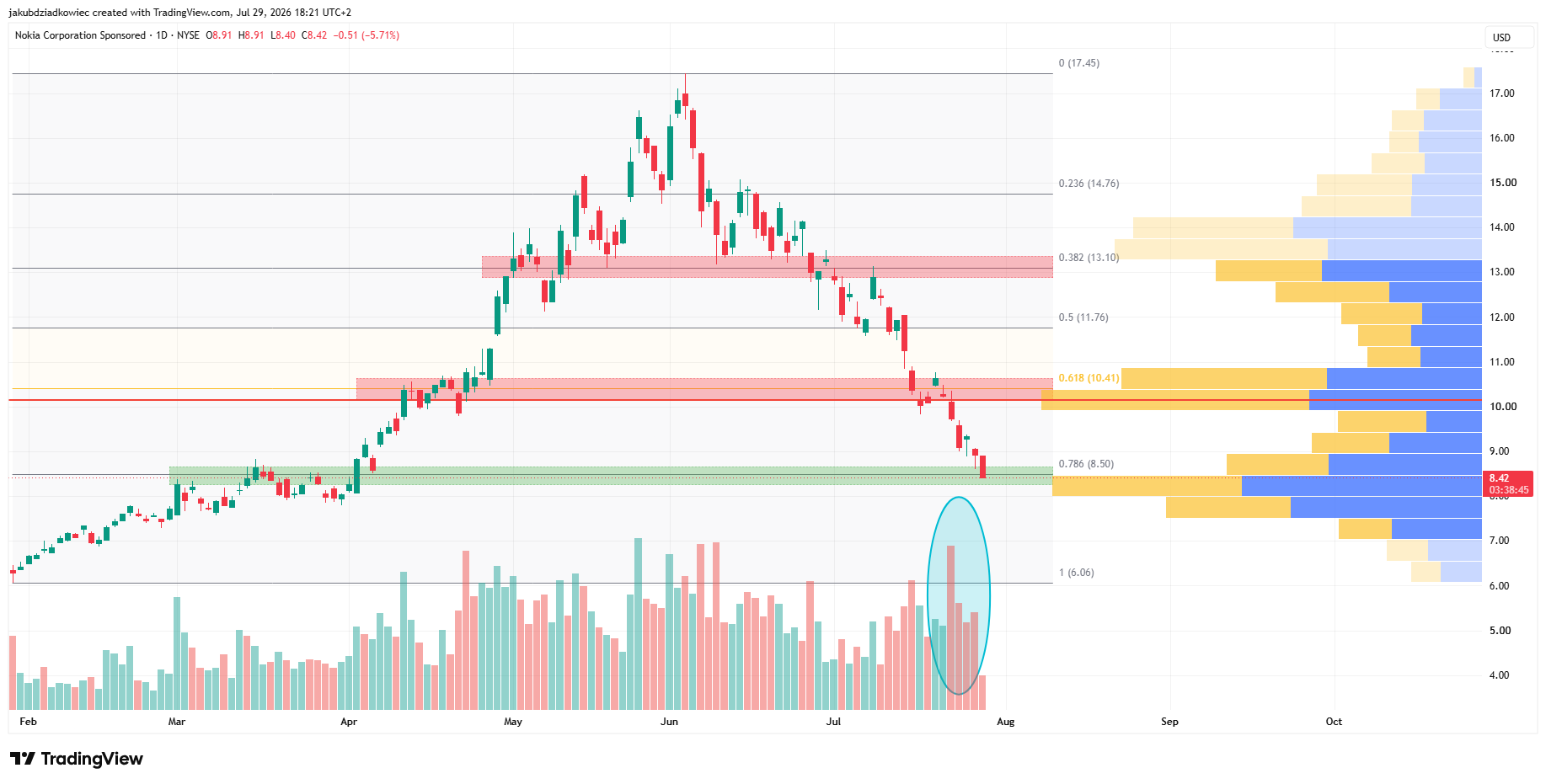
Nokia (NOK) stock traded at $8.44 on Wednesday, down 5.54% intraday, after sellers pushed the price to the 0.786 Fibonacci retracement at $8.50. It is the last major support above the January low of $6.06.
The drop extends Tuesday’s 5.6% slide and deepens a decline that started at the June peak of $17.45. NOK has lost roughly 52% of its value in less than two months.
Why Nokia Stock Is Falling Again This Week
Part of this week’s weakness was mechanical. Tuesday, July 28, was the ex-dividend date for Nokia’s quarterly dividend of 0.04 euros per share, which will be paid on August 6.
However, the adjustment explains only about 0.5% of the move. The rest reflects profit-taking that has continued since last week’s post-earnings breakdown, when investors sold the memory shortage outlook rather than the strong quarter.
Analysts have also started trimming expectations. On July 27, Deutsche Bank lowered its Nokia price target to 11.50 euros from 13.50 euros, while keeping a Buy rating on the shares.
Meanwhile, the sector backdrop remains heavy. Intel dropped 11% after an earnings beat, and profit-taking spread across AI hardware names. Nokia now falls with the sector rather than on company-specific news alone.
NOK Price Analysis Shows Bulls Defending the $8.50 Level
On the daily chart, the Fibonacci retracement drawn from the January low of $6.06 to the June top of $17.45 still maps the decline. The June peak ended a months-long rally fueled by AI and cloud demand.
NOK lost the 0.618 golden pocket at $10.41 last week, and a large spike in volume accompanied the breakdown. Such volume signals conviction among sellers, which favors trend continuation.

The slide has now reached the 0.786 retracement at exactly $8.50. This is the bulls’ final line of defense, and they must step in immediately to hold it.
The Visible Range Volume Profile (VRVP) adds weight to both levels. Its two largest volume nodes sit near $10.41 and $8.50, so these zones will likely act as resistance and support over the coming days or weeks.
Nokia RSI at 27 Gives Bulls No Divergence to Lean On
The daily Relative Strength Index (RSI) reads 27, below the oversold threshold at 30. Historically, such depressed readings can produce short-term bounces, as other beaten-down names showed during this earnings week.
However, there is no sign of a bullish divergence yet. The indicator keeps printing lower lows together with the price, so momentum still favors the sellers.

If NOK loses $8.50 on a daily close, the next support zone sits at the $6.06 anchor low, roughly 28% below Wednesday’s price. In contrast, a daily close back above $10.41 would invalidate the bearish outlook.
Until then, the market decides between a defended floor at $8.50 and a full retest of $6.06.
To read the latest stock market analysis from BeInCrypto, click here.
The post Nokia Bulls Have One Level Left to Defend After 52% Crash From June Peak appeared first on BeInCrypto.
Veteran macro investor Jordi Visser says the easy money in artificial intelligence (AI) is gone. He thinks Bitcoin (BTC) is where the next big gains turn up.
New company filings help explain why. The biggest AI spenders are now burning cash faster than they bring it in.
Big Tech Is Burning Cash to Build AI
Google spent more cash last quarter than it collected. That has never happened since the company listed in 2004.
The measure that matters here is free cash flow. It is simply the money left over after a company pays for the data centers it is building.
All three of the biggest AI spenders saw that cushion shrink.
Company
Cash left over, April to June
Same quarter last year
Microsoft
$19.6 billion
$25.6 billion
Meta
$784 million
$8.5 billion
Alphabet
Negative $5.9 billion
Positive $5.3 billion
Meta’s drop is the eye-catching one. A year ago it kept $8.5 billion. This time it kept $784 million.
Its own release shows why. Sales rose 28%. Costs rose 55%. Meta then borrowed $24.91 billion to keep building. It spent $31.08 billion on new capacity in three months.
One fair caveat. Some of those costs were legal bills and layoff payments, not AI. Together they came to $3.58 billion.
Microsoft looks the healthiest of the three. Its filing shows sales up 18% and its Azure cloud business up 43%.
Even so, its spare cash fell 23%. Nobody escaped the squeeze. Only the size of it changed.
Why Jordi Visser Says the AI Trade Is Over
Visser has worked in markets for more than 30 years. He runs AI research at 22V Research and founded Visser-Labs. He used to be chief investment officer at hedge fund Weiss Multi-Strategy Advisers.
“The AI trade’s over. The ability of getting seven, eight times your money in that is over,” Jordi Visser, on a podcast.
Follow us on X to get the latest news as it happens
He does not think AI is finished. He thinks the returns are shrinking.
Investors used to hope for seven or eight times their money. He now expects closer to 30% a year. That is still good. It is just no longer a windfall.
The reason is competition. Cheap open-source models keep catching up, so no company stays ahead for long. Wall Street is already split on AI chips as a result.
Goldman Says US Stocks Have No Fuel Left
Big investors have little spare money to put to work. Goldman Sachs told clients that leaves stocks stuck.
Hedge funds have already borrowed heavily to buy shares. Their borrowing sits near the top of the past five years.
“There are limited sources of ‘juice’ for rallies in the immediate term. We still need to get through rubble of the past couple weeks before we can start the conversation for any meaningful re-risking,” Bloomberg reported, citing Goldman Sachs trading desk.
Regular investors are pulling back too. Trading activity this month is more than 3% below the five-year average.
Computer-driven funds are the bigger worry. They hold about $196 billion in US shares. A further slide could force them to sell $15.7 billion inside a week.
The wider mood is nervous. The Federal Reserve held rates steady in a 9 to 3 vote. The Dow then fell 1,153 points, its worst day since April 2025.
Long-term borrowing costs jumped as well. The 30-year Treasury closed at 5.20%, its highest level since 2007.
Why Bitcoin and Ethereum Could Benefit
Visser expects AI programs to start moving money on their own. Blockchains are where that would happen.
He does not think Bitcoin leads the way, though. He expects Ethereum to do better, because investors now prefer networks that earn fees.
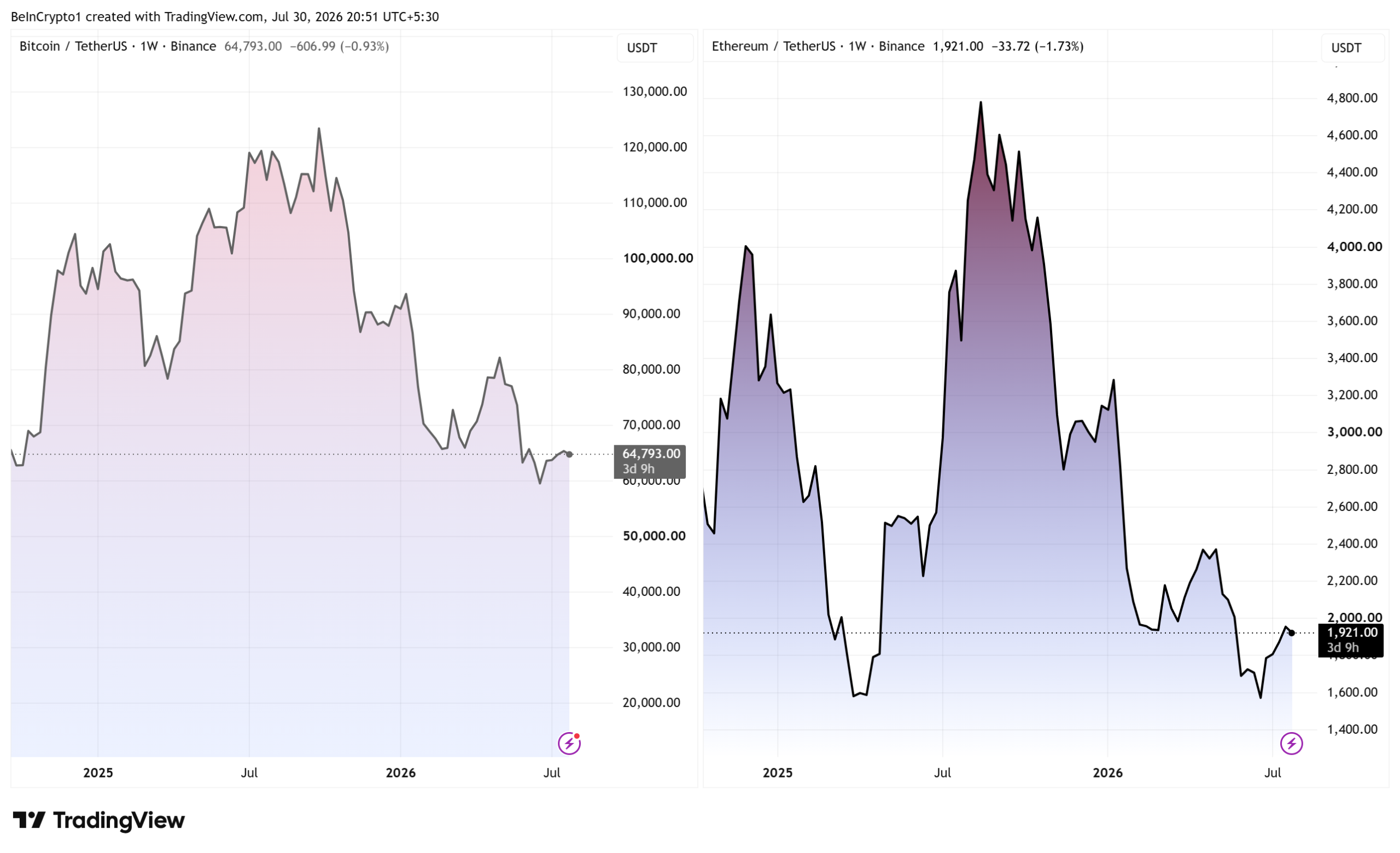
The past month backs him up. Ethereum (ETH) trades near $1,921 and is up 23.3% in 30 days. Bitcoin trades near $64,793 and is up 10.9%.

Zoom out and the picture flips. Over a year, Bitcoin is down 45% and Ethereum 49%.ETH also sits 61% below its 2025 peak. Bitcoin’s current price is 49% below its own record.
So this is a one-month shift, not proof of a new cycle. It matches three bullish Ethereum signals spotted this week, and not much more.
What to Watch Over the Next 30 Days
Visser is waiting on one law. The CLARITY Act would finally decide which US regulator watches which crypto asset.
Traders doubt it passes. Polymarket puts the odds near 30%, and seven roadblocks remain in the Senate.
Rates are the other question. Morgan Stanley economist Mike Gapen expects inflation to ease to about 3.3% by December. That would keep the Fed still. Three officials already wanted a rise.
Then there are buybacks. Goldman expects 90% of big US companies to be free to buy their own shares by mid-August.
Visser needs a law and a buyer. Whichever shows up first will tell us more than any earnings call did.
The post Veteran Macro Investor Says AI’s Easy Money Is Over and Bitcoin Is Next appeared first on BeInCrypto.
Japan slashed its growth forecast for the current fiscal year to 0.9% on Thursday, blaming surging crude oil prices and a weaker yen for squeezing the import-dependent economy.
The downgrade exposes how quickly Middle East tensions can reshape the outlook for an advanced economy.
The Oil and Currency Assumptions Behind the Downgrade
Fiscal year 2026 in Japan runs from April 2026 through March 2027, the standard period governments use for budgeting and forecasting. The Cabinet Office presented the revision alongside updated fiscal projections.
The new figure marks a sharp cut from January. Officials had projected 1.3% growth just six months ago, before global energy markets turned against the country.
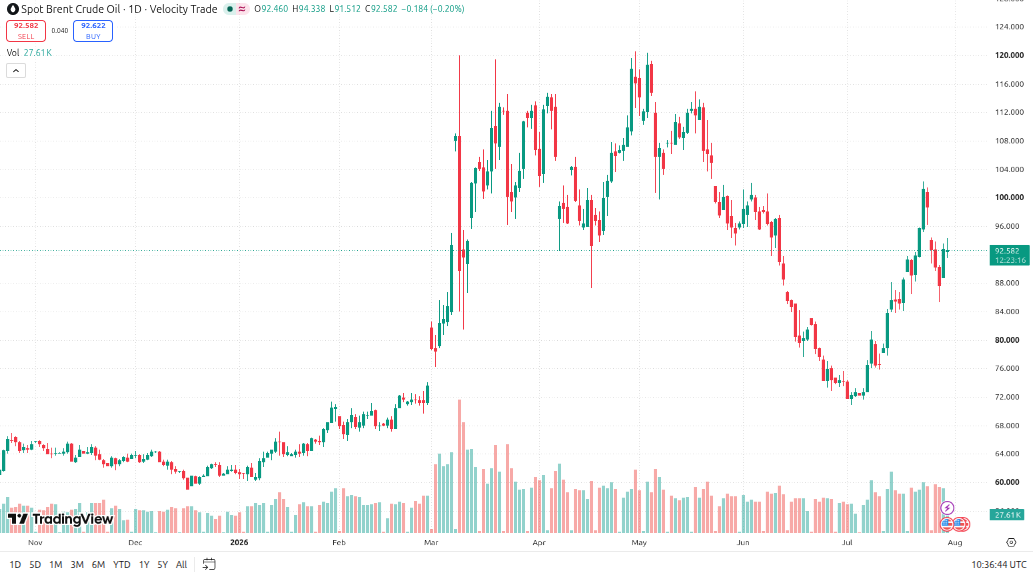
Two assumptions drive the revision. The government now models crude oil at $92.5 per barrel, well above its earlier estimate of $68.
Currency expectations shifted just as dramatically. Officials assume the yen is trading at 161.4 per dollar, compared with 155.2 in the previous forecast.
Follow us on X to get the latest news as it happens.

Both changes hit the same pressure point. Resource-poor Japan imports nearly all of its energy, so higher prices and a weaker currency inflate costs across the entire economy. Household spending absorbs much of that initial shock. Private consumption, which drives more than half of Japanese output, is now forecast to grow just 0.9% instead of 1.3%.
Business investment faces similar pressure. Capital expenditure should rise just 2.3% this year, down from the 2.8% that officials projected back in January.
Inflation moves in the opposite direction. Consumer prices are now expected to climb 2.2%, up from the earlier 1.9% estimate, further testing household purchasing power.
Can Japan Recover Growth in Fiscal Year 2027
Prime Minister Sanae Takaichi’s administration paired the downgrade with a more optimistic medium-term view. Growth should recover to 1.1% in fiscal 2027, according to the same projections.
That rebound depends on policy execution. The government is promoting investment in crisis management, strategic sectors, and public-private partnerships, while new budget guidelines give ministries greater flexibility for growth-oriented projects.
The fiscal arithmetic tells a mixed story. The primary balance, which excludes debt interest, should post a wider deficit of 1.2 trillion yen ($7.4 billion) this year because of supplementary budgets.
Next year looks considerably better on paper. Officials expect a surplus of 1.4 trillion yen ($8.7 billion) in fiscal 2027, driven largely by higher tax revenues.
Subscribe to our YouTube channel to watch leaders and journalists provide expert insights.
That projected swing carries genuine political significance. Japan holds one of the heaviest public debt burdens among developed nations, making credibility with bond markets essential.
Oil markets still remain the central variable. Brent crude has traded around the $80 range recently, while the Bank of Japan points to underlying resilience in exports and specific industrial sectors.
The post Japan Cuts Fiscal 2026 Growth Forecast to 0.9% on Oil and Weaker Yen appeared first on BeInCrypto.


The proposed act is widely viewed as a cornerstone for the next phase of institutional crypto adoption. By establishing clear rules for digital assets, the legislation could give banks, brokers, exchanges and asset managers greater confidence to invest, launch products and build market infrastructure, accelerating the migration of trading and liquidity to regulated U.S. venues.
JPMorgan analysts said the legislation would encourage institutional investment, boost U.S.-regulated trading and lower barriers for banks, exchanges, custodians and market makers.
Some of those trends are already emerging, the bank said, citing Citadel Securities’ $400 million investment in Crypto.com and the CFTC’s approval of the first U.S.-regulated perpetual crypto futures contracts.
The report cautioned, however, that parts of the current draft could deter institutional participation by allowing some tokenized securities and derivatives trading outside SEC or CFTC oversight and imposing lighter anti-money laundering requirements than those faced by traditional financial firms.
Investment bank Jefferies warned that the Clarity Act still faces significant hurdles despite clearing the Senate Banking Committee, according to a report last month.
Read more: Jefferies warns of crypto market volatility as Clarity Act faces Senate test


Aave, the largest decentralized lending protocol, is considering a proposal to abandon six of the blockchains it had expanded onto, in a cleanup affecting about $98 million in deposits. The proposal would see Aave retire “low-adoption” asset markets and 21 expired Pendle principal tokens across 11 Aave deployments, while shutting down its presence on Sonic, Scroll, zkSync, Metis, Soneium and Aptos entirely.
The arguments is based on economics. Each of the six deployments now generate less than $5,000 a quarter. Metis, Soneium and Aptos bring in under $1,000 each, according to the proposal. That does not cover the cost of running them, which includes maintaining price feeds, liquidation systems and monitoring for each market.
For context, Aave’s Ethereum mainnet deployment generates more than $142 million a year and Base about $4.7 million, while Metis produces roughly $3,000.
Deposits have collapsed across all six over six months. Soneium fell 95%, available liquidity on Aptos dropped 94%, zkSync declined 88% to about $844,000, Scroll fell 86% to roughly $2 million, Metis dropped 79%, and Sonic, the largest of the group, fell 74% to just under $8 million.
Ethereum continues to trade within a critical technical area after recovering sharply from its June lows. While the broader rebound remains intact, the latest price action suggests momentum is fading as buyers and sellers battle for control beneath major resistance.
Ethereum Price Analysis: The Daily Chart
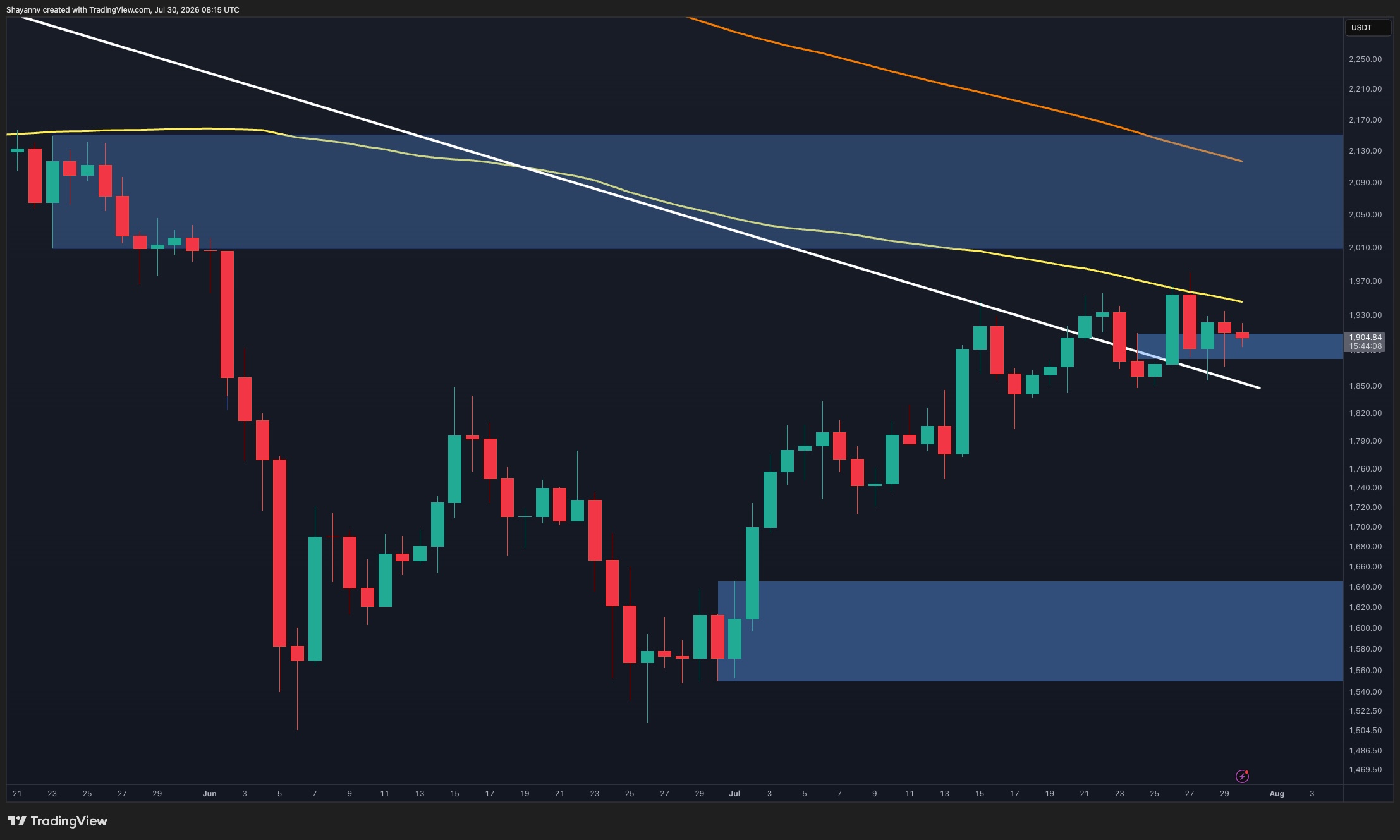
On the daily timeframe, Ethereum remains below both the 100-day and 200-day moving averages, keeping the broader trend cautious despite the recovery from the June bottom. The recent rally stalled just below the 100-day MA near the $1.95K region, where sellers quickly stepped in and pushed the price back toward the $1.88K to $1.91K supply zone.
This area is now acting as immediate resistance. A successful breakout above it would improve the medium-term outlook and expose the confluence of the 100-day and 200-day moving averages inside the $2.02K to $2.15K resistance zone. Until then, ETH remains vulnerable to another rejection.
On the downside, the $1.75K to $1.79K demand zone remains the first important support. Losing this area would likely trigger a deeper correction toward the major demand region around $1.56K to $1.64K.
ETH/USDT 4-Hour Chart
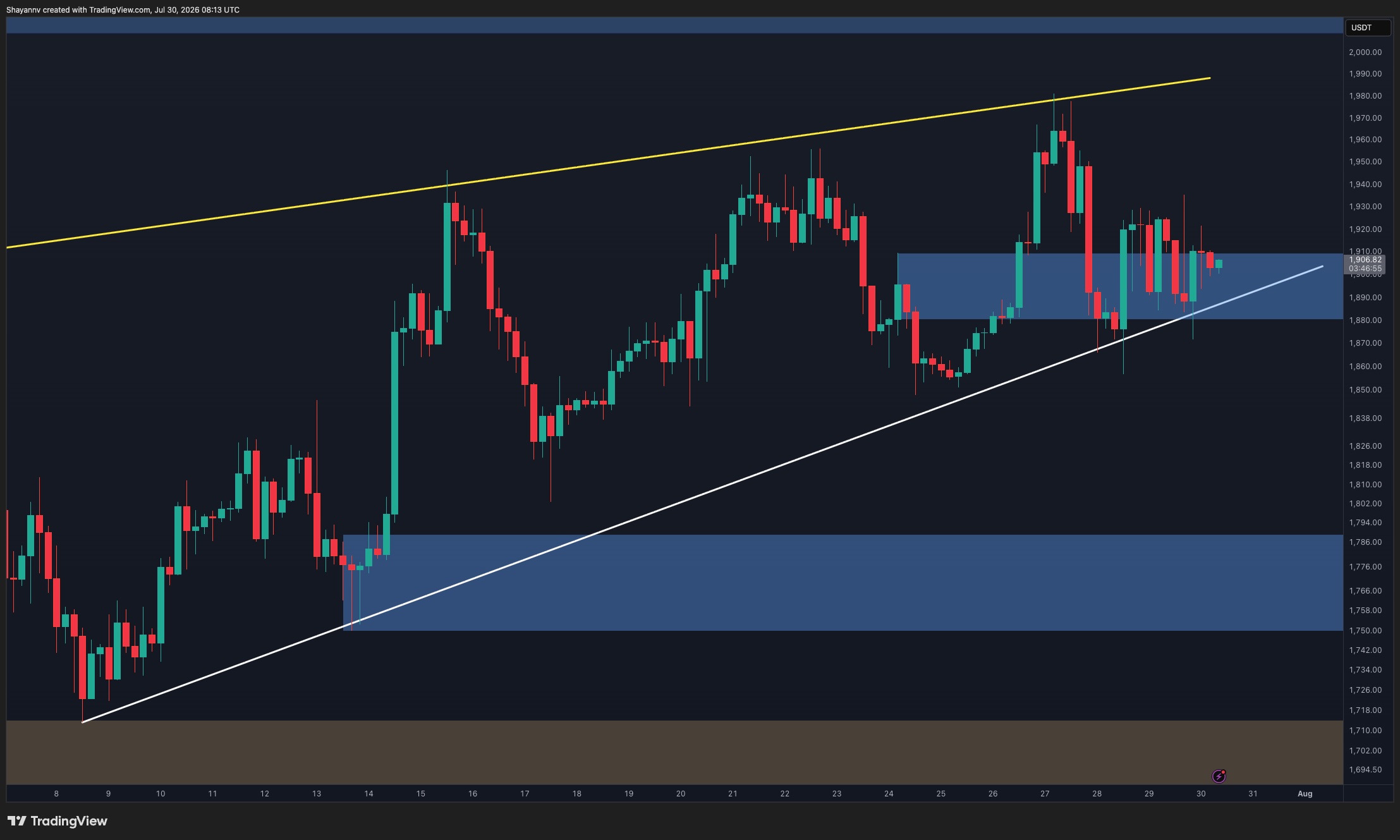
The 4-hour chart shows Ethereum trading inside a compression pattern, with price action confined between the rising white trendline and the descending yellow trendline. This narrowing range reflects increasing indecision as neither buyers nor sellers have been able to establish a decisive directional move.
Ethereum is currently consolidating around the $1.88K to $1.91K resistance zone while continuing to respect the ascending support trendline. A breakout above both the resistance zone and the descending trendline would likely strengthen bullish momentum and pave the way for another attempt at the recent highs.
However, a breakdown below the white ascending trendline would invalidate the current sequence of higher lows and could accelerate a correction toward the $1.75K to $1.79K demand zone, where buyers would be expected to defend the broader recovery structure.
Sentiment Analysis
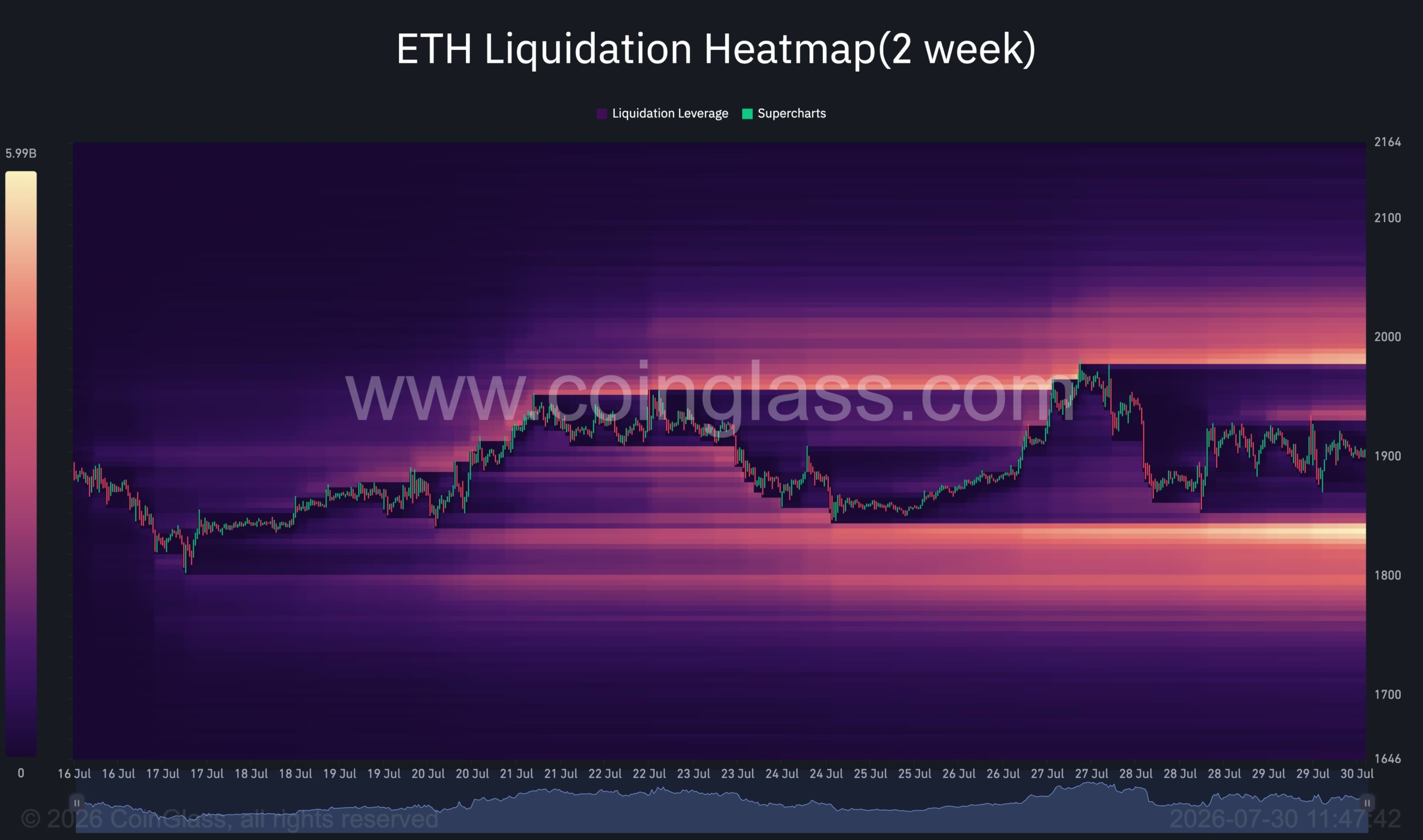
The two-week Binance liquidation heatmap highlights a notable concentration of liquidity above the current price around the $2K level, making it the primary upside liquidity target if buyers regain momentum.
At the same time, a significant liquidation cluster has formed around the $1.82K region beneath the market. Since price is currently trading between these two liquidity pools, Ethereum may continue to experience choppy and range-bound price action before making a decisive move toward one of these high-liquidity areas. A sweep of either cluster could trigger increased volatility as leveraged positions are liquidated.
The post Ethereum Price Analysis: ETH Holds Key Support but Bullish Momentum Fades appeared first on CryptoPotato.

Yet rather than add nurses, many hospitals are paring back, sometimes turning to apps where they can hire nurses as gig workers. Such apps often allow hospitals to avoid paying for benefits for these workers, says Katie Wells, a senior fellow at the AI Now Institute, which has studied gig apps for nursing. “Lean staffing has just become the norm,” Wells says.
The American Hospital Association argues that the issue is not lean staffing but that instead there are workforce shortages that are projected to continue for more than a decade.
“The growing complexity and intensity of patient care, along with overly burdensome regulatory requirements and increased administrative demands from corporate insurers, continue to place significant demands on nurses,” the association said in a statement provided to TIME.
Hospitals are also facing increased costs of caring for patients, according to a March 2026 post by Rick Pollack, AHA’s president and CEO. In 2025, he writes, hospital expenses grew 7.5%, more than twice the rate of growth in hospital prices. Hospitals are also caring for patients who are sicker and whose care is more complex than it used to be, he points out.


The US Treasury’s Office of Foreign Assets Control (OFAC) sanctioned two firms accused of supporting an IRGC-backed scheme that allegedly extorted commercial vessels transiting the Strait of Hormuz by requiring them to purchase maritime insurance.
Wednesday’s designations hit the Persian Gulf Marine Insurance Company and HormuzSafe Marine Services Authority, known as Hormuz Safe. Treasury says the policies extract revenue while covering risks that Iran itself creates.
Follow us on X to get the latest news as it happens
How Iran’s Hormuz Insurance Scheme Drew US Sanctions
The IRGC reportedly began collecting transit fees from tankers passing through the Strait of Hormuz in April, with charges starting at approximately $1 per barrel.
The Treasury said the insurance scheme was created to offset revenue lost following Operation Epic Fury. Treasury Secretary Scott Bessent linked the initiative to Iran’s worsening economic conditions.
“With its economy in freefall and inflation in the triple digits, the regime is desperate for cash,” he said.
According to the department, Iran established the “illegitimate schemes” through the Persian Gulf Marine Insurance Company (PGMIC) and HormuzSafe Marine Services Authority.
It said Iran’s Ministry of Economy developed HormuzSafe. It offers insurance, traffic control, security, and emergency response services to vessels transiting the strait.
The firm accepts payments in Bitcoin (BTC) and other digital assets as part of Iran’s efforts to circumvent Western sanctions.
The Treasury also noted that Iran’s insurance regulator created the Persian Gulf Marine Insurance Company, which issues policies approved by the Persian Gulf Strait Authority.
OFAC sanctioned the IRGC-backed authority on May 27. It has now designated both the Persian Gulf Marine Insurance Company and HormuzSafe Marine Services Authority under Executive Order 13902 for operating in Iran’s financial sector.
In addition, OFAC sanctioned eight shipping companies and identified eight oil tankers as blocked property. The operators are registered in Hong Kong, the Marshall Islands, and China. According to the Treasury, the vessels transported Iranian crude oil and petroleum products.
The agency has now sanctioned more than 100 shadow fleet vessels since January. The latest measure is part of a broader US enforcement action against Iran.
In mid-July, the Treasury sanctioned four cryptocurrency wallets linked to Iran’s central bank. At the same time, Tether froze approximately $131 million in USDT held in those addresses.
Subscribe to our YouTube channel to watch leaders and journalists provide expert insights
The post OFAC Targets Iran’s Crypto-Funded Toll Scheme in Strait of Hormuz appeared first on BeInCrypto.
Earnings call transcript: Whitecap beats Q2 2026 estimates on record cash flow

Ondo Finance explores deal valued at up to $500 million

Mum who murdered toddler daughter filmed smoking cigarette as tot lay dying


-

 Fashion6 days ago
Weekend Open Thread: Brooks Brothers
-
 Sports4 days ago
Commonwealth Games boxing: Jadumani Singh seals dominant 5-0 win over Pakistan’s Sumama Rehman to enter quarter-finals | Commonwealth Games News
-

 Business20 hours ago
Why Trees Belong on the Risk Register
-

 Tech4 days ago
Intel is reversing course and bringing hyper-threading back to its server chips
-

 Crypto World5 days ago
Ripple bought a bank in pieces. The $4 billion audit
-

 Politics3 days ago
Luke Littler dismantles Gerwyn Price to retain title in Blackpool
-

 Politics2 days ago
The Part of the Electric Transition Nobody Wants to Discuss
-
 Entertainment6 days ago
A New Post-Apocalyptic Gundam Anime Series Blasts Into SDCC
-

 News Videos4 days ago
BITCOIN JUST ENTERED THIS CRITICAL ZONE…
-

 Fashion7 days ago
16 Dresses for the High Summer Event
-

 Sports7 days ago
2026 3M Open leaderboard: Scottie Scheffler finds putter in Round 1, sits three back
-

 News Videos7 days ago
The Peugeot Family: How 200 Years of an “Old Money” Dynasty Died in A Boardroom
-

 Business1 day ago
Major shareholder moves on Canyon
-

 Crypto World4 days ago
XRP Ledger adds $2.6B as RWA inflows rank second
-

 Politics4 days ago
Spain sweeps the board at 2026 World Cup with individual awards
-

 News Videos5 hours ago
Bitcoin Enters the 3rd Stage of the Bear Market
-
 Entertainment2 days ago
‘Stargate’ Creator’s New Sci-Fi Series Returns for Season 3 Tomorrow
-

 Tech5 days ago
Anthropic launches Claude Opus 5, a cheaper AI model for coding, agents and enterprise workflows
-

 Crypto World2 days ago
Kraken Enables Retail Access to Jersey Mike’s IPO via Tokenized Shares
-

 Entertainment5 days ago
Sara Gilson Killed By Husband After Viral “Pedophile” TikTok Video
You must be logged in to post a comment Login