

Crypto World
South Korea Has the World’s Hottest Stock Market: Why Does MSCI Still Call It ‘Emerging’?

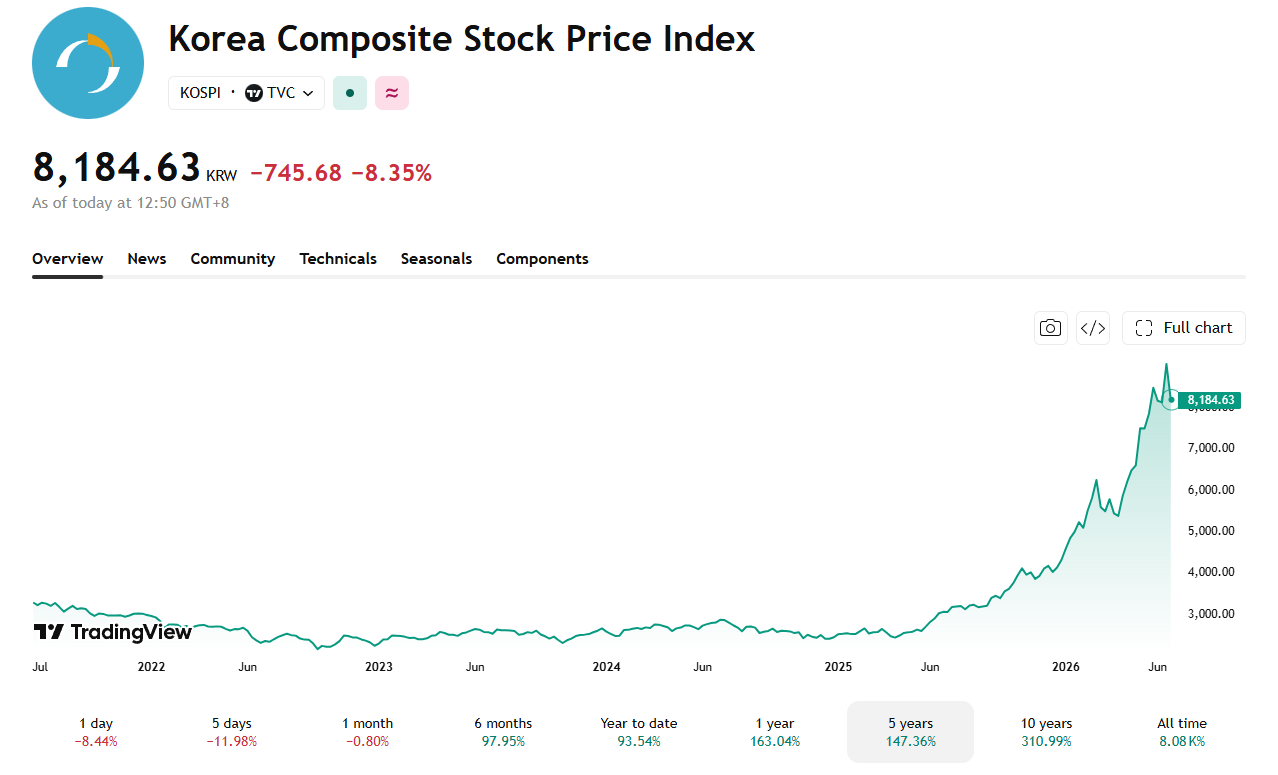
South Korea’s KOSPI surged 112% in 2026, overtook the UK’s FTSE 100, and ranked as the world’s best-performing major index in 2025. Yet MSCI’s latest annual review left the country in its Emerging Markets category for another year.
MSCI CEO Henry Fernandez says South Korea’s economy is not the problem. Its currency market is.
One Currency Rule Blocks the Upgrade
Fernandez told CNBC that South Korea is “one of the most developed markets on the planet” in economic and technological terms. But MSCI judges countries on how their equity markets function for international investors. On that measure, the Korean won creates a specific barrier.
Fund managers buying South Korean equities must first purchase the won to settle trades. In every other market that MSCI classifies as developed, investors can buy or sell that currency at any hour, from any major financial center. The Korean won trades only during business hours in Seoul.
That constraint matters at scale. Fernandez said a third of all globally managed index assets sit in index funds. Managers running those funds cannot rebalance Korean positions outside Seoul trading hours.
July Reform Is Not Enough to Convince MSCI
South Korea plans to launch 24-hour dollar-won spot trading on July 6. Fernandez acknowledged the reform as real progress. But he raised a direct question: will a Seoul-based night shift generate enough liquidity, with a tight enough bid-ask spread, to satisfy institutional demand? He said he has doubts.
MSCI also cited rigid investor identification requirements, restrictions on in-kind transfers, and limits on exchange data use as additional reasons for keeping the country in emerging markets. The index provider stated that investors reported these issues remain unresolved.
South Korea already holds developed-market status under FTSE Russell’s classification system. The MSCI designation carries greater weight for passive fund flows globally, which is why Seoul has long pursued the upgrade. Earlier this year, the KOSPI overtook London’s FTSE 100 to become the eighth most valuable national equity index in the world. Market performance does not factor into MSCI’s methodology, however.

The July trading launch will be the key test. If it produces deep, liquid markets around the clock, MSCI’s next annual review could look different.
The post South Korea Has the World’s Hottest Stock Market: Why Does MSCI Still Call It ‘Emerging’? appeared first on BeInCrypto.

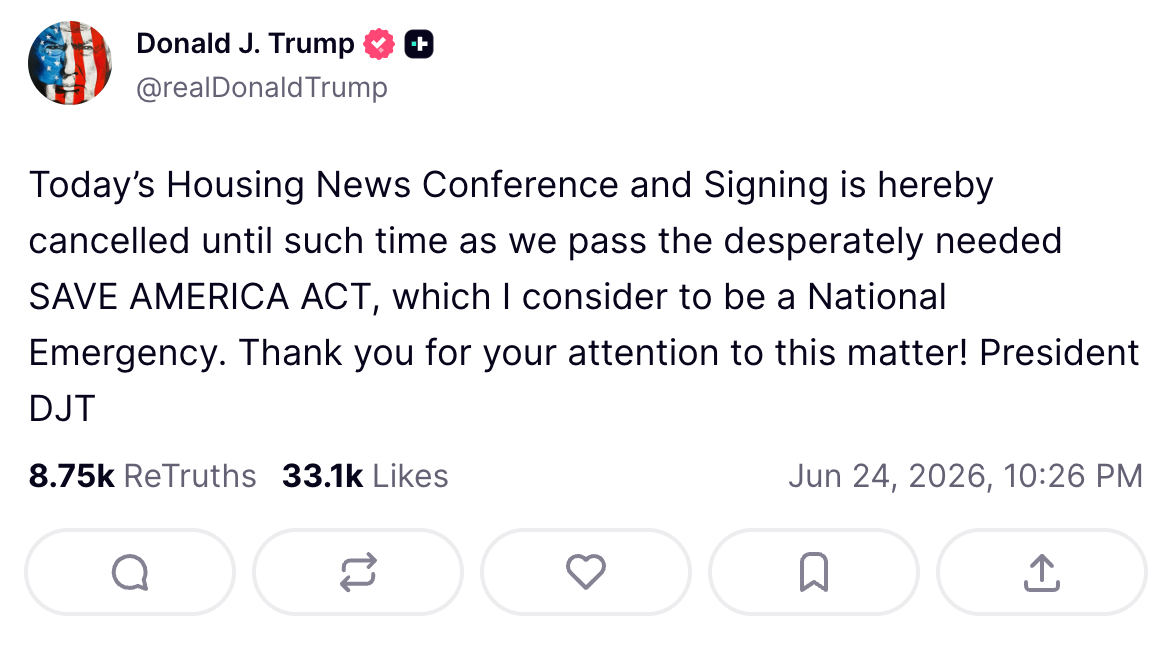
President Donald Trump canceled the signing ceremony for the 21st Century ROAD to Housing Act on June 24, saying he will withhold his signature until Congress passes his voter ID measure. This standoff is now compressing the Senate floor calendar that the CLARITY Act needs to survive.
The housing bill, which cleared the Senate 85-5 and the House 358-32, carries a provision banning the Federal Reserve from issuing a central bank digital currency (CBDC) through December 31, 2030. That makes its stall a crypto policy event, not just a housing one.
A Political Squeeze With Crypto Consequences
Trump posted on Truth Social that the “Housing News Conference and Signing is hereby cancelled until such time as we pass the desperately needed SAVE AMERICA ACT.” The Safeguard American Voter Eligibility (SAVE) Act, which requires proof of citizenship to vote, has already passed the House but faces a near-certain Democratic filibuster in the Senate.

Senate Majority Leader John Thune, who met with Trump at the Capitol, told reporters he hoped the president would “find his way to sign” the housing bill. Senator Elizabeth Warren, who co-sponsored the legislation, said she had “no idea” why Trump canceled the signing.
The housing bill’s CBDC ban had been one of the more durable wins for crypto advocates this Congress. House Republicans attached the provision to the broadly supported bill to give it the legislative momentum it could not achieve as a standalone measure. Its suspension now leaves that win in limbo.
CLARITY Act Window Is Closing
The more direct consequence for crypto markets is what the standoff means for Senate scheduling. The Digital Asset Market Clarity Act sits on the Senate Legislative Calendar as No. 423, placed on June 1 and eligible for a floor vote at any time Majority Leader Thune chooses to schedule one. He has not yet announced a date.
The Senate returns from the July 4 mini-recess on July 13. The August recess begins around August 10, leaving fewer than four weeks of usable floor time. The bill still needs 60 votes to clear a filibuster, meaning at least seven Democratic crossovers beyond the two already on record.
Senator Cynthia Lummis announced this week that the bill will reach the Senate floor in July, marking the first public floor date commitment from the bill’s lead sponsor. But as BeInCrypto has reported on the Senate calendar crunch, Galaxy Digital research head Alex Thorn has already cut his 2026 passage odds to 60%, citing a shrinking schedule.
Brian Gardner, chief Washington policy strategist at Stifel, wrote that the CLARITY Act “probably needs to get through the Senate by the end of July, preferably in June.” He added that failure before the August recess would cause the bill’s prospects to “deteriorate materially.”
The CLARITY Act’s two remaining hurdles, an unresolved ethics provision and law enforcement objections to Section 604, were already straining the timeline before Trump’s housing bill move.
A SAVE Act fight that consumes Senate floor time in July could push the bill past the only realistic legislative gate remaining before the fall campaign season sets in.
The post Trump Blocks Housing Bill, Puts CLARITY Act in Danger of Not Getting Passed appeared first on BeInCrypto.
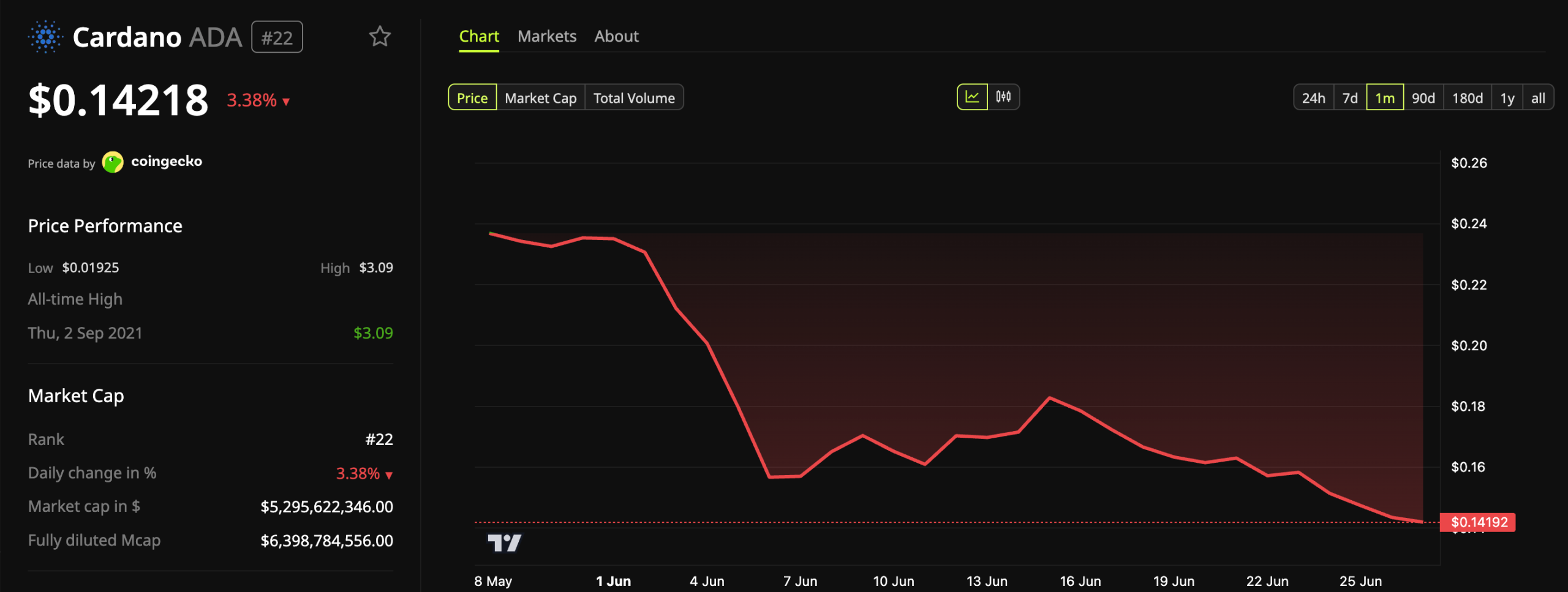
Cardano (ADA) on-chain activity spiked for the second time this month, with daily active addresses and social dominance climbing.
The uptick came as the token traded near December 2020 price lows. ADA has fallen nearly 41% over the past month, outpacing the broader market’s 19.9% decline.
Cardano Activity Surged as the Token Hit Five-Year Lows
The spike arrived during heavy selling. ADA traded near $0.142 on June 26, down about 3.38% on the day.
Today’s decline adds to a broader slide that has pulled the altcoin down by more than 13% over the past week.
Follow us on X to get the latest news as it happens

The downtrend followed ADA’s break below the $0.23 support level in early June. Despite the price slide, Santiment noted that network activity rose.
Daily active addresses reached 29,025. At the same time, social dominance climbed to 0.33% of all crypto discussions. Santiment recorded the same setup earlier in June, marking the second activity spike in a single month.
“Cardano has suddenly become one of crypto’s biggest conversation pieces as on-chain activity explodes for a second time this month,” the firm said.

Hoskinson Warnings and Governance Disputes Fueled the FUD
The analytics firm explained that much of the negative sentiment traced back to founder Charles Hoskinson. In early June, warned that more projects could fail.
Hoskinson also stepped back from videos, interviews, and X. Furthermore, he drew a hard line on his role in the token’s performance.
“What I’m not passionate about is making the price of ADA go up,” he said.
Governance disputes have added to the strain. Santiment noted that while the developments “have fueled bearish sentiment, they’ve also pushed Cardano back into the spotlight.”
It added that the combination of the on-chain spike and elevated FUD has previously preceded mild relief rallies.
“The on-chain spike and major FUD do hint at a mild relief rally, as the chart shows how the two previous instances of this setup unfolded,” the post read.
The coming sessions will show whether the pattern holds or sellers retain control.
Subscribe to our YouTube channel to watch leaders and journalists provide expert insights
The post Cardano Sits at 2020 Lows, But 2 On-Chain Signals Point to a Relief Rally appeared first on BeInCrypto.


- Binance will halt services for EU users after MiCA setback.
- BNB token price has fallen 13.2% over the past month.
- Bitcoin miner inflows to Binance hit a four-month high.
BNB token remained under pressure on Friday as investors weighed Binance’s regulatory setback in Europe against the token’s long-term role within the Binance ecosystem.
The token traded at $566.26, down 0.3% over the previous 24 hours.
During that period, Binance coin (BNB) moved between $541.77 and $569.04, showing that buyers managed to push the price close to the day’s high despite negative headlines.
Even so, the broader trend has remained weak.
BNB has fallen 1.4% over the past seven days, 5.5% in the last two weeks, 13.2% over the past month, and 12.5% over the last year.
The latest decline in sentiment comes after Binance confirmed that it will stop providing services to customers across the European Union after failing to obtain a license required under the bloc’s Markets in Crypto-Assets (MiCA) regulations.
Regulatory setback raises fresh questions
Binance’s withdrawal from the European market represents another regulatory challenge for the world’s largest cryptocurrency exchange.
The company informed affected users that services in the European Union will end after it failed to secure the required MiCA authorisation before the regulatory deadline.
Binance had previously sought approval through Greece before withdrawing its application and has indicated that it intends to pursue authorisation through another EU member state.
Although Binance said Europe remains an important market and expects to secure a license in the future, the interruption creates uncertainty for one of its largest regional user bases.
That uncertainty matters because the BNB token is closely tied to the Binance ecosystem.
While the token has expanded well beyond its original purpose as an exchange utility token, Binance’s trading activity still plays an important role in overall demand.
Any reduction in exchange activity could temporarily affect demand for BNB tokens, particularly from users who hold the token to receive trading fee discounts or participate in Binance products.
BNB token still has utility beyond the exchange
Despite the regulatory headwinds, the BNB token is no longer dependent solely on Binance’s centralised exchange.
The token serves as the native asset of BNB Chain, where it is used to pay transaction fees, support decentralised finance applications, participate in staking, and access Binance Launchpad token offerings.
These use cases continue to generate demand independent of spot trading on the exchange.
The BNB token also benefits from a deflationary supply model.
The token launched with a maximum supply of 200 million coins, and Binance continues to remove tokens from circulation through scheduled burns.
The token burn mechanism has so far removed 289,896.29 BNB tokens from the circulating supply, according to BNBBurn info, and remains one of the key features supporting the asset’s long-term economics.
However, utility alone may not fully offset the impact of negative regulatory developments in the short term.
Investor sentiment often reacts quickly to news involving Binance because of the close relationship between the exchange and its native token.
The wider crypto market decline adds another layer of pressure
The regulatory news arrives at a time when the broader cryptocurrency market is already facing fresh concerns.
Recent blockchain data showed that Bitcoin miners transferred more than 150,000 BTC to Binance during June, marking the highest miner inflows to the exchange in four months.
Large transfers from miners to exchanges are closely monitored because they can precede increased selling activity.
Although deposits do not automatically mean that coins have been sold, they often indicate that miners are preparing to access liquidity after periods of lower mining profitability.
If Bitcoin (BTC) experiences additional selling pressure, the effect can extend beyond the largest cryptocurrency.
And major altcoins, including the BNB token, frequently move in the same direction as Bitcoin during periods of broader market weakness.
If that happens, then the BNB token price could drop below the key support at $541.
However, if the market sentiment improves, then we could see the token recover above $588 and above.

Metaplanet shares on the OTC market closed at about $1.29 on June 25, extending a year-long drop that has taken the stock down 88%, while the company’s Bitcoin holdings have risen to over 40,000 BTC.
The numbers have drawn the attention of one analyst who argues that the market is pricing the stock well below what the company is actually worth.
Metaplanet’s Market Value Trails Its Bitcoin Holdings
According to data posted by Bitcoin watcher Zynx on June 26, Metaplanet currently holds 40,177 BTC with a net asset value of approximately $2.36 billion, while its market cap sits at just $1.54 billion and its debt at $297 million.
“No reason for a profitable company to trade significantly below its book value,” Zynx wrote.
That $2.36 NAV figure comes from Metaplanet’s own tracker, which also shows its enterprise value is around 0.81x BTC NAV, meaning investors are effectively buying the Bitcoin at a discount. Furthermore, the company’s unrealized loss on its BTC stash is about $1.77 billion, since those 40,177 BTC were bought at an average price of $104,000 each, for a total of roughly $4.18 billion.
Additional data from Yahoo Finance shows its MTPLF stock lost 33% of its value in the last 30 days and is also 56% lower than where it was six months ago. This is despite the company consistently buying Bitcoin, including 5,075 in Q1 2026 for $405 million at an average price of $79,900. That buy pushed Metaplanet past MARA Holdings into third place among corporate Bitcoin holders worldwide, with only Twenty One Capital (43,514 BTC) and Michael Saylor’s Strategy (847,363 BTC) boasting bigger bags.
Investor Adam Livingston called the Metaplanet situation “a great opportunity for the long haul,” pointing to the company’s relatively low leverage compared to the likes of Strategy, which relies heavily on preferred shares and convertible notes.
Business As Usual
While the stock performance has been brutal, Metaplanet has not stopped its broader business expansion, with its latest move being the acquisition of Siiibo Securities, a licensed securities firm described as a pioneer of Japan’s online corporate bond market. The deal is reportedly worth 2.1 billion yen, which translates to just over $13 million, and should be closed by July 13.
According to CEO Simon Gerovich, who framed the acquisition as the first move in the Tokyo-listed firm’s “Project Nova,” Siiibo will change its name to Metaplanet Securities and will offer Bitcoin-related yield products to retail investors in Japan.
The executive said Japanese households are holding an estimated $1.7 trillion in savings accounts and low-yield instruments, something he believes is an opportunity, especially considering the country’s gradual shift from deflation to inflation, which should see capital actively looking for better returns.
The post Metaplanet Stock Down 88% in a Year While BTC Holdings Grow appeared first on CryptoPotato.
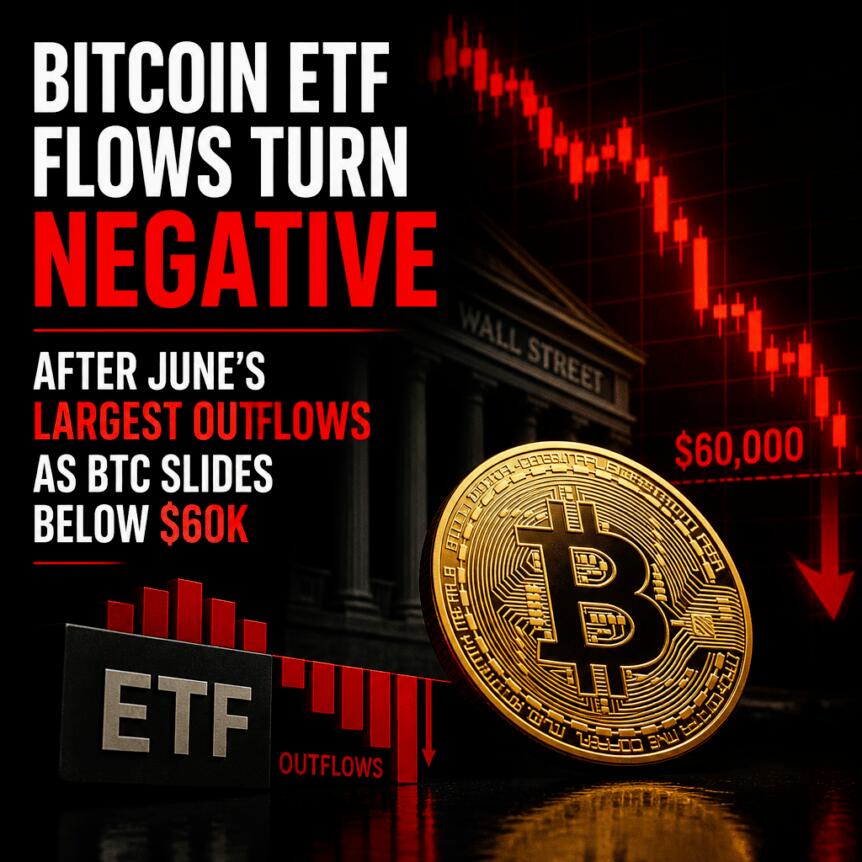
US-listed spot Bitcoin exchange-traded funds saw their steepest daily net outflows of June on Thursday, extending a broader cooling in institutional demand as Bitcoin traded below $60,000.
SoSoValue data shows the ETFs collectively lost $696.3 million in net flows—above the prior monthly high of $519.2 million recorded on June 2—taking June’s total net outflows to $3.61 billion. Year-to-date, net outflows now stand at $4.6 billion.
Key takeaways
- Spot Bitcoin ETFs recorded $696.3 million in net outflows on Thursday, the largest single day of June, as Bitcoin slipped under $60,000.
- June outflows total $3.61 billion, pushing US spot ETF year-to-date net outflows to $4.6 billion, according to SoSoValue.
- Total US spot ETF assets fell below $73 billion for the first time since late 2024, down about 57% from an October 2025 peak.
- Strategy reduced its June Bitcoin buying rate to roughly 3,600 BTC so far, down sharply from May and April, with at least one small net sale reported earlier in the month.
Spot ETF outflows accelerate as Bitcoin weakens
The latest withdrawal wave underscores how quickly flows can react when price momentum turns. With Bitcoin trading below $60,000, US spot Bitcoin ETFs pulled back decisively—registering $696.3 million in net outflows on Thursday and deepening the month’s losses.
SoSoValue’s breakdown also highlights the escalation within June itself: Thursday’s figure exceeded the previous monthly high of $519.2 million set on June 2. That matters because it suggests investors’ redemption behavior is not limited to isolated days—it is broadening across the month as market conditions deteriorate.
SoSoValue further reports that June’s net outflows are now $3.61 billion, while year-to-date net outflows have reached $4.6 billion. In practice, that means ETF investors have been net sellers of exposure rather than net accumulators, even though spot ETFs were designed to provide a straightforward route into Bitcoin’s price.
ETF balance sheets shrink toward late-2024 levels
Beyond daily flows, the impact is visible in ETF balance sheets. According to SoSoValue, total net assets in US-listed spot Bitcoin ETFs dropped below $73 billion for the first time since late 2024.
SoSoValue indicates that the sector’s total net assets reached a record $169.5 billion in October 2025. As of Friday, that number had fallen to roughly $72.6 billion—an approximately 57% decline.
Separate data from WalletPilot adds another layer: the funds held a combined 1.24 million BTC as of Tuesday, and about 63,500 BTC left the products over the past 30 days. Taken together, these figures point to sustained net reductions in ETF-held Bitcoin rather than a brief drawdown.
Strategy’s June buying slows amid public pressure
ETF outflows are not the only sign of institutional appetite softening. Strategy—the largest publicly traded corporate Bitcoin holder—has reportedly reduced the pace of its purchases during June, fueling renewed debate over its approach.
Based on Strategy filings, the company bought roughly 3,600 Bitcoin in June so far. That is down from about 25,000 BTC in May and more than 50,000 BTC in April. The change is significant: it suggests Strategy is not maintaining the same monthly accumulation pace that preceded the market downturn.
The slowdown also included a notable exception earlier in the month: a net sale of 32 BTC, described as one of the few times Strategy has sold Bitcoin during its accumulation period.
Additionally, Strategy’s perpetual preferred stock (STRC) has faced pressure. The stock traded below its intended $100 level, closing at $75.69 on Thursday, down 6.37%. That has amplified scrutiny of Strategy’s capital management and timing, with CryptoQuant analysts raising concerns about the company’s risk management and purchase cadence.
Debate over timing: preserve cash vs. “self-repair” claims
The company’s reduced buying rate has split commentary in the market. Some analysts argue Strategy should pause additional Bitcoin purchases and focus on rebuilding cash reserves during a weaker period for crypto prices.
Others push back on the notion that the plan has broken down. Bitcoin advocate Samson Mow argued that STRC includes a “self-repairing mechanism” that activates when it trades below its $100 benchmark. He also noted that Strategy pauses new share issuance through its ATM program at that level, which he said helps limit additional supply.
Whether those mechanisms are sufficient to offset the near-term pressures remains a key question for observers—especially as ETF flows continue to signal demand softness.
Investors should watch whether ETF outflows stabilize in the coming sessions and whether Strategy’s purchase pace returns closer to earlier months’ levels. If redemptions persist while corporate buying remains muted, the market may struggle to reclaim the momentum that typically draws in spot ETF inflows.

Key Highlights
- Shares of AMD advanced 2.5% Thursday, reaching an intraday peak of $550.88 before closing at $532.57
- UBS increased its price objective to $670; Gartner identified AMD as “the company to beat” in the enterprise AI server CPU market
- First quarter revenue reached $10.25 billion, representing a 37.8% year-over-year increase and surpassing analyst projections
- The company’s forward P/E ratio stands at 71x compared to Nvidia’s 23x — presenting valuation considerations
- The forthcoming MI450 processor, manufactured using TSMC’s 2nm technology, aims to compete with Nvidia’s Vera Rubin architecture
Shares of Advanced Micro Devices climbed 2.5% during Thursday’s session, peaking at $550.88 before finishing at $532.57. This represented a gain from the previous day’s close of $519.74. Trading activity registered approximately 26.7 million shares, falling about 29% short of the typical daily volume of 37.7 million.
Advanced Micro Devices, Inc., AMD
The upward movement occurred on below-average volume, indicating the rally wasn’t driven by widespread market momentum. However, the catalyst behind the move was unmistakable: a series of favorable analyst assessments.
Reports indicate UBS elevated its price objective for AMD to $670. Additionally, technology research leader Gartner designated AMD as “the company to beat” in the enterprise AI server CPU sector — a designation that resonated throughout investment circles.
The broader analyst community maintains a favorable outlook on AMD. Among those monitored by MarketBeat, 28 analysts recommend Buy, 12 suggest Hold, two rate it Strong Buy, and just one recommends Sell.
The consensus price target currently rests at $440.41, although several recent revisions have elevated forecasts considerably. Mizuho increased its target to $615 while TD Cowen adjusted upward to $600, both maintaining constructive ratings.
The company’s first quarter performance, announced on May 5th, reinforced the positive sentiment. Revenue totaled $10.25 billion, exceeding the $9.90 billion projection and marking a 37.8% increase compared to the prior year period. Earnings per share reached $1.37, topping the consensus estimate of $1.29.
Valuation Questions Persist Among Investors
Notwithstanding solid operational performance, AMD’s valuation multiple has emerged as a recurring topic among market watchers. The stock currently carries a trailing P/E ratio near 171x and a forward P/E of 71x. Nvidia, in contrast, trades at a forward P/E of approximately 23x.
Several market observers have highlighted that AMD’s elevated valuation multiples provide limited margin for disappointment. Should growth projections fall short of expectations, even marginally, the stock could experience downward pressure. One analysis noted that even Micron’s robust quarterly results failed to provide uplift to AMD shares, suggesting a more discriminating market climate.
Chief Executive Lisa Su divested 125,000 shares on June 10th at an average execution price of $460.69, generating proceeds of approximately $57.6 million. The divestiture was conducted through a previously established 10b5-1 trading arrangement. Executive Vice President Mark Papermaster similarly sold 6,000 shares on June 15th at $536.33. Both transactions were pre-scheduled rather than opportunistic.
The MI450 Represents the Next Major Milestone
AMD’s upcoming significant product launch centers on the MI450 processor, which is being produced utilizing TSMC’s cutting-edge 2-nanometer manufacturing process. This represents a generational advantage over Nvidia’s 3nm Vera Rubin architecture.
The MI450 is projected to feature 432 GB of HBM4 memory capacity, substantially exceeding Vera Rubin’s 288 GB configuration. Industry analysts also anticipate AMD will deliver superior total cost of ownership economics, a consideration that carries weight in hyperscale data center procurement decisions.
AMD’s current market capitalization hovers around $868 billion, representing a small fraction of Nvidia’s $4.9 trillion valuation. This disparity forms a central component of the bullish investment thesis — significant expansion potential remains.
The company’s data center business segment now contributes 56% of total revenue. Nvidia’s comparable segment represents 92% of its revenue mix, highlighting both how much ground AMD must cover and the substantial growth opportunity that lies ahead.
Institutional investors hold 71.34% of outstanding shares. Wall Street projects full-year earnings per share of $6.15 for the current fiscal period.


Key Highlights
- Wise shares advanced 8% following FY26 results that exceeded the firm’s profit margin guidance
- Pre-tax income reached $660.4 million with a 26.4% margin — surpassing the 20–25% target corridor
- Net revenue expanded 19% annually to $2.50 billion
- The company unveiled a $500 million share buyback initiative for FY27
- Customer base expanded 21% to 19 million users; cross-border transaction volume surged 31% to $243.5 billion
Shares of Wise (WSE) climbed approximately 8% on Friday following the fintech firm’s release of annual financial results that exceeded profit margin projections, complemented by the announcement of a $500 million share repurchase initiative.
Wise Group plc Class A Ordinary Shares, WSE
The shares were changing hands at approximately 894p on the London Stock Exchange during morning trading, representing a gain of 64 points.
The payment platform reported net revenue reaching $2.50 billion for the fiscal year concluding March 31, 2026, marking a 19% year-over-year increase. Pre-tax income totaled $660.4 million, translating to a margin of 26.4%.
This profitability metric exceeded the company’s medium-term guidance corridor of 20–25%, capturing investor attention.
BofA analysts, maintaining a buy rating with a $16.40 price objective, noted that pre-tax profit exceeded their projection by 6.6% and consensus estimates by 1.3%.
The analysts identified a $70 million non-recurring U.S. GAAP foreign exchange adjustment linked to specific government bonds as the primary factor impacting operating income, which settled at $590.7 million.
The platform’s active user base expanded 21% to 19 million. Cross-border transaction volume increased 31% to $243.5 billion, while the cross-border take rate remained at 0.52%, declining six basis points year-over-year.
Card expenditure grew 37% to $43.6 billion. Customer balances increased 40% to $39.0 billion — indicating that more clients are maintaining funds on the platform for regular usage rather than solely for transfers.
Transaction-based revenue totaled $1.89 billion. Net interest income added $609.2 million to overall net revenue after distributing $196.9 million in interest payments to account holders.
CEO Kristo Käärmann emphasized that 75% of transactions in Q4 were processed in under 20 seconds worldwide — a metric the company prominently features in its competitive positioning.
Share Repurchase and Shareholder Returns
Wise announced plans to allocate over $500 million toward share buybacks during FY27. Approximately 40% of this amount will support its ongoing Employee Share Trust initiative to counterbalance dilution from equity-based compensation.
The firm separately deployed $470 million to repurchase 35.9 million shares throughout FY26.
BofA increased its FY27 diluted earnings per share forecast by 5.7% to 54.34 cents, citing improved gross profit margins and the buyback program as key contributors.
Fiscal Year 2027 Guidance
Looking ahead, Wise projected net revenue growth near the midpoint of its 15–20% medium-term target range, calculated on a constant currency basis.
This forecast assumes no significant changes in interest distributed to customers and no substantial movements in central bank policy rates.
Pre-tax income margin is anticipated to land near the upper boundary of the 20–25% range for FY27.
Wise finalized its transition to a Nasdaq primary listing on May 8, maintaining a secondary listing on the London Stock Exchange.
The firm disclosed that it established new direct payment connections in Brazil and Japan during FY26 and secured fresh regulatory approvals in South Africa, the UAE, and Thailand.
New Wise Platform collaborations launched during the period include UniCredit, Raiffeisen Bank, and MBSB Bank, with Capitec coming onboard in April 2026.
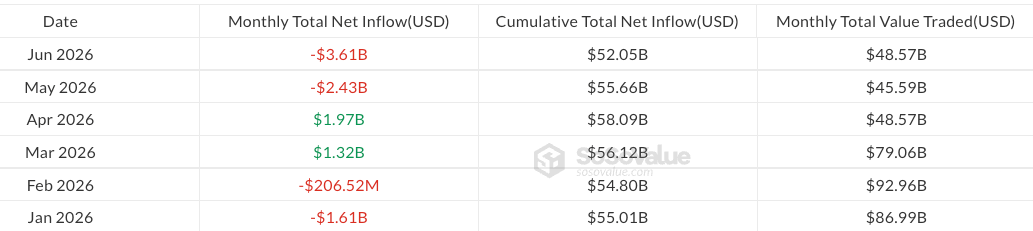
US-listed spot Bitcoin exchange-traded funds (ETFs) recorded their largest daily net outflows of June on Thursday as Bitcoin fell below $60,000.
Spot Bitcoin ETFs shed $696.3 million, surpassing the previous monthly high of $519.2 million logged on June 2, according to SoSoValue data.
The latest withdrawals pushed June’s total outflows to $3.61 billion, bringing year-to-date net outflows to $4.6 billion.
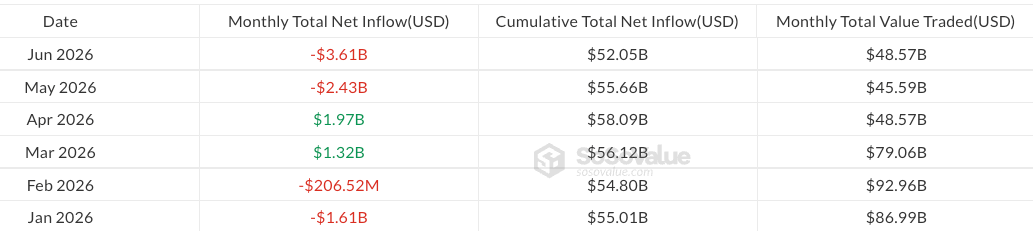
Monthly flows in US spot Bitcoin ETFs as of Friday. Source: SoSoValue
The ETF outflows coincide with signs that other large sources of institutional Bitcoin demand are also slowing. Strategy, the world’s largest corporate Bitcoin holder, has reduced its accumulation pace in June, prompting debate over whether the company should conserve cash during the market downturn.
ETF assets down 57% from 2025 peak
US-listed spot Bitcoin ETFs have seen total net assets fall below $73 billion for the first time since late 2024, as recent outflows and a roughly 50% drop in Bitcoin’s price from its October peak weigh on the sector.
According to SoSoValue, total net assets in US spot Bitcoin ETFs reached a record $169.5 billion in October 2025. As of Friday, that figure stood at about $72.6 billion, a decline of roughly 57%.
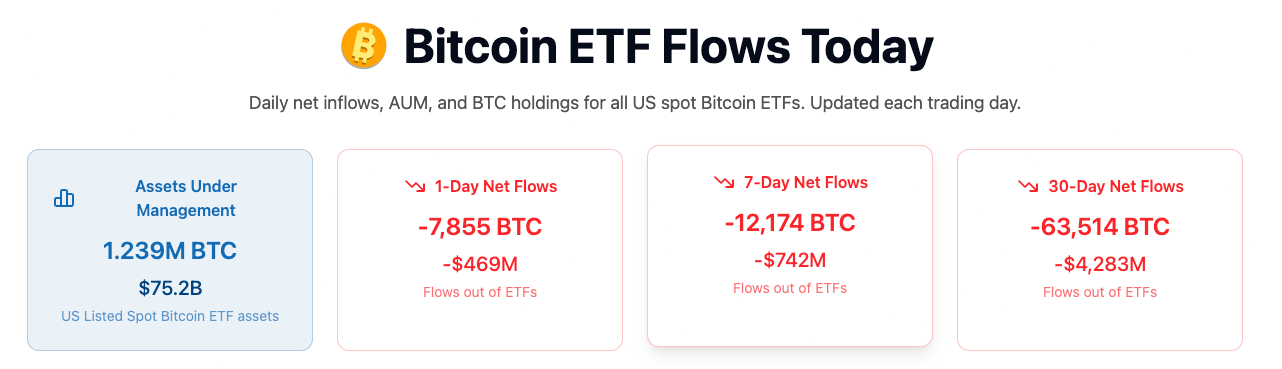
BTC holdings for US spot Bitcoin ETFs as of market close on Tuesday. Source: Wallet Pilot
Separate data from WalletPilot shows the funds held a combined 1.24 million BTC as of Tuesday, with about 63,500 BTC leaving the products over the past 30 days.
Strategy slows Bitcoin buying in June to about 3,600 BTC amid criticism
Some analysts argue that Strategy should pause BTC purchases and rebuild its cash reserves.
Saylor’s Strategy bought roughly 3,600 Bitcoin so far in June, down from about 25,000 BTC in May and more than 50,000 BTC in April, according to company filings.
The slowdown also included a net sale of 32 BTC earlier in the month, one of the few times the company has sold Bitcoin during its accumulation period.
Related: Strategy adds $300M to USD Reserve, acquires 520 BTC
Strategy’s perpetual preferred stock, STRC, has come under pressure, trading below its intended $100 level. STRC closed at $75.69 on Thursday, down 6.37%.
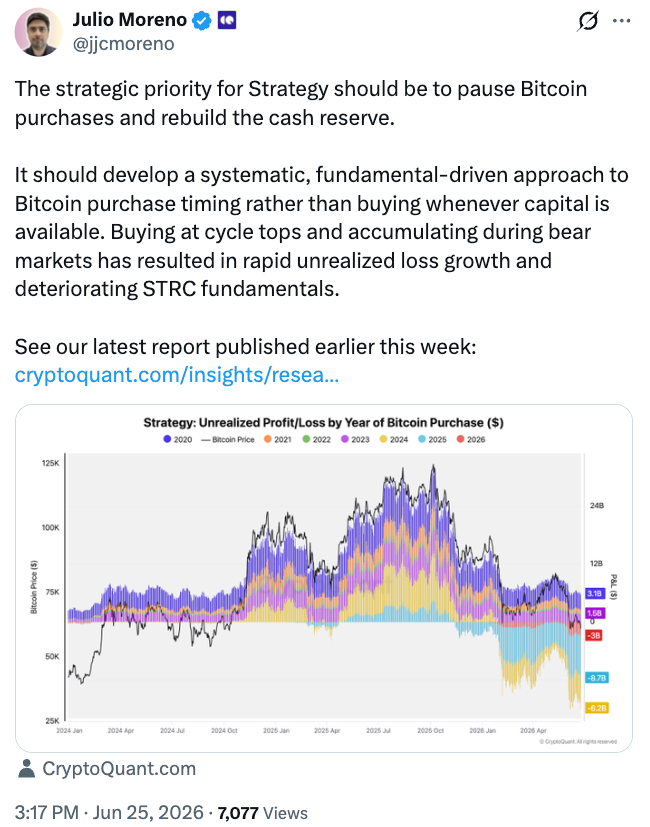
Source: Julio Moreno
The move has fueled debate over Strategy’s Bitcoin-buying model. CryptoQuant analysts have raised concerns about the company’s timing and risk management.
On the other hand, Bitcoin advocate Samson Mow said STRC has a “self-repairing mechanism” that activates when it trades below its $100 benchmark. He noted that the company pauses new share issuance through its ATM program at that level, which limits new supply.
Magazine: Bitcoin slides to $58K, XRP hits $1 but onchain data promising: Market Moves


Ondo Finance, Virtuals Protocol, and Treasures opened more than 430 tokenized stocks to over 40,000 autonomous artificial intelligence (AI) agents on Friday, letting the bots trade onchain equities.
Treasures handles the execution, while Ondo powers the tokenized equities. At launch, the service covers US stocks on Ethereum and Solana, subject to certain jurisdiction restrictions.
AI Agents Step Into Tokenized Equity Trading as Sector Tops $1.5 Billion
Tokenized stocks rank among crypto’s fastest-growing segments. Their distributed value reached about $1.5 billion, according to the data platform RWA.xyz.
That marks roughly 360% year-over-year growth. Ondo Finance leads the segment with more than 57% market share.
Virtuals noted that algorithmic systems already handle about two-thirds of US equity volume, though mostly inside large institutions. The integration opens that same direct-trading capability to any agent.
According to the latest announcement, traders can now leverage agent hedge funds, run copy-trading vaults, hand portfolios full autonomy, or set programmatic strategies that trade nonstop.
Follow us on X to get the latest news as it happens
The launch joins a wider race to make AI agents active financial participants. Mastercard launched Agent Pay for Machines (AP4M), a payment system that enables AI agents to buy and sell services.
Robinhood launched Agentic Trading on May 27. Coinbase also introduced a tool to connect AI agents to customer accounts.
However, US lawmakers have flagged concerns. House Financial Services Committee Democrats pressed the SEC this week on how it oversees AI agents trading for retail investors.
Representatives Bill Foster and Brad Sherman posed 13 questions to SEC Chair Paul Atkins. They set a July 31 deadline and warned that agents trained on similar data could herd and amplify volatility.
Subscribe to our YouTube channel to watch leaders and journalists provide expert insights
The post AI Agents Expand Into Tokenized Stocks as Agentic Finance Race Accelerates appeared first on BeInCrypto.
Crypto World
Ethereum Price Prediction: A Forgotten Bull Signal as SharpLink Loads Up on ETH After 8 Month Hiatus

SharpLink Gaming just broke an eight-month silence on Ethereum, and could likely flip its price prediction. ETH itself is currently on a downtrend, barely holding above a structural trendline break.
Just a few hours ago, SharpLink added 5,000 ETH to its treasury after an eight-month pause, resuming accumulation despite sitting on a reported $1.71 billion unrealized loss on its existing position.
It’s not pretty, but buying through a nine-figure drawdown shows conviction, and it echoes institutional treasury accumulation logic that preceded major Bitcoin re-ratings when Strategy held through similar paper losses. The move also landed while spot ETH ETF inflows remain inconsistent, which makes the corporate bid marginally more significant as a demand signal.
Not just Ethereum, derivatives activity hit record levels this week alongside the SharpLink announcement. But what’s next for ETH? Can it break its downtrend?
Discover: The Best Token Presales
Ethereum Price Prediction: Running Before the Resistance Band Breaks It?
Ethereum is trading at $1,550 after a sharp decline this month. Price remains below major resistance, while recent sessions show buyers defending the lower range. The nearest support sits around $1,500–$1,550, a zone that has attracted demand several times recently.
Meanwhile, momentum remains mixed. The market has not reached overheated conditions, leaving room for a recovery if buying pressure improves. However, bulls still need to reclaim higher resistance levels before a stronger trend reversal can be confirmed.

On the upside, immediate resistance stands near $1,700–$1,750. A sustained move above that area could target $1,850 and potentially $2,000. Until then, Ethereum remains in a recovery phase rather than a confirmed uptrend.
The bullish scenario requires Ethereum to hold above the $1,500 support zone and break through $1,750. In that case, momentum could accelerate toward higher levels. Conversely, a failure to defend support may expose the market to another test of recent lows near $1,400.
Institutional interest and long-term accumulation remain supportive factors. Even so, price action remains the key signal. A decisive close above major resistance is still needed before the market can confirm a durable trend change.
Discover: The Best Crypto to Diversify Your Portfolio
LiquidChain Targets Early-Mover Upside as Ethereum Tests Key Levels
ETH at $1,500 is structurally constructive. But for traders who’ve watched Ethereum grind through resistance for months, the upside math from current levels, even to $2,000, requires patience and tolerance for drawdowns that could touch $1,800 first. That’s not a knock on ETH; it’s just the reality of buying into a $200 billion asset at a technical decision point. Early-stage infrastructure plays offer a different risk profile entirely.
LiquidChain ($LIQUID) is a Layer 3 infrastructure project targeting the cross-chain liquidity problem directly, fusing Bitcoin, Ethereum, and Solana liquidity into a single execution environment through its Unified Liquidity Layer.
The Order prepares…
LiquidChain grows in power.⟁https://t.co/vqvBcdSQYC pic.twitter.com/uOSFmzyQ74
— LiquidChain (@getliquidchain) June 26, 2026
The architecture includes Single-Step Execution, Verifiable Settlement, and a Deploy-Once model that lets developers access all three ecosystems without rebuilding for each chain. Presale price is currently $0.01473, with $870K raised to date.
Research LiquidChain before the current presale tranche closes.
Don’t Miss Out on Our $1,000 USDT Airdrop on ByBit
The post Ethereum Price Prediction: A Forgotten Bull Signal as SharpLink Loads Up on ETH After 8 Month Hiatus appeared first on Cryptonews.

GIFT Nifty tumbles over 150 points as global sell-off in AI stocks rattles sentiment

Trump Blocks Housing Bill, Puts CLARITY Act in Danger of Not Getting Passed

Team USA falls to Türkiye in final Group D match at World Cup

No Jackpot Winner as $257 Million Prize Rolls Over to $269 Million Monday Draw

Blockchain.com files with SEC for U.S. IPO

Weekend Open Thread: Miami – Corporette.com

BITCOIN und ALTCOINS: Wann schwappt die Euphorie-Welle von den US-Indizes zu den Kryptos?

Pakistan Lifts Ban on Crypto Trading, Banks Allowed to Open Accounts | Economy Matters

Birdman – Money To Blow (Official Music Video) ft. Lil Wayne, Drake
-
 Fashion7 days ago
Weekend Open Thread: Miami – Corporette.com
-

 Entertainment6 days ago
Renter of Home in Anne Heche Crash Denies Settlement With Son
-
 Sports3 days ago
Two goals and an assist by sheer aura: Cristiano Ronaldo just entered the World Cup chat
-

 Tech4 days ago
Microsoft accidentally kills epic Outlook email threads
-

 Business6 days ago
Soccer-U.S. defends Iran World Cup travel restrictions, says discussions ongoing
-

 Politics5 hours ago
The House | Manchesterism won’t survive the painful trade-offs unless it gets citizens on board
-

 Politics9 hours ago
Potential 2028er World Cup attendee leaderboard
-

 Politics6 days ago
Andy Burnham and the meaning of Makerfield
-

 NewsBeat7 days ago
Keir Starmer Allies Question His Chances For No 10
-

 Tech16 hours ago
A Look At A Gaggle Of Transputer Boards
-
Crypto World2 days ago
Bitcoin (BTC) Dips Below $62K, Ethereum (ETH) Plunges 6% Daily: Market Watch
-

 Crypto World2 days ago
Securitize Wraps Roubini's SEC-Registered ETF as Dubai VARA Digital Security
-
 Crypto World18 hours ago
Dell (DELL) Shares Tumble Over 5% Following Analyst Downgrade to Hold
-
Business2 days ago
Entergy settles forward sale agreements, raises $672 million in cash proceeds
-
 Business6 days ago
Wall Street Week Ahead: Investors see Micron earnings as pulse check of AI rally momentum
-
 Crypto World6 days ago
Can Charles Hoskinson Really Rescue Cardano?
-

 Entertainment6 days ago
Jose Alvarado Wants Taylor Swift at More Knicks Games
-

 Crypto World6 days ago
HIVE shares jump as $220M AI deal speeds Bitcoin mining pivot
-

 Crypto World6 days ago
Jake Chervinsky accuses CME of protecting derivatives monopoly
-

 Sports22 hours ago
India vs Bangladesh LIVE Score, Women’s T20 World Cup: Bangladesh Opt To Bat; India Enter ‘Do-Or-Die’ Stage As Semi-Final Race Heats Up
You must be logged in to post a comment Login