

Crypto World
Zalando Shares Fall 7% After BaFin Launches Accounting Probe

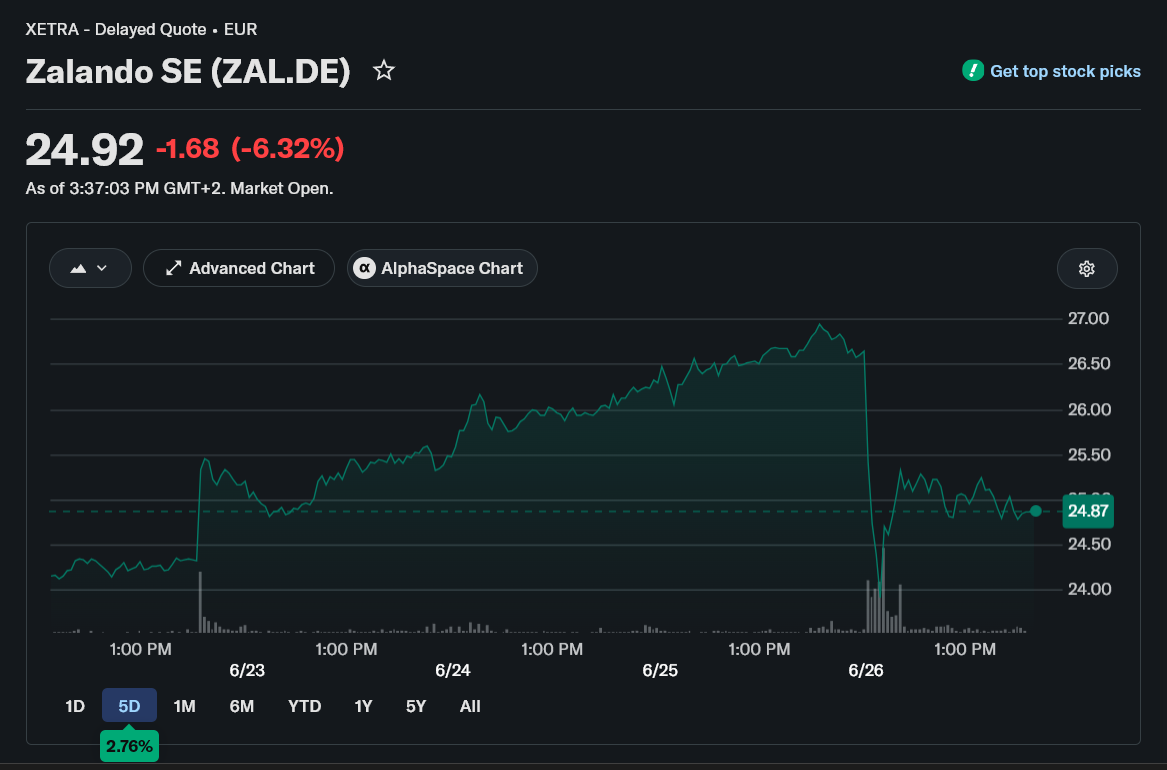
Popular fashion giant Zalando’s shares fell about 7% on June 26 after Germany’s financial regulator, BaFin, opened a formal review of the company’s 2025 financial statements.
The investigation is linked to Zalando’s acquisition of ABOUT YOU, the German online fashion retailer it bought in 2025 for about €1.2 billion. BaFin said there are signs that Zalando may have failed to include required information about a related-party transaction in its financial notes.

A Small Disclosure Issue Spooks Investors
A related-party transaction usually means a deal involving people or companies connected to the business. These disclosures matter because they help investors understand whether a company has been transparent about important financial relationships.
BaFin said the investigation does not mean Zalando has done anything wrong. Its auditors will review the accounts and publish the result once the process is complete.
The announcement still hit investor confidence. Zalando shares dropped as much as 8% in early trading before recovering slightly. By the close, the stock was down around 7%, trading near €24.72.
Zalando pushed back against the concern. The company described the issue as “purely formal and materially insignificant” and said it is in “close and constructive dialogue with BaFin.”
It also said the relevant acquisition details were already publicly available through the official takeover process, which finished in July 2025.
The timing is awkward for Zalando. The company posted a net loss of €87.6 million in the first quarter of 2026, compared with a profit a year earlier. Costs linked to the ABOUT YOU deal and restructuring weighed on results.
Still, revenue rose 23.8% year-on-year to €2.99 billion, and Zalando kept its full-year guidance unchanged.
For now, the main issue is uncertainty. Investors will watch BaFin’s review closely, even if the company says the matter is minor.
The post Zalando Shares Fall 7% After BaFin Launches Accounting Probe appeared first on BeInCrypto.



The ongoing artificial intelligence stock frenzy has pulled in capital from across the market, from traditional metals, considered the safest assets, to crypto, considered the riskiest.
Gold dropped below $4,000 for the first time since November earlier this week, silver has lost more than half its value from its high, and bitcoin has slipped to nearly $58,000.
The three selloffs are not a coincidence. For much of the past two years, they have been, to a large degree, the same trade, and now the same forces are unwinding it.
That trade even has a name, the “debasement” trade. It is the bet that heavy government spending and rising national debt will slowly erode the value of paper money, which pushes investors toward scarce assets that no government can print more of.
Gold and silver are the oldest versions of that bet, while bitcoin, with a supply capped at 21 million coins, got marketed as the digital version. Through 2025, as the dollar looked vulnerable, money poured into all three, and they were treated as one basket.


Sony Interactive Entertainment is removing 551 purchased films from UK PlayStation Store accounts on September 1, 2026, citing content licensing agreements with StudioCanal.
The affected library spans decades of cinema, from Terminator 2: Judgment Day and Rambo: First Blood to Bridget Jones’ Diary, Pan’s Labyrinth, and Paddington. Customers who paid for those titles will lose access regardless of their purchase history.
When a Purchase is Not Ownership
Sony published a formal legal notice confirming the removal, attributing it to the expiration of its licensing agreement with StudioCanal. The notice offered no refunds or alternative compensation for affected buyers.
The situation exposes a structural reality most consumers overlook at checkout. A digital “purchase” on any platform-controlled storefront functions more like a temporary license than outright ownership.
Therefore, Sony and StudioCanal can modify or terminate that license, and the buyer absorbs the loss.
With 551 titles set for deletion, this is one of the largest single-event disappearances of purchased digital content in recent memory.
PlayStation Digital Ownership and the Gaming Parallel
The concern is not limited to films. When GTA 6 pre-orders opened this week, Rockstar confirmed that physical retail editions would include only a digital download code, with no disc.
For buyers who assumed a boxed copy meant a physical artifact they owned outright, that detail reinforced a growing unease. The GTA launch also sent shockwaves through crypto markets that same day, highlighting how far the digital ownership question now extends across gaming and finance.
Together, the two events make the same point. Across entertainment and gaming, consumers are paying for access, not ownership.
The Web3 Argument Gets Louder
Non-fungible tokens (NFTs) were built to address exactly this problem by creating on-chain, portable title deeds that no single platform can revoke. If StudioCanal had issued film rights as NFTs, Sony could not have overridden them.
Those tokens would remain in the buyer’s wallet, transferable and verifiable, independent of any licensing dispute between corporations.
That argument is gaining fresh credibility. Earlier this year, market observers noted a shift in the NFT sector away from speculation toward tangible utility, with digital ownership emerging as the strongest long-term use case.
Meanwhile, Worldcoin’s biometric identity push brought parallel questions about who controls proof-of-ownership in digital spaces into mainstream debate. Across the broader GameFi sector, 2026 has already seen renewed investor appetite for blockchain-backed digital economies.
The PlayStation film deletions may appear to be a routine licensing dispute on paper.
However, they crystallize a question that streaming, gaming, and digital media platforms have not resolved: when a platform changes its terms, what does a consumer actually own?
For blockchain advocates, Sony just provided the most mainstream illustration yet.
The post Sony Deletes 500+ Purchased Movies From PlayStation, Reigniting Blockchain Debate appeared first on BeInCrypto.
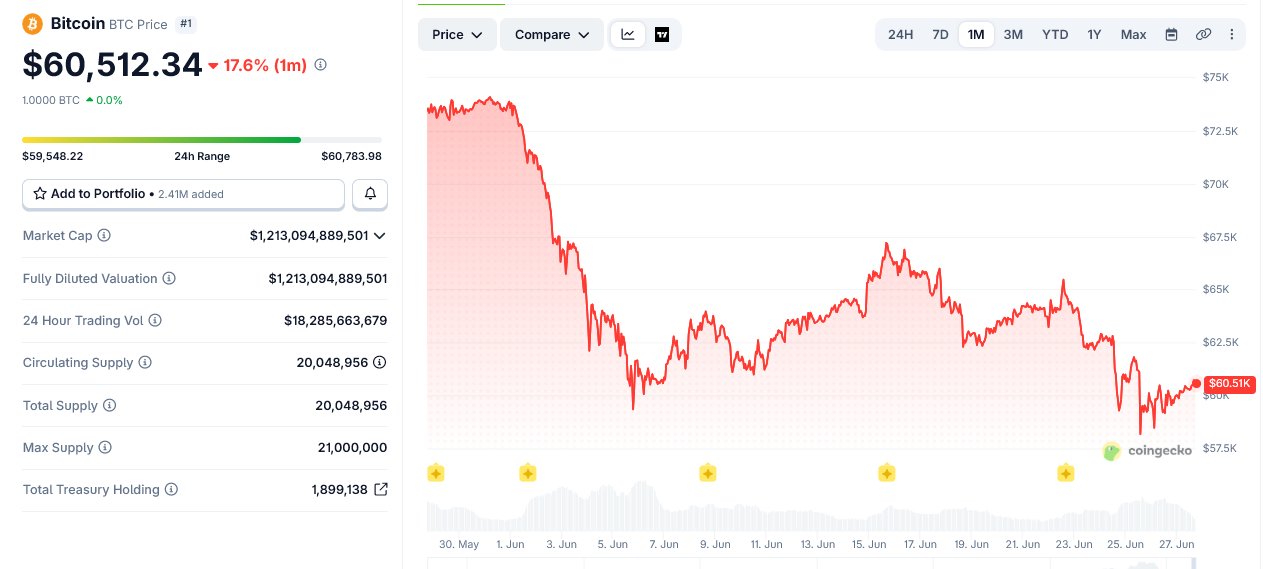
Jeremy Grantham, the GMO co-founder who called both the 2000 dot-com crash and the 2008 housing collapse, branded Bitcoin (BTC) “a useless, speculative mechanism” and predicted it would dwindle over the next few decades.
The veteran strategist built his critique around three failures he sees in crypto. Bitcoin pays no yield, holds no stable value, and fails as a usable currency in daily life, he argued.
Proof of Work, Proof of Nothing
Grantham singled out Bitcoin’s proof-of-work design for particular scorn. The energy burned to validate transactions, he argued, generates no economic benefit for society.
“Proof of unnecessary work shouldn’t be worth a bucket of warm spit, and it will not be.”
Bitcoin Falls Short as Money and Store of Value
Beyond the mining critique, he said Bitcoin does not work as a practical currency. Regular users do not accept it at the supermarket, and serious investors do not settle large transactions with it. Without a functioning transaction layer, the asset cannot claim monetary legitimacy, he added.
He also dismissed Bitcoin as a store of value. Unlike equities, it pays no dividend and generates no cash flow. In his view, that leaves speculators with nothing to anchor a fair price.
A Skeptic With a Record
Grantham’s warnings carry weight because of his track record. He flagged the dot-com bubble before 2000 and warned of the US housing collapse before 2008. His more recent AI bubble stock warning extended that thesis to US equities, where he now sees downside of up to 70%.
However, his timing is not always precise. His 2021 epic-bubble call on US stocks arrived early, as markets climbed before their 2022 correction.
The Bitcoin remarks land as BTC trades near $60,500, down sharply from its late-2025 peak above $126,000. US spot Bitcoin ETF records outflows of $6.35 billion over 30 days through mid-June, reflecting cooling institutional demand.
Earlier, Coinbase CEO’s Bitcoin outlook has also flagged AI infrastructure costs as a variable reshaping crypto capital flows.

Grantham is not alone in his skepticism. Peter Schiff has made similar bearish arguments, contending that Bitcoin holds no intrinsic value.
Whether Bitcoin’s current price holds key support in Q3 2026 will test both camps. Grantham predicted the decline would come gradually, over years or even decades, not all at once.
The post Billionaire Grantham Uses Extreme Words to Describe Bitcoin appeared first on BeInCrypto.

Stocks tied to digital assets are sliding faster than the broader US market, reinforcing an increasingly visible split between crypto-focused equities and the S&P 500. The latest comparison comes from The Kobeissi Letter, which points to steep drawdowns at major crypto businesses as technology selloffs ripple through risk assets.
According to The Kobeissi Letter, Coinbase and Circle shares are down 69% and 72%, respectively, from their all-time highs. Those declines outpace drops seen in several large technology names—such as Oracle, Salesforce, Netflix and Palantir—each down between 48% and 57% from peak levels, while the S&P 500 has retreated about 3.5% from its recent high.
Key takeaways
- Crypto-related equities are falling much more sharply than the S&P 500, according to The Kobeissi Letter.
- Investor pressure is tied not only to broader risk-off moves, but also to weaker digital asset markets and policy uncertainty in the US.
- Bitcoin’s drop below $60,000 and Ether sliding toward $1,500 have intensified selling across the sector.
- Corporate earnings stress is compounding the downturn, with Coinbase missing Wall Street expectations in its latest quarterly report.
- Despite continued institutional activity, 21Shares says crypto’s four-year market cycle remains a key driver of prices into 2026.
Crypto equities break away from the broader market
The widening gap between crypto-adjacent stocks and the S&P 500 appears tied to a combination of macro pressure and sector-specific risk. The pullback in technology equities reflects growing concerns that rapid advances in artificial intelligence could disrupt existing business models across parts of the sector. Within that environment, crypto businesses face additional headwinds.
Even as semiconductor stocks have managed to hold up better through periods of volatility, crypto-related shares have remained under pressure. The Kobeissi Letter’s comparison suggests the underperformance is not just a beta story tied to general market weakness—it also reflects how quickly public equities react to sentiment around digital asset performance.
Digital asset selling feeds equity declines
Market conditions in crypto have worsened alongside equities. The article notes that Bitcoin fell below $60,000 this week and extended its decline to more than 54% from its October peak. Ether has likewise faced heavy selling, recently dropping to around $1,500—about 69% below last year’s high.
When crypto prices slide, revenue expectations for exchanges, custody providers, and payments platforms can come under pressure, and investors often reprice the sector more aggressively than the general market. That dynamic helps explain why Coinbase and Circle have experienced drawdowns that exceed those of several major technology companies.
Broader digital asset policy is also part of the backdrop. The report points to uneven progress on comprehensive crypto market structure legislation in the United States, a factor that continues to influence how investors value the long-term prospects of crypto businesses.
Earnings disappointment adds another layer
Financial results have not helped. The coverage highlights that Coinbase reported first-quarter results that missed Wall Street expectations. As described in earlier reporting from Cointelegraph, the company’s revenue fell 21% from the prior quarter and it posted a loss of $1.49 per share, compared with analysts’ expectations for earnings of $0.27 per share.
For investors, earnings misses during a period of declining crypto market activity can have outsized impact: they reinforce concerns about transaction-driven revenues and trading volume sensitivity. In short, equity investors appear to be dealing with both the market-level hit from weaker coin prices and company-level pressure from the latest quarterly numbers.
21Shares trims 2026 expectations, but sees institutional progress
While public equities are under strain, institutional participation remains a key part of the crypto narrative. In a midyear outlook, 21Shares lowered its expectations for 2026, arguing that digital asset prices have underperformed relative to underlying fundamentals.
According to the report, institutional adoption is still strengthening—particularly in stablecoins, tokenization, and prediction markets. However, 21Shares emphasizes that the dominant force behind crypto prices continues to be Bitcoin’s four-year cycle.
In the same outlook, 21Shares states that increasing institutional ownership may have moderated Bitcoin’s drawdowns but has not fundamentally changed the asset’s cyclical behavior. The firm also indicated it previously forecast the four-year cycle could become obsolete, but has since walked back that view, saying the cycle is “evolving, but it has not broken yet.”
The argument matters for investors because it frames market volatility as more structural than purely sentiment-driven. If Bitcoin’s cycle remains intact, rallies could be more dependent on timing and macro liquidity than on incremental improvements in on-chain or institutional usage metrics—an outlook that can influence positioning across both crypto assets and crypto equities.
What to watch next
Investors will likely focus on whether crypto price action stabilizes—especially around the $60,000 level for Bitcoin and the $1,500 area for Ether—as well as whether upcoming corporate reports from major crypto platforms show earnings pressure easing or continuing. At the same time, market participants will watch how US legislative progress advances, since regulatory clarity (or its absence) continues to shape valuation assumptions for the sector.
Crypto World
AMLBot Puts Polymarket Phishing Toll at $3.1M Across 11 Wallets, Funds Traced to Ethereum
Blockchain intelligence firm AMLBot has fixed the total stolen in Thursday's Polymarket supply-chain attack at approximately $3.1 million in PUSD, providing the first forensically confirmed on-chain dollar figure and tracing the stolen assets from Polygon to Ethereum. On-chain investigator Specter,… Read the full story at The Defiant
The world’s largest altcoin felt the pain of the overall market weakness over the past week, dropping to just over $1,500 for the first time in well over a year.
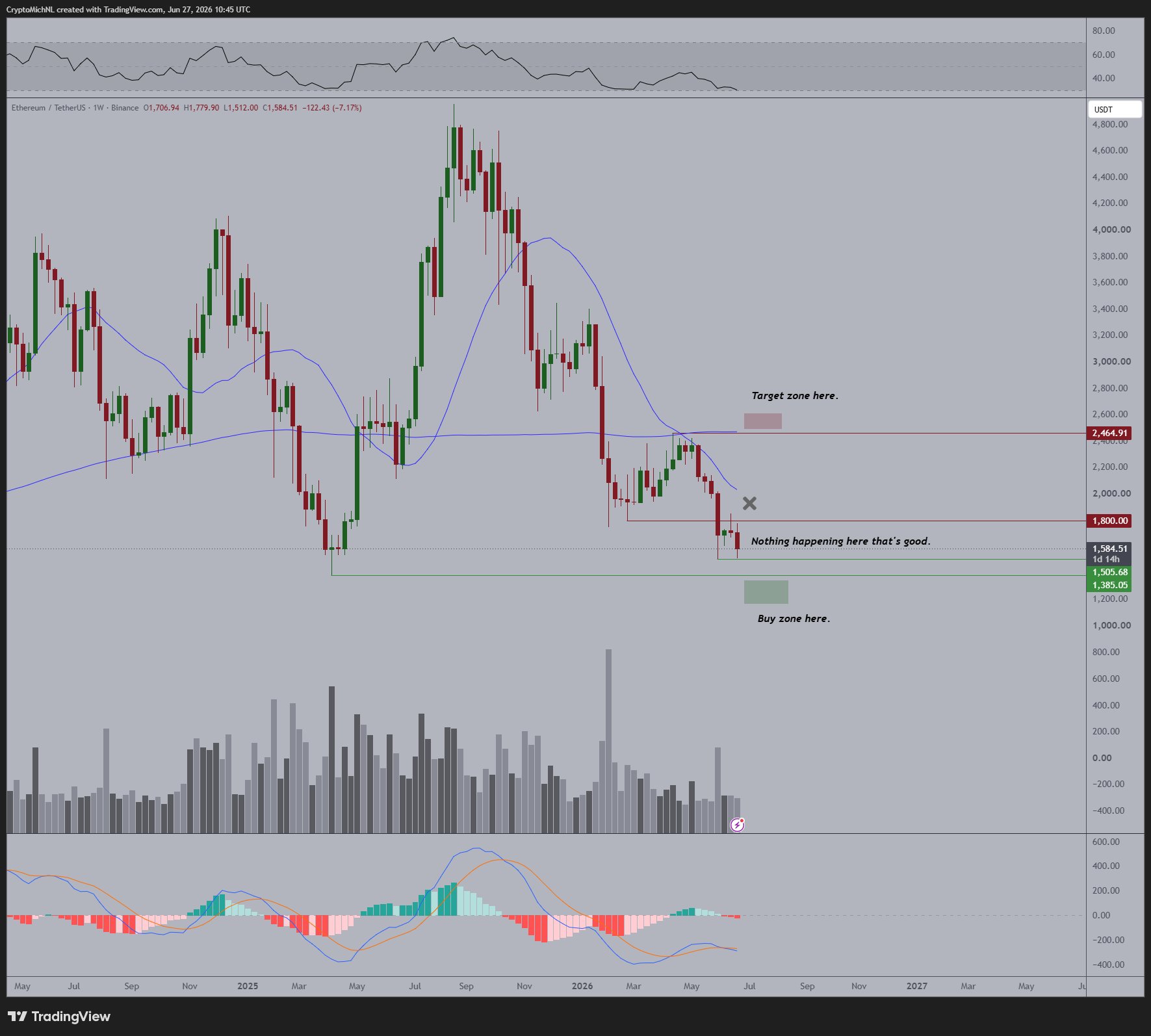
The asset remains below key support levels, including $1,800, which holds a particular significance in its long-term potential, according to popular analyst Michaël van de Poppe.
ETH Below $1.8K Means…
The market observer believes ETH sliding below $1,800 is a “massive opportunity” and that day traders should avoid it, as it’s “not really attractive” here. The chart below paints a clear picture, showing that the asset has been in a clear downtrend for months. It peaked at almost $5,000 last summer, but it has plunged by nearly 70% since then to the current $1,600.
However, there’s finally light at the end of the tunnel as the asset is “making a potential strong bullish divergence on many levels that would indicate that ETH is going to follow Bitcoin.”
Perhaps the biggest catalyst for future price gains in the crypto market, especially for tokens like ETH, which some analysts believe would benefit more than BTC, is the CLARITY Act. The bill, expected to be signed into law in the US this year, should increase regulatory clarity on the entire market in the US.
Van de Poppe says ETH is currently following a classic “sell the rumor, buy the news” type of price action. He also named $1,505 and $1,385 as the next levels at which ETH would present a “tremendous buying opportunity” if it gets there. Overall, though, he believes markets are not eager to go down more, and he doubts ETH will drop to those levels.
“I much rather see a clear breakthrough at $1,800 and see these levels as strong opportunities to be accumulating more positions.”
3 in a Row
Ethereum’s native token is just days away from creating history but in a negative manner by ending a third consecutive quarter in the red. Despite its previous bear cycles, it has never done this but it would require nothing short of a miracle to avoid it now. It closed with a 28.28% drop in Q4 2025, another 29.26% decline in Q1 2026, and is down by more than 24% in Q2 as of press time.
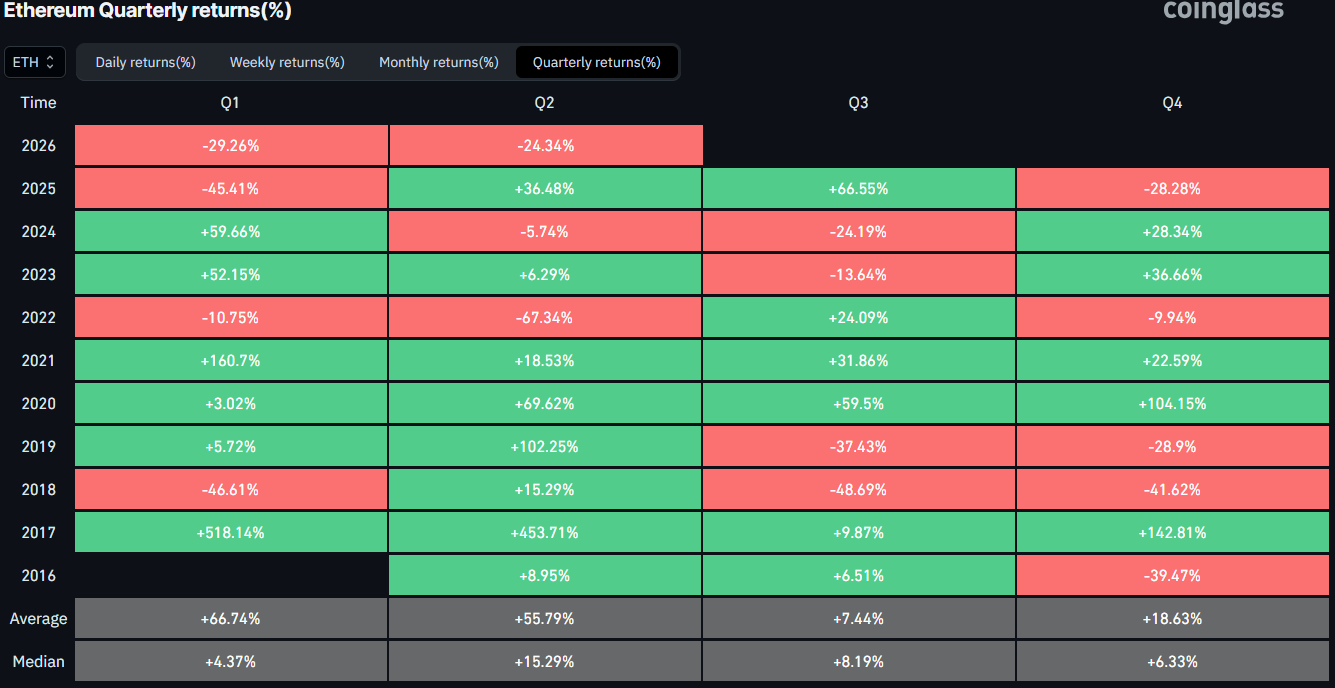
With June almost gone, investors have focused on July now. Ted Pillows brought some hope for the bulls, indicating that ETH has historically seen a bounce back in July. This has been particularly true in 2020, 2021, 2022, and 2025. ETH has posted notable gains in those July, all of which followed a red June.
The post Ethereum (ETH) Below $1.8K: What Does It Mean for Investors appeared first on CryptoPotato.

A pullback across US technology stocks is spilling into the crypto sector, and the market reaction is revealing a wider split between digital-asset equities and the broader S&P 500. Shares of Coinbase and Circle have fallen far more sharply from their peak levels than many large-cap technology names, underscoring how investors are treating crypto stocks as a higher-beta exposure to both risk sentiment and digital-asset fundamentals.
According to data cited from The Kobeissi Letter, Coinbase shares are down 69% from their all-time high, while Circle is down 72%. Those declines outpace drawdowns in several major technology companies—Oracle, Salesforce, Netflix and Palantir—each down roughly 48% to 57% from their peaks. By comparison, the S&P 500 has retreated about 3.5% from its recent high, suggesting crypto-linked equities are absorbing additional pressure beyond the general market rotation.
Key takeaways
- Crypto-focused stocks are declining much more than the S&P 500, pointing to company- and sector-specific risk on top of broad tech weakness.
- Sentiment has deteriorated alongside digital asset prices, with Bitcoin slipping below $60,000 and Ether falling to around $1,500.
- Operational stress is showing up in earnings: Coinbase reported results that missed expectations, including a quarterly revenue drop and a per-share loss.
- 21Shares says institutional adoption is improving some aspects of the market (notably stablecoins and tokenization), but the firm still sees Bitcoin’s four-year cycle as the key driver of price behavior.
Why crypto equities are moving differently from traditional tech
The immediate backdrop is a broad selloff in technology shares, but the crypto space appears to be reacting with additional intensity. The pressure is being linked to rising uncertainty that advances in artificial intelligence could disrupt existing business models within parts of the technology sector. While semiconductor stocks have generally held up better—despite volatility—crypto-related equities have remained under pressure amid weakness in digital asset markets.
Investors also appear to be weighing the pace of US policy progress on crypto market structure. The article notes uneven advancement toward comprehensive legislation in the United States, which can matter to publicly traded crypto firms that depend on clearer regulatory frameworks and more predictable market access conditions.
Digital asset price weakness adds fuel to equity declines
Market sentiment toward crypto has turned more cautious as Bitcoin and Ether extended their downturns. The report states that Bitcoin fell below $60,000 this week, widening its decline to more than 54% from its October peak. Ether, meanwhile, has faced heavy selling pressure, trading around $1,500—about 69% below last year’s high.
When crypto prices drop, equity investors often reprice more than just revenue expectations. They may also adjust assumptions about liquidity, trading activity, custody demand, and the overall risk appetite for crypto-exposed businesses. In that sense, the equity selloff can be interpreted as a compounding effect: traditional market weakness lowers risk tolerance, while falling token prices directly compress fundamentals for crypto-linked companies.
Coinbase results highlight how financial performance is getting tested
Beyond price action, corporate fundamentals are contributing to the negative tone. The article points to Coinbase’s first-quarter performance, stating that the exchange operator reported results that missed Wall Street expectations. According to the referenced coverage from Cointelegraph, Coinbase’s revenue fell 21% from the previous quarter, and the company posted a loss of $1.49 per share compared with analysts’ expectations for a profit of $0.27 per share.
Those numbers help explain why the stock reaction has been so pronounced during periods of weaker market conditions. In downturns, revenue for crypto platforms can be particularly sensitive to reduced trading volumes and tighter liquidity. Even when institutional participation grows, quarterly results can remain under pressure if broader market activity declines faster than new demand offsets it.
CoinShares data and other industry metrics often emphasize institutional adoption, but equity markets tend to react quickly to near-term earnings signals. In this case, the report suggests Coinbase’s fundamentals are worsening at the same time that the wider digital asset market is selling off.
21Shares trims its 2026 outlook while still tracking the four-year Bitcoin cycle
While crypto equities have been under pressure, at least one prominent asset manager is offering a more structured view of what to watch next. The article highlights a midyear outlook from 21Shares in which the firm reduced its expectations for 2026, arguing that digital asset prices have underperformed relative to the industry’s underlying fundamentals.
In the report, 21Shares says institutional adoption is still strengthening—particularly in areas such as stablecoins, tokenization and prediction markets. However, the firm’s central framework remains unchanged: Bitcoin’s four-year market cycle continues to exert the dominant influence on crypto prices.
21Shares notes that growth in institutional ownership has helped moderate Bitcoin’s drawdowns, but it has not fundamentally altered the cyclical behavior of the asset. The firm explicitly walks back an earlier position that the four-year cycle had become obsolete, stating that “Bitcoin’s cycle is evolving, but it has not broken yet,” as reported in the article.
That distinction matters for investors because it reframes “adoption” as a stabilizing force rather than an immediate cycle-breaker. Stablecoin usage, tokenization activity, and other institutional channels can support the ecosystem even when price trends lag, but if Bitcoin continues to follow its historical rhythm, broader market valuations may still face pressure until the cycle shifts.
What investors should monitor next
With crypto equities currently reflecting both a risk-off tech backdrop and renewed weakness in Bitcoin and Ether, the near-term signal investors will likely seek is whether fundamentals stabilize—particularly around trading volumes and quarterly reporting for major listed platforms. At the same time, 21Shares’ view suggests market participants should keep focusing on Bitcoin’s cycle dynamics even as institutional adoption expands; the question now is whether improved adoption can translate into clearer price recovery during the next phase of the cycle.


Robinhood says layoffs aren’t being driven by AI integration
According to a Forbes report published on June 4, 2026, AI has been the top reason cited for tech layoffs during 2026. Robinhood, however, seems to be taking a different tack.
Unlike BitGo, attributing its cuts to AI, Robinhood hasn’t indicated these layoffs were driven by AI adoption. The company’s stated reason is that it’s reducing management layers and streamlining operations to improve efficiency. And at this point, there is no clear evidence that Robinhood is replacing laid-off employees with AI.
That said, AI is likely part of the broader trend affecting how companies think about staffing. Rather than completely replacing employees, AI is often used to make existing teams more productive. Tasks involving research, customer support, coding, analysis and administrative work can frequently be handled faster and with fewer people than in the past.
As for service quality, users should probably expect the core user experience to remain largely unchanged. Functions such as trade execution, portfolio tracking, market data and charting are already highly automated.
The areas to watch are customer support and specialized assistance. AI can handle many routine questions effectively, but more complex issues, such as account restrictions, tax-related questions or crypto transfer problems, still benefit from human expertise.

Key Highlights
- Anthropic may receive clearance to reactivate its Fable 5 AI system following a 15-day suspension
- Final authorization from the Pentagon and NSA remains outstanding before full deployment
- Limited Mythos 5 access was reinstated on Friday by the Commerce Department for select users
- Commerce Secretary Howard Lutnick and Treasury Secretary Scott Bessent facilitated resolution discussions
- Anthropic and OpenAI are advocating for standardized government evaluation protocols for cutting-edge AI systems
According to a recent Axios report, Anthropic’s Fable 5 AI system may return to operation as soon as next week. The Trump administration is reportedly approaching a final determination to remove restrictions that have disabled the model since June 12.
The system went offline following a U.S. government export control directive that raised national security questions. The interruption disrupted access for numerous developers and enterprises who had integrated the technology into their workflows.
According to Axios sources with knowledge of the deliberations, the restrictions may be removed within the upcoming week. Dialogue between Anthropic representatives and government officials is anticipated to continue throughout the weekend.
However, universal approval hasn’t been achieved yet. Both the Pentagon and the National Security Agency must provide their authorization before the model can be reactivated. Several other government entities have already determined that the system poses no significant security risks for public deployment.
Commerce Secretary Howard Lutnick and Treasury Secretary Scott Bessent were instrumental in advancing negotiations. In correspondence to Anthropic, Lutnick acknowledged that the company “has worked with the US government to address risks” connected to both AI systems.
Partial Access Restored for Mythos 5
The Commerce Department granted Anthropic permission on Friday to reinstate Mythos 5 access for a select cohort of vetted users. Mythos 5 represents the more sophisticated version of the two systems and has never been released for widespread public consumption.
Both the Fable 5 and Mythos 5 platforms share the same foundational AI architecture. The primary distinction lies in their deployment strategy: Fable 5 targets general public accessibility, whereas Mythos 5 incorporates enhanced protective measures designed to minimize risks such as cyberattacks or biological weapons development.
The Significance of Fable 5 for Development Teams
Prior to its June 12 suspension, Fable 5 had gained substantial traction among software developers due to its superior coding and analytical functions. Payment processing firm Stripe allegedly utilized it to restructure a 50 million-line codebase within a single day—a task that would have required manual engineering efforts exceeding two months.
Following the suspension, automated development processes were interrupted, and certain organizations migrated their operations to alternative AI platforms, including more affordable Chinese-developed models.
The shutdown also occurred amid broader tensions between Anthropic and the Trump administration. Defense Secretary Pete Hegseth had previously characterized Anthropic as a “Supply-Chain Risk to National Security.” The anticipated reinstatement of Fable 5 signals a transformation in that dynamic.
An administration representative informed Axios that Anthropic “has worked positively with the government.”
Advocacy for Standardized Evaluation Framework
Both Anthropic and OpenAI are urging the Trump administration to establish a formalized assessment framework for advanced AI models prior to their public release. This initiative follows President Trump’s June 2 executive order that introduced voluntary government screening for powerful AI technologies.
OpenAI secured approval on Friday for a restricted preview of GPT-5.6. In an official statement, the organization expressed that it doesn’t believe government access mechanisms “should become the long-term default.”
Anthropic has similarly advocated for an evaluation process that is “transparent, fair, clear, and grounded in technical facts.”

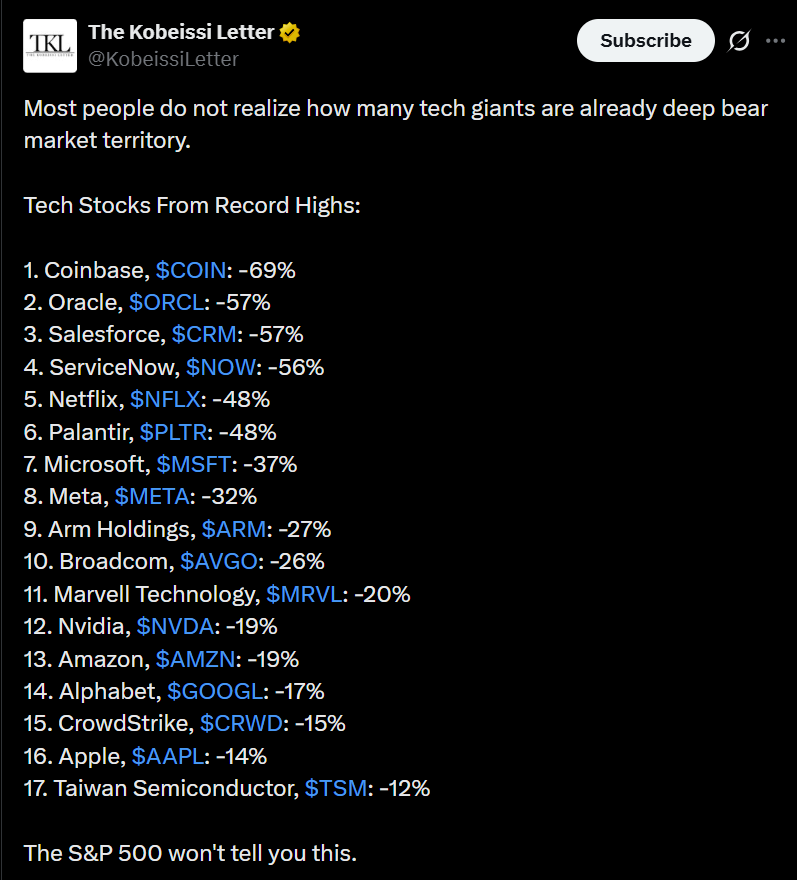
A broad selloff in technology stocks has weighed even more heavily on crypto-focused companies, highlighting a growing divergence between digital asset equities and the broader US stock market.
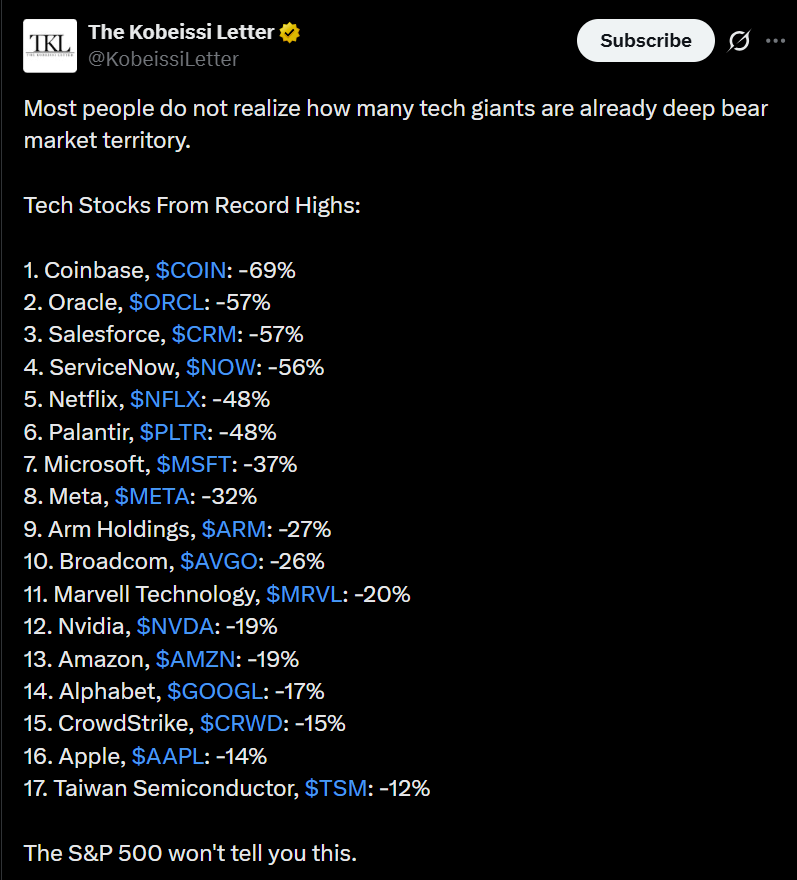
Shares of Coinbase (COIN) and Circle (CRCL) have fallen 69% and 72%, respectively, from their all-time highs. Those declines exceed the drawdowns seen in several major technology companies, including Oracle (ORCL), Salesforce (CRM), Netflix (NFLX) and Palantir (PLTR), which are down between 48% and 57% from their peaks, according to data from The Kobeissi Letter
By comparison, the large-cap S&P 500 Index has retreated just 3.5% from its recent high.
Source: The Kobeissi Letter
The pullback in technology stocks reflects mounting concerns that advances in artificial intelligence could disrupt existing business models across parts of the sector. Semiconductor stocks have generally held up better despite bouts of volatility, while crypto-related equities have remained under pressure amid broader weakness in digital asset markets and uneven progress on comprehensive crypto market structure legislation in the United States.
Negative sentiment toward the sector has intensified after Bitcoin fell below $60,000 this week, extending its decline to more than 54% from its October peak. Ether has also come under heavy selling pressure, recently falling to around $1,500, roughly 69% below last year’s high.
Bear market conditions have also weighed on corporate earnings, with Coinbase reporting first-quarter results that missed Wall Street expectations. Revenue fell 21% from the previous quarter, while the company posted a loss of $1.49 per share, versus analysts’ expectations for a profit of $0.27 per share.
Related: Crypto Biz: The cost of stacking sats
Analysts downgrade crypto market’s 2026 outlook despite strong institutional adoption
The crypto market’s prolonged downturn has prompted analysts at 21Shares to lower their expectations for 2026, arguing that digital asset prices have significantly underperformed the industry’s underlying fundamentals.
In its midyear outlook, 21shares said institutional adoption continues to strengthen, particularly in stablecoins, tokenization and prediction markets. However, the asset manager argued that Bitcoin’s four-year market cycle remains the dominant force driving crypto prices.
According to the report, growing institutional ownership has helped moderate Bitcoin’s drawdowns but has not fundamentally altered its cyclical behavior.
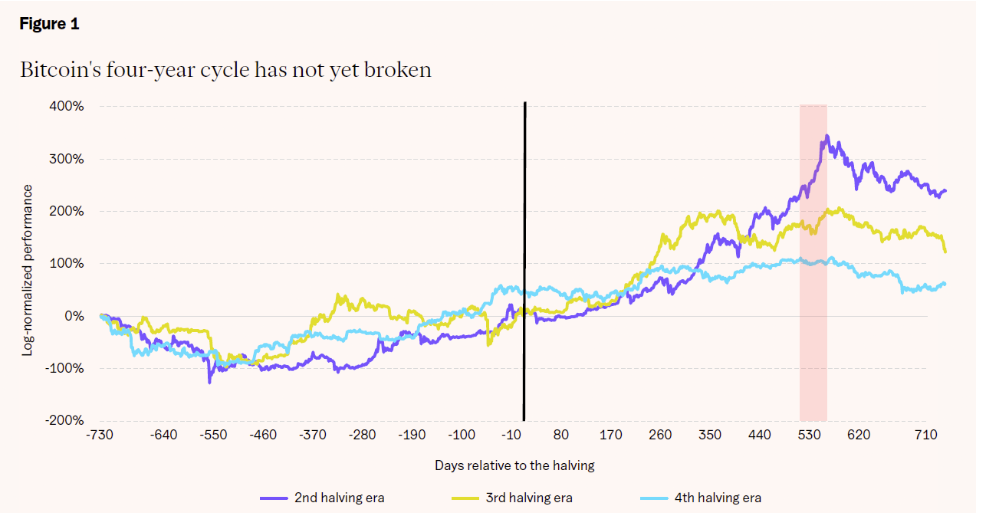
Bitcoin’s price action this year suggests the four-year cycle remains intact. Source: 21shares
“Bitcoin’s cycle is evolving, but it has not broken yet,” 21Shares said, walking back its earlier forecast that the four-year cycle had become obsolete.
Related: Ethereum Foundation leadership exodus continues with director’s departure

XRP TO BE REPRICED ON JULY 1ST!?!? (THIS IS UNREAL)

The peaceful beach under two hours from Cambridgeshire where Ice Age giant was found

Amazon Prime Day offers a glimpse into U.S. consumer as shoppers navigate with pinched wallets


-

 Entertainment7 days ago
Renter of Home in Anne Heche Crash Denies Settlement With Son
-
 Sports4 days ago
Two goals and an assist by sheer aura: Cristiano Ronaldo just entered the World Cup chat
-

 Tech5 days ago
Microsoft accidentally kills epic Outlook email threads
-

 Fashion1 day ago
Weekend Open Thread: Staud – Corporette.com
-

 Business7 days ago
Soccer-U.S. defends Iran World Cup travel restrictions, says discussions ongoing
-

 Politics2 days ago
The House | Manchesterism won’t survive the painful trade-offs unless it gets citizens on board
-

 Politics2 days ago
Potential 2028er World Cup attendee leaderboard
-

 Business1 day ago
Asia stock markets slide as tech shares slump
-

 Tech2 days ago
A Look At A Gaggle Of Transputer Boards
-
Crypto World4 days ago
Bitcoin (BTC) Dips Below $62K, Ethereum (ETH) Plunges 6% Daily: Market Watch
-

 Crypto World3 days ago
Securitize Wraps Roubini's SEC-Registered ETF as Dubai VARA Digital Security
-
 Crypto World2 days ago
Dell (DELL) Shares Tumble Over 5% Following Analyst Downgrade to Hold
-
Business4 days ago
Entergy settles forward sale agreements, raises $672 million in cash proceeds
-

 Crypto World13 hours ago
Kraken's xStocks Opens Bending Spoons IPO Registration to EEA Retail
-

 Sports22 hours ago
FIH Pro League: India defeat Pakistan 7-1, register biggest win of campaign | Other Sports News
-

 Crypto World1 day ago
RTX holders must register wallets before token distribution begins
-
Crypto World1 day ago
Hyperliquid Named on Singapore MAS Investor Alert Register
-

 Sports2 days ago
India vs Bangladesh LIVE Score, Women’s T20 World Cup: Bangladesh Opt To Bat; India Enter ‘Do-Or-Die’ Stage As Semi-Final Race Heats Up
-
 Tech6 days ago
Signal’s Meredith Whittaker says AI chatbots ‘are not your friends’ and calls Copilot agents a backdoor
-
Crypto World1 day ago
The DATA Foundation Launches to Tackle AI’s Multi-Billion Dollar Training Data Bottleneck
You must be logged in to post a comment Login