




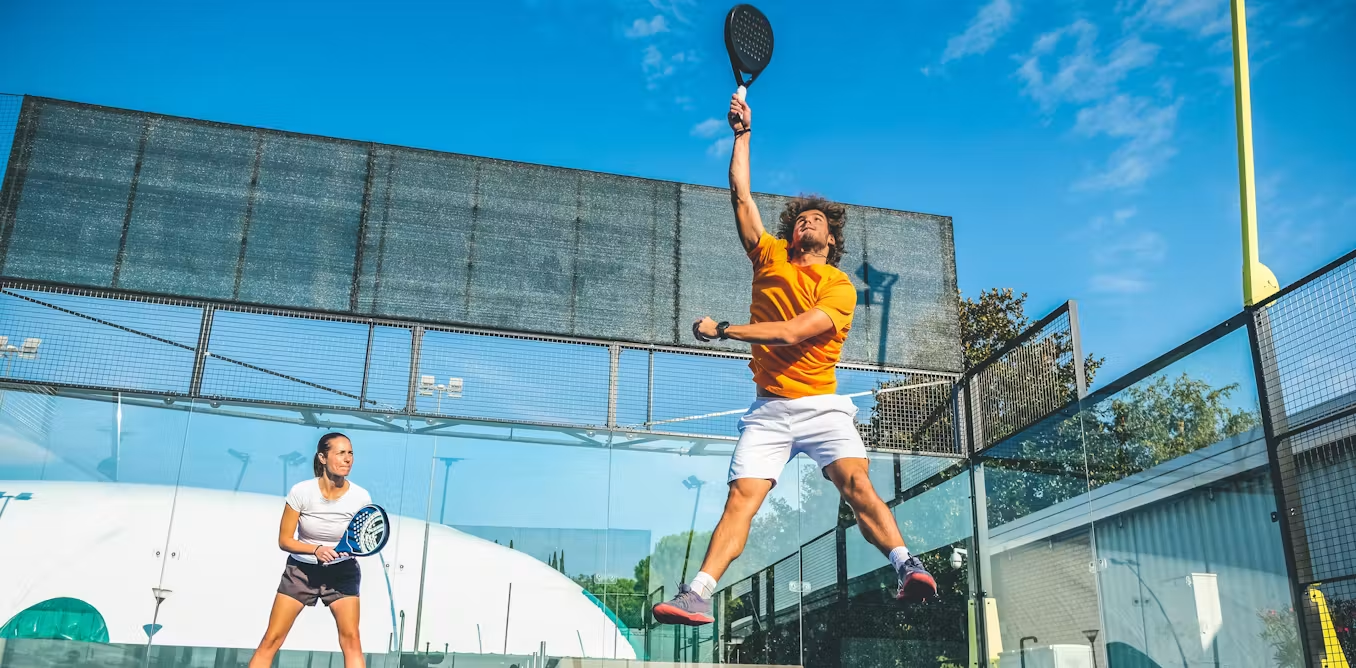
Padel has captured the British sporting imagination. Combining aspects of tennis and squash, and played across a net but within a walled court, padel was invented in Mexico in 1969.
In the intervening half century, it cultivated a significant following in Latin America and Spain. Padel is the second most popular participation sport in Spain – behind football – with 6 million players. The professional padel circuit is now more than 20 years old.
À lire aussi :
Tennis has had a golden generation – but not a golden era
Britain is late to the party. In 2019, the number of people playing padel in Britain was just 15,000. However, the Lawn Tennis Association, the national governing body for padel in Britain, recorded in May 2026 that 1 million people play padel across the country. Such growth is a stunning success story.
Yet, in certain quarters, padel’s rise has not been met with unbridled enthusiasm. There is unease in some tennis circles that padel could entice away a large proportion of recreational players. Even Novak Djokovic has voiced concern that padel threatens tennis at the club level.
Padel’s appeal to club players
Djokovic makes the economic case that one tennis court can be converted into three padel courts, and three courts are more profitable than one. However, the threat runs deeper. Five structural features make padel attractive for club players.
- the initial learning curve is less steep than in tennis – for example, padel points begin with an underarm serve
- padel rackets are more forgiving to imperfect strokes than tennis rackets as they are made of fibreglass or carbon fibre and have no strings
- less time is spent retrieving balls after errant shots because padel courts are smaller than tennis courts and enclosed by walls
- the walls add unpredictability to shots, at least for beginners, and this uncertainty over the ball’s path creates a fun coordination challenge for players, and an entertaining spectacle for their opponents
- padel is inherently social as it is played in a doubles format and the smaller court lends itself to a flow of conversation between partners and opponents alike.
The culture around padel also appeals to club players. Padel culture prizes informality, community and inclusion. Far from the hushed tones of tennis tournaments, padel events are more likely to play music while spectators recline on beanbags and socialise courtside. Racket throwing and gamesmanship are not just frowned upon – such conduct is viewed as decidedly odd. Padel is not simply a different sport to tennis, it offers a different way of doing sport.
The challenge of competitive padel
Among sceptics, however, concern about padel at the recreational level is often coupled with antipathy towards it at the competitive level. Alexander Bublik, men’s tennis world number 11, recently opined: “If you can’t play singles, you play doubles. If you can’t play doubles, you play padel.” However, the ease of starting a sport should not be confused with the difficulty of mastering it.
While padel combines skills from tennis and squash, it is not merely derivative. Padel requires its own distinct set of skills, strategies and physical attributes. Shots such as the vibora, bandeja and bajada are staples in padel, but do not exist in tennis. Learning to use the wall to attack and defend takes years to master.
Strategy in padel and tennis are also fundamentally different. In tennis, the primary objective is to hit the ball past your opponent. In padel, balls that fly past an opponent usually bounce off their back wall and hand them an attacking position. Padel matches are not determined by a dominant shot, such as a powerful forehand, so points often involve long tactical chess matches aimed at manoeuvring opponents out of position to create an opening or to elicit a short lob.
The historical case for padel
Aside from a concern for grassroots tennis and an aversion to competitive padel, traditionalists may object to padel merely as a challenge to the established order. However, lawn tennis is itself a relative newcomer compared to sports such as golf and cricket, which predate it by centuries.
Even in the history of racket sports, lawn tennis is a recent development. It is a descendant of what is now called “real tennis”, a sport developed by French monks in the 12th century, which involved playing over a rope and against the walls of a monastery. Originally played using one’s hand, strung rackets were introduced in the 16th century.
À lire aussi :
Sixteenth-century tennis was a dangerous sport played with balls covered in wool
Lawn tennis evolved from real tennis in the late 19th century. Much like padel now, it enjoyed a period of global expansion in the 50 years following its creation.
Traditionalists should embrace padel because, first, padel preserves the real tennis challenge of playing over a net within walls that form part of the playing area. In this fundamental respect, padel is a truer descendant of real tennis than lawn tennis.
Second, while developments in racket and string technology have made volleying a dying skill in lawn tennis (at least in singles), attacking the net is the primary strategic objective in padel. Those who lament the demise of net play in lawn tennis should embrace padel as preserving the endangered art of meeting the ball before the bounce.
Padel is now a fixture in the British sporting landscape. With 35 million players globally and 100 national federations across five continents, it seems likely to feature in the Brisbane 2032 Olympics.
Lawn tennis and padel need not engage in a zero-sum rivalry in which one side’s winning necessitates the other’s losing. Of the 1 million people who play padel in Britain, approximately two-thirds also play lawn tennis.
Both sports attract their own specialists, but the grassroots need not be a battleground. Club players can enjoy both, and revel in how padel allows them to deepen their existing racket skills to tackle a fresh sporting challenge, to follow a more varied sporting diet and to belong to a vibrant new sporting community.














































You must be logged in to post a comment Login