Connect with us
DAPA Banner
DAPA Coin
DAPA
COIN PAYMENT ASSET
PRIVACY · BLOCKDAG · HOMOMORPHIC ENCRYPTION · RUST
ElGamal Encrypted MINE DAPA
🚫 GENESIS SOLD OUT
DAPAPAY COMING

NewsBeat

Press readers react to MP’s ‘warfare not welfare’ comments

Published

on

Press readers react to MP's 'warfare not welfare' comments

Kevin Hollinrake, the Tory MP for Thirsk and Malton, hit out at the ‘unsustainable’ number of people claiming unemployment benefits in his constituency and called for the reinstatement of the two-child benefit cap to increase the budget of the Armed Forces.
The Conservative Party chairman added that 1,120 people in his constituency were claiming unemployment benefits, which he said was “not sustainable”.

Kevin Hollinrake MP.

​The percentage of people aged 16-64 claiming unemployment benefits in Thirsk and Malton is two per cent, and in Scarborough and Whitby it is 3.1 per cent.

Mr Hollinrake said: ​“The threats we face are getting more and more serious. That is why I voted to demand the Government cuts welfare and gives our Armed Forces the backing they need to keep us safe.”

Advertisement

He added that there was “a consensus that our military is not ready for war” and that reinstating the two-child benefit cap would create savings for increased defence spending.

Readers took to The Press website to have their say.

Beyond Infinity said: “Oh, hooray, what the country needs is more vacuous slogans, right?”

Metalclog said: “The reality is, our Armed Forces cannot survive on a diet of government spin, over-the-horizon spending commitments and hollow rhetoric.”

Advertisement

Freeda said: “It’s more complicated than poor people out of work directly and solely affecting the military budget. A child benefit cap singles out women as the perceived burden of society.

“It would mean fewer potential military recruits being born, more people in debt, families fragmented and older people who have spent a lifetime forging support systems having to uproot and start from scratch.

“If a politician wants votes, don’t make the poor poorer or go against women! A country is judged on the bottom rung of that society’s standard of living, as well as military might and the wealthy.”

ChiefTired said: “Knew it was Hollinrake before I read the article.”

Advertisement

PsDsTsTsK said: “These are disgraceful comments from a Member of Parliament and entirely unbecoming of someone elected to represent the public.”

Source link

Advertisement
Continue Reading
Click to comment

You must be logged in to post a comment Login

Leave a Reply

NewsBeat

Domestic fire in Bolton brought under control by firefighters

Published

on

Domestic fire in Bolton brought under control by firefighters

Greater Manchester Fire and Rescue Service (GMFRS) said crews from Bolton North and Farnworth attended the incident shortly after 4pm.

A spokesperson for GMFRS said: “Fire engines from Bolton North and Farnworth attended a domestic fire on Rushey Fold.

“Crews were in attendance for just over 20 minutes to extinguish the fire.

Advertisement

“One occupant had safely left the property prior to their arrival.”

This incident follows two fires yesterday on Derwent Road and Pelham Street, as well as Greater Manchester crews helping with a large-scale operation at Tintwistle Moor.

Source link

Advertisement
Continue Reading

NewsBeat

Manchester Airport brother sentencing RECAP as Mohammed Fahir Amaaz JAILED for three-and-a-half years after ‘cowardly’ attack

Published

on

Manchester Evening News

Mr Khan, on behalf of Amaaz, begins his mitigation.

The defendant comes from a large family ‘in which there are various police officers’, said the KC, referring to a number of references which ‘give an idea of what might have been in his mind’ at the time of the attack.

His brother Mr Amaad described him as a ‘caring’ man who had always helped members of his family. Another reference said he had ‘always been there for the people around him’, while another mentioned his charity work.

Advertisement

Another said the defendant was ‘caring, attentive and always makes sure people around him are ok’.

Another brother, Mohammed Abid, said the defendant had played an important role caring for their mother and was willing to support ‘vulnerable’ family members.

The defendant is the youngest of six siblings and the attack was ‘not what Fahir is’ and it was ‘completely alien to his character’, according to another reference.

The KC said the references showed a man who wanted to ‘right wrongs and had empathy for others’. The defence barrister said his client was ‘perhaps not thinking of the consequences’ when he went to the defence of his mother.

Advertisement

“The instinct is to protect,” he said.

“These offences took place in a context of a young man who wanted to help others,” said Mr Khan, who went on to say the offence was ‘not premeditated’.

Source link

Advertisement
Continue Reading

NewsBeat

Tomatoes and radishes with buttermilk and dill

Published

on

Tomatoes and radishes with buttermilk and dill

I was in Estonia a few summers back and loved what they did with tomatoes, serving them with sweet black bread, radishes, rich cottage cheese and, often, dill. This is a really useful summer salad, very good with salmon, both plain and hot smoked, fish cakes and cheese.

Source link

Continue Reading

NewsBeat

‘I’m a doctor and I eat this breakfast every day as it helps lose weight’

Published

on

Wales Online

BBC Breakfast expert slammed cereal – and said he tells patients to do something completely different

A doctor has revealed what he consumes for breakfast ‘all the time’ – and how it assists him in losing weight. Dr Rangan Chatterjee, best known for his television programme Doctor in the House and for being the resident doctor on BBC Breakfast and as a regular contributor to BBC Radio, stated people should begin consuming what they eat for dinner much earlier.

Advertisement

Speaking on the Doctor’s Kitchen podcast previously, Dr Chatterjee explained the crucial factor was incorporating some protein as it keeps hunger at bay for longer. He challenged why people have been conditioned into consuming things like ultra-processed cereal for the first meal of the day.

He said: “Who says that these are breakfast foods? And when you really dive into where this all came from and the marketing involved, it’s actually some cereal companies, right? We used to go to India for 6 weeks every other summer. I can still remember my cousins before they went to school, they’d have these big plates. There was like meats, vegetable curries, there was dal, rice, it was like a proper meal.

“And then I noticed after about 10 years you’re going back and like there’s all these adverts from the cereal companies.”

Podcast host Dr Rupi Aujla replied: “There’s that beautiful set of photos where they looked at what kids eat for breakfast around the world. It was done about 10 years ago. I come back to that all the time. What you see in the UK and the US are just these refined sugary cereals, and you definitely see that in certain other countries like Latin America and particularly in Brazil. But then you look at like Asia and it’s just like a hali, you know, like Sri Lanka was like a hali with some. Some I mean that’s the kind of stuff that I would eat for for dinner.”

Advertisement

Dr Chatterjee added: “Yeah, and one of the things I’ve often said to patients to help them with this is eat dinner for breakfast.” Dr Aujla replied: “Yeah, I do that all the time. Yeah, I mean it’s a very simple way because we’ve got this idea of what a breakfast food is, but actually it wasn’t always.”

Content cannot be displayed without consent

Dr Aujla explained: “Protein at breakfast is a great strategy to ensure that you’re not overconsuming and improve weight maintenance.”

Refraining from snacking is the secret to maintaining a healthy weight, Dr Chatterjee explained, adding: “I genuinely do not bring food into my house that I don’t want to be consuming. Sweets, chocolates, cakes, I don’t keep them at home. Because there will be an evening when I’m feeling tired and a bit stressed and I will start opening the cupboards and look for something a little bit sweet and all I can see at the moment are whole nuts and olives, and sometimes I’m like, ah, I’m not sure I feel like that at the moment. No it’s not really what I wanted. Yeah. So, again, in terms of what is practical for many people and my biases, the patients I’ve seen over the years. I think not using your willpower in your house is a great tool.

“And also, I think a lot of these principles depend where you’re at on your journey. Right, if you’re used to having loads of ultra processed foods, and that’s, you know, making up 70% of your diet, as it is for many people. Actually, to reset, maybe for a few months you don’t want that stuff anywhere near you, so it can, it can help you reset your taste buds, not be tempted.

Advertisement

“Yeah, think about it another way, and we don’t like to think about food in this way, but let’s say you were an alcoholic, right, and you were struggling with your alcohol consumption. And you recognise that and you start to get help. I think most of us would probably accept that whilst you’re trying to recover from that possibly not the best idea to have loads of beer and wine and booze kicking around in your fridge and in your house.”

Source link

Continue Reading

NewsBeat

Discovery Festival in Darlington cancelled and pushed back

Published

on

Discovery Festival in Darlington cancelled and pushed back

Discovery Festival, which was due to be held at Mowden Park on August 8 and 9, has been pushed back to the same weekend next year, organisers have announced. 

The event was due to host 80s Calling on the Saturday, headlined by one-half of synth-pop duo Soft Cell Marc Almond, followed by DJs Sigma and The Wanted 2.0 on the Sunday.

Bosses of the event said that rising costs and other events, such as Radio 1’s Big Weekend in Sunderland in May, has had a “huge impact”.

It said this has meant that organisers are “not able to deliver the experience you have previously enjoyed with us and we believe you deserve”. 

Advertisement

Marc Almond will be headlining '80s Calling at Discovery Festival, Darlington in 2026Marc Almond was due to headline ’80s Calling at Discovery Festival, Darlington in 2026 (Image: Chameleon Music Marketing Ltd)

Ticket holders can now either get a full refund if they can’t attend the 2027 dates – August 7 and August 8 – or can hold on to their ticket and get a free extra complimentary ticket for any day at the festival next year. 

A statement from organisers said: “It is with great disappointment that we must announce the postponement of Discovery Festival, in Darlington 2026. 

“When we planned this event a year ago, none of us could have anticipated the current economic situation and the impact it would have on all our lives, affecting everyone’s disposable income. 

“Despite our best efforts, the combination of rising costs and other events announced locally, particularly BBC Radio 1’s Big Weekend which has had a huge impact on the festival and means that this year we are not able to deliver the experience you have previously enjoyed with us and we believe you deserve. 

Advertisement

“Having exhausted all potential alternatives, we have reached the heart-breaking decision to postpone the festival until August 7 to August 8, 2027.

“The full 2027 exciting line ups will be announced shortly, so why not hold on to your tickets and make your decision then! We are all so very sorry, and we truly hope you’ll stay with us for 2027.”

Discovery Festival’s lineup on Saturday featured Level 42, Marc Almond and Heaven 17 while Sunday included Five, Sigma, The Wanted 2.0, XO, and Bjorn Again. 

More than 15,000 people attended the festival in 2025.

Advertisement

Source link

Continue Reading

NewsBeat

Inside the politicisation of the first-ever 2026 World Cup pride match

Published

on

Inside the politicisation of the first-ever 2026 World Cup pride match

When the initial 2026 World Cup schedule was released two years ago, the date of Seattle’s final group-stage contest fashioned an unmissable opportunity. The “Emerald City”, positioned with its exquisite downtown skyline off the Pacific coast in Washington state, is famous for its spectacular Pride celebrations at the end of June. It coincides with the 1969 Stonewall Riots, seen as the catalyst for the liberation of gay people in the United States more than 55 years ago.

For Jen Barnes, founder and CEO of Rough & Tumble – a first-of-its-kind sports bar which promotes gender equity and inclusivity in sports viewing and fandom – Friday is a chance to parade the LGBTQ+ community in perfect harmony with the world’s most popular sport and its greatest show.

“Soccer is the world’s game for a reason,” Barnes, who is co-chair of Seattle’s World Cup Pride+ Match Committee, tells The Independent. “When I think about what it will look like to fans watching from afar and fans who are here experiencing it, I do feel like we are celebrating Pride for the world on that day.

“I think that is really the most important story here.”

Advertisement

And yet, not for the first time at this World Cup, the story is different. What should have been an elaborate celebration of inclusivity has instead turned into another unpalatable political storm. December’s draw in Washington, DC, came and went and, 24 hours later, the matches fell into place.

Which countries would be involved in the first-ever World Cup Pride Match? Iran and Egypt. Two countries with long-standing anti-gay laws and ideology.

In Iran, homosexuality is strictly illegal under Sharia law. Penalties range from flogging to the death penalty. In Egypt, homosexuality is not explicitly outlawed, but LGBTQ+ people experience regular discrimination and violence. Police, via the implementation of vague “debauchery” and “incitement to indecency” laws, regularly persecute and arrest queer people, who can face up to seven years in prison.

In the aftermath of the draw, both countries’ football federations were quick to condemn the rainbow match. Egypt said it “categorically rejects any activities promoting LGBTQ during the match”, citing the “provocation of cultural and religious sensitivities among fans.” Iran’s football federation stated that the event was an “irrational move that supports a certain group.”

Advertisement

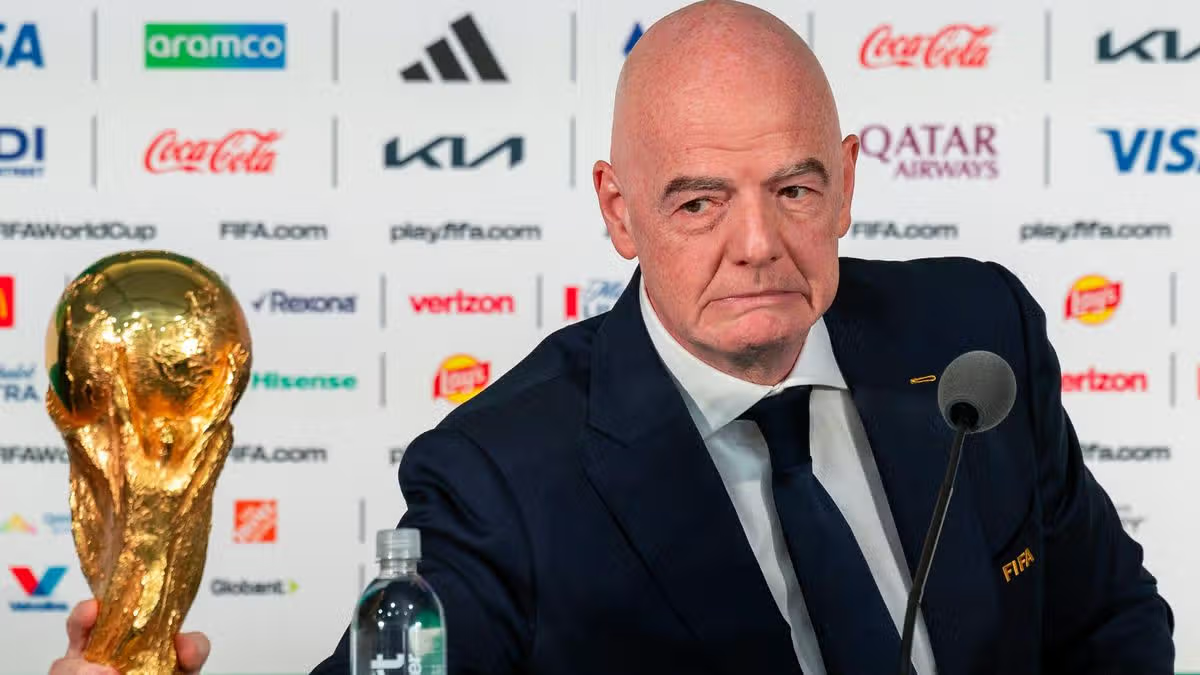
Both countries appealed to Fifa, who were quick to wash its hands of any involvement. “I must clarify that there will be no ‘Pride Match’ at the World Cup,” Fifa president Gianni Infantino said in January.

“There will be a Fifa World Cup match in Seattle and, on the same day, events organised by external organisations will be taking place in the city. But that has nothing to do with the match itself.”

There is some inescapable irony here. At the last World Cup in 2022, Fifa insisted any team captains who wore the rainbow “OneLove” armbands, as England’s Harry Kane planned to, would receive yellow cards due to it being a “political statement”. In protest, the German team memorably covered their mouths in their pre-match team photo.

This time around, on the face of it, there is a very simple alteration Fifa could have made to alleviate any concerns or protests surrounding Friday’s event. The Canadian city of Vancouver plays host to the other Group G match taking place simultaneously on Friday night, with Belgium playing New Zealand: two countries with progressive LGBTQ+ laws.

Advertisement
German players covered their mouths in protest at Fifa’s ‘political statement’ laws at the last World Cup in Qatar
German players covered their mouths in protest at Fifa’s ‘political statement’ laws at the last World Cup in Qatar (Getty)
Seattle celebrates Pride Weekend at the end of June every year
Seattle celebrates Pride Weekend at the end of June every year (AFP/Getty)

Why could the two matches not simply have swapped locations? For one thing, it would have removed one of the three obstacles Iran has faced in their myriad US visa issues over the last fortnight. As it turns out, the Iran team have actually been in Seattle since Wednesday, in a match they need a result (and likely a win) to progress to the knockout stage. Mohamed Salah’s Egypt, meanwhile, will top the group with a victory.

Yet typically, common sense did not prevail with the potential city-swap. We are where we are. “I think it’s expected given their rules,” Barnes said, of Iran and Egypt’s protestations. “I’m not sure if disappointed is the right word. Despite Iran and Egypt’s policies, queer people exist everywhere and that’s really the most important part.

“We don’t control the draw. Those are the countries that were drawn. It’s an important moment to make sure that we are uplifting a community that is disenfranchised in certain parts of our world. We’ve really spent a lot of time uplifting the queer community and making sure that our visitors and our fans coming into town feel safe.

“If they are allies, they know they’re in a wonderful place celebrating the queer community. If they are queer themselves, they’re in a safe place and they’re going to have a lot of fun.”

Advertisement

The latest is that Fifa will not stop fans from bringing in rainbow flags to Seattle’s Lumen Field stadium on Friday.

A Fifa spokesperson added: “General statements of human rights, including rainbow flags and other flags representing sexual orientation and gender identity, are permitted under the Fifa World Cup 2026 Stadium Code of Conduct and may be displayed inside stadiums provided they are used in a manner consistent with the code.”

Celebrations across the city, outside of Fifa’s jurisdiction, include “The Unity Loop” – a curated route designed to direct visitors to LGBTQ+-owned restaurants, bars and shops. There will be watch parties across Seattle, including at Barnes’s Rough & Tumble bar, while there will also be rainbow-themed merchandise and social media campaigns.

Fans have booed the Iranian national anthem in their first two matches
Fans have booed the Iranian national anthem in their first two matches (Getty)

For Seattle’s Police Department, when combining the Pride celebrations with the expected Iranian regime protests – as seen at Iran’s first two matches in Los Angeles, such as booing of the national anthem – it is set to be quite the operation. There will be heightened security measures, including drones and Coast Guard patrols along the waterfront.

Seattle’s mayor, Katie Wilson, admitted that local law enforcement were “expecting and prepared for protest activity.” Jamie Pedersen, the state senator and one of several openly gay members of the Washington State Legislature, added: “If you tried to import a pride celebration into Egypt or Iran, obviously that could be a disaster.

Advertisement

“But in a community like Seattle that prides itself on welcoming people from all over, I just can’t imagine that it’s going to be a significant problem.”

And Barnes, ahead of an event which has been four years in the making, concurred: “What I really do anticipate is purely a celebration of soccer and inclusion. We’ve worked really closely with our Iranian-American community and our Egyptian-American community here. Seattle is such a welcoming community for our LGBTQ+ fans and those who live here.”

As for the legacy of the Pride Match, there is even hope that the event could take place at the 2030 World Cup, held in Spain, Portugal and Morocco. “I absolutely hope that this is something that gets carried forward,” she added. “There are queer human beings everywhere on this planet. There’s no reason not to be inclusive of a huge portion of our fan base and our athletes themselves.”

Advertisement

Source link

Continue Reading

NewsBeat

OpenAI limits newest ChatGPT product to Trump-approved customers

Published

on

OpenAI limits newest ChatGPT product to Trump-approved customers

ChatGPT maker OpenAI said Friday it is restricting the release of its new artificial intelligence model at the request of President Donald Trump’s administration, the latest in an unprecedented government vetting of AI products that could pose cybersecurity risks.

OpenAI said its new AI product, called GPT-5.6 Sol, would only be available for now to a “small group of trusted partners” approved by the Trump administration.

“We don’t believe this kind of government access process should become the long-term default,” OpenAI said in a statement. The company said it viewed the testing period as a temporary step on the “path to broader availability in the coming weeks.”

OpenAI’s staggered release of a powerful new AI system follows actions the government took earlier this month against OpenAI rival Anthropic, maker of the Claude chatbot.

Advertisement

Anthropic took offline two new AI models, known as Fable 5 and Mythos 5, just days after publicly releasing them to comply with a Trump directive blocking their use by foreign nationals.

Officials have grown increasingly concerned since Anthropic warned earlier this year that its Mythos model was adept at finding flaws in software in a way that could be weaponized by malicious hackers and threaten critical computer networks around the world.

Trump earlier in June signed an executive order on AI oversight that established a framework for the federal government to vet the national security risks of the most advanced AI systems for up to 30 days before their public release. The order described participation by AI developers as voluntary but the framework has not yet been fully developed.

OpenAI said its new Sol model “is better at helping people find and fix vulnerabilities” than it is at carrying out cyberattacks and does not cross the company’s own risk threshold. But it acknowledged there could be unforeseen risks especially if its model is combined with other tools.

Advertisement

“That uncertainty, along with the model’s broader step change in capabilities, is why we are pairing the model’s increased capabilities with stronger safeguards and a phased release,” the company said Friday.

Source link

Advertisement
Continue Reading

NewsBeat

Everything you need to know ahead of Cambridge South opening this weekend

Published

on

Cambridgeshire Live

The new station is expected to service around 1.8 million passengers a year

A new train station opens in Cambridge this weekend, after facing delays. Cambridge South station will welcome its first passengers on Sunday, June 28.

Advertisement

The opening comes after much delay, with the date being pushed back twice. The first delay was in February last year, after a sub-contractor went into administration and this led to a second delay.

Cambridge South will be the first station under the Great British Railways, a new public sector body that will overlook Britain’s railways. Emily Heria, senior sponsor on behalf of GBR Anglia, spoke earlier this week about the station opening.

She said: “We are all so excited to open the new station on Sunday, June 28 and can’t wait to welcome our first customers and see their reaction to their new railway station. We hope they will be as proud of their new station as we are to have built it.”

Transport Secretary Heidi Alexander said: “The newly opened Cambridge South station cuts journey times, improves access to jobs, and makes everyday life that little bit easier for thousands of people.

Advertisement

“This £250 million investment means a journey that once took over an hour – involving a train, a bus, and a walk – is now a single 45-minute direct train from London. That’s a real, tangible difference in people’s lives.“With up to 20 services in peak hours connecting passengers to London, Birmingham, Stansted, and beyond, Cambridge South will connect people with opportunities across the region and the wider country. This is Great British Railways in action.”

Ahead of its Sunday opening, here is all you need to know about Cambridge South station.

Where will the station be?

The new station will be situated next to the Cambridge Biomedical Campus and Addenbrooke’s Hospital.

What trains will run through the station?

Once it’s open, the station will welcome up to nine trains per hour. These will run from Cambridge, with direct services to London King’s Cross, London Liverpool Street, Birmingham New Street, Brighton, Gatwick Airport and Stansted Airport.

Advertisement

The services will be run by Greater Anglia, Great Northern, Thameslink and Cross Country, and up to 20 services an hour will call at the station during peak times. Passengers will also be able to make use of a 45 minute direct train to and from London.

What will the station feature?

The station will feature a green roof with solar panels, and a rainwater collection system with a wildflower environment.

It’ll also be connected to the local cycle network, and will have 1000 spaces for cycle parking, as well as blue badge bays. It’s right next to the guided busway system, giving passengers more sustainable travel options around the city.

How much has the station cost?

The station has been mainly funded by a £250 million Government investment. There was also a combined £5 million in contributions from AstraZeneca, Cambridge and Peterborough Combined Authority, and the Greater Cambridgeshire Partnership.

Advertisement

It’s estimated to serve 1.8 million passengers a year.

Source link

Continue Reading

NewsBeat

How padel disrupted the genteel world of lawn tennis

Published

on

How padel disrupted the genteel world of lawn tennis

Padel has captured the British sporting imagination. Combining aspects of tennis and squash, and played across a net but within a walled court, padel was invented in Mexico in 1969.

In the intervening half century, it cultivated a significant following in Latin America and Spain. Padel is the second most popular participation sport in Spain – behind football – with 6 million players. The professional padel circuit is now more than 20 years old.


À lire aussi :
Tennis has had a golden generation – but not a golden era


Britain is late to the party. In 2019, the number of people playing padel in Britain was just 15,000. However, the Lawn Tennis Association, the national governing body for padel in Britain, recorded in May 2026 that 1 million people play padel across the country. Such growth is a stunning success story.

Advertisement

Yet, in certain quarters, padel’s rise has not been met with unbridled enthusiasm. There is unease in some tennis circles that padel could entice away a large proportion of recreational players. Even Novak Djokovic has voiced concern that padel threatens tennis at the club level.

Djokovic on why padel threatens tennis.

Padel’s appeal to club players

Djokovic makes the economic case that one tennis court can be converted into three padel courts, and three courts are more profitable than one. However, the threat runs deeper. Five structural features make padel attractive for club players.

  1. the initial learning curve is less steep than in tennis – for example, padel points begin with an underarm serve
  2. padel rackets are more forgiving to imperfect strokes than tennis rackets as they are made of fibreglass or carbon fibre and have no strings
  3. less time is spent retrieving balls after errant shots because padel courts are smaller than tennis courts and enclosed by walls
  4. the walls add unpredictability to shots, at least for beginners, and this uncertainty over the ball’s path creates a fun coordination challenge for players, and an entertaining spectacle for their opponents
  5. padel is inherently social as it is played in a doubles format and the smaller court lends itself to a flow of conversation between partners and opponents alike.

The culture around padel also appeals to club players. Padel culture prizes informality, community and inclusion. Far from the hushed tones of tennis tournaments, padel events are more likely to play music while spectators recline on beanbags and socialise courtside. Racket throwing and gamesmanship are not just frowned upon – such conduct is viewed as decidedly odd. Padel is not simply a different sport to tennis, it offers a different way of doing sport.

The challenge of competitive padel

Among sceptics, however, concern about padel at the recreational level is often coupled with antipathy towards it at the competitive level. Alexander Bublik, men’s tennis world number 11, recently opined: “If you can’t play singles, you play doubles. If you can’t play doubles, you play padel.” However, the ease of starting a sport should not be confused with the difficulty of mastering it.

Advertisement

Highlights from female padel matches.

While padel combines skills from tennis and squash, it is not merely derivative. Padel requires its own distinct set of skills, strategies and physical attributes. Shots such as the vibora, bandeja and bajada are staples in padel, but do not exist in tennis. Learning to use the wall to attack and defend takes years to master.

Strategy in padel and tennis are also fundamentally different. In tennis, the primary objective is to hit the ball past your opponent. In padel, balls that fly past an opponent usually bounce off their back wall and hand them an attacking position. Padel matches are not determined by a dominant shot, such as a powerful forehand, so points often involve long tactical chess matches aimed at manoeuvring opponents out of position to create an opening or to elicit a short lob.

The historical case for padel

Aside from a concern for grassroots tennis and an aversion to competitive padel, traditionalists may object to padel merely as a challenge to the established order. However, lawn tennis is itself a relative newcomer compared to sports such as golf and cricket, which predate it by centuries.

Advertisement

Even in the history of racket sports, lawn tennis is a recent development. It is a descendant of what is now called “real tennis”, a sport developed by French monks in the 12th century, which involved playing over a rope and against the walls of a monastery. Originally played using one’s hand, strung rackets were introduced in the 16th century.

The ‘real tennis’ world championships.


À lire aussi :
Sixteenth-century tennis was a dangerous sport played with balls covered in wool


Lawn tennis evolved from real tennis in the late 19th century. Much like padel now, it enjoyed a period of global expansion in the 50 years following its creation.

Advertisement

Traditionalists should embrace padel because, first, padel preserves the real tennis challenge of playing over a net within walls that form part of the playing area. In this fundamental respect, padel is a truer descendant of real tennis than lawn tennis.

Second, while developments in racket and string technology have made volleying a dying skill in lawn tennis (at least in singles), attacking the net is the primary strategic objective in padel. Those who lament the demise of net play in lawn tennis should embrace padel as preserving the endangered art of meeting the ball before the bounce.

Padel is now a fixture in the British sporting landscape. With 35 million players globally and 100 national federations across five continents, it seems likely to feature in the Brisbane 2032 Olympics.

Lawn tennis and padel need not engage in a zero-sum rivalry in which one side’s winning necessitates the other’s losing. Of the 1 million people who play padel in Britain, approximately two-thirds also play lawn tennis.

Advertisement

Both sports attract their own specialists, but the grassroots need not be a battleground. Club players can enjoy both, and revel in how padel allows them to deepen their existing racket skills to tackle a fresh sporting challenge, to follow a more varied sporting diet and to belong to a vibrant new sporting community.

Source link

Advertisement
Continue Reading

NewsBeat

Northern Ireland auction house criticised over sale of ancient mummy head

Published

on

An Egyptian mummy head at the forefront of a blurred background. The skin looks rough, dry and black.  Its eyes are closed.  You can see a few yellow teeth through the gap between its lips.

The auction house listing describes the Egyptian head as being radio-carbon dated to between 750 and 800 BC, adding that it came from a private collection.

It says the head was brought to the UK by a British soldier during World War One and it remained in the possession of the family for a century.

The Indonesian head has been carbon-dated to between 800 BC and 750 BC.

Lowry added that he believed there are thousands of these types of remains “in attics” around the UK, with “all sorts of people” also choosing to display them in their homes.

Advertisement

He added that people take “great pleasure” in their aesthetics and “wondering who was that person”.

Biers, who co-ordinates a task force which tracks how human remains are sold online, said there has been a spike in sales “since social media began”, but particularly in the last five years.

She said the ethical issues stem from how the remains were historically obtained.

“Murder, kidnap, people selling because they’re poor and they have no other way to feed their family so somebody wealthy comes along and says: ‘Well, I’ll buy that head or that body from you and take it back to London and then sell it at auction,’” she said.

Advertisement

Biers added that collectors have many uses for the remains, ranging from the ritualistic to some being turned into things like lamps and earrings.

“We’ve got all of this evidence of these horrific situations, like a child’s spine as the handle of a handbag being sold for over €6,000 (£5,174).”

Science journalist Patrick Pester, tracks the trade in human remains and said listings like this are not unusual

“I come across auctions like this every single day, and the vast majority are taking place online,” he said.

Advertisement

Pester said that tens of thousands of these skeletons remain in private collections or within the medical field, but the reality is that nobody knows how many are still out there.

Source link

Continue Reading

Trending

Copyright © 2025