

Crypto World
EU Lawmakers Back Review of DeFi, Staking and NFT Regulation

The European Parliament’s economic affairs committee has urged the European Commission to assess whether crypto lending and borrowing, staking, non-fungible tokens (NFTs) and decentralized finance (DeFi) should be regulated.
The recommendations were part of a report tabled Friday for plenary vote. It also called for promoting tokenization across financial services, encouraging euro-denominated stablecoins and assessing whether additional crypto activities should be regulated under the European Union’s Markets in Crypto-Assets Regulation (MiCA).
Drafted by Belgian Member of the European Parliament Johan Van Overtveldt, the report is an own-initiative resolution by the Committee on Economic and Monetary Affairs (ECON) that outlines recommendations for the Commission on digital asset regulation.
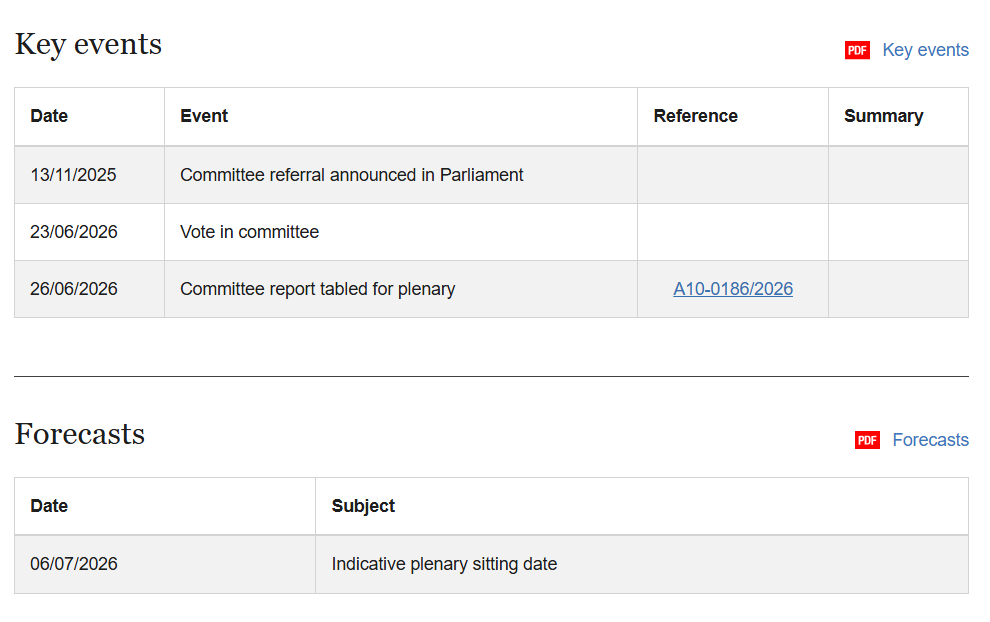
It will next go before the European Parliament for a vote, expected July 7. If adopted, the resolution would become Parliament’s official position on digital assets policy but would not amend MiCA or create new legal obligations.
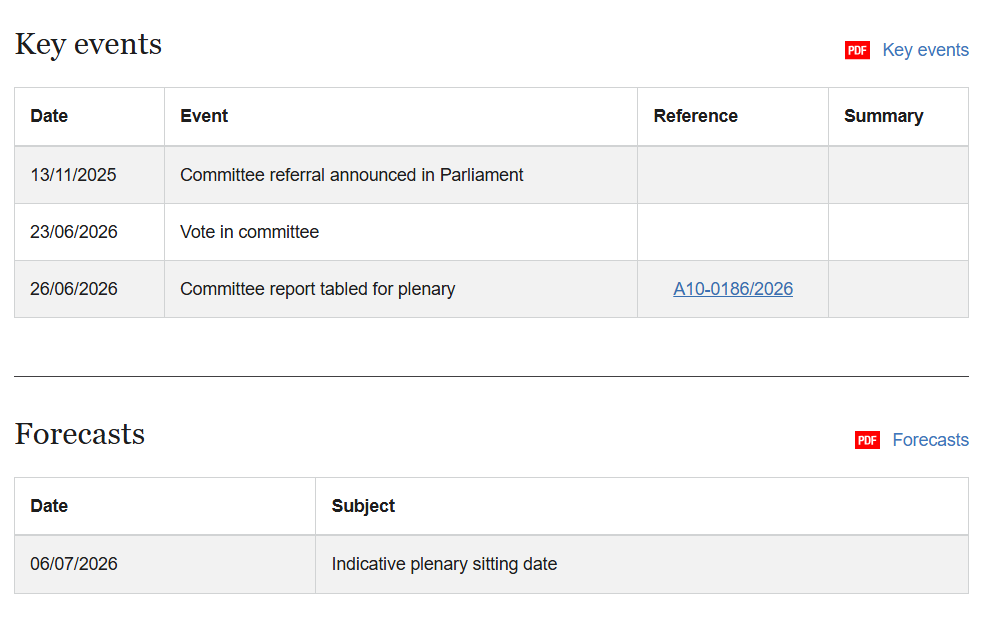
The legislative timeline shows the committee’s approval of the report and its referral for a plenary vote. Source: European Parliament
Related: European Parliament throws support behind digital euro
EU warms up to regulated stablecoins
The recommendations also reflect an evolving view of stablecoins among policymakers. Days after former Bank for International Settlements general manager and longtime crypto critic Agustín Carstens softened his stance on stablecoins, the report welcomed euro-denominated stablecoins under MiCA and encouraged their development to support the bloc’s payment sector.
In 2023, Van Overtveldt called for tighter restrictions on cryptocurrencies following the banking turmoil surrounding Silicon Valley Bank, Signature Bank and Silvergate Bank. The crisis was also closely tied to stablecoins, as USDC issuer Circle held roughly $3.3 billion of its reserves at Silicon Valley Bank when it collapsed, briefly causing USDC to lose its dollar peg.
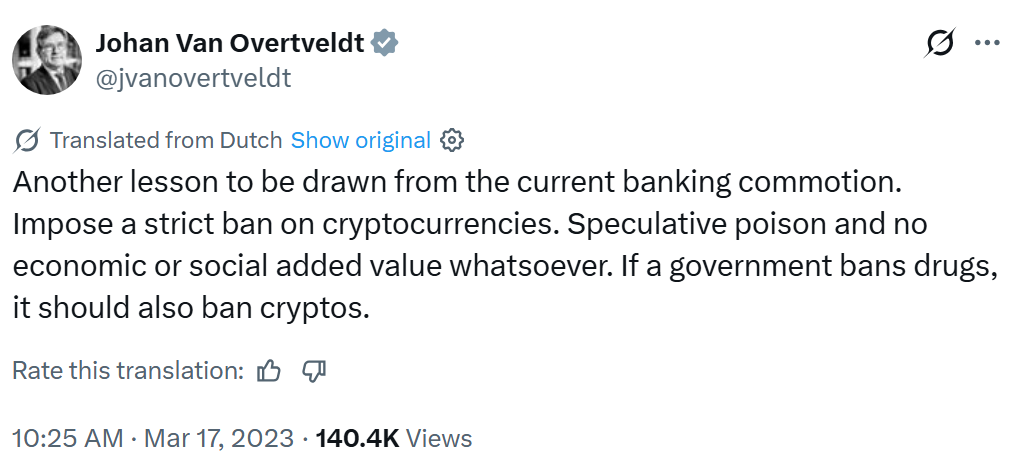
Van Overtveldt likened cryptocurrencies to drugs during the 2023 banking crisis. Source:Johan Van Overtveldt
The report argued that euro-denominated stablecoins could complement tokenized commercial bank deposits and wholesale central bank digital currencies while enabling faster and cheaper cross-border payments. It also said broader adoption could strengthen the competitiveness of EU financial markets and the international role of the euro.
The stance also aligns with ECON’s broader vision for Europe’s digital money ecosystem. On Tuesday, the committee backed legislation for a digital euro, with lawmakers arguing that public and private forms of digital money should coexist rather than compete.
Related: Poland president vetoes MiCA bill again as crypto companies look to license abroad
Lawmakers look beyond MiCA’s current scope
Van Overtveldt first presented a draft of the report in February before months of negotiations and amendments by ECON members. The earlier version largely focused on MiCA’s existing framework, including stablecoin classifications and legal certainty for multi-issued stablecoins.
The committee-approved report urged consistent application of MiCA across the EU to preserve a level playing field for crypto firms. It also warned member states against introducing national requirements beyond MiCA that could fragment the bloc’s digital asset industry.
The Commission is already reviewing MiCA. In May, the Commission launched a public consultation seeking feedback on whether the framework should be expanded to cover areas including DeFi, staking, lending, NFTs and tokenized financial assets, while also reopening debate over the regulation’s ban on interest-bearing stablecoins.
Meanwhile, MiCA’s transitional period ends July 1, after which crypto asset service providers generally must hold authorization under the regulation to continue operating across the EU.
Magazine: AI is banking the unbanked in Africa… faster than crypto

Crypto World
Qualcomm (QCOM) Stock Rockets 15% After Meta Partnership and Aggressive Data Center Goals

Key Takeaways
- Qualcomm increased its fiscal 2029 non-smartphone revenue forecast to approximately $40 billion from $22 billion
- The chip manufacturer established a data center revenue objective exceeding $15 billion by fiscal 2029
- Meta Platforms committed to a multi-year partnership utilizing Qualcomm’s Dragonfly C1000 server chip
- Automotive segment generated record $1.3 billion in Q2 FY2026, representing 38% growth year-over-year
- QCOM shares surged up to 15% following the announcement before moderating
During Wednesday’s investor presentation, Qualcomm unveiled an aggressive expansion strategy that sent Wall Street into a frenzy. The semiconductor company nearly doubled its fiscal 2029 revenue projection for non-smartphone segments, elevating the target to approximately $40 billion from the previous $22 billion goal announced in 2024. The stock rallied as much as 15% during trading.
The previous $22 billion projection was already considered ambitious for a corporation still predominantly associated with mobile phone processors. The revised figure signals that Qualcomm is making a substantial wager on markets outside traditional handsets.
The cornerstone of this transformation is the data center sector. Qualcomm introduced the Dragonfly C1000, a server chip featuring over 250 proprietary cores. Additionally, the company launched a portfolio of AI acceleration products specifically engineered for inference workloads rather than training applications. Leadership is pursuing more than $15 billion in data center revenue by fiscal 2029, starting from essentially zero currently.
To put this in perspective, Qualcomm generated $10.6 billion in total revenue during fiscal Q2 2026. Mobile chip sales accounted for approximately $6 billion of that figure. Data center contributions remain negligible at present.
The most significant announcement wasn’t technical specifications — it was customer validation. Meta Platforms committed to a multi-year, multi-generation agreement to deploy Qualcomm’s new processor across its data center infrastructure, with production scheduled to commence in the second half of 2028. Securing Meta as a launch partner lends substantial credibility to the data center initiative.
Meta Agreement Validates Data Center Strategy
Qualcomm’s innovative High Bandwidth Compute (HBC) architecture employs vertical chip stacking instead of traditional horizontal layouts, positioning memory and processing units in closer proximity. The manufacturer claims this configuration enhances data transfer rates and power efficiency.
The initial generation of this architecture is slated to debut in data center deployments next year, with widespread commercial availability anticipated in 2028. Qualcomm is simultaneously engaging with mobile device, personal computer, and automotive manufacturers about future integration of this technology into their products.
Executive Vice President Durga Malladi stated directly: “What starts in data centers is not going to end there.”
The AI250 accelerator, built on the HBC framework, won’t enter commercial sampling until mid-2027. Meta’s CPU manufacturing doesn’t begin until late 2028. These remain forward-looking milestones rather than realized revenue.
Automotive Segment Delivers Current Results
While the data center narrative focuses on 2028 and beyond, the automotive division is generating results today. Qualcomm reported record automotive revenue of $1.3 billion in fiscal Q2 2026, reflecting 38% year-over-year expansion. The company projects $10 billion in annual automotive revenue by fiscal 2029, supported by a design-win backlog the company estimates at approximately $65 billion.
This trajectory provides tangible evidence for the broader diversification thesis. The automotive business demonstrates the strategy can succeed beyond smartphones in at least one significant market.
From a valuation perspective, the stock trades at roughly 17 times non-GAAP earnings. That multiple sits well below broader market averages and significantly trails valuations assigned to leading AI semiconductor companies — indicating the market continues to view Qualcomm primarily through the lens of its smartphone chip business.
QCOM finished Thursday at $189.39, declining 7.57% for the session, retreating from Wednesday’s investor day-driven rally.

TLDR
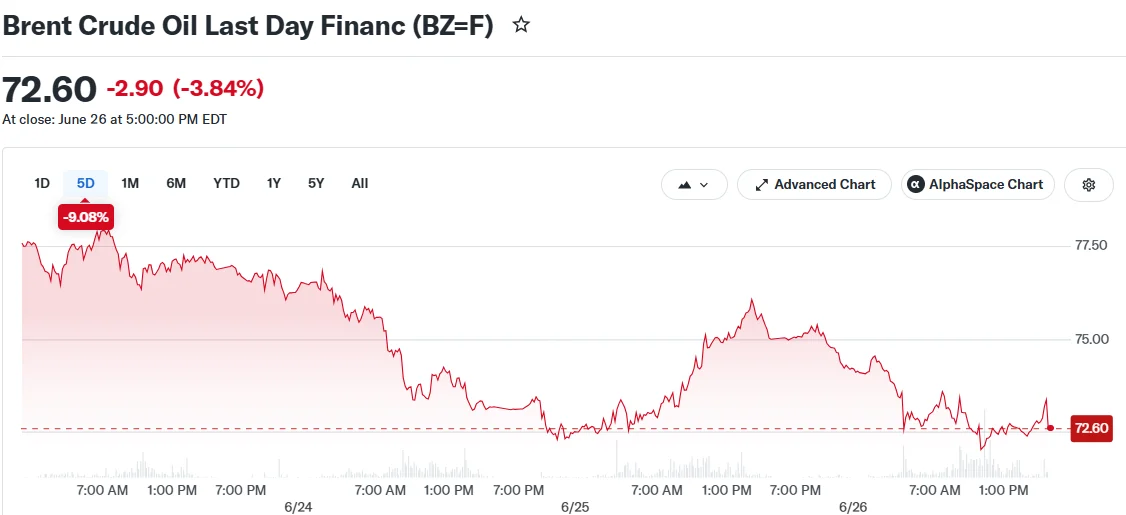
- Brent crude plunged more than 4% to approximately $72 per barrel Friday; WTI declined 3% to roughly $69
- Commercial traffic through the Strait of Hormuz climbed to the highest volume since conflict escalated in late February
- An Iranian attack drone targeted a Singapore-flagged container vessel on Thursday
- US forces retaliated Friday with strikes against Iranian drone storage facilities, missile depots, and radar installations
- Crude prices staged a partial comeback in late Friday trading following confirmation of American military action
Crude oil markets experienced dramatic volatility on Friday, plunging in early trading before staging a recovery after the United States conducted military operations against Iranian targets in response to a drone assault on a commercial ship navigating the Strait of Hormuz.
Brent crude tumbled over 4% during regular trading hours, settling near the $72 per barrel level. West Texas Intermediate experienced a roughly 3% decline to approximately $69 — marking its first closing price beneath $70 since the Iran conflict intensified in late February. Both benchmark grades have now surrendered approximately 25–27% of their value during the past month.
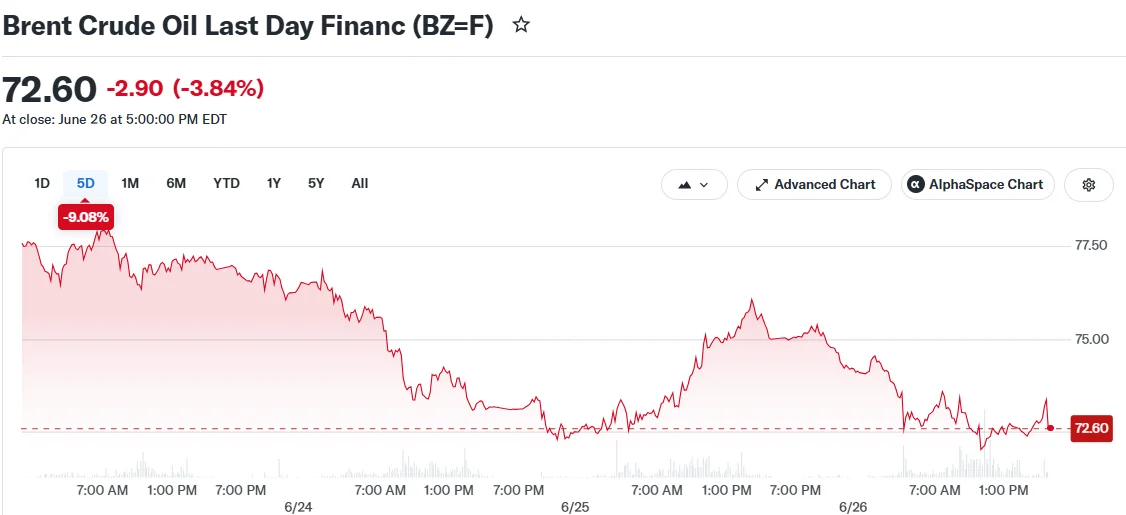
The initial selloff occurred as maritime traffic navigating through the Strait of Hormuz climbed to its most robust levels since hostilities commenced. This development alleviated concerns regarding potential oil supply interruptions and applied downward pressure on crude valuations.
Factors Behind the Crude Selloff
Washington and Tehran finalized a 60-day memorandum of understanding during the previous week, temporarily halting active conflict. The agreement incorporates provisions for restoring commercial shipping operations through the Strait of Hormuz, alongside nuclear negotiations contingent upon sanctions relief.
As maritime vessels resumed more normal transit patterns through the strategic waterway, market participants reduced the conflict-related risk premium that had accumulated in oil futures.
Dennis Kissler, senior vice president at BOK Financial, cautioned on Thursday that the price correction might be excessive. “While the Strait of Hormuz is moving oil, there still exists the possibility of mines in the area as well as rogue Iranian militia continuing to make threats on shipping lanes,” he said. “The latest sell-off in prices is likely overstating the true near-term fundamentals,” he added.
The Drone Attack That Shifted Market Sentiment
On Thursday, Iran launched an attack on the Singapore-flagged container vessel Ever Lovely using what American officials characterized as a one-way attack drone. The commercial ship suffered damage during its passage through the strait.
President Trump expressed dissatisfaction with the assault on Friday. “I don’t like the fact that they took a shot,” he told reporters. “They shouldn’t be doing that.”
US Central Command announced that American military aircraft targeted Iranian missile storage locations, drone facilities, and coastal radar systems on Friday. The command characterized the operation as a “powerful response to yesterday’s attack.”
Iran’s Islamic Revolutionary Guard Corps claimed its forces “successfully repelled the attack.”
The military exchange generated renewed uncertainty about the sustainability of the ceasefire arrangement. Trump had previously indicated he would authorize resumed military operations if Iran breached the agreement’s provisions.
Notwithstanding the strikes, commercial shipping maintained its movement through the strait on Friday. Central Command confirmed it would continue facilitating safe passage coordination for commercial maritime traffic.
An outstanding issue involves whether Iran will implement transit fees for vessels passing through Hormuz. Oman informed European officials that certain tolls might eventually be imposed — a matter of continuing dispute between Washington and Tehran.
Crude oil prices climbed back above session lows in late Friday trading after confirmation of the US military strikes.
TLDR
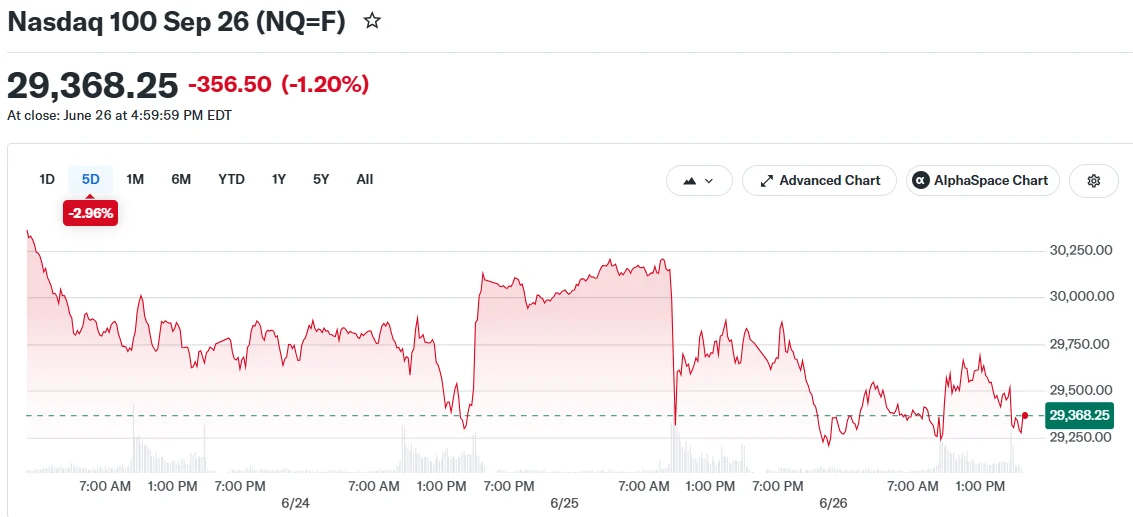
- The Nasdaq Composite declined 0.2% Friday, marking its fifth consecutive session of losses, while the S&P 500 also retreated, with both indices recording weekly declines of more than 4% and nearly 2% respectively.
- Reports from the New York Times indicating OpenAI could postpone its public offering to 2027 intensified selling pressure in technology shares.
- Chip stocks experienced significant weakness following concerns about escalating memory and storage expenses after Apple increased pricing on MacBook and iPad products.
- Expectations of potential Federal Reserve interest rate increases strengthened following robust May Personal Consumption Expenditures data that sustained prospects for tighter policy.
- The Dow Jones outperformed competing indices with a modest weekly advance below 1%, benefiting from reduced technology sector allocation.
American equity markets experienced turbulence throughout the week, with technology shares bearing the brunt of investor anxiety. The Nasdaq Composite extended its losing streak to five consecutive sessions on Friday, settling 0.2% lower. The S&P 500 also registered modest losses. Both benchmarks concluded the week with substantial declines.
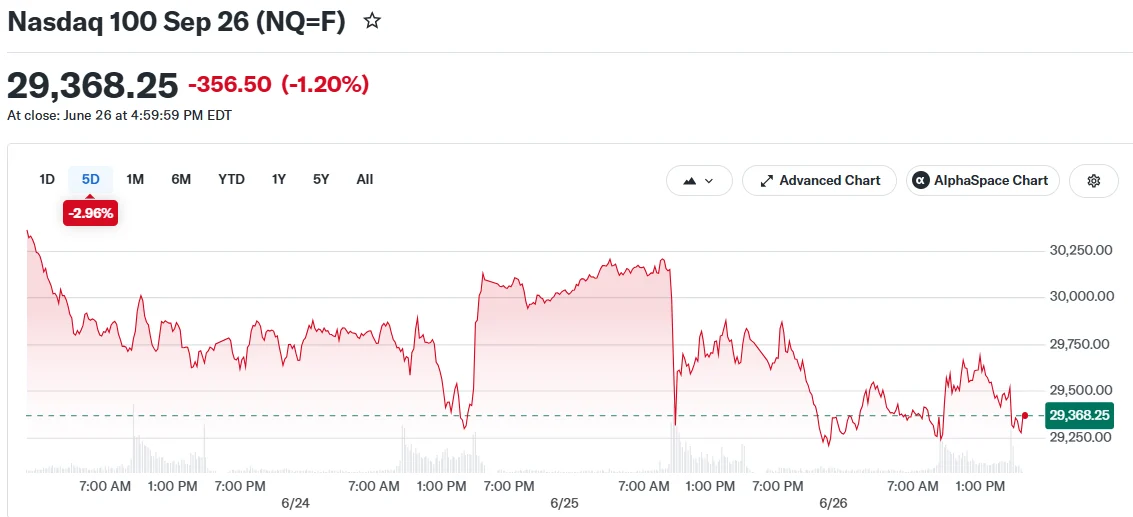
The Dow Jones Industrial Average shed a modest 56 points, representing a 0.1% decline on Friday. Despite the daily loss, the blue-chip index managed to secure a weekly gain of less than 1%. The Dow’s limited technology sector representation provided insulation from the broader selloff.
Artificial Intelligence Skepticism Fuels Market Weakness
Market participants have adopted a more cautious stance toward artificial intelligence investments. The sector confronted multiple headwinds this week, including questions about token economics and free cash flow generation, alongside intensifying competition from budget-friendly AI alternatives and Chinese rivals.
A New York Times article amplified the negative sentiment. The publication reported that OpenAI might delay its much-anticipated initial public offering from 2026 to 2027. This development dampened enthusiasm across the broader technology landscape.
Mizuho’s Daniel O’Regan, an analyst covering the sector, captured the prevailing sentiment. “Feels like every time I open Bloomberg or the WSJ there’s another negative AI headline,” he noted. He suggested the relentless stream of unfavorable coverage would likely continue unsettling individual investors.
Semiconductor manufacturers faced particularly acute pressure. Apple’s recent decision to increase prices on MacBook and iPad devices highlighted rising memory and storage component costs. Micron, a leading chipmaker, delivered solid quarterly results but cautioned that cost pressures would persist.
Hot Inflation Reading Revives Rate Hike Speculation
The Federal Reserve’s favored inflation gauge, the Personal Consumption Expenditures index, registered an elevated reading for May. This data point reinforced the possibility that the central bank might implement a rate increase this year, creating additional headwinds for growth-oriented and technology stocks.
Elevated interest rates typically present challenges for technology companies, whose valuations depend heavily on discounted future earnings projections. Any indication of potential borrowing cost increases disproportionately affects these securities compared to other market segments.
Nevertheless, not all indicators painted a bearish picture. Market breadth metrics remained constructive. Approximately two-thirds of S&P 500 constituents continued trading above their 200-day moving averages at week’s end.
David Donabedian, a senior investment strategist at CIBC Private Wealth, characterized the week’s price action as a recalibration rather than a structural breakdown. He observed that defensive sectors including health care, real estate, and consumer staples demonstrated resilience, while industrials and technology absorbed the heaviest losses.
Oil prices also retreated during the week. Brent crude declined to approximately $72 per barrel while West Texas Intermediate traded near $69. Shipping activity in the Strait of Hormuz persisted despite an incident involving a container vessel, alleviating some supply concerns. The United States and Iran reached agreement on a 60-day ceasefire, though regional tensions persist.
Investors now turn their attention to a holiday-shortened trading week ahead. The June employment situation report arrives Thursday and will receive close scrutiny for additional insights regarding economic momentum and monetary policy trajectory.

Key Takeaways
- SpaceX receives Nasdaq 100 inclusion effective July 7, carrying less than 1% index weighting and potentially generating $7.3 billion in passive investor demand
- The stock tumbled 17.2% during its inaugural trading week, reducing market capitalization from over $2.5 trillion to approximately $2 trillion
- Shares currently hover around the $135 initial public offering price after dipping beneath the $150 debut level
- The aerospace company completed a $25 billion bond offering that attracted $90 billion in demand, though the debt has accumulated roughly $305 million in unrealized losses
- Company insiders offloaded $1.2 million worth of shares during the previous three months without any recorded purchases
SpaceX (SPCX) concluded its inaugural trading week as a publicly traded entity at $153.23, representing a 17.2% decline from its market debut. This downturn compressed the company’s valuation from a zenith exceeding $2.5 trillion to roughly $2 trillion.
Space Exploration Technologies Corp., SPCX
Shares commenced trading at $150 and surged to $225.64 before experiencing a sharp reversal. The stock currently trades marginally above its $135 offering price — a critical threshold that market participants are monitoring intently.
Notwithstanding the challenging debut week, a significant market event looms. Nasdaq announced Friday that SPCX will enter the Nasdaq 100 index effective July 7. The aerospace manufacturer meets Nasdaq’s accelerated eligibility criteria, which permits recently public companies to qualify for index membership soon after listing.
Market analysts project the index inclusion may compel passive investment vehicles to acquire approximately $7.3 billion in SPCX shares. This purchasing pressure originates from both Nasdaq 100 and Russell index additions. The company’s allocation within the Nasdaq 100 will represent less than 1% of total index composition.
This wave of passive capital inflows might deliver short-term price stability. However, the company’s underlying financial metrics present a more nuanced picture.
Recent Debt Offering Raises Eyebrows
On Tuesday, SpaceX executed a $25 billion bond transaction. The offering generated approximately $90 billion in investor interest and was expanded from an original $20 billion target. Initial reception appeared robust.
Nevertheless, the bonds have underperformed since issuance. Bloomberg data indicates the debt has generated paper losses approaching $305 million when measured against comparable US Treasury securities.
Certain Wall Street observers are questioning the rationale behind a massive debt raise immediately following one of history’s largest initial public offerings. The consecutive capital-raising activities have sparked market skepticism.
Ludovic Subran, chief investment officer at Allianz, commented during the FT Global Insurance Summit that the SpaceX transaction demonstrates markets transitioning “from a stretched boom into bubble territory.”
Financial Metrics Raise Red Flags
SpaceX registers a GF Score of merely 12 out of 100, indicating subpar performance across profitability and balance sheet strength metrics. The enterprise reported a net margin of -26.44% alongside an operating margin of -11.05%.
The company’s price-to-sales ratio stands at 79.15 — an elevated valuation multiple that embeds expectations of substantial future expansion.
Corporate insiders divested $1.2 million in equity over the preceding three-month period. Zero insider acquisitions were documented during this timeframe.
In separate developments, the Financial Times disclosed SpaceX is evaluating a direct-to-consumer mobile service leveraging Starlink’s satellite-to-phone technology. This initiative would position the company as a retail wireless provider in direct competition with traditional telecommunications carriers.
OpenAI has reportedly postponed its own public listing plans, a decision market observers interpret as evidence of waning investor appetite for artificial intelligence-related equities.
SpaceX’s official Nasdaq 100 membership becomes effective July 7.
Crypto World
OpenAI’s GPT-5.6 Models Sol, Terra, and Luna Stir Crypto Conversations Despite No Blockchain Connection

Key Takeaways
- OpenAI introduced a restricted preview of the GPT-5.6 family featuring three models: Sol, Terra, and Luna
- These names echo Solana’s SOL token and the infamous Terra/Luna blockchain that imploded in 2022
- According to OpenAI, the naming convention represents different performance levels with no cryptocurrency connection
- Sol serves as the premium tier, Terra functions as the intermediate option, and Luna operates as the budget-friendly choice
- Government officials requested OpenAI maintain limited access during the initial rollout phase
On Thursday, OpenAI revealed its GPT-5.6 model lineup, introducing three distinct tiers branded as Sol, Terra, and Luna. The naming choices immediately triggered discussions throughout cryptocurrency communities due to obvious parallels with prominent blockchain initiatives.
Sol corresponds to the trading symbol for Solana, currently ranking among the top cryptocurrencies by total market capitalization. Meanwhile, Terra and Luna reference a blockchain platform that catastrophically failed in 2022, erasing approximately $60 billion in investor holdings.
OpenAI explicitly stated the naming scheme carries zero connection to cryptocurrency projects. According to the organization, these designations simply distinguish varying capability levels within the model architecture.
Breaking Down the Model Capabilities
Sol represents the premium offering, engineered for computationally intensive operations. Terra occupies the middle ground, delivering performance comparable to the earlier GPT-5.5 version while costing 50% less. Luna serves as the budget tier, prioritized for rapid processing and minimal expense.
The Sol variant introduces enhanced “max” and “ultra” reasoning capabilities. Its ultra configuration deploys multiple cooperative sub-agents to accelerate complex problem-solving workflows.
OpenAI highlighted that Sol achieves record performance on Terminal-Bench 2.1, a specialized evaluation measuring command-line programming proficiency. The company also reported advances in biological research applications and cybersecurity operations.
Regarding security applications, OpenAI confirmed Sol assists in vulnerability identification and remediation. However, the company emphasized the model remains below the “Cyber Critical” threshold defined in its internal safety protocols, preventing autonomous generation of complete working exploits.
Controlled Rollout and Security Validation
This deployment doesn’t constitute a general public launch. OpenAI characterized it as a “limited preview” accessible exclusively to select vetted partners. The organization continues conducting comprehensive safety evaluations before expanding availability.
White House representatives allegedly requested OpenAI maintain restricted distribution while federal agencies finalize a forthcoming cybersecurity executive order structure.
OpenAI dedicated more than 700,000 GPU computation hours to automated adversarial testing, systematically probing for model vulnerabilities prior to release. Additionally, human security specialists conducted manual assessments exploring potential misuse scenarios.
The company explained its multi-layered defense approach incorporates model-embedded protections, live content filtering systems, and user account-level surveillance mechanisms.
API access pricing starts at $5 per million input tokens and $30 per million output tokens for Sol. Terra costs $2.50 input and $15 output per million tokens. Luna operates at $1 input and $6 output rates.
OpenAI additionally confirmed plans to deploy Sol on Cerebras infrastructure this July, targeting throughput speeds reaching 750 tokens per second.
The organization projects broader ChatGPT and API integration for all three models within the next several weeks.
Blockchain payments company Ripple has released its 2025 Annual Impact Report, detailing support for education, financial inclusion, sustainability, and humanitarian programs. Since 2018, the company has donated more than $250 million, including over $70 million contributed in 2025.
The report also highlighted how Ripple’s blockchain tools, including the XRP Ledger and the RLUSD stablecoin, supported projects focused on economic opportunity and financial access. These efforts included programs in emerging markets, microfinance, and humanitarian aid through partnerships with nonprofit organizations.
Ripple Expands Its Global Impact
Ripple committed $25 million in RLUSD to support underserved U.S. small business owners and career programs for military veterans. The company also helped partners deploy $53.6 million and supported nearly 12,000 water and sanitation loans through Water.org.
Several non-profit partners described Ripple’s funding as long-term support rather than one-time donations. The International Rescue Committee also continued exploring stablecoins as a tool for delivering faster cash assistance during humanitarian emergencies.
The report also outlined Ripple’s support for blockchain research and education through its University Blockchain Research Initiative. Now in its seventh year, the program spans 62 universities, has awarded $74 million since 2018, and supported 198 XRPL projects in 2025.
Research funded through the initiative covered stablecoins, tokenized real-world assets, decentralized finance infrastructure, cryptographic security, interoperability, artificial intelligence governance, and blockchain applications. Some projects focused on quantum-resistant improvements for the XRP Ledger, privacy technologies, and tools to detect price manipulation in decentralized finance markets.
Progress Across Climate and Community Initiatives
Ripple’s report highlighted its environmental efforts through blockchain-based climate projects. The company said it has invested $31 million in climate initiatives and retired 1,000 tonnes of carbon dioxide equivalent through sustainable aviation fuel credits in 2025. It also plans to retire 93,000 tonnes by 2030.
Beyond environmental initiatives, Ripple said employee participation reached its highest level since the program began. About 80% of employees joined volunteering and donation efforts, supporting 544 nonprofit organizations while raising $550,000 for charitable causes.
Alongside these social and environmental efforts, Ripple highlighted broader blockchain adoption through its programs. The firm said active users increased 37% and transactions rose 113% year over year. Tokenized real-world assets on the XRP Ledger expanded from $24.7 million to $568 million during 2025, while total network transactions surpassed 3.8 billion.
The post Ripple (XRP) Boosts Global Blockchain Adoption With Over $70M in Donations appeared first on CryptoPotato.
Aave founder Stani Kulechov previewed Aavenomics 3.0 on X Thursday, a tokenomics overhaul that would replace the protocol’s existing discretionary buyback program with an automated, non-discretionary on-chain mechanism funded by all protocol and GHO revenue. The announcement came as Kulechov… Read the full story at The Defiant


Cathie Wood’s ARK Invest has expanded its positions in Coinbase, SpaceX, Circle, Bullish, and Robinhood by purchasing about $25.54 million worth of shares on Friday across several of its exchange-traded funds.
Summary
- Cathie Wood’s ARK Invest bought $25.54 million worth of Coinbase, SpaceX, Circle, Bullish, and Robinhood shares.
- Coinbase led the purchases with a $10.19 million investment, followed by $7.01 million in SpaceX and $5.79 million in Circle.
- The latest buys extend ARK’s recent accumulation of crypto-linked stocks as Wood continues to downplay persistent inflation concerns.
According to ARK Invest’s latest daily trade disclosure, Coinbase accounted for the firm’s largest purchase by value. The investment manager bought 68,366 Coinbase shares through the ARK Innovation ETF (ARKK), ARK Next Generation Internet ETF (ARKW), and ARK Fintech Innovation ETF (ARKF). Based on the stock’s Friday closing price of $149.06, the purchase was valued at roughly $10.19 million.
SpaceX ranked second among the day’s acquisitions. Across ARKK, ARK Autonomous Technology & Robotics ETF (ARKQ), ARKW, and ARK Space Exploration & Innovation ETF (ARKX), the firm purchased 45,728 shares worth about $7.01 million using the company’s closing price of $153.23.
Circle Internet Group was another major addition. According to the disclosure, ARK acquired 78,756 Circle shares through ARKK, ARKW, and ARKF, with the purchases valued at approximately $5.79 million based on the stock’s $73.57 close.
The buying continued with smaller additions to Bullish and Robinhood. ARK purchased 57,511 Bullish shares valued at around $1.34 million and another 12,269 Robinhood shares worth about $1.21 million, using Friday’s closing prices of $23.29 and $98.69, respectively.
Latest purchases extend a week of aggressive buying
The latest transactions follow several rounds of buying earlier in the week, when ARK increased its exposure to many of the same companies after their share prices declined.
As previously reported by crypto.news, the investment firm bought 9,014 Coinbase shares, 9,264 Circle shares, 9,136 Bullish shares, and 35,023 Robinhood shares after all four stocks finished Thursday’s session in negative territory. Coinbase fell 5.06%, Circle lost 3.06%, Robinhood declined 3.83%, and Bullish dropped 6.77% during that trading session.
Separately, ARK disclosed another purchase of 111,799 Coinbase shares earlier this week, valued at about $18 million. During the same period, the firm also increased its exposure to SpaceX by acquiring 210,121 shares worth roughly $32.5 million across four ETFs.
According to ARK Invest, the firm’s exchange-traded funds follow a portfolio policy that limits any individual holding to no more than 10% of a fund. As stock prices move, positions are periodically adjusted to keep allocations within those limits.
Wood continues backing crypto-linked companies despite macro concerns
The latest investments also come as Wood has maintained a constructive outlook on financial markets despite growing concerns about inflation and monetary policy.
As crypto.news previously reported, Wood said investor meetings across Asia and Europe showed that many market participants expect inflation to remain persistent and believe the Federal Reserve may need to tighten policy further. She argued the data point in a different direction.
In a series of posts on X, Wood said underlying inflation is close to disappearing when measured through unit labor costs. Using first-quarter figures, she noted that U.S. productivity increased about 3% year over year while compensation per hour rose roughly 3.5%, leaving implied underlying inflation at around 0.5%.
Wood also cited data from Truflation, saying the platform’s real-time inflation gauge has fallen from about 11% in 2022 to 1.8%, while its core inflation measure has eased to 1.4%. Her comments contrast with market expectations for a possible 25-basis-point Federal Reserve rate increase in September following May’s 4.2% U.S. consumer price inflation reading.
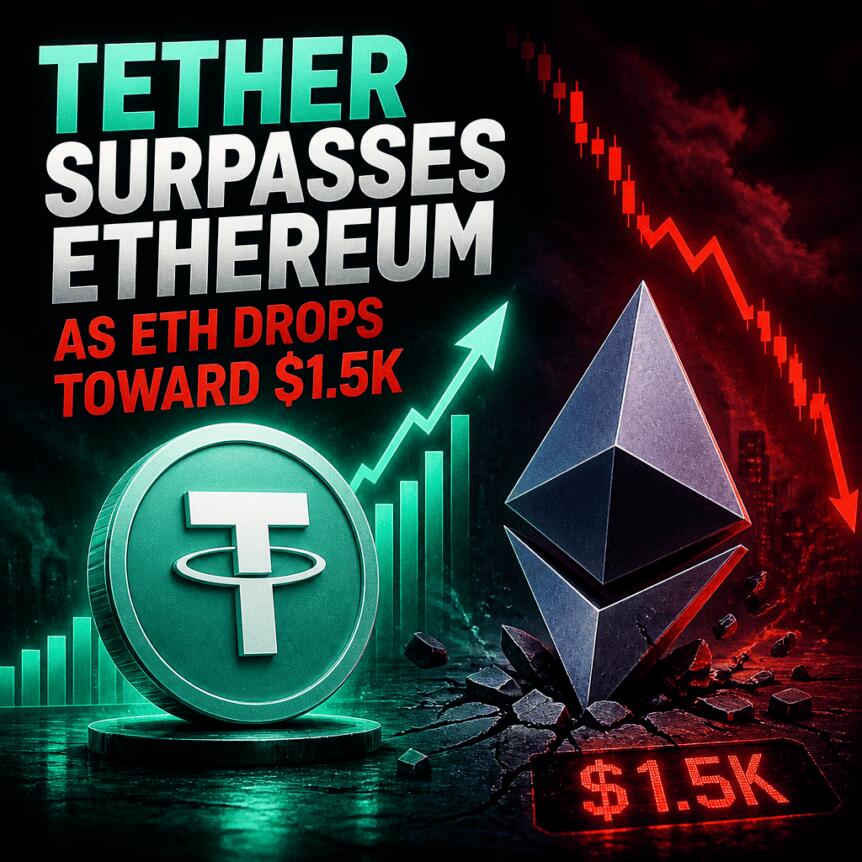
Tether’s USDt has flipped Ether (ETH) into the second spot by market capitalization after a sharp selloff pushed ETH to its lowest level of the year. The rotation underscores a broader theme playing out across crypto: during volatility, traders and institutions increasingly gravitate toward stablecoins for liquidity and risk management.
On Friday, ETH’s market value fell below $185 billion following a 5.2% drop over 24 hours, taking the token down to around $1,510 on Coinbase, according to TradingView. That decline allowed USDt—reported at roughly a $186 billion market cap—to overtake ETH. As Cointelegraph reported, Bitrue Research Institute’s research lead Andri Fauzan Adziima said the stablecoin move “highlights how the market still favors stability over ETH’s volatility right now.”
Key takeaways
- USDt surpassed ETH in market capitalization as Ether slid to about $1,510 on Coinbase after a 5.2% daily drop, per TradingView.
- Analysts interpret the flip as a sign that stablecoins remain preferred during volatility, even when the broader crypto market is shifting.
- Stablecoins represent nearly 15% of total crypto market capitalization, reflecting continued demand for reliable liquidity.
- Ether’s weakness is occurring alongside notable Ethereum Foundation staffing and leadership changes, even as new development initiatives take shape.
Why USDt taking the crown matters
When a stablecoin climbs in market cap during a drawdown, it’s rarely just a one-day anomaly. Stablecoins are often used as the “settlement layer” for trading and transfers—meaning their growth can signal that market participants are prioritizing capital preservation and fast execution over exposure to higher-volatility assets.
Andri Fauzan Adziima of Bitrue Research Institute framed the shift in exactly those terms, suggesting the market’s current preference for stability is outweighing ETH’s relative volatility. That perspective aligns with how market infrastructure typically behaves: deeper stablecoin liquidity can support higher trading activity and lower friction for entering and exiting positions across venues.
Stablecoin momentum and “cycle-independent” demand
The USDt/ETH flip comes amid ongoing stablecoin expansion. Cointelegraph pointed to accelerating stablecoin growth that now accounts for almost 15% of total crypto market capitalization. The article also notes that while stablecoin supply contracted by more than 30% during the last bear market, the latest cycle is different—stablecoin issuance and usage are reaching new highs.
In comments shared on Thursday, 21Shares argued that the current pattern is evidence that stablecoins are becoming one of crypto’s defining use cases and that demand increasingly does not depend on the market cycle. The firm’s statement said: “To us, that is the strongest evidence yet that stablecoins are one of crypto’s defining use cases – demand that no longer depends on the cycle.”
From a practical standpoint, that “cycle-independence” claim matters because it implies stablecoins can remain a structural part of crypto market activity even when risk appetite fades. And as liquidity deepens, more participants can trade with tighter spreads and faster settlement—an environment that can benefit both traders and builders who rely on stablecoin rails for recurring activity.
Ethereum under pressure, with ecosystem shifts underway
Ether’s decline isn’t happening in isolation. The article ties the selloff to a broader stretch of weakness, noting that ETH prices returned to crucial support levels last seen in October 2023 and April 2025. That matters for investors because repeated visits to long-term support can act as a decision point: buyers often step in to defend key ranges, but persistent failures can also accelerate downside.
At the same time, Ethereum’s institutional and organizational landscape has been changing. Cointelegraph cited multiple executive departures as well as a 20% workforce reduction at the Ethereum Foundation. Those internal moves can influence how quickly priorities shift, how quickly research and engineering programs move from roadmap to execution, and—importantly for market participants—how confidence forms around Ethereum’s near-term narrative.
Still, the article highlights a compensating development: a new nonprofit organization called Ethlabs was launched this week by key EF developers and researchers, with backing from ether treasuries Bitmine and Sharplink. The existence of a new entity doesn’t automatically resolve market concerns, but it does signal that ecosystem stakeholders are continuing to organize around Ethereum development rather than stepping away during turbulence.
Not all players are waiting: accumulation and cross-asset rotations
While the USDt flip is a bearish signal for ETH relative performance, the article also points to pockets of support at lower prices. Ether treasury company Sharplink reportedly bought the dip on Thursday, making its first purchase in eight months and acquiring 5,000 ETH. Separately, Bitmine—chaired by Tom Lee—has also been accumulating, adding 76,881 ETH last week, the article notes, referencing its broader bear-market accumulation efforts.
Beyond Ethereum, the stablecoin narrative isn’t unique to USDt. Cointelegraph also reports that Circle’s USDC flipped Ripple’s XRP in market capitalization as XRP retreated toward $1, a level described as its lowest since November 2024. The article gives market caps of $64 billion for XRP versus $73.6 billion for USDC, reinforcing the idea that in periods of weakness for specific assets, stablecoins can keep gaining share.
Circle’s USDC reached a $73.6 billion market capitalization in the comparison cited, while XRP fell back toward $1 and a $64 billion market cap.
For traders, these cross-asset rotations often become a liquidity story as much as a price story: stablecoins can act as a consistent “base” for risk management and positioning, while assets like ETH and XRP can experience sharper drawdowns when sentiment deteriorates.
Looking ahead, the market will likely watch whether ETH can defend its identified support zones and whether stablecoin growth continues to outpace broader crypto assets—especially in the face of ongoing Ethereum ecosystem changes. If USDt’s market cap lead holds during subsequent sessions, it may signal that “stability premium” demand is becoming increasingly persistent rather than reactive.
Key Takeaways
- Prominent crypto trader Garrett Jin has initiated a $21.73M short position on Zcash via Hyperliquid at an entry price of $418.90
- Approximately $4.93M of the total order has been executed, leaving $16.8M unfilled
- Complete execution would position Jin as the platform’s largest ZEC position holder
- Jin’s previous two Zcash trades generated combined profits of $11.66M
- Simultaneously, his 1,268 BTC long position entered at $76,117 faces unrealized losses exceeding $20M
Prominent cryptocurrency trader Garrett Jin has initiated a substantial short position targeting Zcash on the Hyperliquid decentralized trading platform. The position, valued at $21.73 million, carries an entry price of $418.90 per ZEC token.
Blockchain analytics expert Yujin first identified and reported the transaction. Initial data showed that $4.93 million worth of the position had been successfully executed, while the bulk—$16.8 million—remained in the order book awaiting fulfillment.
Potential Impact on Hyperliquid’s Zcash Market
Should the entire order reach completion, Jin’s position would establish him as the dominant Zcash trader on the Hyperliquid platform. This concentration represents significant individual market exposure within the exchange’s ecosystem.
On-chain monitoring service Lookonchain verified the details of Jin’s position. Their analysis revealed the active short employs 2x leverage across 11,780 ZEC tokens, representing approximately $4.92 million in value at the moment of documentation.
Lookonchain’s research also highlighted Jin’s successful track record with Zcash trading. His two preceding ZEC positions collectively yielded profits totaling $11.66 million.
This newest short position continues Jin’s established strategy of betting against Zcash price appreciation. His current wager anticipates ZEC values declining from the $418 threshold.
Bitcoin Long Position Faces Significant Drawdown
Contrary to his Zcash success, Jin’s Bitcoin holdings present a contrasting narrative. He maintains a leveraged long position comprising 1,268 BTC with an average entry point of $76,117 per token.
This Bitcoin trade currently shows substantial negative performance. The unrealized deficit on this position approximates $20.09 million based on recent market data.
Bitcoin’s market price stood around $60,411 during the reporting period, creating a considerable distance from Jin’s $76,117 entry level. This substantial price differential explains the magnitude of unrealized losses.
Taken together, these positions illustrate contrasting outcomes. While Jin has demonstrated profitability through Zcash short strategies, his more substantial Bitcoin wager continues accumulating losses.
Market observers closely monitor Jin’s trading activity due to the considerable capital involved in his transactions. Blockchain analysts including Lookonchain and Yujin systematically document his positions as they materialize on Hyperliquid’s platform.
The $21.73 million Zcash short position remains partially unfilled. Traders following Jin’s activities continue monitoring whether he will complete the full order execution.
Zcash traded at $407.65 during this reporting window, positioning slightly beneath Jin’s $418.90 short entry level. This price differential currently generates modest unrealized gains on the position.
However, his Bitcoin long exposure presents the more pressing challenge. With unrealized losses surpassing $20 million, it constitutes substantial downside risk within his active trading portfolio.

Real Power Is When Your Money Does The Talking For You

A Gaza footballer’s struggle to watch the World Cup: ‘I want to enjoy the world cup like everyone else’

27 Attractive Low-Price Dividend Dogs To Buy In June


-

 Entertainment7 days ago
Renter of Home in Anne Heche Crash Denies Settlement With Son
-
 Sports4 days ago
Two goals and an assist by sheer aura: Cristiano Ronaldo just entered the World Cup chat
-

 Tech5 days ago
Microsoft accidentally kills epic Outlook email threads
-

 Fashion18 hours ago
Weekend Open Thread: Staud – Corporette.com
-

 Business7 days ago
Soccer-U.S. defends Iran World Cup travel restrictions, says discussions ongoing
-

 Politics1 day ago
The House | Manchesterism won’t survive the painful trade-offs unless it gets citizens on board
-

 Politics1 day ago
Potential 2028er World Cup attendee leaderboard
-

 Business1 day ago
Asia stock markets slide as tech shares slump
-

 Tech2 days ago
A Look At A Gaggle Of Transputer Boards
-
Crypto World3 days ago
Bitcoin (BTC) Dips Below $62K, Ethereum (ETH) Plunges 6% Daily: Market Watch
-

 Crypto World3 days ago
Securitize Wraps Roubini's SEC-Registered ETF as Dubai VARA Digital Security
-
 Crypto World2 days ago
Dell (DELL) Shares Tumble Over 5% Following Analyst Downgrade to Hold
-
Business3 days ago
Entergy settles forward sale agreements, raises $672 million in cash proceeds
-

 Sports15 hours ago
FIH Pro League: India defeat Pakistan 7-1, register biggest win of campaign | Other Sports News
-

 Crypto World7 hours ago
Kraken's xStocks Opens Bending Spoons IPO Registration to EEA Retail
-

 Crypto World18 hours ago
RTX holders must register wallets before token distribution begins
-
Crypto World21 hours ago
Hyperliquid Named on Singapore MAS Investor Alert Register
-

 Sports2 days ago
India vs Bangladesh LIVE Score, Women’s T20 World Cup: Bangladesh Opt To Bat; India Enter ‘Do-Or-Die’ Stage As Semi-Final Race Heats Up
-
 Tech6 days ago
Signal’s Meredith Whittaker says AI chatbots ‘are not your friends’ and calls Copilot agents a backdoor
-
Crypto World1 day ago
The DATA Foundation Launches to Tackle AI’s Multi-Billion Dollar Training Data Bottleneck
You must be logged in to post a comment Login