Connect with us

Business

Bank of England’s Sarah Breeden: Rate cut should come soon as inflation eases

Published

on

Business Live

MPC member hails resilience of Northern businesses

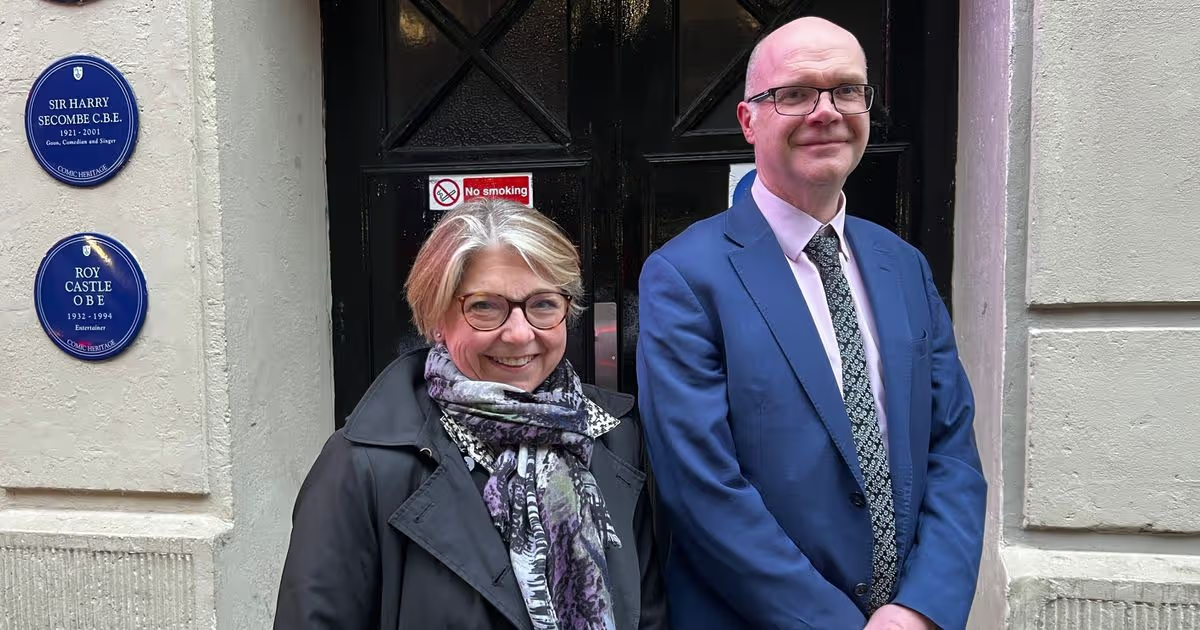
Sarah Breeden, Deputy Governor for Financial Stability at the Bank of England, left, with Ken Clark, the Bank's Agent for the North West, outside the Opera House in Manchester

Sarah Breeden, deputy governor for financial stability at the Bank of England, left, with Ken Clark, the Bank’s agent for the North West, outside the Opera House in Manchester(Image: Alistair Houghton)

The Bank of England should soon take its “foot off the monetary brake” and cut interest rates as inflation continues to ease, a member of the bank’s rate-setting committee has predicted.

Sarah Breeden, deputy governor for financial stability at the Bank of England and a member of the Monetary Policy Committee (MPC), was in Manchester to hear from businesses about what they would like to see from the Bank. She praised the resilience of Northern businesses – and told BusinessLive that without any further economic shocks, she expected a rate cut could come in the next couple of meetings.

Advertisement

At the most recent MPC monthly meeting last Tuesday, she was one of four members who voted to reduce Bank Rate by 0.25 percentage points, to 3.5%. But the rate stayed at 3.75% as five members voted to keep the rate the same.

The minutes of the MPC meeting showed members felt inflation would soon fall back to its 2% target as pay growth and price inflation were easing, but there was debate over how persistent those inflationary pressures still were, and whether a rate cut was needed now or later.

Like other MPC members, Ms Breeden, who is originally from Stockport, regularly tours the country to talk to businesses about how their sectors are performing. She said those discussions help members get a true picture of the wider UK economy, and help them to state their cases at the MPC table.

Asked why she had voted for a cut in rates, she said she felt it would help give more support to businesses sooner.

Advertisement

She said: “When we, all of us, are looking at interest rates and the path for monetary policy, what we’re looking at is ‘where is inflation going to be in the medium term’.

“We’ve had some really good news recently in that inflation is going to hit our 2% target nine months earlier, 12 months earlier, than we had expected it to. We will be at 2% or thereabouts in April and our expectation is that it should stay there from here.

“But of course there are risks around that outlook and so our debate around the MPC table was about the upside risk to inflation, if we continue to have high wages, if they are fuelling increases in prices.

“On the upside, are we having inflation persistence continuing, versus the risk to the downside? Are we going to see a pick-up in activity as we’re expecting? Might there be more of a loosening in the labour market and might that bring inflation below target?

Advertisement

“For me, I was more focused on those downside risks. I wasn’t confident that we’re going to see that pick-up in activity. And so I thought it was appropriate for us to take our foot off the monetary brake a little bit and provide a bit more support for the economy.”

This time round, Ms Breeden’s argument was outvoted on the MPC. But she says that while “there’s no preset path for policy”, a cut remains likely soon if the economy continues on its current path and risks to inflation subside.

She said: “If we continue to have the economy develop as we expected and if there are no shocks – to be clear those are two big ifs… I think it’s reasonable to expect there to be a cut over the next couple of meetings.”

Ms Breeden was confident though that, without shocks, inflation would continue on its downward trend.

Advertisement

She said: “We’ve had four years, haven’t we, when inflation has been above our target of 2%. That’s a really, really long time.

“The original source of those inflationary shocks were external to the UK economy. It was the almost doubling of energy prices, food prices increased by 20%. And perhaps naturally in that context, people were looking to address the cost of living pressures through higher wages.

“What we’re seeing now is that in contrast to the position then when there was a tight labour market, when it was more likely that businesses were to be able to have high wages and then to pass those higher wages on into their costs, we’re seeing less activity in the economy.

“We are seeing a looser labour market and all of that means that the persistence in wage and price inflation, those second round dynamics that have been with us for a long, should be falling away.”

Advertisement

North West businesses ‘resilient’ in face of shocks from Brexit to pandemic

Her overall feeling was that the mood among local businesses was “resilient”.

She said: “There’s been an awareness of some green shoots, some positive stories to tell, but also a recognition that the story isn’t the same across all industries. The story that manufacturing is facing is different to the one in finance and professional services.

“And that’s something that we find really valuable from coming out and talking to businesses, because the more we understand about why firms are experiencing the economy differently, the better able we are to understand it and make policy right.”

That resilience, she said, was particularly striking given the challenges the UK economy has faced.

Advertisement

She said: “If you think about the shocks that the economy has suffered over the last several years, it’s amazingly resilient that we are where we are. We’ve left the European Union, we’ve had a once-in-a-hundred-year pandemic, we’ve had war in Europe, we’ve had the fastest rise in energy prices in many decades, we’ve had the fastest rise in interest rates in decades, and we’ve had a new leader in the U. And all of that has created shocks that businesses have been able to absorb incredibly well – much better than I would have expected.”

Why MPC members must get out and meet businesses

Ms Breeden said she “cannot underscore enough” the importance to MPC members of getting out to meet businesses in person.

She said: “It’s always important to understand businesses and households’ lived experience of the economy. But after those extraordinary shocks that we’ve faced, it is even more important to get out and about and ask people what is happening with their costs, what’s happening with the labour market, what’s happening with demand, what does all of that mean for pricing – and that feeds in very really very really into our decisions. We can’t just look at our models, we’ve got to look out of the window.”


Advertisement
Continue Reading
Click to comment

Leave a Reply

Your email address will not be published. Required fields are marked *

Business

Green light for $70m lifestyle resort in Two Rocks

Published

on

Green light for $70m lifestyle resort in Two Rocks

A development assessment panel has approved an over-50s lifestyle resort proposal for the northern end of the Perth metropolitan area, with the first stage to cost $70 million.

Continue Reading

Business

Mattel Shares Drop 28% After Toy Maker’s Holiday Sales Sputter

Published

on

Mattel Shares Drop 28% After Toy Maker’s Holiday Sales Sputter

Mattel MAT -24.98%decrease; red down pointing triangle shares plunged as much as 28% in late trading after the toy maker said an anticipated surge in holiday sales came up short, and it issued a lower-than-expected profit forecast for 2026. 

The shortfall in sales in the critical weeks before Christmas prompted the maker of Barbie dolls and Hot Wheels cars to step up discounts, it said, putting a squeeze on profit margins. Both sales and profit came in below Wall Street expectations for the fourth quarter.

Copyright ©2026 Dow Jones & Company, Inc. All Rights Reserved. 87990cbe856818d5eddac44c7b1cdeb8

Continue Reading

Business

Aeris Resources Limited (ARSRF) Aeris Resources Limited, – M&A Call – Slideshow

Published

on

OneWater Marine Inc. (ONEW) Q1 2026 Earnings Call Transcript

Aeris Resources Limited (ARSRF) Aeris Resources Limited, – M&A Call – Slideshow

Continue Reading

Business

‘McMansions’ become liability as buyers reject wasted scale in housing market

Published

on

'McMansions' become liability as buyers reject wasted scale in housing market

The “McMansion” is officially moving from a status symbol to liability.

Twenty years after the 2006 housing boom, new data from Zillow reveals a fundamental reversal in the American Dream: Buyers are ditching “wasted scale” and mahogany-heavy footprints for high-efficiency “sanctuaries.”

Advertisement

As insurance premiums and property taxes soar, real estate experts warn that the oversized, unoptimized estates of the mid-aughts are becoming a financial exposure for homeowners who fail to adapt.

“The appetite for space hasn’t disappeared, but the definition of value has evolved. Buyers still want room for family, entertaining and flexibility. What they don’t want is excess without purpose,” Catena Homes principal Harrison Polsky told Fox News Digital.

HOUSING MARKET COOLS AS PRICE GROWTH HITS SLOWEST PACE SINCE GREAT RECESSION RECOVERY

“With rising insurance costs in Texas and higher property taxes, a 5,000-plus-square-foot home that isn’t energy efficient or thoughtfully designed can absolutely feel like a liability. But a well-built, high-performance home of that size with strong insulation, efficient systems and functional layout still represents the American Dream here,” he added. “The shift isn’t away from scale entirely; it’s away from wasted scale.”

Advertisement
A large home under construction

Construction workers build a new home in August 2006 in a new subdivision in Sugar Grove, Illinois, a suburb outside of Chicago. (Getty Images)

“In Palm Beach County, scale still has strong appeal, particularly in waterfront and estate communities. However, soaring insurance costs in Florida have changed buyer behavior,” RWB Construction Management founder Robert Burrage also told Fox News Digital.

“A 6,000 or 7,000-square-foot home built in 2006 without impact glass, elevated construction, modern roofing and generator systems can absolutely feel like financial exposure,” Burrage noted. “Buyers are willing to pay for size, but only if it’s engineered for resilience.”

Going back to 2006, luxury was granite and mahogany. In 2026, Zillow says it’s pickleball courts and golf simulators (with listing mentions up 25%) to whole-home batteries (up 40%) and zero-energy-ready homes (up 70%).

“Resilience and lifestyle go hand in hand. Whole-home generators, battery storage, hurricane-rated systems, smart-home integration and expansive outdoor living are expected,” Burrage said.

Advertisement

“A large home without those features narrows the buyer pool significantly. Meanwhile,” he said, “a slightly smaller but technologically advanced home designed for indoor-outdoor living often performs better in terms of demand and pricing.”

“Today’s buyers are far more educated about operating costs and long-term durability,” Polsky agreed. “In this market, lifestyle infrastructure and sustainability are no longer bonuses. They’re baseline expectations.”

Resale advice used to be: “Keep it beige.” Now, Zillow finds buyers offer more for olive green and charcoal gray, with “color drenching” mentions up 149%. The experts said the “beige box” of the mid-aughts is a harder sell now.

Advertisement

“The sterile beige spec home from the mid-2000s definitely feels dated. Buyers today respond to depth and personality but it has to be curated,” Polsky said. “We’re encouraging sellers to modernize with warmer neutrals, layered textures, and intentional color moments. ‘Safe’ used to mean blank. Now safe means thoughtfully designed. Homes that lack character tend to photograph poorly and sit longer.”

“Buyers want lighter, organic palettes with architectural texture and contrast,” Burrage weighed in. “We’re advising our clients who are building with us to keep interiors fresh and light strategically. A thoughtful design can materially impact buyer perception and final sales price.”

As millennials and Gen X become the primary buying force, they are rejecting the norms of what once was. The real estate experts both answered “yes” when asked if the market is seeing a permanent cultural shift in what “luxury” means.

Advertisement

GET FOX BUSINESS ON THE GO BY CLICKING HERE

“Boomers selling older estates should strongly consider modernizing systems and aesthetics,” Burrage said. “Buyers are comparing them to newly built coastal homes engineered for climate durability and lower operating risk.”

“Boomers selling 2006-era estates need to understand that today’s buyers compare everything to new construction with modern infrastructure. Updating mechanical systems, improving energy performance and refreshing interiors before listing can dramatically improve positioning,” Polsky pointed out. “The American Dream hasn’t gone away, it’s simply become more intentional. Buyers want homes that support how they live, not just how they’re seen.”

Advertisement

READ MORE FROM FOX BUSINESS

Continue Reading

Business

Aussie shares pare early gains to fade from record

Published

on

Aussie shares pare early gains to fade from record

Australia’s share market has retreated after brushing up against record highs as heavyweight earnings results weighed against shocking misses for smaller companies.

Continue Reading

Business

Grayscale Bitcoin Trust ETF: Buy It, Just Not Now

Published

on

Grayscale Bitcoin Trust ETF: Buy It, Just Not Now

Grayscale Bitcoin Trust ETF: Buy It, Just Not Now

Continue Reading

Business

NTPC climbs 12% in three months on thermal additions, renewable growth bets

Published

on

NTPC climbs 12% in three months on thermal additions, renewable growth bets
ET Intelligence Group: Shares of NTPC have risen around 12% over the past three months compared with the 2.9% gain in the ET Power index. Investors are betting on the company’s capacity addition and green energy initiatives amid potential future demand. India’s largest power generator has an installed capacity of nearly 86 gigawatt (GW) as of December 2025 and nearly 33 GW under construction. It plans to add 6.5 GW of new thermal capacity while accelerating renewable additions through its subsidiary NTPC Green Energy (NGEL). It is also ramping up investments in energy storage and nuclear technologies under the SHANTI Act.

Of the total 33 GW currently under construction, about 16.5 GW is coal-based, 1.9 GW is hydro, and roughly 15 GW comprises renewable projects. According to the company management, the company expects the 1,350 megawatt (MW) Sinnar Thermal Power Plant acquisition to close shortly following approval of the resolution plan submitted by NTPC and Maharashtra State Power Generation Company by the National Company Law Tribunal (NCLT). The acquisition will also bring nearly 1,600 acres of land for future growth.

The company’s green-energy arm NGEL has commissioned 2.6 GW so far in FY26 and is likely to complete another 2.5 GW, in line with the target of 5 GW for the year. The subsidiary has a capacity-addition target of 8 GW each in FY27 and FY28. NGEL’s Power Purchase Agreement tie-ups remain strong at 82% for FY26, 83% for FY27, and 60% for FY28, with an overall 74% PPA coverage across its around 20 GW pipeline.

Capacity Addition, Green Shift may Power up NTPCAgencies

Target 10-15% higher Analysts have retained ‘buy’ on the stock citing expansion across thermal and renewable projects

The company is simultaneously ramping up its presence in energy storage. It is in the final stages of evaluating a 5 GWh of battery energy storage system (BESS) across 16 stations under Section 62 where BESS projects are awarded with regulated tariffs approved by regulators, rather than through competitive bidding. It has also finalised a 320 MWh BESS project in Kerala.
In hydropower storage, the third unit of the Tehri pumped-storage project has been commissioned, with the final 250 MW unit scheduled before FY26 ends. Preliminary studies are also underway for around 13 GW of pumped-storage projects allocated by various states.

Advertisement


Analysts have retained ‘buy’ rating with 10-15% higher target prices than the current market price of ₹367. “NTPC continues to make efforts to diversify its generation portfolio. Progress on execution of new thermal projects remains a key variable to monitor,” noted JM Financial Institutional Securities in a report. The broking firm has revised the target price to ₹420 from ₹397 earlier.

Continue Reading

Business

VestoFX.net Review: Is This Trading Platform Any Good?

Published

on

VestoFX.net Review: Is This Trading Platform Any Good?

In this VestoFX.net review, we take a detailed look at what the platform offers, how it works, and what traders can expect when using it for CFD trading across multiple global markets.

The goal is to explain the platform in clear, simple language so everyday traders can understand whether it fits their trading style and experience level.

VestoFX.net Review: What Is VestoFX.net and Who Operates It?

VestoFX.net is an online CFD trading platform designed for traders who want access to multiple asset classes through one account. The platform focuses entirely on Contracts for Difference (CFDs), allowing traders to speculate on price movements without owning the underlying assets.

Advertisement

This website (www.vestofx.net) is operated by Fairmont Financial Services (PTY) LTD, a South African investment firm.

The company is authorized and regulated by the Financial Sector Conduct Authority (FSCA) of South Africa and operates under Financial Service Provider (FSP) license number 51766.

VestoFX.net Review: What Markets Can Traders Access?

One of the main highlights in this VestoFX.net review is the range of CFD markets available. The platform brings together several popular asset classes that appeal to traders worldwide.

Advertisement

Traders can access CFDs on:

  • Cryptocurrencies
  • Forex currency pairs
  • Commodities such as metals and energy products
  • Shares of selected companies
  • Global indices

All instruments are traded strictly as CFDs, allowing traders to focus on price movements rather than ownership.

VestoFX.net Review: How Does CFD Trading Work on the Platform?

CFD trading on VestoFX.net enables traders to speculate on whether an asset’s price will move up or down. Instead of purchasing the asset itself, traders open positions based on price changes.

The platform supports trading in both rising and falling markets.

Advertisement

Tools such as stop-loss and take-profit features are available to help traders manage positions more effectively.

VestoFX.net Review: Is This Trading Platform Any Good?

VestoFX.net Review: How Does the Trading Platform Operate?

VestoFX.net provides a web-based trading platform that can be accessed from different devices. The interface is designed to be straightforward, making it easier to monitor markets and execute trades.

Key platform features include real-time charts, trade execution tools, account balance tracking, and market monitoring features. The layout avoids unnecessary complexity, which may appeal to both new and experienced traders.

Advertisement

VestoFX.net Review: How Can Traders Register an Account?

The registration process on VestoFX.net begins with creating an online account. Traders are required to complete a questionnaire during sign-up.

This questionnaire collects information about trading experience, financial background, and understanding of CFD products. Completing it accurately is part of the onboarding process before funding the account and accessing live trading.

VestoFX.net Review: What Account Types Are Available?

Advertisement

VestoFX.net offers four distinct trading account options, structured to suit a wide range of traders, from those just entering the CFD market to highly experienced participants.

The Basic Account is designed for beginners and requires a minimum deposit of $250. It features floating spreads starting from 3.0 pips on EUR/USD, 3.4 pips on GBP/USD, and 3.3 pips on USD/JPY.

This account allows new traders to begin with a relatively low initial commitment and includes one free withdrawal, making it a practical starting point.

The Gold Account is aimed at traders with more market experience and comes with a minimum deposit requirement of $25,000. Compared to the Basic Account, it offers improved trading conditions, with spreads starting from 2.7 pips for EUR/USD, 3.1 pips for GBP/USD, and 3.0 pips for USD/JPY.

Advertisement

Gold account holders also receive one free withdrawal per month, supporting more frequent trading activity.

For traders looking for more advanced conditions, the Platinum Account requires a minimum deposit of $100,000. This account provides tighter spreads, beginning at 2.1 pips for EUR/USD, 2.5 pips for GBP/USD, and 2.4 pips for USD/JPY.

In addition, Platinum traders benefit from three free withdrawals each month, offering greater flexibility in managing funds.

The VIP Account is structured for professional traders seeking premium trading conditions. With a minimum deposit of $250,000, this account offers the most competitive spreads, starting at 1.6 pips for EUR/USD, 2.0 pips for GBP/USD, and 1.9 pips for USD/JPY.

Advertisement

VIP account holders enjoy unlimited fee-free withdrawals, supporting high trading volumes and active fund movement.

Overall, these account options allow traders to choose a structure that aligns with their experience level, trading activity, and financial objectives, while progressively offering tighter spreads and more flexible withdrawal benefits at higher tiers.

VestoFX.net Review: What Can Traders Invest In Using These Accounts?

All account types provide access to the same core CFD markets, including crypto, forex, commodities, shares, and indices. Differences between accounts relate to trading conditions and platform features rather than market availability.

Advertisement

This setup allows traders to diversify their CFD trading activity across multiple asset classes within one platform.

VestoFX.net Review: Who Is the Platform Designed For?

VestoFX.net is built for traders from around the world, including Switzerland, UAE,Saudi Arabia, Malaysia, Kuwait, Singapore. Its multi-asset CFD structure may appeal to traders who prefer managing different markets from a single account.

With multiple account options, the platform supports traders at different experience levels and trading volumes.

Advertisement

VestoFX.net Review: Is This Trading Platform Any Good?

VestoFX.net Review: What Are the Key Strengths and Limitations?

Strengths include:

  • Access to multiple CFD markets
  • Clear account type structure
  • Regulated operator under the FSCA

Limitations to consider:

  • Only CFD trading is available
  • Trading conditions depend on the selected account type

This balanced overview helps set realistic expectations.

VestoFX.net Review: Final Thoughts on the Platform

This VestoFX.net review presents a CFD trading platform focused on providing access to crypto, forex, commodities, shares, and indices through a single interface. The platform emphasizes clarity, structured onboarding, and multiple account choices.

Advertisement

Rather than offering unnecessary extras, VestoFX.net focuses on core CFD trading functionality, making it a platform worth exploring for traders seeking multi-market exposure.

FAQs

Is VestoFX.net suitable for beginners?
Yes, the Basic account and simple platform layout support new traders.

What markets are available on VestoFX.net?
CFDs on crypto, forex, commodities, shares, and indices.

Advertisement

Do traders own assets on VestoFX.net?
No, all trading is done through CFDs only.

Can traders from Switzerland use the platform?
Yes, traders from Switzerland and many other countries can register.

Are multiple account types available?
Yes, Basic, Gold, Platinum, and VIP accounts are offered.

Advertisement
Continue Reading

Business

Nancy Guthrie disappearance brings focus on cryptocurrency crime tracking

Published

on

Nancy Guthrie disappearance brings focus on cryptocurrency crime tracking

The disappearance of Nancy Guthrie has brought a renewed focus on the traceability of cryptocurrencies and their use by criminals following reports of alleged ransom notes requesting payment in bitcoin.

Guthrie, 84, was last seen on Feb. 1, when authorities believe she was kidnapped from her home. There have been reports about multiple alleged ransom notes demanding payment in bitcoin during the course of the investigation, now in its second week.

Advertisement

While bitcoin gained a reputation for being associated with crime following the 2013 takedown of the Silk Road online black market, where crypto was used to buy illegal drugs and other items, the evolution of the digital assets industry and expanded regulatory oversight of it in the years since has made it more difficult for bad actors to do so.

“Every single bitcoin transaction is recorded on a public ledger called the blockchain, so when it comes to tracing transactions, following the money, you have a perfect record with bitcoin,” Perianne Boring, founder and chair of the Digital Chamber, told FOX Business. The Digital Chamber advocates for the use of digital assets and blockchain-based technologies.

EX-FBI OFFICIAL FLAGS POSSIBLE SCAM AS THIRD ALLEGED NANCY GUTHRIE LETTER EMERGES

Bitcoin and binary code

Bitcoin transactions are recorded on the blockchain, which can be tracked by the public and law enforcement, which has more sophisticated tools. (Jakub Porzycki/NurPhoto via Getty Images)

“The blockchain is a public ledger that is free for anyone to audit, so anyone can look up a specific bitcoin wallet address and see every transaction that’s come in and out from the very beginning,” she said. 

Advertisement

“So, there’s no way to hide those tracks. This is actually an incredibly powerful tool for law enforcement. In fact, it’s a way better tool for law enforcement than it is for criminals, which is why we really don’t see a lot of criminal activity with bitcoin anymore now that the industry has matured,” Boring added.

SEE THE PHOTOS: ARMED MAN AT NANCY GUTHRIE’S HOME

Screengrabs of person of interest in Nancy Guthrie disappearance

FBI Director Kash Patel shared still images recovered from a doorbell camera outside Nancy Guthrie’s residence on Tuesday, Feb. 10. (@FBIDirectorKashPatel via X)

Boring said that criminals may “self-custody” their bitcoin without using a third party – like a bank – to hold on to the money, though they would still face issues trying to convert the crypto to the fiat currency of their choice.

“If a ransom was paid to a bitcoin wallet and the criminal has control of that money, that’s totally possible. But at some point they’re going to have to transfer that money into U.S. dollars or to yen or to euros or whatever currency they want so they can use the money,” she said.

Advertisement

“The companies that provide that money exchange service are all regulated businesses globally… you have to use a regulated financial institution like Coinbase to do that, and at that point, you’re at a [know your customer] entity so we would know the identity of the person who’s trying to exchange the bitcoin that’s linked to the ransom payment,” Boring said.

NANCY GUTHRIE CASE: WHY CRIMINALS ARE TURNING TO CRYPTOCURRENCY FOR RANSOMS

Bitcoin cryptocurrency, photo illustration

The bitcoin and digital assets industry has developed advanced track and trace technologies, Boring said. (Photo illustration by Chesnot/Getty Images)

Another tactic used by criminals to try and subvert the traceability of bitcoin is to send it from a self-custodied crypto wallet to multiple wallets, although those various distributions are still trackable by law enforcement. Boring noted that this tactic led to the emergence of mixing services in the crypto space that will “receive crypto from multiple parties and mix it together, and then you can pull it out the other end.”

“That’s one way to conceal it. But even that, you get all the money that goes into a mixer, you can see all the crypto that comes out of it, so there’s still traceability on it, but it does confuse things a little bit for law enforcement purposes – but law enforcement is very, very sophisticated with being able to track and trace all transactions on the blockchain,” Boring said.

Advertisement

She noted that within the crypto economy, businesses have created track-and-trace software used by compliance officers at crypto firms as well as law enforcement.

GET FOX BUSINESS ON THE GO BY CLICKING HERE

“This is a very sophisticated effort that’s been built over a decade. There is a lot of coordination that happens with the crypto exchanges and law enforcement to track and trace illicit activity in this space, and it’s very effective and very efficient,” Boring said.

She added that the Justice Department has had a number of cases in which they’ve seized large amounts of crypto from criminals, saying that “law enforcement has really done a very good job of helping police criminals that are abusing this technology for nefarious purposes and keeping this ecosystem safe.”

Advertisement
Continue Reading

Business

Have Tech Stocks Hit A Reset Moment?

Published

on

OneWater Marine Inc. (ONEW) Q1 2026 Earnings Call Transcript

While tech firms may benefit from a longer-term “renaissance” in AI, TD Wealth’s Chief Wealth Strategist Brad Simpson says the recent selloff may be a “reset moment” for the sector.

Transcript

Anthony Okolie: While many of the high-flying tech stocks have come under pressure recently, our featured guest today says that investors need to be thinking about the longer-term renaissance that’s happening in the sector. Joining us now with more is Brad Simpson, Chief Wealth Strategist with TD Wealth.

And Brad, welcome to the show.

Brad Simpson: It’s great to be here.

Advertisement

Anthony Okolie: Alright. So, for people who haven’t seen it yet, what’s the big theme of your latest portfolio strategy quarterly? And what inspired that title?

Brad Simpson: Yeah, it’s a big title, isn’t it? “The Brand New Renaissance.” I think the reality is, we wanted to make a publication that, on first blush, it seems like a lot of hyperbole. We are of this belief that– and I think that we are in the middle of the second Renaissance right now. And the first one was 500 years ago, and we’re in the middle of a new one. And I don’t think that’s an overstatement.

And so what inspired us was, on one hand, was that we really wanted to map that out and what does that mean– take it and go back a little bit and actually look at the original Renaissance and what were some of the implications of it, and then compare it to today.

But also to hit home that this is happening at a massive rate, like a 10 times rate. The Renaissance unrolled over a series over a couple hundred years. We’re seeing this unfold rapidly, and it’s changing not just in the things that we’re seeing around us, but how we think about our cognition

Advertisement
Continue Reading

Trending

Copyright © 2025