

Connect with us
DAPA Banner
DAPA Coin
DAPA
COIN PAYMENT ASSET
PRIVACY · BLOCKDAG · HOMOMORPHIC ENCRYPTION · RUST
ElGamal Encrypted MINE DAPA
🚫 GENESIS SOLD OUT
DAPAPAY COMING

NewsBeat

England’s route to World Cup final as last 32 opponents confirmed

Published

on

England's route to World Cup final as last 32 opponents confirmed

England’s potential path through to the 2026 World Cup final has emerged after they secured their place as Group L winners.

Source link

Continue Reading
Click to comment

You must be logged in to post a comment Login

Leave a Reply

NewsBeat

Eleven killed after plane carrying skydivers crashes in eastern France

Published

on

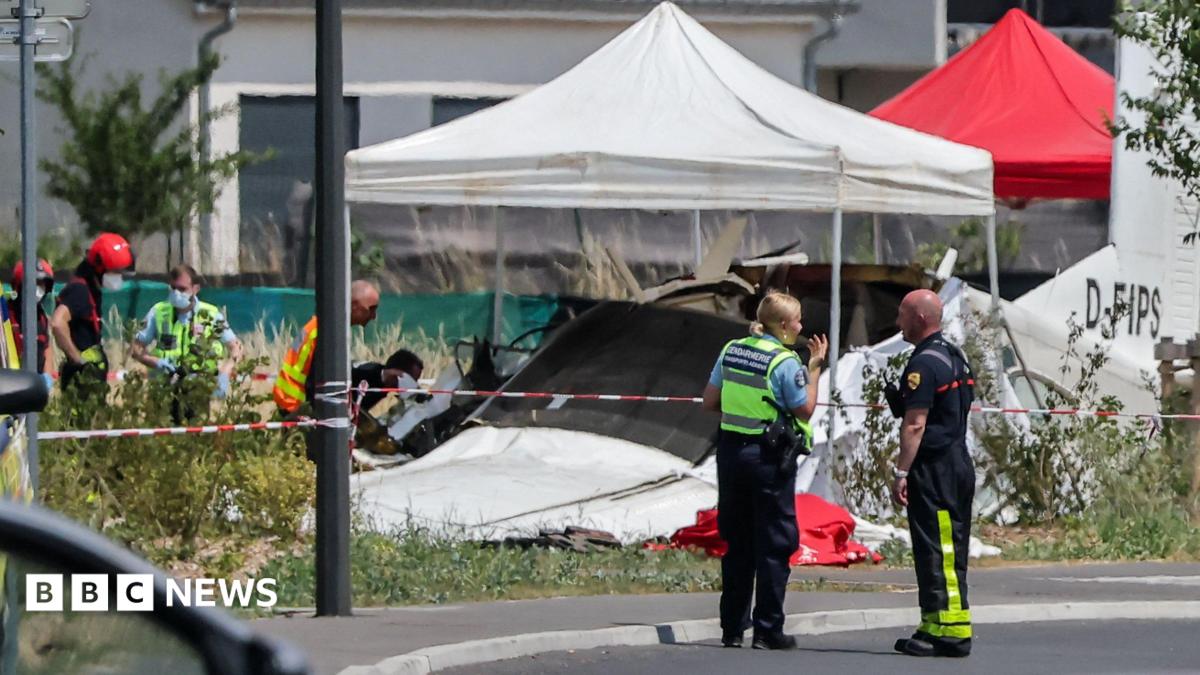
Emergency service workers speak to each other as the attend a light aircraft crash site

Eleven people have died after a civilian aircraft carrying skydivers crashed in the town of Tomblaine in eastern France, local authorities said.

The pilot and 10 passengers died in the incident, including five students and five instructors, local officials said.

The plane, which was being used by a parachutist school, had taken off from Nancy-Essey airfield when it crashed, local media reported.

Police have urged the public to avoid the area around the airport in the Meurthe-et-Moselle department.

Advertisement

The French interior minister was on his way to the scene, the interior ministry said.

Yves Seguy, the prefect of the eastern department of Meurthe-et-Moselle, said that no bystanders were injured in the incident, according to news agency AFP.

Local officials also said relatives of the victims were present at the airfield when the crash happened.

This breaking news story is being updated and more details will be published shortly. Please refresh the page for the fullest version.

Advertisement

You can receive Breaking News on a smartphone or tablet via the BBC News App. You can also follow @BBCBreaking on X, external to get the latest alerts.

Source link

Continue Reading

NewsBeat

Tomblaine plane crash live: Skydiving plane crashes near Nancy with 11 dead

Published

on

Daily Mirror

Hervé Feron, the mayor of Tomblaine, said: “The plane was taking off when it suddenly crashed. At the moment, there is no explanation for the accident.

“The crash caused no collateral damage; it occurred on a bike path near a residential area.

“Tomblaine is providing a room at a secret location to accommodate the victims’ families. According to my information, there were five instructors, five skydivers, and the pilot on board the plane, which was probably rented in Germany.

Advertisement

“The Greater Nancy Metropolitan Area is also providing a room for the victims to gather and pay their respects.”

Source link

Continue Reading

NewsBeat

Scots with hay fever could also suffer from one food allergy this summer

Published

on

Daily Record

While pollen levels soared this week, Scots are also be warned about a ‘hay fever’ food allergy.

Over the past couple of weeks, many people across Scotland may have suffered from hay fever symptoms as pollen levels rose. With a ‘very high’ alert having hit parts of the country this week, many sufferers were urged to close their windows and take preventative measures when needed to keep symptoms at bay.

Advertisement

While hay fever can already be an inconvenience to many patients, with the pollen allergy not having a cure, it seems that the condition can go a step further. While symptoms typically occur when there are higher pollen levels in the air, some patients can also be impacted by the food they consume.

Known as pollen food syndrome (PFS), or oral allergy syndrome, it is an allergic reaction to certain foods that is commonly found in people who have hay fever. Leading to mild symptoms, the allergy can be triggered by some fresh fruits, nuts and vegetables.

Get Daily Record Premium for just £1 per month in exclusive offer to celebrate the World Cup

Celebrate the World Cup with a chance to win £100 in Aldi vouchers

Advertisement

According to Allergy UK, PFS is a relatively common condition that affects around two per cent of the adult population in the UK and is usually linked to having a sensitivity to grass, tree or weed pollen. While the allergy often impacts those with spring and summertime hay fever, it can also impact those who do not have symptoms.

PFS symptoms are a result of certain plant based foods having a similar protein structure to pollen. Due to this structure, the immune system doesn’t always recognise the difference between the pollen in grass or trees you breathe in and the protein in the foods you consume.

As a result, the immune system of hay fever sufferers may recognise the food as an allergen, which creates an allergic response. Typically symptoms include redness, itching, and swelling within minutes of eating the trigger food, which can affect your lips, mouth, tongue, ears, and throat.

Advertisement

According to the NHS, sufferers could also experience other hay fever symptoms, such as a runny nose, eyes watering, and sneezing. These symptoms are generally mild and can be treated by rinsing your mouth and taking antihistamines.

Food allergy patients are more likely to have an allergic reaction if they eat the trigger foods while they are raw. An increased risk of severe symptoms can also occur if patients eat a lot of the raw food in a short space of time.

The NHS states that some of the raw foods that commonly cause PFS include:

  • fruits: apples, strawberries, oranges, cherries, peaches, plums, nectarines, pears and melons
  • vegetables: carrots, potatoes, celery, tomatoes, and soy (soy milk)
  • nuts: hazelnuts, almonds, and peanuts

It should be noted that PFS patients only need to avoid the trigger food when they are raw. If they have cooked or heated then you can consume them without experiencing symptoms.

However, while patients should avoid smoothies that contain the foods, they are also warned that stir-frying may not cook vegetables enough to prevent symptoms. The NHS advises that steaming and microwaving are ideal cooking methods.

Advertisement

Additionally, symptoms could appear while preparing food – such as peeling vegetables while they are raw – as the food particles are released into the air. Patients may want to consider wearing gloves or putting the food under water to help reduce symptoms.

Like most allergies, patients will have different sensitivities. While some people may only be affected by one or two foods, others can react to a wide range of foods containing the protein.

According to Allergy UK, most symptoms will start with five to 10 minutes of eating the trigger food, which should then settle within an hour often without any medical intervention. However, if you are worried about any symptoms or allergies, it is best to contact your GP for advice.


Source link

Advertisement
Continue Reading

NewsBeat

John Swinney ‘sorry’ to see Steve Clarke resign as Scotland boss after World Cup exit

Published

on

Daily Record

The First Minister said that departing Clarke has ‘so much to be proud of’ from his time as head coach.

John Swinney has said he is “sorry” to see Scotland’s head coach Steve Clarke step down following the team’s exit from this year’s football World Cup.

The Dark Blues won their opening match at the tournament, a first World Cup win since 1990, but with two defeats and a minus-three goal difference it was not enough to secure a place in the last 32 of the competition.

News of Clarke’s departure came shortly after Croatia’s 2-1 win over Ghana on Saturday confirmed Scotland’s exit from the tournament.

Advertisement

Clarke led Scotland to three out of the last four major tournaments and it was the national team’s first appearance in the World Cup finals since 1998.

Writing on X, the First Minister paid tribute to Clarke for what he had achieved in the role. “I am sorry to hear that Steve Clarke has stood down as Head Coach @ScotlandNT,” the message read.

“He has taken the team and the country on an exciting journey to reach the World Cup for the first time in 28 years and he has so much to be proud of. I wish him well for the future.”

Advertisement

Mr Swinney also reposted Clarke’s open letter to supporters, calling it “a fantastic, loving message to Scotland”.

The three-page letter, entitled Bye-Bye Scotland, finished with the words: “The most emotional part of this goodbye is for my players, without whom we wouldn’t have had any of the memories that we’ve accumulated from 2019 until now.

“They deserve all the praise and adulation that they receive and it was truly an honour to be called their gaffer. Thanks for having me and good luck to my successor.”

Source link

Advertisement
Continue Reading

NewsBeat

Monaghan v Louth LIVE score updates from the All-Ireland SFC quarter-final at Croke Park

Published

on

Belfast Live

Imagine Louth or Monaghan in an All-Ireland final.

It sounds improbable.

Then again, so did this quarter-final line-up a few months ago.

Advertisement

Neither side will fear the other.

Louth are chasing a first semi-final since 1957. Monaghan are pursuing another breakthrough in what has become a remarkably resilient era for the county.

And that is what makes this fascinating.

The winner won’t merely dream of a semi-final.

Advertisement

The winner will look at the draw and start dreaming much bigger.

Nobody would fancy facing Kerry.

Nobody would relish Galway.

But if the path leads elsewhere, why not?

Advertisement

Why not Louth?

Why not Monaghan?

If either Monaghan nor Louth win their next two games, they will become the unlikeliest All-Ireland finalists since the Antrim hurlers reached the 1989 final.

That is why this weekend feels so intriguing.

Advertisement

The favourites remain.

But so do the possibilities.

Source link

Advertisement
Continue Reading

NewsBeat

Russia’s push to control Arctic waterway presents Europe with a daunting challenge

Published

on

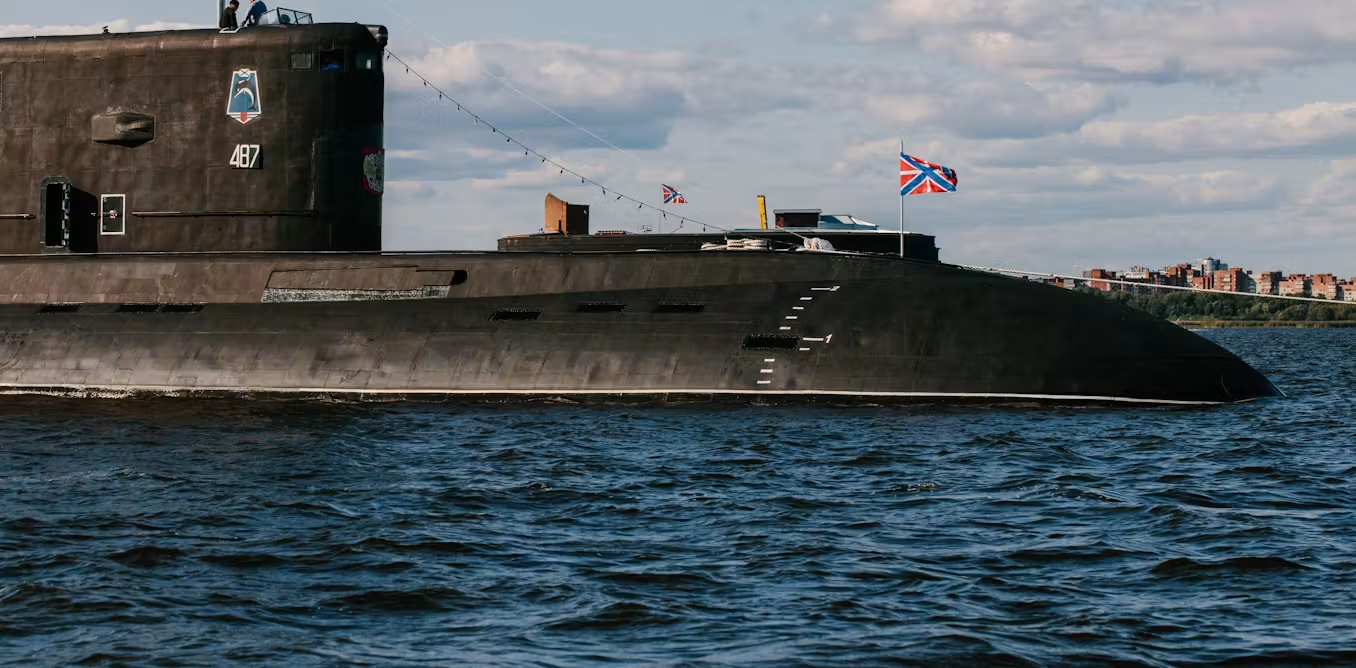
Russia’s push to control Arctic waterway presents Europe with a daunting challenge

Norway’s defence minister, Tore Sandvik, recently warned that Russia must not be allowed to control the Bear Gap. This is a stretch of water that runs roughly 400 miles between Bear Island in the southernmost portion of the Svalbard archipelago and Cape North on Norway’s northern mainland. It serves as the geographical boundary point where the shallow Barents Sea meets the much deeper Norwegian Sea.

Russia has long sought to control the Bear Gap. Control of the waterway would give Russian submarines easier access to the Norwegian Sea, where complex acoustic conditions make detection much harder for Nato forces. From there, Sandvik warned these submarines would be able to threaten Nato countries such as the UK and Denmark directly with hypersonic missiles, which have an operational range of up to 1,500km.

There is also a defensive element to controlling the Bear Gap. From the 1970s onwards, Soviet and later Russian doctrine has emphasised what is termed a “bastion strategy”. Russia has sought to create heavily defended perimeters in and around the Kola Peninsula in its far north-west to protect its ballistic missile and nuclear-attack submarines in “bubbles” close to home waters.

Russia’s northern fleet, which is based near the port city of Murmansk in the northern part of the Kola Peninsula, accounts for two-thirds of its naval nuclear strike capabilities. Thus, Russia sees control of the Bear Gap as key to ensuring Nato forces are kept out of the area and unable to threaten the northern fleet.

Advertisement
Russia has long sought to create defensive perimeters in its north-western waters to protect its ballistic missile and nuclear attack submarines.
Laskin Nikita / Shutterstock

Currently, no one controls the Bear Gap. But Russian activities in the area have become more assertive over the past few years. Russia’s strategy to establish control over this stretch of water seems to depend, fundamentally, on destabilising Norway. Three elements loom large.

First, Russia has been intensifying its GPS jamming operations off the coast of northern Norway in recent years. These activities make the airspace in the region hazardous for military and civilian aircraft, especially during the winter when darkness is the norm. Norway has responded by establishing three monitoring stations for detecting GPS disturbances in the region.

Second, Russia has used disinformation campaigns to frame Norway as an aggressive force. Russia’s state-owned news agency, Tass, reported in April that Ukrainian troops were training with the Norwegian special forces to prepare “terrorist attacks” against Russian ships travelling to and from Murmansk.

Norway has been actively training Ukrainian soldiers since the start of the war in Ukraine in 2022. But there is no evidence that this training is intended to support Ukrainian attacks on Russian maritime traffic in Arctic waters.

Advertisement

And third, Russia has engaged in provocative behaviour in and around the Bear Gap by carrying out military exercises designed to simulate the targeting of Nato assets. Despite the demands currently placed on Russian forces due to the war in Ukraine, these exercises are usually operated at considerable scale with the intention to intimidate.

In July 2025, Russia carried out a naval exercise that involved live missile firing in a vast exclusion zone, some of which extended into Norwegian territorial waters. And in March 2026, Russia’s northern fleet carried out a test of its Oniks anti-ship cruise missile over the Barents Sea, which travelled 300km to its target at sea. Russia released video imagery of the test-fire but did not confirm its exact location.

A map showing the location of the Bear Gap between Bear Island in the southern portion of the Svalbard archipelago and Cape North on Norway's northern mainland.

The Bear Gap runs between Bear Island in the southernmost portion of the Svalbard archipelago and Cape North on Norway’s northern mainland.
Sémhur / Wikimedia Commons, CC BY-SA

Svalbard

Russia’s approach to establishing a dominating influence over the Bear Gap is not solely focused on harassing mainland Norway. Just north of the waterway is the Norwegian territory of Svalbard. In January 2022, Russia was widely suspected of damaging undersea fiber-optic cables connecting Svalbard to mainland Norway.

Russia also regularly harangues Norway about its management of this remote territory. The 1920 Svalbard Treaty, which established Norway as the governing authority of the archipelago, prohibits the construction of fortifications there and stipulates that Svalbard cannot be used for “war-like purposes”.

Advertisement

However, Russia frequently complains about what it sees as Norway’s militarisation of the archipelago. Although there is no permanent military base on Svalbard, Russia argues that Norway is violating the 1920 treaty through naval patrols of the surrounding waters as well as the periodic travel of Norwegian armed forces personnel to the islands.

Russia also maintains that Norwegian satellite infrastructure on Svalbard violates the treaty due to its potential to be used for military as well as scientific means.

If Russia is hell-bent on securing Bear Gap dominance, then its long-coveted acquisition of Svalbard could be accelerated to complete this task. One way of achieving this would be to continue complaining that Norway is breaching the terms and conditions of the 1920 Svalbard Treaty.

They might even hope to provoke Norwegian military overreach, which then provides the pretext to act directly to protect Svalbard’s small Russian-speaking community in the town of Barentsburg. The fact that the archipelago is covered by Nato’s collective defence commitment acts as a major deterrent here.

Advertisement

But, regardless, the threat of Russian aggression is something Norway is seemingly very aware of. In January 2025, a Norwegian white paper warned of “Russia’s willingness to use military force to achieve political goals” and called for “total preparedness throughout Norway to strengthen the resilience of the entire population”.

Russia appears to be stepping up its efforts to establish control over the Bear Gap. Preventing it from doing so is a truly daunting task for Nato forces such as Norway and the UK.

Source link

Advertisement
Continue Reading

NewsBeat

Eleven killed in France plane crash during skydiving trip

Published

on

Boy, 15, arrested for attempted murder after armed attack on school teacher

Eleven people ⁠have been killed in a plane crash in France.

The aircraft crashed in the ⁠town ​of Tomblaine, a suburb of Nancy, in northeastern France ⁠on Sunday, the local ​prefecture ⁠said.

The plane ‌belonged to a parachutist school. ‌The pilot and all ‌10 passengers – five students and ⁠five instructors – died in the accident, the prefecture said.

The incident happened just after 11am.

Advertisement

The French interior minister was on his ‌way to ​the scene, the ‌interior ⁠ministry said.

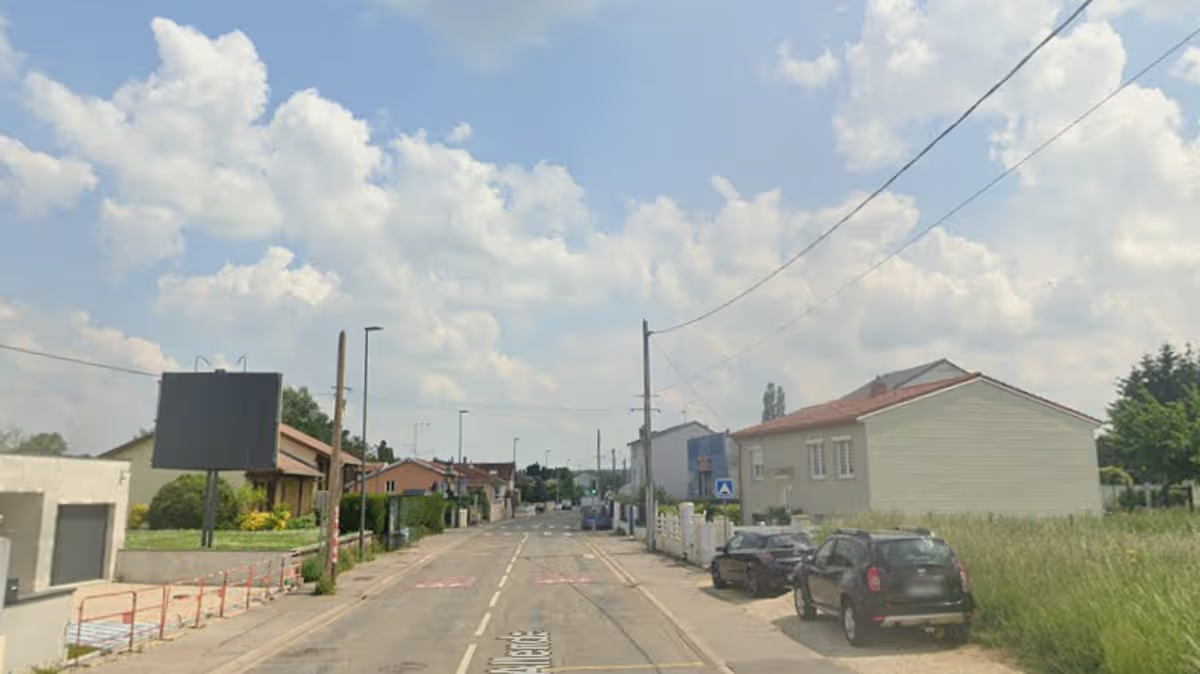
Police have reportedly urged people to avoid the area around the airport in the Meurthe-et-Moselle region. Meurthe-et-Moselle national police posted on social media requesting people to “Imperatively avoid the Salvador Allende Street area entirely.”

It added: “To keep access clear for emergency services and law enforcement, do not go to the scene. Thank you for facilitating their intervention.”

A map of Tomblaine, France:

Advertisement

The Meurthe-et-Moselle prefecture confirmed the crash involved a civilian aircraft which departed from the Nancy-Essey aerodrome.

Adding: “An incident is currently underway in the municipality of Tomblaine involving a civil aircraft that took off from Nancy-Essey aerodrome.

“Yves SÉGUY, prefect of Meurthe-et-Moselle, has decided to activate the departmental operational center (COD) in the presence of all operational services in order to ensure real-time monitoring of the event. The prefect is on site.”

Advertisement

Source link

Continue Reading

NewsBeat

The Cambridgeshire nursery where children ‘love to learn’ in a ‘home-from-home’ setting

Published

on

Cambridgeshire Live

The nursery has been rated ‘strong standard’ in all areas assessed by Ofsted in its latest inspection

A nursery has been rated ‘strong standard’ in all areas accessed by Ofsted. Flying Start Montessori in Fowlmere has been praised by inspectors for creating a “home-from-home” feeling at the setting where children “love to learn”.

Advertisement

The nursery, on Long Lane, underwent an Ofsted inspection in May 2026 and has been rated as at a ‘strong standard’ across six areas. These areas are: achievement, behaviour, attitudes and establishing routines, children’s welfare and wellbeing, curriculum and teaching, inclusion, and leadership and governance.

Inspectors praised the school, which caters to children aged between six months and five years old, for its “highly effective settling procedures” where “leaders and the staff team create a home-from-home feeling at the setting”.

The report, published on June 18, emphasises that “leaders have high expectations for all children” and “maintain regular, meaningful communication with parents”.

The report states: “All children feel relaxed and happy in the warm and inviting environment created by staff. They carefully consider what each individual child needs to feel at home. This promotes the wellbeing of all children. All children feel confident.”

Advertisement

Inspectors also praised leaders’ for having an “excellent overview of the well-designed, ambitious curriculum and ensure that staff implement it well”. This means that the pupils make “excellent progress” and are “well prepared for the next stage of learning, including starting school”.

The report adds: “Children at the setting love to learn. They are excited when staff join them at activities, questioning them and always wanting to know more.

“Older children delight as they are able to enter the ‘workstation’ independently, something which they have to earn. Children have secure relationships with all staff across the setting.”

A spokesperson for Flying Start Montessori said: ““It’s always great to have such positive feedback – it’s the staff, the children and our families which make the nursery what it is.

Advertisement

“Our success is down to the dedication and compassion of the staff. This, coupled together with the unfaltering trust that our parents have in us, means that we can work together to teach our children to be their best selves.”

Source link

Continue Reading

NewsBeat

how a radical artist became a global icon

Published

on

how a radical artist became a global icon

Frida: The Making of an Icon at Tate Modern is the first major interrogation of the Mexican painter Frida Kahlo’s legacy in London for 25 years. It already has more advance sales than any exhibition in Tate history.

The title puts the visitor on first name terms with someone who died in 1954. Yet despite the many privileged glimpses into Kahlo’s life, from photographs, to objects, and – of course – her work, the show is more about ubiquity than intimacy.

Self Portrait with Loose Hair by Frida Kahlo (1946).
Private collection/Tate

The opening sections of the show are brilliant. Immediately to the left of the entrance are two photographs taken by Kahlo’s father when the painter was 18. In one, she is seated in ¾ profile, wearing a dress and holding a book, if not withdrawn, thoughtful. In the other she is pictured with her sisters and their cousins. She stands, slightly taller, in the centre, dressed in one of her father’s suits, one hand in her pocket. She stares out of the picture, with an outwardly directed intensity.

Advertisement

The photographs were taken just months after Kahlo was involved in a bus accident that resulted in a life of periodic surgery. This trauma, among others, is a motif in her work. The seated Kahlo tucks her damaged right leg behind the other; the standing Kahlo holds a walking stick in her right hand. These two images contain the promise of the show: suffering, introversion, defiance, self-presentation, representation and our understanding of these acts today.

Here there are several self-portraits that chart the development of Kahlo’s artistic voice. Her first, Self-Portrait (in a Velvet Dress) (1926) shows a debt to European influence, a synthesis of Italian Mannerism and Art Nouveau. Much more direct and disturbing is the charismatic Self-Portrait with Loose Hair (1947). The background is a slab of the volcanic rock of her homeland. This has the effect of dramatically compressing the implicit space between the image and the viewer: it’s a powerfully psychological presentation of her own creation.

But Frida: The Making of an Icon is not really an exhibition of Kahlo’s work. It is a cataloguing of her legacy. There are only 30 or so works by the artist herself, but very many more by her contemporaries and her successors. It is rich and rewarding to see her work in the context of her Mexican contemporaries, among them Olga Costa and the melancholy Manuel Rodríguez Lozano. It helps to ground Kahlo’s work, showing it, as it were, in its first moment.


À lire aussi :
How Tate Modern is serving up Frida Kahlo – from canvas to cuisine

Advertisement

Recreation of a Kahlo painting, two people sat hand in hand.
Las dos Fridas by Las Yeguas del Apocalipsis (1989).
Tate Collection. Image courtesy Malba Foundation, Museum of Latin American Art of Buenos Aires

There is a similarly rewarding collection of her Surrealist contemporaries: the sparkling canvas by Jacqueline Lamba, Untitled (For Frida) of 1944 is a joy.

As the show demonstrates, Kahlo’s work has been adopted by an astonishingly heterodox group of marginalised people. She is a symbol of the power of self-invention on one’s own terms, even – or especially – in adversity.

Later sections are given to her influence on art and activism, from feminist, to queer and disabled practice. By showing Kahlo alongside artists like Berenice Olmedo, whose work uses prosthetics to reframe the human as “an open process of self-construction”, as Olmedo puts it in the catalogue, or Martine Gutierrez’s exploration of trans identity, or Las Yeguas del Apocalipsis, whose 1989 restaging of Kahlo’s Las dos Fridas exercised queer visibility at the height of the Aids epidemic, the curators show how salient Kahlo’s example is to other artists – artists whose work might otherwise not be seen by a gallery-going public.

Agency and the afterlife

The development of bodily and artistic autonomy is a thread running through the show. But it is not uncomplicated. Even in the first part of the exhibition, there’s a sequence of photographs by her friend, the dealer Julien Levy, that strike an off-note. These expose Kahlo naked from the waist up, un-tressing her hair. The photographs feel voyeuristic, strikingly not self-composed, vulnerable and not on her own terms. She appears to have little agency here – she has either given it to him, or he’s taken it from her.

As I made my way through the later, post-mortem parts of the exhibition, given over to documenting the many homages, quotations and reinterpretations of her work, my mind came back to these photographs.

Advertisement
Two large pop art canvases depicting Kahlo.
Installation view of Frida: The Making of an Icon.
Tate Larina Annora Fernandes

With laudable scholarly thoroughness, the curators map the many empowering gifts that Kahlo’s legacy provides. But there is another side to this exchange. Toward the end of the show, I felt that Kahlo was not being honoured, but bleached. Post-mortem, what agency can Kahlo exercise, as her image is endlessly remade?

Artistic legacies are always collaborative. The work an artist leaves behind is kept vital through reinterpretation, critical study, homage, collection and display. There are few artists who have given the world such a recognisable image and such an open proposition. It is now more than 70 years since Kahlo’s death, and the show’s centre of gravity is not in Kahlo’s work – but rather in what happened next.

As the visitor moves toward the final room, a display of folk art adoptions of her image and somewhat tasteless merch, they are primed to exercise their wallet in the gift shop. The show fulfils its stated purpose, mapping the artist’s evolution from person, to icon, to global brand. By the end, her image is fully detached from her person – a hollow sign into which we might read anything we want.

Frida: The Making of an Icon is at Tate Modern from June 25 to January 3 2027

Advertisement

Source link

Continue Reading

NewsBeat

Fire chief blasts youths over County Durham arson ‘spike’

Published

on

Fire chief blasts youths over County Durham arson 'spike'

The incidents, all believed to have been started deliberately, occurred between January and June this year, while County Durham and Darlington Fire and Rescue Service (CDDFRS) confirmed it had recorded a total of 3,103 arsons in the whole of 2025.

Billy McAloon, station manager at CDDFRS, said: “During the school holidays and when the weather is nice, we typically see a spike in the number of deliberate incidents we attend.

“We want to remind young people and members of the public that setting fire to things like grass or bins is not a game.

Advertisement

“What may start as a moment of mischief can quickly escalate into a serious incident, putting lives, homes, businesses and the environment at risk.”

The warning comes ahead of Anti-social Behaviour (ASB) Awareness Week, which runs from June 29 to July 5.

It also comes as warm, dry weather increases the risk of wildfires spreading quickly.

Mr McAloon said: “When firefighters are called to extinguish preventable fires, it can delay their ability to respond to other emergencies, including house fires, road traffic collisions and incidents where lives may be at immediate risk.”

Advertisement

Firefighters have visited more than 70 schools so far this year to educate young people about the dangers of arson.

They have also worked with police and other partners to carry out walkabouts in hotspot areas for deliberate fires.

As part of ASB Awareness Week, residents can meet fire crews at Darlington Fire Station on Monday, June 29 between 1pm and 3pm, and at South Park on Wednesday, July 1 from 10am to 12pm.

Mr McAloon urged parents to talk to children about the risks, warning that arson is a criminal offence that could impact future education and job prospects.

Advertisement

David Gray, Durham County Council’s health and safety compliance manager, said: “What may seem like a bit of fun or a harmless game, can quickly put lives at risk.

“It’s important that young people are aware of the dangers of setting fires, no matter how small they may be.

“During this hot and dry weather, these can quickly spiral out of control and lead to serious incidents.”

Advertisement

Source link

Continue Reading

Trending

Copyright © 2025