In February 2024, a young man lay somewhere on the frozen shore of James Bay, Canada, surrounded by snow and darkness, succumbing to hypothermia. When he failed to get home on time, his frantic mother sent a Facebook message to Elizabeth Kataquapit, then chief of the indigenous community Fort Albany First Nation in northeastern Ontario. Kataquapit used Facebook to alert the community’s search-and-rescue squad, who jumped onto their snowmobiles and drove into the night. Before dawn, they returned with the dazed man, who told rescuers he’d given up until wolves nudged his hypothermic body. “The wolves told him to wake up,” Kataquapit says. “I really believe they saved his life.”
A fiber-optic network also played a key role.
Not long before the young man’s mishap, the indigenous-owned Western James Bay Telecom Network (WJBTN) had built its own fiber-to-the-home network in this remote Cree community, some 975 kilometers north of Toronto. Before the network, the rescue squad relied on a few handheld radios to pass information along. This time, a Facebook message to the full list of volunteers triggered the search.
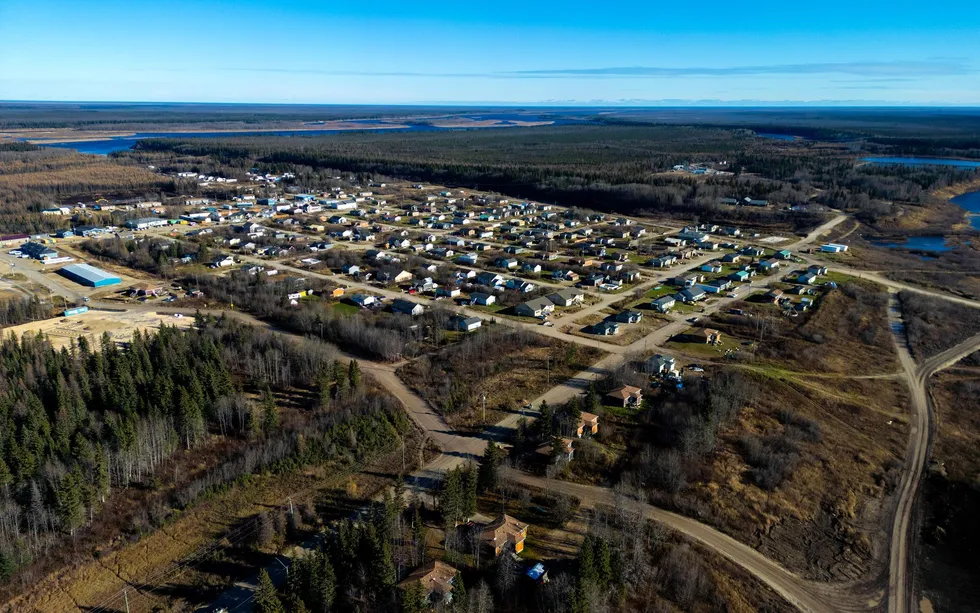
 An aerial view shows the remote community of Fort Albany in northern Ontario.Gavin John
Building Canada’s first fully Indigenous-owned-and-operated fiber-optic network was an uphill battle for Brian Nakogee, WJBTN’s finance officer, who had to secure capital from agencies less familiar with the challenges of remote northern life. For the people of Fort Albany First Nation, accessing many vital supplies and services means traveling about 500 km to the regional city of Timmins. By land, the trip is possible for only a few weeks each winter, when the swampy tundra freezes hard enough to construct a temporary road. “The southern way of doing things is very different than how we here in remote areas piece things together,” says Nakogee.
Telecommunications giants long saw little profit in serving the subarctic coast of James Bay. But even as satellite internet started to become available in remote communities, WJBTN staff saw the value in building and owning its own hard-wired internet service instead of relying on outside companies. Today, the nonprofit operates one of the fastest networks in Canada, while keeping both infrastructure ownership and revenue within the First Nations communities it serves.
WJBTN is part of a broader movement among Indigenous and remote communities seeking more control over their telecommunications infrastructure. In the United States, 30 tribes now operate fiber-to-the-home networks, many launched during COVID. Canada has since created a dedicated Indigenous broadband funding stream. And as more communities pursue the expertise and funding to build their own networks, WJBTN’s experience offers a blueprint for what locally owned connectivity can look like in some of the hardest places to serve.
How a Power Line Became a Broadband Backbone
While many towns in North America were connecting to optical fiber in the early 2000s, the subarctic communities were left out.
The residents of Fort Albany saw the earliest sign of improvement in 2008. That’s when their locally owned power company, Five Nations Energy Inc. (FNEI), strung fiber-optic cable on the utility poles that were delivering electricity from the dusty railway town of Moosonee, 135 km away across the peat bogs. On the shore of the Moose River, Moosonee is the last stop for Ontario’s telecommunications providers. Its only link to the province’s highways is a 5-hour train ride that shuttles passengers, freight, and vehicles through the Boreal forest.

 Elizabeth Kataquapit [top], former chief of Fort Albany First Nation, says high-speed internet has transformed her community. Search & Rescue volunteers now coordinate emergency responses through a Facebook group [bottom]. Gavin John
Soon after, regional Cree leaders formed WJBTN to provide high-speed telecommunications in Moosonee and the three Indigenous communities to the north. WJBTN would lease the fiber-optic backbone from the power company, with just 1 gigabit per second of total capacity for the entire population of about 6,000 people.
But the new fiber backbone did not mean fast internet for residents. One of WJBTN’s first commercial clients was a telecom company called Xittel, which used microwave links and local access points to beam wireless internet to homes across each town. It wasn’t what subscribers were hoping for. This system frustrated users with delays, glitches, and strict data caps. Kataquapit calls it a “turtle.”
Everybody complained about the wireless. Xittel advertised a 10 megabit-per-second connection, but speed tests consistently showed 3 Mb/s for both uploads and downloads. And customers paid dearly if they ever exceeded their data limit. “You were billed close to CA $7 per megabit,” Nakogee recalls.
WJBTN’s dream had always been to connect everyone’s home to fiber optic and make it affordable. Without a technical team, roads, or any major funding, the company just had to figure out how.
Designing a Fiber Network for the James Bay Coast
When Nakogee joined WJBTN in 2014, the telecom company was still in its infancy. It was “a department huddled in the corner, trying to latch onto the services of FNEI,” he says.
Nakogee was asked to prepare a proposal to deliver 40 Mb/s fiber connections to each of the roughly 1,000 homes and businesses spread across 300 km of the James Bay coast. Back then, WJBTN operated on revenue from its early commercial and institutional customers—including Xittel, local government offices, hospitals, air navigation facilities, and family service centers that were connected to the first few strands of fiber. To make a residential fiber network possible, WJBTN first had to build both revenue and trust within the communities it hoped to serve; it had to convince people that the small new organization would follow through on its plan.
 WJBTN finance officer Brian Nakogee played a key role in financing and planning the community-owned fiber network. Gavin John
Nakogee especially needed support from Moosonee and Attawapiskat, the communities at the start and the end of the line. “They’re the bread that holds this sandwich together,” he says. Through years of diplomacy, the budget grew enough to support a business proposal for a fiber-to-the-home network. Together with engineer Dirk MacLeod, in 2015 Nakogee began hashing out the details of a bare-bones version of the system. The plan required both upgrading the network’s long-distance fiber backbone—known in telecom as the backhaul—while also building the local infrastructure that would connect individual homes to the internet.
 Andrew MacLeod, WJBTN’s field project manager, reviews a map of the fiber network.Gavin John
The first step was upgrading the network’s backhaul using newer “coherent optics” technology, which can transmit much larger amounts of data over long distances, explains Dirk’s brother, Andrew MacLeod, another network engineer, who joined as a consultant. Using equipment from telecom supplier Infinera, the new backhaul would deliver 100 Gb/s to distribution points in each town, with redundancy in case a fiber line failed.
Next came the challenge of connecting individual homes. Rather than extend a direct line from the central office for every customer, the engineers designed the network around a telecom architecture called GPON (Gigabit Passive Optical Network), which reduced the fiber needed to connect each customer to the network. Fiber from the backbone would run to networking equipment at each town’s electrical substation, where passive optical splitters would distribute the connection among many households without requiring powered equipment at every junction. In remote communities where maintenance and repair are difficult, reducing the amount of active infrastructure was a necessity.
The total estimated cost was CA $4.7 million, or CA $4,700 per household. By comparison, the Fiber Broadband Association estimates that urban fiber-to-home construction in the United States costs the equivalent of about CA $1,400 to CA $1,800 per household—a stark contrast in expense.
 Fort Albany resident Thomas Scott says high-speed internet has improved his work as a mental health counselor. Gavin John
A radio broadcast in 2018 heralded the good news: The fiber-to-home construction project was a go. Fort Albany mental health counselor Thomas Scott says he “couldn’t wait.” People seeking guidance for addiction or grief typically called him on landlines, and it was hard to help them over the phone without seeing their faces. Businesses, too, rejoiced—including the Kataquapit family store, which relied on the phone system for transactions.
Testing and Deploying a Remote Fiber Network
Winning approval for the project was one thing; building it across hundreds of kilometers of remote subarctic terrain was another.
Dirk MacLeod started with a schematic documenting the GPS position of every house, pole, and length of cable that would ultimately form the network. When WJBTN hired Montreal-based Fonex Data Systems to upgrade the backhaul, the detailed plan made it easy for contractor Tasso Varvarikos to design the deployment. Still, tuning the optical system to operate reliably across transmission lines stretching hundreds of kilometers required extra care. “Once you go up north, there’s no fiber store,” he says,
To minimize surprises in the field, Varvarikos traveled to telecom supplier Infinera’s laboratory in Stockholm, where he and other engineers assembled and tested the network before shipping it to the installation site. The Stockholm lab gave the team access to testing tools and technical specialists who helped configure the system before deployment in the remote fly-in communities. Using Infinera’s simulation software, Varvarikos says he and his colleagues “kicked the crap out of it in the lab” until the network performed reliably.
 The Western James Bay Telecom Network connects remote communities along the western shore of James Bay in northern Ontario.Chris Philpot
Finally, in the spring of 2019, it was time to pack up and head to the sites. First, more than two pallets’ worth of Infinera equipment were squeezed onto two charter aircraft in Timmins. Bush pilots, unfazed by the stringent logistics, made sure that one box reached Moosonee; the other one, Attawapiskat. Varvarikos says they packed extra fiber-optic transceivers, patch cables, tools, and “the kitchen sink and then an extra sink just in case.” By May, the team was ready to install the new backhaul—a months-long process that necessarily preceded household connections. Once the equipment was in place, the engineers tested the network to make sure the systems in each community could communicate reliably and that data moved correctly across the backbone.
During the switchover to the new system, the MacLeod brothers worked from substations in different communities along the coast while Varvarikos coordinated from Fort Albany. Communicating over a spotty phone line, they started moving connections from the old network to the upgraded backhaul, carefully reconnecting cables and verifying that traffic still flowed correctly between communities. Within days, the anchor customers—including hospitals, schools, and air-navigation systems—were hardwired to a 100-Gb/s backbone.
However, households were still relying on the slow legacy network. WJBTN’s next step was flying huge reels of fiber-optic cable into the remote communities at enormous cost. Nakogee recalls cutting predetermined lengths of cable, then repackaging it onto spools to load onto cargo aircraft. The backbone was finally in place; now WJBTN had to bring fiber to every home.
Training a Local Fiber Crew
Then, in a turn of events that rocked the communities, lead engineer Dirk MacLeod had a heart attack and died in July 2019. “My chest was ripped open,” Nakogee says. The grieving company shut down for the summer.
WJBTN had intended to spend three summers training local crews from each community’s power company to maintain and manage the network. After MacLeod’s death, one line worker quietly took it upon himself to finish extending fiber to distribution points in Fort Albany. The team made a plan to begin connecting homes the following spring.
 Utility poles carry power and fiber-optic lines through Fort Albany First Nation.Gavin John
Then COVID hit. Fearful and with limited medical facilities, the communities closed themselves off. Nobody was allowed in.
“COVID really screwed things up,” says Andrew MacLeod. People were screaming for better internet, he recalls, but they wouldn’t let outsiders in. So instead of training local crews and building each town’s network simultaneously as planned, WJBTN made a tantalizing offer: The first community to allow MacLeod in would have its fiber-to-the-home network completed first. Fort Albany jumped on it.
Peyton Reuben, a recent computer systems graduate in Fort Albany, was seeking a new job when his cousin mentioned that there was a “fiber guy” in town. Reuben’s coursework covered coding and how routers and ISPs communicate—a distant relative to Andrew MacLeod’s hands-on infrastructure work.

 WJBTN network coordinator Peyton Reuben looks up at the overhead fiber network in Fort Albany [top]. A splice enclosure joins fiber-optic cables at a distribution point [bottom]. Gavin John
“They were looking for helpers to splice fiber,” says Reuben, something he knew nothing about. Nonetheless, he started work the day he met MacLeod and got a crash course in building an aerial fiber network, running cables from utility poles into neighborhood connection boxes that ultimately served individual homes. The fun part was reaching every pole in every neighborhood in a town crisscrossed by tributaries of the Albany River. “We didn’t have a bucket truck, so we had to climb up the poles,” says Reuben. “It was quite the experience, going through thick brush and thigh-deep water.”
The hard part was splicing the fiber—fusing together hair-thin glass strands that connected homes to the larger network. Inside each connection box, distribution fibers had to be joined to cables leading to individual houses, one strand at a time—around 150 in each box. Reuben’s first attempt “looked like a plate of spaghetti,” says MacLeod. More splicing waited back at the substation, where optical splitters connected neighborhood lines to the town’s central GPON equipment. “It took me four times as long as Andrew to complete a splice tray back then,” says Reuben.
 A worker installs a new fiber-optic line for the Western James Bay Telecom Network.Gavin John
Slowly but surely, every building in Fort Albany saw a strand of fiber drop from overhead and come through a box drilled into the wall, ready to connect to a router. By springtime, aerial cables linked every house—and future building sites—to the substation. Reuben calls it “a spider web that goes everywhere across town.”
Without much fanfare, on a night in April 2022, WJBTN flipped the switch in Fort Albany. The next morning, Kataquapit woke up to a different world. With 250 Mb/s download and 30 Mb/s upload speeds, she found herself just a click away from her children in faraway cities.
Why Not Starlink?
MacLeod and Reuben continued working up the coast, splicing cables and adding connection boxes. As COVID eased, they hired more local help, and the power company lent a hand with bucket trucks. “We were working 12 hours a day, 7 days a week,” says MacLeod. “Guys were sitting in the heat, in bucket trucks, learning on the fly how to do splicing.” By late 2022, the network reached every home.


 Fiber-optic cables and networking equipment inside the Fort Albany substation distribute internet service throughout the community [top, middle]. Large spools of fiber-optic cable were flown in to connect homes [bottom]. Gavin John
Around that time, Starlink’s satellite internet service was becoming widely available. Many of WJBTN’s potential clients asked why they shouldn’t just purchase that instead of a fiber-optic connection that involved drilling into their homes. But speed tests comparing Xittel, Starlink, and the new WJBTN connections showed a major difference in latency: In applications like video calls, Xittel and Starlink’s round-trip signal delays became painfully obvious. Unlike satellite systems, fiber networks don’t need to send signals hundreds of kilometers into orbit and back. That gave WJBTN a significant performance advantage.
MacLeod recalls a conversation with one line worker who wanted to turn to Starlink. “We told him our latency is so much better,” MacLeod says, explaining that ISPs measure performance by both bandwidth and latency. From Attawapiskat, a data packet traveling over WJBTN’s fiber network reached Toronto in 20 milliseconds. Comparable satellite connections took closer to 60 milliseconds. And Xittel’s latency was much worse, at several hundred milliseconds. (Since then, WJBTN has reduced latency further, to about 12 milliseconds.)
The team’s success has bolstered other Indigenous broadband companies. WJBTN representatives have shared their experiences at Indigenous Connectivity Summits since 2017, and how-to workshops have sprung up across Canada (and the United States). And Canada has since created a dedicated broadband funding stream for Indigenous communities. Within Fonex Data Systems, the company hired to do the backbone work, the WJBTN implementation is now considered the model for a successful installation in a remote location.
Nakogee says ownership remains the key advantage. Unlike earlier telecom providers that leased infrastructure or delivered service wirelessly, WJBTN owns the backbone fiber, the right-of-way, and the poles carrying the network. That makes it far harder for outside telecom companies to displace the service. “That’s our secret weapon,” he says.
Fundamentally, it’s about sovereignty. By controlling the infrastructure that carries internet traffic, the communities can govern and maintain the network according to their own priorities rather than the financial goals of distant providers.
How Fiber Changed Daily Life
Shortly after the fiber network was installed, Elizabeth Kataquapit became chief of Fort Albany First Nation. During her term as chief, she kicked the community’s digital era into full gear, encouraging individuals who couldn’t attend community meetings in person to join over Zoom.
Counselor Scott now conducts grief and addiction sessions both in person and via video calls and can connect immediately in a crisis even if he’s away. And as a search-and-rescue volunteer, he responded to the Facebook message when the young man got lost in a winter snowstorm on James Bay. “If we were a half hour later, the person would have [been] gone,” says Scott.
Broadband has also changed everyday life in quieter ways. Residents run small businesses from their homes. Telehealth links patients to specialists in southern cities. More people are working remotely and taking classes online. “Quality of life is so much better,” Reuben says.
But the network has also brought to these northern communities the more isolating side of fast internet. Community members stream more movies and play more video games, and they meet face-to-face less frequently. Standing beside an enormous canoe in his front yard, Scott explains that while he’s grateful for Fort Albany’s new connection to the outside world, he’s equally intent on preserving close connections within the community. Today, he says, as he starts loading fishing nets into the canoe, “I’m taking the kids out after school to harvest whitefish.”
This article appears in the August 2026 print issue as “Wiring the North.”
From Your Site Articles
Related Articles Around the Web



























































You must be logged in to post a comment Login