

Crypto World
Ripple IPO and XRP holders: what you would get

Brad Garlinghouse said one word, “maybe,” and the XRP community heard a promise. Asked whether holders could get a piece of Ripple if it goes public, he nodded toward a “special arrangement.” This is what was actually said, what holders could realistically receive, and the downside almost nobody is talking about.
Summary
- Ripple chief executive Brad Garlinghouse said that “if and when” Ripple goes public, the company might do “something special” for XRP holders, then immediately added it was “not in the immediate term.”
- That hedged “maybe” was offered in response to a direct question, not volunteered as a plan, and he declined to commit to any mechanism such as a token buyback.
- Ripple and XRP are legally and financially separate assets: holding XRP grants no shares, no dividends, and no claim on Ripple’s corporate profits, and no bridge between the two currently exists.
- The mechanisms holders imagine, preferential IPO share access, long-term holding rewards, or tokenized Ripple equity, are all unannounced and face serious securities-law hurdles given XRP’s legal history.
- The overlooked risk is that a Ripple IPO could actually pressure XRP, by drawing institutional capital toward Ripple stock and pushing the company to monetize its escrow holdings to satisfy public-market investors.
One word from Ripple’s chief executive set the XRP community alight, and that word was “maybe.” Speaking on the “Crypto In America” podcast with journalist Eleanor Terrett, Brad Garlinghouse was asked the question XRP holders have wanted answered for years: if Ripple ever goes public, could the people who hold XRP get a piece of it. He did not say no. He gestured first at the indirect benefits Ripple already provides, then, pressed on whether the company would do something specific for holders in an initial public offering, he said, “Maybe, but that is not in the immediate term.”
That was the entire substance of it, a hedged possibility wrapped in a qualification, offered in answer to a direct question rather than announced as a plan. And yet within hours it had been clipped, shared, and reshaped across XRP social media into something close to a corporate commitment, with community members urging one another to “hold accordingly.” The gap between what Garlinghouse actually said and what the community heard is the real story here, because the difference between a hinted-at maybe and a planned reward is the difference between a reasonable hope and a misplaced expectation.
The reason the remark landed so hard is the situation it landed into. XRP holders have spent 2026 watching Ripple collect exactly the kind of institutional wins the community long predicted, settlements with JPMorgan, stablecoin launches with major partners, a steady drumbeat of bank deals, while the token itself has stayed pinned near a dollar and change, beneath every major moving average. That combination, corporate triumph paired with token stagnation, breeds a particular hunger: the sense that the wins are real but are somehow not reaching holders, and that some missing mechanism could finally connect the two. Into that hunger dropped Garlinghouse’s nod, and it did what a catalyst does in a starved market.
This piece separates the hope from the reality. It covers exactly what was said and the precise wording that matters, the crucial distinction between Ripple the company and XRP the token, the mechanisms a holder benefit could theoretically take and why each is harder than it sounds, why Ripple may not even go public soon, the indirect benefit Ripple genuinely does provide, and the downside almost nobody is discussing: that an IPO could actually work against XRP. The goal is the real picture, neither dismissing the possibility nor inflating it into the certainty the hype implied.
What Garlinghouse actually said
Precision matters here, because the entire community reaction rests on a few carefully chosen words, and those words were more conditional than the excitement suggested. Garlinghouse did not volunteer the remark; he was asked directly whether XRP holders could share in Ripple’s success if the company eventually launched an initial public offering. His first instinct was to point to the indirect benefit Ripple already provides, saying he hopes XRP holders feel they benefit from Ripple’s existence through the work the company does to grow the XRP ecosystem. Only when pressed on whether Ripple would do something specific for holders in an IPO scenario did he offer the line that ignited everything: “Maybe, but that is not in the immediate term.”
When pushed further on concrete mechanisms, including a possible token buyback, he declined to commit to any of them, pointing back instead to what Ripple already does for the ecosystem. So the full extent of the supposed promise is a “maybe,” qualified as not near-term, given in response to a direct question rather than offered as a plan, with no program described, no mechanism named, and no action committed to. The community heard “Ripple will do something special for holders.” What Garlinghouse actually said was closer to “maybe someday, if we go public, which is not happening soon.”
Those are not the same statement, and stacking the two conditionals reveals how far the exciting headline sits from anything concrete: a possible benefit, attached to a possible IPO, that he himself describes as not a priority. It is worth adding that days earlier, at an industry conference, Garlinghouse had been cooler still on the idea of going public at all, emphasizing that staying private gives Ripple flexibility. Read in that context, the podcast remark was a hint, not a plan and certainly not a promise. Any honest assessment of what holders would actually get has to begin from that fact rather than from the amplified version that spread online.
Ripple is not XRP: the distinction that decides everything
To understand why this question is so charged, and so easily misunderstood, you have to grasp a distinction that still confuses many people: Ripple and XRP are legally and financially separate assets, and owning one does not mean owning the other. Ripple is a private technology company that builds payment and liquidity products, some of which use the XRP Ledger. XRP is a cryptocurrency, the native asset of the XRP Ledger, which is a decentralized, open-source blockchain that Ripple does not control. Holding XRP gives you ownership of that token and nothing else.
It confers no shares in Ripple, no dividends, no voting rights, and no claim whatsoever on Ripple’s corporate profits or assets. The two are different things with different value drivers, and the price of one does not automatically move the other. That distinction is why the company-versus-token gap keeps resurfacing across Ripple’s 2026 story. Ripple can win institutional business, launch products, and deepen its corporate value without automatically delivering a direct benefit to XRP holders.
This separation is the foundation of the entire holder-payout question, because it means there is no existing structure, no dividend, no buyback mechanism, no holder-equity bridge, that currently connects Ripple’s corporate fortunes to the people who hold XRP. Any such benefit would require a deliberate corporate decision: Ripple choosing to extend something to holders of a token that is legally distinct from its stock. That is precisely what makes Garlinghouse’s “maybe” notable, because it gestures at the possibility of Ripple voluntarily building a connection that does not exist and is not required to exist. The community’s hope is that Ripple might someday decide to construct that bridge.
The reality is that no bridge exists today, none is planned, and the entire question is whether Ripple might ever choose to build one. Everything that follows, every imagined mechanism and every obstacle, flows from this single fact: a Ripple IPO would, by default, do nothing for XRP holders, because the token and the company are separate. Only an affirmative, deliberate choice by Ripple could change that. Until such a choice is announced, a holder payout remains speculation, not entitlement.
The mechanisms holders imagine
Once the “maybe” spread, the community began filling in the blank with specific mechanisms, and it is worth laying them out, because they define the range of what “something special” could plausibly mean. The most discussed idea is preferential access to IPO shares, an arrangement in which verified long-term XRP holders, or users staking on the XRP Ledger, would be granted priority subscription rights to buy into a Ripple offering at favorable terms before the general public. This is the version that most directly answers the community’s wish, because it would let XRP holders transition, at least partly, into Ripple shareholders. It would turn token loyalty into an equity stake.
A second imagined mechanism is a long-term holding reward, a community-based structure that would give some benefit to holders who have kept XRP for a defined period, rewarding loyalty without necessarily handing over equity. A third, more technically ambitious idea is tokenized Ripple equity: a blockchain-based representation of Ripple stock made available to eligible token holders, which would use the very tokenization technology the industry is racing to build in order to bridge the gap between Ripple shares and XRP. Some in the community have also floated the notion of an “equity-token-bound” proof of entitlement, a digital claim linking XRP holding to some future right in Ripple. Each of these would, in its own way, construct the bridge between Ripple equity and XRP holders that currently does not exist.
The crucial thing to hold in mind is that all of them remain imagined, not announced. Garlinghouse named none of them; he declined, in fact, to endorse any specific structure when asked. They represent the community’s wish list of what “something special” might be, not a menu Ripple has offered. The distance between a fan’s plausible idea and a company’s actual program is considerable, especially when the imagined benefit touches securities law, global compliance, investor eligibility, and the legal separation between Ripple equity and XRP.
Why each mechanism is harder than it sounds
The reason Garlinghouse spoke in hints instead of specifics is almost certainly that nearly every concrete version of a holder benefit collides with serious obstacles, and understanding those obstacles is essential to a realistic view. The largest is securities law, and it is a particularly sharp problem for XRP of all tokens. Linking a cryptocurrency’s holding to equity benefits raises exactly the kind of securities-law questions that defined Ripple’s long and costly legal battle, the years-long fight over whether XRP sales amounted to unregistered securities transactions. Building a formal bridge that rewards XRP holders with equity or equity-like rights risks recreating the very entanglement between the token and the company that Ripple spent years and enormous legal resources trying to separate.
The company would have to navigate that terrain with extreme care, because a poorly designed holder-benefit program could reintroduce the argument that XRP is a security tied to Ripple’s enterprise, which is the last thing Ripple wants. That is why the catalyst that matters more than the IPO is still statutory clarity from the CLARITY Act, not an undefined corporate reward. Federal clarity can strengthen XRP’s status without blurring the line between the token and Ripple equity. A holder-equity program, by contrast, could blur that line if designed carelessly.
Beyond securities law, the practical obstacles multiply. A preferential-share program would require verifying who is a genuine long-term holder, drawing cutoff lines that would inevitably be seen as arbitrary or unfair, and managing the identity and compliance machinery to do it at scale across a global, pseudonymous holder base. A holding-reward structure raises questions of how to fund it and how to avoid favoring large holders over small ones. Tokenized equity would face the full weight of securities regulation governing who can own and trade company stock, plus the technical and legal work of making a regulated equity instrument function on a blockchain.
Each mechanism, in other words, is not just a matter of Ripple deciding to be generous; it is a tangle of legal exposure, fairness problems, and operational complexity, any one of which could sink it. This is why the most dramatic interpretations of “special arrangement” are also the least likely. A sober reading has to weight the modest possibilities, a governance gesture, a symbolic recognition, or simply Ripple structuring its business so more value flows through XRP over time, far more heavily than the windfall the community imagined.
Why Ripple may not even go public soon
The entire holder-benefit scenario is downstream of a prior question that often gets lost in the excitement: will Ripple even go public at all, and if so, when. On this, Garlinghouse has been consistent and notably unenthusiastic. He has repeatedly described an IPO as not a priority, and his reasoning is grounded in the current state of the public markets for crypto companies. He has pointed to the underwhelming performance of crypto-related public listings, citing peers whose post-listing stock has struggled, and noted reports that at least one major exchange had delayed its own listing plans.
His view, in short, is that the public markets have not treated Ripple’s peers well, and that there is little reason to rush into that environment. He has also made a positive case for staying private, arguing that it preserves flexibility, including, he joked, the freedom to speak openly without lawyers drafting every word. This is not the posture of a company on the verge of ringing the opening bell. It means the holder-benefit question is built on a foundation that is itself uncertain: a possible reward contingent on an IPO that the chief executive describes as neither planned nor imminent.
That is the sense in which the whole thing is a maybe attached to a maybe. For an XRP holder weighing what they might receive, this is the most important practical point, because even the most generous imaginable holder benefit is irrelevant unless and until Ripple actually decides to go public. By Garlinghouse’s own account, that decision is not on the calendar. The community’s hope therefore rests on two sequential uncertainties: first that Ripple goes public, and second that, having done so, it chooses to extend something to holders it is under no obligation to help.
Either link breaking is enough to make the whole scenario evaporate. That is why the IPO hint should not be treated like a near-term catalyst, even if it tells holders something about how Ripple thinks about its community. The comment matters as a signal of openness, but it does not change the current legal structure, the current IPO timeline, or the current token economics. XRP holders should separate those categories carefully.
The indirect benefit Ripple already provides
Set against the speculation is Garlinghouse’s actual, stated position, which deserves a fair hearing because it is not a trivial argument: that XRP holders already benefit from Ripple’s existence, indirectly but intentionally. The foundation of this argument is a simple fact: Ripple is the largest single holder of XRP. That gives the company a stronger economic incentive than anyone else to increase the token’s value and adoption, because Ripple profits when XRP rises, just as holders do. Its incentives are genuinely aligned with holders, even without any formal program linking the two.
Every commercial partnership Ripple pursues, every payment corridor it opens, every institutional deal it closes, and every regulatory battle it fights is evaluated, at least in part, through the lens of how it drives XRP utility and liquidity. Garlinghouse’s framing is that this alignment is the real benefit, that Ripple’s entire strategy is built around making XRP the most useful, liquid, and trusted digital asset in payments and settlement, and that by growing the ecosystem it makes what holders own more valuable, even without a dividend or an equity link. That is where XRP’s actual utility remains central to the long-term case. The token’s real thesis has to rest on usage, liquidity, and settlement demand, not on implied ownership of Ripple.
Garlinghouse has pointed to concrete examples of this posture, including Ripple’s backing of XRP treasury companies such as Evernorth, which is working to build a large XRP treasury business with Ripple’s support, an effort Garlinghouse frames as helping XRP holders, the XRP community, and Ripple shareholders at the same time. This argument has genuine merit and should not be dismissed as spin. The company’s commercial work plausibly does increase XRP’s utility and demand over time, which is a real, if diffuse, benefit to anyone holding the token. The counterpoint, and the reason the “maybe” resonated, is that many in the community find this indirect alignment insufficient.
They want a concrete share of Ripple’s corporate success, not an incentive structure that may or may not translate into token-price appreciation. That dissatisfaction is precisely the nerve Garlinghouse’s remark touched. His indirect-benefit argument is, in effect, his answer to it: you already benefit, just not in the direct way you want. Whether that answer satisfies holders depends on whether Ripple’s wins eventually become visible in XRP demand rather than simply in Ripple’s corporate valuation.
The downside nobody mentions: an IPO could hurt XRP
Here is the part of the story that the bullish excitement almost entirely skips: a Ripple IPO is not unambiguously good for XRP, and there is a credible case that it could actively work against the token, at least in the near term. The first channel is competition for capital. Today, an institution that wants exposure to Ripple’s success has essentially one liquid way to get it: buy XRP, the token associated with the company’s ecosystem. If Ripple goes public, that changes.
Suddenly there is a direct way to own a piece of Ripple itself, a regulated equity that offers what a token cannot: potential dividends, audited financial transparency, ownership of the company’s actual assets and cash flows, and the compliance comfort of a listed stock. Faced with that choice, institutional capital that might have flowed into XRP as a proxy for Ripple could instead flow into Ripple stock, siphoning off the very institutional demand the XRP bull case depends on. The IPO, in this reading, would give the market a cleaner instrument for the Ripple thesis, and XRP could lose its role as the default vehicle for it. That is the uncomfortable side of where XRP trades while holders wait: the market wants direct token demand, not merely a story about Ripple’s corporate success.
The second channel is selling pressure from Ripple itself. As a private company, Ripple has long been criticized for selling XRP from its large escrow holdings, a persistent source of new supply. After an IPO, that pressure could intensify instead of ease, because a public company answers to Wall Street’s quarterly demands for cash flow and profitability. To satisfy those demands and bolster its financial reports, Ripple’s board could face strong incentives to monetize tens of billions of XRP from its escrow accounts in a more systematic and aggressive way, creating an invisible, long-term overhang on the token’s price.
None of this is certain, and a well-managed IPO could be handled in ways that limit these effects, but the point is that the community’s framing of an IPO as pure upside for holders is incomplete. The honest version acknowledges that going public is a double-edged sword for XRP. It could, in the bullish case, come bundled with a “special arrangement” that rewards holders, or it could, in the bearish case, drain attention and capital away from the token while increasing the supply pressure on it. Holders hoping for the first should at least weigh the second.
What it means for holders today
So what should an XRP holder actually take from all of this, standing in the present with the token trading near a dollar and the “special arrangement” still nothing more than a hedged remark? The disciplined answer is to give the IPO hint the weight it actually carries, which is to say very little, and to keep attention on the catalysts that truly move XRP. A possible IPO reward is a weak basis for any decision, because it is a maybe attached to a maybe: an unplanned, undefined benefit contingent on an IPO that Ripple does not prioritize. It is better regarded as a distant possible upside not to be counted on than as a catalyst to position around.
The things that will actually determine XRP’s path are observable and concrete: whether the CLARITY Act passes and writes XRP’s commodity status into federal law, whether spot ETF flows compound or trickle, whether the network’s settlement usage grows enough to translate into real token demand against the escrow supply, and where Bitcoin drags the broader market. Those are the signals worth watching, and the IPO hint is not among them. This does not mean the remark is meaningless. It reveals something real about Ripple’s posture toward its community, a willingness to at least entertain the idea of connecting corporate success to holders, which is more than many companies would offer.
But revealing a posture is not the same as making a commitment, and the most useful thing a holder can do is to enjoy the signal for what it shows about Ripple’s attitude while declining to build any expectation on top of it. The community heard a promise. What Garlinghouse offered was a maybe, and in investing the difference is everything. An XRP holder is better served by evaluating the token on its actual merits, its use in payments, its regulatory position, its adoption, and its supply dynamics, than by speculating about an IPO reward that exists only as a hedged possibility.
That possibility is attached to an IPO that may never come, and that could, in some scenarios, hurt the token as much as help it. The hope is understandable. The discipline is to keep it in proportion. If Ripple ever announces a real program, holders can judge the terms then; until then, the “special arrangement” is a signal, not a strategy.
Frequently asked questions
Did Ripple promise XRP holders a payout from its IPO?
No. Ripple chief executive Brad Garlinghouse said that “if and when” Ripple goes public, the company might do “something special” for XRP holders, then immediately added that it was “not in the immediate term.” That was a hedged “maybe” offered in response to a direct question, not a plan, a program, or a commitment, and he declined to endorse any specific mechanism such as a token buyback. The community amplified the remark into something close to a promise, but no payout has been announced, no mechanism has been described, and the comment was explicitly conditional on an IPO that Garlinghouse describes as not a priority.
Does holding XRP give me any ownership of Ripple?
No. Ripple and XRP are legally and financially separate assets. Ripple is a private technology company that builds payment and liquidity products, some of which use the XRP Ledger. XRP is the native cryptocurrency of the XRP Ledger, a decentralized blockchain that Ripple does not control. Holding XRP grants no shares in Ripple, no dividends, no voting rights, and no claim on the company’s profits or assets.
What could a “special arrangement” actually look like?
The mechanisms the community imagines include preferential access to Ripple IPO shares for verified long-term XRP holders, long-term holding rewards for those who keep XRP for a defined period, and tokenized Ripple equity made available to eligible holders. All of these are unannounced and remain speculation instead of anything Ripple has offered. Each also faces serious obstacles, especially securities law, because linking token holding to equity benefits raises exactly the questions Ripple fought during its long legal battle over XRP. More modest possibilities, such as a governance gesture or simply structuring the business so more value flows through XRP, are more realistic than a direct equity windfall.
Is Ripple actually going to have an IPO?
It is uncertain, and Garlinghouse has repeatedly described going public as not a priority. He has cited the weak post-listing performance of crypto-company peers and reports of a major exchange delaying its own plans, and he has argued that staying private preserves flexibility. This matters because the entire holder-benefit question is downstream of an IPO happening at all. Even the most generous imaginable reward is irrelevant unless Ripple first decides to go public and then chooses to extend something to holders.
Could a Ripple IPO actually be bad for XRP?
It could, and this is the part the bullish framing tends to skip. An IPO would give institutions a direct way to own Ripple through regulated stock that offers dividends, financial transparency, and ownership of company assets, potentially drawing capital that might otherwise have flowed into XRP as a proxy for Ripple. Separately, as a public company answerable to quarterly earnings expectations, Ripple could face stronger incentives to monetize its large XRP escrow holdings more aggressively, adding long-term selling pressure on the token. Going public is therefore a double-edged sword for XRP, with credible downside as well as the hoped-for upside, and holders should weigh both.
What should XRP holders actually focus on?
On the observable catalysts that truly move the token instead of the IPO hint. Those include whether the CLARITY Act passes and codifies XRP’s commodity status, whether spot XRP ETF flows compound or stall, whether the network’s settlement usage grows into real token demand against the escrow supply, and the direction of Bitcoin and the broader market. The “special arrangement” remark is best treated as a small signal about Ripple’s posture toward its community, given minimal weight in any actual view of XRP’s prospects. Evaluating XRP on its real merits, utility, regulatory position, adoption, and supply, is far sounder than positioning around a hedged maybe.
This article is information, not investment advice. Prices, corporate plans, and statements reflect reporting available as of June 28, 2026, and can change quickly. Brad Garlinghouse’s comments were conditional and did not constitute a commitment or a program. Nothing here is a recommendation to buy or sell XRP or any security. Verify current details from primary sources and consider your own circumstances before making any decision.


The European Banking Authority (EBA) has published a consultation paper outlining how it plans to calculate fines for crypto asset issuers that breach the EU’s Markets in Crypto-Assets (MiCA) framework. The proposal—released June 26—signals that regulators intend to move from rulemaking to consistent, standardized enforcement for “significant” token issuers.
Under the draft methodology, the EBA would apply a structured two-step process: it would first establish a baseline severity for an infringement and then adjust the result based on aggravating or mitigating factors. The framework is designed to cover significant asset-referenced tokens (ARTs) and significant e-money tokens (EMTs), with penalty caps intended to be large enough to deter major market players.
Key takeaways
- The EBA’s June 26 consultation sets out a standardized method for determining MiCA-related fines for issuers of “significant” ARTs and EMTs.
- Fines could reach statutory ceilings of up to 12.5% of annual turnover for significant ART issuers and up to 10% for significant EMT issuers, or up to two times the profits from the violation.
- The EBA’s enforcement “teeth” arrive as MiCA licensing requirements take effect on July 1, ending a transitional period for many firms.
- Crypto firms that miss licensing deadlines face operational constraints—and potentially the very types of conduct targeted by the EBA’s fine methodology.
- Executives have a consultation window until September 28 to comment on the EBA’s approach, but the July 1 compliance deadline leaves little time for adjustments in practice.
A penalty playbook for MiCA breaches
MiCA is the EU’s landmark digital asset regulation, built to bring order to the market by requiring token issuers and crypto service providers to meet bank-like compliance expectations—covering issues such as consumer protections and capital reserves—to access the bloc’s single market.
In its consultation paper, the EBA focuses on enforcement for significant tokens as defined under MiCA. The document proposes a consistent approach to fines rather than leaving penalty levels to ad hoc determinations. According to the EBA, the methodology begins by evaluating the baseline seriousness of an infraction and then accounts for behavior-specific circumstances, such as factors that would increase or reduce culpability.
The proposed ceilings are explicitly framed as punitive. The consultation states that final penalties could be set up to statutory maximums of 12.5% of annual turnover for issuers of significant ARTs and 10% for issuers of significant EMTs. The paper also references a cap of two times the profits generated by the violation, a design intended to prevent companies from treating enforcement risk as a cost of doing business.
EBA’s consultation paper (June 26) lays out the framework in more detail, including the procedural steps the authority would use when calculating penalties.
MiCA licensing deadline turns the calendar into a compliance cliff
The fine methodology arrives at a moment when the industry is already facing a hard operational deadline. By July 1, crypto companies must have obtained formal licenses from national regulators to legally offer services across the EU and to market stablecoins within the 27-nation bloc. The deadline ends the transitional period that allowed some operators to continue functioning under less stringent local rules.
The EBA’s penalty methodology is therefore more than a theoretical enforcement blueprint. Companies that fail to secure regulatory authorization by July 1 could be forced to halt or narrow certain activities. The timing also raises the risk of triggering conduct that falls under the types of non-compliance the EBA’s framework is meant to penalize.
Earlier coverage from Cointelegraph also highlighted that the July 1 deadline would constrain firms unable to complete MiCA authorization processes in time. In practical terms, that means executives and compliance teams may be operating under uncertainty while regulatory paperwork catches up—right as the EBA is preparing to standardize what happens when rules are broken.
Binance’s EU restrictions underscore the operational impact
One of the clearest real-world signals comes from Binance. According to Cointelegraph, the exchange notified European Union users that it would restrict access to some services after it failed to secure MiCA authorization from a member state ahead of the July 1 deadline. The reported reason was that Binance withdrew its MiCA license application in Greece.
As users shared notices on social media, Binance indicated that it would stop onboarding new EU users and limit certain services for EU-based accounts effective July 1. The notices also stated that withdrawals would remain available after that date, aligning with regulatory expectations that customers should be able to exit their positions even when trading or onboarding restrictions apply.
The timing matters for market participants because it suggests a likely pattern: without authorization, major venues may shift from growth mode to risk containment. For users, that translates into fewer options for new entry, while for institutions and market makers it can affect liquidity planning and compliance coverage across jurisdictions.
Cointelegraph reported that Binance saw substantial daily net outflows around the announcement, citing DefiLlama data. The exchange’s subsequent outflow figures over the following two days were also reported by Cointelegraph, reflecting how quickly liquidity can move when regulatory access changes.
EU enforcement in focus as the US relies more on action-by-action
Beyond the specific penalty mechanism, the EBA consultation highlights a broader enforcement posture. By publishing a clear fining methodology just as MiCA licensing takes effect, EU authorities appear to be emphasizing predictability and deterrence—leaving less room for interpretation that enforcement might be gradual or forgiving.
This contrasts with a more enforcement-driven approach often associated with the United States, where regulatory outcomes can depend heavily on case-by-case actions. In the EU’s model, the framework aims to define the penalty logic upfront, providing firms with a clearer sense of the regulatory “cost of non-compliance” if they operate without the required authorizations or breach MiCA obligations.
The EBA also set a consultation period that runs until September 28, giving industry participants time to lobby for changes to the fine methodology. Still, the practical reality is that companies must operate compliantly well before the EBA’s final guideline is locked in—meaning the July 1 deadline will test compliance systems first, and only then will firms try to influence the methodology through formal feedback.
As the consultation deadline approaches, market participants should watch whether national regulators align quickly on implementation details and how quickly firms adapt their compliance programs ahead of and after July 1—because the EBA’s penalty framework will likely shape boardroom decisions long before any final rules are formally adopted.
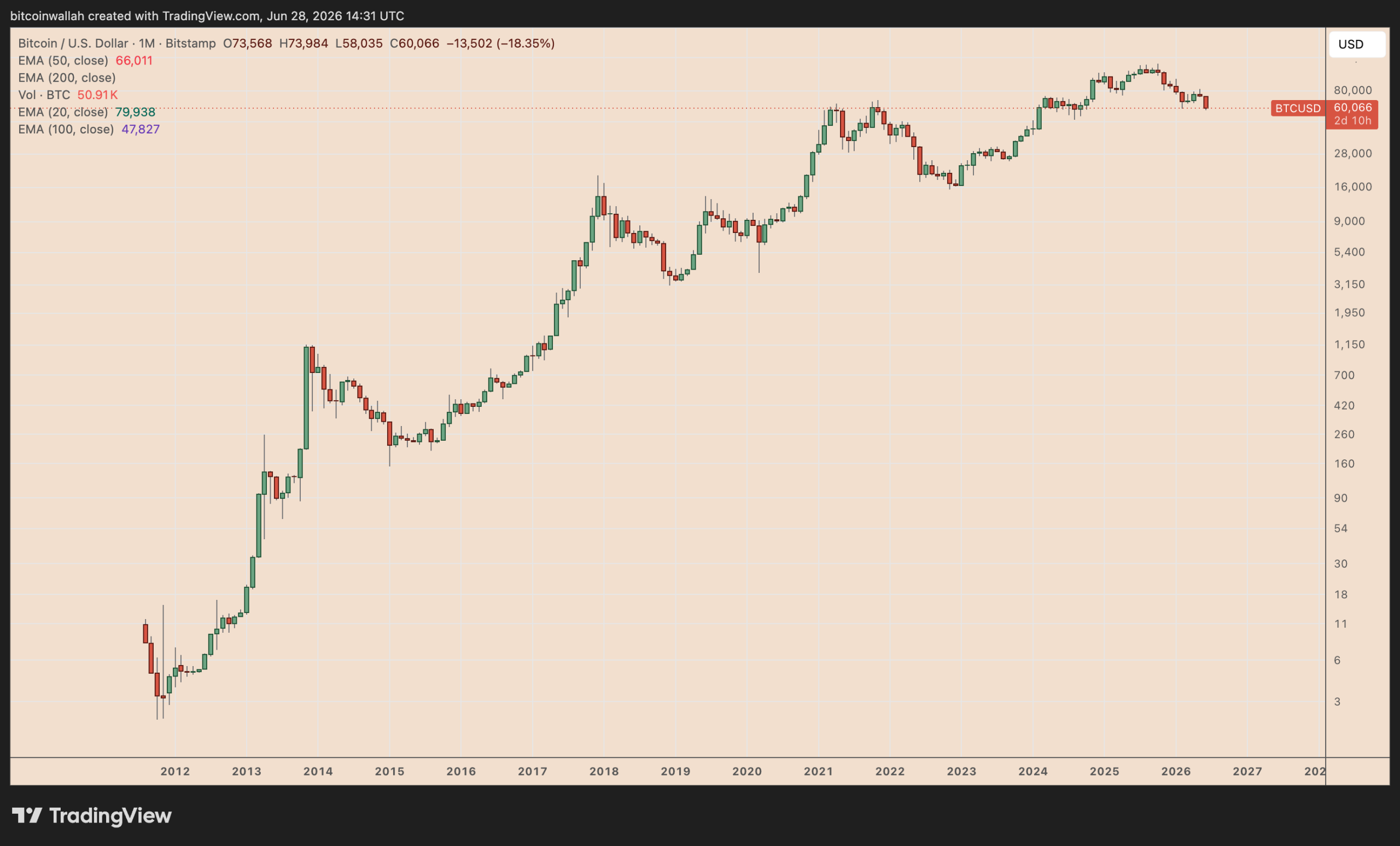
Bitcoin (BTC) is heading for its worst monthly loss since mid-2022, with BTC down roughly 18.5% in June as price struggles to hold the psychological $60,000 support level.
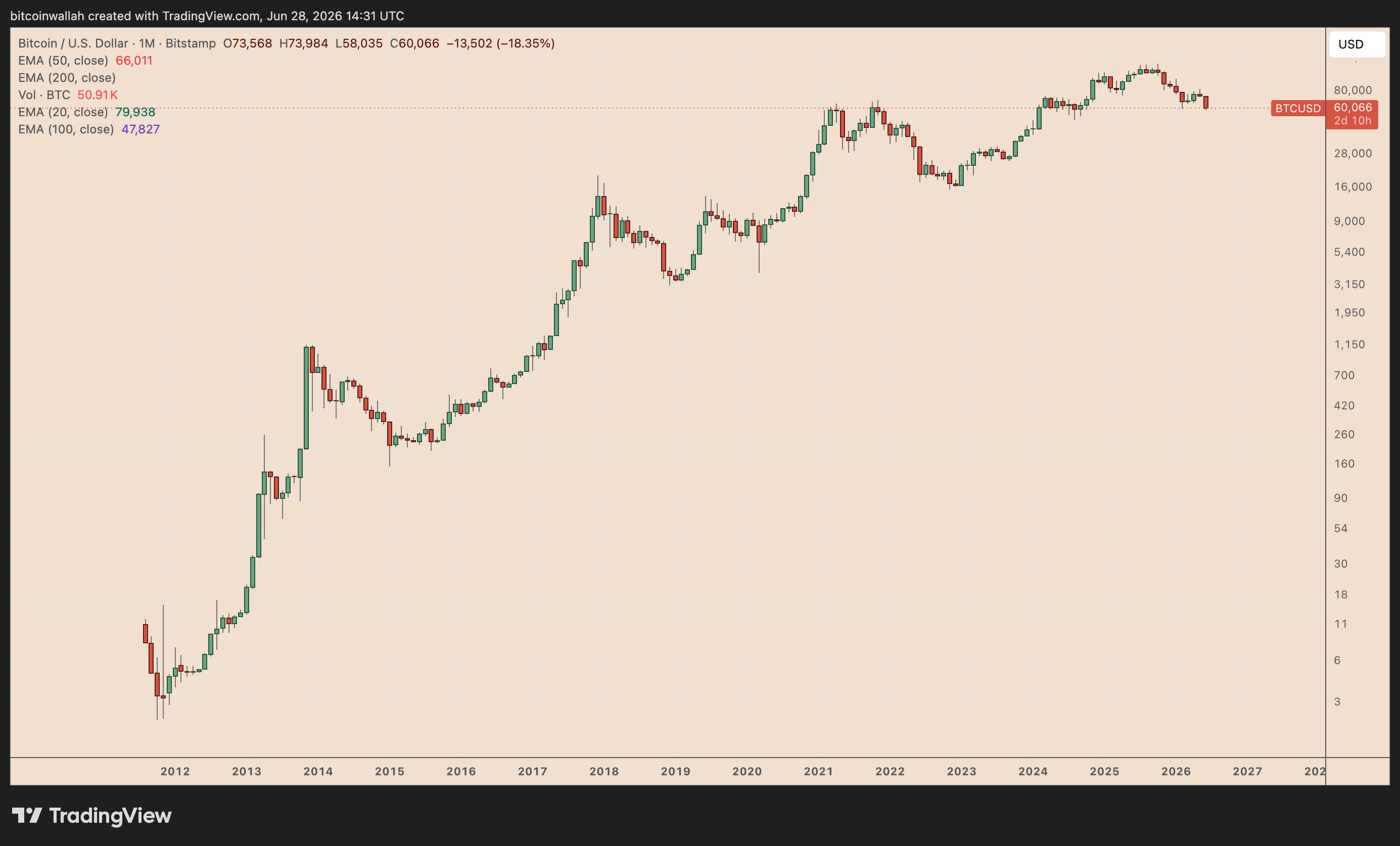
BTC/USD monthly chart. Source: TradingView
Will Bitcoin’s downside momentum extend in July, or is BTC preparing for a recovery?
Key takeaways:
- Bitcoin’s liquidity map shows a major short-liquidation “magnet zone” near $67,600.
- BTC has historically gained 7.6% on average in July, while midterm-year seasonality points to an even stronger 10.3% average return.
Bitcoin may hit $75,000 in July
July may become a “bullish month for Bitcoin,” according to analyst Fleh, who predicted BTC price to rally toward $75,000 next month.
The bullish thesis is based on Bitcoin’s Binance BTC/USDT liquidation heatmap, which shows a large concentration of short liquidation levels sitting above the current price.
On the monthly chart, the strongest visible liquidity cluster sits near $67,645, where the chart shows around $247.39 million in liquidation leverage and roughly $2.26 billion in cumulative short liquidation leverage.
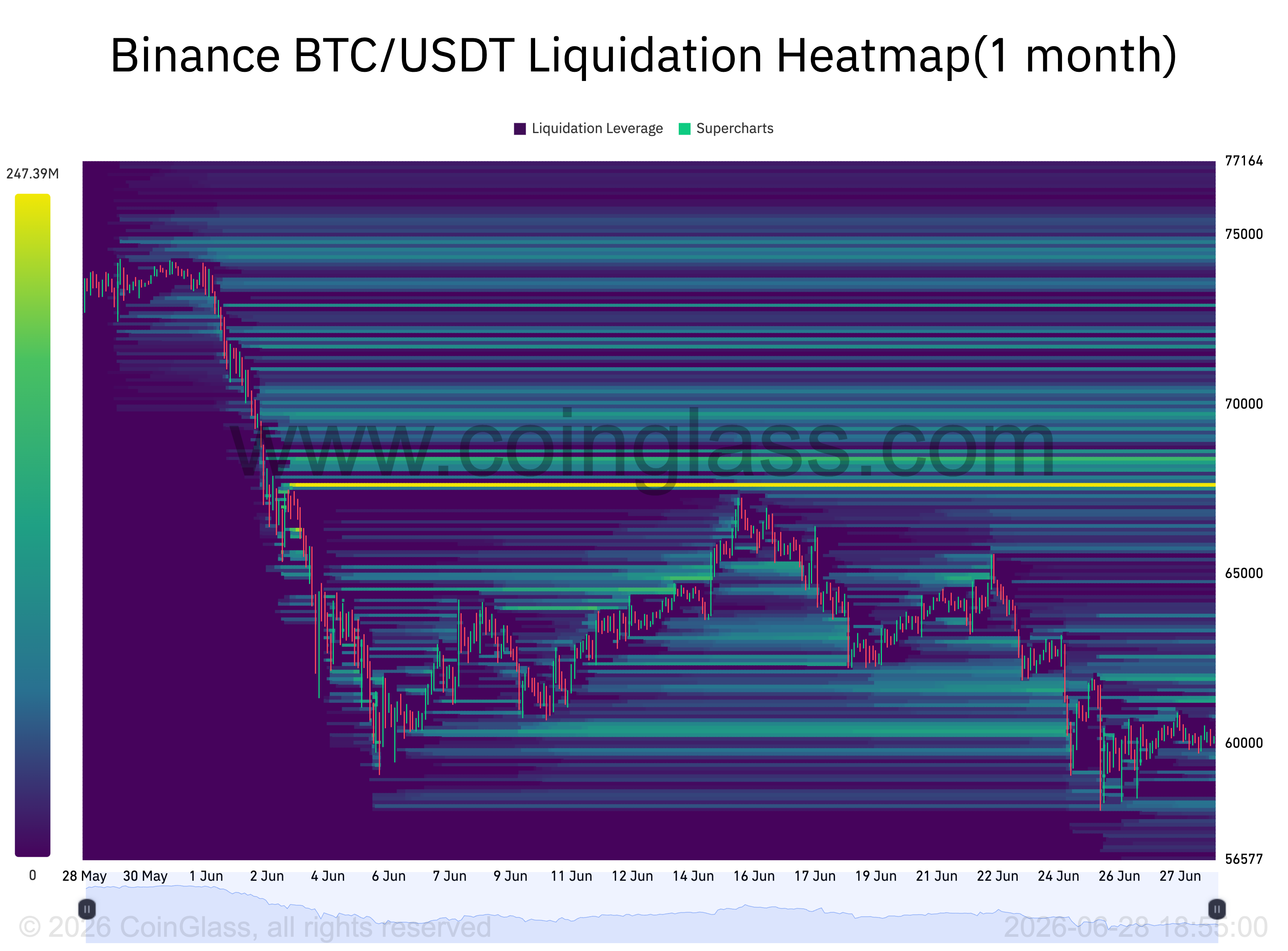
Binance BTC/USDT liquidation heatmap (1 month). Source: CoinGlass
For beginners, such clusters are often called “magnet zones.” When many leveraged positions are concentrated around the same price area, the market can move toward that zone because liquidations create forced buying or selling pressure.
In this case, significant liquidity sits above Bitcoin’s current price near $60,000.
If BTC rebounds and pushes toward $67,600, short sellers may be forced to close their positions. Since closing shorts requires buying Bitcoin back, that can add fresh upside pressure and fuel a short squeeze.
“I think $BTC bottoms here at 60k for now, targeting 75k to the upside before any chance of lower,” Fleh said in a Saturday post.
BTC rises 7.6% on average in July
Bitcoin’s historical monthly returns also support Fleh’s bullish July outlook.
BTC has returned a 7.6% gain on average in July, making it one of its stronger months after a typically weaker June, which shows an average return of -1.40%, according to CoinGlass data highlighted by analyst CGT_Trader.
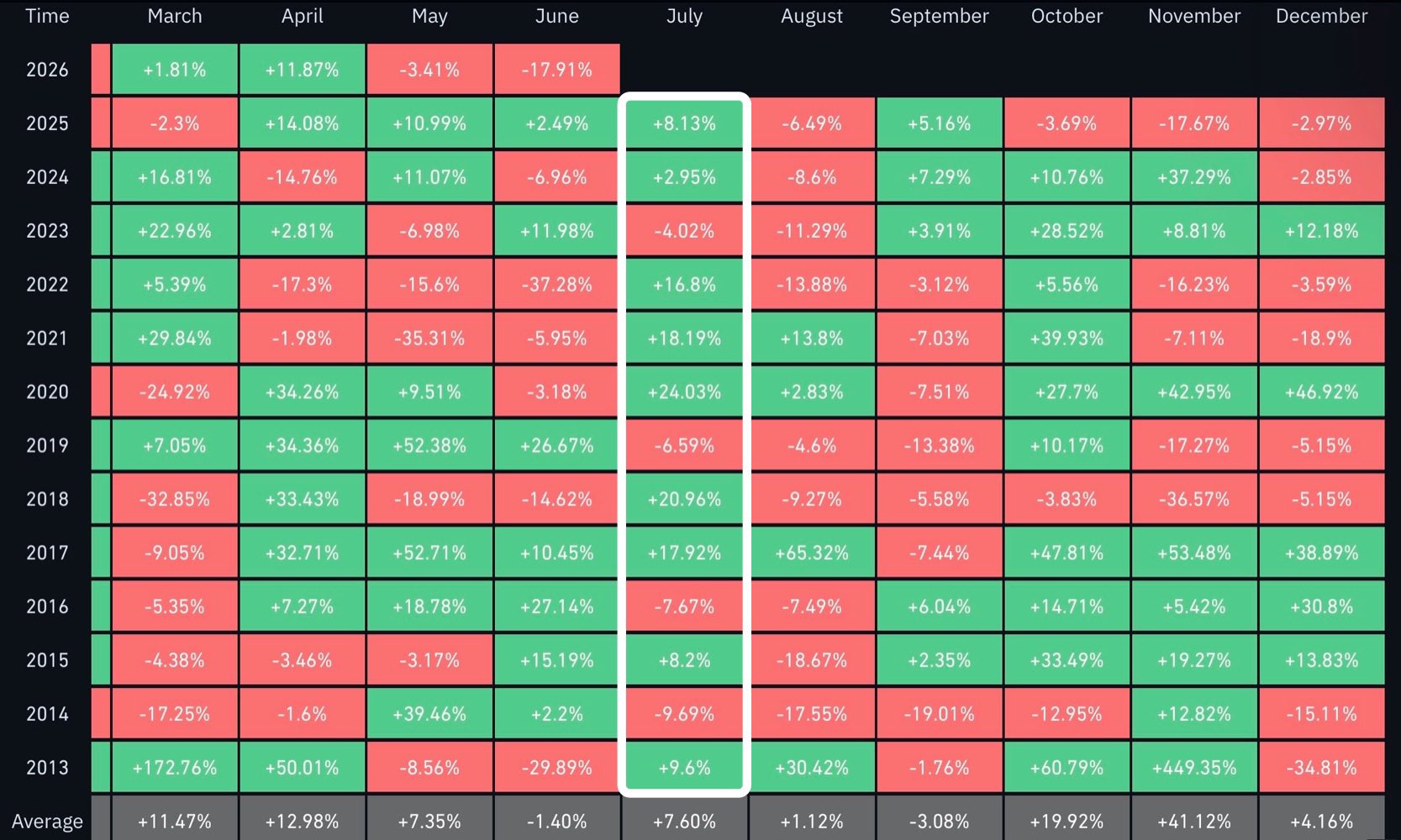
Bitcoin monthly returns tracking the July performance in since 2013. Source: CoinGlass/CGT_Trader
The trend has appeared even during bear market years.
For instance, Bitcoin rose 20.96% in July 2018 and 16.8% in July 2022. More recently, BTC gained 2.95% in July 2024 and 8.13% in July 2025, strengthening the case for another green month ahead.
A separate midterm-year seasonality chart also shows that- Bitcoin has averaged a 10.3% gain during the month, its strongest monthly return in such years.
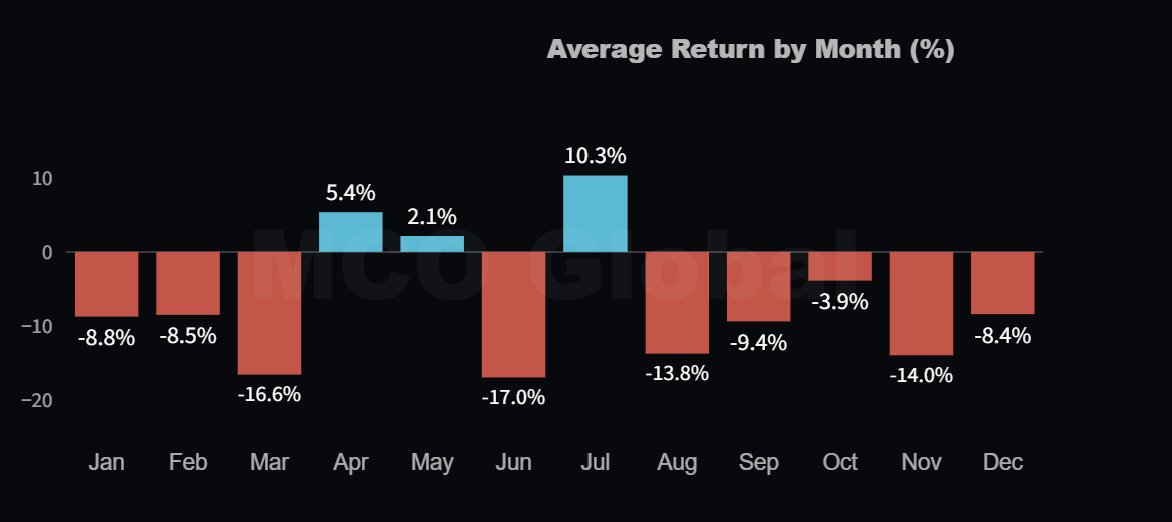
Bitcoin performance by month during US mid-term election years. Source: More Crypto Online
That compares with an average 17% loss in June, pointing to the possibility of a post-sell-off mean-reversion bounce.
Based on Bitcoin’s current price near $60,000, its historical July average return of 7.6% projects a move toward roughly $64,500, while the stronger midterm-year average of 10.3% points to about $66,100.
A repeat of Bitcoin’s bear-market July rebounds from 2022 and 2018 would put BTC between $70,000 and $72,500, while a 2020-style July rally would bring Fleh’s $75,000 target within reach.
BTC’s dip below the 200-week SMA may extend slide
Bitcoin’s ongoing drop below its 200-week simple moving average (200-day SMA, the blue line) near $62,445 raises the risk of further downside in July.
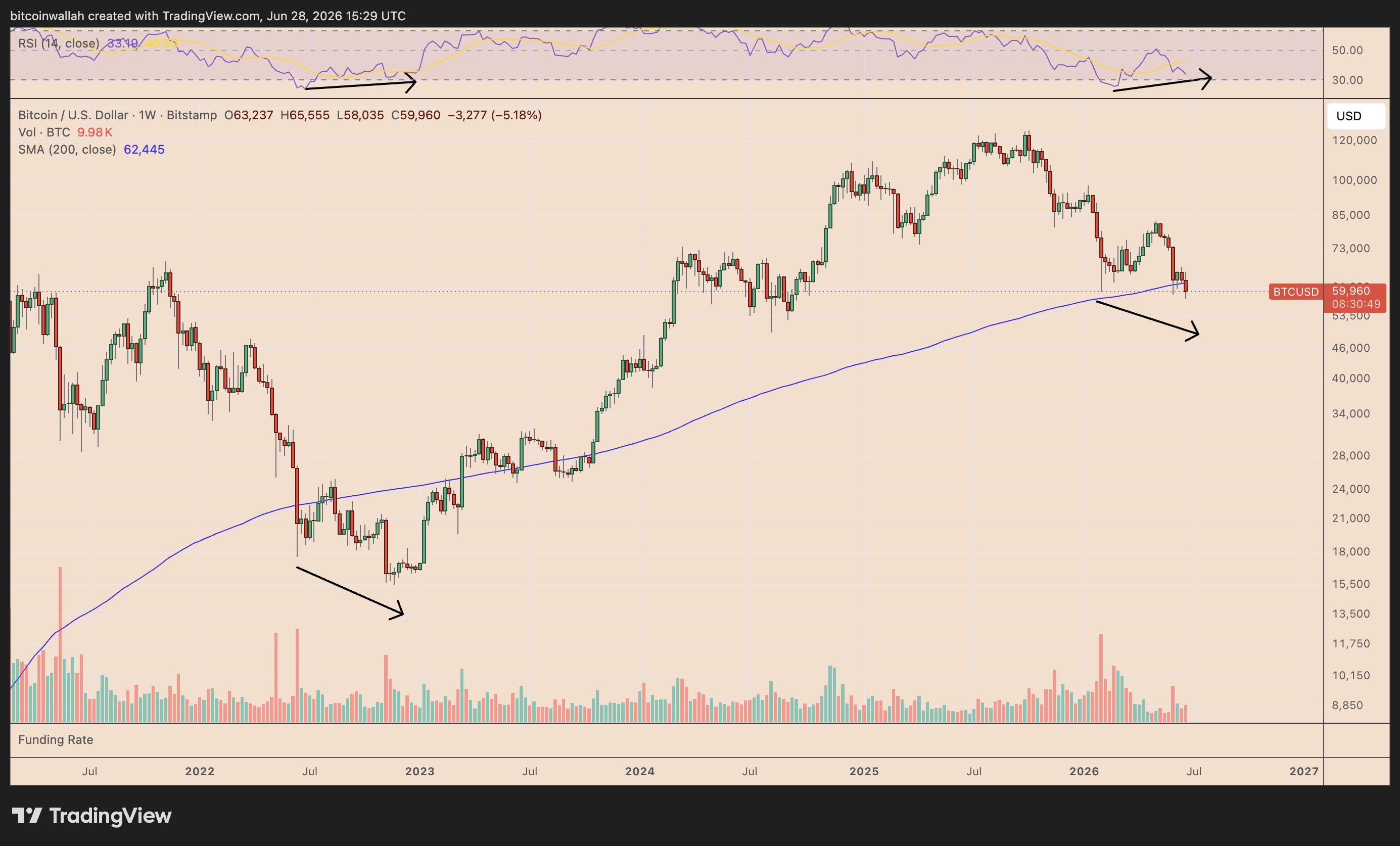
BTC/USD weekly chart. Source: TradingView
A similar loss of long-term moving-average support preceded deeper weakness during the 2022 bear market, when BTC continued lower before forming a bottom.
Related: Bitcoin faces fresh capitulation risk as 50K BTC moved at a loss
Bitcoin’s bear flag breakdown raises the odds of a price decline toward $55,000 in July unless BTC quickly reclaims the 200-day SMA.
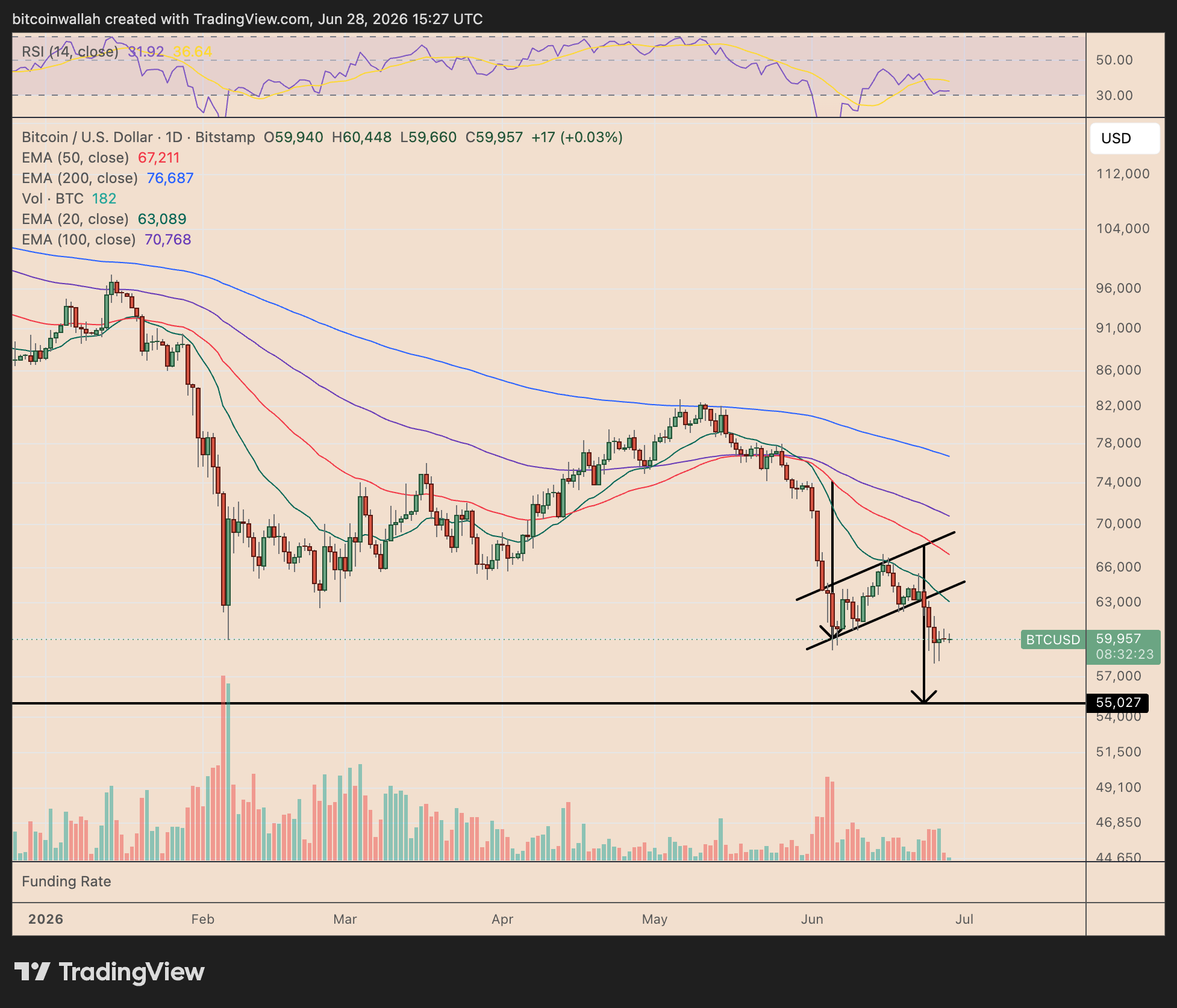
BTC/USD daily chart. Source: TradingView

The European Banking Authority on Friday unveiled a sweeping framework to penalize cryptocurrency issuers that violate the European Union’s digital-asset laws, signaling a tougher enforcement stance as the trade bloc finalizes its historic regulatory architecture.
The consultation paper published June 26 establishes a standardized playbook for hitting non-compliant issuers of what the EBA considers “significant” tokens with potentially multimillion-euro penalties. Under the proposal, the Paris-based watchdog will deploy a strict two-step process to determine fines, assessing the baseline severity of an infraction before factoring in aggravating or mitigating behavior.
The move represents the sharpening of teeth for the EU’s landmark Markets in Crypto-Assets (MiCA) regulation. Introduced to bring order to a historically freewheeling sector, MiCA is the world’s first comprehensive regulatory regime for digital assets, forcing token issuers and crypto service providers to operate with bank-like compliance, consumer protections and capital reserves if they want access to the single European market.
The stakes for non-compliance are explicitly designed to be punitive. According to the EBA’s consultation paper, final penalties could reach statutory ceilings of 12.5% of annual turnover for issuers of significant asset-referenced tokens and 10% for significant e-money tokens, or two times the profits generated by the violation, caps meant to deter even the largest global digital-asset operators.

Cover screenshot of European Banking Authority’s 14-page consultation paper.
Source: EBA
The roll-out of the penalty framework comes at a critical juncture for Europe’s digital asset industry, landing just days ahead of a crucial July 1 deadline. By the start of next month, cryptocurrency firms must have secured formal licenses from national regulators to legally offer their services or market stablecoins within the 27-nation bloc, ending a transitional grace period that allowed many operators to function under looser local rules.
Related: Binance faces EU service limits next week as MiCA rules take effect
Firms that fail to secure their regulatory passports by July 1 face the prospect of being forced to halt operations entirely or risk triggering the exact infractions, such as unauthorized public disclosures or organizational failures, that the EBA’s new framework is built to penalize.
Binance pushes “pause” on EU operations after license fail
The world’s biggest exchange operator, Binance, last week notified European Union users that access to key services will be restricted after the exchange failed to secure MiCA authorization from a member state before the July 1 deadline after it withdrew its MiCA license application in Greece.
Those restrictions include halting the onboarding of new EU users and limiting certain services for EU-based accounts effective July 1, according to exchange notices shared by users on social media.
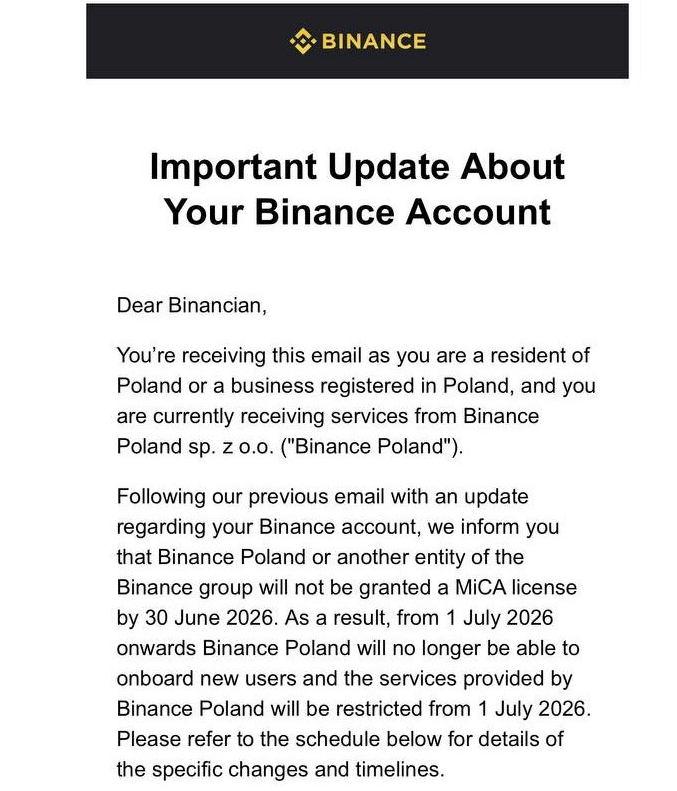
Notice sent by Binance to customers in Poland. Source: IT_Tech_PL
The notices said users will still be able to withdraw their assets after that date, stating that “all digital assets are still available for withdrawal,” in line with applicable regulatory requirements.
Binance recorded $1.96 billion in daily net outflows on Wednesday, following its withdrawal announcement, according to DefiLlama data viewed by Cointelegraph on Sunday. The exchange then saw another $2.52 billion and $1.46 billion in net outflows over the following two days.
EU move shows sharp contrast with US enforcement approach
The timing underscores the European Union’s broader strategy to position itself as the dominant global standard-setter for digital finance, contrasting sharply with the regulation-by-enforcement approach seen in the United States. By laying out clear financial penalties right as the licensing mandate takes effect, authorities in Brussels are telling the market that the era of leniency is officially over.
The industry now has a three-month consultation window ending September 28 to lobby for changes to the EBA’s penalty methodology. However, with the July 1 licensing cliff edge just days away, executives will have to navigate an unforgiving compliance environment long before the final fining guidelines are formalized under law.
Pi Network lets tens of millions of people “mine” crypto by tapping a button on their phone once a day, with no hardware, no electricity bill, and no drained battery. That sounds too easy to be real mining, and in a sense it is not. Here is what Pi mining actually does, how the Stellar Consensus Protocol underneath it works, and what your daily tap really secures.
Summary
- Pi mining is not computational mining in the Bitcoin sense; it is a daily check-in that distributes PI tokens and feeds a trust graph the network uses to reach agreement.
- Pi runs on a version of the Stellar Consensus Protocol, a Federated Byzantine Agreement system that reaches consensus through overlapping groups of trusted participants instead of energy-intensive proof-of-work.
- Mobile users contribute their trust relationships through Security Circles, while the actual transaction validation runs on computer nodes, not on phones.
- There are four roles, Pioneer, Contributor, Ambassador, and Node, and the daily tap mainly proves you are a real human and keeps your token rewards flowing.
- The model trades the energy cost and hard security guarantees of proof-of-work for accessibility, and it depends on honest trust circles and a node network that is still maturing.
Pi mining is the process by which Pi Network distributes its PI tokens to users who confirm their participation through a mobile app and contribute trust relationships to the network, rather than by solving the energy-intensive computational puzzles that power Bitcoin mining. That distinction is the single most important thing to understand about Pi, because the word “mining” carries heavy baggage from Bitcoin, where it means racing thousands of specialized machines to solve cryptographic problems and consuming enormous amounts of electricity in the process. Pi uses the same word for something almost entirely different. A Pi user opens an app once every 24 hours, taps a button, and is credited with newly minted PI.
No puzzle is solved, no hardware is strained, and no meaningful electricity is consumed. This has made Pi one of the most-downloaded crypto apps in the world, with tens of millions of users, and also one of the most debated, because the obvious question is how something so effortless can be called mining at all, and what, if anything, the daily tap actually accomplishes. The answer lies in the consensus mechanism Pi is built on, a system called the Stellar Consensus Protocol, and in a reframing of what “mining” means. In Bitcoin, miners contribute energy and computation to secure the ledger, and they are rewarded for it; in Pi, the contribution is different.
Users supply trust relationships, vouching for people they know, and those relationships aggregate into a structure the network uses to agree on which transactions are valid. This guide explains how that works from the ground up. It covers why Pi rejected proof-of-work in the first place, how the Stellar Consensus Protocol reaches agreement without energy-intensive competition, what Security Circles are and how they feed the network, the four roles a participant can play, what the daily tap genuinely does as opposed to what users often assume, a worked example of how one person’s activity flows into consensus, why the mining rate falls over time, and the criticisms and limits that any honest account has to include. By the end you will understand both the clever idea at the heart of Pi and the real questions that surround it.
What Pi mining actually is
Begin by stripping the word “mining” of its Bitcoin associations, because they cause most of the confusion. In Bitcoin, mining is the work of validating transactions and securing the ledger by solving cryptographic puzzles, and the energy spent doing it is what makes the network hard to attack. Pi mining is not that. When a Pi user taps the lightning button in the app, the phone does not solve anything, does not validate transactions, and does not run any heavy computation.
What the tap does is twofold: it signals that the user is a real, active human participating in the network, and it keeps that user eligible to receive newly distributed PI tokens. In Pi’s own framing, mining is the act of making a contribution to the consensus algorithm in order to secure the ledger, in exchange for rewards, but the contribution a mobile user makes is not energy. It is trust. That is why Pi mining is better understood as a combination of two things: a distribution mechanism and a trust-gathering mechanism.
As a distribution mechanism, it is the way PI tokens are handed out fairly to a large population without requiring anyone to buy expensive equipment, which is the project’s central pitch of accessibility. As a trust-gathering mechanism, the daily check-in and the connections a user makes feed into the network’s way of telling real participants apart from bots, which matters because a system that gives away tokens to anyone who taps a button needs some defense against people creating thousands of fake accounts to farm rewards. The daily tap, and especially the trust relationships a user builds, serve that defense. This is why Pi places so much emphasis on identity verification and on the social connections between users: the whole model rests on being able to distinguish genuine humans from fake ones, and the “mining” activity is partly how it gathers the raw material to do that.
Calling it mining is a marketing choice that borrows Bitcoin’s vocabulary, but mechanically it is closer to a daily proof-of-participation than to anything involving computation. For readers comparing the two models, the model Pi rejected is proof-of-work, where miners expend computation and electricity to secure the chain. Pi’s design replaces that energy cost with a trust-based participation model. The tradeoff is accessibility on one side and a different set of security assumptions on the other.
Why Pi does not use proof-of-work
To understand why Pi works the way it does, you have to understand what it is reacting against. Bitcoin and similar cryptocurrencies use a consensus mechanism called proof-of-work, in which participants called miners compete to solve a difficult mathematical puzzle, and the first to solve it gets to add the next block of transactions and earn a reward. Proof-of-work is genuinely secure and has protected Bitcoin for over a decade, but it has two consequences that Pi’s founders saw as barriers. The first is energy: the global competition to solve puzzles consumes vast amounts of electricity, which is both an environmental concern and a cost.
The second is access: because the competition rewards raw computing power, serious mining requires specialized, expensive hardware and cheap electricity, which puts it out of reach of ordinary people and concentrates it among well-resourced operators. Pi Network was founded by two Stanford researchers, Nicolas Kokkalis and Chengdiao Fan, with the explicit goal of making cryptocurrency accessible to anyone with a smartphone, and proof-of-work was incompatible with that goal. A system that demands costly hardware and large electricity bills cannot, by design, be opened to billions of ordinary phone users. So Pi needed a fundamentally different way of reaching consensus, one that did not depend on burning energy or owning powerful machines, while still allowing the network to agree on a single, valid history of transactions without a central authority in charge.
That requirement led the project to a different family of consensus mechanisms, one built not on computational competition but on trust between participants. The choice it landed on was the Stellar Consensus Protocol, and understanding it is the key to understanding everything Pi does, because it is what allows a phone tap to stand in for the energy a Bitcoin miner would otherwise spend. Pi’s own explanation of mobile mining also frames the design this way, saying its consensus algorithm is adapted from SCP and Federated Byzantine Agreement rather than proof-of-work. The shift from work to trust is the core design decision behind Pi mining.
The Stellar Consensus Protocol, explained
The Stellar Consensus Protocol, usually shortened to SCP, is a way for a decentralized network to agree on the state of a shared ledger without proof-of-work, and it was created by David Mazières, a computer scientist associated with the Stellar blockchain. Its underlying model is called Federated Byzantine Agreement, and the core idea is a genuine departure from how Bitcoin works. Instead of every participant competing, or relying on a fixed, predetermined set of validators chosen by a central authority, each participant in an SCP network decides for itself which other participants it trusts. The set of validators that a given participant chooses to trust is called its quorum slice.
Crucially, no central body assigns these trust relationships; each node selects its own, which is what makes the system both open and decentralized. Consensus then emerges from the overlap of these individual trust choices. When enough of the participants that a node trusts, and enough of the participants they in turn trust, all agree on a transaction or a block, that agreement propagates across the network until a global decision forms. In plainer terms, nodes reach agreement by exchanging messages and aligning with the peers they trust, and because trust relationships overlap and interlock across the whole network, a decision that begins locally spreads until the entire system converges on it.
There is no puzzle to solve and no energy to burn; the security comes from the structure of overlapping trust rather than from computational work. This is why the Stellar Consensus Protocol can run on modest hardware and reach agreement quickly with low energy use, which is exactly the property Pi needed. The protocol has well-studied properties of open membership, flexible trust, and fast, low-bandwidth messaging, and it is a real, respected approach to consensus, not something Pi invented. What Pi did was adapt SCP and layer on top of it a way to gather the trust relationships from a mass of ordinary mobile users, which is where Security Circles come in.
Security Circles and the global trust graph
The bridge between millions of phone users and the Stellar Consensus Protocol is a feature called the Security Circle. Each Pi user is encouraged to build a Security Circle by adding a small number of people, typically three to five, whom they personally know and trust. This is a deliberately human act: you are vouching for specific individuals, asserting that they are real people you have reason to trust. On its own, one person’s Security Circle is a tiny thing, a handful of trust links.
But Pi’s design aggregates every user’s Security Circle into a single, enormous structure called the global trust graph, a map of who trusts whom across the entire network of tens of millions of users. This global trust graph is what feeds Pi’s consensus mechanism, and it is the mobile user’s actual contribution. Where a Bitcoin miner contributes energy, a Pi mobile user contributes trust relationships and the active, daily confirmation of them. The individual Security Circles become the raw material from which the network builds its quorum slices, the overlapping trust sets that the Stellar Consensus Protocol uses to reach agreement.
The graph also serves a defensive purpose that is central to Pi’s whole proposition. Because the network distributes tokens to participants, it is a tempting target for people who would create armies of fake accounts to harvest rewards, an attack known as a Sybil attack. The trust graph is Pi’s main defense: if real humans only add other real humans they know to their circles, then fake accounts struggle to embed themselves in the web of genuine trust, and the network can prioritize the accounts that sit within dense, authentic trust relationships over isolated or suspicious ones. This is why the social dimension of Pi is not incidental but foundational, and why Pi’s identity-based design belongs in the broader debate about proving real humans in crypto.
The security of the whole system is meant to rest on the authenticity of the trust relationships that ordinary users build, which is also one of the model’s most debated features. If users build careful circles with people they genuinely know, the graph can become a useful Sybil-resistance layer. If users add strangers just to boost earnings, the quality of the graph weakens. That tension is central to understanding both Pi’s accessibility and its open questions.
The four roles: Pioneer, Contributor, Ambassador, and Node
Pi organizes participation into four roles, and understanding them clarifies who does what in the network. The most basic role is the Pioneer, which is simply a user who opens the app once every 24 hours and taps the button to confirm they are a real, active human and not a bot. Pioneers are the foundation of the user base, and the daily check-in is the minimum act of participation that keeps a user earning. The Pioneer role, on its own, does not validate transactions or secure the ledger in any direct technical sense; it confirms presence and keeps the rewards flowing.
The second role is the Contributor, which is a user who actively builds a Security Circle by adding trusted people. This is the role through which a user supplies the trust relationships that feed the global trust graph, so Contributors are the ones doing the work that actually matters for the consensus mechanism, even though that work consists of nothing more technical than choosing which people to vouch for. The third role is the Ambassador, a user who grows the network by referring new members, typically rewarded with a boost to their earning rate for doing so. Ambassadors expand the network’s reach, though, as critics point out, referral-based growth is also the feature that draws comparisons to multi-level marketing.
The fourth and most technically significant role is the Node. Node operators run Pi’s node software on a computer, not a phone, and it is these computer nodes that perform the heavy lifting of actually running the consensus algorithm and validating transactions, using the trust graph that all the mobile users have collectively built. The four roles together describe a division of labor: Pioneers prove they are real and keep earning, Contributors supply trust, Ambassadors grow the network, and Nodes do the actual computational work of reaching consensus. Recognizing that the validation happens at the Node level, not on phones, is essential to understanding what mobile “mining” really is.
What the daily tap really does
Here is the honest core of how Pi mining works, the part that promotional descriptions tend to blur. When you tap the button each day as a Pioneer, you are not validating transactions, you are not running the consensus algorithm, and you are not securing the ledger in the way a Bitcoin miner secures Bitcoin. What you are doing is two specific things. First, you are confirming that you are a real human who is actively present, which keeps your account in good standing and keeps you eligible to receive PI.
Second, through your Security Circle and your ongoing confirmation of those trust links, you are contributing to the global trust graph that the network’s computer nodes use to reach consensus. Your phone is a source of trust data, not a validator. The crucial point, in Pi’s own words, is that the heavy lifting of running the consensus algorithm based on the trust graph still falls to computer nodes. The mobile phones create and confirm the trust relationships; the nodes use those relationships to do the actual work of validating transactions and securing the ledger.
So when a Pi user says they are “mining,” what is really happening is that they are feeding the security model with trust and keeping their reward stream active, while the computational securing of the network happens elsewhere, on the node layer. This is not a criticism so much as a clarification, because it explains both why Pi mining can be so effortless and why it is so different from what most people picture when they hear the word mining. The effortlessness is real because the user truly is not doing computational work. The contribution is real too, but it is a contribution of trust and presence, not of energy or computation.
Understanding this distinction is the difference between thinking you are personally securing a blockchain with your phone and understanding that you are providing one input, trust, into a system whose actual validation happens on computers run by node operators. That is also why “mining” in Pi should not be evaluated with the same checklist as Bitcoin mining. The daily tap is closer to proof of participation and identity maintenance than to proof-of-work. The right question is not whether the phone solves blocks, because it does not, but whether the trust graph and node layer mature enough to secure a real network.
A worked example: how one Pioneer’s activity flows into consensus
To make this concrete, follow a single user through a day. Imagine a Pioneer named Maria who has had the Pi app for a few months. Each morning she opens the app and taps the lightning button, which starts a 24-hour earning cycle and credits her with PI at her current rate. That tap, on its own, simply tells the network that Maria is a real, active human and keeps her rewards flowing.
So far, nothing about the ledger has changed; Maria has only confirmed her presence. The part that feeds the network is Maria’s Security Circle. Some weeks ago, Maria added five people she knows personally, her sister, two close friends, a coworker, and a former classmate, to her Security Circle, vouching for each as a real, trustworthy person. Those five trust links are Maria’s contribution to the global trust graph.
When the network’s computer nodes run the Stellar Consensus Protocol to agree on the next set of transactions, they draw on the vast web of trust relationships that Maria and tens of millions of other users have built. Maria’s five links are a tiny but real part of the overlapping trust sets, the quorum slices, that the nodes use to reach agreement, and because Maria’s circle connects to her contacts’ circles, which connect to theirs, her small contribution is woven into the larger structure that lets the whole network converge on a shared, valid history. If Maria also chose to run node software on her computer, she would move into the Node role and take part directly in the validation work; as a Pioneer with a Security Circle, she instead supplies trust that the nodes consume. The reward she receives for her daily tap is, in effect, payment for her presence and her trust contribution.
This is the full loop of Pi mining at the level of one person: tap to prove presence and earn, build a circle to contribute trust, and let the node layer turn that aggregated trust into consensus. The example also shows why Pi’s model is both accessible and contested. Maria did not need an ASIC miner, a warehouse, or a power contract, which is the whole point. But the quality of her contribution depends on the authenticity of her trust choices, and the strength of the network depends on millions of similar choices being honest.
The mining rate and why it falls
A practical feature that surprises many new users is that the rate at which they earn PI is not fixed; it falls over time, by design. Pi built in a declining emission schedule loosely modeled on the way Bitcoin’s block reward halves over time, intended to create scarcity as the network grows. In Pi’s history, the base mining rate has dropped sharply at population milestones: it halved as the network crossed 1 million users, halved again at 10 million, and has continued to decline as the user base has grown into the tens of millions. A Pioneer today earns a small fraction of what early users earned for the same daily tap.
The logic is that rewarding early participants more generously bootstraps the network, while tapering rewards as it grows prevents the supply from expanding too fast and preserves some scarcity. On top of the declining base rate, a user’s actual earnings are shaped by multipliers tied to the roles described earlier. Building a Security Circle increases your rate, referring new users as an Ambassador adds a boost, engaging with apps in the ecosystem can contribute, and some users choose to lock up their PI for a period in exchange for a higher rate. So two users tapping on the same day can earn quite different amounts depending on how much they have contributed to the network’s trust and growth.
All of this sits against the backdrop of Pi’s very large maximum supply, on the order of 100 billion tokens, of which only a portion is currently in circulation. That large supply, combined with the way new tokens enter the market as users complete verification and move their balances onto the live network, is a structural factor that weighs on the token’s price, a dynamic worth keeping in mind alongside the mechanics of how the mining itself works. For readers following the market side, how mined Pi reaches the market explains why unlocks, migration, and supply absorption matter after tokens become transferable. The declining rate is, in part, the project’s attempt to manage that supply, rewarding participation while trying not to flood the market.
Risks, criticisms, and what mining really secures
An honest explanation of Pi mining has to address the genuine criticisms and limits, because they go to the heart of what the model is and is not. The most fundamental point, already noted, is that mobile “mining” does not secure the ledger the way proof-of-work does. The daily tap proves presence and feeds the trust graph, but the actual validation runs on computer nodes, and the security of the whole system rests on the trust graph being authentic and on the node network being sufficiently decentralized and robust. That leads directly to the central criticism: the trust-based security model is debated.
Its strength depends on real humans adding only other real humans to their circles, and skeptics question how reliably that holds at a scale of tens of millions of users, and how resistant the system truly is to manipulation if trust links can be gamed. Centralization is another recurring concern. For much of its life Pi has operated with significant control held by its founding team and foundation, including over key aspects of the network and the pace of its decentralization, which sits uneasily with the decentralized ideal that the consensus model is meant to embody. The node network that does the real validation is still maturing, and the degree to which it is truly decentralized is a fair question.
Critics also point to the referral mechanics, the Ambassador role and its rewards for recruiting new users, as resembling the structure of multi-level marketing, where growth is driven by recruitment, and they note that the long period during which Pi could be mined but not traded or used invited skepticism about whether the tokens would ever have real value. There are technical limits too, including questions about the network’s transaction throughput and its capacity to serve a user base of its claimed size. None of this means Pi is necessarily a scam, a charge its supporters reject by pointing to its real technical development and large verified community, but it does mean a clear-eyed user should understand exactly what their daily tap does and does not accomplish. You are not single-handedly securing a blockchain with your phone.
You are providing trust and presence to a system whose validation happens on a node network, in exchange for tokens whose ultimate value depends on the project delivering real utility and decentralization over time. That is the honest picture of what Pi mining secures, and what it does not. For price-focused readers, where the mined token trades is a separate question from how the mining mechanism works. For consensus comparisons, another way networks reach consensus shows how other systems use locked capital rather than proof-of-work or Pi’s trust graph.
Frequently asked questions
Is Pi mining real cryptocurrency mining?
Not in the way Bitcoin mining is. Bitcoin mining involves solving cryptographic puzzles with specialized hardware, consuming large amounts of energy, to validate transactions and secure the ledger. Pi mining involves tapping a button in an app once a day, which solves nothing and consumes no meaningful energy. What the tap does is prove you are a real, active human and keep you eligible for PI rewards, while the trust relationships you build feed the network’s consensus mechanism.
The actual transaction validation runs on computer nodes, not phones. So Pi uses the word mining, but mechanically it is closer to a daily proof-of-participation than to computational mining.
What is the Stellar Consensus Protocol?
The Stellar Consensus Protocol, or SCP, is a way for a decentralized network to agree on a shared ledger without proof-of-work, created by computer scientist David Mazières. It uses a model called Federated Byzantine Agreement, in which each participant chooses for itself which other participants it trusts, forming what is called a quorum slice. Consensus emerges when these overlapping trust choices align across the network, so a decision spreads until the whole system converges on it. Because security comes from the structure of overlapping trust rather than from computational work, SCP uses little energy and can run on modest hardware, which is why Pi adapted it for mobile use.
What does tapping the button actually do?
Two things. First, it confirms you are a real human who is actively present, which keeps your account in good standing and your PI rewards flowing. Second, combined with your Security Circle, it contributes to the global trust graph that the network’s computer nodes use to reach consensus. What it does not do is validate transactions or secure the ledger directly; your phone is a source of trust data, not a validator.
In Pi’s own description, the heavy lifting of running the consensus algorithm falls to computer nodes, while mobile users supply the trust relationships those nodes rely on. So the tap is about presence and trust, not computation.
What is a Security Circle?
A Security Circle is a small group of people, typically three to five, whom a Pi user personally knows and trusts and adds to their account, vouching for them as real, trustworthy individuals. On its own a Security Circle is just a few trust links, but Pi aggregates every user’s circle into a single global trust graph spanning the whole network. That graph is the mobile user’s real contribution: it feeds the consensus mechanism and serves as the network’s main defense against fake accounts, since genuine humans adding only other genuine humans makes it harder for bot armies to embed themselves in the web of authentic trust. The social authenticity of these circles is foundational to Pi’s security model.
Why does my Pi mining rate keep dropping?
By design. Pi built in a declining emission schedule, loosely modeled on Bitcoin’s halving, to create scarcity as the network grows. The base rate has halved at population milestones, dropping as the network passed 1 million and then 10 million users, and continuing to fall as it reached the tens of millions, so a Pioneer today earns a fraction of what early users earned. Your actual earnings also depend on multipliers from building a Security Circle, referring users, engaging with the ecosystem, and optional lockups.
The declining rate is partly an attempt to manage Pi’s very large maximum supply of around 100 billion tokens, rewarding early participation while trying to limit how fast new supply enters.
Is Pi Network legitimate, or is it a scam?
It is truly debated, and this guide does not resolve it. Supporters point to real technical development, the adaptation of a respected consensus protocol, and a large verified community as evidence that Pi is a serious project. Critics raise concerns about centralized control held by the founding team, the maturity and true decentralization of the node network, referral mechanics that resemble multi-level marketing, the long period when Pi could be mined but not used, and questions about the network’s technical capacity. A clear-eyed view is that Pi is a real project with real open questions, and that any user should understand exactly what their daily tap accomplishes and treat the token’s ultimate value as uncertain instead of assured.
This article is educational information, not financial advice. Details of Pi Network’s mechanics, mining rate, supply, and development reflect information available as of June 28, 2026, and can change. Pi Network is a debated project, and its token’s value and future remain uncertain. Verify current details from official sources and consider your own circumstances before participating or making any decision.
The past several months have not been kind to XRP. After it marked a new all-time high in mid-July 2025, it has been mostly downhill, losing over 70% of its value, dumping toward $1.00, being surpassed by BNB and USDC in terms of market cap, and registering six consecutive months in the red at one point.
Amid all of these adverse developments, some analysts have turned highly bearish on the asset. While the dominant belief is that XRP has reached its most crucial moment during this cycle, some, such as Ali Martinez, pointed to potential drops to the next crucial support levels at $0.80, $0.62, or $0.51 if the $1.00 floor gives in.
Glassnode warned that XRP token holders continue to realize more losses than profits, indicating intensifying selling pressure even among investors in the red. Even ChatGPT made some worrying predictions if the asset indeed flips $1.00 from support into resistance soon. But maybe such low sentiment is what is needed for XRP to turn things around.
Run Up Instead?
Paradoxically, history shows that the markets rarely reward such consensus. In fact, Warren Buffett has said it best, “Be fearful when others are greedy, and be greedy when others are fearful.”
Extreme pessimism has frequently appeared near important turning points across the crypto market. BTC, ETH, and XRP have all experienced periods where sentiment collapsed and remained there for a while before major recoveries began. This is generally possible when weak hands exited, and long-term investors quietly accumulated.
For XRP, this accumulation appears to be coming from ETF investors, as the funds tracking its performance have seen a green-only streak of eight consecutive weeks, while the BTC and ETH ETFs have bled out heavily.
The recent sell-off also pushed several on-chain and technical metrics into historically oversold territory. Some analysts argue that XRP may be approaching a zone where risk-reward begins to improve, even if short-term volatility persists.
History is indeed on XRP’s side. Recall that the asset’s sentiment had plunged to similar levels in mid-June but skyrocketed by double digits within 24 hours as the analytics company Santiment attributed that rally to the deteriorating investor behavior.
July Agrees
Current data show that XRP is on track to close June with a decline of over 20%, its worst monthly performance since February 2025. Data from CryptoRank suggests that this aligns with previous performances, as June has been a predominantly bearish month for the asset.
On the contrary stands July. XRP has closed each of the past six editions in the green, showing some impressive gains. Five out of the six have seen double-digit price increases, including massive 45%+ pumps in 2020 and 2023. The median gain for July stands at close to 11%.

The post Everyone Expects XRP to Crash Further: Is Ripple About to Surprise the Market? appeared first on CryptoPotato.


SBI Holdings is a financial services group with businesses spanning securities, banking, insurance, asset management and venture investing with a market capitalization of about $11 billion. The Tokyo-based company is one of Japan’s most active traditional-finance participants in digital assets, with stakes and partnerships across crypto trading, liquidity, tokenization, stablecoins and blockchain-based settlement.
Bitbank is one of the country’s largest licensed cryptocurrency exchanges, offering spot trading, custody and other digital-asset services to retail and institutional clients.
Cheaper, quicker to buy
Crypto mergers and acquisitions have remained brisk in 2026 as banks, payments firms and exchanges race to build regulated digital asset businesses rather than develop them in-house.
The industry has recorded 144 deals worth $11.8 billion so far this year, according to data from Architect Partners, with buyers increasingly targeting exchanges, custody providers, data firms and stablecoin infrastructure as regulatory clarity draws more institutional capital into the sector.
According to Payne, the Bitbank acquisition is about more than customer growth. The deal brings a Financial Services Agency-licensed exchange, one of Japan’s deepest altcoin liquidity pools and an institutional custody business, Japan Digital Asset Trust, giving SBI capabilities that would be far more costly and time-consuming to build internally.
The acquisition comes at a pivotal moment for Japan’s crypto industry. Legislation passed by the country’s lower house on June 11 would shift crypto assets under the Financial Instruments and Exchange Act, aligning them with securities regulation. The reforms lower the tax rate on crypto gains to a flat 20% and pave the way for spot bitcoin , ether (ETH) and XRP exchange-traded funds, while simultaneously imposing more stringent capital, custody and disclosure requirements on exchanges.


Mow is not the first to argue that bitcoin’s traditional four-year cycle has changed. After bitcoin climbed to a then-all-time high before the April 2024 halving, several analysts suggested growing institutional demand following the launch of U.S. spot bitcoin ETFs could alter the pattern that has historically followed each halving. Others, however, argued it was too early to conclude the cycle had changed.
$55,000 more likely
Not everyone agrees. Several analysts have recently argued that bitcoin is either close to a market bottom or still has further to fall, although they rely on different indicators and models.
CoinDesk market analyst Omkar Godbole recently wrote that if you were “wondering just how much lower bitcoin is likely to drop, the answer, at least according to one historically accurate contrarian indicator, is not much.”
That indicator is based on bitcoin’s 50-week and 100-week simple moving averages. The 50-week average, representing roughly one year, is very close to dropping below the 100-week line, forming what analysts call a “bear cross.” Historically, similar signals coincided with market bottoms, leading some analysts to see the pattern as bullish.
More recently, Markus Thielen, the founder of 10x Research, said he believes the bottom is more likely at $55,000 and not until somewhere between August and October. Arthur Hayes, the BitMex co-founder, took a more bearish position, saying bitcoin would bottom at around $40,000 within the next six months.
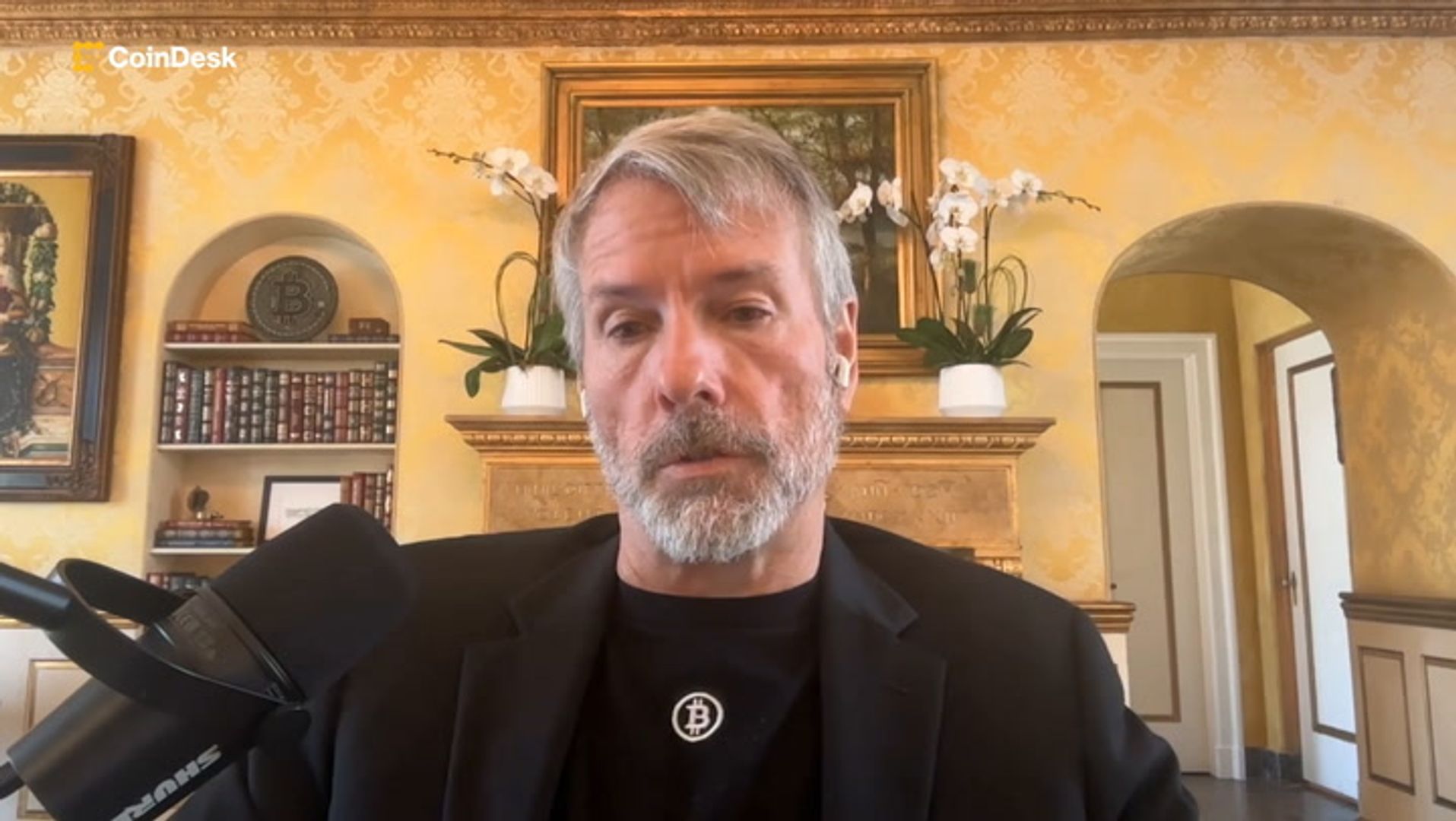
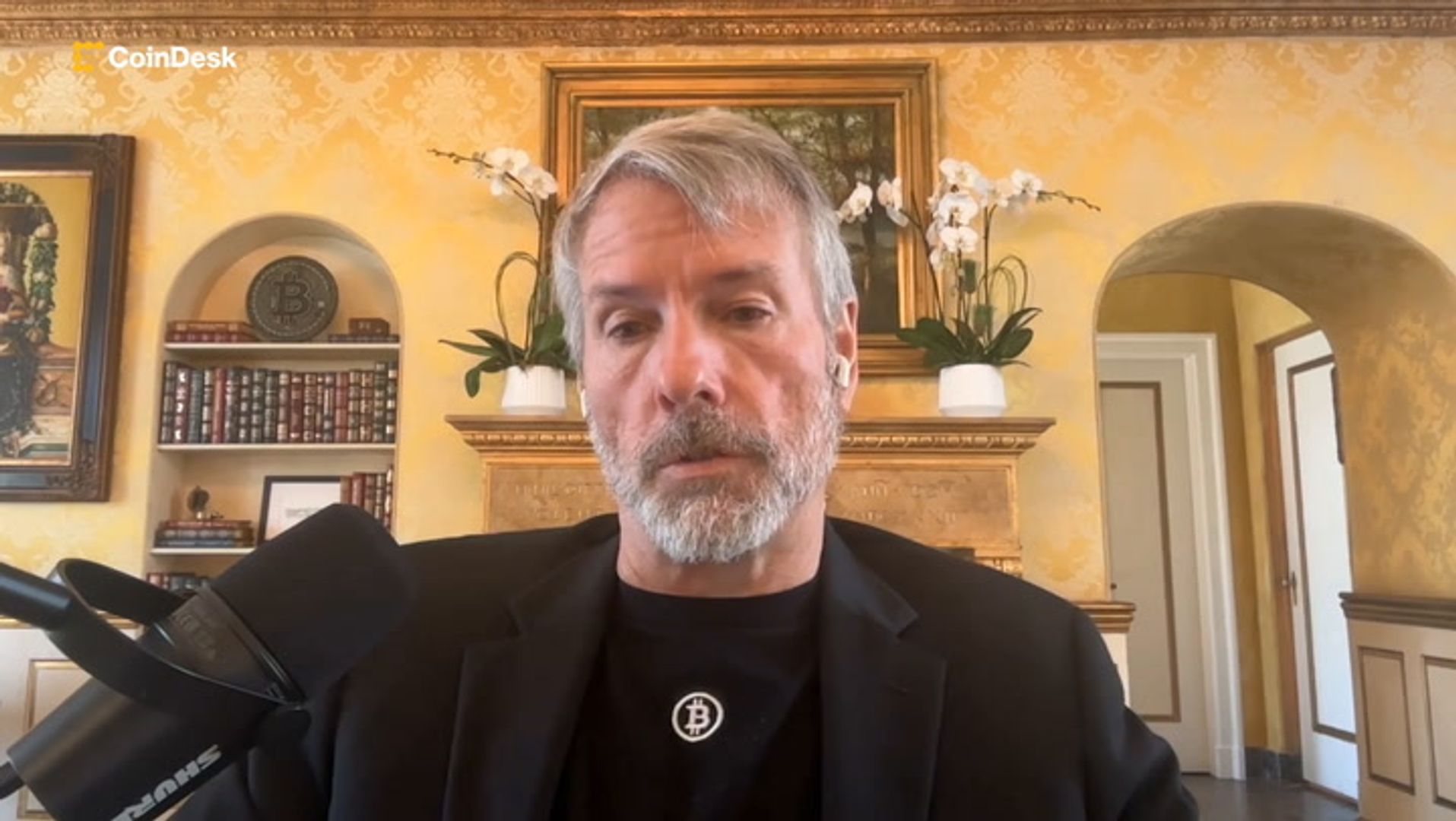
Michael Saylor shared a StrategyTracker chart on X this Sunday showing Strategy holds 847,363 bitcoin valued at $50.88 billion as of June 28, 2026, with 113 purchase events and an average cost basis of $75,653 per BTC.
That chart displays orange bubbles for MSTR’s buys overlaid on bitcoin price history, highlighting aggressive accumulation especially in 2024-2025 with the average purchase price line trending upward.
“We’re gonna need more charts” signals Saylor’s intent for continued bitcoin purchases, generating more data points as Strategy maintains its position as a leading corporate BTC holder.
Last week, Ripple CEO Brad Garlinghouse said he remains bullish on bitcoin but that Saylor’s approach to funding bitcoin purchases has damaged the wider cryptocurrency market, as the preferred stock at the center of Strategy’s model fell to a record low.
Strategy’s (MSTR) stock fell 8% lower Thursday to $86, amid concerns about its ability to meet dividend obligations. However, Saylor’s treasury still has 10 months of dollar reserves available to cover STRC’s dividend obligations. MSTR is currently priced at $82.31 following a further 3.54% drop. STRC hovers around $74.57 after a 1.48% increase on Sunday.
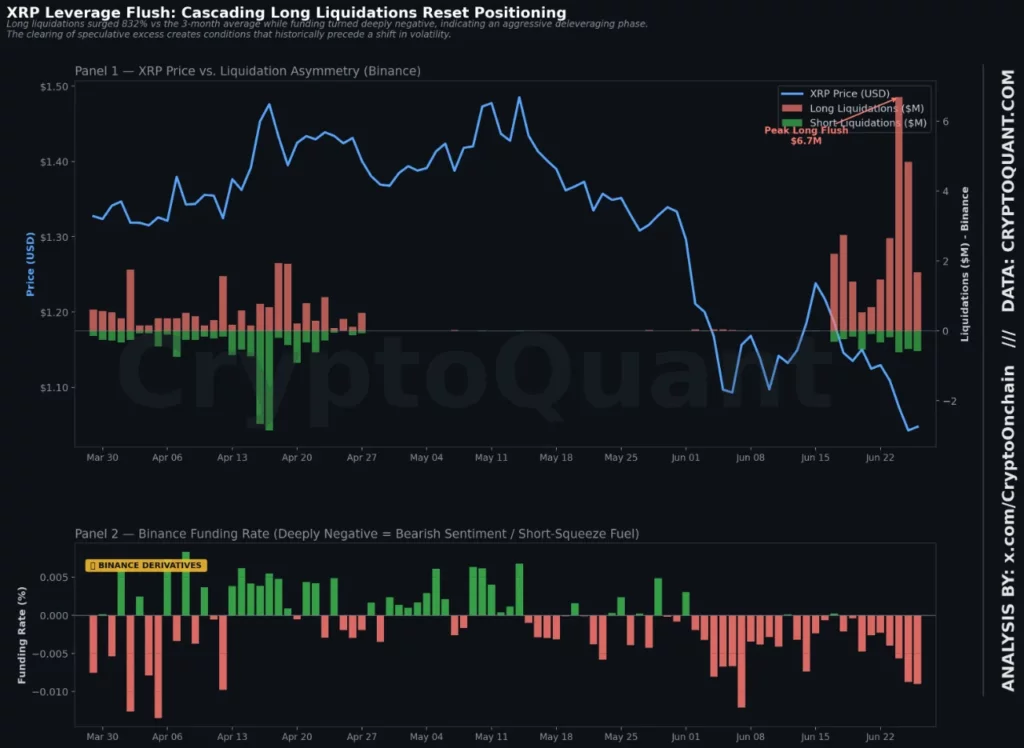
XRP is trading near $1.05 as buyers continue to defend the $1 level after a weak month.
Summary
- XRP trades near $1.05 after falling sharply over the past week and month.
- ETF inflows remain positive while Bitcoin and Ethereum funds continue showing heavy weekly outflows.
- Analysts watch $1 support, rising active addresses, and possible rebound signals toward the $1.30 zone.
The token is down more than 7% over the past week and about 19% over the past 30 days, while its 24-hour range sits between $1.04 and $1.07.
The price action remains weak, but several market signals show that XRP has not lost all support. ETF inflows remain positive, daily active addresses are rising, and some analysts now point to early reversal patterns on the daily chart.
XRP trades near $1 after sharp monthly decline
XRP holds a market rank of #6, with market capitalization near $65.4 billion. Its 24-hour trading volume stands above $1.1 billion, showing that activity remains strong even as price stays near recent lows.
The token remains far below its all-time high of $3.65 from July 2025. It has also fallen more than 50% over the past year and about 49% over the past 200 days, showing that the current weakness is part of a longer downtrend.
A recent XRP price prediction noted that XRP is trading near a 20-month low. The same report said $1 has become the key level to watch, with downside support near $0.85 and $0.70 if that area fails.
That makes the current setup simple. XRP needs to hold $1 to avoid a deeper technical breakdown. A strong move above $1.12 and then $1.27 would be needed before traders can argue that momentum is shifting back toward buyers.
ETF demand stays positive despite weak price
XRP fund flows continue to stand out against Bitcoin and Ethereum. On June 26, XRP ranked first in single-day net inflows at about $15.63 million, while spot Bitcoin ETFs saw about $444.51 million in outflows and Ethereum funds lost about $12.85 million.
The weekly trend also remains positive. XRP spot ETFs have now posted seven straight green weeks, with roughly $144.69 million in net inflows over that stretch, according to SoSoValue data.
This is not the same pattern seen in Bitcoin and Ethereum. Over the same seven-week stretch, Bitcoin ETFs recorded about $7.73 billion in outflows, while Ethereum ETFs lost around $1.18 billion.
A previous fund flow report showed XRP products had already beaten Bitcoin and Ethereum for five straight weeks. Another CLARITY Act analysis said XRP ETFs had drawn roughly $1.44 billion in cumulative inflows through six weeks of buying, even as price remained weak.
That contrast is important for the current XRP price analysis. It suggests that fund demand has not been enough to lift the token yet, but it may be helping to slow deeper losses near $1.
On-chain activity and chart signals improve
Analyst Ali Charts said XRP network activity has risen over the past two weeks. Daily active addresses climbed from about 23,000 on June 14 to nearly 39,500, pointing to higher on-chain participation.
Rising active addresses can show more users interacting with the network. It does not guarantee a price recovery, but it gives traders another data point at a time when price is testing a key support level.
Ali also pointed to two bullish reversal signals on the daily chart. He said the Tom DeMark Sequential indicator printed a “9” buy signal, which can sometimes appear before a short relief rebound lasting one to four daily candles.
He also said the past three daily sessions formed a Morning Star Doji pattern. That pattern is often used by technical traders to identify a local bottom after a downtrend.
If buying volume rises from here, Ali said XRP could move toward $1.30. That level also lines up with earlier resistance areas from recent price action.
A prior XRP technical report said traders were watching $1.20 as a recovery level, with $1.24 and $1.30 as the next zones if buyers pushed through resistance.
Derivatives reset may shape the next move
Acccording to CryptoOnchain, XRP derivatives have gone through a heavy deleveraging phase. Long liquidations jumped to nearly $3 million over the past week, up more than 800% from the prior month.
Open interest also fell from about $1.18 billion to roughly $1.04 billion. At the same time, funding rates turned deeply negative, showing that traders who were positioned for upside have been forced out.
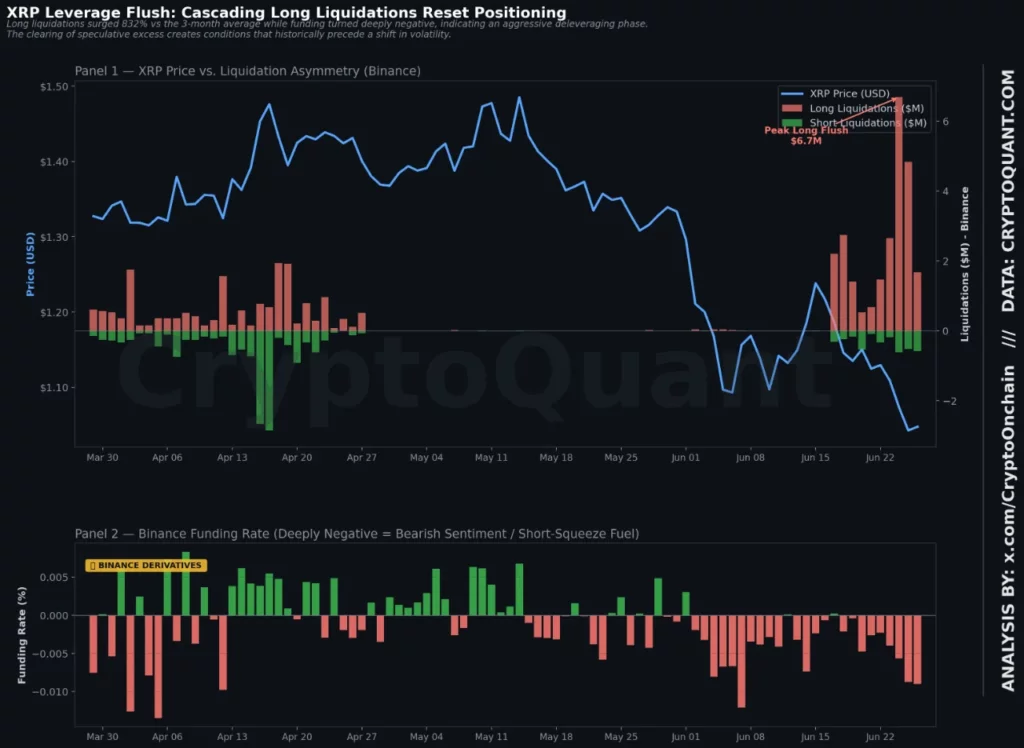
That type of reset can cut speculative excess from the market. It can also create conditions for a sharp move if short sellers become crowded and spot buyers remain steady.
The spot side looks calmer than futures. Binance reserves were nearly flat over the week, suggesting holders are not rushing to move XRP to exchanges for immediate sale.
The next signal will come from open interest and funding rates. If open interest starts to recover while price holds $1, traders may read it as a healthier reset. If XRP loses $1 with rising volume, the market may shift back toward $0.85 and $0.70 support.
Ripple’s wider ecosystem also remains in focus after RLUSD became available in Japan through SBI VC Trade. The stablecoin launch gives Ripple a new regulated channel in Asia, though XRP’s short-term direction still depends on price action, fund flows, and whether buyers can defend the $1 level.
Disclosure: This article does not represent investment advice. The content and materials featured on this page are for educational purposes only.
Taylor Swift and Travis Kelce’s unannounced wedding has already generated more than $4 million in trading volume on prediction platform Kalshi, with bettors wagering on the venue, the date, and even the bridesmaids.
According to Kalshi, entertainment trading grew from $43 million in 2024 to over $300 million in 2025. Music markets alone surpassed $400 million in Q1 2026, putting total 2026 entertainment volume on pace for $1 billion.
Location and Timing Drive the Biggest Bets
The location market has drawn $2.26 million in volume, making it Kalshi’s largest Swift-Kelce trading category. New York holds 80% odds, with Rhode Island trailing at 21%. Polymarket narrows the call further, placing Manhattan at 85%.
A street-closure permit filed near Madison Square Garden for July 3 has intensified speculation about the date. Neither Swift nor Kelce appears on the permit.
Kalshi gives 95.5% odds that the wedding will occur this year. Polymarket sets the chance of it occurring before August 31 at 96%. The permit reportedly calls for tenting outside the arena to accommodate between 500 and 999 guests.
New York City will simultaneously host July 4 celebrations and FIFA World Cup matches that weekend.

Separate markets track the wedding party. Jason Kelce leads the odds of being a groomsman at 89%, followed by Patrick Mahomes at 72%.
On the bridesmaid’s side, Abigail Anderson Berard holds 85% odds for maid of honor. Selena Gomez follows at 76%, with Gigi Hadid at 54%. Blake Lively and Brittany Mahomes, meanwhile, have both fallen to 8% odds.
Celebrity Markets Break Records as Kalshi Eyes $40 Billion
The Swift-Kelce surge arrives as prediction markets post record monthly transactions. Monthly active users reached 865,411 in March 2026, up 118% from the prior year. Monthly notional volume hit $23.89 billion, a 1,107% year-over-year increase.
The sector grew from roughly $1.2 billion in monthly volume in April 2025. By March 2026, that figure had exceeded $25 billion. Kalshi is targeting a $40 billion valuation in an ongoing funding round, up from $22 billion a month earlier.
The platform has also expanded through a World Cup prediction partnership, broadening its market categories.
Female Traders Reshape the Prediction Market Audience
Kalshi reports the share of female traders on its platform has doubled over the past year. That shift suggests celebrity-focused markets attract users well beyond the typical trading audience. Research also shows US voters consult prediction markets alongside conventional polling.
A bill seeking to ban prediction markets has circulated in Congress, though it has yet to clear both chambers. Despite that, Kalshi’s reach across sports, politics, and pop culture continues to grow.
The post Swifties Storm Prediction Markets: Over $4 Million Wagered on Taylor Swift’s Wedding appeared first on BeInCrypto.

Week in Review: Most popular stories on GeekWire for the week of June 21, 2026

UK Priminister RESIGNS! His Replacement Has Bought Into Crypto Already!?!?! BoE Changes Crypto Rules

Russell wins Austrian Grand Prix ahead of Verstappen and Antonelli


-
 Sports5 days ago
Two goals and an assist by sheer aura: Cristiano Ronaldo just entered the World Cup chat
-

 Tech6 days ago
Microsoft accidentally kills epic Outlook email threads
-

 Fashion2 days ago
Weekend Open Thread: Staud – Corporette.com
-

 Politics2 days ago
The House | Manchesterism won’t survive the painful trade-offs unless it gets citizens on board
-

 Politics3 days ago
Potential 2028er World Cup attendee leaderboard
-

 Business2 days ago
Asia stock markets slide as tech shares slump
-

 Tech3 days ago
A Look At A Gaggle Of Transputer Boards
-
Crypto World5 days ago
Bitcoin (BTC) Dips Below $62K, Ethereum (ETH) Plunges 6% Daily: Market Watch
-
 Crypto World3 days ago
Dell (DELL) Shares Tumble Over 5% Following Analyst Downgrade to Hold
-

 Crypto World4 days ago
Securitize Wraps Roubini's SEC-Registered ETF as Dubai VARA Digital Security
-
Business5 days ago
Entergy settles forward sale agreements, raises $672 million in cash proceeds
-

 Crypto World1 day ago
Kraken's xStocks Opens Bending Spoons IPO Registration to EEA Retail
-

 Sports2 days ago
FIH Pro League: India defeat Pakistan 7-1, register biggest win of campaign | Other Sports News
-

 Crypto World2 days ago
RTX holders must register wallets before token distribution begins
-
 Crypto World2 days ago
Hyperliquid Named on Singapore MAS Investor Alert Register
-

 Crypto World1 day ago
Coinbase, Circle Deepen Crypto Stock Losses Despite Resilient S&P 500
-

 Sports3 days ago
India vs Bangladesh LIVE Score, Women’s T20 World Cup: Bangladesh Opt To Bat; India Enter ‘Do-Or-Die’ Stage As Semi-Final Race Heats Up
-
Crypto World2 days ago
The DATA Foundation Launches to Tackle AI’s Multi-Billion Dollar Training Data Bottleneck
-

 Crypto World3 days ago
Strategy (MSTR) has a 10-month cash runway for dividends, but retail investors are losing faith
-
 Crypto World3 days ago
AAVE price tests 9-month trendline after 17% rebound as breakout hopes build
You must be logged in to post a comment Login