
Crypto World
Ripple IPO and XRP holders: what you would get

Brad Garlinghouse said one word, “maybe,” and the XRP community heard a promise. Asked whether holders could get a piece of Ripple if it goes public, he nodded toward a “special arrangement.” This is what was actually said, what holders could realistically receive, and the downside almost nobody is talking about.
Summary
- Ripple chief executive Brad Garlinghouse said that “if and when” Ripple goes public, the company might do “something special” for XRP holders, then immediately added it was “not in the immediate term.”
- That hedged “maybe” was offered in response to a direct question, not volunteered as a plan, and he declined to commit to any mechanism such as a token buyback.
- Ripple and XRP are legally and financially separate assets: holding XRP grants no shares, no dividends, and no claim on Ripple’s corporate profits, and no bridge between the two currently exists.
- The mechanisms holders imagine, preferential IPO share access, long-term holding rewards, or tokenized Ripple equity, are all unannounced and face serious securities-law hurdles given XRP’s legal history.
- The overlooked risk is that a Ripple IPO could actually pressure XRP, by drawing institutional capital toward Ripple stock and pushing the company to monetize its escrow holdings to satisfy public-market investors.
One word from Ripple’s chief executive set the XRP community alight, and that word was “maybe.” Speaking on the “Crypto In America” podcast with journalist Eleanor Terrett, Brad Garlinghouse was asked the question XRP holders have wanted answered for years: if Ripple ever goes public, could the people who hold XRP get a piece of it. He did not say no. He gestured first at the indirect benefits Ripple already provides, then, pressed on whether the company would do something specific for holders in an initial public offering, he said, “Maybe, but that is not in the immediate term.”
That was the entire substance of it, a hedged possibility wrapped in a qualification, offered in answer to a direct question rather than announced as a plan. And yet within hours it had been clipped, shared, and reshaped across XRP social media into something close to a corporate commitment, with community members urging one another to “hold accordingly.” The gap between what Garlinghouse actually said and what the community heard is the real story here, because the difference between a hinted-at maybe and a planned reward is the difference between a reasonable hope and a misplaced expectation.
The reason the remark landed so hard is the situation it landed into. XRP holders have spent 2026 watching Ripple collect exactly the kind of institutional wins the community long predicted, settlements with JPMorgan, stablecoin launches with major partners, a steady drumbeat of bank deals, while the token itself has stayed pinned near a dollar and change, beneath every major moving average. That combination, corporate triumph paired with token stagnation, breeds a particular hunger: the sense that the wins are real but are somehow not reaching holders, and that some missing mechanism could finally connect the two. Into that hunger dropped Garlinghouse’s nod, and it did what a catalyst does in a starved market.
This piece separates the hope from the reality. It covers exactly what was said and the precise wording that matters, the crucial distinction between Ripple the company and XRP the token, the mechanisms a holder benefit could theoretically take and why each is harder than it sounds, why Ripple may not even go public soon, the indirect benefit Ripple genuinely does provide, and the downside almost nobody is discussing: that an IPO could actually work against XRP. The goal is the real picture, neither dismissing the possibility nor inflating it into the certainty the hype implied.
What Garlinghouse actually said
Precision matters here, because the entire community reaction rests on a few carefully chosen words, and those words were more conditional than the excitement suggested. Garlinghouse did not volunteer the remark; he was asked directly whether XRP holders could share in Ripple’s success if the company eventually launched an initial public offering. His first instinct was to point to the indirect benefit Ripple already provides, saying he hopes XRP holders feel they benefit from Ripple’s existence through the work the company does to grow the XRP ecosystem. Only when pressed on whether Ripple would do something specific for holders in an IPO scenario did he offer the line that ignited everything: “Maybe, but that is not in the immediate term.”
When pushed further on concrete mechanisms, including a possible token buyback, he declined to commit to any of them, pointing back instead to what Ripple already does for the ecosystem. So the full extent of the supposed promise is a “maybe,” qualified as not near-term, given in response to a direct question rather than offered as a plan, with no program described, no mechanism named, and no action committed to. The community heard “Ripple will do something special for holders.” What Garlinghouse actually said was closer to “maybe someday, if we go public, which is not happening soon.”
Those are not the same statement, and stacking the two conditionals reveals how far the exciting headline sits from anything concrete: a possible benefit, attached to a possible IPO, that he himself describes as not a priority. It is worth adding that days earlier, at an industry conference, Garlinghouse had been cooler still on the idea of going public at all, emphasizing that staying private gives Ripple flexibility. Read in that context, the podcast remark was a hint, not a plan and certainly not a promise. Any honest assessment of what holders would actually get has to begin from that fact rather than from the amplified version that spread online.
Ripple is not XRP: the distinction that decides everything
To understand why this question is so charged, and so easily misunderstood, you have to grasp a distinction that still confuses many people: Ripple and XRP are legally and financially separate assets, and owning one does not mean owning the other. Ripple is a private technology company that builds payment and liquidity products, some of which use the XRP Ledger. XRP is a cryptocurrency, the native asset of the XRP Ledger, which is a decentralized, open-source blockchain that Ripple does not control. Holding XRP gives you ownership of that token and nothing else.
It confers no shares in Ripple, no dividends, no voting rights, and no claim whatsoever on Ripple’s corporate profits or assets. The two are different things with different value drivers, and the price of one does not automatically move the other. That distinction is why the company-versus-token gap keeps resurfacing across Ripple’s 2026 story. Ripple can win institutional business, launch products, and deepen its corporate value without automatically delivering a direct benefit to XRP holders.
This separation is the foundation of the entire holder-payout question, because it means there is no existing structure, no dividend, no buyback mechanism, no holder-equity bridge, that currently connects Ripple’s corporate fortunes to the people who hold XRP. Any such benefit would require a deliberate corporate decision: Ripple choosing to extend something to holders of a token that is legally distinct from its stock. That is precisely what makes Garlinghouse’s “maybe” notable, because it gestures at the possibility of Ripple voluntarily building a connection that does not exist and is not required to exist. The community’s hope is that Ripple might someday decide to construct that bridge.
The reality is that no bridge exists today, none is planned, and the entire question is whether Ripple might ever choose to build one. Everything that follows, every imagined mechanism and every obstacle, flows from this single fact: a Ripple IPO would, by default, do nothing for XRP holders, because the token and the company are separate. Only an affirmative, deliberate choice by Ripple could change that. Until such a choice is announced, a holder payout remains speculation, not entitlement.
The mechanisms holders imagine
Once the “maybe” spread, the community began filling in the blank with specific mechanisms, and it is worth laying them out, because they define the range of what “something special” could plausibly mean. The most discussed idea is preferential access to IPO shares, an arrangement in which verified long-term XRP holders, or users staking on the XRP Ledger, would be granted priority subscription rights to buy into a Ripple offering at favorable terms before the general public. This is the version that most directly answers the community’s wish, because it would let XRP holders transition, at least partly, into Ripple shareholders. It would turn token loyalty into an equity stake.
A second imagined mechanism is a long-term holding reward, a community-based structure that would give some benefit to holders who have kept XRP for a defined period, rewarding loyalty without necessarily handing over equity. A third, more technically ambitious idea is tokenized Ripple equity: a blockchain-based representation of Ripple stock made available to eligible token holders, which would use the very tokenization technology the industry is racing to build in order to bridge the gap between Ripple shares and XRP. Some in the community have also floated the notion of an “equity-token-bound” proof of entitlement, a digital claim linking XRP holding to some future right in Ripple. Each of these would, in its own way, construct the bridge between Ripple equity and XRP holders that currently does not exist.
The crucial thing to hold in mind is that all of them remain imagined, not announced. Garlinghouse named none of them; he declined, in fact, to endorse any specific structure when asked. They represent the community’s wish list of what “something special” might be, not a menu Ripple has offered. The distance between a fan’s plausible idea and a company’s actual program is considerable, especially when the imagined benefit touches securities law, global compliance, investor eligibility, and the legal separation between Ripple equity and XRP.
Why each mechanism is harder than it sounds
The reason Garlinghouse spoke in hints instead of specifics is almost certainly that nearly every concrete version of a holder benefit collides with serious obstacles, and understanding those obstacles is essential to a realistic view. The largest is securities law, and it is a particularly sharp problem for XRP of all tokens. Linking a cryptocurrency’s holding to equity benefits raises exactly the kind of securities-law questions that defined Ripple’s long and costly legal battle, the years-long fight over whether XRP sales amounted to unregistered securities transactions. Building a formal bridge that rewards XRP holders with equity or equity-like rights risks recreating the very entanglement between the token and the company that Ripple spent years and enormous legal resources trying to separate.
The company would have to navigate that terrain with extreme care, because a poorly designed holder-benefit program could reintroduce the argument that XRP is a security tied to Ripple’s enterprise, which is the last thing Ripple wants. That is why the catalyst that matters more than the IPO is still statutory clarity from the CLARITY Act, not an undefined corporate reward. Federal clarity can strengthen XRP’s status without blurring the line between the token and Ripple equity. A holder-equity program, by contrast, could blur that line if designed carelessly.
Beyond securities law, the practical obstacles multiply. A preferential-share program would require verifying who is a genuine long-term holder, drawing cutoff lines that would inevitably be seen as arbitrary or unfair, and managing the identity and compliance machinery to do it at scale across a global, pseudonymous holder base. A holding-reward structure raises questions of how to fund it and how to avoid favoring large holders over small ones. Tokenized equity would face the full weight of securities regulation governing who can own and trade company stock, plus the technical and legal work of making a regulated equity instrument function on a blockchain.
Each mechanism, in other words, is not just a matter of Ripple deciding to be generous; it is a tangle of legal exposure, fairness problems, and operational complexity, any one of which could sink it. This is why the most dramatic interpretations of “special arrangement” are also the least likely. A sober reading has to weight the modest possibilities, a governance gesture, a symbolic recognition, or simply Ripple structuring its business so more value flows through XRP over time, far more heavily than the windfall the community imagined.
Why Ripple may not even go public soon
The entire holder-benefit scenario is downstream of a prior question that often gets lost in the excitement: will Ripple even go public at all, and if so, when. On this, Garlinghouse has been consistent and notably unenthusiastic. He has repeatedly described an IPO as not a priority, and his reasoning is grounded in the current state of the public markets for crypto companies. He has pointed to the underwhelming performance of crypto-related public listings, citing peers whose post-listing stock has struggled, and noted reports that at least one major exchange had delayed its own listing plans.
His view, in short, is that the public markets have not treated Ripple’s peers well, and that there is little reason to rush into that environment. He has also made a positive case for staying private, arguing that it preserves flexibility, including, he joked, the freedom to speak openly without lawyers drafting every word. This is not the posture of a company on the verge of ringing the opening bell. It means the holder-benefit question is built on a foundation that is itself uncertain: a possible reward contingent on an IPO that the chief executive describes as neither planned nor imminent.
That is the sense in which the whole thing is a maybe attached to a maybe. For an XRP holder weighing what they might receive, this is the most important practical point, because even the most generous imaginable holder benefit is irrelevant unless and until Ripple actually decides to go public. By Garlinghouse’s own account, that decision is not on the calendar. The community’s hope therefore rests on two sequential uncertainties: first that Ripple goes public, and second that, having done so, it chooses to extend something to holders it is under no obligation to help.
Either link breaking is enough to make the whole scenario evaporate. That is why the IPO hint should not be treated like a near-term catalyst, even if it tells holders something about how Ripple thinks about its community. The comment matters as a signal of openness, but it does not change the current legal structure, the current IPO timeline, or the current token economics. XRP holders should separate those categories carefully.
The indirect benefit Ripple already provides
Set against the speculation is Garlinghouse’s actual, stated position, which deserves a fair hearing because it is not a trivial argument: that XRP holders already benefit from Ripple’s existence, indirectly but intentionally. The foundation of this argument is a simple fact: Ripple is the largest single holder of XRP. That gives the company a stronger economic incentive than anyone else to increase the token’s value and adoption, because Ripple profits when XRP rises, just as holders do. Its incentives are genuinely aligned with holders, even without any formal program linking the two.
Every commercial partnership Ripple pursues, every payment corridor it opens, every institutional deal it closes, and every regulatory battle it fights is evaluated, at least in part, through the lens of how it drives XRP utility and liquidity. Garlinghouse’s framing is that this alignment is the real benefit, that Ripple’s entire strategy is built around making XRP the most useful, liquid, and trusted digital asset in payments and settlement, and that by growing the ecosystem it makes what holders own more valuable, even without a dividend or an equity link. That is where XRP’s actual utility remains central to the long-term case. The token’s real thesis has to rest on usage, liquidity, and settlement demand, not on implied ownership of Ripple.
Garlinghouse has pointed to concrete examples of this posture, including Ripple’s backing of XRP treasury companies such as Evernorth, which is working to build a large XRP treasury business with Ripple’s support, an effort Garlinghouse frames as helping XRP holders, the XRP community, and Ripple shareholders at the same time. This argument has genuine merit and should not be dismissed as spin. The company’s commercial work plausibly does increase XRP’s utility and demand over time, which is a real, if diffuse, benefit to anyone holding the token. The counterpoint, and the reason the “maybe” resonated, is that many in the community find this indirect alignment insufficient.
They want a concrete share of Ripple’s corporate success, not an incentive structure that may or may not translate into token-price appreciation. That dissatisfaction is precisely the nerve Garlinghouse’s remark touched. His indirect-benefit argument is, in effect, his answer to it: you already benefit, just not in the direct way you want. Whether that answer satisfies holders depends on whether Ripple’s wins eventually become visible in XRP demand rather than simply in Ripple’s corporate valuation.
The downside nobody mentions: an IPO could hurt XRP
Here is the part of the story that the bullish excitement almost entirely skips: a Ripple IPO is not unambiguously good for XRP, and there is a credible case that it could actively work against the token, at least in the near term. The first channel is competition for capital. Today, an institution that wants exposure to Ripple’s success has essentially one liquid way to get it: buy XRP, the token associated with the company’s ecosystem. If Ripple goes public, that changes.
Suddenly there is a direct way to own a piece of Ripple itself, a regulated equity that offers what a token cannot: potential dividends, audited financial transparency, ownership of the company’s actual assets and cash flows, and the compliance comfort of a listed stock. Faced with that choice, institutional capital that might have flowed into XRP as a proxy for Ripple could instead flow into Ripple stock, siphoning off the very institutional demand the XRP bull case depends on. The IPO, in this reading, would give the market a cleaner instrument for the Ripple thesis, and XRP could lose its role as the default vehicle for it. That is the uncomfortable side of where XRP trades while holders wait: the market wants direct token demand, not merely a story about Ripple’s corporate success.
The second channel is selling pressure from Ripple itself. As a private company, Ripple has long been criticized for selling XRP from its large escrow holdings, a persistent source of new supply. After an IPO, that pressure could intensify instead of ease, because a public company answers to Wall Street’s quarterly demands for cash flow and profitability. To satisfy those demands and bolster its financial reports, Ripple’s board could face strong incentives to monetize tens of billions of XRP from its escrow accounts in a more systematic and aggressive way, creating an invisible, long-term overhang on the token’s price.
None of this is certain, and a well-managed IPO could be handled in ways that limit these effects, but the point is that the community’s framing of an IPO as pure upside for holders is incomplete. The honest version acknowledges that going public is a double-edged sword for XRP. It could, in the bullish case, come bundled with a “special arrangement” that rewards holders, or it could, in the bearish case, drain attention and capital away from the token while increasing the supply pressure on it. Holders hoping for the first should at least weigh the second.
What it means for holders today
So what should an XRP holder actually take from all of this, standing in the present with the token trading near a dollar and the “special arrangement” still nothing more than a hedged remark? The disciplined answer is to give the IPO hint the weight it actually carries, which is to say very little, and to keep attention on the catalysts that truly move XRP. A possible IPO reward is a weak basis for any decision, because it is a maybe attached to a maybe: an unplanned, undefined benefit contingent on an IPO that Ripple does not prioritize. It is better regarded as a distant possible upside not to be counted on than as a catalyst to position around.
The things that will actually determine XRP’s path are observable and concrete: whether the CLARITY Act passes and writes XRP’s commodity status into federal law, whether spot ETF flows compound or trickle, whether the network’s settlement usage grows enough to translate into real token demand against the escrow supply, and where Bitcoin drags the broader market. Those are the signals worth watching, and the IPO hint is not among them. This does not mean the remark is meaningless. It reveals something real about Ripple’s posture toward its community, a willingness to at least entertain the idea of connecting corporate success to holders, which is more than many companies would offer.
But revealing a posture is not the same as making a commitment, and the most useful thing a holder can do is to enjoy the signal for what it shows about Ripple’s attitude while declining to build any expectation on top of it. The community heard a promise. What Garlinghouse offered was a maybe, and in investing the difference is everything. An XRP holder is better served by evaluating the token on its actual merits, its use in payments, its regulatory position, its adoption, and its supply dynamics, than by speculating about an IPO reward that exists only as a hedged possibility.
That possibility is attached to an IPO that may never come, and that could, in some scenarios, hurt the token as much as help it. The hope is understandable. The discipline is to keep it in proportion. If Ripple ever announces a real program, holders can judge the terms then; until then, the “special arrangement” is a signal, not a strategy.
Frequently asked questions
Did Ripple promise XRP holders a payout from its IPO?
No. Ripple chief executive Brad Garlinghouse said that “if and when” Ripple goes public, the company might do “something special” for XRP holders, then immediately added that it was “not in the immediate term.” That was a hedged “maybe” offered in response to a direct question, not a plan, a program, or a commitment, and he declined to endorse any specific mechanism such as a token buyback. The community amplified the remark into something close to a promise, but no payout has been announced, no mechanism has been described, and the comment was explicitly conditional on an IPO that Garlinghouse describes as not a priority.
Does holding XRP give me any ownership of Ripple?
No. Ripple and XRP are legally and financially separate assets. Ripple is a private technology company that builds payment and liquidity products, some of which use the XRP Ledger. XRP is the native cryptocurrency of the XRP Ledger, a decentralized blockchain that Ripple does not control. Holding XRP grants no shares in Ripple, no dividends, no voting rights, and no claim on the company’s profits or assets.
What could a “special arrangement” actually look like?
The mechanisms the community imagines include preferential access to Ripple IPO shares for verified long-term XRP holders, long-term holding rewards for those who keep XRP for a defined period, and tokenized Ripple equity made available to eligible holders. All of these are unannounced and remain speculation instead of anything Ripple has offered. Each also faces serious obstacles, especially securities law, because linking token holding to equity benefits raises exactly the questions Ripple fought during its long legal battle over XRP. More modest possibilities, such as a governance gesture or simply structuring the business so more value flows through XRP, are more realistic than a direct equity windfall.
Is Ripple actually going to have an IPO?
It is uncertain, and Garlinghouse has repeatedly described going public as not a priority. He has cited the weak post-listing performance of crypto-company peers and reports of a major exchange delaying its own plans, and he has argued that staying private preserves flexibility. This matters because the entire holder-benefit question is downstream of an IPO happening at all. Even the most generous imaginable reward is irrelevant unless Ripple first decides to go public and then chooses to extend something to holders.
Could a Ripple IPO actually be bad for XRP?
It could, and this is the part the bullish framing tends to skip. An IPO would give institutions a direct way to own Ripple through regulated stock that offers dividends, financial transparency, and ownership of company assets, potentially drawing capital that might otherwise have flowed into XRP as a proxy for Ripple. Separately, as a public company answerable to quarterly earnings expectations, Ripple could face stronger incentives to monetize its large XRP escrow holdings more aggressively, adding long-term selling pressure on the token. Going public is therefore a double-edged sword for XRP, with credible downside as well as the hoped-for upside, and holders should weigh both.
What should XRP holders actually focus on?
On the observable catalysts that truly move the token instead of the IPO hint. Those include whether the CLARITY Act passes and codifies XRP’s commodity status, whether spot XRP ETF flows compound or stall, whether the network’s settlement usage grows into real token demand against the escrow supply, and the direction of Bitcoin and the broader market. The “special arrangement” remark is best treated as a small signal about Ripple’s posture toward its community, given minimal weight in any actual view of XRP’s prospects. Evaluating XRP on its real merits, utility, regulatory position, adoption, and supply, is far sounder than positioning around a hedged maybe.
This article is information, not investment advice. Prices, corporate plans, and statements reflect reporting available as of June 28, 2026, and can change quickly. Brad Garlinghouse’s comments were conditional and did not constitute a commitment or a program. Nothing here is a recommendation to buy or sell XRP or any security. Verify current details from primary sources and consider your own circumstances before making any decision.


Who are possible challengers to FIFA President Gianni Infantino?
Infantino was originally expected to easily retain his position at the helm of FIFA in March 2027.
Now, with public calls for review into his leadership, potential rivals may feel emboldened.
“FIFA is full of sharks, and there’s no question that many of them can smell blood. Infantino’s election in 2027, which seemed like a sure bet only a few days ago, is now an open question,” Boykoff says.
Challengers for his role must submit their candidacies by Nov. 18, and there has already been some speculation as to who might make a bid.
Sheikh Salman bin Ebrahim Al Khalifa, president of the Asian Football Confederation (AFC), was defeated by Infantino in 2016, the current administrator’s first term, but he could return a decade later as a frontrunner. He called Infantino’s investment proposal and his failure to consult AFC on it “totally unacceptable,” putting the two publicly at odds.
We will begin with the mandatory disclaimer, as we are well aware that historical performance does not guarantee similar moves in the future. However, history does tend to rhyme, and that’s what happened in July for BTC.
The question is: will August follow suit, as the month has not been kind to the largest cryptocurrency, especially the last four editions.
July Brought Some Gains
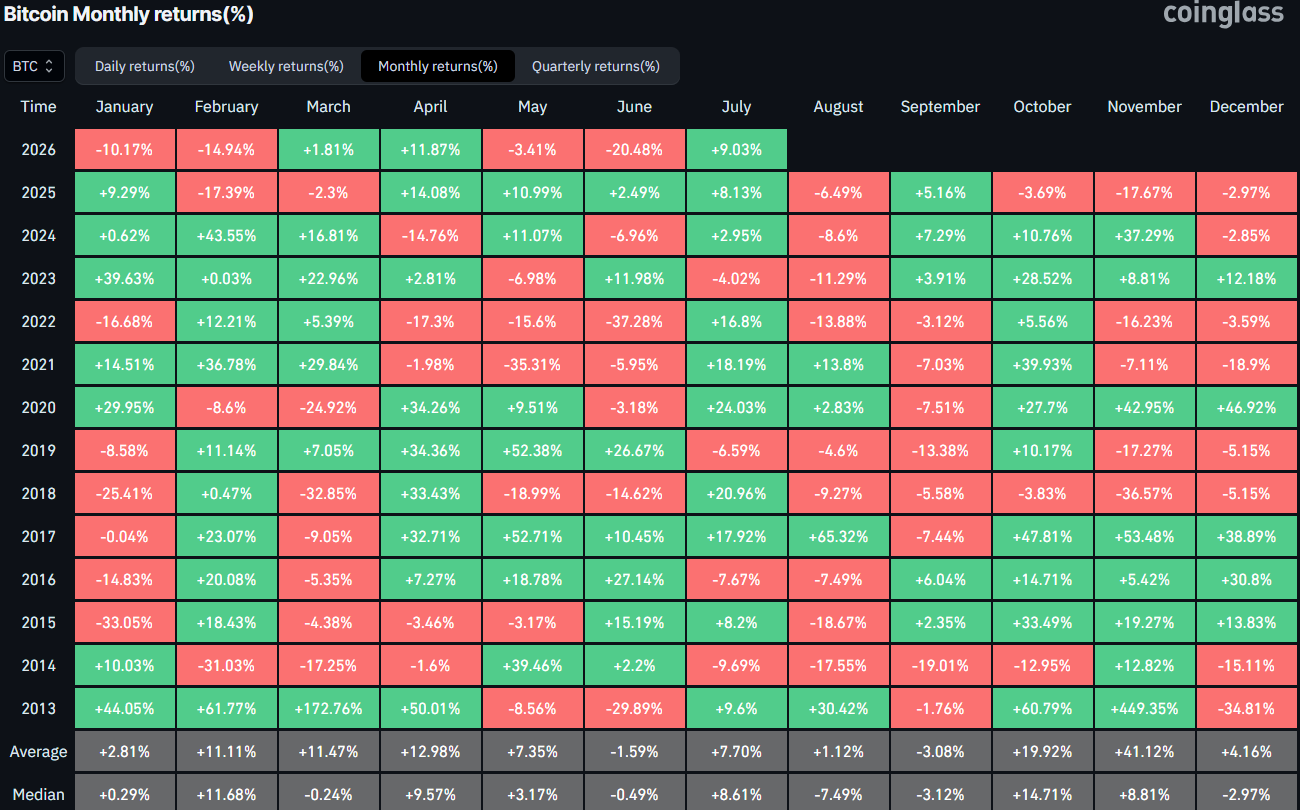
Before we explore what happened in July, here’s a brief outlook of the painful June, which set the stage for a rebound during the seventh month of the year. The 2026 edition of June became the most violent in terms of price moves for the cryptocurrency in precisely four years. It tumbled by 20.48% in 2026 compared to 37.28% in June 2022.
As such, it was almost expected that July would be a better month. History was also on BTC’s side as 9 out of the last 11 were in the green. However, the start was actually quite surprising as bitcoin dipped below $58,000 on July 1 for the first time in nearly two years.
The bears quickly lost control, though, and the asset reclaimed the coveted $60,000 level within a day or two. It wasn’t the most volatile of months, but BTC still managed to post some gains and peaked on July 21 at $67,000. This became its highest price tag in two months.
However, it was rejected there despite the softer-than-expected inflation data for June and the fact that the Fed refused to hike interest rates last week. Thus, bitcoin ended the month at under $64,000, which was still a 9% monthly increase.
Your Move, August
As popular analyst Ali Martinez put it yesterday: August hasn’t been kind to bitcoin. In fact, the last four have all been in the red, posting losses of 13.88%, 11.29%, 8.6%, and 6.49%, respectively. The silver lining is that the declines become less violent over time.
The broader August perspective is still deeply negative, though. Only three out of the last 12 editions have been in the green, with 2017 standing out as the most bullish one on record. At the time, BTC rocketed by over 65%, but it was a different time and a vastly different market phase.
For now, BTC enters August 2026 with lots of uncertainty not only within the industry itself, where interest has dwindled lately, but on a macro perspective as well. The war in the Middle East continues, and the one between Ukraine and Russia too, while inflation remains an issue, and Trump’s controversial actions tend to halt each breakout attempt in its tracks.
The post Bitcoin Rebounded in July, but Bears Target an August Pullback appeared first on CryptoPotato.
Cointelegraph is committed to providing independent, high-quality journalism across the crypto, blockchain, AI, and fintech industries.
All news, reviews, and analyses are produced with full journalistic independence and integrity. For more details on our standards and processes, please read our Editorial Policy.
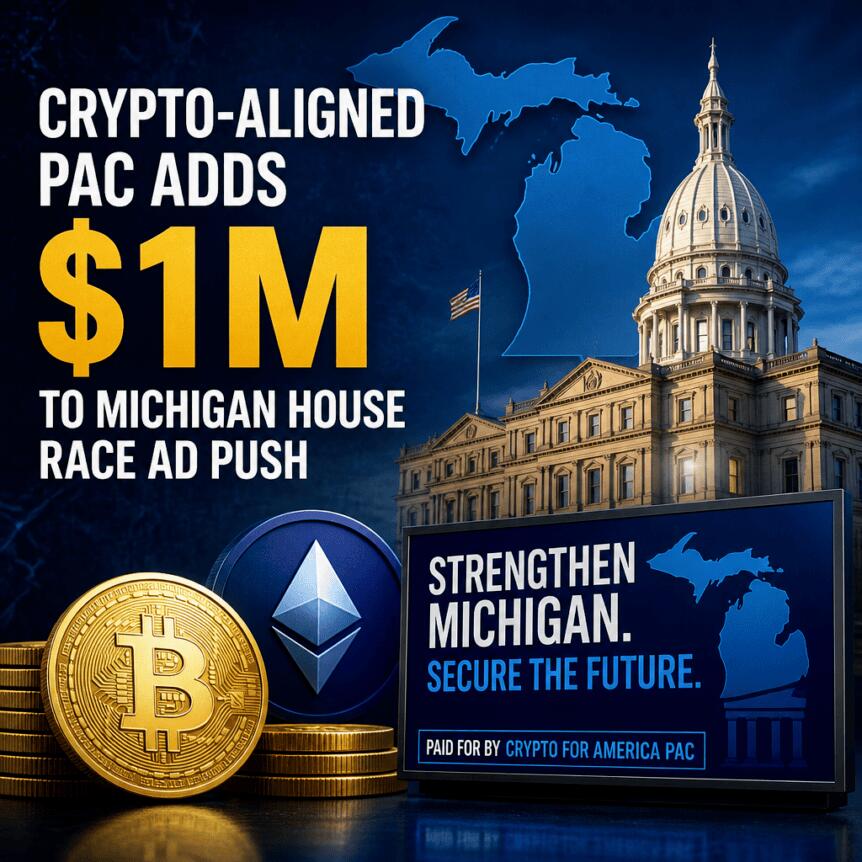
A crypto-industry-backed political action committee affiliate has intensified its advertising push ahead of next week’s Michigan Republican primary, according to the latest Federal Election Commission (FEC) filings. Protect Progress PAC, which the filings indicate is funded largely by contributions from cryptocurrency companies Ripple Labs and Coinbase, has spent more than $2 million on media to influence the contest in Michigan’s 13th Congressional District.
The most recent updates, filed as of Thursday, show the committee ramping up spending in support of U.S. Representative Shri Thanedar while also funding opposition to his Democratic challenger, Donavan McKinney. The renewed disclosures come shortly after earlier reporting showed the PAC had already ramped up its buy—effectively doubling its reported ad spending from the prior week.
Key takeaways
- FEC filings show Protect Progress PAC has spent over $2 million on media for Michigan’s 13th district primary race.
- New disclosures add $884,240 to advertisements supporting Shri Thanedar and more than $150,000 to ads opposing Donavan McKinney.
- The PAC’s funding is described in the filings as being largely backed by cryptocurrency companies Ripple Labs and Coinbase.
- Thanedar’s legislative record includes support for crypto-related bills such as the GENIUS Act and the CLARITY Act.
- Protect Progress is an affiliate of Fairshake, a major outside spender in U.S. elections tied to crypto industry policy goals.
Michigan’s 13th district: Protect Progress increases ad buys
According to FEC disclosures accessed via the commission’s docquery system, Protect Progress PAC reported spending more than a combined $2 million on media in connection with Michigan Representative Shri Thanedar and his Democratic primary contest against Donavan McKinney.
As of Thursday, the filings reflect a further escalation: compared with what the PAC had already reported spending a week earlier, the committee’s latest report effectively doubled its media spending. The additional outlay includes $884,240 dedicated to ads supporting Thanedar and more than $150,000 aimed at opposing McKinney.
The Michigan primary is scheduled for Tuesday, but the filings underscore that the committee and its network have been willing to deploy substantial resources well before Election Day. Similar patterns have been visible across multiple congressional races during the 2026 cycle, according to the article’s referenced coverage and FEC-based reporting.
Why the race is drawing crypto-linked political money
Thanedar’s congressional record is at the center of the narrative around why outside groups see his candidacy as important for crypto policy. During his time in the House, he voted in favor of the stablecoin-focused GENIUS Act and supported the legislative push for clearer digital asset market structure—the Digital Asset Market Clarity (CLARITY) Act, which has been discussed in the Senate.
He also cosponsored the Promoting Innovation in Blockchain Development Act, an effort aimed at protecting developers. Supporters of crypto policy reform often point to such measures as steps toward a more predictable regulatory environment, while critics argue the industry has too much influence over the political process.
For voters watching the contest, the spending escalation suggests the primary is being treated as more than a local political test—it is being framed by donors and advocacy networks as part of a broader strategy to influence which lawmakers back specific digital asset legislation.
McKinney’s response and the broader allegations over crypto influence
McKinney has publicly characterized the ad push as a payoff for political favors. In a July 21 statement related to the PAC spending, he said “the crypto lobby is paying my opponent back for helping Trump make over $1 billion since taking office,” according to a video shared on his campaign’s Facebook page.
That comment appears to reference the U.S. President’s disclosures about crypto-related earnings, including a figure cited in earlier reporting referenced by the article—more than $1.4 billion from crypto investments in 2025—along with concerns raised by Democrats that Trump could be using his role to profit through policies such as GENIUS.
While those claims are rooted in political argument rather than direct proof of intent tied to the specific Michigan ads, they highlight a recurring tension in U.S. crypto politics: outside spending may be framed by industry-aligned PACs as policy support, while opponents often describe it as evidence of undue influence.
Cointelegraph reports that it reached out to both Thanedar’s and McKinney’s campaigns for comment on the PAC expenditures but did not receive an immediate response.
Fairshake’s affiliates: national momentum in multiple primaries
Protect Progress PAC is an affiliate of Fairshake, a political network that has become one of the most prominent outside spenders linked to crypto industry policy goals. Fairshake was responsible for spending more than $170 million across the 2024 election cycle through media buys supporting candidates it viewed as aligned with crypto-friendly regulation, as summarized in the article.
The article also notes that affiliates have already deployed millions of dollars in 2026 races beyond Michigan, pointing to activity in states including Texas and Illinois. In addition, it cites Public Citizen reporting from June that Fairshake and its affiliates accounted for more than $82 million out of roughly $189 million deployed by crypto companies during the 2026 election cycle.
Fairshake itself reportedly listed holding a $193 million “war chest” as of January, according to figures referenced in the piece. Taken together with the Michigan disclosures, the pattern suggests a sustained approach: deploy substantial resources early enough to shape narrative and voter attention around specific legislative priorities.
The article further describes similar affiliate activity in other congressional primaries. It says Defend American Jobs PAC spent more than $65,000 on media in Washington’s 4th congressional district to support a Republican candidate, with Washington holding primaries on the same day as Michigan.
In Alabama, scheduled primaries on Aug. 11 are also described as a focus for Fairshake-linked spending. FEC filings cited in the article indicate Defend American Jobs PAC spent more than $511,000 on media supporting Jerry Carl Jr., a Republican who represented Alabama’s 1st congressional district from 2021 to 2025.
For readers tracking the cycle, these parallel contests illustrate how crypto-aligned PAC affiliates appear to treat primary elections as strategic targets—places where candidate positioning on digital asset policy could be determined before general election dynamics begin.
What to watch as Michigan’s primary approaches
With Michigan’s 13th district primary scheduled for Tuesday, the key question is whether Protect Progress’s latest ad surge will further alter voter perceptions or turnout in the remaining days. More broadly, the filings reinforce that crypto-linked political spending is not limited to high-profile general election races—affiliates are actively contesting primaries with resources intended to influence policy direction well after election season announcements fade.
Binance founder Changpeng Zhao (CZ) says this bear market has no shortage of money. Plenty of it is hunting for somewhere to go.
Elsewhere, Social Capital founder Chamath Palihapitiya said where he thinks it should land. Not in artificial intelligence (AI) chips.
The Bear Market Has Money. It Is Not Buying Crypto
CZ did not say where the money should go, but acknowledged that there was a lot of liquidity floating despite the bear market.
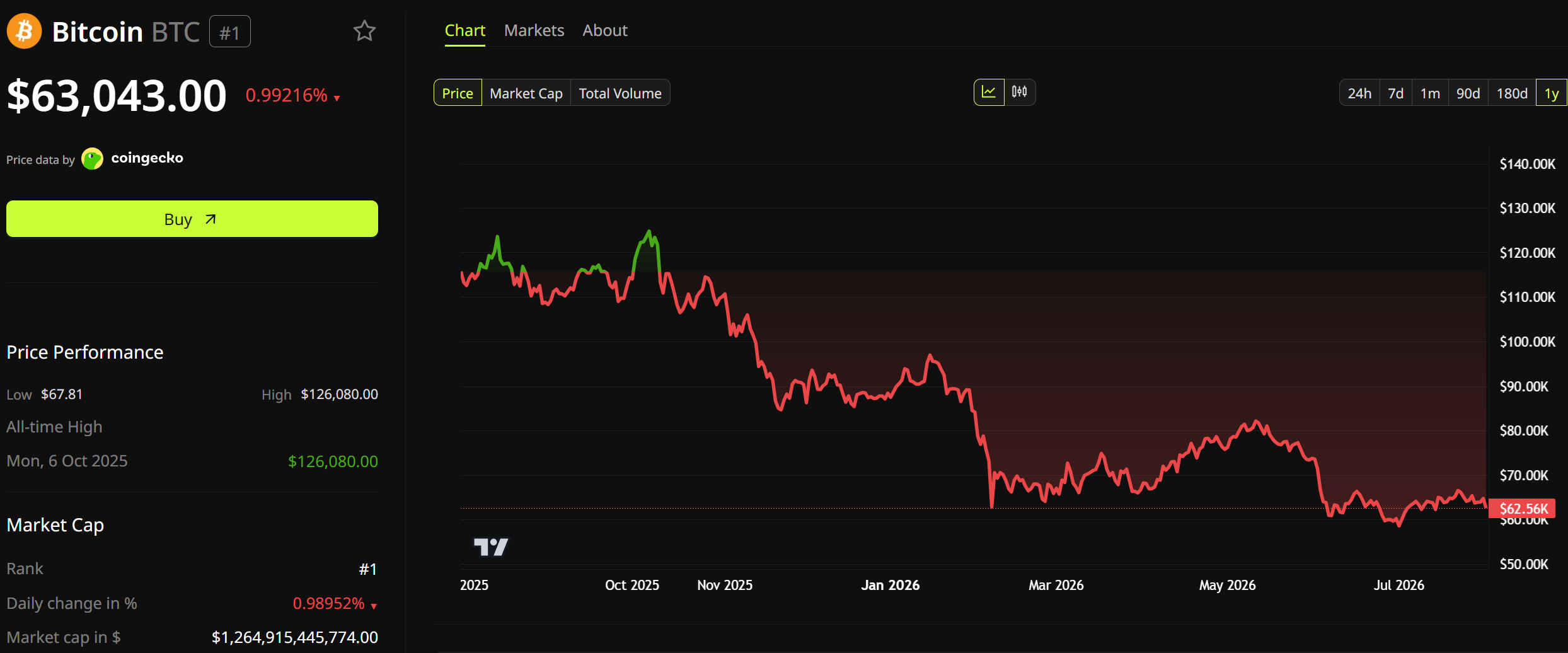
The numbers show why it is not going into crypto. Bitcoin (BTC) trades near $63,037. It is down 45% in a year. That is almost exactly half its October 6 record.

Chamath Is Buying Land, Not Chips
Meanwhile, the Social Capital founder Chamath Palihapitiya, a venture capitalist, entrepreneur, and investor, buys three things at once. Land, a power connection, and an empty building to hold the computers.
“LPS (Land Power Shell) is still the most obvious and fastest path to cash on cash returns,” Palihapitiya wrote.
Palihapitiya is a former senior executive at Facebook (now Meta), a renowned SPAC sponsor, and former minority owner of the Golden State Warriors.
His reason is simple. Towns keep blocking data centers. Every site that already has power gets rarer.
The numbers back him. Data Center Watch counted at least 75 US projects blocked or delayed in early 2026, worth about $130 billion.It was the worst quarter on record. Opposition groups doubled and now operate in 49 states.
Politicians joined in. More than 300 state data center bills were filed in six weeks. Maine missed becoming the first state to ban them outright by one House vote.
Why He Quit the Chip Business
He says he helped start Groq in 2016. Nvidia licensed Groq’s technology last December. The deal was not exclusive. Groq founder Jonathan Ross moved to Nvidia.
Neither company gave a price, but Palihapitiya says $20 billion. Still, he would not do it again as chips have to run too fast, factories have to be too exact, and a startup cannot get enough memory.
How Much Power He Has Bought
Palihapitiya says he and his partner Anita Vlallian have acquired almost six gigawatts (GW). It arrives in stages through 2029.
One deal shows the going rate. Nasdaq-listed TeraWulf used to mine Bitcoin. In July it leased a 401-megawatt site in Hawesville, Kentucky, to Anthropic. The lease runs 20 years and should bring in about $19 billion.
Here is the part that proves his point. That site is not built yet. Power starts flowing in late 2027 and reaches full load in early 2028.
The money is committed anyway. Palihapitiya holds roughly 15 times that much capacity. His is not leased out yet, so the figure shows the size of his bet, not its value.
However, miners got there first, and already own cheap power, land with grid hookups, and empty sheds. Coinbase chief executive Brian Armstrong disputed the mining warning in July.
What Could Go Wrong
Jordi Visser of 22V Research says easy money is over in AI. He expects about 30% a year now.
The land bet also needs the protests to keep coming. If towns start approving data centers again, the scarcity goes away.
TeraWulf’s $19 billion is a forecast too. Its own filing calls it expected revenue.
CZ is right. The money is out there. The question is whether it buys power lines or comes back to Bitcoin and crypto markets.
The post CZ Says Bear Market Money is Hunting, Social Capital Founder Says Skip AI Chips appeared first on BeInCrypto.
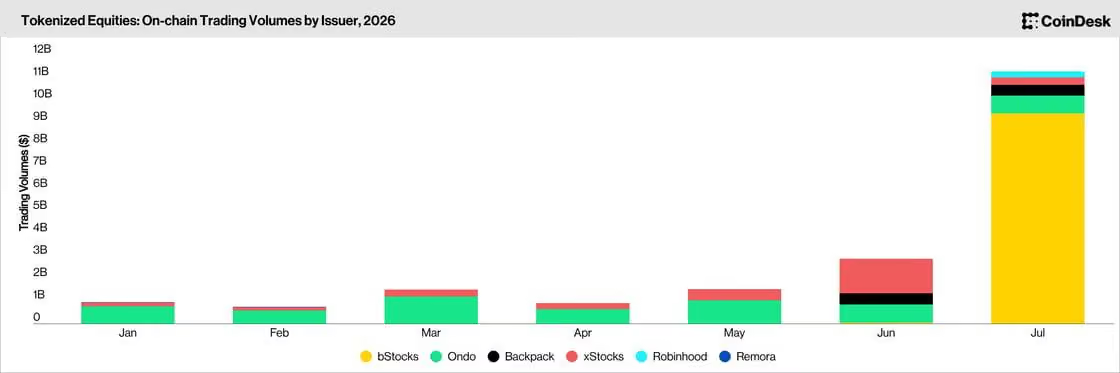
Trading volume for tokenized stocks and ETFs surged 288% to a record $11.3 billion in July, though most of the increase came from a single Binance-linked token.
Binance bStocks accounted for $9.41 billion, or 83.3% of the total, according to CoinDesk Data’s latest Stablecoins & Tokenized Assets report. A bStocks token, QQQB, tracking Invesco’s QQQ ETF, generated $9.27 billion alone, equivalent to roughly 82% of all tokenized-equity volume.

Excluding QQQB, July volume was roughly $2.03 billion, about 30% below the market’s implied June total of $2.91 billion. xStocks volume dropped to $335 million from $1.55 billion, while Ondo recorded $792 million and Backpack $479 million, the report details.
QQQB began trading on Binance on June 30 with zero maker fees through Aug. 31. Binance also began counting stocks and bStocks volume at three times its traded value for some users seeking higher VIP tiers on July 23, though the multiplier does not alter actual trading volume.
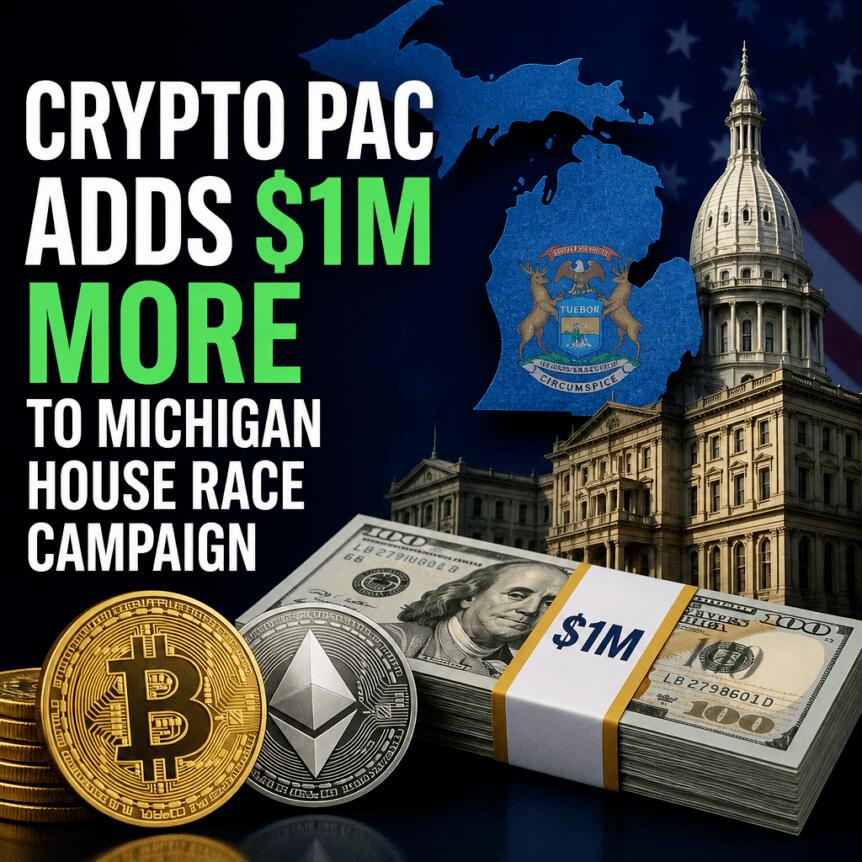
An affiliate committee of the crypto-focused Fairshake political operation has increased its ad spending ahead of next week’s primary election in Michigan’s 13th Congressional District, according to Federal Election Commission filings. The spending highlights how cryptocurrency companies continue to shape campaign activity through super PAC and affiliate structures as lawmakers consider major digital-asset policy.
As of Thursday, Protect Progress PAC reported spending more than $2 million on broadcast and digital media related to the Michigan Democratic primary between Rep. Shri Thanedar and challenger Donavan McKinney. The latest filing reflected a rapid acceleration from the amount the PAC reported just a week earlier, including nearly $884,240 in additional ad buys supporting Thanedar and more than $150,000 aimed at opposing McKinney.
Key takeaways
- Protect Progress PAC reported over $2 million in media spending tied to Michigan’s 13th District Democratic primary, based on FEC filings as of Thursday.
- New filings nearly doubled prior reported spend, adding $884,240 for Thanedar and more than $150,000 to oppose McKinney.
- The spending is connected to crypto-aligned political groups, with Protect Progress described as an affiliate of Fairshake.
- Thanedar’s record includes crypto-related legislative actions, including support for stablecoin and digital asset market structure proposals.
- Fairshake affiliates are active in multiple primaries, including races in Washington and Alabama ahead of their own election dates.
Michigan primary: Protect Progress ramps up ad buys
FEC documents show Protect Progress PAC has concentrated its spending on one of the most closely watched parts of this election cycle for crypto industry-aligned political efforts: candidate positioning around digital-asset legislation. In Michigan’s 13th district, the committee’s ad spending is designed to back incumbent Rep. Shri Thanedar while targeting his Democratic primary opponent, Donavan McKinney.
The latest filing effectively widened the committee’s footprint compared with what it had reported in an earlier submission. It added $884,240 in media expenditures supporting Thanedar and more than $150,000 opposing McKinney, bringing total reported media spend to over $2 million.
FEC filings are available through the committee’s FEC record: FEC document inquiry.
Why Thanedar’s crypto record mattered to the PAC
Protect Progress’s focus on Thanedar aligns with the incumbent’s legislative record on digital-asset issues. During his time in the U.S. House, Thanedar voted in favor of stablecoin-focused legislation known as the GENIUS Act. He also voted in favor of a crypto market structure proposal currently under consideration in the Senate, the Digital Asset Market Clarity (CLARITY) Act.
In addition, Thanedar cosponsored the Promoting Innovation in Blockchain Development Act, an effort aimed at protecting blockchain developers. For PAC-affiliated political spending, these votes and sponsorships are often treated as concrete signals of candidate alignment—especially as CLARITY work advances through Congress.
McKinney’s campaign challenged the premise that the race is driven solely by local issues. In a July 21 statement related to the PAC’s spending, McKinney argued that “the crypto lobby is paying my opponent back” for his support of policy decisions tied to the Trump administration.
McKinney also referenced President Donald Trump’s disclosures that he earned more than $1.4 billion from crypto investments in 2025, including through his memecoin, Official Trump (TRUMP), and via his family’s business, World Liberty Financial. Democrats have frequently accused the Trump administration of profiting from its position through laws affecting the crypto sector, including proposals like GENIUS. (Those claims are linked in the original reporting to Trump’s disclosed earnings and related coverage.)
Fairshake affiliates keep spending across the election map
Protect Progress is described as an affiliate of the Fairshake PAC. Fairshake and related committees have been a major force in U.S. federal elections in recent cycles, channeling large sums toward candidates seen as supportive of crypto-industry aligned policy.
Earlier reporting cited that Fairshake was responsible for more than $170 million in spending during the 2024 election cycle through media supporting candidates it viewed as favorable to crypto policy. The same reporting framework also noted that Protect Progress and other affiliates had already directed millions of dollars into 2026 races in multiple states.
More broadly, the consumer advocacy group Public Citizen reported in June that Fairshake and its affiliates accounted for spending of more than $82 million out of roughly $189 million that crypto companies used across the 2026 election cycle. Public Citizen also reported Fairshake’s claimed war chest of $193 million as of January, underscoring the scale of activity behind affiliate PAC machinery.
More primaries: Washington and Alabama spotlight additional spending
While Michigan remains a focal point, other Fairshake affiliates have also targeted races as primaries approach. In Washington’s 4th congressional district, the Fairshake affiliate Defend American Jobs PAC spent more than $65,000 on media to support a Republican candidate. Washington’s primary is scheduled for the same day as Michigan’s.
Alabama’s primary, set for Aug. 11, has similarly attracted attention from Fairshake affiliates. FEC filings indicate Defend American Jobs spent more than $511,000 on media supporting Jerry Carl Jr., a Republican who served in Alabama’s 1st congressional district from 2021 to 2025.
One additional datapoint in the reporting around the Alabama race is the scale of the candidate’s personal wealth. The original article referenced a reported net worth figure of up to $15 million in 2023, citing a separate local report.
What to watch next in crypto-linked elections
As PAC affiliate spending continues to surge in primary contests, voters and market participants will likely watch whether crypto-aligned policy commitments translate into measurable legislative momentum—particularly on stablecoin and market-structure proposals such as GENIUS and CLARITY. The next FEC disclosures may clarify how much more media time these committees add as voting dates approach.
It was precisely six years ago when a rather unknown company in the cryptocurrency industry at the time made a revolutionary change to its asset reserve strategy and adopted Bitcoin. The entity in question, called MicroStrategy back then, started to accumulate BTC en masse and only accelerated its purchases after the 2024 presidential elections in the US.
The community became accustomed to hearing about new acquisitions made by the company, some of which were worth billions of dollars. Its total stash grew exponentially and currently sits at 843,775 units. Within this timeframe, BTC bulls consistently heard that the company (and its former CEO) would never sell… until they did. And then everything changed.
During the most recent earnings call, the company hinted that it has plans to sell up to $5 billion in bitcoin, which is significantly higher than the previously claimed $1.25 billion.
The Latest Shift
Strategy (as it is called now) has gone five consecutive weeks without purchasing BTC, marking its longest acquisition pause in years. Instead of deploying capital into BTC, the firm has steadily increased its cash reserve through recent fundraising activities. As we previously reported, Strategy has been rebuilding its USD position while continuing to explore financial options tied to its expanding portfolio of preferred stock offerings.
In the most recent official change, CEO Phong Le took to X to announce the company’s new primary corporate objective, which reads:
“Our corporate objective is for STRC to trade at $99-$100 over time.”
In the earnings call, he was more specific:
“Our intent is to sell bitcoin for three reasons when we think it’s appropriate for the company. One, fund the U.S. dollar reserve up to $1.25 billion. Additional reasons include funding dividend and interest payments of $1.76 billion a year and funding up to $2 billion in common and preferred stock repurchases,” Le said, according to a FactSet transcript.
The tweet and comments garnered immediate reactions from some well-known industry commentators as well as constant critic Peter Schiff, who was quick to determine that: “In other words, common shareholders are screwed.”
Crypto Kaleo, though, a popular analyst who recently argued that Strategy would have to sell at least 50,000 BTC in the next couple of years to fund dividend payments, wasn’t so kind. In one tweet, he ironically asked whether the CEO remembers when the company’s primary corporate objective was to increase Bitcoin per share before adding: “It was only two months ago, so shouldn’t be difficult!”
In another post, though, he brought the bashing to a higher level, claiming that Strategy is no longer a BTC company. Instead, it operates as a credit company, and its credit rating is “atrocious.”
Strategy went from having a primary objective of increasing Bitcoin per share to trying to make sure their preferred shares trade back to $100… in just two months.
They’re no longer a BTC company.
They’re a credit company.
And their credit rating is atrocious. https://t.co/fHoXr376QY
— K A L E O (@CryptoKaleo) July 31, 2026
The comments below his post were split. Some agreed that Strategy is increasingly resembling a leveraged financial organization rather than a straightforward BTC holding company. Others defended the firm’s approach, noting that maintaining confidence in STRC is essential if Strategy wants to continue raising capital efficiently and safely for future crypto purchases.
STRC Matters
The Saylor-co-founded company launched STRC as part of its growing suite of preferred stock offerings designed to finance its long-term BTC accumulation strategy. However, it needs to trade at its par price of $100 to function properly, and it hasn’t been able to for months. It dumped below $75 at one point, before the company shifted its focus to rebuilding its USD reserve. It has since recovered to almost $90.
As such, some investors view Le’s comments as a tactical, short-term objective rather than believing Strategy has abandoned its Bitcoin-focused vision. Still, the timing has fueled questions about the firm’s evolving identity and strategy, especially given the ongoing market uncertainty.
The post Analyst Blasts Strategy After CEO Signals New Priority Beyond Bitcoin appeared first on CryptoPotato.
The U.S. Securities and Exchange Commission (SEC) has paused Nasdaq’s approval of cash-settled bitcoin index options and will reconsider the decision following a legal challenge from CME Group, the agency said in an order released for public inspection on July 31.
Back in May, the SEC granted Nasdaq PHLX conditional approval to list cash-settled bitcoin index options under the ticker QBTC. The product still required exemptions from the Commodity Futures Trading Commission (CFTC) before it could launch.
CME Group challenged the approval in June, arguing that bitcoin is a commodity and, as such, options tied directly to its value fall under the CFTC’s exclusive jurisdiction rather than the SEC’s.
If the CME is right, the SEC would have no authority to approve QBTC, and Nasdaq would need to register as a CFTC-regulated futures or swaps venue, or redesign the contracts to track a security such as a spot bitcoin exchange-traded fund.
The CME already operates regulated bitcoin futures and options markets, while Nasdaq’s QBTC would compete for the same trading activity without Nasdaq registering under the CFTC framework that governs the CME.
Crypto World
Bitcoin mining difficulty shrinks 14% from this year’s high as plunging revenues force operators to pivot
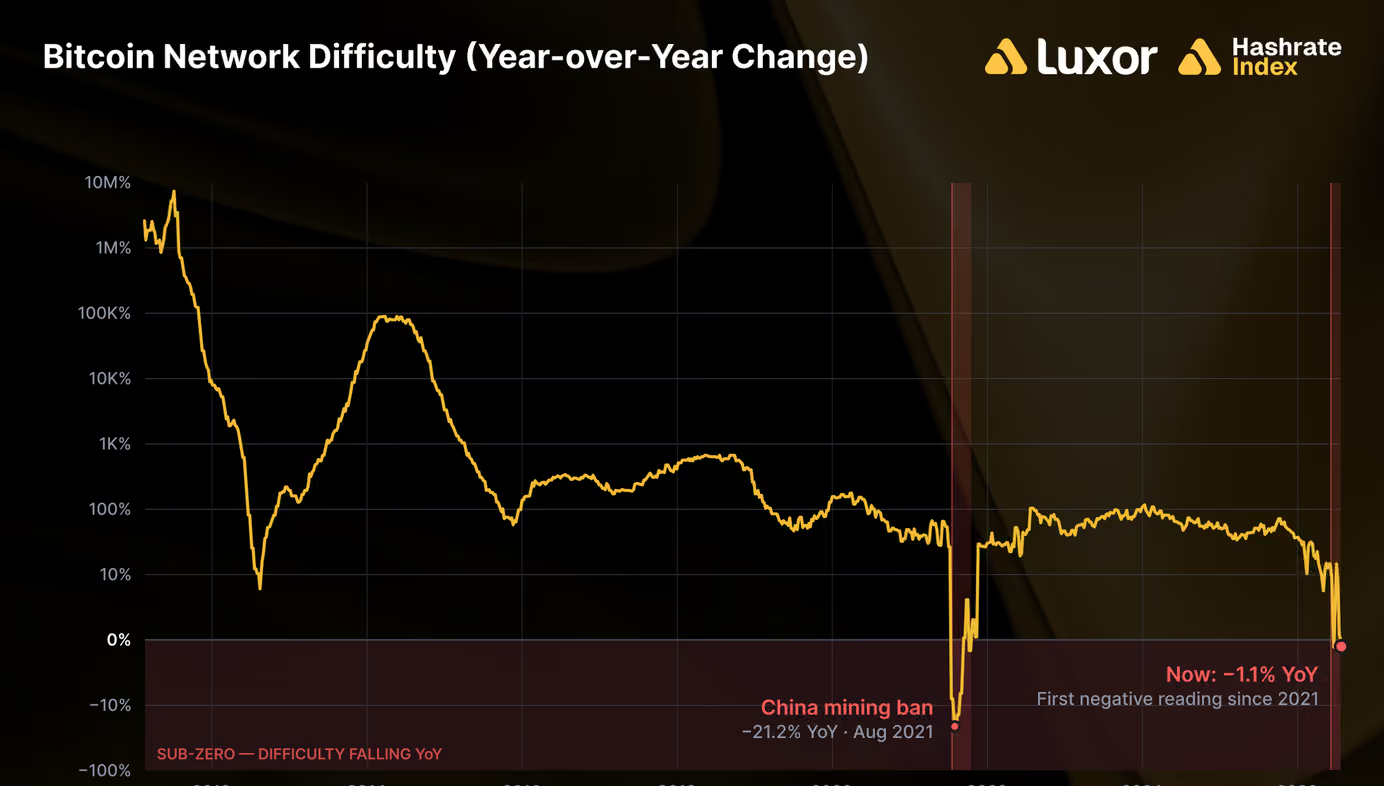
Bitcoin’s mining difficulty has fallen below its year-earlier level for only the second time in the network’s history as weak mining economics and the shift toward artificial intelligence weigh on capacity growth.
The metric, which measures how difficult it is to mine a Bitcoin block, is now at 126.23 trillion after falling 0.74%, about 1.1% below the 127.62 trillion reached a year earlier and 19.1% from the 155.97 trillion all-time high seen in November 2025.
Difficulty adjusts every 2,016 blocks, or roughly every two weeks, to keep Bitcoin’s average block time near 10 minutes. Falling difficulty indicates that less computing power was competing during the previous adjustment period, while reducing competition for miners that remain online.
The metric has dropped about 14% from its January peak, reached this year, following declines of 10% in June and 5% earlier in July, according to network data.
The only previous year-over-year decline was after China’s 2021 mining ban, which temporarily removed roughly half of the network’s computing power. Difficulty recovered as miners relocated to other regions.

This time around, the plunge is more mining economics-based.

FIFA’s Infantino Scraps World Cup Investment Plan. But Is It Too Little, Too Late?
Where are MTV’s most famous VJs now? See the hosts, then and now

Report: Pirates acquire RHP Camilo Doval from Yankees


-
 Sports6 days ago
Commonwealth Games boxing: Jadumani Singh seals dominant 5-0 win over Pakistan’s Sumama Rehman to enter quarter-finals | Commonwealth Games News
-

 Business3 days ago
Why Trees Belong on the Risk Register
-

 Fashion1 day ago
Weekend Open Thread: Wit & Wisdom
-

 Tech6 days ago
Intel is reversing course and bringing hyper-threading back to its server chips
-

 Politics22 hours ago
Meta enters AI-training agreement with far-right ‘propaganda rag’ Newsmax
-

 Politics5 days ago
Luke Littler dismantles Gerwyn Price to retain title in Blackpool
-

 Crypto World4 hours ago
MicroStrategy Post-Earnings CLARITY Act Push Could Add New Catalyst for Its Stock
-

 Politics4 days ago
The Part of the Electric Transition Nobody Wants to Discuss
-

 News Videos6 days ago
BITCOIN JUST ENTERED THIS CRITICAL ZONE…
-
 Entertainment4 days ago
‘Stargate’ Creator’s New Sci-Fi Series Returns for Season 3 Tomorrow
-

 Business4 days ago
Major shareholder moves on Canyon
-

 Crypto World6 days ago
XRP Ledger adds $2.6B as RWA inflows rank second
-

 Politics6 days ago
Spain sweeps the board at 2026 World Cup with individual awards
-

 News Videos2 days ago
Bitcoin Enters the 3rd Stage of the Bear Market
-
Crypto World13 hours ago
XRP Ledger v3.3.0 brings five institutional features
-

 Entertainment7 days ago
Sara Gilson Killed By Husband After Viral “Pedophile” TikTok Video
-

 Crypto World4 days ago
Kraken Enables Retail Access to Jersey Mike’s IPO via Tokenized Shares
-

 Tech5 days ago
New macOS Sequoia & Sonoma security updates for older Macs
-

 News Videos4 days ago
Claude: Build Financial Dashboards in Minutes (2026)
-

 Politics2 days ago
Luke Littler’s dominance sparks GOAT debate
You must be logged in to post a comment Login